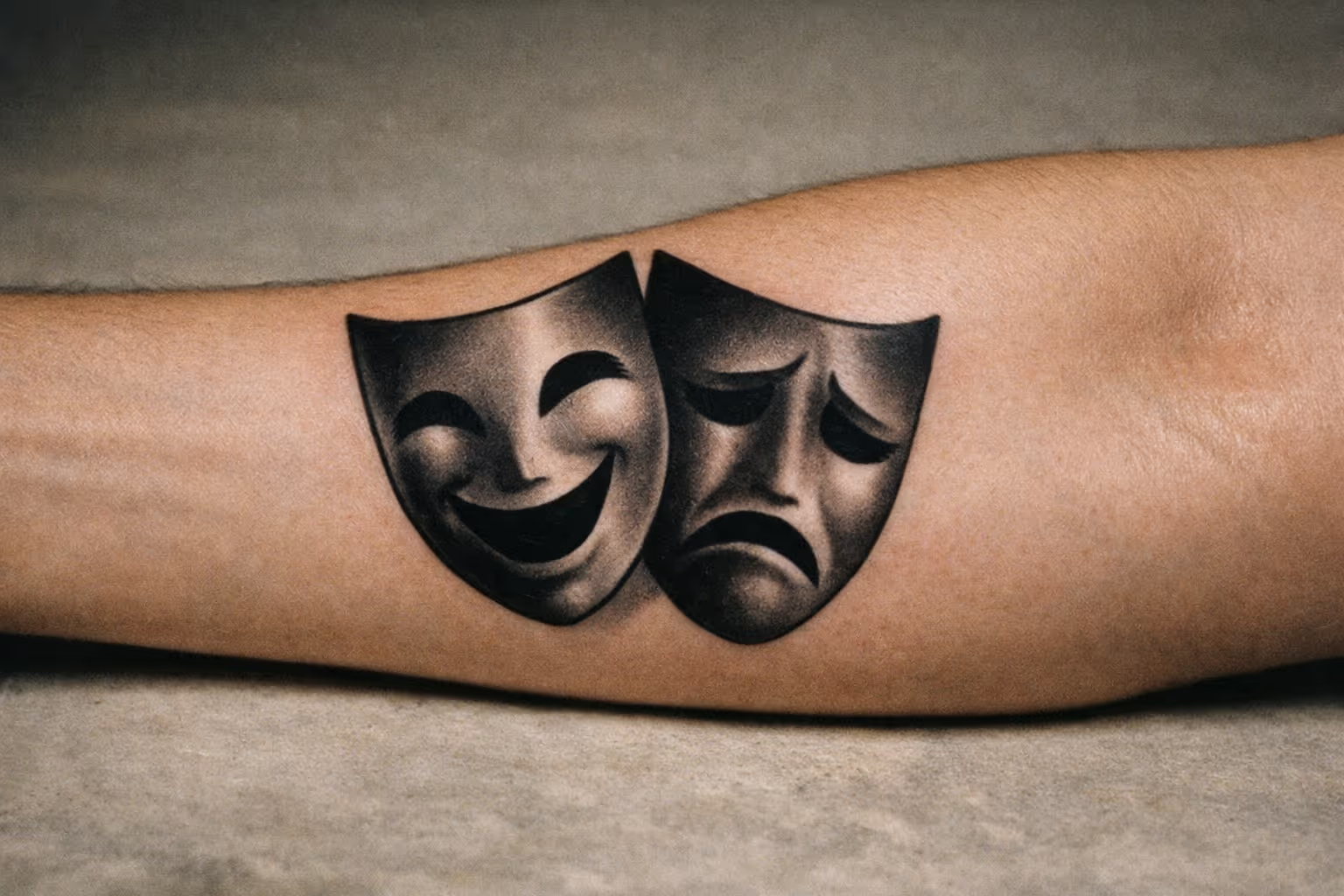
A laugh now cry later tattoo has a hard size floor most people ignore: below about three inches, the two masks lose their expressions and blur into vague faces. It also needs flat skin and healed black-and-grey shading to keep that theatrical contrast crisp - put it over a curve or rush the shading and the whole grin-and-grimace effect collapses. Here’s the meaning behind the masks, the placements that stay sharp, and the sizing that protects the detail.
What the Laugh Now Cry Later Tattoo Actually Means
At its core, this tattoo is about duality: joy and pain existing side by side (2)(4). The public face versus the private feeling. Success alongside struggle. One mask is grinning, the other is crying, and the wearer carries both because life deals both hands.
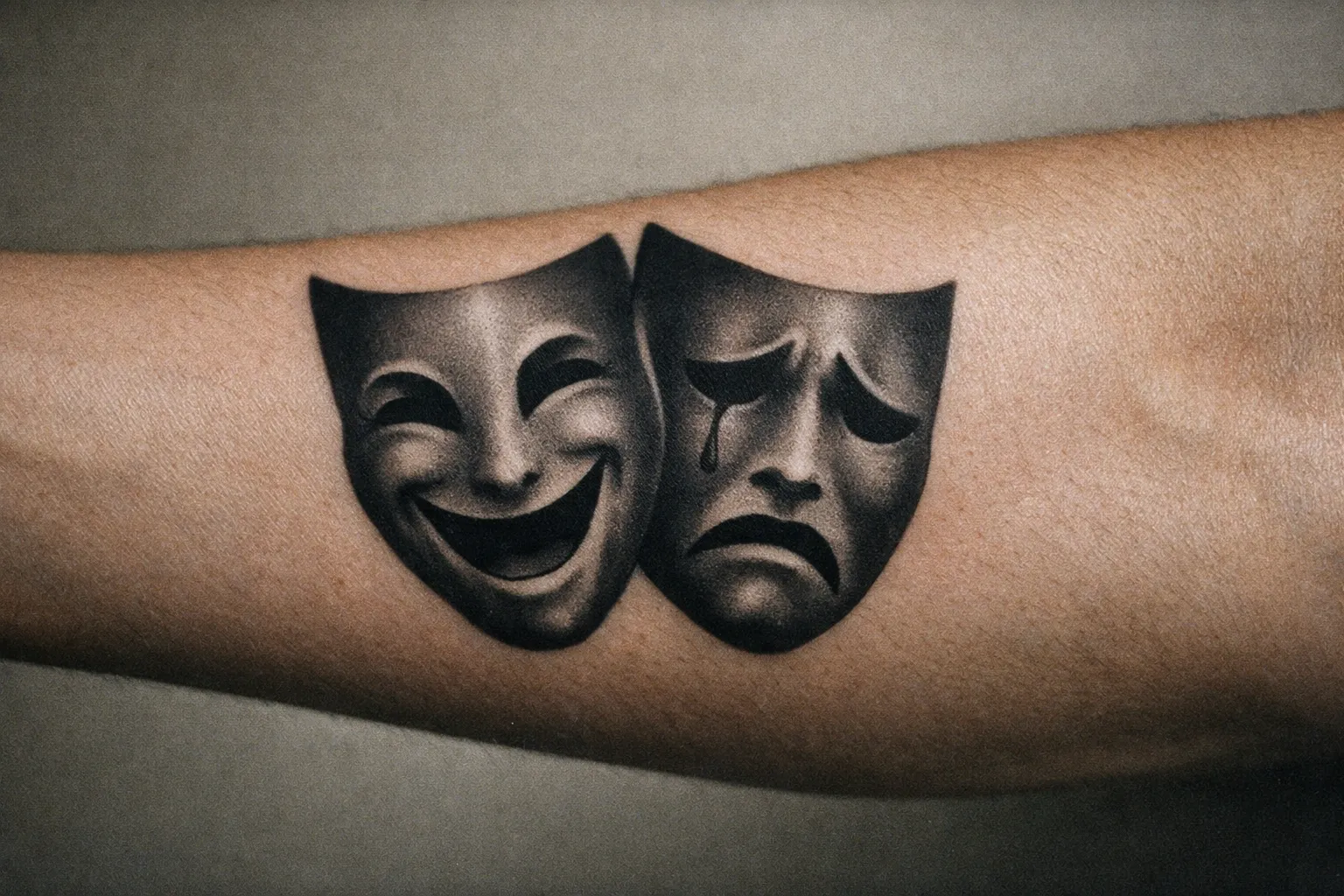
This motif borrows heavily from theater. The smiling and crying masks go back to Greek drama, where actors used exaggerated expressions to project emotion across huge stone amphitheaters - comedy on one side, tragedy on the other. It’s the same pair behind the 🎭 emoji, which stands for the performing arts and the comedy/tragedy contrast. So a laugh now cry later tattoo is basically that emoji’s older, more personal cousin. The masks themselves are named Thalia (comedy) and Melpomene (tragedy) in classical tradition - a detail worth knowing if you want to add a banner with the names, which some Chicano-influenced pieces do.
Some people see it as resilience - laughing even when things get tough (2). Others take it as a warning: enjoy the good times now because the bill comes due later. There’s no one fixed meaning, which is fine. Pick what fits you, and tell your artist, because that will affect which mask you want to stand out more.
A quick note on origins: the phrase got a boost in modern culture through hip-hop - Ice Cube’s Laugh Now, Cry Later album (2006) helped spread it to a mainstream audience, though he didn’t invent the idea (3). The related “Smile Now, Cry Later” phrase comes from Chicano tattoo culture, with artists like Freddy Negrete central to that black-and-grey style - Negrete is widely credited as one of the originators of the fine-line black-and-grey technique that defines the classic version of this design (5). That lineage matters: the style isn’t just aesthetic, it carries a specific craft tradition rooted in East Los Angeles tattooing from the 1970s onward.
Cultural Roots and the Gangster Laugh Now Cry Later Tattoo
This design has deep roots in Chicano and prison tattoo culture, especially when done in black-and-grey with smooth shading (5). That’s where the gangster laugh Now Cry later tattoo label comes from - but that’s more about style than a strict category. Plenty of people get this design with zero gang ties because the duality theme resonates on its own.
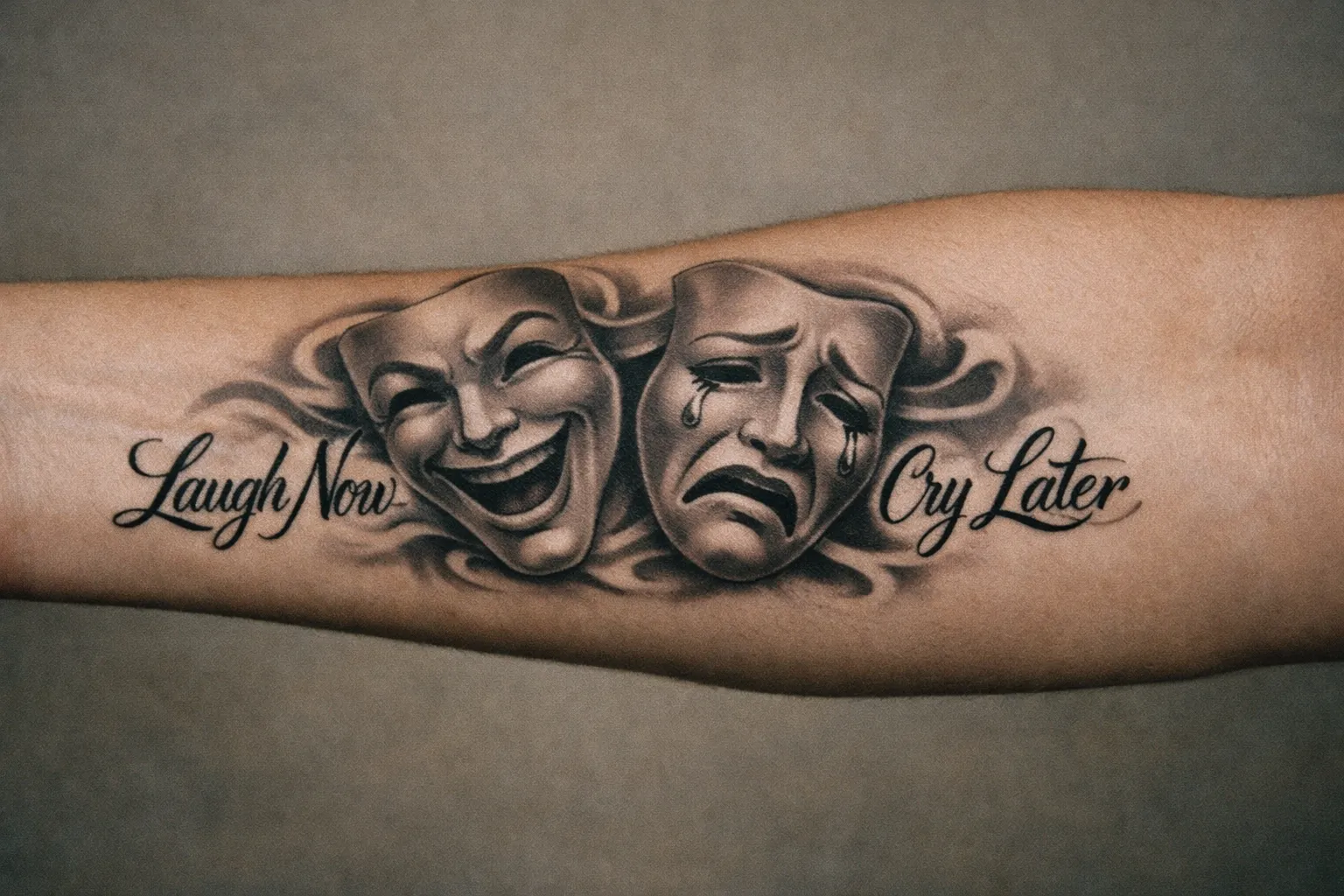
Here’s the blunt truth: the “gangster” look mostly comes down to how it’s done. Bold black-and-grey, high contrast, ornamental script, and extras like roses, dice, prayer hands, or clocks (5). You can get all that aesthetic without claiming any street affiliation - lean on the script, roses, and shading, and it reads as classic rather than a gang marker.
Treating the tattoo as only a gangster symbol flattens it. The sources consistently describe broader themes - duality, resilience, tragedy, emotional balance (2)(3)(4) - and recent takes frame it more as a personal emotional symbol than a one-note street motif (3)(4). Tattoodo’s 2023 trend data shows the design appearing far more often in personal memorial and emotional-duality contexts than in any street-affiliated category, which tracks with how the motif has migrated from its Chicano origins into mainstream black-and-grey work over the past two decades.
Design Variations: Minimalist vs. Gangster vs. Realism
You can run the same two masks in very different styles, and your choice here will affect your budget, session time, and how the tattoo ages.
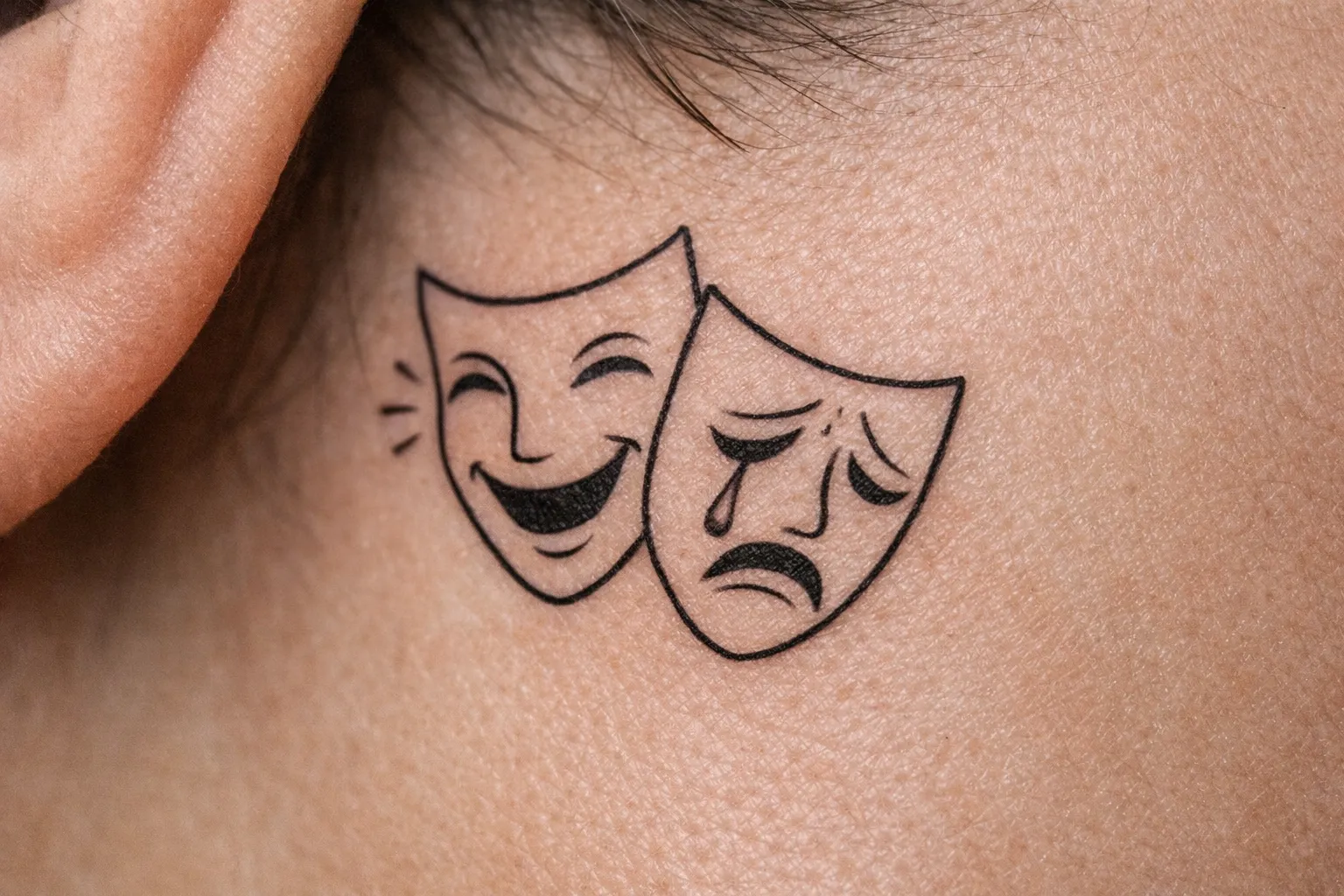
Minimalist / fine-line version. Think small outlines of the masks, minimal internal details, often done with single-needle or light shading. This is the cheapest and quickest route. Great if you want the symbol without committing to a big piece. But don’t go smaller than about 3 inches - at tiny sizes, the expressions just collapse.
Traditional Chicano / gangster version. Bold black-and-grey, high contrast, smooth gradients, often combined with script, roses, or a banner (5). This is the iconic look. It demands an artist who can handle clean facial anatomy and controlled shading - if the contrast is weak, the masks blur into each other.
Realism version. Detailed masks with tear tracks, wrinkles, and dramatic light-to-dark shading. The most demanding and expensive. Reserve this for larger spots like the upper arm, chest, calf, or thigh, and only with an experienced black-and-grey artist. On smaller or curved areas, it’ll blur and mud within a few years.
A phrase-only version - just the “laugh now, cry later” lettering without masks - is cheaper and faster but far less visually interesting. If you go this route, hire a specialist in script - bad lettering ages worse than almost any other style.
What a Good Stencil for This Design Should Include
A solid laugh Now Cry later tattoo stencil is your first line of defense against a muddled final piece. Since the whole design hinges on the contrast between two faces, the stencil has to nail that readability.
Check these on your stencil:
- Clear separation between the masks. The laughing mask and crying mask need distinct expressions that hold up at your chosen size. If they look like two similar faces, the meaning evaporates.
- Symmetry, if the masks are mirrored or stacked. Stencil planning matters most here - a crooked look is painfully obvious on symmetrical layouts.
- Spacing on fine details. Eyes, mouth corners, and tear lines should be at least 2-3 mm apart so they don’t bleed together as the tattoo settles.
- Emotional staging. A good trick: place the laughing mask a bit higher and the crying mask lower or darker. It boosts the contrast visually before you even read the faces.
Always get a stencil placement photo before the needle hits skin. That’s your last chance to catch crooked eyes, mouths, or tear tracks. If you’re going realism, ask for a black-and-grey value study - value contrast does more for clarity than line thickness here.
Drawing and Custom References
Custom work starts well before the session. A strong laugh Now Cry later tattoo drawing bridges the gap between a generic flash mask and something that reads as yours.
Bring 2-3 reference images, not just one. A single reference pushes your artist toward copying; a small set lets them build something that avoids the tired drama-mask cliché. References also help you communicate the style you want - minimalist outline, Chicano black-and-grey, or full realism - without relying on words alone.
If you want to add narrative depth, this is where you bring in extras: script across a banner, a rose for beauty alongside pain, a clock for time running out, a skull for mortality. Each addition bumps up cost and session time, so pick what means something to you instead of just filling space. A clean pair of masks reads stronger than a crowded design with five competing motifs.
Placement and Sizing That Keep the Masks Readable
Placement isn’t decoration. It’s about whether your tattoo still reads as a laugh now cry later tattoo years from now.
The best spots give you enough flat-ish surface to hold facial detail:
- Upper arm - classic for the Chicano style; plenty of room, ages well, minimal distortion.
- Forearm - good visibility, fits medium pieces, easy to expand later.
- Chest - bold and central; fits the duality theme over the heart, but the skin moves with every breath.
- Calf and thigh - large, flat canvases ideal for realism and bigger compositions.
Avoid curved, high-movement, or pinched areas like the wrist, side of the neck, hand, or fingers. Those spots distort facial features and fade faster. Expression depends on tiny details - pupils, mouth corners, tear lines - and those get crushed on moving joints.
Go at least 3-5 inches for your first laugh now cry later tattoo, and bigger if you’re doing realism. Smaller than that, and the eyes, mouth, and tears compress into vague faces instead of a clear laugh-and-cry pair. This is the most common mistake I see with this design.
Pain-wise: upper arm and forearm are on the easier side. Chest (especially near the sternum) and inner thigh hurt more - chest > forearm for most people. None of it’s unbearable, but if it’s your first, start with the arm.
What a Mask Piece Costs
Prices vary by artist, city, size, and style. Here’s a practical frame: most artists charge $150-$300 per hour, and a medium black-and-grey mask piece takes about 2-4 hours, so expect roughly $300-$1,200 before tip depending on reputation and market. For context, a comparable-complexity portrait tattoo from a specialist in the same tier typically runs in the same range - the mask design isn’t a bargain option just because it’s a known motif. According to pricing surveys published by Tattoodo and Byrdie, black-and-grey portrait work averages $400-$900 for a medium piece, putting the laugh now cry later mask squarely in the same bracket as a face portrait of similar size. Custom layout, added script, and roses each add roughly 30-60 minutes of session time, which compounds fast at hourly rates.
By tier:
- Budget / simplified linework: around $100-$250 in lower-cost areas, usually one session.
- Medium black-and-grey with shading: $300-$800, one or sometimes two sessions.
- Large custom realism or compositions with script, roses, or portraits: $800-$2,000+, often two sessions totaling 3-6 hours.
Budget for the deposit (applied to final price), session cost, and a tip. In U.S. tattoo culture, 15-20% tip is standard for good work. On a $500 tattoo, $50 is 10% - acceptable but modest; $75-$100 is more typical. (More on that below.)
Common Mistakes to Avoid
- Going too small. Masks lose expression when details compress. Stick to 3-5 inches or larger.
- Weak contrast. Without strong dark/light separation, the laughing and crying faces blur into generic faces. Black-and-grey is your friend here (2).
- Copying a stencil without checking proportions. Asymmetrical masks are glaring on symmetrical designs - always review the stencil photo.
- Assuming any artist can do this well. It’s about controlled shading, smooth gradients, and clean facial anatomy. Look at healed black-and-grey work in portfolios, not just fresh tattoos.
- Ignoring placement. Curved, high-movement areas distort the masks. Pick flatter, low-movement spots.
- Flattening the meaning. Reducing it to a “gangster symbol” ignores the wider themes of duality and resilience (2)(3)(4) - and the broader meaning usually makes it personal.
Aftercare for Black-and-Grey Mask Tattoos
Shaded black-and-grey work hangs on smooth gradients, and poor aftercare ruins those. Protect the contrast that makes the masks readable.
Day 1-3: Keep the bandage on as your artist says. After removal, wash gently with lukewarm water and fragrance-free antimicrobial soap, pat dry, and apply a thin layer of fragrance-free healing ointment or moisturizer. Expect some plasma and ink weeping early on - that’s normal.
Week 1: Switch to a thin layer of fragrance-free moisturizer two to three times daily. Don’t pick or scratch as scabs form and flake - lifting scabs on shaded gradients pulls ink and leaves patchy spots. Avoid pools, baths, and heavy sweating; soaking and sweat degrade fresh shading.
Week 2-4: The surface looks healed but the skin is still settling. Keep moisturizing and start strict sun protection - UV rays fade black-and-grey contrast fast. Once healed, use broad-spectrum SPF 30+ whenever it’s exposed, or cover with sun-protective clothing. Reapply sunscreen every two hours outdoors.
Two placement notes: on the chest, wear loose clothing during healing - tight shirts rubbing fresh shading blur lines and lift scabs early. On high-movement spots, hold off on heavy workouts until the flaking stage is over; sweat soaking into fresh ink invites infection and fades contrast.
Related Interests and Motifs
If the laugh now cry later tattoo clicks with you, some related designs tend to attract the same crowd:
- Theater / drama masks (🎭): the classic comedy-and-tragedy pair from Greek drama, without the “later” framing.
- Chicano black-and-grey: the broader style this tattoo lives in - smooth shading, fine script, roses, religious iconography (5).
- Script and lettering tattoos: phrase-only versions or banners paired with masks.
- Emotional-duality symbols: yin-yang, two-faced portraits, sun-and-moon pairings - different motifs, same idea of opposites held together.
- Memorial pieces: mask designs often mark someone lost, with the laughing side for memories and the crying side for absence.
These overlap with the laugh now cry later tattoo without repeating it. Useful if you’re building a larger black-and-grey sleeve and want the masks to fit into a clear theme. One practical note on sleeve planning: the masks work best as a focal anchor piece rather than a filler element - place them at the outer upper arm or center of the forearm where they get the most flat surface, then build supporting motifs (roses, script, clock) around them rather than crowding the masks themselves. Artists who specialize in Chicano black-and-grey sleeves typically plan the full layout before starting any single piece, which affects your first session’s stencil placement.
✓ Pros
- Strong symbolic duality between joy and pain resonates personally.
- Multiple style options from minimalist to realism suit different budgets and tastes.
- Classic placements like upper arm and forearm age well and preserve detail.
✗ Cons
- Small sizes and curved placements cause loss of expression and faster fading.
- Requires an experienced artist skilled in black-and-grey shading for clarity.
- Realism style demands larger size and higher cost, limiting placement choices.
Frequently Asked Questions
- Can the laugh now cry later tattoo be customized beyond the masks?
- Yes, adding elements like script banners, roses, clocks, or skulls can add personal meaning but increase cost and session time.
- Why is stencil placement photo important before tattooing?
- It lets you catch crooked features or spacing issues early, especially important for symmetrical or stacked mask layouts.
- How does the tattoo age on high-movement areas like wrists or fingers?
- The fine details blur and fade faster due to skin movement and distortion, making the expression unclear over time.
- Is the gangster style laugh now cry later tattoo always linked to gang affiliation?
- No, the style is aesthetic - bold black-and-grey shading and script - but many wear it purely for its emotional symbolism.
- What's the best way to tip my tattoo artist for this design?
- Standard tipping is 15-20% of the final price; more if the artist did custom work or complex shading.
- Can I get just the phrase 'laugh now cry later' without masks?
- Yes, phrase-only tattoos are cheaper and faster but less visually impactful; hire a script specialist to avoid poor lettering.
The Bottom Line
A laugh now cry later tattoo works when the contrast between the two masks stays clear - and that comes down to a few choices you make before the needle starts. Go big enough (3-5 inches minimum), pick a flat, low-movement spot like the upper arm or forearm, and pick an artist whose healed black-and-grey shading proves they can hold smooth gradients. Review the stencil photo for symmetry, bring 2-3 references, and decide what the masks mean to you so the right one gets the emphasis.
Then protect it: gentle washing and fragrance-free moisturizer for the first weeks, no picking, and strict SPF once it’s healed. The meaning is yours to set - duality, resilience, a reminder, a memorial - but the execution and aftercare are what keep both faces sharp years down the line.