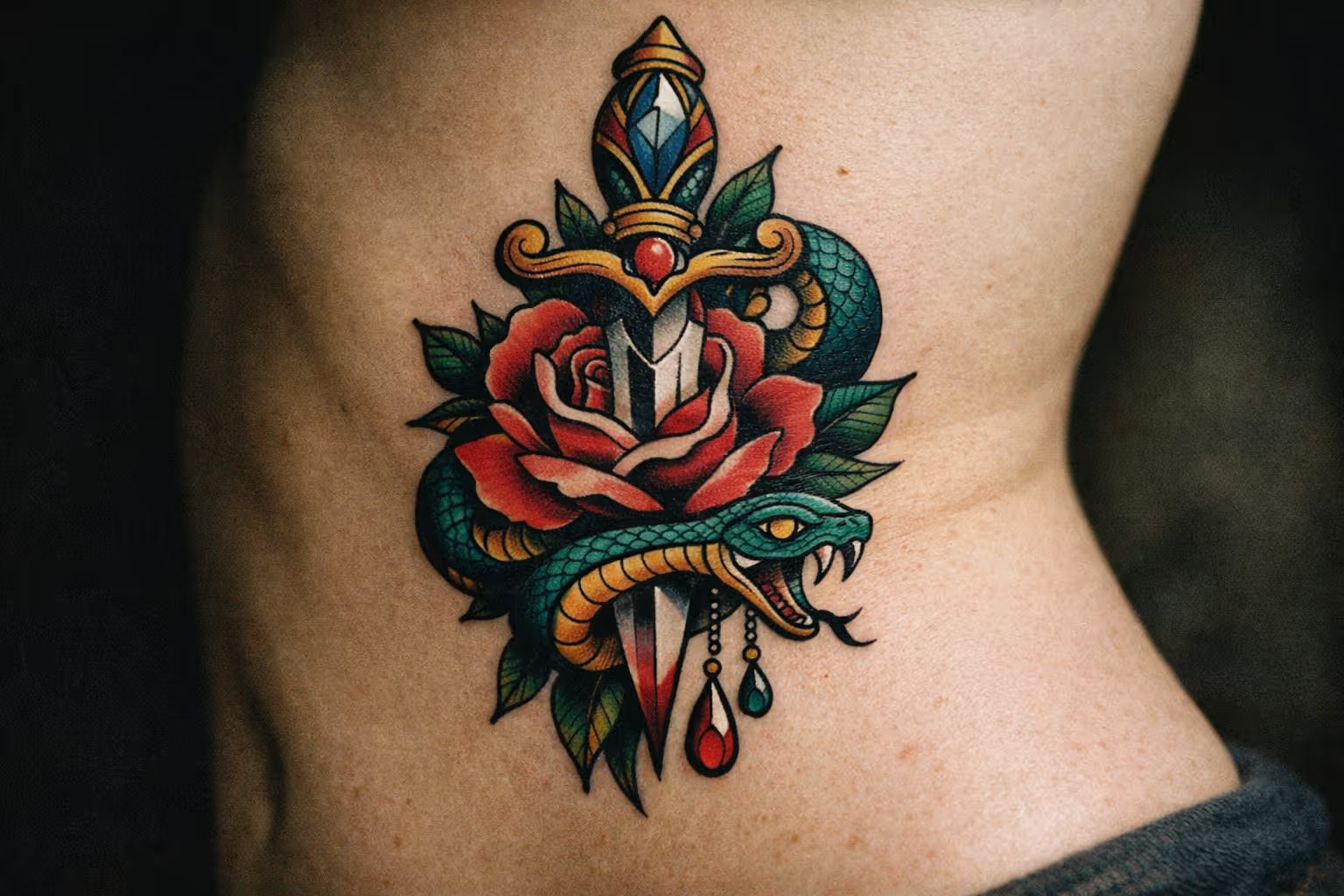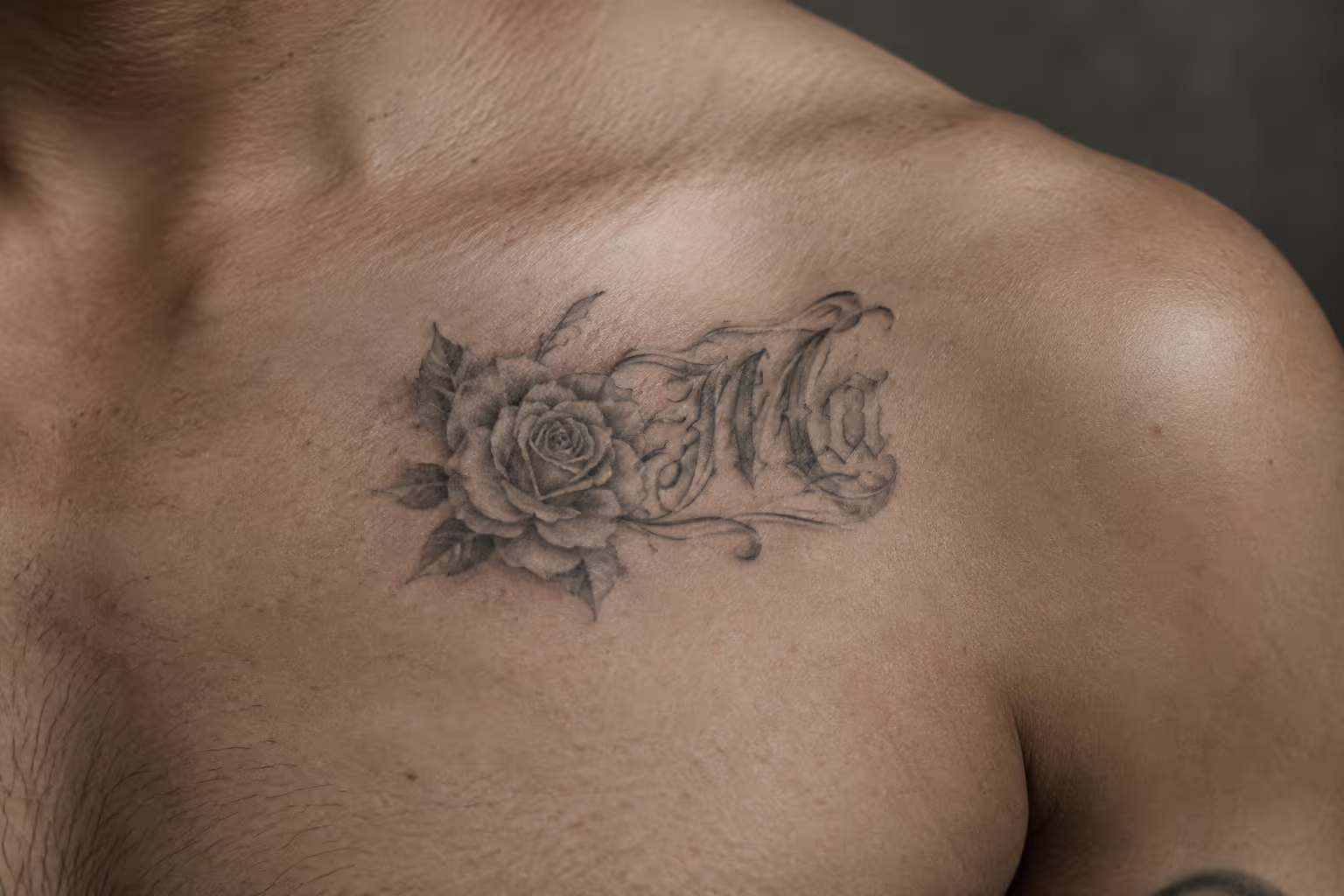
The fine, almost pencil-drawn grey shading in a Chicano tattoo started as a workaround. Inmates built single-needle machines from ballpoint pens, guitar strings and boom box parts because that was what they had (1). The look moved into a professional shop when Good Time Charlie’s Tattooland opened in East Los Angeles in the mid-1970s (1). If you’re planning one, the history explains the look. The motif, the lettering and the artist decide whether your piece holds up.
What Chicano Imagery Means, and Why There’s No Single Code
Chicano tattoo imagery has no fixed symbol dictionary. Each design takes its meaning from the subject chosen and the person wearing it. NPR’s account of the tradition shows the range (1):
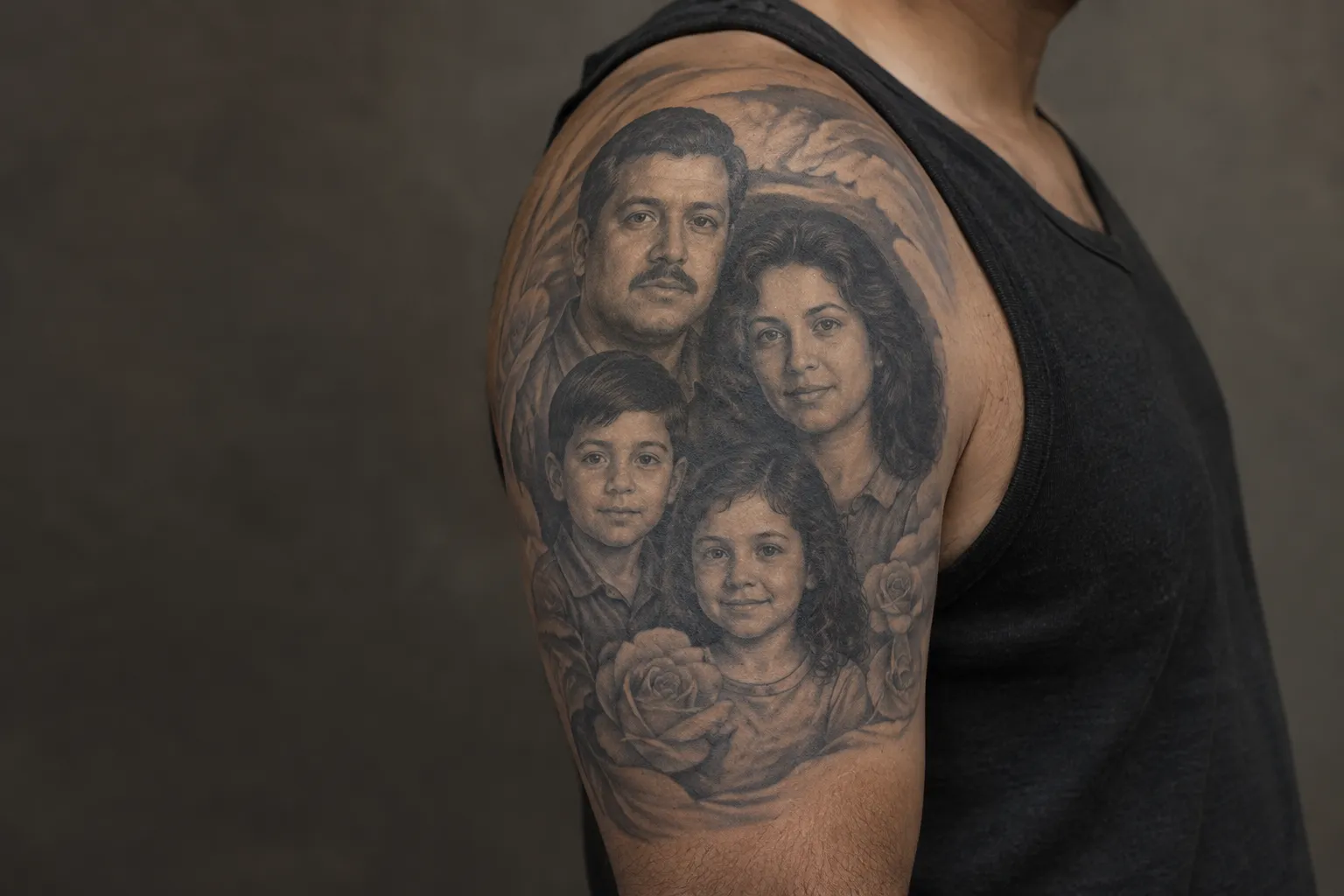
- a client’s portrait of his first-born daughter
- Chuey Quintanar’s rendition of Michelangelo’s Pietà
- Freddy Negrete’s Aztec, Mexican revolutionary and cholo imagery, which he described as “campfire stories” and cultural marks
That is family, Catholic devotion and cultural identity, all under one style. If someone tells you a rose or a clown “always means” one thing, they’re flattening it. Ask your artist what a motif means in the design and community you’re drawing from.
✓ Pros
- The black-and-grey palette lets portraits and layered scenes share one visual language.
- Personal references can sit alongside community history without forcing every motif to carry the same meaning.
- Open skin and graduated grey can create depth without relying on a broad color palette.
✗ Cons
- Subtle value changes are easy to lose when the design is reduced or the grey is packed too dark.
- Flourished lettering competes for space with portraits and symbols if the layout is not planned as a whole.
- A familiar motif can read as borrowed shorthand when its personal or cultural context is left unexplained.
Chicano Tattoo Style: From Prison Ink to Professional Art
The Chicano tattoo style developed in three phases. It began with improvised prison machines, moved to professional studios in East Los Angeles in the mid-1970s, and later earned museum recognition (1).
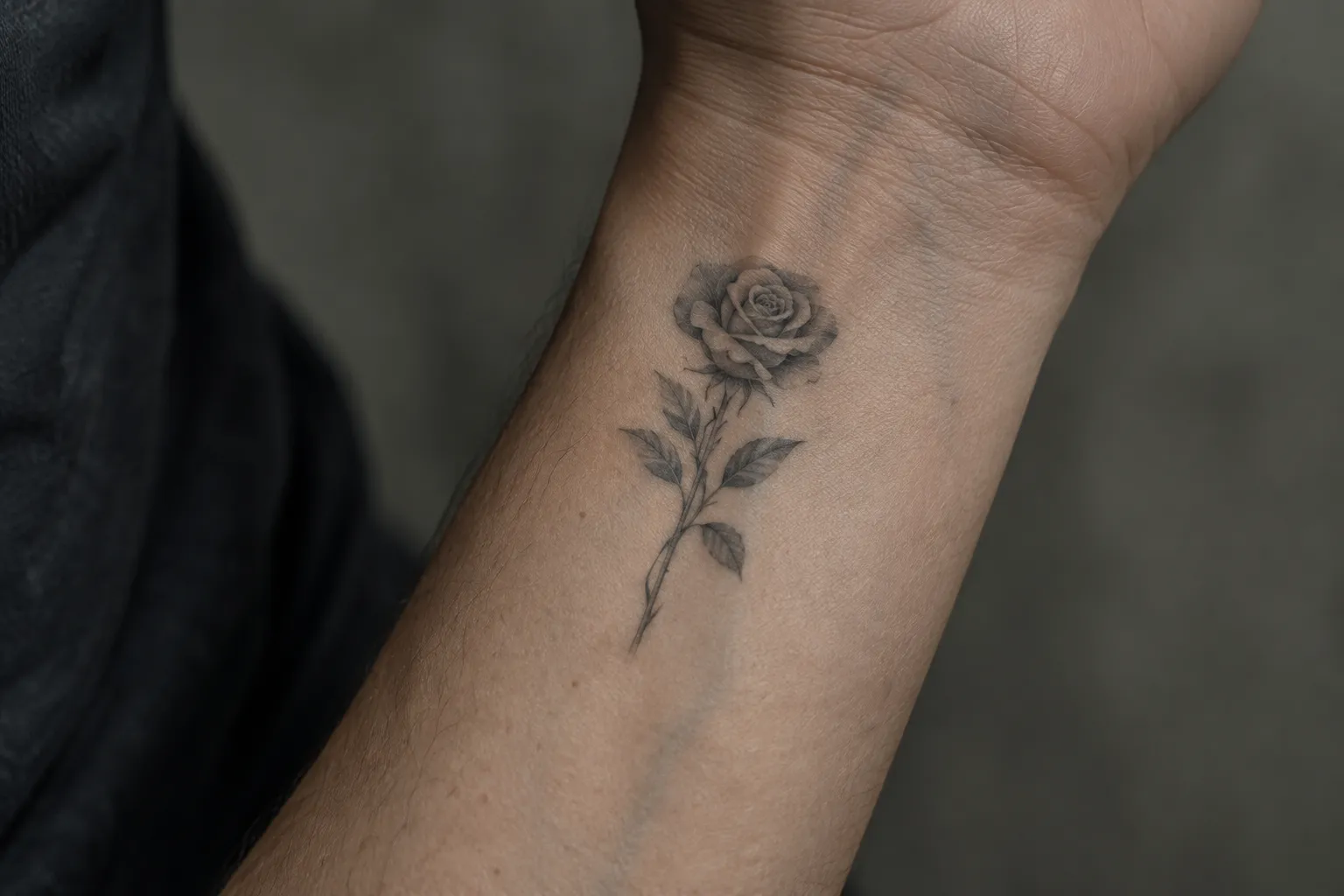
The style used to be called joint-style or prison-style. Machines ran on one needle because that was what an inmate could rig, and the limits of those tools shaped the fine-line look (1). The work then moved from penal institutions into the barrios of East Los Angeles, then into high-end shops around the world (1).
Good Time Charlie’s and the East LA Turning Point
Good Time Charlie’s Tattooland opened in East Los Angeles in the mid-1970s. Its primarily Mexican-American clients asked for tattoos in the style of “la pinta,” meaning prison (1). Freddy Negrete got a job there in 1977 (1). The shop’s owners changed their professional machines to run a single needle, which carried the prison look into a professional shop (1). NPR presents the shop as a turning point, not proof that one person invented the style.
The third phase is institutional. NPR’s April 15, 2018 account documents the style’s place in the Tattoo exhibition at the Natural History Museum of Los Angeles (1). The show traced the origins and evolution of tattooing, and Chicano black and grey was a significant part of it (1).
The Black-and-Grey Technique: Single Needles and Diluted Ink
Chicano black-and-grey technique rests on two hallmarks: single-needle or very tight fine linework, and black ink diluted into grey tones for subtle shading (1).
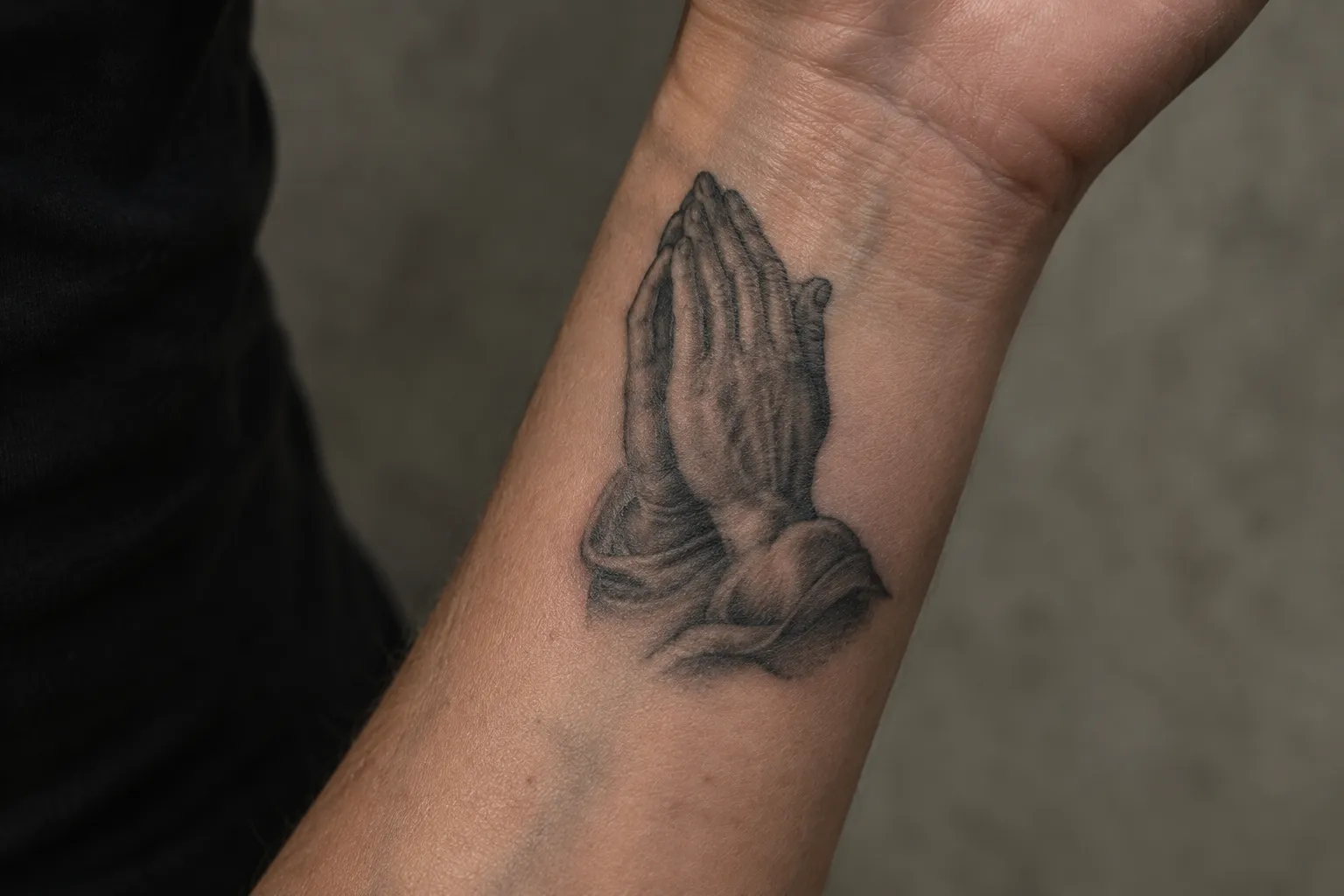
Hallmark one: fine line. The single needle produces thin, controlled lines that read like graphite rather than the heavy outline of American traditional. Kari Barba told NPR that single-needle black and grey was as close as you could get to drawing with a pen or pencil (1).
Hallmark two: grey wash. Watered-down black ink turns grey (1), and varying the dilution lets an artist build soft gradients from pale grey to solid shadow. Skin tones, rose petals and drapery on a Virgin of Guadalupe all depend on that gradient. Modern shops use pre-mixed grey wash sets, but the logic is the same.
The common pitfall is muddy grey. An artist who packs too many dark layers loses the contrast between highlight and shadow. The healed piece then reads as a grey smudge from across a room. Skilled work leaves open skin as the highlight. When you look at healed photos, check whether the brightest areas are still bright after a year or two. Fresh photos hide this.
Signature Motifs: Roses, Religion, Aztec Imagery and Portraits
Pick your Chicano motif by what you want the tattoo to communicate, not as interchangeable decoration. NPR’s documented examples make the choice concrete: a client had Quintanar tattoo a portrait of his first-born daughter, Negrete drew the comedy and tragedy masks with ornate lettering reading “smile now, cry later,” and Negrete called his Aztec, Mexican revolutionary and cholo imagery “the marks of our culture” (1). Match your subject to the story you actually want the piece to tell.
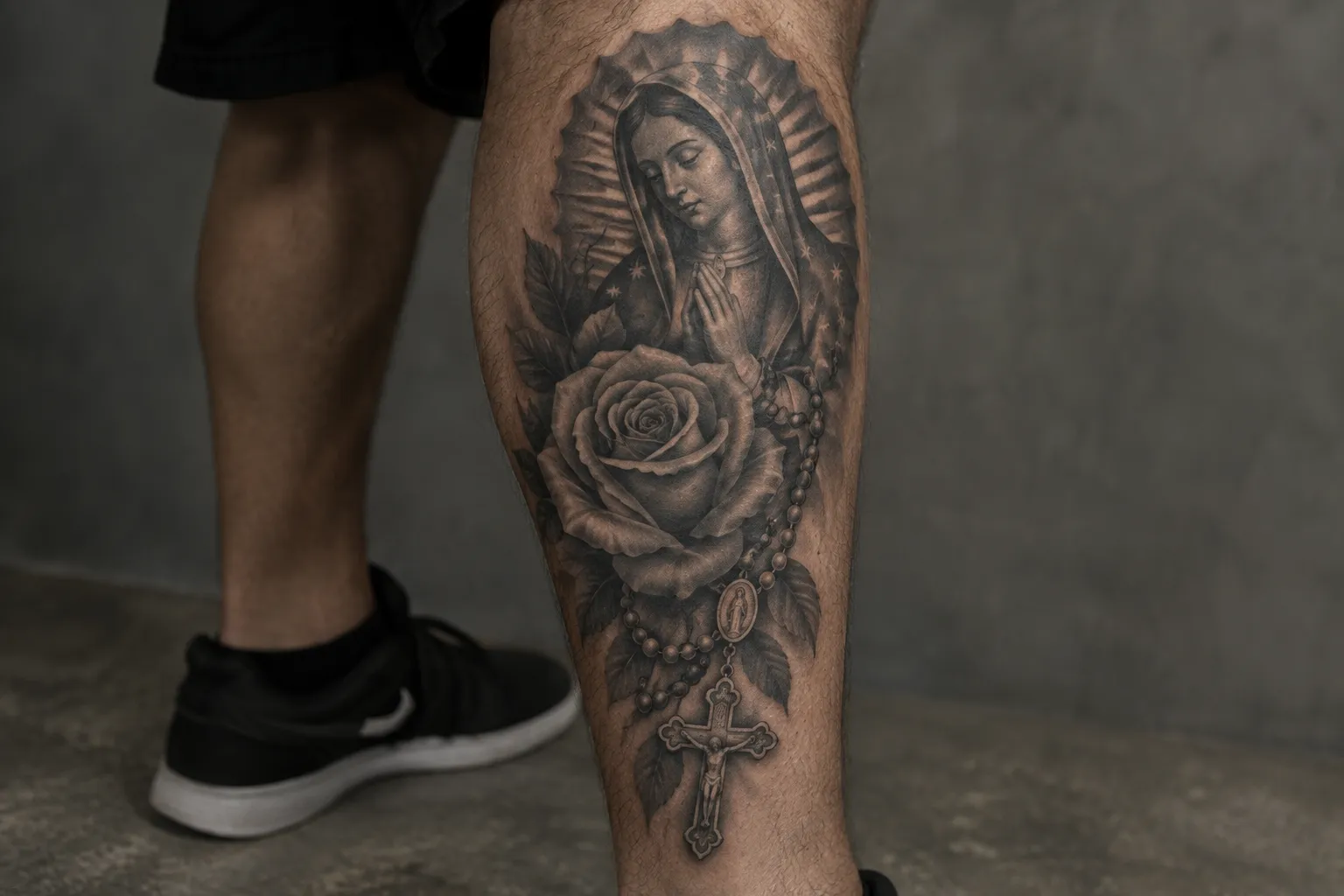
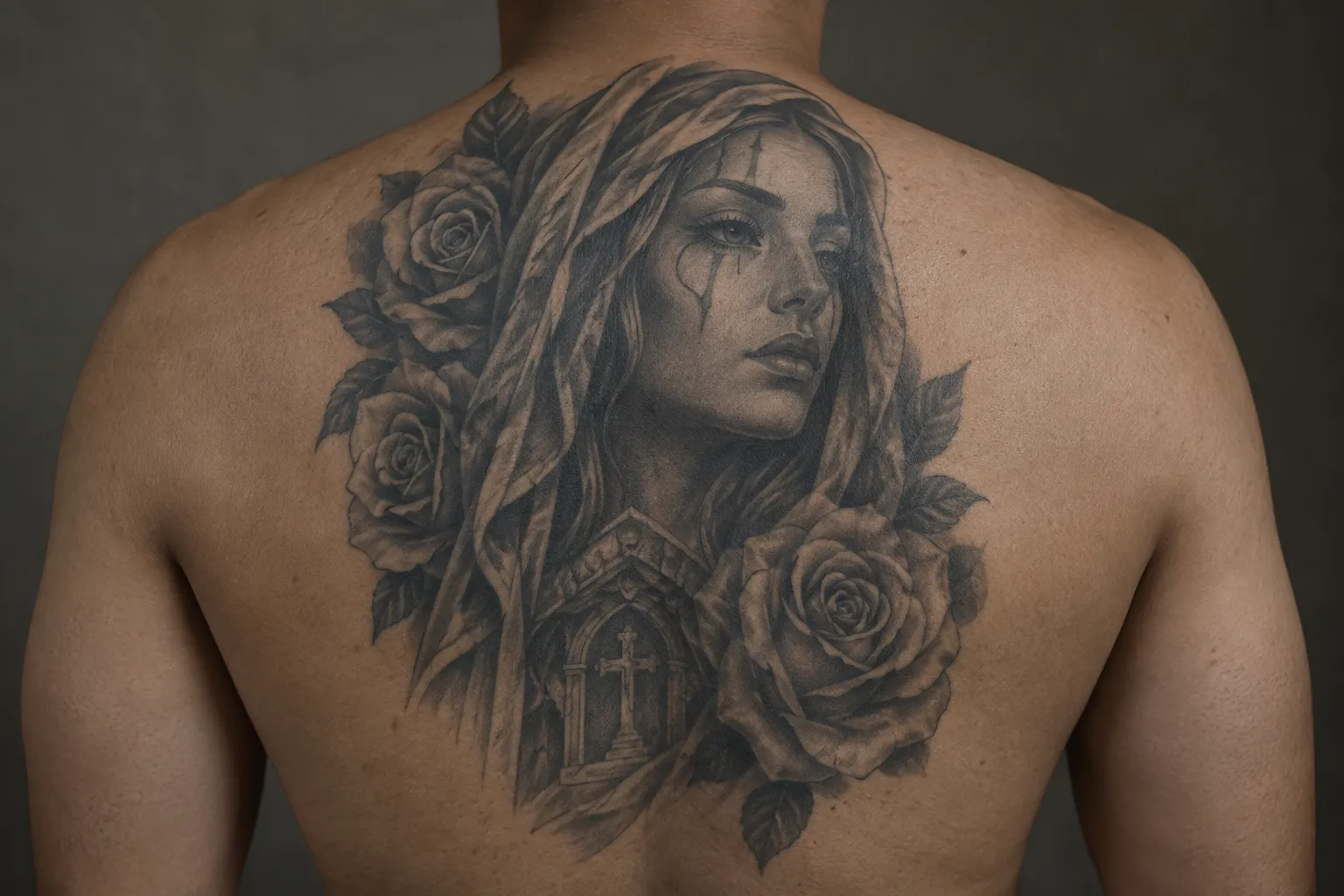
- Roses and Catholic symbols (1): rosaries, praying hands, the Virgin of Guadalupe, the Pietà. A single rose fits a forearm or calf; a full Virgin with rays and roses needs the larger, flatter space of the back or chest.
- Aztec and Meso-American imagery (1): warriors, pyramids, calendar stones. Calendar-stone detail needs flat space, so upper back or full chest suits it better than a narrow forearm.
- Mexican revolutionary imagery (1): Negrete counted it among the “campfire stories” and “myths” of his culture, and drew girls dressed as revolutionaries, with gun-belts and sombreros, on prison stationery.
- Portraits (1): NPR shows Quintanar tattooing a portrait of a client’s first-born daughter. Give the face enough size for its features to hold as it heals, and ask to see healed portraits at a similar scale. Outer forearm and calf are common choices. Ribcage hurts noticeably more than forearm, and stretch on the ribs can distort a face over the years.
”Smile Now, Cry Later” Masks
The comedy-and-tragedy masks are closely tied to the phrase “smile now, cry later.” One of Negrete’s most famous early drawings, from his time in the California Youth Authority, showed the masks with ornate lettering reading “smile now, cry later” (1). Ask for a “smile now, cry later” in most tattoo shops, he says, and the artist will know exactly what you’re after (1). A common reading is laughing through hardship today and paying for it later, but wearers adapt it. The payasa is a related motif. The word means female clown in Spanish, and the design is a woman in clown makeup, often carrying the same duality. Masks suit the forearm or calf.
Chicano Lettering: Scripts, Sizing and Legibility
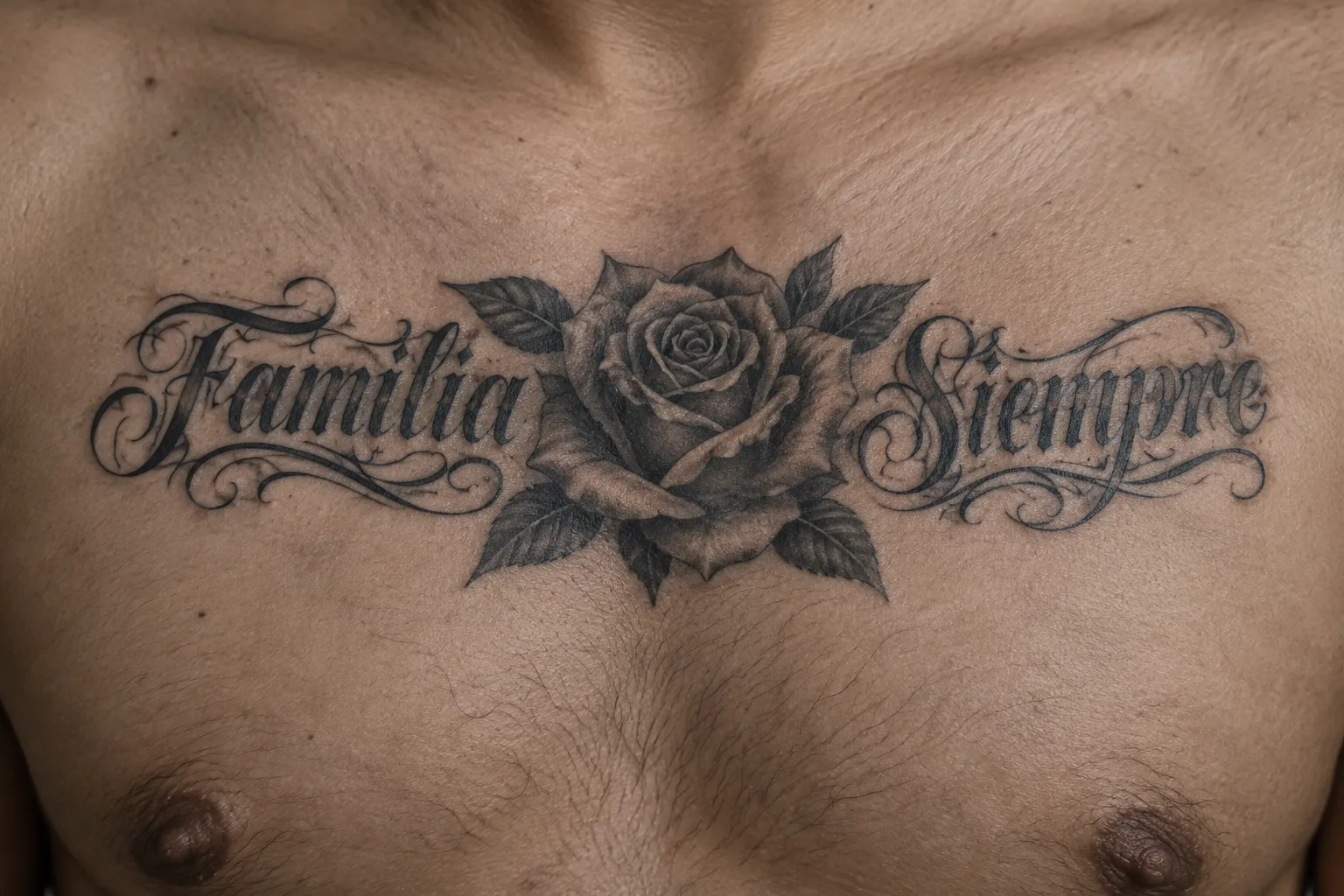
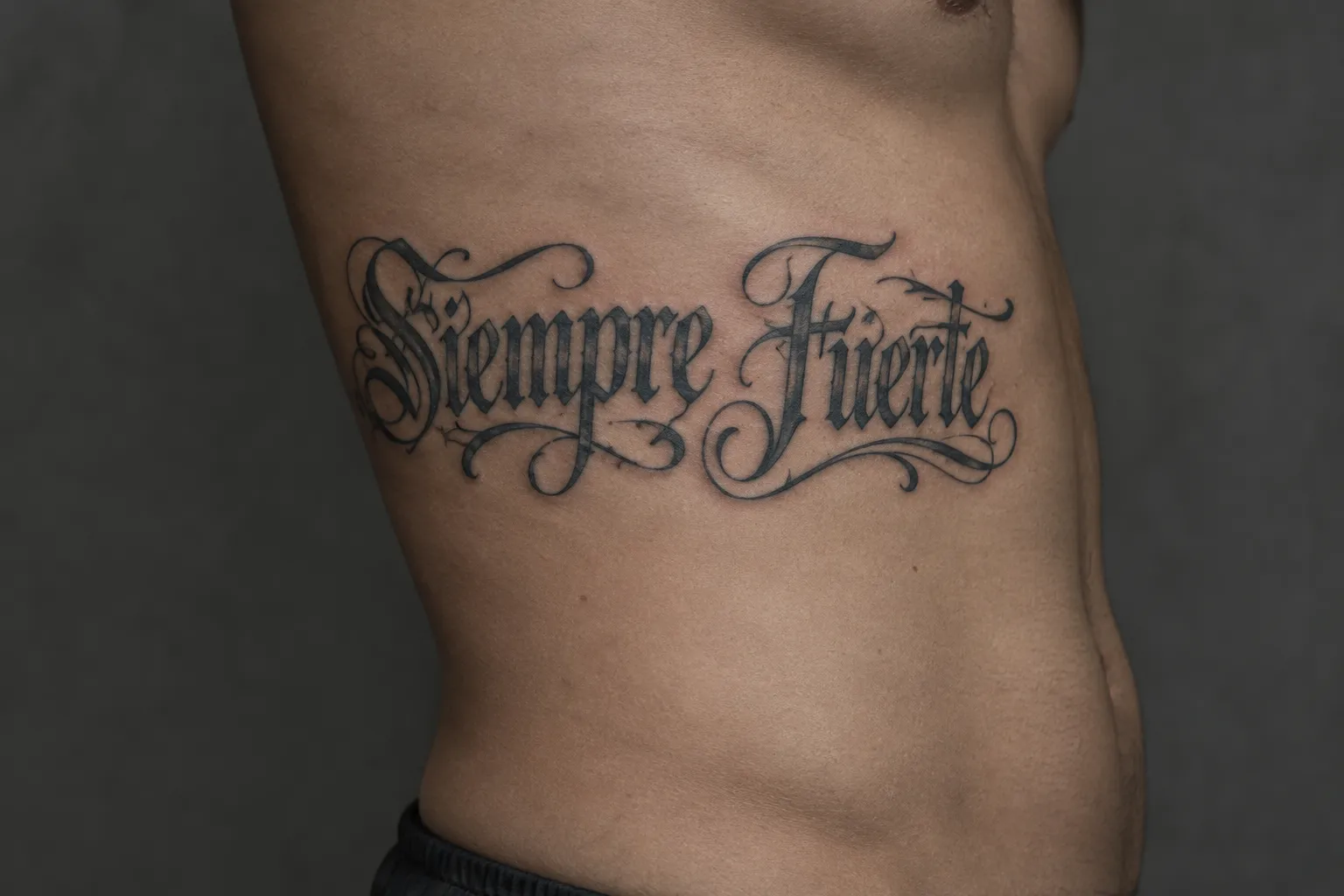
Chicano lettering uses ornate script with heavy flourishes, so it needs more height than plain tattoo fonts to stay readable once it heals. Plan for about 25 mm (1 in) letter height on ornate script.
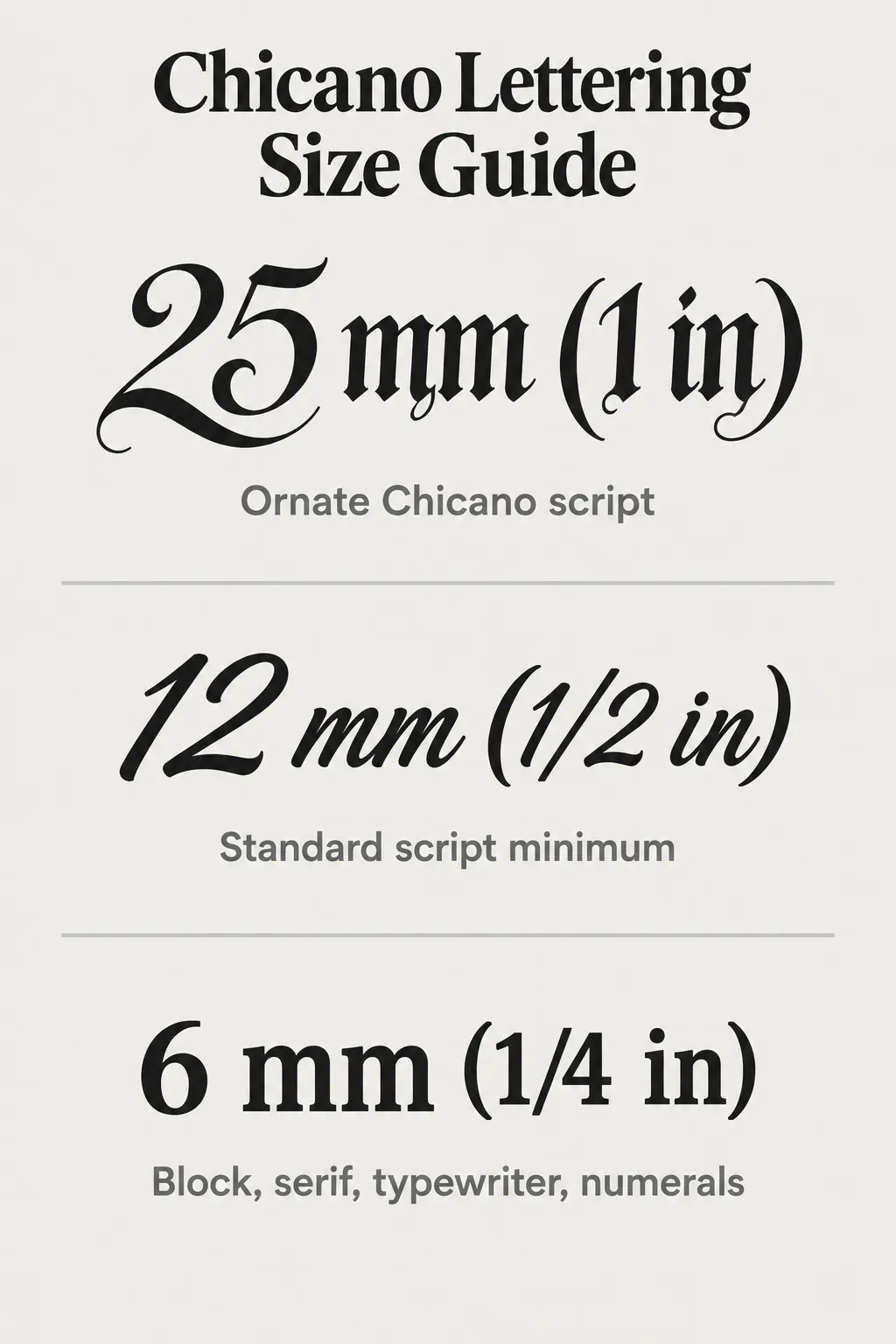 Ornate Chicano script needs about 25 mm (1 in) of letter height, standard script at least 12 mm (1/2 in), and block, serif, typewriter or numeral lettering at least 6 mm (1/4 in).
Script sizing floors, measured as the height of the whole letter:
- Ornate or fine Chicano script: about 25 mm (1 in)
- Standard script: at least 12 mm (1/2 in)
- Block, serif, typewriter or numerals: at least 6 mm (1/4 in)
The flourishes cause the trouble. Thin connectors and tight loops spread slightly in the skin, and the counters inside letters like “a,” “e” and “o” close up when the letters are too small (2). A phrase like “smile now, cry later” across the forearm, a family name across the stomach, or a barrio name across the upper back gives the script room to breathe.
Placement changes clarity. On the wrist, only bold script or block lettering holds, because the skin there is thin and moves constantly. Fine ornate script on the wrist blurs within a few years. Before you sign off on the stencil, check the exact wording and spelling with the artist (2), then look at the design from a few steps back.
Chicano Art Tattoo Pioneers: Artists Who Shaped the Style
The Chicano art tattoo tradition was shaped by artists who reached it by different routes: prison, a homemade machine in a garage, or a professional shop. NPR profiles three of them: Freddy Negrete, Chuey Quintanar and Kari Barba (1).
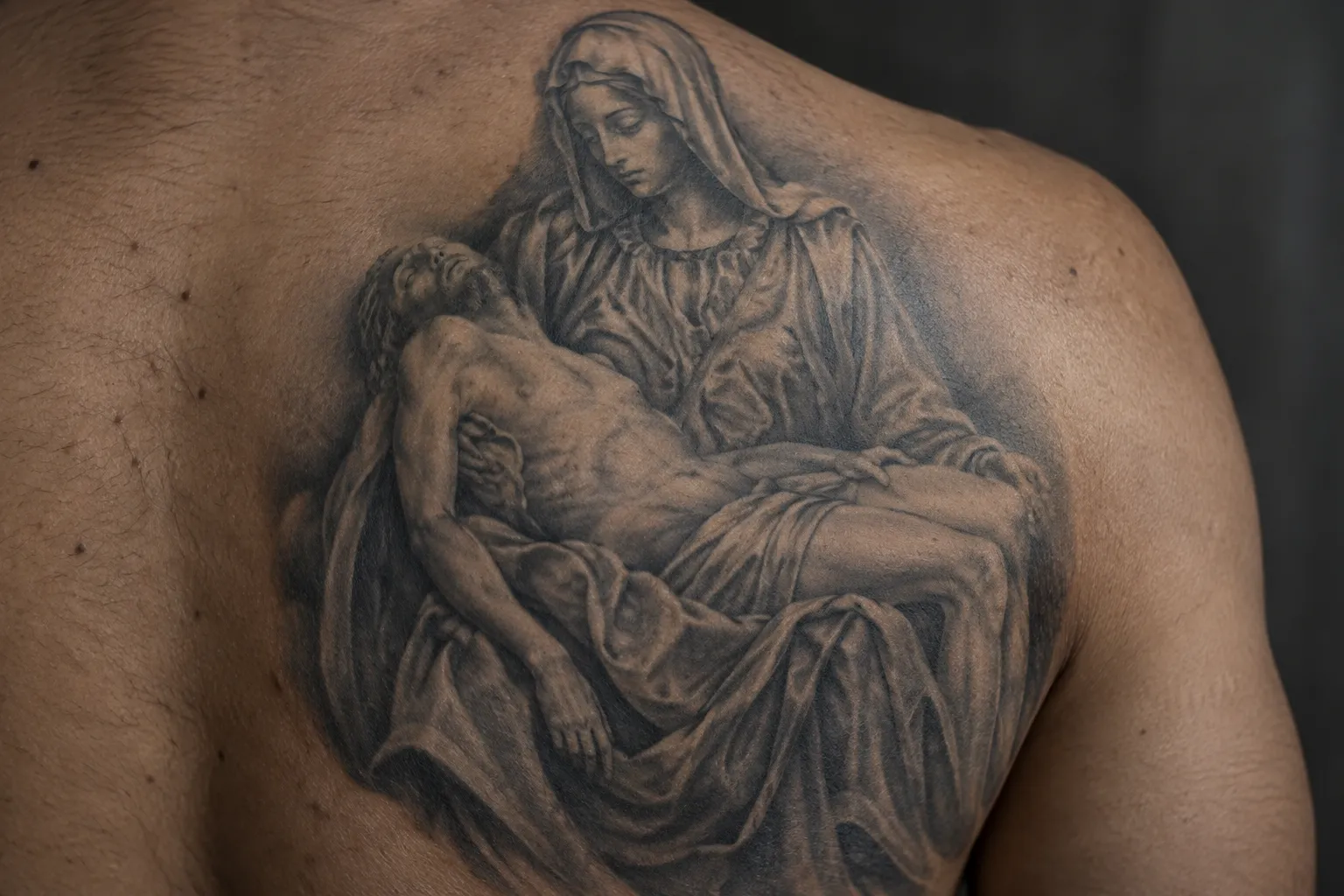
Freddy Negrete’s “super power” in the penitentiary, NPR writes, was his ability to draw; it was his currency, he says, and he made stationery decorated with roses and Catholic and Aztec symbols for other inmates (1). He landed a job at Good Time Charlie’s in 1977 (1), linking the prison origin to the studio phase.
Chuey Quintanar did not learn in “la pinta”: he learned on a single-needle machine in his garage in Long Beach, California, at 14, after a friend made him a homemade machine and told him he should start tattooing (1). His later work includes the Pietà and the daughter portrait described above (1).
Kari Barba came to the style from outside the community. She told NPR that learning about its Chicano roots increased her respect for it (1).
Use these names as reference points when you choose a tattoo artist and compare portfolios. Look for artists who trace their training to this lineage or who show a deep body of healed black-and-grey and script work.
Before You Book: Hygiene, Pricing and Choosing a Design
Before you book a Chicano tattoo, confirm three things: the artist uses a new sterile needle for every tattoo, can explain where their ink comes from, and can show healed fine-line work.
Admire the prison history, but don’t copy it. The same resourcefulness that defined the style’s origins, homemade machines built from ballpoint pens, guitar strings and boom box parts (1), is exactly the kind of unsterile improvisation the FDA warns can transmit infectious disease such as hepatitis (4). Respect for where the style came from should not translate into tolerance for cut-rate equipment today. The FDA also notes that contaminated inks have caused infections even when artists followed hygiene procedures (4). Washington State’s consumer guidance says an artist should use a brand new, sterile needle for every tattoo (3). Ask about both needles and ink sourcing. Tell your artist about any medications you take.
Then match size to detail. Bring a clear brief covering the subject, exact lettering, placement and what the piece means to you. Ask how the artist will adapt it to that placement.
Pricing depends on the artist’s hourly or day rate, the number of sessions and the detail level. Get a written estimate rather than relying on a ballpark.
Frequently Asked Questions
- What does a Chicano tattoo mean?
- A Chicano tattoo means what its wearer assigns to the design; the style does not provide a fixed code that determines every motif.
- Do Mexicans have cultural tattoos?
- Yes. Chicano tattooing is a Mexican-American tradition rooted in East Los Angeles, and its imagery often draws on Aztec, Meso-American, Catholic and Mexican revolutionary references.
- What is the best Chicano tattoo design?
- The best design is one whose subject and layout fit your intent, placement, and the artist's demonstrated skill with that kind of work.
- What are Payasa tattoos?
- A payasa tattoo depicts a woman as a clown; its meaning varies, so discuss the specific expression, styling, and context with your artist.
- What do the comedy-and-tragedy clown masks represent?
- The masks are commonly read through "smile now, cry later," but wearers may give the pairing a different personal meaning.
- Who are notable Chicano tattoo artists?
- Freddy Negrete, Chuey Quintanar, and Kari Barba are useful historical reference points; compare portfolios for healed work in your intended subject and style.
- What religious imagery appears in Chicano tattoos?
- Chicano religious designs often draw on Catholic imagery, but the meaning of a particular figure or object depends on the wearer and composition.
Picking Your Piece
Choose the subject first, then size it so the grey gradients and script survive healing: about 25 mm (1 in) letter height for ornate lettering, and forearm, calf or back for portraits. Finally, judge the artist on healed photos, not fresh ones, and confirm a new sterile needle for every tattoo before you book.