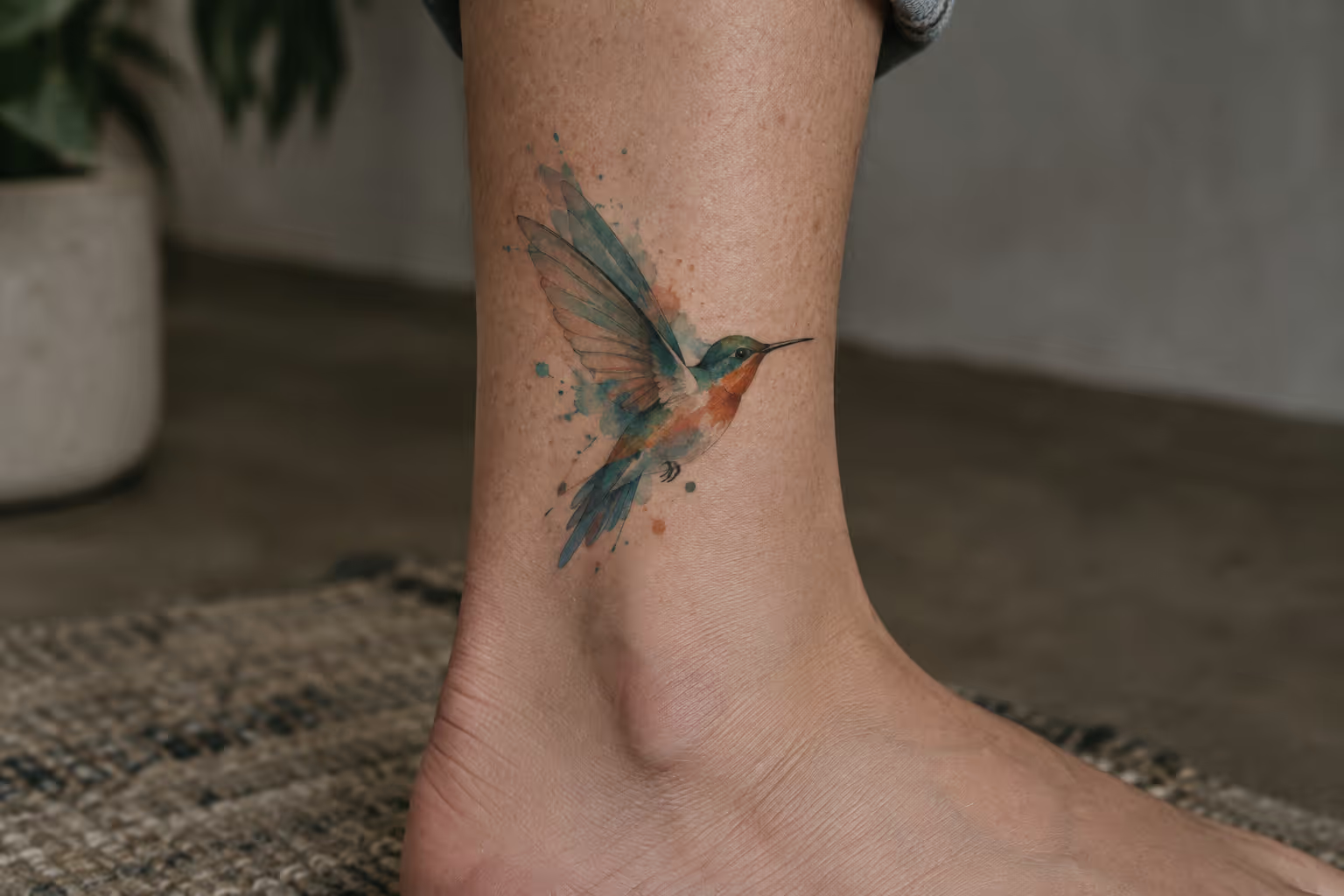
A watercolor tattoo does not have to skip every black line. Some of the strongest healed examples use a thin dark line on purpose, because pure color washes soften and blur as the years go by (12). The style imitates paint on wet paper, with soft gradients, blended color, splatter and drips. How that look survives in skin depends on two things you decide before the session: how much structure the design gets, and whether the artist has healed watercolor work to show you.
✓ Pros
- You can set the amount of structure to match the subject instead of choosing between a rigid outline and none.
- The color can do expressive work beyond filling a closed shape, which suits designs built around open space and movement.
✗ Cons
- A fresh photo gives limited evidence about whether the artist's light washes hold together after healing.
- Planning needs to account for how the design reads after its palest details are no longer visible.
How a watercolor tattoo is done: technique, outlines, and what the style means
A watercolor tattoo builds an image from layered color washes, blended gradients, splatter and drips, often with little or no bold black outlining (3)(13). It is a way of applying color, not a subject. A watercolor rose, owl or abstract splash all follow the same technical logic.
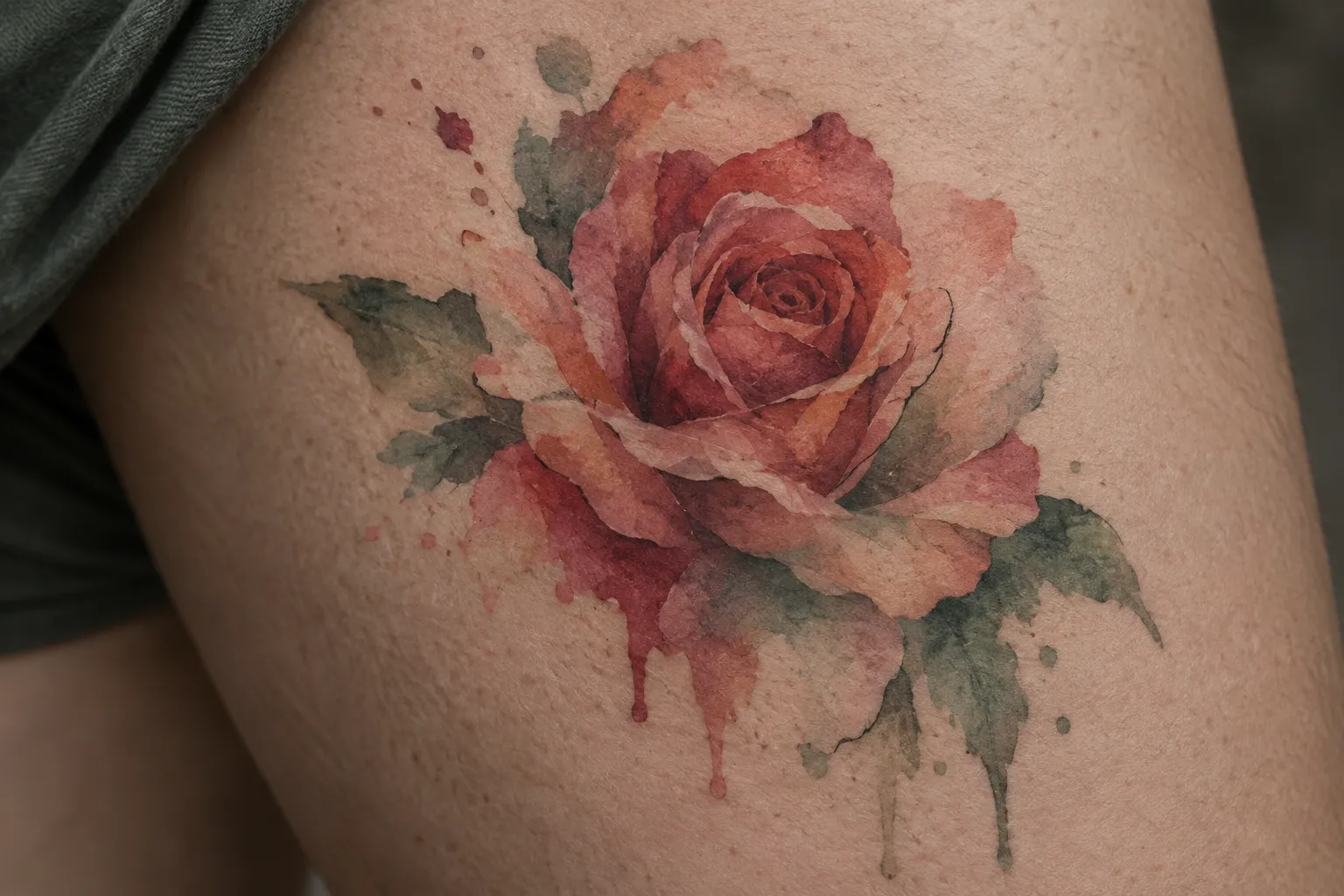
The easiest way to understand it is to compare it with American traditional. Traditional work was built around bold outlines, saturated solid color packing and black as a structural skeleton, all choices that help a design survive decades in skin (10). Watercolor deliberately drops those guardrails. Outlines get broken, pigment is flicked past the edge of the design, and gradients fade out into bare skin instead of closing into a hard shape (10). Done well, those choices are intentional. They are not shortcuts.
What makes a tattoo read as ‘watercolor’
Two technical hallmarks set the style apart.
Soft wash layering. Watercolor color work is usually laid with curved magnum needle groupings, typically 9CM, 11CM or 13CM, because the curved mag’s soft edge puts down overlapping washes without hard tracking lines (10). The artist loads pigment lightly and stacks several passes to build density gradually, rather than packing color solid in one round (10). The result is translucent overlap, where one hue shows through another the way paint does on paper.
Paint-mimicking details. Splatter, drip trails, open negative space and edges that bleed past the main subject create the illusion of a wash (14). In skin, nothing is literally moving or pooling. The artist imitates the look of wet pigment with a medium that is permanent and sits in a living, shedding, sun-exposed organ (14). The color is also often laid at lower saturation than a traditional piece (14).
The most common pitfall comes straight out of that lower saturation. A piece that looks exactly like the Pinterest painting on day one was probably built with pigment concentrations too low to survive (14). Pale washes fade fastest, and white highlights almost always disappear within a few years (10)(14). An artist who chases the fresh photo at the expense of pigment density is building for the photograph, not for the years after it (14).
Why some artists add a thin black line anyway
The idea that every watercolor tattoo must be outline-free does not hold up. The lack of a black outline has raised concerns about aging, so many tattooists use fine black lines to address it, while others argue it is not a problem at all (3). Treat “no outline” as one option within the style, not its definition.
On the technical side, artists usually switch to a 1RL or 3RL (a small round-liner grouping) for any residual linework or structural anchoring (10). That line can be:
- A full fine outline under the washes, which reads almost like a sketch with paint dropped over it
- A partial line on only one side of the subject, for example the shadow side of a flower
- Dot-stippled structure or a dark internal shape that holds the form without drawing a border
The trade-off is plain. With a black skeleton under it, the piece keeps its shape for much longer. Without one, you are relying on soft edges that have nothing holding them in place (10).
What a watercolor tattoo means
The style itself has no fixed symbolism. Watercolor tattoos draw on watercolor painting, a very old practice that started with natural pigments taken from the earth (3), but the meaning of your tattoo comes from the subject you choose, not from the wash technique.
A rose, a hummingbird or an abstract splash carries whatever that motif means to you. Rendering it in watercolor softens the visual language, but it does not change what the motif references, so if the meaning matters to you, look into the subject’s origin rather than the style’s.
Strengths and weaknesses of the style
The upside is a painterly look you cannot get from any other approach, plus flexibility. The style works with or without an outline and suits nature and abstract subjects. The downside is that, without a black outline holding the drawing, fading color means a fading image (12), and specialist work carries premium hourly pricing (2). Weigh both sides before you fall for a fresh photo.
Design ideas that hold their shape as the color fades
The best watercolor tattoo ideas start from a subject with a strong, recognizable silhouette, so the design still reads once the palest washes soften (12)(14). Pick the outline-free option only if the shape alone tells you what the subject is.
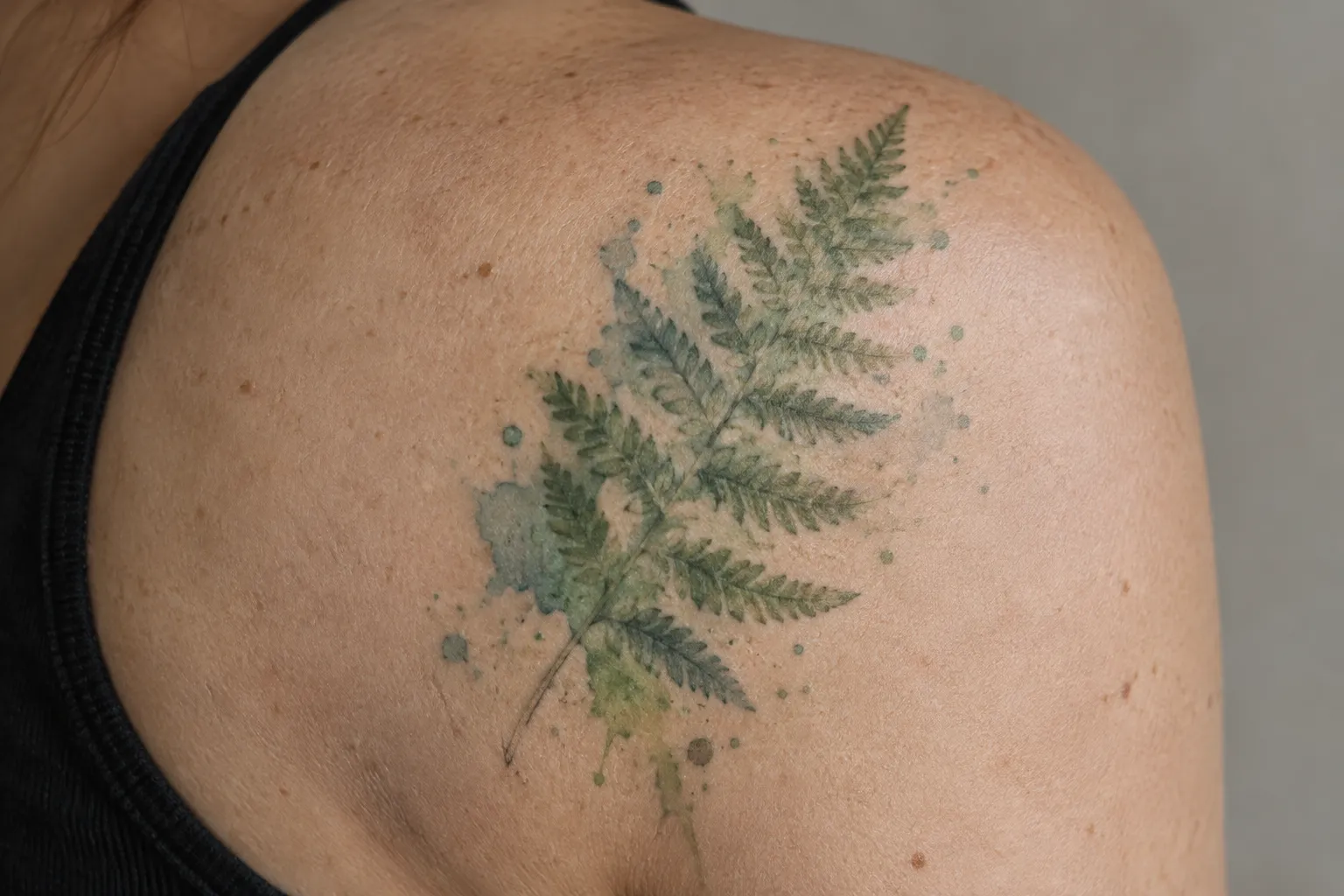
A quick test before you book: fill your reference image solid black, like a shadow puppet. If you can still tell it is a hummingbird, a fern or a wave, the subject can carry a soft, borderless treatment. If it turns into a blob, it needs structure.
Subjects that work without a hard outline
Design guidance for the style recommends strong silhouettes and points to botanicals, birds, butterflies, and ocean or sky themes as watercolor-friendly subjects (12)(14). Here is why each group suits the style:
- Botanicals and florals: petals and leaves justify soft color bleeding past the drawing (14), and a single bloom carries better than a dense bouquet (10).
- Birds: motion and plumage give the splatter a purpose (14). A hummingbird or songbird is often built as a minimal dark skeleton with a wash body that suggests feathers rather than drawing each one (10).
- Butterflies: the wings are already translucent fields of color, so a light keyline body with washed wings reads as the insect itself (10).
- Ocean, sky and abstract splash: in waves, sunsets and pure color fields, the gradient is the subject (10)(14).
Placement matters as much as subject. Good spots for outline-free work have enough flat space for the gradient to breathe and spend most of the year covered (10)(14):
- Upper back or shoulder blade: a large, flat area that stays under clothing most of the year
- Thigh: room for a wide wash, low friction and little direct UV
- Inner upper arm: flat, consistent skin that sees less sun than the outer arm
- Inner forearm: visible to you, with less sun than the outer forearm
The ribs split opinion: they stay covered (14), but constant skin movement there blurs soft edges (10), and the ribcage is far more painful than the forearm. Hands, fingers and feet are poor choices for soft washes: friction and fast skin turnover wear pale color down quickly (10)(14).
When to request a partial dark anchor instead
If your subject fails the silhouette test, or depends on small internal details like a face, lettering or a detailed animal portrait, ask for selective structure rather than a full traditional outline. That can mean a partial black or dark-toned line, a shadow, or a dark silhouette element that anchors the image while the washes stay painterly (3)(14).
A watercolor fox is a good example: built line-anchored, a strong black linework fox carries the color exploding behind it (14). A wolf rendered as a solid dark silhouette against a splash needs no outline, because the dense form itself provides the contrast the eye locks onto (14). Raise this with your artist at consultation and agree on it before stenciling, not halfway through the session.
How watercolor work ages and why fading varies
Watercolor tattoo aging has no fixed lifespan. How soon a piece needs attention depends on placement, sun exposure, palette and how it was built (14), so treat any “years until fading” figure as an estimate, not a guarantee.
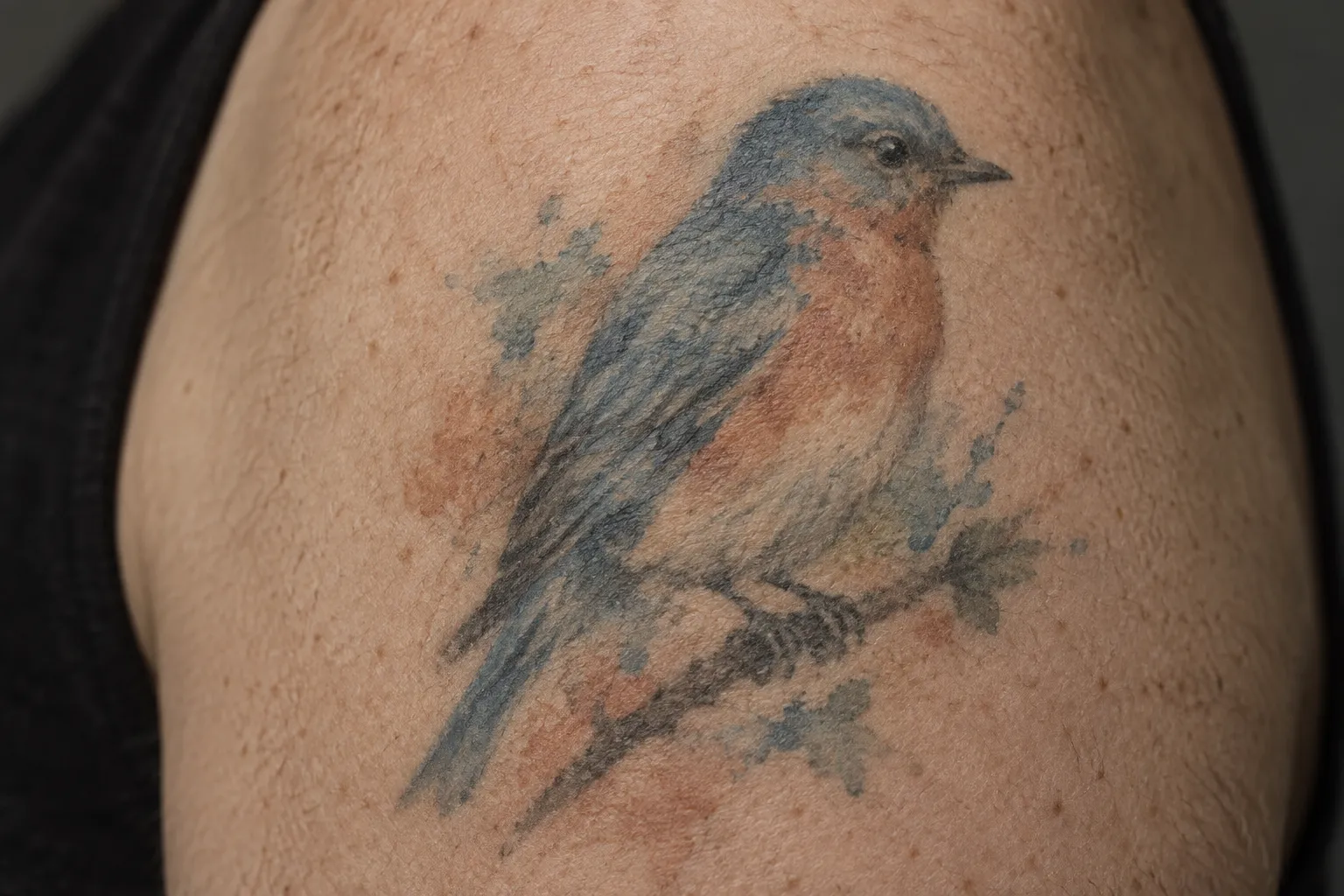
You will see confident claims online that watercolor pieces fade within a specific number of years. Some do. Others hold up well for a long time. The difference comes from the variables below, not from the label “watercolor.”
What happens to pigment under the skin
Tattoo pigment is placed in the dermis, the layer below the surface skin that sheds. Over time, pigment particles can shift deeper, which contributes to a faded or blurred look (8)(9). A crisp edge on day one slowly softens as the particles move.
The mechanism that keeps a tattoo visible at all is more dynamic than most people assume. Research on tattooed mouse skin found that skin macrophages, the immune cells that capture pigment, are the cells that hold tattoo particles, and that long-term persistence relies on new macrophages taking up the pigment again as pigment-bearing cells die (7). It is a cycle of release and recapture, not ink sitting still forever. The work was done on mouse skin (7), so it describes a mechanism, not how a given watercolor design will look on you. Pale, low-density washes simply have less pigment to lose while that turnover goes on (14).
Why the same style ages differently on different people
Put the biology together with the design choices and you get the practical picture.
Density. A wash built up in several light passes to solid healed saturation has more pigment to lose before it looks washed out than a single faint pass does: the lighter the dilution, the fewer pigment particles sit in the dermis (14). This is the strongest argument for an artist who works in layers rather than chasing a pale look on the first pass.
Edges. Soft edges with no structure have nothing to hold the shape as particles migrate. A thin dark line, even a partial one, gives the eye a boundary to read long after the color has softened (3)(10).
Highlights. White and very pale highlights are the first details to disappear (10). If the design depends on a white glint in an eye or a pale petal edge, assume that detail will be gone eventually and plan around it.
Placement and sun. UV light can fade some tattoo inks (1). An outer forearm in a sunny climate takes far more exposure than an upper back that stays under a shirt. Areas with friction or heavy skin turnover, like hands and feet, wear down color faster (10).
Your skin. Tattoo pigment is translucent and filtered through your own undertone, so the same palette reads differently on different people (14). Two people with the same design from the same artist can see different results.
Watercolor tattoos that age well usually combine a strong silhouette, layered density, some dark structure and a low-sun placement. Ones that fade fastest tend to be pale, structureless, heavy on white highlights and placed on the hands or the outer arm of someone who lives outdoors (10)(14).
Protecting the wash: healing and long-term color care
A watercolor piece peels like any other permanent tattoo, but because the color is lighter, the healing phase can look alarming (14). Gentle healing and consistent sun protection once healed are what slow fading the most: daily sunscreen on a healed piece is the single highest-return habit (12).
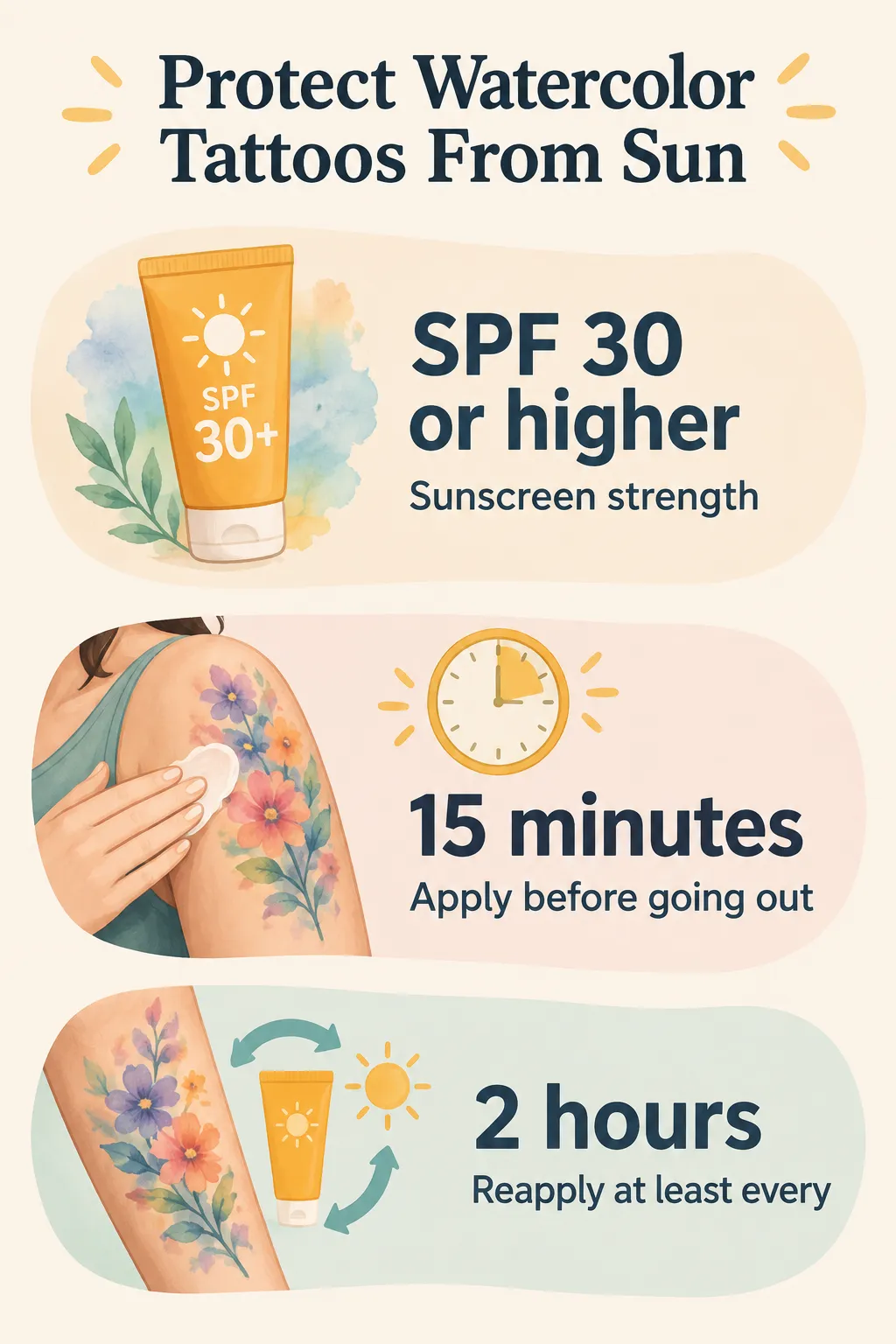 The American Academy of Dermatology advises protecting healed tattoos with SPF 30 or higher, applying it 15 minutes before going outside, and reapplying at least every 2 hours.
Healing timeline, day by day
Follow your artist’s specific instructions first. This is the general arc for a fresh tattoo; the full routine is in our week-by-week tattoo aftercare guide:
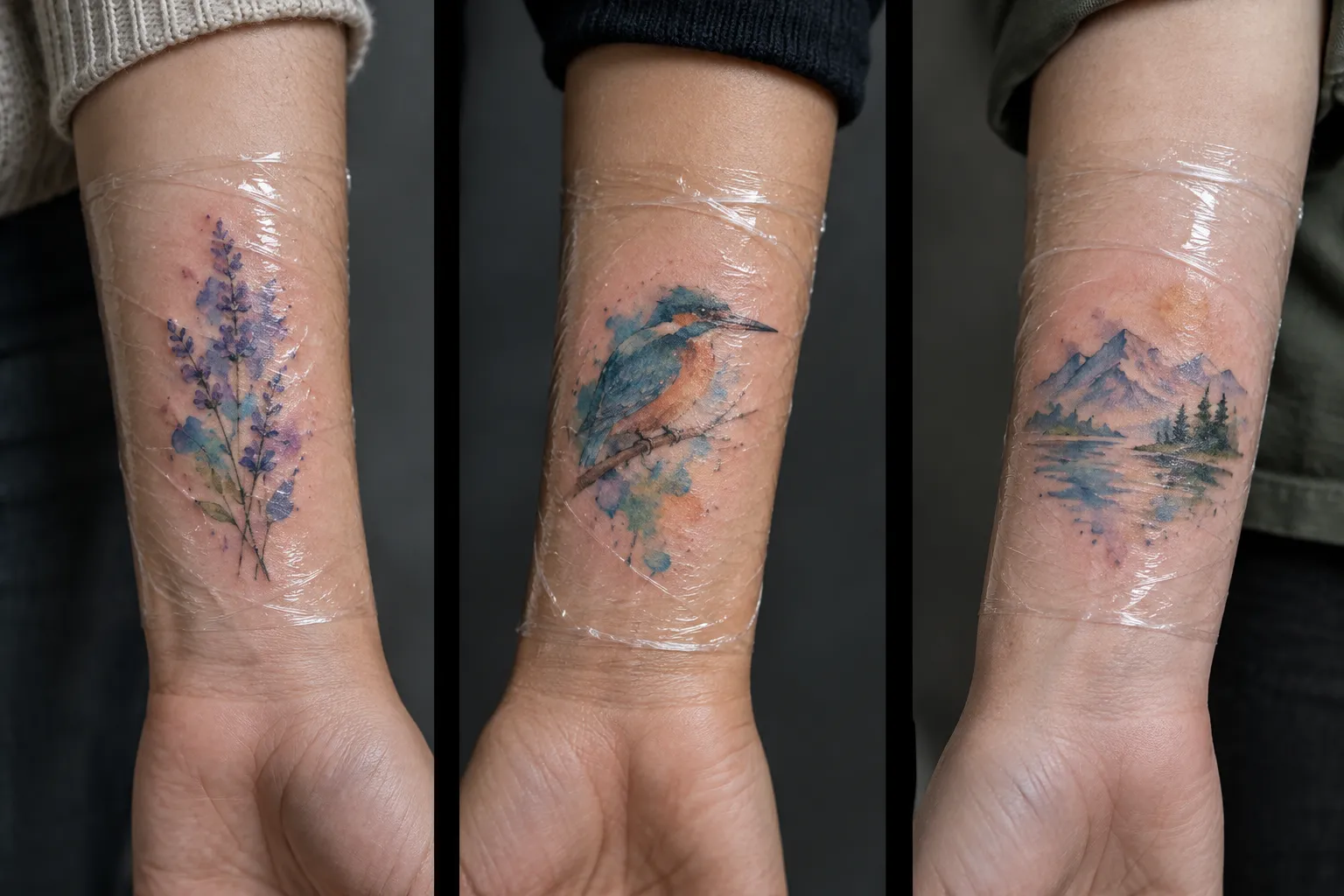
Day 1-3: fresh and weeping. Keep the initial wrap on for as long as your artist tells you to. After removing it, wash gently with lukewarm water and a fragrance-free, mild liquid cleanser, then pat dry with a clean paper towel. Expect some plasma, ink and redness. Keep the tattoo out of direct sun, pools, baths and the ocean.
Day 4-7: tight and starting to flake. Apply a thin layer of fragrance-free, water-based moisturizer two or three times a day. Light flaking starts, and the washes can seem to vanish under the flaking skin before partly returning (14). That is normal and not a sign the washes are failing. Do not pick or scratch: pulling flakes off early takes pigment with them and leaves patchy spots.
Week 2: peeling and itching. The skin sheds in colored flakes and itches. Keep moisturizing, keep covering the tattoo with loose, sun-protective clothing rather than sunscreen on broken skin, and avoid soaking.
Week 3-4: healed on the surface. The surface looks healed, but deeper skin is still settling until about week six, so keep direct sun off it for the first four to six weeks. Judge the color only once healing is complete (14). It will look softer than the fresh photo, which is why judging an artist by fresh work alone is misleading.
Generic pre-session advice applies too: tell your artist about any medications you take, including blood thinners, whose most serious side effect is a risk of heavy bleeding, with bruising among its signs (15). Do not stop or change a prescribed blood thinner without talking to your doctor first (15).
Sun exposure and moisturizer rules once healed
Once fully healed, sun is the main long-term threat to washes (14), and our guide to tattoo sun protection covers the routine from fresh ink onward. According to the American Academy of Dermatology, healed tattooed skin should be protected with a broad-spectrum, water-resistant sunscreen of SPF 30 or higher, applied 15 minutes before going outside and reapplied at least every 2 hours (1). For a watercolor piece on the forearm or shoulder, that means sunscreen every day the tattoo is uncovered, not just beach days.
Sunscreen does not cover everything. The AAD advises staying out of tanning beds and away from sunlamps, because they may fade tattoo ink and raise skin cancer risk (1). No SPF makes a tanning bed safe for a tattoo.
The moisturizer you choose matters too. For dry tattooed skin, the AAD recommends a water-based lotion or cream and warns that petroleum-based products such as petroleum jelly can cause ink to fade (1). Check labels on “healing” balms, because many are petroleum-based.
One planning note that belongs before the session: the AAD suggests choosing skin that is free of moles, since tattooing over a mole can make early signs of skin cancer harder to spot (1). Splatter details can drift across a wide area, so map the moles in your planned spot with your artist before stenciling.
Vetting a watercolor specialist: portfolio checks and studio safety
A capable watercolor tattoo artist shows you healed watercolor-specific work, ideally photographed 6-12 months after tattooing (11), and runs a studio with sterile, single-use supplies (16)(17). Both checks matter, and neither replaces the other.
What to ask before booking
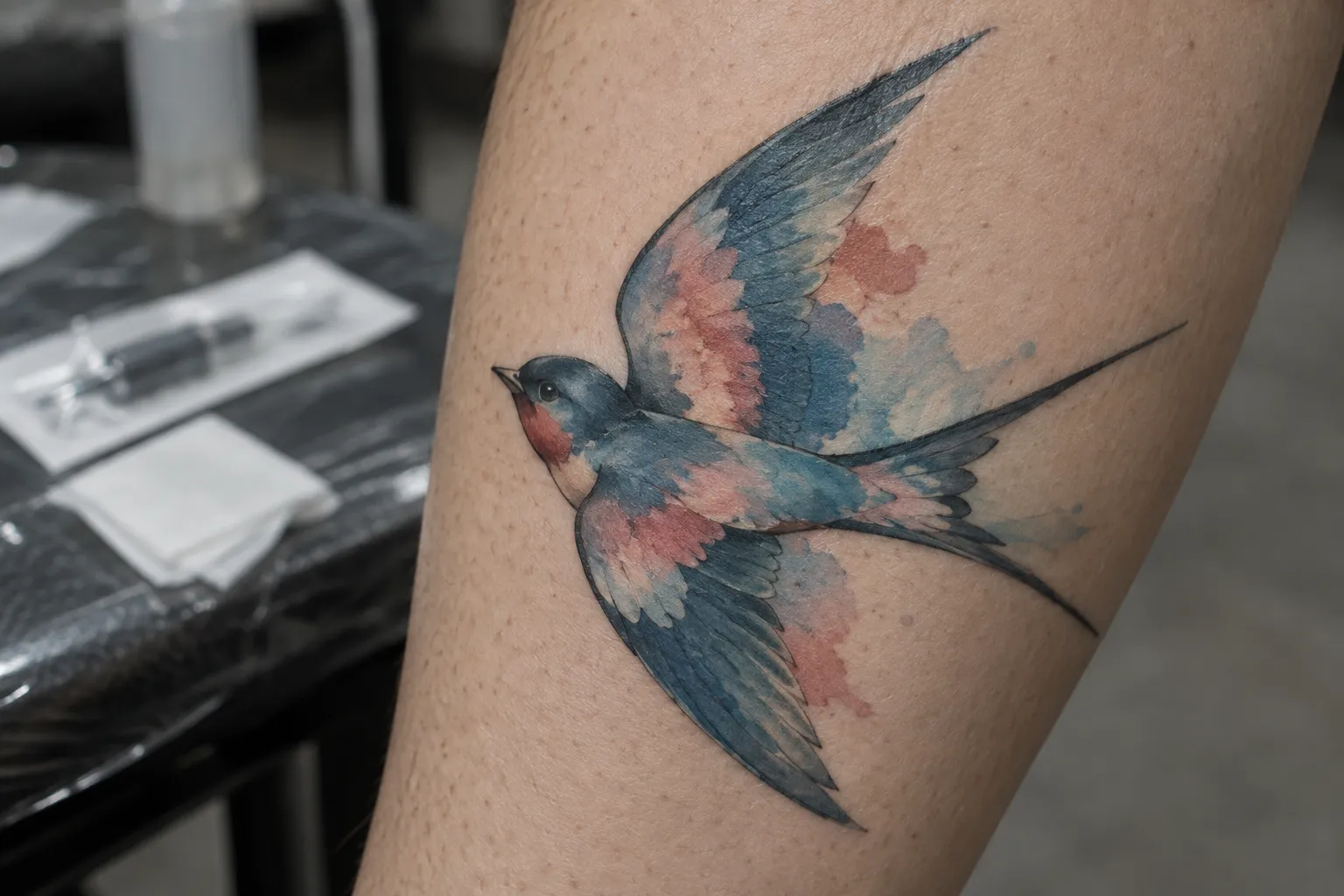
Ask for healed photos, not just fresh ones. Fresh watercolor looks saturated and glowing because the skin is inflamed and the ink sits right at the surface. One style guide recommends looking for healed photos taken 6-12 months after tattooing, which is when you can see whether colors held or turned muddy (11). If an artist’s whole portfolio is fresh shots under ring lights, ask for healed examples. A specialist who is confident in their work will have them.
Confirm they do watercolor specifically. Plenty of good color tattooists can pack a solid neo-traditional rose. That is a different skill from feathering a gradient into bare skin with curved mags and light passes. Look for watercolor-specific pieces in the portfolio, not just “some color work” (11).
Ask how they think it will read in a few years. A good artist will talk honestly about fading and tell you where your design needs structure. Bring reference images and identify what must stay recognizable if the pale washes soften. The consultation is where color choices, scale, placement and any supporting structure get settled, before the machine turns on (13).
Ask for a time estimate for your design. Depending on size and layering, a watercolor piece can take several hours or several sessions (13). Ask for an estimate for your specific piece rather than assuming a standard duration.
Ask about pricing and touch-ups up front. As of November 2026, a US pricing guide last updated in May 2026 puts watercolor labor at $180-$300 USD per hour, noting that it is specialist-only work with fewer artists and premium pricing (2). That is an hourly labor rate, not a total project price. Ask whether the first touch-up after healing is included, and what later color refreshes cost.
Red flags in a portfolio or studio
In the portfolio, watch for:
- Only fresh photos, with no healed examples at all
- Washes so pale they barely register even fresh, which leaves no density to age into
- Every piece depending on white highlights or tiny internal detail
- An artist who dismisses any question about fading or insists their watercolor “never fades”
In the studio, check hygiene yourself. Ask to see the equipment before you start, make sure everything is in sterile packaging, and confirm the artist holds the license your state requires (16). The artist should wear gloves, use a brand-new sterile needle and lay out single-use ink containers just for your tattoo (17).
Even a spotless studio does not cover every risk. According to the FDA, infections can come from contaminated ink as well as unsterile equipment, and contaminated ink has caused infections even when hygienic procedures were followed (4)(5). FDA scientists have found that even unopened, sealed tattoo inks can harbor bacteria and other microorganisms (5), and the agency issued a safety advisory on May 15, 2019 about specific contaminated inks (4). Ask what ink brands the artist uses, and if you get a reaction after your session that looks like more than normal healing, see a doctor.
How to vet a watercolor tattoo artist
Use these checks to assess an artist's watercolor experience, design judgment and studio hygiene before booking.
- 1
Choose what must stay readable
Gather reference images and decide which parts of the design need to remain recognizable if the palest washes soften.
- 2
Check for watercolor-specific work
Look for watercolor pieces in the artist's portfolio rather than relying on general color-tattoo experience.
- 3
Request healed photos
Ask to see watercolor work photographed 6-12 months after tattooing, not only fresh pieces.
- 4
Discuss structural support
Ask whether the subject needs a partial dark line, shadow or silhouette to keep its shape legible.
- 5
Check hygiene in person
Confirm gloves, a brand-new sterile needle, sterile packaging, single-use ink containers and a state license.
Frequently Asked Questions
- How long do watercolor tattoos last?
- Watercolor tattoos are permanent, but no fixed timeline predicts when one will need refreshing. Ask your artist what changes they expect in your specific design.
- What does a watercolor tattoo mean?
- Watercolor is a technique, not a fixed symbol. Meaning comes from the subject you choose, not from the wash technique.
- Are watercolor tattoos more expensive?
- The total quote depends on the design and session time, not just an hourly rate. Ask whether the estimate includes a post-healing touch-up.
- Are watercolor tattoos more painful?
- Placement matters more than watercolor style: the ribcage is typically more painful than the forearm. Ask about breaks if your design needs a long session.
- Are watercolor tattoos easy to conceal?
- A design is easiest to cover when its full footprint fits beneath clothing, including any drips or splatter. Ask the artist to mark that boundary on the stencil.
- Can watercolor tattoos be removed?
- Laser removal may not clear every color equally, and multiple sessions are common. Consult a qualified removal provider before choosing a design on the assumption it can be erased.
- Do watercolor tattoos look good on dark skin?
- A watercolor design can be planned for dark skin, but color contrast varies by pigment and skin tone. Request healed examples on skin tones close to yours.
- What colors can watercolor tattoos use?
- Watercolor designs can use a broad range of tattoo pigments, but palette planning should account for how colors contrast with your skin and work together after healing.
Before you book: structure, a proven artist and a sun plan
How a watercolor tattoo looks in ten years rides on two decisions made before the needle touches skin. The first is structure: either a subject with a strong silhouette that reads without an outline, or a thin dark line, shadow or silhouette that anchors the washes. The second is the artist: someone who works in watercolor specifically and can show you healed pieces from 6-12 months out, in a studio with sealed, single-use supplies.
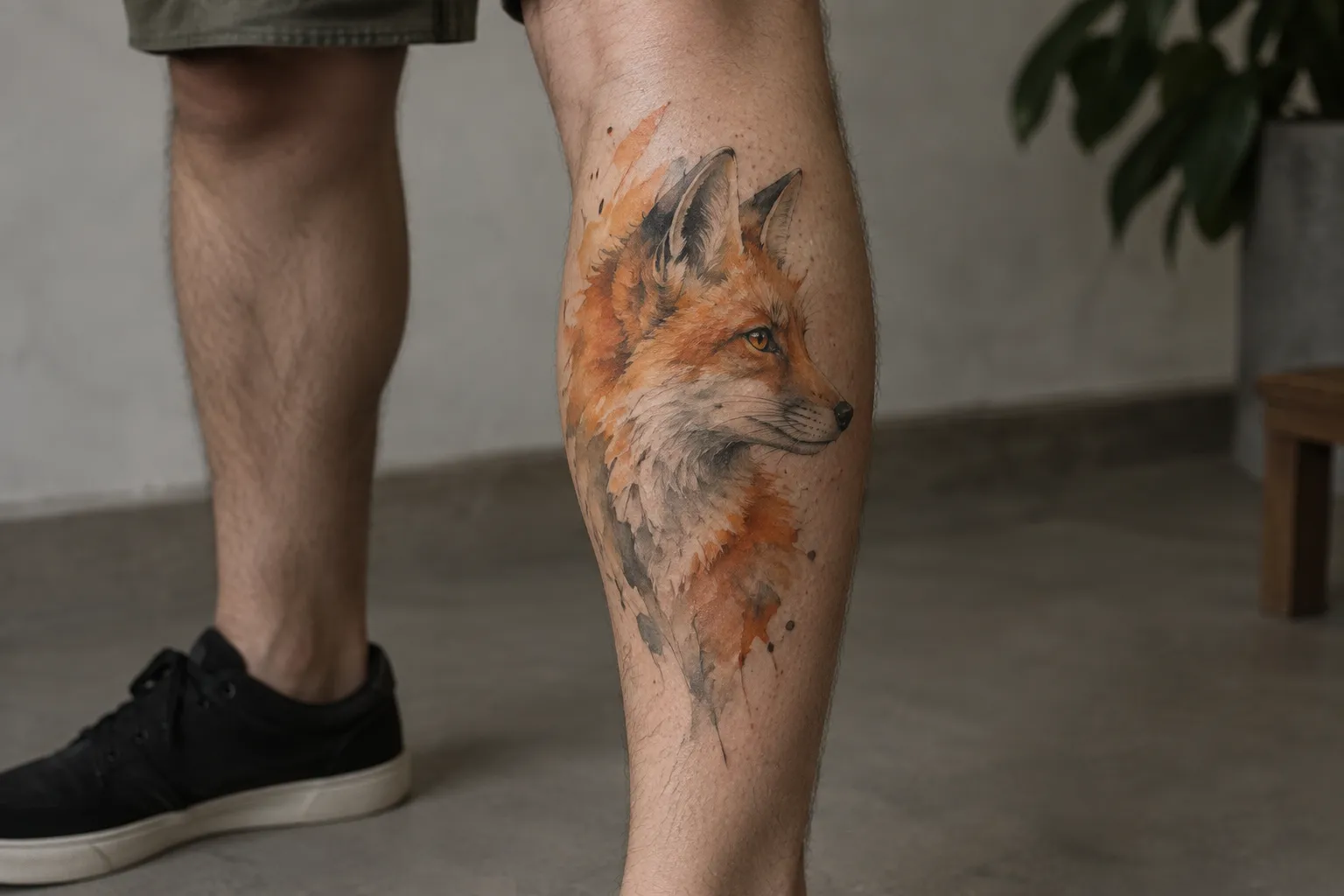
Settle the practical details at the consultation. Agree on placement with sun exposure in mind (upper back and thigh over hands and the outer forearm), confirm the palette will still work once the palest layer softens, and ask how touch-ups are handled and priced. Then commit to the long-term routine: water-based moisturizer, no tanning beds, and SPF 30 or higher whenever the tattoo is uncovered (1).