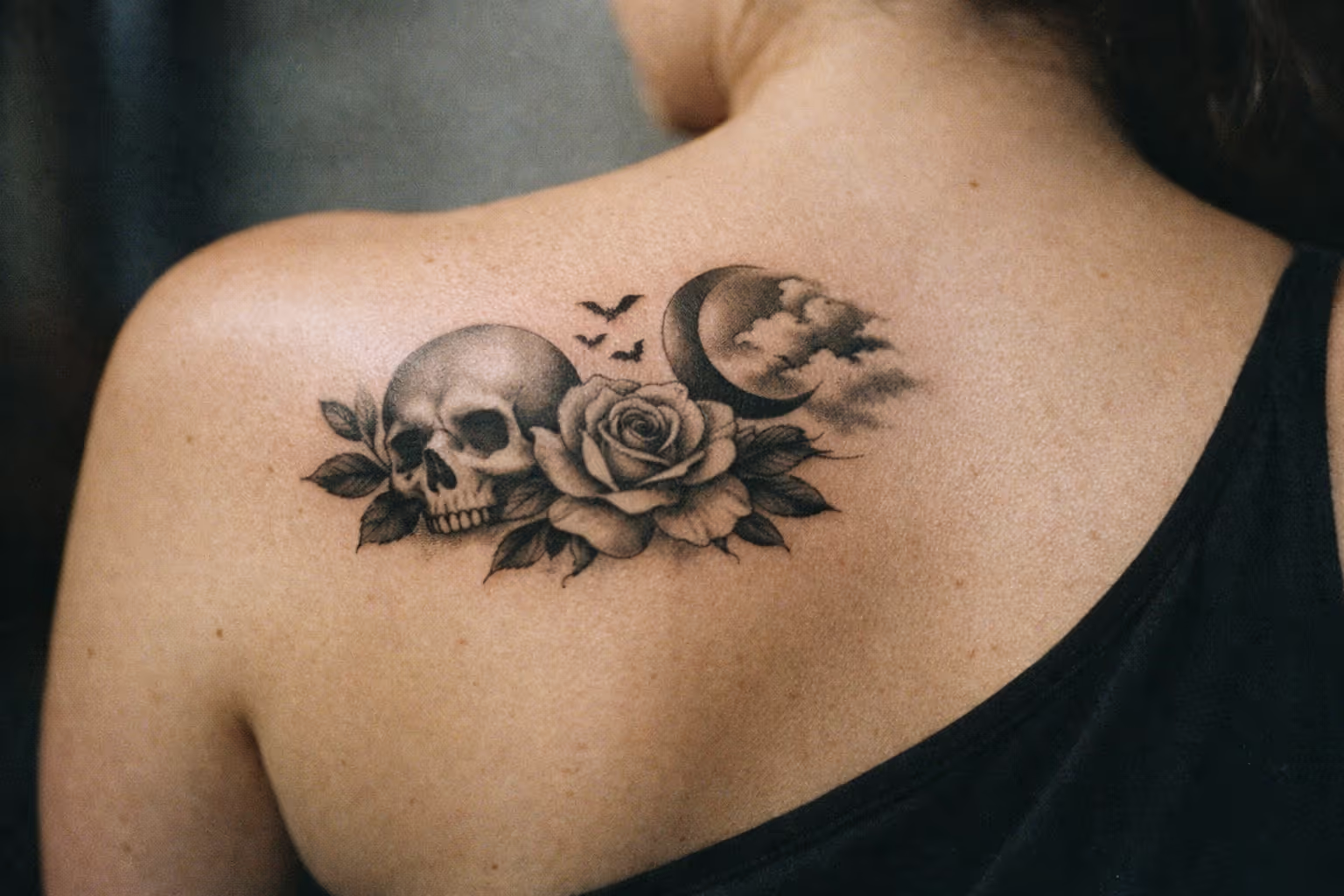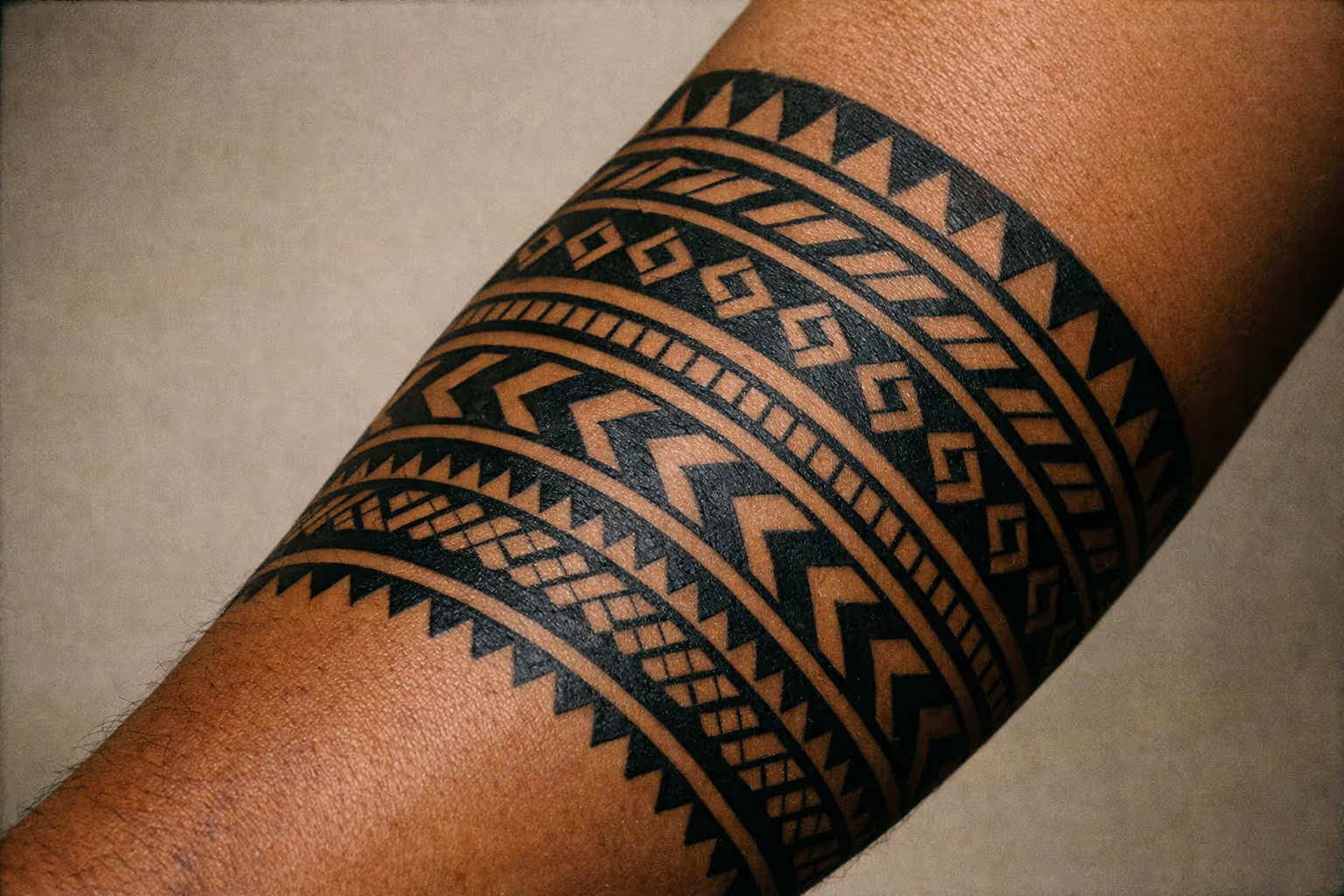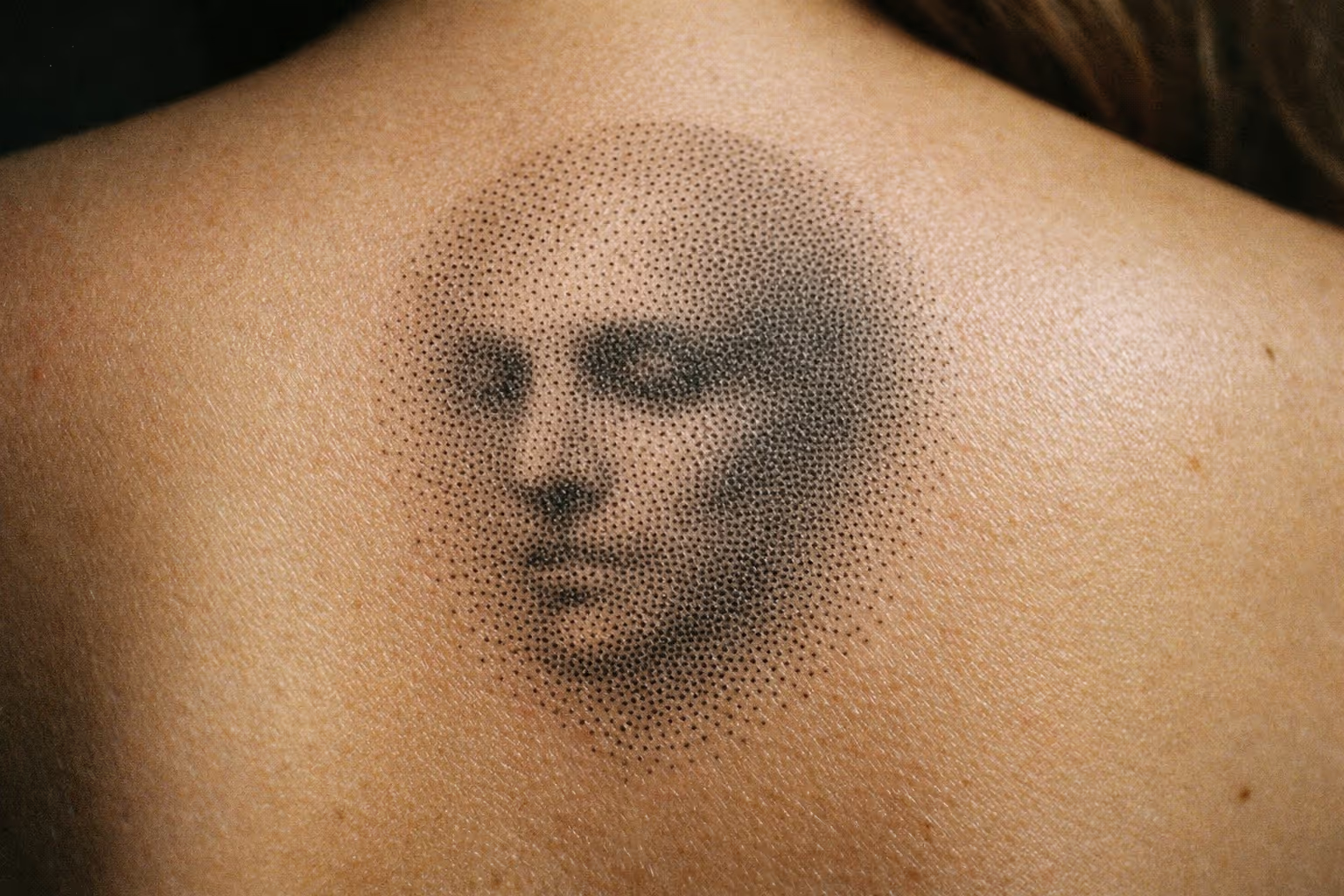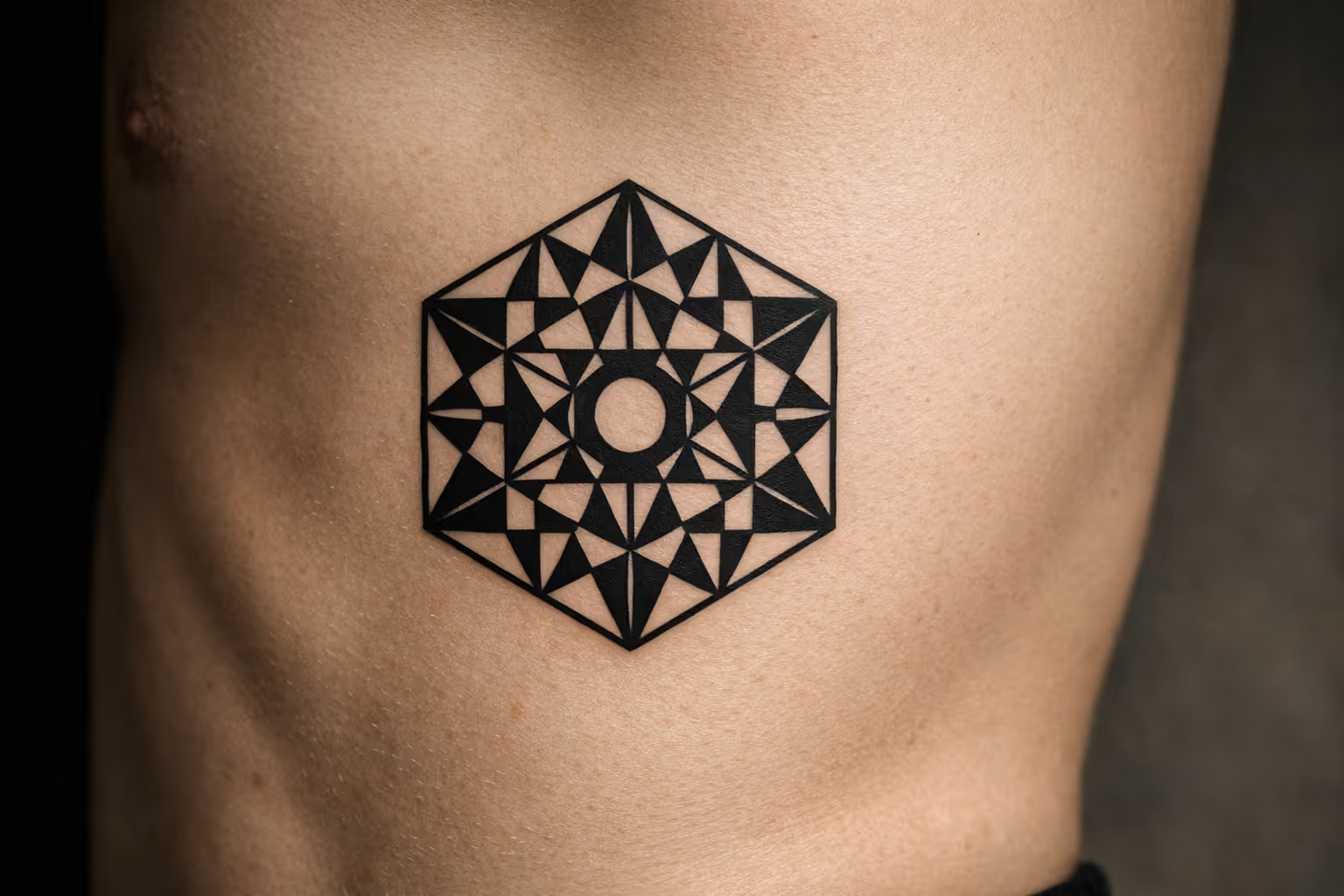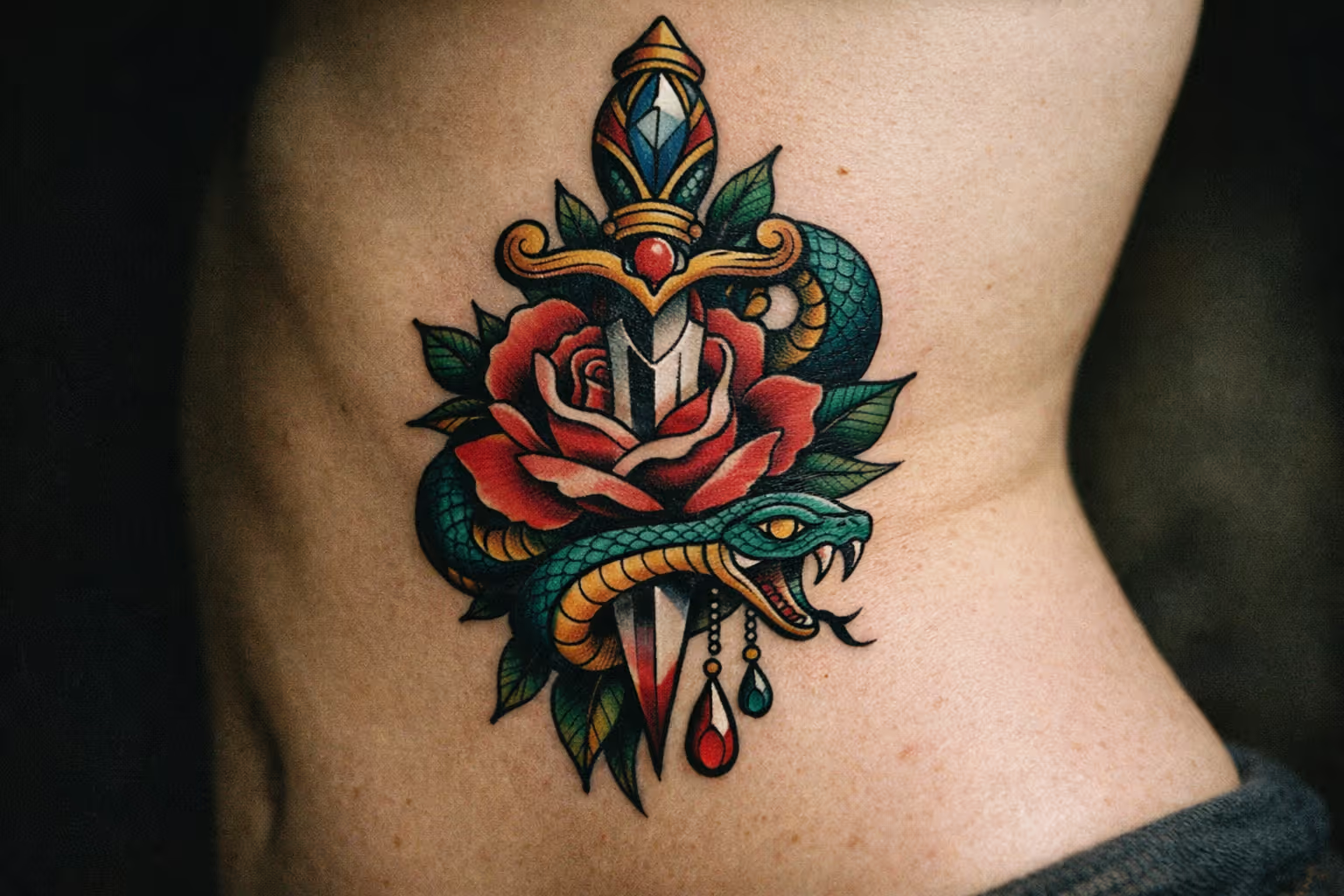
The moment you spot variable line weights and a jewel-toned gradient sitting inside what looks like a traditional composition, you’re looking at a neo traditional tattoo. The style keeps American traditional’s bold outer contour but swaps flat fill for dimensional shading and expands the palette well past the classic five colors. That extra internal detail and those softer gradients change three practical things you need to decide before you book: how big the piece has to be, how many sessions it takes, and how it looks in ten years. This guide covers the technical rules, the palette logic, placement strategy, and what healed neo-trad actually looks like versus fresh.
✓ Pros
- Broader palette than American traditional: jewel tones, earth tones, muted secondaries
- Dimensional shading creates visual depth flat-fill styles can't match
- Bold outer structure gives longevity similar to traditional
- Art Nouveau and illustrative influence allows complex, custom compositions
- Reads well at scale: upper arm, thigh, and back pieces are particularly strong
✗ Cons
- Heavier internal detail means minimum size is larger than traditional equivalents
- Multi-session commitment: color layering and gradients add hours fast
- Softer gradients and fine interior lines are more vulnerable to blur over time than flat fill
- Demands an artist with specific skills in saturation, smooth shading transitions, and controlled depth
- Poor placement (high-movement zones, small canvas) collapses the detail faster than simpler styles
What the Neo Traditional Tattoo Style Actually Is
A neo traditional tattoo keeps the high-contrast readability of American traditional (the bold outer outline that lets the design read from across a room) but expands into a wider palette, illustrative composition, and dimensional shading instead of flat color blocks. Subjects like animals, portraits, and botanicals get rendered with depth and modeling rather than silhouetted and filled flat.
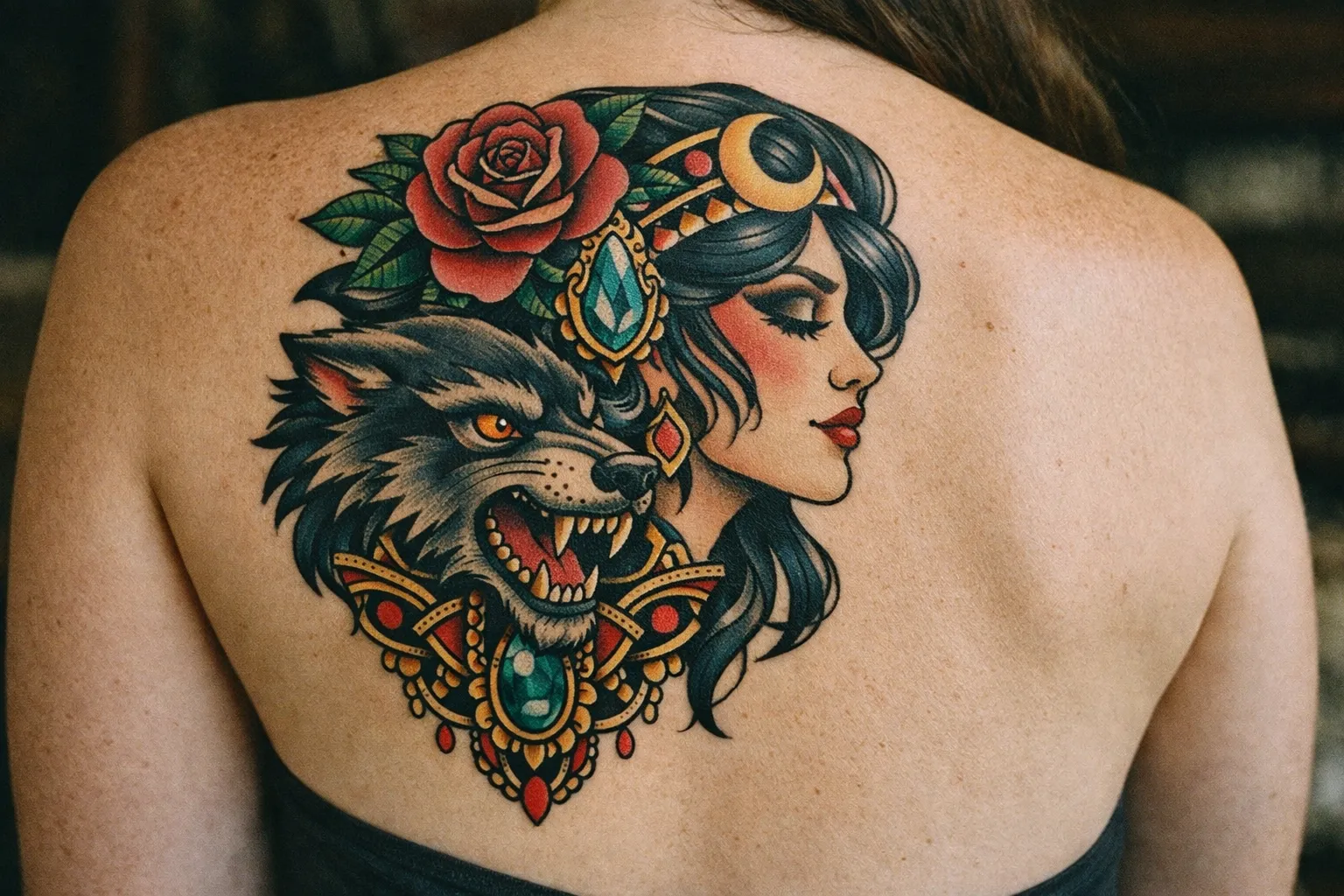
The spelling doesn’t matter. “Neo traditional,” “neo-traditional,” and “neotraditional tattoo” are treated as interchangeable in booking forms and portfolio tags across major tattoo platforms. You’ll see all three; they mean the same style. And that neo traditional style sits in its own category in most professional portfolios, filed separately from realism and new school, not as a sub-tag of either.
To be clear about what it is not: this is not realism (no photographic rendering), not Japanese irezumi (a different lineage entirely), and not new school (no cartoon exaggeration or neon-only palette). It borrows the dimensional feel of illustration while keeping the graphic backbone of old-school work.
The Art Movements Behind the Aesthetic
Style guides consistently cite Art Nouveau, Art Deco, and Ukiyo-e printmaking as the art-historical influences behind neo-traditional composition. Each shows up in a specific way.
Art Nouveau brings organic line, botanical motifs, and decorative borders. This is why so many neo-trad pieces frame their subject in flowing floral ornament rather than a bare field. Art Deco contributes geometric structure and symmetry to framing and background elements. Ukiyo-e contributes a compositional sensibility: strong silhouette, flat decorative planes, subject framing, rather than the Japanese tattoo tradition itself. It’s the print aesthetic borrowed for how a subject is staged, not the irezumi rulebook.
Practically, these references explain why neo-trad tends toward a portrait-like focal subject surrounded by ornament, instead of American traditional’s icon-on-a-field approach. The subject is the star; the ornament builds the world around it.
Neo Traditional vs. American Traditional: The Specific Differences
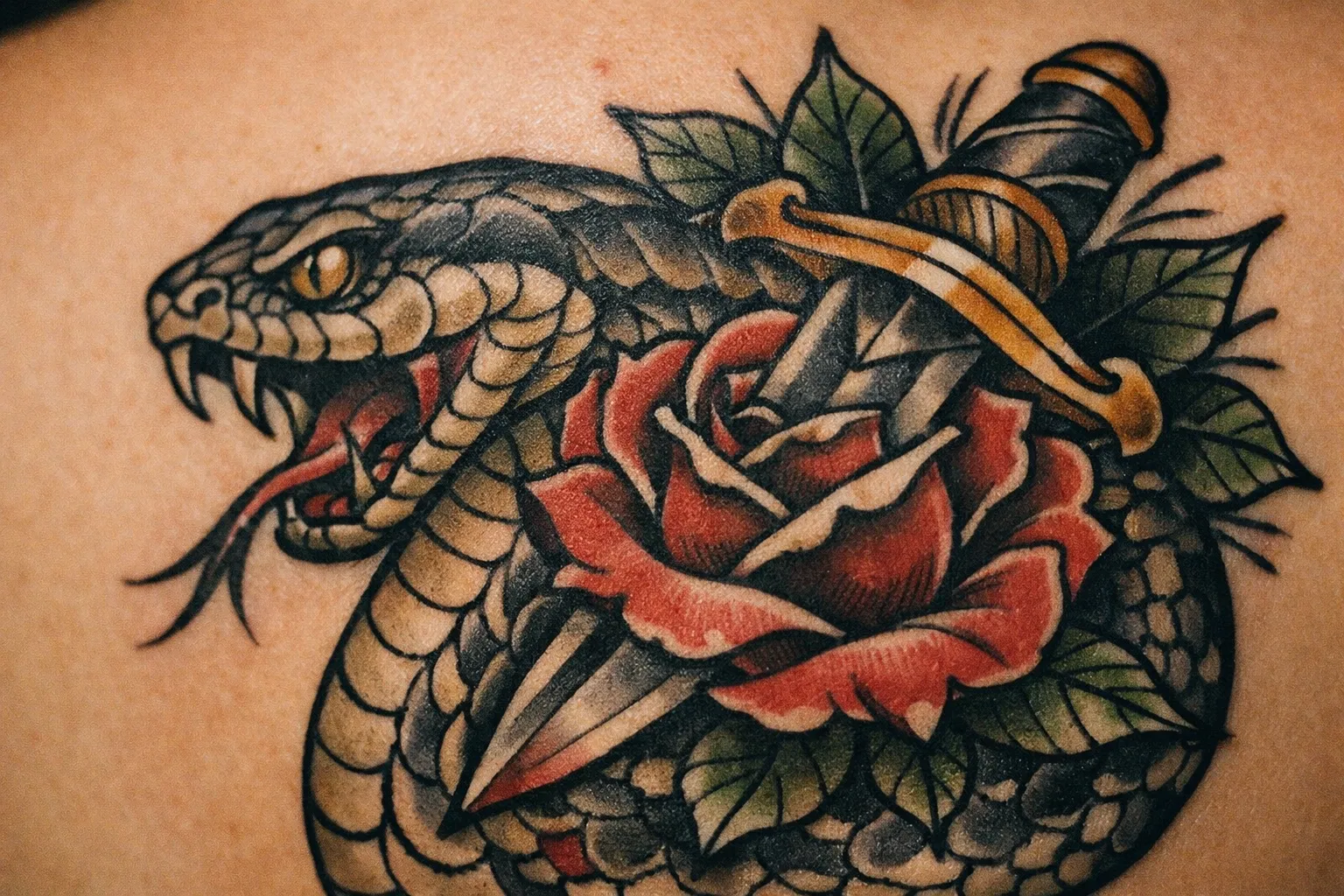
The single most visible difference between the two styles is line weight. American traditional uses one line weight throughout, commonly a single-pass 7 to 9 round liner, with no tapering. Neo-traditional uses a hierarchy: a heavier outer contour, medium internal lines, and fine detail lines, all in the same piece. The working principle is a graduated range: heavier outer contours, medium internal lines, and finer detail lines; that variation is what your eye reads as depth.
The other four differences follow from that.
Palette: American traditional works within a strict five-color logic (red, yellow, green, black, plus occasional blue or brown) with flat, saturated fill. Neo-traditional pulls in secondary hues, muted earth tones, and jewel tones (deep teals, burgundies, golds), with blended transitions between colors rather than hard color blocks. Shading: American traditional is flat fill with a hard black shadow block; neo-traditional models form with midtone gradients, deliberate highlight areas, and soft transitions that create the illusion of volume. Composition: American traditional places an icon against a field, while neo-traditional builds illustrative compositions with foreground/background relationships and ornamental framing. And aging behavior: flat fill holds its edges predictably, while neo-trad’s softer gradients and finer interior lines are more susceptible to blur, which is exactly why the size minimums in this style matter more.
Neo Traditional vs. American Traditional at a Glance
Neo Traditional vs. American Traditional at a Glance
| American Traditional | Neo Traditional | |
|---|---|---|
| Line weight | Single weight (7-9 RL) | Hierarchical (11 RL outline → 3 RL detail) |
| Palette | 5 core colors, flat fill | Extended palette, blended transitions |
| Shading | Flat fill + hard shadow block | Dimensional gradients, midtone modeling |
| Composition | Icon on field | Illustrative, ornamental framing |
| Minimum workable size | about 2-3 inches for simple motifs | ~palm size for detailed subjects |
| Aging profile | Very predictable; flat fill holds | Detail-dependent; gradients soften over time |
| Typical time (medium piece) | About 1-2 hours | About 2-3 hours |
For a full breakdown of American traditional rules and sleeve planning, see our American traditional tattoo guide. If you want the same iconography with more color and depth, neo-trad is where those neo traditional tattoo designs live: same wolf, same rose, but modeled instead of flat.
The Line Weight Hierarchy: Why It Matters More Than You Think
Neo-traditional’s three-tier line weight system is the rule that defines how the style is executed. The outer contour is the heaviest line in the piece and does the structural work: it’s what holds the composition together. Internal lines define major forms (petals, fur, feathers) at a medium weight. The finest lines handle texture and detail, and they’re the most vulnerable to blowout or blur.
Variable line weight is the mechanical reason neo-trad looks dimensional without being realism. Your eye reads heavier lines as closer and lighter lines as receding. That depth cue is built into the linework before any color goes down, which is why a good neo-trad piece already looks three-dimensional in its outline stage.
Here’s the risk: the finer the interior line, the more precise the needle depth has to be. Blowout happens when ink spreads into deeper layers of the skin because the needle went too deep or the area was overworked, and it hits the thinnest interior lines disproportionately. If you want the full mechanics of why that happens and how to spot it, read our tattoo blowout guide. For neo-trad specifically, blowout doesn’t just fuzz a line: it collapses the depth illusion those variable weights were built to create.
That’s also the test for choosing an artist. Ask to see healed work at least 12 months old where the fine interior lines are still distinct from the midtone shading. That separation is the whole skill. If an artist’s healed portfolio shows interior lines that have already merged into the shading, the line-weight execution isn’t controlled enough for this style.
What “Controlled Linework” Looks Like in a Healed Piece
Fresh neo-trad always looks sharper than healed, as is true of every tattoo. The real question is how much it softens.
In a well-executed healed piece, the outer contour is still crisp, the midtone gradients still read as gradients (not muddy patches), and the finest detail lines are still distinct even if slightly softened. The red flags in a portfolio are the opposite: interior lines that have merged into the shading, or gradients that have gone flat and patchy. If the healed examples show those problems, the piece was either underworked, overworked, or too small for its detail level.
The Palette: Beyond the Classic Five Colors
American traditional’s five-color logic exists for a reason. The classic scheme survived because a narrow set of hues (red, yellow, green, black), laid down flat and solidly packed behind a heavy outline, holds its edge for decades. Neo-traditional deliberately moves away from that, which is a trade-off, not a flaw.
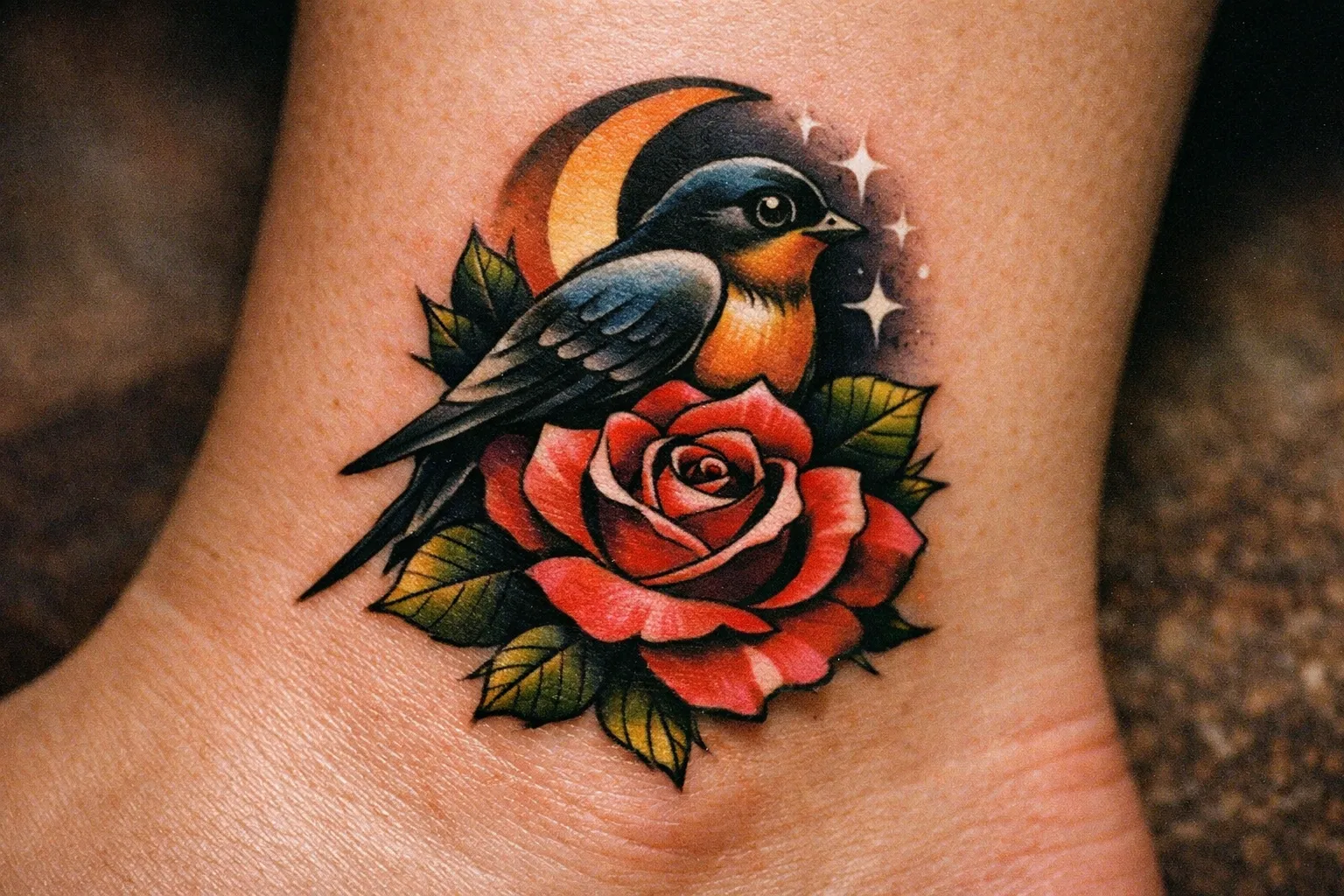
The neo-trad palette runs to jewel tones (deep teal, burgundy, amber, forest green), muted earth tones (ochre, dusty rose, warm grey), and blended transitions between adjacent hues. That’s the “Victorian velvet” quality people describe without explaining it: rich, layered color that models form instead of just filling it. A single petal might run from deep burgundy at the base to a lighter rose at the tip, with a warm highlight worked in. That gradient is what creates the dimensional look, and it’s also what makes the palette more complex to execute and more sensitive to aging.
The aging reality is worth stating plainly. Mixed secondary and tertiary colors use more complex pigment blends, and those are more susceptible to visible fading or hue shift under UV than dense black or strong primaries. Blended color transitions soften over time more than flat fills do. The gradient doesn’t vanish; it compresses. Which is why the value structure (dark darks, deliberate light areas) matters more for longevity than the exact hues you pick. Every color desaturates eventually; strong darks stay legible longest.
So if longevity is your priority, favor higher-contrast color choices within the neo-trad palette, such as deep jewel tones against lighter skin areas, over subtle, low-contrast gradients that have less room to soften before they read as muddy.
How Neo Traditional Tattoos Age: The Honest Version
Neo-traditional ages better than fine line or watercolor, but it’s more detail-dependent than American traditional. The bold outer contour holds the composition together even as interior detail softens. The structure survives; the fine texture is what’s at risk.
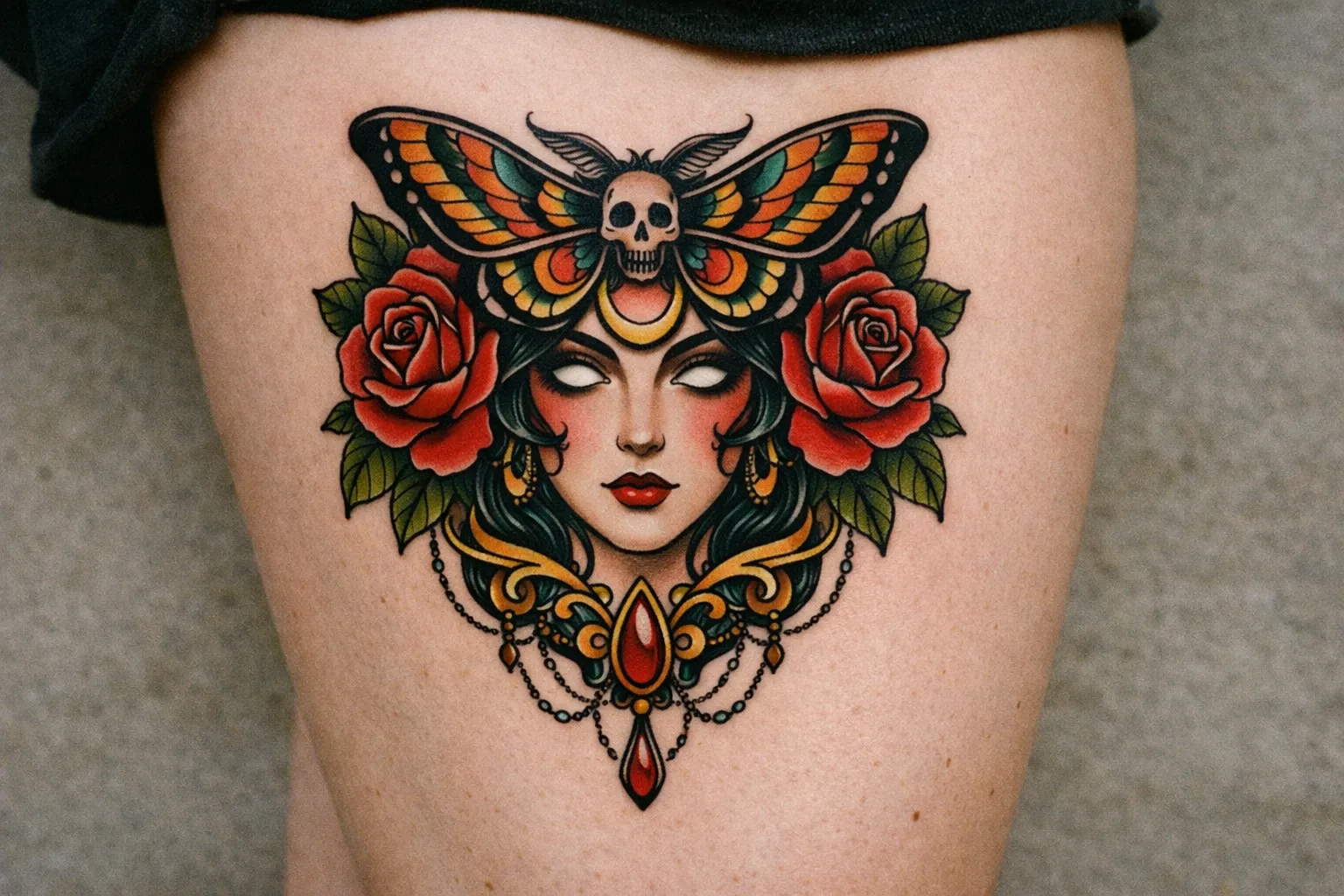
What actually softens over the years: the finest interior lines (fur, feather, texture detail), the subtlest color gradients, and any ornamental micro-detail packed into a small area. Dermatology sources explain the mechanism: ink particles are held in the dermis by immune cells, and over years those cells migrate and get replaced, which gradually blurs fine detail while larger shapes stay legible. The detail doesn’t disappear. It compresses and softens slightly, which reads as “softer” rather than “ruined”, provided the value structure was strong to begin with.
Size is the deciding factor. A neo-trad piece that was correctly sized, at palm-scale minimum for detailed subjects, ages into a slightly softer version of itself. A piece that was too small ages into a muddy version of itself: the ornament merges, the gradient goes flat, the face loses definition. Same style, same artist, different outcome, entirely because of scale.
Sun exposure is the accelerant. UV breaks down color pigments faster than anything else, and research on tattoo pigments reports visible fading and color shift within a few years on unprotected tattoos compared with covered areas. The American Academy of Dermatology advises applying a broad-spectrum, water-resistant sunscreen of SPF 30 or higher to tattooed skin whenever you are in the sun, 15 minutes before going out and reapplied at least every two hours (7). Apply it to any neo-trad piece whenever it’s exposed: a forearm piece that sees daily sun without it will show measurable color shift within a few years.
Two more honest notes. First, the 12-month test: fresh neo-trad always looks its sharpest, so ask your artist for healed examples at least 12 months post-completion. That healed portfolio is the only truthful preview of long-term results. Second, touch-ups: budget one touch-up between months 3 and 12, since saturated reds, yellows and light blues lose vibrancy first, then a color refresh roughly every 8 to 12 years, sooner in areas with high sun exposure or friction.
Which Design Choices Age Best
- High-contrast value structure, meaning a dark outline, midtone modeling and deliberate light areas, outlasts low-contrast subtle gradients.
- A single strong focal subject with supporting ornament outlasts a crowded multi-subject composition at the same size.
- Jewel tones and saturated hues hold better than pastels or very muted, low-saturation colors. Cosmetic tattoo research has documented that lighter, low-saturation pigments fade sooner than densely packed darker pigments under routine UV.
- Simpler ornamental backgrounds age better than dense micro-detail backgrounds.
Size, Placement, and Why Designs Need More Room
Here’s the minimum, stated plainly: designs with faces, animal anatomy, or ornamental framing need at least palm size, roughly 4 × 4 inches (about 10 × 10 cm), to preserve internal detail through healing and aging. Below that, the gradient and the ornament start competing for the same space, and both lose.
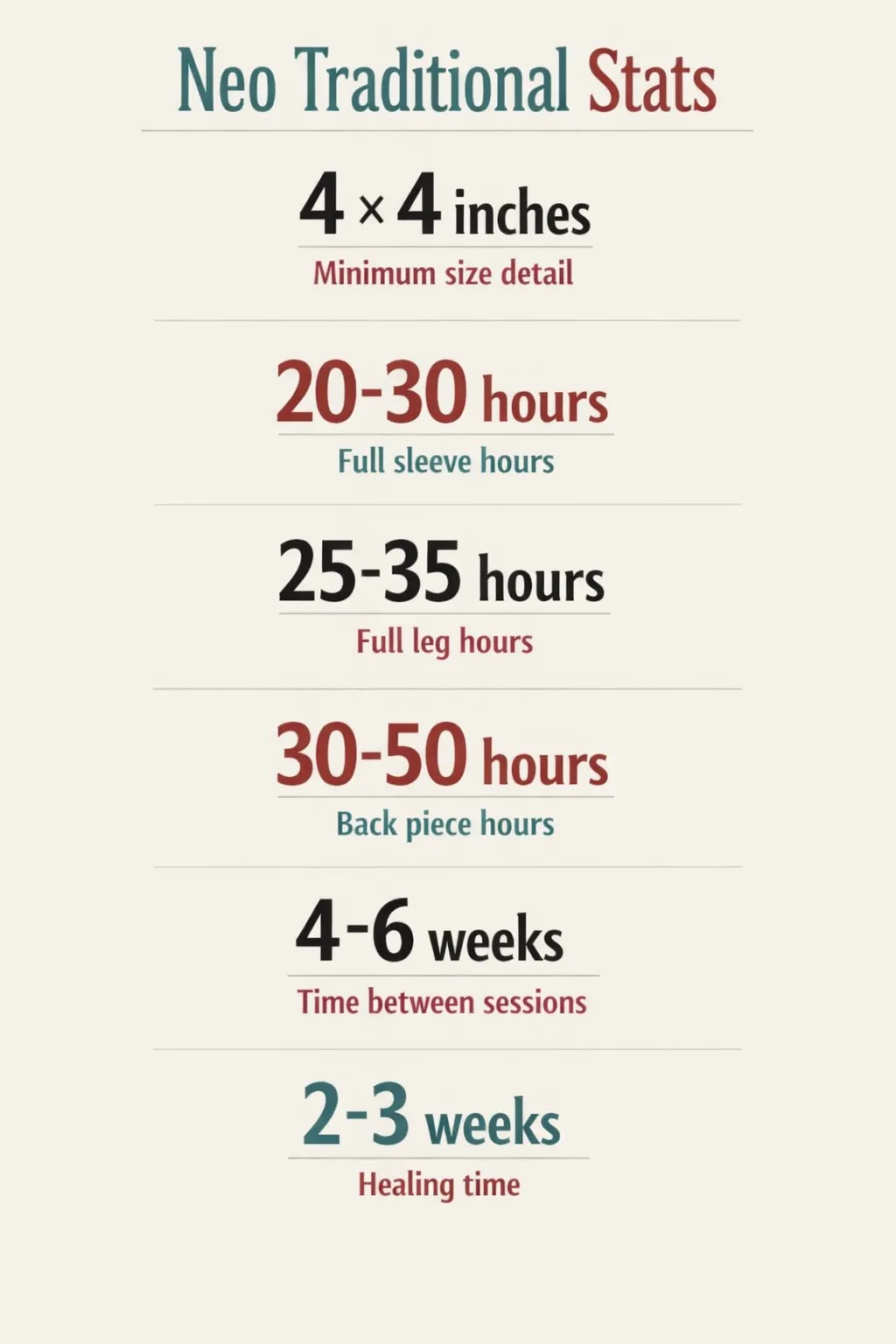 Neo-Traditional metrics: palm-size detail (4 × 4 inches), sleeve 20-30 hours, leg 25-35 hours, back piece 30-50 hours, 4-6 weeks between sessions, 2-3 weeks healing.
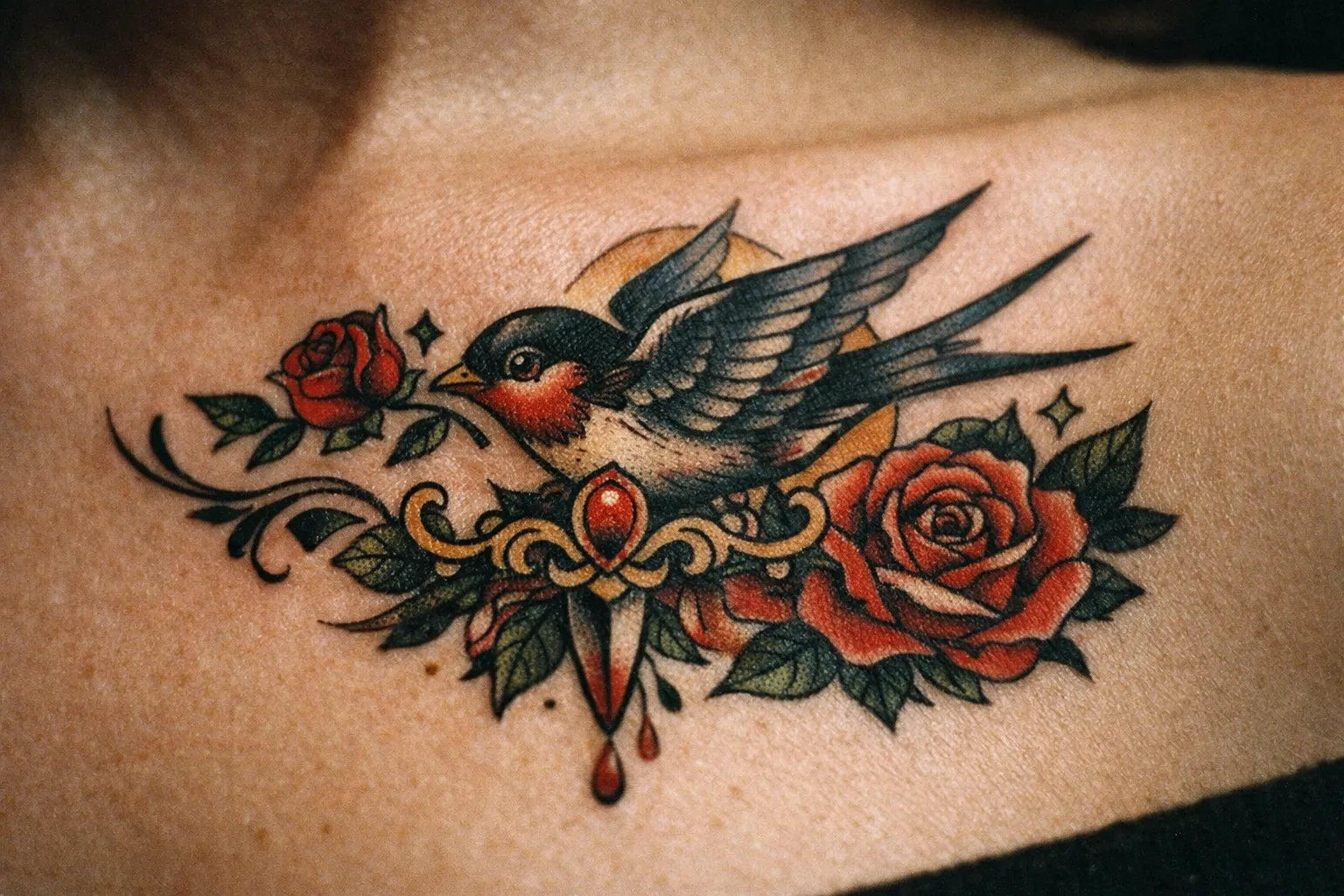
The reason the minimum runs higher than American traditional isn’t the subject: it’s the interior detail. A neo-trad wolf head carries midtone modeling, fur texture, and often ornamental framing, all of which need physical room to stay distinct. The same wolf in flat American traditional fill holds together at 2 to 3 inches because there’s no gradient to compress. Strip out the modeling and you can go smaller; keep it and you can’t.
I’ve seen clients push back on this more than almost anything else. They bring in a reference at 2 × 2 inches and want to know why I won’t just scale it down. The answer is always the same: the detail you’re paying for is the first thing that disappears when the canvas is too small.
Best placements for dimensional work, and why:
- Upper arm / outer bicep: a large, flat, low-movement canvas with good visibility. This is the default recommendation for a first neo-trad piece.
- Outer forearm: excellent visibility and relatively stable skin, good for portrait-orientation subjects at 6-8 inches. The inner forearm works too but sees more sun.
- Thigh: the largest single canvas on the body, ideal for complex multi-element compositions or portrait-scale pieces.
- Calf: good for vertical compositions; slightly more movement than the thigh but still stable.
- Upper back / shoulder blade: excellent for large pieces, and the low sun exposure helps color longevity.
Placements to approach carefully with this level of detail:
- Ribcage / sternum: the pain is significant (ribcage runs noticeably hotter than the forearm on every honest pain comparison) and the skin moves with breathing. Workable for experienced collectors, not the place to start.
- Inner elbow / back of knee: high-flex zones where fine interior lines soften faster.
- Hands, fingers, feet: high friction and fast skin turnover. Neo-trad’s fine interior detail degrades here faster than a bold traditional piece would.
Size Guide by Subject Type
For planning your neo traditional tattoo ideas around a realistic scale:
- Single animal head or portrait, no background: minimum 4 × 4 inches; upper arm or outer forearm.
- Animal or figure with ornamental framing: minimum 5 × 6 inches; upper arm, thigh, or outer forearm.
- Full compositional piece with background: minimum 6 × 8 inches; thigh, upper back, or full forearm.
- Sleeve panel or connected multi-subject piece: plan in sections; a full sleeve runs 20-30 hours across 3-5 sessions.
The through-line: match the detail level to the canvas. One strong focal subject with supporting ornament, sized correctly, beats a crowded composition crammed onto a small area every time.
Session Count, Healing, and What It Actually Costs
Neo-trad is almost always a multi-session style once you add color layering and dimensional shading. A 4 × 4 inch piece, the practical minimum for this style, typically runs 2-3 hours; a 6 × 8 inch forearm portrait runs 4-6 hours, usually in one full-day session, though an artist who prefers to let the linework settle before packing colour will split it in two.
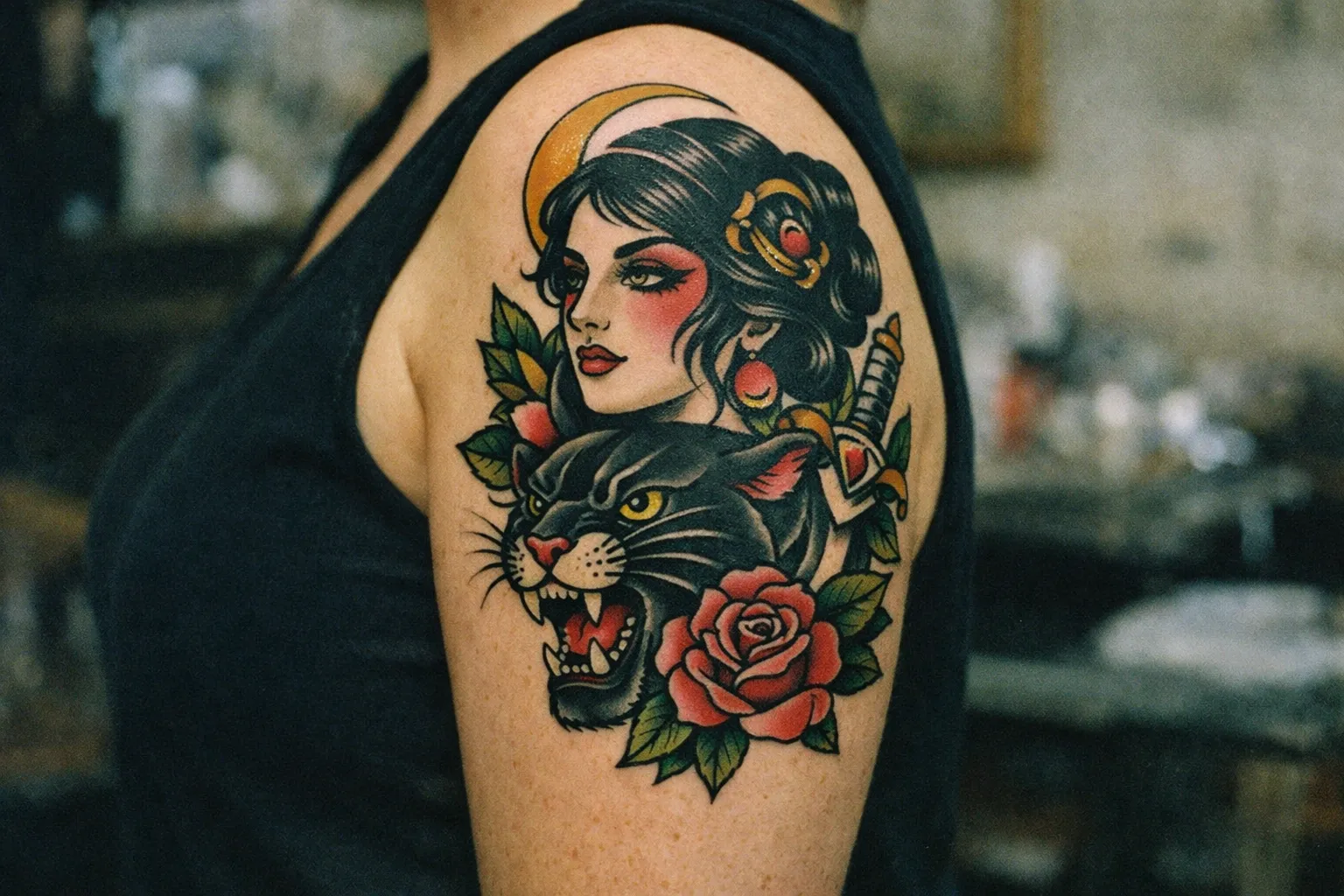
Larger projects scale up fast. A full sleeve runs 20-30 hours across 3-5 full-day sessions. A full leg piece runs roughly 25-35 hours across 4-6 sessions, and a back piece 30-50 hours across 5-8 sessions. On any large project, most artists ask for four to six weeks between major sessions, because the surface heals in about 2-3 weeks, but deeper layers need longer before more color is packed into adjacent areas.
On cost: rates split by artist tier rather than by region. A journeyman colour artist with a solid book runs $150-220 per hour, an established neo-traditional specialist $250-400, and a recognised name with editorial or convention work $400-700, often flat-rate only. Most established colour shops in the US, UK and Australia sit in the $180-350 band in 2026. Neo-trad carries a real premium over plain American traditional, where flat fill and a five-colour palette keep rates closer to $150-250, because of its technical demands and the relative scarcity of specialists. Translated into projects, sleeve pricing varies widely depending on region, artist profile, and color complexity, so get a written quote per session rather than relying on any single published range. The cost drivers are size, color complexity, and session count, not the subject matter itself.
What pushes the number up within neo-trad: dense ornamental backgrounds, fully shaded dimensional faces or animals, linked multi-panel compositions, and high color count. If you’re budget-conscious, the focal subject can still be fully neo-trad in feel while you reduce background density, lower the color count, and skip the most time-intensive micro-detail ornament.
Tipping. The industry norm is 15-25% of the session total, with 20% the standard benchmark for good work. On a multi-session project, tip at each session rather than waiting until the final appointment, because the artist is doing full work every time you sit down. On a $350 session, $50 is roughly 14%, just under standard; $70 to $88 lands in the 20-25% range.
The Linework-First Approach
Most experienced neo-trad artists do linework in session one, then return for color and shading in session two or later. The reason is healing: linework heals faster and more predictably, and packing color into unhealed skin risks patchy saturation and uneven gradients.
Between sessions, the linework will look stark and unfinished: just the outer contour and interior structure with no fill. That’s correct. Don’t judge the piece until the color is in; a bare neo-trad line stage always looks thinner than the finished result.
How to Choose a Neo Traditional Artist: What to Actually Look For
The portfolio test comes first: look for healed work at least 12 months old. Fresh neo-trad always looks sharper than its long-term state, so a feed that’s 100% fresh tattoos with no healed examples is a genuine gap, not a neutral one.
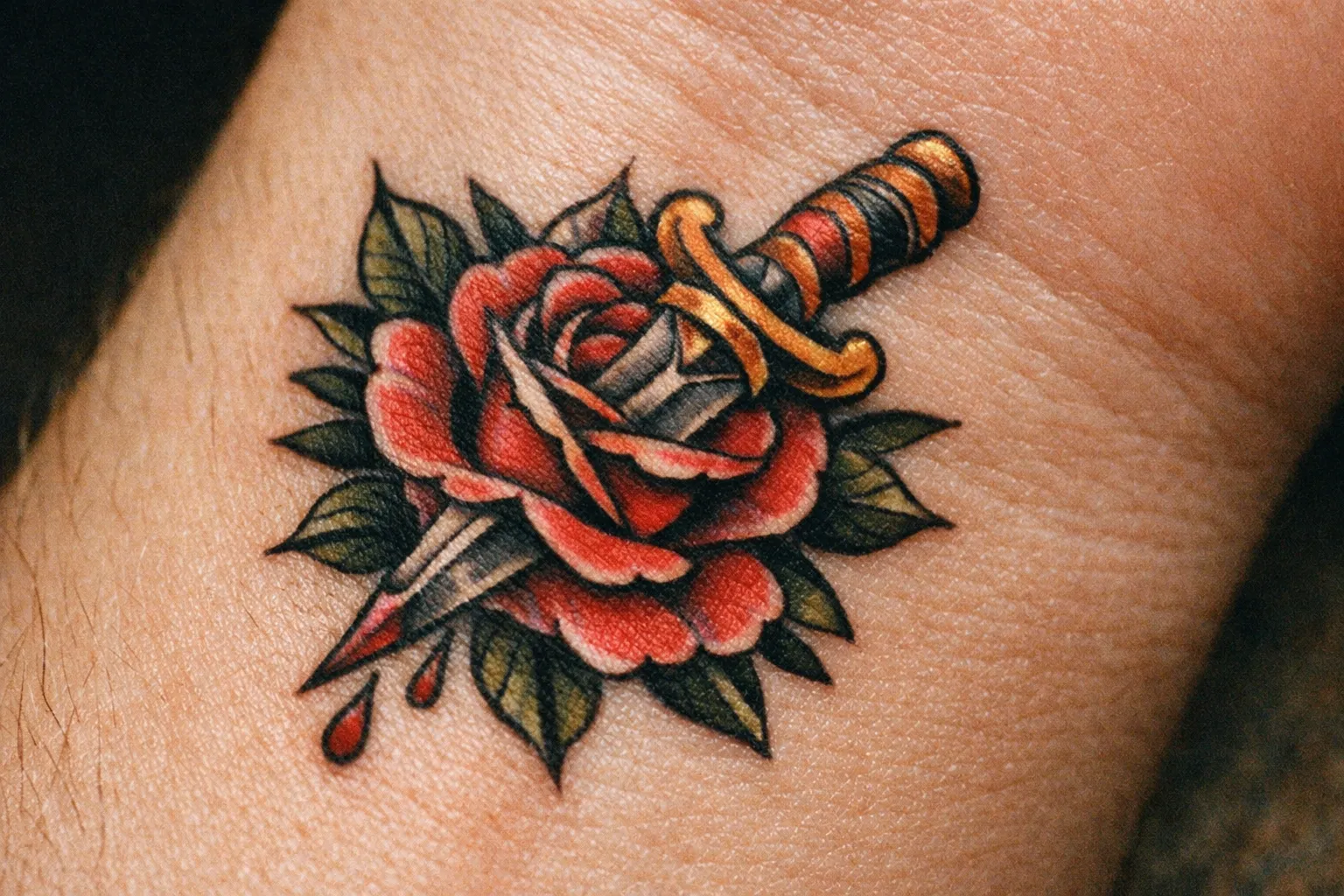
When you find healed work, examine three things. Are the outer contours still crisp? Are the gradients still readable as gradients, or have they gone flat and patchy? Are the finest interior lines still distinct from the shading? Those three answers tell you whether the artist controls saturation, transitions, and needle depth, the exact skills the style depends on.
A few more filters worth running through:
- Style specificity. Favor an artist whose portfolio is predominantly neo-traditional over a generalist who “also does neo-trad.” The style is technically specific and rewards focus.
- Red flags. Interior lines merged into shading in healed pieces, gradients gone patchy, or outer contours that have spread or blurred; the last one is possible blowout, and our tattoo blowout guide covers how to read it.
- Ask directly. Can they show you a healed piece at the size and complexity you’re planning? A healed 6 × 8 inch portrait is a far better reference than ten fresh 3-inch pieces.
- Waitlists. Sought-after neo-trad artists commonly run 1-6 month waitlists for medium pieces, longer for sleeves. Build that into your timeline rather than rushing to whoever’s available next week.
I’ve turned down clients who wanted to book me for neo-trad work that was outside what I could confidently execute at their requested scale. A good artist will do the same. If someone agrees to everything without asking about size, placement, or your healing history, that’s worth noticing.
How to Vet a Neo-Traditional Artist's Portfolio
15 minutesSteps to ensure your artist can deliver quality neo-traditional work that ages well.
- 1
Request healed examples
Ask for photos of tattoos at least 12 months old to see how the linework and shading hold up.
- 2
Examine linework clarity
Check that outer contours remain crisp and that fine interior lines are distinct from shading.
- 3
Assess shading quality
Look for smooth, readable gradients without patchiness or muddy areas.
- 4
Confirm style focus
Prefer artists who specialize in neo-traditional rather than generalists who occasionally do it.
- 5
Ask about waitlists and sizing
Ensure the artist understands the size and placement requirements for your design and be prepared for wait times.
Frequently Asked Questions
Frequently Asked Questions
- What is a neo traditional tattoo?
- A neo traditional tattoo keeps American traditional's bold outline but adds a wider palette, dimensional shading, and illustrative composition influenced by Art Nouveau and Art Deco.
- What's the difference between traditional and neo traditional tattoos?
- Neo-traditional uses variable line weights and graduated shading with a broader palette, while traditional uses one line weight and flat saturated colors within a strict five-color scheme.
- What are the rules for neo traditional tattooing?
- Core rules include a bold outer contour, variable interior line weights, dimensional shading, an extended palette, larger minimum size, multi-session execution, and stable placement.
- Is $50 a good tip for a $350 tattoo?
- A $50 tip is roughly 14% of $350, slightly below the 15-25% industry standard; $70-$88 better matches the 20-25% range for good work.
- How well do neo traditional tattoos age?
- They age better than fine line or watercolor but softer interior lines and gradients blur over time; proper size, placement, and sun protection are key.
- How many sessions does a neo traditional tattoo take?
- Medium pieces take 2-3 hours, often in one or two sessions; full sleeves require 20-30 hours over 3-5 sessions with healing time between.
- What placements work best for neo traditional designs?
- Upper arm, outer forearm, thigh, calf, and upper back provide stable, flat canvases; high-flex and high-friction areas degrade fine detail faster.
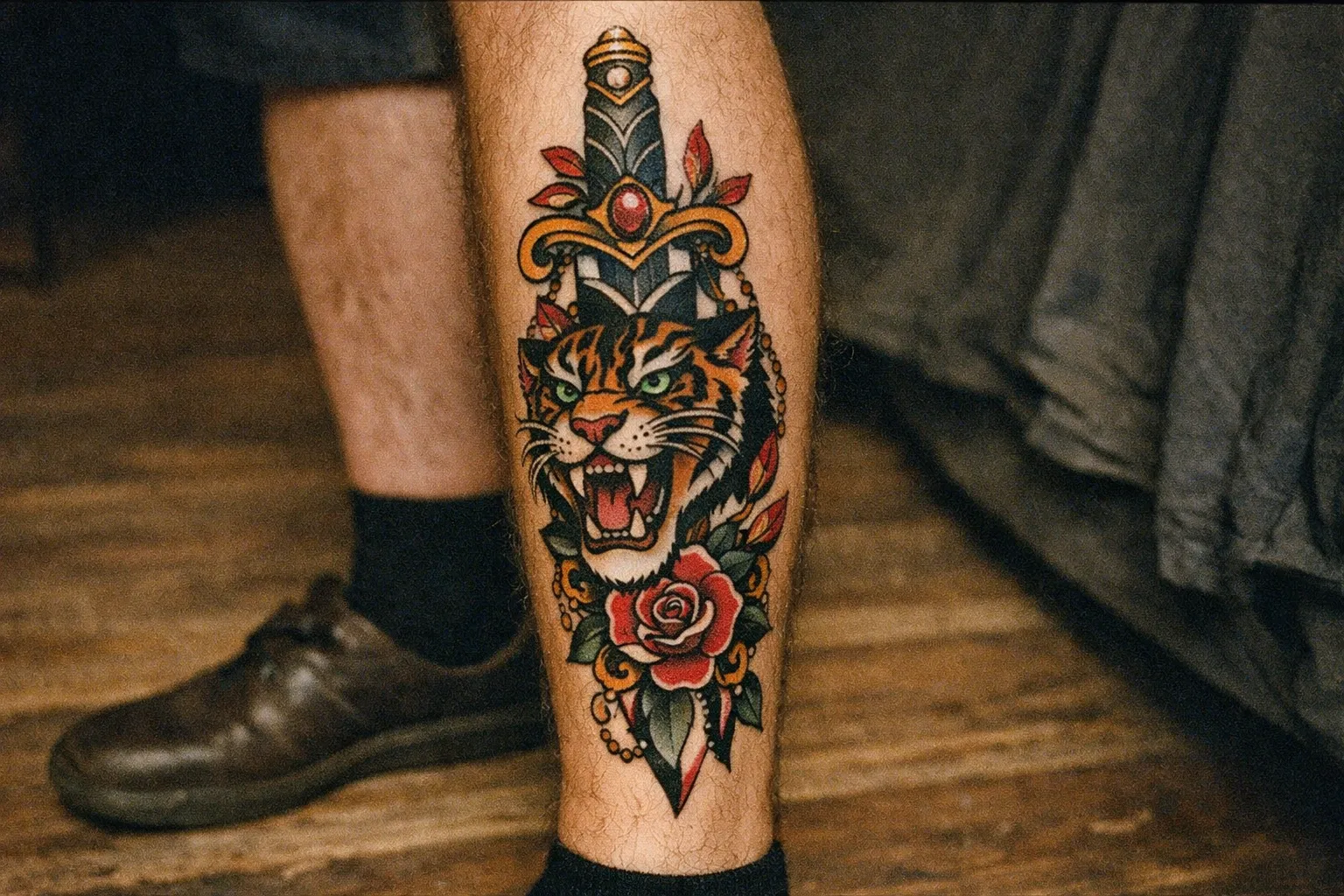
The Decision Comes Down to Size, Placement, and Your Artist’s Healed Portfolio
Neo-traditional gives you more palette range, more depth, and more compositional complexity than American traditional, but it asks for more canvas, more sessions, and a more technically specific artist in return. That’s the whole trade.
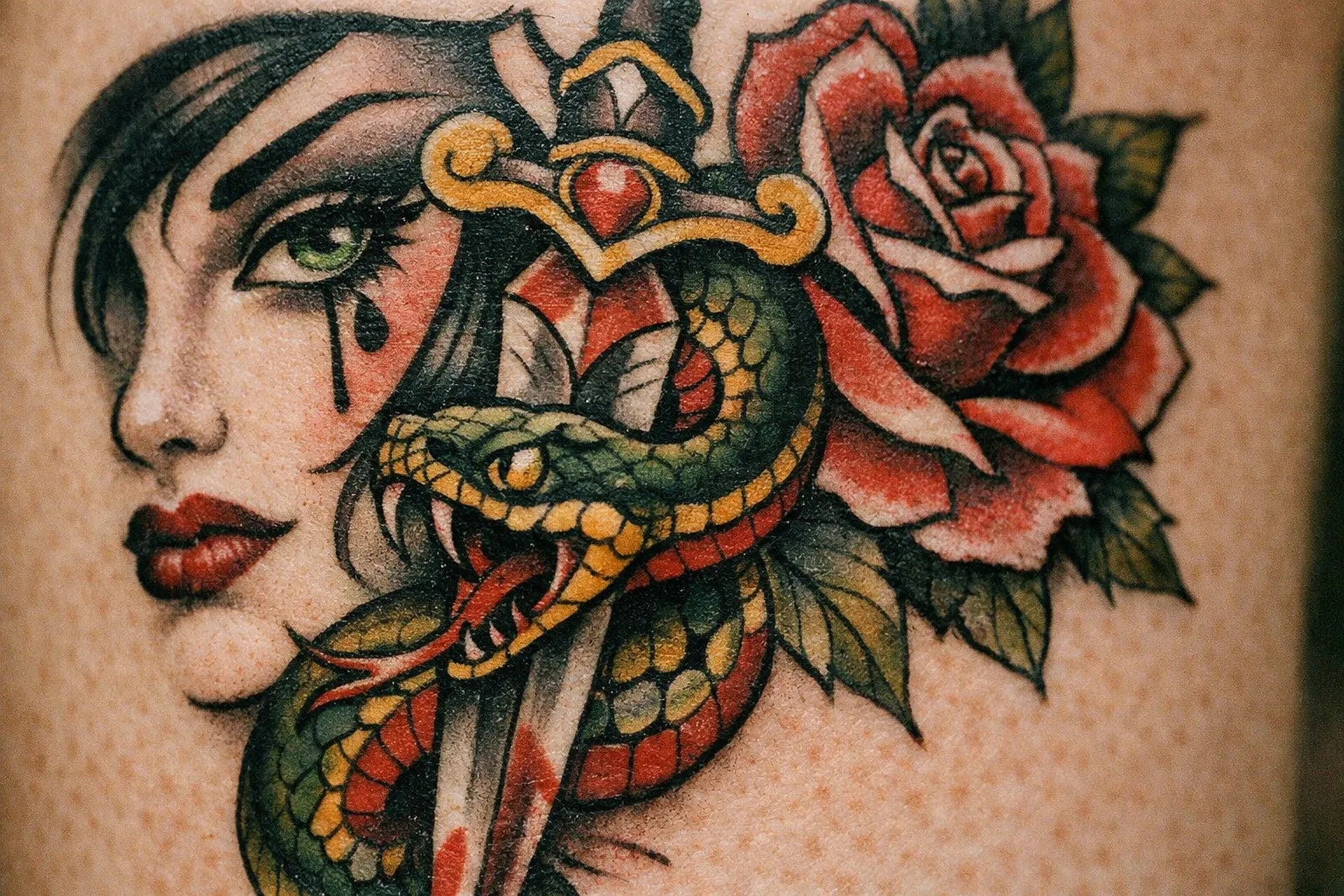
Three things decide whether a piece holds up: correct minimum size for its detail level (palm-scale for anything with a face or fine texture), stable placement away from high-flex and high-friction zones, and an artist whose healed portfolio shows controlled gradients and distinct interior lines at 12 months and beyond. Miss any one of those and the detail you paid for softens into mud faster than it should.
If you’re torn between traditional and neo-traditional, let the aging question settle it. Traditional is simpler and more predictable over decades. Neo-trad is richer and more illustrative, but the detail is only as durable as the execution and the canvas it sits on. Before you book anything, look at healed work, not fresh, at the size and complexity you actually want.