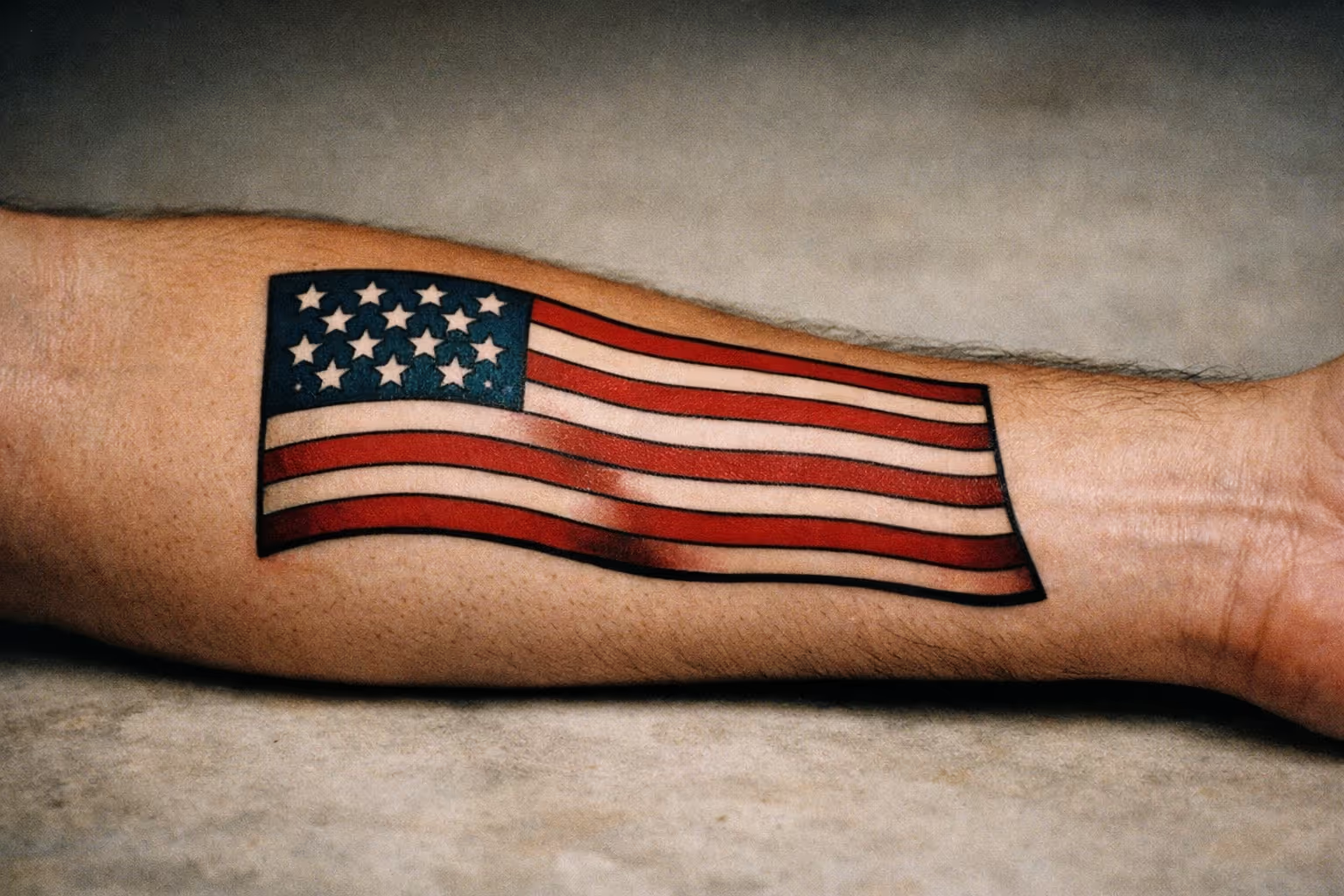
An American flag tattoo hides two technical traps behind a simple image. The stars: pack fifty of them into anything under three inches and they heal into a navy blob, no matter how good the artist is. The reds: on the forearm especially, they dull within a few years without diligent sun protection. Size and placement decide whether the flag stays sharp or goes muddy. Here’s how to plan one by size, style, and placement before you book.
What the American Flag Tattoo Actually Means
An American flag tattoo can carry a variety of meanings, and it’s important to recognize that there is no single fixed interpretation before you commit to the design.
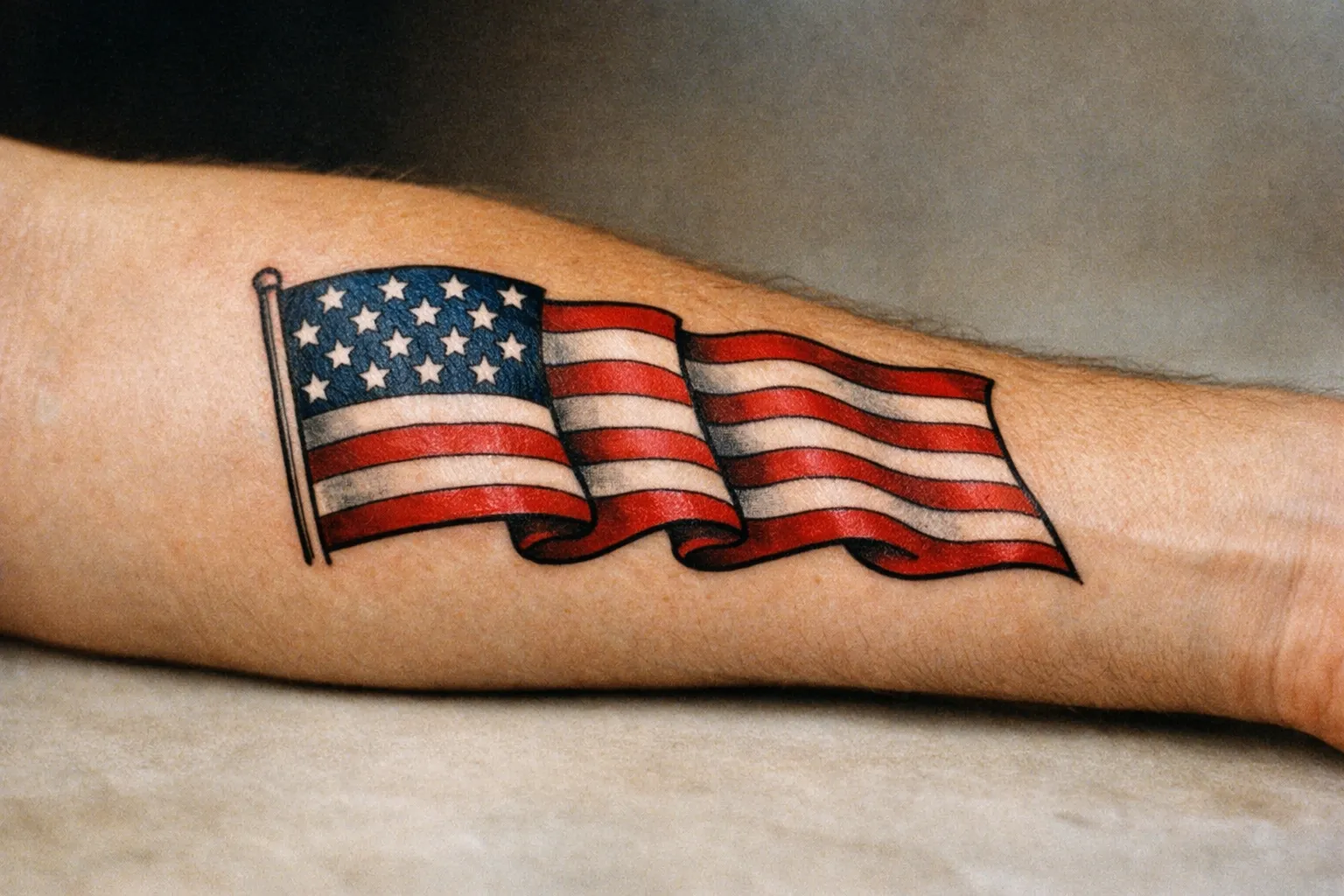
For most people, the flag reads as patriotism - love of country, full stop. But it carries more weight than that depending on who’s wearing it. Active-duty military, veterans, and first responders make up a large share of flag tattoo clients, and they often pair the design with unit insignias, dog tags, or specific dates of service. In those cases the flag is a memorial - for a fallen squadmate, for 9/11, for a deployment that changed something.
The flag also shows up in immigration narratives. A naturalized citizen might pair the Stars and Stripes with their country of origin to mark a life split between two places. And depending on what surrounds it - a raised fist, a date, a slogan - the same flag can read as protest or as a marker of civil rights progress rather than uncritical pride.
Be clear with yourself and your artist about which of these you mean. A flag with a dog tag and a date says something different than a flag with a clenched fist. The imagery you stack around it changes the message completely.
The Colors and Their Symbolism
Each color in the flag carries meaning that shows up in the tattoo whether you ink it in full color or black-and-grey:
- Red symbolizes valor and hardiness.
- White signifies purity and innocence.
- Blue stands for vigilance, perseverance, and justice.
Those associations are commonly cited in American tradition, but they originate from commentary on the Great Seal of the United States - not from the U.S. Flag Code or any original flag legislation. The Flag Code says nothing about color symbolism. That distinction matters if someone asks you what your tattoo “officially” means - there’s no official answer, just a well-worn tradition. Some wearers add a personal layer - one star per state they’ve lived in, or per family member who served. That kind of detail works best when it’s planned into the star field from the start, not crammed in afterward.
One technical caution before you fall in love with the color: red ink fades faster than black under UV exposure. On a sun-hit forearm, that vivid red can dull noticeably within a few years. If long-term legibility matters to you, factor that in before you choose a full-color piece.
Eagle and Flag: The Classic Combo
The flag-plus-bald-eagle combination is one of the highest-frequency requests in this category, and it makes sense - the eagle reads as strength and freedom, which mirrors what most people are reaching for with the flag itself.
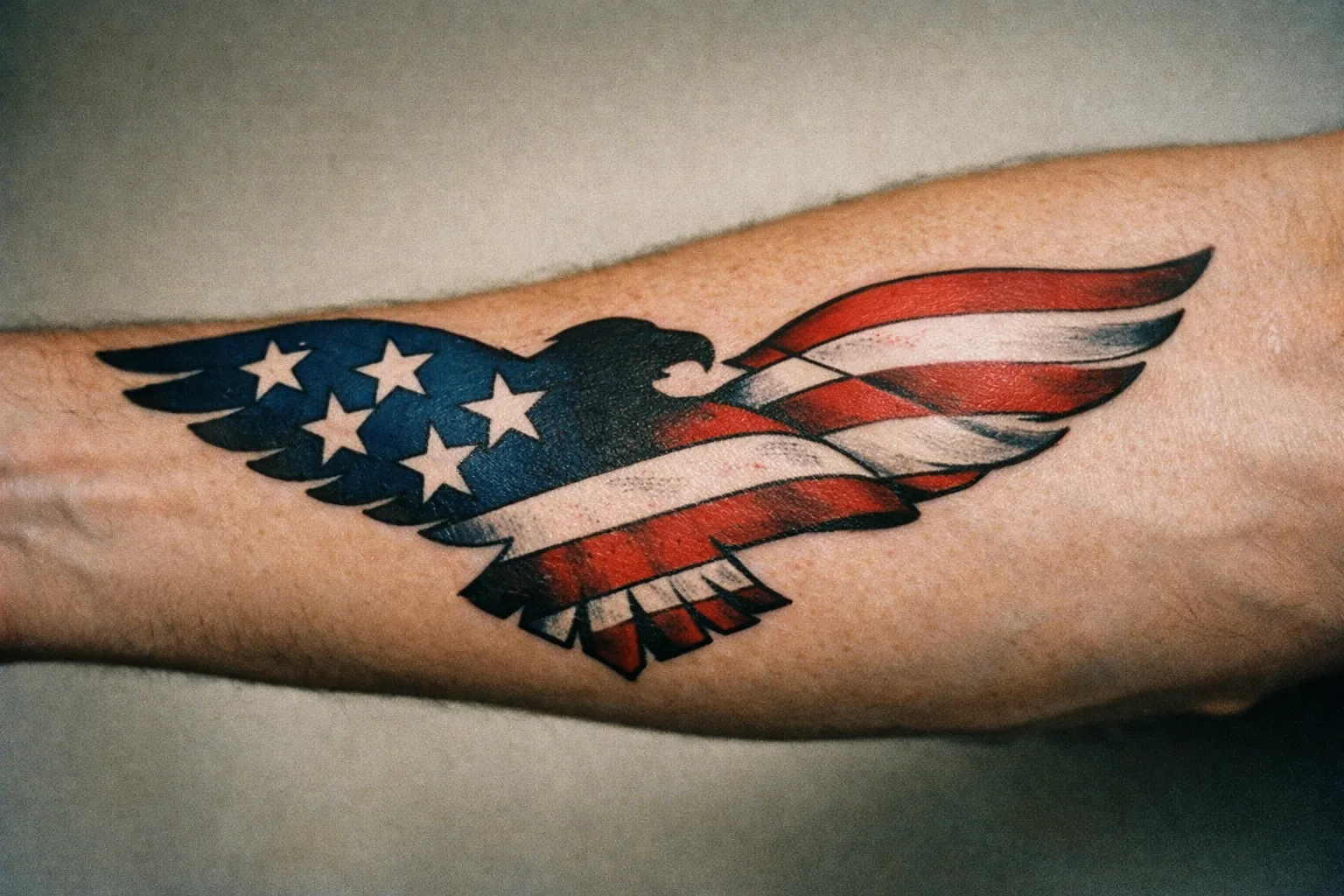
Technically, this is a space-hungry design. An eagle with a believable wingspan runs 6-10 inches across, which pushes it onto the upper arm, chest, or back rather than a narrow forearm. The two hallmarks of a strong eagle-and-flag piece are a clean separation between the bird’s feather detail and the flag’s geometry - you don’t want the eagle’s wing muddying the stripes - and a clear focal hierarchy, where either the eagle or the flag dominates rather than the two competing for attention.
The common pitfall: cramming a fully spread eagle, a waving flag, a banner of text, and a date into a single half-sleeve. From more than a few feet away, that reads as a brown smudge. If you want all those elements, plan a full sleeve, not a crowded half.
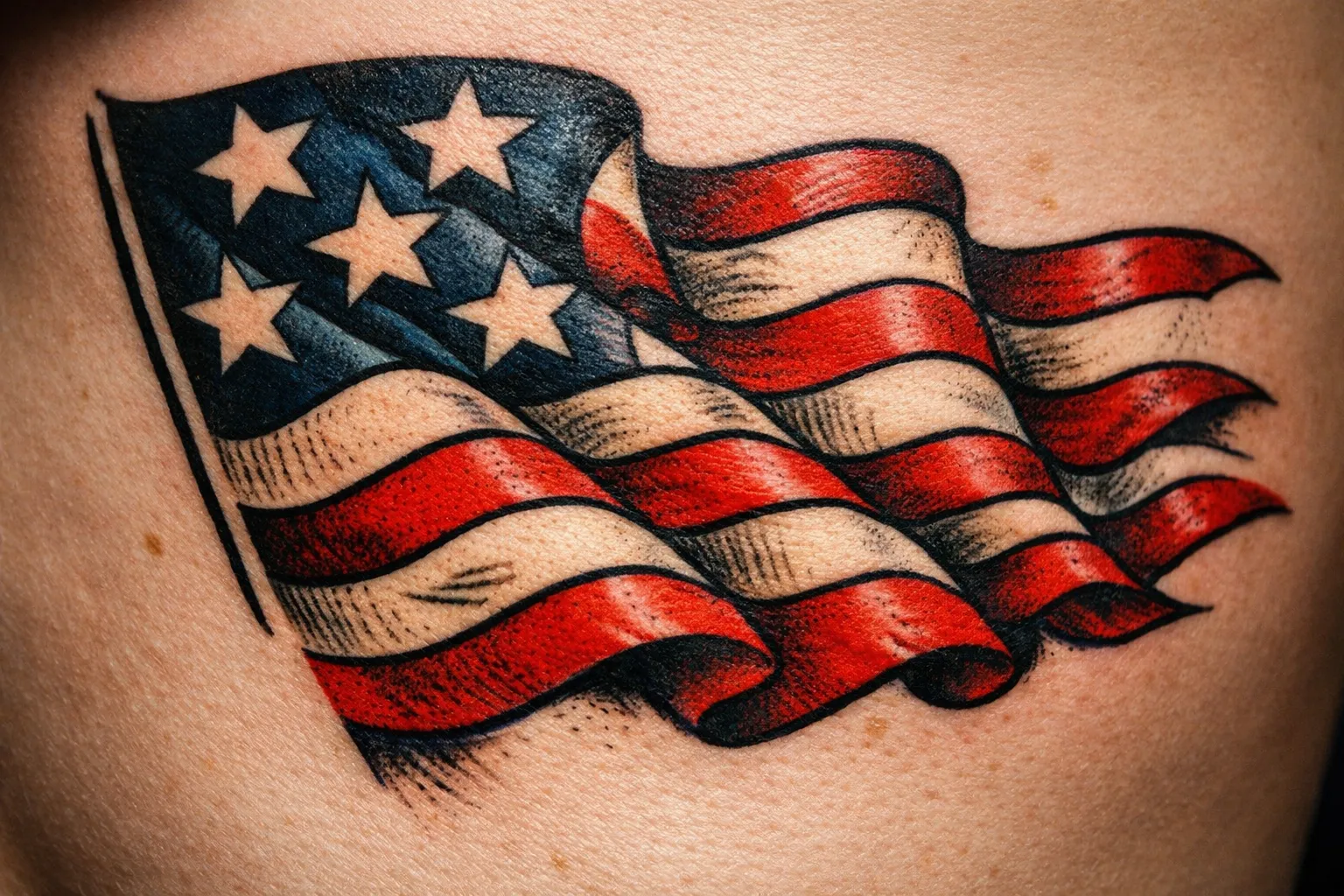
For an American traditional take - thick black outlines, a limited palette of saturated red and blue, simplified stars - the eagle-and-flag combo is a natural fit. Bold linework holds up as skin shifts, which is why I keep recommending traditional for clients who want something that still looks sharp in twenty years.
Planning a Full Flag Sleeve
A full American Flag tattoo sleeve typically wraps the flag around the triceps and biceps, with the star field sitting near the shoulder and the stripes flowing down toward the wrist. There’s room for folds, texture, secondary elements like an eagle or service insignia, and script.
Be realistic about the commitment. A detailed sleeve is not a one-sitting project:
- Session 1: outline plus major black shading - the structural base.
- Session 2+: color and secondary elements, added after the base has healed for 3-4 weeks.
Total time runs 8-20 hours over 2-5 sessions, and cost commonly lands between $1,000 and $2,500+ depending on your city and the artist’s seniority. Established artists charge $120-$200 per hour; realism and memorial specialists often run $200-$300+ per hour.
One placement detail I see people get wrong: aligning the stripes perpendicular to the bicep. Every time you flex, the wave distorts. Stripes should follow the natural flow of the muscle - it’s a rookie error that no amount of shading fixes after the fact.
Worth noting for 2026: the patchwork sleeve trend means you don’t have to give the whole arm to one flag. A 2-3 inch rectangular flag “patch” can sit as one tile among nature motifs, script, and nostalgia flash. That approach lets the sleeve evolve over time instead of locking you into a single patriotic theme from the start.
The Ripped Flag in Black and Grey
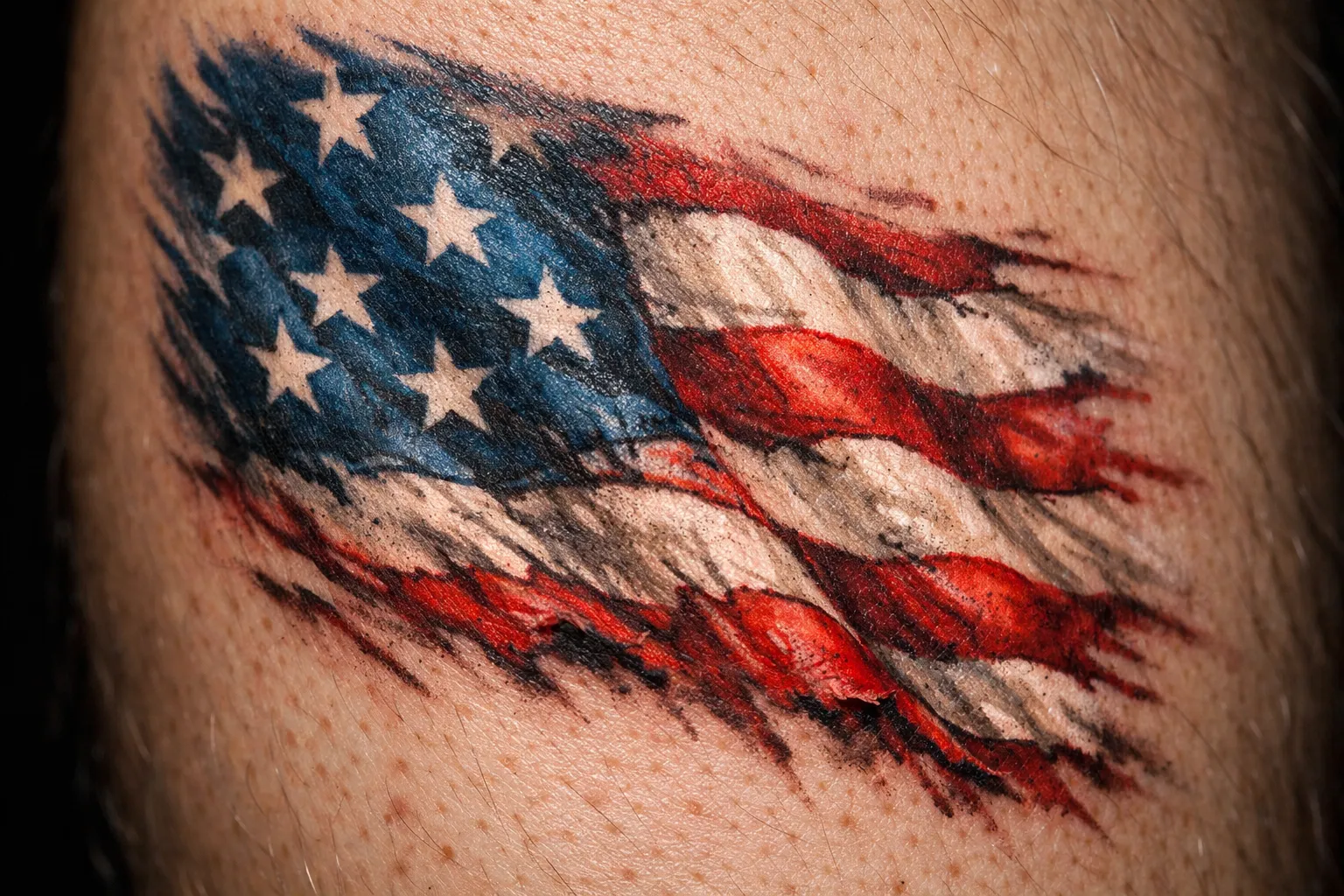
The black ripped American Flag tattoo sells an illusion: torn skin or torn cloth peeling back to reveal the flag beneath, usually rendered in heavy black-and-grey with negative-space stripes. It’s one of the most requested blackwork variations, and blackwork’s durability makes it a smart long-term choice.
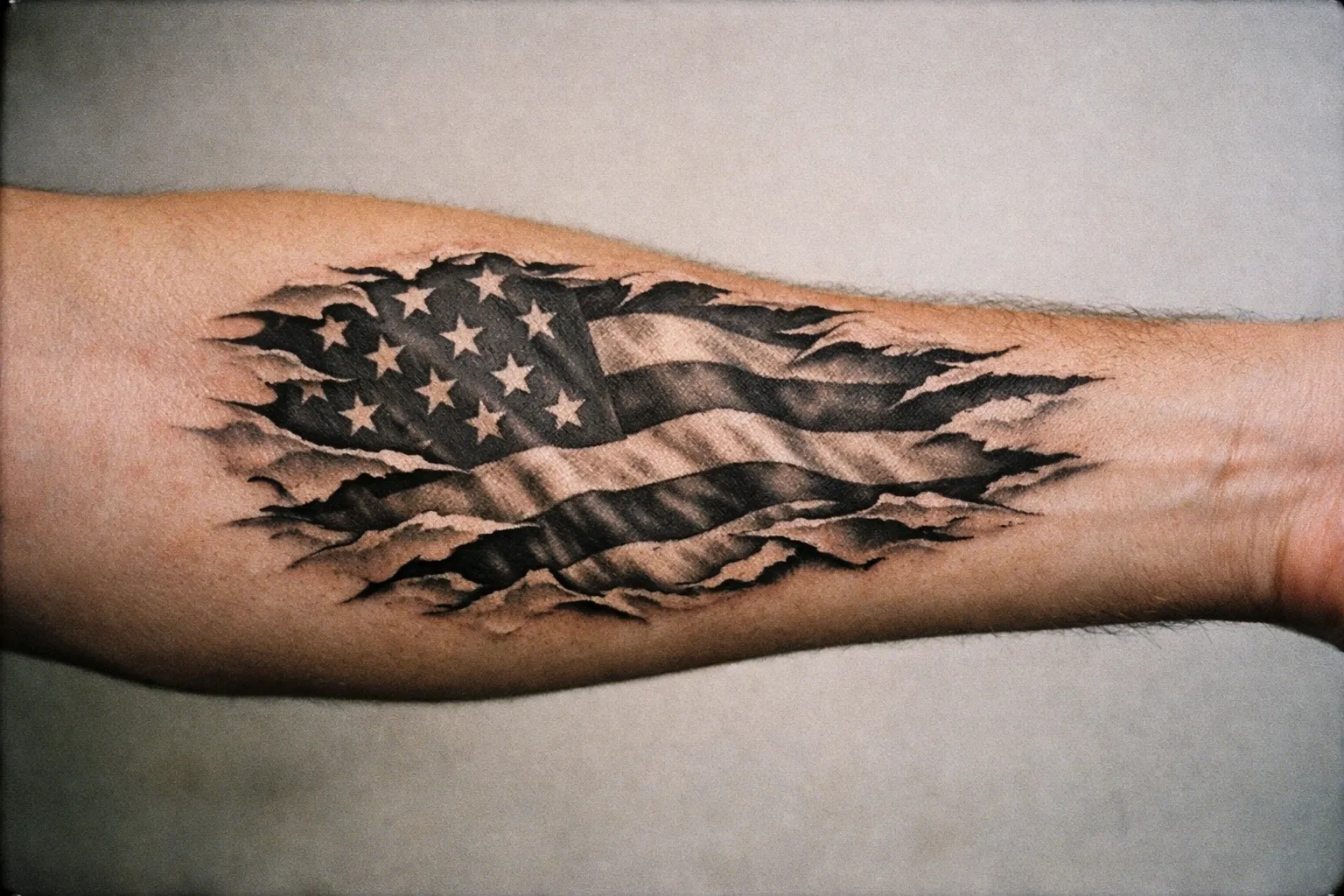
Pulling it off depends entirely on shading. The artist has to build believable depth - convincing shadows under the torn edge, a clean gradient where the “skin” lifts away - or the whole effect collapses into a flat graphic. This is advanced-artist territory. When I’m evaluating portfolios for clients considering this style, I always look at healed examples, not just fresh ones, because torn-skin work that looks crisp on day one can blur badly if the shading was overworked.
Place it where there’s room for the detail: biceps, chest, or back. A ripped flag crammed onto a small 3-inch patch loses the depth that makes it work.
One honest caveat on symbolism. A ripped, distressed, or burning flag splits opinion. Some read it as honoring battle-worn service and sacrifice; others read damage to the flag as disrespect, and the U.S. Flag Code does specify that a physical flag shouldn’t be defaced. Many shops - especially in conservative regions - decline burning-flag or flag-underfoot designs outright. If the torn look is meant to honor service, say that clearly. Intent is worth discussing before the needle starts.
Putting the Flag on Your Forearm
The forearm is the most-searched placement for a reason: high visibility, a natural landscape orientation, and enough room to show star detail without committing to a full sleeve. An American Flag forearm tattoo typically runs 4-7 inches long, with the flag “waving” toward the wrist.
For pain, the forearm sits on the gentler end of the scale - far more tolerable than ribs or sternum. The inner forearm is more sensitive than the outer, but most people handle a forearm flag in a single sitting without much drama.
Sizing matters for the stars. A flag under 3 inches with a full 50-star field will heal into a cluster of indistinct blobs - the stars are simply too small to hold definition as skin settles. Below that threshold, a good artist will hint at the star pattern through negative-space clusters rather than outlining every star individually. If you want crisp, readable stars, give them room.
Black-and-grey holds up especially well on a sun-exposed forearm, where full-color red is most prone to fading. If you’re after longevity over flash, a black-and-grey forearm flag with negative-space stripes is the durable pick.
American Flag Tattoo Ideas by Style
The same flag reads completely differently depending on the style you choose. Here’s how the main approaches break down, with the American Flag tattoo ideas that suit each:
- American traditional - Thick black outlines, saturated red and blue, simplified stars. Two hallmarks: bold linework and a deliberately limited palette. Best for smaller forearm or upper-arm flags and the classic flag-with-eagle combo. Ages better than almost anything else. Pitfall: thin, timid outlines that don’t hold up past a few years.
- Realism / micro-realism - Detailed fabric folds, light reflections, texture. Needs 5+ inches to give the stars space. Improved needles and pigments now let artists tuck mini realistic flags into larger compositions - inside a dog tag, on a helmet.
- Blackwork / black-and-grey - Heavy shading, negative-space stars, torn-skin illusions. Ages well and matches the dominant 2026 blackwork trend (2).
- Fine-line / minimalist - An outlined flag with minimal shading, sometimes suggesting only 3-5 stripes. Lower cost, subtle, and popular with first-timers.
For the colors and folds of a realism flag, a good artist photographs an actual folded U.S. flag under studio lighting to map where the highlights and shadows fall. That’s how you avoid flat, lifeless stripes - and it’s a question worth asking your artist directly if you’re going realism.
Placement Beyond the Forearm
The forearm and sleeve get most of the attention, but placement should follow your meaning and how visible you want the piece.
Chest and over the heart is the common choice for memorial flags - a fallen service member’s name and dates beneath the Stars and Stripes. These pieces run large, 8-12+ inches, and the chest gives room for that scale. Pain here is moderate to high, especially over the sternum - noticeably more demanding than the forearm.
Calf and shoulder blade suit dynamic eagle-and-flag scenes that need vertical space. The shoulder’s rounded surface works well for circular emblems - a shield combined with the flag, for instance.
Behind the ear, wrist, or ankle can hold a small fine-line flag, but accept the tradeoff: at 1-2 inches, a full star field won’t survive. Keep micro-flags simple. High-friction spots like the wrist and ankle also tend to fade faster and need touch-ups sooner than most placements.
If you’re early in a career, think about clothes before you commit to a placement. Many shops decline neck, hand, and face flag tattoos for first-timers, citing employment concerns. A placement that disappears under a short sleeve protects both your professional options and the tattoo from UV.
✓ Pros
- Wide range of styles from traditional to minimalist suits many tastes
- Strong cultural and personal symbolism, especially for veterans and immigrants
- Blackwork styles offer durability and longevity
- Forearm placement balances visibility and manageable pain
✗ Cons
- Red ink fades faster on sun-exposed skin, especially forearms
- Complex designs like eagle and flag combos require large placements and multiple sessions
- Distressed or ripped flag designs can be controversial and may be declined by some shops
- Small flags under 3 inches lose star detail and clarity
Are There Rules for Flag Tattoos?
There’s no law that regulates what you tattoo on your own body. The U.S. Flag Code (4 U.S.C.) governs physical flags - it says a flag shouldn’t be defaced, worn as apparel, or dipped - but two things are worth knowing: first, it does not cover tattoos at all; second, the Flag Code is advisory, not criminally enforceable. There are no federal penalties for civilians who violate it, and the Supreme Court has repeatedly protected flag-related expression under the First Amendment. Legally, you can ink any flag design you want.
The real rules are practical and ethical:
- Get the details right. The flag has 13 stripes and a star field of 9 rows alternating 5 and 6 stars. Veterans and history-aware viewers notice a wrong star count or a random layout immediately. A sloppy flag undercuts the whole point.
- Respect studio and community norms. Many shops won’t tattoo a burning flag, a flag underfoot, or heavily defaced designs - especially in conservative areas - to avoid offending clients and staff.
- Age and ID. Most U.S. states set the minimum tattoo age at 18, with some allowing 16-17 with parental consent. ID is universally required.
If you want a distressed or battle-worn flag, the design isn’t illegal - but it invites interpretation, so it’s worth talking through intent with your artist before you commit.
How Big Is a $100 Tattoo?
At most U.S. studios, the shop minimum runs $80-$120 in mid-size cities and up to $150-$200 in major metros and prestige studios. A $100 budget generally buys a 1-2 inch simple design - an outline or basic blackwork flag, or a small minimalist piece - without full color realism or complex shading.
Here’s how flag sizes map to cost in practice:
- Small linear flag (1-2 in), wrist or behind the ear: $80-$150.
- Palm-sized forearm flag (~3-4 in): $150-$300, depending on color, realism, and artist reputation.
- Half-sleeve flag with shading and secondary elements: $400-$800.
- Full color flag sleeve, shoulder to wrist: $1,000-$2,500+.
One practical reality: $100 won’t get you a detailed, individually-starred flag. If crisp stars matter, budget for at least a 3-inch design - anything smaller and the star field blobs together as it heals regardless of how much you paid.
What Tattoos Are Gen Z Getting?
Gen Z is steering away from large traditional flash toward fine-line, micro-realism, and custom script. Applied to the flag, that shows up as a few distinct patterns:
- Small fine-line flags - an outlined flag, often suggesting just 3-5 stripes, paired with a handwritten date or short motto.
- Micro-flags inside larger compositions - a tiny detailed flag tucked into a dog tag, a patch, or a patchwork sleeve rather than dominating an arm.
- Patch-style flags - a 2-3 inch rectangular flag as one tile in a collection of nature, script, and nostalgia motifs.
The thread running through all of these is restraint. Placement that stays covered by standard work attire is a recurring priority - it protects professional flexibility and shields the ink from UV fading. Younger clients ask about that tradeoff more than any other generation I’ve worked with.
Mexican-American and Italian-American Flag Designs
For people whose roots cross borders, a fused-flag design can carry that dual identity in one image.
A Mexican-American flag tattoo typically blends the Stars and Stripes with the eagle-devouring-a-snake-on-a-cactus emblem from the Mexican flag. The American side often signifies opportunity and a life built in the U.S.; the Mexican side honors ancestral roots and tradition. Together they map a migration story across generations.
An Italian-American flag tattoo merges the Stars and Stripes with Italy’s green, white, and red tricolor. Full color gives a vivid contrast; monochrome ink keeps it understated. You can push the personalization further with a family crest or a regional motif - a Venetian mask, a Roman column.
For these fusion pieces, larger placements like the upper arm or back give you room to keep both flags legible. If you want it small - wrist or ankle - simplify both flags rather than trying to fit full detail into a couple of inches.
Related Interests and Companion Designs
A flag tattoo rarely lives alone in someone’s collection. If you’re saving flag designs, these motifs tend to travel with them:
- Bald eagle tattoos - the most common pairing, and a frequent standalone for the same patriotic crowd.
- Military insignia - dog tags, rank markings, and unit patches, often layered into memorial flag pieces.
- Patriotic script and quotes - service dates, deployment coordinates, or a short motto under the flag.
- Faith elements - a cross, dove, or scripture line, common in regions with strong religious communities.
A useful move: instead of crowding the main flag, add one small layered detail - a single dog tag, a date, a set of coordinates - to carry the personal meaning. It reads cleaner and ages better than a banner stuffed with text.
Aftercare and Healing
Flag tattoos lean heavily on saturated color and fine detail, so aftercare directly affects how the piece holds up. Red ink in particular fades fast if you neglect it.
Day 1-3: Keep the wrapping on as long as your artist advises, then wash gently with a fragrance-free antibacterial soap, pat dry, and apply a thin layer of tattoo ointment. Expect some redness and weeping. Don’t pick at anything.
Week 1: Switch to a light, fragrance-free moisturizer once the initial weeping stops. Flaking and itching are normal - let it flake off on its own. Keep it out of direct sun and out of pools, lakes, and baths.
Week 2-4: Primary healing wraps up around days 7-14, but color and texture keep settling. Stay out of direct sun on the fresh tattoo; once it’s healed, use sun-protective clothing or sunscreen over it long term, especially on a forearm. UV is the single biggest enemy of those flag reds and blues.
Skipping moisturizer or exposing fresh color to direct sun in the first two weeks is the fastest way to premature fading. The whole point of a sharp flag is the contrast between the stripes - protect it.
American Flag Tattoo Aftercare
4 weeksStep-by-step care instructions to preserve color and detail in your flag tattoo.
- 1
Day 1-3: Initial Care
Keep the wrapping on as advised, wash gently with fragrance-free antibacterial soap, pat dry, and apply a thin layer of tattoo ointment. Avoid picking at scabs.
- 2
Week 1: Moisturizing Phase
Switch to a fragrance-free moisturizer once weeping stops. Let flakes fall naturally. Avoid sun exposure and water immersion like pools or baths.
- 3
Week 2-4: Healing and Protection
Continue avoiding direct sun on the fresh tattoo. After healing, use sun-protective clothing or sunscreen to prevent fading, especially on forearms.
Making the Decision
Before you book, settle three things: the meaning you want the flag to carry, a size that lets the stars survive (at least 3 inches if you want them defined), and a placement that fits both the design and your life.
Forearm for visibility. Chest for a memorial. A covered spot if your career needs the flexibility.
Pick black-and-grey if longevity matters most, especially on sun-exposed skin. Pick American traditional if you want bold work that holds up over decades. Save the ripped-skin and full-color realism for an artist whose healed portfolio proves they can pull it off. And get the stripe count and star layout right - that’s the detail that separates a flag people respect from one they quietly notice is wrong.
Frequently Asked Questions
- Can I legally get any American flag tattoo design I want?
- Yes. The U.S. Flag Code governs physical flags but does not regulate tattoos. However, some studios may refuse certain designs based on community standards.
- Why do red inks fade faster on American flag tattoos?
- Red pigments are more prone to UV degradation, especially on sun-exposed skin like forearms, causing the color to dull faster than black or blue inks.
- What size should my flag tattoo be to keep star details clear?
- At least 3 inches in length is recommended to maintain star clarity; smaller flags risk the stars blurring into indistinct shapes.
- Are ripped or distressed flag tattoos considered disrespectful?
- Interpretations vary. Some see them as honoring sacrifice, others as disrespect. It's important to discuss your intent with your artist and consider shop policies.
- How does placement affect tattoo pain for American flag designs?
- Pain varies by location: forearms are relatively mild, chest and sternum areas are more sensitive. Choose placement based on your pain tolerance and visibility preferences.
- Can I combine the American flag with other cultural flags in one tattoo?
- Yes, fusion designs like Mexican-American or Italian-American flags are popular. Larger placements like upper arm or back help keep details legible.
- What aftercare products are best for American flag tattoos?
- Use fragrance-free antibacterial soap initially, then switch to fragrance-free moisturizers during healing, and protect healed tattoos with sun-protective clothing or sunscreen.