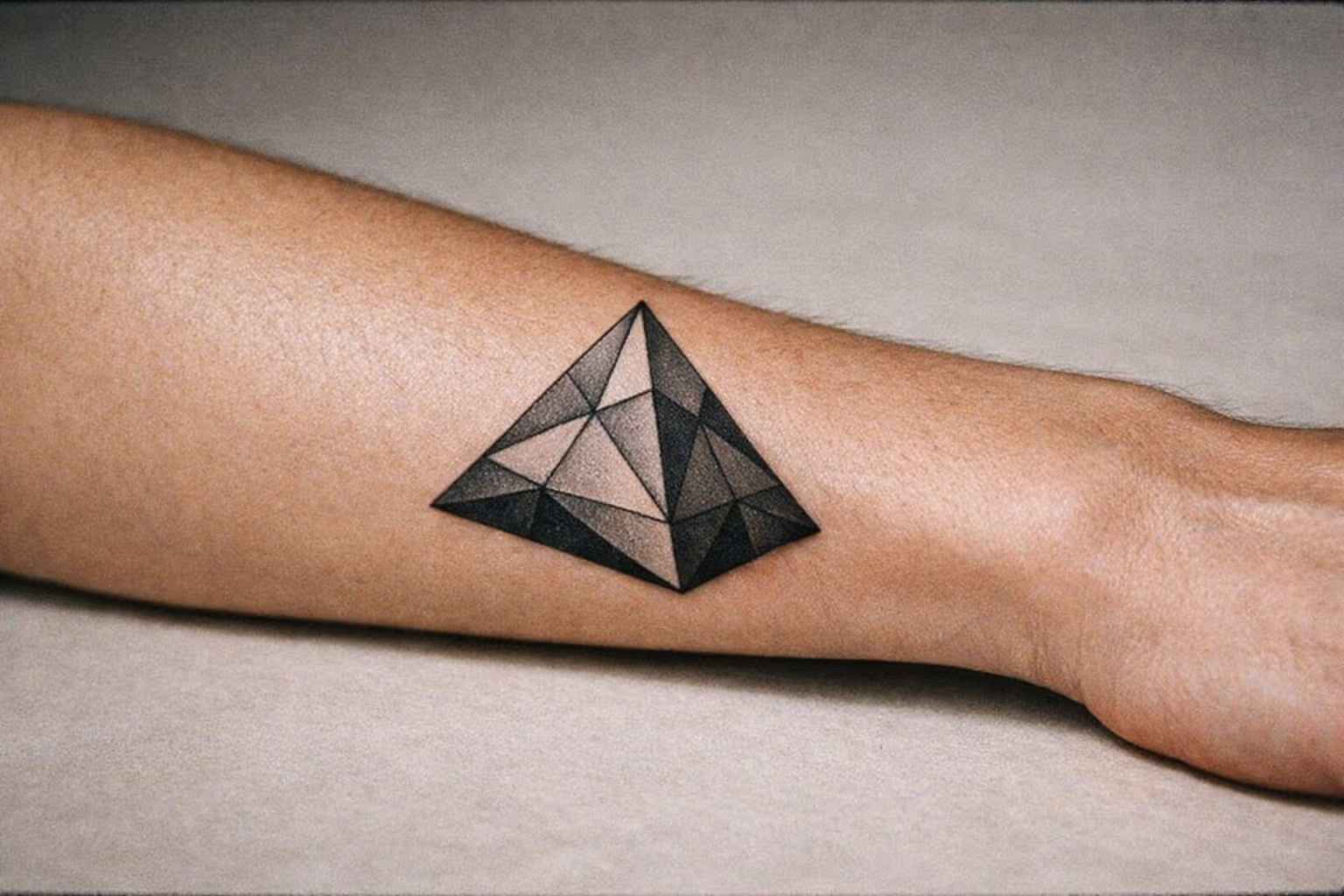
“Pyramid tattoo” points at three very different designs, and picking blind can hand you a meaning you never wanted. The Eye of Providence pyramid - the dollar-bill one - reads as vigilance or conspiracy depending on the crowd; an Aztec step-pyramid carries Mesoamerican weight; an Egyptian pyramid leans toward permanence and the afterlife. Each also has its own minimum size before the detail collapses. Here’s how the three compare, and how to size and place one so it holds.
What a Pyramid Tattoo Actually Means
Strip away the mysticism and you’re left with a stable geometric shape - wide base, single apex. That structure is why most of the symbolism clusters around the same ideas: strength, stability, protection, and ascent (4). I’ve seen the motif described in terms of seven core concepts - ancient wisdom, strength, balance, mystery, power, protection, and connection to the universe - and other sources extend that list to include determination, perseverance, unity, longevity, and intelligence (4).
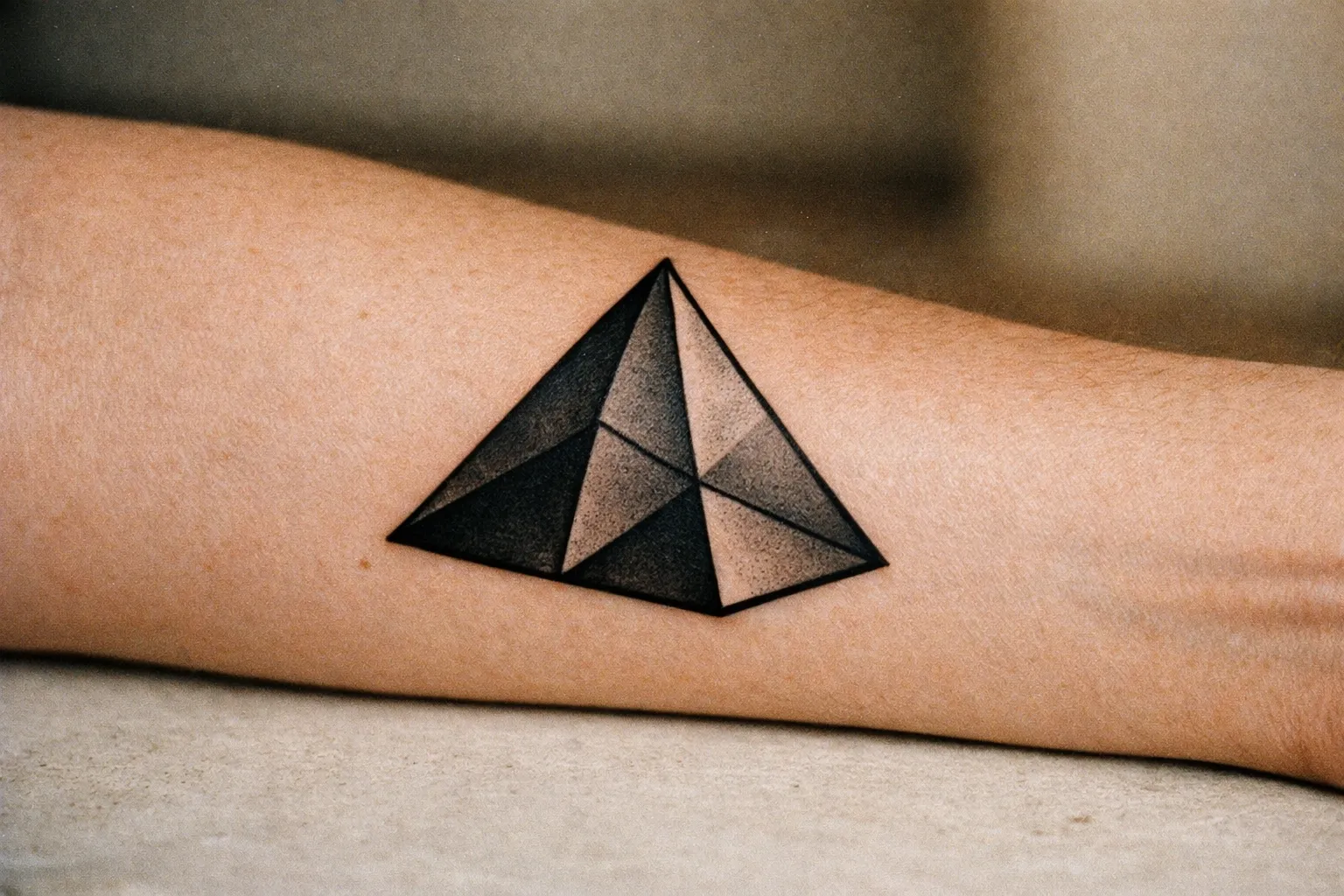
In esoteric design language, the pyramid reads as a mountain-like axis linking ground to sky, and the triangle form itself gets associated with fire in certain symbolic systems (2)(3). Pair a standard pyramid with an inverted one and you get the “as above, so below” framing that shows up in occult and sacred-geometry work (3).
Here’s the honest caveat: the meaning shifts with whatever you attach to it. A bare pyramid leans toward stability and ancient wisdom. Add an eye and you’re in spiritual-oversight territory. Switch from smooth Egyptian sides to stepped Mesoamerican architecture and the cultural reference changes entirely. Don’t assume every pyramid tattoo means the same thing.
The Pyramid Eye Tattoo and All Seeing Eye Pyramid Tattoo
The pyramid Eye tattoo is the most-requested variant, and it’s easy to understand why. The eye-in-pyramid composition reads as enlightenment, higher power, guidance, and divine oversight (5). In Western pop culture it’s also tied to Freemasonry, the Eye of Providence, and Illuminati imagery (3) - so know that the symbol carries that baggage whether you intend it or not. If you want the spiritual reading without the conspiracy association, your artist’s styling choices do a lot of the talking. Soft black-and-grey pulls it toward the contemplative. Bold occult linework pushes it the other direction.
An all seeing Eye pyramid tattoo works in two clear directions:
- Black and grey for a classic, restrained look that ages predictably.
- Color accents - a colored iris, radiating rays - for contrast that pops on healed skin.
The technical pitfall is cramming. The eye details and the pyramid silhouette need to stay visually separate, or the whole thing turns to mud at small sizes. I’ve watched artists try to squeeze too much into a 2-inch version and the iris just disappears after healing. Ask your artist to keep the pyramid outline reading as a clean triangle, with the eye as a distinct element inside it - not competing with it.
The all seeing Eye pyramid tattoo has roots in the Eye of Providence, a symbol with Christian and Masonic origins representing divine watchfulness. In modern Western tattoo culture, it often takes on a broader spiritual or conspiratorial meaning depending on context. The eye itself symbolizes insight and protection, while the pyramid grounds the design in ancient wisdom and stability.
Placement and size: This design needs room for detail. A forearm or outer bicep at 3-5 inches gives the eye enough space to hold its linework. The sternum works for a centered, symmetrical piece if you can handle it - sternum and ribcage outrank forearm on the discomfort scale, since the needle is riding close to bone with minimal muscle padding. Don’t shrink an eye-in-pyramid below about 2.5 inches. The iris and lash detail collapse as it heals.
Egyptian Pyramid Designs: When the Scene Needs Room to Breathe
An Egyptian pyramid tattoo leans into the scenic version of the motif - the Giza silhouette, sand dunes, sun rays breaking over the apex, sometimes ruins or hieroglyphic fields (1). This is the design that asks for shading space rather than just clean outlines.
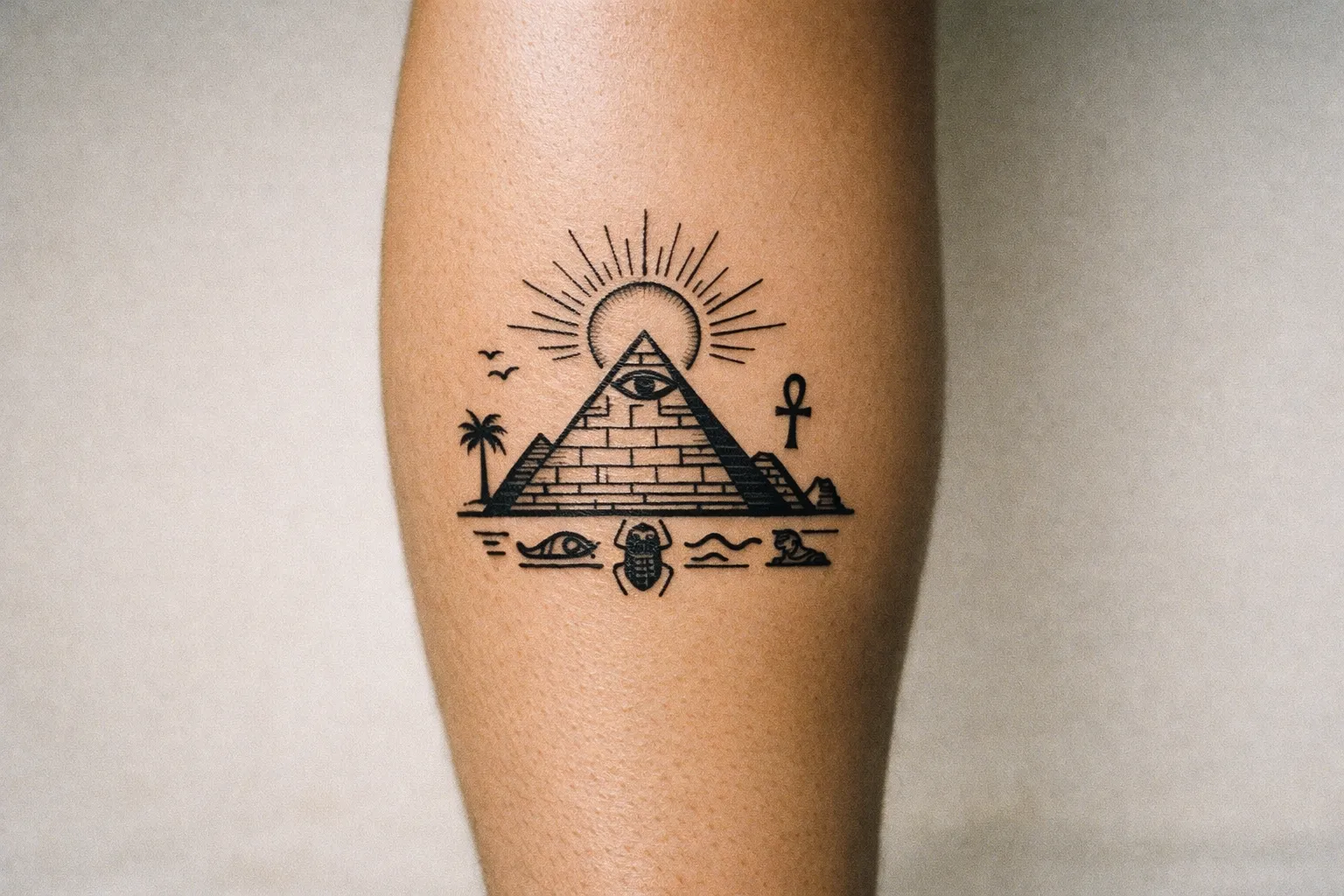
Because of that, the upper arm, calf, chest, or back are your best placements - flat or gently curved fields where a shaded scene can breathe. A small wrist piece won’t do an Egyptian scene justice. The gradients in the sand and sky need real estate.
Two technical hallmarks separate a good Egyptian pyramid from a flat one: smooth value transitions in the sky and sand, and a crisp, level base line on the pyramid itself. The common failure is a pyramid that looks like a triangle sticker pasted over a background - the artist has to commit to a light source and shade the visible face consistently. If you’re adding hieroglyphs or an Eye of Horus, confirm stencil placement and line thickness before the first pass. Detailed background work punishes setup errors.
The Egyptian pyramid tattoo draws heavily on the cultural heritage of ancient Egypt, where pyramids were monumental tombs symbolizing the pharaoh’s journey to the afterlife and connection to the divine. In tattoo culture, this design often represents endurance, mystery, and a link to ancient wisdom. The inclusion of hieroglyphs or the Eye of Horus adds layers of protection and spiritual significance.
Size guidance: plan for 4-8 inches minimum for a scenic Egyptian piece. Below that, the dunes and ruins lose legibility within a couple of years.
Aztec and Mesoamerican Designs
An Aztec pyramid tattoo is a different animal from the Egyptian version, and treating them as interchangeable is a mistake I see clients make regularly. Where Egyptian pyramids are smooth-sided, Aztec and broader Mesoamerican pyramids are stepped - terraced platforms with stairways climbing to a temple at the summit (2). The visual language is geometric and architectural, often paired with Aztec calendar motifs, serpents, or sun-stone iconography rather than sand and sun rays.
The stepped structure reads well as ascent - each tier suggesting progression - but those same steps are a technical trap. Uneven step spacing or a crooked stairway is immediately obvious because the eye expects repetition. This is geometric work. The base lines must be level and the steps evenly spaced, full stop.
The Aztec pyramid tattoo reflects the rich symbolism of Mesoamerican cultures, where stepped pyramids served as temples and ceremonial centers. These designs often symbolize spiritual ascent, connection to ancestors, and the cyclical nature of life. The stepped form is a hallmark of this style, distinct from the smooth Egyptian pyramids, and carries a different cultural weight.
Placement: the vertical, stacked composition suits the forearm (running wrist-to-elbow), the outer calf, or the spine for a longer piece. Size range 4-7 inches for a forearm column. Black-and-grey with strong contrast holds up best here. Heavy color in the temple detailing can muddy as it heals on a small piece.
Minimalist vs. Realistic: Choosing Your Pyramid Style
Most of the decision comes down to how much detail you want and where it’s going. Here’s how the main options break down:
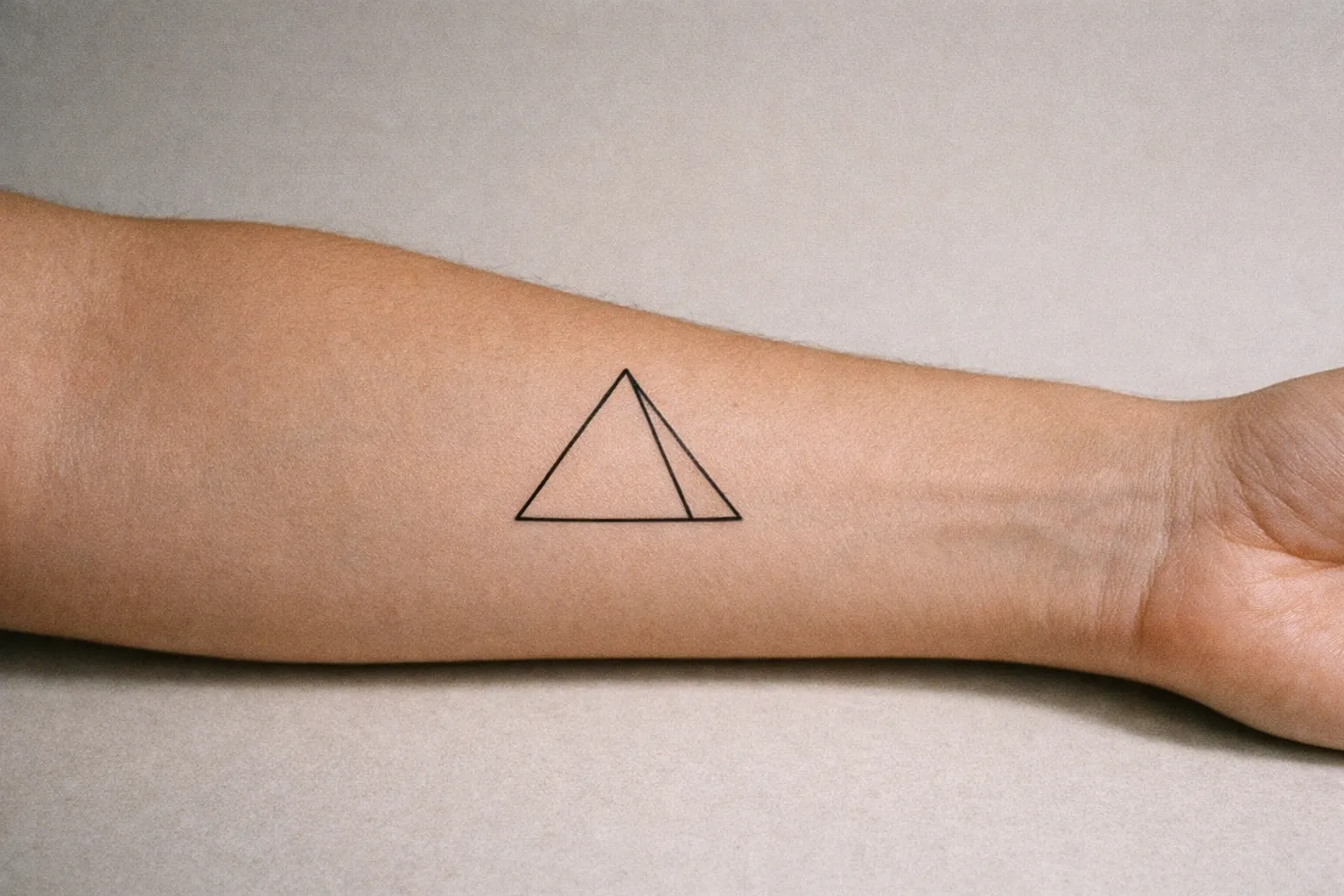
- Minimalist pyramid - single-line or light-outline geometry. Best for first-timers, smaller budgets, and compact placements like the wrist, forearm, ankle, or behind the ear. Expect roughly 1-2 hours of chair time. Size: 2-3 inches is a smarter starting point than an ultra-tiny version, because micro-geometry loses crispness fast.
- Realistic Egyptian or scenic pyramid - full shading, backgrounds, light sources. Needs the upper arm, calf, chest, or back and 2-5+ hours of work. Size: 4-8 inches.
- Pyramid eye / all-seeing-eye - moderate detail, spiritual or occult feel, black-and-grey or color-accented (5). Forearm or sternum, 3-5 inches, 2-4 hours.
- Aztec stepped pyramid - architectural geometry, Mesoamerican symbolism. Forearm, calf, or spine, 4-7 inches.
A note on aging that I always bring up with clients: geometric tattoos punish thin lines. For a minimalist pyramid, ask for slightly bolder outer lines than you’d use on a fine-line floral, because straight edges soften over time and a hairline that looks sharp fresh can blur within a year. Black-and-grey ages more predictably than very light color fills, especially on high-friction spots like the wrist and ankle.
If you want to layer in extra meaning, collectors often combine the pyramid with moon phases, constellations, eyes, skulls, or mandalas. Keep the pyramid as the dominant shape. The moment you overpack the composition, the structure that gives the design its visual logic gets lost.
What a Pyramid Piece Costs and How Long It Takes
Pricing varies by artist, region, and complexity, but these industry bands give you a realistic frame:
- Small minimalist pyramid: roughly $100-$250, around 1-2 hours.
- Medium detailed work (eye-pyramid, small Egyptian scene): $300-$800, 2-5 hours.
- Large custom geometric or full scenic composition: $1,000+, depending on artist reputation and placement.
These are U.S. estimates, not fixed quotes. A named, in-demand geometric specialist will charge more than a generalist, and that premium is often worth it for clean linework.
Before you book, bring a reference image, your preferred size in inches or cm, the placement, and a style direction - blackwork, fine line, dotwork, or realism. The clearer you are, the closer the stencil lands on the first try.
The single most important hiring criterion for a pyramid tattoo is geometric precision, not general tattoo skill. Look at an artist’s healed geometric photos, not just fresh ones. Fresh lines always look sharp. Healed lines tell you whether they actually hold. Uneven pyramid edges are immediately noticeable, and a loose illustrative artist who’s great at portraits may not have the straight-line discipline this design demands.
Ask the artist to check the stencil from two angles before the first line goes down. Symmetry errors that you can’t see on a curved arm in the mirror become glaring after healing. I do this with every geometric piece regardless of how experienced the client is.
Pain by Placement
Pain tracks placement, not the design itself. As a rough ranking for common pyramid spots: sternum and ribcage > spine > inner forearm > outer calf > outer forearm. Bony, thin-skinned areas near the chest and ribs are the most intense because the needle vibrates close to bone with little muscle padding. The outer forearm and outer calf are the friendliest options if it’s your first tattoo and you’re already eyeing a 3-inch minimalist piece.
If you’re set on a sternum centerpiece for the symmetry, go in knowing what you’re signing up for and plan a session length you can actually sit through. Rushing a geometric piece because you’re in pain is how you end up with a wandering base line.
Aftercare for Geometric Line Work
Straight-line tattoos show healing problems more visibly than loose illustrative work, so aftercare matters more here than most people expect. Skipping it risks ink loss, patchiness, and distorted healed lines. Follow the timeline:
- Day 1-3: Keep the wrap on as long as your artist directs. Wash gently with a mild, fragrance-free soap, pat dry, and apply a thin layer of fragrance-free moisturizer. Expect some plasma and a little redness around the lines.
- Week 1: Keep washing twice daily and moisturizing lightly. Do not pick or scratch as it flakes - peeling a scab off a straight line is how you get a gap in the edge. No swimming, no soaking, no heavy sweating.
- Week 2-4: The surface heals but the skin underneath is still settling. Keep moisturizing, and once healed, protect the piece with sun-protective clothing or SPF - UV is what fades crisp geometric lines fastest over the years.
For any design with detailed eye, hieroglyph, or temple work, the healed result depends on the setup as much as the aftercare. Clean needle groupings and correct line thickness at the start give the lines a fighting chance through the peeling phase.
Remember, geometric tattoos age differently depending on placement. High-friction areas like the wrist or ankle may require more diligent moisturizing and sun protection to maintain crisp lines. Using a fragrance-free moisturizer consistently through weeks 1 to 4 helps prevent dryness and flaking that can distort the design.
Frequently Asked Questions
- Can a pyramid tattoo have different meanings depending on style?
- Yes. A bare pyramid generally symbolizes stability and ancient wisdom, while adding elements like an eye shifts the meaning toward spiritual oversight. The style - Egyptian smooth sides versus Aztec stepped platforms - also changes the cultural reference.
- Why is geometric precision so critical for pyramid tattoos?
- Because straight lines and symmetry are the core of the design, any unevenness or crooked lines are immediately obvious and degrade the tattoo's appearance over time.
- What are the best placements for detailed pyramid tattoos?
- Flat or gently curved areas like the forearm, upper arm, calf, chest, or back provide enough space for shading and detail to hold up well.
- How should I prepare before getting a pyramid tattoo?
- Bring a clear reference image, specify your preferred size and placement, and discuss the style direction with your artist to help the stencil land correctly on the first try.
- What aftercare practices help preserve crisp geometric lines?
- Follow your artist's instructions closely, avoid picking flakes, keep the tattoo moisturized with fragrance-free products, and protect it from sun exposure with clothing or SPF once healed.
- Is pain level different for pyramid tattoos based on placement?
- Yes. Areas with less muscle padding near bone, like the sternum and ribcage, hurt more than fleshier spots like the outer forearm or calf.
- Can color accents affect the longevity of a pyramid tattoo?
- Light color fills tend to fade faster and blur more than black-and-grey, especially on high-friction areas like the wrist and ankle.