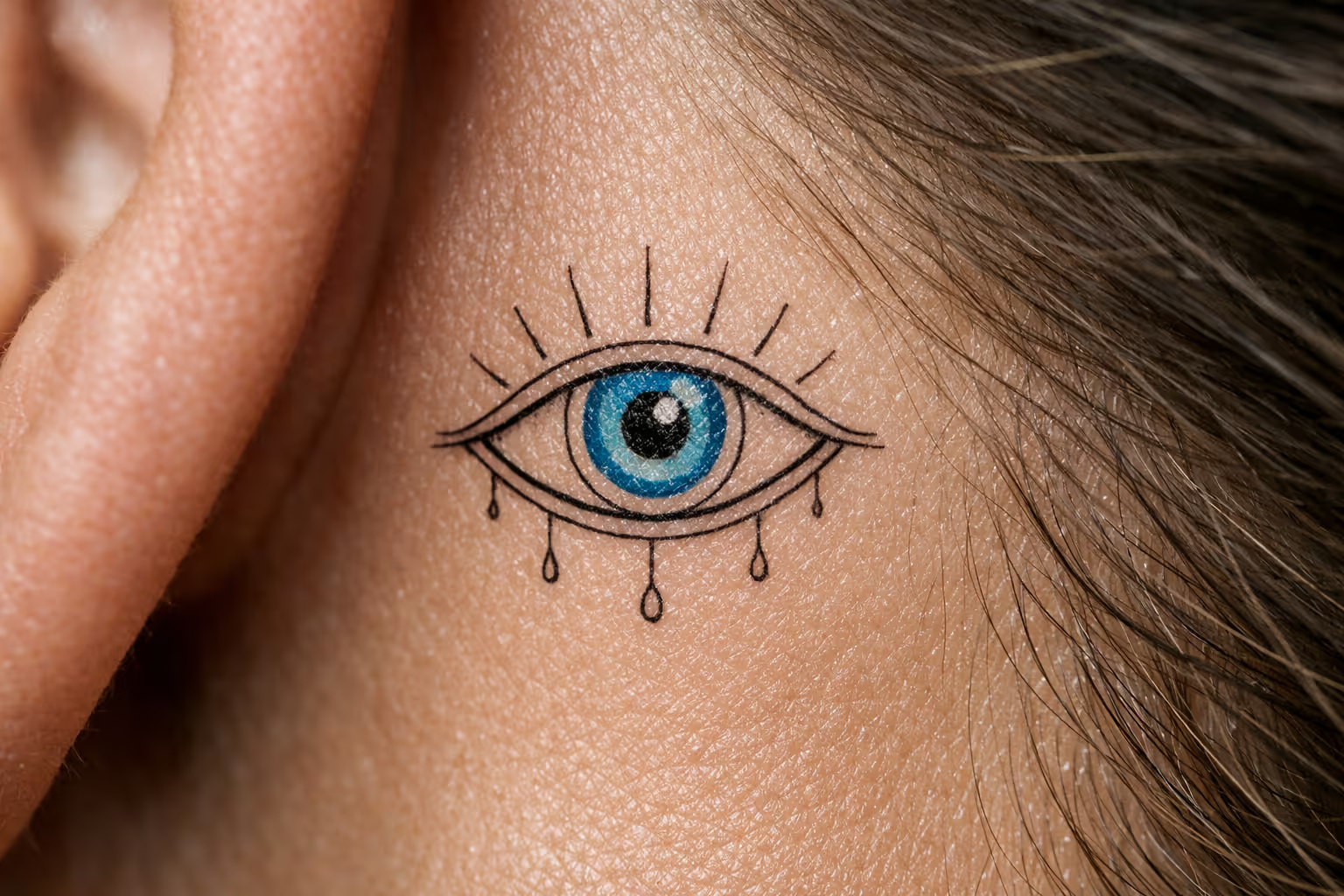
Plenty of people hesitate on an evil eye tattoo because the name sounds like inviting bad luck onto your skin. It’s the opposite. The evil eye - the Nazar, that cobalt-blue glass amulet - is a ward: it repels envy and the harm it carries, it doesn’t cast it. Once that clicks, the design is mostly about getting the blue and the shape right. Here’s what the symbol means, the color rules that matter, and how to size and place it.
What Does an Evil Eye Tattoo Mean?
The short answer: protection from envy. The longer answer is that the evil eye tattoo represents the Nazar - the blue glass amulet you’ve seen hanging in doorways across Greece, Turkey, and the Levant - which is believed to absorb or reflect harmful energy directed at the wearer (3).
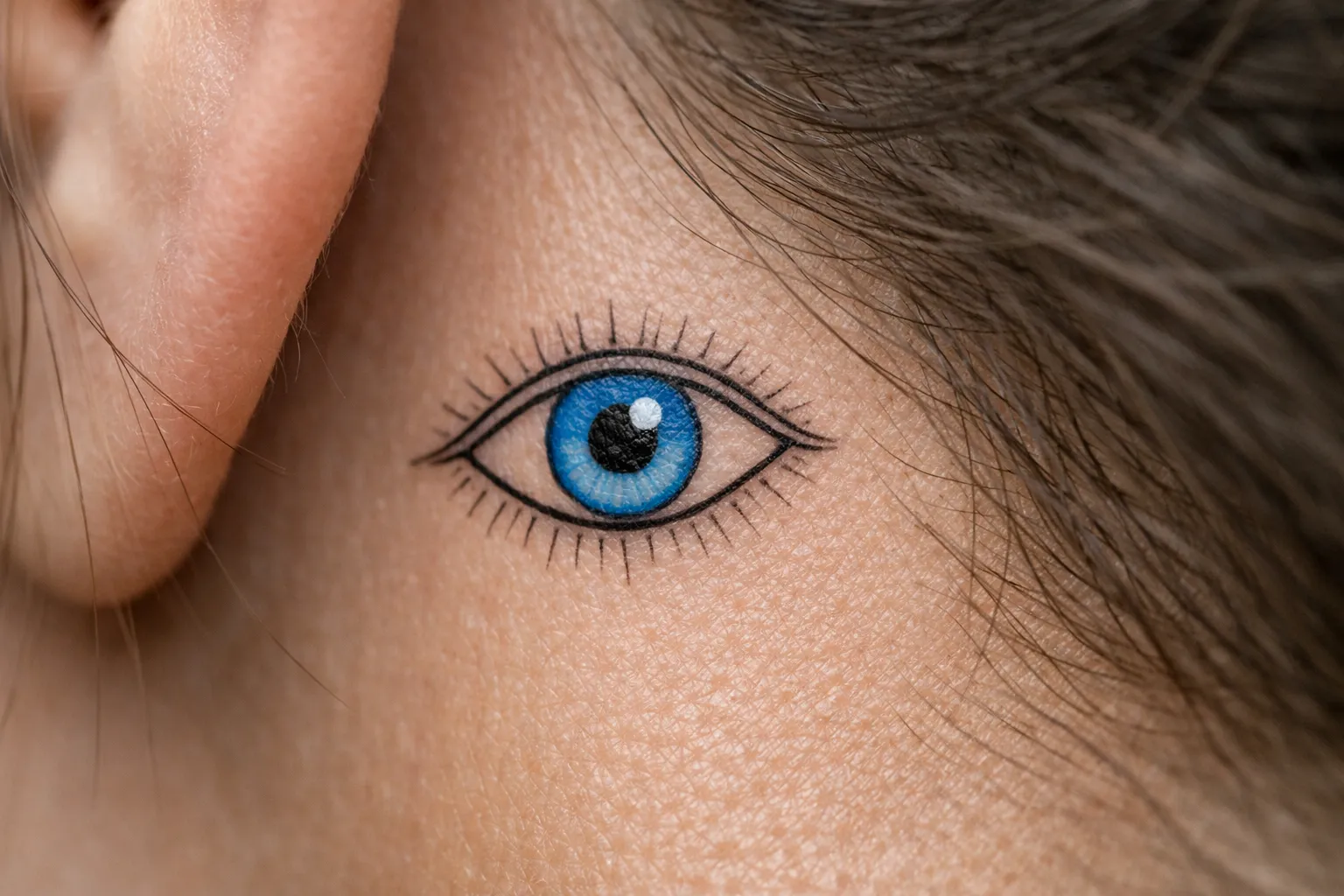
One point that gets confused constantly: the amulet itself is protective. The “evil eye” being repelled is the curse - usually cast unintentionally through jealousy or covetous staring. So the 🧿 emoji is the good guy. It’s the unseen envy it deflects that’s the problem (3).
People get this tattoo for a mix of reasons:
- Pure protection - a permanent talisman they can’t lose or forget at home.
- Heritage - Greek, Turkish, Armenian, Lebanese, Iranian, and other Mediterranean/Middle Eastern roots.
- Spiritual practice - paired with broader interests in astrology, hamsa, or witchcraft.
- Aesthetic - clean cobalt-and-white circle that reads well on skin.
If your reason is purely aesthetic, that’s worth knowing before you sit down. Communities who grew up with the Nazar generally don’t mind respectful use, but they do notice when the symbol gets treated as a throwaway trend.
The History of the Evil Eye
The belief in the evil eye predates almost every religion currently practiced. Archaeologists have traced protective eye amulets back to roughly 3000 BCE in Mesopotamia, with related artifacts appearing in ancient Egypt, Greece, Rome, and Phoenicia (3).
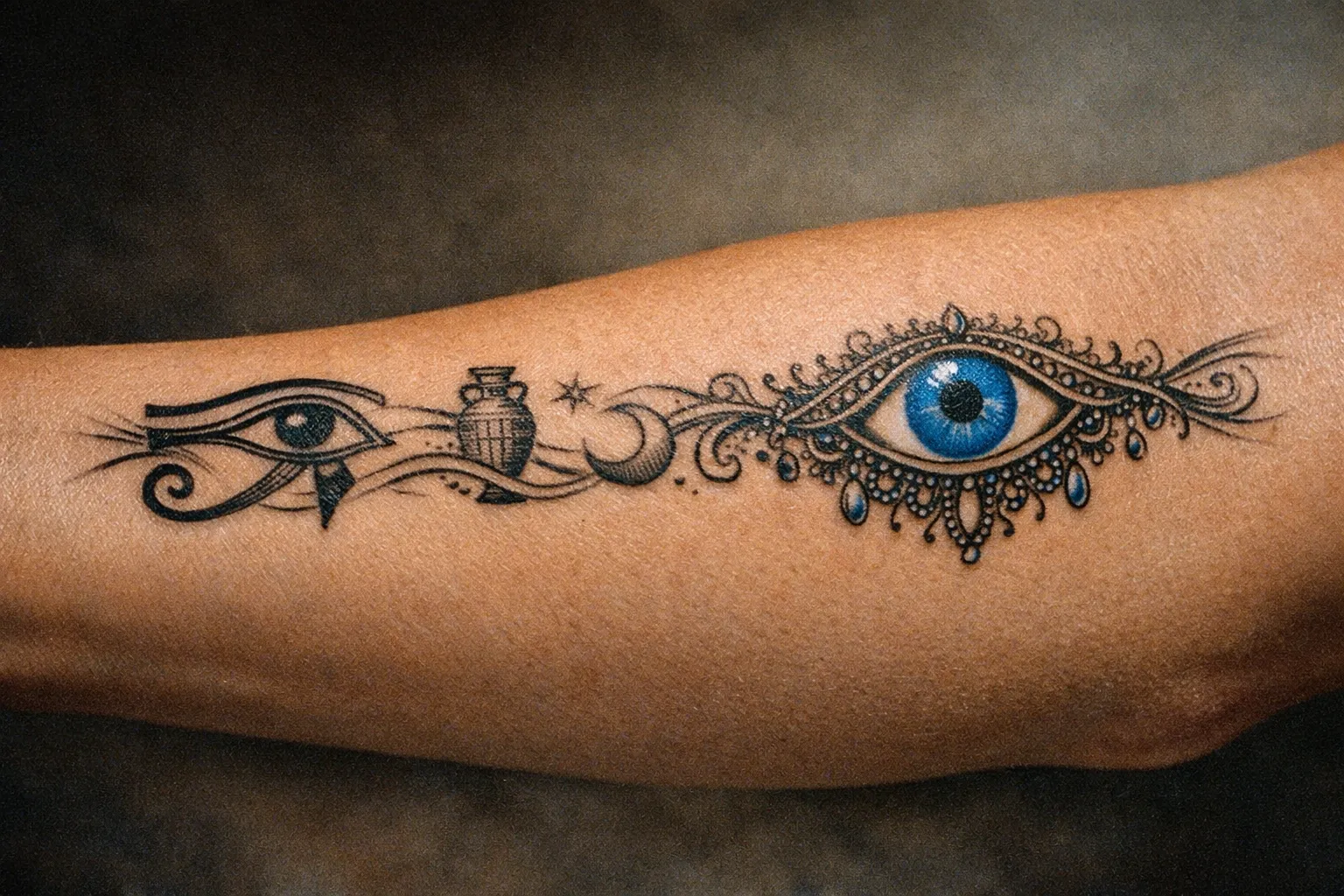
Ancient Greeks called the curse baskania; Romans called it fascinum. The defense in both cases was the same: an eye that stared back. Hesiod wrote about it. Plutarch wrote a whole essay trying to explain it scientifically. Roman children wore bulla pendants for the same reason Greek kids today wear a Nazar pinned to their shirt.
The cobalt-blue glass bead most people picture - concentric rings of dark blue, light blue, white, and a black pupil - is a Turkish refinement, mass-produced from glassworks around İzmir and Görece for centuries. The blue color matters: in Mediterranean cultures, light-eyed strangers were historically considered more likely to cast the curse, so a blue eye was thought to be the most effective counter.
The symbol traveled with trade, migration, and diaspora, which is why you’ll find local variants from Mexico (mal de ojo) to South Asia (nazar utarna rituals) to North Africa. The tattoo is a modern wearable form of an old portable amulet.
The Rise of Tattoos Featuring the Evil Eye
Evil eye tattoos have moved from niche to mainstream over the last decade. A few things drove it:
- Social media saturation. Search volume for “evil eye tattoo” climbs steadily on Pinterest and Instagram, and one stock site alone now hosts around 378 evil eye tattoo illustrations for licensing - a useful proxy for commercial demand (4).
- The fine-line micro-tattoo boom. Tiny wrist and behind-the-ear Nazars are quick, cheap, and photograph well, which suits a TikTok-era audience.
- Spirituality-as-aesthetic. The same wave that made tarot, crystals, and astrology mainstream pulled protection symbolism along with it.
- Diaspora identity. Younger Greek, Turkish, Armenian, Iranian, and Levantine clients getting visible heritage tattoos that read in any country they live in.
I’ve been booking Nazar designs almost weekly for a few years now - small linework versions can be a $100 walk-in, while detailed ornamental pieces run several hundred. The symbol’s gone from “what’s that?” to instantly recognizable.
Is It Okay to Tattoo the Evil Eye?
Spiritually, yes - across the cultures that use the Nazar, putting it on skin is generally seen as appropriate. It’s an amulet. Amulets are meant to be carried. A tattoo just removes the option of leaving it at home.
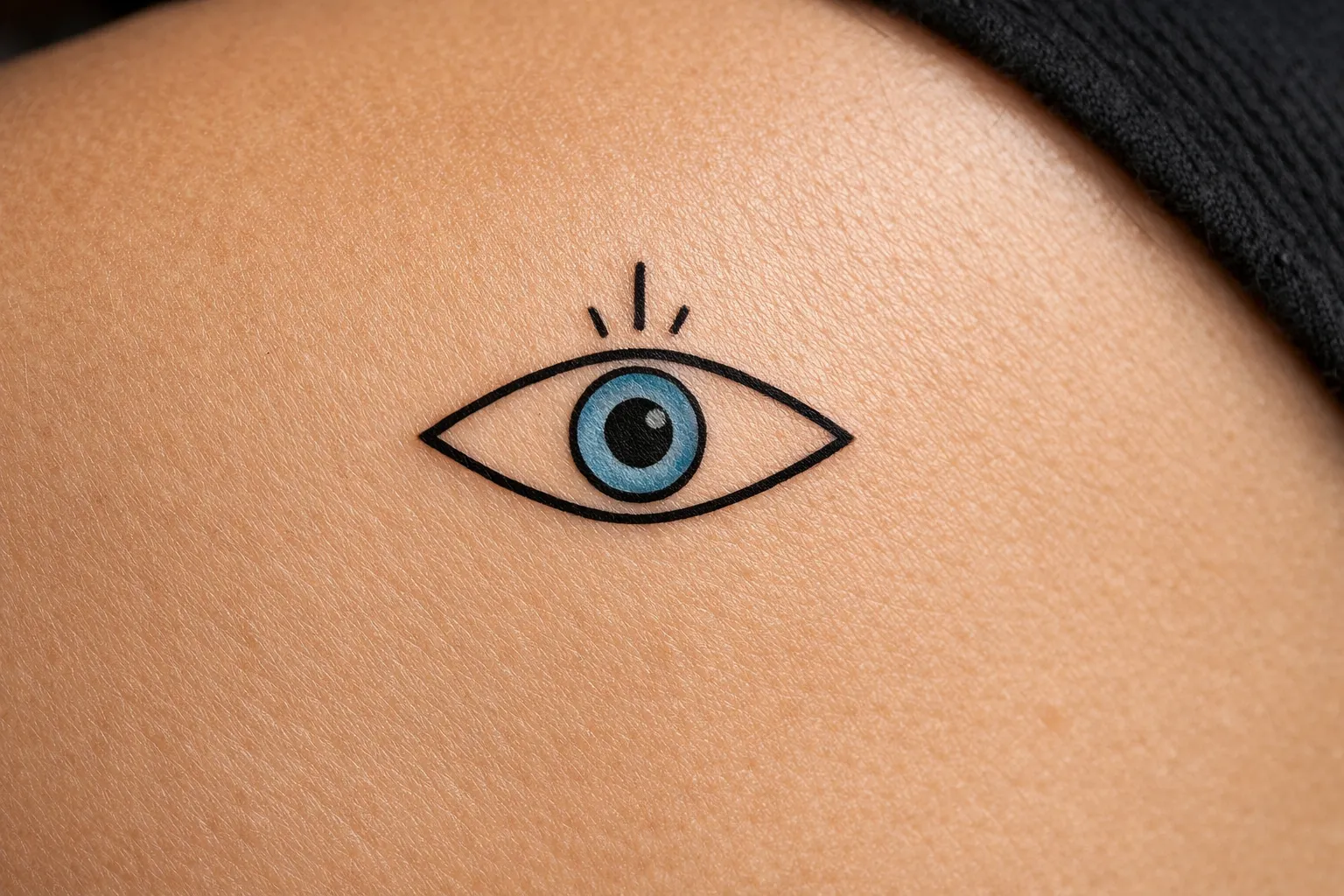
Socially, the answer has more layers. A few honest considerations:
- If you have Mediterranean, Middle Eastern, North African, or South Asian heritage, this is your symbol. Get it.
- If you don’t, it’s still widely considered acceptable, but understand what you’re wearing. Read about Nazar tradition, know it’s a protective amulet rather than a generic “boho eye,” and ideally don’t pair it with imagery that contradicts its meaning.
- Religious sensitivity. Some conservative Muslim and Jewish traditions discourage tattoos entirely; the symbol’s protective meaning doesn’t override that. If you’re navigating that within your own family or faith, that conversation matters more than any design decision.
The short rule: respect the symbol, don’t reduce it to wallpaper, and you’re fine.
Evil Eye Tattoo Design Ideas
The traditional Nazar is concentric: black pupil, dark blue iris, light blue ring, white outer ring. From there, designs branch in a few directions:
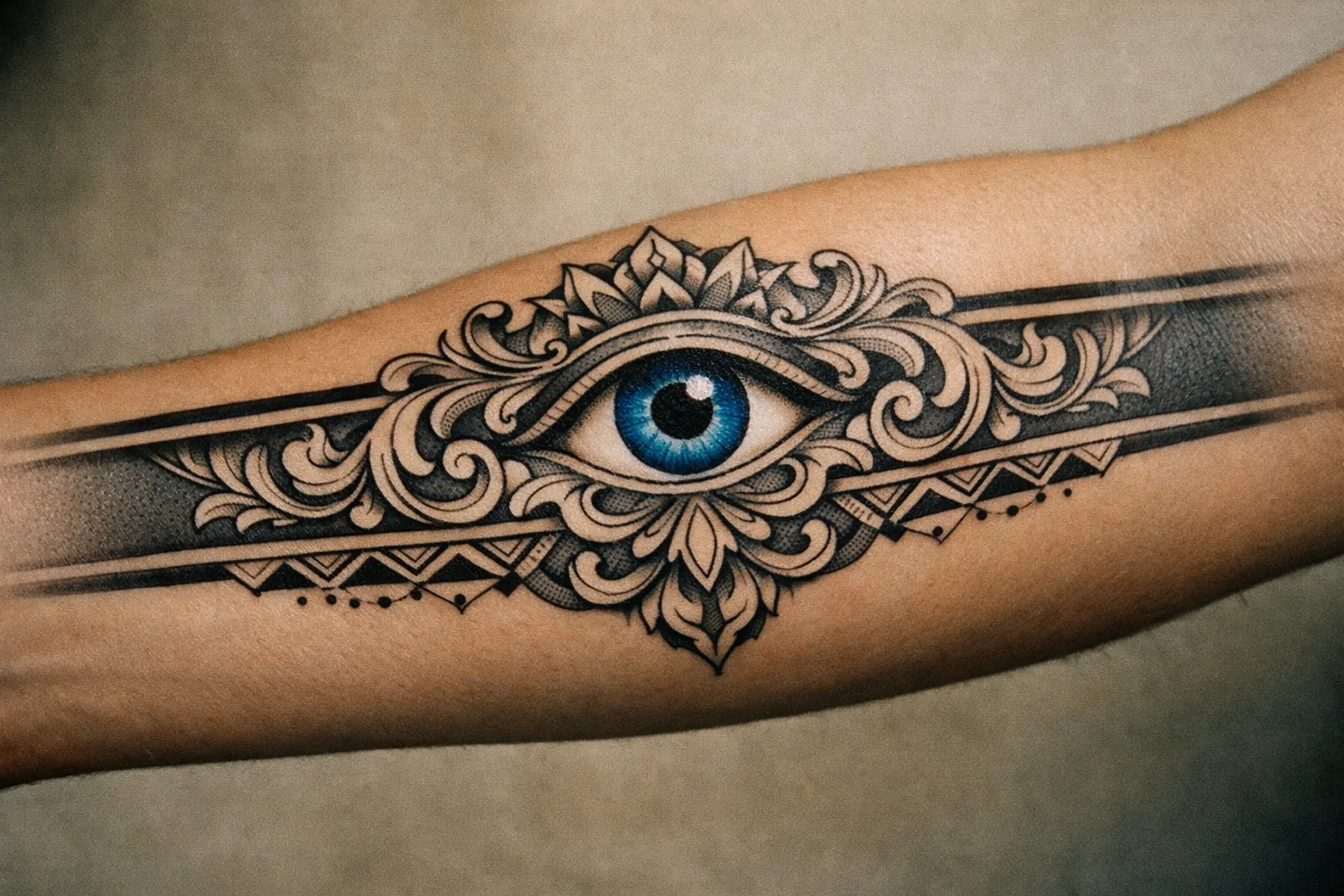
- Classic Nazar bead - round, 1-2 in (2.5-5 cm), most often on the inner forearm, back of arm, or behind the ear.
- Eye-shaped Nazar - an almond eye outline with the cobalt color palette inside, slightly more illustrative.
- Nazar + hamsa - the eye sits in the palm of the protective hand. Strong on the upper back, sternum, or outer forearm at 3-5 in (7.5-12 cm).
- Nazar + Greek key (meander) border - clean black linework frame, very legible at small sizes.
- Nazar + moon, sun, or constellation - modern spiritual mashup, popular on the ribcage and outer thigh.
- Minimalist linework Nazar - single-needle, black ink only, no color. Cleaner aging but loses the iconic blue.
Best Placements for an Evil Eye Tattoo
You’re picking a spot for two reasons: visibility and symbolism (guarding “entry points” of the body).
- Inner forearm or wrist - high visibility, traditional protective placement for the hands.
- Behind the ear - discreet, popular for fine-line versions about 0.75-1.25 in (2-3 cm).
- Back of the neck - eye faces outward, “guards your back” symbolically.
- Sternum or upper chest - protects the heart, larger canvas (3-5 in / 7.5-12 cm works well). A sternum tattoo in this style pairs especially well with hamsa or moon-phase elements.
- Outer ankle or top of foot - guards the lower body; expect faster fading from shoes and friction.
- Inner bicep - concealable, ages well, fits 2-3 in (5-7.5 cm) comfortably.
Skip the fingers and the side of the hand for anything detailed. Color packs poorly there, and the concentric rings of a Nazar will blur into a smudge within a few years. I’ve done the touch-ups on these. It’s not a fun conversation.
Sizing Rules That Actually Matter
Don’t go under 1 inch (2.5 cm) for a full-color Nazar. The four concentric rings need room to read. Tiny finger versions will fuse into a dot within three to five years. For black linework only, you can drop to about 0.75 in (2 cm) and still have it age cleanly.
Pain - What to Expect by Placement
Pain is relative. Outer arm, calf, and upper back are the easy zone. Ribcage, sternum, spine, ankle, and behind the ear all hurt more - thin skin over bone is the recurring culprit. Inner wrist is louder than people expect for how small the tattoo usually is.
The Evil Eye as a Fashion Accessory in Tattoos
A lot of evil eye tattoos are honestly worn as accessories - same way the bead gets worn on a bracelet, anklet, or pinned to a backpack. There’s nothing wrong with this if the wearer understands the symbol.
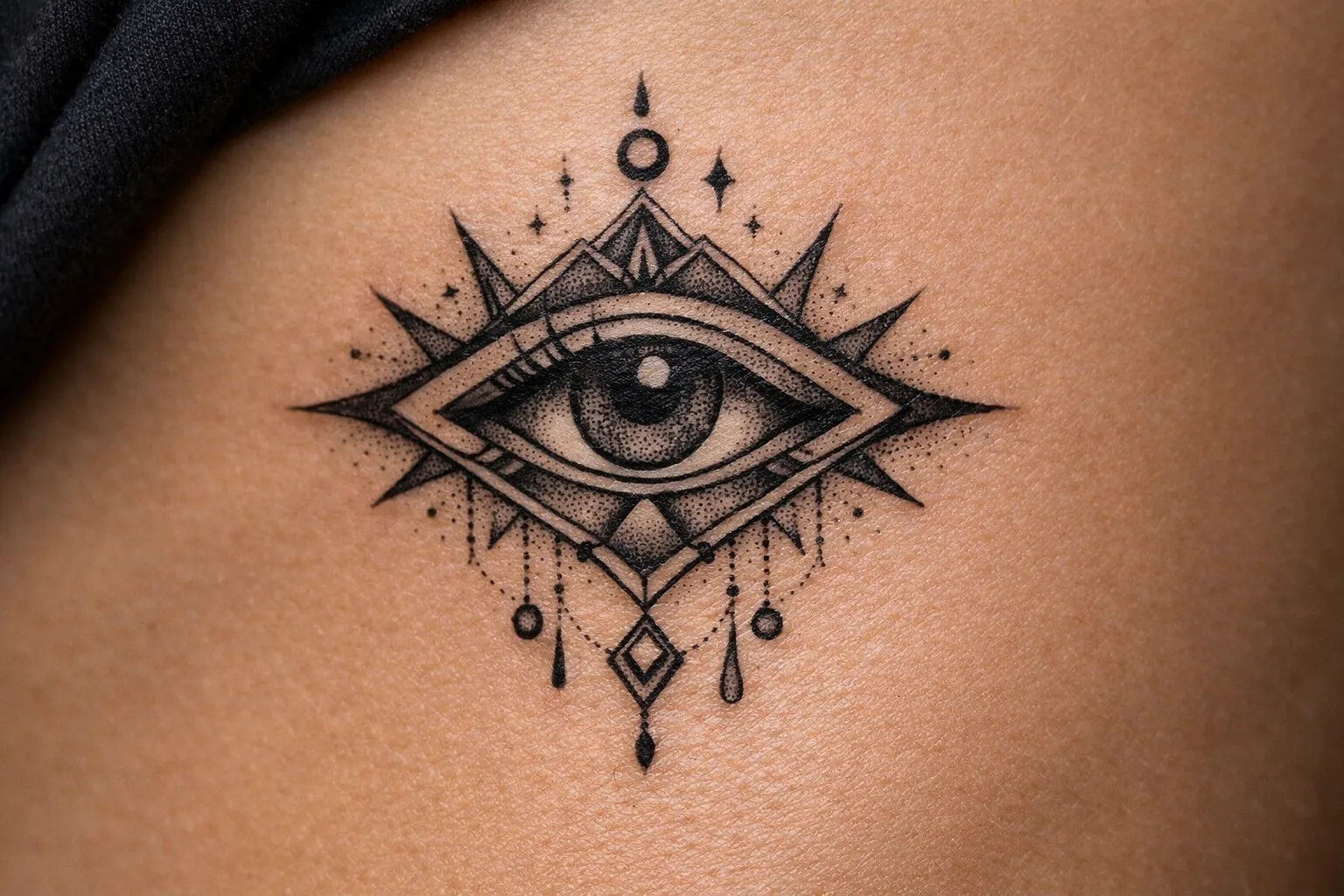
What makes a Nazar work as a “fashion” tattoo:
- Pair it with jewelry, not against it. A Nazar tattoo behind the ear with a gold hoop, or on the inner wrist next to a stack of thin bracelets, reads as styled rather than random.
- Color discipline. Stick to the traditional cobalt + white + black. Pastel reinterpretations look dated within two years.
- Placement that breathes with outfits. Outer forearm, back of neck, ankle, and collarbone all show with everyday clothing.
- Future-proof composition. Leave a few millimeters of clean skin around the eye if you might add Greek key border, laurel, or a moon later.
The fashion approach gets criticized in some corners as appropriation, especially when the wearer can’t say what the symbol means. The fix is small and free: know your tattoo’s meaning before you book it.
All Seeing Eye Tattoos and Eye of Providence Symbolism
The all seeing Eye tattoo - usually an eye inside a triangle, sometimes with rays of light - is a different symbol with a different lineage from the Nazar. It’s the Eye of Providence, a Christian symbol for divine oversight that became famous through its use on the US one-dollar bill and through Masonic iconography (2).
What it tends to mean today:
- Divine watchfulness or guidance - the original Christian reading.
- Self-awareness and consciousness - modern spiritual reading.
- Esoteric / occult interest - paired with alchemical symbols, tarot, sun and moon phases.
- Visual nod to Illuminati conspiracy iconography - usually ironic, sometimes not.
Getting the symbol doesn’t make you a member of anything. It’s a widely-used motif with a long pre-conspiracy history.
Design Notes
- Works best at 3-6 in (7.5-15 cm) - the triangle needs room to balance with the eye.
- Strong placements: forearm, outer bicep, center chest, upper back, outer calf.
- Common pitfall: artists who over-render the iris and underweight the triangle. The geometry should anchor the piece; if the eye dominates, it stops reading as Eye of Providence and becomes a generic floating eye. Clients drawn to this kind of structured symbolism often explore sacred geometry tattoo designs for the same reason.
Eye of Horus Tattoos: Protection and Royal Power
The Eye of Horus tattoo - also called the Wedjat - is the falcon-marked eye from ancient Egyptian mythology, associated with protection, healing, royal authority, and the journey to the afterlife (2). Egyptians wore it as an amulet, painted it on coffins, and marked it on the bows of ships.
Visually, it’s distinct from the Nazar in every way: a stylized human eye with a sharp brow line, a teardrop-style marking under the eye, and a curving “falcon cheek” line trailing off. There’s a left-eye/right-eye distinction in ancient sources (the Eye of Horus vs the Eye of Ra), but most modern tattoos use the form interchangeably.
Placement and Sizing
- Outer forearm or bicep, 3-5 in (7.5-12 cm) - the most common spot, lets the linework breathe.
- Chest or upper back, 5-8 in (12-20 cm) - appropriate for detailed versions with hieroglyphic borders or color.
- Behind the ear or back of neck, 1.5-2.5 in (4-6 cm) - works in black linework only; color won’t hold at that size.
Common Pairings
Ankh, scarab, pyramids, lotus, sun disk, or Ra/Bastet figures. If you’re building toward a larger Egyptian-themed piece, plan the composition with your artist before the first session - the Wedjat is hard to retrofit into a sleeve without negative space planning.
Style Hallmarks
Done well: thick black outline, confident curves on the teardrop and cheek lines, clean spacing inside the eye itself. Done poorly: thin scratchy lines that don’t match the bold geometric tradition the symbol comes from. American traditional and neo-traditional styles handle the Wedjat better than fine-line. I’ve seen fine-line Wedjats that look sharp fresh off the needle and muddy within three years - the detail just doesn’t hold.
Third Eye Tattoos: Intuition and Higher Consciousness
The third Eye tattoo comes from Hindu and Buddhist tradition, where it represents the Ajna chakra - the energy center associated with intuition, perception beyond the physical, and higher consciousness (2). In iconography you’ll see it on the foreheads of deities, ascetics, and Buddha figures.
Modern third eye tattoos tend toward one of three approaches:
- Forehead/brow placement - uncommon outside specific spiritual practices; visible face tattoos carry real social weight, so consider this carefully.
- Hand with an eye in the palm - overlaps visually with hamsa imagery but reads here as the eye of inner sight.
- Eye with mandala, lotus, or geometric halo - sits on the sternum, upper back, or outer forearm at 3-6 in (7.5-15 cm).
Cultural Note
The third eye isn’t a free-floating “spiritual” symbol - it’s specifically Hindu and Buddhist in origin. If you have no connection to either tradition, that doesn’t make it off-limits, but it’s worth knowing the source. Pairing it with chakra colors, Sanskrit script, or a lotus reinforces the meaning; pairing it with random occult imagery muddies it.
A practical tip: ask the artist whether the eye should face inward or outward. Inward (closed lid, or pupil pointing down) reads as introspection. Outward (open, alert) reads as awareness of the world. The choice changes the tattoo’s meaning more than most people realize.
Realistic Eye Tattoos: The Hardest Eye to Do Well
Realistic eye tattoos demand skill that most artists don’t have. You’re rendering a wet, reflective sphere on a flat textured surface (skin), and any misstep in gradient, highlight, or iris geometry turns the eye from “calm and human” to “frightened” or “dead.”
What separates a good realistic eye tattoo from a bad one:
- Iris construction. Real irises have radial fibers, a darker outer ring (limbal ring), and a slightly irregular pupil. Symmetrical cartoon irises age into something uncanny.
- Highlight placement using negative space. Skilled artists use untattooed skin as the catchlight, not solid white ink. White ink yellows and fades; bare skin doesn’t.
- Restraint on detail. Tattoos under 3 in (7.5 cm) can’t carry photorealistic eye detail. Lines blur, highlights merge, and within five to ten years you’re left with a mottled oval.
Recommended Size and Placement
Realistic eyes need real estate. Plan for 4-6 in (10-15 cm) minimum, placed on the outer forearm, upper back, chest, or outer thigh - areas with flat-ish skin and lower friction. Avoid the inner wrist, fingers, and feet entirely for this style.
Cost
A realism eye in color, done by a competent artist at typical mid-tier US rates ($120-$200/hr), runs $400-$900 for a 3-6 hour session. In major metros (NYC, LA, London) with hourly rates around $200-$350+, the same piece can clear $1,000.
Cost and Time: What an Evil Eye Actually Costs
Real numbers, US mid-tier studios in 2025:
- Tiny minimalist Nazar (1-2 in, linework only): $80-$150 shop minimum, 30-60 minutes.
- Small-to-medium ornamental eye with color (2-4 in): $150-$350, 1-3 hours.
- Large detailed eye, sunflower-realism eye, or Greek-themed piece (4-8 in): $400-$900+, 3-6 hours, sometimes across two sessions.
- High-demand artists or major metros: add 30-60%, easily reaching $1,000+ for the same design.
Most studios charge a shop minimum of $80-$150 regardless of how small the tattoo is - covering setup, needles, and the time you’d otherwise occupy. Don’t argue this down. It exists because hygiene costs the same whether you’re getting a dot or a sleeve.
Consultations are usually 15-45 minutes and often free, sometimes with a $20-$50 deposit credited toward the tattoo. Bring 5-10 reference images, especially if you want a Nazar that combines with hamsa, Greek key, sunflower, or constellations.
Aftercare: Day 1 Through Week 4
Eye tattoos with that cobalt blue need protection from sun and friction to stay vibrant. The standard timeline:
- Day 1-3: Keep the artist’s bandage on as long as they specify (often the second-skin film stays 3-5 days; traditional plastic comes off in a few hours). Wash gently 2-3 times a day with fragrance-free, antibacterial soap, pat dry, no rubbing.
- Day 4-14: Switch to a thin layer of fragrance-free moisturizer 2-3 times daily. The tattoo will scab, flake, and itch - do not pick. Avoid swimming, hot tubs, and long showers entirely.
- Week 2-4: Surface healing is complete but the deeper layers are still settling. Keep moisturizing. Use sun-protective clothing or SPF 30+ once fully healed (sunscreen on a fresh tattoo is not recommended).
- Month 2-3: Full internal healing. Color settles into its final tone, which is usually 10-20% lighter than the fresh tattoo. Continue daily SPF on exposed areas to prevent the blue from fading. Understanding sun protection for tattoo care is especially important for cobalt pigments, which are among the fastest to fade under UV exposure.
Tanning and sunbeds in the first 4-6 weeks will visibly fade blue pigment. If you’re getting a Nazar in summer, plan around your beach trips, not the other way around.
Pairing the Evil Eye with Other Designs
The Nazar plays well with others if you plan the composition.
Greek Tattoos: Ancient Symbolism of Classical Greece
A Greek-themed evil eye tattoo is a natural fit for clients with heritage or a serious connection to Greek culture. Common pairings:
- Meander (Greek key) border - geometric, ages well, frames the eye cleanly.
- Laurel wreath - victory and honor, looks strong wrapping around a Nazar on the upper arm.
- Olive branch - peace and Athena, suits a more delicate fine-line piece.
- Marble bust elements - Aphrodite, Athena, or a kouros profile, usually as part of a larger 6-10 in (15-25 cm) piece.
- Greek script - verify spelling with a native speaker before inking. Greek alphabet errors are the most common regret in this category.
A Nazar at the center of a Greek-style sleeve gives the whole piece an anchor and a meaning beyond aesthetics.
Realism Sunflower with an Eye
The realism sunflower tattoo with an eye at its center has become a recognizable mashup - sunflower petals radiating from a Nazar or realistic iris like sun rays. It works because:
- The sunflower softens what can otherwise read as an ominous lone eye.
- The petals give the artist a larger canvas (5-8 in / 12-20 cm) on a less painful placement like the upper arm or thigh.
- The symbolism layers - sunflower for warmth and joy, eye for protection - which suits clients who want a meaningful piece without a grim aesthetic.
Expect this combo to run $400-$700 for a competent realism artist, 3-5 hours.
Other Pairings Worth Considering
- Hamsa - Middle Eastern/North African protective hand, often shown with the eye in the palm.
- Moon phases - feminine, cyclical, fits well with a Nazar on the spine or ribcage.
- Constellations - pair the Nazar with your sun sign for a layered protection-plus-identity piece.
- Snake - ancient guardian symbol, common in Greek and Egyptian imagery.
What Tattoos to Avoid
Worth saying plainly since it comes up in the same searches:
- Hate symbols. Swastikas in Nazi context, SS bolts, 1488, and other extremist iconography. Permanent and disqualifying.
- Gang signs and prison codes you don’t have the right to wear. The teardrop and certain numerical codes carry specific meanings in specific communities, and uninformed use creates real safety problems.
- Religious symbols from traditions you have no connection to. This includes some Hindu deities, Indigenous tribal markings, and specific Christian icons used outside their religious context. Respectful engagement is fine; uninformed appropriation isn’t.
- Misspelled foreign-script text. Greek, Arabic, Hebrew, Sanskrit, Chinese, Japanese - verify with a native reader, not Google Translate. Misspellings are the most common regret across every studio.
- Hyper-trendy micro-tattoos in high-friction zones. Tiny fingers-and-toes designs blur or vanish within a few years. Not a moral problem, just a practical one.
- A partner’s name that hasn’t been earned by at least a few years together. Artists have a name for the cover-up appointments this generates.
Frequently Asked Questions
- Can I get an evil eye tattoo if I don't have Mediterranean or Middle Eastern heritage?
- Yes, it's generally accepted if you understand and respect the symbol's protective meaning rather than treating it as a generic aesthetic. Avoid pairing it with contradictory imagery.
- How should I prepare reference images for my evil eye tattoo consultation?
- Bring 5-10 images showing the style, size, and any combined elements like hamsa or Greek key borders. This helps your artist understand your vision and plan line weight and aging.
- Why do some evil eye tattoos fade faster on certain placements?
- High-friction areas like fingers, feet, and sides of hands cause color to blur and fade quickly. Also, thin skin over bone can affect healing and pain.
- What is the difference between the evil eye tattoo and the Eye of Providence tattoo?
- The evil eye tattoo (Nazar) is a Mediterranean protective amulet, usually blue concentric circles. The Eye of Providence is a Christian symbol inside a triangle, representing divine watchfulness.
- Can realistic eye tattoos be done small?
- No, realistic eyes need at least 4 inches (10 cm) to hold detail and shading. Smaller sizes blur and lose the photorealistic effect within a few years.
- What aftercare products are best for preserving the blue color in an evil eye tattoo?
- Use fragrance-free, antibacterial soap during initial healing, then switch to fragrance-free moisturizer. After healing, protect with sun-protective clothing or SPF 30+ sunscreen.
The Decision That Actually Matters
Before booking, answer one question on paper: what do you want this tattoo to do for you? “Protect me from envy,” “honor my Greek grandmother,” “remind me to trust my intuition,” “look good with my jewelry” - all valid, but each one points to a different design, size, and placement.
Bring that sentence to the consultation along with 5-10 reference images. Ask the artist about line weight (request at least 0.35-0.40 mm for outlines on anything under 2 in), where the eye should face, and how the design will age over ten years. A good artist will push back on choices that won’t hold up.
The Nazar has been worn for 5,000 years because people keep finding it useful. A well-placed, well-sized, well-understood evil eye tattoo does the same job a glass bead does - just without the option of taking it off.