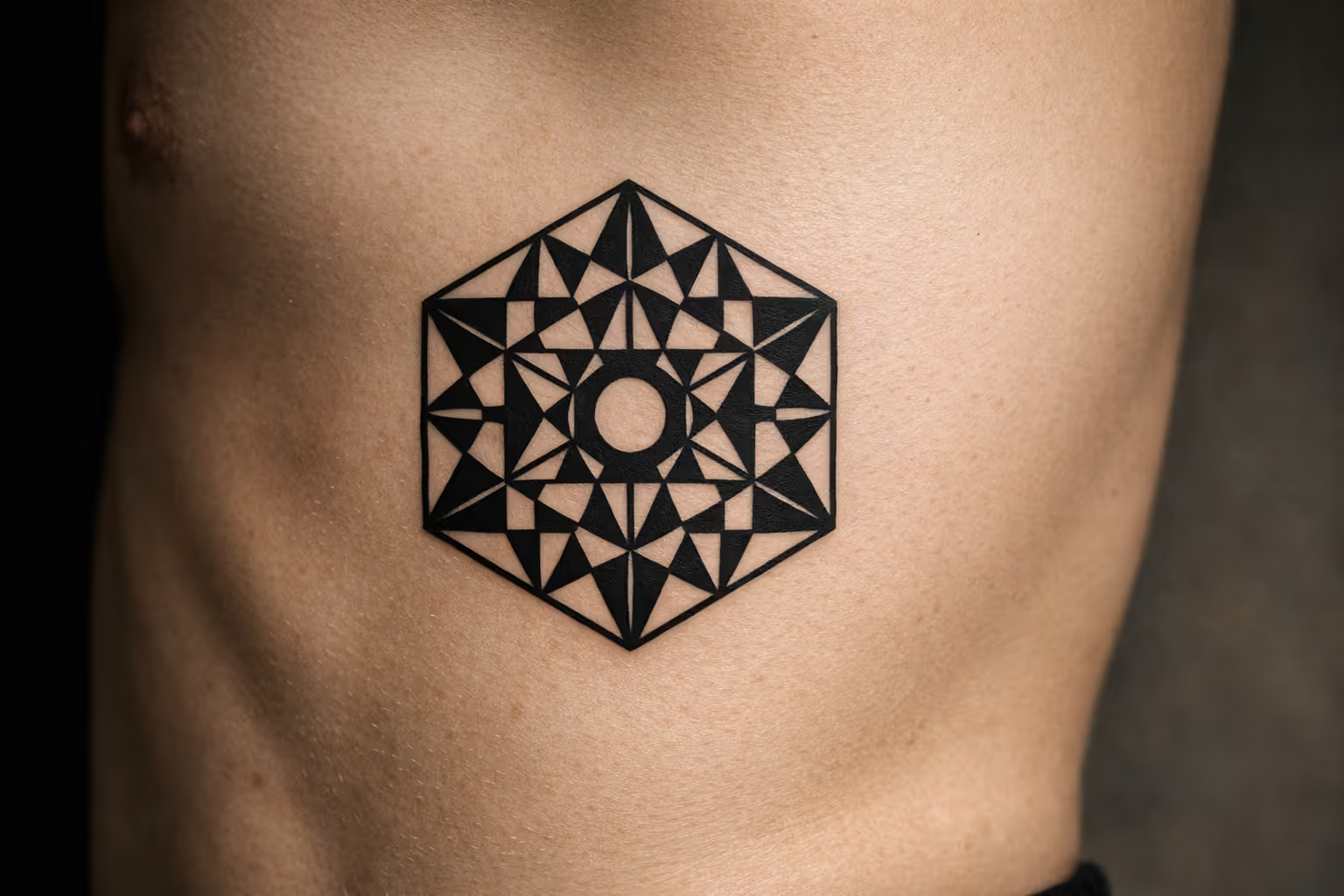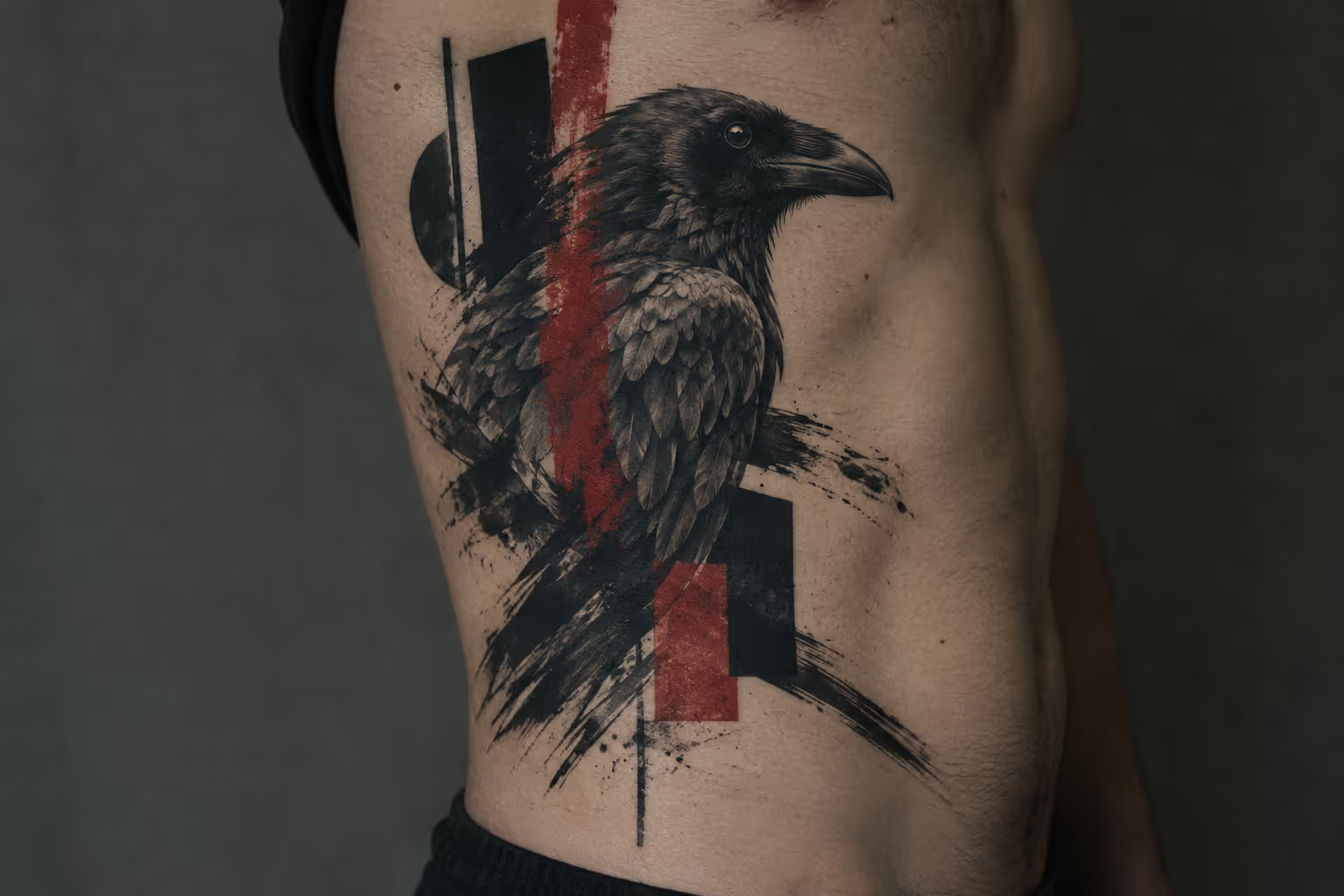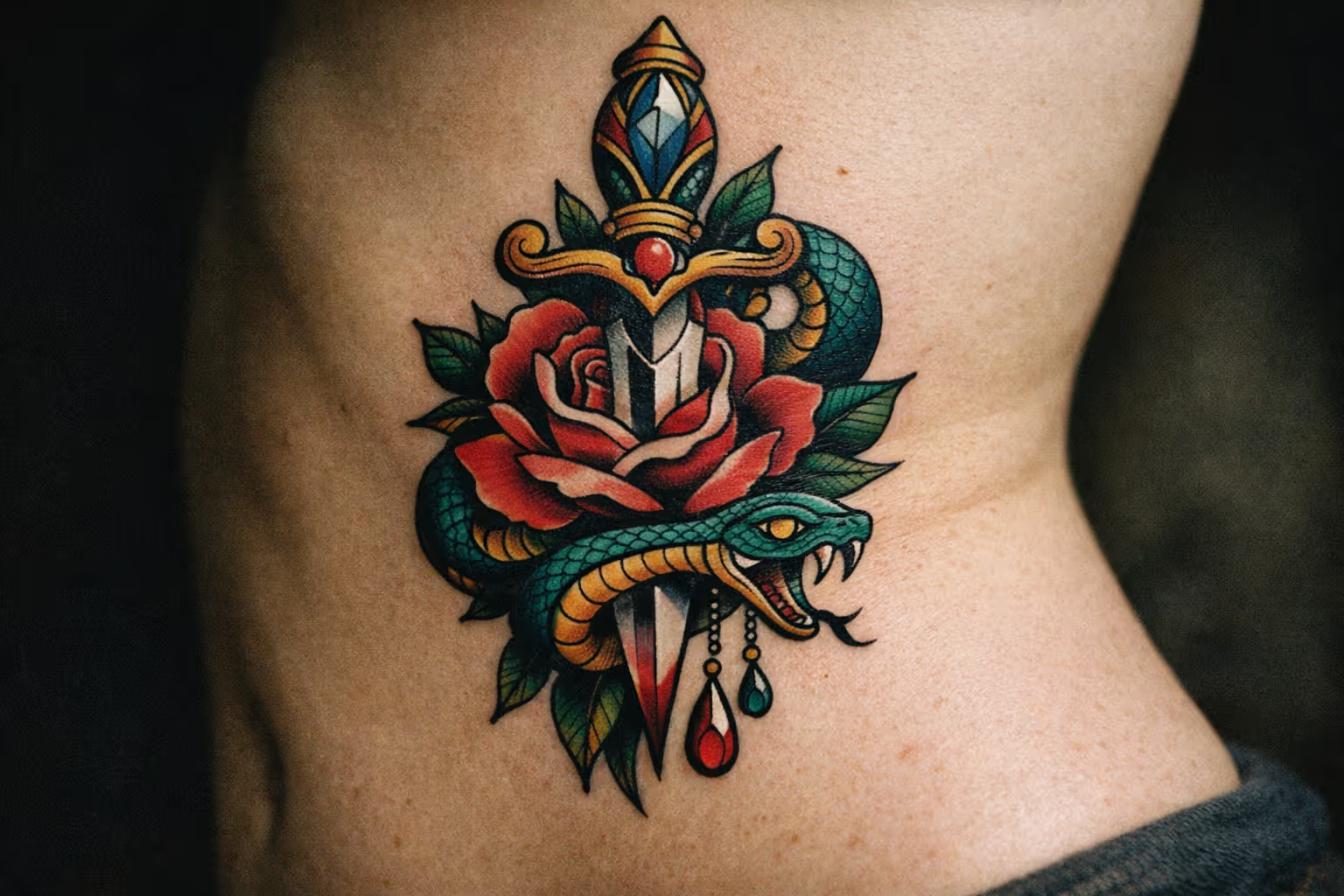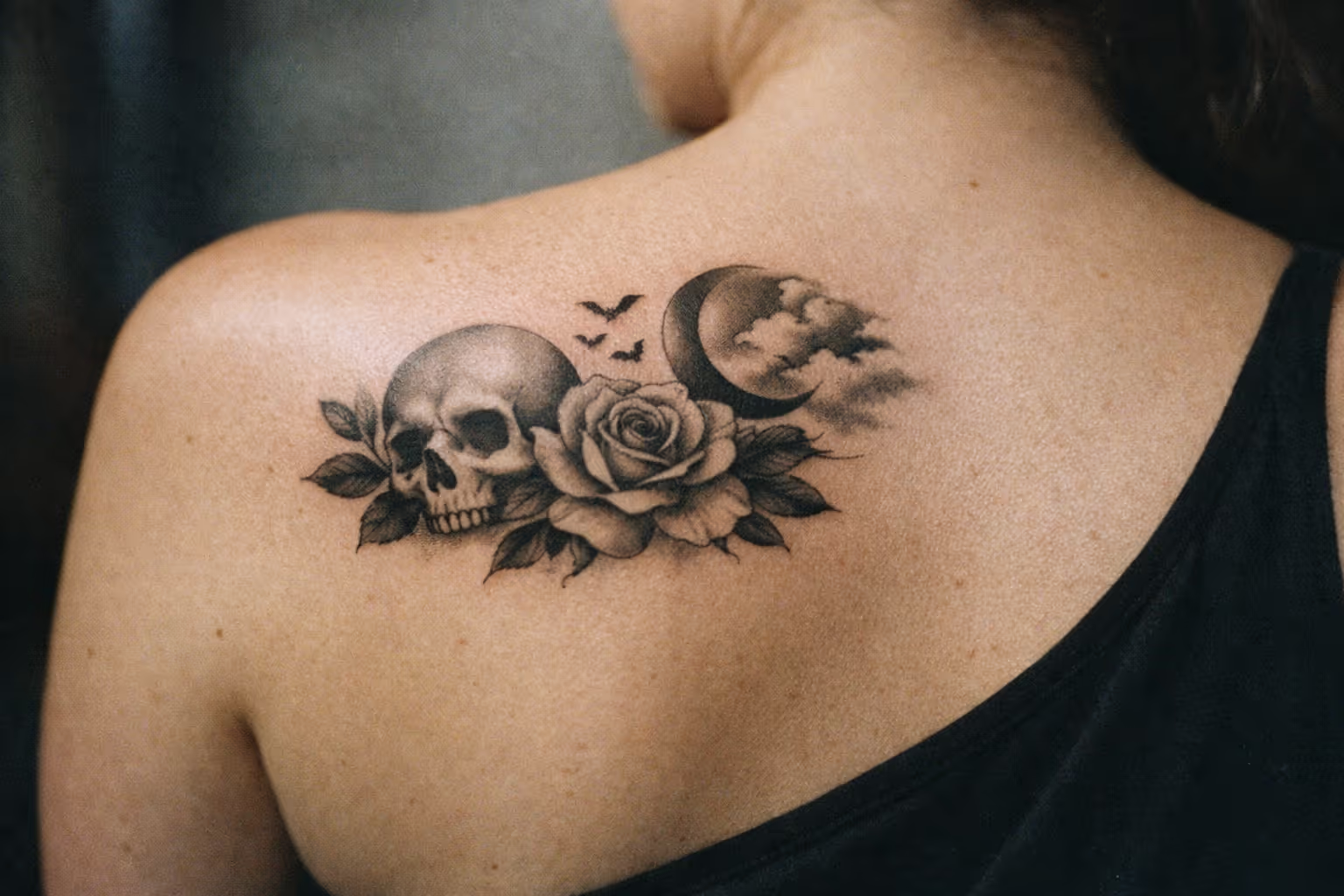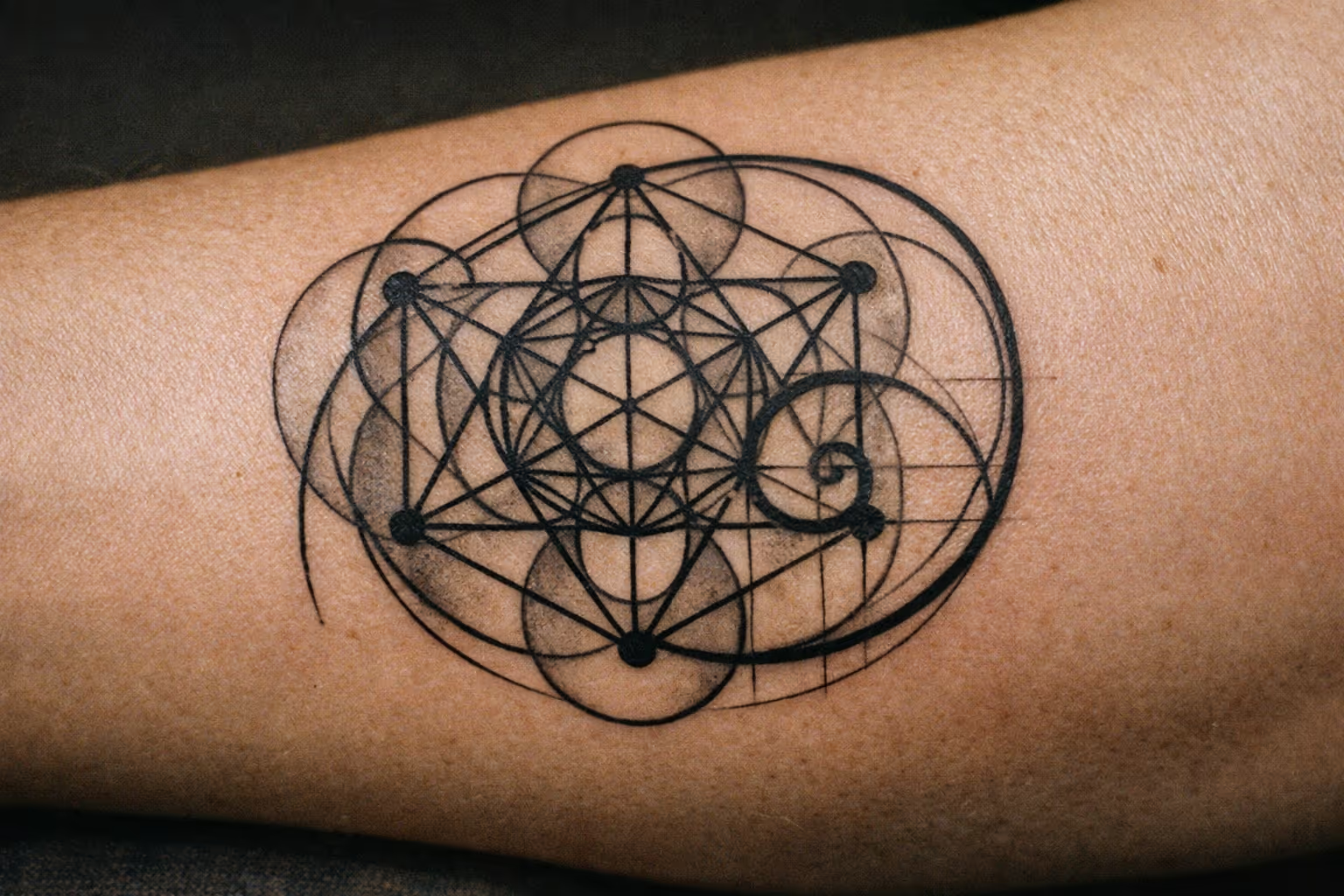
Two people can get the same sacred geometry tattoo and mean completely different things by it. Metatron’s Cube leans toward structure and protection; the Flower of Life toward interconnection; a Fibonacci spiral toward growth and nature’s proportions. Under the symmetry, each pattern carries its own specific meaning - and its own minimum size, below which the fine linework collapses into a smudge. Here’s what the main symbols say, how big they need to be, and 2026 pricing.
What Sacred Geometry Tattoos Actually Mean
A sacred geometry tattoo isn’t just a pretty pattern. It’s a design system built on mathematical precision, where every circle, line, and dot has to land exactly where it should or the whole piece falls apart. These tattoos draw from symbols humans have been carving into stone, weaving into textiles, and painting onto temple walls for thousands of years: the Flower of Life, Metatron’s Cube, the Fibonacci spiral, mandalas, Platonic solids. Done well, they’re some of the cleanest, most architectural work you’ll ever see on skin. Done badly, they’re crooked, blurred, and obvious from across the room.
This guide covers what each symbol actually means, which designs work at which sizes and placements, what a realistic budget looks like in 2026, and the mistakes that ruin sacred geometry pieces. We’ll also get into sacred Geometry Fibonacci tattoo options, feminine sacred Geometry tattoo approaches, and how to plan a full sleeve without ending up with a tangled mess.
The core idea behind sacred geometry is that the universe is organized by repeating proportions and patterns - ratios you can find in nautilus shells, sunflower seed spirals, galaxy arms, and the bones of your own hand. The sacred Geometry tattoo meaning usually points back to one or more of these ideas: unity, cosmic order, balance, protection, growth, or connection between the physical and the spiritual (2).
What that means practically: most clients pick a sacred geometry tattoo because the symbol stands for something specific, not because they want generic ornamental work. Someone choosing a Flower of Life is usually telling you they care about interconnectedness or creation. Someone choosing Metatron’s Cube is usually drawn to balance and protection (1)(6). The symbols are the whole point.
A few things to flag before you commit:
- These designs come from multiple distinct traditions - Kabbalistic, Hindu (yantras), Buddhist (mandalas), Pythagorean, Hermetic. Modern Western tattoo culture often blends them, which is fine if you understand what you’re combining and not fine if you’re mixing a Sri Yantra with a Merkaba without knowing either.
- Some symbols (especially yantras and specific religious seals) are treated as ritual tools in their origin cultures, not decorative motifs. If that matters to you, research before you book.
- “Meaning” in sacred geometry is layered, not fixed. A triangle can mean fire, ascension, the trinity, or upward consciousness depending on the system you’re reading from (4).
✓ Pros
- Highly symbolic designs with deep cultural roots
- Clean, architectural linework when done well
- Wide range of sizes and placements to suit different tastes
✗ Cons
- Requires precise stencil and artist skill to avoid distortion
- Small or overcrowded designs blur quickly
- Some symbols have complex cultural meanings that can be misused
The Core Symbols and What They Stand For
These are the building blocks you’ll see in almost every sacred geometry portfolio. I’ve worked with most of them across different scales and placements, and each one has real constraints worth knowing before you sit down.
Flower of Life. Nineteen overlapping circles arranged in a hexagonal lattice. Read as the blueprint of creation - every Platonic solid can be derived from it. Found carved at the Osirion temple in Egypt and in sites across Asia and Europe (1). Best at 4 inches or larger; smaller than that and the inner circles blur into mud during healing.
Seed of Life. Seven overlapping circles, the geometric heart of the Flower of Life. Read as origin, fertility, the seven days of creation. Works well at 2-3 inches, common over the heart or back of the neck.
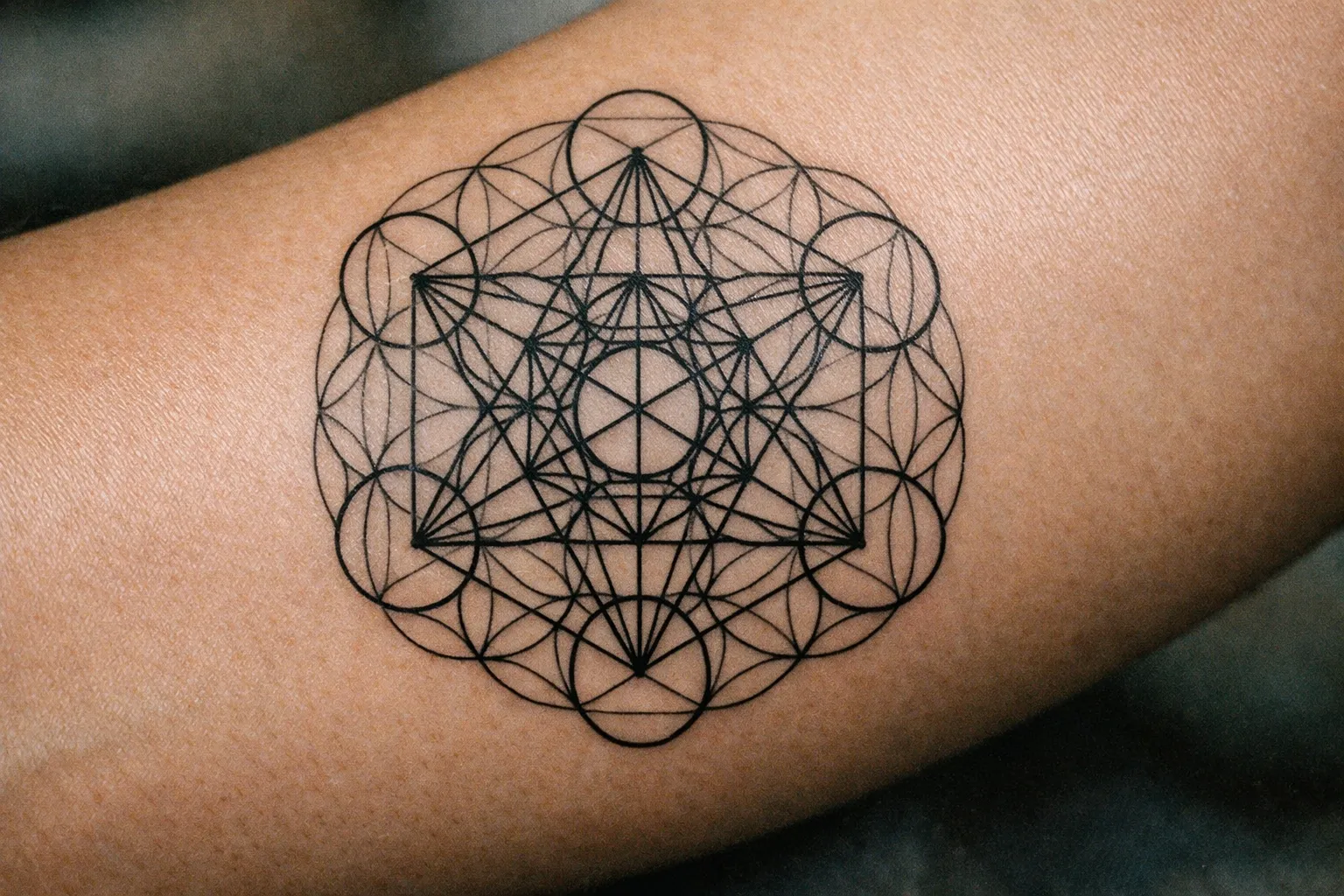
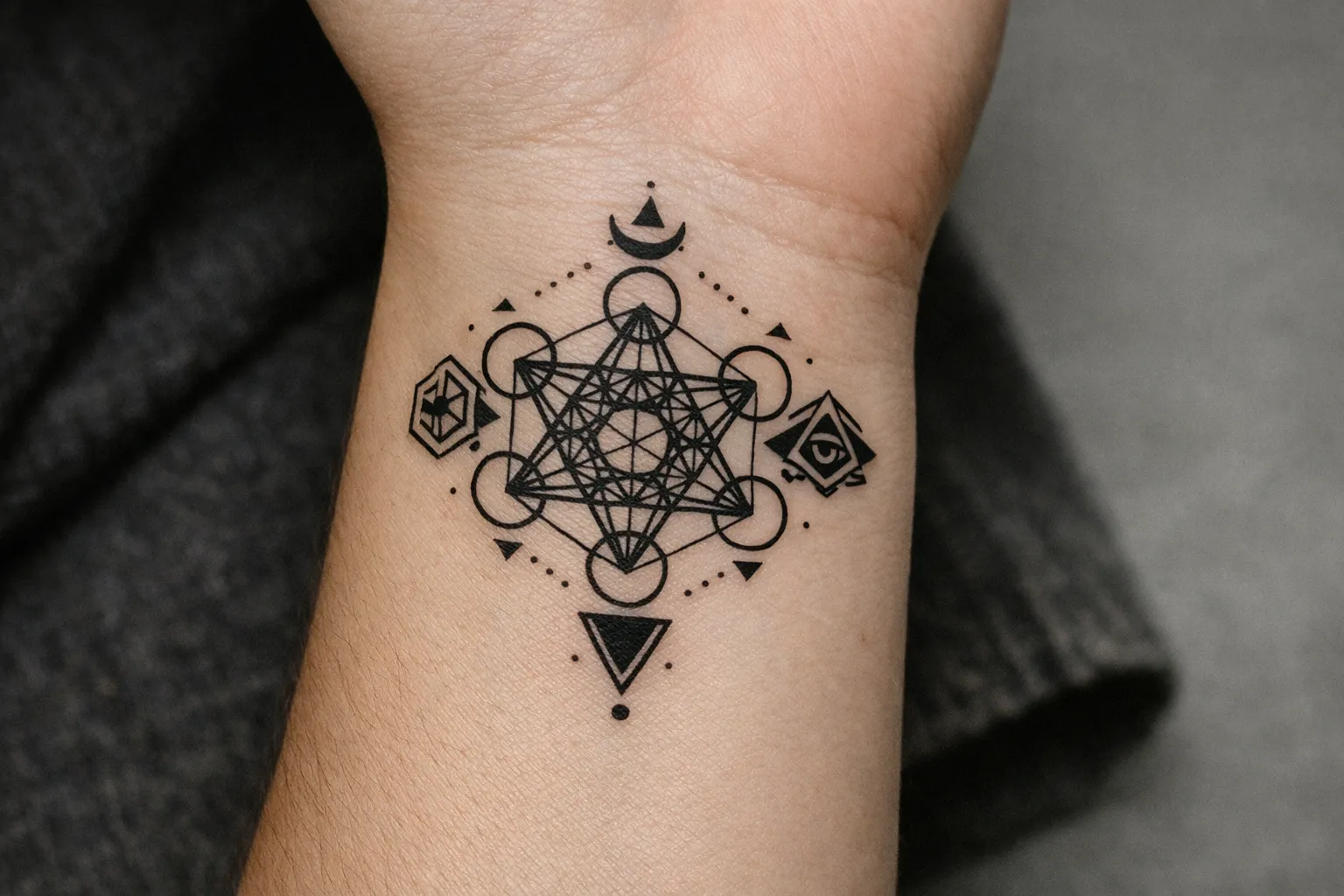
Metatron’s Cube. Thirteen circles connected by straight lines, containing all five Platonic solids inside it. Associated with balance, protection, and the flow of universal energy (6). Demands real space - 5 inches minimum, ideally 6+. Sternum, upper back, and outer forearm handle it well.
Merkaba. Two interlocking tetrahedra forming a three-dimensional star. Read as body, spirit, and light unified - a “vehicle” for ascension in some esoteric systems (1). Works at 3-5 inches and reads cleanly even at smaller sizes because the line count stays low.
Platonic solids. Five three-dimensional shapes - cube, tetrahedron, octahedron, icosahedron, dodecahedron - each tied to an element: earth, fire, air, water, and ether (4). Excellent as matching tattoos, a set across the ribs, or anchors inside a larger sleeve.
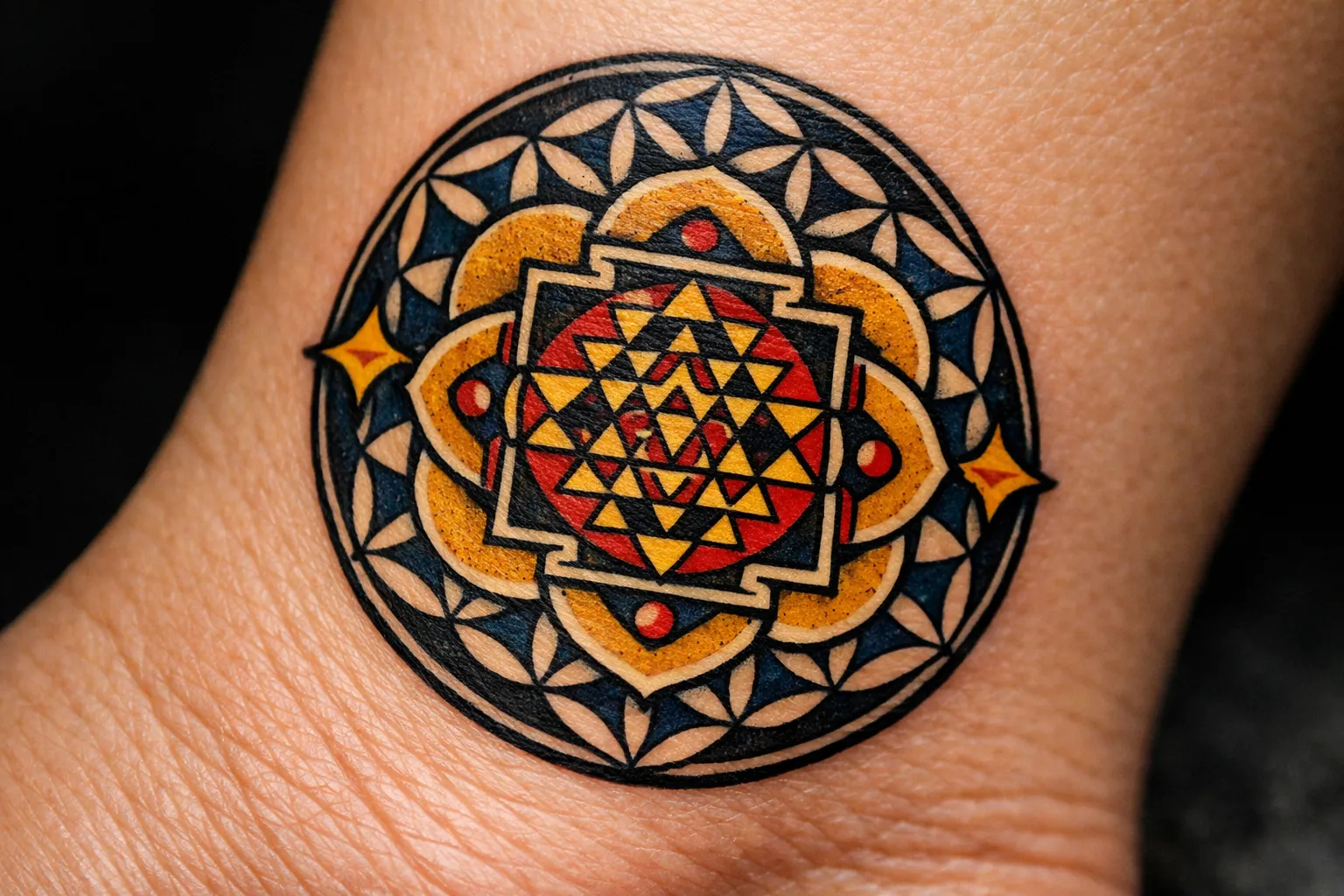
Sri Yantra. Nine interlocking triangles around a central dot, originating in Hindu Tantric tradition. Treated as a meditative diagram, not just a pattern. If you choose this one, know what it is.
Fibonacci spiral / Golden Ratio. The spiral generated by the Fibonacci sequence approximates the Golden Ratio (~1.618), which shows up in shells, hurricanes, and plant growth. The most popular sacred Geometry Fibonacci tattoo layouts pair the spiral with a nautilus, sunflower, ram’s horn, or galaxy. Reads beautifully at 3-6 inches on the inner forearm or calf.
What Is the Most Powerful Sacred Geometry Symbol?
“Most powerful” depends on what tradition you’re reading from - no objective answer exists. That said, the symbols most often cited as especially potent across multiple traditions are:
- Flower of Life - for its claim to contain every other sacred form within it (1).
- Metatron’s Cube - for holding all five Platonic solids and being associated with archangelic protection in Kabbalistic readings (6).
- Sri Yantra - for its use as an active meditation diagram in Tantric practice.
- Merkaba - for representing the unified body-spirit vehicle in esoteric traditions (1).
- Fibonacci spiral - for showing up empirically in nature, which is its own kind of authority (2).
If you want one symbol that carries the broadest weight, the Flower of Life is the safest answer because most other sacred geometry symbols can be derived from it. If you want personal resonance, pick the one whose meaning actually maps to your life.
Designs by Format: How These Pieces Get Built
There are roughly four ways these designs get built. Picking the right format up front saves you from a piece that doesn’t match what you wanted - and I’ve seen clients realize this too late more times than I can count.
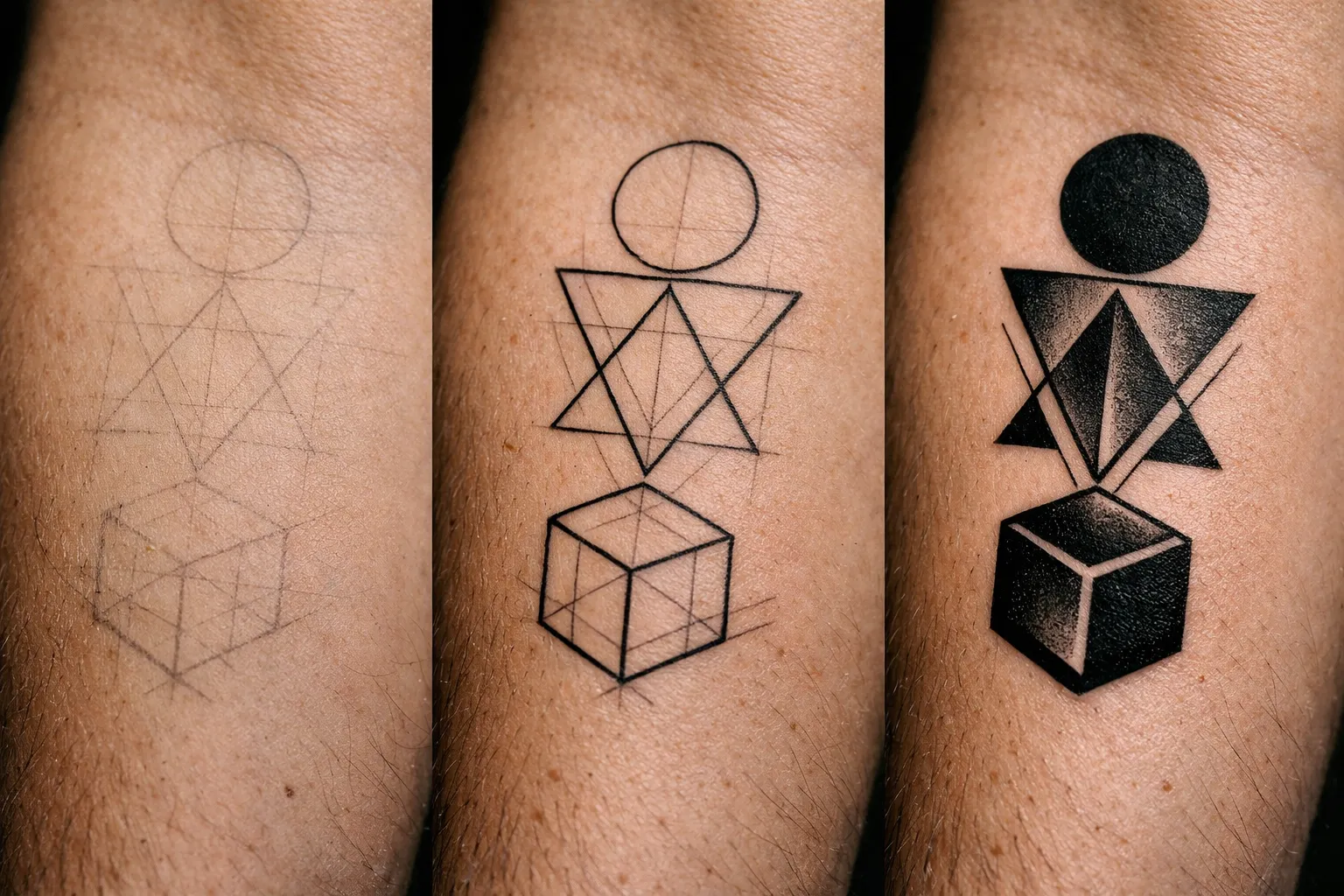
Single sigil. One symbol, clean lines, 1.5-4 inches. Forearm, inner bicep, sternum, behind the ear. Best for a first tattoo or for anyone who needs the work to stay subtle. A small Seed of Life or Merkaba works at this scale.
Pattern field. Repeating tessellations, dotwork gradients, or a large mandala filling a panel. Sizes from 6 inches up to full back. Works on forearms, calves, thighs, and full back. Demands an artist who can stencil symmetrically over curved skin.
Hybrid designs. A geometric animal - wolf, deer, lion - built from triangles, or a portrait overlaid with a Flower of Life grid (3). These are the most flexible of all the sacred Geometry tattoo designs because the geometry becomes structural rather than the whole subject.
Ornamental flow. Mandalas combined with florals, lunar phases, or fine-line filigree, shaped to follow body contours rather than sit as a rigid block. This is where most feminine sacred geometry lives.
Feminine Sacred Geometry Tattoos
A feminine sacred Geometry tattoo isn’t a different category of symbol - it’s a different approach to line weight, flow, and placement. The geometry stays the same; what changes is how it’s framed and where it sits on the body.
Hallmarks of the style:
- Finer line weight (often 3RL needles for outlines vs. 7RL or 9RL on more architectural pieces).
- Curved framing. Petals, vines, lunar arcs, and floral elements soften the rigid geometry.
- Body-contoured layouts. Mandala points angle toward the collarbone, hip, or navel instead of sitting square.
- Dotwork shading for gradient depth without heavy black fills.
Common placements that work with this approach:
- Sternum - Flower of Life or mandala anchored under the collarbones, 4-6 inches.
- Spine - vertical column of Seed of Life, Metatron’s Cube, and Merkaba, 8-14 inches long.
- Outer thigh or hip - large mandala with floral border, 6-10 inches.
- Inner forearm - Fibonacci spiral with botanical elements, 4-5 inches.
- Underboob / ribs - ornamental mandala, 5-7 inches (ribcage > forearm on the pain scale, by a wide margin).
A pitfall worth naming: cramming too much delicate detail into a small fine-line piece. Fine line on a 2-inch mandala looks crisp at the appointment and blurs by month six, especially on hands and forearms. If you want fine line, scale up - don’t scale detail down.
Fibonacci Spiral Variations Worth Knowing
The Fibonacci spiral is its own sub-genre because it’s the one sacred geometry motif that sits comfortably between science and spirituality. I’ve drawn probably forty versions of this spiral over the years, and the ones that age best are the ones that don’t try to do too much.
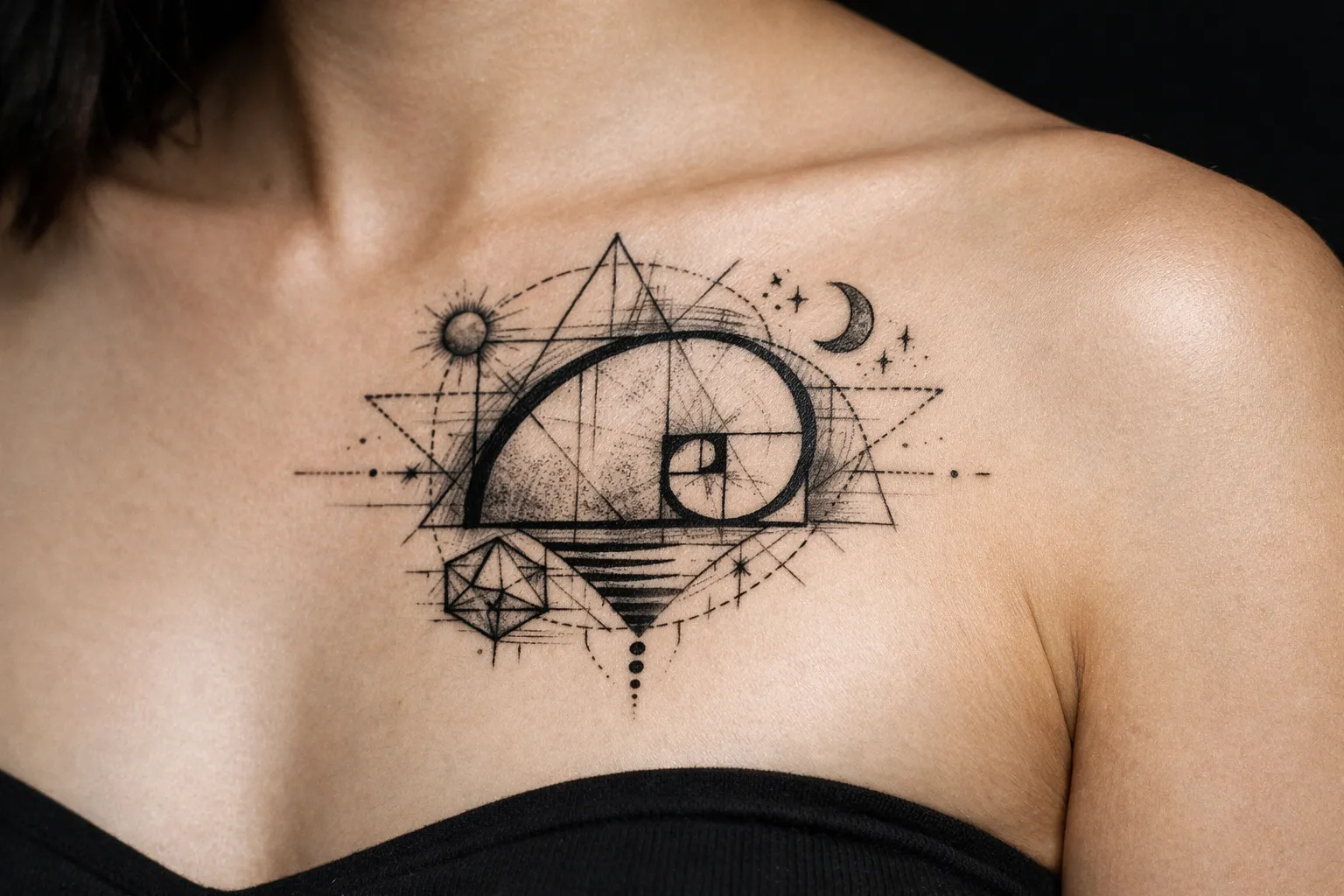
- Pure spiral. Clean line Fibonacci with the nested squares visible. Math-leaning, minimalist, reads at 3-4 inches on the inner forearm. Avoid going smaller - the spiral’s elegance comes from the precision of the ratios, and tiny versions look like a generic swirl.
- Nautilus or ammonite shell. The most natural pairing, since nautiluses genuinely grow along a logarithmic spiral close to the Fibonacci pattern. Works at 4-6 inches.
- Sunflower head. The seed arrangement follows Fibonacci numbers - a stylized sunflower with the spiral overlaid makes the math visible. Best at 5+ inches to keep the seed detail readable.
- Galaxy or hurricane. Spiral arms with stippled stars or wind lines. Effective on the upper arm or shoulder blade, 6-8 inches.
- Compositional use. Instead of tattooing the spiral itself, some artists use the Golden Ratio to position the focal point of a sleeve at roughly 0.618 of the limb’s length. You don’t see the math; you feel that the layout sits right.
How a Sleeve Comes Together
A sacred Geometry tattoo sleeve is one of the harder builds in the style, because every symbol has to align to the curved geometry of your arm without distorting. Done well, it’s some of the most striking work you can wear. Done poorly, the mandalas look oval and the lines drift.
Pick a structural theme first. Three approaches that work:
- Thematic sleeve - Flower of Life, Seed of Life, and Metatron’s Cube woven into one continuous lattice from wrist to shoulder.
- Elemental sleeve - each section (wrist, forearm, upper arm, shoulder) devoted to one Platonic solid and its element (4).
- Patchwork evolution - start with a single 3-4 inch anchor piece and expand outward over months or years, leaving deliberate connection points for future work.
Plan around the joints. Elbows and wrists distort geometry the most. Symmetrical mandalas placed directly over the elbow will look skewed when your arm bends. Most experienced artists use the elbow as a rotational center - a radial mandala built around it - rather than fighting the joint.
Budget the negative space. Aim for 40-60% untattooed skin across the sleeve. Fully blacked geometric fields overpower the limb and make individual symbols unreadable. Negative space is what lets each shape register.
Session structure. Expect 4-10 sessions of 3-5 hours each, spaced 3-6 weeks apart to allow healing between adjacent areas. Linework usually comes first across the whole sleeve, then dotwork shading and black fills layer in over subsequent sessions.
Find the right artist. Filter portfolios for healed work at 3-12 months out, not just freshly inked photos. Healed sacred geometry shows whether lines stayed crisp or spread. Ask how they build their designs - most specialists now use vector tools, Procreate symmetry functions, and Golden Ratio grids rather than freehanding (5).
What Does a $3,000 Budget Get You?
Pricing in 2026 at reputable U.S. studios runs roughly:
- Shop minimum: $100-$200 for very small (1-2 inch) simple geometry.
- Mid-tier hourly: $150-$250/hour.
- Established sacred geometry specialists: $250-$400/hour in major cities (LA, NYC, Austin, Portland).
At a $200-$250/hour rate, a $3,000 budget buys roughly 12-15 hours of work. That’s enough for:
- A detailed half-sleeve (forearm or upper arm) with linework, dotwork shading, and 3-4 anchor symbols.
- A large back mandala, 10-12 inches across, fully detailed.
- A multi-session sternum-to-navel centerpiece integrating Metatron’s Cube, ornamental linework, and dotwork gradients.
For context, a full sacred geometry sleeve typically lands between $2,000 and $5,000 depending on detail density, coverage, and the artist’s tier. If a quote comes in dramatically below that range for full sleeve work, look at the artist’s healed portfolio carefully. Geometry is one of the styles where price and skill correlate hardest - more so than almost anything else I work in.
Tattoos to Avoid in This Style
Not every sacred geometry idea ages well or holds up culturally. These are the ones I’d push back on if a client brought them to me.
- Symbols you don’t actually understand. Occult sigils, specific religious seals, and bind runes carry real weight in their traditions. Tattooing one because it looked good on Pinterest is the version of this that ages worst.
- Copying someone else’s custom piece line-for-line. Established sacred geometry sleeves by artists like Dillon Forte get copied constantly (5). Both the original client and the artist hate it, and most reputable shops will refuse the job.
- Tiny, highly detailed pieces. A Flower of Life under 2.5 inches or a Metatron’s Cube under 4 inches will blur within a year or two. The detail is the point - strip the detail and you’re left with a vague circle.
- Overcrowded compositions. Stacking Flower of Life + Sri Yantra + Metatron’s Cube + Merkaba into one 5-inch piece creates visual noise. Pick one focal symbol and let the rest support it.
- Heavy script combined with dense geometry. Quotes wrapped through mandalas become unreadable from more than a couple feet away.
- Sacred geometry on the hands and fingers at fine-line scale. Hands lose ink fastest - fine geometric work there often needs touch-ups within 12-18 months.
Common Mistakes That Wreck Geometry Tattoos
Even with a good artist, a few specific pitfalls show up over and over. Most of them are preventable before you ever sit in the chair.
- Going too small. The most common issue. Lines spread 0.1-0.3 mm during healing, which destroys detail in tight geometry.
- Ignoring joint distortion. Perfect circles on the side ribs or over the knee look oval at rest because the skin is curved.
- Poor stencil alignment. A symmetrical mandala stenciled even 2 mm off-axis reads as crooked forever. A good artist will re-stencil three or four times if needed.
- Cheap aftercare. Fine sacred linework on a forearm can visibly fade within 1-2 years without sun protection.
- Rushing the sleeve. Trying to complete a full sleeve in three back-to-back sessions usually results in inconsistent line weight and rough healing.
Aftercare for Sacred Geometry Work
Geometry is unforgiving. Any blowout or fading shows immediately because the lines are supposed to be perfect. This is not the style where you can skip the second week of moisturizing and get away with it.
- Day 1-3: Keep the second-skin bandage on as long as your artist directs (usually 24-72 hours). Once removed, wash gently with a fragrance-free soap and pat dry. No soaking, no swimming, no gym.
- Day 4-14: Apply a thin layer of fragrance-free moisturizer or a water-based tattoo balm 2-3 times daily. The tattoo will peel - don’t pick. Sleep on clean sheets and avoid tight clothing over the area.
- Week 2-4: The surface looks healed but deeper layers are still settling. Keep moisturizing. Avoid direct sun exposure entirely.
- Week 4-6+: Fully healed. From here on, daily SPF 30+ on any exposed sacred geometry work is non-negotiable. UV breaks down fine linework faster than anything else.
Total healing: 4-6 weeks for the skin to fully settle. Touch-ups, if needed, are usually done at the 6-8 week mark.
Frequently Asked Questions
- How do I know if a sacred geometry symbol is appropriate to tattoo?
- Research the symbol's cultural and spiritual origins carefully. Some symbols are ritual tools rather than decorative motifs, so understanding their meaning and context is crucial before committing.
- Can sacred geometry tattoos be combined with other styles?
- Yes, but be cautious. Hybrid designs that use geometry as structural elements work best. Mixing unrelated sacred symbols without understanding can lead to visual and cultural confusion.
- What should I look for in an artist for sacred geometry work?
- Look for healed portfolio photos showing crisp, consistent linework at 3-12 months post-appointment. Ask about their use of digital tools like vector software or symmetry functions to ensure precision.
- Is it possible to get a sacred geometry tattoo in color?
- Color is possible but usually limited to accents. Heavy color fills can obscure the clarity of geometric lines, so subtle use is recommended.
- Why do sacred geometry tattoos require more aftercare attention?
- Because the style relies on precise, clean lines, any fading or blowout is very noticeable. Proper moisturizing and sun protection over 4-6 weeks and beyond are essential to maintain sharpness.
- How does skin curvature affect sacred geometry tattoos?
- Curved areas like elbows, ribs, or knees distort geometry. Experienced artists plan designs around joints or use rotational symmetry to minimize distortion.
- Can I get a small sacred geometry tattoo on my wrist or fingers?
- Small, detailed sacred geometry tattoos on hands and fingers tend to blur and fade quickly due to skin texture and exposure. Larger sizes and other placements are better for longevity.