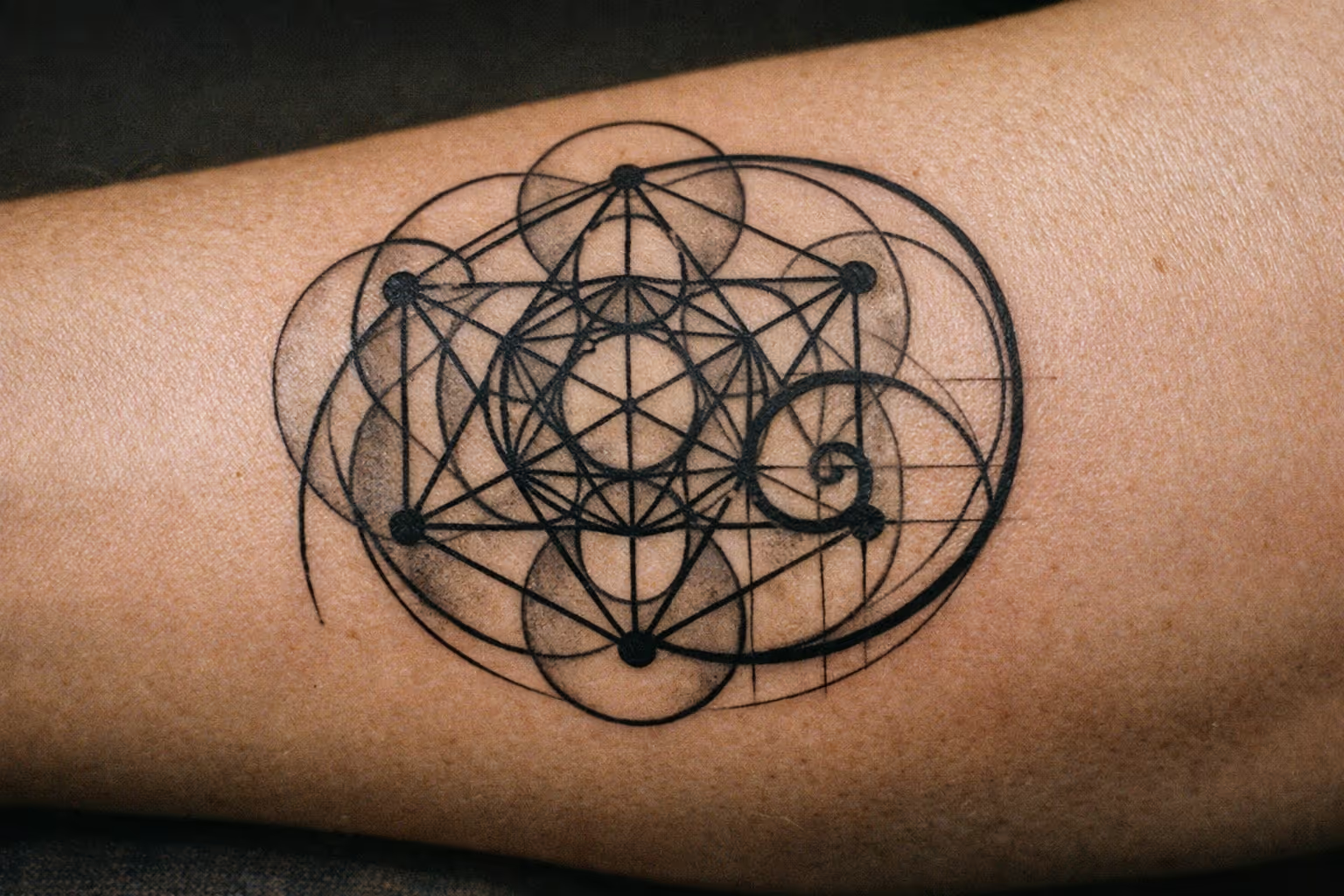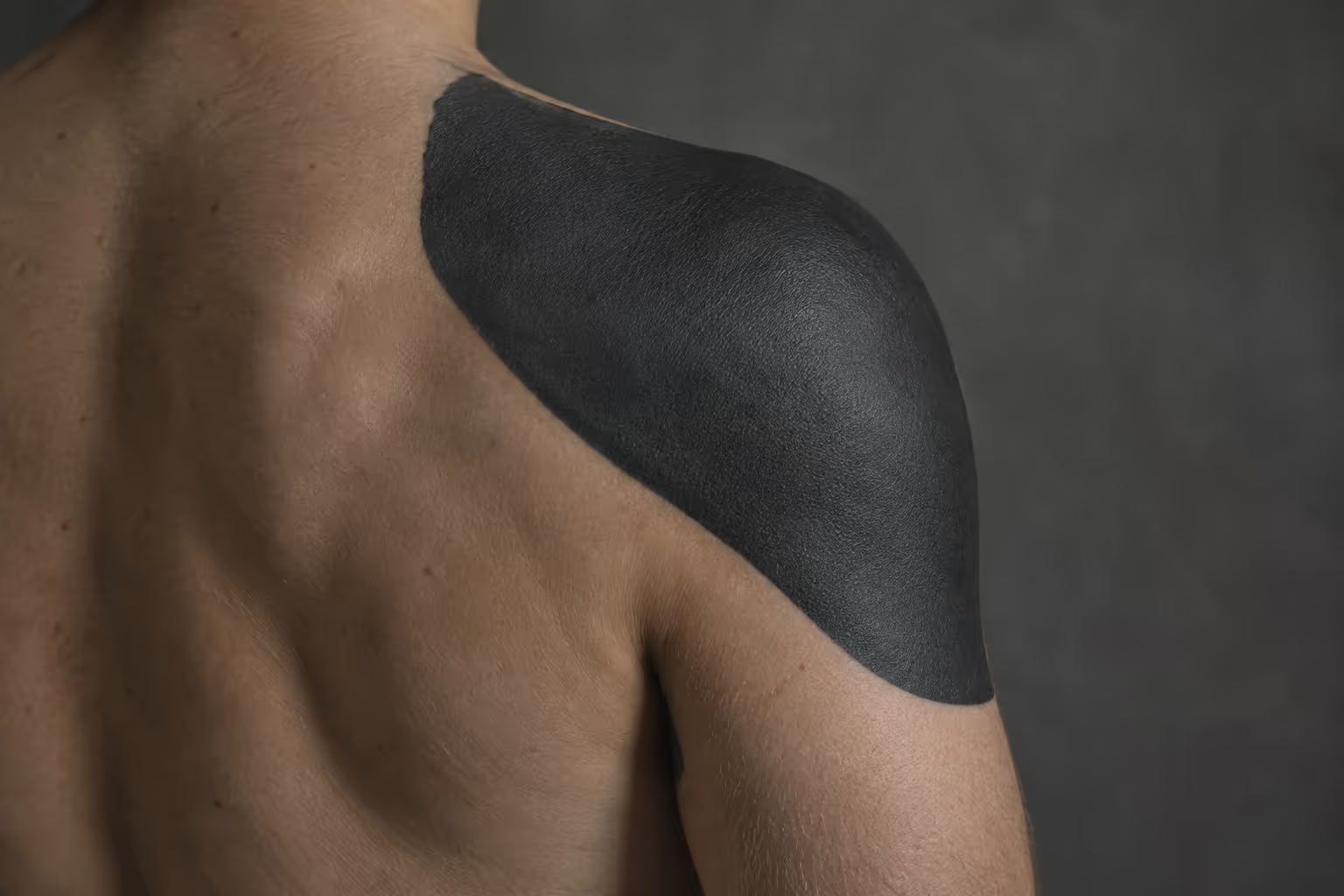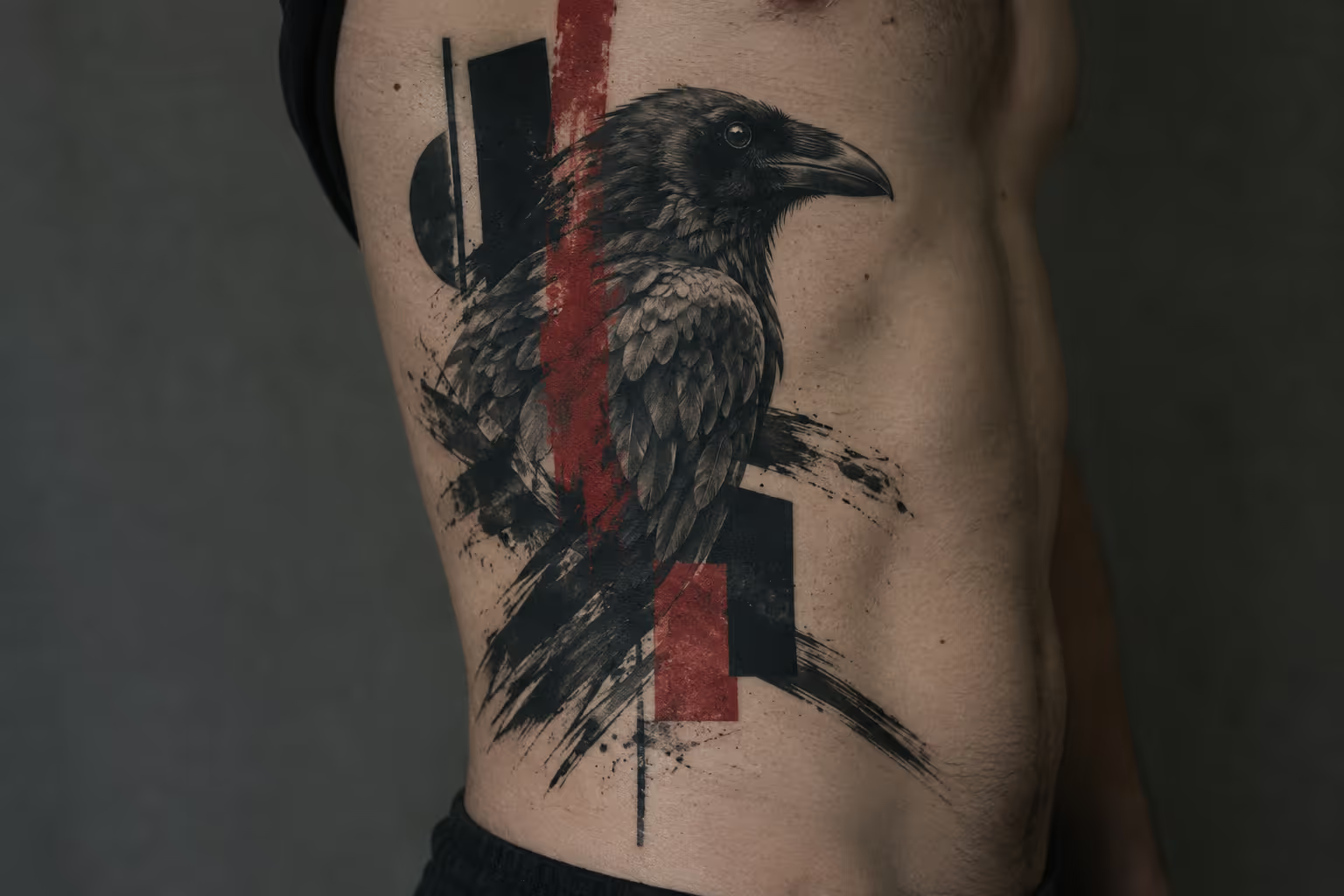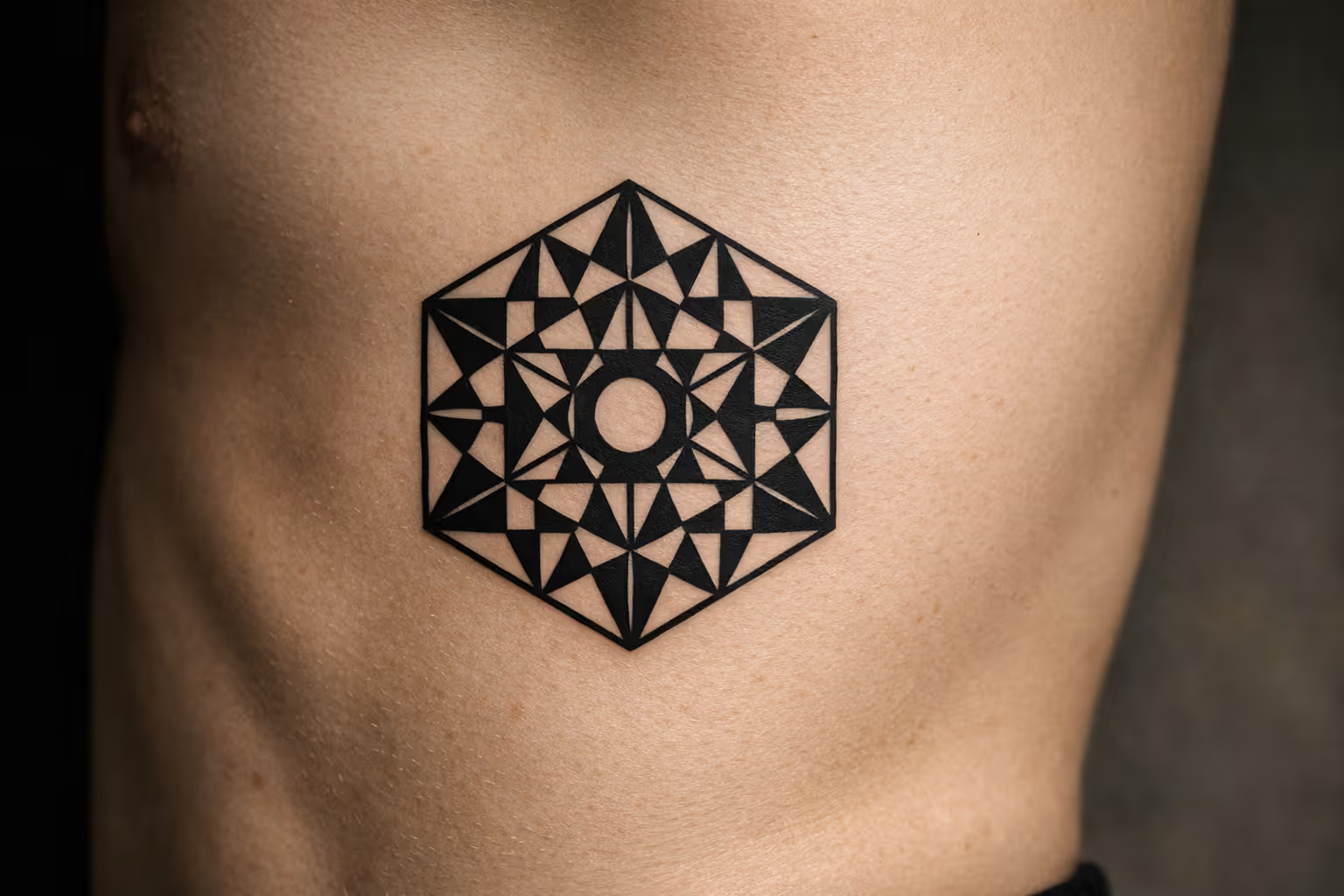
One equilateral triangle inked on a forearm sits inside a tradition that runs from Islamic tilework to Pythagorean philosophy. That’s the thing about a geometric tattoo: the design is the math, not decoration laid on top of it. The shape is the subject, and every line has to hold its angle to work. Industry data cited in tattoo statistics roundups shows geometric work grew roughly 27% year-over-year in 2023, with “sacred geometry” pieces up around 28% in the same window (2). This guide connects the parts that usually live in separate articles: what the shapes mean, where they hold up on the body, how they’re actually made, and how they age over a decade.
✓ Pros
- Scales from a 1-inch wrist symbol to a full back piece without losing coherence
- Blackwork and bold linework geometric designs age better than fine-line realism or grey wash
- Highly customizable via digital symmetry tools before committing to skin
- Strong visual impact in both minimalist and complex forms
- Dotwork geometric pieces age particularly well compared to densely packed fine-line work
✗ Cons
- Dotwork and sacred geometry sessions run 2-3× longer than conventional shading - budget and time accordingly
- Symmetry-dependent designs are unforgiving of stencil misalignment; errors are immediately visible
- Very thin, densely packed lines can blur and merge within 5-10 years
- High-detail pieces require multi-session commitment - not a one-sitting project
- Curved placements (elbows, knees, shoulders) distort symmetrical patterns when the limb moves
What a Geometric Tattoo Actually Is (and What It Isn’t)
A geometric tattoo is a design built primarily from lines, circles, triangles, hexagons, polygons, and fractals, where the mathematical form is the subject rather than decoration wrapped around something else (1)(5). The hallmarks are consistent: strict symmetry, repetition, mathematical ratios, and deliberate negative space. When those four things line up, the piece reads clean. When they don’t, it reads as a wobble.
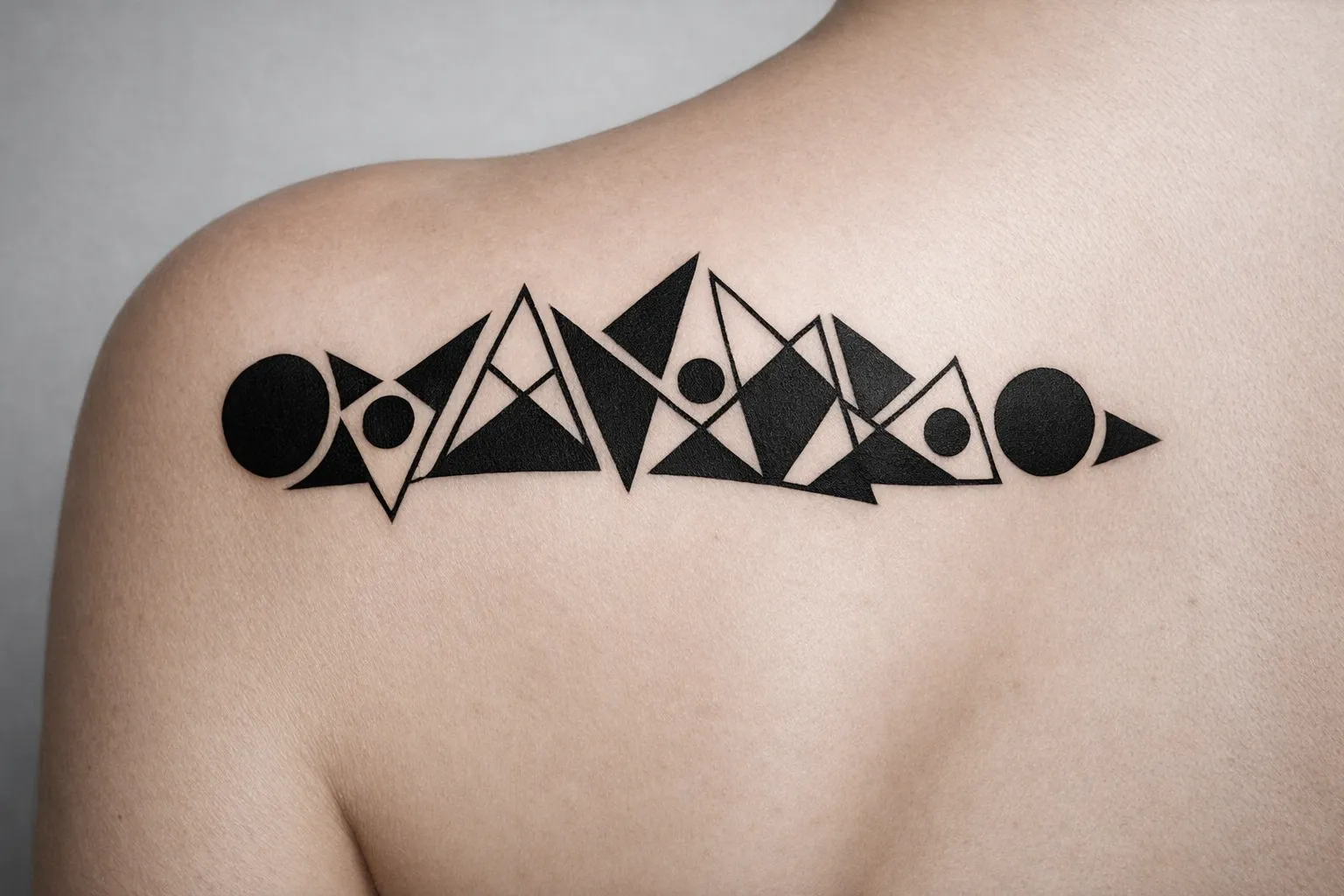
The style gets confused with tribal and ornamental work, but the distinction is pretty straightforward. Geometric design makes the shape the focal point. Tribal work uses geometry as cultural patterning tied to a specific tradition. Ornamental work uses geometric elements as framing around a different subject. In a geometric piece, remove the shapes and there’s nothing left - because the shapes were the whole point.
The growth isn’t a fluke of one platform. Geometric work pairs cleanly with minimalist black ink and fine-line styles, and digital design tools with symmetry guides made it far easier to build and iterate before anything hits skin (1)(5). None of this is a 2020s invention. The roots run through Islamic geometric tilework, Celtic knotwork, and Pythagorean geometry - people have been finding meaning in precise repeating shapes for a very long time.
What Geometric Tattoos Symbolize
Geometric tattoos broadly represent order, balance, and precision - the idea that mathematical structures underlie natural reality. That’s the general read. Beyond it, individual shapes carry their own associations, and those associations shift depending on which tradition you’re pulling from.
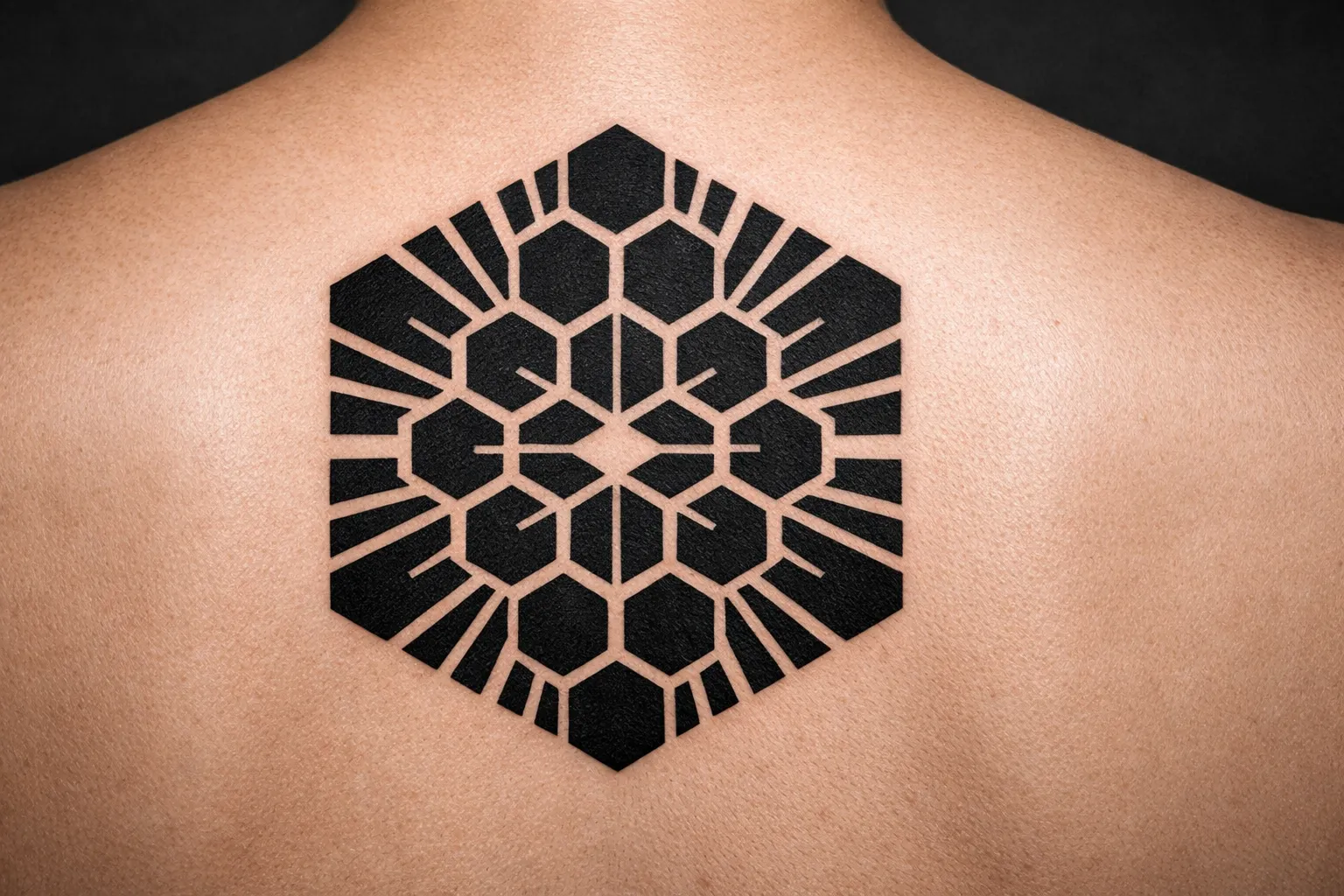
- Triangle: direction, change, and the trinity. Shows up across Christian, Hindu, and alchemical traditions, which is part of why it reads as loaded even at a small size.
- Circle or ring: wholeness and continuity, no beginning or end. Appears in both Celtic and Buddhist contexts, usually tied to cycles and completeness.
- Hexagon: efficiency and natural structure, mostly through the honeycomb. Turns up in Islamic geometric art and in modern sacred geometry.
- Spiral: growth and evolution, found in Polynesian and Celtic traditions, where it tracks movement and expansion outward.
- Cube and Platonic solids: the classical elements - earth, fire, water, air, ether - in Western esoteric tradition.
Here’s the honest part: plenty of people choose geometric designs because they like how the shapes look, full stop. That’s a legitimate choice. You don’t have to assign meaning to a hexagon cluster to earn the right to wear it. If a design means something specific to you, good. If it just fits your taste, that’s also fine. The one place meaning genuinely matters is sacred geometry, which carries more specific associations - covered next.
Sacred Geometry Tattoos: The Specific Symbols and What They Mean
Sacred geometry is an ancient system of symbolic patterns believed to encode the structure of the universe, with roots in Egyptian, Greek, Hindu, and Islamic architecture. Unlike a plain triangle you picked because it looked clean, these symbols come with documented cultural and spiritual weight. That changes how you should approach them.
The core motifs:
- Flower of Life: overlapping circles forming a hexagonal grid, associated with creation and interconnection. One of the most requested sacred geometry designs, and one that scales reasonably well.
- Metatron’s Cube: contains all five Platonic solids, associated with divine order and protection. Detail-heavy - it needs room.
- Sri Yantra: nine interlocking triangles forming 43 smaller triangles, Hindu in origin, linked to abundance and cosmic balance. Technically demanding work; the internal triangles have to stay precise or the whole thing collapses.
- Vesica Piscis: two overlapping circles, appearing in Christian and Pythagorean contexts, associated with duality and creation.
- Platonic solids: tetrahedron, cube, octahedron, dodecahedron, icosahedron - each linked to a classical element.
The practical warning is real. Sacred geometry content repeatedly flags that choosing a Sri Yantra or Metatron’s Cube purely for aesthetics, with no understanding of the associations, is a documented source of later regret. You don’t have to be a scholar. Spend an hour reading about the symbol before it’s on your skin permanently. That hour is cheap insurance against a decade of “why did I get this.”
On placement: sacred geometry pieces are frequently set on the sternum, spine, and chakral areas to align with the spiritual symbolism (9). Those are higher-pain zones. Sternum and spine rank among the sharpest placements on the body - well above forearm or calf. Factor the pain into the decision, because a design meant to sit over the sternum is a different commitment than the same design on an outer forearm.
Mandala vs. Geometric: Not the Same Thing
A mandala is a specific type of geometric tattoo - always radially symmetrical, built outward from a central point with concentric rings of shapes (9). A geometric tattoo is the broader category: it can be linear, abstract, non-radial, or asymmetrical. All mandalas are geometric. Not all geometric tattoos are mandalas.
Mandalas originate in Hindu and Buddhist traditions as meditation tools. Modern use is largely secular, focused on balance and focus rather than religious practice (9). The practical difference matters at the stencil stage: a mandala demands perfect radial symmetry from a fixed center point, so placement errors are more visible than on a linear geometric piece. A ring that’s off by a couple of degrees on one side will read as broken.
The Most Popular Patterns for Geometric Tattoos Right Now
Dotwork mandalas, fine-line hexagonal tessellations, Flower of Life compositions, fractals, and blackwork-dotwork hybrids are the most requested geometric patterns in 2024-2025. Here’s how each one actually behaves on skin.
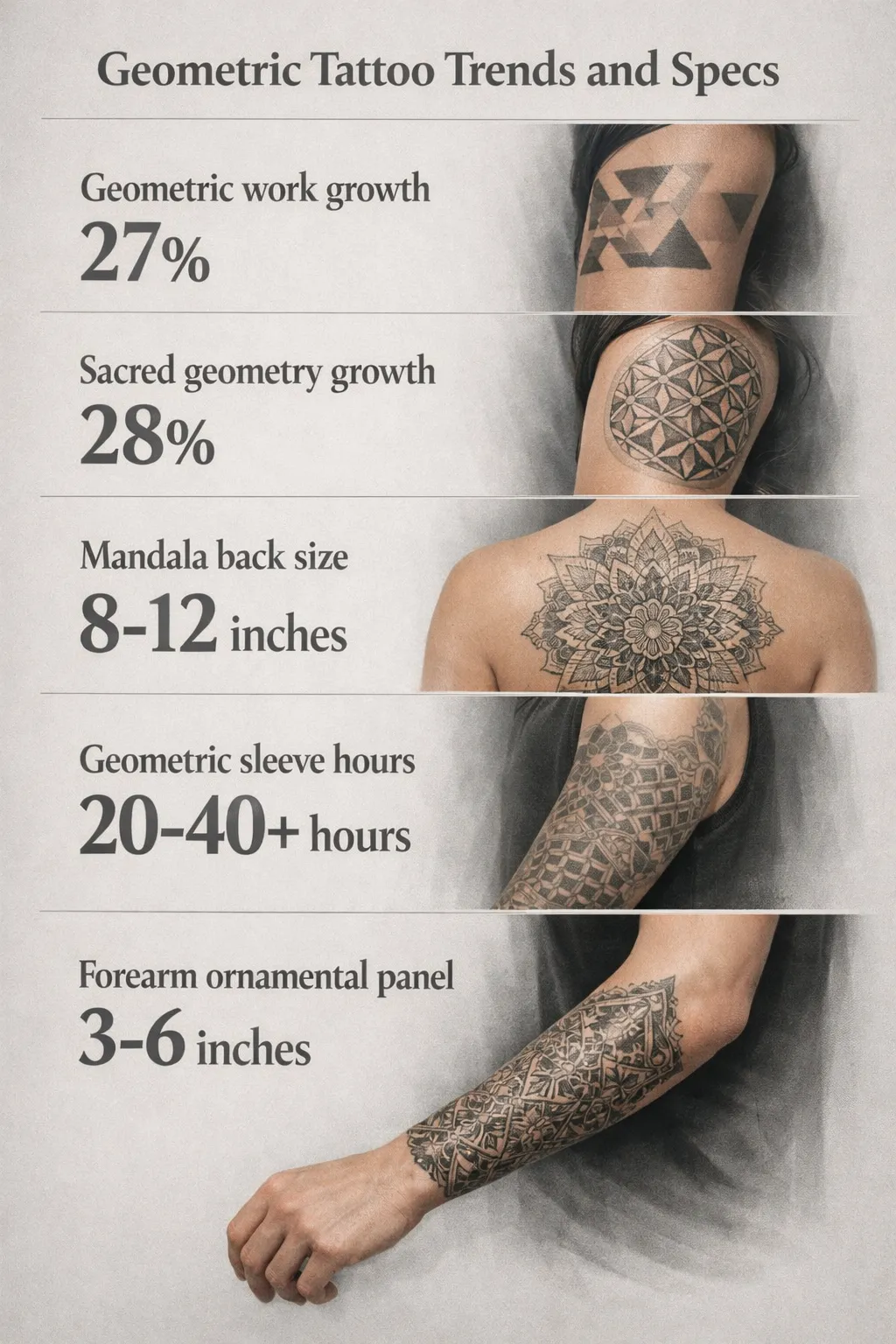 Geometric tattoo trends: 27% growth in geometric work and 28% in sacred geometry; common sizes include 8-12 inch mandala backs, 20-40+ hour sleeves, and 3-6 inch forearm panels.
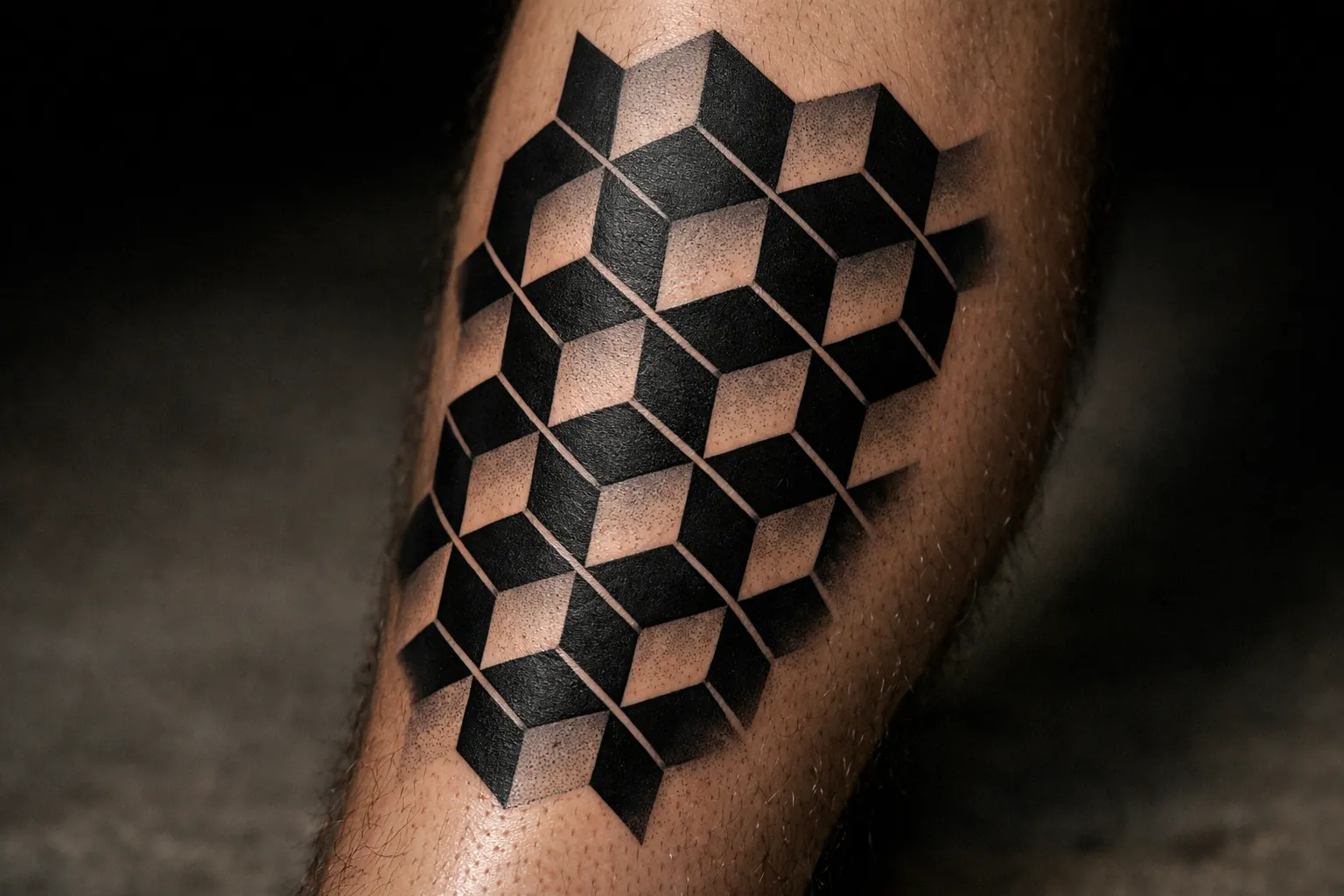
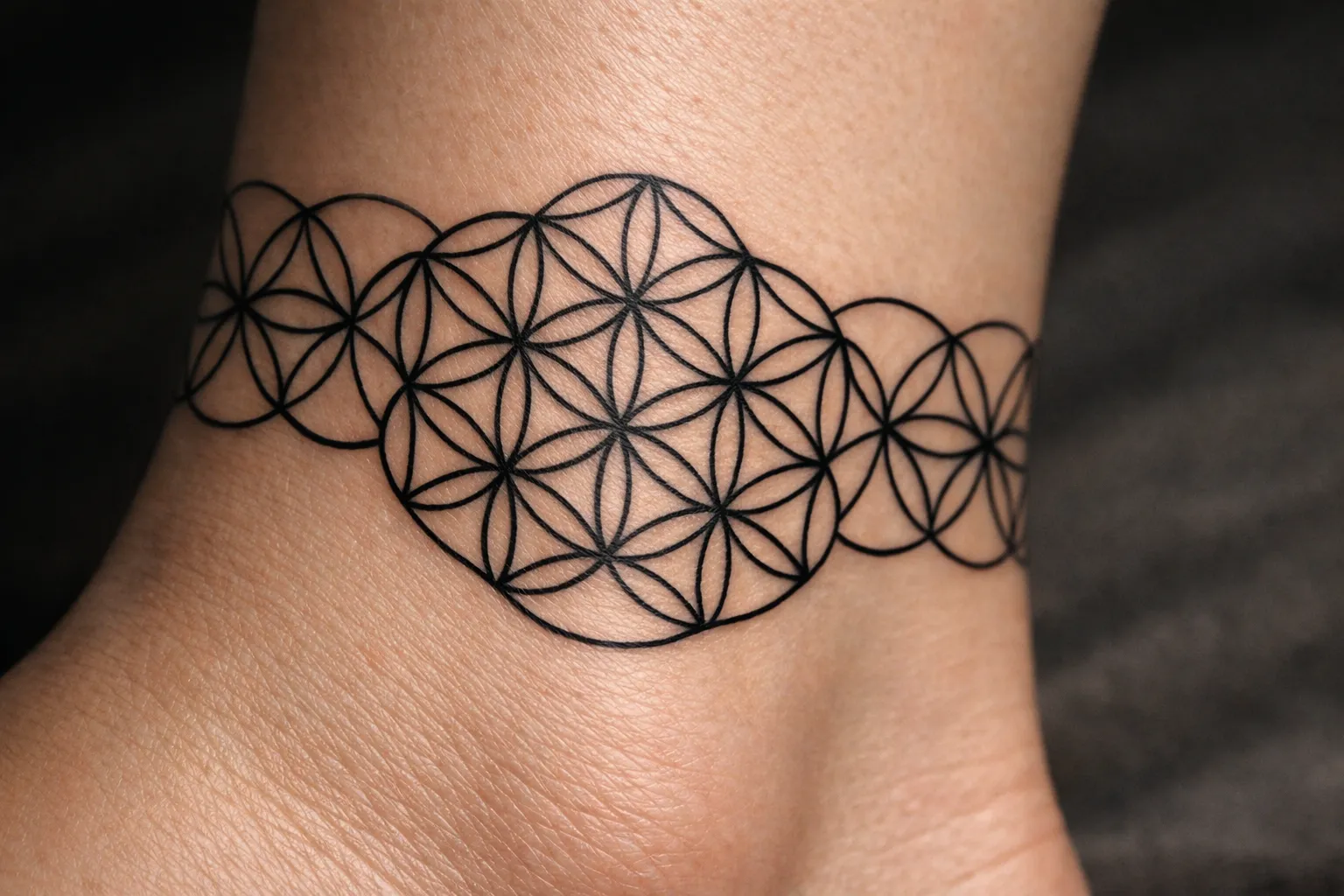
Dotwork grids and stippled fields use thousands of individual dots to build gradients and texture. They’re especially popular for mandalas and ornamental pieces. The catch: dotwork runs 2-3× longer than conventional shading because every dot is placed by hand (4). Budget the time and the money for it.
Fine-line linework uses single-needle or 3RL outlines with minimal shading. It trended hard through 2024-2025, and it’s genuinely striking fresh. But it ages harder than bold linework - lines under about 1mm can soften noticeably within 5-10 years. If you go fine-line, anchor the design with at least one area of stronger weight.
Hexagonal tessellations are honeycomb grids used as background texture or as standalone sleeve elements. Hexagons were called out specifically in 2024 trend data, and they’re versatile - they fill space without competing with a focal piece.
Fractals are self-similar patterns that repeat at different scales, like Sierpiński-triangle or Koch-snowflake-inspired designs. Complex to execute, and they demand an artist comfortable with mathematical precision. Not a first-timer piece.
Blackwork and dotwork hybrids combine solid black shapes with dotwork gradients. High contrast, reads well from a distance, and ages better than fine-line alone. This is the durable end of the geometric spectrum.
Minimalist single-symbol pieces - one triangle, one hexagon, one small mandala - stay consistently popular. At 1-2 inches they’re fast to execute and lower cost, which makes them a strong choice for a first geometric tattoo.
Geometric Tattoo Design Ideas by Placement
Flat, stable surfaces hold geometric symmetry better than curved, mobile ones. That single principle drives every placement decision here. A straight line stays straight on a forearm. On a flexing elbow, it doesn’t.
Forearm Geometric Tattoo
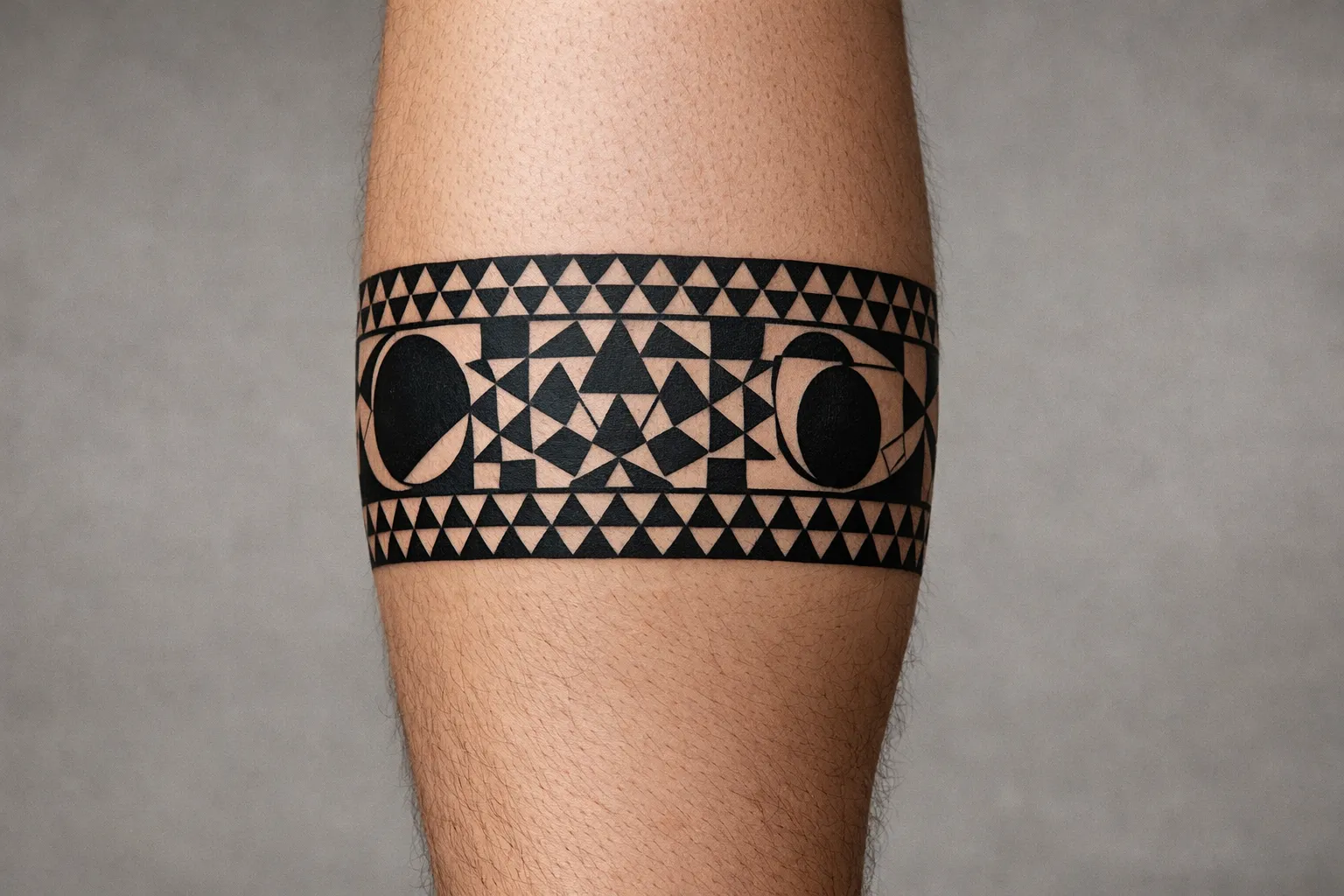
The forearm is the strongest match for geometric work. It runs roughly 9-11 inches from wrist to elbow crease and about 3-4 inches wide at its widest point, with a flat-ish plane that keeps straight lines straight. A forearm geometric tattoo also reads clearly from multiple angles, which is rare - it works on both the inner and outer surface at once.
For size, a single ornamental panel sits well at 3-6 inches; a forearm-length piece running wrist to elbow needs 6-10 inches. Outer forearm gives you visibility; inner forearm is more personal and gets less sun, so it fades slower. Pain-wise, the outer forearm is moderate, while the inner forearm and wrist crease are sharper.
Geometric Tattoo Sleeve
A geometric tattoo sleeve gets built in stages, not one marathon session: outline anchor pieces first, then interior patterns, then dotwork fill, then touch-ups. Start with one or two anchor pieces on the upper arm and forearm at 4-6 inches each, and live with them for 3-6 months before adding connectors. That gap lets you watch how they heal and settle before you commit the rest of the arm.
Sacred geometry and mandala elements work well as focal points; dotwork and blackwork fields make good connectors. A full sleeve runs 20-40+ hours across multiple sessions, so plan the budget before the first appointment, not after. Design around the shoulder and elbow curves rather than fighting them - symmetrical patterns distort at those joints when the arm moves.
Geometric Tattoos on the Leg
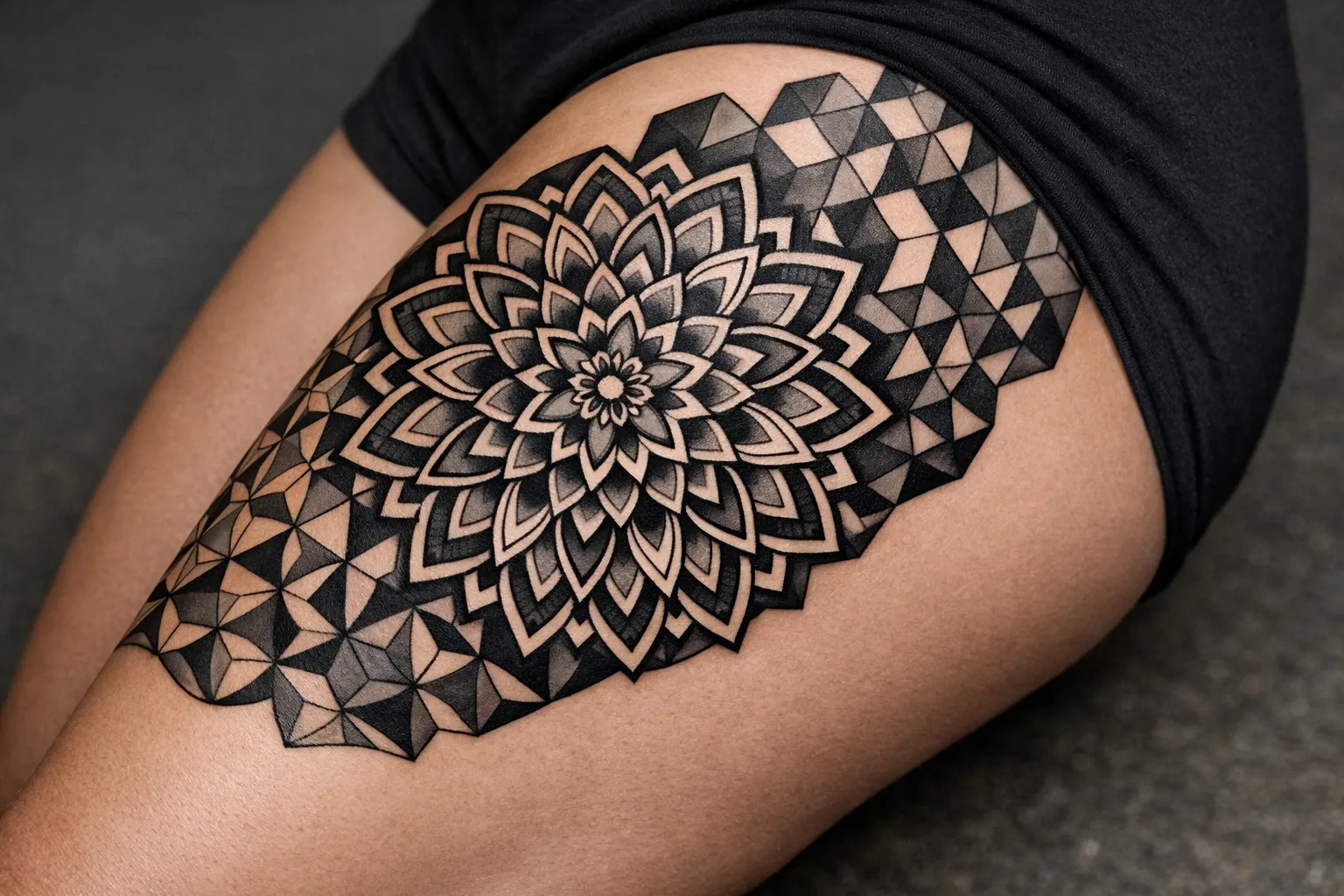
The calf is the leg’s version of the forearm: flat-ish, good ink retention, moderate pain. Geometric tattoos on the leg sit well on the calf at 4-8 inches. The thigh offers more surface for large mandala or sacred geometry compositions, especially the outer thigh, where pieces can run 6-12 inches without crowding.
Avoid the knee and the back of the knee for anything symmetry-dependent. The skin there folds and moves significantly, and a mandala that looks perfect straight will warp visibly every time the joint flexes.
Chest, Sternum, and Back Placements
The sternum and spine are common homes for sacred geometry like the Sri Yantra and Flower of Life, chosen for the chakral alignment. Pain here is notably higher than forearm or calf - sternum and spine rank among the sharpest placements on the body. The upper back between the shoulder blades is a different story: flat, large, and forgiving, ideal for a mandala centerpiece at 6-10 inches. The shoulder blade itself is manageable; the spine line is sharper. A chest plate at 5-8 inches works for geometric compositions that use the sternum as an axis of bilateral symmetry.
Geometric Tattoo Ideas: Designs Worth Considering
Concrete ideas by scale, so you can match ambition to commitment.
Small and Minimalist Geometric Tattoos (1-3 inches)
A minimalist geometric tattoo delivers strong graphic impact at low cost and short chair time. Options that work:
- A single equilateral triangle on the inner wrist or behind the ear - fast, clean, high contrast.
- A small hexagon cluster on the forearm at 2-3 inches, which doubles as a future sleeve anchor.
- A tiny mandala on the inner forearm or ankle at 1.5-2.5 inches. Below 1.5 inches, fine-line detail starts to blur within a few years, so don’t go smaller than the detail can survive.
- A Vesica Piscis or simple Flower of Life outline at 2 inches on the sternum or wrist.
On cost: small geometric pieces at 1-2 inches typically run $50-$150 at most shops, though shop minimums usually apply (7). Don’t expect to walk out under the minimum just because the piece is tiny.
Medium Geometric Compositions (3-6 inches)
- A partial mandala on the forearm or calf - a half-mandala wrapping the inner forearm uses the arm’s curve instead of fighting it, which is a smarter composition than forcing a full radial design onto a rounded surface.
- A sacred geometry cluster like Metatron’s Cube or Sri Yantra on the upper arm or chest at 4-5 inches, which gives the internal detail enough room to stay readable after healing.
- A geometric animal hybrid - a wolf, fox, or eagle built from triangular facets, treating an organic subject like a low-poly 3D model. Works on the forearm or calf at 4-6 inches.
- A Fibonacci or golden-ratio spiral at 3-5 inches, which sits well on the forearm, ribcage, or upper back.
Large and Multi-Session Geometric Work (6+ inches)
- A full mandala back piece centered between the shoulder blades at 8-12 inches. Plan for 3-5 sessions minimum once dotwork fill is involved.
- A sacred geometry sleeve integrating Flower of Life, Metatron’s Cube, and geometric animal elements - 20-40+ hours, treated as a year-long project.
- A geometric chest plate with bilateral symmetry at 8-12 inches across, using the sternum as the axis.
- A full-leg geometric panel from thigh to calf. Rare, but striking, and it needs an artist who can map the pattern around the knee without breaking it.
Technique Breakdown: How Geometric Tattoos Are Actually Made
Session time and cost swing hard depending on technique, and understanding why helps you plan. Three approaches dominate geometric work.
Fine-line geometric uses a single needle or 3-round liner for clean outlines with minimal shading. It’s the fastest to execute. The aging caveat: lines under roughly 1mm can soften noticeably within 5-10 years, so anchor delicate designs with at least one area of stronger line weight.
Dotwork geometric builds gradients, texture, and pattern fill from thousands of individual dots. It takes 2-3× longer than conventional shading (4), which is why a mandala that looks like a two-hour piece is often four to six. It ages well, though, because individual dots keep natural separation where packed fine lines merge.
Blackwork and dotwork hybrid combines solid black shapes - high contrast, reads from a distance - with dotwork gradients for detail up close. It’s the most durable combination for large geometric pieces.
Geometric Tattoo Technique Comparison
| Fine-Line Geometric | Dotwork Geometric | Blackwork + Dotwork | |
|---|---|---|---|
| Needle Setup | Single needle / 3RL | Single needle / 3RL | Magnum + liner |
| Session Time | Baseline | 2-3× longer | Moderate-long |
| Aging Outlook | Softens within 5-10 yrs if lines under 1mm | Ages well; dots have natural separation | Most durable; high contrast holds |
| Best Placement | Forearm, calf, upper back | Forearm, sternum, upper back | Sleeve, back, chest |
| Best Size Range | 1-6 inches | 3-12 inches | 4-12+ inches |
| Ideal For | Minimalist symbols, fine mandalas | Mandalas, sacred geometry | Sleeves, back pieces |
On the design side, modern geometric artists lean on symmetry guides in apps like Procreate - vertical symmetry, radial symmetry, and assisted drawing layers - to build and iterate before printing a stencil (6). Procreate is a one-time purchase of around $13, and this workflow is now standard practice, not a novelty.
One last technical point that clients skip: stencil alignment. Because geometric designs live and die on straight lines and precise angles, a small stencil misalignment is immediately visible. Ask to see the stencil placed before any ink goes in, and check it from multiple angles.
Geometric Tattoos That Age Badly: What to Avoid
The tattoos to avoid in geometric work are the ones that ignore how skin changes over a decade. None of this is alarmist - it’s just what shows up on healed skin.
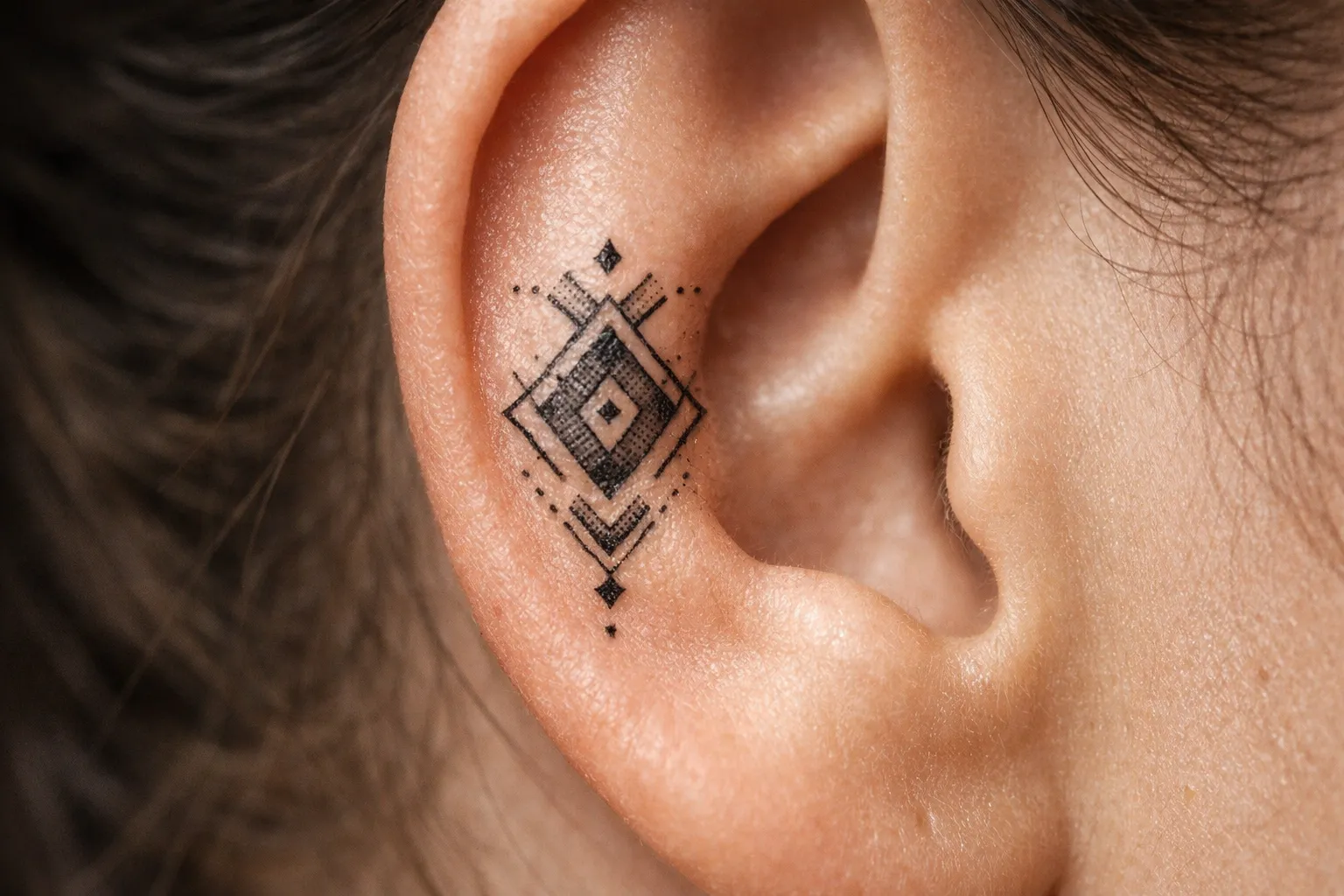
- Ultra-fine lines packed too densely. Lines spaced under 1-2mm apart tend to merge as skin softens over 5-10 years. Crisp hatching fresh can read as a grey smudge healed.
- Complex sacred geometry compressed into small sizes. A Metatron’s Cube or Sri Yantra under 3 inches loses its internal detail within a few years. These designs need room - 4 inches minimum for readable internal structure.
- Symmetrical designs on mobile joints. Elbows, knees, and the back of the knee distort symmetrical patterns when the joint flexes. A mandala that looks perfect straight will warp when the limb bends.
- Sacred geometry chosen with no understanding of its associations. The Sri Yantra and Metatron’s Cube carry specific cultural and spiritual weight. Picking them purely for looks is a documented source of later regret.
- Skipping the stencil check. Geometric work is less forgiving of placement errors than organic styles. A 2-degree tilt on a mandala is visible. Verify the stencil before the artist starts.
- Cutting corners on aftercare for high-detail pieces. Picking at healing skin or letting scabs form on geometric linework creates patchy fading and broken lines. Every line is part of a pattern, so one gap reads loudly.
Planning a Geometric Tattoo: Sessions, Healing, and Aftercare
Treat any piece over 4 inches as a multi-stage project rather than a one-sitting tattoo. The sequence runs outline first, interior patterns second, dotwork fill and shading third, touch-ups after everything heals. Days or weeks between stages reduce trauma and swelling, which protects line quality.
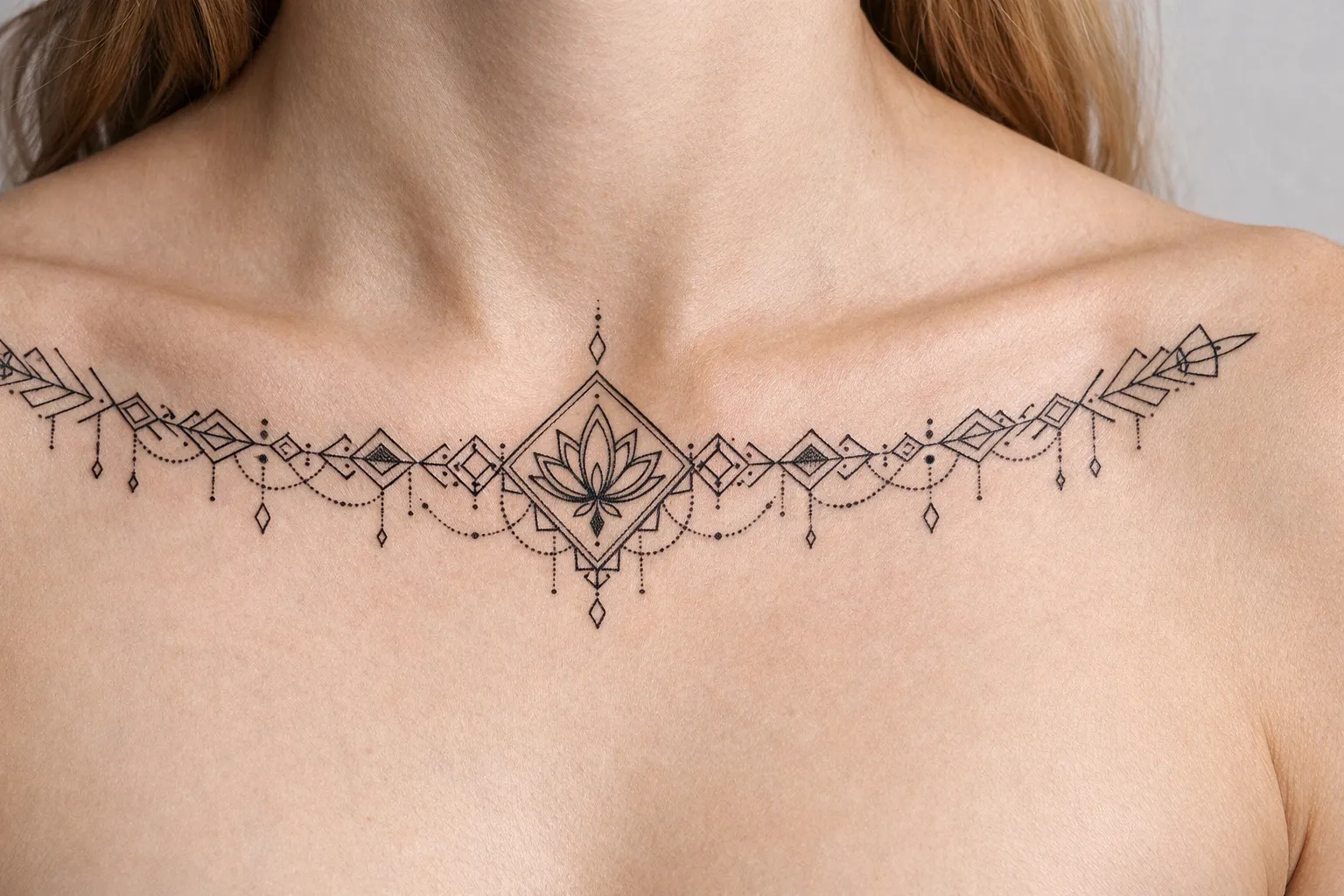
The dotwork time factor bears repeating because it catches people out: dotwork sessions run 2-3× longer than conventional shading (4). A mandala that reads like a two-hour piece is often four to six hours of stippling. Don’t book a dotwork back piece as a single session and expect to finish it.
Healing Timeline for Geometric and Dotwork Tattoos
- Day 1-3: The tattoo is an open wound. Clean it 2-3× daily with fragrance-free soap, pat dry, and apply a thin layer of fragrance-free moisturizer. No gym, no swimming, no soaking.
- Week 1: Peeling starts around day 4-6. Do not pick - on geometric linework, pulling a flake can pull pigment with it and leave a gap in a line that’s part of a pattern. Moisturize 2-3× daily.
- Week 2-4: Surface healing is mostly complete by the end of week 2-3 for most geometric and dotwork pieces (4). Deeper layers are still settling. Avoid direct sun and soaking. Color may look dull - that’s normal.
- Week 4-8: Full internal healing settles by around week 6-8. Once healed, SPF 30+ on any exposed geometric tattoo is the single biggest factor in long-term line crispness. UV exposure blurs fine lines faster than almost anything else.
One habit matters more for geometric work than most styles: sitting still. Flinching or shaking during fine linework directly affects straight lines and tight patterns. If you know you move a lot in the chair, tell your artist before booking a precision piece so they can plan session length around it.
How to Brief Your Artist and Use Digital Tools to Plan
Do some of the design work before the consultation. Apps with vertical and radial symmetry guides - Procreate is the common one, a one-time purchase around $13 - let you iterate on scale, placement, and proportion before any stencil prints (6). Bring screenshots or a printed mockup to the consult. When you’re designing digitally, duplicate the base geometry layer and hide it, then work aggressively on the copy. That way you can revert to the original structure without losing it.
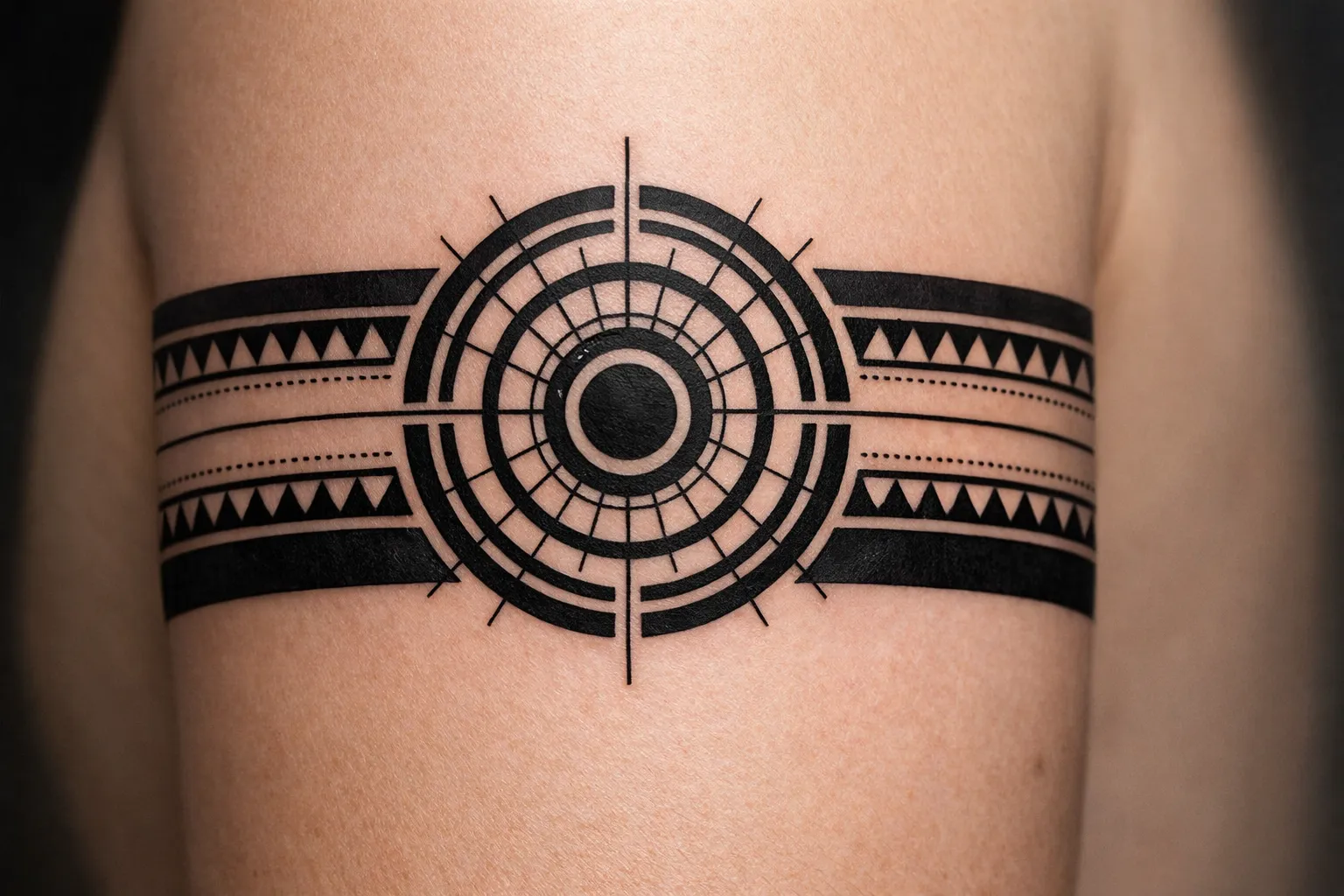
For sacred geometry, build outward from a central anchor. Start with a central point or symbol - a small mandala, a Sri Yantra, a hexagon cluster - and expand in rings or layers (9). Future additions can then grow outward without breaking symmetry, which matters if you plan to extend the piece into a sleeve or back composition later.
Follow body lines, not just grids. The strongest geometric sleeves and back pieces wrap around muscles and follow limb curves instead of treating the body as a flat canvas. Show your artist reference photos of geometric work that wraps, not just flat front-on compositions, so you’re both planning for the same thing.
For the consult itself, bring 5-10 reference images - patterns and compositions you like, not exact designs to copy - plus a clear note on placement and size range, and any symbolic meaning you want the design to carry. If you’re getting a Metatron’s Cube or Sri Yantra, ask your artist for a brief written note on what the symbol represents. It keeps you connected to the design over the years, which is exactly the kind of connection that prevents regret.
Frequently Asked Questions
- What do geometric tattoos symbolize?
- Geometric tattoos broadly represent order, balance, and mathematical precision - specific shapes have distinct associations like triangles for direction and circles for wholeness.
- What are the most popular geometric patterns for tattoos?
- Dotwork mandalas, fine-line hexagonal tessellations, Flower of Life, Metatron's Cube, fractals, and blackwork-dotwork hybrids dominate 2024-2025 trends.
- What are some tattoos to avoid in the geometric style?
- Avoid ultra-fine dense lines, complex sacred geometry under 3 inches, and symmetrical designs on mobile joints like elbows and knees.
- How long does a geometric tattoo take to heal?
- Surface healing takes 2-3 weeks with peeling starting around day 4-6; full internal healing settles by 6-8 weeks.
- How long does a geometric tattoo session take?
- Fine-line sessions are fastest; dotwork takes 2-3× longer; large sacred geometry or sleeves require multiple sessions over weeks or months.
- What's the difference between a mandala and a geometric tattoo?
- Mandalas are radially symmetrical, built from a center point; geometric tattoos include mandalas but also linear and asymmetrical designs.
- Where do geometric tattoos age best?
- Flat, stable surfaces like outer forearm, calf, and upper back hold lines best; avoid elbows, knees, and back of knees for symmetry.
What Actually Matters Before You Book
Three decisions determine whether a geometric tattoo still reads well in ten years. Placement first: flat and stable beats visible and trendy, so the forearm, calf, and upper back win over elbows and knees. Technique second: bold linework and dotwork age better than ultra-fine lines packed tight. Artist third: geometric work is precision work, so check healed photos, not just fresh ones, before you book anyone.
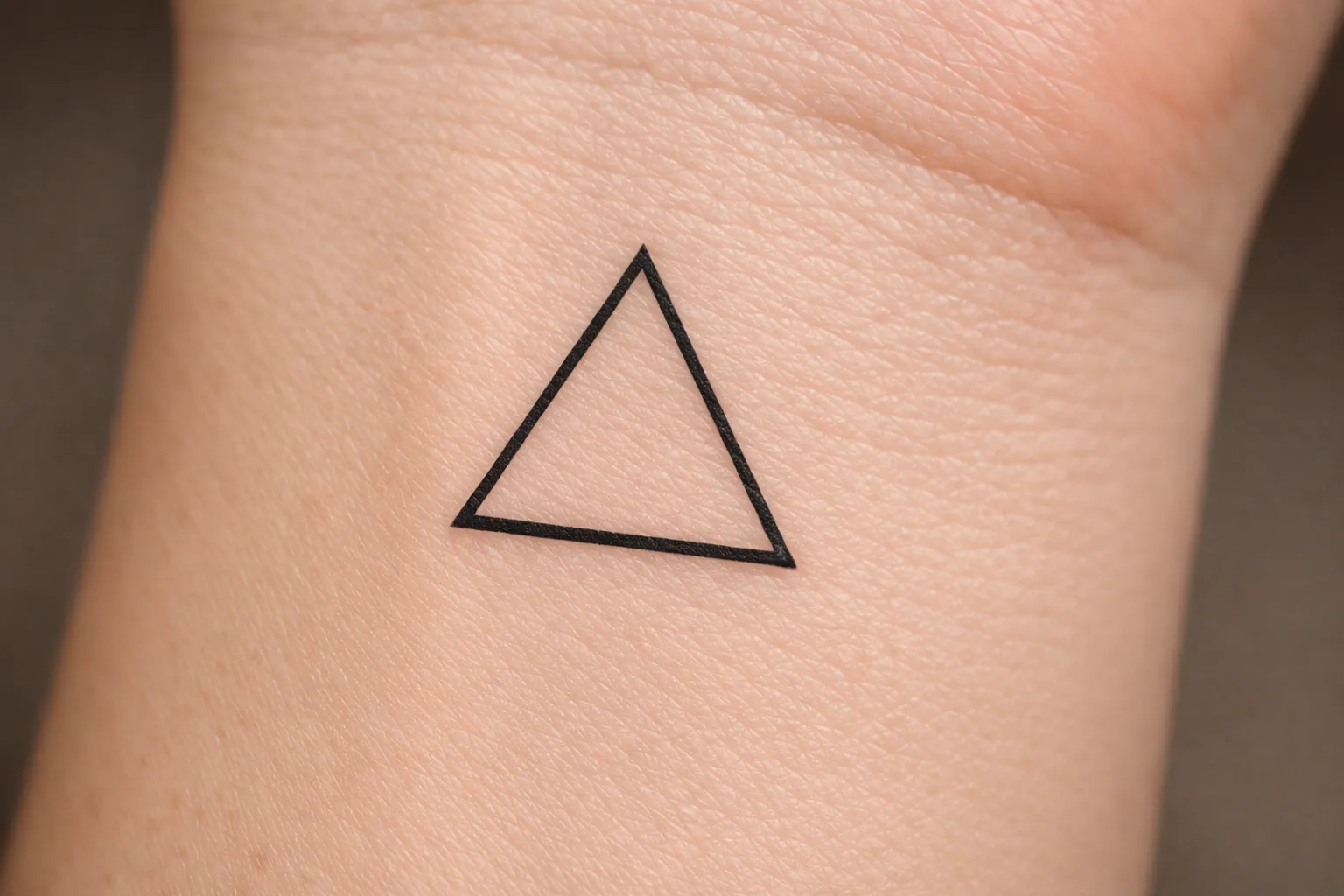
If sacred geometry is what’s pulling you, spend the hour understanding what the symbol means before it’s permanent. The design will outlast the trend cycle. The meaning should outlast it too.