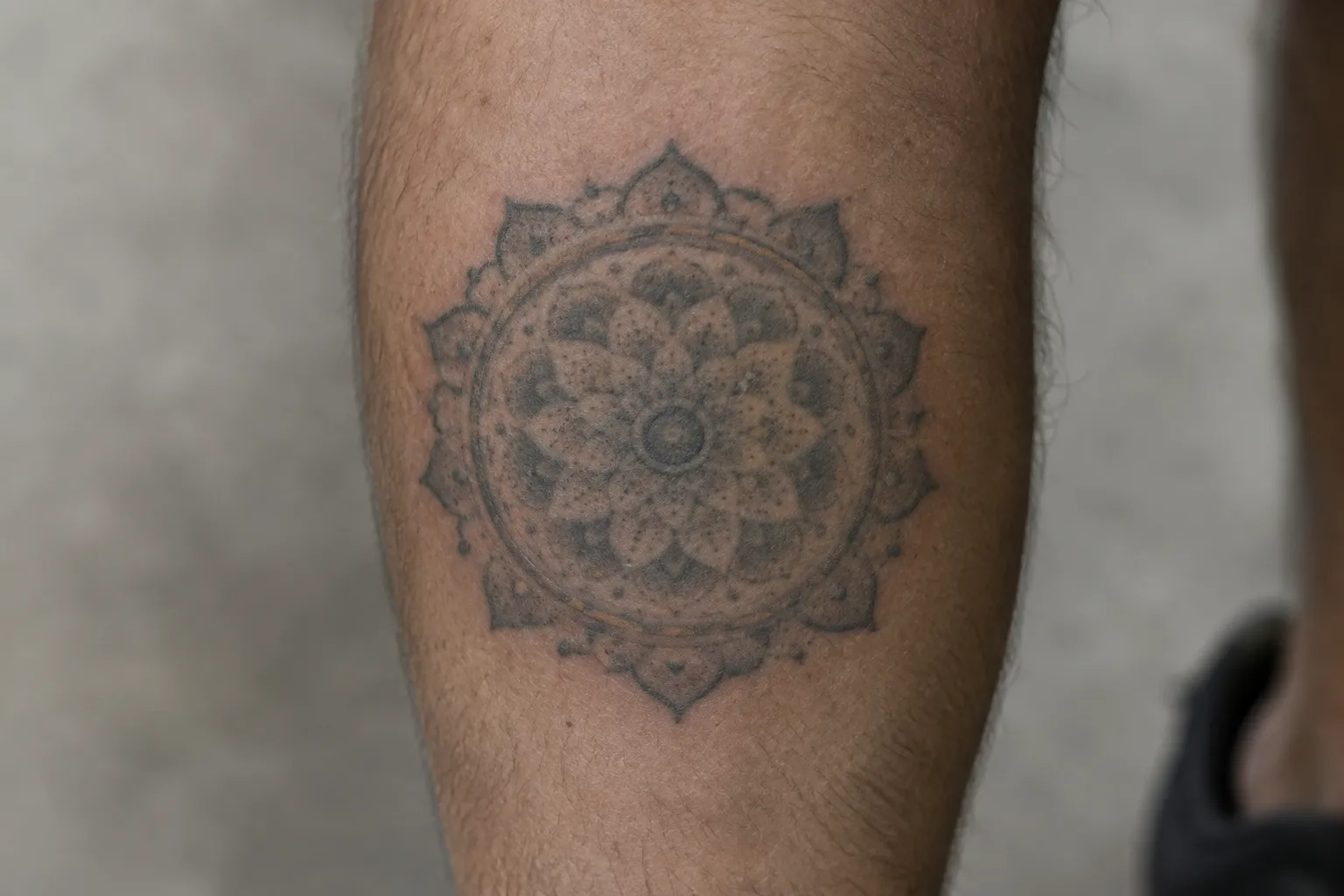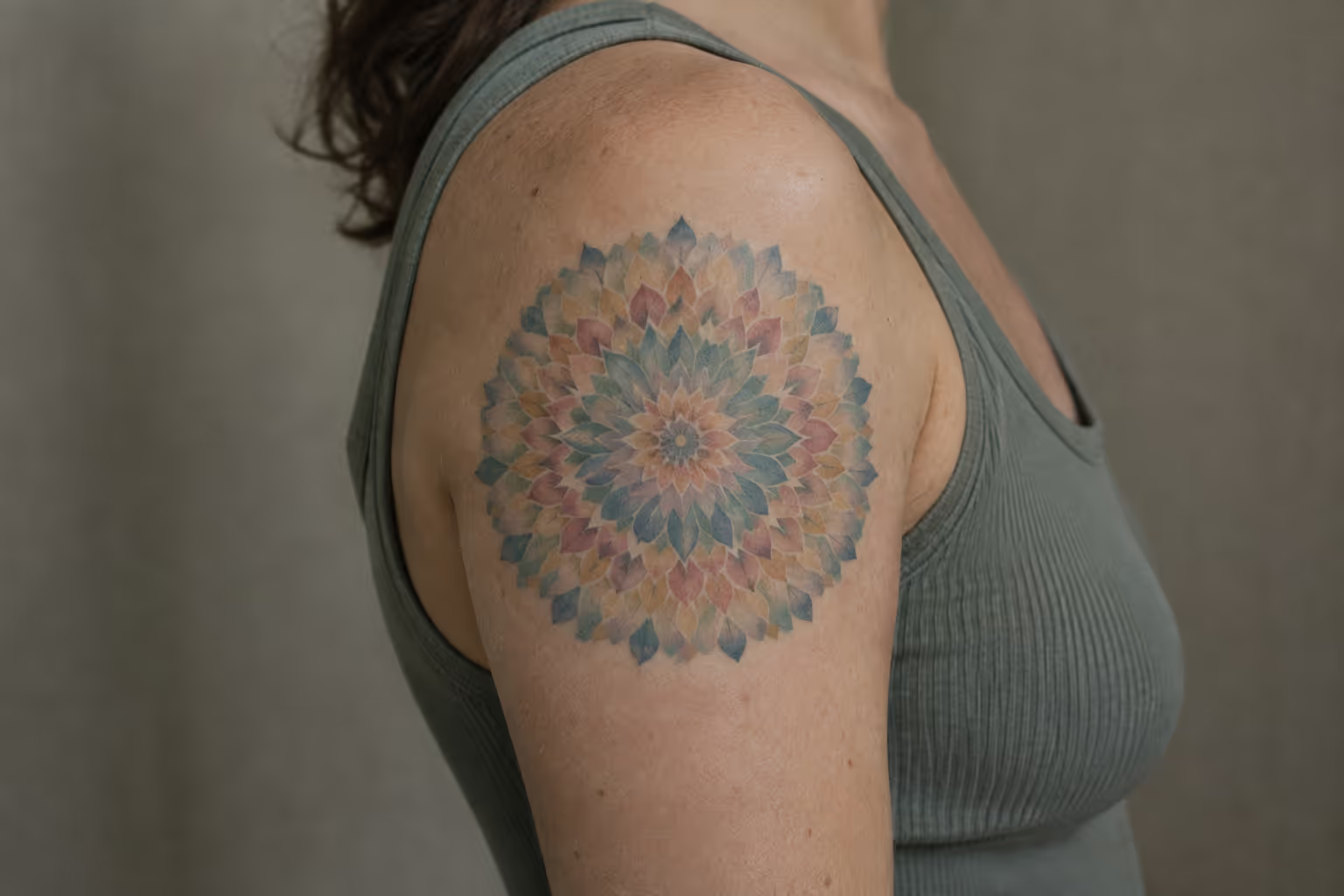
A mandala tattoo lives or dies on one structural rule: every element radiates from a single centre point, so a petal that drifts even slightly off-axis is visible from across a room. The word is Sanskrit for “circle” (4). In Hindu and Buddhist Tantric practice the mandala is an aid to meditation, and a basic Hindu mandala takes the form of a square with four gates around a circle and a centre point (12). That ritual weight stays with the design when it moves from a shrine to skin. It should shape how you choose the design, where you put it and who tattoos it.
✓ Pros
- Radial structure can be adapted from a small, spare motif to a larger piece with border detail.
- The centre point gives the artist a clear layout reference when integrating the design into other work.
- Knowing the religious roots leaves room for personal meaning without confusing the two.
✗ Cons
- The symmetry leaves little visual cover for uneven spacing or a misplaced centre.
- A design planned for one body position may distort when the joint bends or the skin curves.
- Fine inner geometry can lose its separation as the tattoo ages, especially when scaled down.
Mandala Tattoo Meaning: Religious Roots and Personal Symbolism
Mandala tattoo meaning works on two separate layers: the documented cosmic symbolism of Hindu and Buddhist Tantrism, and the personal meaning you assign to it. They are not the same thing, and treating them as one leads to lazy design choices.
Hindu and Buddhist Roots: The Womb and Diamond Realms
In Hindu and Buddhist traditions, mandalas are seen as representations of the universe (4) and used as a support for meditation (12). Japan’s Shingon Buddhism centres its rituals on two mandalas that its founder, Kūkai, brought back from China (12):
- The Womb Realm mandala
- The Diamond Realm mandala
So yes, the mandala is a religious object in origin. It isn’t a generic “balance” symbol that happens to be round. That shorthand is how most Western tattoo marketing presents it, and it flattens a specific sacred context.
What You Bring to the Design: Personal Meaning
Many people who get a mandala today aren’t Hindu or Buddhist. They choose it for the geometry, the sense of order, or a personal marker of something coming back together after a rough stretch. That’s a legitimate reason. Just be honest with yourself about which layer you’re wearing. If the tattoo means “I finished grad school” to you, that’s your meaning. It doesn’t replace the Tantric one.
Is it okay to get one? Mandalas are widely tattooed and widely accepted. The respectful approach is to know where the motif comes from, skip copying a specific temple or deity mandala you don’t understand, and let the artist draw something custom.
Mandala Design Styles: Geometric, Lotus and Ornamental Variations
Mandala tattoo designs all translate the same traditional skeleton (concentric circles, lotus petals and geometric shapes) into tattoo styles like geometric linework, dotwork, floral or ornamental blackwork (4)(11). Two technical hallmarks define good mandala work:
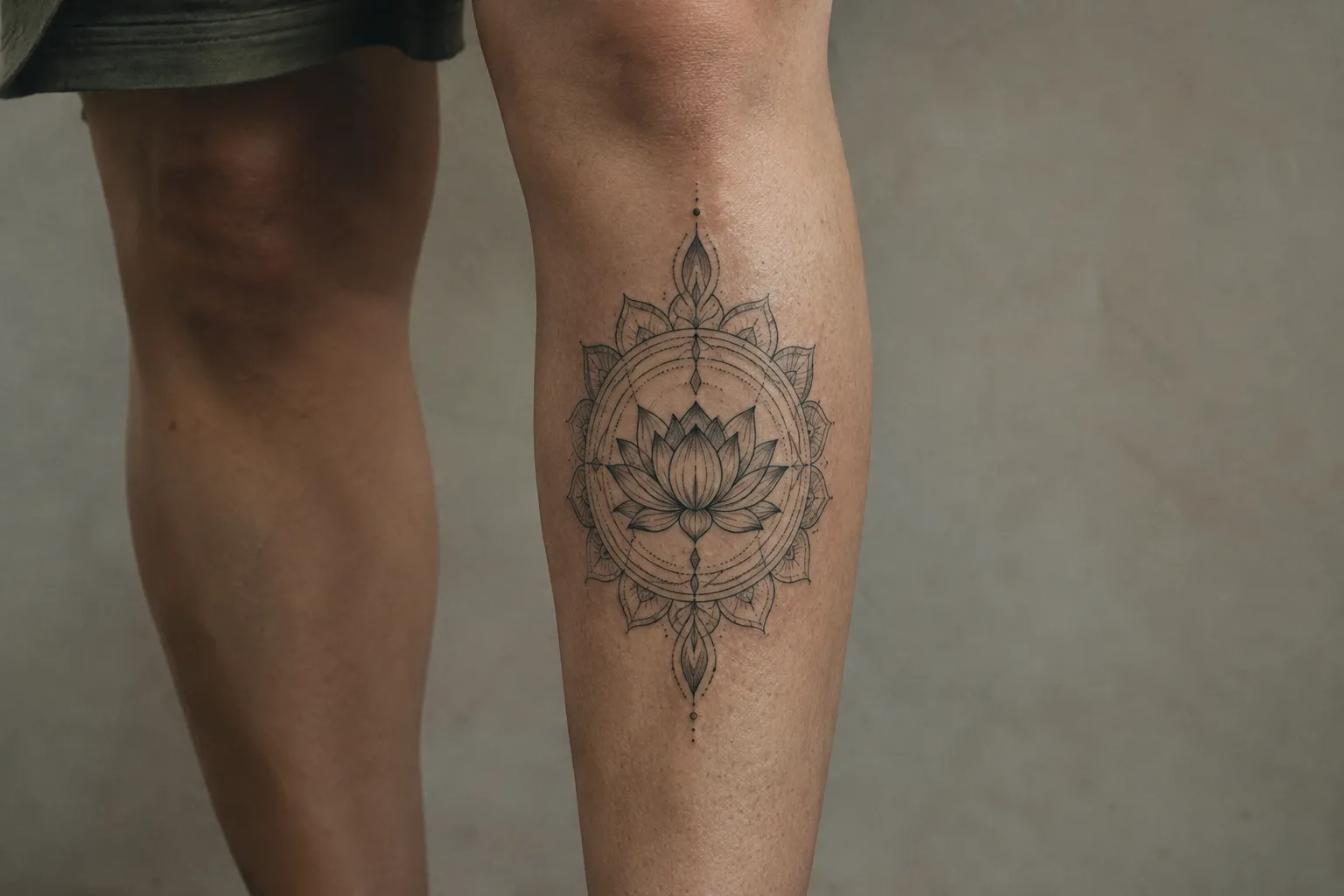
- Strict radial symmetry around one true centre point
- Repeated modules with measured negative space between them
The common pitfall when it’s done badly: an off-centre inner circle or crowded rings where the spacing collapses. Symmetry exposes every error, and there’s no shading trick that hides a lopsided petal.
In many Tantric Buddhist mandalas, the border is built from four outer circles: the purifying fire of wisdom, a ring of vajras, eight charnel grounds and a lotus circle (12). These carry specific meanings: the fire stands for wisdom, the charnel grounds for the impermanence of life (12). They aren’t interchangeable decoration, so if you borrow a ring-of-fire border, know what you’re borrowing.
Lotus Mandala Tattoos and the Symbolism of Rebirth
A lotus mandala tattoo draws on the one element with the most direct documented meaning. The lotus stands for purity, enlightenment and rebirth (4), and it forms one of the outer circles of many Tantric mandalas (12). In tattoo terms, a lotus mandala usually means a petal ring or a full lotus bloom at the centre with geometric rings radiating out. At medium size, 4-8 in (10-20 cm) on the shoulder or forearm (4), the petals have room for clean outlines and soft shading.
Geometric and Dotwork Mandala Designs
A geometric mandala tattoo leans on crisp linework, triangles, and nested polygons. Dotwork builds tone from stippling instead of solid shading. Both are hard to execute. Dotwork in particular needs generous spacing, because very small details placed tightly together can merge as the skin changes (8). If you love fine geometry, go bigger rather than denser.
Choosing a Mandala Design Placement That Stays Legible
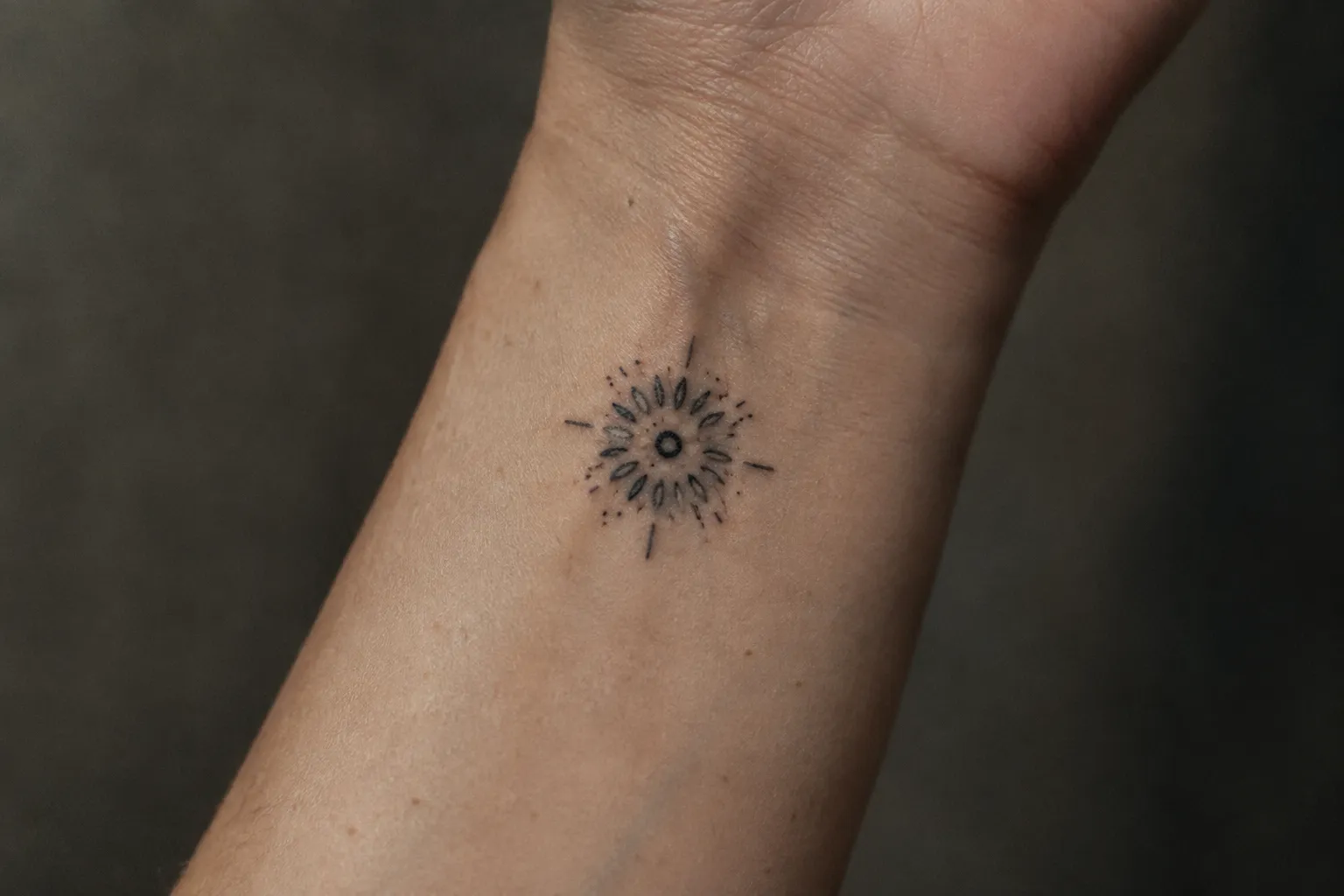
Mandala tattoo placement should be chosen for how well the centre point and spacing will read in ten years, not for pain or visibility alone. Shoulder, forearm, upper arm, back, chest, thigh, knee and sternum all work (11), provided the size matches the detail. A mandala cost guide groups the designs as small (2-4 in, 5-10 cm) for a wrist piece, medium (4-8 in, 10-20 cm) for the shoulder or forearm and large (8 in, 20 cm, and up) for a back piece (4).
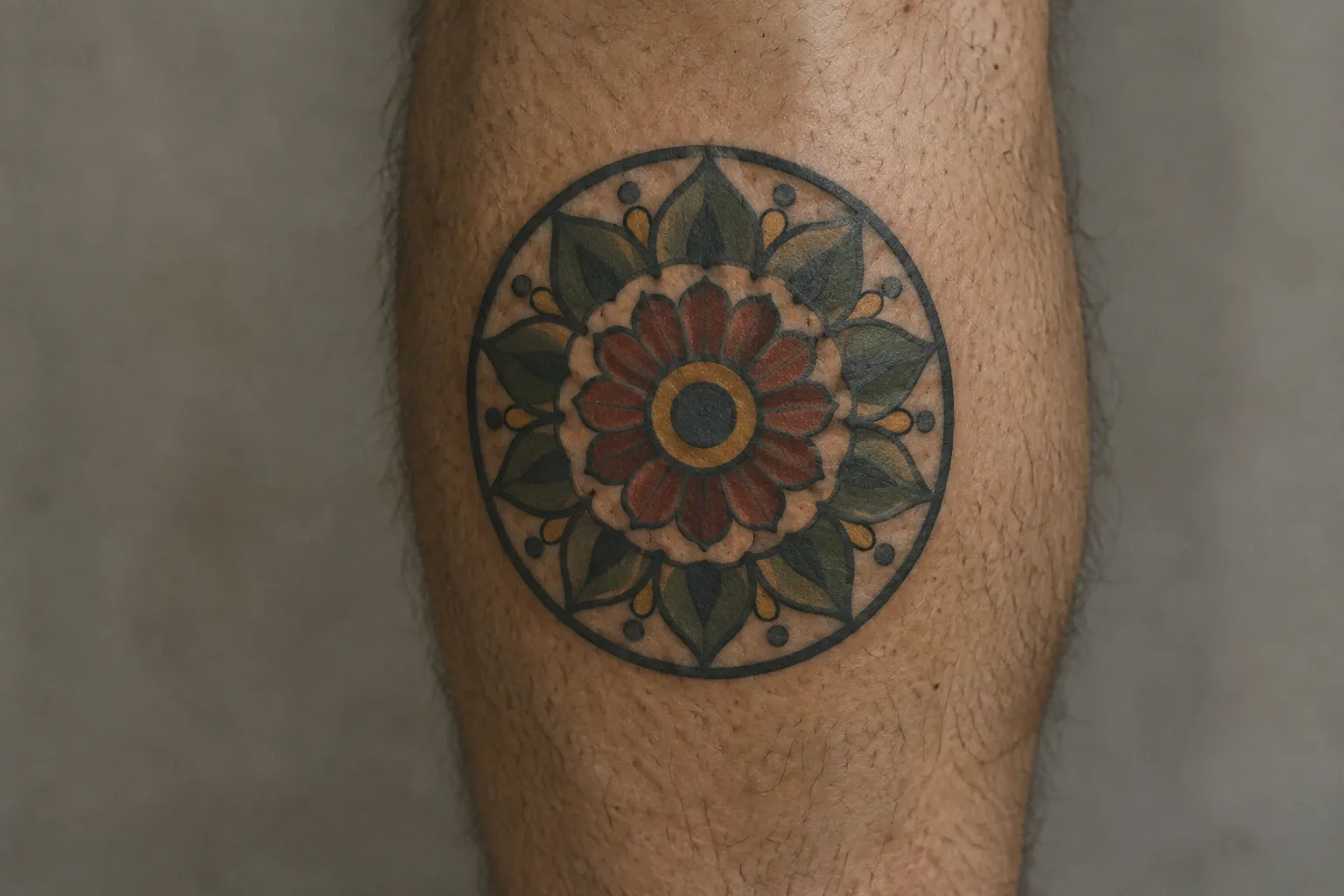
Pain runs highest on the ribs and sternum and is milder on the forearm, shoulder and thigh (4). Fine-line mandalas hold their detail longer on the chest, back and shoulders than on hands, feet and inner wrists (10), and skin that moves, creases or rubs, like the fingers, elbows, knees and ribs, changes the most over time (8).
Sleeve Integration: Aligning the Centre Point
A mandala can anchor a sleeve. Whether it fits is a question of layout: how its centre point, repeated rings and edges line up with surrounding elements across the arm’s curve (11). A flat circle stenciled onto a round forearm distorts into an oval. Ask your artist to show where the centre sits and how the outer ring transitions into filler before the stencil goes on.
Hands, Feet and Other High-Friction Spots
Hands, fingers and feet change more over time than most placements, and fine detail there loses definition sooner (8). Clear structure and open spacing are what keep a tattoo readable (8). If you want a hand mandala, favor a design that survives daily wear over one that shows off fine linework. Fading, more than pain, is the real reason to hesitate on the hands. That’s also the short answer to “what tattoos should I avoid?” Avoid intricate designs shrunk onto small, high-wear skin.
Mandala Placement at a Glance
| Shoulder | Forearm | Upper arm | Back | Chest/sternum | Thigh | Knee | Hand | |
|---|---|---|---|---|---|---|---|---|
| Legibility and friction | Curved surface; low friction | Relatively flat; exposed to daily wear | Low friction; rounded surface | Low friction; broad working area | Centreline helps alignment; sternum is more painful | Broad, low-friction area | Skin creases and moves with the joint | High wear; detail fades sooner |
| Detail that suits the area | Petal rings and soft shading | Clear radial lines and open spacing | Medium-to-high detail with a body-aware stencil | Full borders and fine interior structure | Radial layout aligned to the body's centreline | Larger patterns with room between rings | Simplified forms that account for movement | Bold outer ring and minimal dotwork |
Session Length, Licensing and Ink Safety Before You Book
A mandala tattoo’s session length depends on size. Plan around it before you book, and remember that an artist’s license covers infection control, not allergy risk.
How Long a Mandala Tattoo Takes, by Size
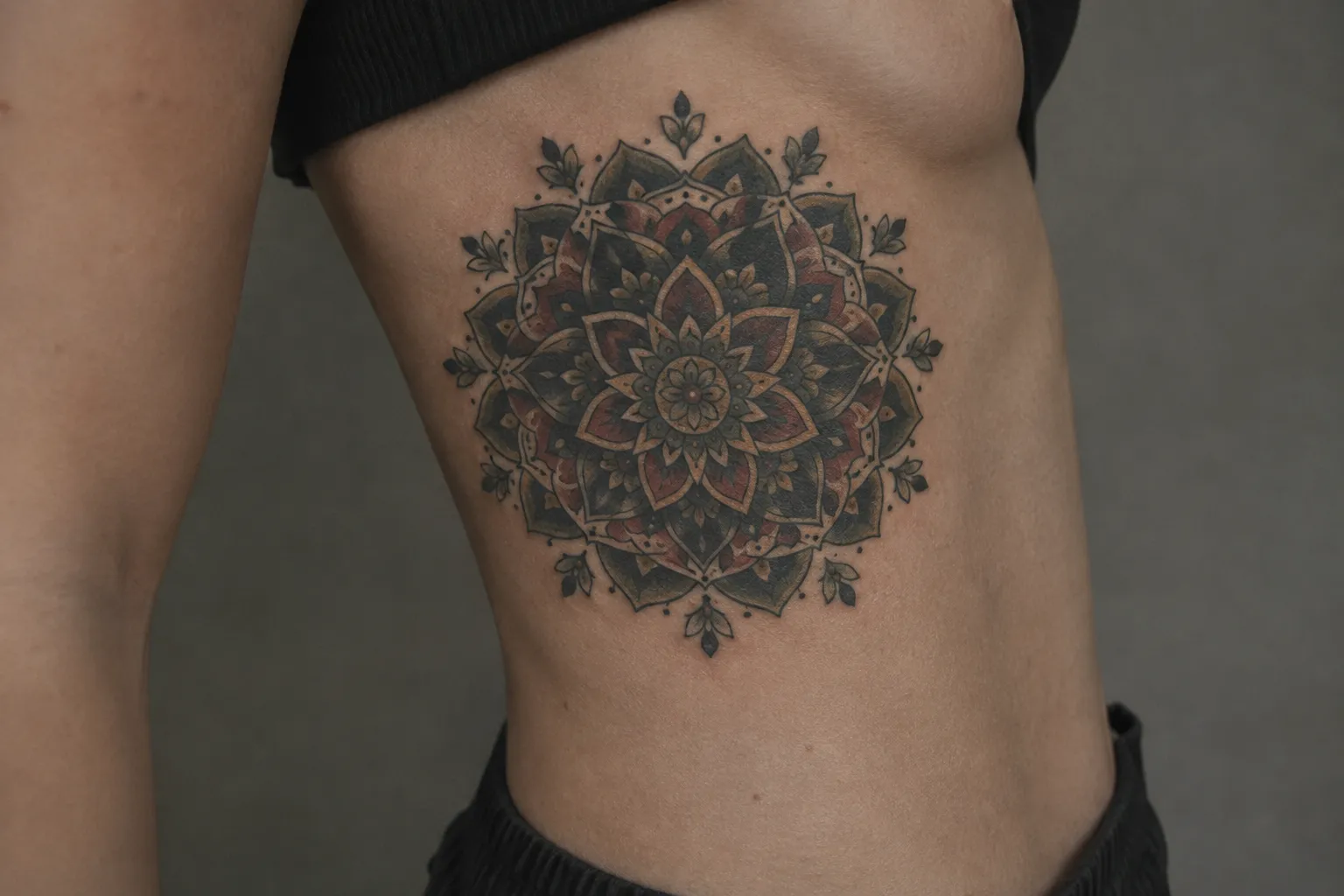
One Seattle studio estimates 3-5 hours for a medium 3-5-inch mandala and 6-8 hours for a large back or chest piece, usually split over two sessions (10). Its fine-line artist recommends a break every 90 minutes (10). That’s one shop’s practice, not a medical standard. Still, it’s a sensible benchmark when you plan your day off.
Artist Licensing and Ink Safety Basics
In New York City, every tattoo artist needs a Tattoo Artist License, issued only after the Health Department’s infection-control course and its final written exam (13). Rules differ elsewhere, so check your local health department. A license doesn’t remove every risk. The FDA warns that even sealed inks can contain microorganisms and has received reports of infections and allergic reactions linked to tattoo inks (3). The AAD notes skin reactions can occur even with a licensed artist and proper aftercare (9). Tell your artist about any medications you take and past reactions to pigments.
How to Prepare for a Mandala Tattoo
Use these steps to plan a mandala tattoo booking around placement, layout, studio safety and healing.
- 1
Choose the placement and scale
Match the design size to the available skin and decide how much detail the area can hold.
- 2
Check the artist's local credentials
Confirm the artist meets your local licensing requirements, then ask about their experience laying out radial designs.
- 3
Review the design on your body
Ask the artist to mark the centre point and show how the rings and outer edge sit on the body's curve.
- 4
Agree on session timing and breaks
Discuss the estimated session length, whether the work needs more than one appointment, and when breaks will happen.
- 5
Plan care before the appointment
Get the artist's written aftercare instructions and prepare fragrance-free moisturizer and sun-protective clothing for healing.
Healing and Aftercare for a Sacred-Geometry Design
A mandala tattoo heals on the same week-by-week aftercare timeline as any permanent tattoo, but the fine centre detail makes long-term sun protection matter more than usual.
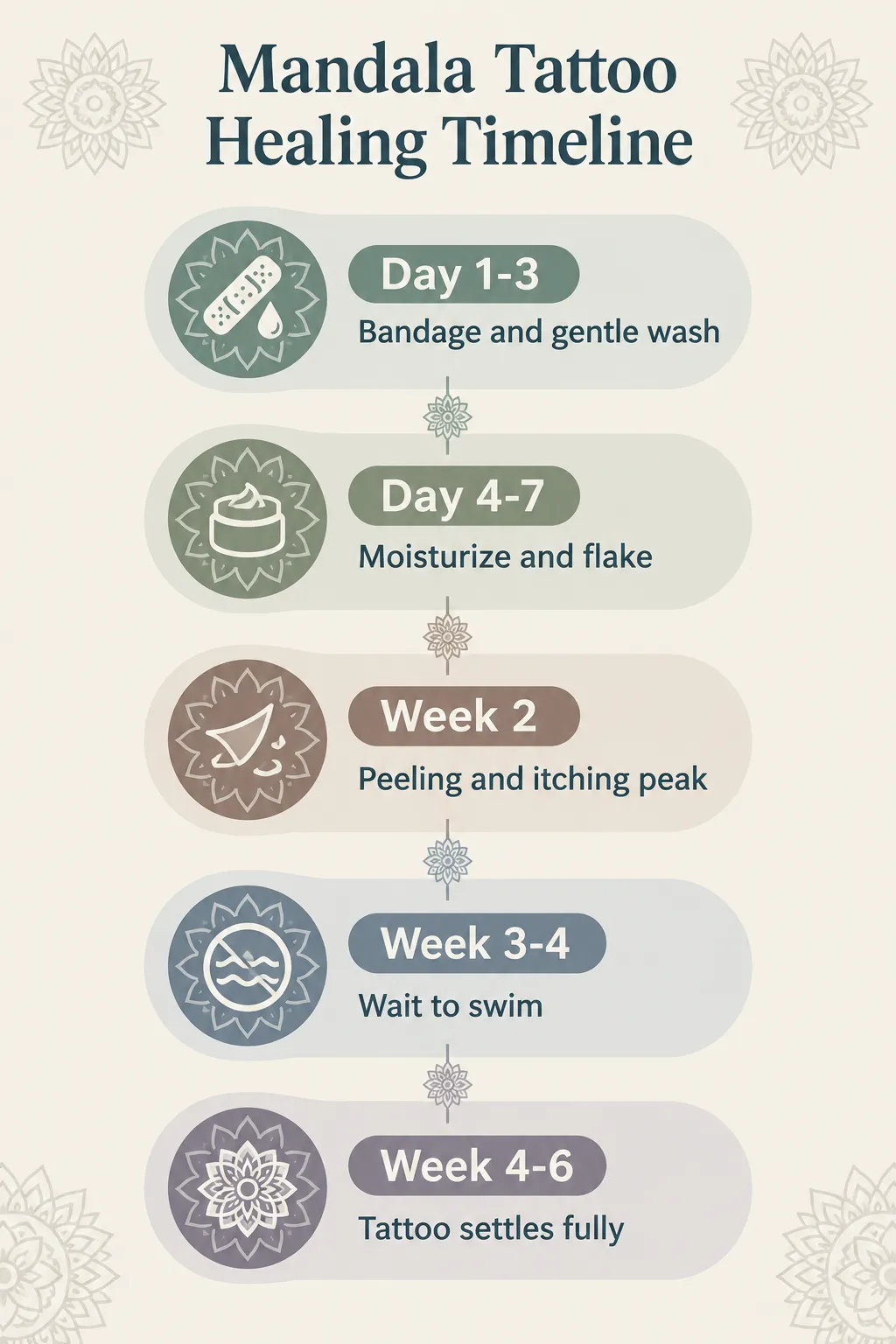 Mandala tattoo healing, stage by stage: bandage and gentle washing on days 1-3, moisturizing and light flaking on days 4-7, peak peeling in week 2, no swimming until weeks 3-4, and the tattoo settling fully by weeks 4-6.
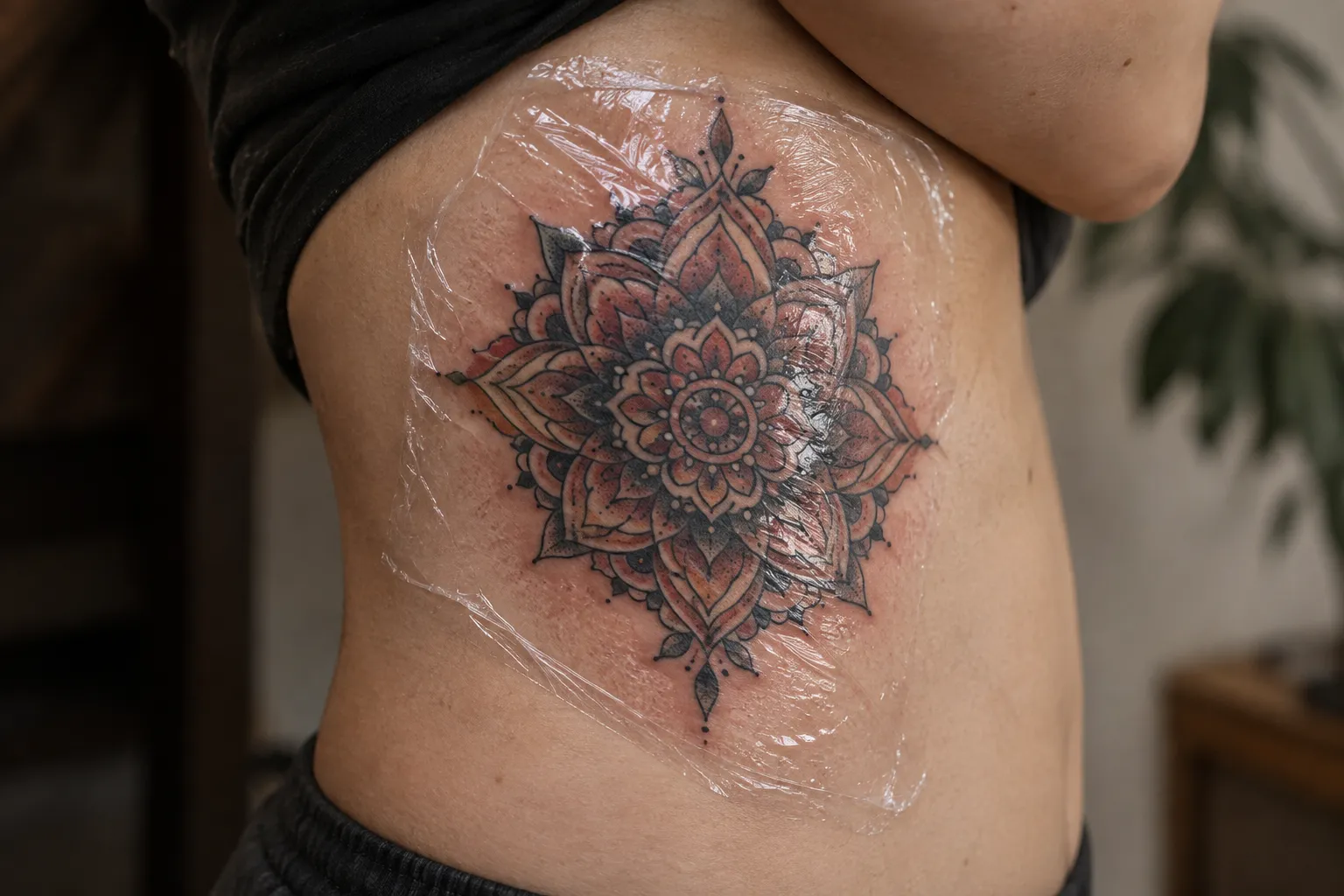
Healing Timeline: Day 1 to Week 6
- Day 1-3: Keep the bandage on as long as your artist says, then wash gently with a mild fragrance-free soap and pat dry. Some weeping and redness is normal.
- Day 4-7: The surface dries and starts to flake. Apply a thin layer of fragrance-free moisturizer two or three times a day. Don’t soak the tattoo in baths, pools or the sea.
- Week 2: Peeling and itching peak. Don’t pick or scratch, because pulled scabs leave gaps in the rings.
- Week 3-4: The surface looks healed, but the skin underneath is still settling. Wait until the end of week 3 before swimming, and cover up with sun-protective clothing outdoors.
- Week 4-6: The tattoo settles fully. Keep it out of direct sun until then, and switch to sunscreen once it has healed.
If the tattoo isn’t healing, develops a rash, or you run a fever, contact your tattooist and a health professional (3).
Sun Protection for a Healed Mandala
UV light fades some inks (6). Once healed, the AAD recommends a broad-spectrum, water-resistant sunscreen of SPF 30 or higher, applied 15 minutes before going outside and reapplied at least every 2 hours (6). Fine dotwork and thin inner rings lose contrast first, and sun changes tattoos faster on the forearms, hands and shoulders (8), so be strict about this there.
Frequently Asked Questions
- What does a mandala tattoo mean if you are not Hindu or Buddhist?
- You can give a mandala a personal meaning without claiming its religious symbolism; explain the distinction when describing your design to others.
- Is it respectful to get a mandala tattoo?
- Learn the motif's Hindu and Buddhist Tantric roots, and ask your artist to create original geometry rather than copy a specific ritual diagram.
- Is a mandala always a religious tattoo?
- Its roots are religious, but a tattoo can carry personal or aesthetic meaning; those modern interpretations do not erase its Tantric origin.
- What tattoo designs should you avoid copying?
- Avoid copying a temple or deity-specific mandala unless you understand its context; ask the artist to develop a distinct design instead.
- How do you check a mandala stencil before the tattoo starts?
- Check the stencil standing and in your usual posture, then bend or rotate the area to see whether the centre and rings shift.
- Can a mandala tattoo be added to an existing sleeve?
- Yes, if the artist can align its centre and outer rings with the sleeve's existing flow; test the layout on your arm before tattooing.
- What should you ask a tattoo artist before booking a mandala?
- Ask to see healed examples of their radial work and discuss how they will preserve spacing at your chosen size and body position.
- Should a mandala design change when it is placed on a joint?
- Yes, joints move and crease, so the artist may need to simplify details or alter the layout to keep the motif readable in motion.
What Decides How Your Mandala Reads Years From Now
The motif carries documented Tantric symbolism and whatever personal meaning you bring to it, so decide which layer you’re wearing before you pick a design. After that, the decisions that matter are practical ones. Put fine detail on low-friction skin like the chest, back or shoulders, and size it so the rings have breathing room. Budget realistic session time, and use SPF 30 once the tattoo is healed. Book a consultation with a licensed artist and ask them to show you the centre point and spacing on your actual body before anything is stenciled.