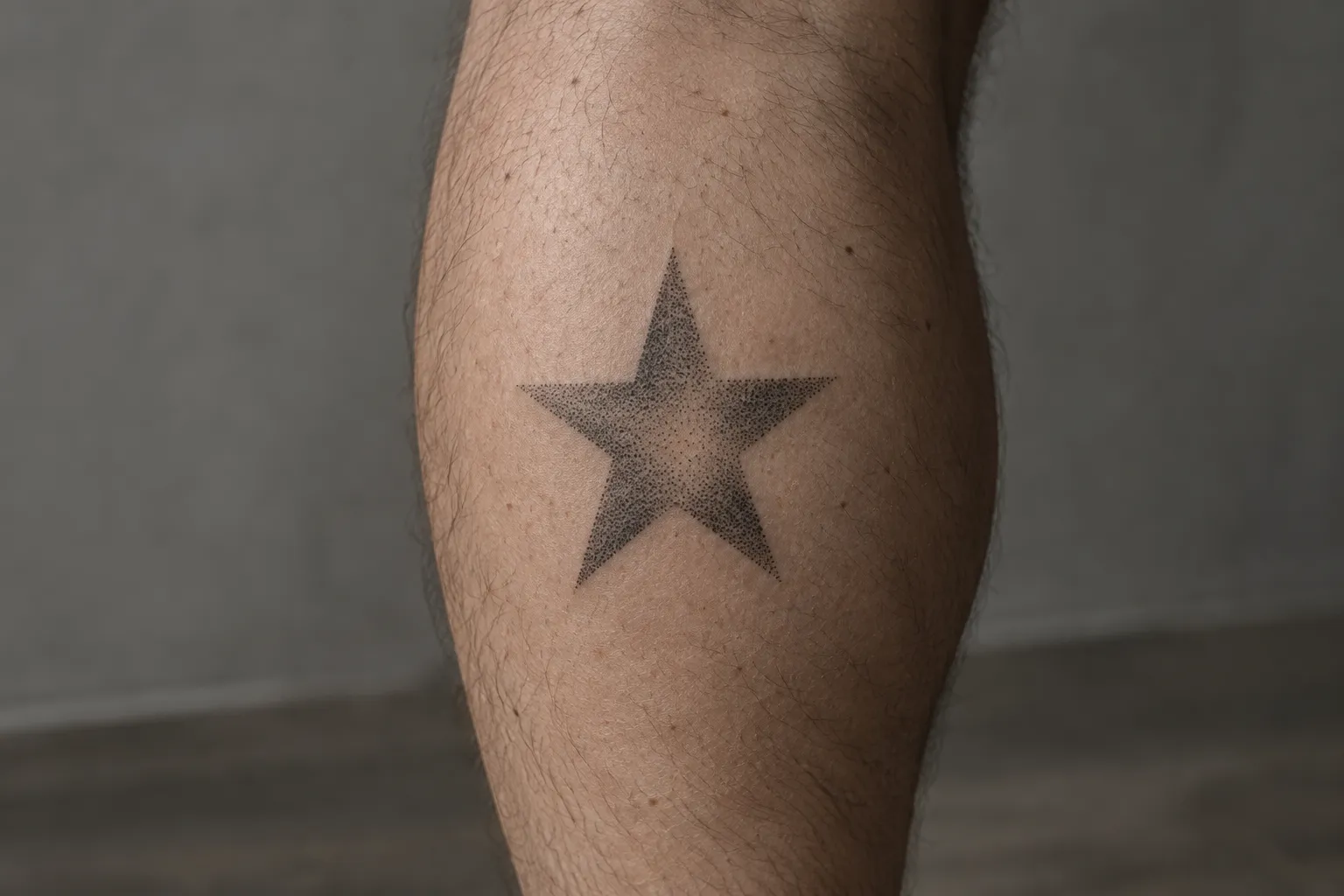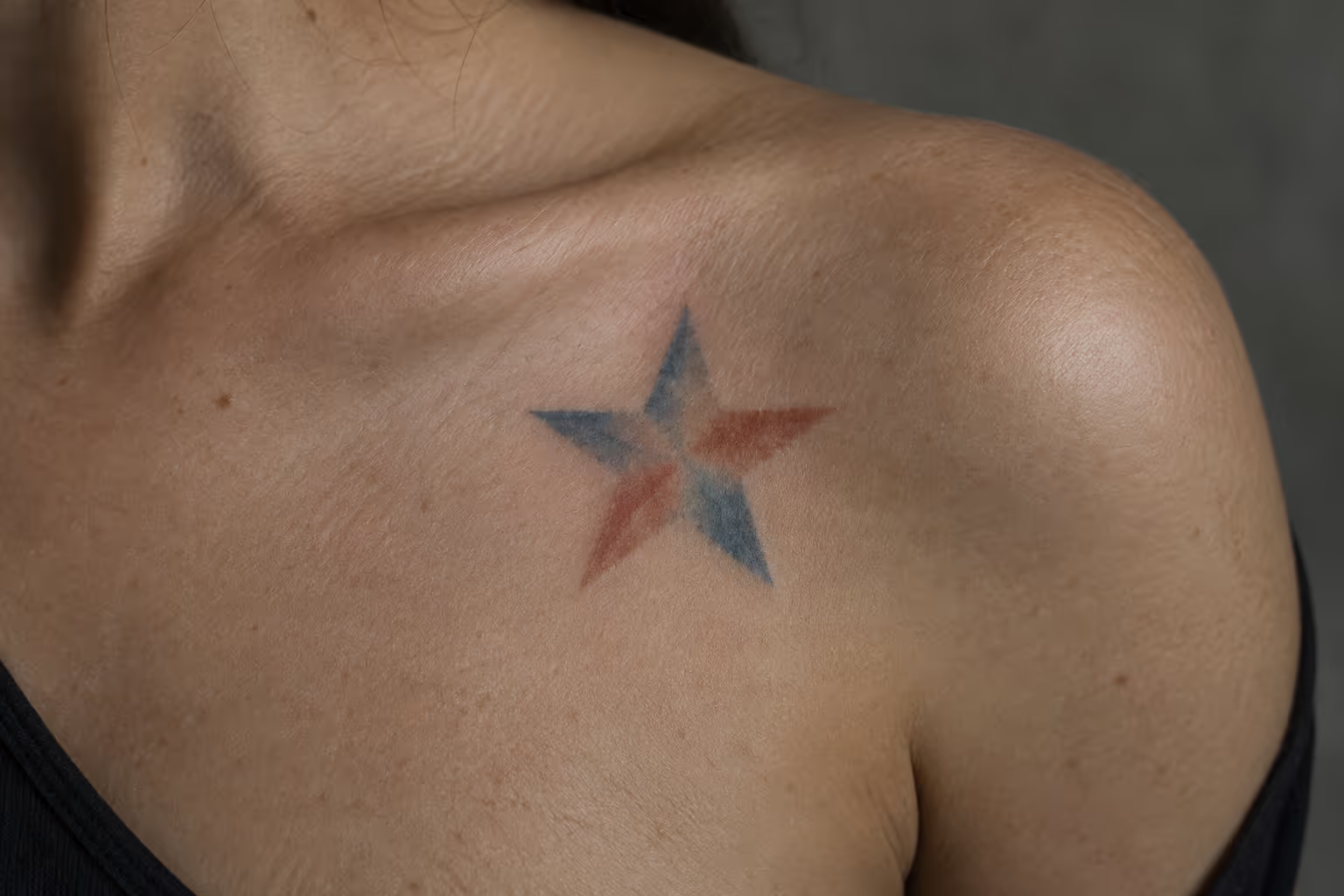
A five-point star and a nautical star can look almost identical, but only one of them comes with sailor history: in old-school sailor tattooing, the nautical star stood for direction-finding and getting home (10). A plain star means whatever you bring to it, unless you pick a design that already carries religious or cultural weight. That gives you a lot of freedom, but you need to know which version you’re choosing before you put it on your skin. The other decision that matters is size, because a star’s points and gaps blur faster than most people expect.
✓ Pros
- A star can be designed as a standalone mark or scaled into a larger composition.
- Choosing the compass-rose treatment gives the design a specific maritime reference.
- A solid silhouette offers a simpler option when fine internal detail will not hold at the chosen size.
✗ Cons
- The motif is common, so a small change in point shape or layout may be needed for a less familiar design.
- A viewer may assume a plain star has a specific meaning that the wearer never intended.
- Tiny interior angles and closely spaced lines leave little margin for natural ink spread over time.
Star Tattoo Meaning: Navy History, Symbolism, and Everyday Interpretations
Star tattoo meaning splits into two categories: a maritime tradition tied to the nautical star, and personal interpretations like hope or ambition that vary by wearer. Mixing the two is how people end up with a plain star they think has naval heritage.
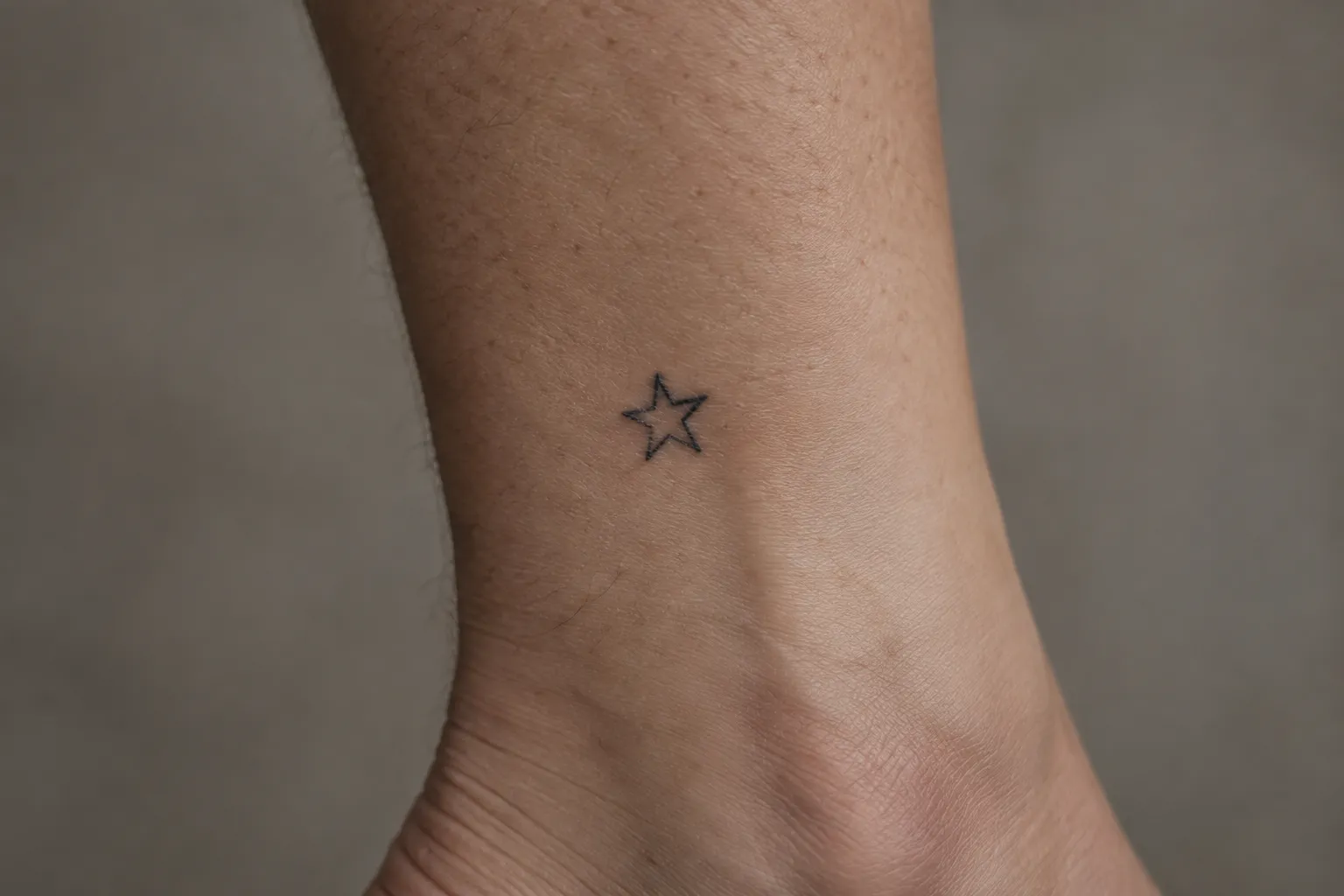
This section covers the star as a general celestial motif. The specific nautical and shooting-star designs get their own breakdowns below, because they differ in look and in history.
Sailor History: The Compass-Rose Star
In old-school sailor tattooing, the five-point star derived from the compass rose stood for direction-finding and safe return, sometimes read as the North Star guiding the wearer home (10). The star also has a concrete navigational origin. On nautical charts it marks true north on the compass rose and stands for the North Star. The nautical star is still an informal marker of service in the U.S. Coast Guard, Navy, and Marine Corps (1). Nautical star tattoos have been popular in the United States since the 1990s, where wearers read them as protection, guidance, good luck, or finding one’s way home (1).
The star has a second, smaller history too. In the 1950s, some lesbians in Buffalo, New York, wore a small blue five-pointed star on the wrist, where a watch could cover it, and people who want to reflect that history may choose a nautical-style star (1).
That sailor meaning is maritime, not a universal star meaning.
What’s Interpretation: Hope, Guidance, and Milestones
Stars are commonly read as guidance, hope, ambition, protection, or a marker of success (2). Those readings are real in the sense that people hold them. They are not fixed definitions, though. Some people get a star for someone they lost. Others get one as a small decorative accent with no deeper story, and that is a valid reason too (9). Some star designs do carry religious or cultural weight of their own, such as the Star of David and the pentagram, and in some contexts a five-point star has gang connotations, so look into a specific design before you commit (8).
If meaning matters to you, decide what the star represents before the consult. Then let that choice shape the design.
Nautical Stars: Compass-Rose Design and Naval Tradition
A nautical star tattoo is a five-pointed star split into light and dark halves on each point, styled like a compass rose (1).
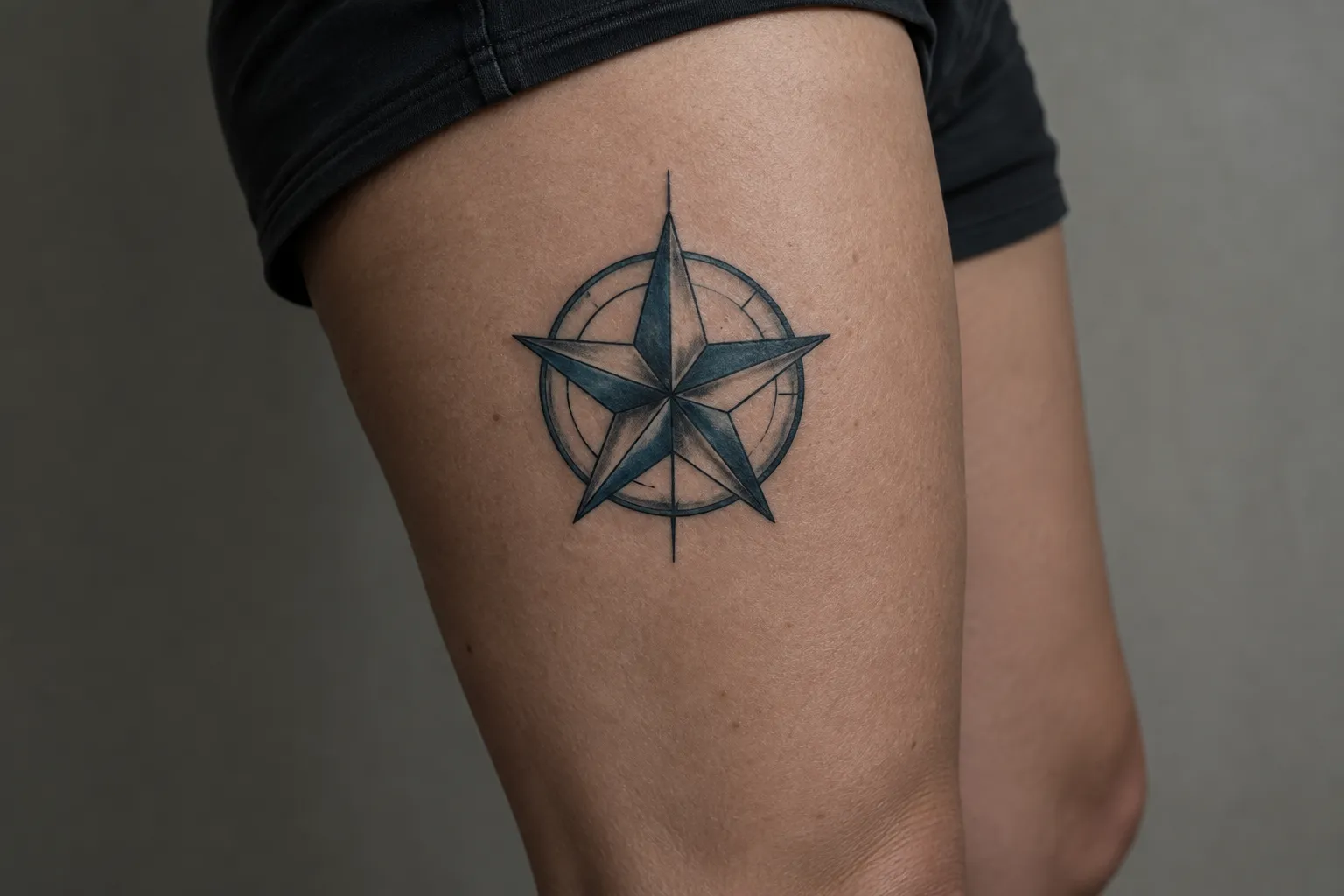
In American traditional work, a nautical star gets bold black outlines and solid color, and that style ages well because it keeps simple shapes, sharp contrast, and no microscopic detail (9). Traditional nautical stars are built to age well over decades (8).
The common pitfall comes from artists who thin out the outline or blend the shading into soft gradients. The crisp light-and-dark split muddies, and from across a room the star reads as a gray blob.
Alternating Light and Dark Points: The Giveaway Detail
Each point is divided down its center line, with one half filled and the other left light, so the star looks faceted (1). That counterchanged pattern recalls the compass roses on nautical charts (1), the same figure that anchors a nautical compass tattoo.
If your design has it, you’re wearing a nautical star. If it doesn’t, you aren’t.
When a Five-Point Star Isn’t Nautical
What makes a star nautical is that counterchanged, compass-rose rendering (1). A plain five-point star, whether outlined or solid, lacks that cue, so it won’t read as a sailor’s star.
That matters if you’re getting one to honor a family member who served. Ask your artist for the split-point treatment specifically. A plain star won’t carry the reference you intend.
Shooting Stars and the Science Behind the Streak
A shooting star is not a star: NASA defines the streak of light as a meteor, which forms when a meteoroid enters Earth’s atmosphere at high speed and burns up (5). That doesn’t make the design less valid. It just means you’re depicting a brief event in the atmosphere, not a distant sun.
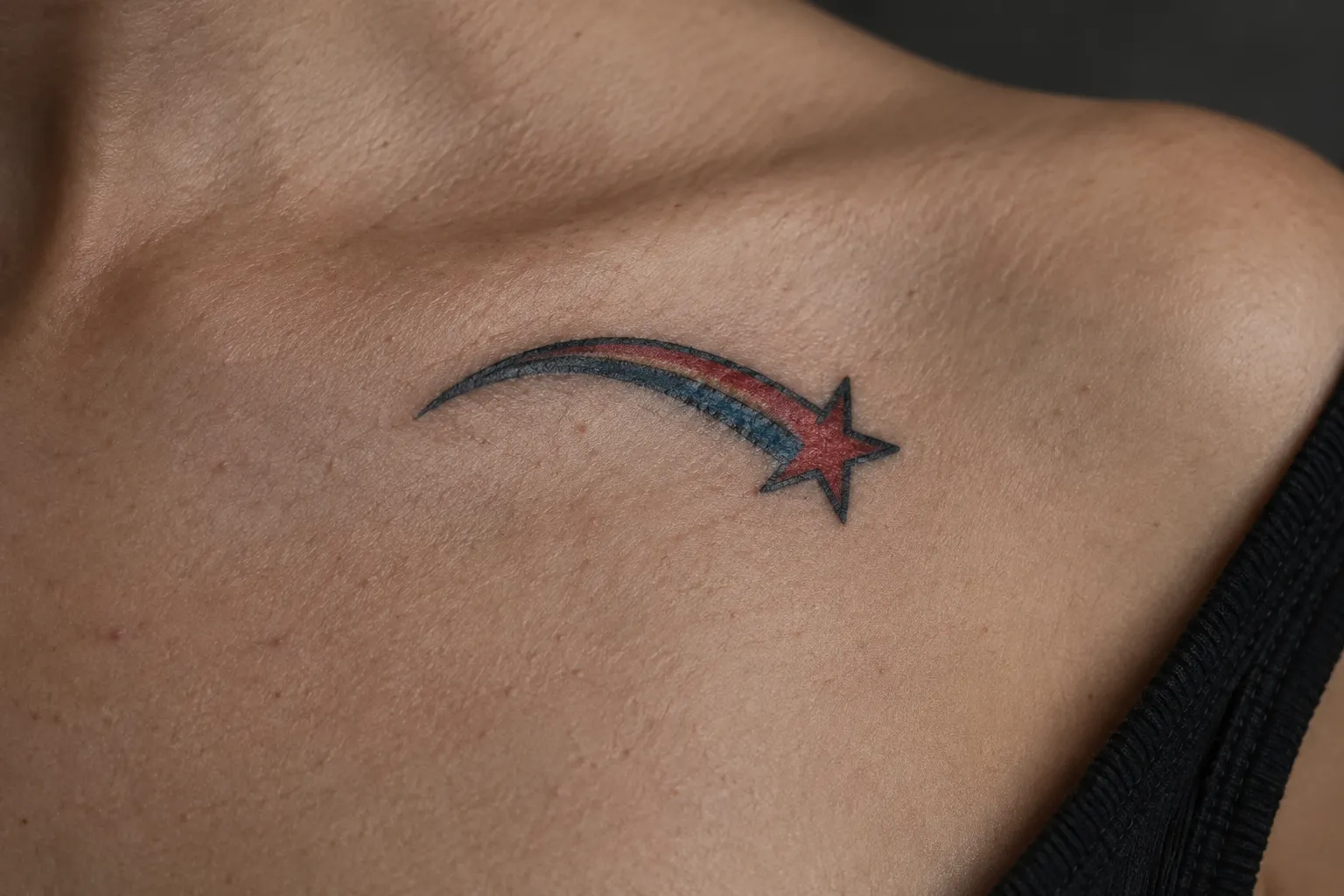
Most shooting-star tattoos pair a small five-point star with a trailing tail. The tail can be a few straight lines, a curved swoosh, or a dotted trail. A shooting star is usually tied to wishes, fleeting moments, and change, and it can mark a major life event (2).
NASA’s Definition: A Meteor, Not a Star
NASA uses three names for the same object depending on where it is (5):
- A meteoroid is the rock while it is still in space.
- A meteor is the streak it makes while burning up in the atmosphere.
- A meteorite is whatever survives and hits the ground.
So a shooting-star tattoo depicts a meteor (5).
Nautical Star vs. Shooting Star: Two Motifs Often Confused
People file both designs under “star tattoo,” but they are two separate motifs:
- The nautical star is static and symmetrical, with heavy contrast and a long association with finding one’s way home (1).
- The shooting star is about motion. Its tail and streak depict a meteor, a brief event in the atmosphere (5), and it is usually read as a wish or a passing moment (2).
If direction or a safe return is your message, pick the nautical version. If a moment or a wish is your message, pick the shooting star.
Five-Point, Geometric, Minimalist, and Constellation Designs
Beyond nautical and shooting stars, the main star designs are the plain outline, the solid five-point star, geometric and minimalist treatments, and constellations, which need the most room. Each one ages differently, so match the style to the space you have.
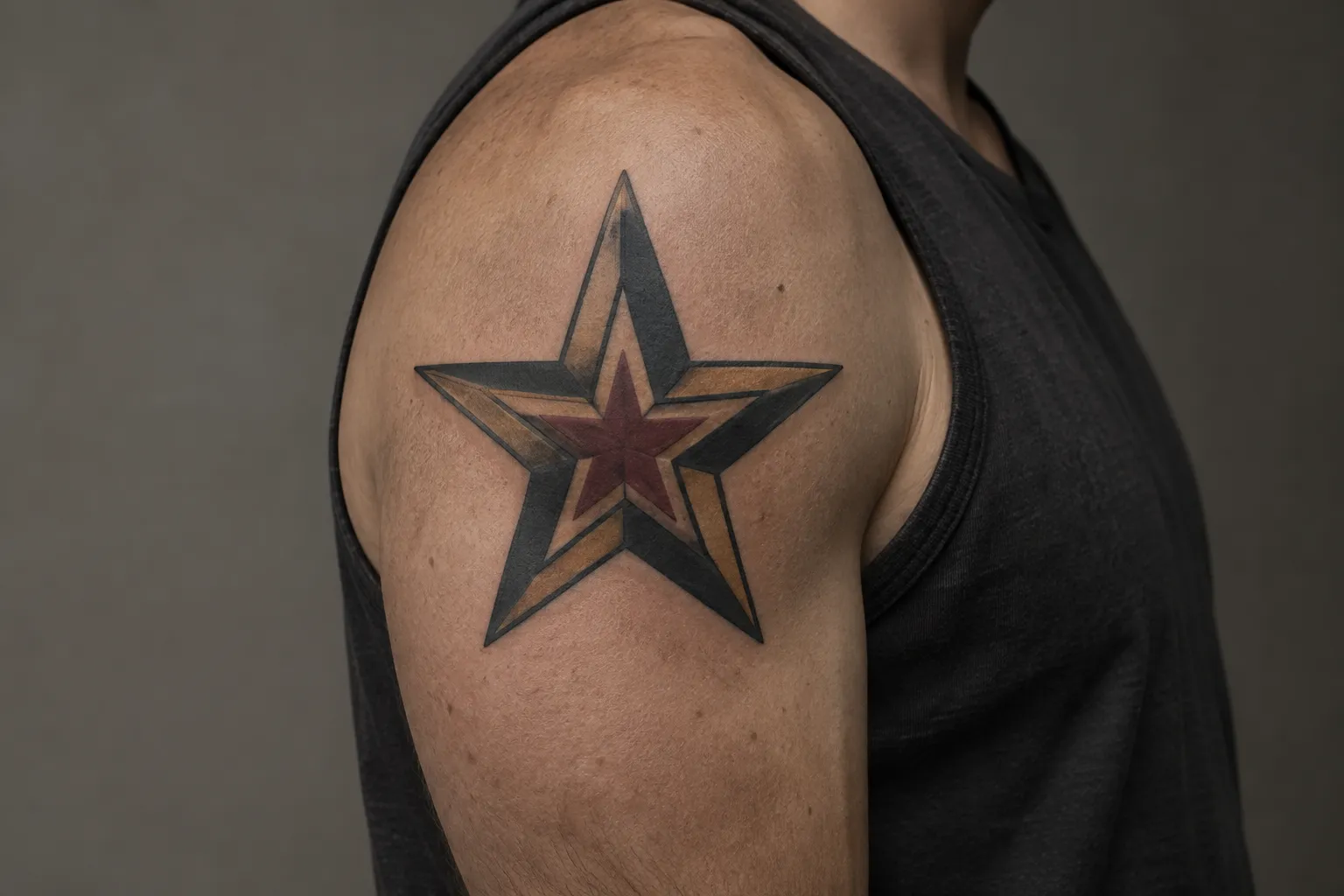
Plain Outline vs. Solid Five-Point Star
An outlined star has open space inside, which looks light and clean when fresh. A solid black star is the more durable option. It has no inner gaps to fill in, so it keeps its silhouette as the edges soften with age.
If you want a small star that will still read clearly years from now, solid usually beats outline.
Geometric and Minimalist Treatments
Geometric stars use linework, dotwork, or nested shapes. Minimalist stars strip the motif down to a few clean lines. Both look sharp on day one.
The risk with both is detail density. Close fine-line elements may merge over time, so a small star needs simplifying to keep its shape (6)(9). If you can’t count the points from arm’s length on the stencil, the design is too busy for that size.
Constellations: When a Design Needs More Room
A constellation is a set of small dots connected by thin lines, and it gets crowded fast. It needs more space than a single star (7). Placed too small or too fine, it can heal into a blur nobody recognizes (7).
Give it a flat area like the forearm, upper back, or ribcage rather than squeezing it onto a finger.
How the three star motifs differ
| Nautical star | Shooting star | Five-point or geometric star | |
|---|---|---|---|
| Visual structure | Compass-rose points with contrasting halves | Star with a trailing streak or tail | Plain silhouette, outline, or constructed linework |
| Meaning basis | Sailor tattoo tradition and U.S. sea services | Wishes and passing moments; depicts a meteor | Personal; no compass-rose cue |
| Small-scale watchout | Keep the light-dark divisions and outline distinct | Tail strands can lose separation | Packed linework can close up; solid forms are simpler |
Small Stars: Placement, Sizing, and Simplifying the Points
A small star tattoo holds its shape best on low-friction, low-sun skin like the ribs or inner arm, because hands and feet see more wear (3). Common small-star sites include the wrist, ankle, and behind the ear (2)(8). Each of those comes with trade-offs.
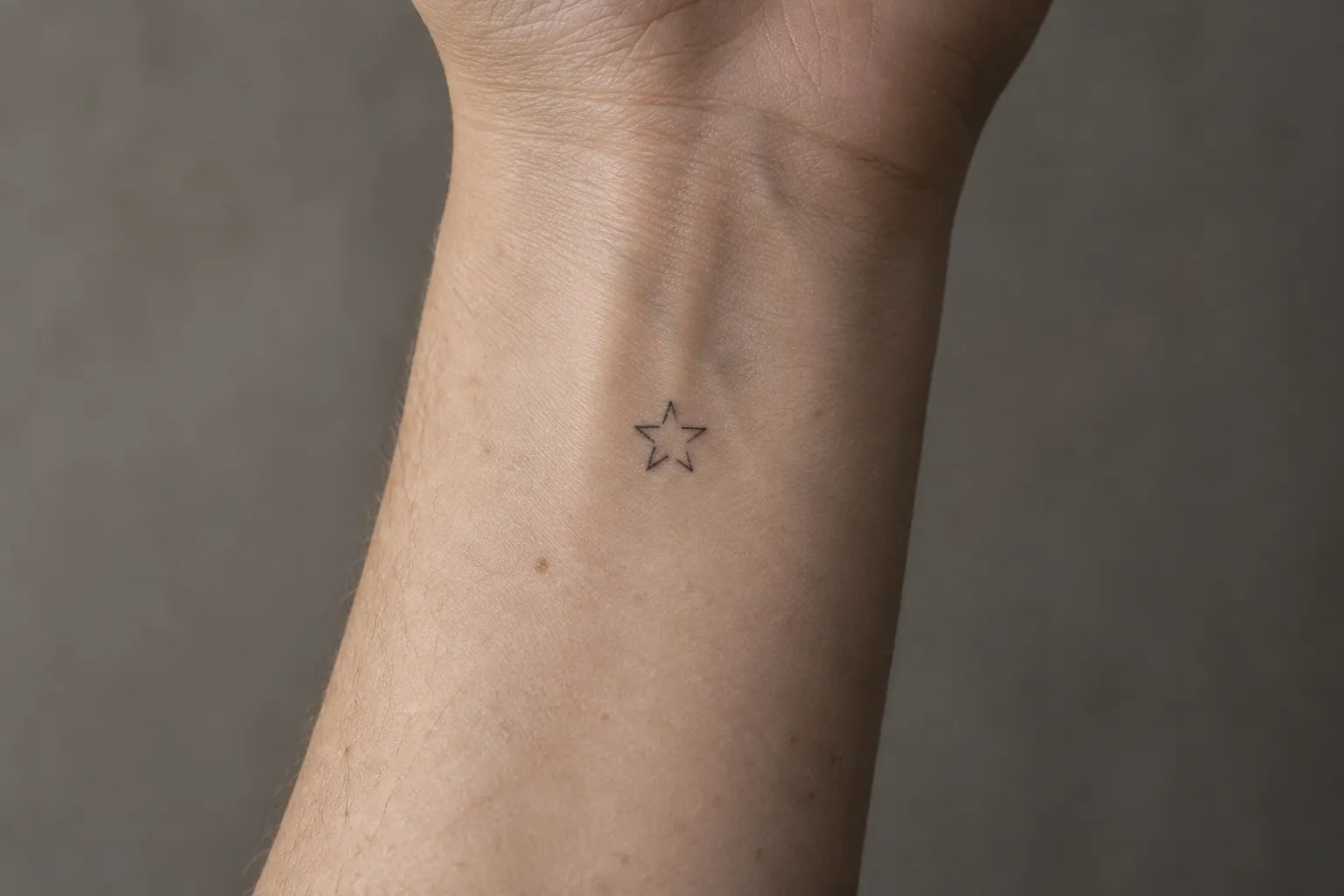
Best Low-Friction Spots: Ribs and Inner Arm
Fine-line work favors the ribs and inner arm over the hands or feet, which are more exposed to wear (3). Both spots stay out of direct sun most of the year and don’t rub against much.
On pain, the ribs rank among the most painful placements, while the outer forearm and outer upper arm rank among the easiest, as our tattoo pain chart lays out. Ribs are not a good spot for a first tattoo.
Wrist, Ankle, and Behind-the-Ear: What to Watch For
These sites work, but each needs a bit of care:
- Wrist: watch bands, bracelets, and constant hand movement cause friction, and the top of the wrist gets sun. A solid star holds better here than a delicate outline.
- Ankle: socks and shoe edges rub, and the ankle is bony, which makes it a sharper session than the calf. Keep the star bold.
- Behind the ear: the skin is thin and the spot has limited flat space, so it suits a single small solid star. It does not suit a constellation or a tailed design.
Simplify the Points and Tail at Tiny Scale
A tiny star needs simple branches and enough spacing to hold its shape (9). Details that sit closer together than about 2 millimeters will eventually merge (6).
In practice, the inner corners of the points are where a small star fails first. Ink spreads slightly as it ages, the notches between the points fill in, and the star rounds toward a blob. Ask your artist to open those angles. Shorten or thicken a shooting-star tail rather than adding more strands.
Walk into the consult with a reference image and a placement in mind, and let the artist tell you whether the points and gaps will hold at that size before you commit.
How to choose a star tattoo design and size
Use the intended placement and the design's smallest details to check that the star will remain legible at its chosen size.
- 1
Bring a reference and choose a site
Bring a reference image to the consultation and name the body site you are considering.
- 2
Check the details at the intended size
Ask the artist to assess whether the points, gaps, and any tail will stay legible at that scale.
- 3
Match fine-line work to the placement
For fine-line work, consider a lower-friction, lower-sun area such as the inner arm or ribs.
- 4
Simplify tiny designs
If the star is very small, ask the artist to simplify the points and shorten or simplify the tail.
- 5
Plan sun protection
Before the appointment, plan how you will protect the healed tattoo from sun exposure.
How Fine-Line Stars Age and How to Protect the Ink
Fine-line stars age by softening at the edges and fading under UV light (3). What keeps delicate ink sharp is sizing with margin, smart placement, solid black ink, and sunscreen, which one studio calls the single best anti-aging treatment for delicate ink (6).
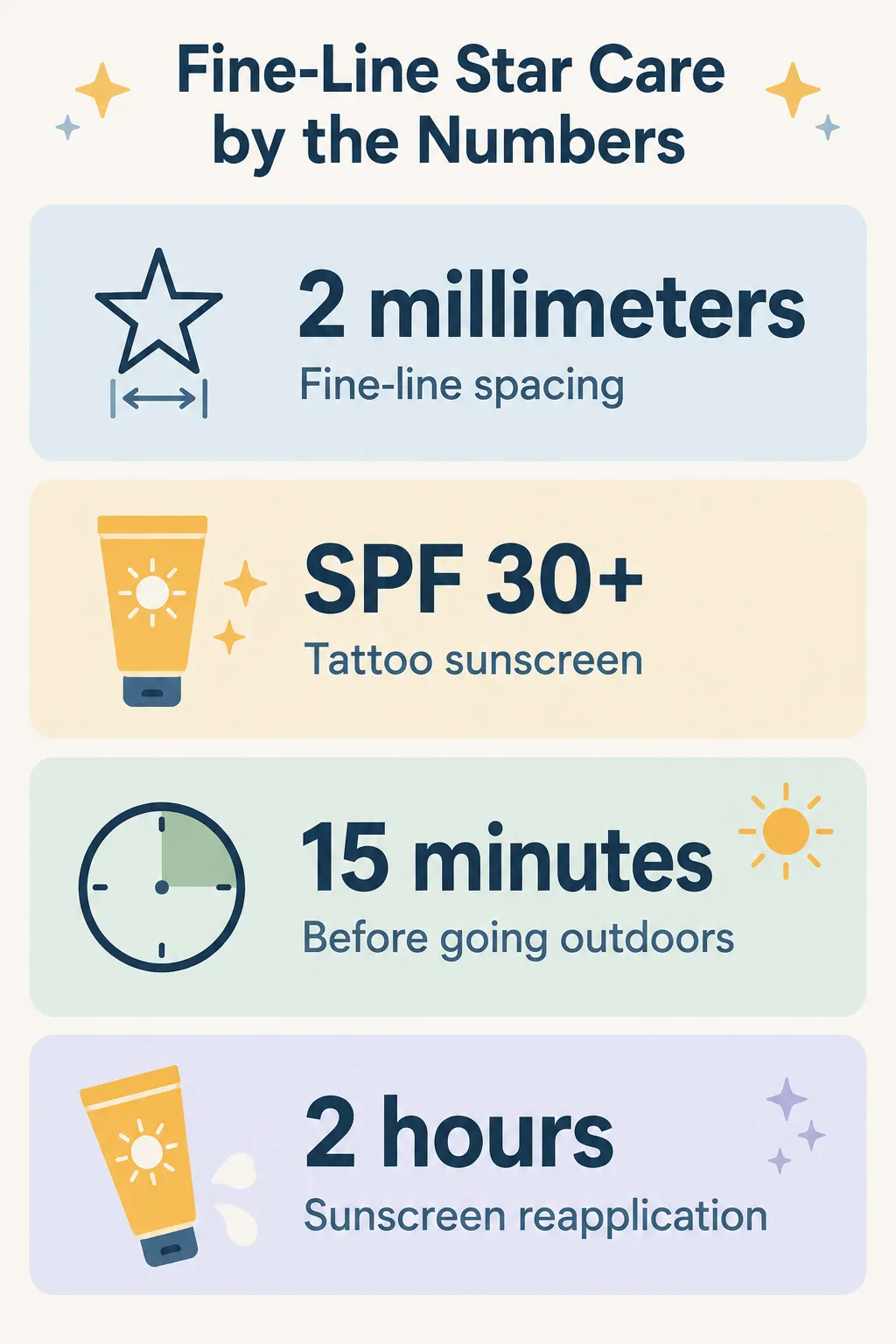 Fine-line star care: keep close details about 2 millimeters apart, and protect healed tattoos with SPF 30+ sunscreen, applied 15 minutes before going outdoors and reapplied at least every 2 hours.
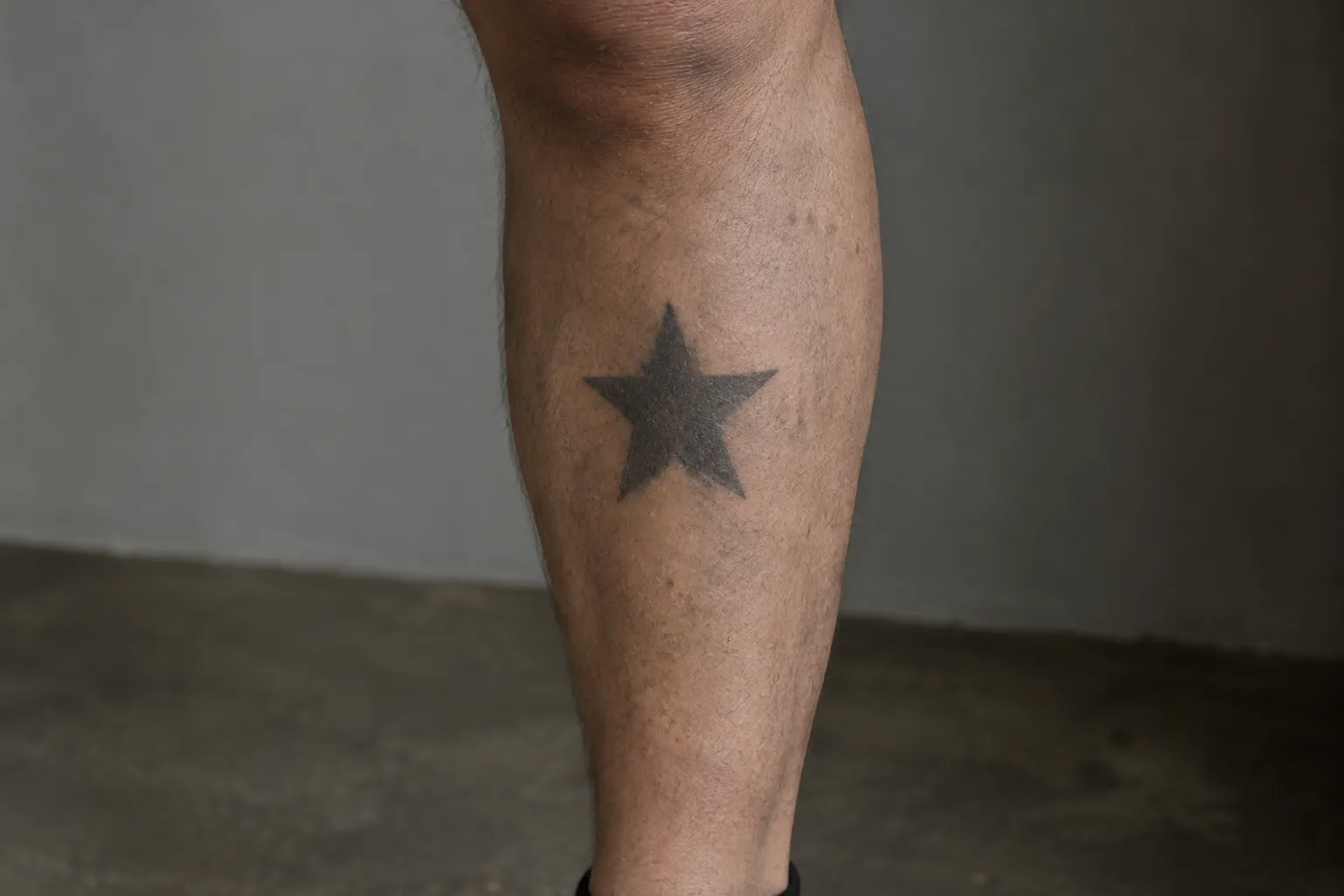
Improper needle depth can also cause blowouts, where ink spreads under the skin and permanently blurs delicate work (6). That one is down to your artist’s skill, so check healed photos in their portfolio, not just fresh ones.
Day 1 to Week 6: What to Expect
The healing timeline breaks down roughly like this, in line with our week-by-week tattoo aftercare guide:
- Days 1-3: Keep the tattoo clean and follow your artist’s wrap instructions. Some redness, tenderness, and weeping plasma are normal.
- Days 4-7: The skin feels tight and starts to flake. Don’t pick or scratch, because pulling flakes from a fine-line star can lift ink from the points. If the skin feels dry, use a water-based lotion or cream (4).
- Week 2: Peeling and itching peak. Let the flakes come off on their own.
- Weeks 3-4: The surface looks healed but the skin underneath is still settling, and the star can look slightly cloudy until then. Keep it out of direct sun for the first 4 to 6 weeks and cover it with sun-protective clothing outdoors. Full integration comes around week 6.
Sunscreen: SPF, Timing, and Reapplication
Once healed, follow the American Academy of Dermatology’s sun routine for tattooed skin (4):
- Use a broad-spectrum, water-resistant sunscreen with SPF 30+.
- Apply it 15 minutes before going outdoors.
- Reapply at least every 2 hours.
UV light can fade some tattoo inks. Tanning beds and sunlamps may also fade tattoos, so skip them entirely (4).
Skip Petroleum-Based Lotions
The AAD cautions that petroleum-based products such as petroleum jelly can cause ink to fade. Use a water-based lotion or cream instead (4). This matters most on fine-line stars, where there’s less ink to lose before the shape starts to break down.
Frequently Asked Questions
- What meaning can a plain star tattoo have?
- A plain star has no single fixed meaning; its symbolism is usually personal, so decide what you want it to represent before choosing the design.
- How can I tell a nautical star from a shooting star tattoo?
- A nautical star has compass-rose styling with divided light and dark points, while a shooting-star design uses a streak or tail to suggest a meteor.
- Can a star tattoo carry religious or gang connotations?
- Some can: the Star of David and the pentagram carry religious or cultural weight, and in some contexts a five-point star has gang connotations, so look into a specific design before choosing it.
- Do star tattoos have an LGBTQ+ history?
- Yes. In the 1950s, some lesbians in Buffalo, New York, wore a small blue five-pointed star on the wrist, where a watch could cover it, and some people choose a nautical-style star to reflect that history.
- Which star tattoo designs are risky at very small sizes?
- Dense constellations, narrow outlined points, and multi-strand tails are risky at tiny sizes because their small gaps can close as ink softens.
- What does a shooting-star tattoo symbolize?
- A shooting-star tattoo is usually read as a wish, a fleeting moment, or a change, and it can mark a major life event.
- What are some tattoos to avoid?
- Avoid designs with tiny interior angles, closely spaced points, or multi-strand tails at a small size, since those details close up as ink softens; also avoid a plain star if you want it to read as a naval reference without the compass-rose styling, since viewers won't read it that way.
- How long before a fine-line star tattoo fades?
- There is no predictable fade date; sun exposure, friction, placement, and line execution all affect how quickly its edges soften.
Choosing a Star That Still Reads Clearly in Ten Years
The compass-rose nautical star is the star tied to sailors and the U.S. sea services (1). A shooting star is a meteor (5), and a plain five-point star means whatever you decide it means. The design decision that matters most is matching the level of detail to the placement:
- For fine-line or tiny stars: go simple and solid, and put them somewhere low-friction like the inner arm or ribs.
- For more detail: save constellations and tailed designs for a flat area with enough room.
- For the long run: protect the healed tattoo with broad-spectrum SPF 30+ every time it sees sun (4). Sunscreen is the habit that does the most to keep delicate ink crisp (6).