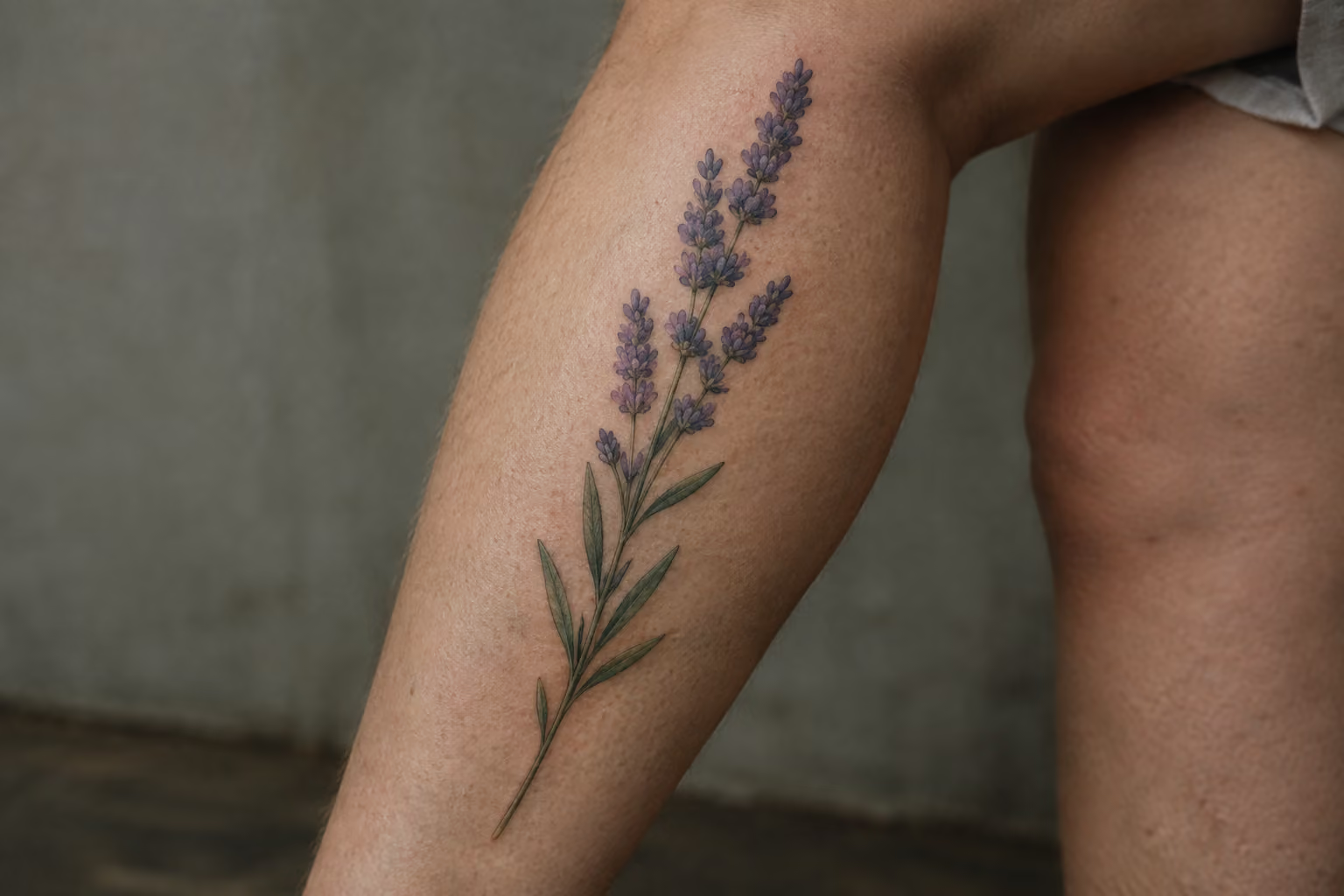
A lavender tattoo doesn’t have to be purple. The real plant’s flower spikes come in purple, lilac, pink and white (1)(5), so the ink you choose decides whether the piece reads as lavender or as a generic purple flower. This guide covers what the motif is commonly said to mean, how to build a sprig from the plant’s actual structure, color versus black and grey, and where a small version holds its detail as it ages.
✓ Pros
- The stem-and-spike silhouette stays recognizable without relying on dense petal detail.
- A botanical reference can be personalized through species shape, color, and scale.
- The design can carry a personal memory without needing added lettering.
✗ Cons
- The motif's symbolism varies by person and historical context.
- Fine-line details need enough space to remain distinct as they soften.
- Highly visible placements can make sun exposure and fading harder to manage.
The motif has clear strengths. You get flexible color choices, a shape that works small or large, and a botanical silhouette that forgives a little softening over the years. Most people already read it as calm or devotion. The downsides are just as clear. That symbolism isn’t universal, tiny fine-line detail blurs, and bony or high-friction placements lose crispness faster than flat, padded ones.
What a Lavender Tattoo Means: Calm, Devotion, Remembrance
The lavender tattoo meaning most often reported is calm, healing, devotion and remembrance. The plant carries those meanings across many traditions, with no single fixed meaning (4). Another reading puts purity, innocence, loyalty, love and devotion first (6).
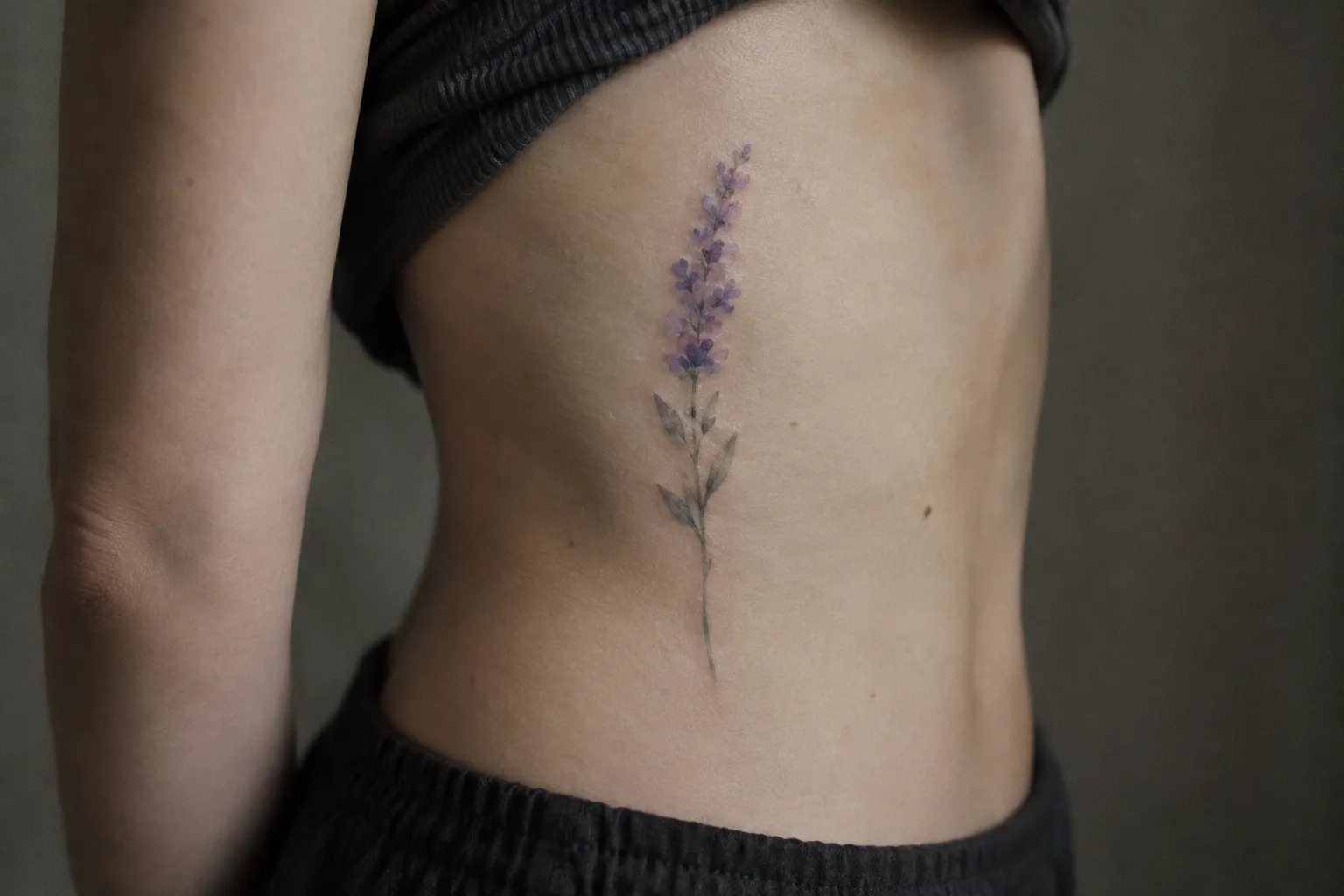
Treat whatever meaning you attach as yours. If someone asks what your sprig means, “my grandmother grew it” is as valid an answer as anything a symbolism chart says. It’s also the answer that holds up better in twenty years.
Calm, healing, and devotion associations
Lavender is read as a sign of silence, care and calmness, and a sprig as a reminder to stay calm (6). The plant is native to Europe (1). Its species range across the Mediterranean region, northern Africa, western Asia and the Middle East (5). The name comes from the Latin lavare, “to bathe or wash,” because the ancient Romans steeped bundles of the herb in bathing water (5). Lavender still shows up in perfumes, soaps, lotions and herbal medicine (1).
Devotion appears in both readings (4)(6). Some wearers add a white dove or a white ribbon to push the sprig toward loyalty and devotion (6).
The meaning has also moved over time. In the Victorian language of flowers, a sprig of lavender could translate to “distrust” (13). That shift is a good reason not to pin your design on one “official” meaning.
Remembrance symbolism
Lavender is also read as a remembrance flower (4)(6). In practice it’s often chosen for a memorial piece: a sprig for someone who grew it, a dried bundle that sat on a kitchen windowsill, a flower from a wedding or a funeral. The motif does the job well because it’s quiet. A memorial sprig doesn’t need a banner, a date or a portrait to carry the reference. For another flower rooted in remembrance, see our poppy tattoo guide.
If you want to add a name or date beside the stem, size the lettering properly. Standard script needs a letter height of at least 12 mm (1/2 in), fine or ornate script about 25 mm (1 in), and block or typewriter lettering and numerals at least 6 mm (1/4 in). On the wrist, only bold script or block lettering holds up. A delicate cursive name squeezed under a fine-line sprig is one of the first things to blur.
What a lavender tattoo can symbolize for an LGBT woman
For many lesbian, bisexual and queer women, lavender carries a specific historical charge. In the early twentieth century the color took on meaning as a slang term for gay men (14). In 1970, lesbian activists reclaimed “Lavender Menace,” a phrase Betty Friedan reportedly used in 1969 for the threat she believed lesbianism posed to the women’s movement, by wearing lavender-dyed “Lavender Menace” T-shirts at the Second Congress to Unite Women in New York (14).
A lavender tattoo can therefore work as a quiet identity marker. It’s legible to people who know the history and reads as “a pretty flower” to people who don’t. Some wearers like that double reading because it lets them control who gets the reference.
Keep two caveats in mind. First, that history attaches to the color lavender more than to the plant, so a black and grey sprig carries the association less directly than a lilac one. Second, it isn’t universal. Plenty of LGBT women wear lavender sprigs purely for the calm or memorial meaning, and plenty of straight women wear them with no queer reference at all. If the identity reading matters to you, color is the lever that strengthens it.
Lavender Sprig Tattoo Designs and Botanical Details
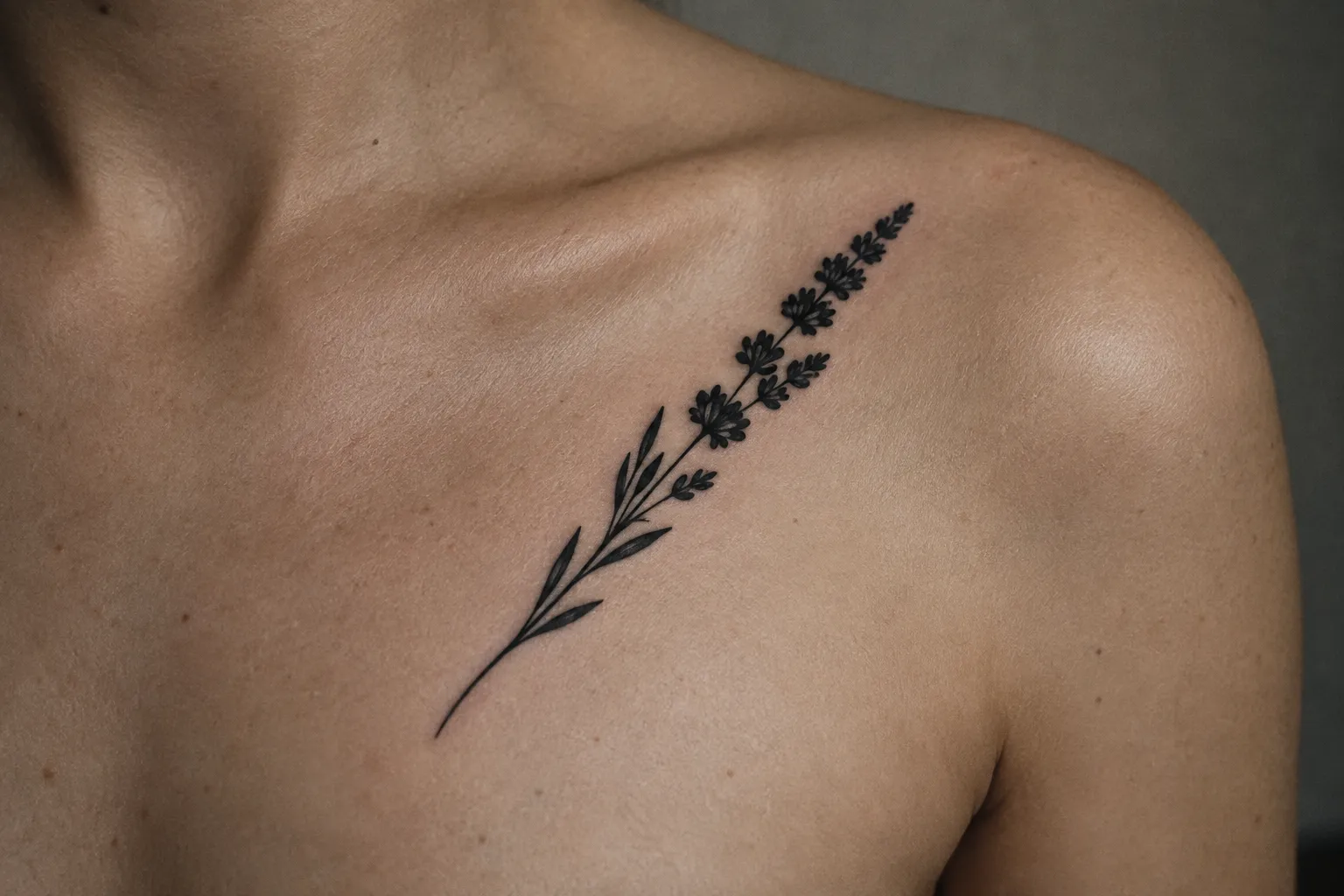
A lavender sprig tattoo works best when it’s drawn from the plant’s real structure: a long bare stem carrying flowers clustered in a spike above the foliage (1). That elongated silhouette is already graphic before any shading goes in. It’s why lavender holds up as a small fine-line motif when roses and peonies often turn to mush at the same scale.
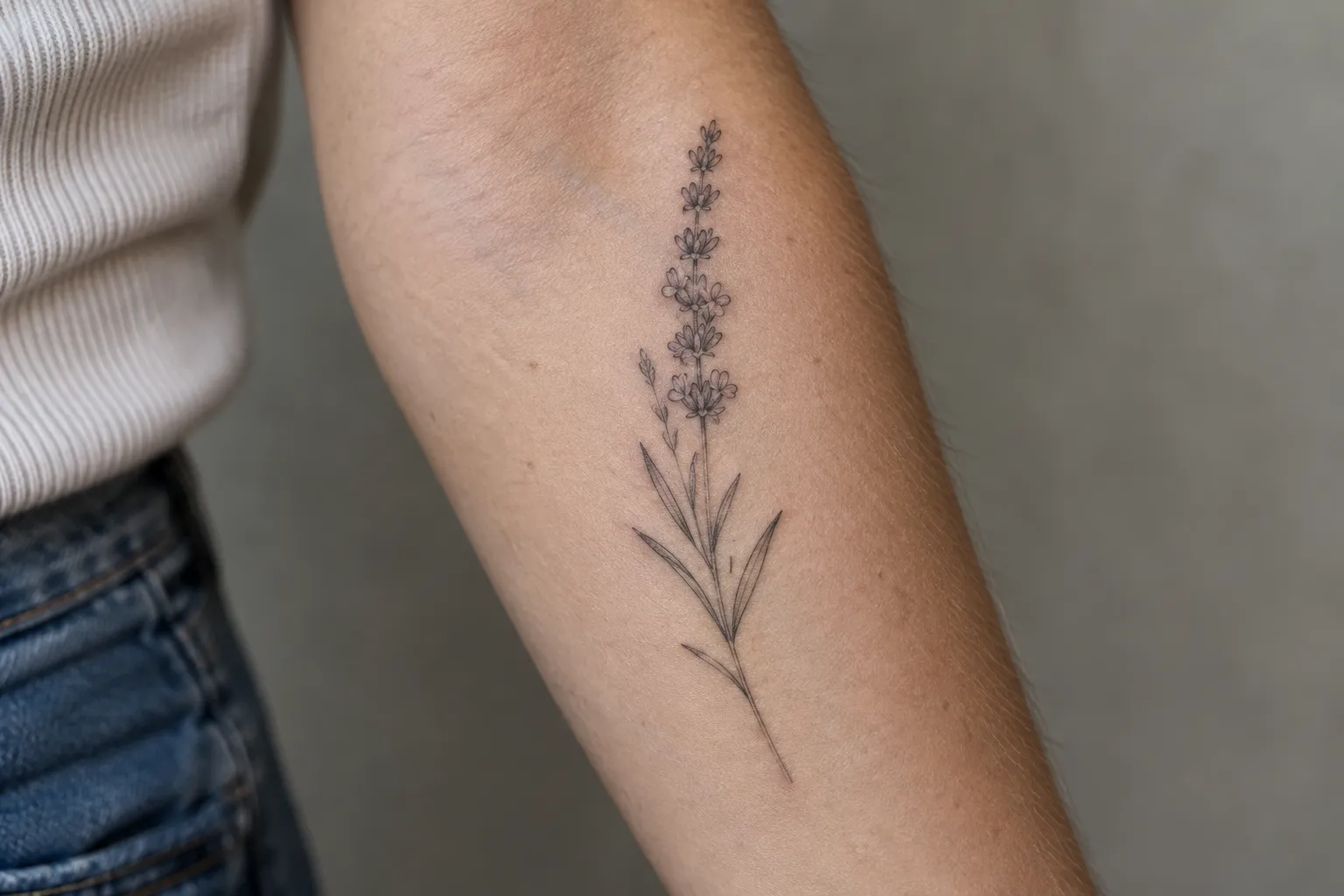
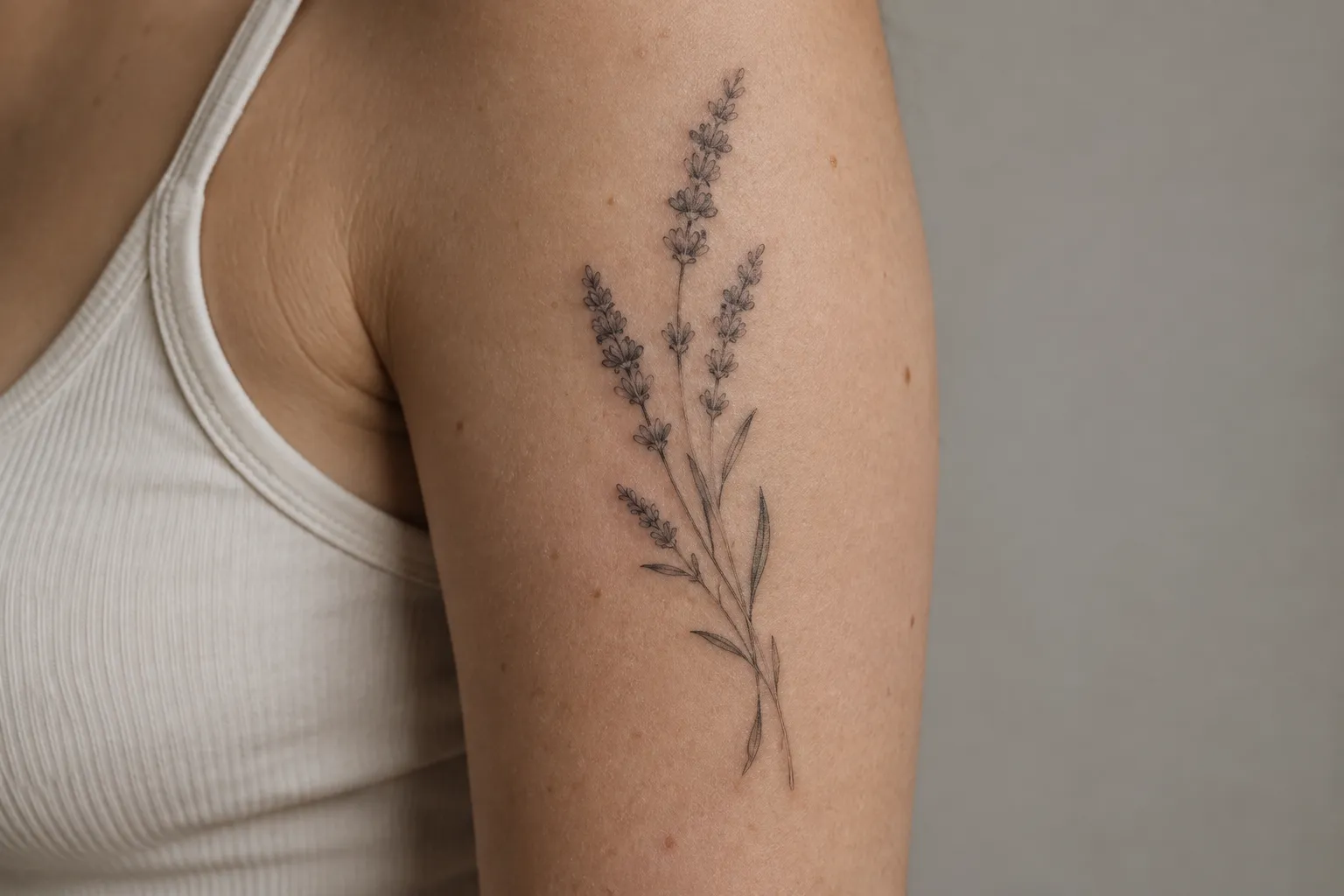
Before you book, decide which of three looks you want: a botanical illustration with shaded leaves and individual florets, a simple outline sprig, or a colored sprig. Then show your artist a reference with the scale and placement you want. Those three choices produce three different tattoos, and they sit differently on the body.
Single stem and flower spike layout
A single stem with one flower spike is the base layout, and most variations build from it. The stem runs long and mostly bare. The flower clusters stack toward the tip, tapering as they go, and a few narrow leaves sit low on the stem. That’s the whole recipe, and restraint is what keeps it legible.
The vertical shape decides placement more than anything else. Forearms suit botanical designs because the elongated sprig follows the length of the arm (10). The outer calf and the side of the thigh work for the same reason. A horizontal sprig across the collarbone can work too, but the artist has to curve the stem to follow the bone, or the straight line will look off when you move.
Common variations, from simplest to most demanding:
- One stem, one spike: the cleanest small option, suited to the inner forearm or behind the ankle
- Two or three stems crossed: adds depth, needs more room so the spikes don’t merge
- A tied bundle: a ribbon or twine wrap low on the stems, popular for memorial pieces
- Sprig plus a second element: a bee, a moon or a lettering line, which needs planning so the extra element doesn’t crowd the florets
Matching species and cultivar shape to your reference photo
Lavender isn’t one plant. It’s a genus in the mint family, Lamiaceae, with about 47 species, and flower and leaf shapes vary from one species to the next (1). Size varies too: plants grow 1-4 feet tall and 1-2 feet wide depending on species (1). For a tattoo, that range tells you something practical. A “lavender” reference can show anything from a tight, compact spike to a loose, airy one.
So don’t hand your artist a generic “lavender” image pulled from a stock site. If the plant in your grandmother’s garden had chunky, tufted flower heads topped with petal-like flags, that’s a different drawing from the slim, evenly spaced spikes of a classic English-style lavender field. Bring a photo of the actual plant if you can, or a botanical illustration of the species whose look you want. A reference that matches the intended shape matters more than a color label.
Bring three references: one for the plant shape, one for the line style you like (fine line, illustrative, traditional), and one showing a healed tattoo at roughly the size you’re planning. The healed photo is the one most people skip, and it’s the one that shows how the design will look in a couple of years.
Leaves and flower clusters without overcrowding
The most common mistake with a lavender sprig tattoo is drawing every floret. Real lavender spikes carry dozens of tiny flowers, and a tattoo that tries to show all of them becomes a dark smudge once the lines soften. Ask the artist to preserve open space between flower clusters and leaves instead of relying on many tiny marks to suggest texture. Fine-line guidance treats that spacing as central to long-term readability (11).
A small sprig can use fewer leaves and fewer flower clusters than a larger illustration (12). Three to five suggested clusters on a small stem read better than fifteen crammed ones. Leaves should stay narrow and few, usually two to four low on the stem, so the eye goes straight to the flower spike.
If you want the full botanical-illustration look with shaded leaves and individual florets, that’s a sizing decision. Go bigger. A piece covering the outer forearm can hold detail that a sprig small enough for the inner wrist cannot.
Color Versus Black and Grey Lavender Ink
Lavender doesn’t need saturated purple to read clearly. The flower’s documented colors include purple, lilac, pink and white (1)(5), so you can choose a palette that suits your skin tone and style and still have the sprig read as lavender. Recognition comes from the shape: long stem, stacked clusters, tapering spike. Color reinforces that shape. It doesn’t replace it.
Purple, lilac, pink, and white options
Purple and lilac are the plant’s usual flower colors (1), so they make the subject recognizable at a glance. Someone across a room will read “lavender” before they register any linework. That’s the main argument for color, and it matters most if the queer or identity reading of the color is part of why you want the tattoo.
Pink and white are also real lavender flower colors (5), and they open options people rarely consider. A soft pink sprig reads as gentler and more unexpected. White ink as an accent, used for highlights on florets over a lilac base, can add dimension. White on its own is a poor choice for a whole flower: it tends to fade toward the skin tone and can look like scarring once healed.
A few practical notes on color:
- Pale lilacs and pinks need contrast. Without a defined outline or darker shading underneath, light pastels can wash out against lighter skin and disappear on deeper skin tones. Ask the artist how the palette will heal on your skin, not on the flash sheet.
- Color fine line softens faster than bold color. Thin colored lines carry less pigment, so they lose saturation sooner.
- Style changes the palette. An American traditional lavender, with thick black outlines and a limited palette, will usually render the spike in one or two flat purples with black shading. It ages very well. It also looks nothing like a delicate fine-line sprig, so pick the style before the color.
Black and grey shading and negative space
A black and grey lavender sprig relies on outline, shading and negative space instead of colored petals. The trick is to keep the flower clusters distinct from each other so the sprig stays legible at small scale. Bare skin between clusters does the work that color would otherwise do. That skin is what separates one floret group from the next, and it’s what keeps the spike from reading as a solid grey bar.
Black and grey is the more forgiving choice for most small designs. Black holds its edge longer than pastel pigments, and a well-placed grey wash can suggest the purple tone without committing to it. Most fine-line requests are black and grey and small format (12), and that’s the exact combination where the technique is under the most stress, so spacing matters even more.
Two hallmarks separate good fine-line lavender from weak work. First, the lines are laid with a single needle or a tight cluster of three, in one clean pass, with no bold outline holding the shape together (12). Second, there’s deliberate open skin around and inside the design. The pitfall when artists get it wrong is cramming: too many parallel lines in too small a footprint. Cramped fine-line work is the regret people report most often a few years later (11).
Placement and Sizing for a Small Lavender Design
A small lavender tattoo holds its detail longest on a flat, padded, low-friction area like the outer upper arm, thigh or calf. Hands, fingers and feet face more washing, friction and sun, which wears fine detail down faster (8)(9). If long-term crispness matters to you, that is the decision rule. Visibility is a separate question: a placement that heals well may not be one you want on show, and the reverse is also true (8).
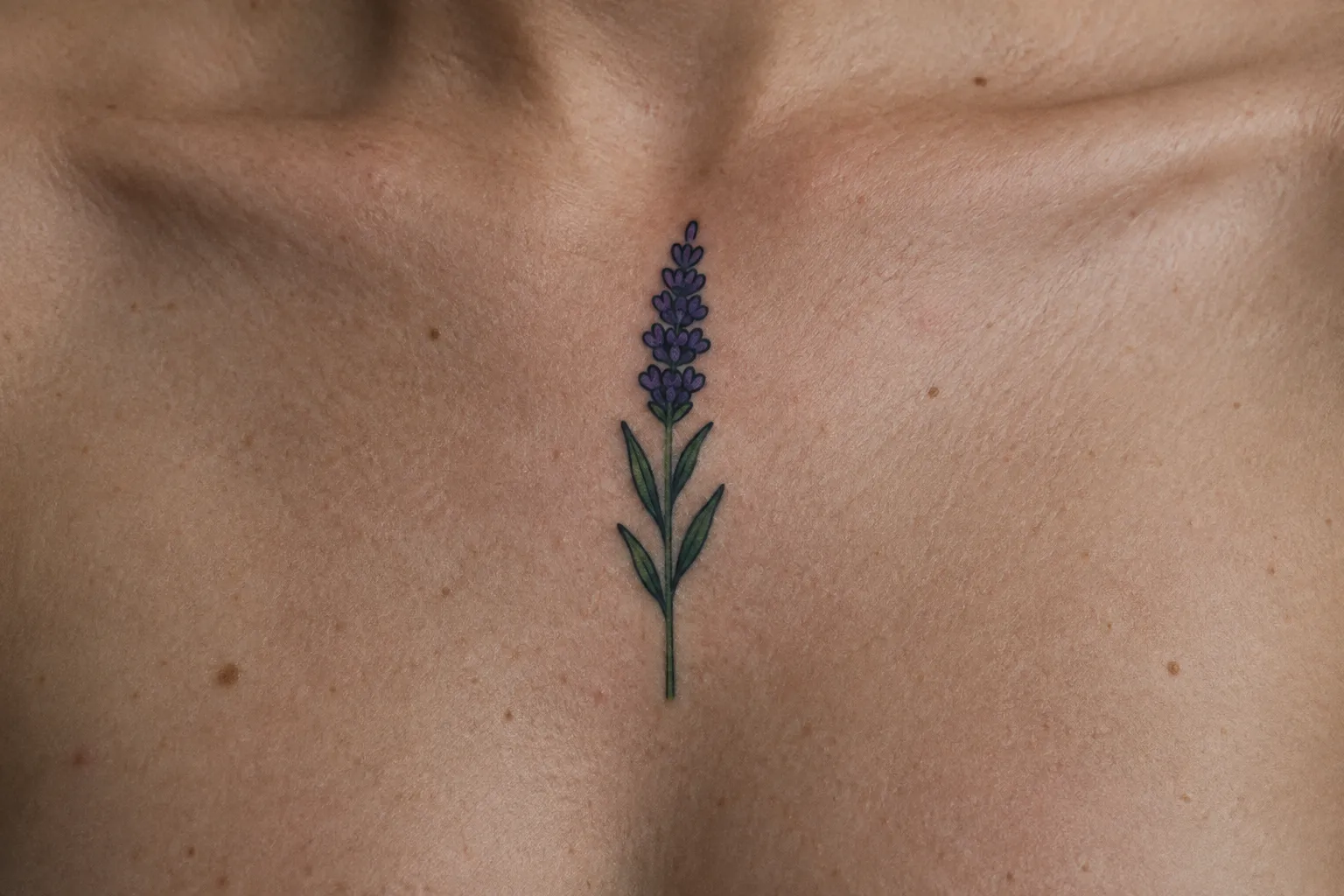
Low-friction spots: outer upper arm, thigh, calf
The outer upper arm, thigh and calf are the most forgiving placements for pain, healing and long-term sharpness (8). The upper arm is the standout for fine detail. The surface is broad and fairly flat, there’s muscle under the skin rather than bone, and it spends most of the year under a sleeve, so it gets little sun (10). Line work holds its edges there about as well as anywhere on the body (10).
Placement options for a small lavender tattoo, roughly from most to least forgiving:
- Outer upper arm: flat, padded, mostly covered; good for a vertical sprig
- Outer thigh: plenty of flat space for detail, easy to hide
- Calf: suits a long vertical stem, visible in shorts
- Forearm: a natural fit for an elongated botanical (10), high visibility, more sun
- Collarbone and ribs: good flow for a curved sprig, but thin skin over bone hurts more and needs more care (8)
- Hands, fingers, feet: last choice for fine detail (see below)
On pain, flesh beats bone. The outer upper arm, outer thigh and calf sit at the low end of the scale. The ribs and sternum sit far higher, and long rib or sternum sessions are among the hardest anyone sits through. The outer forearm is low to moderate, while the inner forearm gets sharper toward the wrist. Our tattoo pain chart breaks this down by body area.
For a standalone sprig on a limb, the 1/3 rule helps with scale. It treats roughly one-third of a limb segment as a natural visual unit for a standalone piece, so the upper arm between shoulder and elbow holds one cohesive design at about that scale. The same rule applies to composition, balancing darks, midtones and open skin. That balance is what keeps a lavender spike from looking like a thick dark bar. The full explanation is in our tattoo placement guide.
Fine-line spacing for a small sprig
Fine-line practitioners use a rough rule of keeping parallel lines about 2 millimeters apart and leaving real negative space around the design (11). Treat that as practitioner guidance, not a medical or industry standard. It’s still a useful brief to give your artist. On a lavender sprig, parallel lines show up everywhere: the stem’s two edges, the veins in a leaf, the outlines of stacked florets. Each pair that sits closer than that will start to merge as the lines soften.
Fine-line tattoos soften and blur faster than bold work, so plan for a touch-up at some point (11). Small, lettering-like details and tightly packed lines lose readability first as a fine-line tattoo ages (11)(12).
If a design doesn’t fit your chosen spot with that spacing intact, make it bigger instead of compressing the detail (12). Thinning the line weight to squeeze more florets into the same space is the wrong fix. Fine-line work holds when the lines are thin without being starved and the piece is large enough to keep real gaps between strokes (12). If you can’t go bigger, cut detail: fewer clusters, fewer leaves, one stem instead of three.
Hands, fingers, and feet: the trade-offs
Hands, fingers and feet get frequent washing, friction and UV exposure, and placement guides link all three with faster fading and loss of crispness (8)(9). They’re also thin skin over bone, which puts them at the high end for pain. A finger sprig looks great on day one, but ink on hands and fingers commonly fades and patches within the first one to three years (10).
That doesn’t make them forbidden. It makes them a trade-off you should choose knowingly, not because a hand spot is convenient or trending. If you go ahead, keep the design bold and simple: a single stem, a few chunky clusters, no fine shading. Expect touch-ups.
The same placements compared on the three factors that matter for a fine-line sprig:
Fine-Line Lavender Sprig Placement Comparison
| Outer upper arm | Thigh | Calf | Forearm | Hand and fingers | |
|---|---|---|---|---|---|
| Friction | Low | Low | Low to moderate | Moderate | High |
| Sun exposure | Low | Low | Moderate in summer | High | High |
| Fine-detail retention | Strong | Strong | Good | Good with sun protection | Poor for fine detail |
Lavender Versus Other Floral Tattoos (and What to Avoid)
Lavender stands out among floral tattoos because its long, narrow spike reads clearly at small sizes. Big-petaled flowers usually need more room or heavier simplification to stay legible. If the question is “what’s the prettiest flower to get tattooed,” the useful answer is the one whose shape survives the size and placement you want.
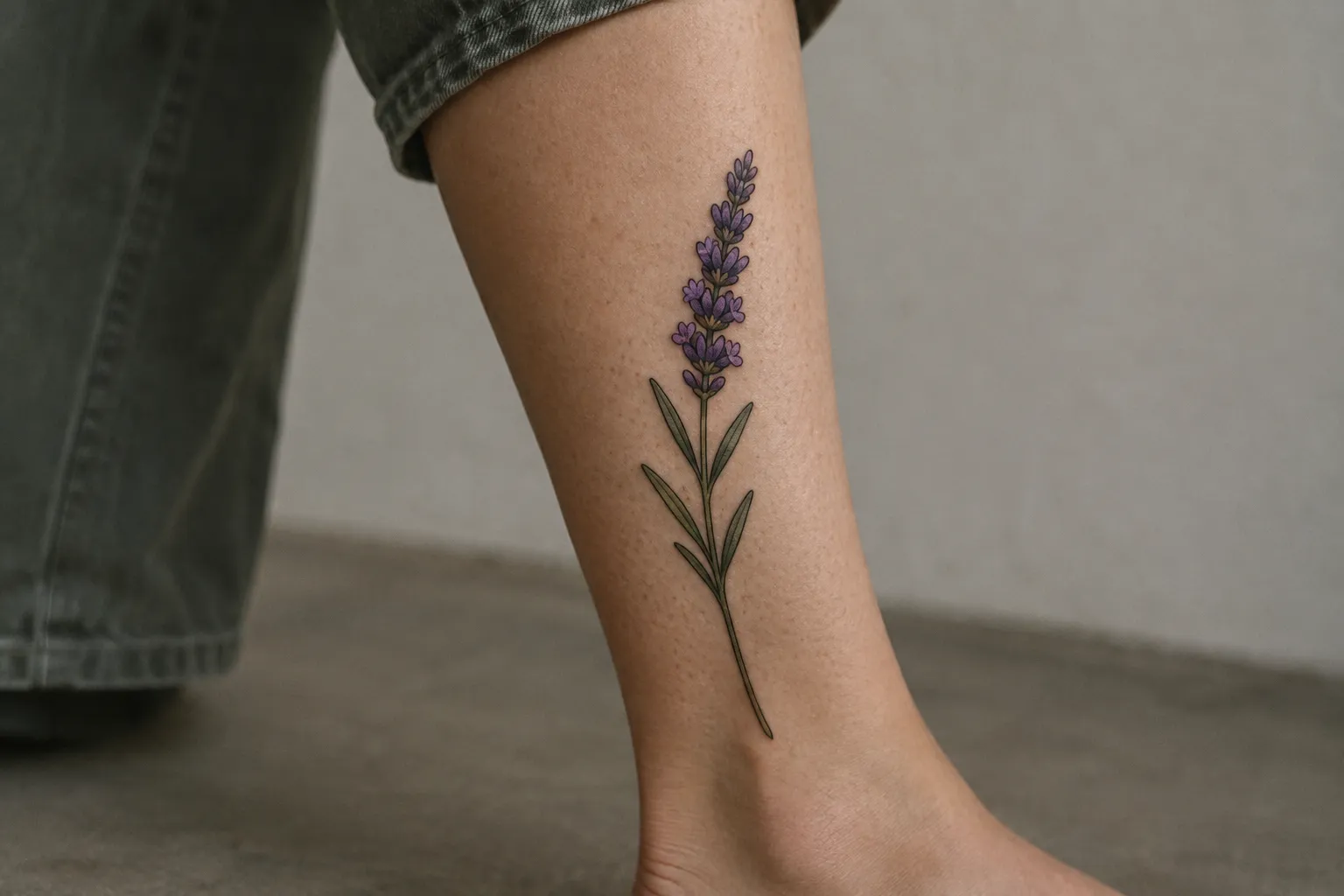
What makes lavender stand out among floral motifs
The plant is built from a long bare stem carrying a dense spike of tiny florets. That silhouette is graphic on its own. It doesn’t need to be stylized into a symbol the way a rose or a peony usually does (4). For a small piece, that’s a real advantage. A tiny rose relies on overlapping petals that close up as lines spread. A tiny lavender sprig relies on a vertical line and a stacked rhythm, and both survive softening better.
Big blooms win at large scale. A peony or chrysanthemum on a thigh or back panel, especially in Japanese-influenced work, gives the artist room for petal layering and saturated color that a lavender spike can’t match. So “prettiest” depends on canvas size. Lavender suits the small, vertical, delicate brief. Roses, peonies and lotus flowers suit the large, rounded, saturated one.
Other flowers carry their own meanings, and our flower tattoo ideas guide sets them out flower by flower. Those are a separate choice, and lavender’s associations don’t transfer to them. If you’re torn between lavender and another flower, pick by shape and placement first, then check the other flower’s symbolism on its own terms.
Design mistakes worth avoiding
The tattoos to avoid are mostly ones built for a photo, not for skin that ages. With lavender and fine-line florals, these show up most:
- Cramped fine-line detail. Parallel lines closer than about 2 millimeters, or every floret drawn individually in a tiny footprint (11). This is the most common fine-line regret.
- Tiny lettering attached to the sprig. Script under the 12 mm (1/2 in) letter-height floor blurs into a scribble. Size it up or leave it off.
- Mismatched reference images. A reference showing a large illustrative piece, copied at a third of the size. The detail that worked big blows out or fills in small. Match the reference’s scale to yours.
- Pastel-only color with no structure. Pale lilac with no outline or shading depth washes out once healed.
- Fine detail on hands, fingers or feet. These placements lose crispness sooner (8)(9).
- Trend-only additions. A micro-realistic bee in single-needle grey next to the sprig, or a matching design tied to a passing meme. Ask yourself whether you’d still want it in ten years, not ten days.
- Choosing an artist from a filter-heavy feed. Ask to see healed fine-line work, not only fresh photos.
Healing Timeline and Aftercare After a Lavender Sprig
A lavender sprig tattoo heals on the surface in about 2-3 weeks. The deeper skin keeps remodeling until the tattoo is fully integrated around the six-week mark. Leeds NHS medical-tattooing guidance gives the same surface window, saying the area should heal by 2-3 weeks (7). Follow your own tattooer’s instructions, because the routine below describes a standard healing calendar and your artist knows your skin and their technique.
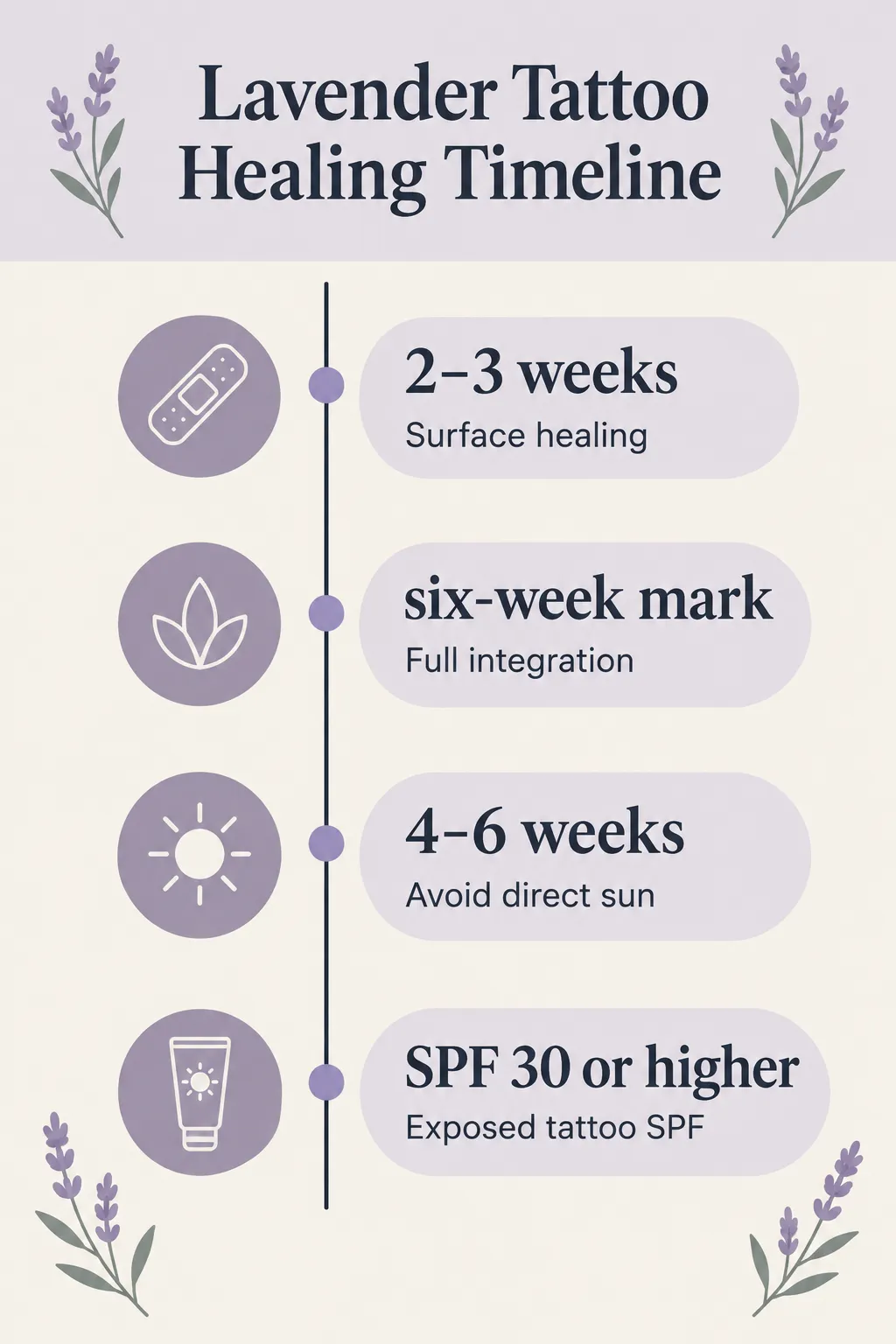 A lavender tattoo’s surface heals in 2-3 weeks, deeper skin integrates around the six-week mark, and sun protection means avoiding direct sun for 4-6 weeks before using SPF 30 or higher when exposed.
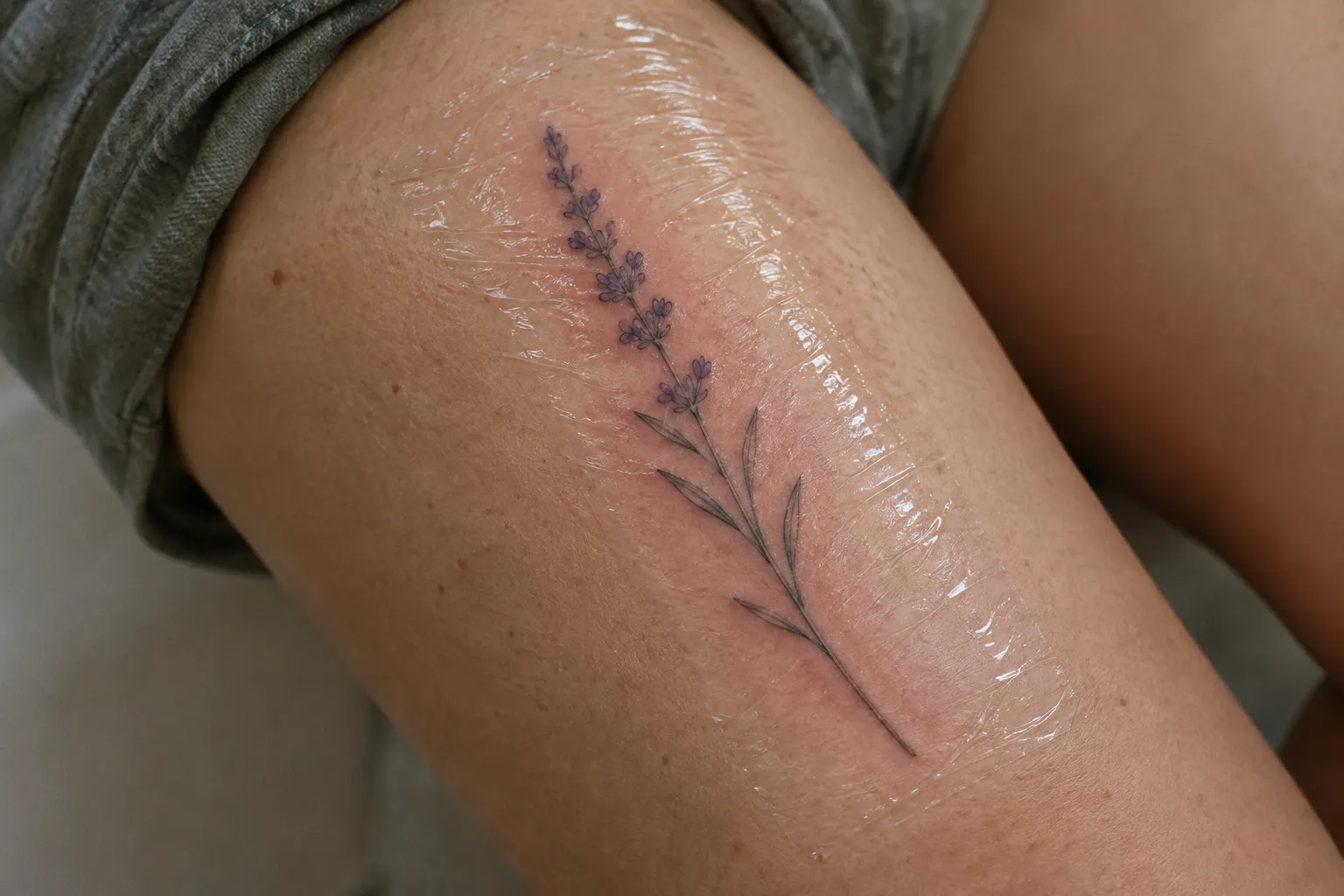
What to expect in the first 2-3 weeks
The healing calendar runs like this:
- Day 1-3: an open wound. Expect weeping plasma, some redness and swelling. Wash 2-4 times a day with unscented soap, using fingertips only, and apply a thin film of petrolatum ointment that leaves a slight shine, not a wet layer.
- Day 4-7: the skin feels tight and shiny and starts to flake. From about day 3, switch to a fragrance-free moisturizer. Keep washing 2-4 times a day through the first week, then taper as weeping stops.
- Week 2: peeling and itching. Don’t pick or scratch, because flakes pulled early can take pigment with them.
- Week 3-4: the surface looks healed while the deeper skin is still remodeling. Fine lines can look slightly cloudy here. That’s normal and usually clears.
- From week 6: touch-ups can be booked; the deeper skin keeps settling for a few months.
A few rules apply throughout. Use only fragrance-free products: no essential oils, exfoliants or scented “natural” balms on a healing tattoo. Antibiotic creams aren’t needed for normal healing, since they’re for an infection a doctor has diagnosed. Avoid swimming, soaking, hot tubs and saunas for at least the first 2-3 weeks. The full routine is on our tattoo aftercare page.
Signs you should contact a professional
Redness, swelling and warmth can be normal after tattooing. A rash, a tattoo that isn’t healing, or a fever means you should contact a health professional (2). Infection can come from unsterile equipment or contaminated ink (2)(3). According to the FDA, even unopened, sealed tattoo inks can harbor bacteria and other microorganisms that cause infections, and the agency has also received reports of allergic reactions to inks (2). That’s a good reason to ask any studio how it handles hygiene and ink before you book.
Watch for redness that spreads outward instead of settling, swelling that gets worse after day three, pus, red streaks, or heat that builds over days instead of fading. Don’t wait those out.
Sun protection once healed
Keep the tattoo out of direct sun for the first 4-6 weeks. Fine-line guidance cautions against putting sunscreen on an open, healing tattoo (11), so during that window use sun-protective clothing like a loose long sleeve or light trousers. Once the skin has closed and the six weeks are up, apply SPF 30 or higher whenever the tattoo is exposed. Sun exposure is one of the biggest factors in tattoo aging (9). A forearm sprig that sees summer sun every day needs this more than a thigh piece that’s covered most of the year.
Frequently Asked Questions
- What does the lavender tattoo mean?
- Lavender tattoos are commonly associated with calm, healing, devotion, and remembrance (4), but these meanings are cultural associations rather than a fixed definition.
- What does a lavender tattoo symbolize for an LGBT woman?
- For some LGBT women, lavender references queer history in the US, including the 1970 reclamation of "Lavender Menace" (14); a colored sprig signals that history more directly.
- What is the prettiest flower to get tattooed?
- The best floral choice depends on the available space: lavender suits a small vertical design, while peonies, roses, and chrysanthemums allow more room for layered detail.
- What are some tattoos to avoid?
- Avoid cramped fine-line designs with parallel lines closer than about 2 millimeters (11), and script lettering under 12 mm (1/2 in) letter height. Skip fine detail on hands, fingers and feet if you want it crisp in a few years (8)(9). Be wary of designs copied from a reference drawn at a much larger scale.
- Does a lavender tattoo have to be purple?
- No. Lavender flowers can be purple, lilac, pink, or white (5), and black-and-grey shading can identify the sprig through its shape and open spaces.
- How long until a lavender tattoo is fully healed?
- The surface usually heals in 2-3 weeks, while the deeper skin keeps remodeling for a few months.
Before You Book Your Lavender Sprig
Treat lavender’s calm-and-devotion meaning as cultural shorthand, not a rule. It’s an association (4)(6), and it has changed over time (13). Pick the meaning that’s yours, and pick color if the identity reading of lavender matters to you.
Then make the decisions that affect how it ages. Choose a flat, low-friction spot like the outer upper arm, thigh or calf if you want the fine detail to hold, and accept the trade-offs if you go for a hand or finger. Keep parallel lines about 2 millimeters apart (11), and size the design up instead of compressing it. Bring a reference that matches the species shape you want. After the session, follow the healing calendar through six weeks, keep the tattoo out of the sun, and contact a professional if you see a rash, poor healing or fever.