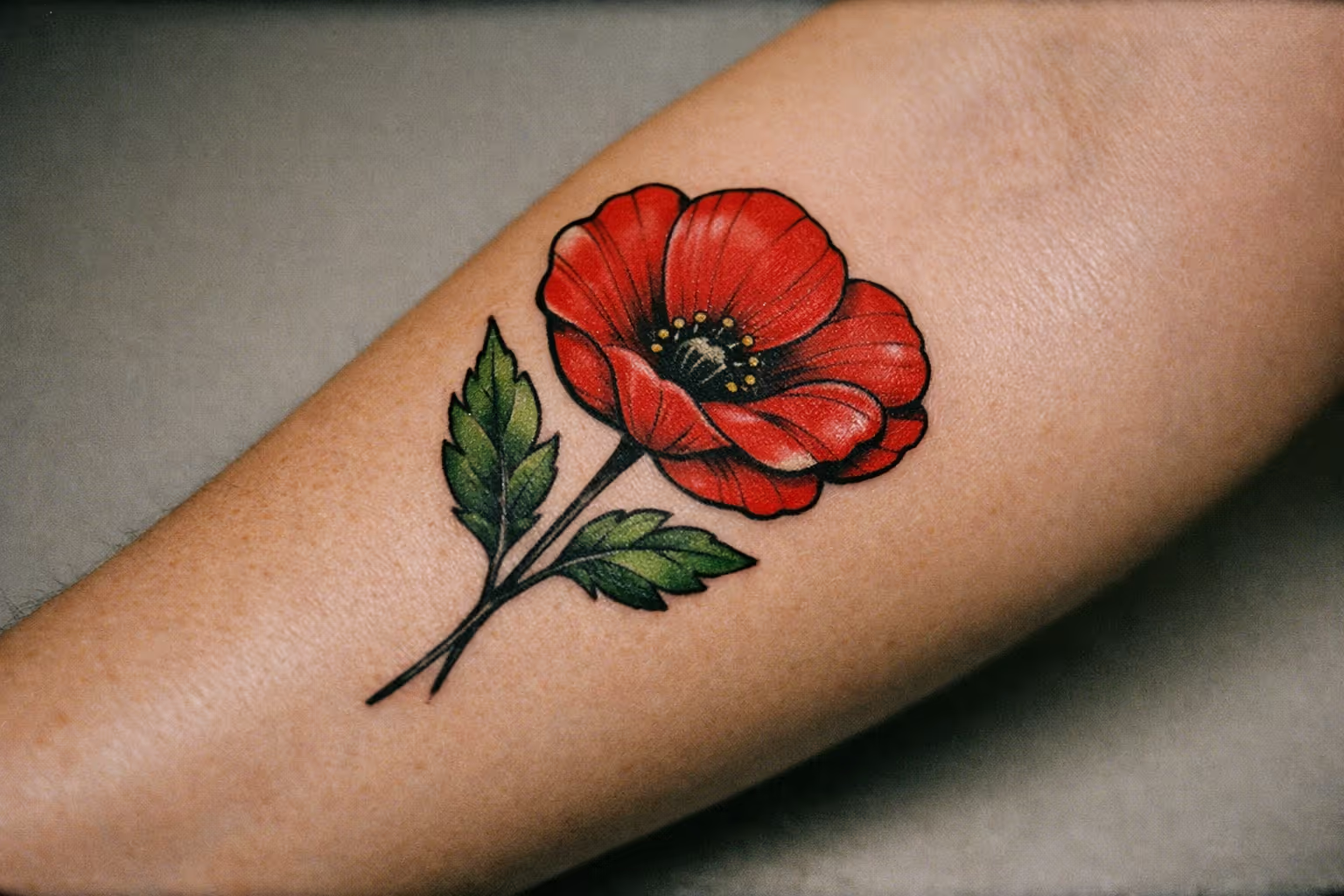
A poppy tattoo is deceptively hard to keep sharp. Under an inch, its fine internal detail blurs within 1-3 years, and the saturated reds it’s known for fade fast without daily SPF. The symbolism is strong and worth getting right, but size and color are what decide whether you still recognize it a decade in. Here’s how to build a poppy that lasts, and what it actually stands for.
What a Poppy Tattoo Means
The dominant association in the West is remembrance and sacrifice, especially for fallen soldiers. That comes directly from WWI - red poppies were among the first plants to grow on the churned-up battlefields of Western Europe, and the poem “In Flanders Fields” by Lieutenant Colonel John McCrae cemented the link. On Remembrance Day across the UK, Canada, Australia, and New Zealand, people still wear poppies to honor military dead. A red poppy tattoo carries that weight whether you intend it to or not in those countries. I’ve had clients come in not knowing this and leave glad they asked first.
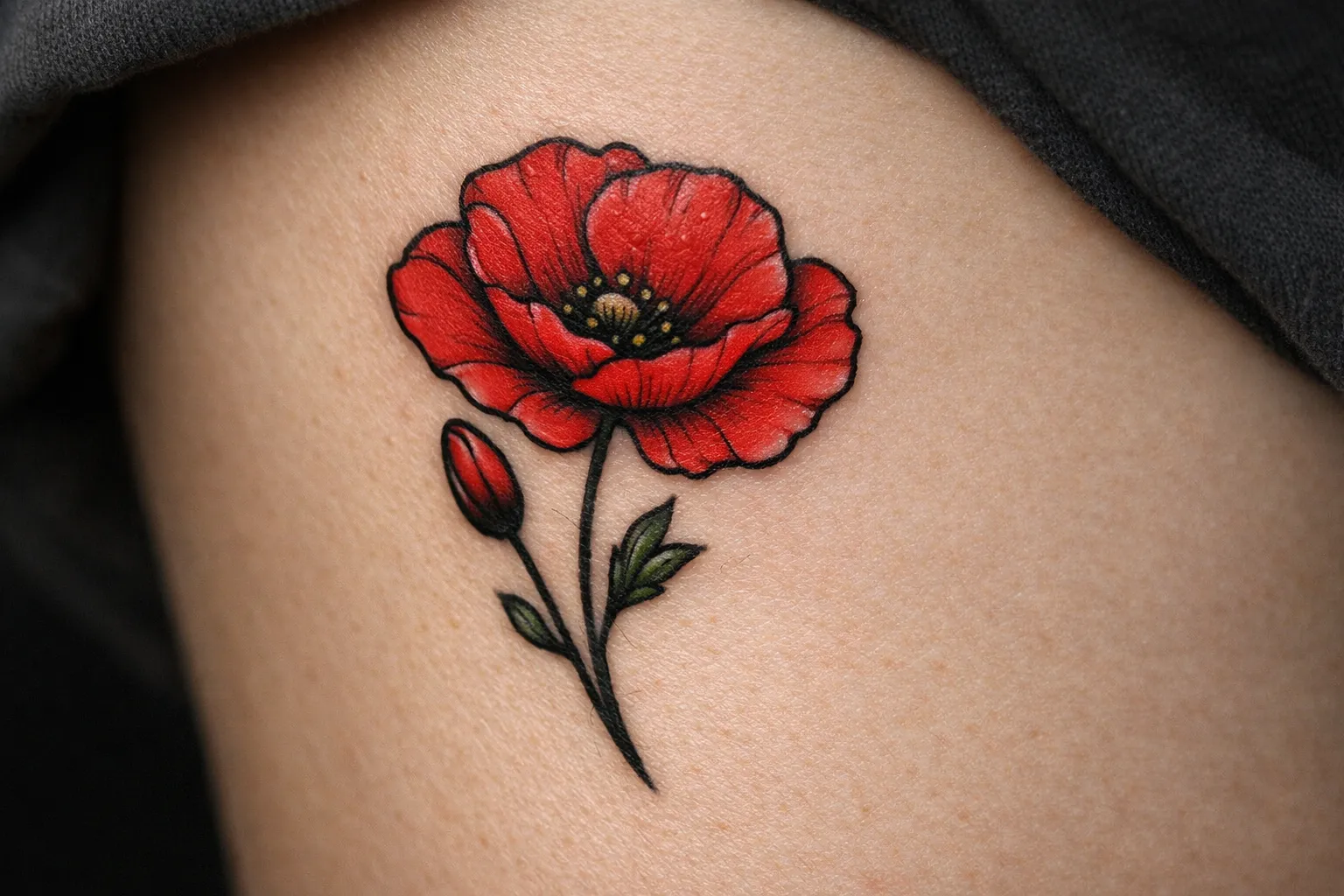
But remembrance is only one thread. Across older traditions the poppy means several distinct things:
- Eternal sleep, dreams, and the subconscious - Greek and Roman mythology tied poppies to Hypnos (sleep) and Morpheus (dreams), which is why funerary art used them and why “The Wizard of Oz” sends Dorothy to sleep in a poppy field (1).
- Consolation, resurrection, and eternal life - rooted in Egyptian funerary symbolism.
- Ephemeral beauty - poppy blooms are short-lived, so the flower reads as a reminder to value the present (1)(3).
- Resilience and hope - poppies thrive in poor, disturbed soil, including war-scarred ground, which is why mental-health-focused designs lean on the “blooming in bad soil” idea.
- Passionate love - in Japanese and Chinese symbolism, poppies signal deep love between partners (2).
Color shifts the meaning further:
- Red poppy: sacrifice, remembrance, bloodshed, resilience (2)(5).
- Yellow/golden poppy: renewal, optimism, state pride. Some sources describe the California poppy as carrying the idea that “true gold is in the heart” - a poetic interpretation that circulates in certain design communities but is not a universally recognized fixed meaning, and not one backed by documented historical or botanical sources.
- Black/gray poppy: mourning, mystery, a darker introspective tone (1).
Pick your primary meaning before you pick a style. “I want a poppy to honor my grandfather who served” and “I want a California poppy because I just moved to LA” lead to completely different designs. I can’t tell you how many clients come in having already decided on a style before they’ve sorted out the meaning - that’s backwards, and it usually shows in the finished piece.
The Golden Poppy and California’s State Flower
The California poppy tattoo is its own lane, and worth getting right botanically. Eschscholzia californica has been California’s state flower for over 100 years, nicknamed “cup of gold” and “Copa de Oro”. The plant has four silky, distinctly orange-yellow petals on blue-green foliage - very different from the red field poppy’s many crinkled petals and dark center.
If you want the golden poppy tattoo to actually read as a California poppy, ask your artist specifically for that four-petal cup shape and the orange-gold gradient, not a generic red flower warmed up in palette. Get the species right and the symbolism sharpens: rest, calmness, dreams, a declaration of love, and a clear nod to California.
Common supporting elements people pair with a golden poppy tattoo:
- A small California state outline or coastline.
- A bear (the state animal) for a layered state-pride piece.
- A loose cluster of two or three blooms at varied heights, which reads more like a real wild patch than a stiff bouquet.
Placement-wise, a single golden poppy works well at 2-3 inches on the forearm or outer ankle, where the warm tones catch daily light without baking under constant sun. A larger orange composition photographs beautifully but fades faster than red or black - more on protecting that below.
Traditional vs. Modern Poppy Designs
Two broad camps, and they age differently.
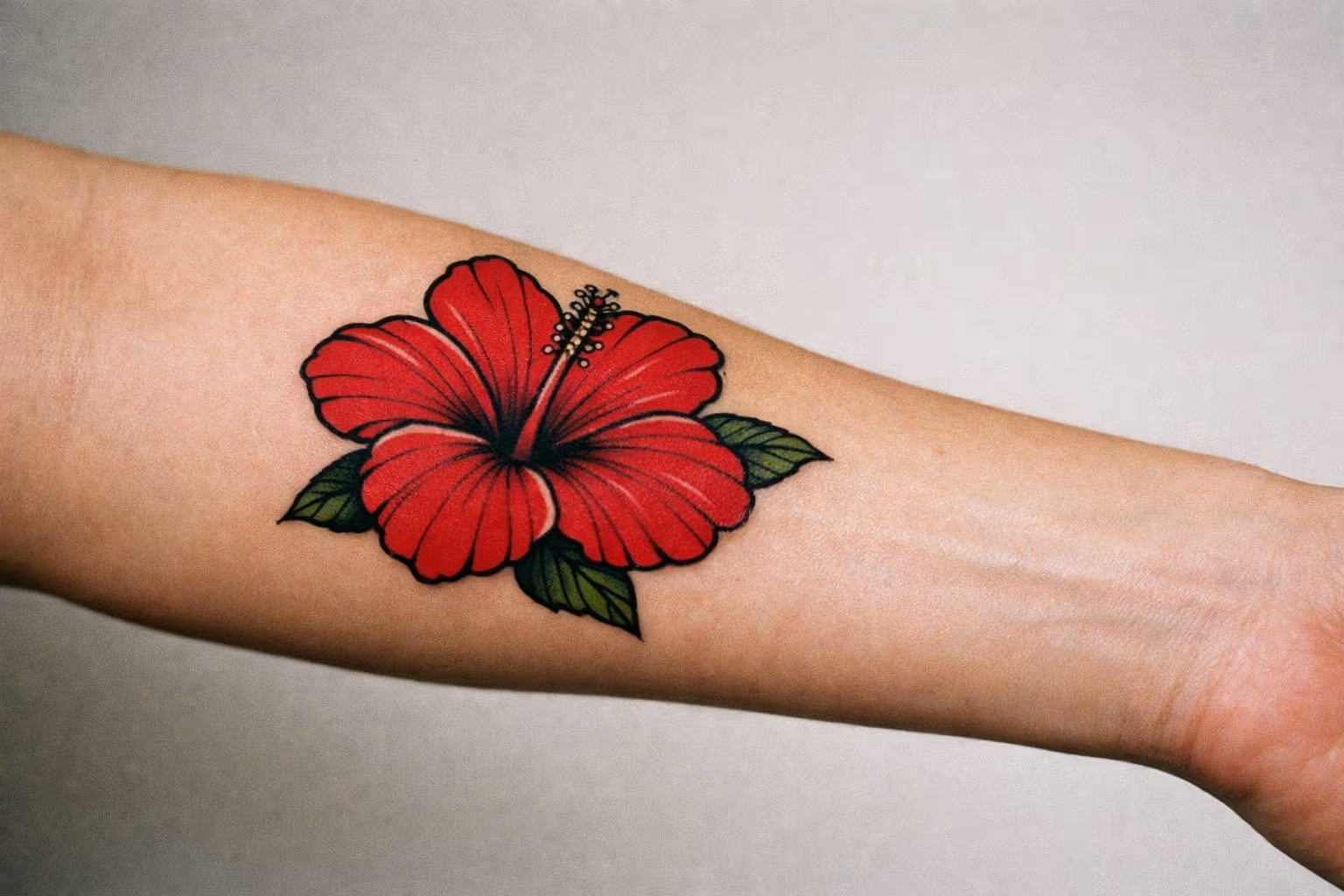
Traditional and neo-traditional poppies use thick black outlines and a limited, saturated palette - bold reds, a black center, deep shadow in the petal folds. The technical hallmarks here are strong value contrast and heavy linework: dark centers, solid shadows, nothing left to chance - the same structural approach that makes American traditional flash still readable on a 70-year-old. That contrast is what keeps the tattoo legible after the brightest reds inevitably soften. This style suits military remembrance pieces and pairs cleanly with dog tags, helmets, or Flanders crosses (5). The common pitfall: an artist who outlines well but flattens the petals with no internal shading, leaving you with a sticker-looking flower that has no depth once it’s healed.
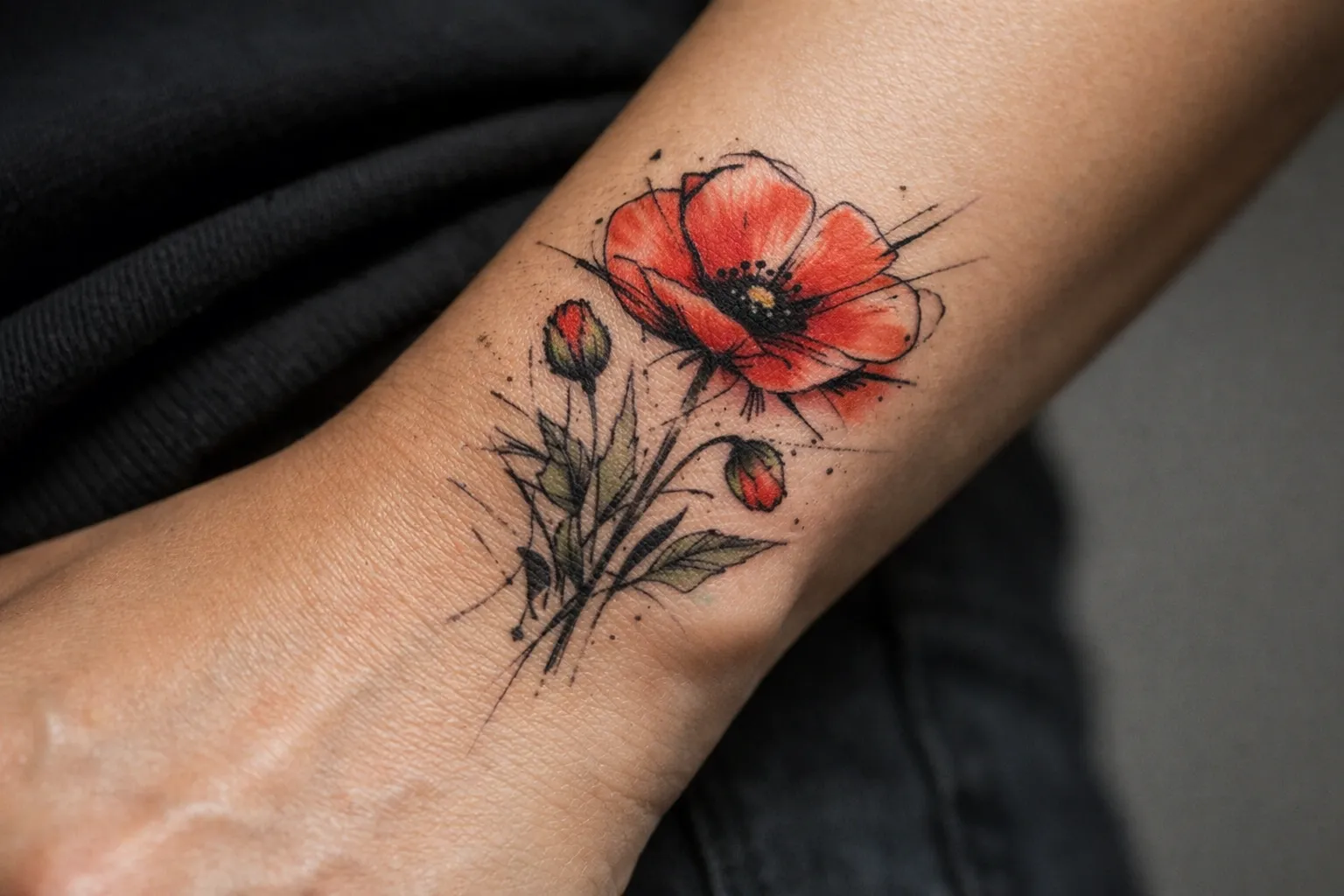
Modern fine-line and watercolor poppies lean delicate - single-needle or 3RL liners for the stem and filaments, soft color washes, sometimes no outline at all. The look is airy and currently everywhere on social platforms, with micro wild poppies around 1-2 inches driving a lot of first-tattoo bookings. The pitfall: fine-line color with weak contrast blurs and fades faster than any other poppy style - noticeably quicker than a bold traditional red poppy with a thick outline, which can hold its basic shape for a decade or more. Petal veins and stamen detail under 1 inch can become unreadable in 1-3 years, especially on high-movement skin. I’ve seen genuinely beautiful fine-line poppies turn into soft smudges by year two because the artist pushed too much detail into too small a space.
Blackwork and black-and-gray poppies skip color entirely and rely on linework and stippling. These hold up best long-term because there’s no red or orange to fade. Good choice if you want something that still reads clearly in a decade.
Best Wild Poppy Tattoo Ideas
The “wild poppy” aesthetic - the kind you’ll see in any “best 42 wild poppy tattoos” listicle - is about looseness, not symmetry. Real poppy patches are uneven, windblown, and varied in height. Tell your artist that explicitly, or you’ll get a tidy florist bouquet instead.
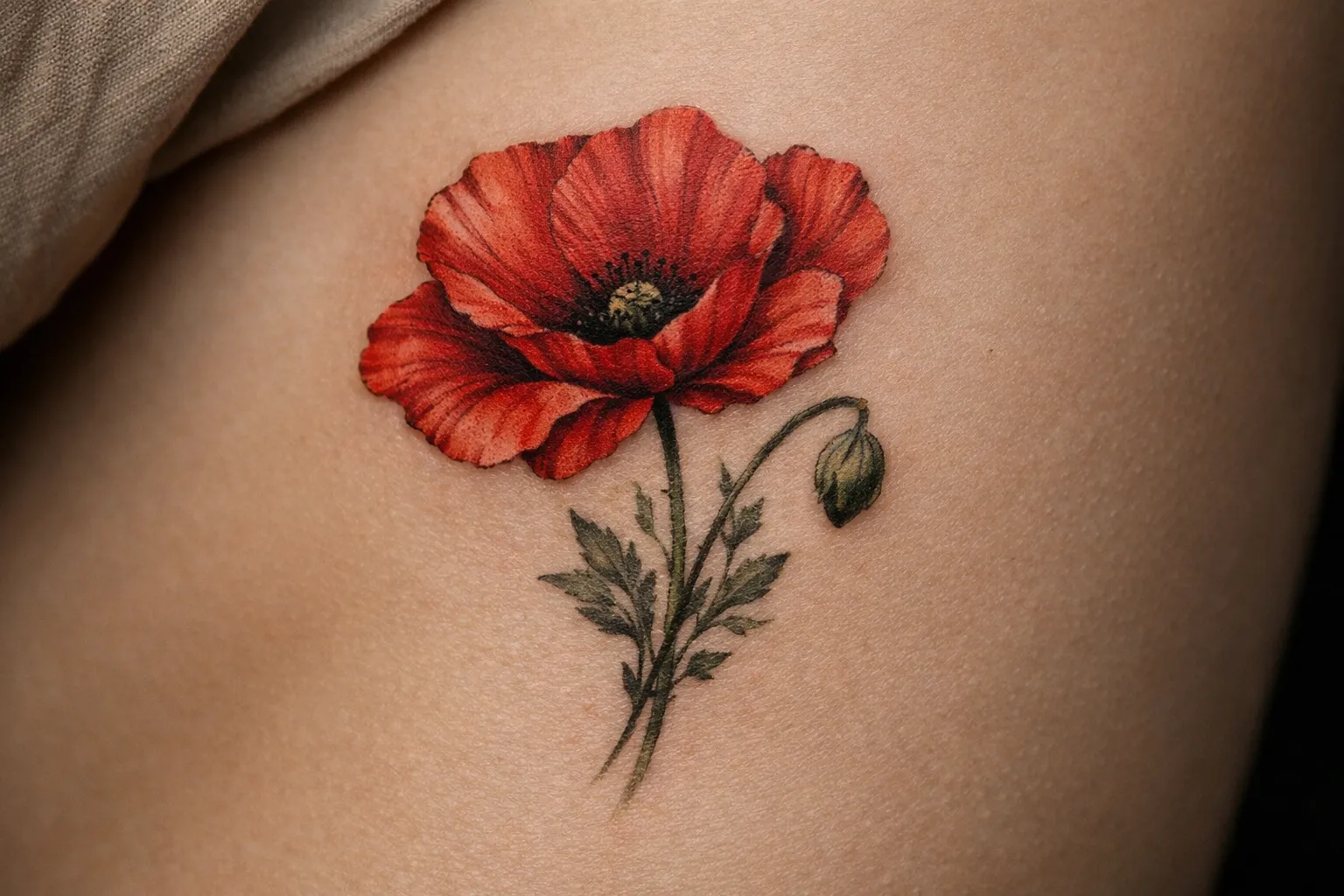
Concepts that work well as larger pieces (4-8 inches on the upper arm, thigh, ribs, or back):
- Windblown wild poppy field wrapping the calf or forearm, stems bending in one direction to suggest movement.
- A single wild poppy breaking through cracked stone - the clearest visual shorthand for resilience and hope.
- Poppy with barbed wire, helmet, or dog tags for an explicit military memorial (5).
- Fine-line wildflower bundle mixing poppy with daisy, lavender, or forget-me-not for layered personal meaning - the forget-me-not in particular doubles down on memory.
For the wild look, ask for looser linework, varied stem heights, and partial watercolor edges to evoke wind. Symmetry kills the effect.
Size and placement quick reference:
- 1-2 inches (single linework stem): wrist, inner forearm, behind the ear, outer ankle.
- 2-4 inches (single color bloom with leaves): forearm, calf, shoulder.
- 4-8 inches (multi-bloom composition): upper arm, thigh, ribs, back.
Placement and Pain
Pick placement for two things: how often you want to see it, and how much it’ll hurt. If the poppy is a daily reflection on someone you lost, don’t bury it on your upper back where you’ll never look at it.
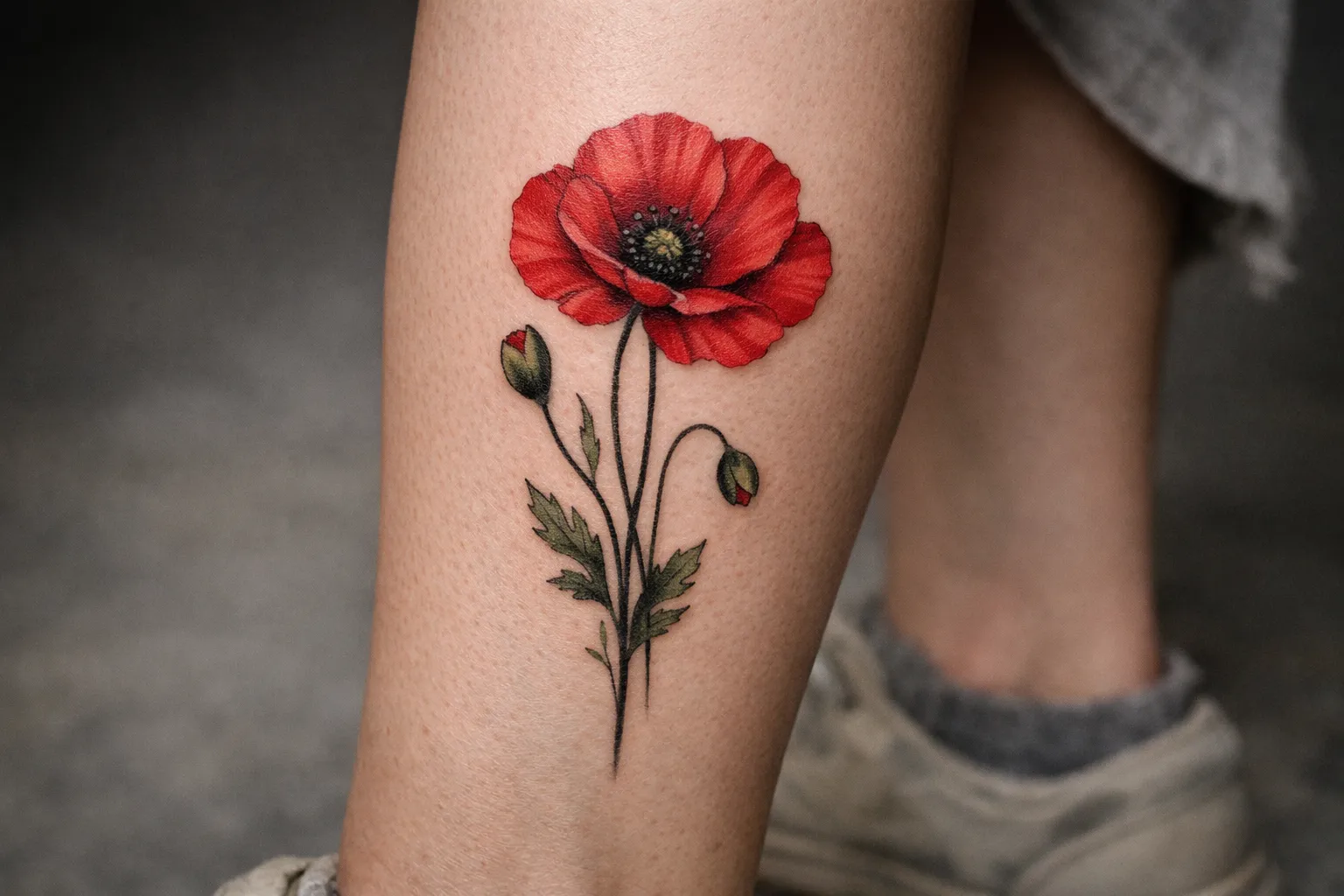
On pain, the reliable rule is bone and thin skin hurt more than muscle and fat. Relative scale for common poppy spots, roughly worst to easiest:
- Ribs and sternum - thin skin over bone, plus the breathing movement. A rough sit for a large memorial piece, and I’d only recommend it if you’ve already got some sessions under your belt.
- Ankle and inner wrist - bony, sharp in spots.
- Thigh - generous canvas, moderate sting. Feels like persistent scratching rather than sharp pain, which is why it’s a favorite for large wild poppy compositions.
- Outer forearm and upper arm - fleshier, among the more tolerable spots, and ideal for a 2-4 inch single bloom.
The thigh deserves a specific mention: it gives you room for an intricate scene, stays private under clothing, and you control when it’s visible. The trade-off is the back of the thigh is more sensitive than the front.
If you’re nervous, the anticipation usually outruns the actual session. A small linework poppy is done in 30-60 minutes - over before the discomfort really settles in.
Cost, Time, and Healing
Most poppy guides skip the numbers. Here they are for a mid-tier US shop in 2024-2025. Shop minimums in many cities have climbed 10-20% in the last few years, so a tiny piece that used to run under $80 now usually starts around $100-150.
Cost ranges:
- Tiny single poppy (1-2 in, linework): $80-$150.
- Small color poppy (2-3 in): $150-$300.
- Medium piece (4-6 in, color, flower with leaves): $300-$600.
- Large wild poppy composition (6-10 in, multiple blooms, realism or neo-traditional): $600-$1,200+.
Session time:
- Minimalist line poppy, no color: 30-60 minutes.
- Small color piece: 1-2 hours.
- Medium detailed color poppy: 2-4 hours.
- Large wild poppy panel: 4-8 hours, often split across two sessions.
Budget for a touch-up within 3-5 years, especially on saturated reds and golden tones - figure $100-$300. Many artists do the first touch-up free or discounted; ask before you book.
Healing timeline
A poppy tattoo heals on the same schedule as any tattoo. Color pieces aren’t harder to heal, but they show fading sooner if you neglect them.
- Day 1-3: Keep it covered as your artist directs, then wash gently with a fragrance-free soap twice a day and pat dry. Expect some plasma and minor weeping. Apply a thin layer of fragrance-free moisturizer or tattoo balm - thin, not gooped on.
- Week 1: Flaking and light scabbing start. Do not pick. Itching is normal; tap, don’t scratch. No swimming, no baths, no soaking. Quick showers are fine.
- Week 2-4: The top layer is essentially healed by day 7-14, but the deeper layers keep settling for 4-6 weeks. Colors may look slightly cloudy under healing skin and brighten as it finishes.
Once healed, daily SPF 30-50+ is the single biggest factor in how your reds and oranges hold up. Skip sunscreen and you can see heavy fading on bright tones in 2-3 years - a pattern consistent with research on UV-driven pigment breakdown published in dermatology literature, including findings covered in the Journal of the American Academy of Dermatology on tattoo ink photodegradation. Sun-protective clothing over the area during long outdoor days helps even more - especially relevant if you’re getting a golden poppy tattoo on the forearm, which gets constant sun exposure.
Symbols to Understand Before You Book
A poppy is loaded with meaning, which is mostly an asset - but it’s worth knowing where symbols go wrong so you don’t end up explaining something you didn’t intend.
Avoid symbols with coded group affiliations if you’re not part of that group. This is the heart of the “what does a 2% tattoo mean” question that comes up alongside poppy searches: a 2% tattoo is reportedly associated with biker and outlaw communities, referencing membership in a small minority of riders or club members - though the exact meaning varies by club and is not publicly standardized. It has nothing to do with poppies. Don’t get one as decoration - it can read as gang or club affiliation you don’t actually hold. The same caution applies to 1% symbols, certain numbers, and any code whose community you’re not in.
Be aware of regional sensitivity around red poppies. In the UK, Canada, Australia, and New Zealand, the red poppy is specifically tied to military remembrance (2)(4)(5). If you live in or travel to those places, expect people to read your tattoo as a war memorial, and be prepared to answer for it. Using it as generic decor can land as insensitive in communities where it’s reserved for the war dead.
Other things worth avoiding:
- Copying a Pinterest screenshot exactly. Those boards are reference, not a stencil - exact copies create near-duplicate tattoos and don’t account for your body’s curvature, so petals and stems warp when you move.
- Ultra-pale yellow or gold on high-sun skin - low contrast means it barely reads after a couple of years.
- High-detail poppies under 1 inch on fingers or the side of the hand. They blur fast.
- Cramming every poppy meaning - war, dreams, addiction, love, resurrection - into one small design. You get clutter and diluted symbolism. Pick one or two.
Poppies and Related Flower Symbolism
People who land on poppy tattoos usually circle nearby motifs too - wildflower tattoos, remembrance pieces, veteran ink, state-flower tattoos, and broader symbolic botanicals. If you’re building a larger composition, a couple of pairings reinforce the poppy’s meaning rather than competing with it:
- Forget-me-not - memory, a natural partner for a remembrance poppy.
- Olive branch - peace, which works well with white or memorial poppies.
- Lotus - spiritual growth and rebirth across several Asian traditions; a good pairing if your poppy leans toward dreams and the subconscious.
- Rose - romantic love, which pairs with the East Asian “passionate love” reading of the poppy.
If you’re choosing between poppy and another flower tattoo ideas entirely: gladiolus reads as strength and persistence, lotus as purity and rebirth, and roses as love or remembrance depending on context. None of them carry the specific war-memorial charge the red poppy does, which is the deciding factor for a lot of people.
Questions People Ask
Frequently Asked Questions
- Can a poppy tattoo have different meanings depending on color?
- Yes, red poppies are strongly linked to war remembrance and sacrifice, golden poppies symbolize optimism and state pride, and black or gray poppies convey mourning or mystery.
- How should I size a fine-line poppy tattoo to ensure it ages well?
- Fine-line poppies should be at least 1.5-2 inches to keep detail legible over time; smaller sizes risk blurring and fading within a few years.
- What aftercare steps help preserve bright colors in poppy tattoos?
- Use fragrance-free soap and moisturizer during healing, avoid picking scabs, and after healing, apply daily SPF 30-50+ sunscreen or wear sun-protective clothing to prevent fading.
- Is the red poppy tattoo appropriate everywhere?
- In countries like the UK, Canada, Australia, and New Zealand, red poppies are strongly associated with military remembrance and may be seen as war memorials, so consider local cultural context before getting one.
- What common design mistakes cause poppy tattoos to age poorly?
- Overly detailed fine-line work under 1 inch, flat petals without shading in traditional styles, and ultra-pale colors on high-sun areas often lead to blurring, fading, or loss of depth.
- Can I combine multiple symbolic meanings in one poppy tattoo?
- It's best to focus on one or two meanings to avoid cluttered designs and diluted symbolism; trying to include everything from war to dreams to love can confuse the message.
- What does a 2% tattoo mean and is it related to poppies?
- A 2% tattoo is a biker or outlaw symbol indicating membership in a small minority of riders or clubs; it is unrelated to poppies and should be avoided unless you belong to that community.
Choosing Your Poppy Tattoo
Decide the meaning first, then let it drive everything else. A remembrance piece wants a red field poppy with strong contrast and maybe dog tags or dates. A state-pride piece wants the correct four-petal California golden poppy, not a warm-toned generic flower. A dreams-and-rest piece can take a crescent moon and stars.
Bring your artist 3-5 references - one real flower photo, one tattoo style you like, one you don’t - so they understand both the look and the meaning you’re after. Ask for strong value contrast in the petal folds and dark centers so the design stays legible after the brightest tones fade. Budget for daily SPF and a touch-up in a few years.
Get the species right, give it enough size to age well (at least 1.5-2 inches if there’s any fine detail), and put it somewhere you’ll actually see it if reflection is the point. That’s what separates a poppy tattoo that still reads clearly in ten years from one that’s a soft blur by year three.