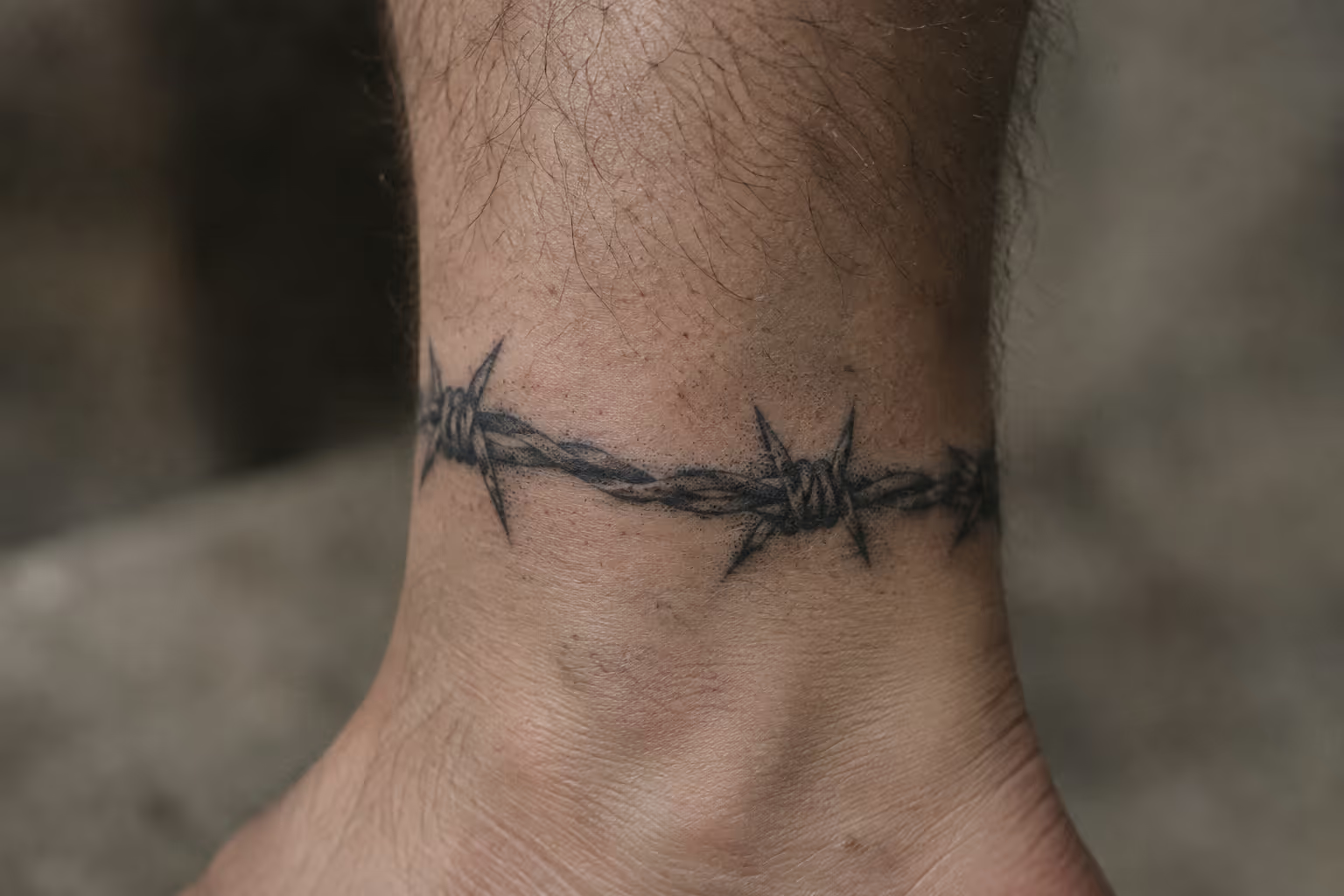
A barbed wire tattoo has no single fixed meaning. The same twisted strand can read as strength on one arm and as confinement on another (1). The message comes from your design choices: intact wire or a snapped strand, a narrow armband or a heart, bare linework or wire threaded through flowers. Below, each variant is matched to the intent it carries best, with notes on where it sits on the body and how the linework holds up once healed.
✓ Pros
- A clear silhouette can communicate a boundary or break without extra imagery.
- The motif can be adapted from a compact heart to a wraparound band.
- Pairing wire with another image gives the artist more ways to steer its interpretation.
✗ Cons
- The prison association may follow the design even when it is not the wearer's intent.
- A narrow bicep band can read as a specific 90s reference rather than a personal symbol.
- Small, tightly packed barbs can lose definition as the ink settles and spreads.
Barbed wire tattoo meaning: strength, protection, or confinement
Barbed wire tattoo meaning covers a wide range, from strength and endurance to protection, suffering, imprisonment and oppression, and no single reading is the correct one (1)(4). That range is why two people with nearly identical wire on their arms can mean opposite things by it.
The common readings fall into a few groups:
- Strength and endurance: you got through something hard, and the wire marks it.
- Protection: wire keeps things out, so it can stand for a boundary you set around yourself or someone else.
- Suffering or hardship: the barbs are the point, and the wire represents a painful period.
- Confinement or oppression: wire as the thing that held you in, whether that was a situation, a relationship or an institution.
- Faith: barbs read as thorns, which links the motif to Christian imagery (1).
The prison reading is the one people jump to, and it is an overgeneralization. The motif’s readings include protection, resilience, faith and personal hardship alongside imprisonment (1), and a barbed wire tattoo in mainstream Western use almost never encodes an actual sentence (4). The popular claim that you can count the barbs to learn how many years someone spent inside is folklore, not an established code (4). Some people who have been incarcerated do wear wire. Plenty of people who have never seen a cell wear it too.
Aesthetics also count as a meaning. Many people choose the motif because they like how it looks, or because it calls back a specific era, and those are valid reasons. A barbed wire armband most often means little beyond its look (4). A wearer who picked the band because it looked good in 1996 is not hiding a deeper code.
Context sets the read more than the wire itself does. A strand wrapped through roses says something different from the same strand around a clenched fist. A heart caught in wire reads differently from a heart with the wire snapped off it. If you want people to read your intended meaning rather than their own assumption, build it into the composition.
Where the symbolism comes from: fencing and confinement
Barbed wire took hold as a cattle fence in the United States. The first U.S. patent for it was issued in 1867, and Joseph Glidden of DeKalb, Illinois, received his patent for a twisted two-strand design in 1874 (10). Several barbed-fence patents came before his, but Glidden’s was the design that succeeded commercially and went on to fence the American West (4). Its first job was boundary-making: keeping livestock in and marking land as owned. That origin is where the protection and boundary readings come from (4).
The darker readings came later, once wire moved from ranch fences to the edges of First World War trenches, prison walls and detention camps (4). Each new use added a layer, so the motif now carries farmland, war, captivity and survival at once.
As a tattoo, the motif descends from the object itself rather than from an older tattoo tradition, so there is no ancient cultural code to defer to (4). Its meaning has also shifted over a few decades: a tough-looking band in the 1990s, a period piece once that trend faded (4), and more recently a motif reworked as fine-line pieces, small wire knots and hearts (6). If you wear it, expect people to read it through whichever of those layers they know best.
Reading the wire: intact strands versus a broken link
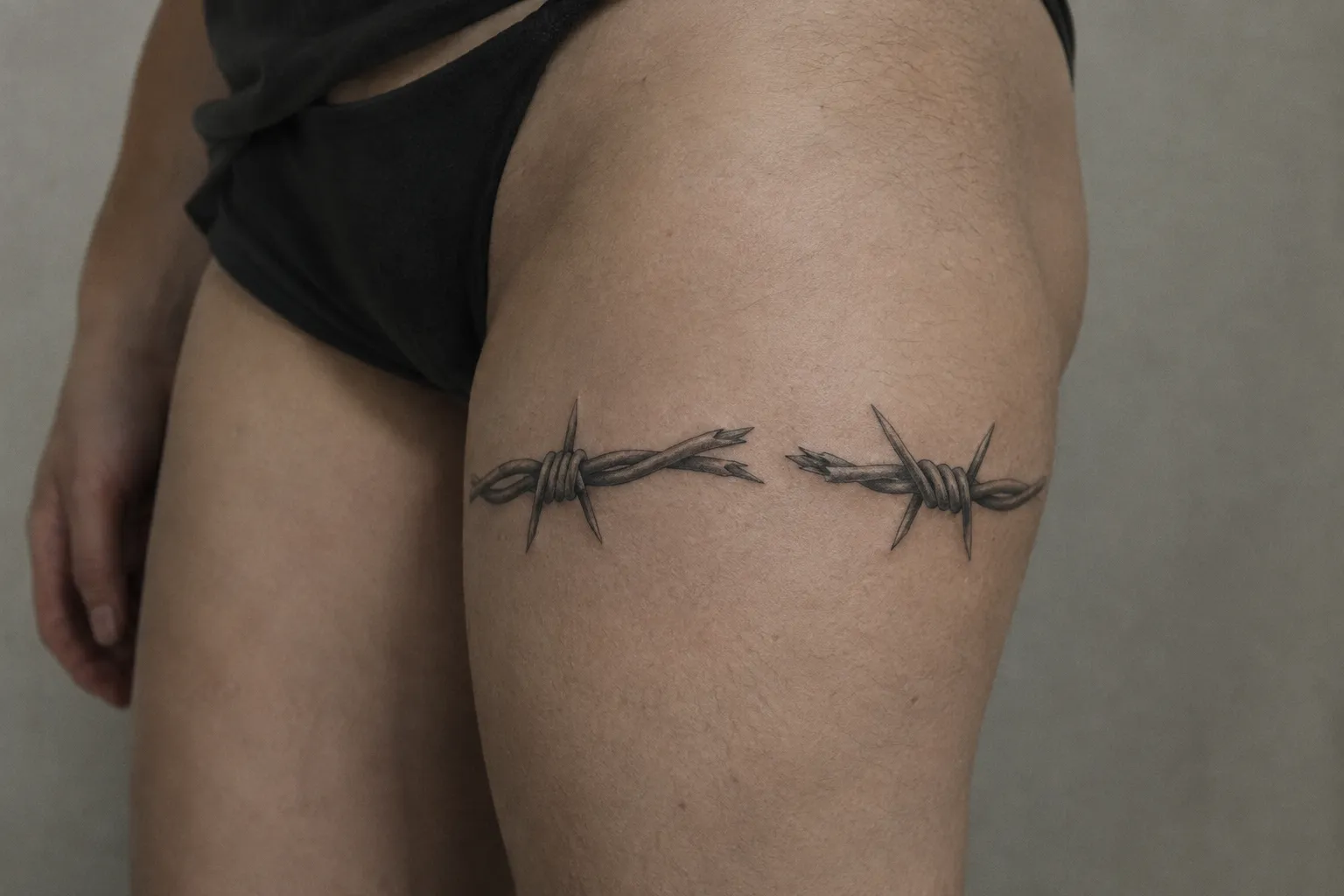
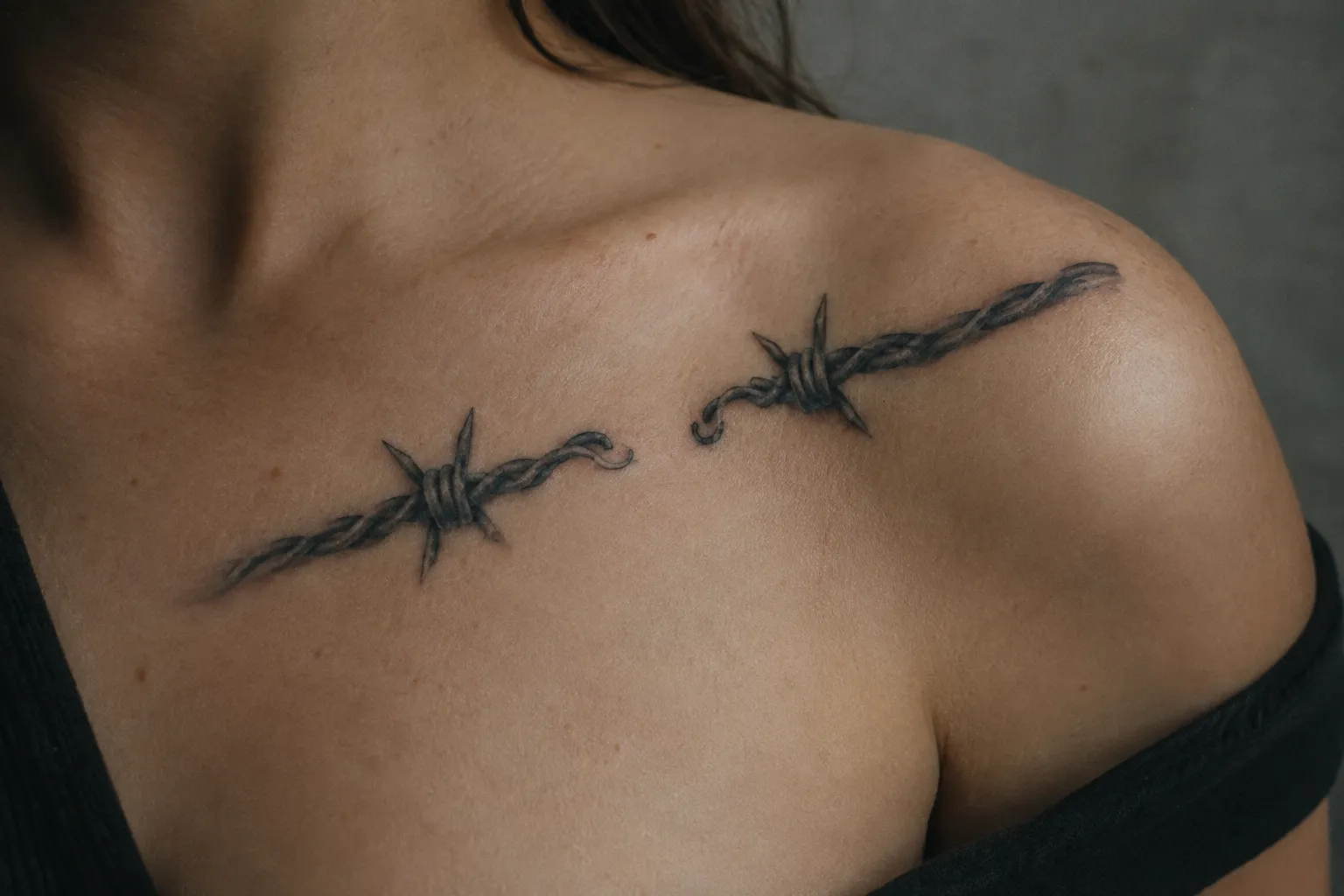
The condition of the wire is the clearest control you have over its meaning. Keep the strands intact to signal a boundary, restriction or ongoing hardship, or show a cut or broken strand to push the read toward escape and overcoming adversity (1). If you settle only one design decision, make it this one, because it changes how strangers read the tattoo before they notice anything else.
Intact wire that closes around a limb reads as either protection or oppression (1), and the elements around it supply most of the meaning (4). A complete loop with no break is closed, and a viewer feels that. If your meaning is “I set this boundary on purpose,” intact wire fits. If your meaning is “this held me and I got out,” a closed loop works against you.
A broken strand reads as release, but only when the break is drawn clearly. That comes down to linework. The two cut ends need visible, deliberate tips: a slight curl or splay where the twisted strands come apart, and a clean gap of open skin between them. A gap drawn too narrow with no shaped ends looks like a skipped section or a blowout from a distance. Ask your artist to treat each cut end as its own small drawing.
Placement of the break affects the read as well. A break on the outer arm, facing forward, is the first thing people see, so the story reads as “broke free.” A break tucked around the back of the arm leaves the band looking intact from most angles, which suits someone who wants the meaning private.
Barb direction is a quieter detail. Barbs drawn pointing outward, away from the skin or away from a central image, read as defensive, like a guard around something. Barbs angled inward, toward a heart or the limb, read as pain pressing in. Nobody has codified this. It is a visual effect, and a good artist can push it either way.
Bring these points to the consultation before the sketch stage, not after:
- Intact or broken, and if broken, where the break should sit when your arm hangs at your side.
- Barb direction, outward or inward.
- What the wire surrounds or crosses, if anything.
- Two or three reference images showing the line weight you like, so the artist knows whether you want heavy traditional outlines or fine line.
Changing these on a finished stencil wastes your session time. Changing them on paper costs nothing.
The 90s armband: Pamela Anderson, Barb Wire, and the classic band
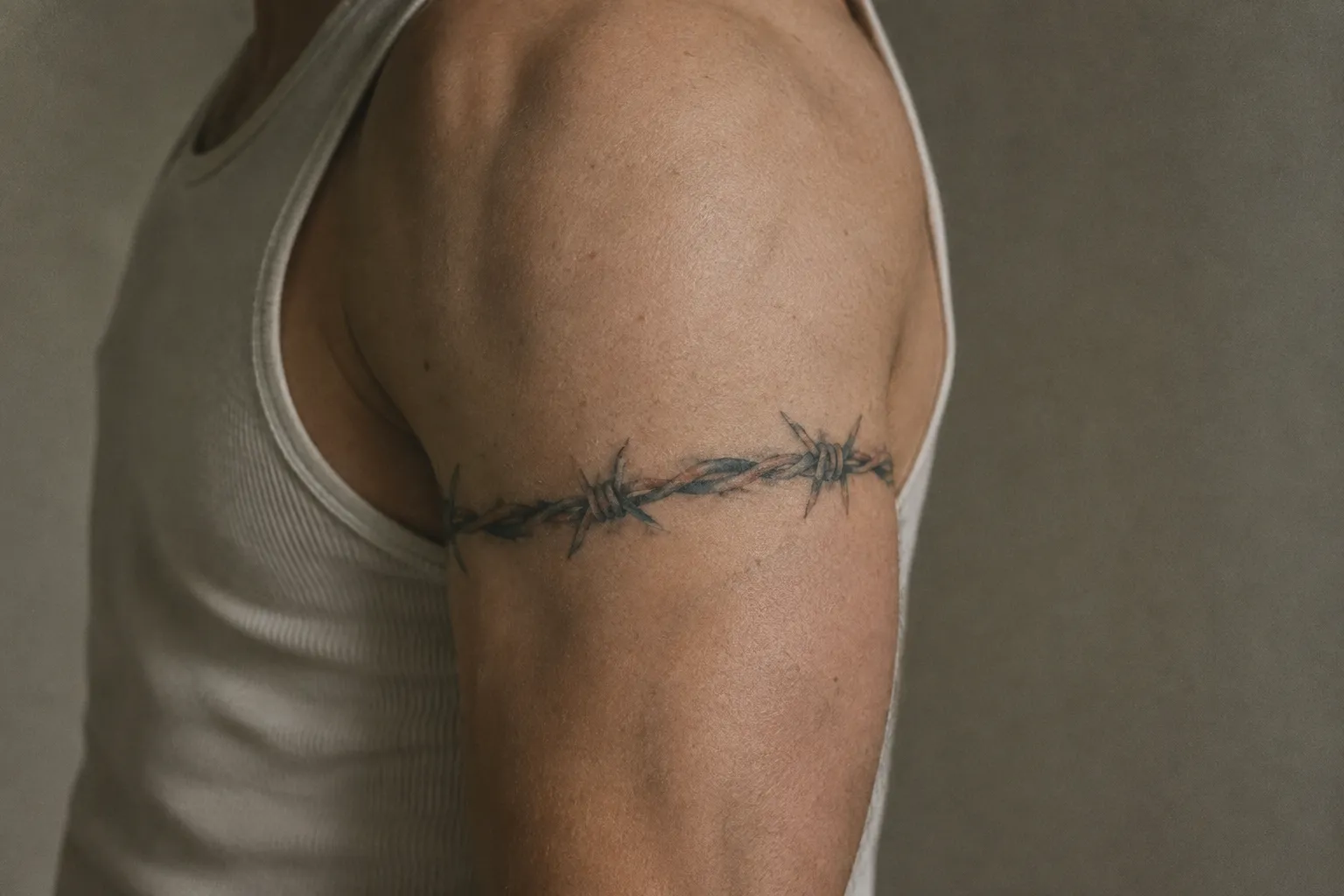
The barbed wire armband tattoo peaked in the mid-1990s. In 1995, Pamela Anderson wore a barbed wire band around her left bicep on the red carpet, which pushed the motif into trend territory for years (6). She had the band done for her role in the 1996 film Barb Wire: by her own account, the production planned to paint it on each day, and she chose to have it tattooed instead (4). If someone asks when barbed wire tattoos were most popular, that is the answer: the second half of the 1990s, with the upper-arm band as the defining format (4).
Why the armband became a 90s shorthand
A single strand around the bicep needs no color, no background and no personal reference, which makes it easy to read and easy to copy. Anderson’s band gave it a celebrity anchor, and through the second half of the decade the band, worn mostly as a tough, masculine decoration, became common enough for comedians to mock it as a cliché (4). She had hers removed with laser in 2014 (6).
That history is why the band now reads as a period piece to many viewers (4). A narrow wire band on the bicep places you in a decade the way a 90s tribal band does: both belonged to the same wave of decorative armbands (4). This is neither good nor bad, but decide which reason is driving your choice:
- Nostalgia: you want the 90s reference, and the dated quality is the point. A classic band in the original style works here.
- Toughness or endurance: you want the wire’s meaning without the period association. Change the format, through a different placement, a broken strand or added imagery, so the result does not read as costume.
- Personal meaning: the wire stands for something specific to you. The armband shape is optional.
Later designs do not need to reproduce that narrow band at all (6). The motif has moved well beyond the bicep.
Choosing placement and width today
The upper arm is still the classic spot, and it is a forgiving one. On the tattoo pain scale, the outer upper arm and shoulder sit in the lowest tier, while the bicep is moderate, so a full wrap gets sharper as it crosses the inside of the arm.
The most common technical mistake on armbands is a band that does not sit level. An arm is not a cylinder. It tapers, and the bicep changes shape when you flex. A band stenciled with your arm raised can tilt when your arm hangs at your side. A good artist checks the stencil with your arm relaxed, flexed and at rest before committing, and plans the closing seam where the two ends meet so it does not drift.
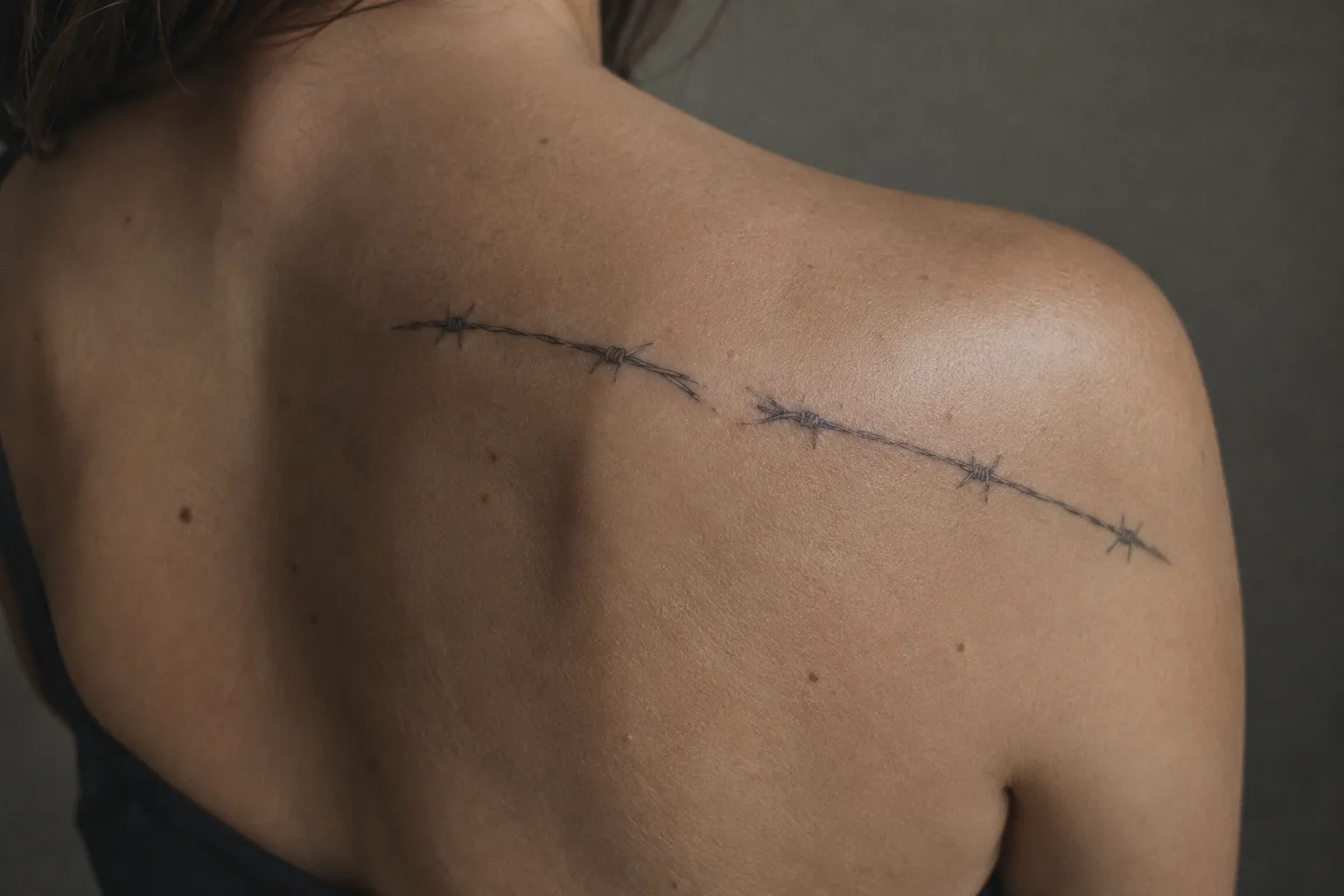
Width depends on line weight and how the piece will age. A double-strand twist with clear black outlines and spaced barbs holds up well: as a bold-line design, barbed wire ages reasonably well (4), and open skin between elements keeps it readable as the ink settles. A thin single fine-line strand looks crisp when fresh, but tightly packed barbs can soften into a fuzzy line. If you want something delicate, ask for fewer barbs with more space between them rather than a thinner line.
The forearm is the other common choice for a full band. It is visible in short sleeves and works well for a partial wrap that stops short of the inner wrist. A partial band, wire across the outer forearm only, avoids the seam problem entirely.
Barbed wire heart tattoo: love, heartache, or guardedness
A barbed wire heart tattoo pairs a heart outline with wire that either circles it or crosses through it, setting affection against pain, guardedness or hardship (1)(3). The heart-and-wire design is often traced to the early 1990s, when artists combined two existing tattoo designs into one image (3). It takes the classic armband in a different direction: a contained image rather than a band, with an emotional subject where the band has a general toughness theme.
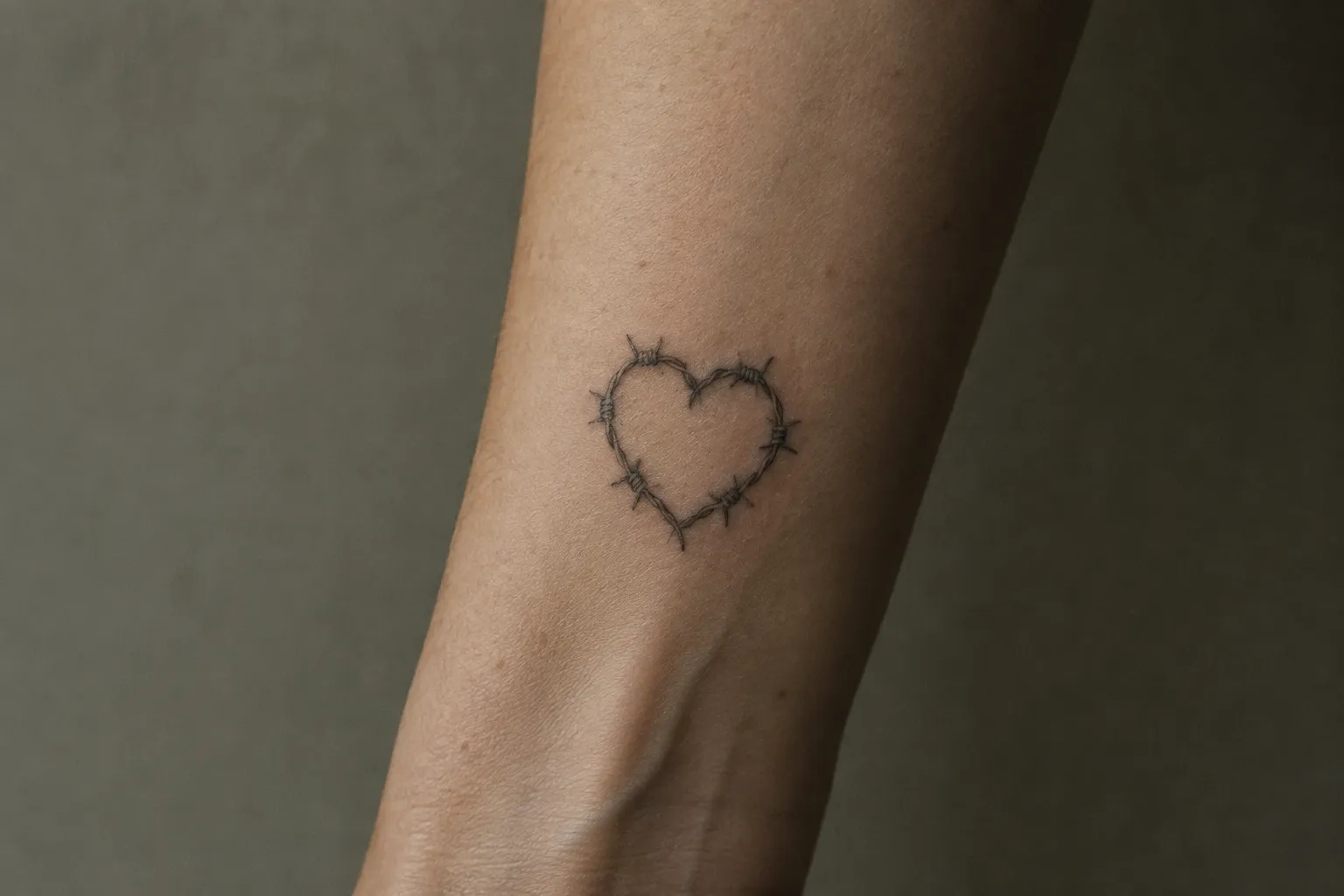
The combination has no single fixed meaning: it can read as heartache (1), as a heart guarded against hurt, or as a love that endured hardship (3). Choose your emphasis before anyone draws it:
- Heartache: love that hurt. The wire cuts across or through the heart, and the barbs press inward.
- Guardedness: a protected heart, someone slow to let people in. The wire circles the heart with space between them, barbs facing outward like a fence.
- Love enduring hardship: a relationship or bond that survived something difficult. The heart stays whole and the wire is broken or falling away, or the heart sits above the wire.
The composition carries the meaning more than the symbol does. The same heart and the same wire, arranged three ways, give three different tattoos. Tell your artist which one you mean in a single sentence, for example “the wire is protecting it, not hurting it,” and let them solve the layout.
Dua Lipa’s barbed wire heart, tattooed on her left forearm in 2018, is a well-known example of the minimal modern approach (6). It is a smaller, contained image rather than a wrap-around band, which shows how far the motif has moved from the 1995 bicep. The 90s armband says “this is a style.” A heart-based piece like hers reads as personal, and that is why it does not look dated the way a classic band can.
Style changes the mood considerably. In American traditional, a barbed wire heart gets the two hallmarks of that style: thick black outlines and a limited palette, usually a solid red heart with black and gray wire and perhaps a yellow highlight. That version reads from across a room and ages well, because the heavy outline holds the shape for decades. Done badly, traditional work suffers from thin, wobbly outlines and patchy red fill that heals blotchy. Look at an artist’s healed traditional work, not fresh photos, before you book.
Fine line gives you the softer read: a single-needle wire around an open, unfilled heart. It suits the inner forearm or the side of the ribcage. The trade-off is longevity. Fine-line wire with small barbs blurs faster than bold work, especially on hands and wrists, where skin moves and sun exposure is constant. If you go fine line, keep the piece large enough that each barb has clear space around it.
Good placements for a heart-and-wire piece include the outer or inner forearm, the upper arm, the sternum and the ribcage. On pain, ribcage and sternum > forearm, since bone sits right under thin skin on the chest.
Faith, flowers, and other modern reinterpretations
Beyond the armband and the heart, barbed wire often serves as a contrast element, paired with religious imagery to evoke thorns or with soft natural imagery to set danger against hope (1).
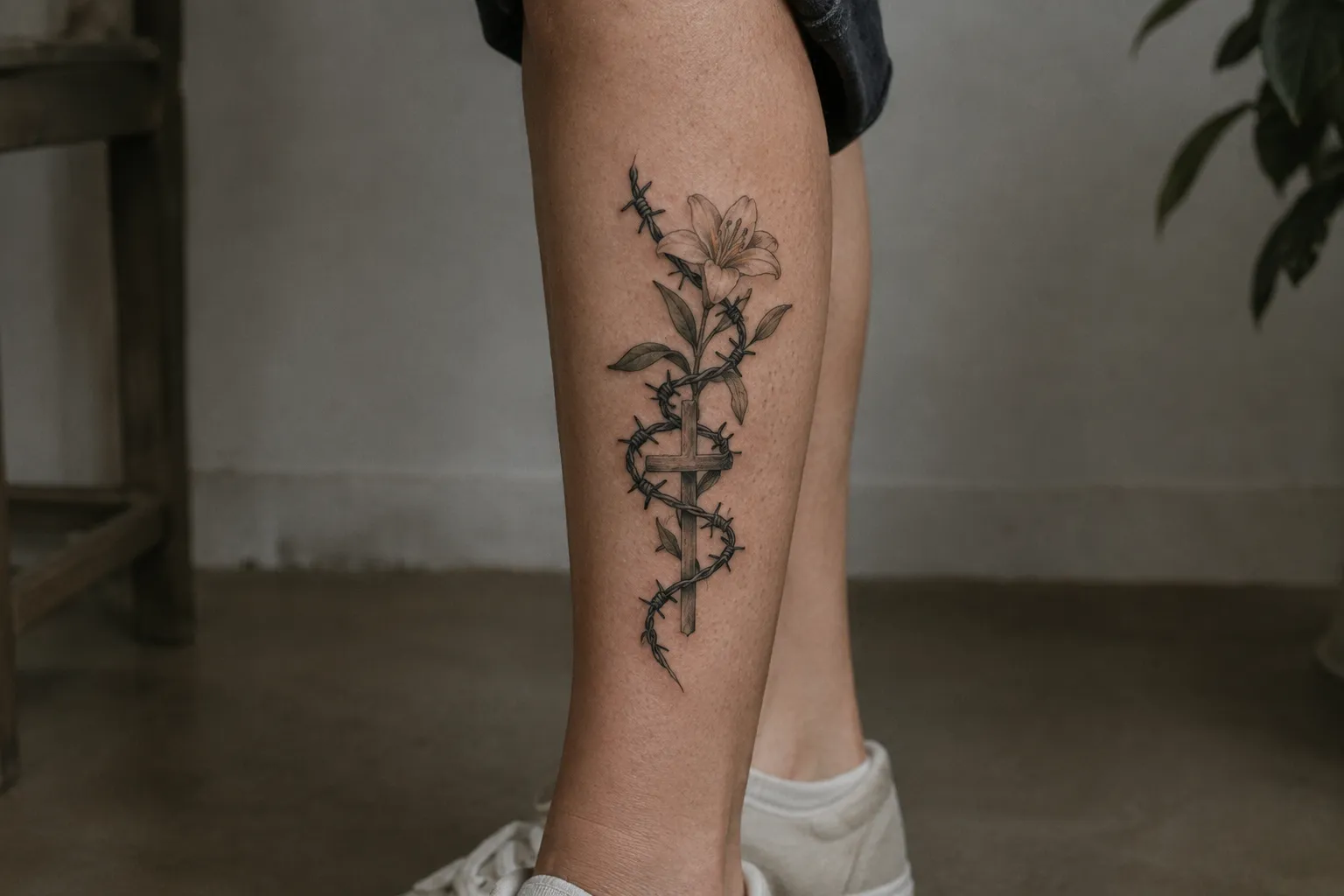
Crown of thorns and cross pairings. Wire drawn in a ring reads naturally as a crown of thorns, which ties the barbs to Christian imagery of suffering and sacrifice (1)(5). Wire alone can be ambiguous, though. A ring of wire on the forearm may read as a crown of thorns to a churchgoer and as a fence to everyone else. Adding a cross or a sacred heart makes the religious context explicit (3). Wire winding around a cross is a common layout and fits the inner forearm or the upper back between the shoulder blades.
Flowers and butterflies. Wire combined with flowers or butterflies creates the danger-versus-hope or toughness-versus-vulnerability contrast (1). A rose growing through a strand, a butterfly resting on a barb, or a vine of wire with blossoms opening along it all read as something fragile that survives in a harsh place. Wire and a rose is the most established pairing: the wire for pain or defense, the flower for beauty or love (4). Fine line and soft black and gray shading suit these pieces, and they wrap well along the forearm, the ribcage or the outer thigh.
On linework: when wire meets organic shapes, the wire needs a visibly different line weight from the petals or wings, usually crisper and darker. If both use the same thin line, the composition turns to mush at arm’s length and the contrast you paid for disappears.
Custom work over copied references. The most useful thing you can do with any of these ideas is ask your artist to design an original piece around your own meaning rather than reproducing an image you found (1). Bring references to show what you like, such as line weight, how dense the barbs are and how flowers are rendered, and then let the artist compose something new. A copied design arrives with someone else’s meaning attached, or none.
The table below lines up the four main variants side by side, so you can see at a glance which placement, meaning and wire condition go together.
Barbed wire tattoo design variants
| Classic armband | Heart and wire | Faith-based crown of thorns | Floral-softened wire | |
|---|---|---|---|---|
| Typical placement | Upper arm or forearm | Forearm, sternum or ribcage | Inner forearm or upper back | Forearm, ribcage or thigh |
| Meaning emphasis | Nostalgia or general toughness | Heartache, guardedness or enduring love | Sacrifice and belief | Danger set against hope |
| Wire condition | Intact | Intact or broken | Intact, closed ring | Broken, overgrown or giving way to flowers |
Picking your design: placement, cost, and what to avoid
Your design choice should settle three things before you book: a placement that suits the wire’s shape, a realistic quote based on size and detail, and a composition that is personal rather than a template. Here is how each one works.
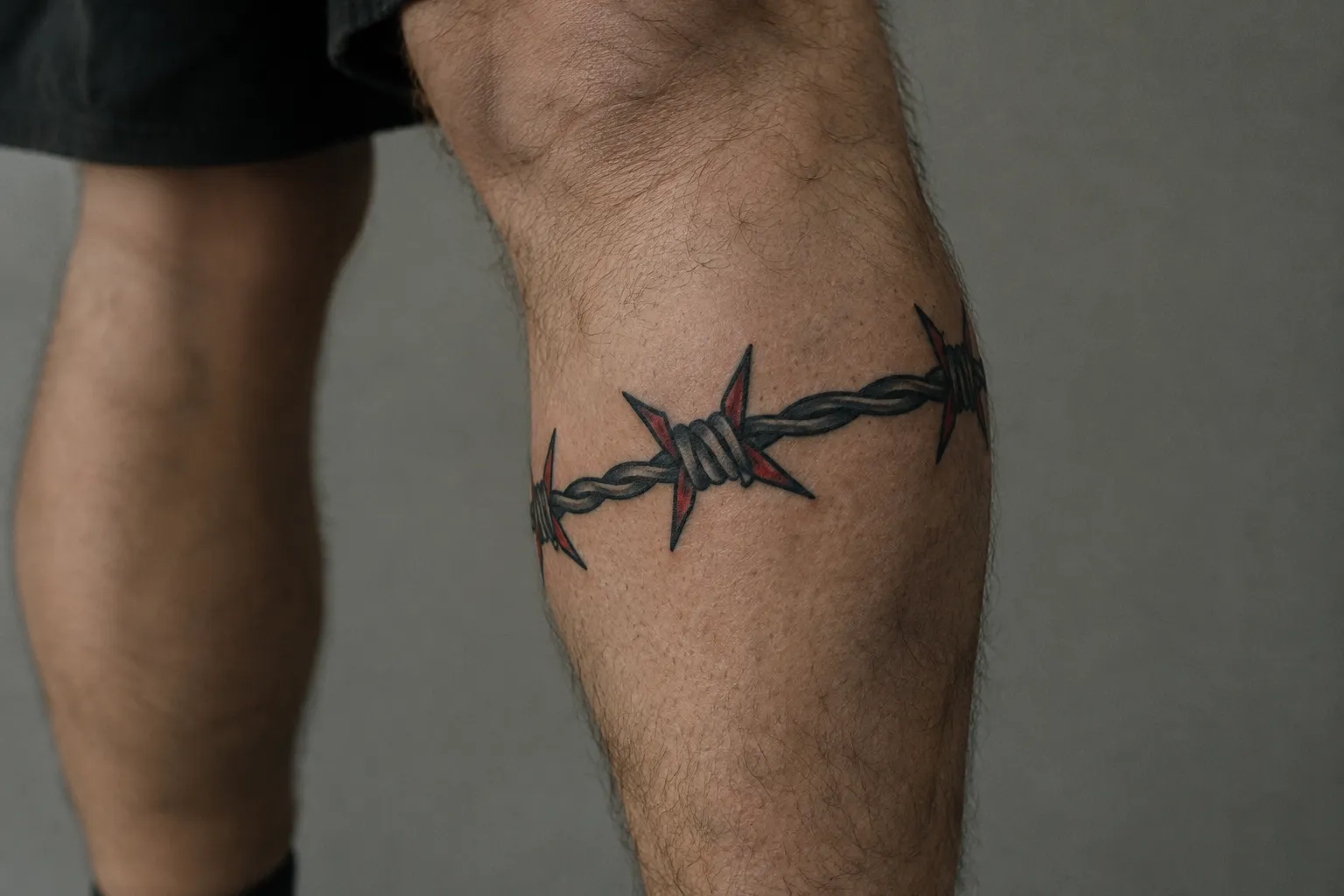
Placement options
Barbed wire is a linear motif, so it suits placements that let it wrap or run. Modern takes include fine-line work and small wire knots on the ankle, ribcage and wrist (6), alongside the classic arm placements:
- Upper arm: the original armband spot. It is fleshy, among the least painful options, and easy to cover with a sleeve.
- Forearm: visible in short sleeves, a good fit for heart pieces and partial bands, and low to moderate on pain.
- Wrist: suits a thin bracelet strand or a small knot. On the wrist, bold linework holds and delicate barbs blur, so keep barbs sparse and outlines solid. Pain is higher than on the outer arm, and sharper toward the inner wrist, where tendons and nerves run close to the surface.
- Ankle: an anklet of wire is a popular modern twist. Ankle > forearm on pain, and constant friction from socks and shoes makes healing fussier.
- Ribcage: room for a long strand with flowers along the side of the body. Ribcage > upper arm on pain, and it is one of the harder spots to sit for.
Visibility also matters: a forearm band is on show in short sleeves, a ribcage piece rarely is. Decide whether you want it easily hidden or out in the open (6).
What a barbed wire tattoo costs
A barbed wire tattoo has no fixed price. Cost depends on the artist’s rate, the size of the piece, how much detail and shading it carries, and where you live. A small fine-line wrist strand and a shaded double-strand armband with a broken section are different jobs. Most shops also charge a minimum, so even a tiny wire knot costs more than its size suggests.
The quickest way to a real number is to send the artist your placement, a rough size relative to your body (“wraps the full upper arm,” “fits the inner wrist”), your style references, and whether you want color. Ask whether they price by the piece or by the hour. A full armband is a short session for an experienced artist, while a wire-and-floral ribcage piece can take much longer.
Designs to avoid
The barbed wire tattoo to avoid is the generic copy: a stock band traced from a flash sheet or a screenshot with no decision behind it. It ages fine physically, but it reads as a 90s template, and you will have nothing to say when someone asks what it means.
Also avoid a design that only works if viewers agree on a single meaning. If the piece depends on everyone reading wire as “resilience” and you know some will read “prison,” change the composition (break the wire, add imagery, shift the placement) until it carries your meaning without explanation.
Finally, avoid tiny, densely barbed fine-line wire on hands, fingers and wrists. Those barbs will soften into a smudged line, and wire depends on its points being visible.
Tattoo hygiene, healing, and long-term care
Good tattoo care starts before the needle, with questions about sterile equipment and ink handling, and continues for years after healing with daily sun protection. According to the U.S. Food and Drug Administration, infections have been linked both to contaminated inks and to unsterile practices, and some people develop allergic reactions to the inks themselves (8).
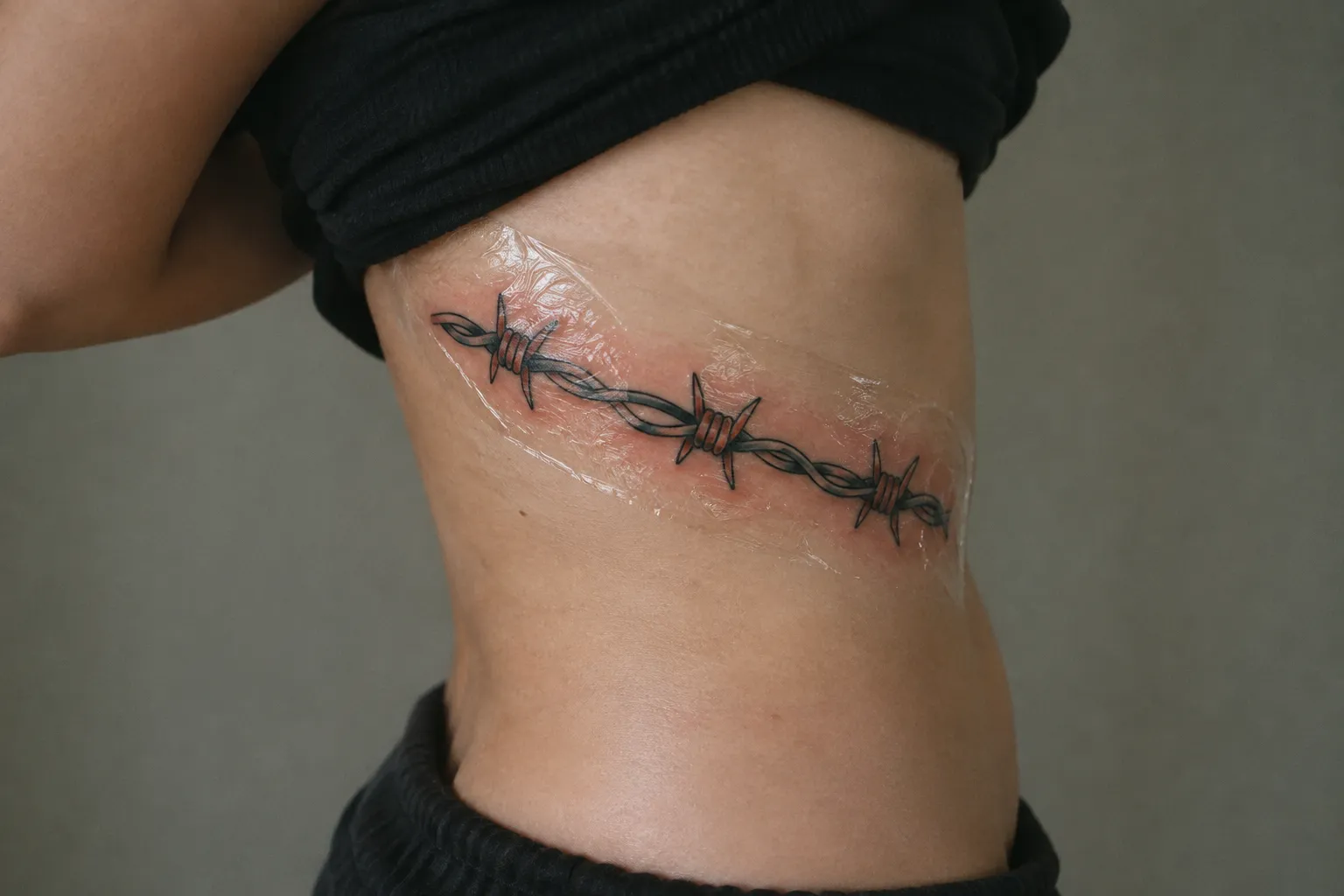
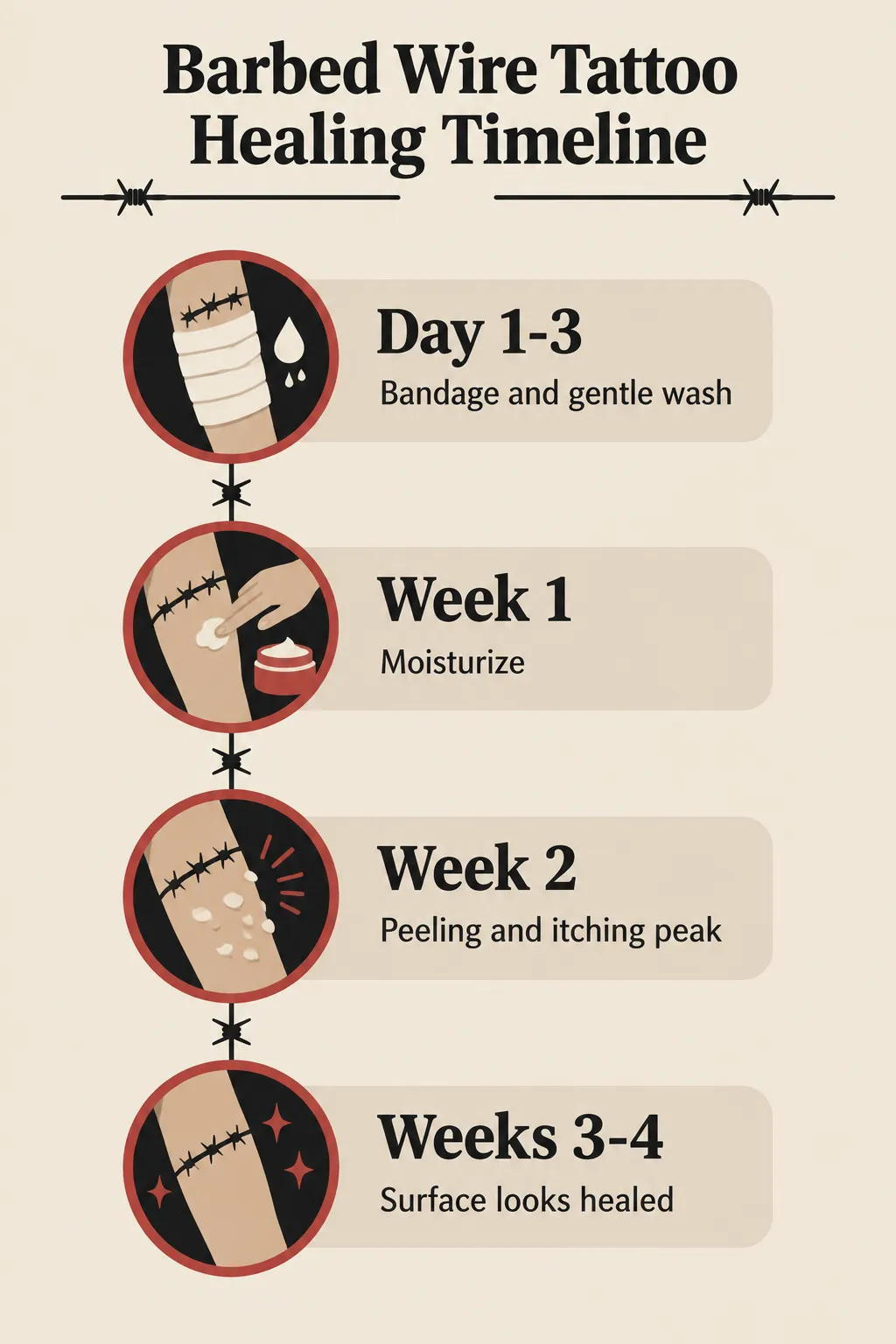 Barbed wire tattoo aftercare moves from bandage care on Day 1-3 to moisturizing in Week 1, peak peeling in Week 2, and a healed-looking surface in Weeks 3-4.
Ask the shop before you book:
- Are needles single-use and opened in front of you?
- Is ink poured into single-use caps for each client, never dipped from the bottle?
- How is reusable equipment sterilized, and can they show you?
- Do they hold the license your state or local authority requires?
The FDA notes that even unopened, sealed inks can harbor bacteria (8), so how the shop handles ink matters as much as where it comes from. A good studio will answer these questions without hesitation.
A barbed wire piece follows the standard tattoo aftercare timeline:
- Day 1-3: Keep the bandage on as long as your artist instructs, then wash gently with clean hands and lukewarm water and pat dry. Expect redness, some oozing and tenderness around the linework.
- Week 1: Apply a thin layer of fragrance-free moisturizer two or three times a day. Do not soak the tattoo in baths, pools or the ocean. Light flaking starts.
- Week 2: Peeling and itching peak. Do not pick at the flakes, especially along fine barbs, where pulling skin can lift ink and leave gaps.
- Weeks 3-4: The surface looks healed, but the skin underneath keeps settling for a few months. Keep the tattoo out of direct sun for the first 4 to 6 weeks, and cover it with sun-protective clothing when you are outdoors.
On the ankle and wrist, socks, shoes and watch straps rub fresh work, so keep them off the tattoo while it heals.
Warning signs during healing
Normal healing is gradual improvement. Redness eases, oozing stops and flaking finishes within a few weeks. The FDA advises contacting a health professional if a new tattoo develops a rash or does not seem to be healing (8). Aggressive infections can bring high fever, shaking, chills and sweats, and may need antibiotics or even hospital care (8). Do not dismiss a spreading rash, increasing pain after the first few days, or pus as normal healing.
If you suspect a reaction to the ink, tell your artist as well as your doctor: the artist can identify the ink, and its brand, color and lot number help pin down the source of the problem (8).
Protecting the tattoo from UV fading
Sun is the main reason crisp wire turns soft over time. According to the American Academy of Dermatology, UV light can fade tattoo inks, and tattooed skin should be protected with a broad-spectrum, water-resistant sunscreen of SPF 30 or higher, applied 15 minutes before sun exposure and reapplied at least every 2 hours (9). The AAD also advises staying out of tanning beds and away from sunlamps, which can fade tattoos as well (9).
Sunscreen is for healed skin. For the first 4 to 6 weeks, keep the tattoo out of direct sun with clothing and shade instead. After that, treat forearm and wrist wire like your face: it gets daily sun whether you plan for it or not, and the finer your design, the more it depends on a consistent SPF 30 or higher routine.
Frequently Asked Questions
- Which barbed wire tattoo should you avoid?
- Avoid a design whose meaning depends on strangers reading the wire exactly as you intend; composition, placement and added imagery can help make that intent legible.
- How much does a barbed wire tattoo cost?
- A reliable quote requires your artist's rate, placement, approximate size and detail level; send those details and ask whether pricing is hourly or by the piece.
- When did barbed wire tattoos become popular?
- The armband's best-known popularity peak was the mid-to-late 1990s; current versions more often alter the format or pair the wire with another image.
- Does a barbed wire tattoo always mean prison?
- No; the motif can suggest boundaries, endurance, faith or hardship, and its interpretation depends on the design and the person wearing it.
- Can barbed wire be combined with other symbols?
- Yes; choose the companion image to narrow the read, then decide whether the wire protects, crosses or breaks away from it.
- Will a barbed wire armband look dated?
- A narrow single-strand bicep band can signal a 90s reference; changing its scale, placement or composition can make the design feel less tied to that era.
Bringing your choices to the consultation
A barbed wire tattoo means what your design choices make it mean, not what a fixed code dictates. Before you book, settle four things: intact or broken wire, the format (armband, heart, faith-based or floral), placement and how much pain you will accept there (ribcage and ankle > forearm > outer upper arm), and the line weight you want, keeping in mind that bold outlines with spaced barbs age better than dense fine line.
Bring those decisions and two or three reference images to the consultation, and ask about single-use needles and ink caps before you sit down. Once healed, apply broad-spectrum sunscreen of SPF 30 or higher on any visible wire 15 minutes before going out and reapply at least every 2 hours (9). That routine is what keeps the barbs sharp for years rather than blurred into a gray line.