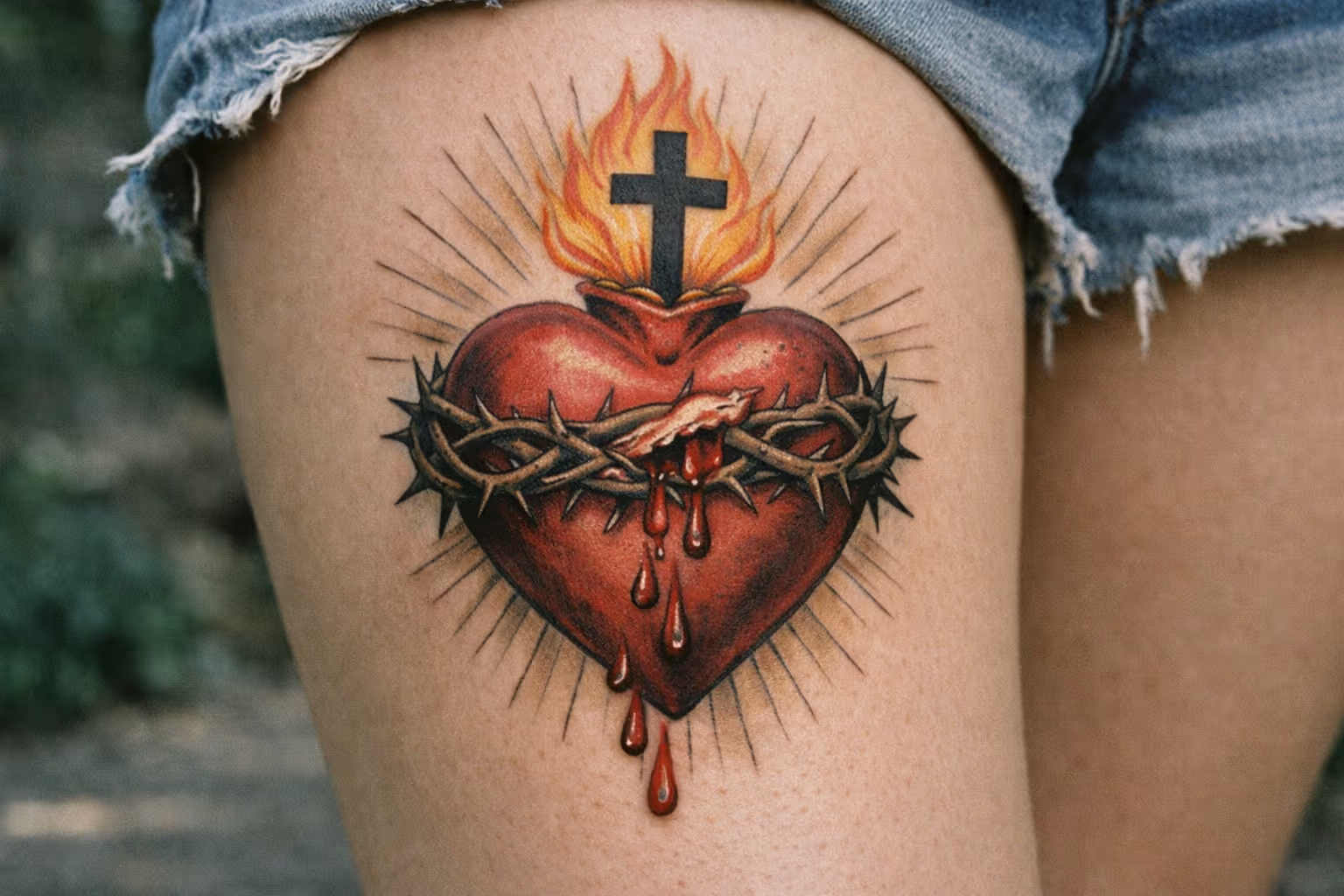
A flaming heart wrapped in a crown of thorns, topped with a cross, pierced by a lance wound with two or three drops of blood, radiating light. That is a sacred heart tattoo, and every one of those elements means something precise in Catholic art. This guide covers the Sacred Heart of Jesus specifically - not generic heart tattoos, and not sacred geometry, which is an unrelated subject that happens to share the word “sacred.” Get the elements wrong and you either build an ambiguous flaming heart or accidentally assemble an Immaculate Heart of Mary. The design decisions matter before you ever pick a placement.
Here is the short version of the trade-offs before we go deep.
✓ Pros
- Iconographically rich - every element carries a specific meaning you can personalize
- Works across multiple styles: traditional, fine-line, blackwork, neo-traditional
- Strong cultural and devotional history makes the design legible almost anywhere
- Scales from a small forearm piece to a large chest composition
- Adapts to secular meanings (perseverance, memorial) without losing visual integrity
✗ Cons
- High element count means more detail is needed, so the minimum size runs larger
- Red, the pigment the design depends on, is the color most likely to fade unevenly and need an earlier touch-up, so sun protection is not optional
- Reads as an overt Catholic identity marker, which can complicate visibility in some workplaces
- Easy to conflate with the Immaculate Heart of Mary if you don't choose elements carefully
- The chest, the most devotionally resonant placement, hurts more than forearm or upper arm
What a Sacred Heart Tattoo Actually Means
A sacred heart tattoo means love that cost something: the heart of Christ shown wounded and still burning. The flame is divine love, the crown of thorns is the Passion, the cross is the Crucifixion, and the lance wound is Calvary (4). The modern devotion traces to visions reported by St. Margaret Mary Alacoque between 1673 and 1675 at the Visitation convent in Paray-le-Monial, France, where she described Christ showing her his heart and asking for Communion on the first Friday of the month and for a feast day in its honor (6)(14). The Visitation order dates the first of these apparitions to 27 December 1673, the feast of St. John the Evangelist (14). Once the image settled it stopped drifting, and holy cards printed a century apart show the same arrangement (4). That fixed form is what you’re putting on your body.
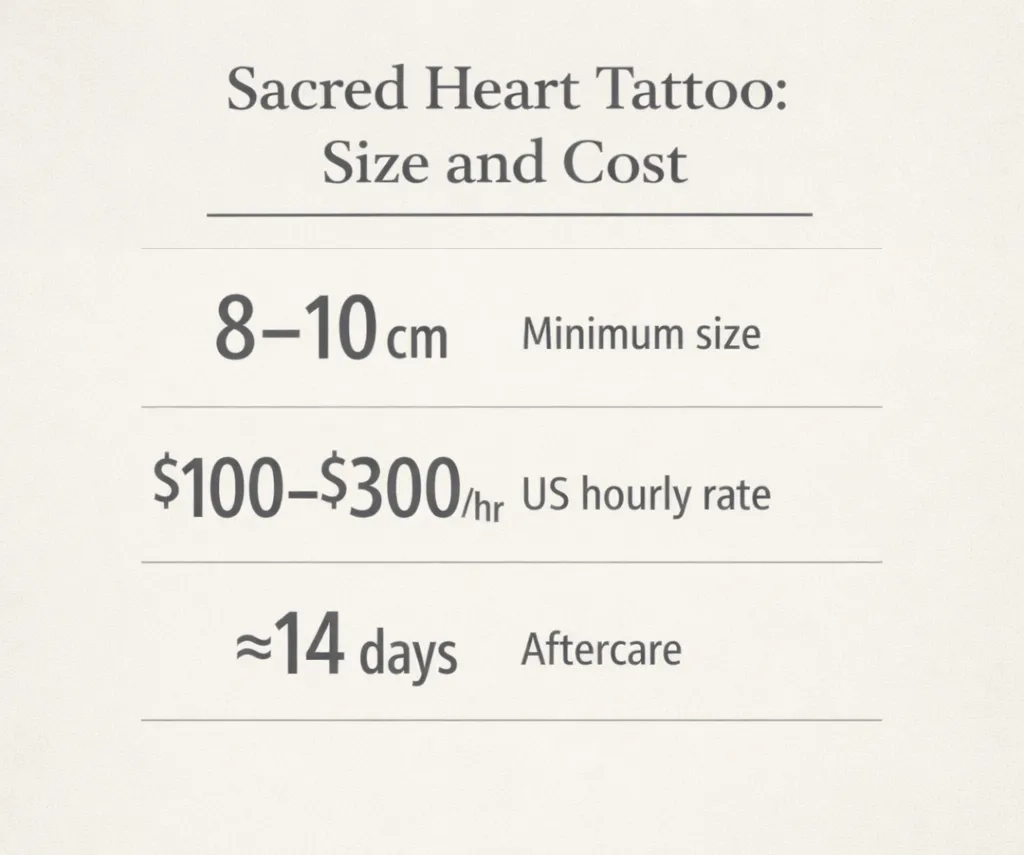 Minimum size of 8-10 cm to keep thorns, flame and cross distinct, a typical US rate of $100-$300 an hour, and a dedicated aftercare routine of about 14 days.
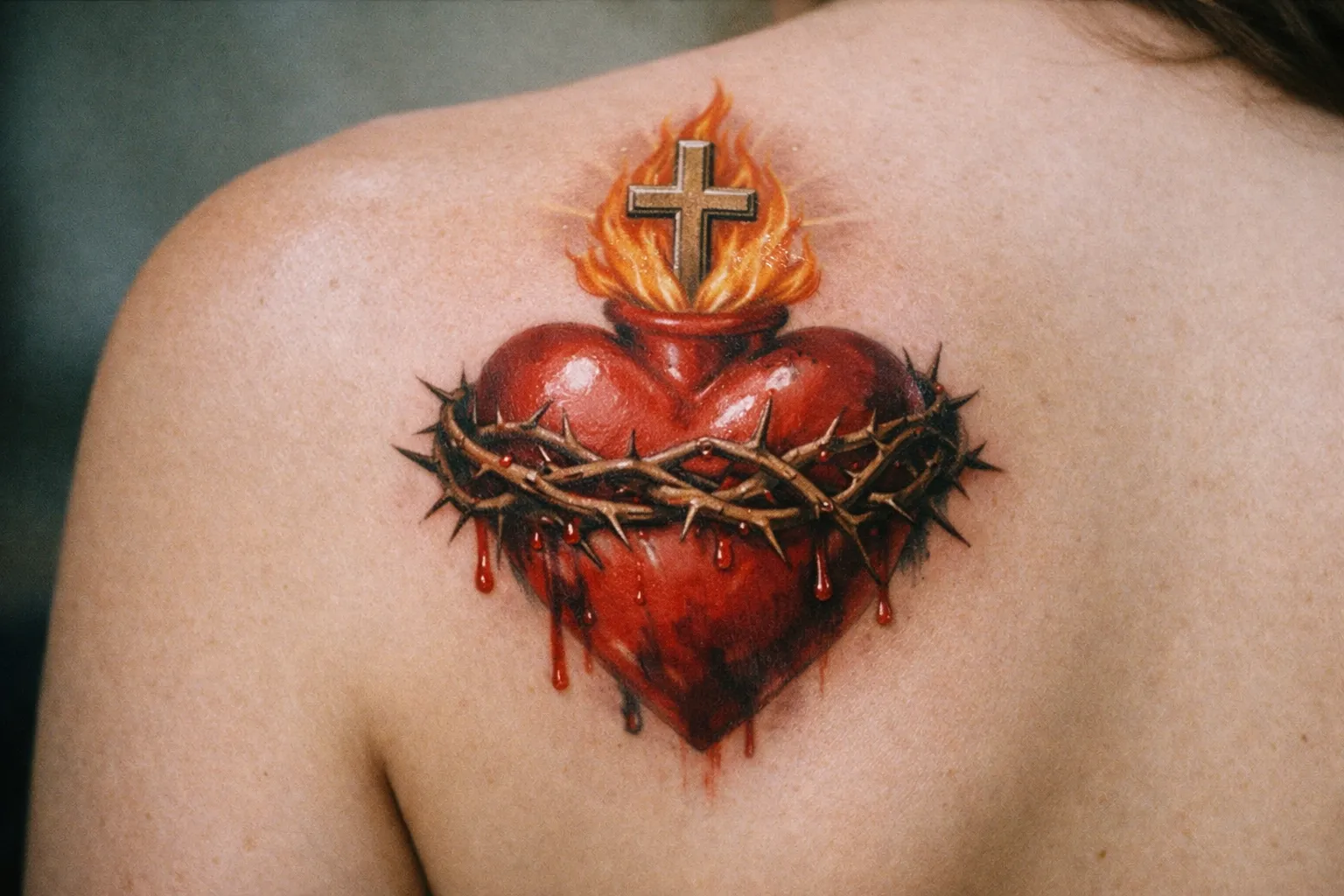
The iconography encodes four core meaning-layers. The heart is the seat of Christ’s interior love. The flame is burning charity toward humanity. The crown of thorns is a direct reference to the Passion. The cross rising from the top ties the whole image to the Crucifixion rather than to generic affection. Add the lance wound with its drops of blood, recalling the piercing of Christ’s side, plus rays signifying radiating grace, and you have the full devotional statement (1)(4).
Beyond strict Catholic practice, the sacred heart tattoo meaning has widened into a few reliable clusters. Wearers use it for sacrificial love, perseverance through suffering, a memorial for someone lost, family heritage - honoring Catholic grandparents - or marking a crisis survived or a vow kept (1)(4). “Love that cost something” is the useful shorthand for non-Catholic wearers who connect to the aesthetic without the devotional framework. What it is not: a generic heart with religious trim (1), and not sacred geometry. Those are separate topics.
The Four Elements and What Each One Signals
Break the design down and each piece is doing a specific job:
- Heart - the seat of love and emotion, Christ’s interior life
- Crown of thorns - the Passion, suffering endured
- Flame - burning divine love, active and enduring
- Cross - the Crucifixion, non-negotiable if you want a legible Sacred Heart of Jesus
- Lance wound and blood drops - Calvary, the pierced side (optional but traditional)
- Rays - radiating grace (optional but traditional)
Adjusting emphasis shifts the emotional register. Play up the wound and blood drops and the piece reads as sacrifice and suffering. Enlarge the flame and it reads as love and passion. Remove too many elements - drop the cross and thorns - and what remains is an ambiguous flaming heart, which slides into generic passion imagery rather than a recognizable Sacred Heart.
Sacred Heart of Jesus vs. Immaculate Heart of Mary - Know the Difference Before You Design
The Sacred Heart of Jesus and the Immaculate Heart of Mary are separate devotions with separate iconography, and confusing the two is common in tattoo searches (1). Catholic teaching distinguishes them: the Sacred Heart focuses on Christ’s burning love for humanity and the suffering he endured for it, while the Immaculate Heart focuses on Mary’s love for God and for her Son, and her cooperation in his redemptive mission (8)(9). A good tattooer treats them as distinct. One Santa Monica studio lists “roses on a crown-of-thorns heart, a sword through a flame-and-cross heart” among the ways the iconography gets broken, and asks clients to commit to one devotion at the consultation (4).
The visual difference is clean once you know it. The Sacred Heart of Jesus shows a heart encircled by a crown of thorns, surmounted by a cross and flames, and wounded by the lance, with two or three drops of blood (8)(13). The Immaculate Heart of Mary shows a heart wreathed in roses, pierced by a sword, and aflame, with flowers rather than a cross rising from the top (8)(13); some pieces add a crown of twelve stars, a Marian attribute taken from Revelation 12 (4). The sword recalls the sorrows Mary endured, foretold in Simeon’s prophecy in Luke 2; the roses stand for her purity (4)(8).
Sacred Heart of Jesus vs. Immaculate Heart of Mary
| Crown/wreath | Piercing element | Flame | Cross/sword above | Additional symbols | Devotional focus | |
|---|---|---|---|---|---|---|
| Element | Crown/wreath | Piercing element | Flame | Cross/sword above | Additional symbols | Devotional focus |
| Sacred Heart of Jesus | Crown of thorns | Lance wound, blood drops | Yes | Cross | Rays of grace | Christ's love for humanity |
| Immaculate Heart of Mary | Wreath of roses | Sword | Yes | No cross (flowers or flames) | Crown of stars (sometimes) | Mary's love and sorrows |
Two mistakes come out of ignoring this. The blending mistake: adding roses and a sword to a piece you intended as a Sacred Heart quietly turns it into an Immaculate Heart. The overloading mistake: piling crown of thorns plus roses plus a sword onto one heart produces an iconographically incoherent hybrid that reads as neither devotion cleanly. The fix is one decision made before the consultation - which figure is this piece for, Christ or Mary? That single answer resolves most of the element questions that follow.
Style Breakdown - From American Traditional to Fine-Line Feminine
Style choice decides which elements survive at a given size. In fine-line work the flame is the first element to go, while bold traditional outlines keep the whole composition legible for decades (4). One note up front: the Chicano black-and-grey lineage, which grew out of Mexican Catholic imagery and East Los Angeles shops in the 1970s, is a separate tradition and isn’t covered in depth here (4).
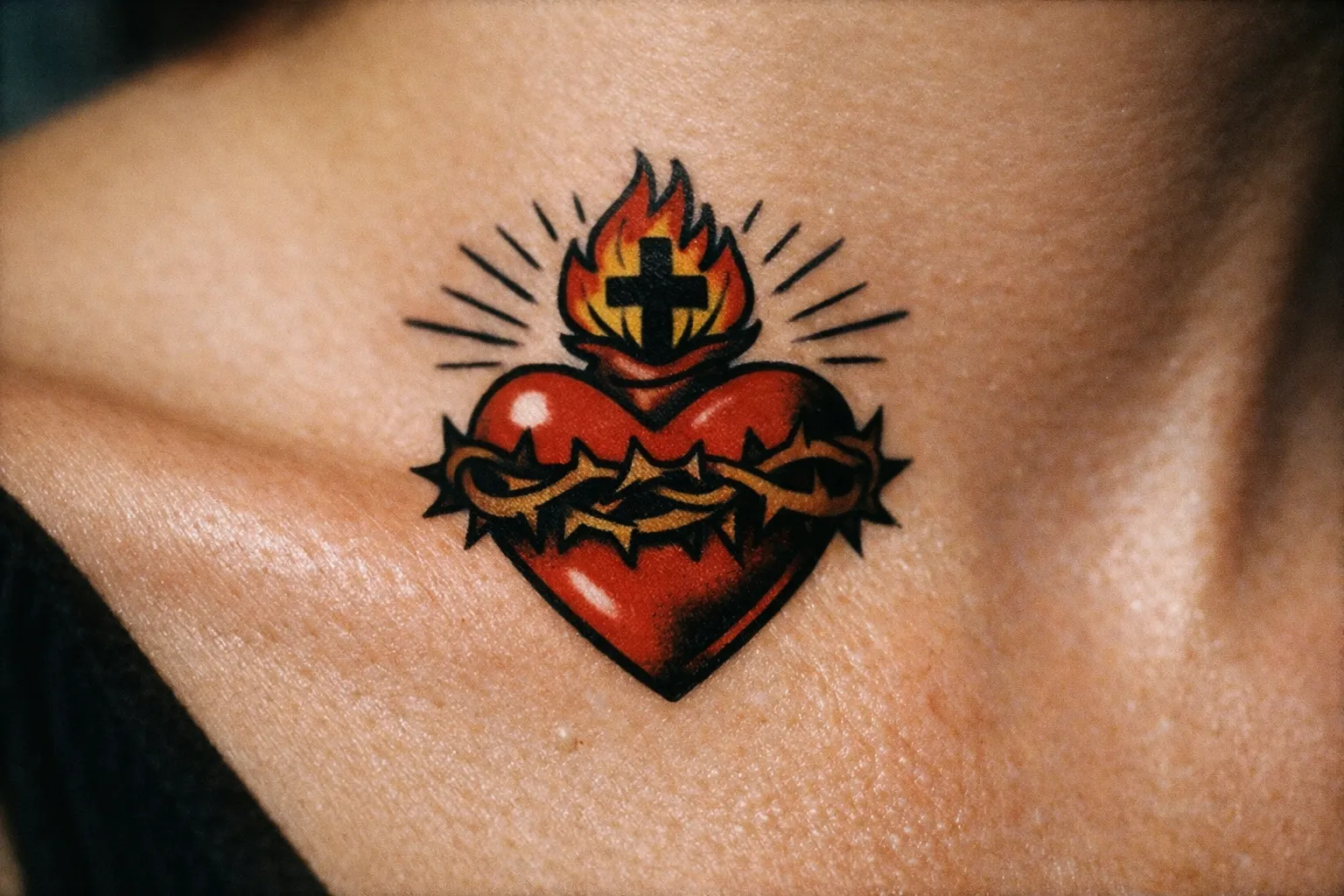
American Traditional Sacred Heart
The traditional sacred heart tattoo is the workhorse version, and it works because bold American traditional linework keeps all four core elements legible even at forearm scale. Two hallmarks define the style: thick black outlines and a limited saturated palette - deep red heart, warm yellow and orange flames, dark green or black thorns, a dark cross - with flat color fills and minimal shading. When artists do it badly, they lighten the outlines to look more “refined” and the whole design goes soft within five years.
Common additions include a banner carrying a name, date, or short phrase (3 to 6 words maximum), plus daggers or radiating lines. At 10 to 15 cm (4 to 6 in) on the forearm, this style holds all its detail for decades (4). When you vet an artist, look for bold outlines, saturated healed color, and clean banner lettering in their portfolio - not just crisp fresh shots.
Neo-Traditional Sacred Heart
Neo-traditional is the thicker-line variation with richer color gradients and more illustrative flourishes - more dimensional than flat traditional. Flames and rays get elaborate treatment, and the heart may show more anatomical suggestion. It works well at upper arm or chest scale: 4 to 7 in, roughly 10 to 18 cm (4). Go smaller and the gradient detail muddies over time, because subtle color transitions need room to breathe as the piece ages.
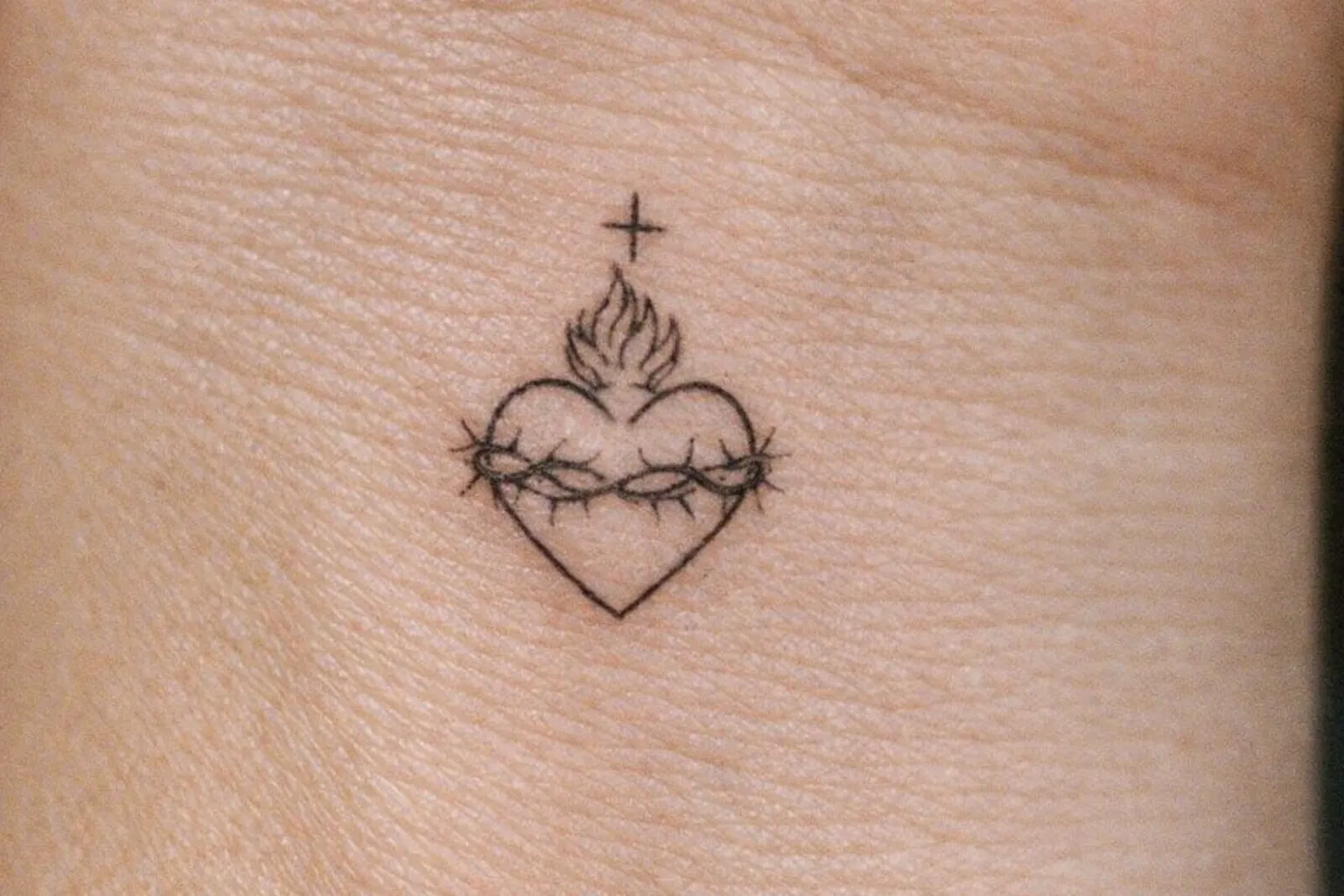
Fine-Line and Feminine Sacred Heart
A feminine sacred heart tattoo usually means single-needle or tight 3RL work: thin outlines, ornamental rays, lace-like halos, small decorative crosses. The technique keeps the core elements - thorns, flame, cross - intact at reduced line weight. The risk is drifting into generic decorative heart territory if the thorns or cross get dropped for aesthetic reasons. Once those go, it stops reading as a Sacred Heart.
Common placements for this style are the inner forearm, inner wrist, collarbone, and side rib, typically 2 to 4 in, roughly 5 to 10 cm (4). Fine-line work looks sharpest the day it’s done. Prioritize healed photos when choosing an artist - the healed result tells you whether the thin lines actually held.
Blackwork and Minimalist Sacred Heart
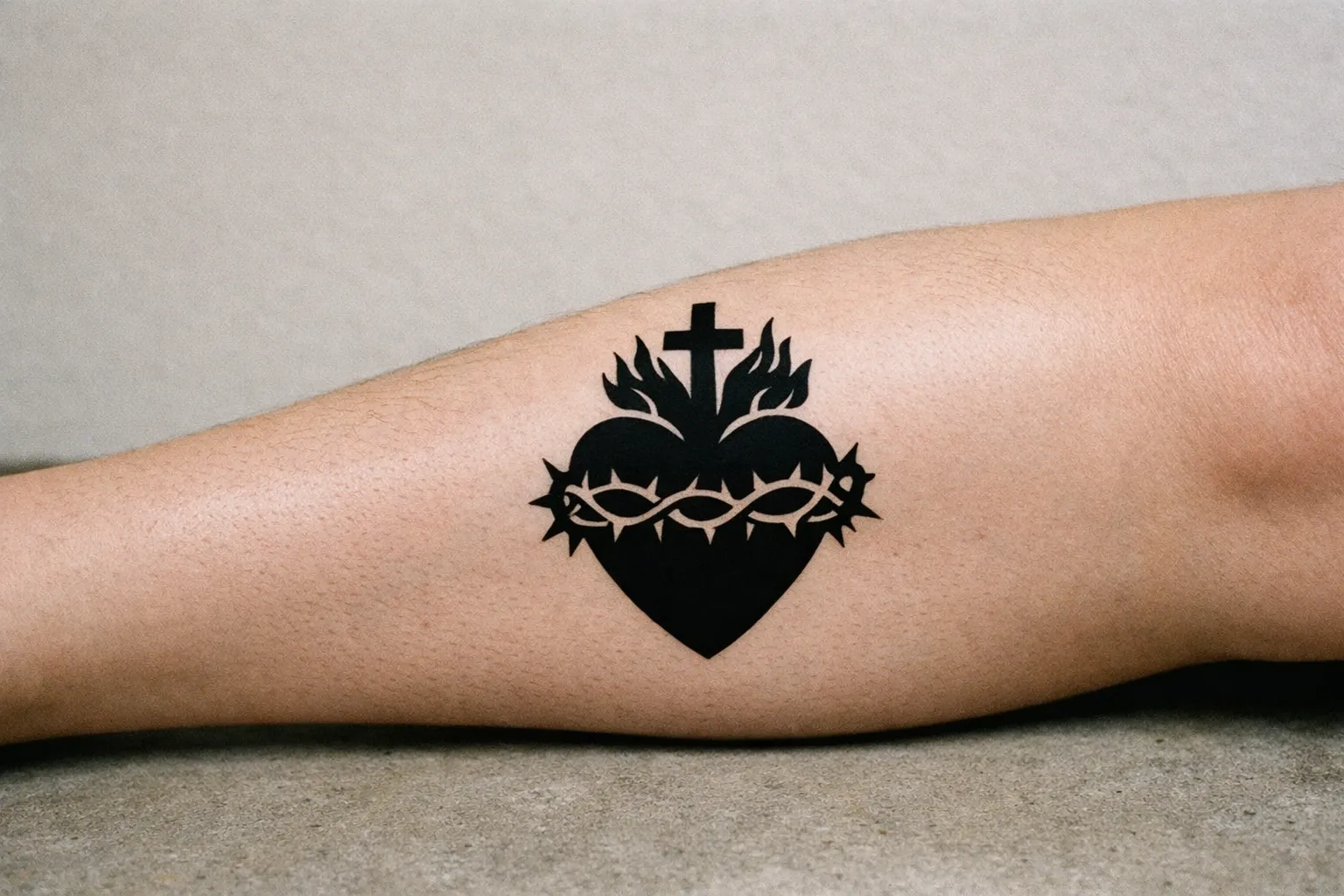
The blackwork or minimalist approach simplifies to a silhouette: heart plus thorns plus flame, often without the cross, working the shape and negative space. It runs in single-needle blackwork or bold blackwork depending on size. The trade-off is real: without the cross, the piece reads as a flaming heart with thorns - still recognizable as Sacred Heart territory, but less doctrinally specific. For thorns to stay legible in blackwork, plan a minimum of 3 in, about 8 cm (4).
Realistic and Illustrative Sacred Heart of Jesus
Realism integrates the heart into a full Christ portrait or torso, which needs real scale. It sits best on the chest, upper arm, or back at 15 to 25 cm (6 to 10 in) or larger. Color realism is the most time-intensive style (17), and one studio books a holy-card realism Sacred Heart as three to four sessions, 15 to 22 chair hours (4); at the $100 to $300 an hour most studios charge (17), that is at least $1,500 before tip.
Where to Place It - Chest, Forearm, and Everything Smaller
Two factors drive the placement decision: the size you need to keep the elements legible, and how visible you want the devotional signal to be day to day. Those two things don’t always point to the same answer.
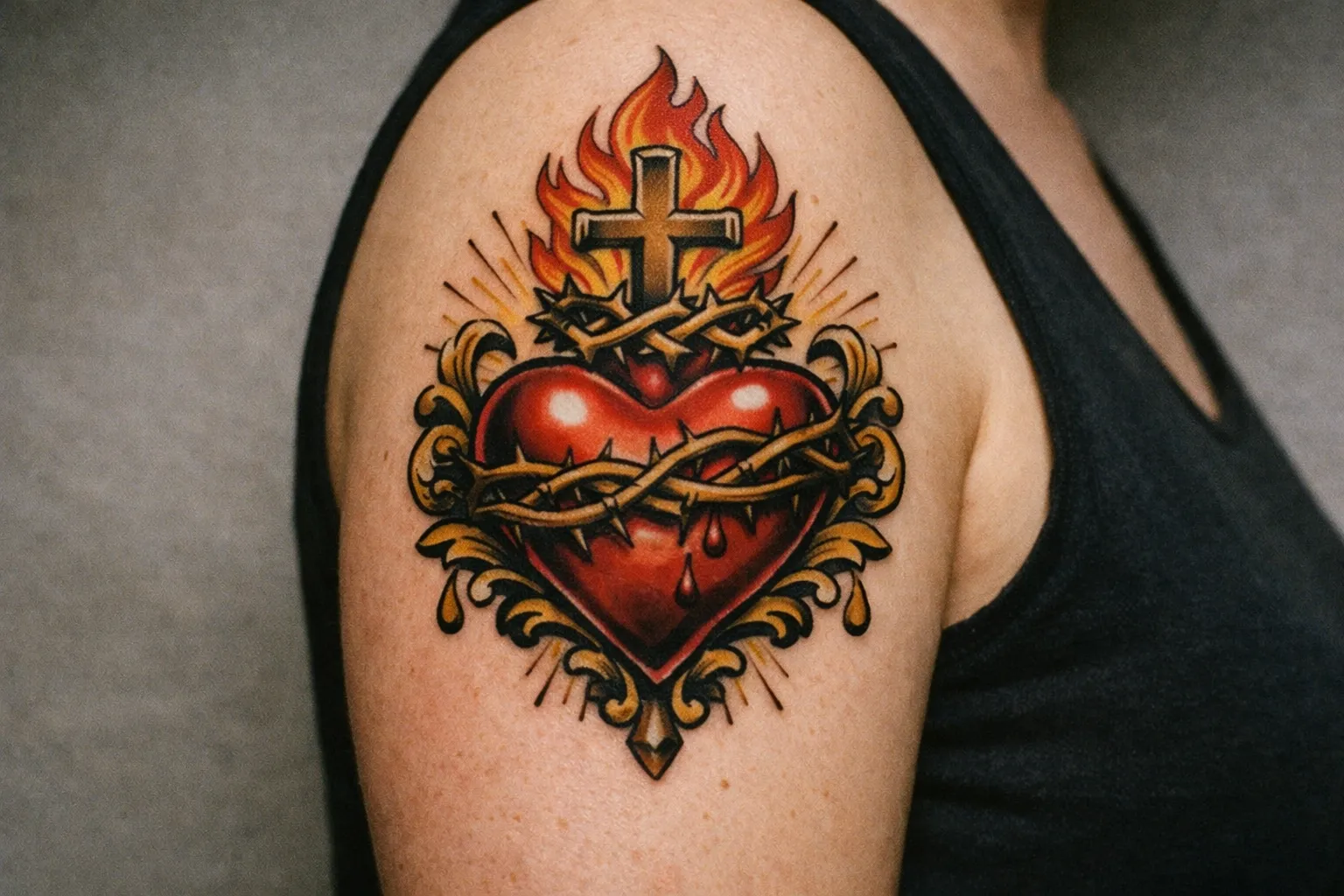
Sacred Heart Chest Tattoo
The chest is the most devotionally resonant placement for a sacred heart chest tattoo, because it aligns the tattooed heart with the physical heart and echoes traditional devotional images of Christ. Plan at least 15 to 20 cm (6 to 8 in) for a centered piece with rays and flames; smaller than that and the detail work crowds. Full chest panels run 8 to 12 in, about 20 to 30 cm (4).
Pain-wise, the outer chest runs more intense than forearm or upper arm (18), and centered sternum placement is sharper still, closer to a ten (19). On cost, a 2026 pricing guide puts a smaller sternum or half-chest design at $300 to $600 and a full chest piece at $1,500 to $2,500 or more, for a mid-tier artist in a mid-size market (17); one studio plans a full chest panel at 8 to 12 chair hours across one or two sessions (4). Chest skin is relatively stable compared with the stomach or hip, but significant weight change can still warp the composition over years. This placement suits American traditional, neo-traditional, or realistic work at scale.
Forearm and Upper Arm
The forearm takes a vertical piece at 10 to 15 cm (4 to 6 in). The outer forearm is visible daily - which suits wearers who want the devotional reminder accessible. The upper arm or bicep holds 8 to 12 cm (3 to 5 in) and wraps naturally with the arm’s curve, good for traditional and neo-traditional.
Both are among the easiest placements to sit relative to the chest or ribcage (18). The forearm’s vertical real estate is exactly why it’s the classic home for a traditional sacred heart with a banner: the heart-plus-banner composition wants that space. If you’re uncertain about pain, start here.
Smaller and More Discreet Placements
The inner wrist, collarbone, behind the shoulder, and side rib take smaller pieces, typically 5 to 8 cm (2 to 3 in), suited to fine-line and minimalist styles. The side rib runs more intense than the forearm (18). At wrist scale, the design has to simplify: thorns and flame silhouette, possibly no cross, or a very small cross as the top element only.
The calf and thigh hold larger traditional work at 12 to 18 cm (5 to 7 in), with good skin stability and lower pain than the chest or ribs (18). Less common for a Sacred Heart, but it works well for bigger traditional pieces.
Designing Your Piece - Elements, Personalization, and What Not to Mix In
Answer one question before anything else at the consultation: is this a Catholic devotion or a broader personal meaning? A devotional piece keeps the cross, possibly Christ’s initials or a scripture reference - non-negotiable. A broader piece marking perseverance, a memorial, or family heritage has more freedom, but the core elements still decide whether it reads as a Sacred Heart at all.
You can personalize without breaking the iconography by adjusting emphasis rather than swapping elements:
- Wound and blood drops - more prominent puts the weight on suffering and sacrifice
- Cross size - larger reads as more overtly devotional
- Ray direction and density - shapes how much grace radiates from the piece
- Flame style - wilder flames read as passion, contained flames as reverence
For text, banners work best with 3 to 6 words or a name plus date. Longer phrases compress badly at forearm scale and blur within a few years (4). Rather than mood-boarding endlessly, name one or two specific life events or relationships the piece marks. That refines the composition faster than any Pinterest board.
Design Mistakes to Avoid
This is where most people go wrong:
- Mixing Sacred Heart and Immaculate Heart elements - thorns plus roses plus a sword on one heart is iconographic confusion, not a richer design
- Going too small - Sacred Hearts need roughly 8 to 10 cm (3 to 4 in) minimum to keep thorns, flame, and cross distinct; below 3 in, the crown-of-thorns detail blurs within five years (4)
- Removing the cross and thorns entirely - what’s left is a flaming heart that reads as generic passion, not a Sacred Heart of Jesus
- Confusing the motif with sacred geometry - a completely unrelated design category; the word “sacred” is the only overlap
- Putting a romantic partner’s name inside the heart on a visible placement - high cover-up risk; safer for children, parents, or deceased loved ones
Who Wears a Sacred Heart - Catholic Devotion, Cultural Heritage, and Secular Readings
For practicing Catholics, the sacred heart of Jesus tattoo carries the full weight of the devotion: the promises attached to it, the First Friday tradition, the explicit identification with Christ’s love (6)(8). In this reading the cross and wound are non-negotiable elements - they are what make the image what it is.
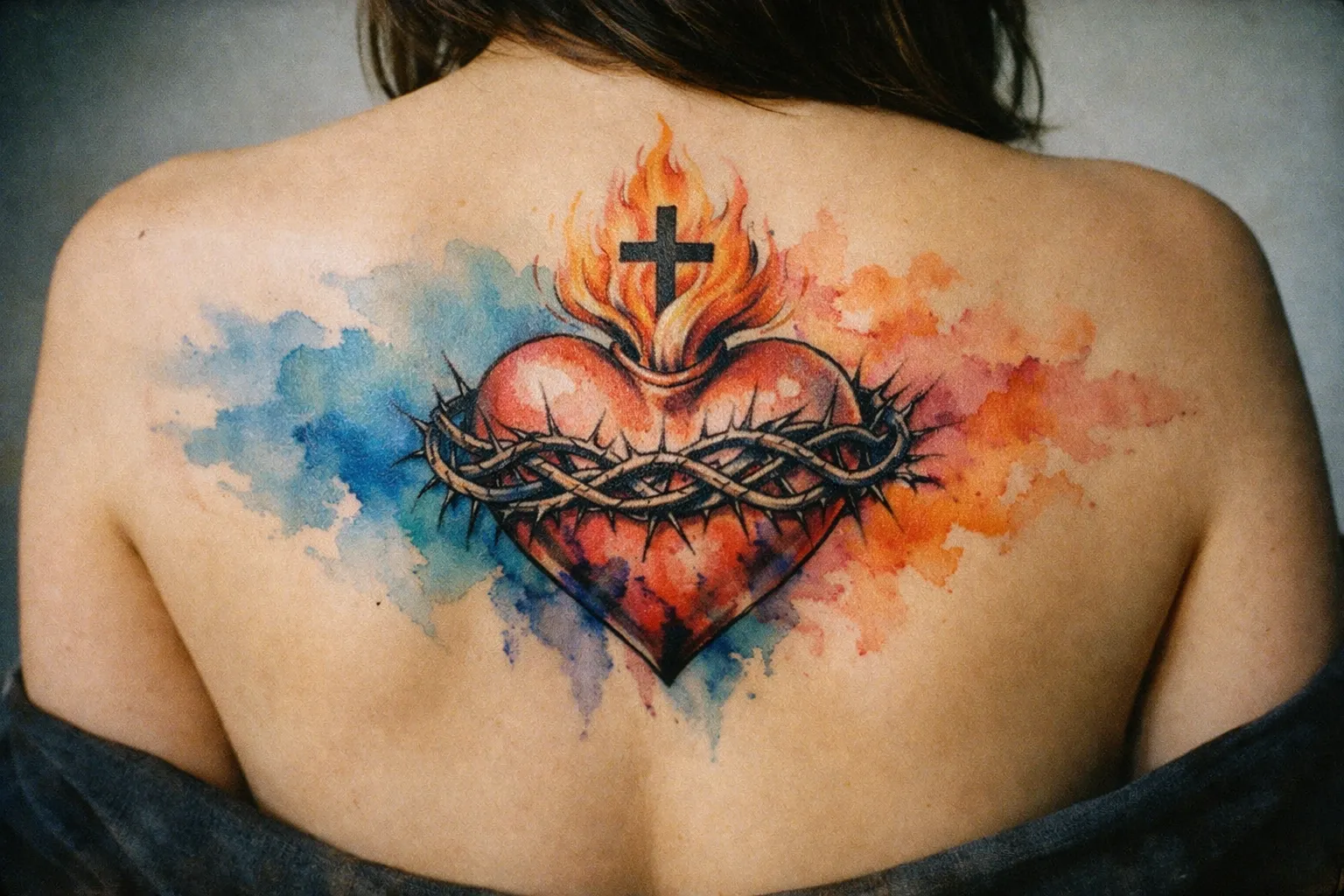
Many wearers are not practicing Catholics but grew up in Catholic families. For them the Sacred Heart functions as a marker of heritage and cultural identity - a way to honor parents, grandparents, or a religious upbringing, with deep roots in Mexican and broader Latin American Catholic art (1). The iconography still applies exactly the same; the devotional weight becomes personal rather than liturgical.
Then there’s the secular reading: perseverance through suffering, love that cost something, a crisis survived. The motif communicates these without requiring Catholic belief. But the elements - thorns, flame, cross - stay put. Stripping them out to make the piece “less religious” is what turns it into an unrecognizable generic heart. Worth knowing: the devotion is predominantly Catholic, but some high-church Anglicans follow it too, so it isn’t strictly confined to one denomination (15).
One practical consideration on visibility. A sacred heart chest tattoo or a forearm piece reads as an overt Catholic identity signal in most cultural contexts - the iconography is legible almost everywhere, so most viewers will read Christian faith into it regardless of your intent (1). If you might later work in a secular or conservative professional environment, factor that into placement. It’s not a reason to avoid the design; it’s a reason to think about whether you want it on your forearm or somewhere you can cover.
How the Healed Piece Ages - Color, Line Weight, and Long-Term Care
UV light can fade some tattoo inks, so the American Academy of Dermatology recommends a broad-spectrum, water-resistant sunscreen with SPF 30 or more whenever a tattoo is in the sun, applied 15 minutes before going outside and reapplied at least every two hours (16). Red is the color one studio flags as most likely to fade unevenly and to need a touch-up sooner than the black around it, which makes the heart the part of this design that shows age first (4). That drives most of the long-term care decisions.
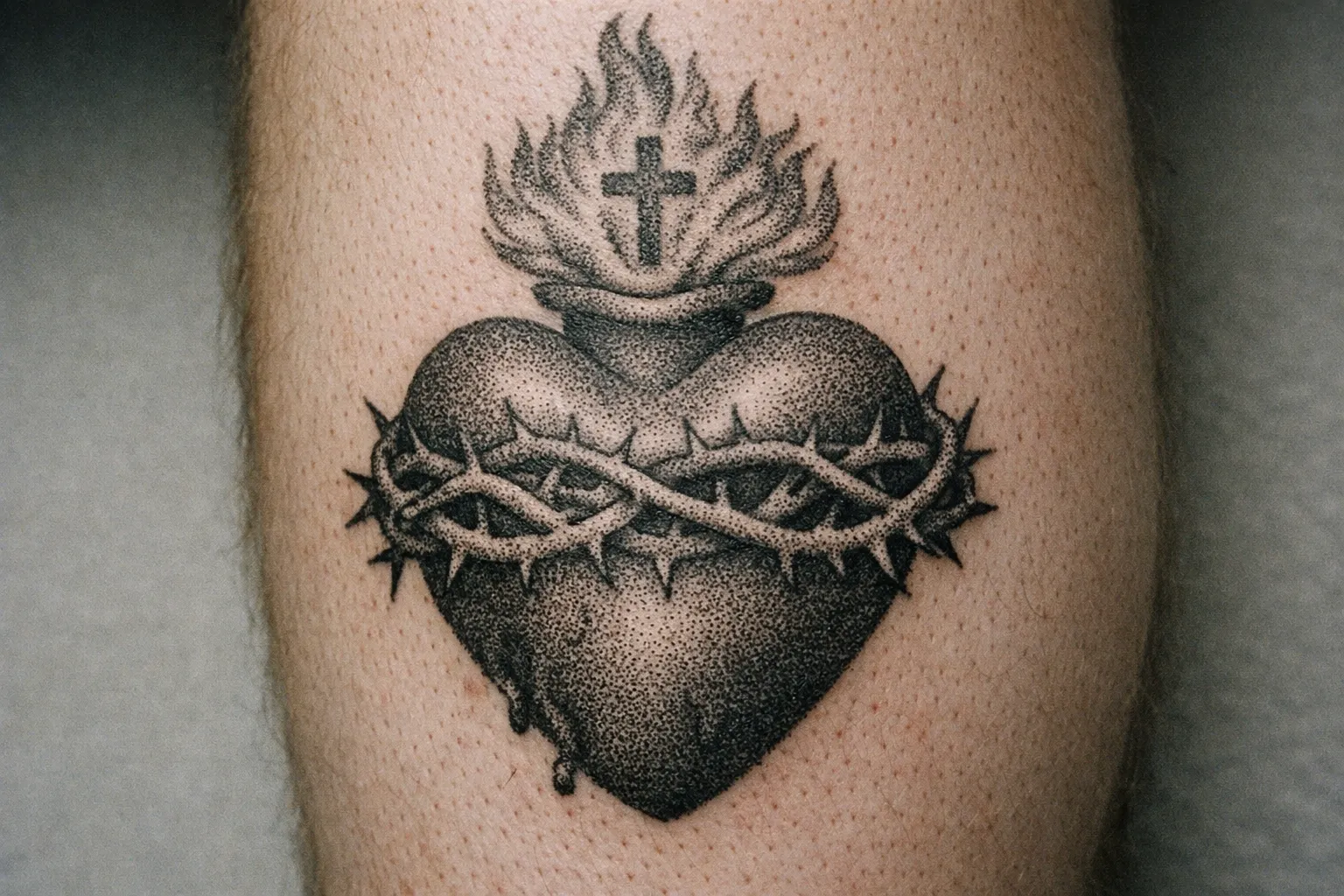
The dedicated aftercare routine runs about 14 days, but healing takes longer: the surface looks healed around weeks 3 to 4, the deeper skin keeps remodeling, and full integration comes around week 6. Here’s the timeline, and the week-by-week aftercare rules cover each stage in detail:
- Day 1 to 3: Keep the bandage on as directed. Wash with fragrance-free soap, pat dry, and apply a thin fragrance-free moisturizer or tattoo-specific ointment. No soaking, swimming, or sun.
- Days 4 to 7: Keep washing two to four times a day and moisturize lightly 2 to 3 times a day. The skin tightens and starts to flake - do not pick it.
- Week 2: Peeling and itching peak, the riskiest window for picking; tap the skin instead of scratching it.
- Weeks 3 to 4: The surface looks healed while the deeper layers keep settling. Color may look dull or milky; that’s normal. Stay out of pools, hot tubs, and saunas until at least week 3, and keep the tattoo out of direct sun for the first 4 to 6 weeks.
- Around week 6: Full integration. From here on, sunscreen is the one permanent addition: SPF 30 or higher whenever the tattoo is in the sun, reapplied at least every two hours, which matters most for the red heart in this design (16).
If a section healed light, many artists offer a free touch-up (17); book it between weeks 6 and 12. Small fine-line sacred hearts are the first to need one: a studio that tattoos them at 2 to 3 in plans a touch-up at year six, while its bold traditional pieces still read correctly at year 30 (4). Placement matters too. Forearm and upper arm are among the most stable; the stomach, hip, and chest can warp with significant weight change, and Sacred Heart lines distort when skin stretches.
Frequently Asked Questions
- What does a sacred heart tattoo mean?
- Catholic devotional image of Christ's heart - flame is divine love, crown of thorns is the Passion, cross is Crucifixion, lance wound is Calvary. Also marks perseverance, memorial, or faith.
- Can I get a Sacred Heart tattoo if I'm not Catholic?
- Yes. Studios tattoo it on practicing and lapsed Catholics, Protestants, agnostics, and people who simply love the symbol (4)(5). Understand the elements' meanings to make an intentional choice and keep the core iconography.
- Is the Sacred Heart only for Catholics?
- Devotionally it is predominantly Catholic, with some high-church Anglicans (15). As a tattoo it's worn by people marking heritage, suffering, or secular meanings, and it reads as Catholic faith in most contexts (1).
- Which tattoo designs should I avoid when going for a Sacred Heart?
- Avoid mixing Sacred Heart and Immaculate Heart elements, going under 8-10 cm, removing cross and thorns, confusing with sacred geometry, or adding romantic partner's name visibly.
- What's the difference between the Sacred Heart and the Immaculate Heart of Mary?
- Sacred Heart has crown of thorns, cross, flame, lance wound; Immaculate Heart has roses, sword, flame, sometimes crown of stars. They are separate devotions.
- How big does a sacred heart tattoo need to be?
- Minimum 8-10 cm (3-4 in) to keep core elements distinct. A centered chest piece wants 15-20 cm (6-8 in) and a full chest panel 20-30 cm (8-12 in) (4). Fine-line styles can go smaller but need simplified elements.
- How much does a sacred heart tattoo cost?
- Most studios bill $100-$300 an hour, with a shop minimum of about $80-$150 for small pieces; a 2026 guide puts a sternum or half-chest design at $300-$600 and a full chest piece at $1,500-$2,500+ (17). A single-session traditional piece of 3-5 in takes 2-4 chair hours (4).
What Actually Decides Whether This Works
Three things determine whether a sacred heart tattoo holds up, and none of them is the reference photo.
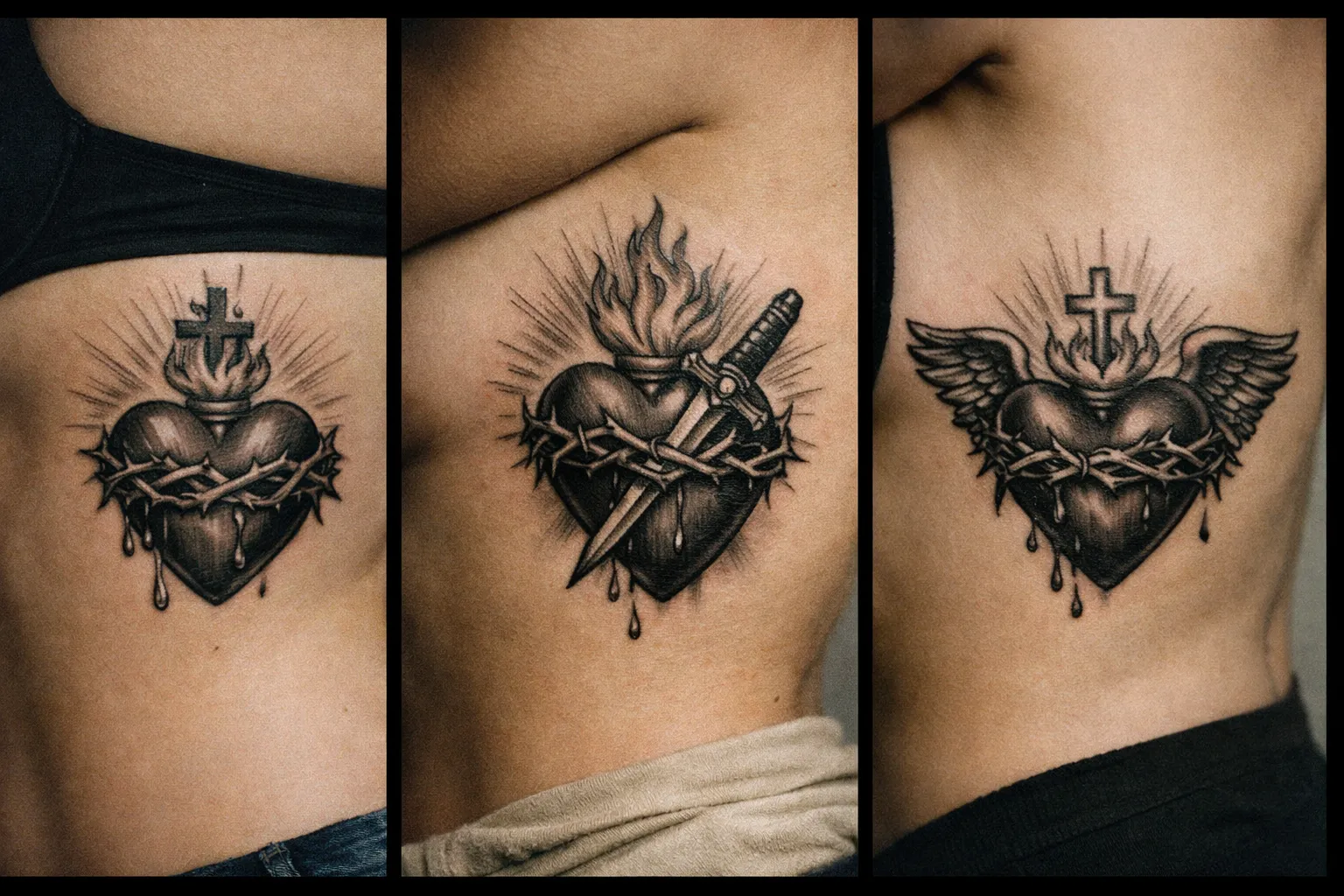
Placement decides visibility. A chest piece is an overt Catholic identity marker in most contexts. A forearm piece is visible daily. A collarbone or rib piece is discreet. Choose based on how you want to carry it, not just how it looks in a photo.
Size decides longevity. The four core elements need room. Go under 8 to 10 cm and you’re trading away whatever survives five years of healing and UV. Bold traditional linework at 12 cm outlasts fine-line at 5 cm by a wide margin.
The consultation is where the design gets locked. Walk in with the decisions already made: Sacred Heart or Immaculate Heart, which elements are non-negotiable, and the one sentence of personal meaning the piece marks. A consult that starts from those answers produces a better composition than one that starts from a Pinterest board.