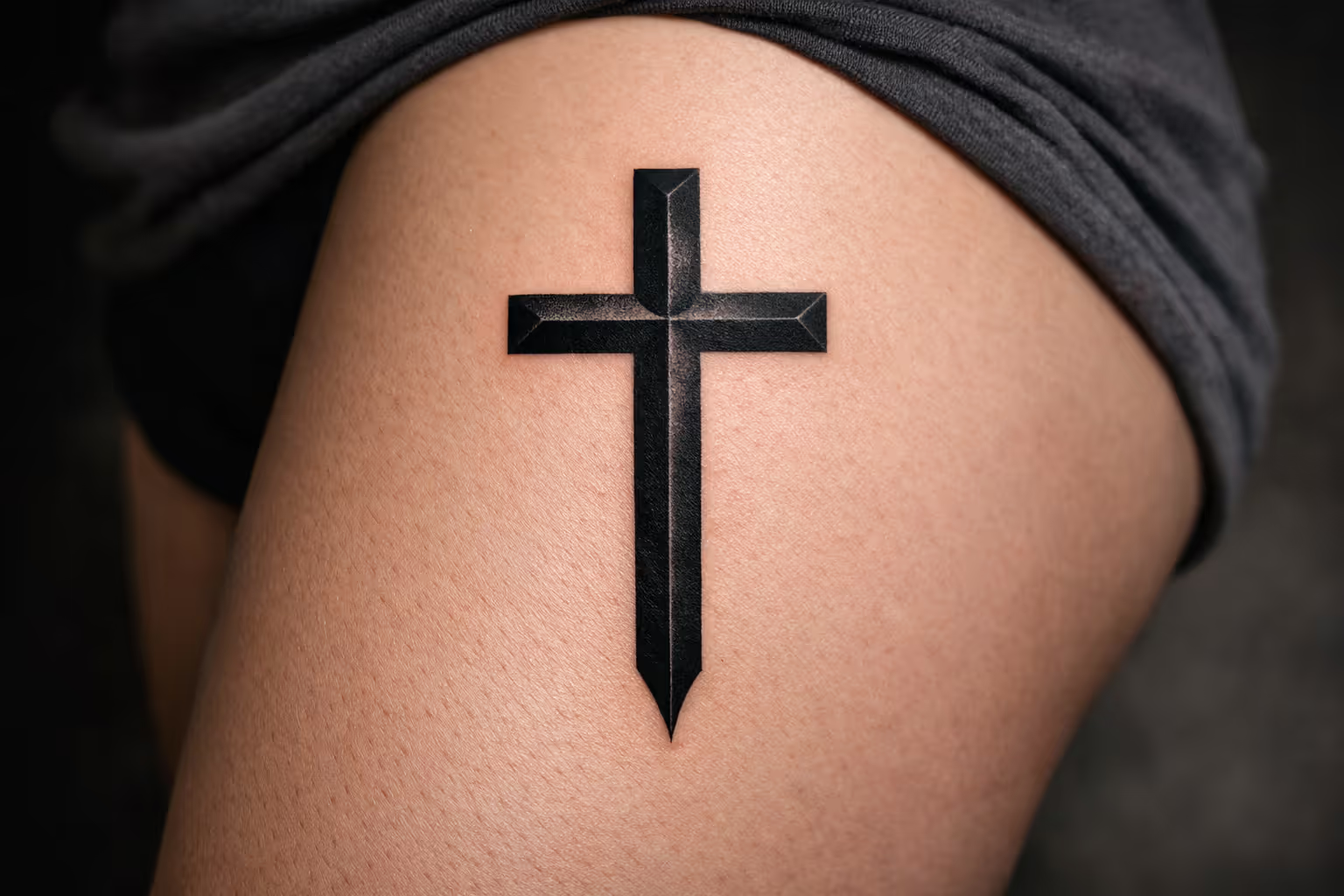
Most people book a cross tattoo without realizing they’re choosing between several very different symbols. A plain Latin cross, a Celtic cross, an Orthodox cross, a full crucifix - each carries its own meaning, its own cultural baggage, and its own sizing and aging quirks. Pick by looks alone and you may say something more specific than you intended. Here’s how the main cross variants differ, and how to choose the one that fits.
What a Cross Tattoo Actually Means
The base symbol is the Christian cross - the instrument of crucifixion, repurposed into the central icon of salvation, sacrifice, and resurrection (2)(3). That core meaning carries into most cross tattoos, but the specific variant you pick shifts the message considerably:
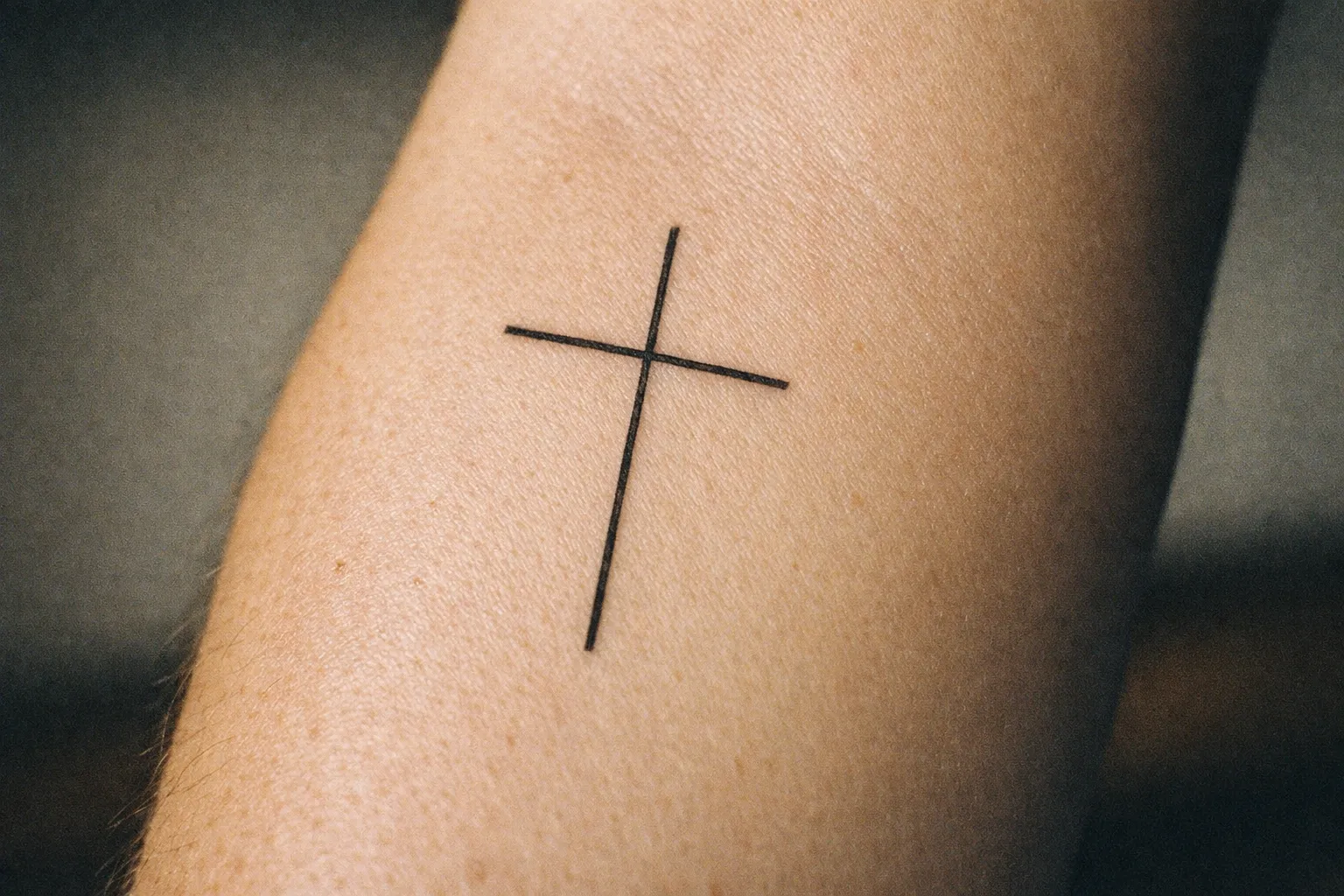
- Latin cross (crux immissa) - vertical beam longer than the horizontal. The default Christian cross, used in roughly 40-60% of faith-based cross tattoos(3).
- Greek cross (crux quadrata) - four equal arms. Common in Orthodox tradition and clean minimalist designs.
- Orthodox cross - three horizontal bars with the lower bar slanted. A strong Eastern Orthodox identity marker.
- Celtic cross - Latin cross enclosed in a circle, almost always paired with knotwork. The circle reads as eternity or the sun, and the design carries Irish and Scottish heritage signaling on top of the Christian meaning (1).
- Tau cross - T-shaped, associated with Saint Anthony and Franciscan tradition.
- Gothic cross - embellished with barbed wire, thorns, snakes, or roses. Often subcultural rather than devotional.
Among people who get cross tattoos, surveys put the breakdown roughly at 40-60% personal Christian faith, 20-30% memorial for a deceased loved one, 10-20% cultural heritage (Celtic, Irish, Orthodox), and 10-20% purely aesthetic(3). Worth knowing before you pick your variant.
On the Forearm
The forearm is the most-requested placement for a cross tattoo, especially among men, and it’s the one I’d recommend if you’re undecided. Flat, stable canvas that doesn’t distort much with muscle, visible in about 60-80% of normal outfits, and coverable with a long sleeve when you need it. It’s a practical choice, not just a popular one.
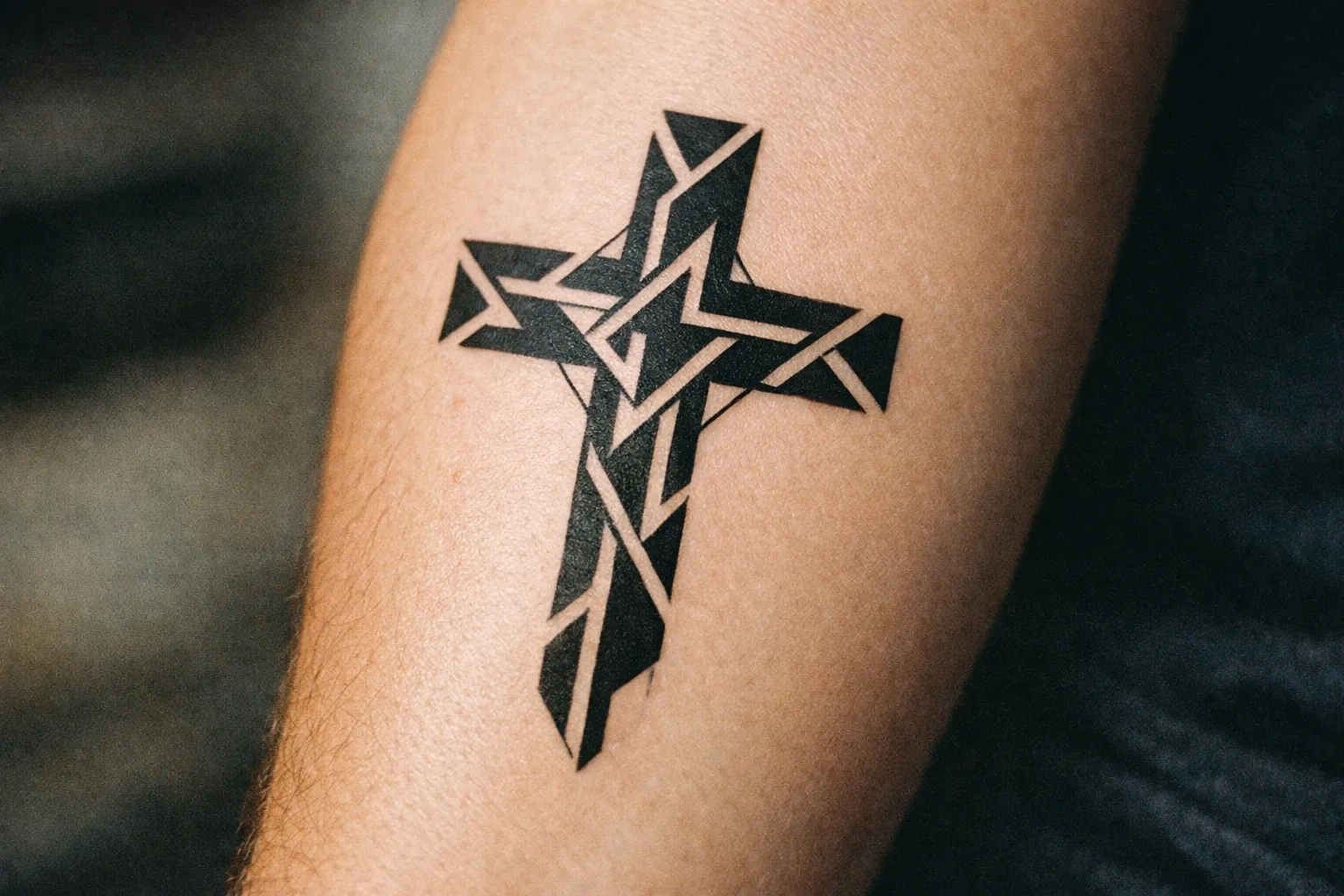
Size range: 2-5 inches (5-13 cm) tall, 0.5-1.5 inches wide for a vertical Latin cross. Going bigger reads as a statement piece; going smaller starts to look lost on an adult forearm.
Placement detail: Run the vertical beam along the tendon line between the radius and ulna. This keeps the cross straight whether your arm is relaxed or flexed. A crooked beam is the most common forearm-cross mistake I see, and it’s almost always a placement call, not an artist error.
Pain: Outer forearm is more forgiving than inner forearm, and both are easier than the wrist. It’s one of the more manageable placements for a first tattoo.
A forearm cross tattoo works in nearly every style: clean blackwork Latin cross, fine-line minimalist, Celtic knotwork if you have the surface area, or a memorial piece with dates and small lettering down the beam.
Small and Minimalist Designs
A small cross tattoo - anything from 0.3 to 1 inch (0.8-2.5 cm) - lives in a different design space than larger pieces. You’re not getting shading, you’re not getting knotwork, and trying to cram detail into that footprint is the fastest way to end up with a blurred smudge in two years.
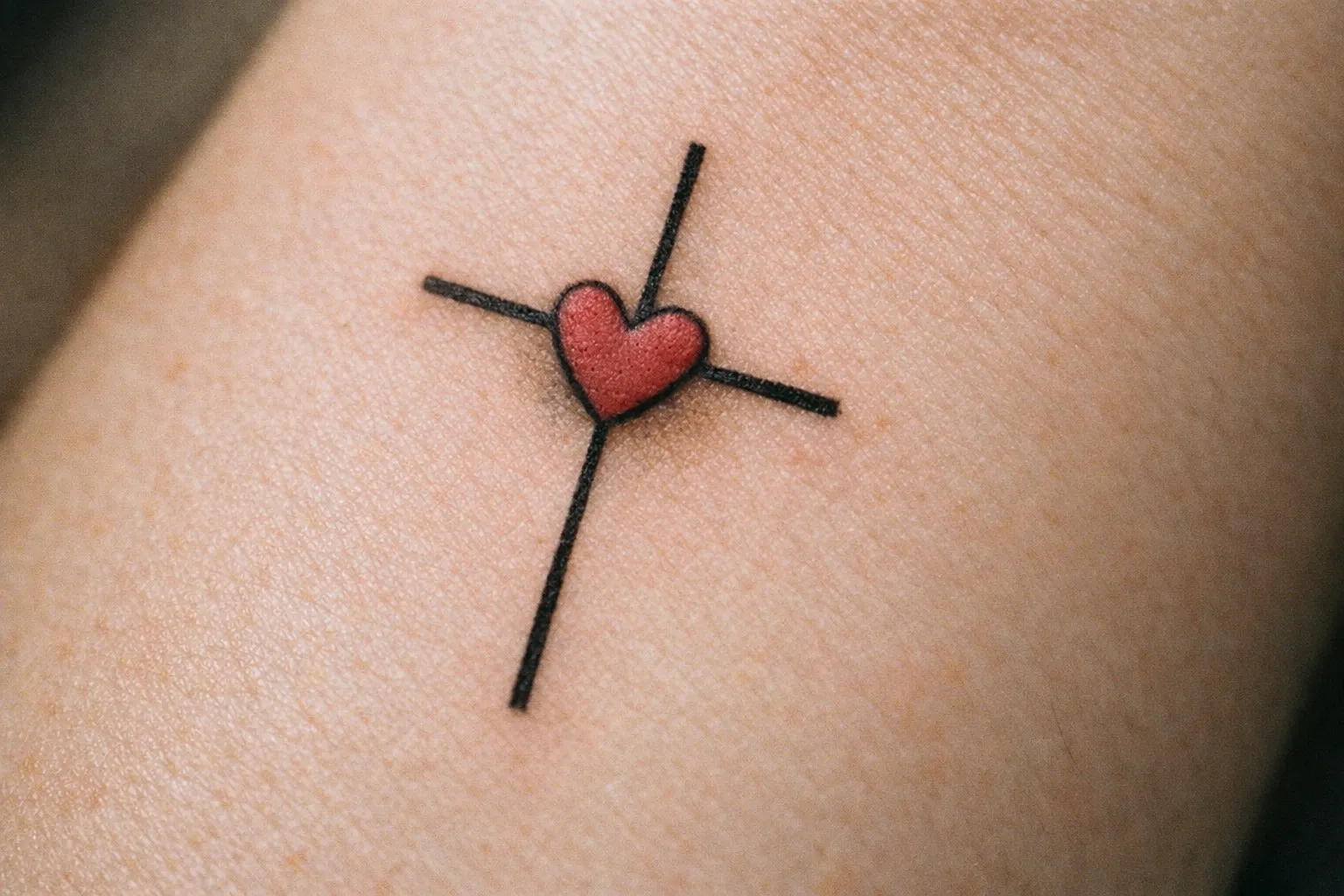
Best placements for small crosses:
- Behind the ear - high visibility, low surface curvature, ages well
- Inside wrist - higher pain, more fading from sun and friction; expect a touch-up around year 3
- Side of finger - looks great fresh, fades fastest of any placement; plan for touch-ups every 1-2 years
- Collarbone - flat, stable, easy to hide
- Sternum or under-breast - more painful but a clean canvas
Technique: Ask for single-needle or a tight 3RL (3-round liner) for fine-line work. A standard liner needle on a 0.5-inch cross will blow out the corners and lose crispness within a year. If the artist isn’t comfortable with single-needle work, find one who is - it’s a specialty, not a standard skill.
Small cross tattoos are often someone’s first piece. That’s fine, but understand that small fine-line work is technically harder than a medium blackwork piece, not easier. Book the artist, not the size.
Cross Tattoo Designs and Variations
Beyond the basic cross types, these are the combinations people actually book. Each carries a specific meaning and works at a specific size and placement.
Geometric Cross Tattoo
Sharp angles, repeated shapes, sometimes mandala influence. Reads as structured and modern. Works at 3-6 inches on the shoulder, outer forearm, or upper back. Avoid tight curves on small versions - geometric designs need room to breathe, and the detail collapses fast when you shrink them.
Heart and Cross Tattoo
The Sacred Heart variant - a flaming or bleeding heart wrapped around or pierced by a cross - is the historic Catholic version, traditionally placed on the chest at 4-6 inches. The simpler heart-and-cross hybrid (a heart-shaped knot in the cross arms) works as a small piece on the wrist or behind the ear.
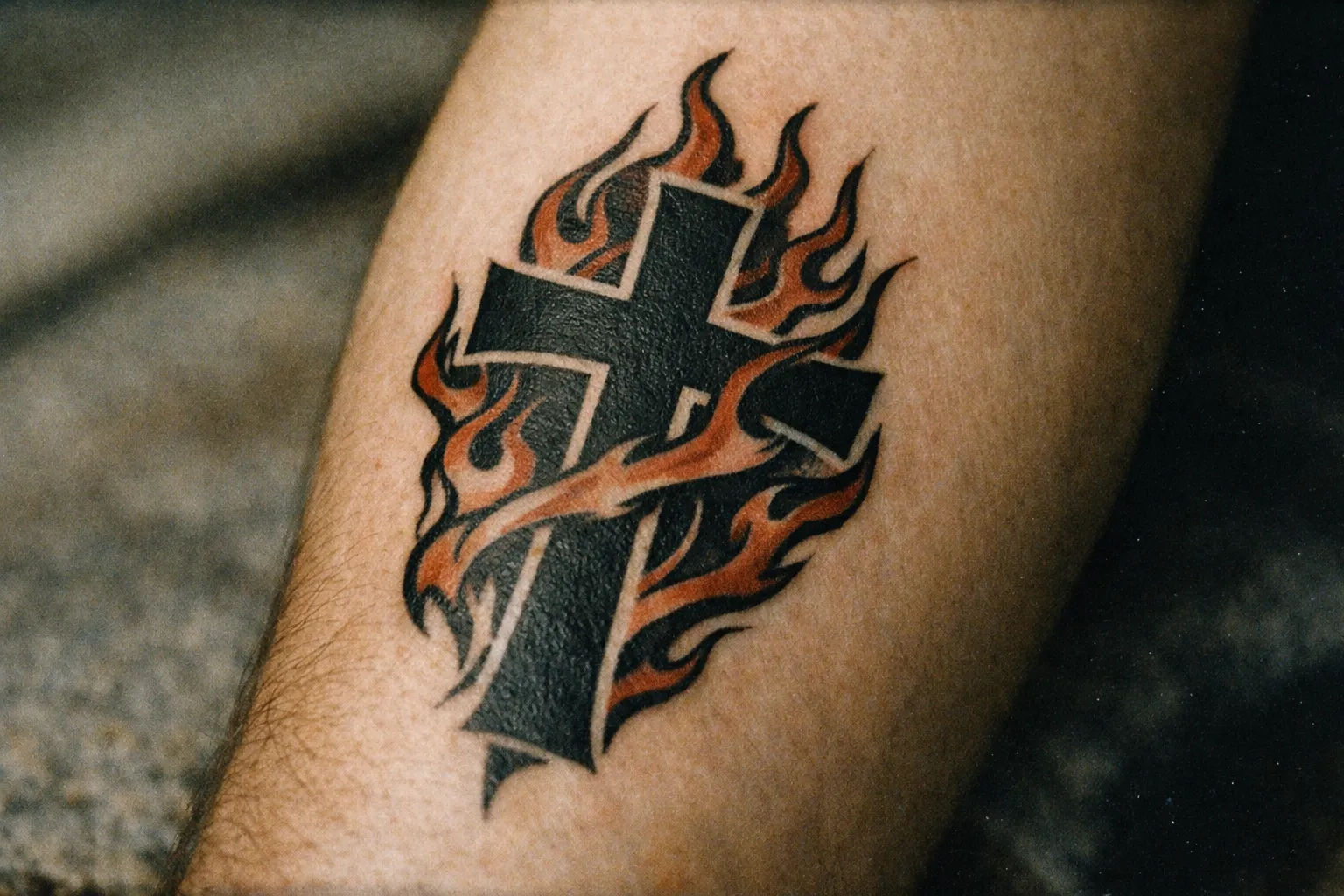
Cross with Flames
Flames around the cross reference both divine love and the crucifixion. The trick is keeping the flame linework distinct from the cross itself. When artists do this badly, the flames bleed into the beam and the whole thing reads as a black blob by year three. Needs at least 4 inches to work cleanly.
Cross with Wings
Wings on either side of a cross is one of the most common memorial cross tattoo designs - used to mark the death of a parent, child, or close friend. Sizing matters here more than most people realize: this piece looks weak under 4 inches because wing detail needs room. Best at 5-8 inches on the upper back, chest, or outer shoulder.
Cross with Roses
The rose adds love, sacrifice, and in Catholic symbolism, Mary. Aesthetically it softens the hard lines of the cross, which is why it reads as one of the more popular feminine cross tattoo designs - though plenty of men get it too, usually in American traditional style with thick outlines and a tight palette. 4-7 inches on the forearm or upper arm.
Jesus on the Cross (Crucifix)
A realistic crucifix is one of the more technically demanding cross tattoos. Skin tones, drapery folds, and facial detail all need to hold up over a decade, which means you need at least 6 inches, ideally on the back, chest, or full upper arm. Smaller than that and the face turns to mush by year five. I’ve seen clients come in with reference photos of 3-inch crucifixes from other shops, and the conversation is always the same: the detail isn’t there anymore.
Upside-Down Cross Tattoo
Two completely different meanings depending on who’s reading it. The Cross of Saint Peter is a legitimate Christian symbol - Peter requested upside-down crucifixion because he didn’t consider himself worthy of dying as Jesus did. In modern Western culture, however, the inverted cross is widely read as anti-Christian or satanic imagery. If you’re going for the Petrine meaning, be prepared to explain it constantly.
Cross Behind the Ear
A small cross behind the ear (typically 0.5-1 inch) is one of the cleanest minimalist placements - flat skin, low fading, easy to hide with hair. Often paired with the meaning of “hearing God’s word,” though that’s a relatively modern reading rather than a historic one.
Infinity Cross
The infinity loop crossed with a cross beam - eternal life, continuity of faith. Works small (1-2 inches) on the wrist or inner forearm. Keep the linework single-weight to avoid muddying the loop intersections.
Anchor Cross
Anchor and cross combined references Hebrews 6:19 - “hope as an anchor for the soul.” Common with sailors, recovery community members, and people who want a faith tattoo that doesn’t read as overtly religious at a glance. 3-5 inches on the forearm or ribcage.
Cross with Praying Hands
Often a memorial piece, often based on Albrecht Dürer’s Praying Hands. Needs 5-8 inches to capture the hand anatomy - anything smaller and the fingers fuse together. Forearm, upper arm, or chest.
Skull and Cross Tattoo
Memento mori imagery - mortality balanced against eternal life. Common in neo-traditional and blackwork styles. Works at 4-7 inches on the forearm, calf, or chest. If you’re drawn to this combination, it’s worth exploring the broader world of skull tattoo symbolism, which spans everything from European memento mori to Día de los Muertos traditions.
Lion and Cross
The Lion of Judah reference - Christ as conquering king. A heavy design that needs real estate: 6-10 inches on the chest, back, or full upper arm. Don’t try to shrink this onto a forearm; lion mane detail gets lost fast, and what’s left doesn’t read as a lion anymore.
Cross Sleeve
A full or half sleeve built around a central cross, layered with doves, clouds, rays, scripture, and sometimes a portrait. Plan 15-25 hours across 3-6 sessions and budget accordingly. The single most common mistake is starting the sleeve without a final composition mapped out - you end up with disconnected elements instead of a unified piece, and fixing it costs more than planning it right would have.
3D Cross Tattoo
A cross shaded to look raised off the skin, often with a “torn skin” effect underneath. Looks striking fresh but ages badly - the shadow lines that create the 3D illusion tend to blur into the cross itself by year five or six, killing the effect. If you want one, plan for a touch-up every 4-5 years, and go in with realistic expectations about how it looks at the ten-year mark.
Cross Designs for Men
Cross tattoos for men trend larger, bolder, and more centrally placed than women’s versions - typically on the forearm, biceps, chest, ribcage, or upper back, in sizes from 4 inches up to full sleeves and backpieces. Style choices skew toward:
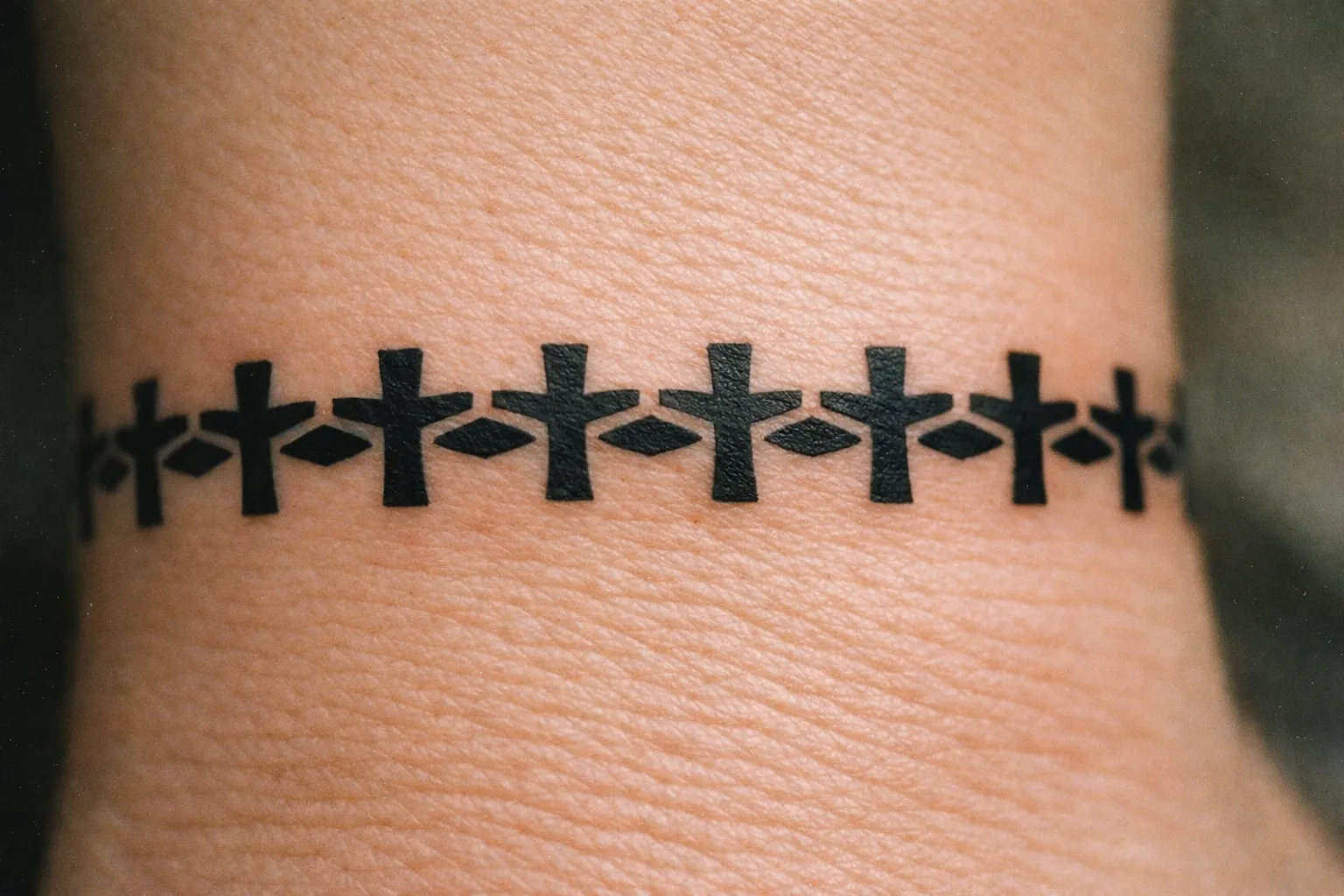
- Blackwork and bold linework - thick outlines, heavy fill, designed to read clearly from across a room and hold up for decades
- Celtic crosses with knotwork - strong heritage signal, especially among men with Irish or Scottish background
- Realistic crucifixes - chest or back, often as the centerpiece of a religious sleeve
- Combinations - cross with lion, cross with clock, cross with praying hands, cross with rosary draped around it
For men’s forearm cross tattoos specifically, the most common ask is a clean Latin cross with light shading or a simple decorative element - a date, a scripture reference, a dove. Anything more complex than that needs to go larger or move to the biceps. Trying to fit a detailed composition into a 3-inch forearm cross is where a lot of pieces go wrong.
Cross Designs for Women
Designs more often skew small, fine-line, and decorative - wrist, behind the ear, collarbone, ankle, sternum. Common combinations include cross with flowers, cross with birds (especially doves), cross with rosary beads, and infinity crosses. Sizes typically 0.5-3 inches.
This is a generalization, not a rule. Plenty of women get full backpieces and plenty of men get tiny wrist crosses. Pick the design and scale that fits your body and the meaning you want to carry.
Meaning by Cultural Tradition
The same shape carries different weight depending on the tradition behind it:
- Roman Catholic - crucifix (with corpus/body of Christ) is the canonical form; emphasizes sacrifice and the Eucharist
- Eastern Orthodox - three-bar cross with slanted footrest; specific theological symbolism for each bar
- Protestant - empty Latin cross, emphasizing resurrection over crucifixion
- Celtic Christian - Latin cross with circle, blending pre-Christian Celtic symbolism with the gospel (1)
- Coptic - equilateral cross with specific geometric variants from Egyptian Christianity
- Ethiopian - highly ornate, often with complex knotwork patterns unique to Ethiopian Orthodox tradition
If your faith is specific, get the cross specific to your tradition. A generic Latin cross on someone from an Orthodox background reads as a missed opportunity to honor the actual lineage of the faith. I’ve had clients from Ethiopian Orthodox backgrounds come in with a Latin cross reference because it was the first image they found online - worth a five-minute conversation before the stencil goes down.
Is It a Sin?
This is the most-searched theological question about cross tattoos, and the honest answer is that there’s no single Christian consensus.
The verse most commonly cited against tattoos is Leviticus 19:28: “You shall not make any cuts on your body for the dead or tattoo yourselves.” Some Pentecostal, fundamentalist Baptist, and conservative traditions read this as a standing prohibition. Others - including most mainstream Catholic, mainline Protestant, and evangelical perspectives - read Leviticus in its Ancient Near Eastern context (a prohibition against pagan mourning rituals) and treat tattoos under New Testament freedom of conscience.
The practical framework most pastors use today asks three questions: What is your motive? Does the imagery honor or dishonor Christ? Are you submitting to authority (parents if you’re a minor, your spouse if married)? Under that framework, a cross tattoo motivated by faith and not done in rebellion is generally treated as a conscience issue, not an automatic sin.
If you’re Catholic or Orthodox, talk to your priest. If you’re Protestant, talk to your pastor. Different traditions have different counsel, and that counsel matters more than a generic internet answer.
What Rune Tattoos to Avoid Around a Cross
People sometimes pair Norse runes with Christian crosses for heritage or aesthetic reasons, and this is where you can step in something ugly without realizing it. Several runes have been co-opted by white supremacist and neo-Nazi movements over the last century, and reputable artists will decline to tattoo them or steer you toward alternatives.
Runes to avoid or research carefully before getting:
- Othala (ᛟ) - historically meaning “heritage” or “homeland,” now widely used by white nationalist groups
- Sowilo doubled (ᛋᛋ) - appropriated by the SS in Nazi Germany
- Tiwaz (ᛏ) - co-opted in some neo-Nazi contexts despite a legitimate Norse meaning
- Algiz inverted - appears in some hate-group iconography
If your goal is to honor European Christian or pre-Christian heritage alongside a cross, consider safer alternatives: Celtic knotwork, the Chi-Rho (☧), Alpha and Omega, a date or location in plain text, or the Tau cross, which has Franciscan and early Christian usage. None of these carry political baggage, and all of them hold up well in linework.
What Is the 1/3 Rule in Tattoo Composition?
The 1/3 rule is a composition guideline artists use to keep larger pieces from looking unbalanced. It’s not a hard mathematical formula - it’s a way of thinking about visual weight.
For a cross tattoo with surrounding elements, divide the design into thirds:
- One third for the central cross itself - the focal point, the heaviest visual weight
- One third for the background or supporting imagery - rays, clouds, knotwork, roses, banner
- One third for text, dates, or secondary symbols - scripture reference, name, date, supporting motif
When pieces look “wrong” without an obvious reason, it’s usually because one element is hogging more than its share. A massive cross with tiny text crammed below it reads top-heavy. A small cross floating in a sea of clouds reads weak. The 1/3 split keeps the eye moving through the piece instead of getting stuck on one element.
For small standalone cross tattoos, the rule doesn’t apply - there’s only one element. It matters most for forearm, chest, back, and sleeve compositions.
Language Choices for Lettering Around a Cross
If you’re adding text to your cross tattoo, the language you pick changes the read of the piece significantly.
- Latin - In hoc signo vinces, Soli Deo gloria, Memento mori. Carries Catholic and historical weight. Verify the grammar with someone who actually reads Latin, not a translation app.
- Greek - Original New Testament language. Common choices include Ιχθύς (ichthys) or Α Ω (Alpha and Omega). Get the diacritics right.
- Hebrew - Old Testament references, names of God. Hebrew is written right-to-left and Google Translate consistently gets nuance wrong. Use a native speaker or a Hebrew scholar.
- Aramaic - Jesus’s spoken language. A niche choice that signals serious theological investment.
- English / native language - most legible, lowest risk of mistranslation, often the most personally meaningful for memorial dates and names.
The single most common cross tattoo mistake involving language is getting a scripture reference tattooed in a language you don’t read, only to discover years later that the translation was wrong. Pay a translator. It’s worth $50 to avoid permanent embarrassment.
Pain by Placement
Relative scale, because numerical pain ratings don’t translate across different people:
- Outer forearm, outer biceps, calf - lowest, manageable for most people in a single sitting
- Shoulder, upper back - low to moderate
- Inner forearm, inner biceps - moderate
- Chest (over pec muscle) - moderate to high; chest > forearm
- Inner wrist, ankle bone, finger - high; lots of nerve endings, less fat cushion
- Ribs, sternum, spine - highest; ribs > chest > forearm; expect to need breaks
A small forearm cross is a reasonable first tattoo. A 6-inch ribcage cross is not.
Cost and Time
Current US, Canada, and UK urban averages:
- Small simple cross (1-2 in) - $80-$250, 15-45 minutes in the chair
- Medium forearm cross with light shading (2-5 in) - $200-$500, 1-3 hours
- Large Celtic or Gothic cross with knotwork (6-10 in) - $400-$1,000+, 3-6+ hours, often split across two sessions
- Cross sleeve or large chest piece - $800-$2,000+, 15-25 hours across 3-6 sessions
Shop minimums typically run $80-$150 regardless of how tiny the piece is. Touch-ups range from free within the first year to $50-$200 after that. Tip 15-25% on the session price.
If you ever want it removed, laser removal runs $200-$500 per session, and dark cross outlines typically need 6-10 sessions to fade significantly. Some never fully clear. Get the tattoo because you want it for life, not because you think you can erase it later.
Aftercare Timeline
Same protocol for any cross tattoo, regardless of size or placement:
- Day 1-3 - Leave the initial bandage on as long as your artist instructed (anywhere from 2 hours for plastic wrap to 5 days for second-skin bandages). After removal, wash gently 2-3 times daily with fragrance-free soap, pat dry, apply a thin layer of fragrance-free moisturizer. Expect plasma weeping and minor swelling.
- Week 1 - Itching and flaking start. Do not pick, do not scratch. Keep moisturized but not soaked. Avoid pools, hot tubs, ocean, gym equipment, and direct sun.
- Week 2-4 - Surface healing completes. Color may look dull or patchy - this is normal, the final layer of skin is still settling. Continue moisturizing daily.
- Month 2-3 - Deep healing finishes. Final color and crispness emerge. Schedule any touch-up after week 6, not before.
- Long term - Sun-protective clothing or SPF 30+ on the tattoo every time it’s exposed. UV is the single biggest factor in tattoo fading, and it’s the one most people ignore until the damage is done.
If you see spreading redness, pus, red streaks moving away from the tattoo, or develop a fever - that’s not normal healing. See a doctor.
Common Pitfalls
- Trying to cram detail into a small cross. Celtic knotwork below 3 inches turns to mush. A realistic crucifix below 6 inches loses the face. Pick the right size for the style, not the other way around.
- Ignoring how the placement ages. Finger and wrist tattoos fade fastest. Inner-bicep tattoos blur from skin movement. Plan touch-ups accordingly.
- Getting religious imagery without thinking about the religious context. A cross tattoo will be read as a Christian symbol by most viewers. If you’re not Christian and don’t want that read, pick a different motif.
- Not researching combined symbols. Inverted crosses, certain runes, and some Gothic embellishments carry meanings you may not intend.
- Skipping medical consultation with chronic conditions. Blood thinners, diabetes - these don’t automatically rule out tattoos, but they require a conversation with your doctor first.
- Over-moisturizing during healing. Petroleum-heavy products and constant slathering suffocate the tattoo. Thin layers, three times a day, no more.
How to Pick the Right Cross Tattoo
Work through these questions before booking:
- What does the cross mean to you? Faith, memorial, heritage, aesthetic? Your answer determines the style and what you add around it.
- Which tradition? Latin, Orthodox, Celtic, Coptic, Ethiopian - pick the one that matches your actual background or chosen tradition.
- What size and placement fits your life? Visible or hideable? Large statement or quiet personal marker?
- Are you adding text? If yes, in what language, and have you had it verified by a fluent speaker?
- Have you found an artist whose portfolio shows healed work in your chosen style? Fresh photos lie; healed photos tell the truth.
A cross tattoo doesn’t have to be complicated to carry real meaning. A clean 3-inch Latin cross on the outer forearm, executed by a competent artist, will outlast and outread a cluttered 8-inch piece full of elements you added because they looked cool on someone else’s chest. Pick the meaning first, the style second, and the size that actually fits the design - in that order.
Frequently Asked Questions
- Why do small cross tattoos blur or fade quickly?
- Small crosses under 1 inch don't have room for shading or knotwork detail, and standard needles can cause ink blowout. Fine-line single-needle work is required, and even then, some fading and blurring is inevitable over time.
- What should I consider about language when adding text to a cross tattoo?
- Use a fluent speaker or translator for Latin, Greek, Hebrew, or Aramaic to avoid mistranslations. English or your native language is safest for memorial text. Grammar and diacritics matter for authenticity.
- Is the upside-down cross always anti-Christian?
- No. The Cross of Saint Peter is upside-down by tradition and is a Christian symbol of humility. However, in modern Western culture, it is often interpreted as anti-Christian or satanic, so be prepared to explain your intent.
- How does placement affect pain and aging of a cross tattoo?
- Outer forearm and calf are among the least painful and age well. Inner wrist, finger, ribs, and sternum are more painful and prone to fading or blurring due to skin movement and exposure.
- What is the 1/3 rule in tattoo composition?
- It's a visual balance guideline dividing the tattoo into thirds: one third for the central cross, one third for background/supporting imagery, and one third for text or secondary symbols. It prevents unbalanced or top-heavy designs.
- Are there any symbols I should avoid combining with a cross tattoo?
- Yes. Some Norse runes have been appropriated by hate groups and carry political baggage. Safer alternatives include Celtic knotwork, Chi-Rho, Alpha and Omega, or the Tau cross.
- How long does healing take for a cross tattoo?
- Surface healing completes around 2-4 weeks, but deep healing can take 2-3 months. Proper aftercare with fragrance-free soap and moisturizer, plus sun protection, is essential for long-term color retention.