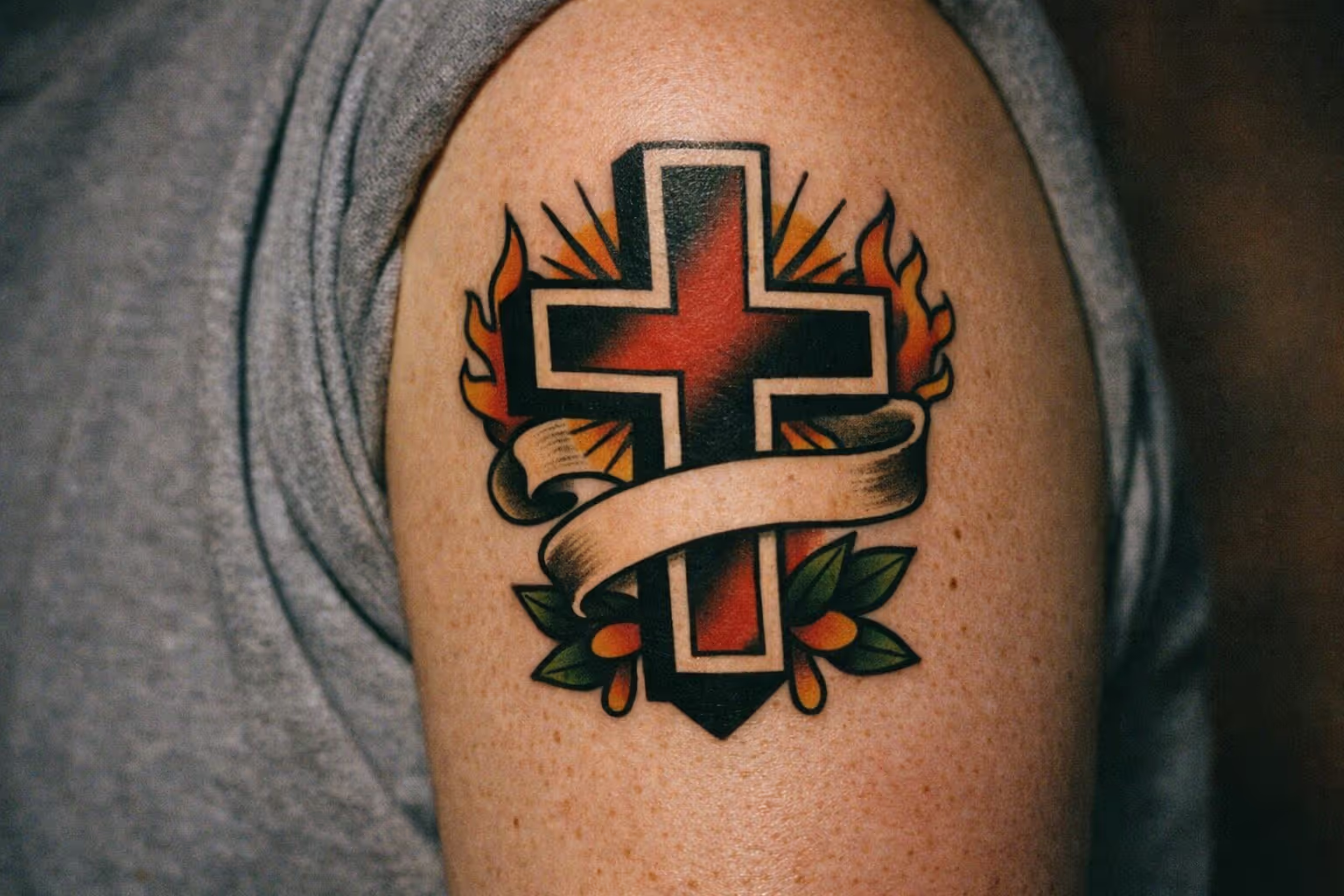
About one in ten American adults carries a tattoo they consider religious or spiritual, according to Baylor University research, and faith tattoos are one of the fastest-growing categories in the studio chair. Crosses dominate that space, showing up in roughly 61% of image-based religious tattoos in Baylor’s visual study - that figure covers image-based designs only and excludes text-only pieces - with script running a close second. The gap between a faith tattoo that reads cleanly for a decade and one that blurs into an illegible smudge usually comes down to three decisions made before the needle touches skin: the design category, the size, and where it sits on your body. This guide covers all three, plus the denominational questions most competitors skip.
✓ Pros
- Strong personal anchor - research links religious tattoos to higher prayer frequency and service attendance
- Wide design range from a 0.5 cm wrist cross to a full Armor of God sleeve
- Cross and dove motifs read positively across most social and professional contexts
- Inward-facing orientation makes many faith tattoos primarily devotional rather than performative
- Placement flexibility - wrist, forearm, back, sternum - allows concealment when needed
✗ Cons
- Visible placements function as permanent identity "advertisements" - beliefs can evolve
- Script errors (wrong verse reference, mistranslation) are permanent and common
- Some denominations maintain written positions against tattoos; social conflict is real
- Fine-line script below 1 inch (25 mm) per letter blurs within 5-10 years
- Large sleeves (Armor of God) require 2-4 sessions and significant time/cost commitment
What Faith Tattoos Actually Symbolize - and Which Motifs Carry the Most Weight
The cross is the single most common faith tattoo symbol, appearing in 61% of religious image tattoos in Baylor’s visual study - a figure that counts image-based designs only, not text-only pieces - but it isn’t one design. It’s a family of them, and each variant carries a distinct tradition-specific read.
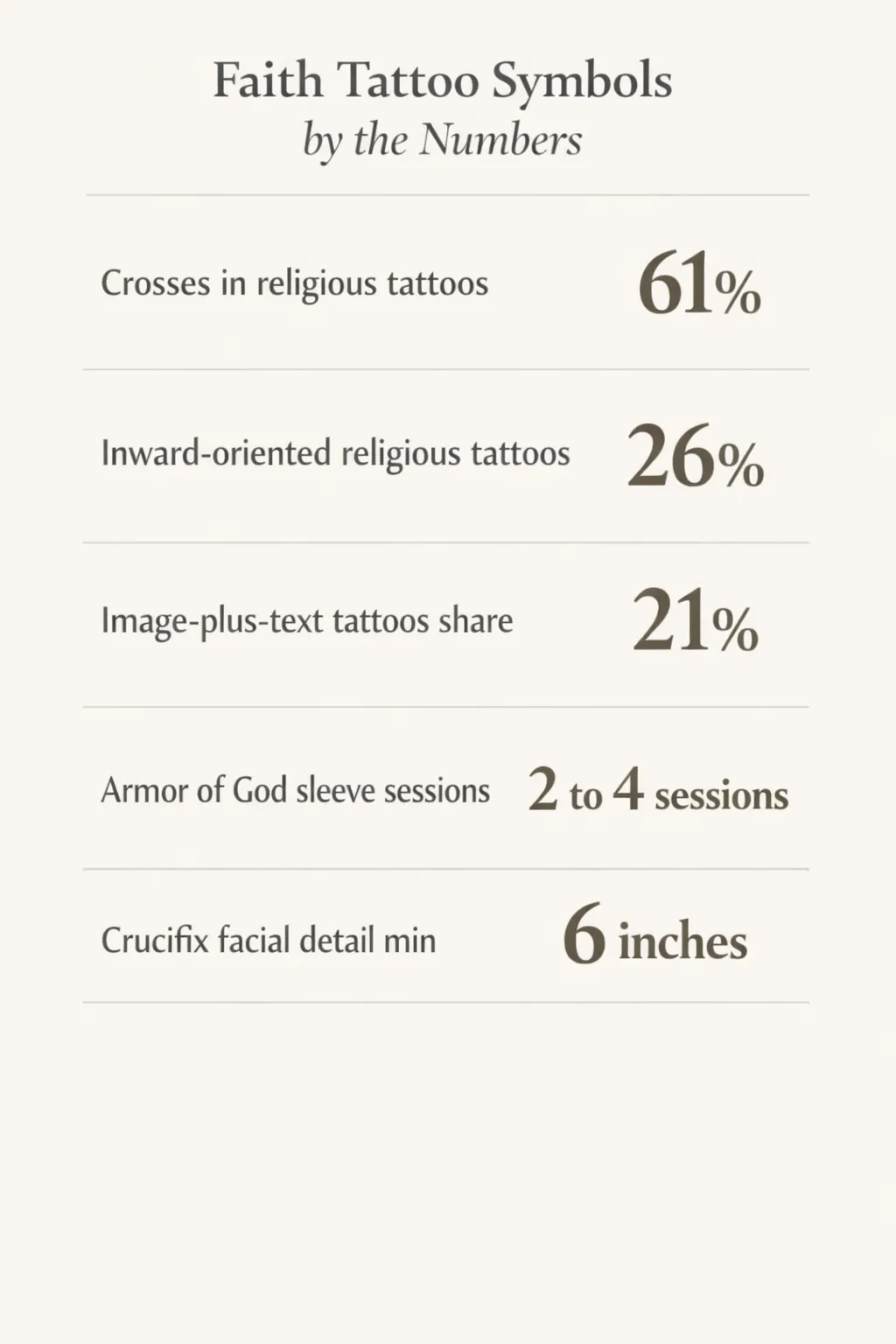 Baylor University study data: 61% of religious tattoos feature crosses, 26% inward-oriented designs, 21% are image-plus-text, Armor of God sleeves require 2-4 sessions, and crucifix details require at least 6 inches for facial detail.
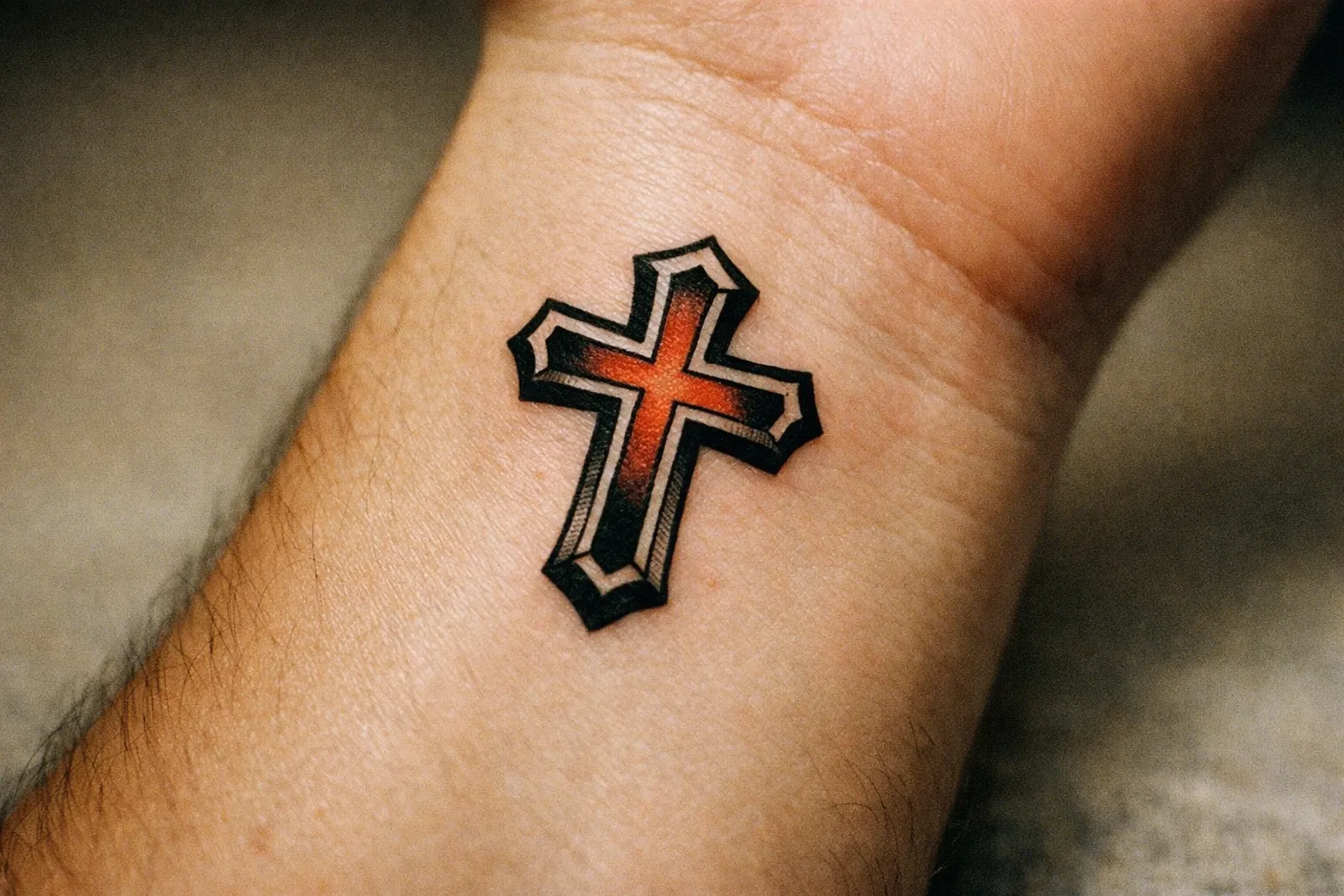
- The Latin cross (vertical beam longer than the horizontal) is the default Christian cross and the one most Protestants choose, emphasizing resurrection through the empty form.
- The crucifix carries the body of Christ and is canonical in Roman Catholic imagery, emphasizing sacrifice.
- The Celtic cross encloses the Latin form in a circle, usually with knotwork; the circle signals eternity, and the whole design flags Irish or Scottish heritage.
- The Eastern Orthodox three-bar cross adds a slanted lower footrest and is a strong Orthodox identity marker.
Beyond the cross, a handful of motifs do most of the work:
- Dove - the Holy Spirit in Christian tradition, or peace and new beginnings more broadly. It reads positively across nearly every social context and works standalone or paired with a cross or olive branch.
- Anchor - references Hebrews 6:19 (“hope as an anchor for the soul”). Common in recovery communities and among people who want a faith symbol that isn’t immediately legible as Christian.
- Praying hands - devotion and memorial; needs 5 to 8 inches to capture hand anatomy without the fingers turning to mush.
- Crown of thorns - sacrifice and suffering, often paired with a cross or a verse on perseverance.
- Sacred Heart - a flaming or bleeding heart, 4 to 6 inches on the chest for full detail; smaller heart-and-cross hybrids work on the wrist or behind the ear.
One finding worth sitting with: 26% of religious tattoos in Baylor’s research were oriented inward toward the wearer, versus 18% of non-religious tattoos (1). That’s a deliberate choice for personal contemplation over public display, and it should shape where you put yours.
Cross Design Variations, Sizes, and Ideal Placement
The forearm is the most-requested placement for a cross tattoo, and for good reason: it’s flat, ages reliably with sun protection, and holds a clean vertical design without distortion. Run the vertical beam along the tendon line between the radius and ulna so the cross stays straight when you flex, and know that the outer forearm hurts less than the inner. For a Latin cross, plan on 2 to 5 inches (5 to 13 cm) tall.
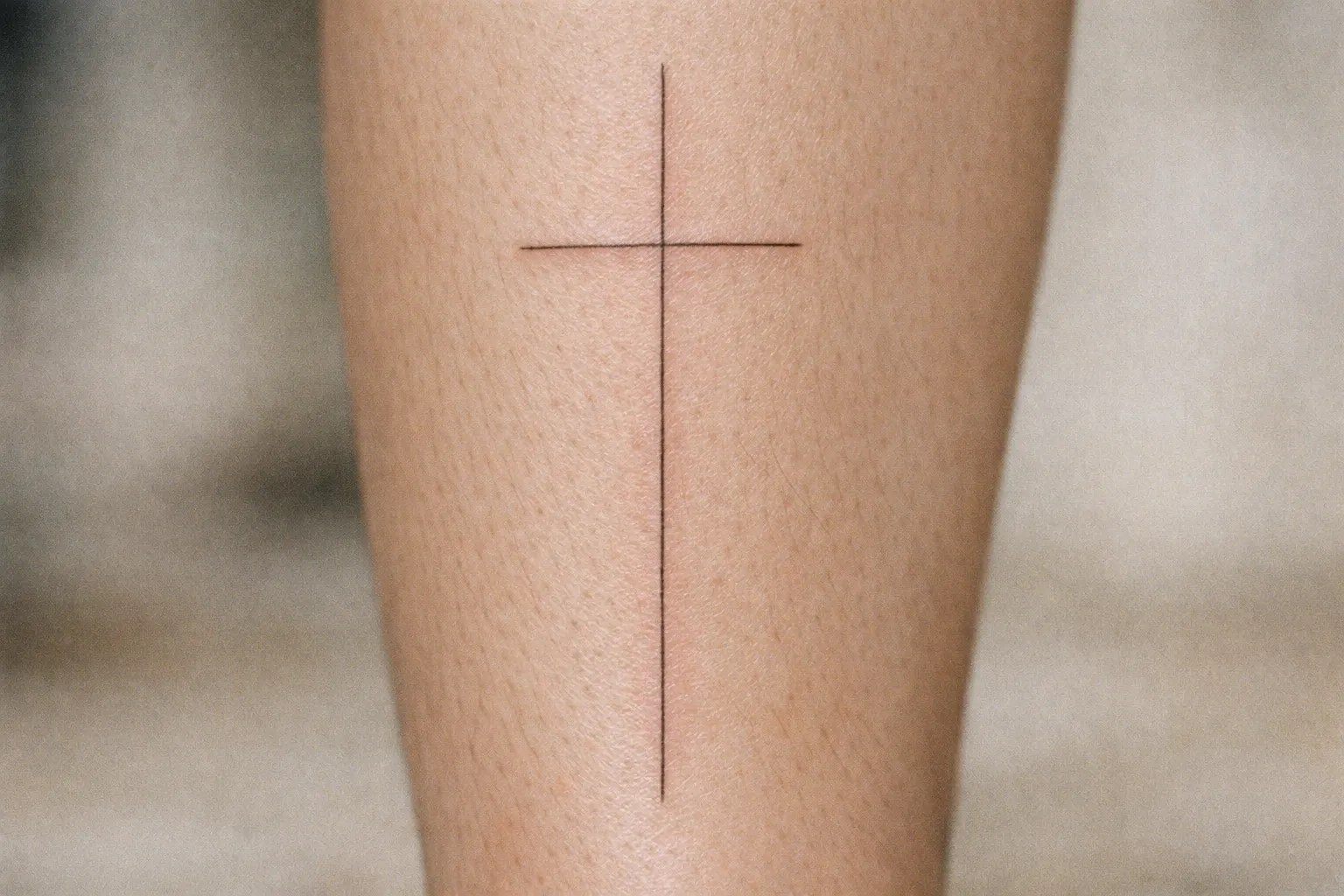
Size drives almost everything else about a cross design:
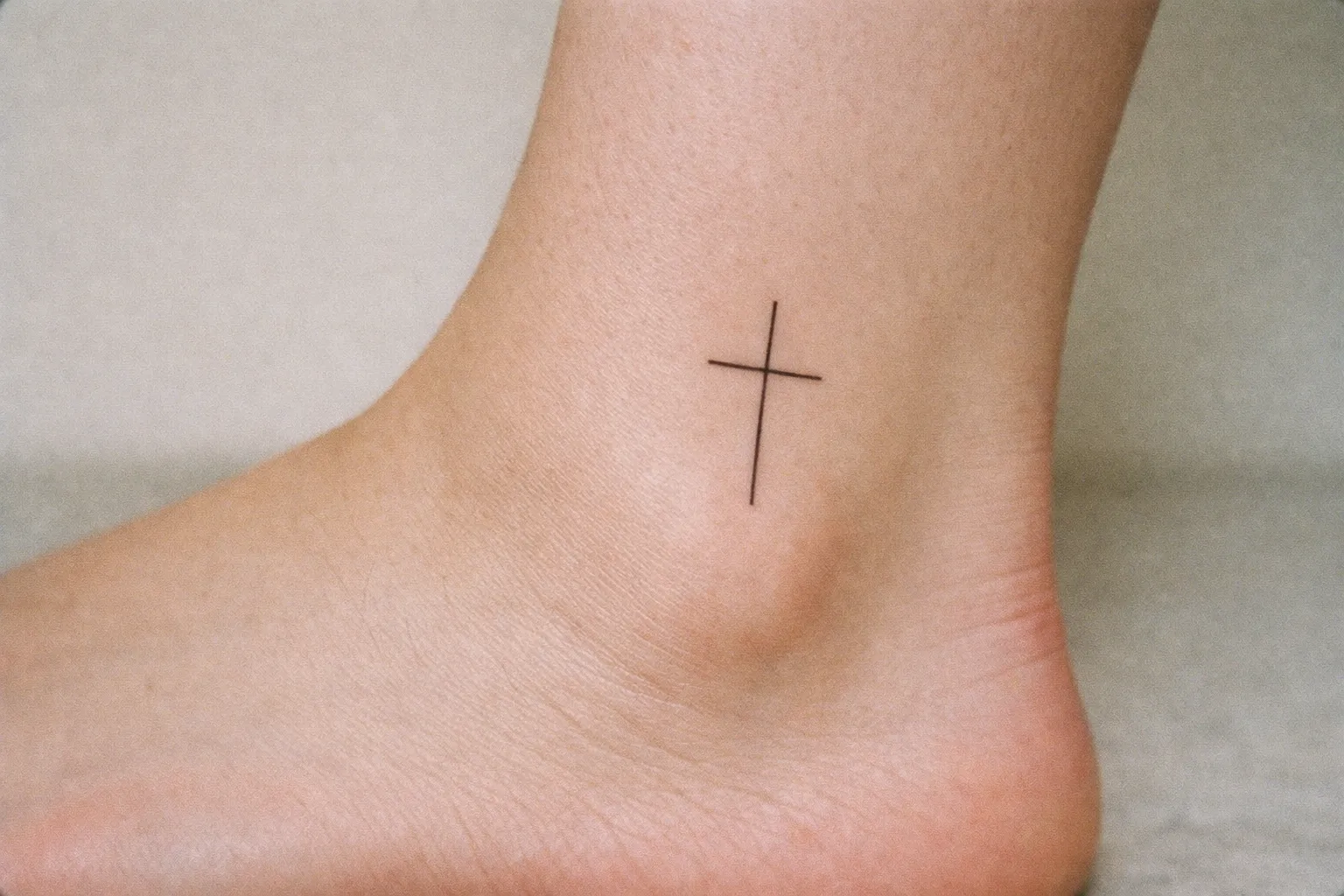
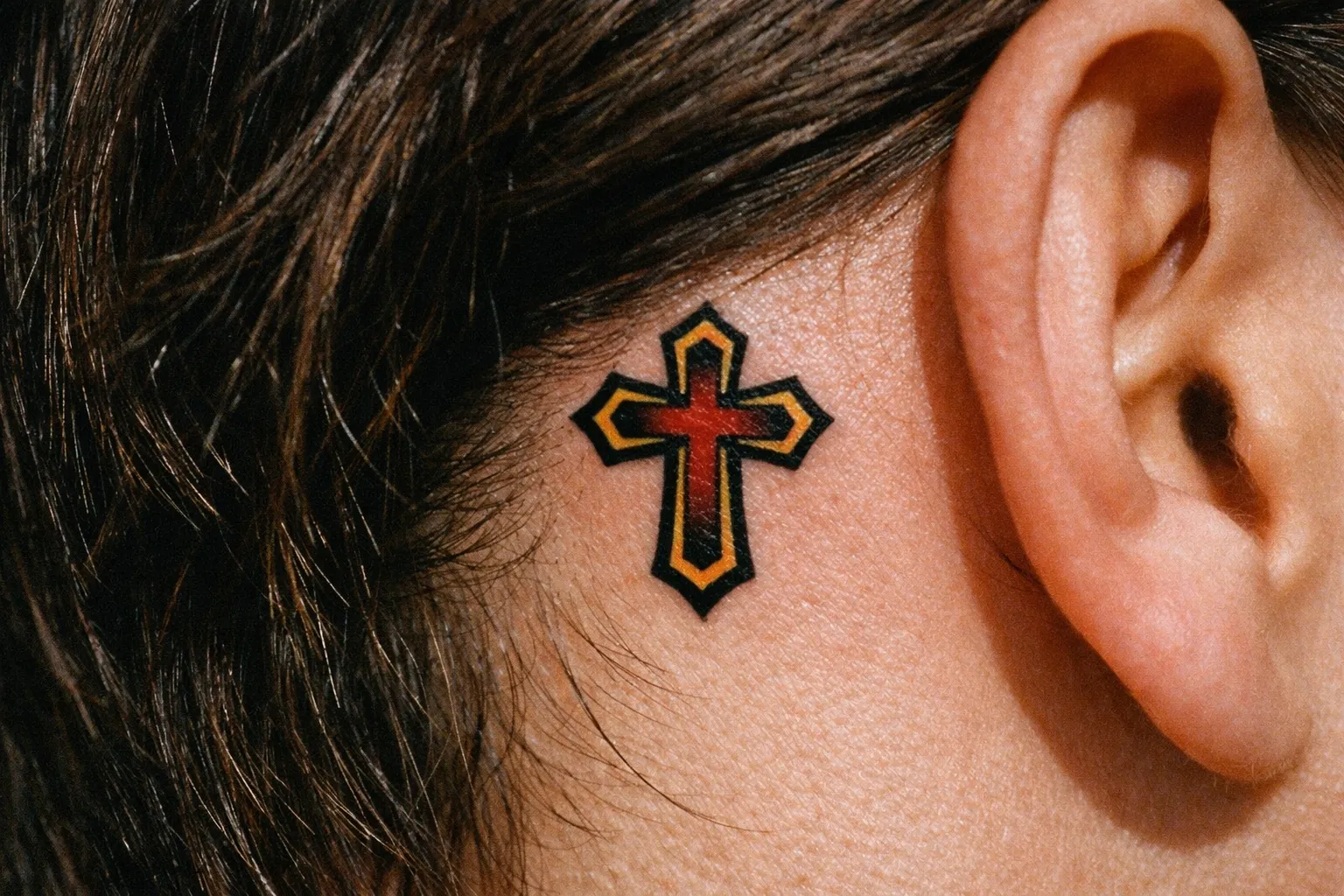
- Small and minimalist crosses (0.3 to 1 inch / 0.8 to 2.5 cm): behind the ear, inside wrist, collarbone, or sternum. These require single-needle or tight 3RL work. A standard liner needle will blow out the corners within a year, and there’s no room for shading or knotwork at this scale.
- Medium crosses (2 to 5 inches): enough room for light shading, a scripture reference down the vertical beam, or one decorative element like a dove or a date. Forearm or biceps.
- Large and complex crosses (6 to 10 inches): Celtic knotwork (which collapses below 3 inches), realistic crucifixes (the face loses detail under 6 inches by year five), or Lion of Judah combinations. Chest, upper back, or full upper arm.
- Cross sleeve: plan 15 to 25 hours across 3 to 6 sessions, and map the full composition before starting. The 1/3 rule keeps it balanced: one third central cross, one third background imagery, one third text or secondary symbols.
On style and aging: blackwork and bold linework hold up most reliably over the decades. 3D shaded crosses look sharp fresh but need touch-ups every 4 to 5 years. Celtic knotwork in blackwork outlasts fine-line versions of the same design.
I’ve watched more than a few Celtic cross requests come in at 2 inches. The client wants the knotwork, the artist wants to please them, and two years later the negative space has closed up and the whole thing reads as a dark blob. Three inches is the real floor for knotwork to survive healing. Below that, you’re designing something that looks great as a stencil and disappoints as a healed tattoo.
If your faith is specific, match the cross to your tradition: Roman Catholic to the crucifix, Eastern Orthodox to the three-bar cross, Protestant to the empty Latin cross, Celtic Christian to the knotwork circle cross, Coptic to the equilateral geometric variants.
Cross Designs for Men - Forearm, Chest, and Sleeve Placements
Men gravitate toward larger, bolder cross work. In Baylor’s study, men’s religious tattoos landed on the upper arm 26% of the time, the forearm 21%, and the back 19% (1), and 61% of men’s religious tattoos were large - over 3 inches. A bold Latin cross on the outer forearm in blackwork is the reliable starting point: legible, ages well, and leaves room to expand into a sleeve later. The upper arm and chest give you canvas for portrait crucifixes, Lion of Judah combinations, or a verse banner without crowding.
Cross Designs for Women - Wrist, Collarbone, and Fine-Line Options
Women’s faith tattoos skew small and delicate. In the same research, 69% of women’s religious tattoos were small, at or below 1×1 inch (1), most often on the wrist (23%), foot (18%), or back (18%). Common combinations include a cross with flowers, rosary beads, or an infinity cross on the inner wrist. Fine-line work at this scale needs single-needle technique and more frequent touch-ups than a bolder piece would - that’s not a knock on the style, just the physics of thin ink in high-movement skin.
Script and Bible Verse Tattoos - Choosing Words That Stay Legible
Script is the second most common faith tattoo format, with more than a quarter of religious tattoos being text-only in Baylor’s study (1), and legibility is the problem most people don’t think about until it’s too late. The practical minimum is 0.3 to 0.4 mm of healed stroke width and a letter height of at least ½ inch (12-13 mm) for standard script, or about 1 inch (25 mm) for ornate script, to stay readable over 5 to 10 years. Below that, especially on high-movement areas like wrists and fingers, script softens into an illegible smudge.
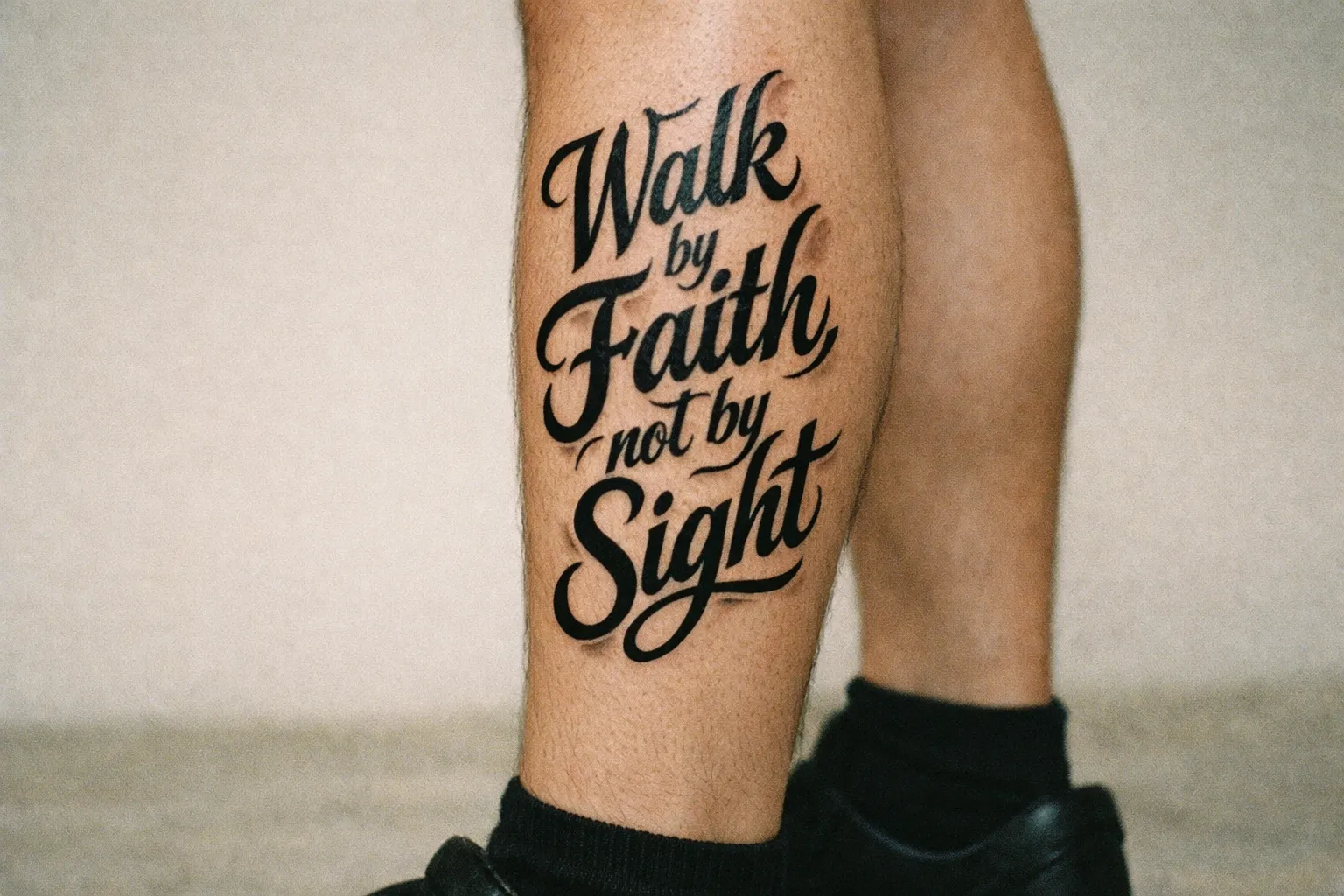
Match the phrase length to the placement. Short, concept-rich phrases fit cleanly on smaller canvases:
- “Be still and know” (Psalm 46:10)
- “Fear not” (Isaiah 41:10)
- “I am with you”
These sit well on the inner wrist, collarbone, or ribcage with few layout problems. Full verses need a forearm, upper arm, or back to breathe.
On verse selection, the Psalms were the most popular Old Testament source in Baylor’s sample (1). Among the most-tattooed verses for men: Philippians 4:13 (“I can do all things through Christ”), Joshua 1:9, Isaiah 40:31, and Proverbs 3:5-6 (2). For women, the common picks overlap but skew differently: Romans 8:31, Proverbs 31:25, Isaiah 40:31, John 16:33, and Philippians 4:13 (2). Popularity alone is a weak reason to choose a verse, though. The ones that hold up over decades are almost always tied to something specific that happened.
Non-English text is an option, but a risky one. Latin (Soli Deo gloria, In hoc signo vinces), Greek (agape, the ichthys), and Hebrew (emunah) read as less obvious to casual viewers, but every one of them needs verification by a fluent speaker. Hebrew runs right-to-left - a layout error artists get wrong more often than they’d admit. Aramaic is niche but signals real theological investment.
The Most Common Script Errors - and How to Avoid Them
The errors that get inked permanently are almost always avoidable. Mixing up John 3:16 and 1 John 3:16 changes the theological meaning entirely - those are different verses. Wrong chapter or verse numbers are common. Mistranslations in Latin, Greek, and Hebrew get discovered after the fact, when it’s too late.
Before the stencil goes on skin, run this checklist: verify the reference, verify the translation with someone fluent, confirm the orientation (right-to-left for Hebrew), and check that the font stays legible at your planned size. Thirty minutes of proofreading now saves a cover-up consultation later.
Combining Images and Text in Faith Tattoos - Doves, Armor of God, and Symbolic Compositions
Image-plus-text designs accounted for 21% of religious tattoos according to secondary reporting on the Baylor study (1), and they’re where the more ambitious compositions live. The key with any of them is keeping the text at a workable size while giving the image enough room to actually read.
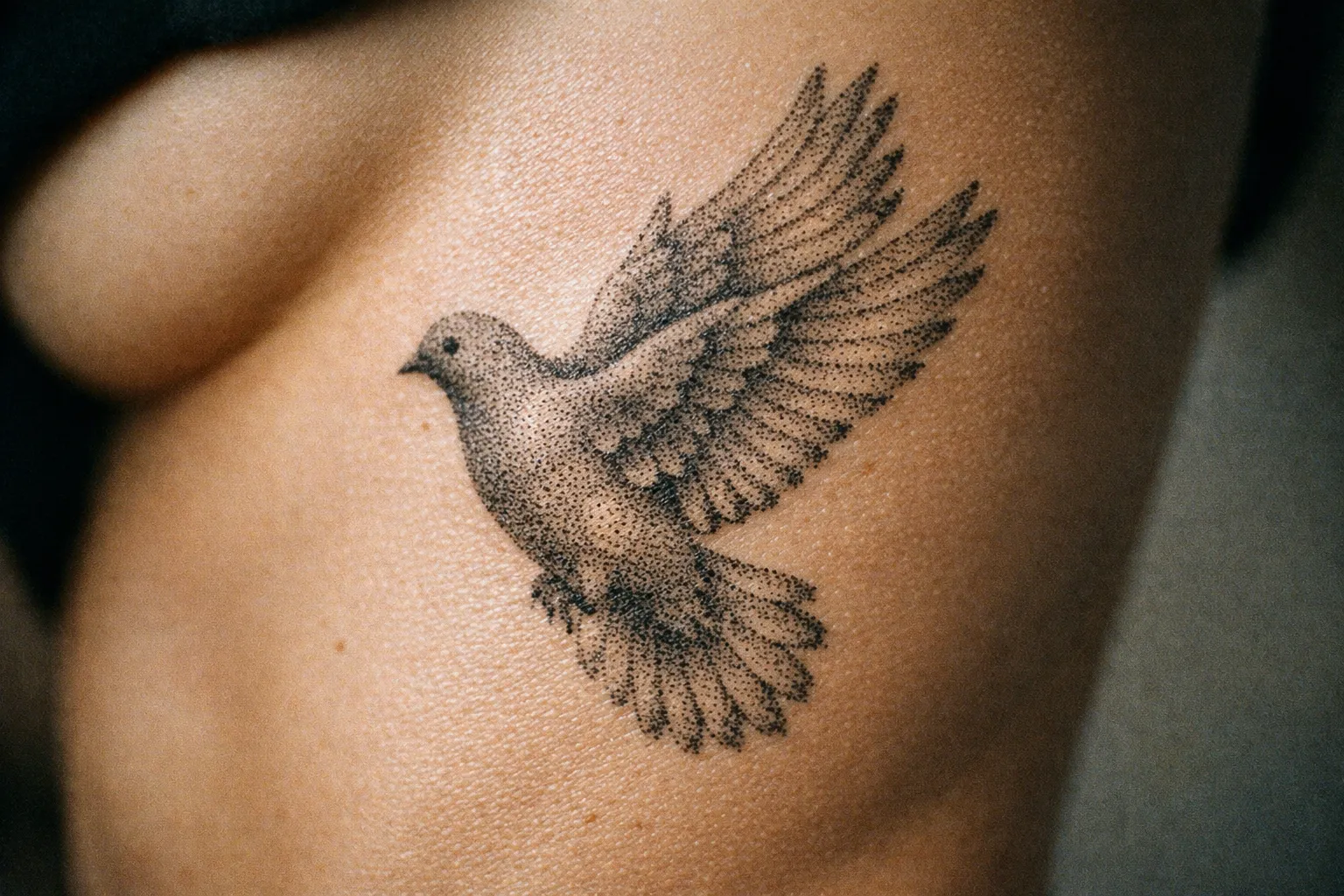
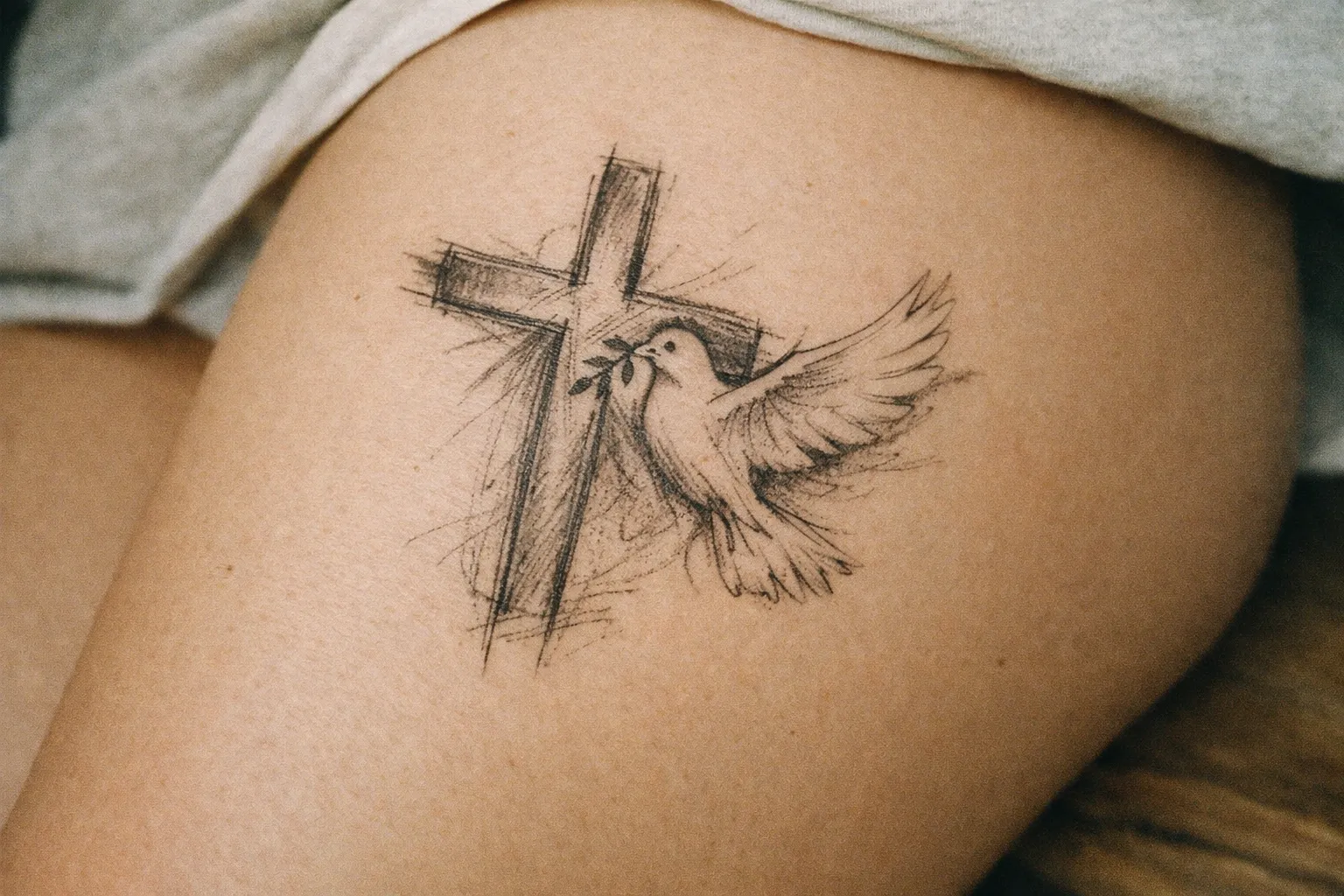
- Dove + scripture: the dove signals the Holy Spirit or peace, paired with a verse like John 14:27. The most-requested size is 8 to 15 cm on the forearm - inner for personal visibility, outer for larger pieces. Black-and-grey realism ages most predictably here.
- Cross + verse: the most common image-plus-text format. Run the reference down the vertical beam or in a banner beneath the crossbar, and keep script letters at a minimum ½ inch (12-13 mm), or ¼ inch (6 mm) in bold block lettering. Forearm or upper arm for a full verse; wrist or collarbone for a short reference only.
- Anchor + heart: the anchor references Hebrews 6:19, sized 3 to 5 inches on the forearm or ribcage. Heart-and-anchor combinations show up often in recovery and memorial contexts, and they pair well with a short verse on hope.
- Armor of God sleeve (Ephesians 6:10-18): the most ambitious faith tattoo composition there is. The helmet of salvation, breastplate of righteousness, shield of faith, and sword of the Spirit each map to a body area. It needs 2 to 4 sessions of 2 to 3 hours each, and a half-sleeve of 15 to 20 cm is the minimum viable canvas. Map the full composition before session one - this is not a design you want to figure out mid-sleeve.
For any complex piece, the 1/3 rule keeps it from becoming visual noise: one third central faith image (cross, dove, crown of thorns), one third background (light rays, mountains, vines, clouds), one third text or secondary symbols.
Catholic faith tattoos deserve a specific note. The crucifix with rosary beads, the Sacred Heart, and saint portraits are canonical imagery. A crucifix needs at least 6 inches for facial detail to survive, and saint portraits are realistic work that demands an artist with a strong healed portrait portfolio - not just fresh photos. Fresh photos flatter everyone. Healed portraits tell you whether the artist can actually hold detail through the healing process.
Placement Guide - Where Faith Tattoos Sit, How They Age, and What They Communicate
Placement dictates size, pain, concealment, and how well the piece ages, so it deserves more thought than most people give it. Here’s how the common spots compare.
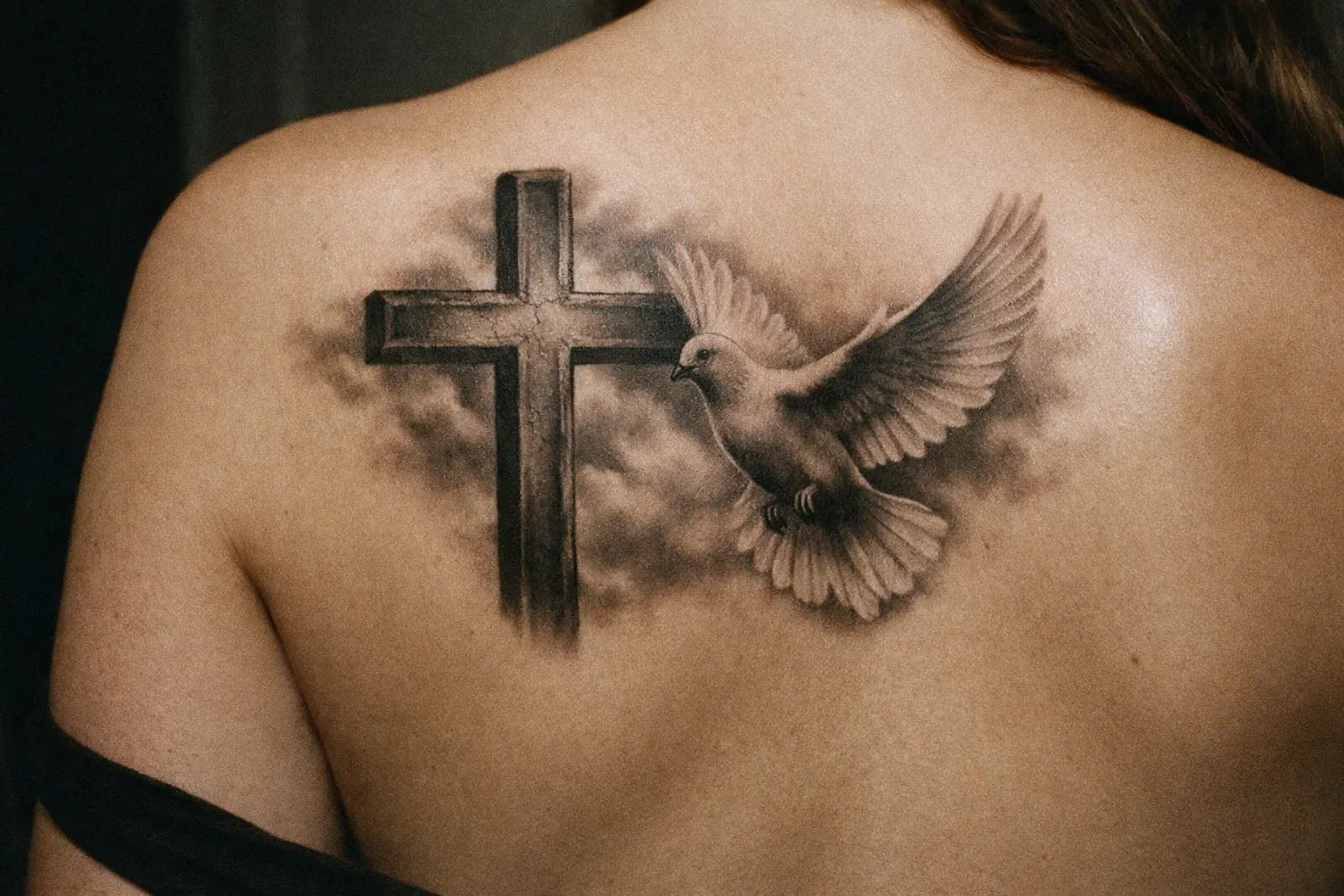
- Outer forearm: low-to-moderate pain, high visibility, easy to conceal under a sleeve, and reliable aging with SPF 30+ when exposed. 2 to 5 inches for crosses, 8 to 15 cm for doves or combined pieces. This is the default for a reason.
- Inner forearm: moderate pain, faces the wearer (relevant to that inward-orientation finding), ages reliably. Same size range as the outer.
- Upper arm and biceps: low-to-moderate pain, moderate visibility, very reliable aging, and men’s most common placement at 26%. More canvas for complex symbols or a sleeve foundation. Minimum 3 inches.
- Upper back: the largest canvas, low visibility, very reliable aging, and 19% of both men’s and women’s religious tattoos. Ideal for a full Armor of God composition. Hardest to see yourself, which matters if the piece is devotional. Minimum 4 inches.
- Chest and sternum: moderate-to-high pain (chest hurts more than forearm), low-to-moderate visibility. Sacred Heart and crucifix are natural fits, and an over-the-heart placement adds weight without needing explanation. Minimum 3 inches.
- Wrist, collarbone, behind the ear: small designs only, at or below 1×1 inch. Women’s most common spots (wrist 23%, foot 18%). Easy to conceal, fine-line work required, more frequent touch-ups.
- Neck and hand: many studios vet or decline these because of employment impact. High pain. Finger crosses fade fastest and need touch-ups every 1 to 2 years. Neck placements are permanently visible, so have a serious conversation before committing.
The aging reality by placement is consistent: fingers and wrists fade fastest, forearm and upper arm age most reliably with sun protection, and ribcage and sternum are high-pain spots that can distort with weight change. UV exposure is the single biggest fading factor, so broad-spectrum SPF 30 or higher after healing is non-negotiable for anything exposed.
Faith Tattoo Placement Comparison
| Outer forearm | Inner forearm | Upper arm / biceps | Upper back | Chest / sternum | Wrist | Collarbone | Finger | Neck | |
|---|---|---|---|---|---|---|---|---|---|
| Pain Level | Low-moderate | Moderate | Low-moderate | Low-moderate | Moderate-high | High | Moderate | High | High |
| Visibility | High | Moderate | Moderate | Low | Low-moderate | High | Moderate | High | Very high |
| Concealment | Sleeve | Sleeve | Short sleeve | Any top | Shirt | Watch/bracelet | Collar | None practical | None practical |
| Aging Reliability | Reliable (with SPF) | Reliable | Very reliable | Very reliable | Reliable | Moderate (fades faster) | Moderate | Poor (touch-ups every 1-2 yrs) | Moderate |
| Min. Recommended Size | 2 inches / 5 cm | 2 inches / 5 cm | 3 inches / 7.5 cm | 4 inches / 10 cm | 3 inches / 7.5 cm | 0.5 inch / 1.5 cm | 1 inch / 2.5 cm | 0.3 inch / 0.8 cm | 1 inch / 2.5 cm |
Denominational Considerations - What Different Traditions Say About Faith Tattoos
Leviticus 19:28 is the biblical text most often cited against tattoos, rendering in the ESV as: “You shall not make any cuts on your body for the dead or tattoo yourselves.” Other translations vary the wording; the NIV reads “do not cut your bodies for the dead or put tattoo marks on yourselves.” How much weight that carries depends heavily on your tradition.
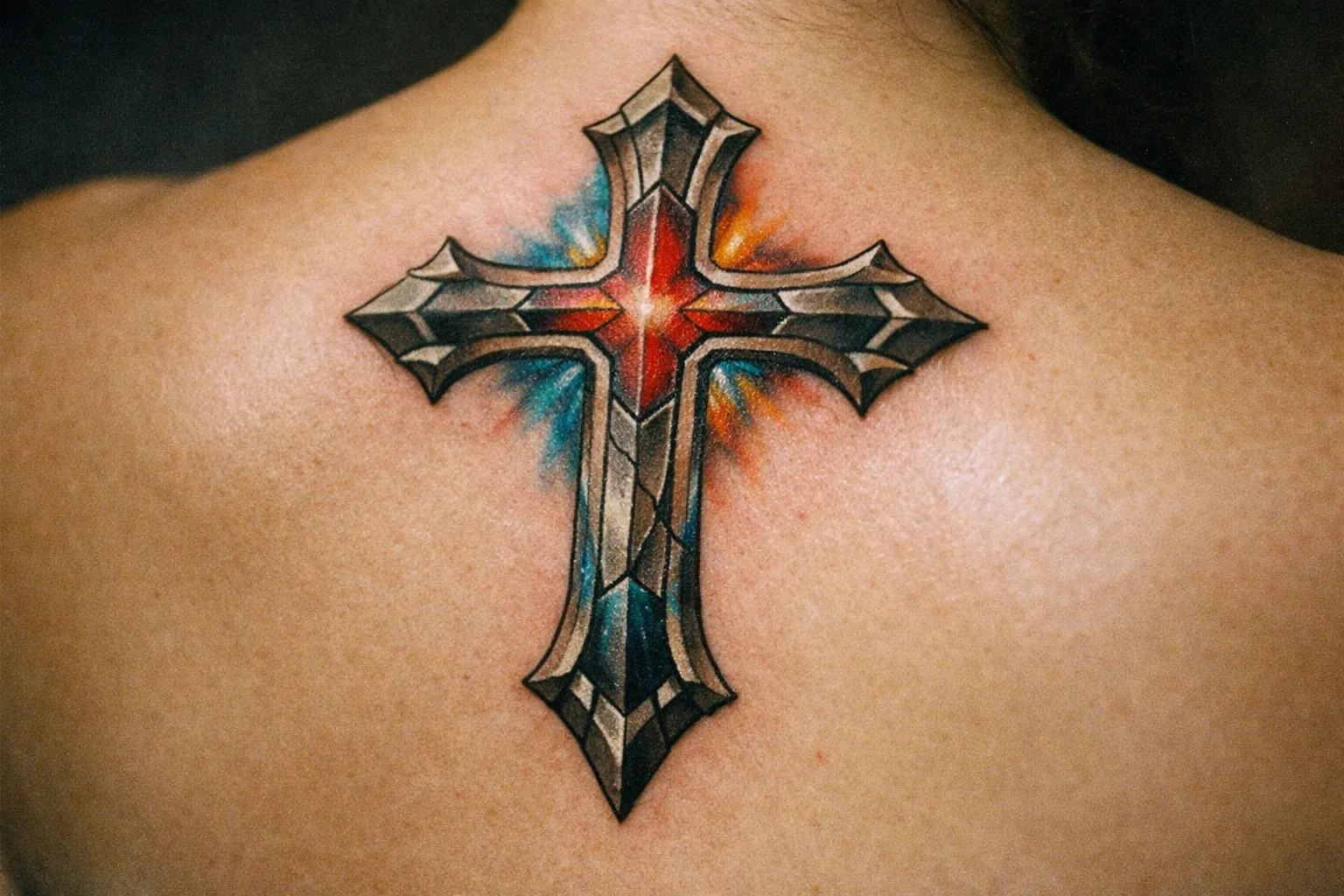
Most Catholic, mainline Protestant, and evangelical pastors treat cross tattoos as a conscience issue, not automatic sin, and the practical framework many use comes down to three questions: examine your motive, ask whether the imagery honors or dishonors, and consider submission to community authority.
Here’s how the major traditions land:
- Roman Catholic: no official prohibition. The crucifix and Sacred Heart are canonical imagery. Consult your priest if you’re unsure about specific imagery.
- Eastern Orthodox: no universal ban, though some jurisdictions discourage it. The three-bar cross is tradition-specific.
- Protestant (evangelical and mainline): largely conscience-based. Philippians 4:13 and Joshua 1:9 are among the most tattooed verses in this world.
- Conservative traditions (some Baptist, Pentecostal, Holiness denominations): written position statements against tattoos exist here. A visible faith tattoo on the face or neck can create genuine social and spiritual conflict, so consult a pastor or elder before committing - especially for highly visible placements.
Beyond Christianity, Leviticus 19:28 is also cited in Jewish law, and Islamic scholars are divided on tattoos. This guide focuses on Christian imagery because that’s what dominates U.S. faith tattoo culture: Baylor’s 2025 reporting found about 80% of adults with tattoos in the national study had some religious affiliation, with Evangelical Protestants and Catholics forming the largest groups. For context, a U.S. bishops’ article cited Pew figures showing 32% of Americans have tattoos, with 41% of religiously unaffiliated adults tattooed versus 29% of religiously affiliated adults.
What Makes a Faith Tattoo Hold Up - Design Decisions That Affect Longevity
A faith tattoo that ages badly can’t do its devotional job. That’s not a philosophical point - it’s a practical one. The design choices that protect longevity are worth understanding before you commit.

Script legibility is the first battleground. Script letters below ½ inch (12-13 mm) blur within 5 to 10 years, especially on wrists and fingers. A line that starts at 0.3 mm wide can soften to 0.5 to 0.6 mm after a decade, so choose a font with clear letterforms rather than a decorative script full of thin hairlines. Bold linework outlasts fine-line every time.
Size minimums exist for a reason. Celtic knotwork collapses below 3 inches. Realistic crucifixes lose facial detail under 6 inches by year five. Small standalone crosses only work at 0.3 to 1 inch with single-needle technique. Fine-line work in general holds up anywhere from 1 to 10 years depending on placement, ink depth, skin, and aftercare, and most of the visible change happens in the first 2 to 5 years.
Sun protection is the single biggest long-term factor. SPF 30 or higher on exposed placements is essential because UV light fades ink, and your forearm gets far more sun than your back or chest. Factor that into the placement decision itself.
Avoid symbolic clutter. For any piece under 8 cm, cap it at two or three elements. Five symbols crammed into a 6 cm space becomes visual noise within a few years. The 1/3 composition rule applies most to forearm, chest, back, and sleeve work.
Finally, think through mixing traditions. Combining explicitly Christian symbols with non-Christian religious icons can read as syncretistic to faith communities. And research any symbol carefully before pairing it with a cross: some Norse runes have been co-opted by hate groups (Othala, doubled Sowilo, Tiwaz in certain contexts). Safer heritage pairings include Celtic knotwork, the Chi-Rho (☧), Alpha and Omega, or the Tau cross.
Before You Book - Practical Steps for Planning a Faith Tattoo
Planning Your Faith Tattoo
About 2 hoursStep-by-step guide to prepare for a faith tattoo that lasts and holds meaning
- 1
Define the purpose
Decide if the tattoo is for personal devotion (inward-facing) or public witness (outward-facing); this shapes orientation, placement, and size.
- 2
Choose the design category
Pick cross only, script only, or image-plus-text; each has different sizing and legibility demands.
- 3
Select the motif and tradition
Match your choice to your tradition: Latin cross, crucifix, Celtic cross, dove, anchor, or verse.
- 4
Draft and verify all text
Confirm scripture references, translations, orientation (right-to-left for Hebrew), and font legibility; consult fluent speakers for non-English text.
- 5
Decide placement and size
Use placement comparisons; consider concealment needs, pain tolerance, and how the design ages at the chosen spot.
- 6
Find the right artist
Review healed-work portfolios, not just fresh photos; for portraits or knotwork, ensure healed examples of that style.
- 7
Book a consultation
Spend 15-30 minutes with your artist; bring references and verified text; confirm composition plans for large pieces.
- 8
Plan sessions for large pieces
Schedule 2-4 sessions of 2-3 hours each, spaced 4-6 weeks apart; never start a sleeve without a full layout approved.
On aftercare, the timeline is straightforward:
- Day 1-3: keep the initial bandage as instructed, then wash 2 to 3 times daily with fragrance-free soap and apply a thin layer of fragrance-free moisturizer. Expect some plasma weeping and minor swelling.
- Week 1: itching and flaking begin. Do not pick or scratch. Avoid pools, hot tubs, and direct sun.
- Week 2-4: surface healing completes and color may look dull or patchy. Keep moisturizing.
- Month 2-3: deep healing finishes and final crispness emerges. Schedule any touch-up after week 6, not before.
- Long term: SPF 30 or higher whenever the tattoo is exposed. UV is the biggest fading factor there is.
Frequently Asked Questions
Frequently Asked Questions
- What tattoo symbolizes faith?
- The cross is the most common Christian faith symbol, appearing in about 61% of religious tattoos. Dove, anchor, Chi-Rho, and ichthys are also meaningful options.
- What Bible verse says not to get tattoos?
- Leviticus 19:28 forbids tattooing, but interpretations vary. Most Catholic, Protestant, and evangelical pastors treat it as a conscience issue, not a strict ban.
- What is a good meaningful tattoo for a man?
- Men often choose large crosses on upper arm, forearm, or back. A bold Latin cross 3-5 inches on the outer forearm ages well and allows sleeve expansion.
- What tattoos glorify God?
- Any design inked with genuine devotion and care can glorify God. Common motifs include crosses, scripture verses, doves, praying hands, and crowns of thorns.
- How small can faith tattoo script be and still stay legible?
- Minimum letter height is about ½ inch (12-13 mm) for standard script and ¼ inch (6 mm) for bold block lettering. Smaller script blurs within 5-10 years, especially on wrists and fingers. Short phrases work better than full verses.
- Do faith tattoos need to be visible to be meaningful?
- No. About 26% of religious tattoos face inward for personal contemplation, not public display. Inner forearm, wrist, and sternum placements support this.
- Can I get a faith tattoo if my denomination discourages tattoos?
- Some conservative denominations oppose tattoos. Visible faith tattoos can cause social or spiritual conflict; consult a pastor or elder before committing.
- How long does a large faith tattoo like an Armor of God sleeve take?
- Typically 2-4 sessions of 2-3 hours each, spaced 4-6 weeks apart. The full design should be mapped before starting to avoid costly layout fixes.
Making the Decision
Three decisions determine whether a faith tattoo works over the long haul: the design category (cross, script, or a combination), the placement (which dictates size, pain, concealment, and how it ages), and the execution quality. Get those right and the piece will still read cleanly in a decade. Cut corners on any of them and you’ll be looking at a touch-up or a cover-up sooner than you’d like.
Stop scrolling references and look at healed work. Fresh photos flatter every artist; healed photos are the only honest measure of how their lines hold up. A fifteen-minute consultation with the right artist is worth more than an hour of Pinterest, and it’s where the difference between a solid faith tattoo and a regrettable one actually gets decided.