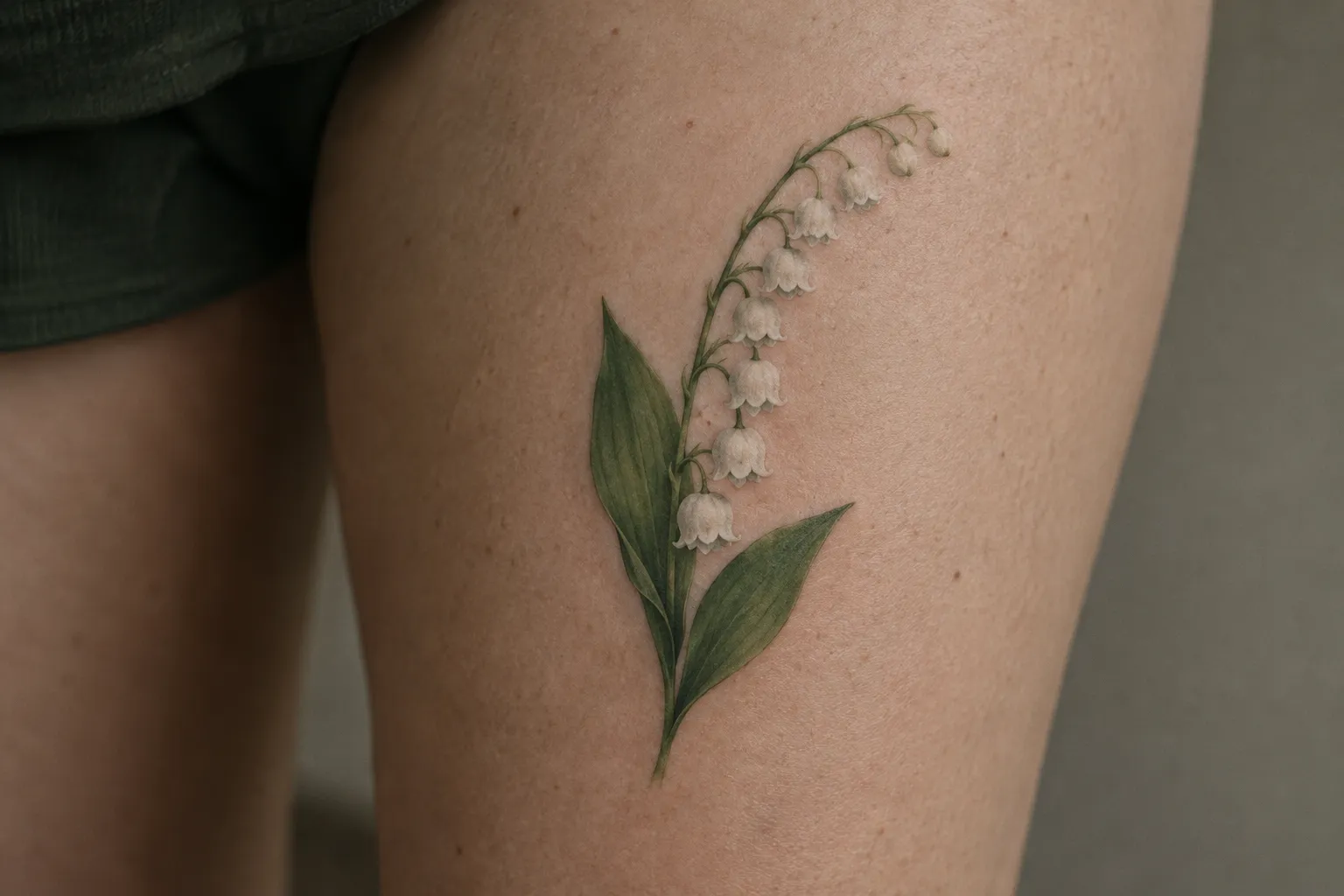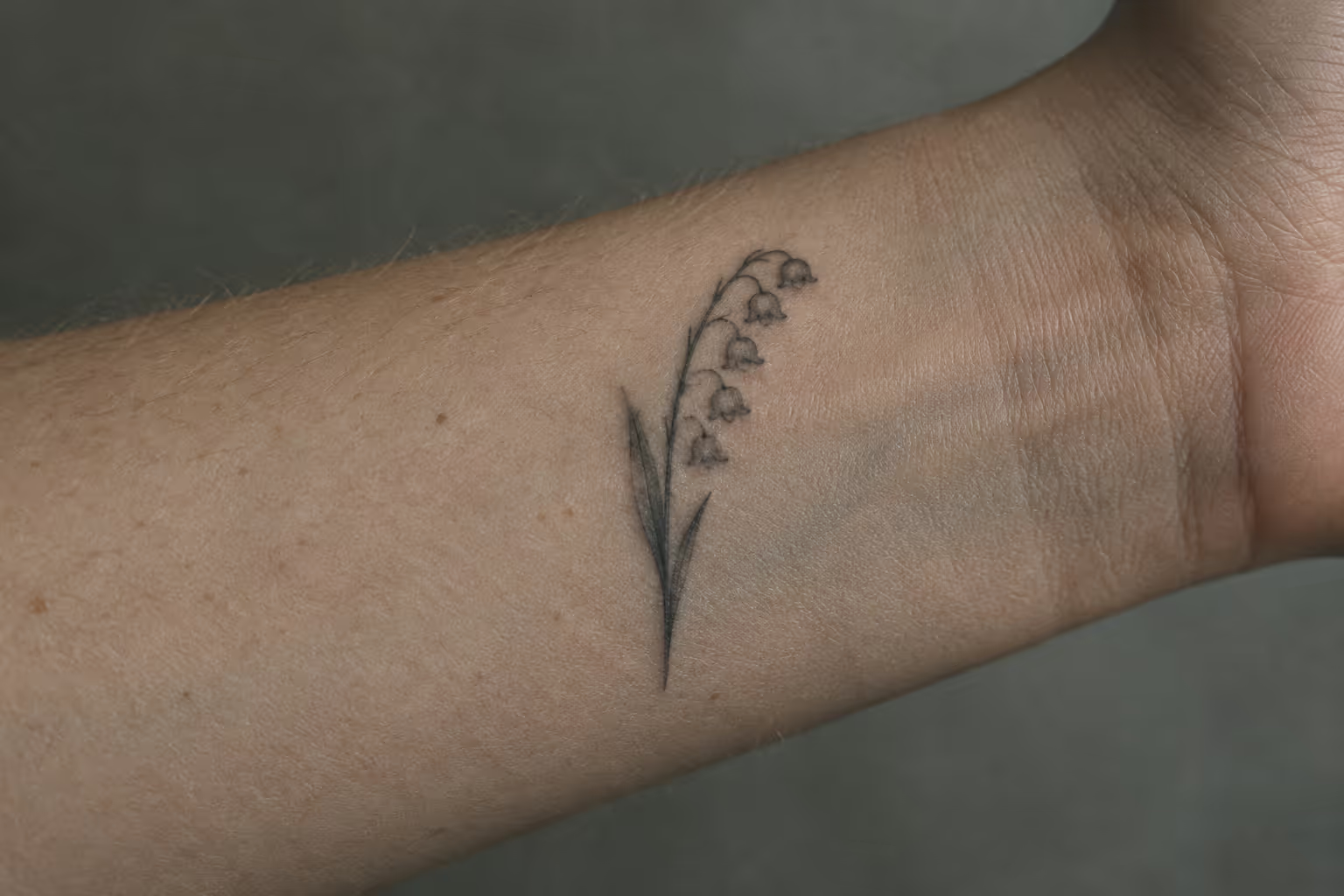
A lily of the valley flower isn’t a single bell. It’s a one-sided cluster of 6 to 16 tiny nodding bells, each about ⅓ inch (about 8 mm) long and wide (2). That detail separates a lily of the valley tattoo that reads as this specific plant from a generic bell-flower sketch. This guide covers what the flower means, how its bloom season ties it to May, and which sizes and placements can hold the bells clearly.
Lily of the Valley Tattoo Meaning: Return of Happiness and Beyond
The traditional lily of the valley tattoo meaning is “return of happiness,” a reading tied to the plant coming back each spring (1)(5). Flower guides also give it purity, humility and sweetness (1)(5), and tattoo guides add more readings on top.
Convallaria majalis is native to Eurasia (2), and despite its name it isn’t a true lily: it belongs to the asparagus family (1)(5). For the true lilies, see our lily tattoo guide. One tattoo studio’s guide calls it May’s birth flower “in the Victorian style” and the traditional flower of a royal wedding bouquet (8). Its old common names include Our Lady’s Tears and Mary’s tears (1)(3). Christian legend says it first bloomed where Eve’s tears fell as she left the Garden of Eden, or where Mary’s tears fell at the crucifixion (1)(3). Those legends give the flower a devotional, mourning-adjacent layer that some people want and others don’t.
Tattoo articles list purity, humility, sweetness, renewal, and hope (4). Others add remembrance, protection, and quiet strength (7). The Old Farmer’s Almanac connects the May flowers to purity, hope, and renewal, and describes lily of the valley specifically as representing sweetness and purity (1). None of these is wrong. None of them is the single fixed meaning either.
A decision rule helps here:
- If you want the historical meaning, go with “return of happiness.” It’s the reading tied to the plant’s spring reappearance (1)(5).
- If you’re drawn to purity, humility, renewal, or hope, you’re in good company: purity and humility already appear in flower guides (1)(5), and tattoo articles add renewal and hope (4).
- If it’s a memorial piece, the legend of Mary’s tears (1) and the remembrance reading in tattoo guides (7) both support that intent.
Decide which of these you mean before you book, because it changes what you add to the design. A “return of happiness” piece might pair open bells with new buds. A memorial piece is more likely to carry a name or date.
✓ Pros
- The bell cluster gives the motif a recognizable silhouette even without color.
- A single stem can be scaled into a larger composition without changing the flower's basic structure.
✗ Cons
- Tiny versions leave little room to distinguish each bell from the next.
- A crowded cluster can lose the plant's defining one-sided arrangement.
The trade-offs, briefly. On the plus side, the design is delicate, carries a clear traditional meaning, scales from a tiny sprig to a shoulder composition, and fits a wide range of placements. On the minus side, fine detail can blur when the design is shrunk too far (7). The drooping one-sided cluster needs an artist who can render it so it doesn’t read as a random bell flower, and fine linework softens faster than bold lines, so plan for a touch-up at some point (8).
May Birth Flower Tattoo Meaning and the Bloom Season
A May birth flower tattoo usually features lily of the valley, which is one of May’s two birth flowers alongside hawthorn (1). In France, small sprigs of lily of the valley, muguet, are given to friends and family on 1st May for luck and happiness (5). If you want a specifically May design, lily of the valley is the more recognizable of the two in tattoo form: hawthorn flowers in small white, red, or pink clusters (1), while lily of the valley has its one-sided row of bells.
Flowering lasts around 3 weeks, from late spring to early summer (2). The Woodland Trust gives the season as May to June (3). Read those together: the plant blooms for roughly three weeks somewhere inside a May-to-June season, not for the whole stretch. If your May birth flower tattoo is meant to mark a specific spring, a birth, or a season of change, the “fleeting” part of that bloom is part of the reference.
A birthday isn’t the only reason people choose it. Tattoo guides tie it to loved ones, remembrance, and new beginnings (4)(7). Those are personal design intentions, not botanical facts, so tell your artist which one you mean.
The season can also shape the drawing:
- Full bloom: every bell open, for a birthday or a celebration piece.
- Buds plus open bells: the round green buds (3) suggest something still unfolding, which suits a “return of happiness” or new-beginning theme.
- Berries: the plant’s bright red berries (3) appear after flowering. Adding a few signals late season.
Getting the Botanical Details Right for an Authentic Design
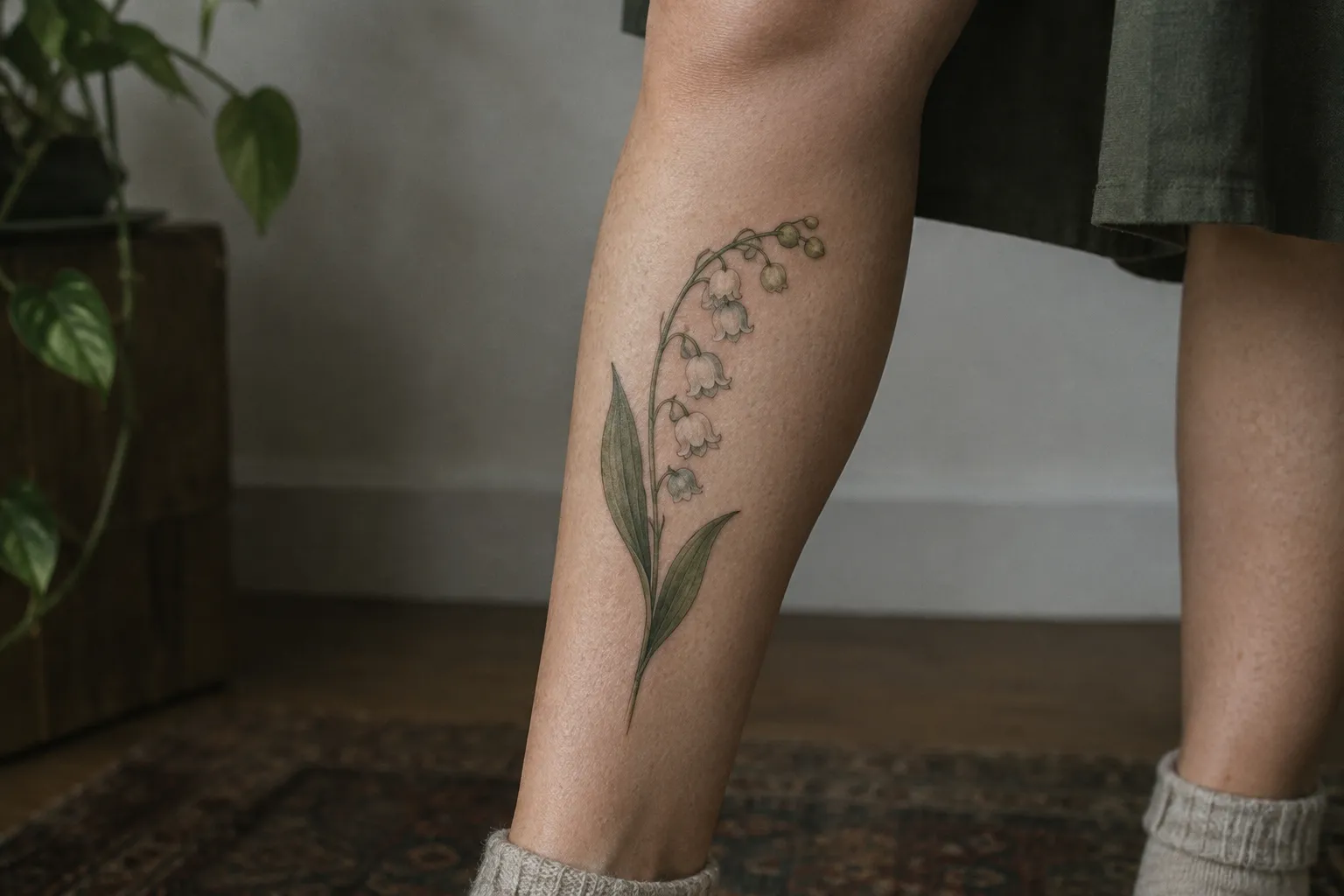
The defining feature of lily of the valley is a one-sided, drooping flower spike, with every bell hanging off the same side of an arching stem (3). Get that right and the design reads as this plant even at small scale. Draw bells on both sides of a straight stem and you’ve drawn a generic bell flower.
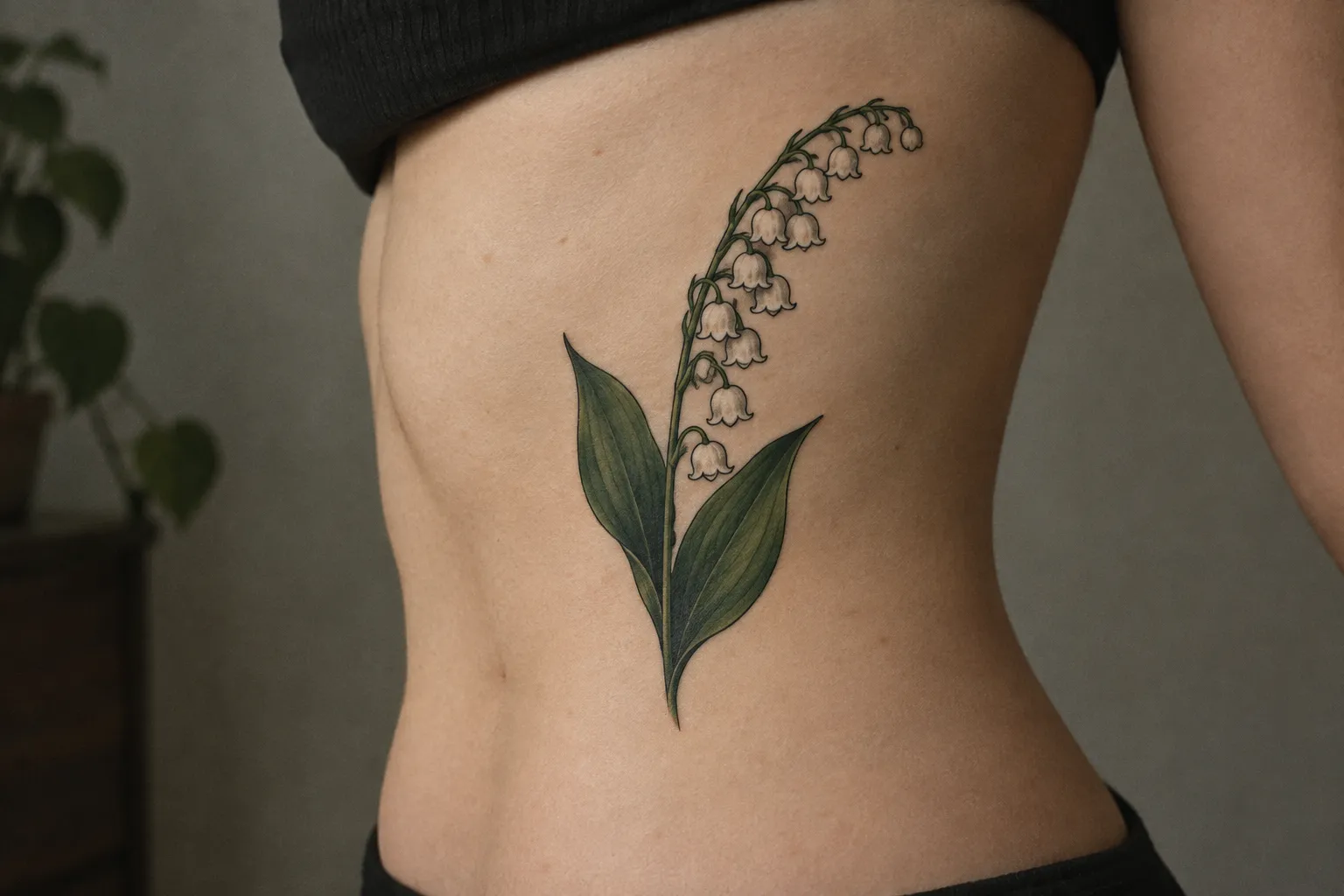
The structural details to bring to the consult:
- Bell count: 6 to 16 small, nodding bells per cluster (2). You don’t need all sixteen. Too many small details can blur as the tattoo heals, and keeping the bells a little larger helps them age better (7).
- Bell shape: fused bells with six lobes that curve outward at the rim (2). That flared lip is what makes each bell look like lily of the valley and not a tiny tulip.
- Bell size: about ⅓ inch (about 8 mm) long and wide in life (2).
- Leaves: oval, untoothed, and growing in pairs from the base (3). A pair of broad leaves wrapping the base of the stem gives the design weight and a natural frame.
Bring a botanical reference photo showing the one-sided cluster, not a stylized clip-art bell flower. A good artist will simplify it, but they need the real structure to simplify from. An exact, detailed reference shrunk to a tiny size won’t keep every bell and leaf distinct once it heals (7). Ask how the detail translates at the size you’re planning.
Choosing Size and Placement: From Small, Discreet Ideas to Shoulder Pieces
The right lily of the valley size depends on placement: a tiny stem with a few bells suits the wrist, ankle, or behind the ear, a 2-4 inch (5-10 cm) vertical stem works on the inner forearm, ribcage, or spine, and the shoulder into the upper arm leaves room for more detail (4)(7)(8). Pick the level of detail you want first, then the placement that can carry it.
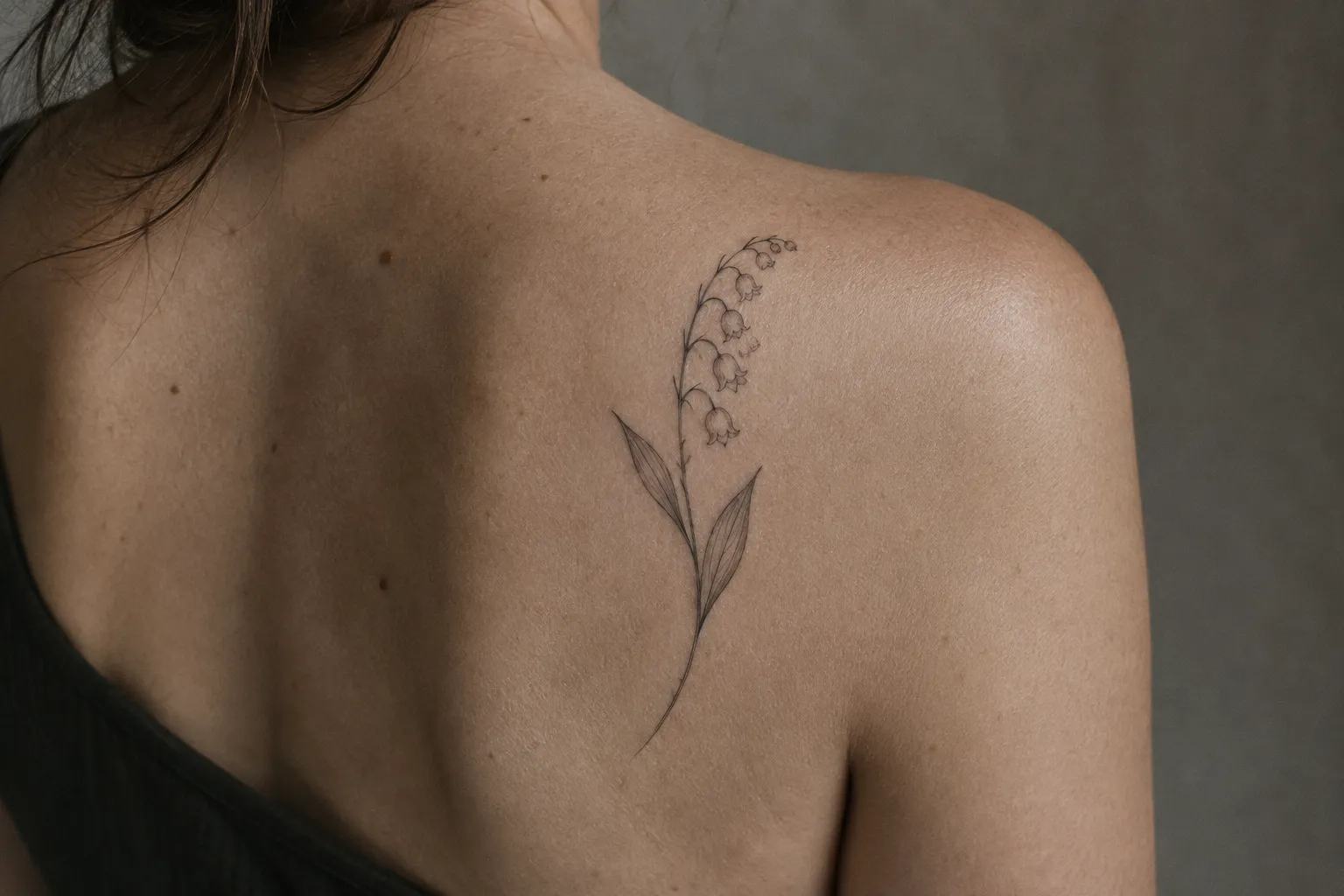
Small and discreet: wrist, ankle, behind the ear
A small lily of the valley tattoo works best as a single curved stem with a few bells. Wrist, ankle, and behind-the-ear placements all appear in published design ideas (4). At this scale, the one-sided droop does most of the identifying work, so don’t let the artist crowd extra bells in.
Be realistic about aging. Very tiny minimalist florals can soften quickly over time; a darker outline and a little more size help the bells stay readable (7), the same advice our flower tattoo ideas guide gives for any small bloom. The skin behind the ear is thin, and the process there can be painful (4). The ankle bone is more sensitive than the fleshy calf, so expect ankle > calf for pain.
Mid-size vertical stem: inner forearm, ribcage, or spine
A 2-4 inch (5-10 cm) vertical stem suits the inner forearm, ribcage, spine, or behind the shoulder (8). The same guide notes that it still reads as a specific species at that size (8). This is the format that lets you show the arching stem, a full one-sided cluster, and a leaf pair without compressing anything.
- Inner forearm: flat and visible in short sleeves. Low to moderate pain, sharper toward the wrist.
- Ribcage: follows the body’s curve, easy to cover. Pain runs ribcage > forearm, because the skin is thin and moves when you breathe.
- Spine: a vertical stem follows the line of the back cleanly. Over the bony ridge, spine > forearm for pain.
- Back of neck: also listed as an option (4), for a shorter stem.
Shoulder and upper arm: room for more detail
A shoulder composition can extend down onto the upper arm, which gives room for more intricate detail and lets you cover or show the tattoo depending on what you wear (4). A sweeping stem can follow the curve of the shoulder, and the same sweeping format works on the arm and calf (7). This is where several stems, multiple leaf pairs, buds, and berries fit without shrinking. For leg placement, the ankle suits small sprigs (4), while the calf takes a longer sweeping stem (7).
Size and placement at a glance. Small, discreet designs go on the wrist, ankle, or behind the ear and hold a single stem with a few bells. The 2-4 inch (5-10 cm) vertical stem goes on the inner forearm, ribcage, spine, or behind the shoulder (8) and holds a full one-sided cluster with leaves. Shoulder and upper-arm compositions leave room for more intricate botanical detail (4). For cost, a medium tattoo of 2-5 inches typically runs $300-$900 in the US as of May 2026 (6), which covers the vertical-stem format. Small and shoulder-scale pieces are priced at the consult.
Style Options: Realistic, Black-and-White, and Color Designs
Lily of the valley is commonly tattooed in realistic, black-and-white, and color styles (4), and published ideas also include traditional, linework, and fine line versions (4)(8). Tell your artist the contrast and detail you want. No single style is required for the flower to read clearly.
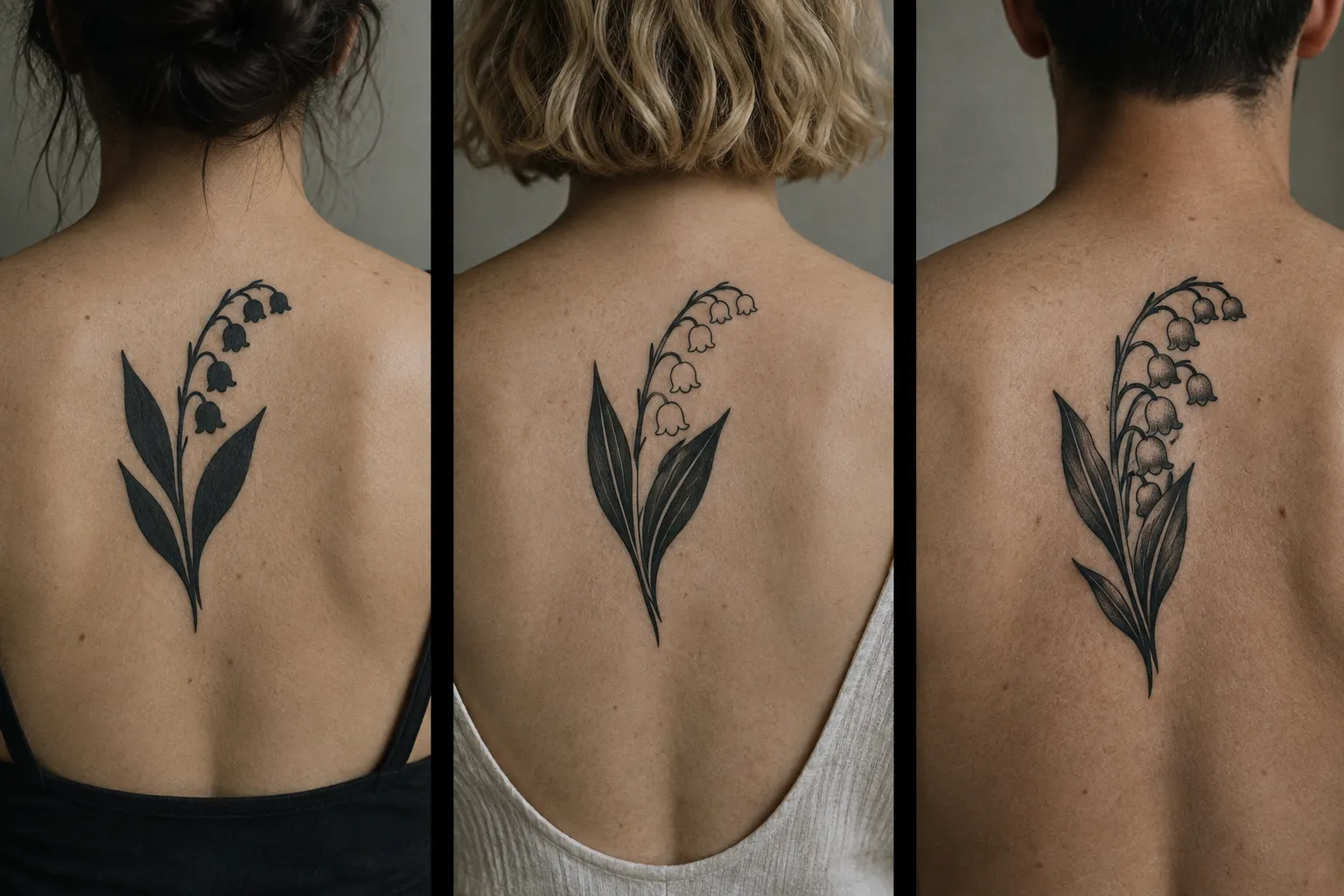
Realistic. It captures lifelike bell-shaped blooms, delicate green stems, and soft shading for an almost three-dimensional look (4). Shaded leaves add the depth that stops a delicate design from disappearing on the skin (7).
Black-and-white linework and fine line. Linework focuses on the shape of the flowers with thin, clean lines and no heavy shading or color (4), leaving open skin to stand in for the white petals. The pitfall is placing the lines too close together: too many fine details can blur as the tattoo heals (7).
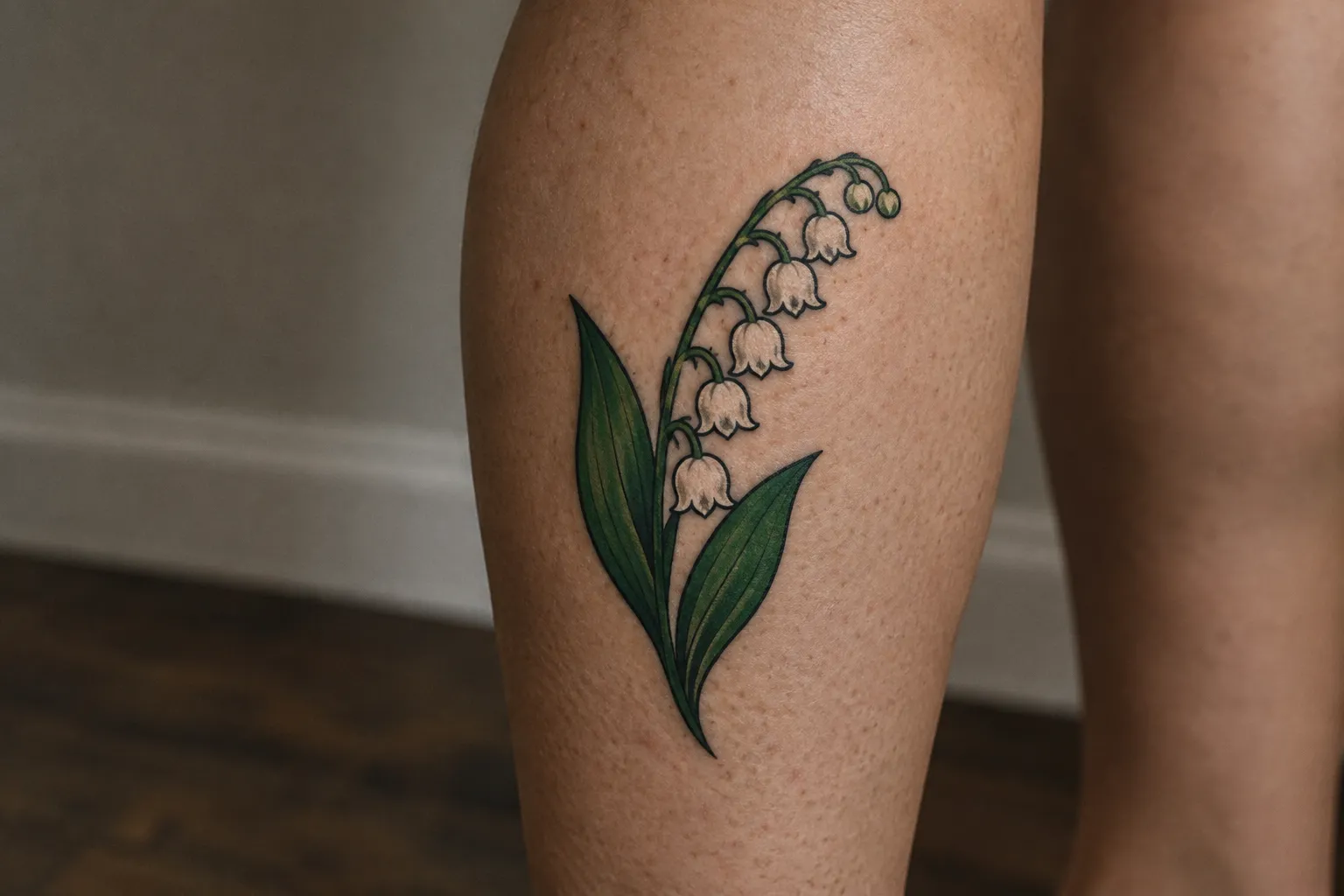
Color. The flowers are white, though the plant can also produce pink or purple blossoms (1), and blue-bell versions appear among published designs (4). Color pieces often use green for the leaves and white or pink for the flowers (4). Black-and-grey work generally shows less noticeable fading than bright color (4), so a design that relies on white highlights to define the bells needs a black or grey structure underneath it.
Traditional. It uses bold lines, simple shading, and bright colors like green and white (4). The failure mode is too many bells. Bold outlines need fewer, larger bells, so expect an artist to cut the cluster down to a handful.
Personalizing the Design: Text, Skulls, and Other Add-ons
Lettering is a common way to personalize a lily of the valley design: published ideas pair the flowers with a name, a date, or a short phrase alongside or beneath the stem (4). Settle your intent first (May, return of happiness, or a remembrance) before you choose the lettering or added imagery.
Size the lettering by letter height, the height of the whole letter, not the body of it:
- Standard script: at least 12 mm (1/2 in).
- Fine or ornate script: about 25 mm (1 in).
- Block, serif, typewriter, and numerals: at least 6 mm (1/4 in).
On the wrist, only bold script or block lettering holds over time. A date in block numerals curving along the stem is one of the cleanest ways to add text without crowding the bells.
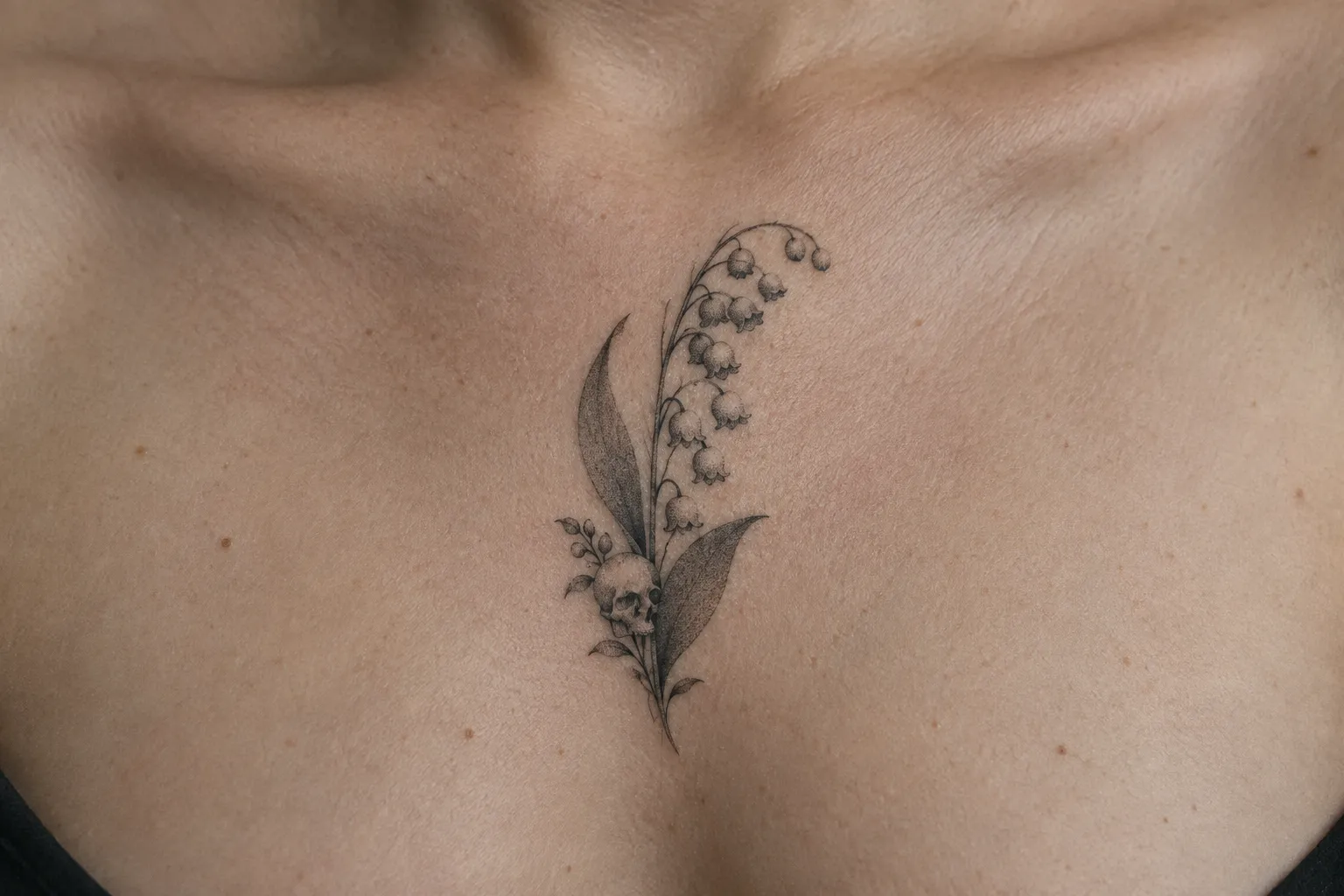
Skull combinations also appear among published lily of the valley ideas (4). One tattoo guide reads the pairing as beauty in fragility, the balance of mortality, or a mix of softness and strength (4). Other pairings in published designs include ferns, roses, hummingbirds, snakes, and dandelions (4), and stems wrapped into a heart (7). Keep the lily of the valley large enough in a combined piece that the one-sided cluster still reads.
Safety, Cost, and Aftercare for Your Tattoo
Lily of the valley is poisonous if eaten, because of cardiac glycosides and saponins (2), but that has nothing to do with tattoo safety. Tattoo risk comes from contaminated ink, unsterile equipment, and allergic reactions (9). The image of a toxic plant on your skin carries no toxicity.
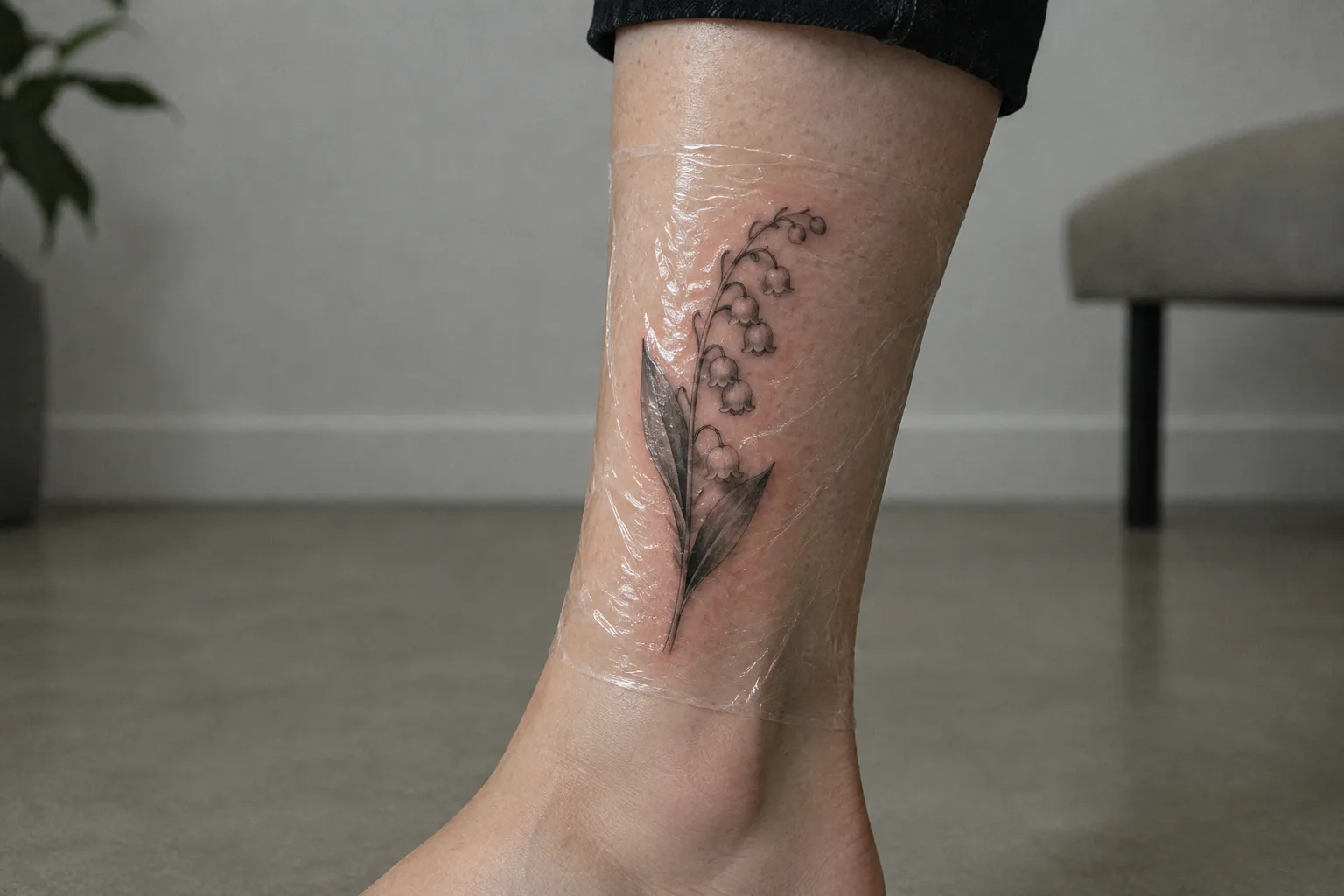
The real safety questions are about the studio. State and local authorities oversee the practice of tattooing, while the FDA oversees tattoo inks as cosmetics (9). The FDA has received reports of infections from contaminated inks and allergic reactions to inks. Even unopened, sealed ink can harbor bacteria (9). Unhygienic practices and equipment that isn’t sterile can also cause serious infections (9), so choose a licensed, hygienic studio and ask what ink they use.
On cost, a medium 2-5 inch tattoo typically runs $300-$900 in the US as of May 2026, based on a mid-tier custom artist (6). That range covers the 2-4 inch (5-10 cm) vertical stem format (8). Detail, color, and your artist’s rate move it within that range.
Aftercare basics and when to see a doctor
Day 1-3: Follow your artist’s wrap instructions. Wash gently with lukewarm water and a fragrance-free soap, pat dry, and apply a thin layer of ointment. Expect some redness and weeping plasma.
Day 4-7 and week 2: Switch to a fragrance-free lotion. The skin tightens and starts to flake, then peels and itches in week 2. Don’t pick or scratch. Avoid soaking in baths, pools, or the sea, and wear loose clothing over ribcage or ankle pieces.
Week 3-4 and beyond: The surface looks healed, but the deeper skin keeps settling until about week 6. Keep the area out of direct sun for the first 4 to 6 weeks. Fine-line bells can look patchy as the skin settles, so judge the healed result, not the fresh one, before booking a touch-up. The full week-by-week routine is in our tattoo aftercare guide.
See a doctor if the tattoo isn’t healing, develops a rash, or comes with a fever (9). If you report a reaction, the FDA recommends identifying the ink brand, color, and lot or batch number (9), so ask your studio for those details.
Frequently Asked Questions
- What does a lily of the valley tattoo symbolize?
- Its traditional meaning is return of happiness, tied to the plant's return each spring; tattoo guides also add personal readings such as remembrance or renewal.
- What is the symbolism of a lily of the valley outside tattooing?
- Outside tattooing, it is one of May's birth flowers, a 1st May gift for luck in France, a royal wedding-bouquet flower, and the subject of Christian legends about Eve's and Mary's tears.
- What is the prettiest flower to get tattooed?
- There is no objective prettiest flower; choose one whose shape still reads at your planned size, such as lily of the valley's one-sided bell cluster.
- What is the 1/3 rule tattoo?
- The 1/3 rule treats roughly one-third of a limb segment as a natural size for a standalone piece, and balances dark areas, midtones and open skin; for lily of the valley, that open skin keeps the bells separate.
- Where should I put a lily of the valley tattoo?
- Choose a placement that leaves the bells room to separate; a tightly curved or frequently rubbed spot can make fine details harder to preserve.
- How much does a lily of the valley tattoo cost?
- Ask for a quote after the artist sizes the bell cluster and discusses color, detail, and placement; those choices affect the final price.
- Is a lily of the valley tattoo dangerous because the plant is poisonous?
- No - the plant's toxicity is a concern if ingested, while tattoo risks come from ink reactions, contamination, and unsterile equipment.
Matching the Cluster to the Placement
The right lily of the valley piece comes down to one match: the one-sided bell cluster’s detail against a size your placement can hold. A wrist or ankle sprig needs few bells and generous spacing. A 2-4 inch (5-10 cm) stem on the inner forearm, ribcage, or spine (8) can carry the full cluster and leaf pair. The shoulder into the upper arm leaves room for more intricate detail (4), such as buds, berries, and several stems. Bring a botanical photo of the real cluster, decide which meaning you’re after, and pick a licensed studio. Follow the aftercare timeline through week six. That matters far more for your safety than the plant’s toxicity ever will.