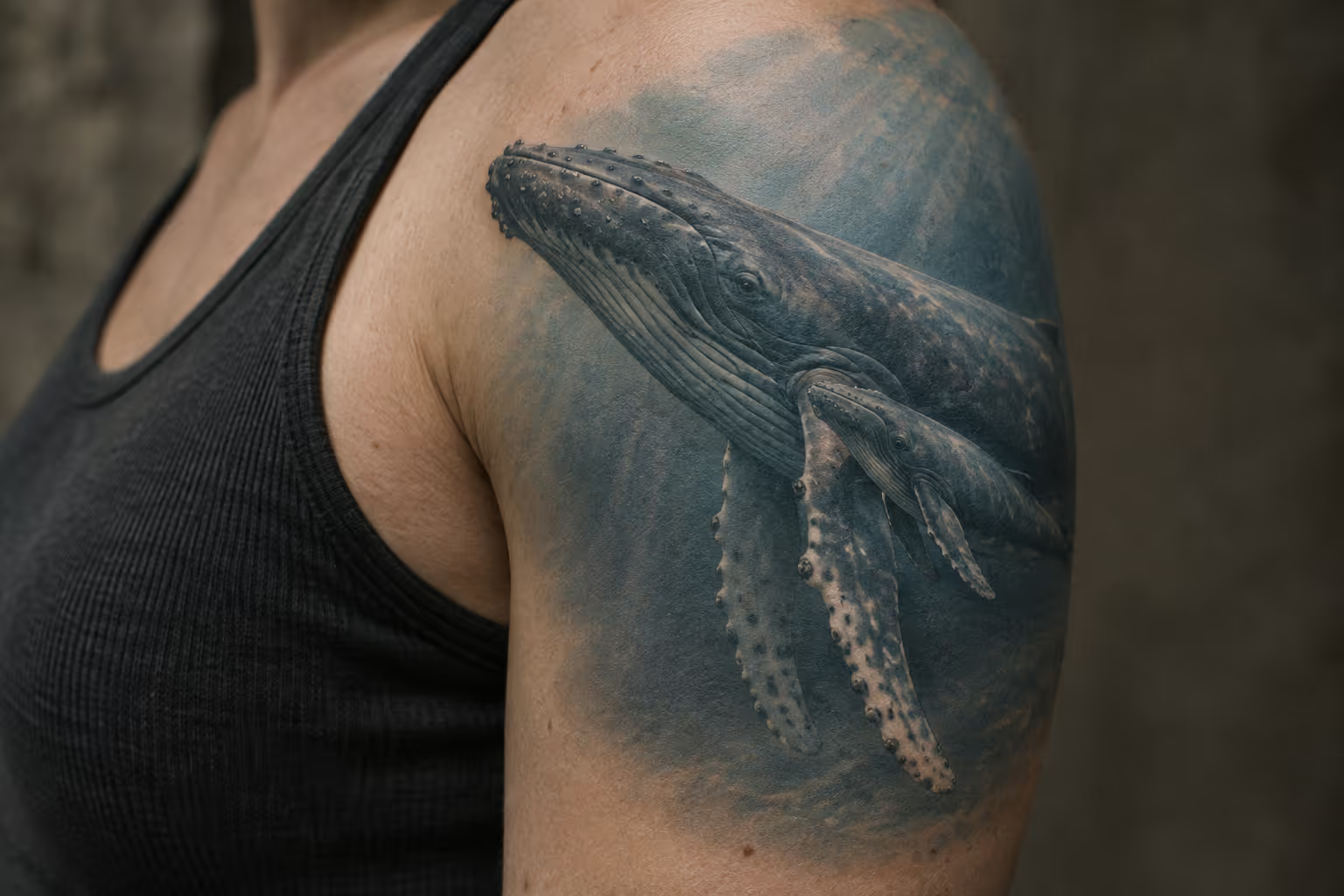
Tattoo idea pages present a mother-and-calf whale as a lifelong family bond (4). NOAA reports that humpback calves stay near their mothers for up to 1 year before weaning, and calves are not believed to keep long-term associations with them afterward (8). The image still works as a family piece. What it shows honestly is a short, protective, formative stretch of time, and that is a stronger reference than a vague “forever.”
Whale Tattoo Meaning: Family, Ocean and Protection Symbolism
Whale tattoo meaning depends on the wearer. Tattoo guides list family, resilience, travel, guidance and protection, and none of those is the single correct reading (5)(4). Treat any “the whale means X” claim as one interpretation among several. What matters more is the reference you attach to it and whether the design can carry that reference visually.
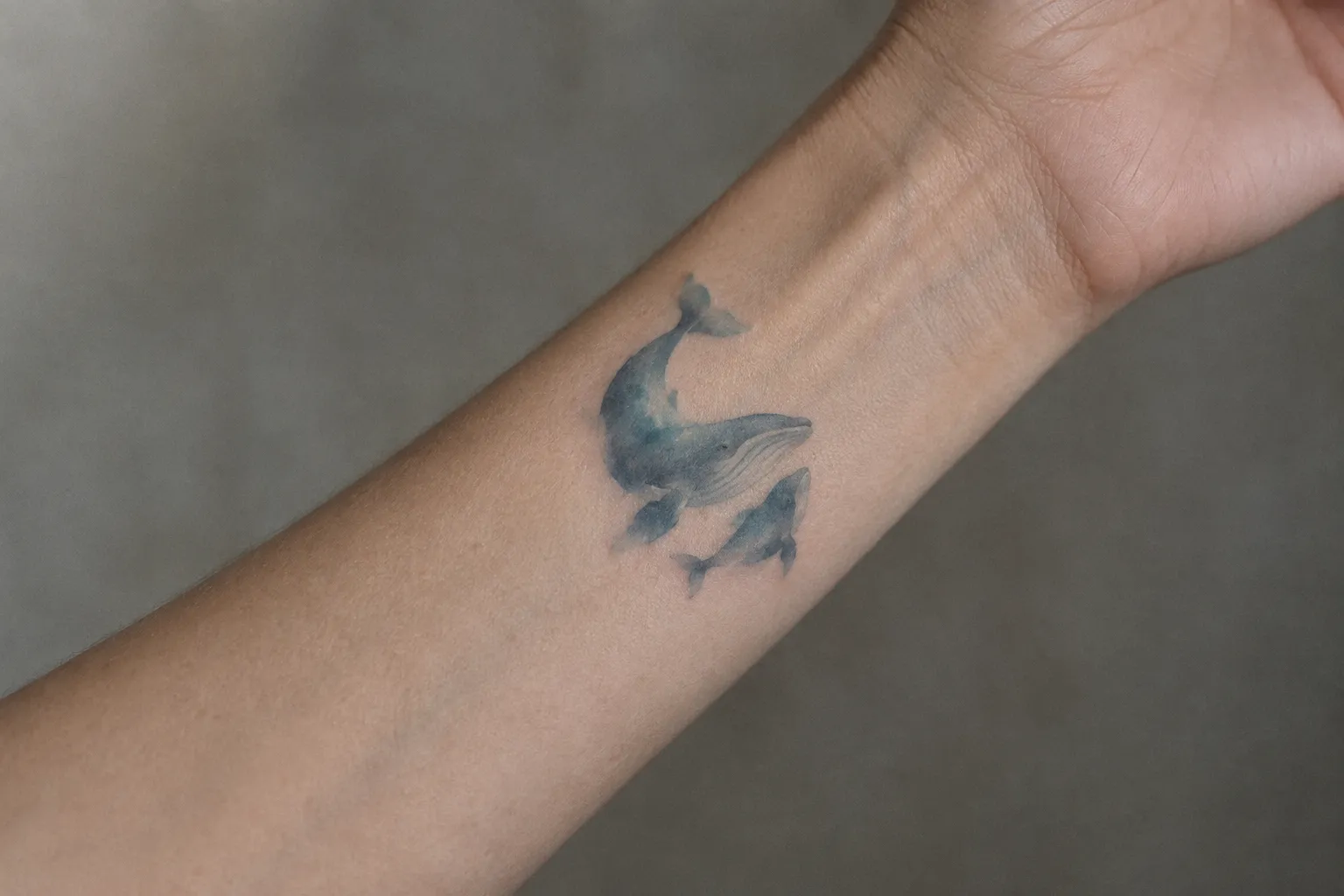
The recycled meaning lists come from tattoo idea pages, not from one cultural tradition. One guide frames the whale’s deep dives as a symbol of rebirth: you go down into the pressure and come back up (4). Another ties the whale to the moon, to empathy and to peace (1). These readings come from tattoo idea pages, not from a named culture. The Hawaiian meaning, which does belong to a specific culture, is covered in the Polynesian section below.
Whale-and-calf designs: what the bond actually looks like
The mother-and-calf composition is the most requested family whale design, and it has a real biological reference. NOAA’s humpback data says calves stay near their mothers for up to 1 year. Mothers are protective, swim closely and often touch the calf with their flippers (8). Calves are not believed to maintain long-term associations with their mothers once that year is over (8).
That fact gives you a more precise design brief than “family forever”:
- A new-parent piece: the first year of a child’s life, the period you were physically closest. The calf tucked under the mother’s pectoral fin fits this exactly.
- A memorial for a parent: the years they kept you close before you went your own way. The calf swimming slightly ahead of the mother reads as independence that the mother made possible.
- A tribute to a mentor or caregiver: any finite, formative relationship that shaped you.
On the drawing side, scale tells the viewer the calf is a calf. NOAA gives a newborn humpback length of about 13 to 16 feet (about 4 to 5 m) (8), against a maximum length of about 60 feet (about 18 m) (8). A calf drawn noticeably smaller than the mother, close against her flank and slightly above, reads as young at a glance. Draw them the same size and you get two whales, not a parent and a calf.
Other common interpretations: resilience, travel, guidance
Beyond family, tattoo guides attach several other readings to whales (5)(4):
- Resilience: surviving deep water and surfacing again. A breaching pose carries this best.
- Travel and the ocean: love of the sea, travel and exploration (5). A migration line suits it (see the humpback section).
- Guidance and protection: the large animal watching over something smaller. This overlaps with the calf design.
- Peace: a slow, horizontal glide, with no splash and no motion lines (4).
In Native Hawaiian tradition, whales have been honored as ʻaumākua, family or personal gods and deified ancestors who could take the shape of animals (11). That is a cultural meaning with a specific origin, which is different from a catalog list. The Polynesian section gets into how to handle it.
Orca vs. whale tattoos: an orca (killer whale) design is its own motif. Orcas belong to the dolphin family (4), and their symbolism comes from different sources than the humpback’s. If you want an orca, research it separately and don’t assume humpback symbolism transfers.
✓ Pros
- A real fluke pattern can make the design refer to one identifiable whale.
- Humpback anatomy gives the artist distinct shapes to work with, especially the long pectoral fins and lifted fluke.
✗ Cons
- Fine details need enough space between them to remain legible as the ink settles.
- A design borrowed from a specific tatau tradition can carry personal or community meaning that does not belong to the wearer.
The upside of a whale design is flexible symbolism, a shape that works in fine-line or blackwork, and a motif that scales from a tiny fluke behind the ear to a full back panel. The downside is that larger detailed scenes can take a few months to fully heal (3). Cultural motifs also need research to avoid misuse, and a “universal meaning” from an idea list is one reading, not a fact.
Humpback Design Details Grounded in Real Biology
A humpback whale tattoo becomes personal when it uses real humpback anatomy, meaning fluke markings, long pectoral fins and documented migration routes, instead of a generic whale outline. NOAA describes humpbacks as primarily black, with variable white markings and individually distinctive flukes (8). That color pattern suits black-and-grey and blackwork work. You don’t need color to make a humpback read as a humpback.
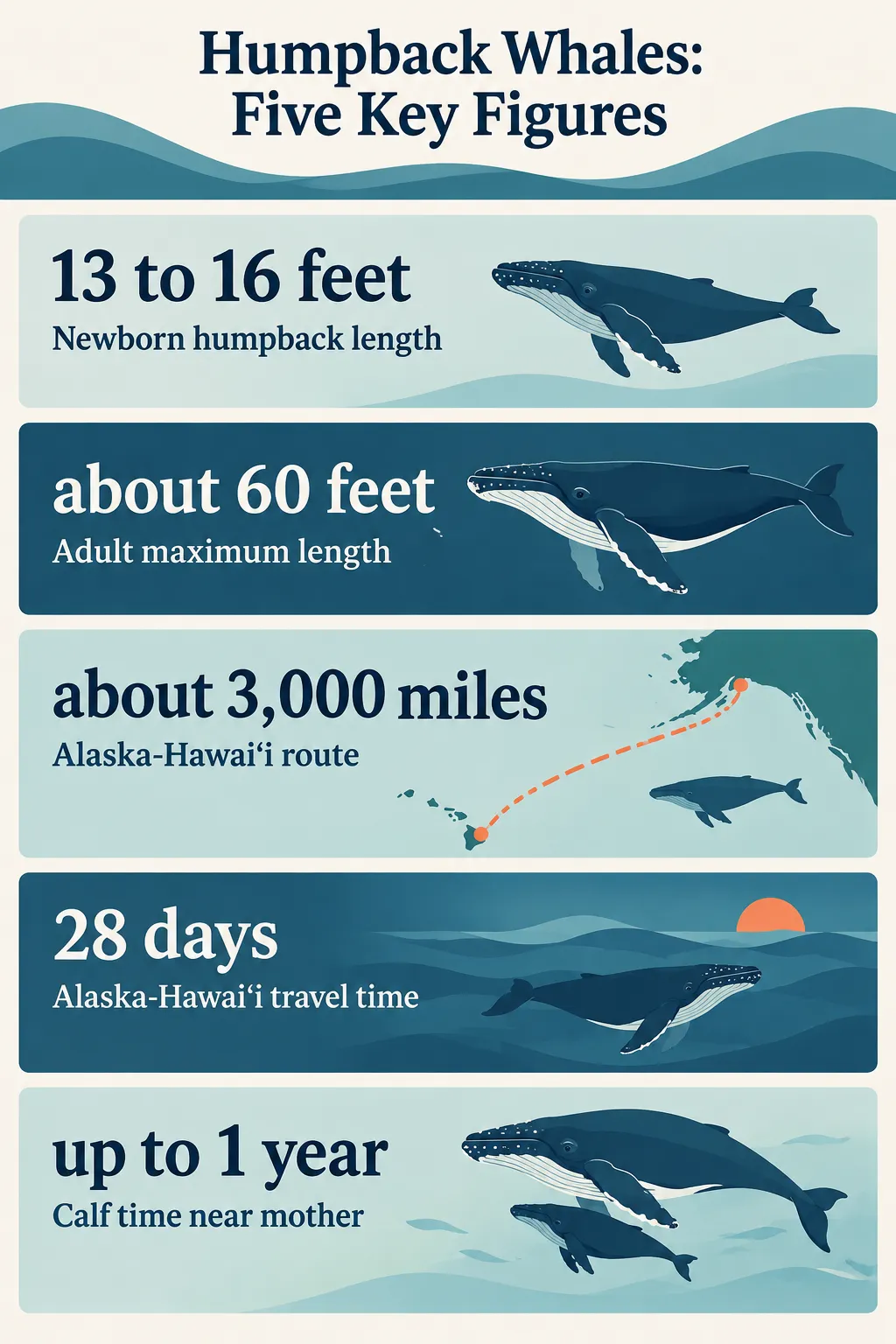 Humpback calves stay near their mothers for up to 1 year, newborns measure 13 to 16 feet, adults reach about 60 feet, and some Alaska-to-Hawaiʻi migrations cover about 3,000 miles in 28 days.
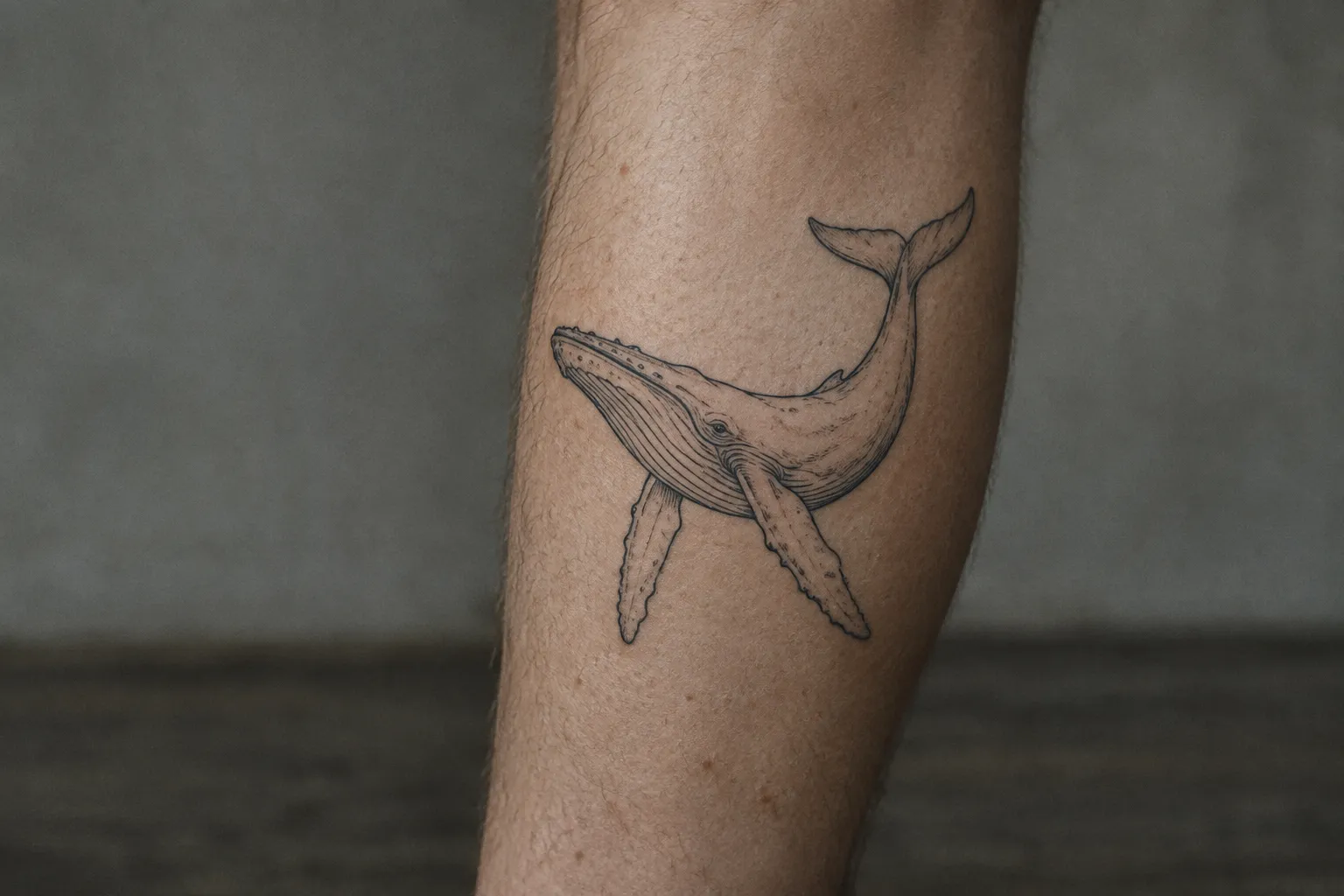
The details that separate a humpback from “a whale”:
- Pectoral fins: humpbacks have long pectoral fins; their scientific name, Megaptera, means “big-winged” (8), and the flippers can reach 25 to 30 percent of the whale’s total length (12). Draw them short and the whale loses its identity. They also give you a strong diagonal across the composition.
- The breach: a humpback launching out of the water, body twisted, fins spread. It needs vertical space, so it suits the forearm, calf or ribcage, not the wrist.
- The fluke: the tail lifted above the surface before a dive. It works at almost any size because the outline is simple.
- Throat grooves and knobby head: the pleated throat grooves and the rounded knobs on the head and lower jaw (12) make good texture at large sizes. At small sizes these are the first details to cut.
For a large piece, NOAA’s figure of about 60 feet (about 18 m) (8) is a useful scale anchor. A diver, a boat or a surfer drawn small next to the whale gives the viewer that size without any lettering.
Using fluke patterns to reference a specific whale
NOAA notes that each whale’s fluke pattern, shape and scars can help identify it, which researchers use the way you would use a fingerprint (8). For a tattoo, that means you can reference one particular animal. You might pick a whale you saw on a trip, a named whale from a research catalog, or one tied to a place that matters to you.
Here is how to brief it:
- Bring a clear photo of the underside of the fluke. The black-and-white pattern on the underside is what identifies the individual.
- Ask the artist to simplify, not invent. Keep the main white patches, the trailing-edge notches and any big scars. Drop the speckling.
- Size for the pattern. A fluke ID only reads if the white patches are big enough to stay separate as the ink settles. Palm-sized on the outer forearm or upper arm holds more of the pattern than a piece small enough for the inner wrist.
A fluke-ID design matches that one whale, and it also looks like a clean, well-executed tail to anyone who doesn’t know the reference.
Migration-line designs: short fast route vs. long sweeping route
NOAA documents two humpback migrations you can build a journey design on, instead of a vague “ocean journey” idea. Some North Pacific humpbacks travel about 3,000 miles (about 4,800 km) from Alaska to Hawaiʻi in as few as 28 days (8). Some populations swim 5,000 miles (about 8,000 km) between tropical breeding grounds and colder feeding grounds (8).
Pick the route that fits the layout:
- The Alaska-to-Hawaiʻi route: short and fast. It suits a tight design, such as a single dotted line from one point to another, a small whale at the end and a date or coordinates. It works on the forearm or along the collarbone.
- The breeding-to-feeding route: long and sweeping. It suits a multi-stop map, a curved line across the shoulder blade, or a back panel where the whale travels through waves and current lines.
If you add lettering such as a date, coordinates or place names, size it by letter height, meaning the height of the whole letter. Block letters and numerals need at least 6 mm (1/4 in). Standard script needs at least 12 mm (1/2 in), and fine or ornate script about 25 mm (1 in). Thin dates squeezed under a small whale are the first thing to blur.
Polynesian Whale Symbolism and the Tatau Tradition
Whale imagery in a Polynesian style draws on tatau, a tradition in which designs traditionally recorded genealogy, social rank and important milestones, so they are not interchangeable decoration (10). That is a different history from the “family, protection, wisdom” lists most whale guides repeat (4)(1). If you want Polynesian-inspired whale imagery, the design should come out of a conversation with a practitioner, not out of an image search.
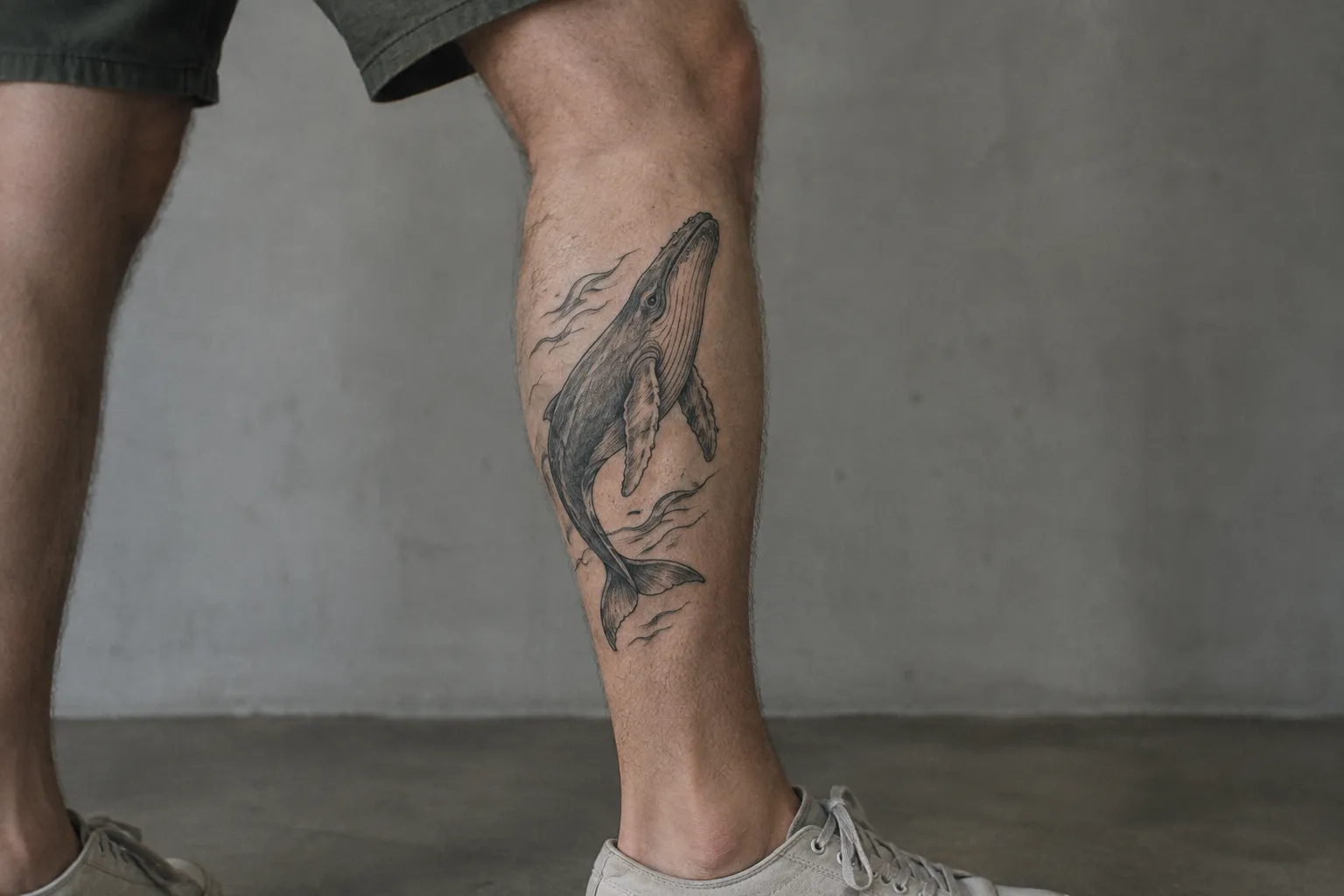
Some context on the tradition itself: tatau, the onomatopoeic name for the practice, goes back about 3,000 years (10). The Polynesian Triangle includes more than a thousand islands in the South Pacific forming several dozen cultural groups, and most of them have their own distinct tattoo traditions (10). There is no single “Polynesian whale meaning.” Depending on the archipelago, tatau was practiced differently and symbols had different meanings, and Marquesan, Samoan, Māori, Hawaiian and Tongan traditions each have their own history (10). Traditional application, where it is still practiced, uses a sharp comb dipped in ink and tapped into the skin (10).
“Tribal whale” flash, meaning a whale silhouette filled with generic Polynesian-looking pattern, borrows the look of tatau without its content. National Geographic’s reporting notes that much of the online information listing what these patterns mean isn’t accurate (10), so a flash sheet tells you nothing reliable about what its pattern says. Our tribal tattoo guide covers how the Western tribal style differs from living Polynesian traditions.
What tatau motifs can encode
Traditionally, a tatau design could record:
- Genealogy: who your family is and where they come from (10).
- Social rank: your position in the community (10).
- Milestones: events in your life (10).
According to National Geographic’s reporting, a Marquesan tattoo artist won’t copy a picture a client brings, because replicating something personalized is, in his words, “like stealing someone else’s story” (10). This is the opposite of a flash sheet. Copying a found Polynesian whale piece can mean wearing someone else’s story.
The Hawaiian meaning shows how specific these associations get. Whales have also long been revered as physical manifestations of Kanaloa, god of the sea and open-ocean voyaging (11), and their role as ʻaumākua belongs to particular Native Hawaiian families and beliefs. It is not a general “whales mean protection” rule.
Finding a practitioner who explains the tradition
If you want a Polynesian whale tattoo with cultural grounding:
- Look for a practitioner rooted in a specific tradition. Look for an artist who works in a named style, such as Samoan tatau or Marquesan, and can tell you which one, not an artist who lists “tribal” as a style.
- Expect a consultation, not a stencil. The artist will ask about you, your story and what you want the tattoo to represent, then build the design from that, often sketching it straight onto the skin (10).
- Ask what each element means and whether it is appropriate for you to wear.
- Don’t bring someone else’s tattoo as a reference. Bring the reasons you want the piece instead.
If you have no connection to a Pacific culture and just like the look, a blackwork whale with geometric pattern that doesn’t imitate tatau is the honest alternative.
Small Whale Designs and Where to Place Them
A small whale tattoo works best as a clean silhouette or a simplified fluke on the wrist, ankle or behind the ear. Longer breaching or fluke compositions need the forearm or ribcage. The placement decides how much detail survives. Pick the spot first and then cut the design to fit it, not the reverse.
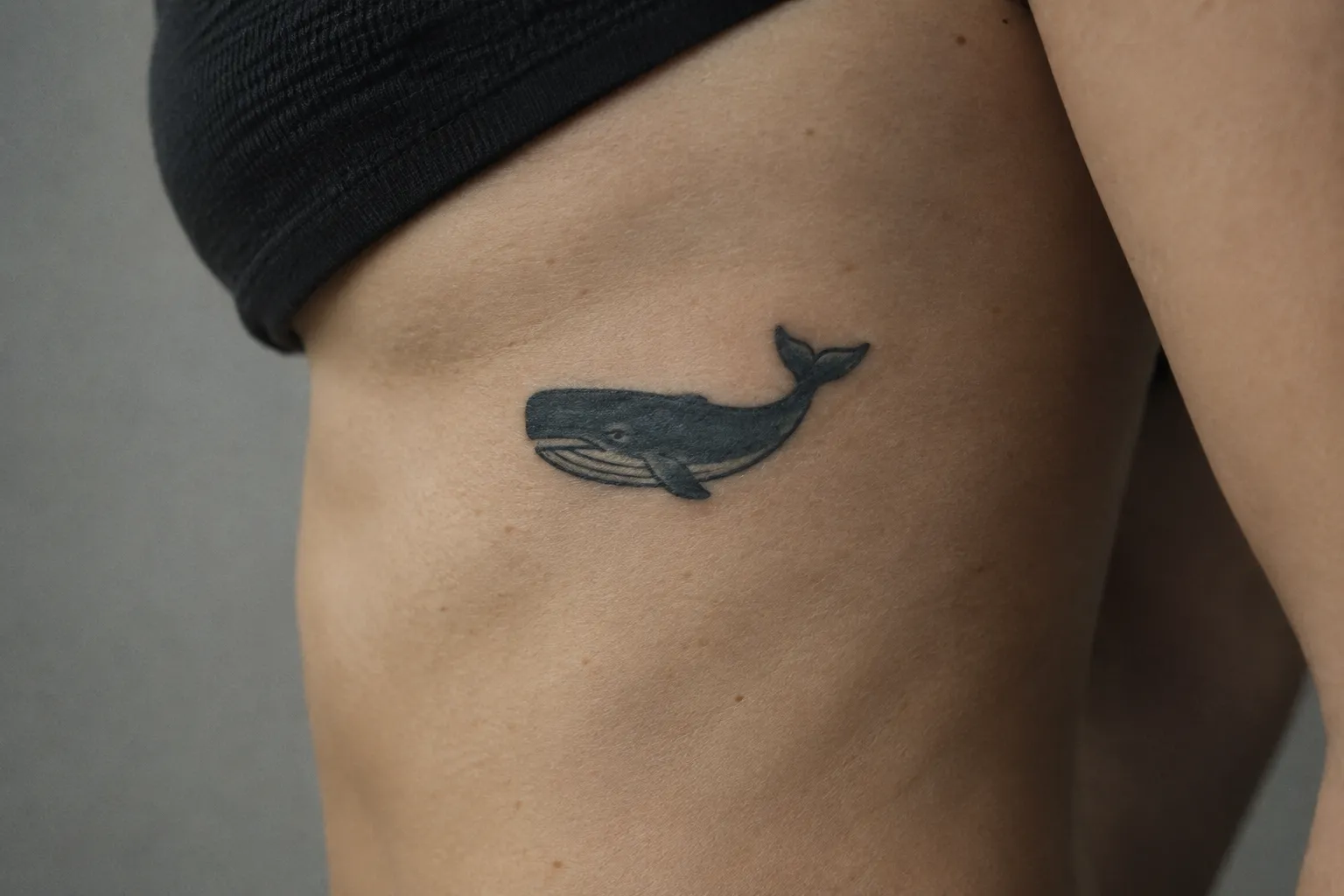
The core idea of a small whale tattoo is a reduction. You keep the outline, the fin or tail shape that identifies the species, and one point of focus. You give up throat grooves, barnacles, water spray and fluke speckling.
Small-scale placements: wrist, ankle, behind the ear
Inner wrist: a horizontal whale silhouette or a lifted fluke fits along the forearm’s line. Keep the detail low, though. Packed texture in thin ink is the first thing to blur into a haze (9), so a fine-line whale with dotted water around it is a poor fit for the wrist. A solid black silhouette or a bold single-weight outline is the safer choice here, and any lettering on the wrist should be bold script or block.
Ankle: a fluke above the ankle bone or a small whale circling the outer ankle. Thin skin over bone makes it more sensitive than the forearm, and shoes and socks rub it during healing. Keep the design simple and plan on loose footwear for the first weeks.
Behind the ear: a tiny fluke or a whale in profile. Hair hides it, so it’s a good choice if you want it out of sight at work. The space is small and curved, so a single shape with no water scene is the right fit.
Spacing at small scale: dotwork water, bubbles and spray read well on screen and fail on skin. Packed pattern is among the first things artists cut at small sizes (9), so keep the dots few and well apart. Ask your artist how much space each element needs at your size before the stencil goes on.
Pain at these spots: the ankle sits right over bone, and the inner forearm gets sharper toward the wrist. On a tattoo pain scale, both rank above the outer forearm, one of the least painful placements.
Larger scenes: forearm, ribcage and back panels
Forearm: the outer forearm is a good placement for a breaching humpback or a lifted fluke with water below. You get length for the long pectoral fins and the curve of the jump, and it sits flat enough for clean linework. It’s also one of the easier spots to sit for.
Ribcage: a whale running lengthwise along the ribs follows the natural curve of the body, which makes the pose look like swimming. Mother-and-calf designs work well here because there’s room for both animals at a clear size difference. The ribcage hurts much more than the forearm, and breathing moves the skin while the artist works, so plan shorter sittings.
Back panels: the back has enough flat space for a full migration scene. That can mean the whale with current lines, the calf, a map line, waves, or a diver for scale. It’s the only placement where a humpback can carry real anatomical detail, including throat grooves, fluke pattern and skin texture, without cutting most of it. A full back is multi-session work, and the healing load is bigger (see below).
Calf and thigh: these work for vertical breaches, with enough room for spray and water lines that would blur at wrist size.
Previewing placement: print the design at actual size, cut it out and tape it on the spot for a day. Look at it in a mirror, with your arm moving, in the clothes you usually wear. Your artist can also place the stencil and adjust it before starting. Ask to see it from arm’s length, not only up close.
Fine-Line vs. Blackwork: Picking the Right Style
Fine-line suits a whale tattoo built from a simplified fluke or outline that suggests motion and water. Blackwork suits a bold humpback silhouette, breaching pose or geometric pattern. Let the amount of biological detail you want decide the style, not the mood board.
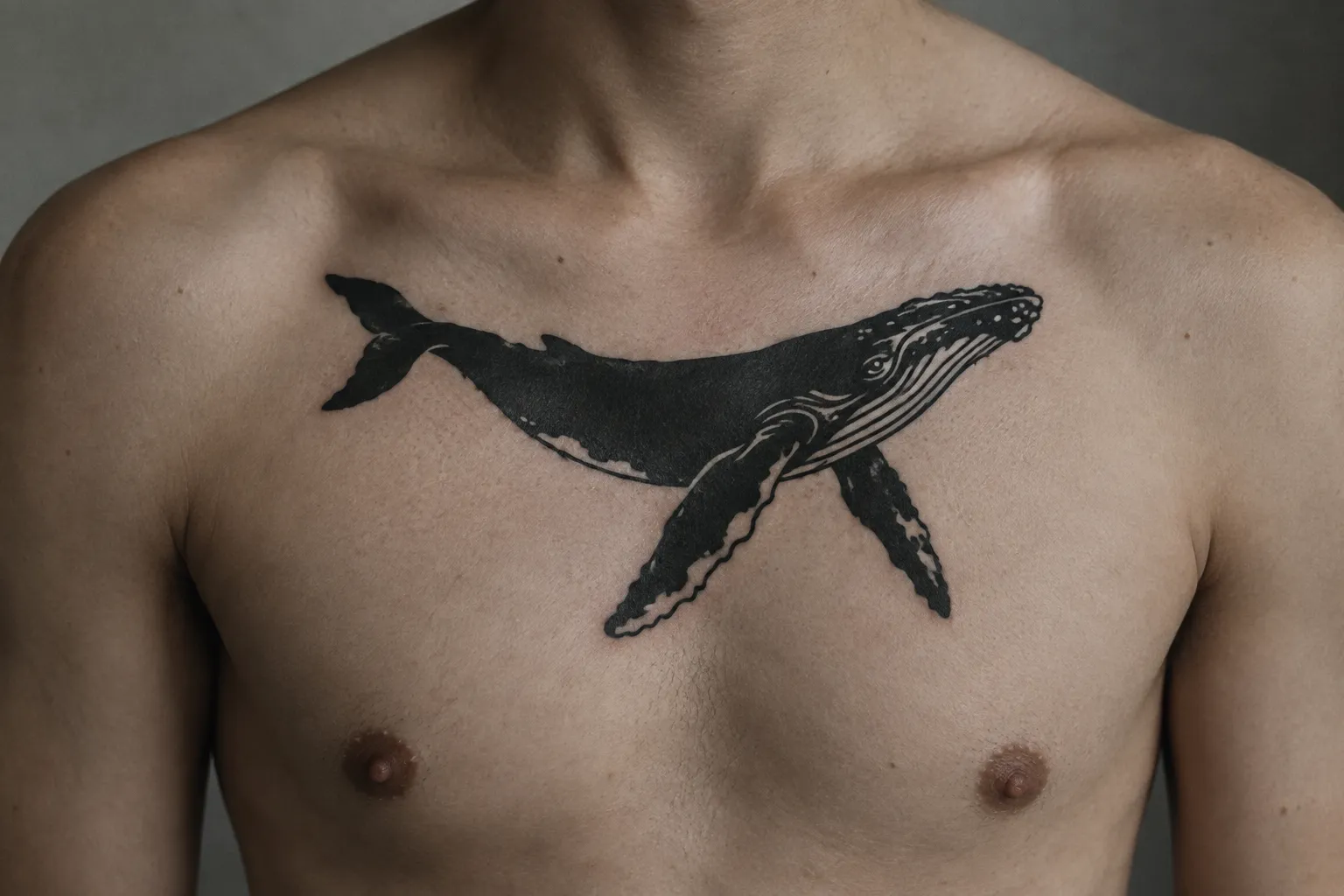
Fine-line hallmarks: consistent thin strokes and open space (9). A fine-line whale is mostly contour, with the outline of the body, the curve of the fin and a few lines of water. The skin left open between lines does part of the work.
Common fine-line pitfall: packing texture into thin ink. On skin, dense texture in thin lines is the first thing to blur into a haze (9). Artists who know the style edit before they ink. Interior texture goes first, and the outer flow plus one focal point stays (9). For a whale, that means keeping the silhouette and the fin or fluke shape and dropping throat grooves, barnacles and spray. A good test is to look at the silhouette from arm’s length: if the shape disappears, shrinking it won’t help (9). It’s also worth asking the artist for the smallest size they would still sign (9).
Blackwork hallmarks: solid black fill and high contrast, often with geometric or ornamental pattern inside or around the shape. A humpback’s primarily black body (8) suits this style. You get a bold silhouette with white markings left as open skin.
Common blackwork pitfall: patchy healing. A large black fill can heal with lighter patches, and a section that heals light is usually fixed with a touch-up once the tattoo has healed. Look at healed photos of the artist’s solid black pieces, not fresh ones, because fresh black always looks even.
Matching style to detail:
- A simplified fluke, a small silhouette, or a whale in motion with a few water lines works in fine-line.
- A breaching humpback with long pectoral fins, a fluke-ID pattern, or a whale with geometric fill works in blackwork.
- A large scene with a whale, calf and water may be both: blackwork for the whales, fine-line for the current and waves around them.
The same motif changes a lot between the two. A fine-line whale reads as light and airy, while a blackwork whale reads from across a room.
At the consultation, bring three references: one for the pose you want, one for the style you like (preferably healed work), and one photo of a real humpback if you want accurate anatomy. Say which elements you’d keep if the artist has to cut detail.
The table below lines up the two styles attribute by attribute.
Fine-Line vs. Blackwork Whale Tattoos
| Fine-line | Blackwork | |
|---|---|---|
| Line weight and detail | Thin, consistent strokes; minimal interior detail | Heavy outlines, solid fill, high contrast |
| Best size | Needs more room than a tiny piece | Small silhouettes to large back panels |
| Typical whale motifs | Fluke, outline, whale with water lines | Breaching humpback, long pectoral fins, geometric fill, fluke-ID pattern |
| Healing consideration | Same aftercare; healing time depends on size | Large fills can heal with light patches that need a touch-up |
Choosing a Studio and Healing Your New Piece
A safe whale tattoo needs a studio that opens sealed needles in front of you and sterilizes its equipment. Then comes aftercare: wash twice a day in the first weeks, and expect a larger piece to take a few months to heal fully (3). Hygiene checks matter, but infection can also come from the ink itself (6).
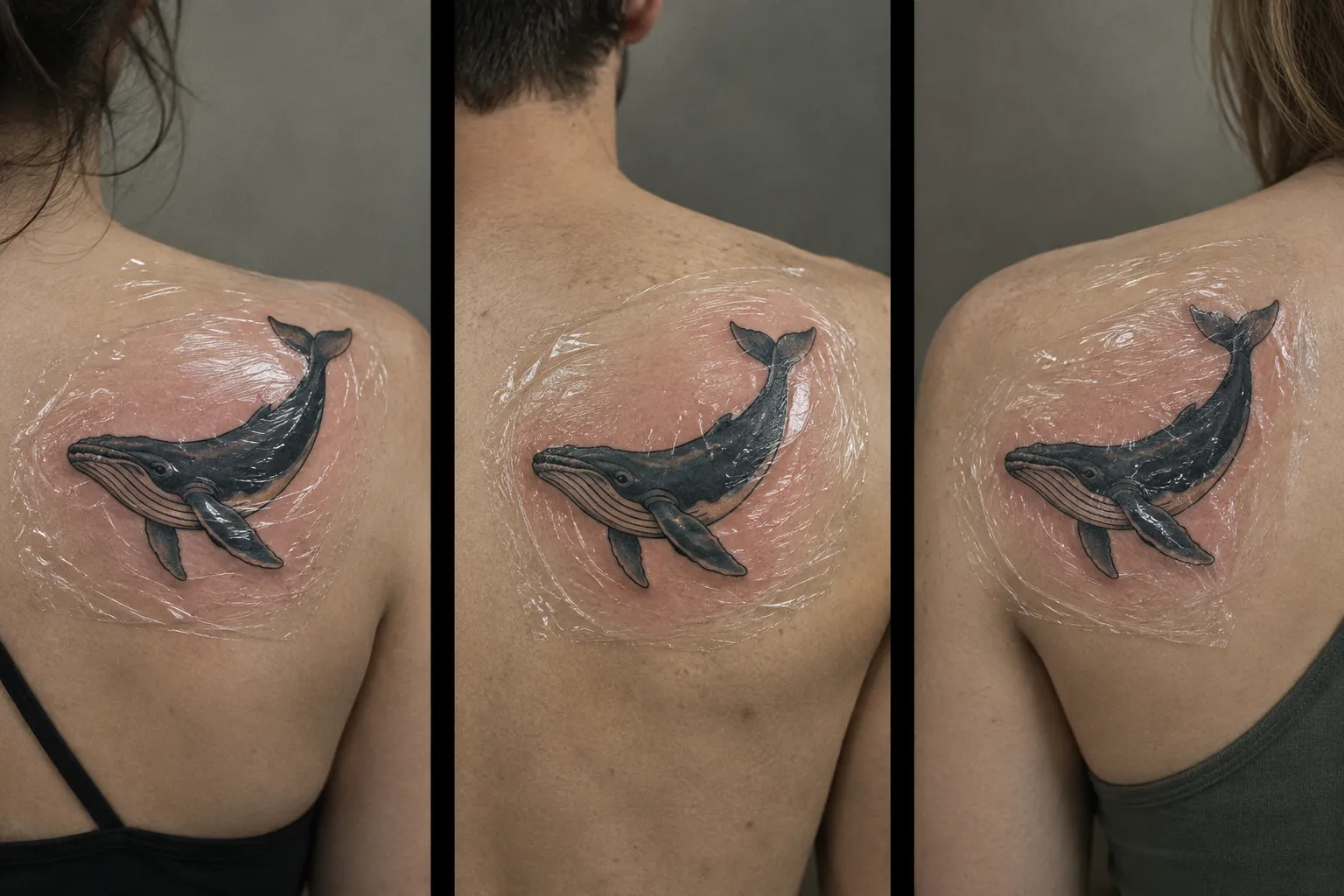
Studio hygiene checklist
Before the first line, check that:
- Needles and tubes come out of sealed packages and are opened in front of you.
- Ink goes into new single-use cups, never straight from a shared bottle and never back into it.
- Reusable equipment is sterilized, and the studio can tell you how.
- The artist wears new gloves and changes them after touching anything off the work area.
- The studio meets your local authority’s rules. In the US, state and local authorities oversee the practice of tattooing (6).
FDA reports that infections have been linked to contaminated tattoo inks, and that even unopened, sealed inks can harbor bacteria and other microorganisms (6). The FDA notes that serious infections can come from unhygienic practices and non-sterile equipment, and that they can also come from ink contaminated with bacteria, mold or other microorganisms (6). Following sealed-needle and sterilization practices is necessary, but it isn’t sufficient on its own. Ask what inks the studio uses and how they store them. A studio that handles that question comfortably is usually careful elsewhere too.
Healing timeline: small silhouette vs. large scene
The daily routine is the same for every size. According to Cleveland Clinic, wash gently with mild, fragrance-free soap and warm water twice daily, pat dry, and avoid swimming and direct sun while healing (3). The total healing time is what changes with size. The stages below follow our week-by-week tattoo aftercare guide.
Small whale tattoo (fluke behind the ear, wrist silhouette):
- Day 1-3: keep the original wrap on for as long as your artist says. Then start washing twice daily (3). Expect redness, a little oozing of blood and ink, and soreness (3).
- Day 4-7: the skin feels tight and starts to flake. Moisturize twice a day with a simple moisturizer or the ointment your artist recommends (3). Don’t scratch it, and keep it out of pools, hot tubs and baths (3).
- Week 2: peeling and itching. Let flakes and scabs fall off on their own (3).
- Week 3-4: the surface looks healed, but the deeper skin is still recovering, with full integration around week 6. Keep it out of direct sun for the first 4 to 6 weeks, since UV rays can make ink fade more quickly (3).
Large scene (breaching humpback on the ribcage, back panel):
The same steps apply, but stretched out. Cleveland Clinic says larger tattoos can take a few months to fully heal (3). A back panel done over several sessions also means you go through the healing cycle each time. Plan beach trips, swimming and sun-heavy holidays around the sessions, not the other way round. Ocean water is off-limits during healing, which is a cruel irony for a whale piece.
See a doctor if you notice: fever, pain that gets worse instead of better, an unusual odor, or significant drainage. Cleveland Clinic lists these as possible infection warning signs (3). Normal healing gets a little better every day. Infection gets worse.
Frequently Asked Questions
- What does a whale tattoo mean?
- A whale tattoo can mark a specific relationship, journey or personal association rather than a universal symbol. Choose a pose that makes that reference readable.
- What does the whale totem represent?
- Tattoo idea pages use "whale totem" loosely, next to zodiac signs and talismans. Ask which tradition a totem meaning comes from before treating it as one.
- What does an orca tattoo symbolize, and how is it different from a whale tattoo?
- An orca belongs to the dolphin family, a different animal from the humpback, so its symbolism does not carry over. Ask whose tradition an orca design draws from before using its motifs.
- What is the 1/3 rule in tattooing?
- The 1/3 rule treats roughly one-third of a limb segment as a natural visual unit for a standalone piece, such as the upper arm between shoulder and elbow. A single whale sized to that unit reads clearly.
- How can I preview a tattoo design on my body before booking?
- Use an actual-size paper mock-up to check placement while moving and wearing usual clothes. A phone overlay can suggest position but cannot show real-size line spacing.
- Where should I place a whale tattoo for the best result?
- Choose the body area by the design's longest dimension and detail level. Ask your artist to check the stencil while you move, not only while standing still.
Matching Your Whale Design to Size, Style and Skin
Before you book, settle three things in this order:
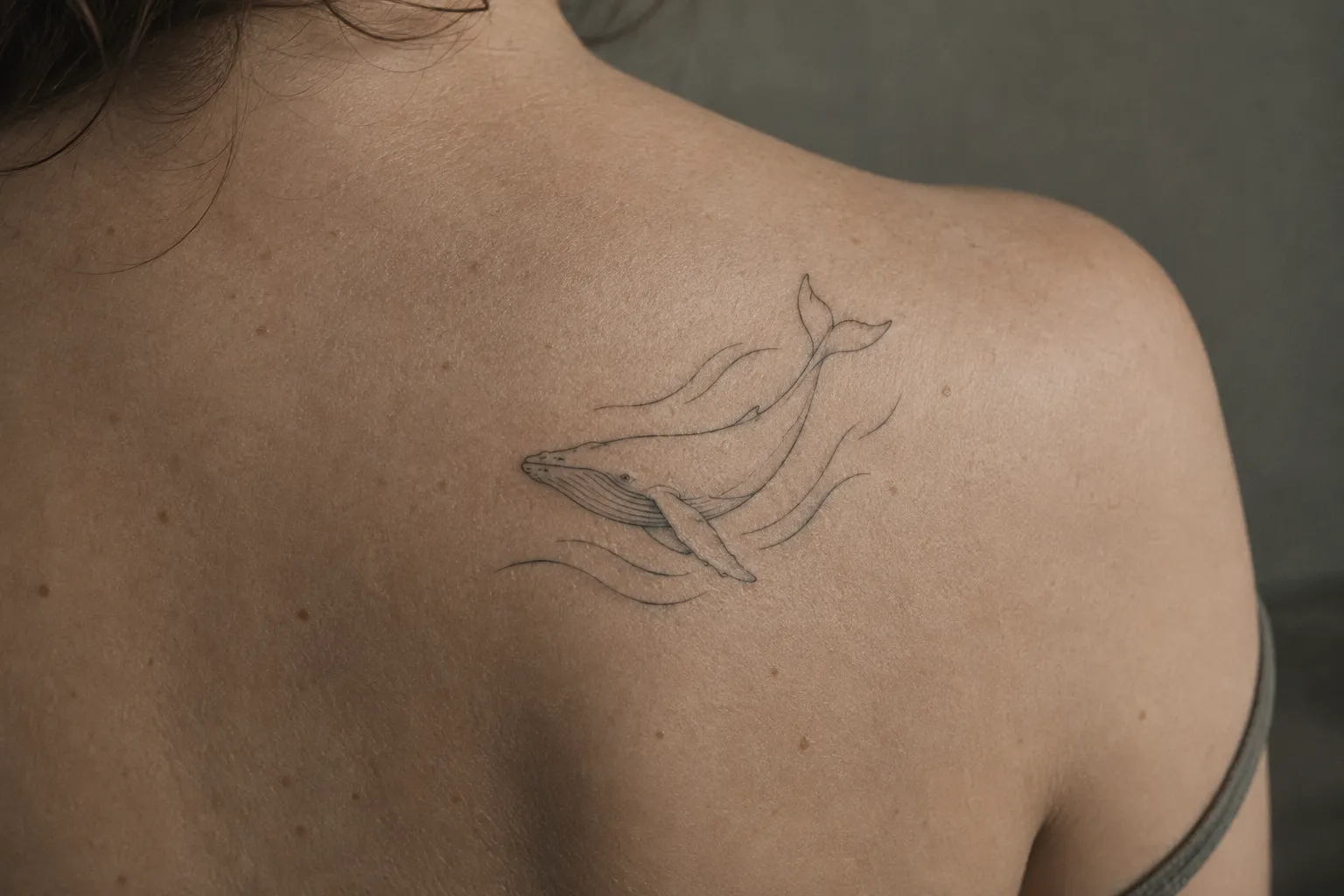
- Placement. It sets the size, and the size sets how much detail survives. A wrist holds a silhouette, and a back holds a scene.
- Style. Choose fine-line for an outline and motion, blackwork for a bold humpback, or both for a large piece.
- Reference. Decide what you want the whale to point to: a calf for a specific stretch of family life, a NOAA migration route for a real journey (8), or a fluke-ID pattern for one particular whale.
If you’re drawn to Polynesian imagery, go to a practitioner of a specific tradition and expect them to build the design with you (10).
Bring three references to the consultation: pose, healed style examples, and a real humpback photo. Ask the artist what they would cut at your size. Plan your healing around the piece: twice-daily washing in the first weeks, a simple moisturizer, no direct sun and no swimming until it’s healed. For a large scene, full healing can take a few months (3).