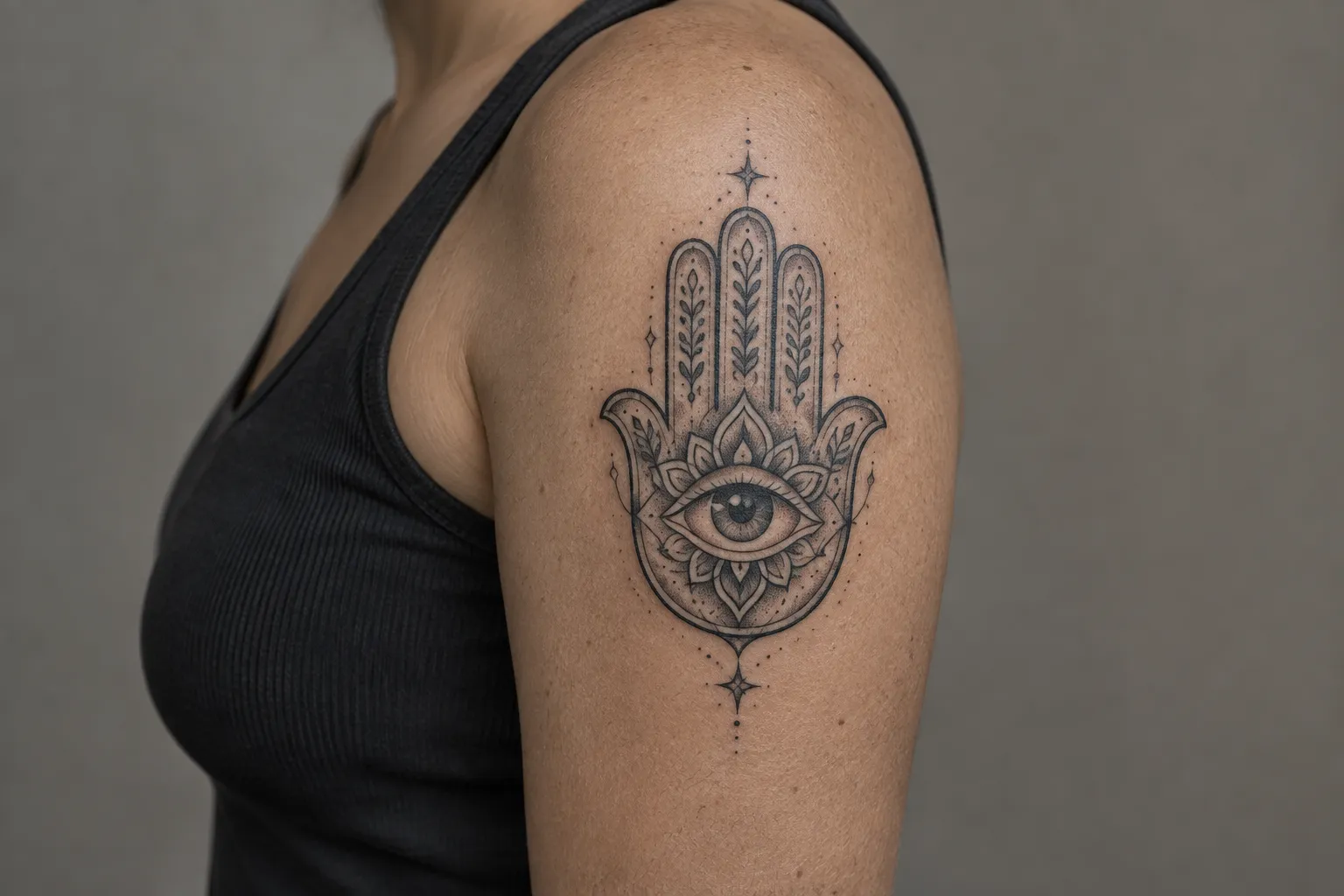
A hamsa tattoo is an open hand, often with an eye set in the palm, taken from an amulet that more than one faith used against envy and the evil eye. The British Museum holds a Moroccan khamsa pendant in silver, enamel and glass from circa the 1890s, 13 cm (about 5 in) tall, that it says may have been worn by Muslims or Jews against the “eye of envy” (11). That shared history shapes the rest of this guide: what the hand means, who wears it, and how much detail each placement can carry.
✓ Pros
- The open-hand silhouette stays readable even when the surrounding ornament is removed.
- The central eye gives the design a natural focal point for different scales.
- The neutral name 'hamsa' leaves room to define your own cultural connection.
✗ Cons
- A fine iris can close up if its outline and pupil are packed too tightly.
- A hand-shaped design can read differently depending on how it faces the viewer.
- A small wrist or finger placement limits how much pattern can hold its shape.
The trade-offs are clear before you start. The hand carries protective symbolism across several cultures. It scales from a small outline to an ornamental back panel, and you choose the finger orientation and meaning yourself. Against that, the debates about orientation and religious ownership mean some people will read your tattoo differently than you intend. Dense ornament ages badly at small sizes, and wrist and hand placements take friction and fading that a back or thigh piece never sees.
Hamsa Tattoo Meaning: The Hand of Protection Across Cultures
The hamsa tattoo meaning centres on protection: an open hand that wards off envy and the evil eye, a belief documented in Middle Eastern and North African amulets used by Jewish and Muslim communities (11). Contemporary tattoo guides keep that protective reading as the core and layer blessing, good fortune and strength on top (5). No single meaning is fixed, because the symbol has passed through several traditions, and each one shaped how it is read.
The name itself is plain. Khamsa is Arabic for “five,” a reference to the five fingers (4). The form appears as chamsa in Hebrew (1). Many hamsas are drawn symmetrically, with a second thumb where the little finger would be (7). That gives you the balanced, mirror-image hand you see on most jewellery, and it is the version most tattooers work from.
The British Museum’s khamsa pendant: what the object tells us
The British Museum’s catalogue entry describes a silver “Hand of Fatima” or khamsa pendant made in Morocco around the 1890s. It is decorated with a raised roundel of yellow enamelled circles in twisted silver wire, a red or amber glass stone in a bezel, and a small cross-shaped pendant, also called a khamsa, hanging below (11). It measures 13 cm high by 8 cm wide (11). The rest of the hand is covered in rows of stamped circles and dots (11).
That object has three useful lessons for a tattoo design. First, the museum says the amulet may have been used by Muslims or Jews, not one or the other (11). Second, it notes that belief in protective hand amulets goes back millennia (11). Third, look at the decoration: dots, circles, a central stone. The historical hamsa was an ornamental object long before tattooers started filling palms with mandalas. A dotwork border or a round jewel in the palm is a direct echo of objects like this one, not a modern invention.
Hand of Fatima, Hand of Miriam and other names
The symbol has gone by several names, including the eye of Fatima, the hand of Fatima and the hand of Miriam (7). The names point to Fatima, daughter of the Prophet Muhammad, and to Miriam, the sister of Moses, which is why the amulet carries significance for both Muslims and Jews (7). Some tattoo guides add Tanit and Mary to the list (5).
The name you use tells people which tradition you are drawing on: one hamsa tattoo guide pairs the hand of Fatima with Islam, the hand of Miriam with Judaism, and plain hamsa or khamsa with no single faith (1). This matters less for the tattoo than for the conversation you will have about it at the dinner table.
The eye in the palm: evil-eye protection symbolism
The eye in the palm ties the hand to evil-eye belief: the idea that envy or a jealous stare can cause harm, and that an eye-shaped charm turns that harm back (4)(7). The concept has its own names, ayin hara in Hebrew and nazar in Arabic (3). This is a belief and a tradition, not a guaranteed effect, and a good artist will not sell it to you as one.
In design terms, the palm eye is the focal point. Everything else on the hand supports it. That is why the eye’s size and line weight decide whether the whole tattoo reads clearly from a metre away, which we come back to in the design and sizing sections.
Modern reinterpretation is part of the hamsa’s story. In 2018, Jerusalem’s Museum for Islamic Art devoted an exhibition, Khamsa, Khamsa, Khamsa, to the symbol: 555 different hamsas, including new renditions by some 50 artists and designers, tracing how it turned from a magical object in Muslim and Jewish culture into an icon of popular art (12).
Who Can Wear a Hamsa: A Shared Symbol, Not One Religion
The hamsa is not owned by a single religion: museum records place it among Muslim and Jewish communities (11), and scholars have interpreted it as a Jewish, Christian or Islamic amulet and as a pagan fertility symbol (7). Religious views bear on tattooing and on amulets as much as on the hand itself. One hamsa tattoo guide notes that traditional Judaism prohibits tattoos (Leviticus 19:28) and that Islam generally does too, with views varying by school and community (1). My Jewish Learning adds that amulets are somewhat problematic in Judaism because the Bible prohibits magic (7), and some Salafi authorities reject the khamsa as an amulet (13).
The answers to the three questions below are qualified ones. Historical use crossed communities, and if you belong to a tradition, its view is worth asking about before the stencil goes on.
Can non-Jews wear a Hamsa?
One hamsa tattoo guide answers yes, with a respectful approach (1). The British Museum describes Middle Eastern and North African hand amulets that may have been used by Muslims or Jews to ward off envy (11). It has become a widely recognised Jewish and Israeli symbol in modern times, though it may derive from Islamic or pagan culture (7).
Tattoo guides frame respect as learning the symbol’s meaning and origins before tattooing it (1)(5). The question is still debated: the hamsa’s commercialisation has prompted debate within Jewish and Muslim communities about cultural appropriation (4). If you are not Jewish and you choose the “hand of Miriam” name or add Hebrew lettering, you are drawing on Jewish tradition specifically, so find out what the words mean and how the community uses them before it goes on skin.
Is a Hamsa okay for Christians?
The hamsa has been interpreted by scholars as a Christian amulet as well as a Jewish, Islamic or pagan one (7), and some tattoo guides list Mary among its names (5). Levantine Christians call it the hand of Mary, while in 1526 church authorities in Spain banned khamsas as Islamic symbols and ordered them replaced with Christian crosses (13).
One hamsa tattoo guide notes that Christian views on tattoos vary and that hamsa tattoos are less common in Christian tradition (1). If the question matters to you, ask within your own church. Whether you treat the design as a faith statement or as a cultural motif is your call.
Is a Hamsa a Hindu symbol?
Museum records place the hand amulet in the Middle East and North Africa (11), and scholars have read it as a Jewish, Christian or Islamic amulet or a pagan fertility symbol (7). Some tattoo pages list Hindu traditions among its users (5), and that is where the confusion often starts.
Two things blur the line. The Sanskrit word hamsa names an aquatic bird, read as a goose or a swan, that serves as a spiritual symbol in Indian culture (14), a separate motif from the open hand. Hindu and Buddhist art also has a raised-palm gesture, the abhayamudra, a gesture of reassurance and protection (15). Modern hamsa tattoos sometimes pair the hand with a lotus or the om sign, which one hamsa guide describes as a fusion of Eastern and Middle Eastern spirituality (1). If you want that look, know you are combining two separate traditions, and name it that way when someone asks.
Hamsa Evil Eye Tattoo Design Styles
Among the hamsa evil eye tattoo styles one guide describes are a minimalist outline, a mandala or geometric hand, and henna-style floral ornament (1). Which one you choose depends less on taste than on size. Intricate detail needs enough room to stay legible (1).
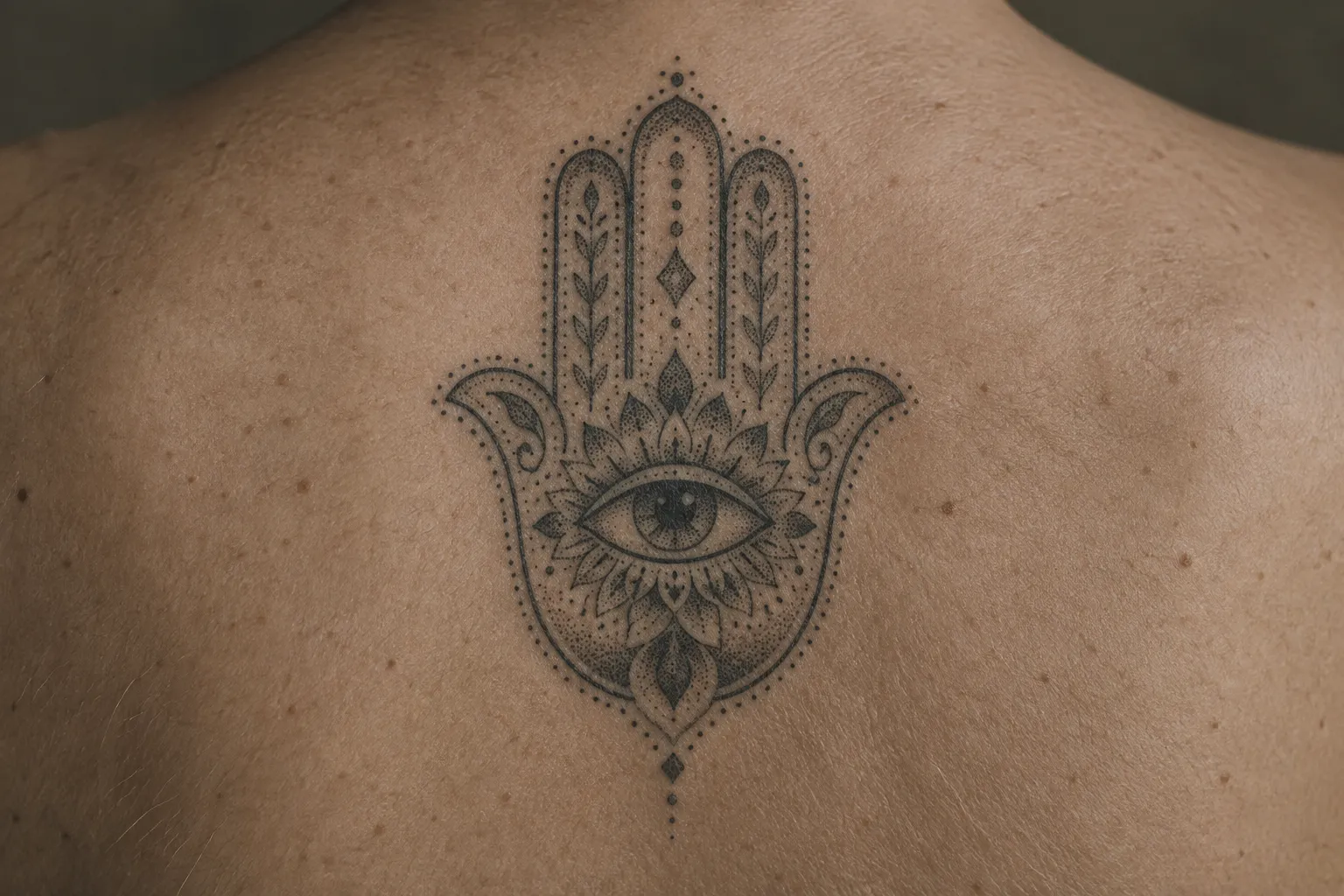
Minimalist eye-in-palm outlines
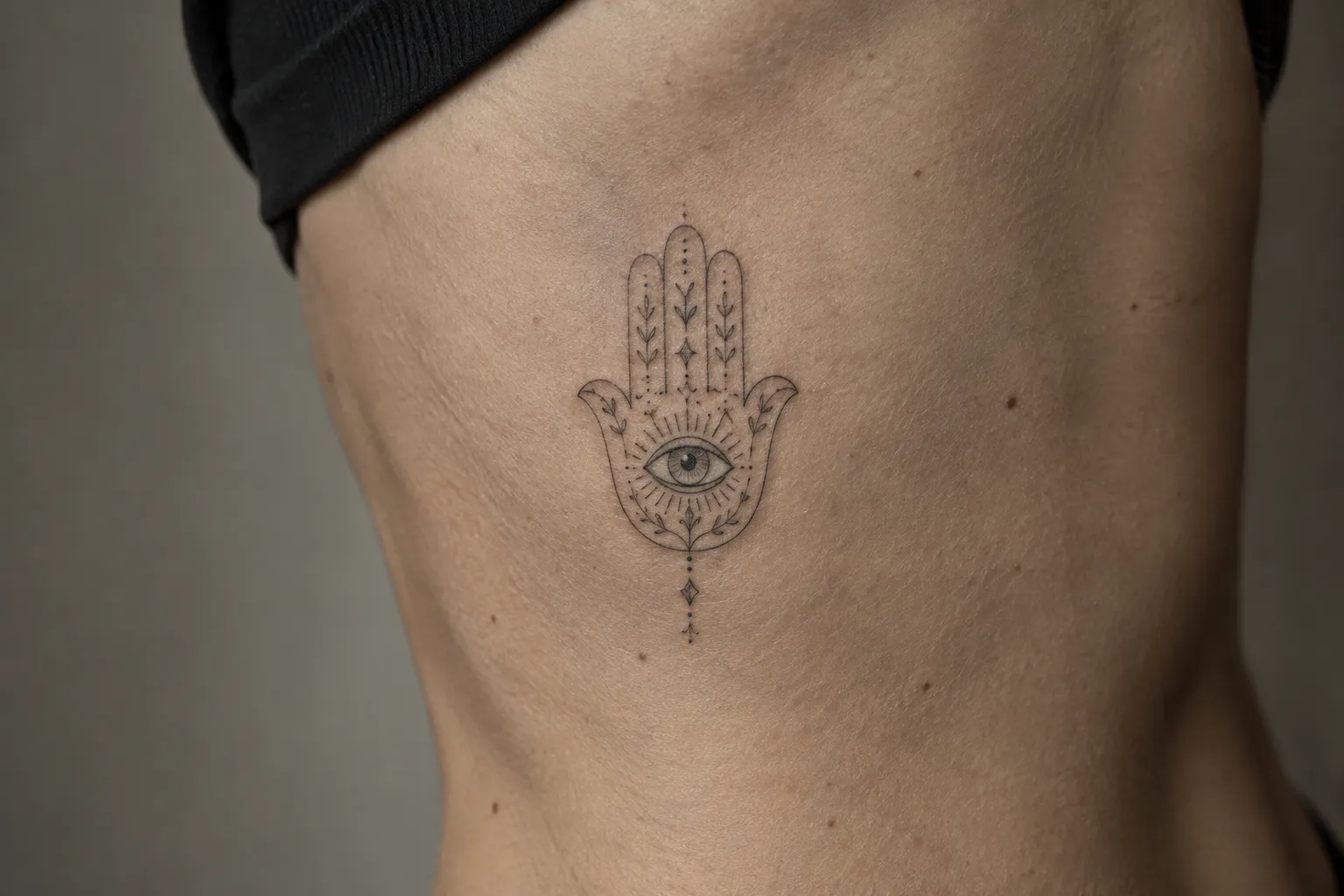
The minimalist hamsa is a clean hand outline with a simple central eye and very little inside it (1). Two technical hallmarks define it: a single consistent line weight (usually a fine to medium liner, not a hair-thin single needle across the whole piece) and plenty of open skin inside the hand. The eye is reduced to an almond shape, a circle for the iris and a solid pupil.
The common pitfall is going too thin. Fine-line work looks crisp on the day and soft on the healed result, because ink settles and spreads slightly under the skin over the years. If the iris circle sits too close to the almond outline, the two merge into a grey smudge. Ask for a bolder line on the eye than on the hand outline. The eye is the part people need to recognise.
Placement fits this style: small enough for the inner wrist, behind the ear or the side of a finger (1). Remember that fingers come with fading issues, covered in the placement section.
Ornamental mandalas, geometric framing and floral additions
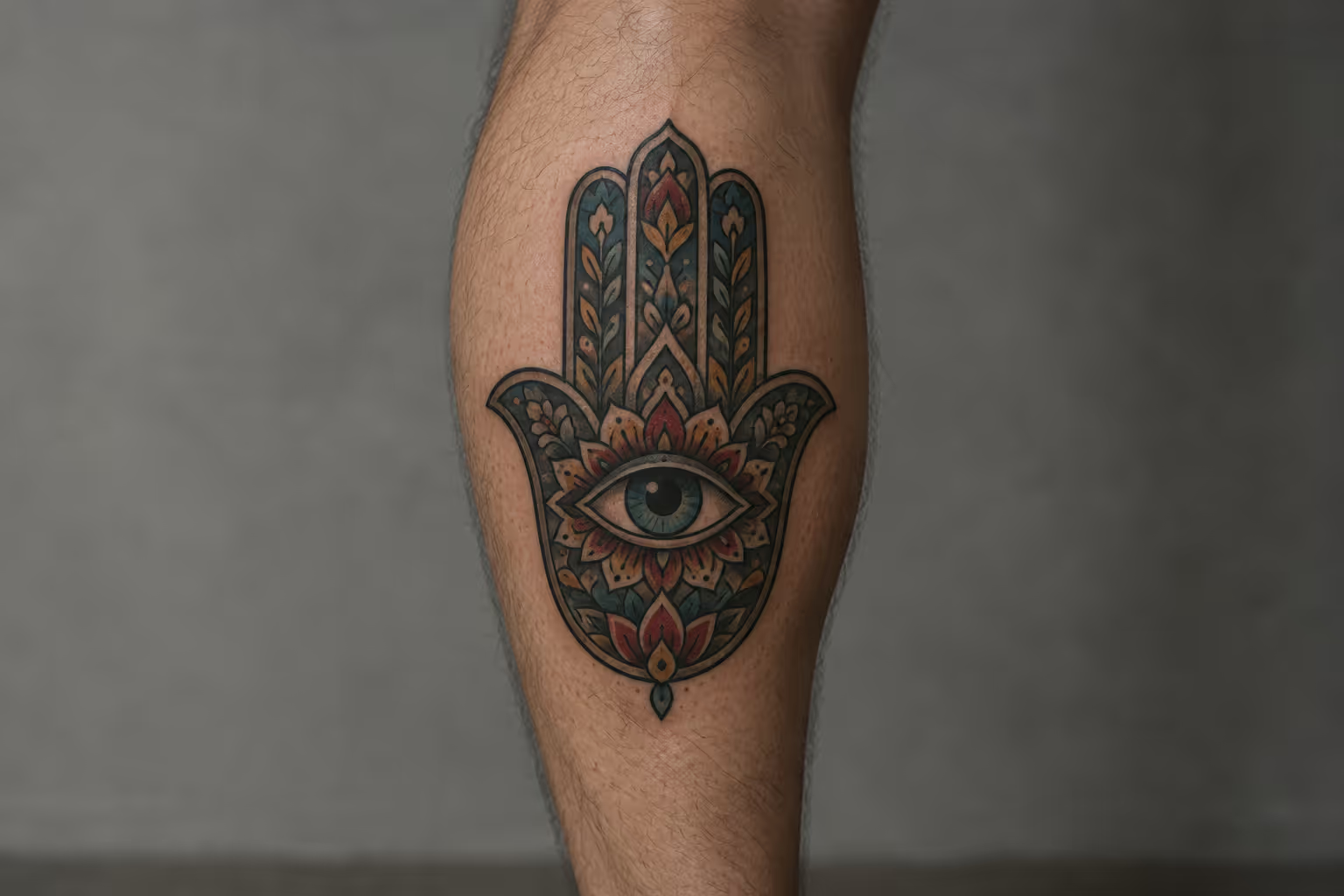
Ornamental hamsas fill the palm and fingers with pattern. Common choices are geometric or mandala ornament and floral additions (1). The two hallmarks here are symmetry (the hamsa’s mirrored thumbs make it a natural frame for radial patterns) and controlled contrast between solid black, dotwork shading and open skin. Without open skin, the eye disappears into the pattern.
Good ornamental hamsas borrow directly from the jewellery tradition: a stamped-dot border, a round “stone” set in the palm, a small charm hanging below the wrist. Floral versions often wrap lotus or vine forms around the fingers or out from the base of the hand. Some add an evil-eye bead in the palm, a pairing one hamsa guide says doubles the protective symbolism (1), or a short string of beads below.
The pitfall is packing ornament into a size that can’t hold it. Too much detail in a small tattoo can become muddy as it ages (1). Mandala petals that are tight and clean when fresh blur into a dark mass over the years on a small piece. A piece covering the outer forearm or a full upper-back panel gives the lines enough spacing to stay sharp.
Matching detail to tattoo size
Matching detail to size is the single most useful rule for this motif. Small designs are better suited to simple outlines and limited internal detail, while larger placements give room for ornament and shading (1). For scale, the tiny band in tattoo pricing runs 1-2 inches (about 2.5-5 cm) (1), which is outline-and-eye territory. Large, intricate work is listed at 7 inches (about 18 cm) or more (1), which is where full mandala ornament belongs.
Between those two, a palm-sized hamsa can carry a detailed eye plus one ring of ornament, a dot border or a few petals, but not all three at once. Ask your artist what size they recommend for your placement and detail level (1). If they print the design at actual size and the iris already looks crowded on paper, it will look worse healed.
Finger Orientation: Up or Down?
Finger orientation on a hamsa is a personal choice, not an ancient rule: historical hamsas appear with fingers pointing both up and down, and the meanings attached to each direction are modern interpretations (1). Choose the direction based on what you want the tattoo to mean and how it looks on the placement.
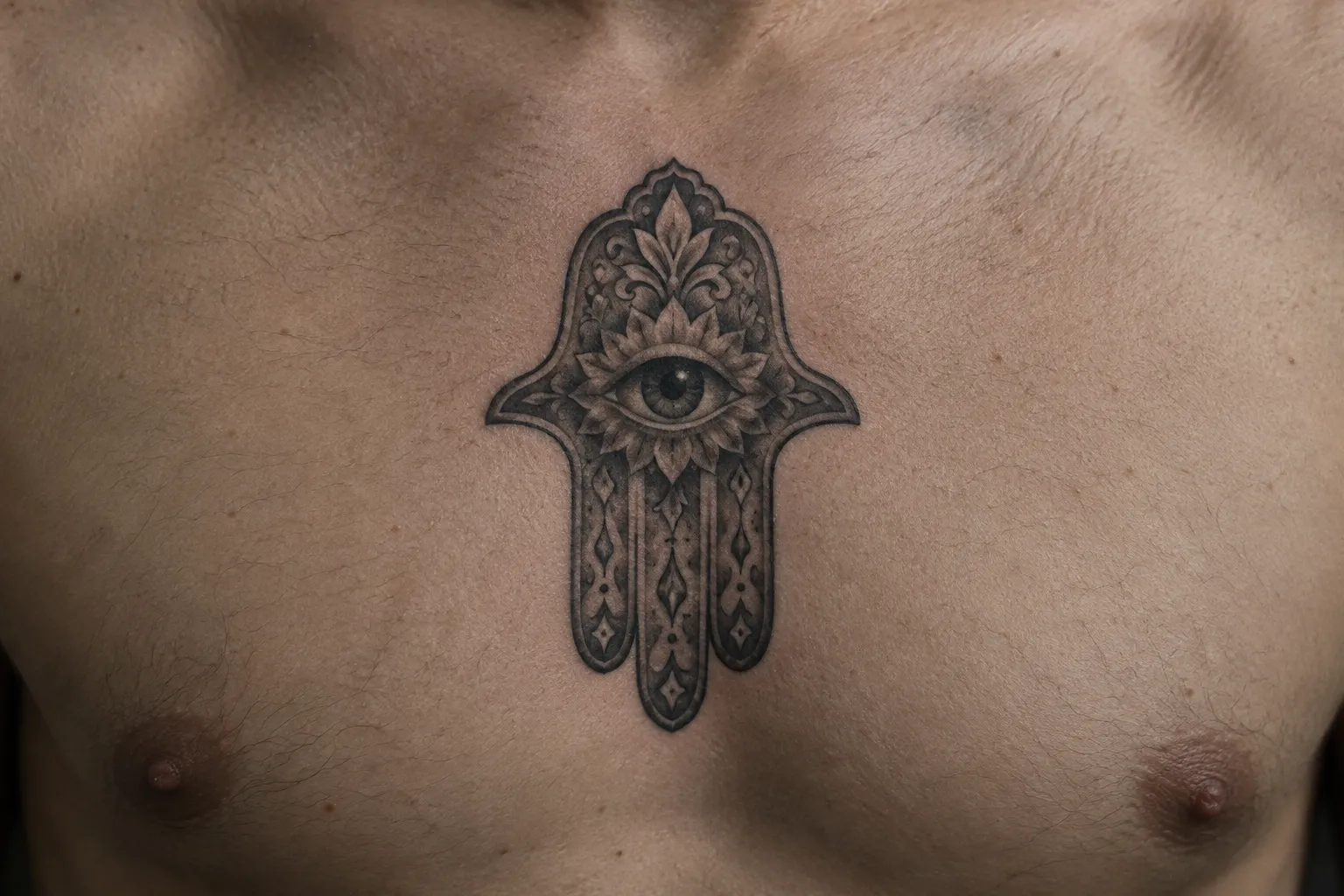
Fingers-up: the modern reading
The most common modern reading treats a fingers-up hamsa as a shield: protection against evil, negativity and the evil eye (5). This is the version you see most often on flash sheets, and it pairs naturally with a large, open palm eye.
Fingers-down: the modern reading
The fingers-down hamsa is often read as a gesture of blessing, abundance or welcome (5). Even the modern readings are not consistent, though. One symbol-meaning site reverses the pairing: a hamsa facing upward attracts luck and prosperity, one facing downward offers protection and fertility (3). If two guides can’t agree, nobody can tell you your orientation is “wrong.”
Why historical hamsas don’t follow one rule
The guide that assigns separate meanings to each direction labels them a modern interpretation and notes that both orientations appear in historical contexts (1). Treating “up for protection, down for abundance” as unchanging tradition overstates what the record supports.
The practical decision is about how the tattoo reads on your body. On a forearm, fingers pointing toward your hand look upright to you when you look down at your arm, and upside down to someone facing you. Decide whether the design should face you or the people looking at you, because that changes how it reads when your arm is relaxed or turned (1). This is the same decision you would make for a line of lettering, and it is worth five minutes in front of a mirror with the stencil.
Where to Place a Hamsa Hand: Wrist, Forearm, Back and Thigh
Hamsa hand tattoo placement is a trade-off between visibility, room for detail and wear: the wrist keeps a hamsa visible and compact, while the upper back offers more room for detail but is less visible (1). Hands and fingers face frequent washing and friction, which is a fading concern (1).
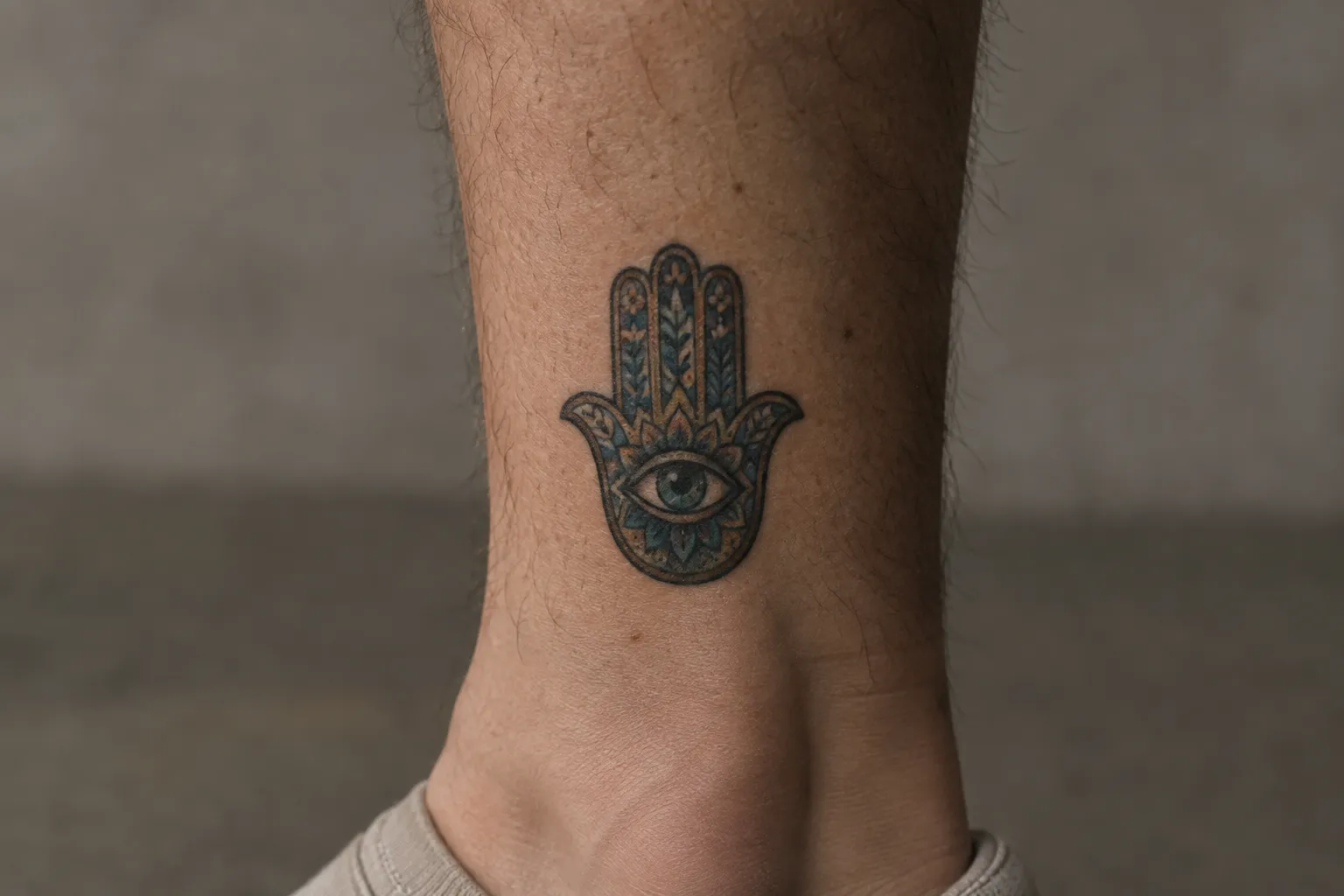
As with any tattoo placement, your options trade visibility against room, from most visible to most hidden:
- Fingers and hands: highly visible, very little room, highest fading risk.
- Inner wrist: visible in short and long sleeves, compact, suits a minimalist outline.
- Forearm: visible in short sleeves, enough flat space for an ornamental hamsa.
- Ankle: small outline only, partly hidden by footwear, and shoe friction fades it faster (1).
- Behind the ear or nape: small outline only, and hair covers it only part of the time (1).
- Upper back: hidden under most clothing, the most room for ornament and symmetry.
- Thigh: hidden most of the time, large flat area for detailed work.
Wrist and forearm: visible and compact
The wrist is the classic hamsa spot because a protective hand there is always in view. It is also narrow and curved, so it suits a minimalist outline with a clear eye, not a mandala. On the wrist, the orientation question comes up most: a design that faces you reads upside down to everyone else, and vice versa (1).
The forearm gives you a wider, flatter area. The outer forearm has room for an ornamental hamsa with a dotwork border or floral additions, and its larger version is one of the placements that suits decorative patterns (1). On the tattoo pain scale, the inner wrist (thin skin over tendons and bone) generally hurts more than the fleshier outer forearm (1).
Upper back and thigh: room for ornament
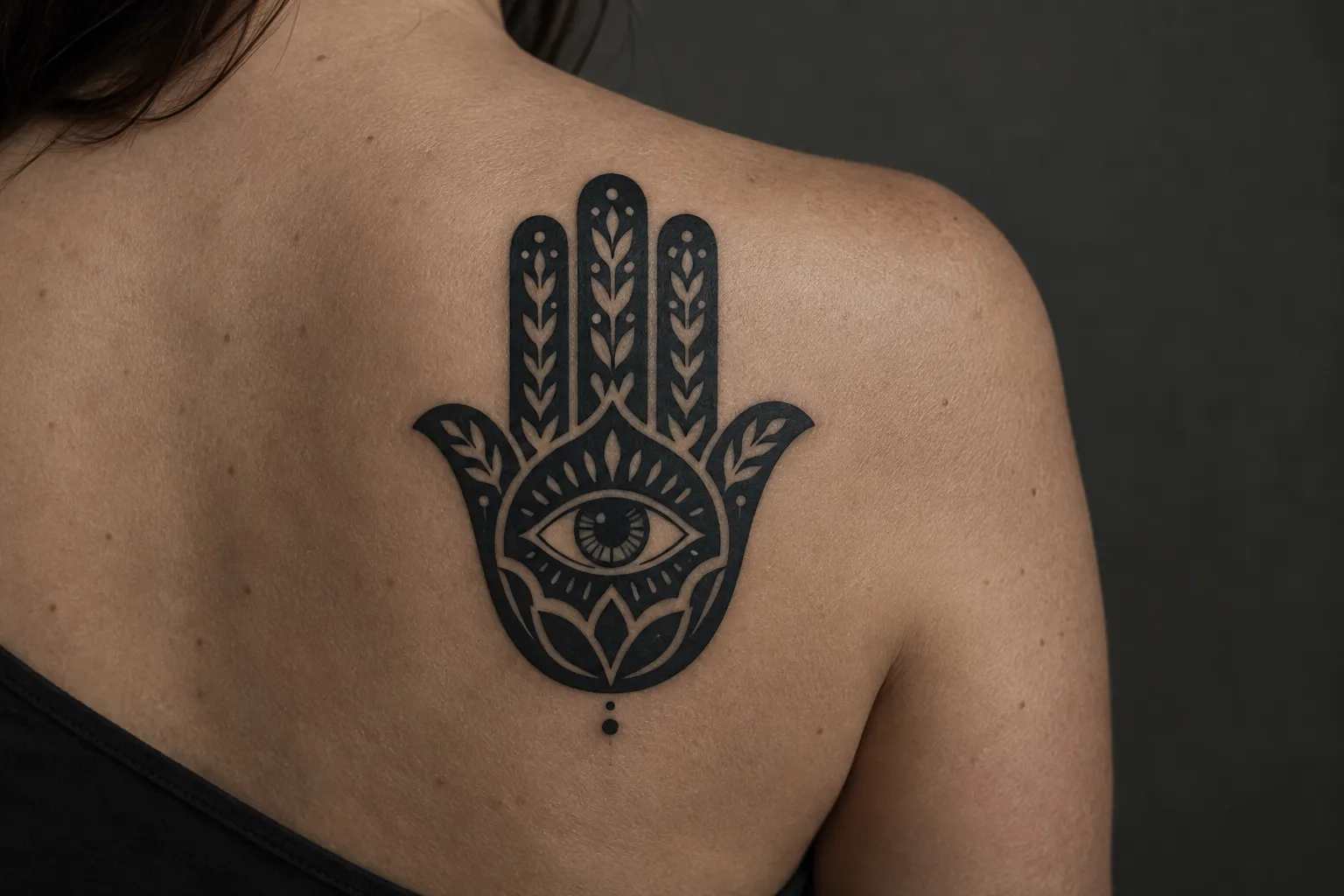
The upper back, forearm and thigh are the larger areas where decorative patterns have room (1). The upper back is a good placement for a fully symmetrical hamsa. The area between the shoulder blades has a natural vertical centre line, so mirrored thumbs and radial mandala ornament line up with your anatomy. The trade-off is that you rarely see it yourself (1).
The outer thigh is broad and flat with more padding than most areas, and it usually ranks among the gentler large placements. The spine and shoulder blades are bonier, so the centre of the upper back typically hurts more than the outer thigh (1). Both placements stay out of the sun most of the year, which helps fine dotwork hold its contrast over the years (1).
Hands and fingers: a fading risk from frequent washing
Hand and finger tattoos are exposed to frequent washing and friction, which one hamsa guide flags as a fading concern (1). The palm-side edges of fingers and the sides of the hand shed skin quickly and rub against everything you hold. Hand placements need frequent touch-ups, the same guide warns (1).
If you want a hamsa on your hand, keep it bold: a thick outline, a solid pupil, no fine interior pattern. Expect touch-ups, and ask your artist about them before booking. On the pain scale, the backs of the hands and fingers sit well above the forearm because there is so little padding over the bone.
To compare the four main placements: the wrist offers high visibility, little room for detail and moderate friction from cuffs, watch straps and handwashing, so it suits small outline designs. The forearm offers high visibility in short sleeves, moderate to generous room and lower friction, so it suits palm-sized to larger ornamental work. The upper back offers low visibility, the most room for detail and low friction, which makes it the strongest choice for large intricate pieces in the 7 inches or more range (1). The thigh offers low visibility, generous room and low friction outside the inner-thigh rub zone, which suits mid-sized to large ornamental designs.
Cost and Size Guide by Design Scale
Hamsa tattoo prices scale with size and detail, ranging, in a hamsa tattoo guide last reviewed in April 2026, from $80-$150 for a tiny 1-2 inch design to $1,200-$2,500+ for an extra-large piece over 10 inches (1). Artist experience and location shift those numbers, so treat them as a budgeting range, not a quote.
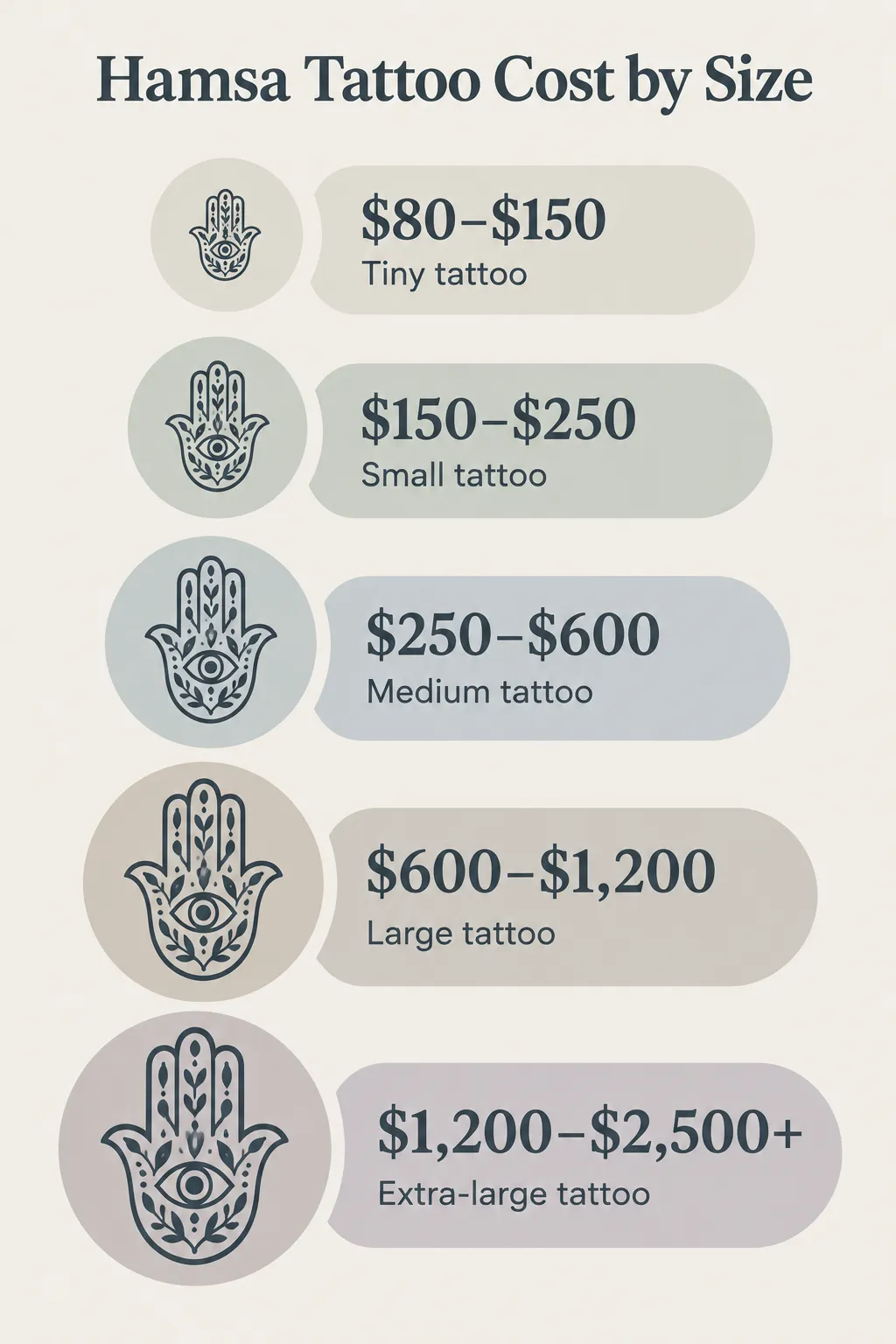 Hamsa tattoo price bands listed in April 2026 run from $80-$150 for tiny designs to $1,200-$2,500+ for extra-large pieces, with three size bands in between.
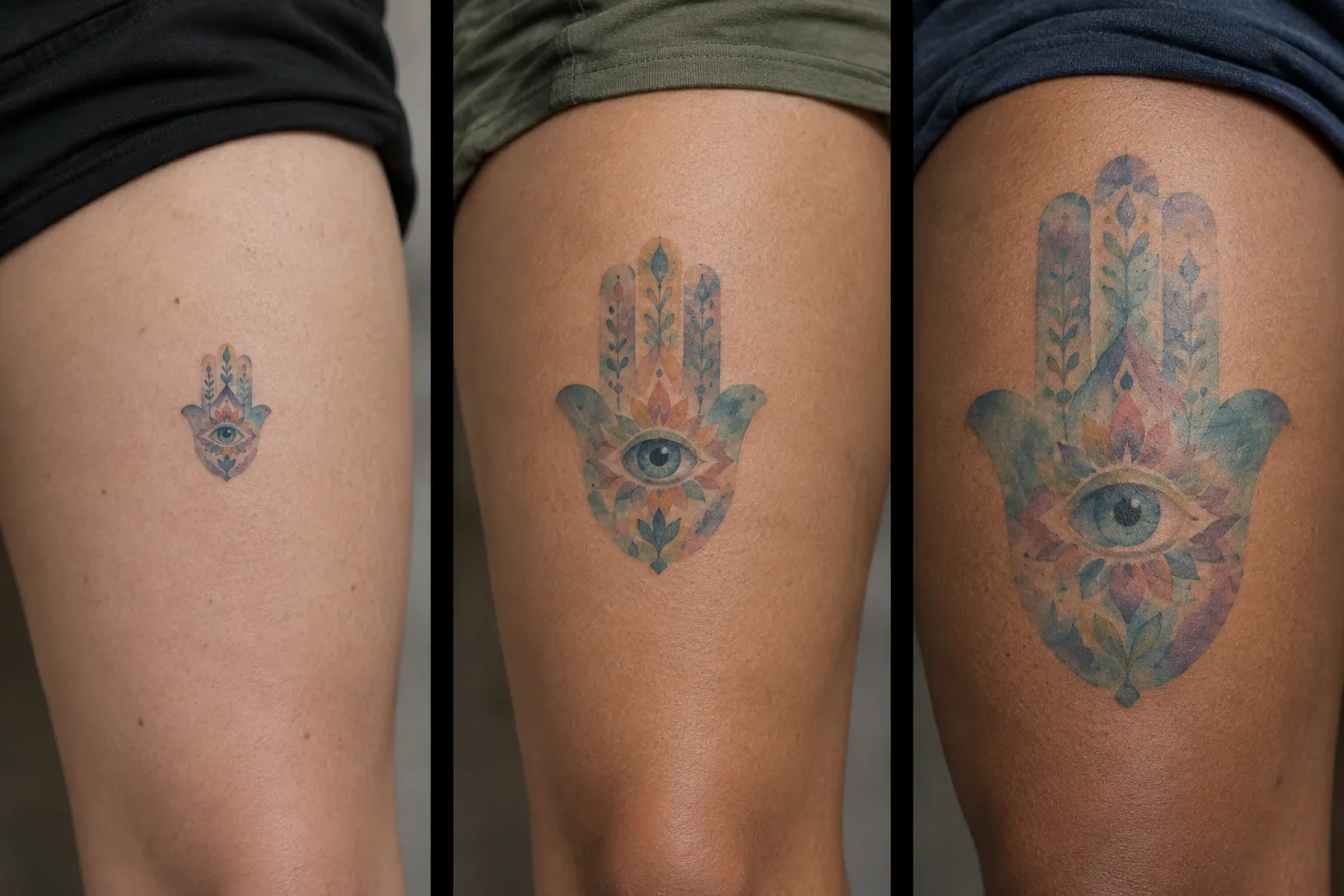
By size, as listed in April 2026 (1):
- Tiny, 1-2 inches (about 2.5-5 cm): $80-$150, often the shop minimum (1). Outline and simple eye only.
- Small, 2-3 inches (about 5-7.5 cm): $150-$250 (1). Room for a bolder eye and a minimal accent such as a dot border.
- Medium, 4-6 inches (about 10-15 cm): $250-$600 (1). Forearm or calf territory, enough for one layer of ornament.
- Large, 7-10 inches (about 18-25 cm): $600-$1,200 (1). Full back, thigh or full upper arm, with full mandala or floral work.
- Extra-large, over 10 inches (over 25 cm): $1,200-$2,500+ (1). Back panels and large thigh pieces, often split across sessions.
Style shifts where you land inside each band. Minimalist linework sits at the lower end, ornamental and detailed work in the mid to upper range, and watercolour or realistic work at the upper end because it takes specialised skill (1).
The size bands double as a detail guide. If your budget points you to the tiny or small band, design for that band: outline, eye, maybe one accent. A rule-of-thumb from the chair: when the design you love costs more than you planned, scale the ornament down rather than shrinking the whole thing. A smaller tattoo with the same detail just ages into a blur.
Consultation, Safety and Aftercare for a Hamsa Piece
A good hamsa session starts with five decisions made before booking: meaning, approximate size, placement, orientation and detail level. Then ask your artist to adapt the design rather than copy someone else’s tattoo (1). Safety checks on equipment and ink come next, followed by a healing routine that runs about four weeks on the surface.
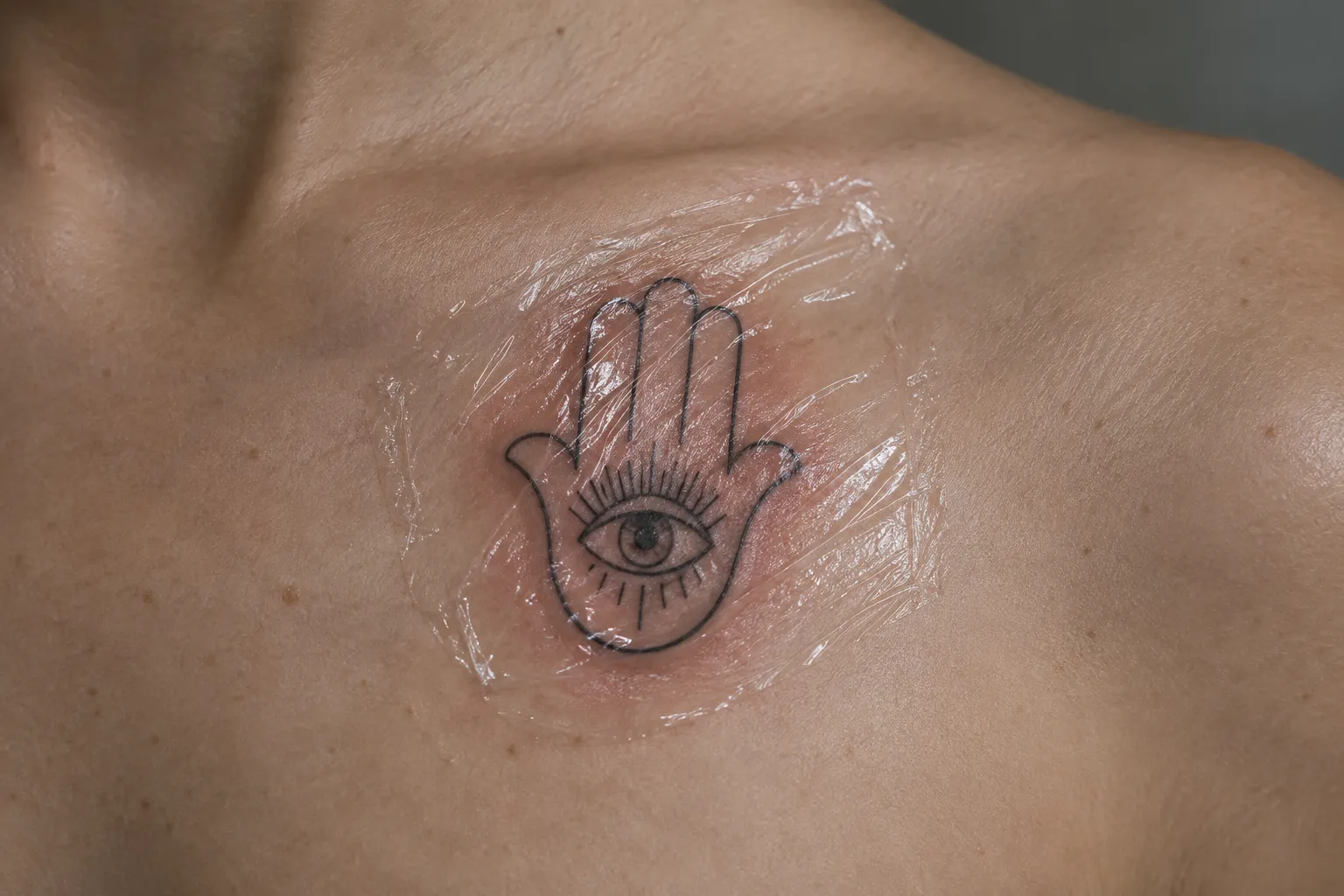
Decide meaning, orientation and detail level first
Bring your artist a short brief, not a screenshot. Say what the hamsa means to you (protection, a family link, a cultural tie), which tradition’s name you use for it, and whether you want fingers up or down. Then name the placement and let the artist tell you how much detail it can hold. Three reference images of styles you like (one minimalist, one ornamental, one jewellery photo) give them more to work with than a single Pinterest pin.
If you plan to add lettering, such as a Hebrew or Arabic word, size it by letter height: block letters at least 6 mm (1/4 in) tall, standard script at least 12 mm (1/2 in). Have the spelling and meaning checked by a fluent reader before the session.
Test the stencil on the actual placement
One hamsa guide suggests taking the stencil or drawing home and taping it to the placement for a few days before committing (1). Ask the artist to place it, then stand naturally, let your arm hang, turn it, and look in a mirror. Check whether the hand faces you or the observer (1), whether the palm eye sits centred on a flat area or wraps around a curve, and whether the ornament reads at that size. Moving a stencil is free. Moving a tattoo isn’t.
Plan a Hamsa Tattoo Consultation
Settle the design choices and studio checks before the tattoo session begins.
- 1
Define your intention
Tell your artist what the hamsa means to you and whether you are drawing on a particular cultural or religious tradition.
- 2
Choose orientation and detail
Decide whether the fingers point up or down, then match the eye and ornament to the final size.
- 3
Choose the placement
Name the body area and consider how its curve, visibility and available space affect the design.
- 4
Check the stencil on your body
Stand naturally, turn the placement and check whether the hand faces you or an observer and whether the palm eye stays clear.
- 5
Ask about studio safety
Ask how equipment is kept sterile, which inks are used and whether the studio holds the required local licence.
- 6
Follow the healing instructions
Use your artist's aftercare directions, keep the area clean and avoid picking or exposing the healing tattoo to direct sun.
Ask about sterile equipment and ink
Ask the studio how it handles sterile equipment and which inks it uses. According to the FDA, even unopened, sealed tattoo inks can harbour bacteria and other microorganisms that cause infections (8). Unhygienic practice is not the only source of infection: ink contaminated with bacteria or mold is another (8). The FDA oversees tattoo inks as cosmetics, while state and local authorities oversee the practice of tattooing (8), so check your studio’s local licence as well.
Note the ink brand and colour your artist uses. If something goes wrong, the FDA advises telling the artist and identifying the ink brand, colour, and lot or batch number (8).
Aftercare basics and warning signs
Follow your artist’s instructions first. In outline, healing follows the week-by-week tattoo aftercare timeline:
- Day 1-3: Keep the wrap on for as long as your artist says, then wash gently with lukewarm water and a fragrance-free soap, pat dry, and apply a thin layer of the ointment or moisturiser your artist recommends. Expect redness and some weeping.
- Day 4-7: Keep washing two to four times a day and moisturise lightly with a fragrance-free moisturiser. The skin feels tight and starts to flake. Don’t pick or scratch, and stay out of pools, hot tubs, the sea and baths.
- Week 2: Peeling and itching peak. Keep moisturising and leave the flakes alone.
- Week 3-4: The surface closes, and any milky look from the peeling phase clears. Keep it out of direct sun for the first four to six weeks with sun-protective clothing, and switch to sunscreen only once it is fully healed.
A fine palm eye looks crisper fresh than healed. Judge the result around week six, once the tattoo has settled, and book any touch-up after that.
Contact a health professional if the tattoo isn’t healing or develops a rash (8). A fever is another warning sign (8).
Frequently Asked Questions
- What does a Hamsa tattoo mean?
- A Hamsa tattoo can mark protection, cultural connection, or personal intention; name the tradition you are drawing on rather than assuming one meaning fits everyone.
- Can non-Jews wear a Hamsa?
- One hamsa tattoo guide says yes, with a respectful approach, though some in Jewish and Muslim communities debate appropriation; Hebrew text or the name Hand of Miriam draws on Jewish tradition and should be understood before tattooing.
- Is a Hamsa okay for Christians?
- Levantine Christians call it the hand of Mary, while 16th-century church authorities in Spain banned it as an Islamic symbol; if that matters to you, ask within your own church before treating the design as a faith symbol.
- Is a Hamsa a Hindu symbol?
- The open-hand Hamsa is a Middle Eastern and North African amulet; the Sanskrit hamsa is a goose or swan symbol, and pairing the hand with a lotus or om sign is a modern fusion.
- Does finger orientation matter?
- Orientation matters mainly for how the tattoo reads on your body; try both directions as a stencil and check them with your arm relaxed.
- How much does a Hamsa tattoo cost?
- Ask for a quote based on the finished size, linework and ornament; compare what each artist includes rather than treating a broad price band as a booking quote.
- What size keeps the palm eye legible?
- The eye needs enough separation between its iris and almond outline to stay distinct after healing; have the artist check the design at actual size.
- Which placement fades fastest?
- Finger and hand placements tend to lose crisp detail sooner; if a palm eye is the priority, ask your artist whether a less friction-prone site suits it better.
What to Settle Before Your Artist Draws the Stencil
Scholars have interpreted the hamsa as a Jewish, Christian or Islamic amulet, and as a pagan fertility symbol (7), so the tattoo is yours to define, not a badge of one faith. Orientation and ornament are personal choices, but they must match your size and placement: a bold outline and clear eye for the wrist or fingers, full mandala or floral work only where you have the room, like the upper back, thigh or outer forearm. Walk into the consultation knowing your meaning, your direction and your budget band. Then stand in front of the mirror with the stencil on and check how it reads before the needle starts. Plan for a few weeks of fragrance-free aftercare and four to six weeks out of direct sun, so the palm eye heals as cleanly as it was drawn.