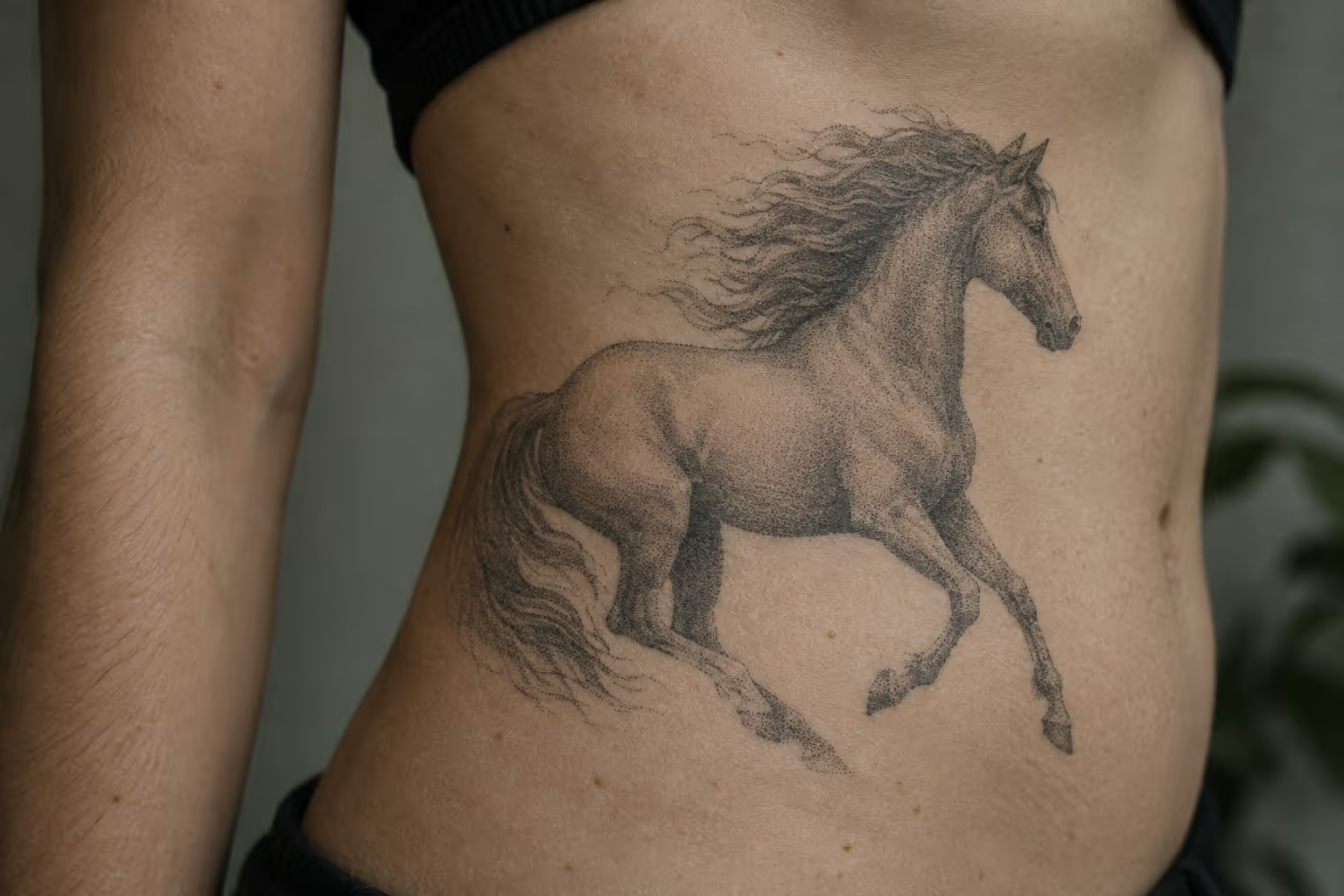
A horse tattoo doesn’t carry one fixed meaning. A rearing stallion reads as defiance, while the same animal standing calm under a saddle reads as partnership, so the pose and tack you choose decide what the piece says (1). The size you give it decides whether the legs, hooves and mane still read once the ink settles. Pick the message first, then pick a style and placement that leave enough skin for it.
✓ Pros
- Pose and tack let the same horse motif carry distinct personal meanings.
- A crop or silhouette can suit a small piece, while a larger scene has room to develop.
- The horse's direction and shape can be matched to the limb or body panel.
✗ Cons
- Horse anatomy needs enough room for the legs and hooves to stay distinct.
- A design that crosses the ankle bone hurts more than the same design on the padded outer forearm.
- UV light can fade some tattoo inks once the tattoo has healed.
- Combining several symbols can make the intended message harder to read.
Horse tattoo meaning: how pose and tack shape the message
Horse tattoo meaning comes from pose and tack together. A running horse reads as freedom, a rearing horse reads as power, and a saddle or reins shifts either one toward partnership (1). The horse alone is too broad to carry a single message. Horses were painted on cave walls at Lascaux before anyone rode them, and they turn up in nearly every mythology that had access to one (1). Genetic studies place the domestication of modern horses on the Pontic-Caspian steppe, in the Volga-Don region of southwestern Russia, around 2200 BCE (6). That long history lets a horse carry almost any idea. A horse drawn with no particular idea in mind tends to look like stock art.
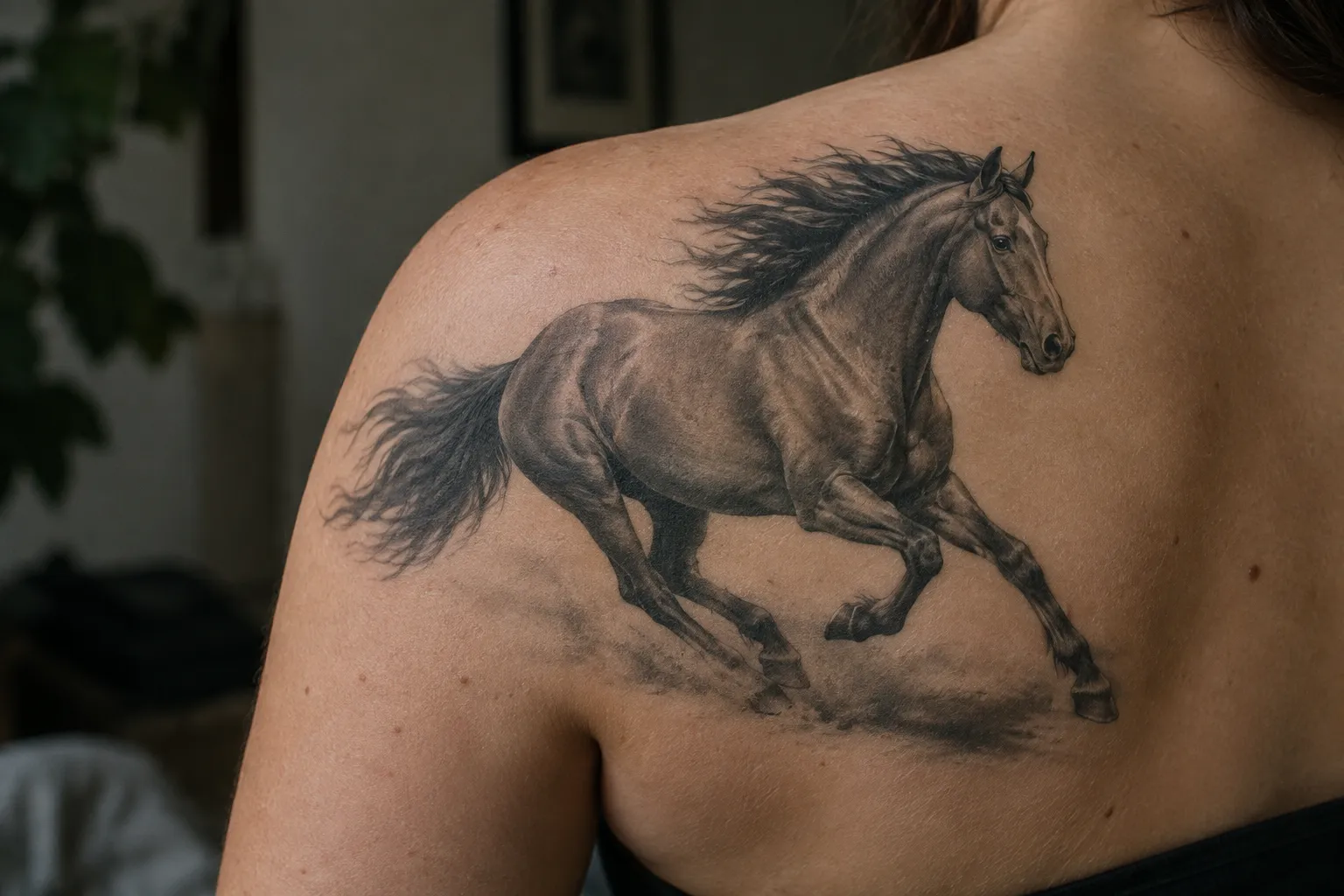
So narrow the meaning before the drawing starts. Bring your artist a sentence, not a single word. “Freedom” is vague. “A bare horse at full gallop because I left a job that boxed me in” gives the artist a pose, a level of tack and a mood to draw.
Running vs rearing: what the pose says
A running horse commonly conveys freedom and forward motion (1). The legs stretch, the mane streams back, and the whole body reads left-to-right or right-to-left. That direction matters on the body. Ask your artist to orient the gallop so it moves toward the front of your body or down the limb, not into your armpit or off the edge of the leg.
A rearing horse suggests power, defiance or readiness to fight (1). It is a vertical composition: front hooves up, weight on the haunches, head thrown back. That changes where it can go, which the placement section below covers.
A calm, standing or head-only portrait suits memorial work for a companion animal (1). No motion, no drama, just the face, the ears and the markings that made that horse recognizable.
Tack and context: saddle, bridle, or none
Tack changes the symbolism as much as pose does. A horse with no saddle and no bridle reads as untamed, something that can’t be owned. Add reins or a saddle and the subject shifts to partnership, discipline or work (1). Clients are often surprised how much a single strap of leather changes the reading (1).
This gives you four useful combinations:
- Bare and running: independence and escape, the classic freedom piece.
- Bare and rearing: defiance, fight, refusing to be handled.
- Saddled or bridled and calm: partnership, trust, years of working together.
- Saddled and running: shared effort, a rider and horse moving as one.
If you ride, adding tack is often the more honest choice. A bare wild horse on someone who spent fifteen years schooling a specific gelding sends the wrong message.
Cultural references: Epona, Rhiannon, and the mustang
Celtic references are one mythological route. Epona was a Gaulish horse goddess adopted by the Roman cavalry, usually shown seated beside or riding a mare, and the related Welsh figure Rhiannon arrives on a white horse that no rider can catch. Either reference can signal protection or guidance in a horse design, and both invite knotwork and Celtic ornament into the composition (1). If the Celtic connection matters to you, ask your artist to build on that iconography rather than stacking generic triquetras around the horse.
The mustang is the American shorthand for independence (1). There is a nerdy wrinkle here, though. Horses evolved in North America, died out there at the end of the last ice age and only came back on Spanish ships, so every free-running herd in the American West descends from domestic animals that got loose (1). That doesn’t ruin the freedom reading. It does mean “untamed” is a modern layer on the motif: the freedom reading is the most common one and also the most modern, while for most of human history the horse was a working partner, which is where the loyalty and partnership readings come from (1).
Realism vs line work: choosing a style that holds up over time
Realism and fine line are not interchangeable promises for a horse tattoo. Realism needs room for soft value transitions, while fine line works best as simplified gesture (1). Pick the style that matches the space you have, not the Pinterest image you saved.
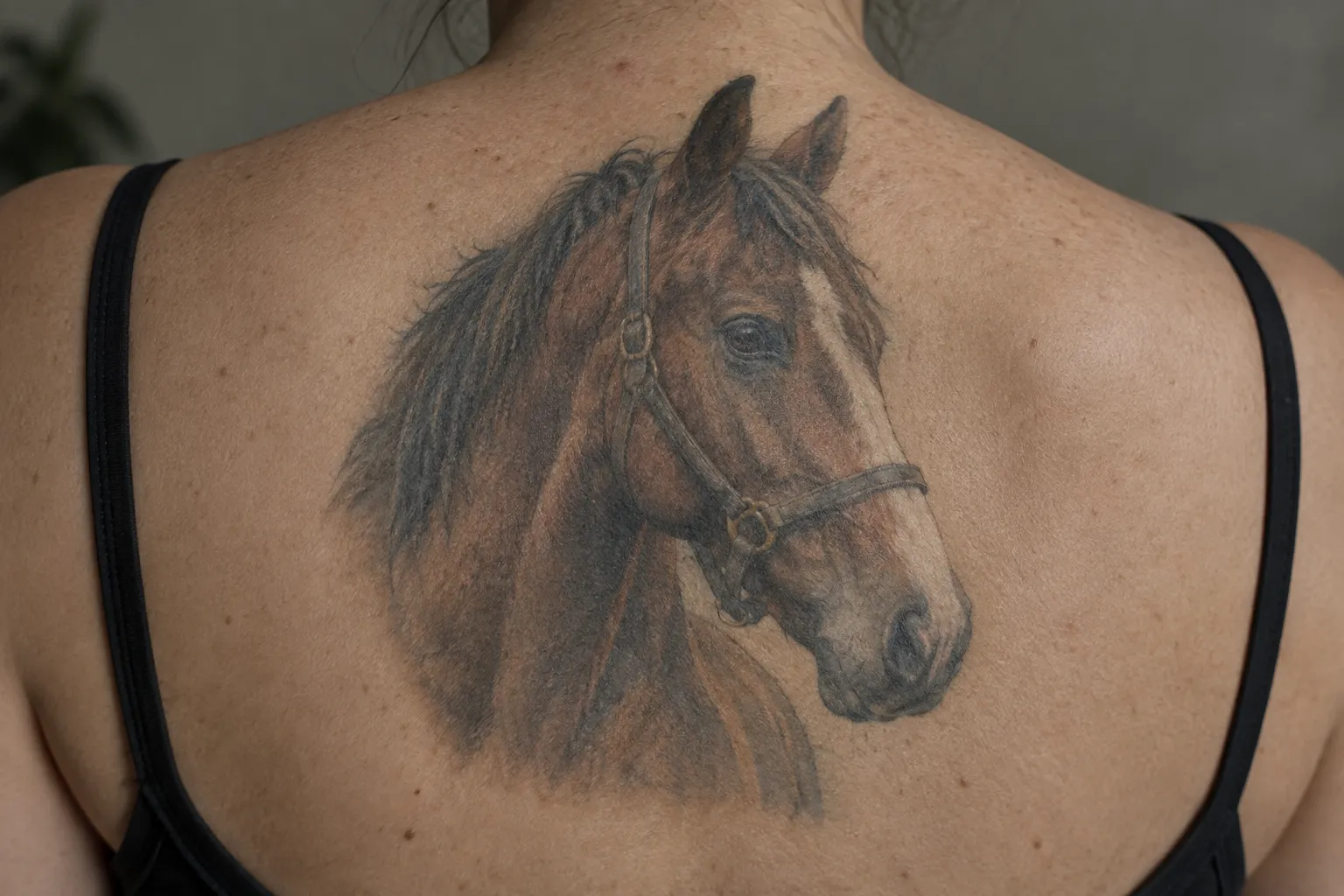
Black-and-gray realism builds the horse’s form from smooth gradients rather than outlines, and it depends on accurate anatomy: the muscle groups over the chest, hindquarters and forearm are what sell the animal (1). Horse muscle is hard to render. A slightly wrong shoulder on a dragon reads as style, but on a horse it reads as a bad horse (1). The common pitfall is size. Realism packed too small loses its gradients within a few years as the ink softens (1), because the grey tones that separate a muscle from its shadow sit very close together. Over the years, ink settles and spreads slightly under the skin. At a small scale those tones merge, and a realistic horse turns into a grey smudge with an eye.
Fine line has a different hallmark: a thin, single-weight line. It works best as expressive gesture, such as the arc of the neck and a suggested mane, rather than as a miniature anatomical portrait (1). The pitfall is detail creep. When an artist tries to put individual mane strands, fetlock hair and muscle contours into fine line at a small size, the lines sit too close together, and spreading ink closes the gaps between them over the years (1). Lines that are too thin may also fade faster (2). A fine line tattoo of a horse should look like a confident sketch: a few lines that catch the movement, nothing that needs a magnifying glass.
Bold or neo-traditional sits between the two. Traditional and neo-traditional treatments use strong outlines and simplified muscle shapes, so the horse reads clearly at a glance (1). American traditional adds its own hallmarks of a bold black outline and a limited palette (2). Neo-traditional is a modern twist on it, with more vibrant colour and strong outlines (2). The pitfall here is a lazy outline: a stiff, cartoonish horse with a straight-tube neck. A good traditional horse still needs a believable gesture, even when the muscles are simplified into a few shapes.
Watercolor sits outside these three because it fights the subject. Its appeal is bleed, while a horse’s legibility depends on a clean silhouette, so the bleed eats the edge where a leg meets the background and the animal loses its outline (1). Watercolor colours may also fade faster than traditional ink (2).
Here is how the three compare as a decision, laid out in the table below.
Healed and fresh look different in all three, because ink spreads and softens over the years (1). Judge your artist’s healed portfolio photos, not just the fresh ones.
Horse tattoo styles at a glance
| Black-and-gray realism | Fine line | Bold or neo-traditional | |
|---|---|---|---|
| Best suited to | Specific-horse portrait or dramatic full-body scene | Simplified gesture or subtle placement | A horse that needs to read clearly at a glance |
| Space needed | Most | Least, if simplified | Moderate |
| How it changes as it heals and ages | Soft value transitions lose contrast | Thin lines may fade or blur | Outline and saturated fill help hold the shape |
| Risk when undersized | High | High if overloaded with detail | Lower, but a full gallop still needs room |
Small design ideas: when a head crop beats a full gallop
A small horse tattoo works best as a simplified silhouette or a head-and-mane crop, because full anatomical detail needs more space to stay legible (1). Size the design by the detail it has to carry. A head-and-mane crop works at about 4 inches (about 10 cm) on the forearm, while a full-body horse needs 6 inches (about 15 cm) or more (1).
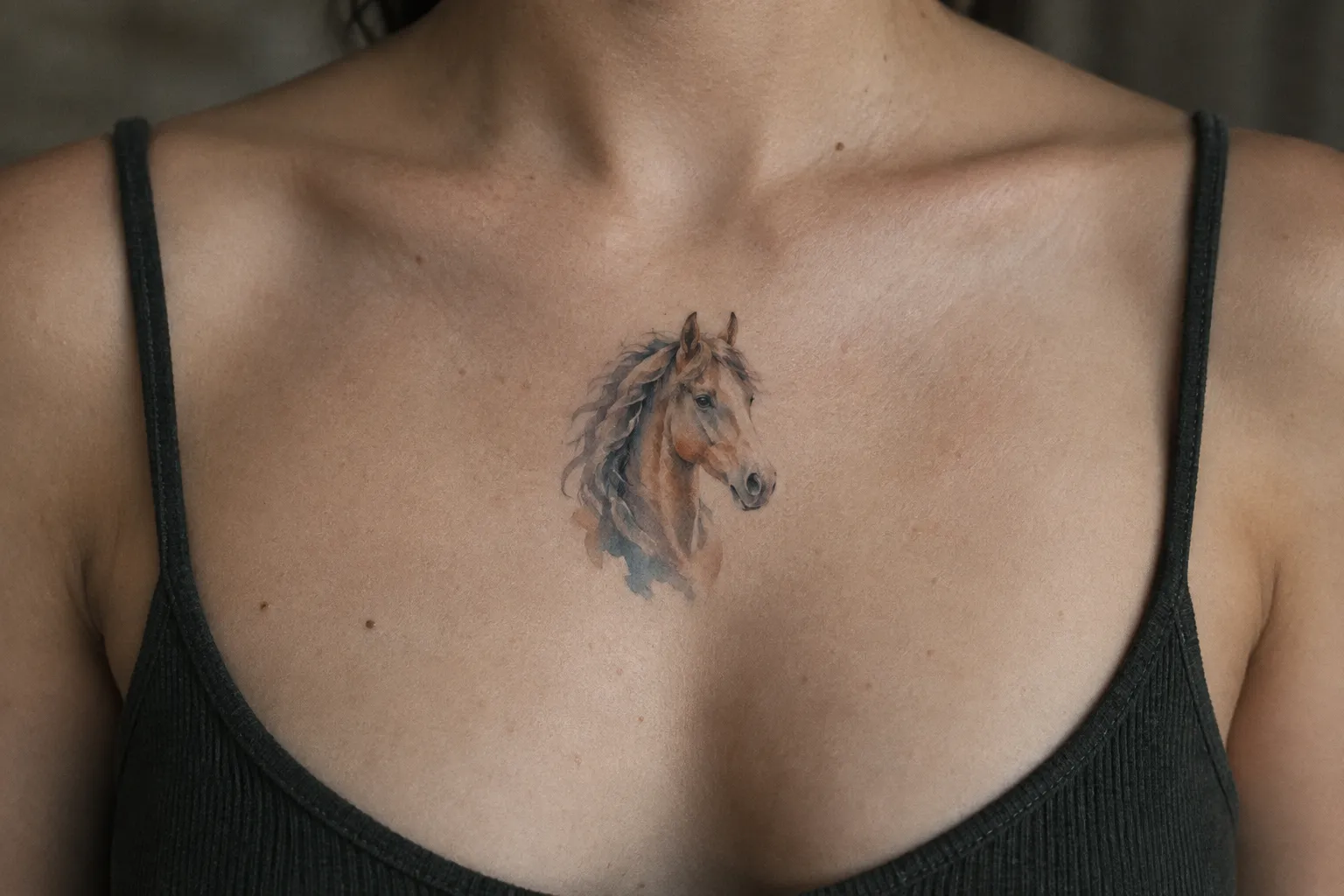
Those two figures form the decision rule. A head crop has one face, two ears, an eye and a mane, which are big shapes that survive being small. A full-body horse has four legs, four hooves, a tail and all the negative space between them. Below its threshold, the legs read as sticks and the hooves as dots (1).
For anything smaller than a head crop, drop the anatomy and go to gesture: a running silhouette filled solid black, a one-line drawing of the neck and mane, or a horse head in profile reduced to an outline. These suit first-time tattoo wearers and anyone who wants a subtle piece that is easy to conceal (2).
Best placements for a head-and-mane crop
The outer forearm is the workhorse placement for a head-and-mane crop at about 4 inches (about 10 cm) (1). It is flat enough for the eye and nostril detail, visible to you every day, and the mane can follow the length of the arm.
Simplified silhouettes and outlines can go smaller. The wrist, ankle and behind the ear suit minimalist horse designs (2), as long as you accept they will be outline or solid-fill pieces, not portraits. Behind the ear only works for the simplest gesture, such as a head silhouette or a single-line neck curve. There is no flat space there for anything more.
Why full-body horses need more room
A full-body horse at 6 inches (about 15 cm) or more (1) gives each leg enough width to show the knee and the cannon bone, and gives each hoof enough mass to read as a hoof. The negative space between the legs is part of the design. When it closes up, the horse’s lower half becomes a dark blob.
If your skin area can’t take that size, change the design rather than the scale. Crop to the head and neck, or to the head and shoulders with the mane flying. The meaning stays intact. A running horse cropped at the chest with the mane streaming back still reads as motion.
Horse head tattoo placement: matching the crop to the limb
Horse head tattoo placement works best on the outer forearm, where the mane can follow the limb, while a full horse in motion fits the outer thigh or calf, and the back holds a herd, a landscape or a mounted figure (1). As our tattoo placement guide puts it, match the shape of the design to the shape of the body part. Horizontal motion wants a long surface, and vertical poses want height.
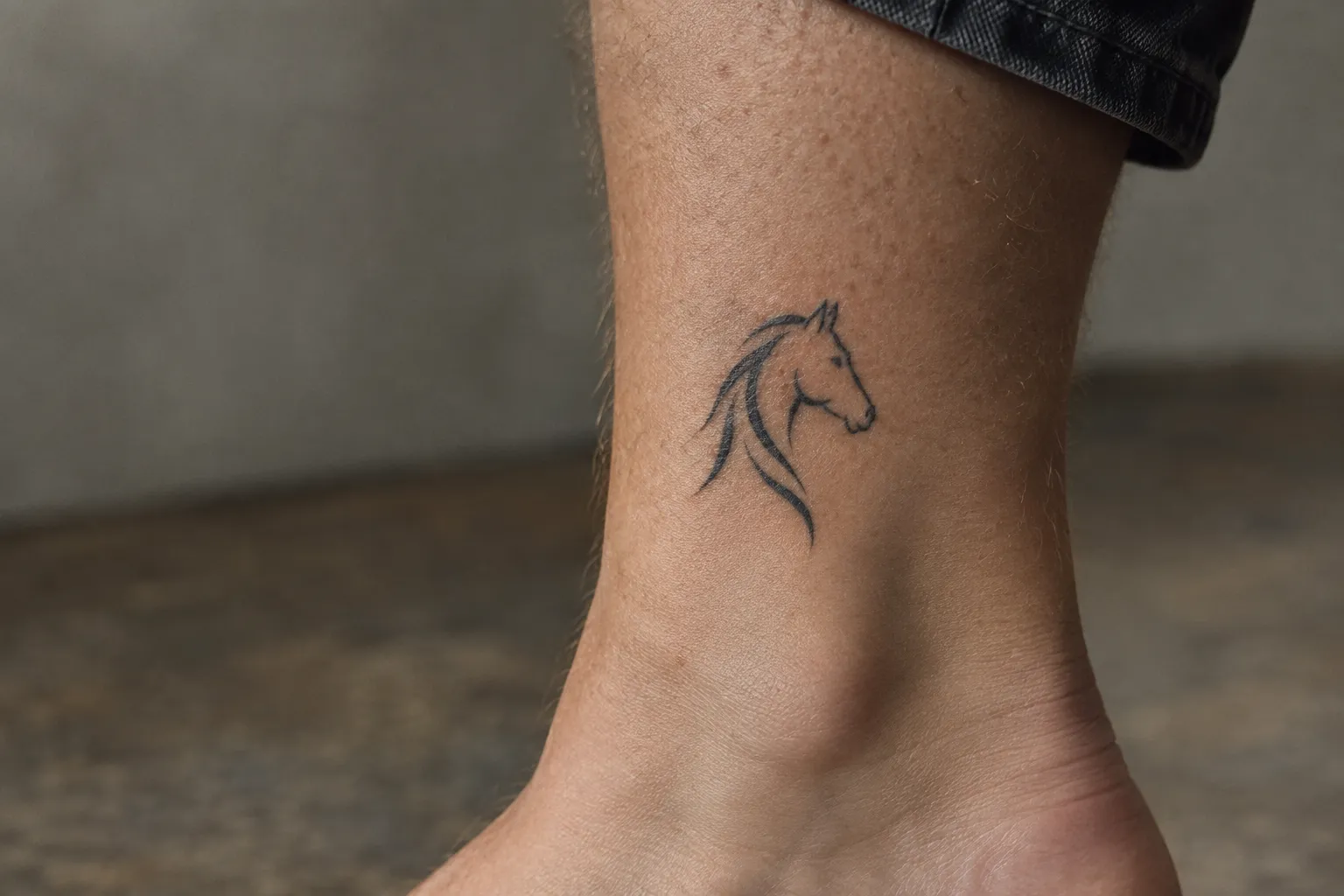
Outer forearm for a head crop
A horse head tattoo on the outer forearm has three advantages. The surface is fairly flat between the wrist and elbow, the mane can run along the arm’s length so the design follows the limb instead of fighting it (1), and you can see it without a mirror. Orient the head so the face points toward the wrist or toward the elbow depending on how you want it to read when your arm hangs.
For pain, the outer forearm is one of the easier spots, while the inner forearm gets sharper toward the wrist, where tendons and nerves run close to the surface.
Thigh, calf, and back for a full horse or scene
For a full horse in motion, the outer thigh or calf gives more room (1). The outer thigh is the bigger, flatter canvas of the two and suits a horizontal gallop. The calf is taller than it is wide, so a running horse there usually works better angled slightly or wrapped, and a rearing horse fits the calf’s vertical shape well.
The back is the placement for larger compositions: a group of horses, a landscape, or a mounted figure (1). A herd running across the shoulder blades or a rider on a rearing horse down the spine needs that much skin. Expect multiple sessions for anything at that scale in realism (2).
A rearing pose needs vertical room (1). That makes the upper arm, calf, side of the thigh, or a vertical panel on the back better homes than the outer forearm, where a rearing horse ends up compressed. Ribcage placement can take a rearing horse too, but the ribcage hurts more than the thigh or forearm, and long realism sessions there are hard to sit through.
Design mistakes that blur the symbolism
The most common horse tattoo mistake is asking for a whole horse at a size that can’t hold one, and the other is asking one horse to say two opposite things at once (1). One blurs the image, the other blurs the meaning.
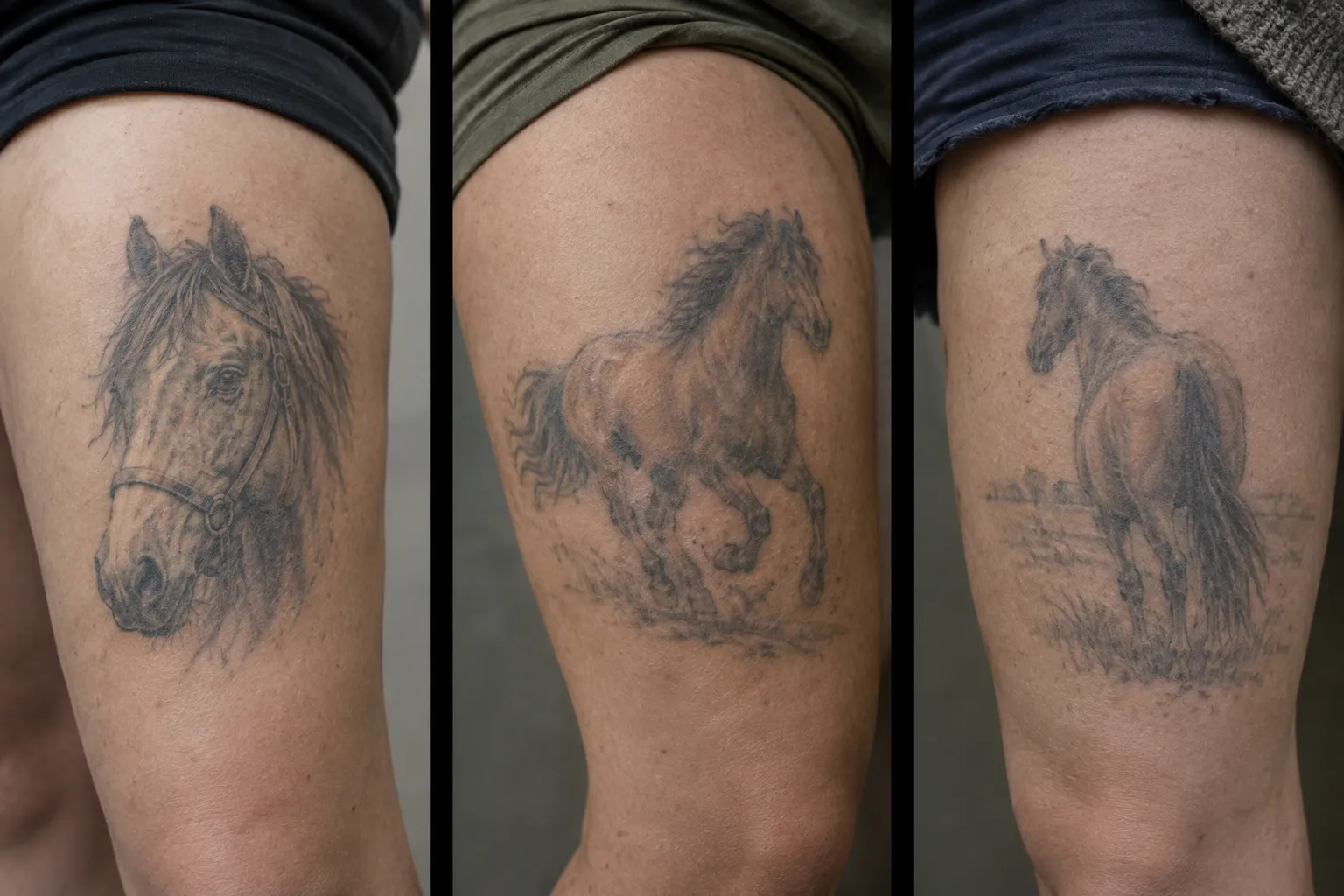
Shrinking a full-body horse below its threshold. Under roughly 6 inches (about 15 cm), legs become sticks and hooves become dots (1). This mistake is easy to make because the stencil looks fine on the day. Fresh ink is sharp. Healed, then softened over several years, the tight spaces between the legs fill in. If the placement you want is small, change the crop.
Stacking freedom and death symbolism without a rationale. Freedom and death imagery can become muddled together (1). A galloping wild horse with a skull, roses, a clock, a dove and a date asks the viewer to read five things at once, and the horse’s freedom reading fights the memorial reading. If the tattoo is for a horse that died, a calm portrait with its markings and perhaps a name or date says “memorial” clearly. If it’s about breaking free, leave the death imagery out. Combining them can work, but only when you can explain in one sentence why they belong together.
Treating realism and fine line as the same choice. Realism depends on value transitions, while fine line suits simplified gesture (1). Asking for “a realistic horse in fine line” at wrist size asks for something no needle can deliver. Decide which you want: a believable horse, or a beautiful sketch of one.
Skipping reference photos for a personal portrait. A generic stock horse won’t look like your horse. Clear, well-lit photos from several angles, plus close-ups of the face markings, blaze and ear position, are what make the individual recognizable (1). More on this below.
Beyond the motif, general tattoo risks still apply. The FDA lists allergic reactions, granulomas, and keloids in people prone to them. It also notes that removal usually takes several treatments and that complete removal without scarring may be impossible (3). That last point is the best argument for getting the size and meaning right the first time.
Studio hygiene before the session, sun care after it heals
Treat studio hygiene and healed-tattoo sun care as one checklist. Confirm sterile equipment before the session (3), then use broad-spectrum SPF 30 or higher on the healed horse (4). A good design ruined by an infection, or faded flat by UV, isn’t a good design anymore.
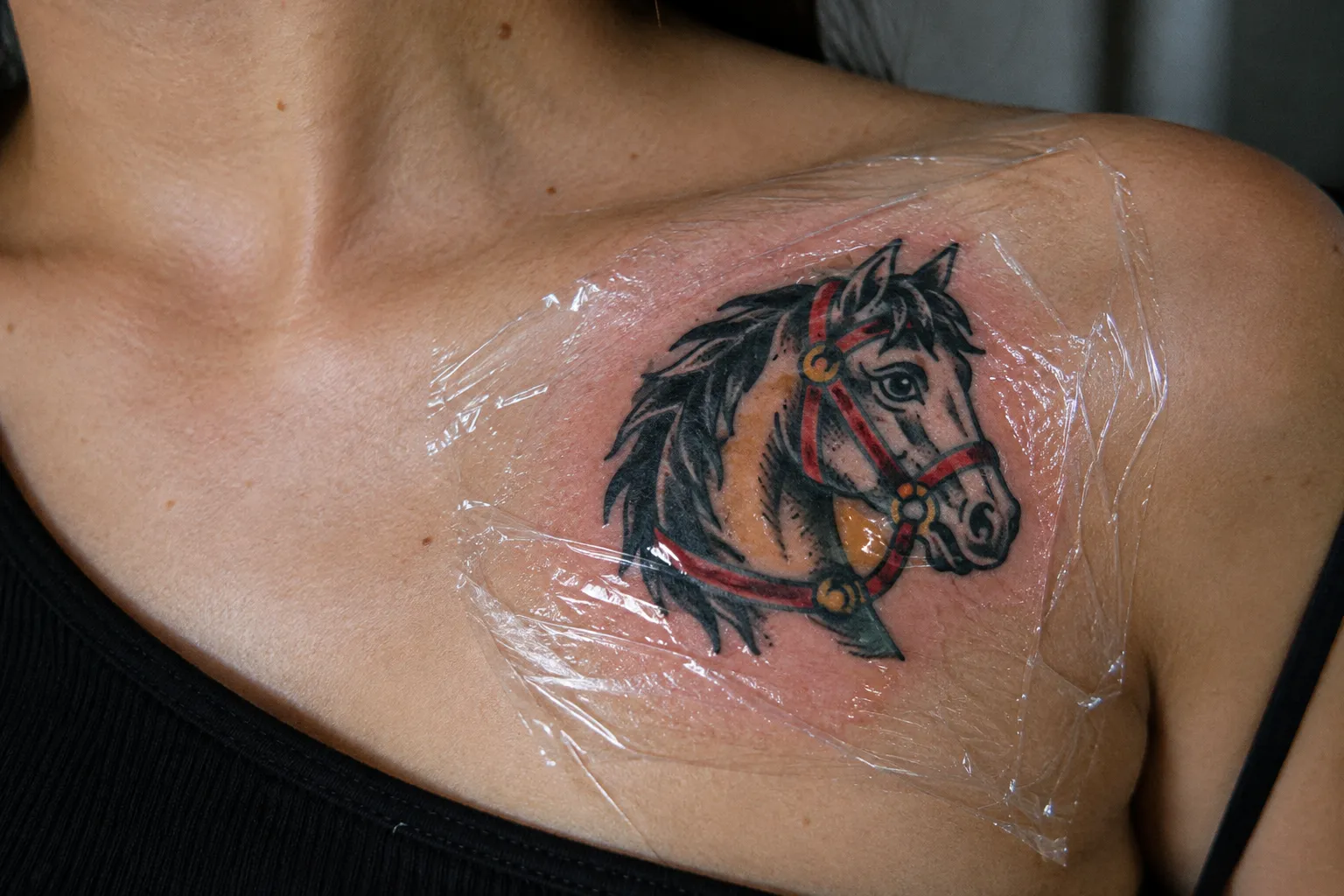
Checking studio hygiene before you sit down
The FDA warns that unsterile tattooing equipment and needles can transmit infectious diseases such as HIV, hepatitis and staph skin infections (3). Harvard Health’s tips for a safe session come down to two checks (5):
- Ask the artist what the shop’s sterilization process is. The shop should have an autoclave, a device for sterilizing equipment.
- Make sure the artist uses a new, sterile needle for your tattoo and wears a new pair of gloves.
Tattooing itself is regulated by local jurisdictions (3). Your state or local health department can tell you whether studios must be licensed or registered, and may have a list of licensed shops and any complaints filed (5). The FDA also notes that no color additives are approved for injection into the skin (3), and that contaminated inks can cause infection even when hygienic procedures are followed (3). Ask your artist what ink brand they use and whether it has been subject to any recall. A good shop answers without getting defensive.
Protecting a healed tattoo from the sun
Sunscreen is for healed skin. While the tattoo heals, keep it out of direct sun for the first 4 to 6 weeks and cover it with clothing instead, following the timeline in our tattoo aftercare guide:
- Day 1-3: follow your artist’s wrap instructions, wash gently with fragrance-free soap, and pat dry.
- Day 4-7: the skin tightens and starts to flake. Keep moisturizing with a thin layer of fragrance-free lotion, and avoid soaking in baths, pools or the sea.
- Week 2: expect peeling and itching, and don’t pick. Wear loose clothing over the area outdoors.
- Week 3-4: the surface looks healed, but the skin underneath keeps settling until about week 6.
Once the tattoo is healed, the American Academy of Dermatology recommends a broad-spectrum, water-resistant sunscreen with SPF 30 or higher, applied 15 minutes before you go outside and reapplied at least every 2 hours (4). UV light can fade some tattoo inks, and tanning beds and sunlamps can fade them too (4). Sun care matters most for fine line, the style most vulnerable as it ages, and for black-and-gray realism, which only ages well when its soft value transitions have room. A traditional horse with bold outlines and flat colour ages best (1), but it still doesn’t need the damage.
Prepare for a horse tattoo and protect it as it heals
Use reference photos to plan the design, check studio hygiene before the session, and protect the healed tattoo from UV exposure.
- 1
Gather reference photos
For a portrait of a specific horse, bring clear, well-lit photos from several angles and close-ups of its markings and ear position.
- 2
Check the studio's hygiene practices
Ask about the shop's sterilization process, make sure the artist uses a new, sterile needle and fresh gloves, and check whether your state or city requires studios to be licensed.
- 3
Match the size to the detail
Allow about 4 inches (10 cm) for a head-and-mane crop and 6 inches (15 cm) or more for a full-body horse; simplify the design if you have less space.
- 4
Protect the tattoo during healing
Follow the wrap, wash, and moisturize routine while it heals, then shift to sun protection once it's fully healed, as covered above.
Placement, pain, and reference photos for a personal portrait
Placement matters as much for pain as the design does, while style and size decide how long you sit. Thin skin over bone, such as the ankle bone, hurts noticeably more than the padded outer forearm. A simple running-horse silhouette is a short session wherever it goes, but the sections that cross bone are the ones you’ll feel.
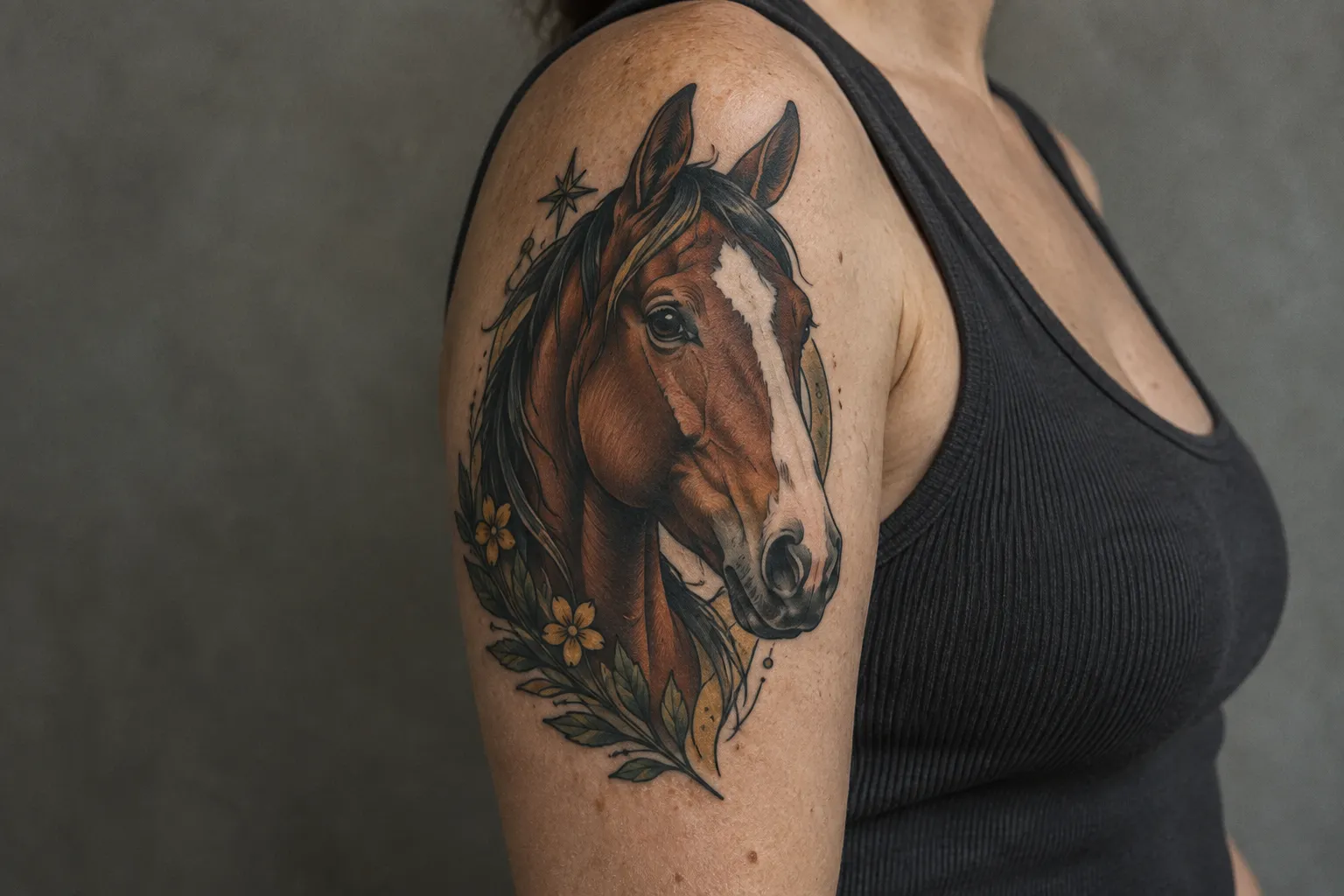
On our tattoo pain scale, the outer thigh, calf and outer forearm sit in the low tier, the inner forearm gets sharper toward the wrist, the ankle bone brings the vibrating pain of a needle working over bone, and the ribcage ranks among the most painful spots. A small silhouette on the ankle, often chosen because it is “simple”, can be more uncomfortable per minute than a palm-sized head crop on the forearm. If you want the ankle, keep the design compact enough that it doesn’t wrap over the bone, or accept a few sharp minutes.
Realism takes longer to tattoo than a line piece, and large realistic pieces need several sessions (2). Long shading sessions on a sensitive placement add up, which is one more reason realism pairs better with the outer thigh or back than with the ribcage.
Gathering reference photos for a specific horse
For a portrait of a specific horse, the reference photos do most of the work. Bring clear, well-lit photos from several angles, plus close-ups of the face markings, the blaze and the ear position (1). Ask the artist to build the design from that horse’s blaze, markings and ear set rather than from a generic reference image (1). Two chestnuts with a star look identical in stock art. In your photos, one has a slightly offset star and ears that sit back, and that is what makes the tattoo look like your horse.
A few practical tips for the photos:
- Shoot in overcast light or open shade, with the camera at the horse’s eye level, not in flat midday sun that drops the face into shadow (1).
- Take a three-quarter view with both ears forward, plus a straight profile.
- Photograph the markings separately and close up, including any socks or a whorl you want included (1).
- If the horse has died and you only have old photos, bring all of them: drawing time can’t invent what a photograph didn’t record (1).
You can also personalize the piece through details tied to your own tack, such as a background colour drawn from a saddle pad or the pattern of a bridle you used for years. That kind of choice ties the tattoo to your history with the horse without adding competing symbols.
Frequently Asked Questions
- What does a horse tattoo symbolize?
- A horse tattoo's meaning comes from its pose and tack: a bare running horse reads as freedom, a rearing one as power or defiance, reins or a saddle shift it toward partnership, and Celtic Epona or Rhiannon can signal protection or guidance.
- What's a simple horse tattoo idea for a first piece?
- A one-line neck-and-mane gesture is a simple first horse tattoo; ask the artist to keep the silhouette clear at your chosen size and placement.
- Do watercolor horse tattoos fade quickly?
- Watercolor colours may fade faster than traditional ink, and the bleed can eat the edge where a leg meets the background, so the horse loses its outline; a clear black outline helps it keep its shape.
- Is a photorealistic horse tattoo more painful on the ribcage or ankle than on the forearm?
- Yes. The ribcage ranks among the most painful placements and the ankle bone brings the vibrating pain of a needle over bone, while the outer forearm sits in the low tier; long realism shading adds time on any of them.
- What does a heartbeat (EKG line) horse tattoo represent?
- It pairs a horse with a heartbeat line, and what it marks is personal, so tell your artist the story behind it; give the line enough weight to stay legible after healing.
- What horse tattoo designs work on darker skin?
- Ask your artist how your skin tone will influence the final look, and review their healed work on similar skin tones.
- What is the 1/3 rule for tattoos, and what tattoos should you avoid?
- The 1/3 rule treats roughly a third of a limb segment as the natural size for a standalone piece; it is a general placement guideline, not a horse rule. Avoid a detailed full-body horse shrunk until its legs and hooves merge, and a horse asked to say freedom and death at once.
- Can a horse work as an anxiety tattoo?
- A horse can be a personal grounding motif if it connects to your experience; there is no single horse design that represents anxiety for everyone.
Settling size, placement, and sun care before you book
Three decisions matter more than anything else. Size the design by the detail it needs: about 4 inches (about 10 cm) for a head-and-mane crop on the outer forearm, and 6 inches (about 15 cm) or more for a full-body horse (1). Pick the placement by the pose: a horizontal gallop on the outer thigh, a rearing horse somewhere with height, and a group or mounted scene on the back (1). Once the tattoo has healed, protect it with broad-spectrum, water-resistant SPF 30 or higher, applied 15 minutes before sun exposure and reapplied at least every 2 hours (4).
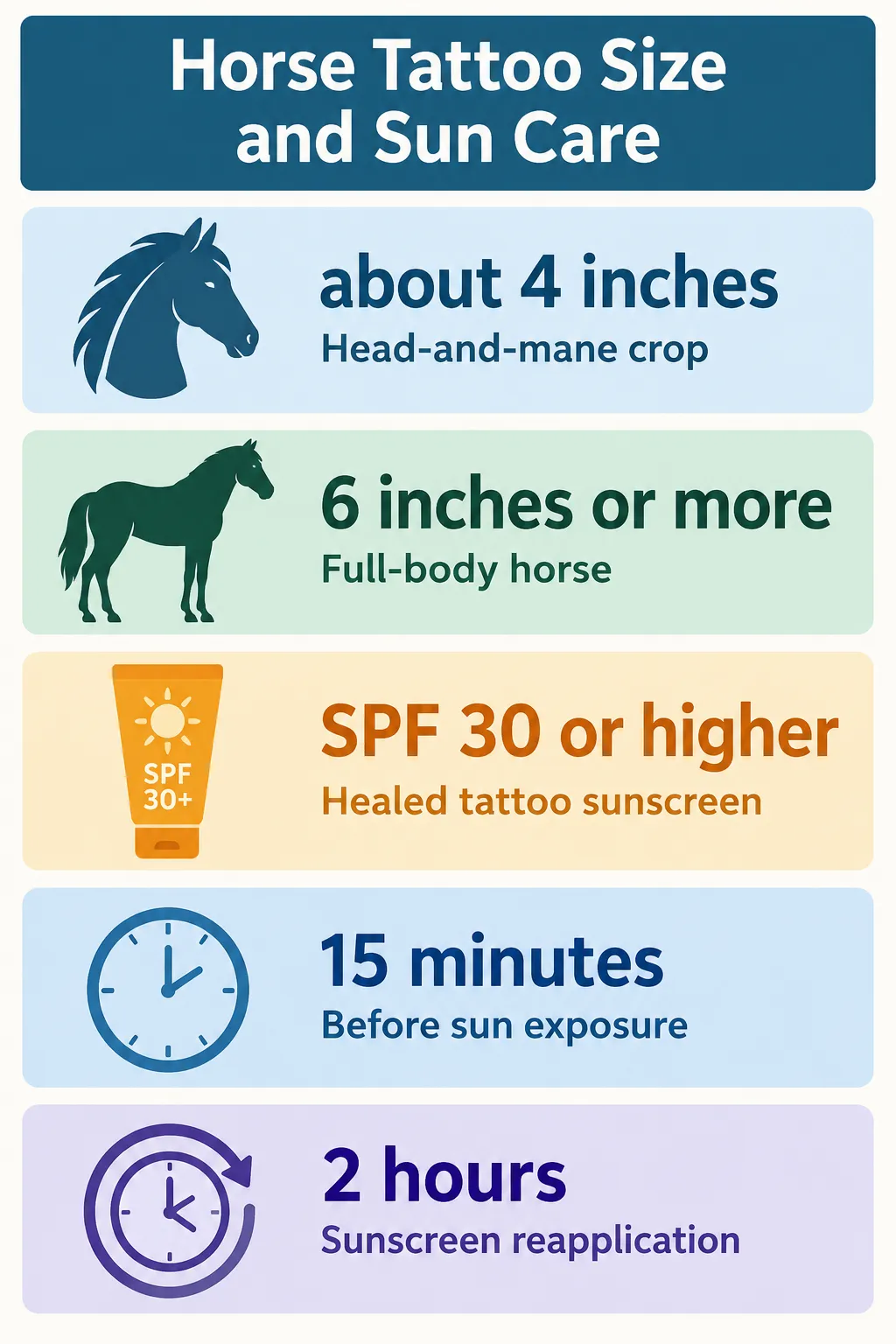 Plan about 4 inches for a horse head-and-mane crop and 6 inches or more for a full-body design; after healing, use SPF 30 or higher 15 minutes before sun exposure and reapply at least every 2 hours.
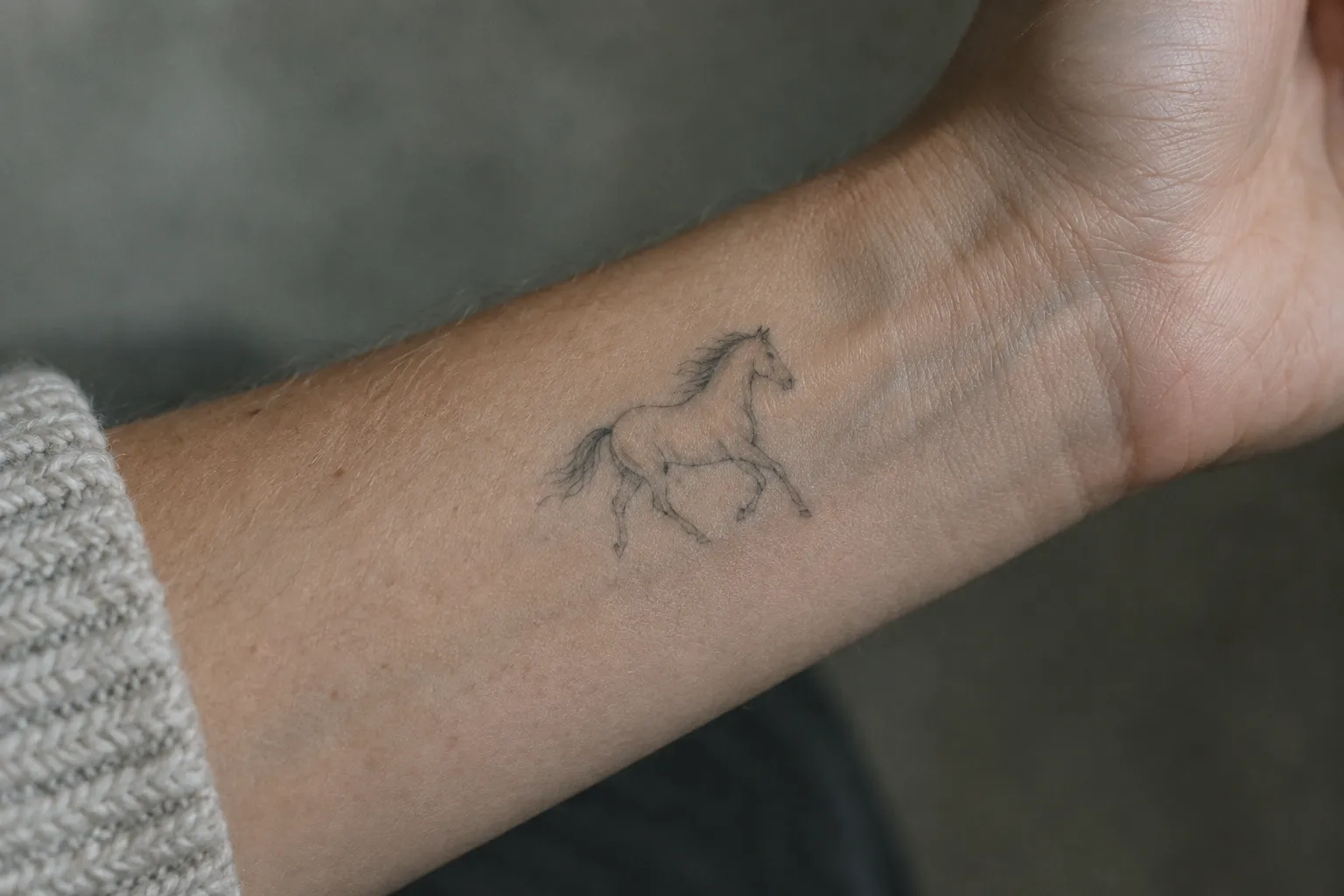
Before you book the session, gather multi-angle photos of your horse’s markings (1), decide whether you want realism, fine line or a bold outline, and ask the studio how they handle sterile needles and single-use ink (3). If you settle those points first, you can judge each consultation on the artist’s work rather than spending it explaining what you want.