A red cap with white spots reads as fly agaric folklore to one person and psychedelic shorthand to another (1)(5). A mushroom tattoo has no fixed meaning: the same image can read as nature connection, fairy-tale magic, personal renewal, or psychedelia depending on species, color, and the surrounding composition rather than the mushroom alone (1). Choose those four things on purpose, and the design says what you want it to say.
✓ Pros
- A mushroom motif can be made personal through species choice and supporting imagery.
- The design can move between graphic, naturalistic and storybook approaches without losing the central motif.
✗ Cons
- A red-and-white cap may suggest either folklore or psychedelic imagery, so the surrounding details need to steer the reading.
- Small compositions leave less room to distinguish fine gills, spots and stems as the tattoo ages.
The motif has two main strengths. Its symbolism is open-ended, and it works in many styles, from fine-line silhouettes to full woodland scenes. It also has two weak points. Some viewers will assume it is drug-related. And fine detail fades faster in high-friction, sun-exposed spots (1).
Mushroom Tattoo Meaning: Symbolism Beyond Psychedelics
Mushroom tattoo meaning most commonly centres on transformation, rebirth and interconnection. Those readings come from fungi’s role as decomposers and from their hidden mycelial networks (1). The motif is fairly recent in Western tattooing, and its readings come from three separate sources (1):
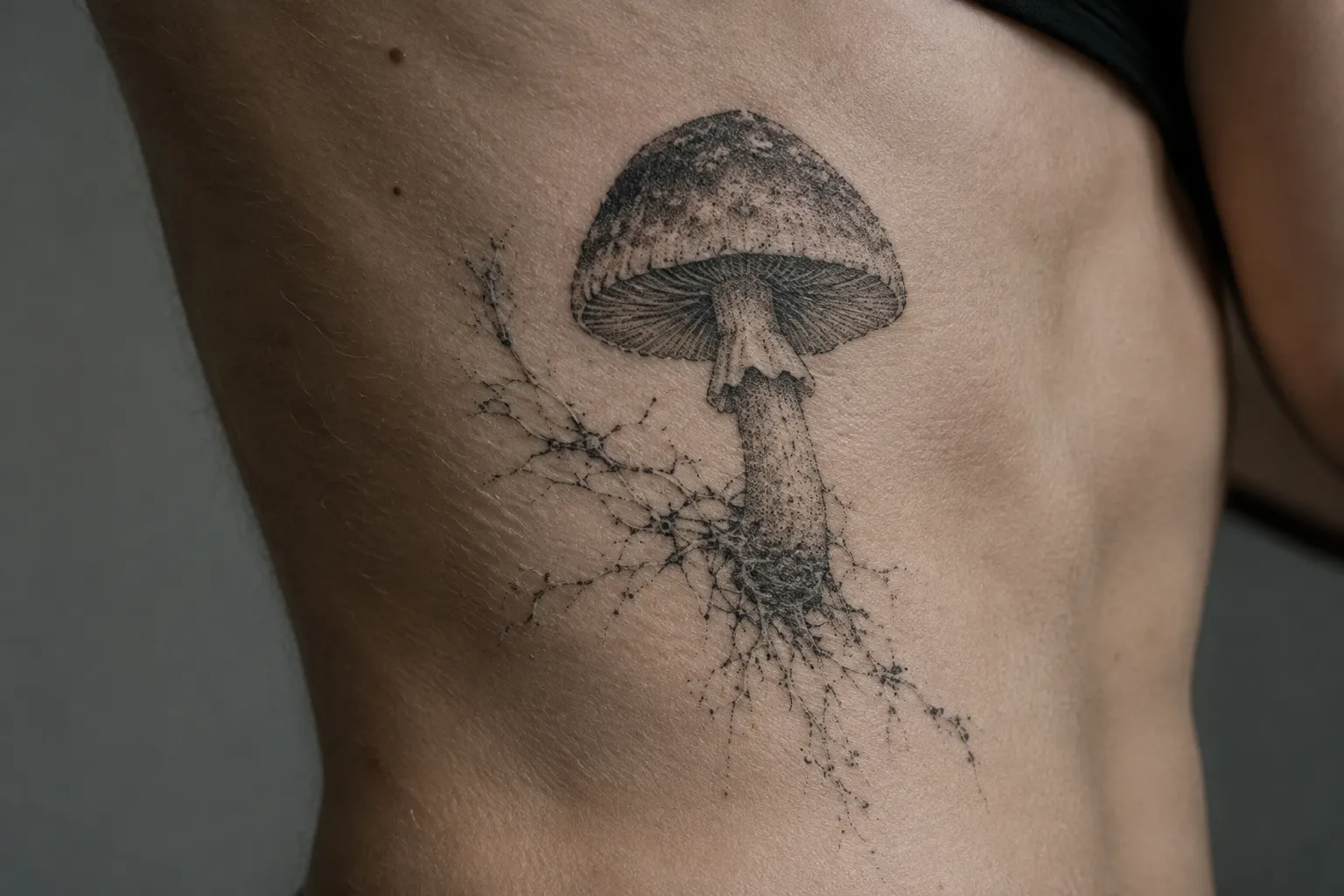
- Biology. Fungi turn dead matter into new life, so the mushroom stands for renewal.
- European folklore. Rings of mushrooms were said to mark where fairies or elves had danced in the night (1). Treat that as legend, not documented history. If your design is built around a fairy ring, you are referencing a story, not a fact about mushrooms.
- Late-twentieth-century counterculture. Here the mushroom became shorthand for altered states (1). One of the best-documented mushroom tattoos in Western tattoo history is tied to the Allman Brothers Band and dates to January 1971 (1).
Older ritual use of psilocybin mushrooms is traced to Mesoamerican cultures such as the Aztecs and the Maya (5). The modern Western psychedelic reading is a different thing from that ritual context.
The psychedelic reading only applies to specific depictions and subcultures (1). A red cap with white spots is usually fly agaric, Amanita muscaria, and it carries its own folklore and visual history (1). A generic mushroom and a fly agaric are not the same symbol, so decide which one you are drawing (1).
Renewal, decay and the skull-and-cap pairing
A skull or bones beneath the mushroom makes the decay-and-renewal reading easy to see (1). The cap grows out of what died. Even a viewer who knows nothing about fungi gets the idea from across the room.
Mycelial threads as a symbol of community
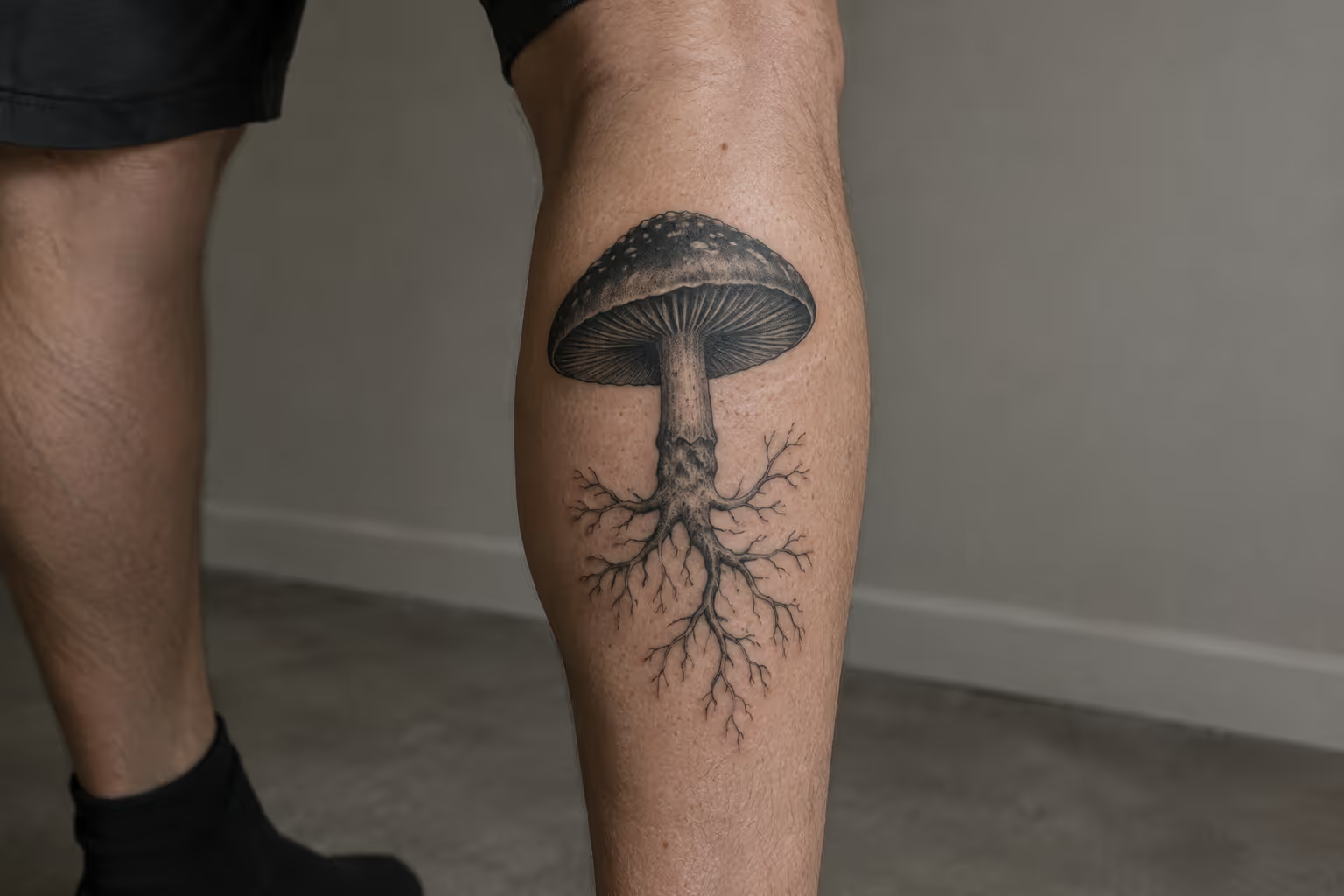
A mycelial network stands for connection, community and unseen bonds: separate individuals joined by hidden roots (1). If connection is the point, draw the threads: shown with its underground threads, the mushroom makes the interconnection reading explicit (1).
Design Styles: Cottagecore, Fairy-Tale, Botanical and Psychedelic Looks
Mushroom designs fall into a handful of visual directions. One idea guide names five: realistic/botanical, whimsical/fantastical, psychedelic/visionary, minimalist and abstract (5). Here is how the main ones look in practice.
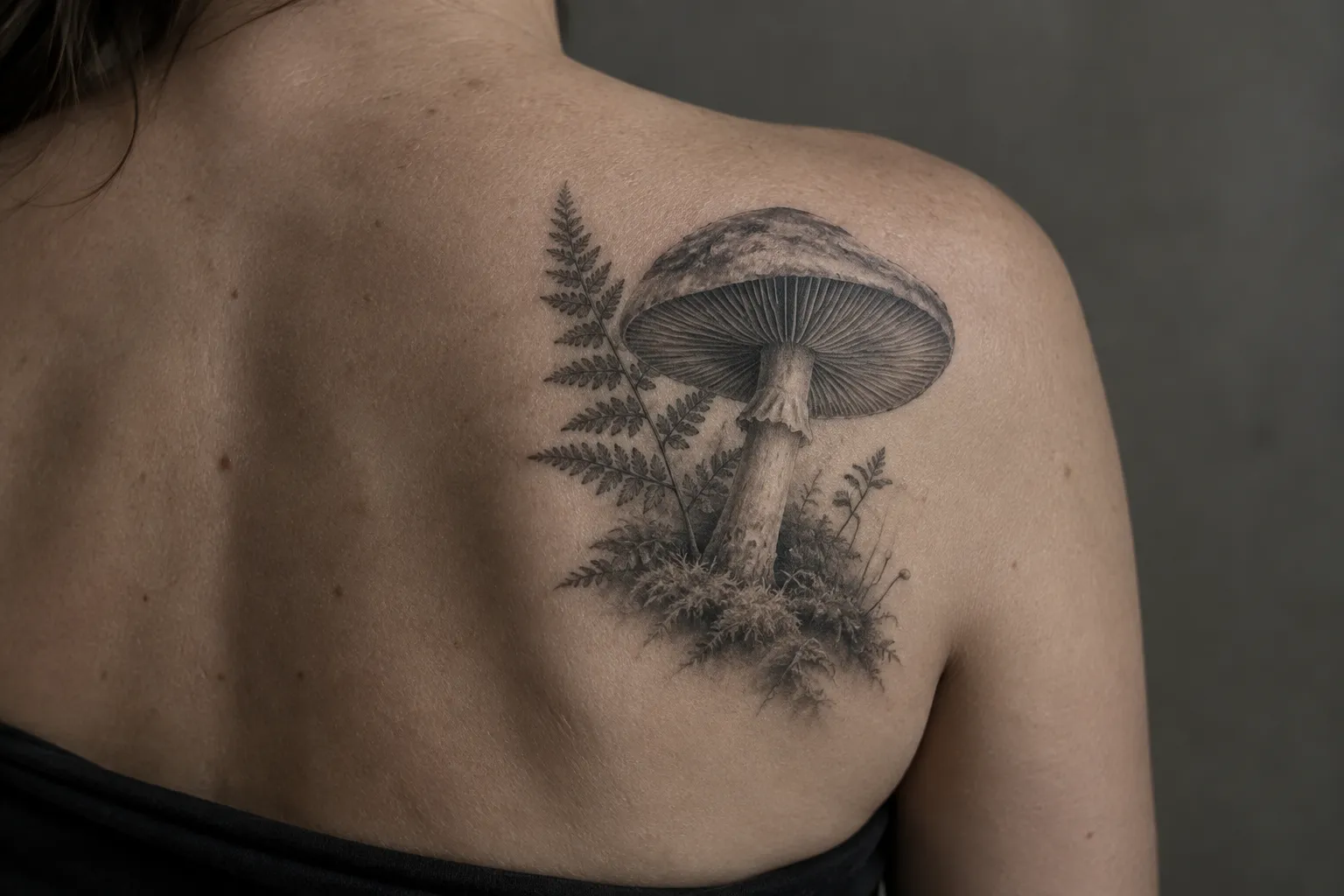
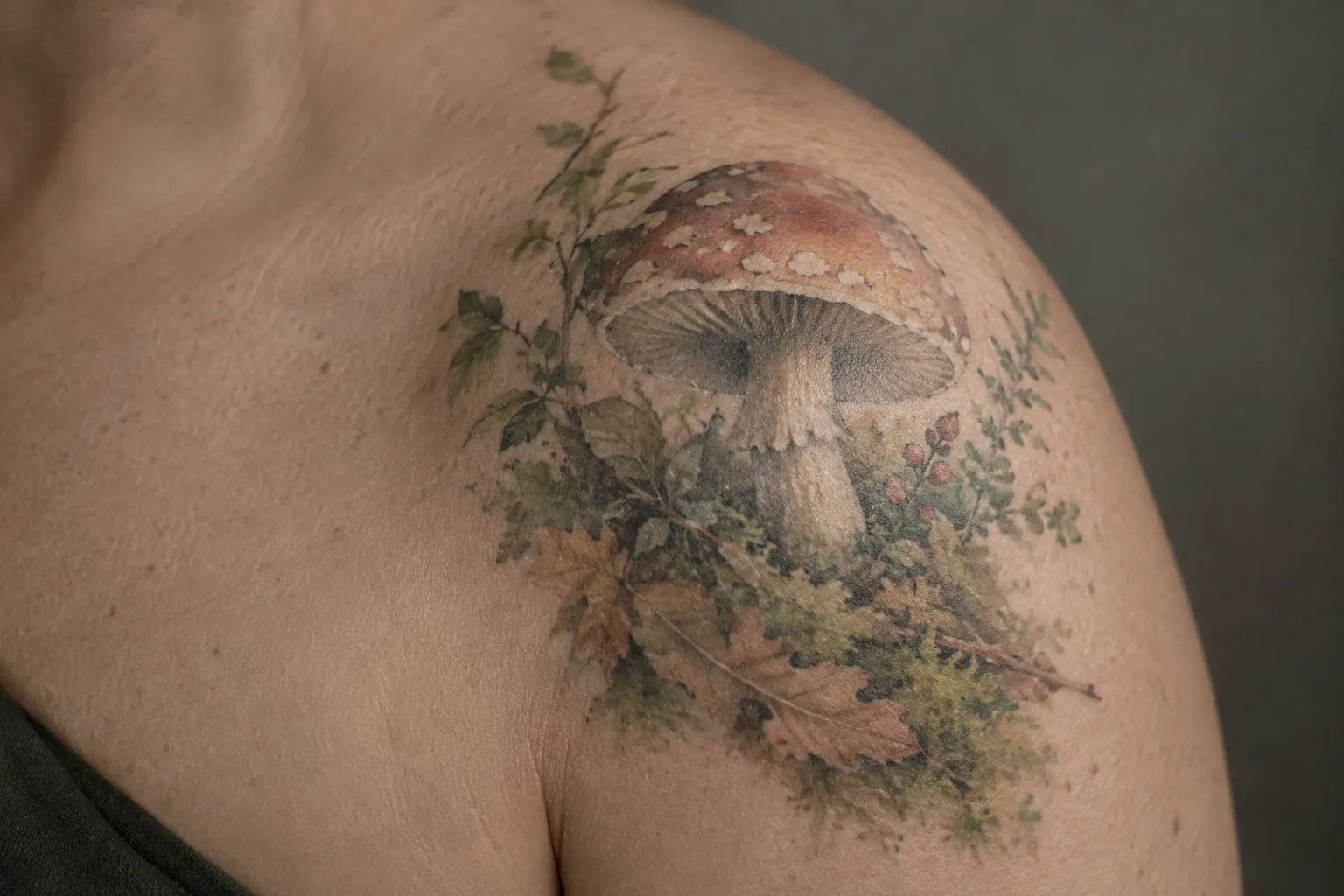
Cottagecore pairs earthy-colored mushrooms with moss, ferns, snails and other woodland details. The result is a soft, storybook forest-floor scene (1).
- Hallmarks: muted browns and greens, plus layered small elements.
- Pitfall: too many snails and fronds crammed into a forearm-sized space turn into a brown smudge once healed.
Fairy-tale designs add fairies, gnomes or an otherworldly landscape. An Alice in Wonderland reference is another route (5).
- The mushroom has no classic American traditional flash of its own (1), but a fly agaric drawn in that style suits this direction well. You get a thick black outline and a limited palette of red, white and yellow, the combination traditional work is known for holding up well over the years.
- Pitfall: thin outlines on a traditional design. Without the bold line, the red bleeds into the white spots.
Botanical designs are naturalistic species studies, sometimes with leaves, flowers or insects (5).
- Hallmarks: accurate gill and stem structure, and fine stippled shading.
- This style suits you if a particular species matters to you, such as a chanterelle or a shaggy mane.
Psychedelic or surreal designs use bold colors, kaleidoscopic patterns and cosmic imagery (5). Abstract designs go another way, using the mushroom’s shapes and textures rather than a literal depiction (5).
- Pitfall: neon color packed edge to edge with no black or skin breaks. It looks loud fresh and muddy healed.
Minimalist designs are an outline or silhouette and little else (5). This style is covered in the next section.
Matching supporting imagery to the message: skull vs mycelium
Choose the supporting imagery before the mushroom:
- For renewal, grow the cap out of bones (1).
- For connection, show visible mycelial threads (1).
- For forest affinity, go cottagecore.
- For magic, add a fairy-tale element.
- For a quieter night-time mood, add a moth: both draw on transformation and the unseen (1).
Color choices: earthy tones vs vivid psychedelic palettes
Earthy tones support a cottagecore woodland mood. Vivid or surreal colors suit psychedelic imagery (1). Placement is a craft decision tied to the level of detail you want, so settle it with your tattooer (1). Bright saturated color usually needs more room than an earthy, line-led piece.
Mushroom Tattoo Styles at a Glance
| Cottagecore | Fairy-tale | Botanical | Psychedelic or surreal | Minimalist | |
|---|---|---|---|---|---|
| Visual hallmarks | Layered forest-floor details | Folklore figures or storybook references | Species-focused structure and stippling | Kaleidoscopic patterns or abstract shapes | Single outline or silhouette |
| Typical palette | Earthy, muted | Red, white and yellow for traditional treatment | Naturalistic tones | Vivid or high-contrast | Black linework |
| Symbolic mood | Woodland affinity | Folklore and whimsy | Interest in a particular species | Altered-state associations | Quiet, graphic simplicity |
| Composition-sized placement | Outer forearm or calf | Calf or forearm | Forearm or calf | Thigh or back | Behind the ear or ankle |
Small and Cute Mushroom Designs for Subtle Placement
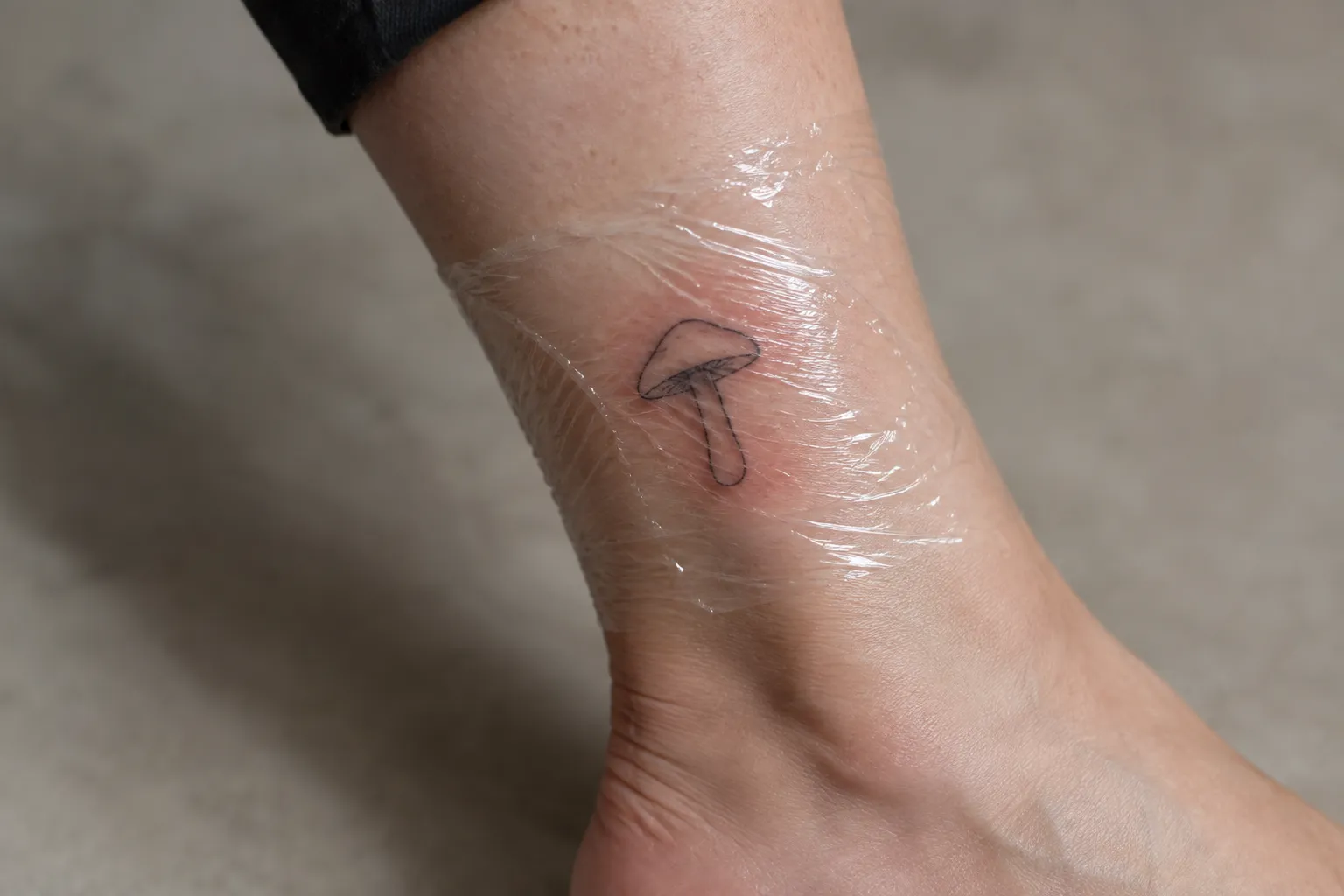
A small mushroom tattoo works best as a single specimen in minimalist outline or silhouette, placed on the ankle, forearm or behind the ear (5)(1). The idea guide’s examples include a cute ankle design (5). That is the classic version of a cute mushroom tattoo: one rounded cap, a short stem, maybe a single blade of grass.
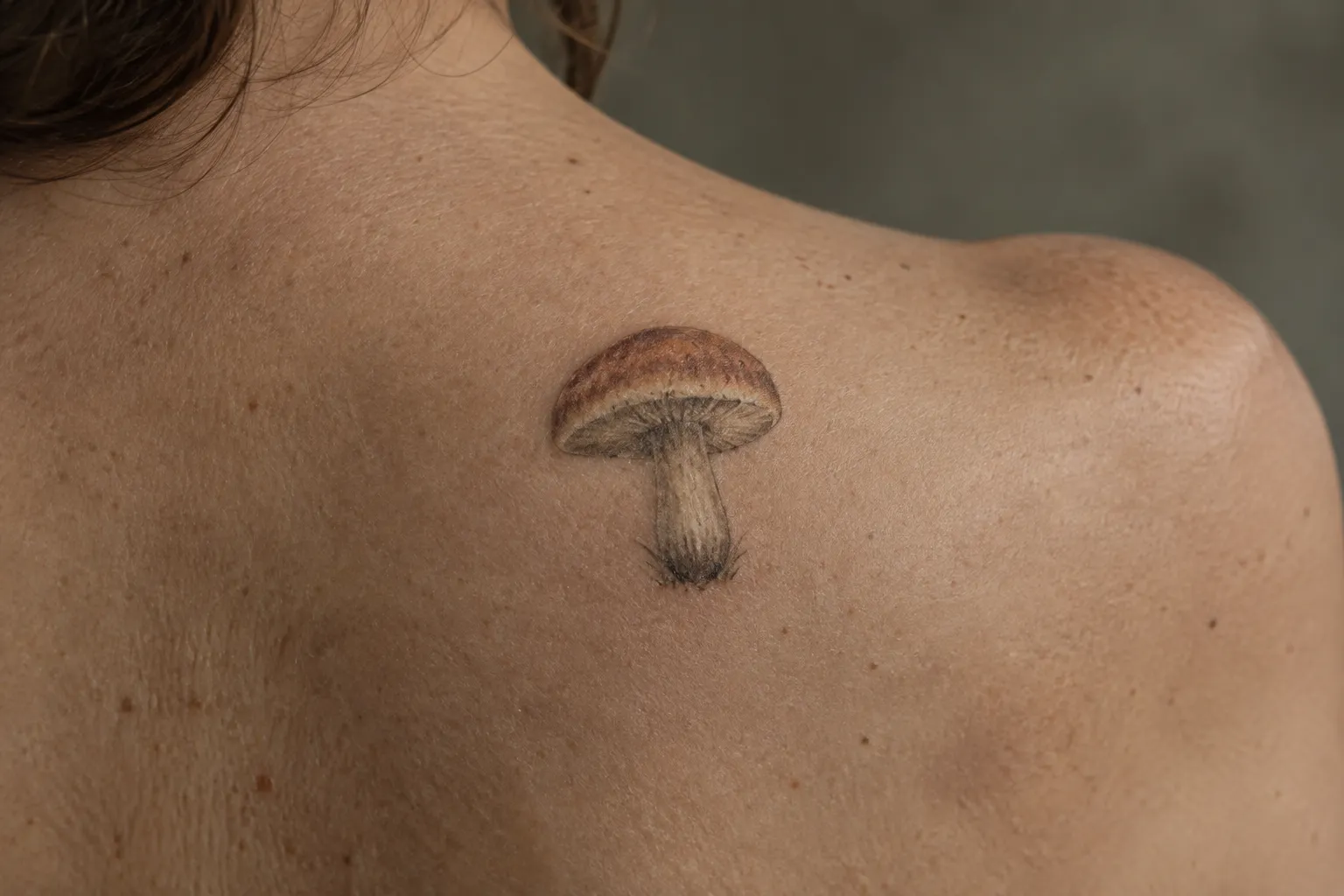
Fine line is the usual style here. It has two hallmarks:
- single-needle linework
- minimal or no shading, with skin left open inside the cap
The common failure is detail creep. Gills, spots, a tiny snail and dotwork shading all get squeezed into something small enough for the inner wrist. Lines that sit too close together spread over the years and blur into a blob. Keep it to one strong shape and let the negative space do the work.
On pain, bonier spots hurt more than fleshy ones: ankle and behind-the-ear > outer forearm. For a first tattoo, the outer forearm is the easier sit.
Placement Guide: From a Single Cap to a Full Forest Scene
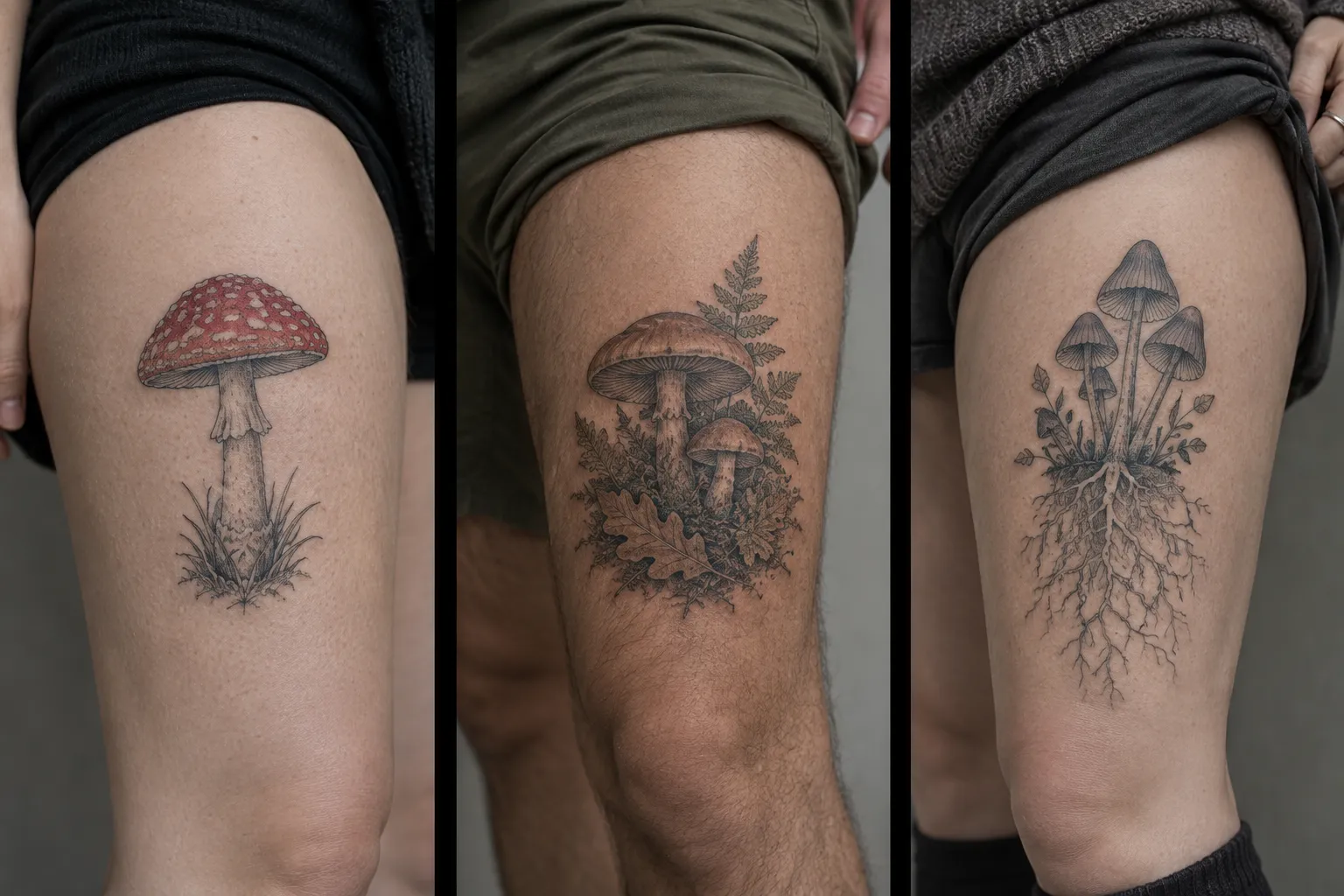
The scale you want should drive placement. A single mushroom suits the ankle, calf, forearm or behind the ear. A forest-floor or mycelial-network composition needs the thigh, calf or back to read clearly (1).
Make these decisions in order:
- Decide the meaning first. Is it renewal, connection, forest affinity or fairy-tale magic (1)?
- Decide the count. Do you want one mushroom, a woodland cluster or a larger network (1)?
- Pick placement to fit.
Composition size controls legibility. Mycelial threads squeezed onto an ankle stop looking like a network and start looking like scribbles. That loses the exact meaning you chose them for. If you want the large version but have limited sessions, a palm-sized calf piece can be extended later.
Tattoos to Avoid, Healing and Aftercare
Avoid finely detailed or intricately colored mushroom designs on hands and fingers. Detailed work is reported to fade faster in these high-friction, sun-exposed areas (1). Talk about scale and placement with your artist before you commit to fine detail.
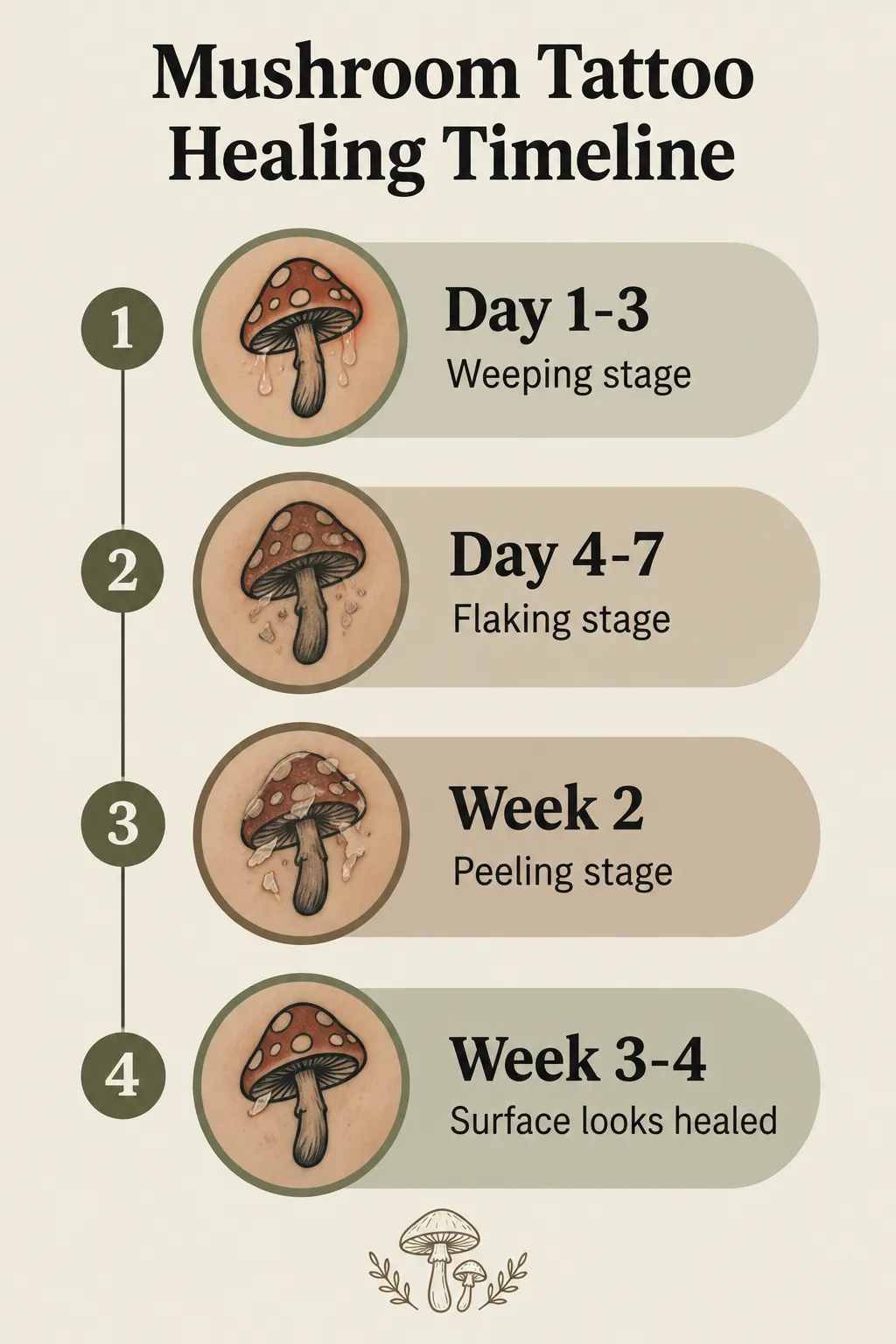 Mushroom tattoo healing progresses from weeping on days 1-3 and flaking on days 4-7 to peeling in week 2 and a healed-looking surface in weeks 3-4.
What fades fastest, and where
Detail fades fastest on hands and fingers (1), and friction from shoes or straps softens fine lines elsewhere. Ultraviolet light can fade some tattoo inks (4). Once healed, protect the piece with a broad-spectrum, water-resistant sunscreen of SPF 30 or higher. Apply it 15 minutes before going outside and reapply at least every two hours (4).
Hygiene matters as much as the design:
- In the US, state and local authorities oversee tattooing (2): check the studio’s local license and that its equipment is sterile.
- The FDA warns that infections can come from unhygienic practices, non-sterile equipment and contaminated ink, even in a sealed container (2).
- If you take a blood thinner, a tattoo could cause severe bruising. Ask your doctor before the session, and don’t stop or change the medicine without talking to them first (6).
Healing timeline
For what to do at each stage, see our week-by-week tattoo aftercare guide.
- Day 1-3: Keep the wrap on as long as your artist says. Wash gently with lukewarm water and pat dry. Expect some oozing.
- Day 4-7: The skin turns tight and starts to flake. Switch to a thin layer of fragrance-free lotion. Don’t pick at it.
- Week 2: Peeling and itching. Let the flakes come off on their own.
- Week 3-4: The surface looks healed, but the skin underneath is still settling. Full integration takes about six weeks; keep the tattoo out of direct sun for the first 4-6 weeks.
When to flag a reaction to your tattooist
Some redness, swelling or warmth right after the session is normal (2). Contact a healthcare professional, and notify the tattooist, if any of these happen (2):
- the area does not seem to be healing
- a rash (redness or bumps) near the tattoo
- a fever
Frequently Asked Questions
- What does a mushroom tattoo mean?
- A mushroom tattoo can signal renewal, connection, folklore or psychedelic imagery; the species and surrounding motifs guide which reading comes forward.
- What is a mushroom a symbol of?
- A mushroom can symbolize decomposition feeding new growth, while a visible mycelial network can suggest relationships or community rather than a single fixed meaning.
- What are some tattoos to avoid?
- Avoid designs whose tiny details depend on staying crisp in a high-friction spot; ask your artist which elements will remain legible at the planned scale.
- Can I customize my mushroom tattoo design?
- Yes - ask your artist to redraw your references for the chosen body area, since a motif that reads on paper may need simpler shapes on skin.
- Are mushroom tattoos popular among certain groups?
- Mushroom tattoos appear across different style preferences; a psychedelic association comes from particular imagery and subcultures, not from everyone who chooses the motif.
Before You Book the Session
The meaning of a mushroom tattoo rides on four things: species, color, composition and placement. Decide what you want it to say first, then the scale. A single cap fits an ankle or the area behind the ear. A mycelial network needs a thigh, calf or back.
Keep fine detail off your hands. Confirm the studio’s hygiene before the needle comes out. Plan for SPF 30 or higher once the tattoo has healed (4).