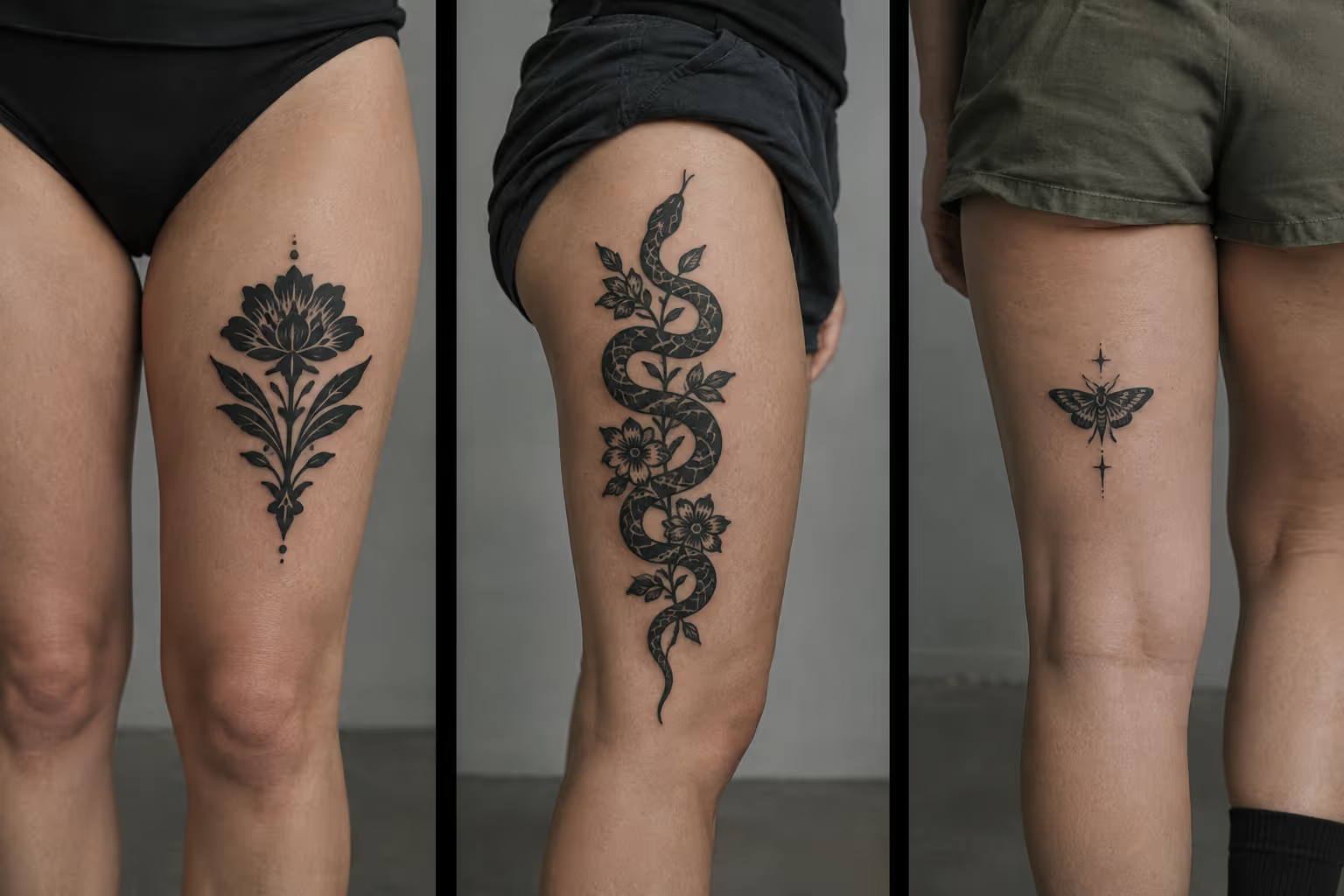
The thigh is one of the few spots on the body big enough for a full dragon or a portrait. A thigh tattoo also gives you a choice most placements don’t: front and outer skin shows in shorts, while the inner and back of the leg stay hidden under most clothes. The zone you pick decides two things before any linework goes down, which designs fit and how much the session hurts. Below: front, side, inner and back compared, plus sizing, appointment prep and the full healing window.
Thigh tattoo placement: front, side, and back compared
Choose your thigh tattoo zone by visibility. The front shows in shorts, the outer thigh sits in the middle, and the inner and back thigh stay the most private. The front of the thigh suits a piece that demands attention, while the side or inner thigh gives you less visible options (2). Pick the front thigh for a bold, highly visible centerpiece. Pick the outer or side thigh if you want a flowing, large-scale layout (2)(6).
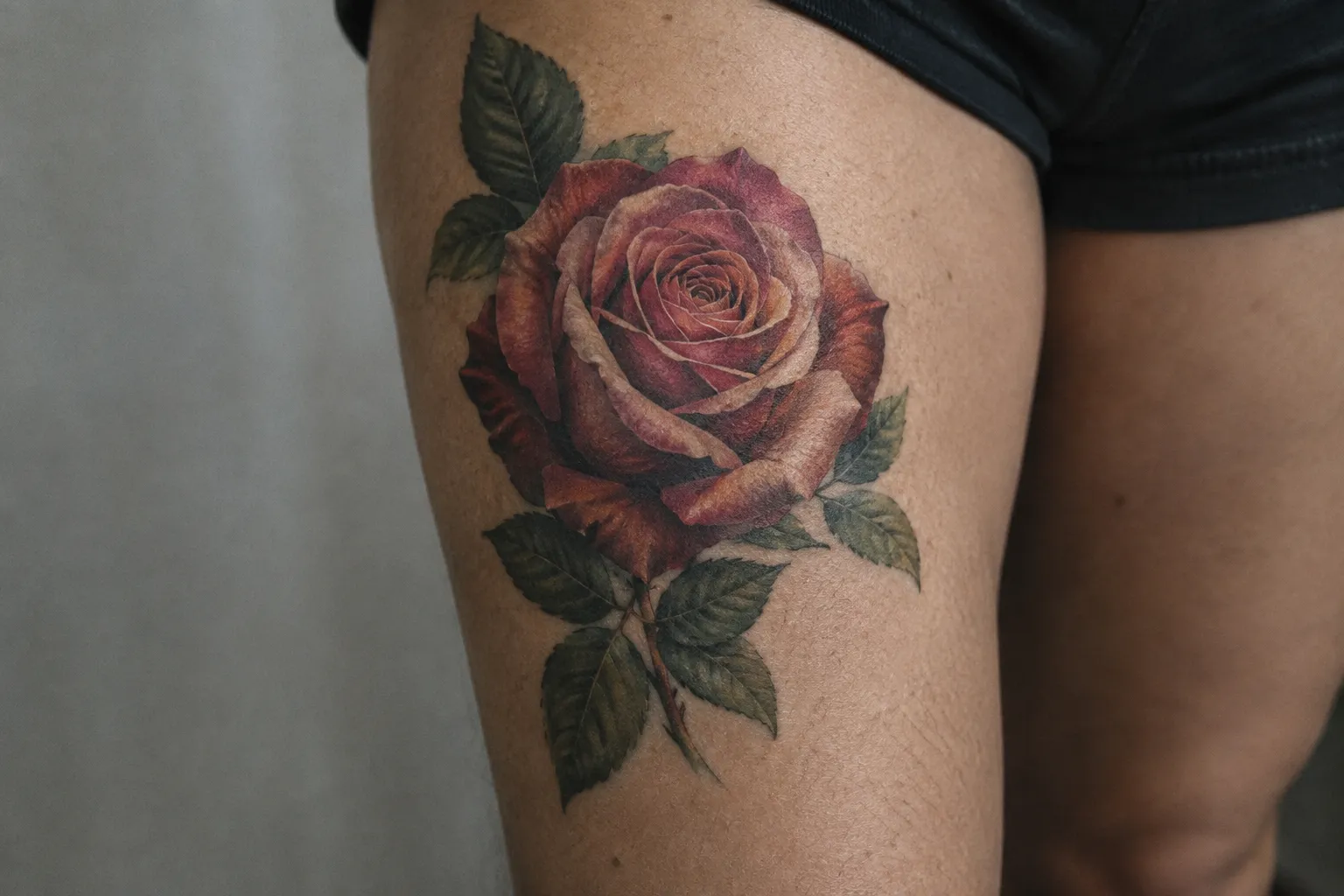
Front thigh: a bold, showable centerpiece
A front-thigh piece makes a statement when you show it off, and shorts or pants can hide it (2). It is highly visible to you when seated, a natural choice for a design you want to see yourself (6), and you can check your own healing without a mirror.
Outer and side thigh: flowing, large-scale layouts
A side thigh tattoo is the flexible middle ground. It is easy to cover up and can only be seen when you turn to the side (2). The side thigh lends itself to a large piece that follows the natural curves of the leg (2), and the natural flow of the outer leg suits vertical, flowing compositions (6).
Inner and back thigh: more private, less exposed
Go inner or back when privacy comes first. The trade-off is sensitivity: the back of the thigh causes more discomfort than the front because the skin there is thinner (2). You also can’t see your own progress without twisting or using a mirror, which makes aftercare checks clumsier.
Pros and cons at a glance: the thigh gives you a large canvas, easy coverage, and a choice of zones with different visibility. Against that, a big piece means a long healing window, sensitivity changes sharply from zone to zone, and the back and inner placements are hard to check yourself.
✓ Pros
- A thigh gives long designs room to follow the leg's natural line.
- You can choose a zone that suits how often you wear shorts or skirts.
✗ Cons
- A design that looks balanced on paper may need reshaping to sit correctly on a curved leg.
- Fresh work can make everyday movement and clothing choices less comfortable while it heals.
Design ideas and styles that fit the leg’s shape
Thigh tattoo ideas work best when the composition follows the leg. Put a bold, centered design on the front, and save flowing or large-scale layouts for the outer thigh (6). The thigh is a long, curved cylinder, not a flat sheet. A design drawn square on paper needs reworking to sit right on it.
Bold centerpieces for the front
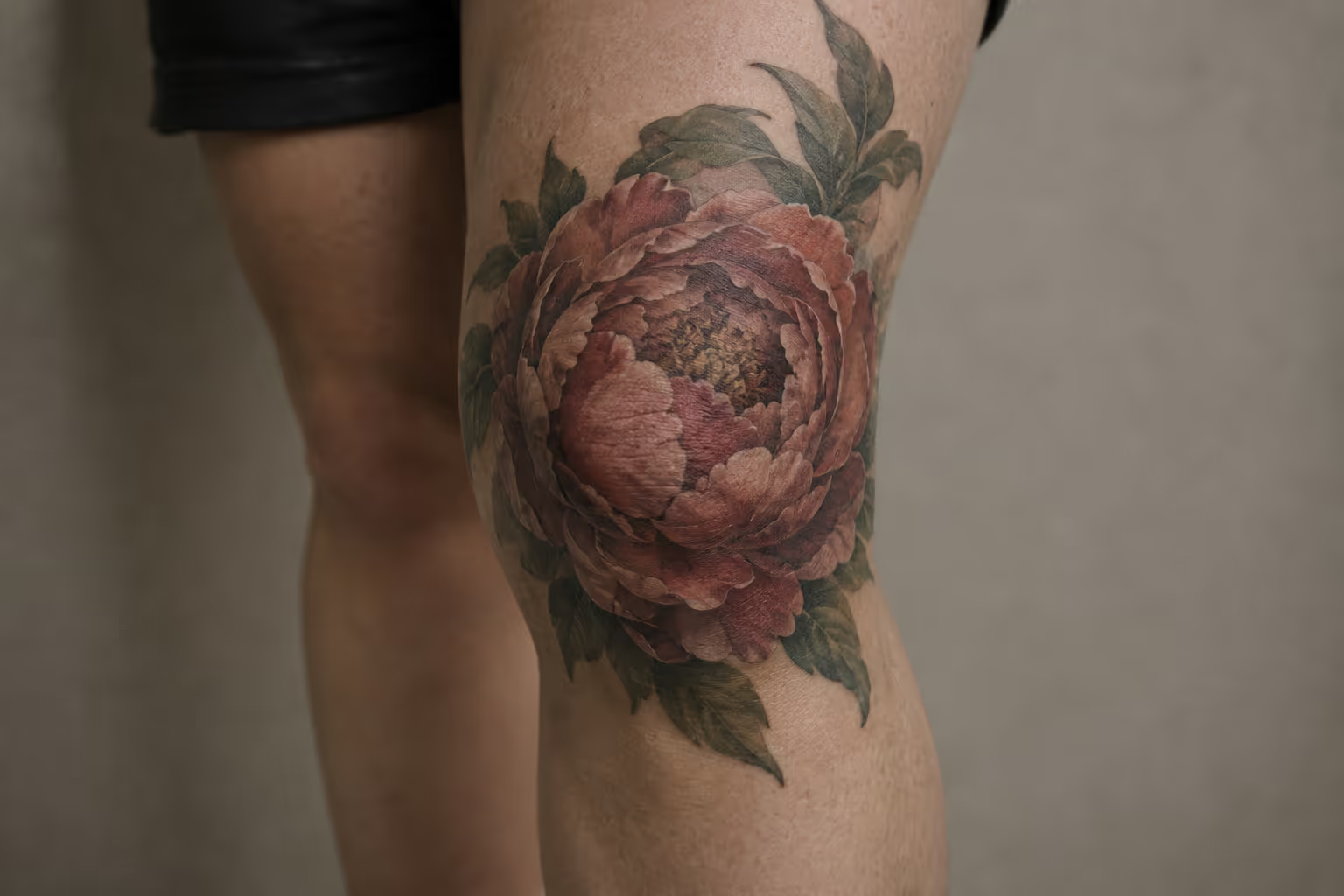
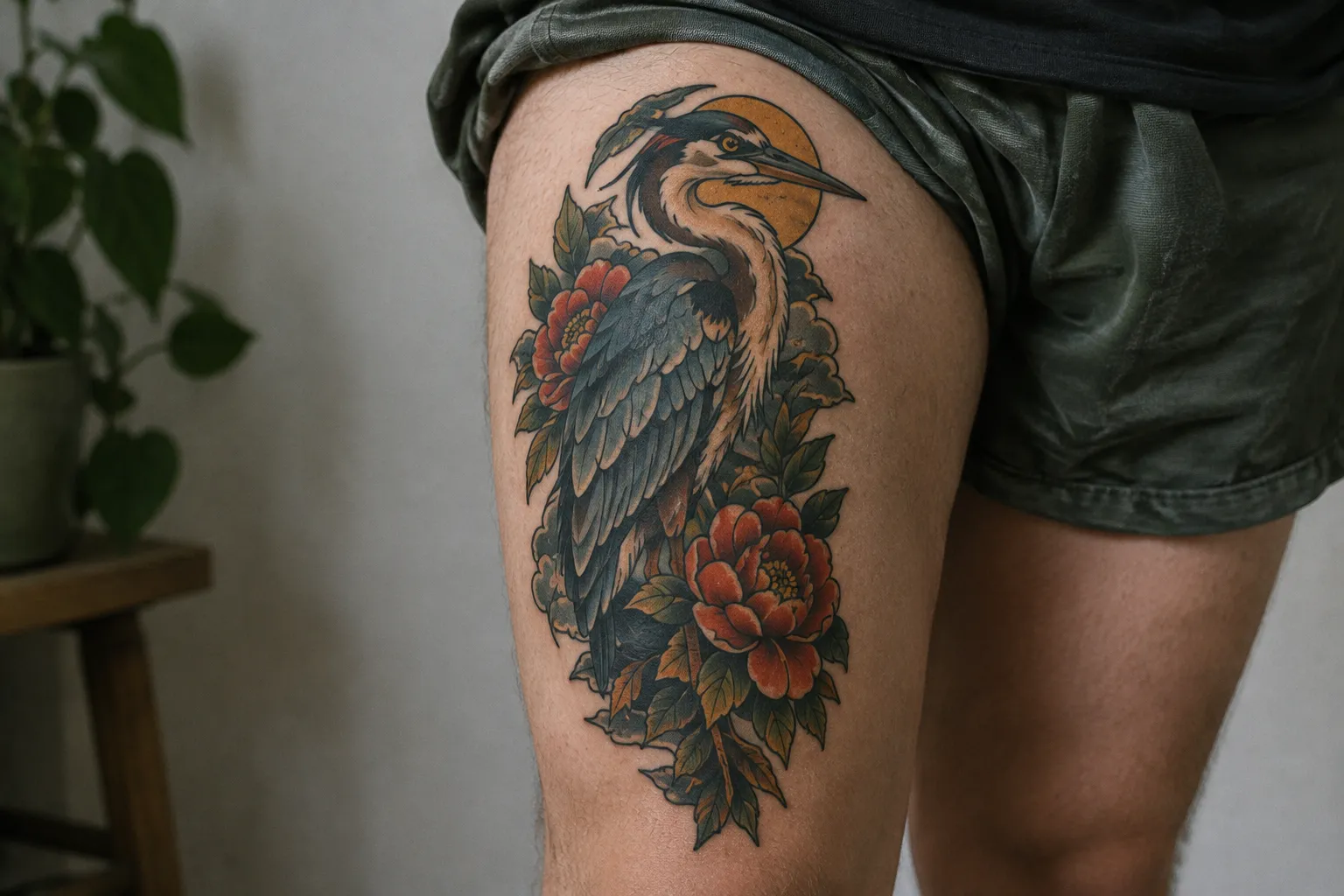
The front thigh accommodates bold centerpiece compositions well, such as a neo-traditional piece centered on the leg (6). Neo-traditional work brings bold outlines and rich saturated color, and the thigh gives it room for a full scene: a cat framed by roses, an owl surrounded by flowers or a snake coiled around botanical elements (6). Mandala-inspired geometric work centered on the front thigh also reads as balanced and intentional (6).
Dragons, florals, and sleeve-style wraps for the outer thigh
Japanese dragons and floral sleeves typically land on the outer thigh (6), as does a full Japanese composition wrapping from hip to knee (6). The vertical canvas lets koi swim, dragons coil and tigers crouch, and background elements such as waves, clouds or maple leaves fill the space around them (6). If the composition is meant to continue down onto the calf, plan it with the rest of the leg tattoo from the start.
The back of the thigh is popular as well, because it takes detail and can be shown or covered (2).
Smaller or delicate pieces for a lower-key look
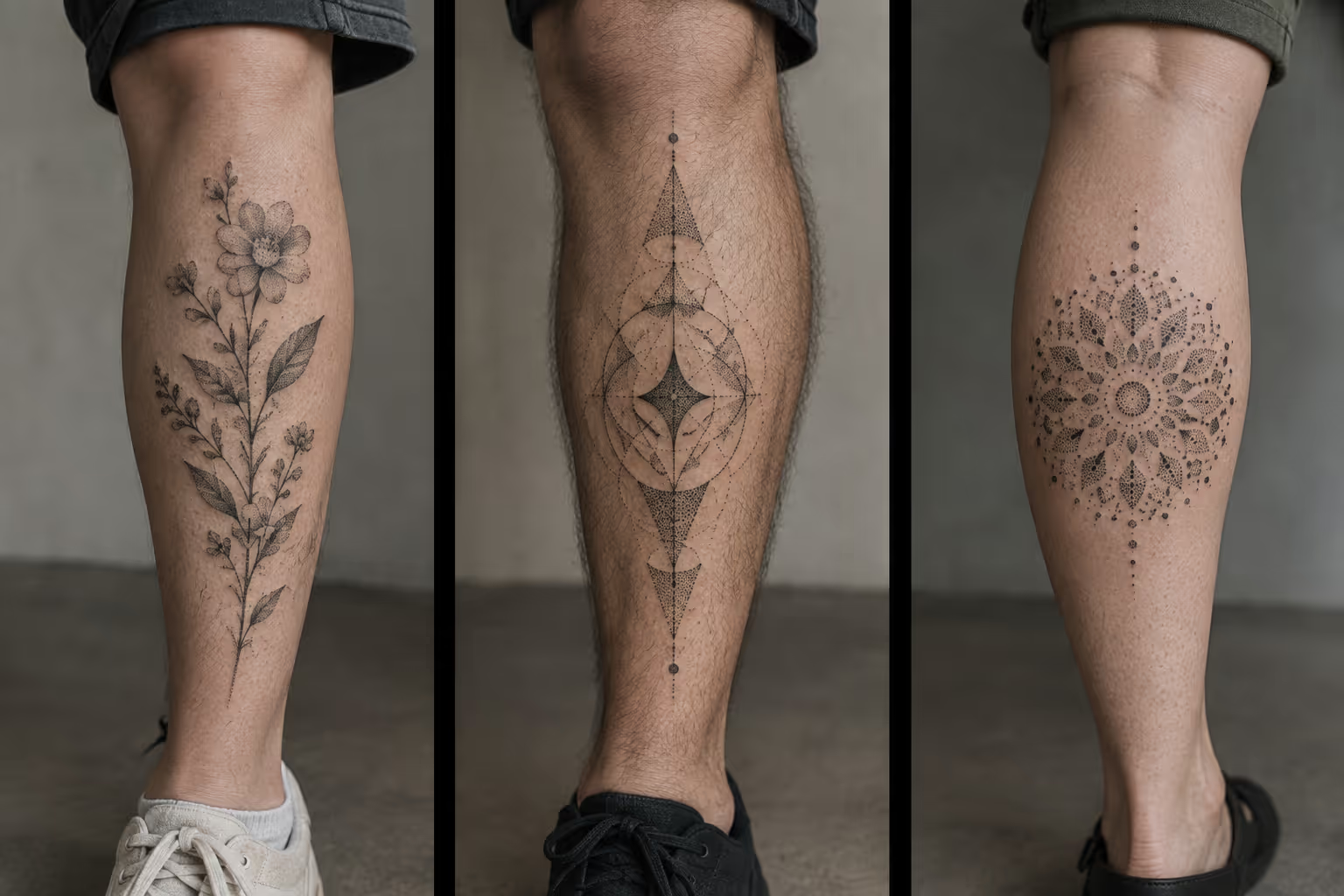
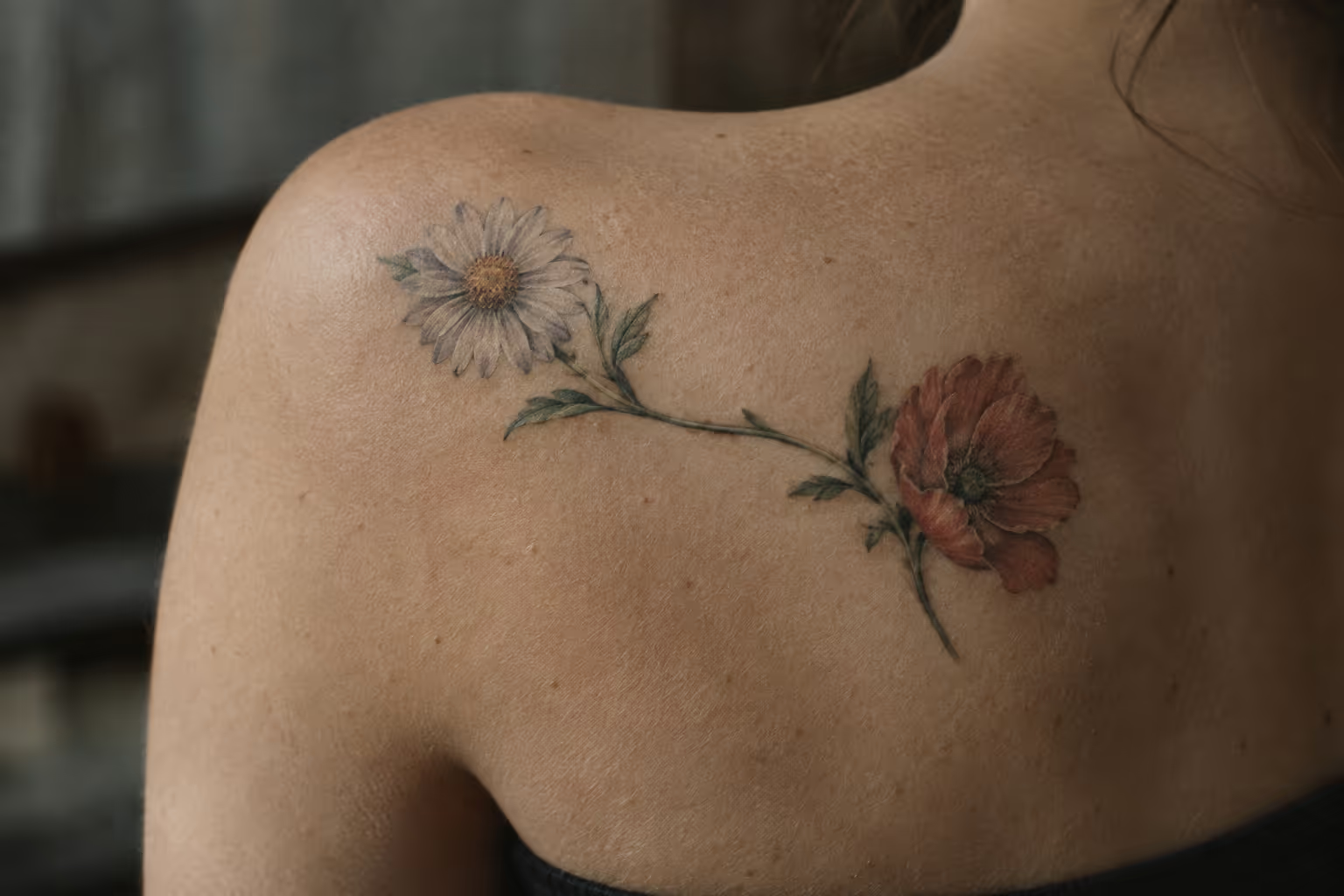
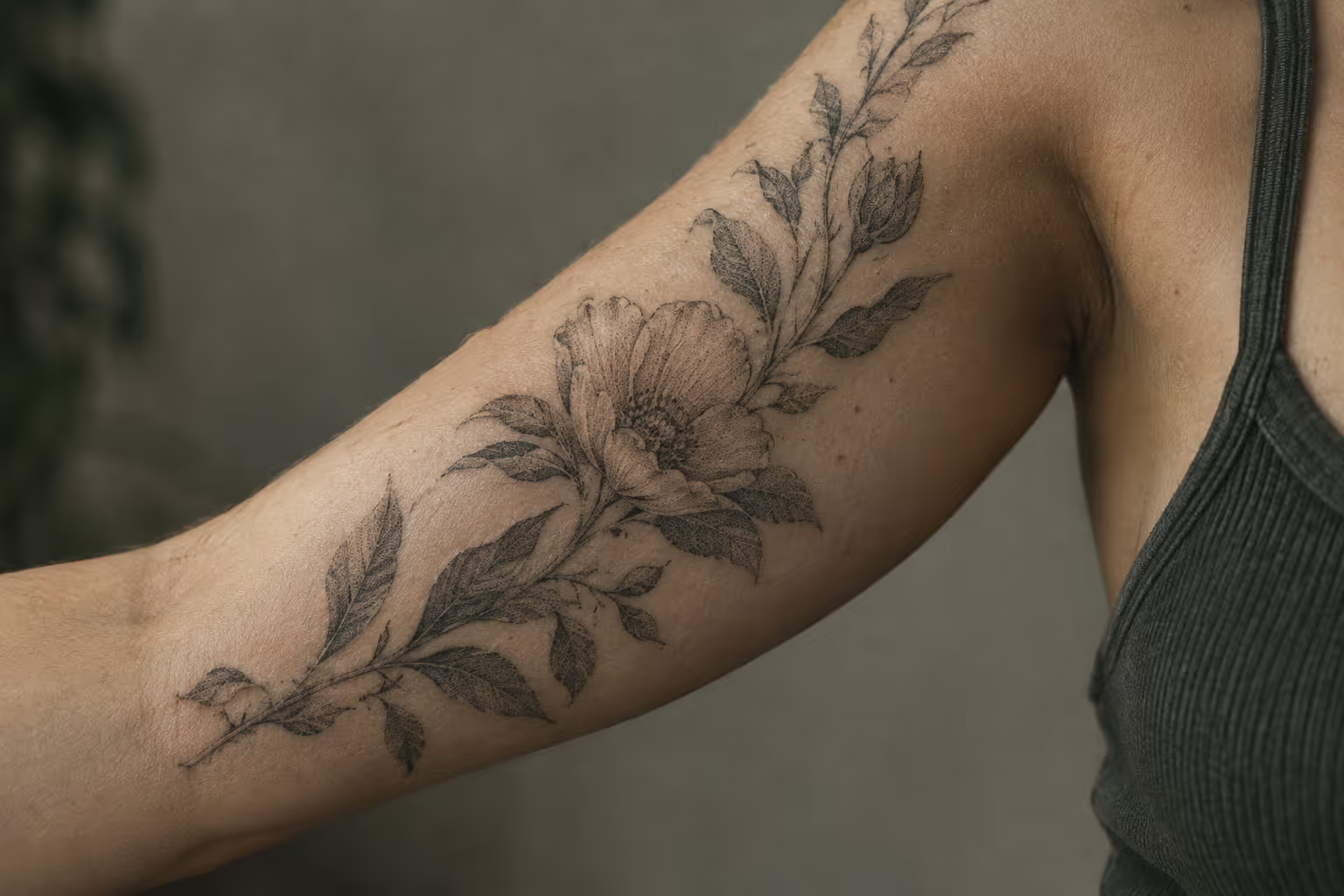
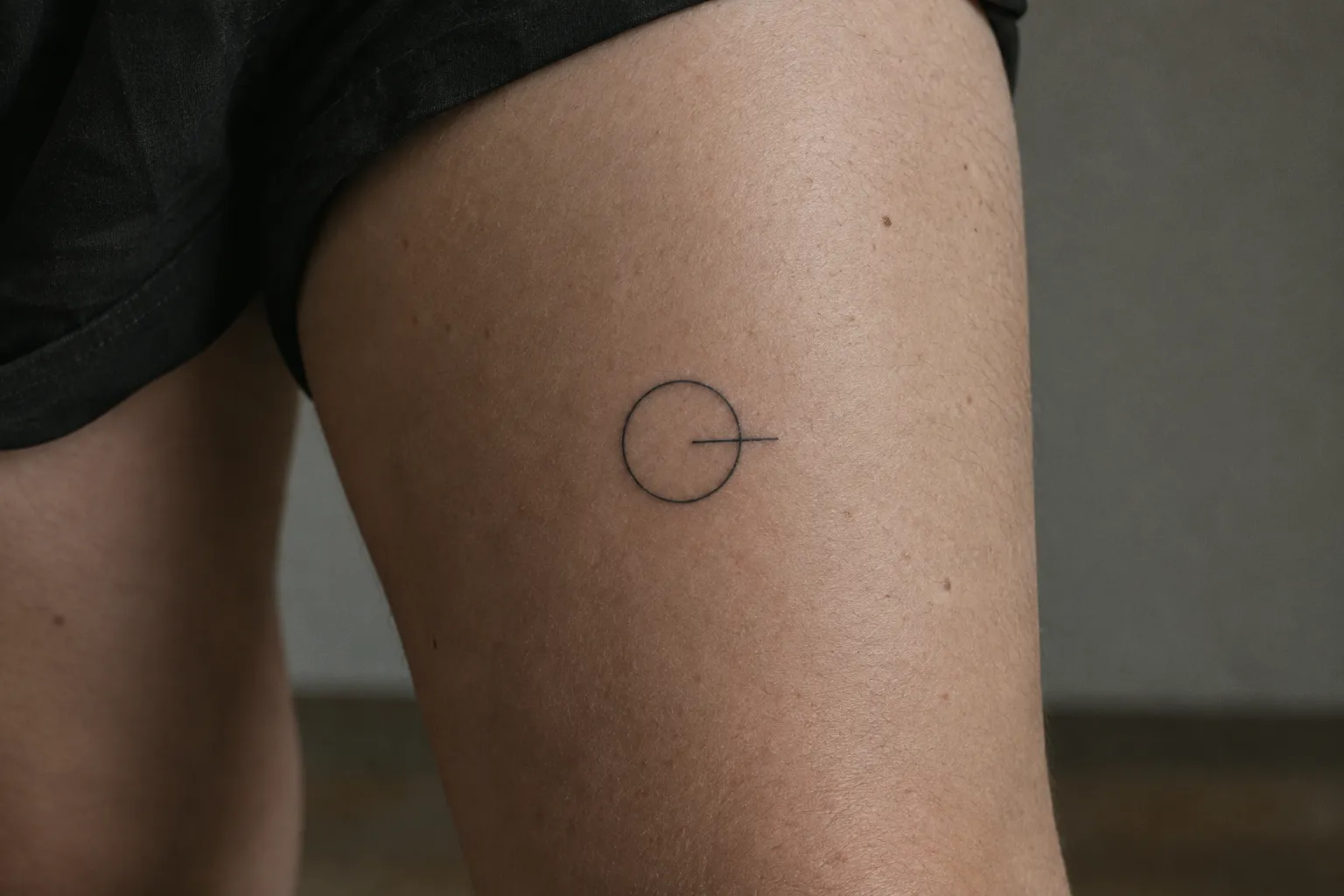
One 2026 thigh guide calls fine-line botanical work the leading style for the outer thigh: trailing vines, roses, peonies or wildflowers along the long vertical surface of the leg (6). At that scale the elements get breathing room, and negative space becomes part of the composition (6). The inner thigh suits small, private pieces such as a quote or delicate floral work (6).
If you add script, keep standard script at least ½ inch (12-13 mm) tall, and fancy or ornate script about 1 inch (25 mm).
How much a thigh placement hurts, zone by zone
Thigh tattoo pain is low on the front and outer thigh compared with most placements, thanks to thick skin and muscle (2). It climbs toward the back of the thigh, where the skin is thinner (2) and the area gets more painful near the knee (6). It peaks on the inner thigh, where the skin is thin and close to lymph nodes and nerves (6). On our tattoo pain scale, the outer thigh sits in the lowest tier with the forearms and calves, and the inner thigh and groin in the top tier.
A rough relative order, most to least painful (6):
- Inner thigh and groin
- Back of the thigh, worst close to the knee
- Front thigh
- Outer thigh, comparable to the outer forearm and well below the ribcage
The kneecap and the ditch at the back of the knee are a zone of their own; see our knee tattoo guide if your design runs that far down.
Long sittings are common on the outer thigh because it stays comfortable for hours (6). On the inner and back thigh, shorter blocks are easier to sit through.
Two prep steps help:
- Skip alcohol for at least 24 hours before the appointment, because it thins the blood (4).
- Tell your artist about any medications you take.
Sizing rules: the 1/3 guideline and scaling to the leg
One thigh guide sorts pieces into three relative sizes: palm-sized, half-thigh coverage and the full outer thigh, with the largest split across several sessions (6).
The “1/3 rule” is an informal rule of thumb, not an industry standard. As our tattoo placement guide puts it, roughly one-third of a limb segment is a natural visual unit for a standalone piece. On the thigh, the classic way to miss it is a small piece stranded in the middle of a large, empty leg.
The outer thigh’s natural flow suits vertical compositions (6), so scale your design by length first. A tall, vertical composition fits the leg better than a wide one.
Check the stencil both standing and seated before you commit, because the skin shifts when you sit.
Symbolic meanings behind popular thigh motifs
In most cases the meaning of a thigh tattoo comes from the motif and the tradition it was borrowed from, not from the placement. Samoan tattooing is the exception.
- Samoan: here the placement itself carries weight. The pe’a, the traditional men’s tattoo, spans from the waist to the knee, and the women’s malu from the upper thighs to below the knees (9). Both show that the wearer is ready for adulthood and to serve the community (9). The National Park Service describes these designs as a mark of pride meant to be worn by Samoans, and their display by people without that heritage as disrespectful (9).
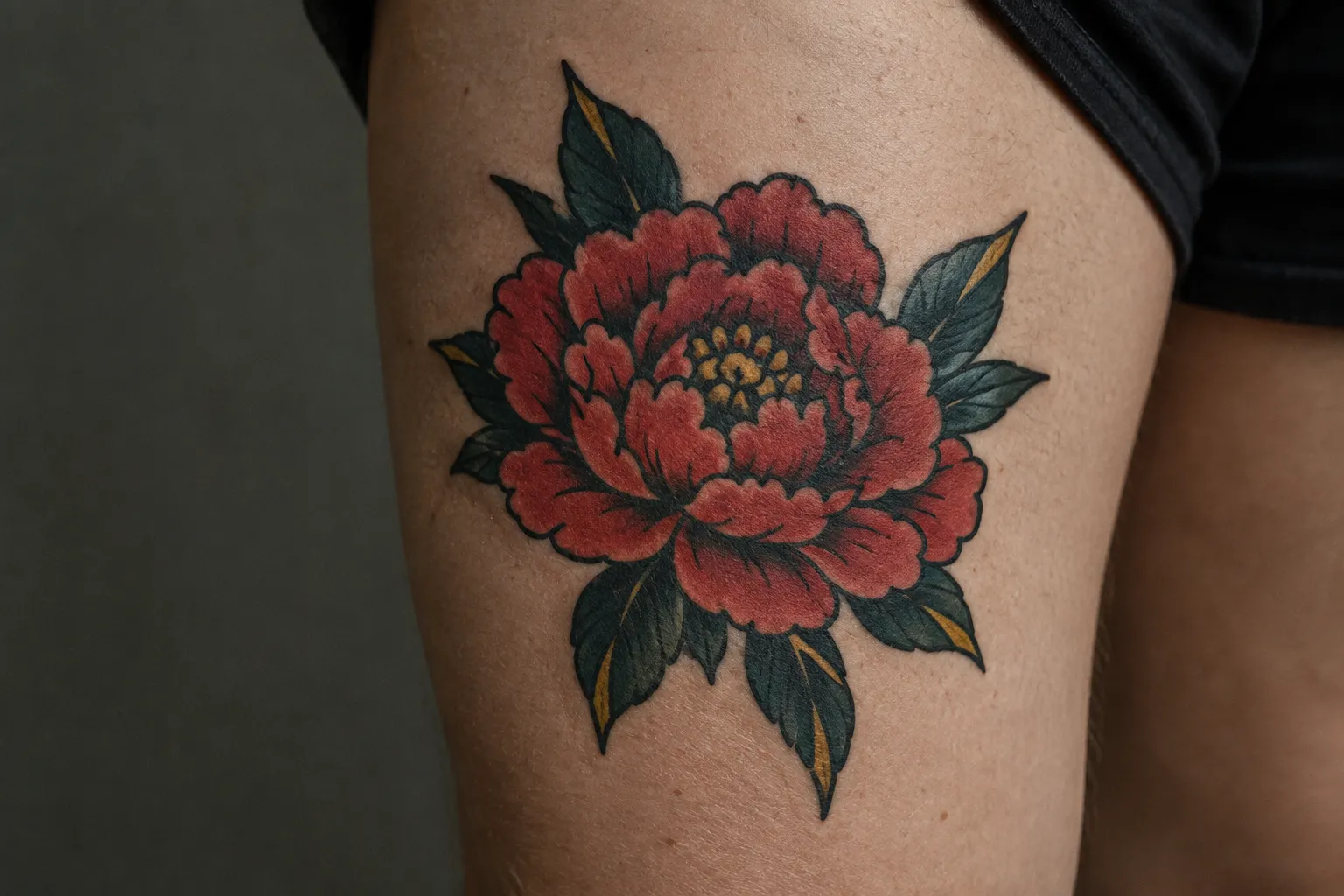
- Japanese (irezumi): dragons, koi, tigers, peonies and cherry blossoms are among the common motifs of traditional Japanese tattooing (10). In the East the dragon is respected and wise, a symbol of strength and power, while the West has long cast it as evil and greedy (2).
What to wear and how to prepare for the appointment
For a thigh tattoo appointment, wear loose shorts that roll up past the work area or a long skirt with a side slit. Either one lets the artist reach your leg without you undressing (4)(5). Dress for access, not style. Your artist needs to reach the area for several hours without either of you contorting, and turning up for a thigh piece in your tightest jeans happens more often than you’d think (5).
A few more prep points:
- Don’t shave the area yourself. Trim if you like, and the artist will shave it during the appointment (4).
- Keep the skin free of sunburn, cuts and bruises. Sunburnt skin can’t be tattooed, so the session gets rescheduled (4).
- Eat a proper breakfast and bring snacks or a sugary drink to keep your blood sugar steady (4).
- Wear or pack loose bottoms for the trip home: tight jeans and leggings rub against a fresh thigh tattoo (6).
Healing timeline and aftercare for the leg
A thigh tattoo heals on the same calendar as other placements, set out in our tattoo aftercare guide: weeping and swelling in days 1-3, tight, flaking skin in days 4-7, peeling and itching in week 2, a surface that looks healed by weeks 3-4, and full integration around week 6. Even when the surface looks and feels healed, the skin beneath it is still healing (1). Size, location and aftercare all affect how long it takes (1).
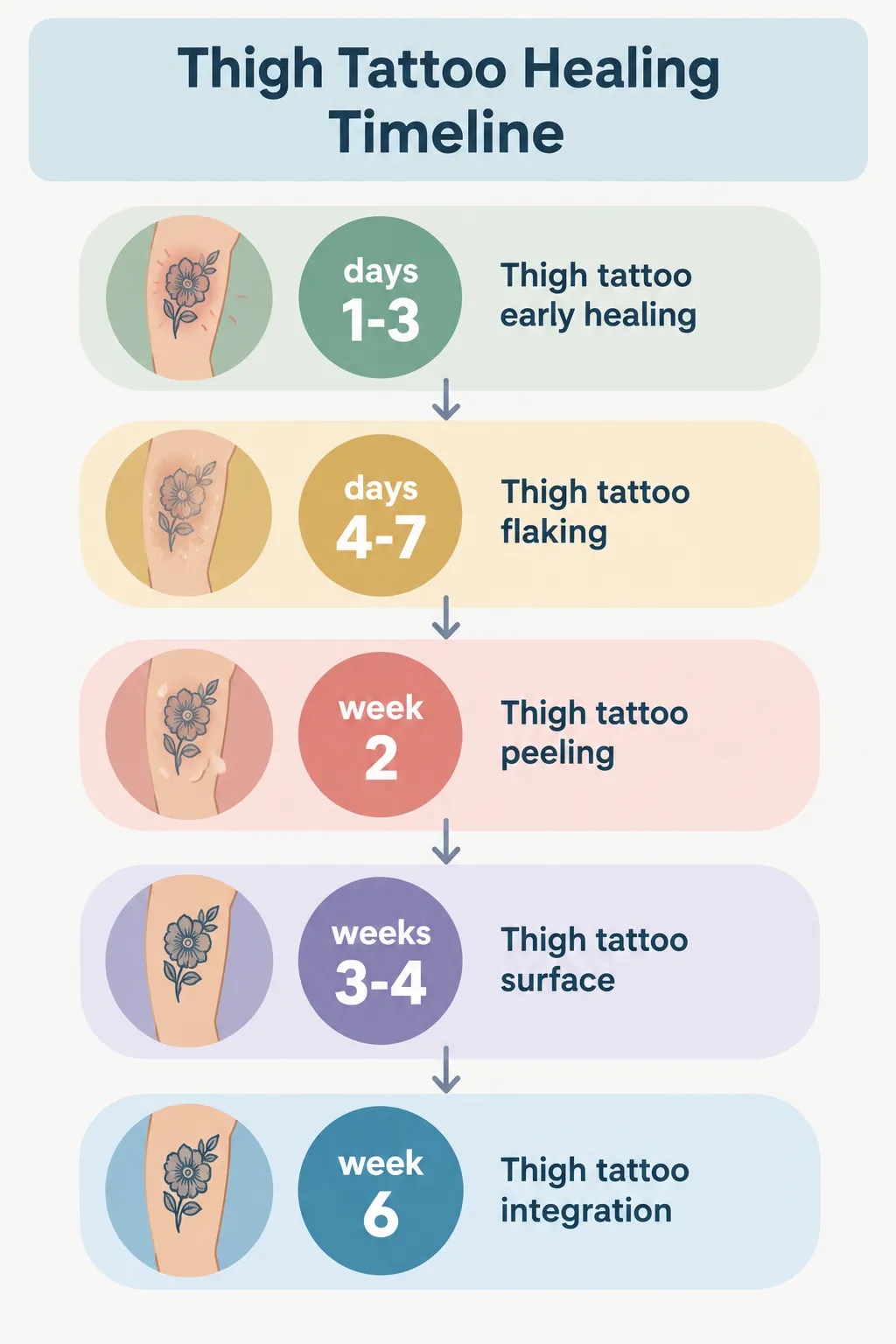 Thigh tattoo healing progresses from weeping and swelling on days 1-3 to full integration around week 6, with peeling in week 2 and a healed-looking surface in weeks 3-4.
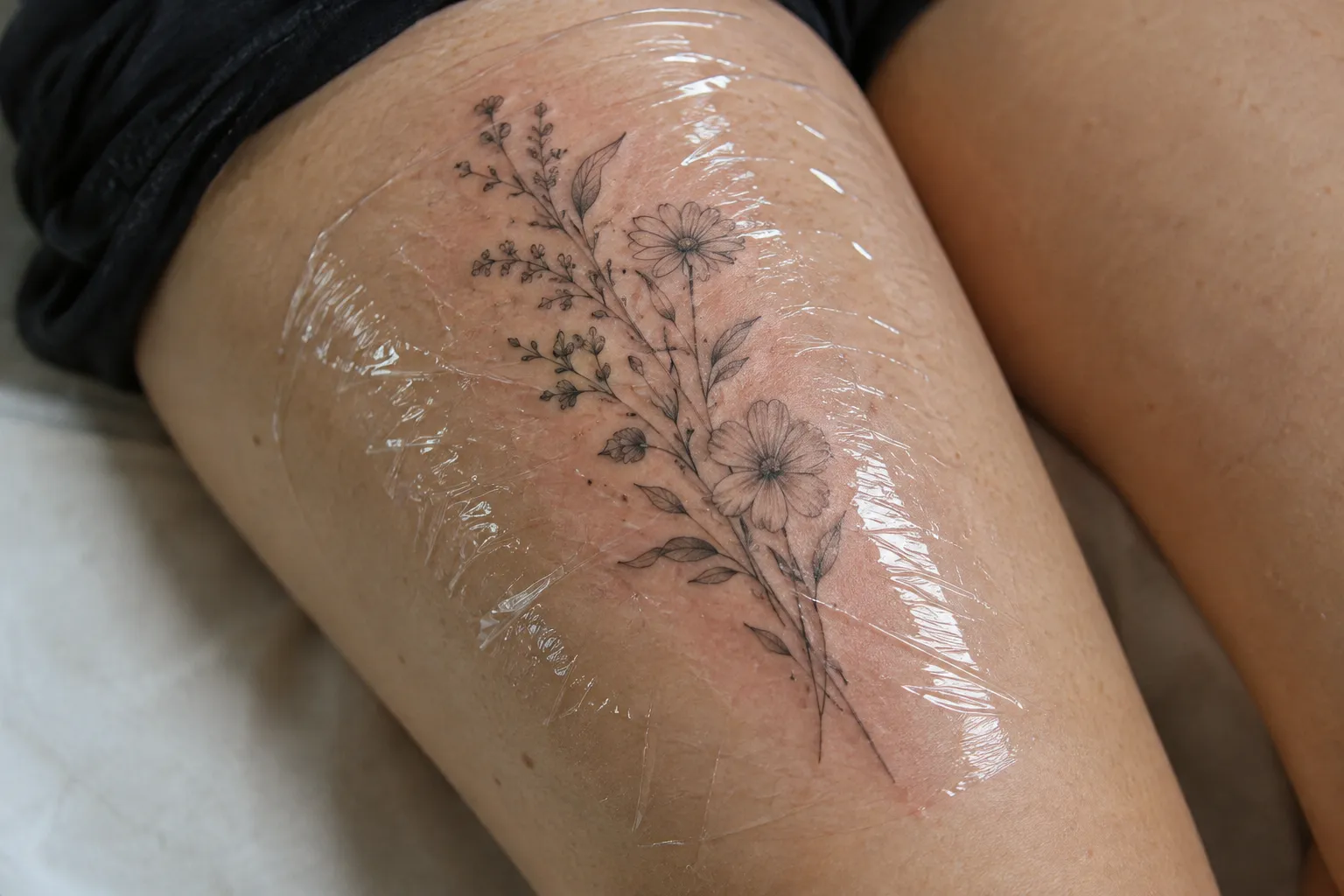
Days 1-7: wrap off, wash, moisturize
- Follow your artist’s instructions on when to remove the bandage (1).
- Clean the tattoo daily with lukewarm water and a fragrance-free soap, then pat it dry instead of rubbing it (1).
- Wear loose clothing over it (1). Tight jeans, leggings and most athletic wear rub against a fresh thigh tattoo (6).
Weeks 2-4: peeling and itching
- Flaking and itching are part of normal healing (8). Don’t scratch or pick at scabs (1).
- Apply a water-based moisturizer several times a day for the first 2-3 weeks (1).
Until it is fully healed
- Don’t go swimming until the tattoo is fully healed (1).
- Cover it with loose clothing to protect it from the sun (1), and keep it out of direct sun for the first 4-6 weeks. Once it has healed, use a broad-spectrum, water-resistant sunscreen of SPF 30 or higher whenever it is in the sun (7).
Signs that need a tattooist or doctor
Some redness, swelling, soreness, itching and flaking are part of normal healing (8). See a doctor or a board-certified dermatologist right away if you notice signs of infection instead (8):
- redness that darkens or spreads instead of fading
- pain that continues or worsens
- a rash of itchy, red, painful bumps in the tattoo
- pus or open sores
- fever, chills or shivering
If the area seems not to be healing, or a rash appears near the tattoo, contact both your tattooist and a health professional, especially if you develop a fever (3).
Frequently Asked Questions
- What should I wear to a thigh tattoo appointment?
- Wear clothing that gives your artist access without requiring you to undress, and bring a loose layer for the trip home.
- What does the 1/3 rule mean for tattoo sizing?
- The 1/3 rule is an informal proportion guide, not a fixed measurement: roughly one-third of a limb segment is a natural visual unit for a standalone piece. Ask your artist how it applies to your design and zone.
- Does a thigh tattoo have a symbolic meaning?
- Usually the meaning comes from the motif, not the placement. Samoan tattooing is the exception: the men's pe'a and the women's malu cover the thighs and mark readiness for adulthood.
- Which thigh tattoo placement is most painful?
- The inner thigh near the groin hurts most, then the back of the thigh near the knee; the front and outer thigh hurt least.
- Is a thigh tattoo suitable as a first tattoo?
- The outer thigh is one of the low-pain spots often suggested for a first tattoo; leave the inner and back thigh until you know how you sit through a session.
- Can pants cover a thigh tattoo?
- Pants can cover a thigh tattoo; how much shorts reveal depends on whether the design sits on the front, outer, inner, or back of the leg.
- What affects the cost and session time for a thigh tattoo?
- Design size, detail, and the artist's rate determine the quote and sitting plan; request an estimate for your specific design before booking.
Choosing your thigh zone
Pick your zone by how visible you want the piece to be and how much sensitivity you’ll tolerate. The outer thigh is the easiest sit, the front is the most showable, and the back and inner thigh are the most private and the most tender. Then let the design follow the leg: bold and centered up front, flowing and large along the outer thigh. Plan aftercare through full integration around week 6, not just until the surface looks healed. If anything looks off after the tattoo seems healed, call your tattooist or a doctor.