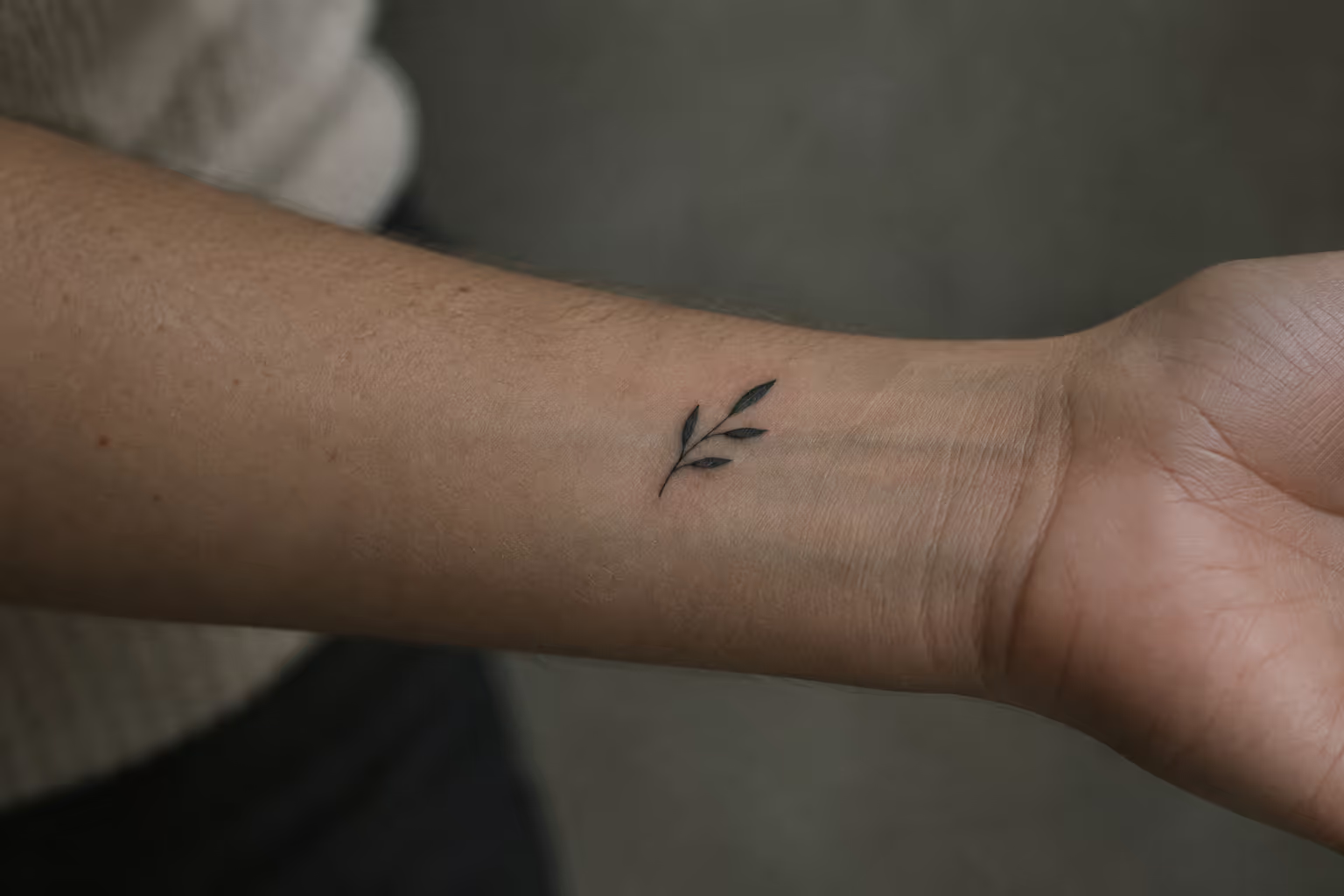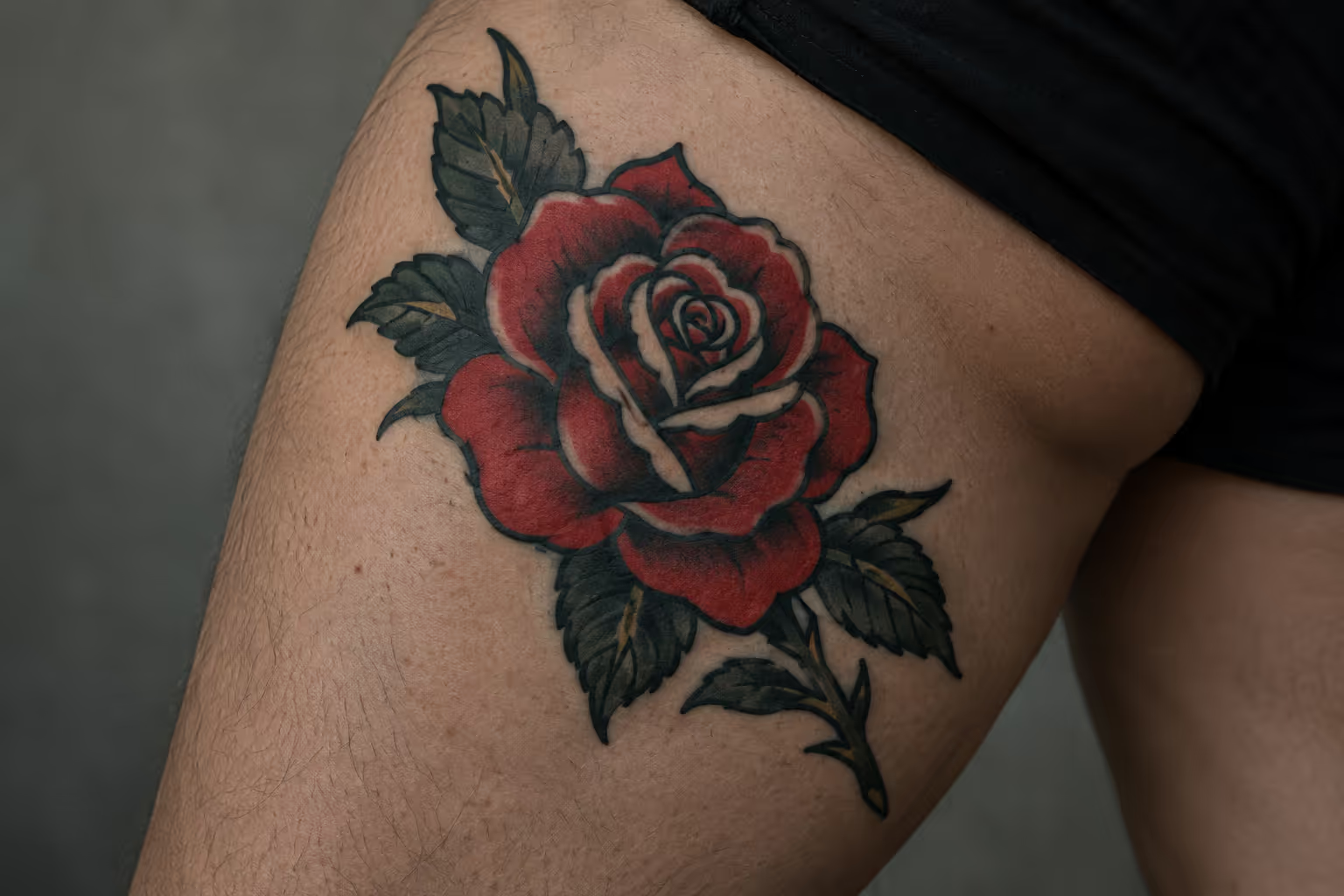
A survey of 1,092 people who rated their tattoo pain on a 0-10 scale found no significant effect of body area on pain intensity, neither during tattooing (p = 0.094) nor after (p = 0.742) (15). The study grouped tattoos into broad regions rather than comparing thigh, calf and shin numerically, so no study backs a ranking between the three. That changes how you should plan leg tattoos. The thigh’s broad flat area, the calf’s curve and the shin’s bony flatness are design decisions first, so pick the zone that fits the artwork’s shape and plan the healing around how that zone moves and rubs.
Thigh, Calf, and Shin: Choosing by Shape
| Thigh | Calf | Shin | |
|---|---|---|---|
| Canvas | Broad, flat area | Rounded muscle | Narrow, flat area |
| Surface shape | Relatively flat; skin shifts with movement | Curved; wraps around the leg | Flat and bony |
| Design fit | Large portraits and realism | Wraparound, vertical, or geometric work | Centered, symmetrical, or linework designs |
| Visibility and cover-up | Easy to cover under shorts or trousers | Visible in shorts | Visible when the lower leg is exposed |
Across the whole leg, the upside is room and clothing flexibility. The downside is healing friction. Knees bend, calves flex with every step, socks and footwear rub the lower leg, and large pieces mean long sessions.
✓ Pros
- The leg offers enough surface for designs that need a long vertical flow or a broad composition.
- Clothing gives you practical control over whether a thigh piece is visible.
- Different zones support distinct layouts, from a thigh portrait to a calf wrap or centered shin work.
✗ Cons
- Lower-leg footwear and socks can catch or rub while fresh skin is healing.
- Walking and bending keep the leg in motion during recovery.
- Large, detailed pieces can require multiple appointments and sustained sessions.
Thigh Tattoo Ideas for the Leg’s Largest Flat Area
A thigh tattoo gets the most flat, uninterrupted skin on the leg, which is why one design guide recommends the outer thigh for large portraits and realism (8). There are no tight curves to fight. Detail that would warp around a calf or an ankle stays readable here.
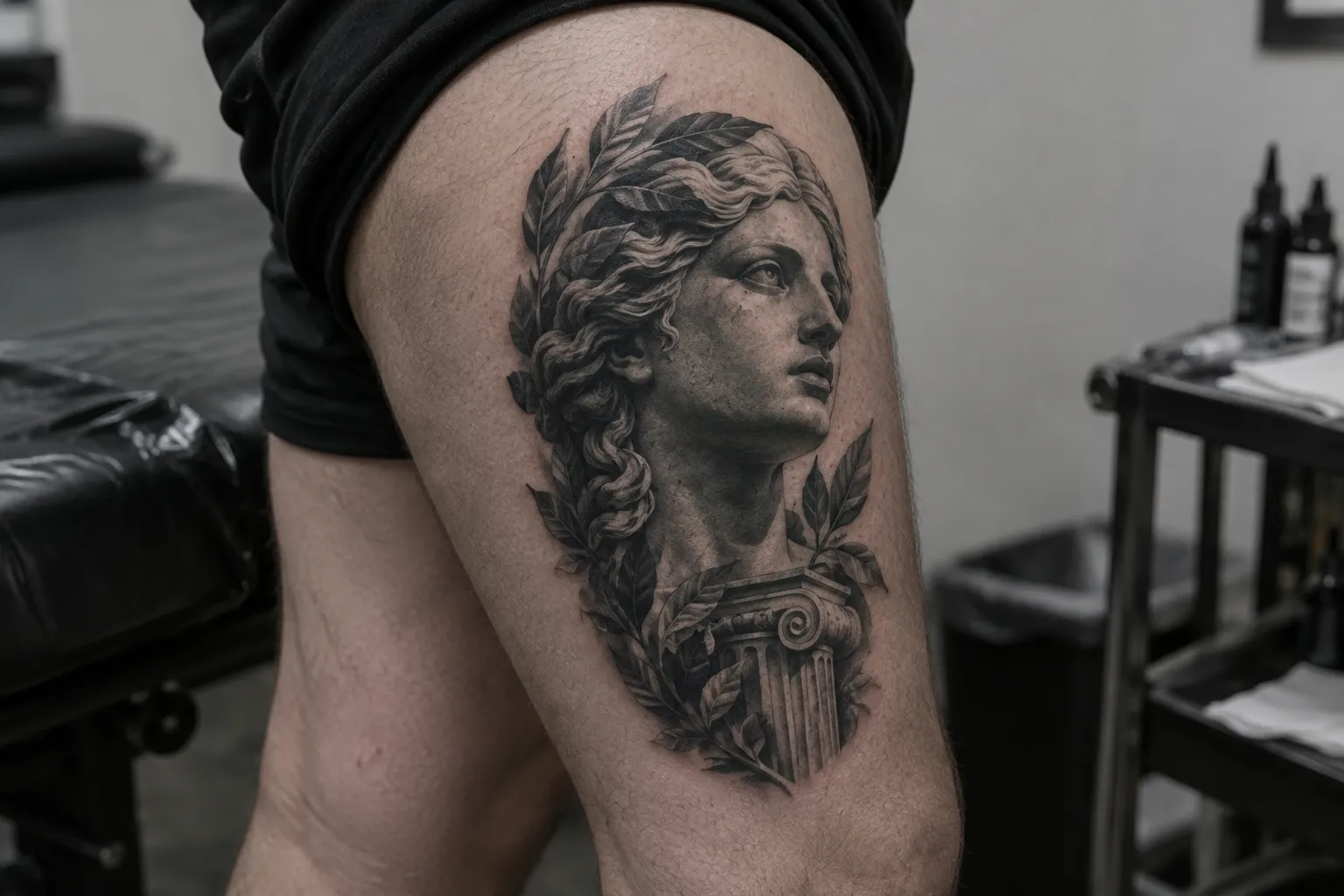
The thigh is still a muscle, though. As you walk, sit or squat, the skin shifts, so the strongest designs are the ones that work with that movement (3). One guide notes that vertical flow reads better than horizontal on the thigh (4), so confirm the scale and orientation with your artist before you commit. Ask them to place the stencil while you’re standing, then check it seated, because a face that looks centered standing can slide sideways when you sit.
Portrait and realism work on the outer thigh
For a portrait or a realism piece, go big: one design guide says the outer thigh takes large-scale pieces of 10-14 in (25-36 cm) (8). Go much smaller and the soft gradients that make realism work start to close up as the ink settles over the years. The outer thigh is flatter than the front and gives the artist a consistent surface for smooth shading. Realism is technically demanding work, so book someone whose healed portraits you’ve seen, and judge the healed photos over the fresh ones.
Inner thigh placement for a design that’s easy to cover
The inner thigh suits something personal that you want hidden under almost any clothing, including most shorts. The skin is softer and the area rubs when you walk, so bold, open designs hold up better than dense micro-detail. Keep inner-thigh pieces modest unless you’re planning a larger panel that wraps toward the front.
Calf Tattoo Designs That Follow the Muscle’s Curve
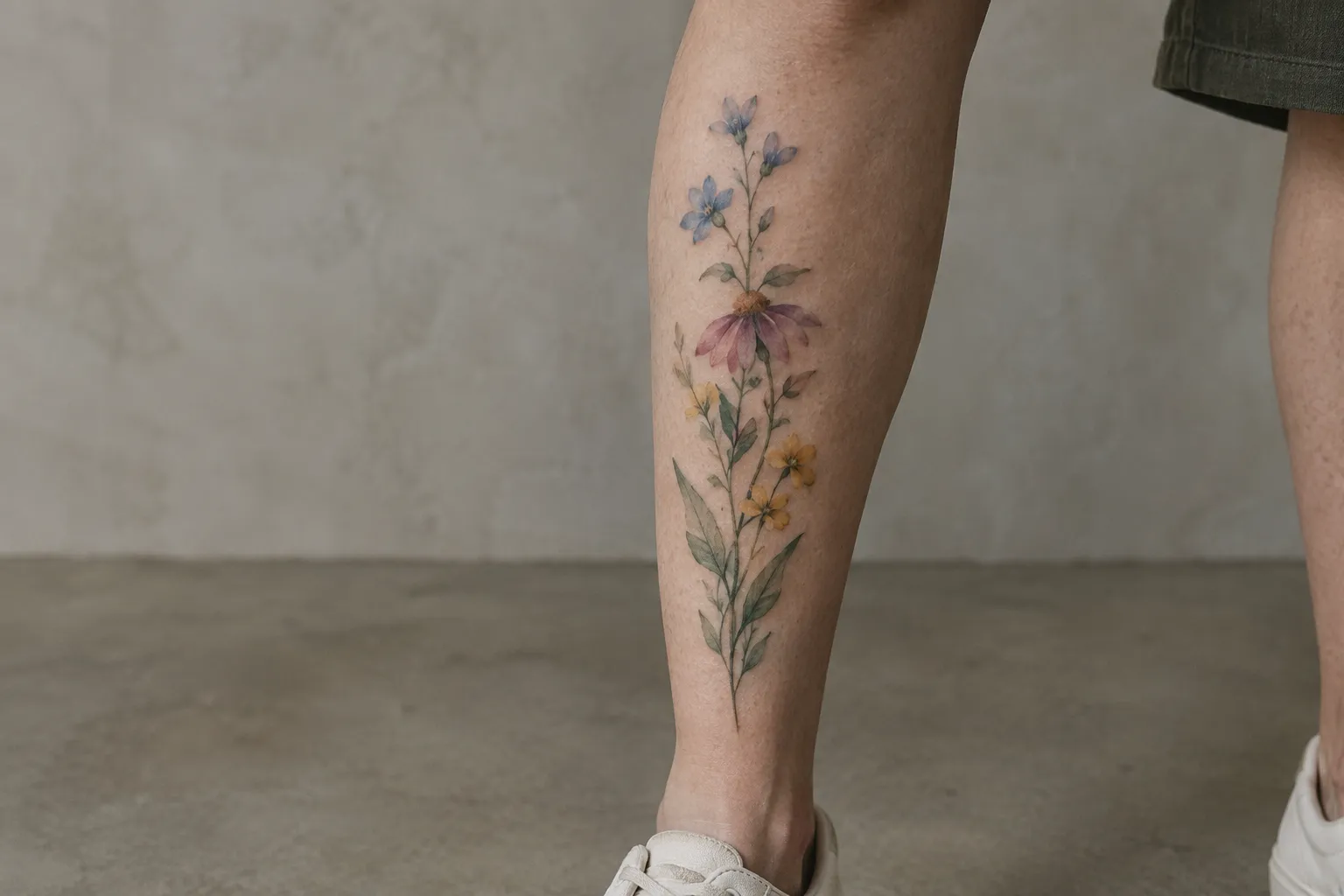
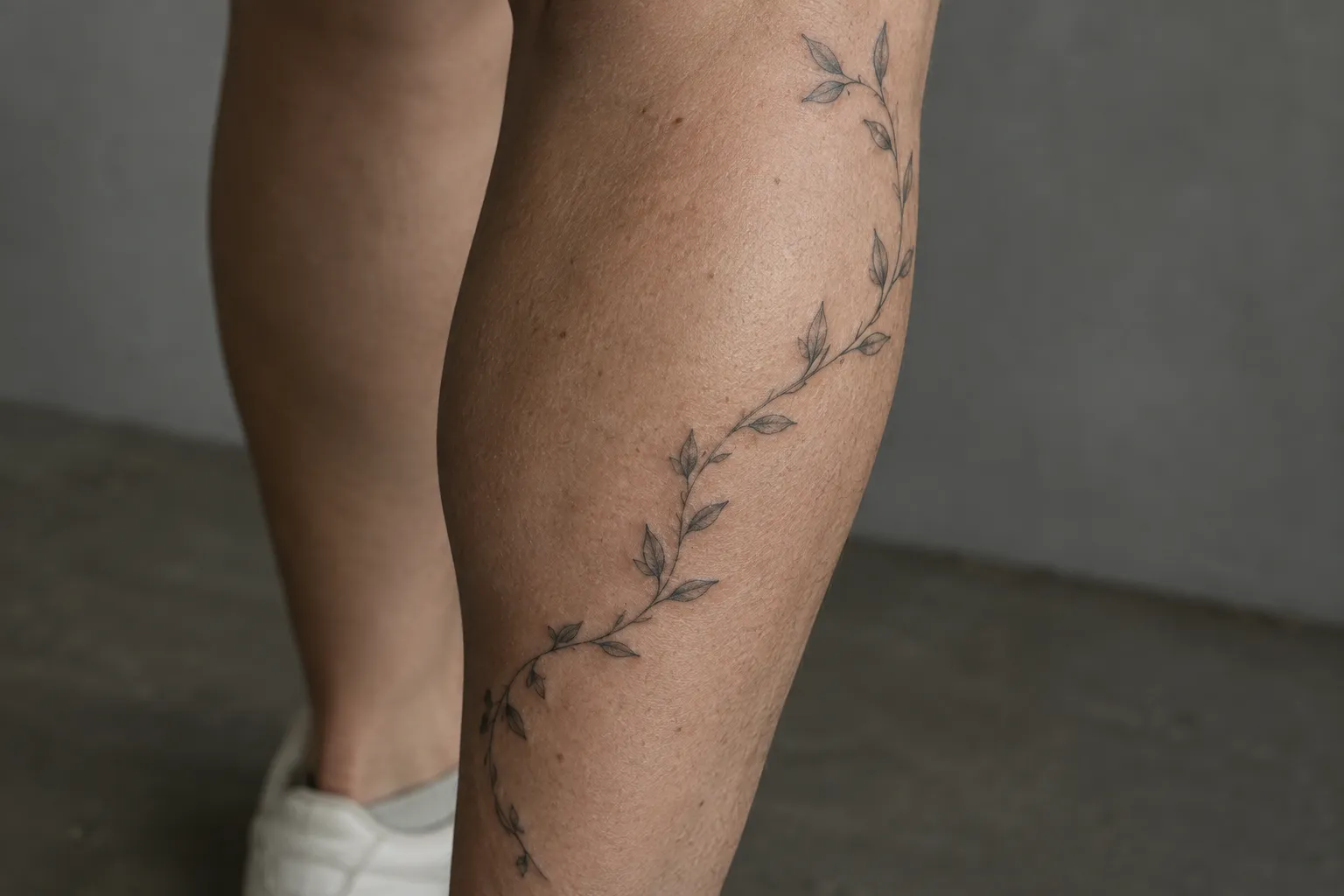
A calf tattoo sits on a rounded muscle, so it suits designs that wrap around the leg or run vertically down it (3)(7). One design guide also suggests geometric or wraparound work for the calf specifically (8). The curve is the feature you design around.
Wraparound pieces that disappear around the leg
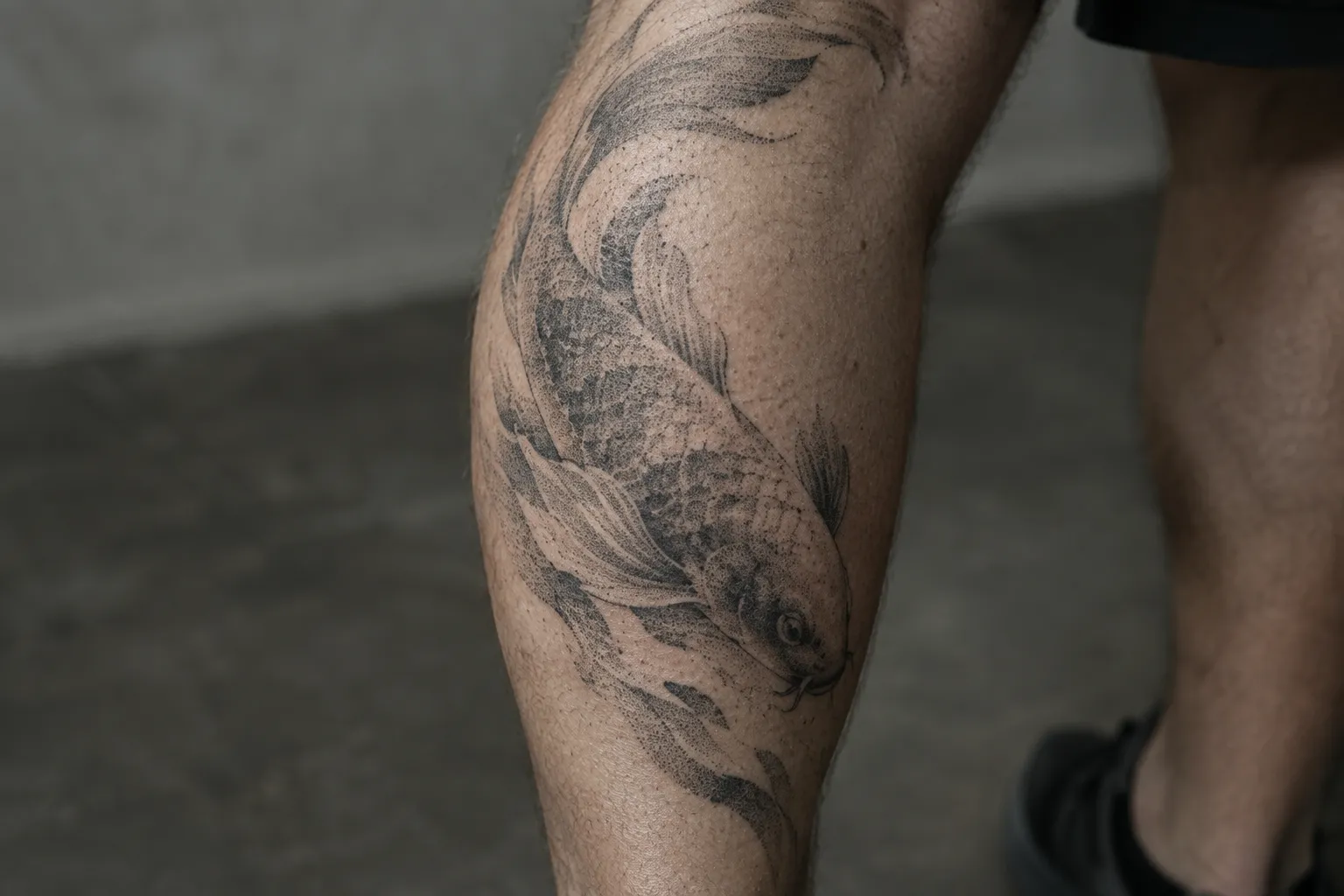
A calf wrap creates depth: as the design turns around the muscle, part of it drops out of view, and the piece reads as three-dimensional rather than flat (3). Snakes, koi, vines and dragon tails all use that effect. Size a wrap to your circumference, not to a flat drawing. Have the artist measure around the widest part of the calf and plan the composition so the focal point lands on the outer calf, where people will see it from the side.
Geometric blackwork is the common pitfall on the calf. Straight lines and perfect circles drawn flat on paper bend once they’re stenciled onto a curve. A good artist adjusts the pattern on your leg, sometimes freehanding guide lines with a skin marker. A weak one transfers a flat stencil and leaves you with wobbly hexagons.
Vertical calf designs that don’t wrap
If you want a single image rather than a wrap, run it vertically along the back or outer calf. Vertical compositions suit the calf’s long shape (7), and one design guide recommends at least 7-10 in (18-25 cm) of height on a muscular calf to keep the proportions (8). Vertical designs also leave room for future work on either side if you later decide to build toward a half sleeve.
Shin Tattoos: Flat, Bony, and Built for Symmetry
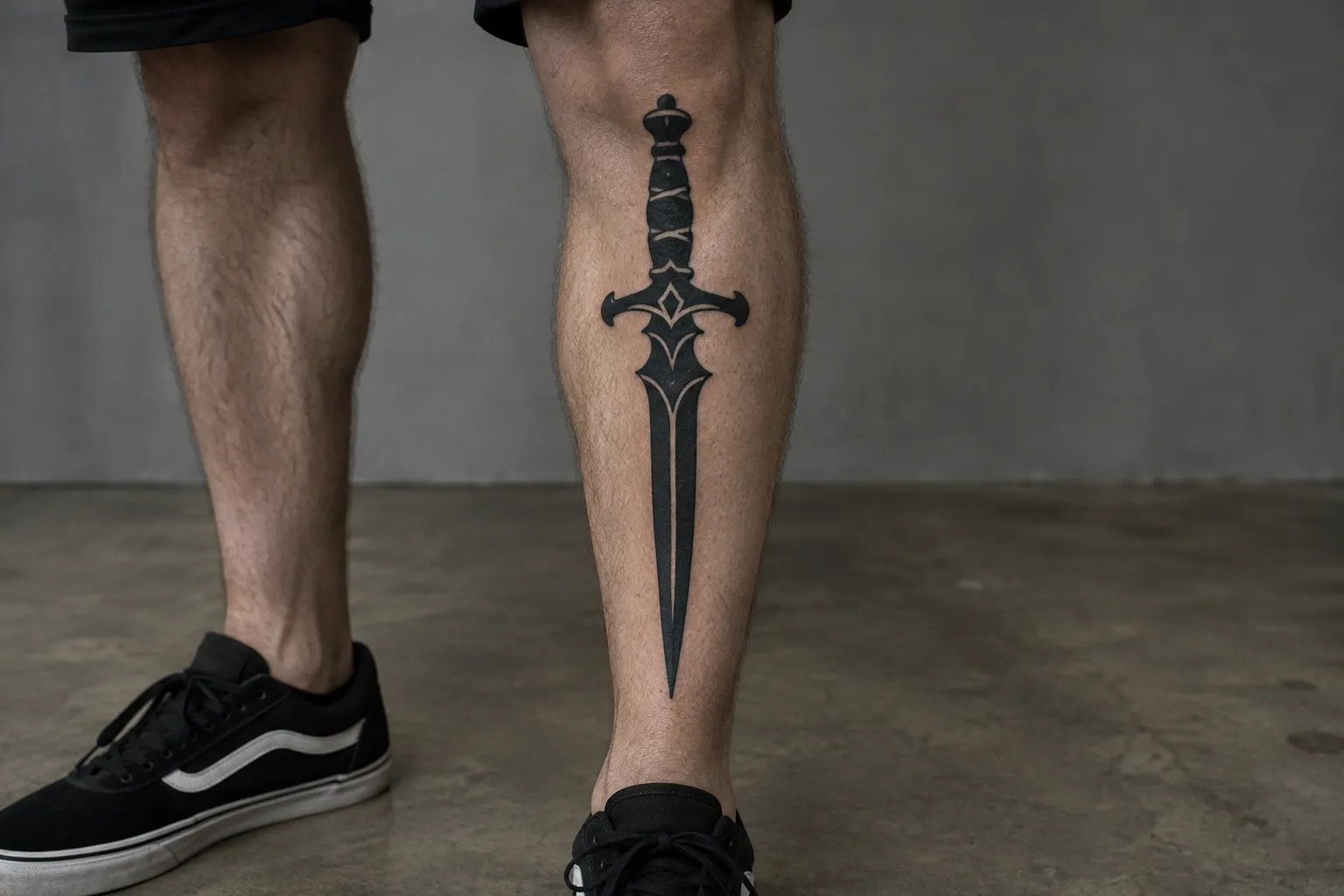
The shin is the flattest, narrowest zone on the lower leg, which makes it a natural fit for centered vertical and symmetrical compositions (3). One design guide also points to linework and detail for this zone (4).
Why a flat surface suits symmetry
On a flat surface, a mirrored design stays mirrored. A dagger, a column of ornament, a botanical stem or a traditional panel keeps its straight axis because nothing curves away underneath it. Fine linework also reads well here because the lines don’t distort.
If you want lettering running down the shin, size it by letter height, as our tattoo font guide does. Standard script needs at least 12 mm (1/2 in), and fine or ornate script needs about 25 mm (1 in). Block and serif lettering can go down to 6 mm (1/4 in).
A knee transition is a style idea, not a rule. Some collectors cap a shin panel with an ornament or mandala over the kneecap. Knee skin creases and moves constantly, so treat this as an advanced add-on.
Calf curve vs shin flatness: picking by shape
On a like-for-like basis, the calf and shin differ mainly in curvature (3). The calf’s curve suits wraparound compositions that use the muscle’s contour for depth. The shin’s flat, bony surface suits symmetrical, centered designs. Choose between them based on the artwork’s shape, not on assumptions about which one hurts or heals worse.
Leg Tattoo Ideas by Style, Theme, and Who’s Getting It
The best leg tattoo idea is one whose shape matches its zone. Put portraits or realism on the thigh, wraparound or geometric work on the calf, and linework on the shin (3)(4)(7)(8). There isn’t a single “best” design. There’s a best fit between the image and the surface.
A simple rule: let the artwork pick the zone
Lay your reference image next to a photo of your leg and work through three questions:
- Is the image wide and detailed (a portrait, a scene)? Put it on the thigh.
- Does it have movement or a long body (a snake, a koi, a vine)? Put it on the calf as a wrap or vertical piece.
- Is it tall, narrow or mirrored (a dagger, ornament, lettering)? Put it on the shin.
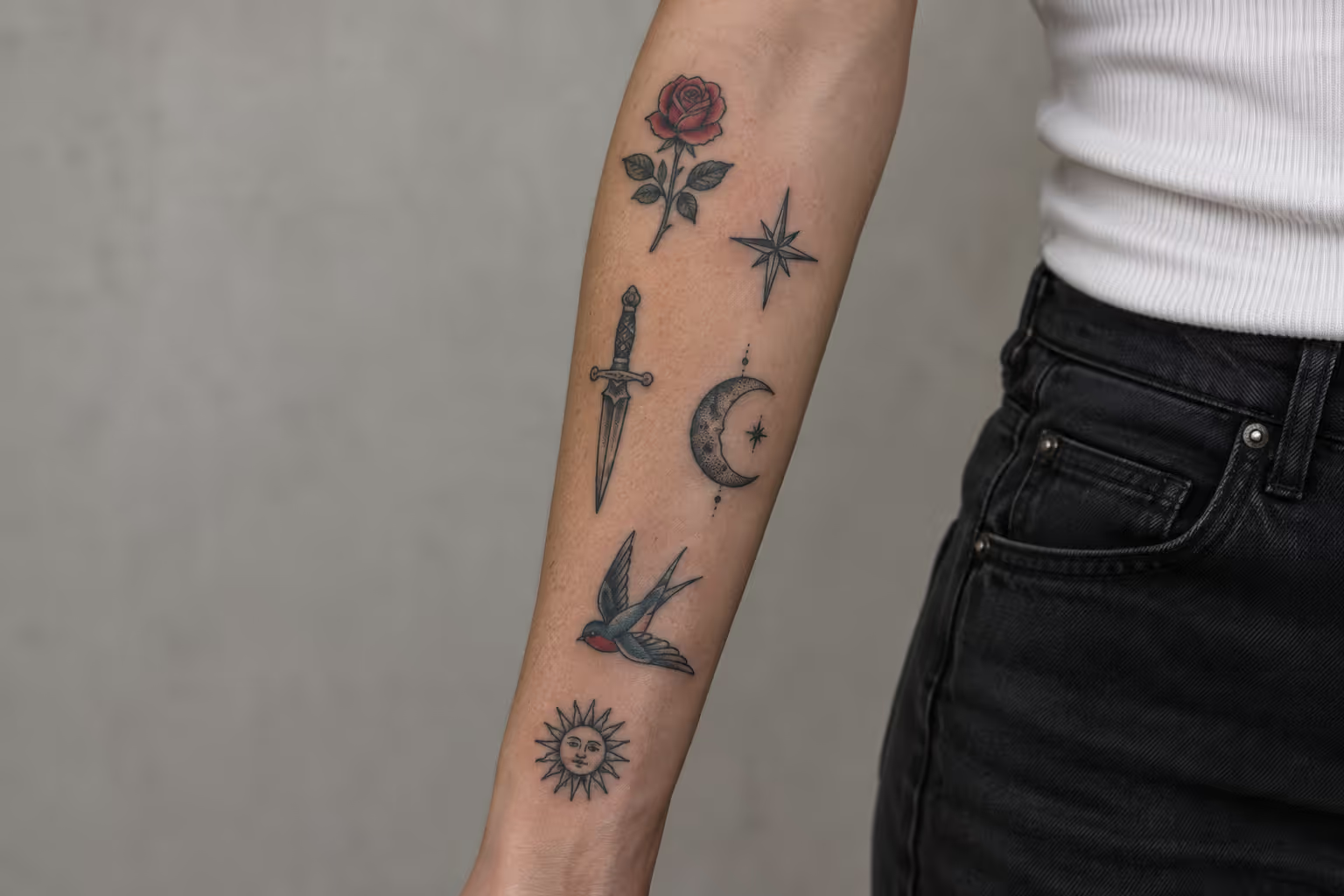
Style changes the sizing too. American traditional relies on two hallmarks: thick black outlines and a limited palette of red, yellow, green and black. Both help the design read from a distance on the lower leg. The pitfall is thin outlines packed with color, which blur together within a few years.
Japanese irezumi treats the leg as part of a larger composition. Imagery flows from the thigh down to the calf with background elements like wind or water tying it together. Plan that kind of piece as a whole leg from the start, even if it’s tattooed in stages.
Keep one distinction clear. These zone-by-design suggestions come from tattoo design guides, not clinical standards. Medical guidance about tattoos comes from bodies like the FDA, and it covers safety and healing, not which motif belongs on your calf (9).
Where women commonly place leg tattoos, briefly
The leg tattoo ideas above don’t change by gender. If your wardrobe swings between long skirts and shorts, the thigh gives you the most control over who sees the piece, while the shin suits visible vertical work.
How Painful Are Leg Tattoos? What Predicts It
Leg tattoos are not proven to be more painful than tattoos elsewhere. In the one survey-based study on pain by body area, location did not significantly predict pain intensity (15). That contradicts most placement charts, which typically rank the shin above the calf and the outer thigh as the gentlest spot (13).
What the pain research found
The study surveyed 1,092 people using a 0-10 pain scale (15). One analysis of four published pain charts notes that none of them cites data for its rankings (13). The underlying study reports no significant difference by body area, with p = 0.094 during the session and p = 0.742 afterward (15), numbers that undercut any chart ranking the shin above the calf or thigh. The charts mostly agree with each other, but agreement between opinions isn’t measurement.
So what is the most painful part of a leg tattoo? Many people expect the shin, the back of the knee and the bony ankle to be worst, because the needle works over bone or thin, creased skin. Expect your own experience to differ from anyone else’s, and treat chart rankings, including the body map in our tattoo pain guide, as rough guesses (13).
Session length, stress, and bleeding matter more than zone
During tattooing, longer sessions and higher stress significantly predicted more pain, but the bleeding link fell just short of conventional significance (p = 0.052) (15). After tattooing, session length, stress and bleeding all came out as significant predictors. Treat bleeding as a weaker factor during the session itself, and a stronger one for how sore you are afterward. Session length and stress are the two you can partly manage:
- Split large pieces into several shorter sessions instead of one marathon.
- Arrive rested and fed. Stress and an empty stomach make the last hour much harder.
- Tell your artist about your medications. Avoid alcohol and blood thinners before a session, since extra bleeding is linked to more pain and makes the artist’s job harder.
How long the session takes depends on the size, detail and your artist’s speed, and there’s no reliable standard figure for any leg zone. A small linework shin piece can fit in one sitting. A detailed outer-thigh portrait or a full calf wrap often needs several appointments.
Healing Timeline and Warning Signs for Thigh, Calf, and Shin
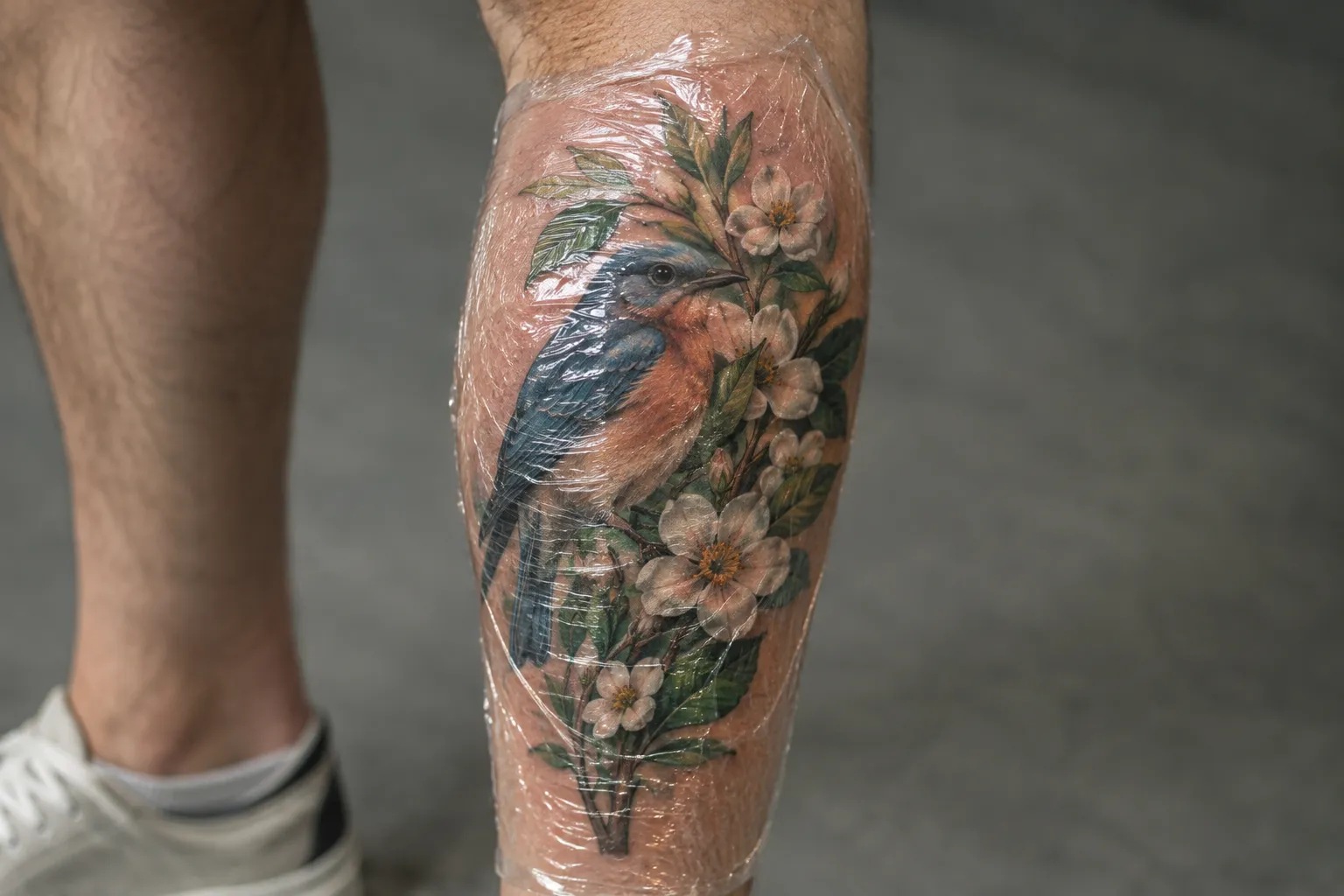
A leg tattoo heals in the same stages as any other, from tender and oozing skin in the first days to full integration around week six, but the lower leg adds friction from footwear and constant movement. Follow your artist’s instructions first; our tattoo aftercare guide covers the week-by-week routine.
Day 1-3: fresh and tender
- Day 1-3: expect redness, swelling, soreness and some clear fluid. Wash gently with clean hands and pat dry. Wear loose clothing over the thigh and avoid tight socks or boot tops over a calf or shin piece. Keep the leg raised when you can, because standing for long stretches can make a lower-leg tattoo throb.
Day 4 to week 6: flaking, peeling, settling in
- Day 4-7: the skin tightens and starts to flake. Apply a thin layer of fragrance-free moisturizer. Leave scabs alone, because picking or peeling flakes can interfere with healing (10).
- Week 2: peeling and itching peak. Keep moisturizing lightly and don’t scratch.
- Week 3-6: the surface looks healed by weeks three to four, though the skin can look cloudy for a while and keeps settling until about week six. Keep direct sun off it for the first 4-6 weeks. After that, cover it with sun-protective clothing or apply a broad-spectrum, water-resistant sunscreen of SPF 30 or more when your legs are out (2).
Showering is fine during healing. Bathing, swimming and saunas should wait until the surface has fully closed, which usually means at least three weeks.
When to call a professional instead of waiting it out
Redness, swelling, soreness, clear fluid, itching and flaking can all be part of normal healing (12). The FDA advises contacting a healthcare professional if the area isn’t healing or develops a rash, especially with fever (9). The AAD’s list of infection signs is broader:
- redness that darkens or spreads instead of fading
- pain that continues or worsens
- a rash of itchy, red, painful bumps
- pus or open sores
- fever, chills or shivering
The AAD advises seeing a doctor or board-certified dermatologist right away if any of these appear (12). These reactions can happen even with a licensed artist and correct aftercare (12).
Frequently Asked Questions
- Are tattoos on the leg painful?
- A leg tattoo can hurt, but the cited survey found that body area did not significantly predict pain intensity; session conditions were more informative.
- What is the most painful part of a leg tattoo?
- No leg zone is established as the most painful by the cited survey; shin and ankle pain-chart rankings are estimates, not measured rankings.
- What is the best leg tattoo idea?
- The best fit depends on the image's shape: broad compositions suit the thigh, flowing forms suit the calf, and centered work suits the shin.
- How big is a $3,000 tattoo?
- There is no reliable price-to-size conversion for a tattoo; ask the artist for a quote based on the design, placement, detail, and their rate.
- How long does a leg tattoo take?
- A leg tattoo's session time depends on the artist's pace and the design's detail; ask for an estimate after the artist reviews your reference.
- Can I run after getting a tattoo on my leg?
- Wait until running will not create sweat or repeated rubbing on the fresh tattoo, and ask your artist before resuming strenuous training.
- Can I shave or wax my legs after a tattoo?
- Wait to shave or wax directly over the tattoo until the skin has fully healed, so hair removal does not disturb scabs or peeling skin.
- Where do women commonly get leg tattoos?
- Thigh and shin are common choices: the thigh is easier to conceal with clothing, while the shin suits visible vertical designs.
Picking Your Zone Before the Consultation
Choose thigh, calf or shin based on the shape the artwork needs. The thigh suits wide, detailed pieces, the calf suits wraps and vertical flow, and the shin suits symmetry and linework. Don’t choose by an assumed pain level, because the one survey on the question found no link between body area and pain intensity (15). Bring reference images that show how the design sits on that zone’s shape, and confirm the scale with a stencil both standing and seated. During healing, watch for the AAD’s and FDA’s warning signs (9)(12), and keep the tattoo out of pools and baths for at least the first three weeks.