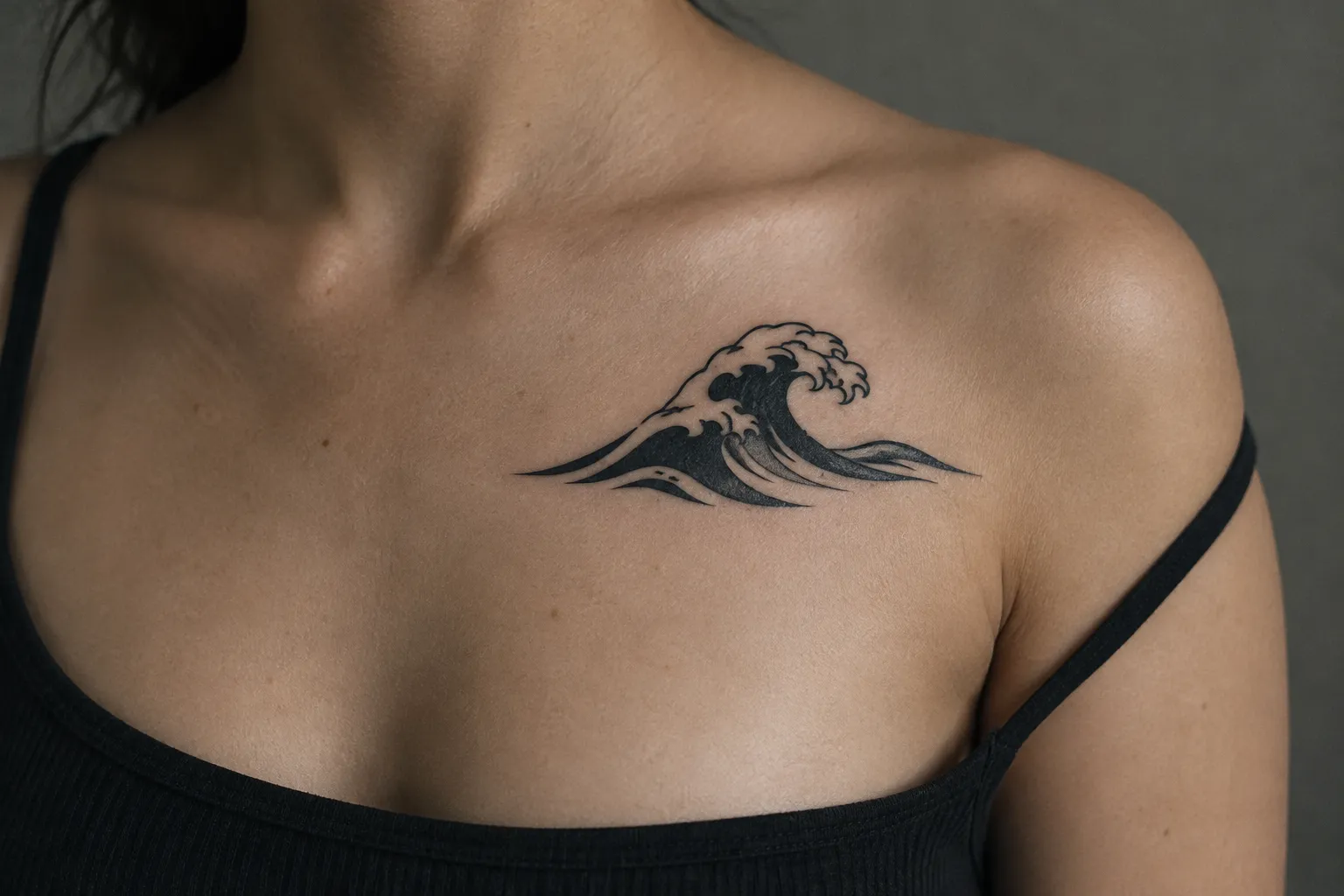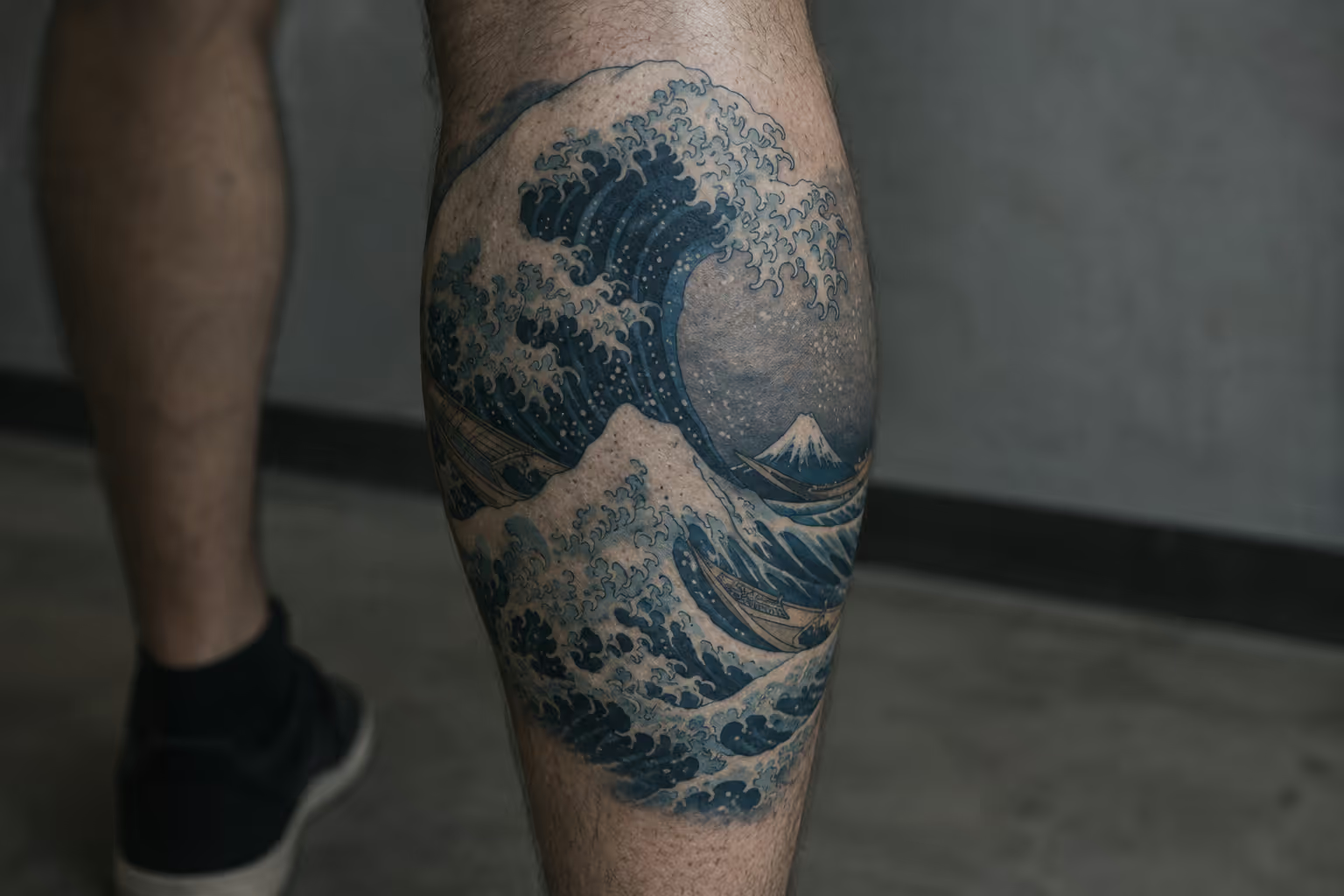
A wave tattoo based on Hokusai’s Under the Wave off Kanagawa is a specific print, not a generic wave. It dates to around 1830-32 and shows three fast fish-carrying boats, a claw-like crest, and Mount Fuji sitting small inside the wave’s hollow (5). Your first real design choice is whether to keep those details or strip them out. That choice sets the scale, the placement and how well the piece holds up as it ages.
✓ Pros
- One motif can carry a personal tribute or sit inside a larger Japanese composition.
- The design can scale from a spare curve to a full-body-area scene.
- A wave's directional flow gives the artist a clear way to work with body contours.
✗ Cons
- Small placements leave little room for recognizable scene details.
- Blue-heavy designs need consistent sun protection to limit fading.
- Mole-free placement can narrow the usable area for the composition.
Here are the trade-offs in brief. On the plus side, the symbolism is flexible, the motif works from a single small curve up to a back piece, and it pairs naturally with other Japanese subjects. On the minus side, a detailed Great Wave scene needs real size to read, blue ink fades without sun care, and parking a wave over a cluster of moles makes skin checks harder.
Wave tattoo meaning: common interpretations explained
Wave tattoo meaning has no single fixed definition. The common readings are strength and resilience, change, freedom and a connection to nature, and a calm wave can also stand for peace (2).
Resilience, change, freedom and nature as common readings
Popular wave tattoo guides tie the wave to strength and resilience, to life’s constant change and to freedom (2). Japanese work handles water differently. In irezumi, waves stand for the power of nature and the flow of a life, but they are rarely the subject: they are the background that lets the main motif move (3). A standalone wave chosen for resilience follows the Western single-image habit, and leaving out the background is exactly what separates that kind of tattoo from irezumi (3).
Personal ocean tribute vs symbolic narrative wave
Decide this before you look at any references. If you want a personal ocean tribute, such as a love of the sea, a surf habit, travel or someone special, the wave can stand alone as the emblem (2). If you want a Japanese narrative piece, the wave works best as a background that links other imagery like koi or dragons (3). A standalone wave is a self-contained statement. A background wave is there to carry another subject (3).
Designs across both camps range from a single minimalist line to full Hokusai-inspired scenes and larger ocean compositions (2).
Japanese-inspired waves: Hokusai’s Great Wave and composition choices
A Japanese wave tattoo grounded in Hokusai draws on the print’s three defining features: the claw-like crest, the three boats, and Mount Fuji framed in the wave’s hollow (5). Leave one or more out and you get a stylised wave, which can still be a strong design, just a different one from the source print.
Traditional Japanese tattooing treats water as structure, not decoration:
- Waves drawn as structured, repeating scrolls and foam fingers that frame the main subject and fill the space between panels (3).
- A curl direction set by the whole composition, with the water running along the body’s length rather than around it (3).
Watch for a wave drawn with no internal structure: it can heal into a flat blue mass with a curl on top rather than a wave with real movement.
Hokusai’s Under the Wave off Kanagawa: crest, boats and Fuji
The print belongs to Hokusai’s Thirty-six Views of Mount Fuji series. Its composition plays a huge foreground wave against tiny boats and a distant Fuji (5). That contrast in scale is the whole point of the image, so a close copy needs room for the small elements to stay legible. The palette also matters. A technical study of one impression at the Met found Prussian blue mixed with indigo in the outlines, and a brighter blue printed over darker stripes in the wave’s hollow (5).
In tattoo terms, a faithful Great Wave relies on layered blues and clean black linework rather than one flat blue fill. Bring your reference image and tell the artist which features matter most to you: the clawed foam, Fuji, the boats, or a limited blue palette. That lets them adapt the composition to the body area instead of copying the print’s rectangle.
Using a wave as background for koi or dragon imagery
In irezumi, wave patterns often serve as the background that ties a koi, dragon or other subject into a larger piece (3). Here the wave stops being the subject and becomes the setting. It carries the flow between motifs and fills the space between panels, which is why a sleeve reads as one piece (3).
Here is how the three approaches stack up against each other:
Three ways to design a wave tattoo
| Standalone personal-tribute wave | Hokusai-style narrative scene | Small or fine-line wave | |
|---|---|---|---|
| Best for | A self-contained emblem | A recognizable Japanese composition | A discreet piece |
| Scale | Small to medium | Needs enough flat space for details | Smallest of the three |
| Scene elements | No boats or Fuji | Crest, boats and Fuji | Contour only; no scene elements |
| Placement fit | Forearm, ribs or calf | Outer forearm, thigh or back | Wrist or inner forearm |
Small and fine-line wave designs for minimal placements
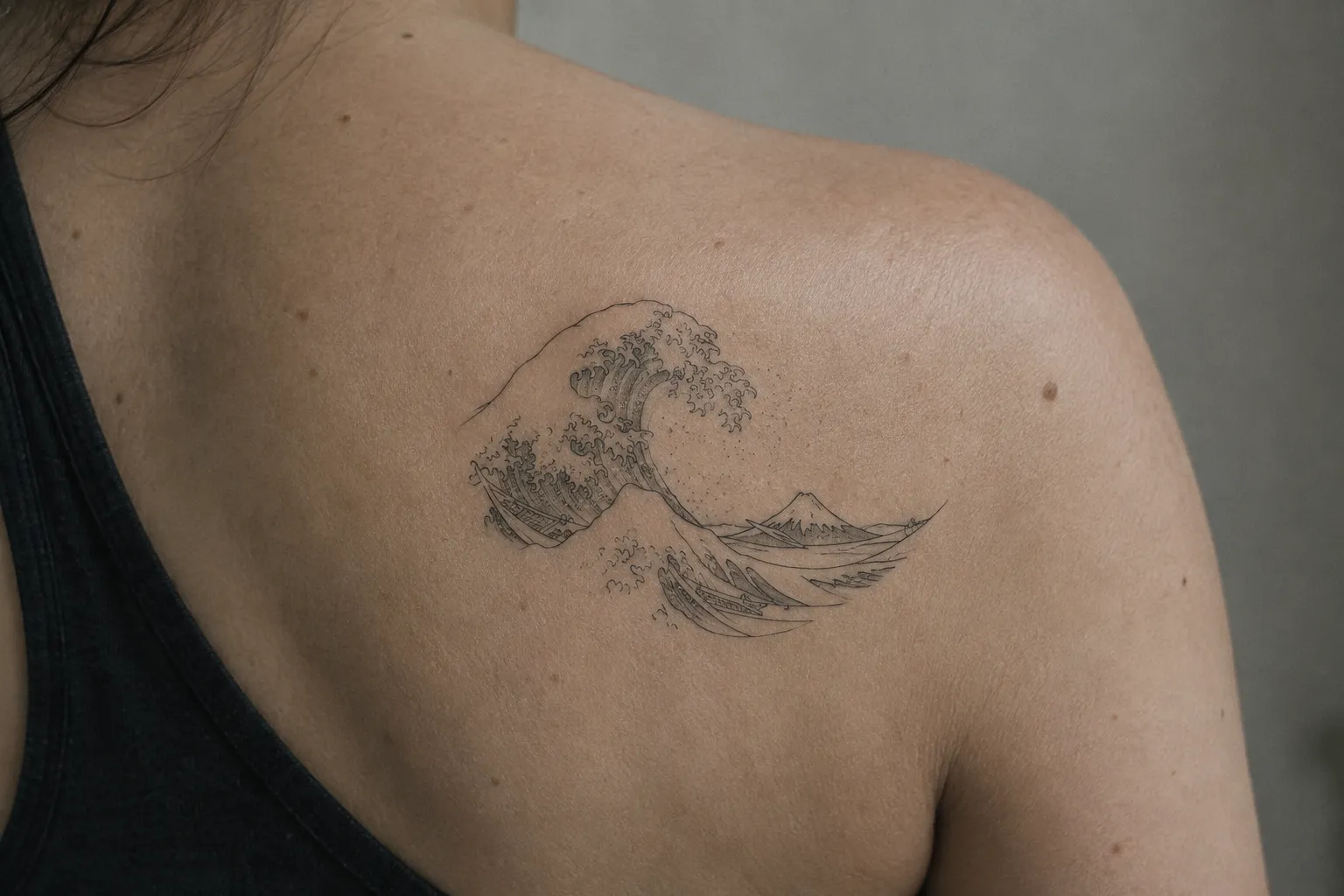
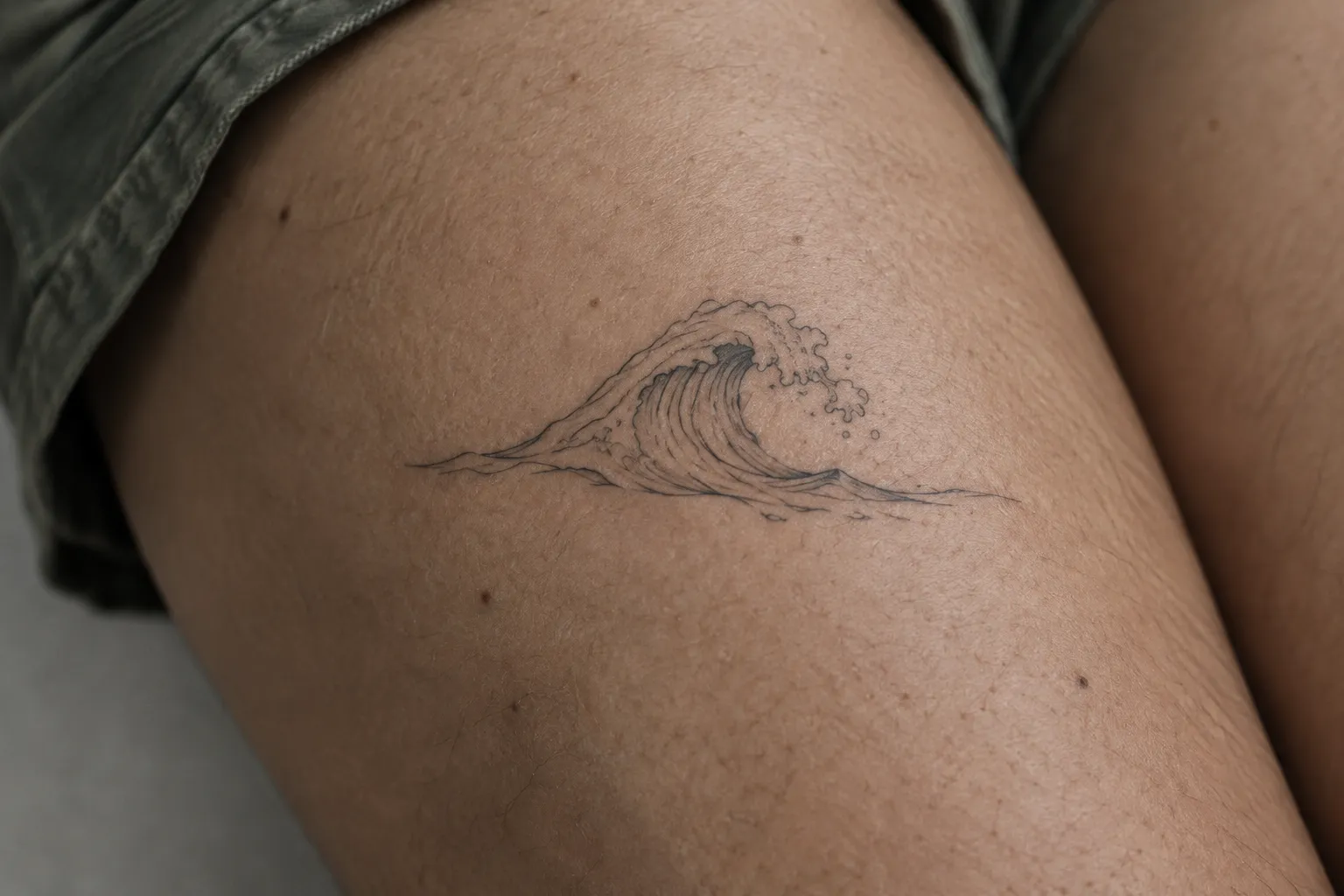
A small wave tattoo works when it is drawn as a single clean curve or a compact crest. A shrunk copy of the full Great Wave does not work at that size. Fine-line technique uses sparse contours and little or no shading for a restrained look.
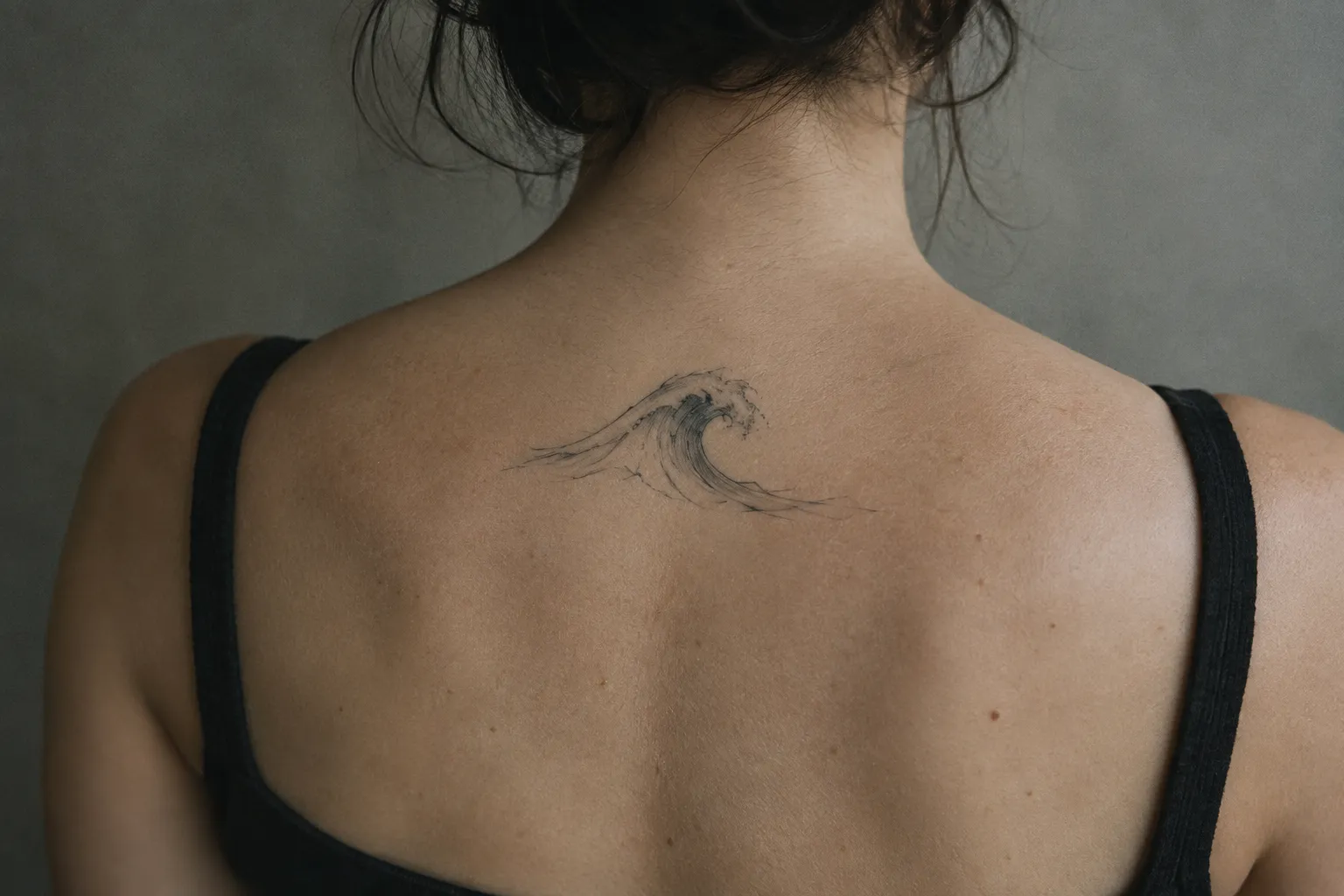
The hallmarks of fine-line wave work are single-needle-weight lines and open negative space instead of packed shading. The usual pitfall is crowding: thin single-needle lines spread in the skin over the years, so foam lines drawn too close together can blur into each other (6). Ask to see healed examples of the artist’s comparable linework and shading, not fresh photos, and check whether fine details have merged (6). Fresh fine line always looks crisp. Healed fine line shows you who can hold a line.
Wrist and forearm placements for a single clean curve
- Inner wrist: suits one curl small enough for the inner wrist. Keep the line count low, because wrist skin moves constantly.
- Inner forearm: gives a palm-sized wave room for a second line of foam or a horizon.
- Outer forearm: handles a slightly more stylised crest and sees less friction from sleeves and desks.
Agree on the final size and detail level with your artist at the consult. Do not pick it from a photo of someone else’s arm.
What gets lost when a Great Wave scene is shrunk too far
The boats go first, then Fuji, then the structure of the crest itself. Those are the three elements that make the image Hokusai’s. If the placement is small, drop the scene and keep the crest shape. A clean claw of foam reads as “Great Wave-inspired”. Three blurred specks for boats do not.
Placement options and the one-third rule
The best wave placements are curved or cylindrical areas like the forearm, calf and ribs, where the body’s contour carries the wave’s motion. Flat placements tend to flatten that impression. The second filter is medical rather than aesthetic: the AAD suggests getting a tattoo on skin that is free of moles, because a tattoo can make the earliest signs of skin cancer harder to see (4).
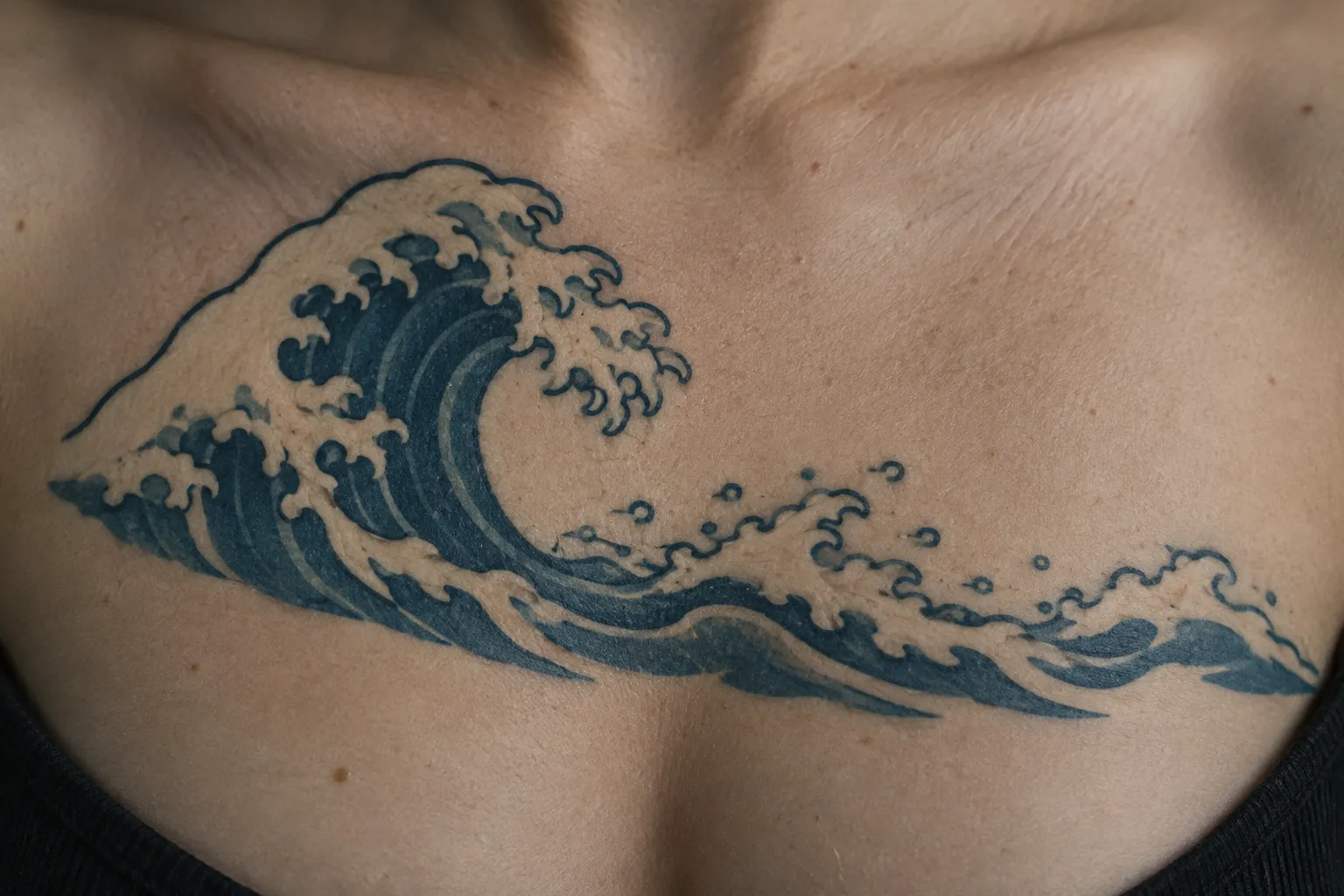
How the one-third rule applies to wave tattoo scale
The 1/3 rule treats roughly one-third of a limb segment as the natural visual unit for a standalone piece, as our tattoo placement guide explains. For a wave, that unit suits a single crest or curl on the forearm or calf. A full Hokusai scene with crest, boats and Fuji needs more room than a third of a limb, so it belongs on the whole outer forearm, the thigh or the back.
Placement choices that follow the wave’s flow and avoid moles
Before the session, decide which direction the wave breaks. On a forearm it can roll toward the wrist or toward the elbow. On ribs it should follow the line of the torso. Then check the area for moles. Making a mole a “drop of spray” looks clever on the day and makes every future skin check harder. Treat mole-free skin as part of the same placement decision as flow.
Pain is the last filter: the ribs rank among the more painful placements, while the calf and outer forearm sit in the low tier of the pain scale. Thin skin over bone hurts more than muscled areas.
Larger wave compositions for forearm, calf, back and ribs
Bigger placements are where a wave can carry a full crashing-wave scene or an ocean panorama that small pieces cannot hold. Forearm, calf, thigh, back and sleeve placements all have room for dramatic water and broader scenes.
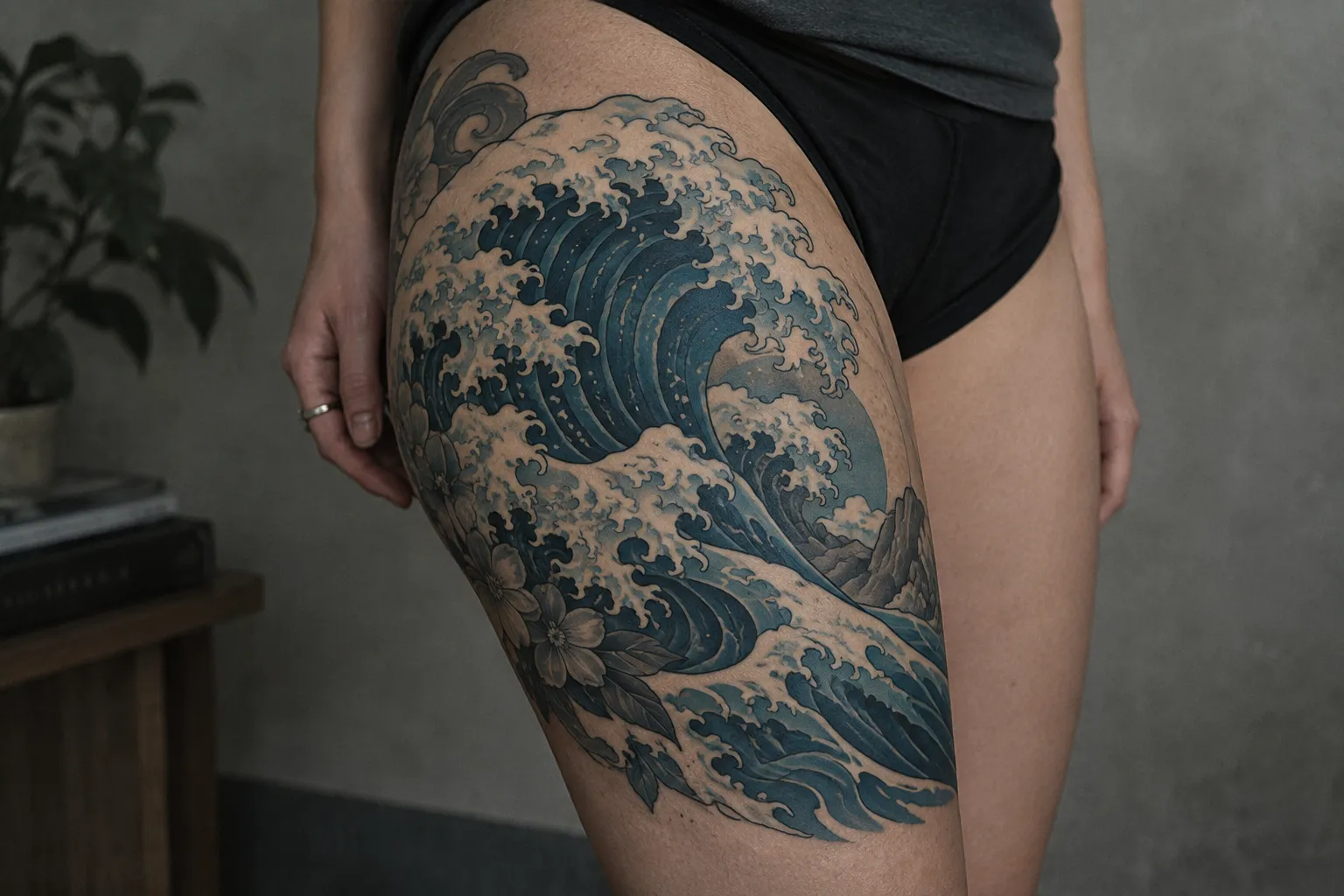
Calf and ribcage for a crashing wave
The calf suits larger crashing-wave work. The muscle’s curve gives the water a natural roll, and the calf sits in the low tier of the pain scale. The ribcage follows the torso’s curve, so a wave there can sweep from the side toward the front. Expect the ribs to be the harder session of the two.
Back and sleeve for a full ocean scene
A back panel or full sleeve is the scale where a Japanese wave tattoo becomes a setting. Water can wrap around a koi or dragon, or carry the complete crest-boats-Fuji arrangement with room to breathe. For colour on large pieces, a limited palette in the Hokusai spirit, with deep indigo-range blues against black and open skin for foam, holds up better than many competing hues. Big blue areas also need steady sun protection, since UV light can fade some tattoo inks (4). That leads straight to aftercare.
Caring for a healed wave design
A healed wave design keeps its blues and linework longest with two habits used together. First, apply broad-spectrum, water-resistant sunscreen of SPF 30 or higher 15 minutes before sun exposure, and reapply at least every 2 hours. Second, use a water-based lotion instead of petroleum-based products, which can fade ink (4).
Before it counts as healed: the first weeks
The early weeks matter too. Your artist’s instructions come first, but the general sequence, as our tattoo aftercare guide sets it out, looks like this:
- Day 1-3: keep the tattoo clean and covered as directed, and don’t soak it.
- Week 1: from about day 4 the surface tightens and starts to flake. Don’t pick or scratch, and keep it out of direct sun.
- Week 2-4: peeling and itching peak in week 2, and by weeks 3-4 the surface looks healed while the skin underneath is still remodeling. Protect any skin that hasn’t fully closed, keep the tattoo out of direct sun for the first 4-6 weeks, and expect full integration around week 6.
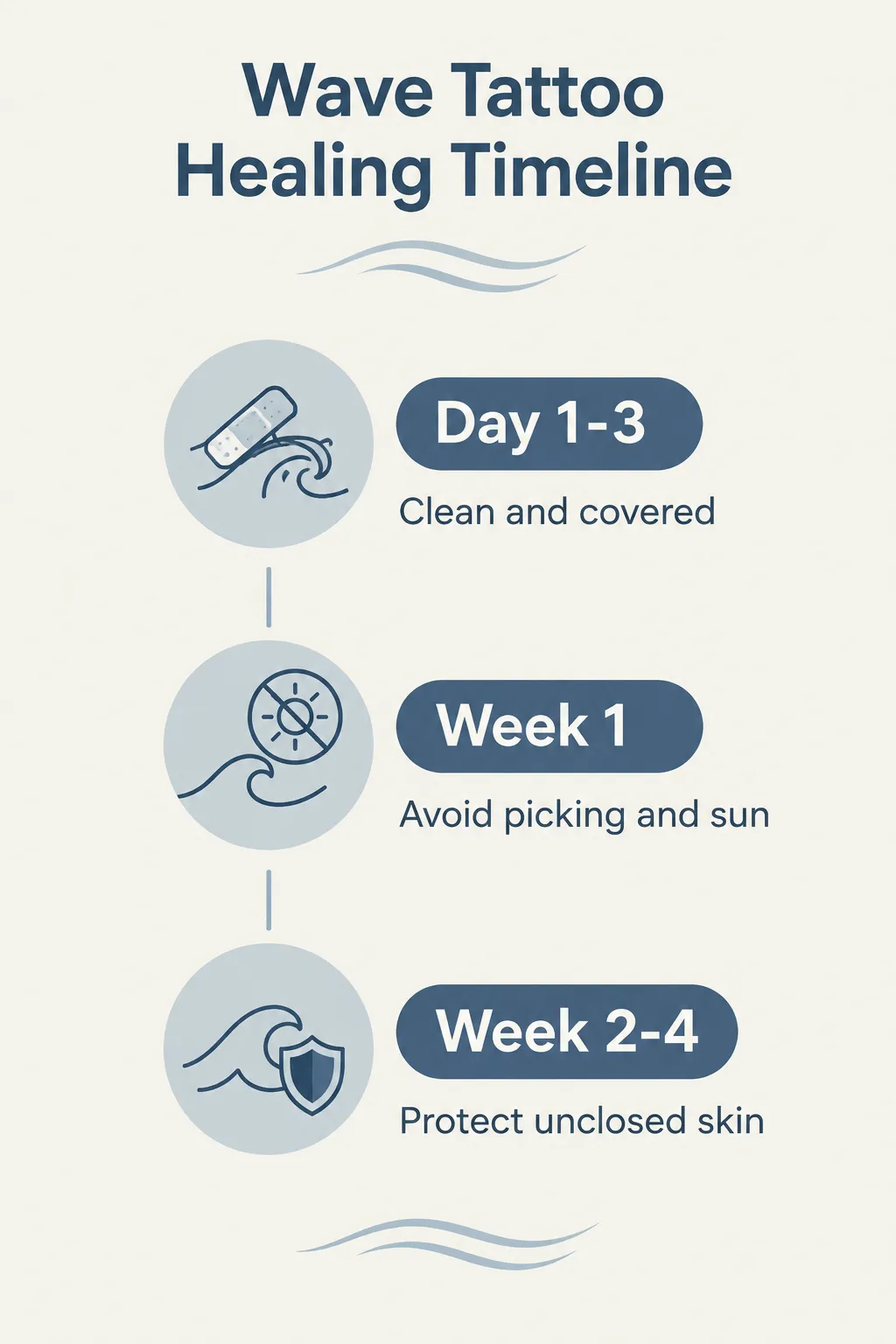 Healing timeline: clean and covered on days 1-3, no picking or direct sun in week 1, unclosed skin protected through weeks 2-4.
Sun protection and product choices
UV light can fade some tattoo inks, so the SPF habit is for life, not just the healing month (4). The AAD also warns against tanning beds and sunlamps, which can fade tattoos and raise skin cancer risk (4). If the healed skin feels dry, reach for a fragrance-free, water-based moisturizer.
When a healed tattoo needs a dermatologist, not just sunscreen
A change in an old, fully healed tattoo is not automatically a fading issue. The AAD states that tattoo reactions can appear immediately or years later. It recommends seeing a board-certified dermatologist for any reaction or change in tattooed skin (4). So a change in the skin, or in a mole near the design, warrants a skin check, not a touch-up booking (4).
Frequently Asked Questions
- What does the wave tattoo mean?
- A wave tattoo can represent resilience, change, freedom, nature, or a personal connection to the ocean; Japanese irezumi often uses waves as scene-setting background.
- What is the 1/3 rule tattoo?
- On a limb, roughly one-third of a segment is a natural visual unit for a standalone piece; confirm the size and layout with your artist before approving the stencil.
- What are some tattoos to avoid?
- Avoid designs that require detail your chosen placement cannot hold, especially tightly packed linework or tiny lettering; ask to see comparable healed work first.
- Where should I put a wave tattoo?
- Choose a placement that accommodates the wave's direction and planned detail, then check the skin in person for moles before finalizing the stencil.
- Can a small wave tattoo include Mount Fuji or boats?
- A small design can suggest the Great Wave with its crest, but readable boats and Fuji need more space than a wrist-sized piece provides.
- How do you keep a healed wave tattoo from fading?
- Limit UV exposure with broad-spectrum SPF 30 or higher and protective clothing; seek a dermatologist's advice if the tattooed skin changes.
Matching scale and detail to the wave you want
Settle the message first, then size the design to fit it. A standalone curve on the wrist or forearm works for a personal tribute. A Hokusai-grounded scene with crest, boats and Fuji needs an outer forearm, thigh or back. A wave wrapped around koi or dragons belongs on a sleeve or back panel. Place it on mole-free skin that follows the wave’s direction. Once it heals, protect the blues with SPF 30 or higher, use water-based lotion, and see a dermatologist for any change in the skin, whenever it shows up.