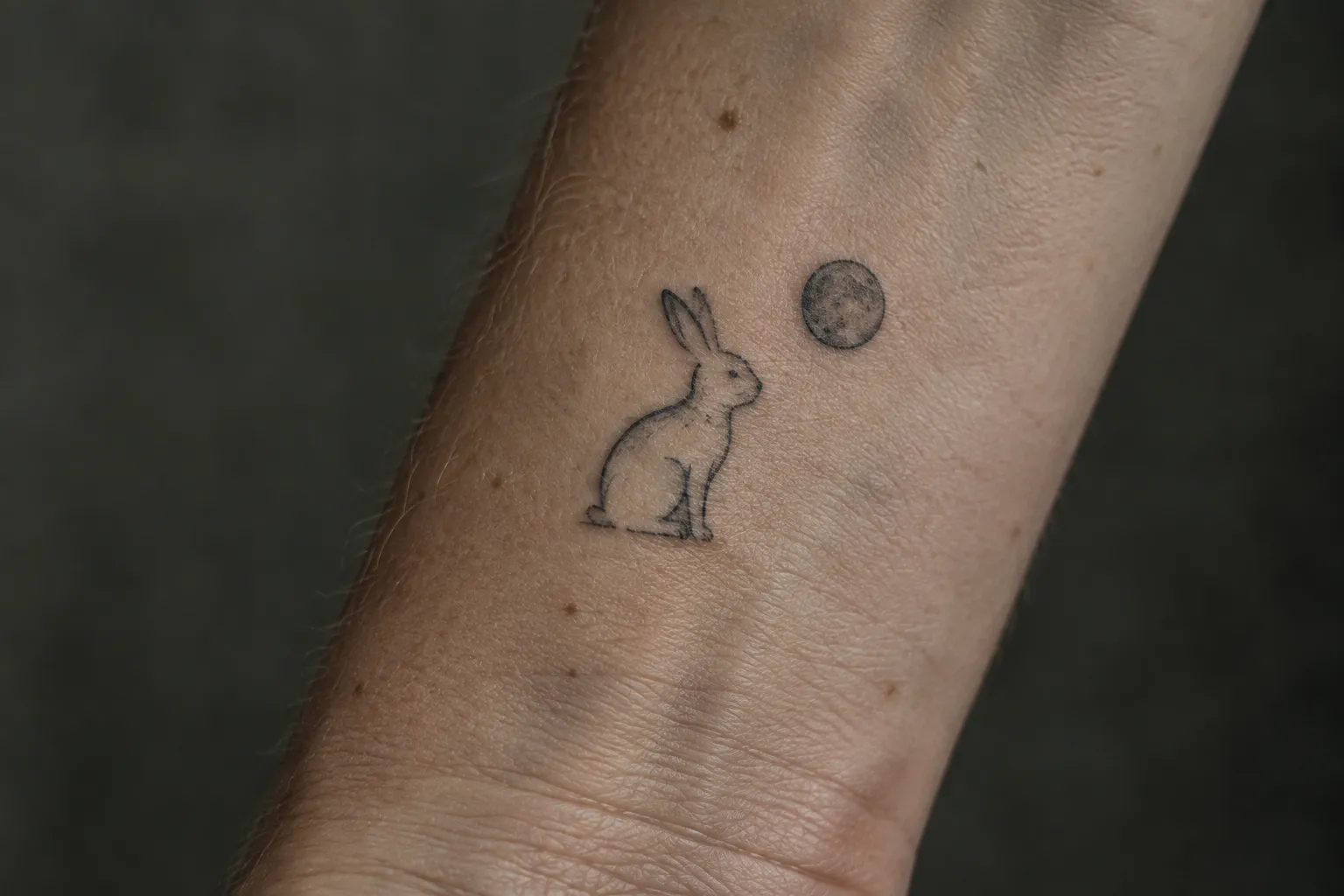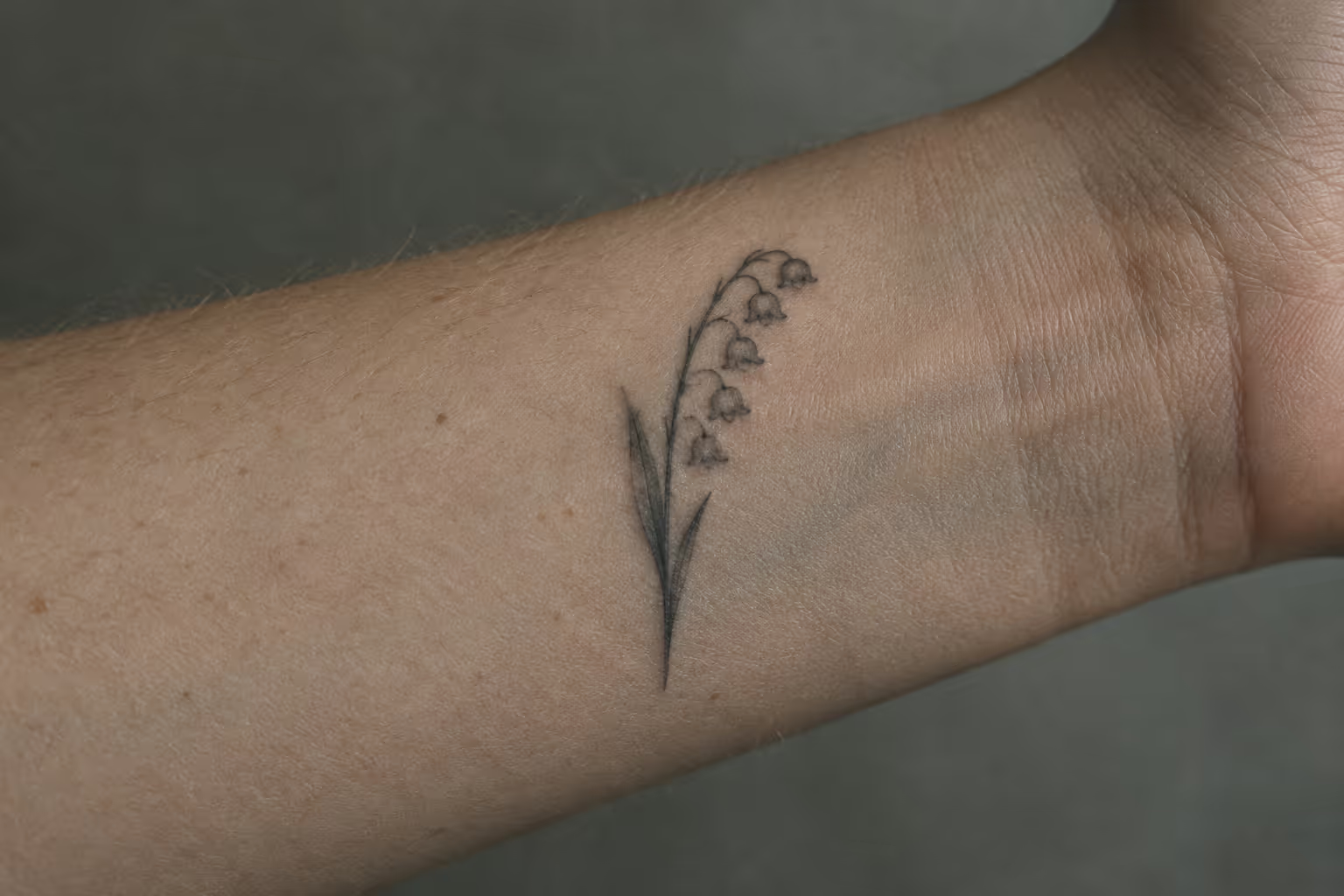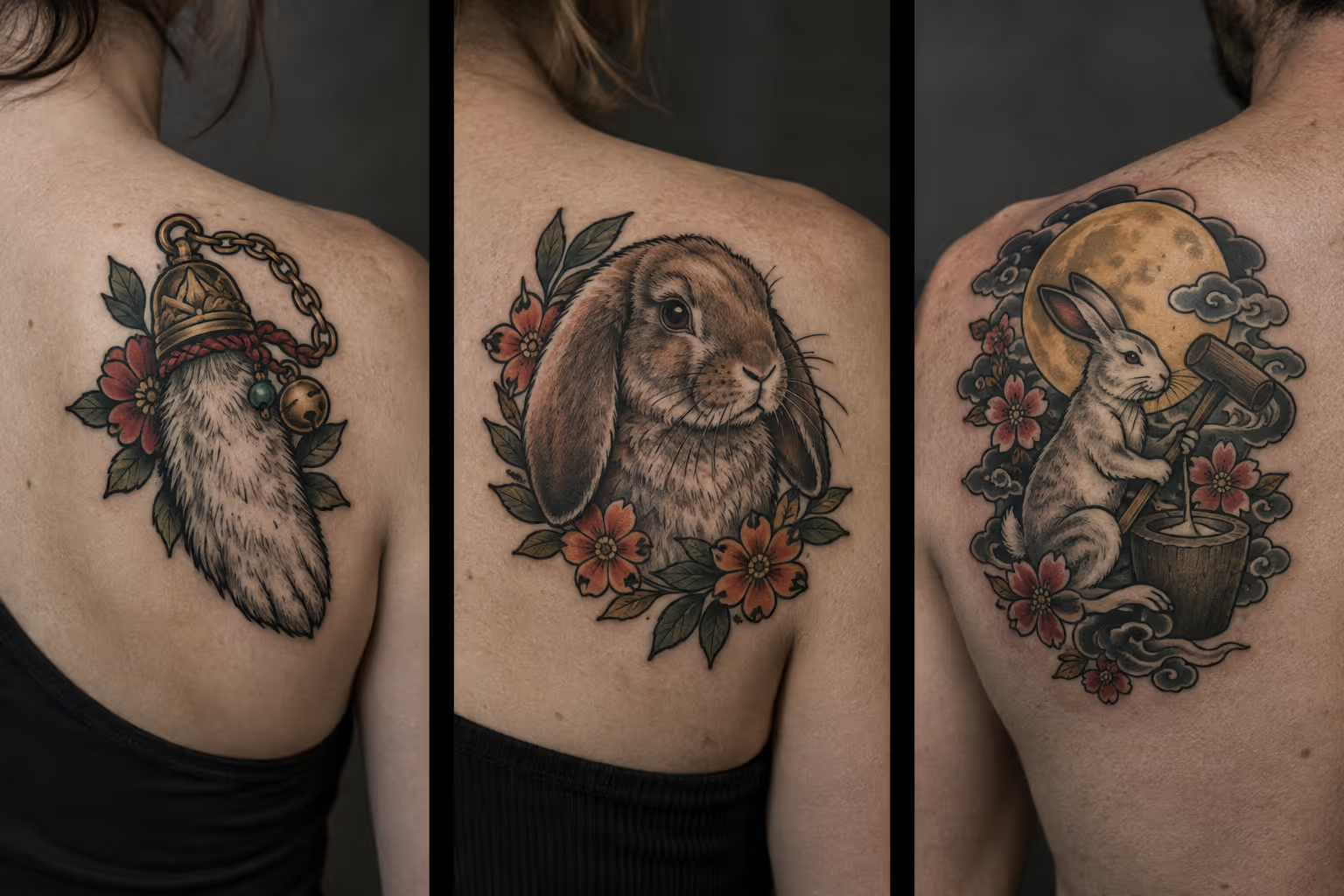
A rabbit tattoo can mean three very different things depending on what surrounds the animal. A rabbit’s foot on a chain reads as a lucky charm, a portrait of a lop-eared rabbit reads as a pet tribute, and a rabbit with a mallet in front of a full moon reads as Japanese moon-rabbit folklore. The symbolism lives in the details you pick, and those details then decide the size, placement and line style that will keep the design legible once it heals.
✓ Pros
- A recognizable animal shape can stay readable without a large canvas.
- The motif can point to a pet, a chosen charm, or a specific folklore tradition.
- Pose and a single prop can give a small design personality without crowding it.
✗ Cons
- Subtle facial marks and closely spaced lines can lose definition as skin changes.
- A familiar bunny-head silhouette may suggest a logo rather than the intended reference.
- Some compact placements leave too little room for the objects that make a design specific.
Rabbits are a strong motif for a few practical reasons. The meaning can be personal or folkloric, the animal’s silhouette works at small sizes and in fine line, and the moon rabbit gives you a culturally specific option with a real story behind it. There are trade-offs too. Fine-line detail softens with age, the ear and finger placements people often ask about are among the more painful ones, and a plain rabbit next to a crescent won’t read as folklore without a story-specific object.
Rabbit tattoo meaning: luck, loyalty, and the moon rabbit
Rabbit tattoo meaning depends on the imagery you choose and on you, the wearer. The motif has no single fixed meaning: luck, spring and rebirth, alertness and moon folklore are all common readings (1), and a portrait of a pet rabbit is a tribute in its own right (2). Pick the meaning first, because each one points to different props, a different scale and a different placement.
The lucky rabbit’s foot
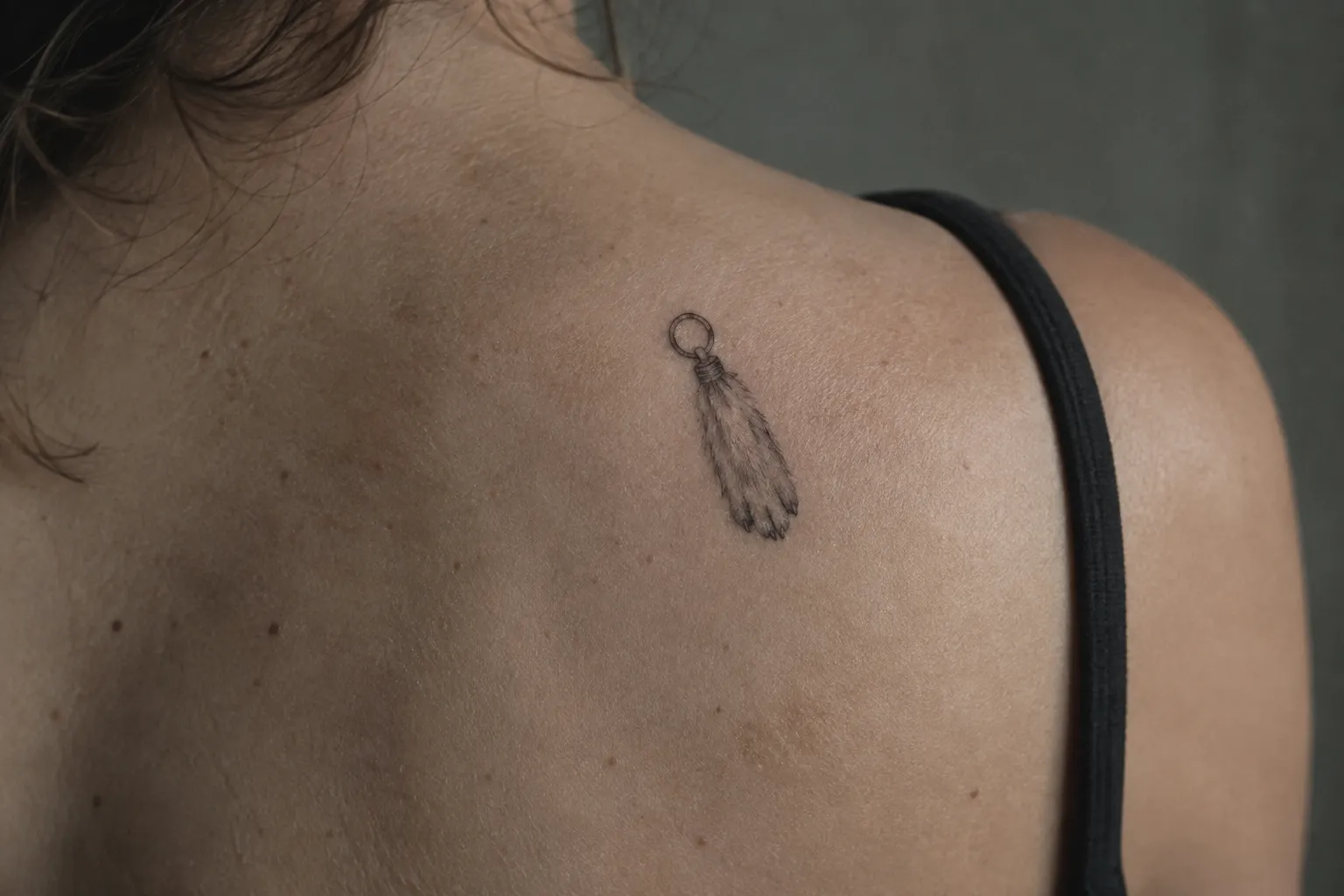
The rabbit’s-foot charm is well known enough that a rabbit tattoo reads as a good-luck piece to most viewers (1). The foot is carried as a lucky amulet in many parts of the world, and in North American folklore it came with strict conditions: the left hind foot, from a rabbit caught in a cemetery, sometimes under a full or new moon or on a Friday the 13th (9). Those conditions are now mostly ignored, and most people read the charm as a generic “lucky” symbol.
On skin, the rabbit’s foot fits American traditional flash well. Think a bold black outline and a limited palette, usually red, yellow, green, blue and black (2), with a gold chain or ring at the top and maybe a banner or a four-leaf clover beside it. That style holds up because the foot is a simple, bold shape.
Is a bunny good luck, then? As a symbol, yes: most viewers will read a rabbit’s foot that way (1). If luck is the point for you, treat the tattoo as a charm you chose rather than something that does anything. Also expect a few people to find a severed-foot image grim. A stylized, cartoonish foot avoids most of that.
Pet tributes and loyalty
A pet tribute is the most personal rabbit tattoo meaning, and it relies on likeness rather than symbolism. A rabbit owner will spot the difference between a lop, a Netherland dwarf and a Rex at a glance, so ear carriage, coat markings and body shape matter more here than any prop. Bring clear photos of your own rabbit in profile and front-on.
Portraits need room. Fur texture, eye highlights and the shading that separates a white rabbit from a grey one all collapse when the piece is shrunk to fit an inner wrist. If you want a true likeness, plan for the outer forearm, the calf or the back of the upper arm. If you want something small, simplify to a silhouette that captures one defining trait, such as the flopped ear or the patch over one eye.
Folklore, fertility and the moon
The rabbit and the hare carry folklore across many cultures, and the stories don’t agree. In East Asia the rabbit lives on the moon (more on that below). The rabbit is also the fourth animal of the Chinese zodiac, and some people tattoo it for a Rabbit birth year (2). In Western tradition the rabbit and the hare point toward spring, fertility and renewal, the Easter connection most people already know (1). The Easter Bunny itself began as a hare: German Lutherans told of an Easter Hare that brought eggs, mentioned in German texts from 1572 and 1682, and German immigrants carried it to the United States in the 18th century (10). The link to a goddess named Ostara or Eostre was proposed by 19th-century German scholars, and the story of Eostre turning a bird into an egg-laying hare has no basis in pre-Christian myth; it dates from 1883 (10).
Modern Western culture has added its own readings, and you should know them before you commit. A cartoon bunny reads as cute or childlike. A white rabbit with a pocket watch reads as the White Rabbit of Lewis Carroll’s Alice’s Adventures in Wonderland (11). A bunny-head silhouette with a bow tie reads as the Playboy logo whether you intend it or not (12). Small, flat, front-facing bunny heads drift toward that logo quickly, so if that isn’t your reference, give the rabbit a body, a side profile or a prop.
The Japanese moon rabbit: folklore worth tattooing
The Japanese moon rabbit, tsuki no usagi, lives on the moon and pounds mochi rice cakes with a mallet (7)(8), and its story gives a rabbit tattoo a specific subject instead of a generic animal-plus-moon pairing. In Chinese tellings the same rabbit pounds the elixir of life instead (7), and either activity can anchor a culturally grounded design.
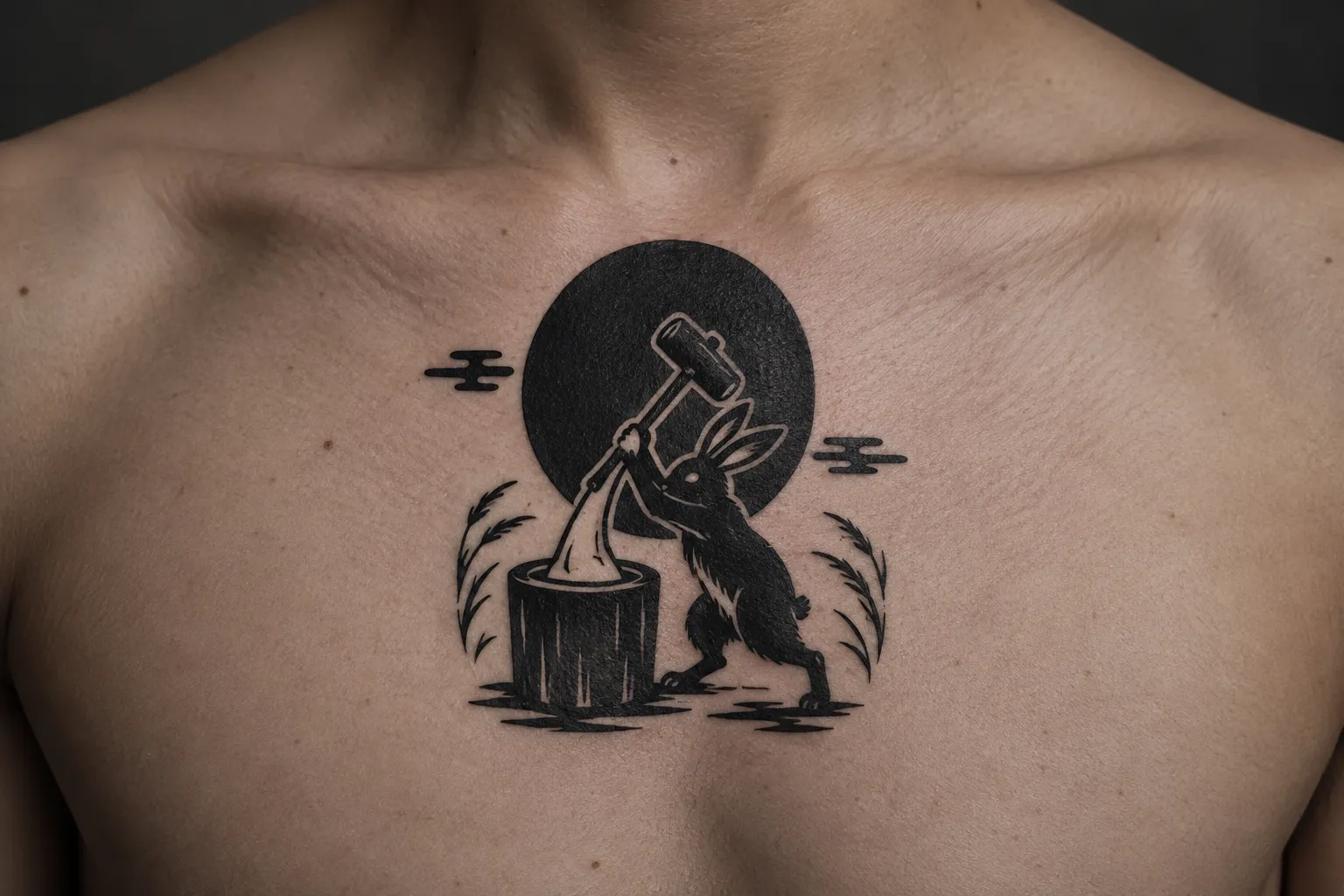
The idea starts with the moon’s face: East Asian and Indigenous American folklore both read the dark markings of the moon as a rabbit or hare (7). A Buddhist Jataka tale from India explains how the rabbit got there. A rabbit with nothing else to offer a hungry old man throws itself into the fire as food, and the old man, the god Śakra in disguise, draws its likeness on the moon to honor the sacrifice (7). The story eventually reached Japan, where the god is known as Taishakuten (8).
Rice-cake pounding vs. the elixir of immortality
These two versions are different stories, and each calls for different objects in the design.
Rice-cake pounding is the Japanese and Korean version (7). The rabbit stands at a large wooden mortar and swings a mallet to pound rice into mochi (8). It links to tsukimi, Japan’s autumn moon-viewing tradition, where people set out round dumplings and plumes of pampas grass (susuki) for the full moon (8). A design with a mortar, a mallet, a few round mochi and a stalk of pampas grass reads as Japanese.
The elixir of immortality comes from China, where the Jade Rabbit (Yutu) pounds the elixir of life for the moon goddess Chang’e (7). The visual cue is a slimmer, upright pestle and mortar, often with herbs, and sometimes Chang’e herself. This version ties to the Mid-Autumn Festival rather than tsukimi (7).
Mixing the two isn’t wrong, but it blurs the reference. Pick one tradition and tell your artist which one, so the props, clothing details and background match.
Pairing the rabbit with a lunar setting and story-specific object
A rabbit by itself, or a rabbit beside a crescent, reads as “rabbit and moon.” For the design to read as the moon rabbit, it needs two things: a lunar setting and an object from the story. In practice that means:
- A full moon, not a crescent. The rabbit lives in the full moon, so a large disc behind or around the rabbit is the clearest signal. Our moon tattoo guide covers what each phase says on its own.
- One story object. That could be a mallet and mortar for the Japanese version or a pestle and herbs for the Chinese one. One well-drawn object beats three tiny ones.
- A seasonal detail if you have room. Pampas grass, autumn clouds or a few round mochi set the scene without crowding the rabbit.
If you go fully Japanese in style, the rabbit usually shares the piece with cherry blossoms, waves, clouds and the moon, in a larger tattoo that tells a complete story (2). The common pitfall is shrinking that format. Clouds and waves need space to flow, and squeezed onto a wrist they turn into dark smudges. A moon disc, a rabbit and a mallet together need at least a palm-sized area. The outer forearm, the shoulder blade or the calf all give the circle enough flat space to stay round.
Small and playful bunny tattoo designs
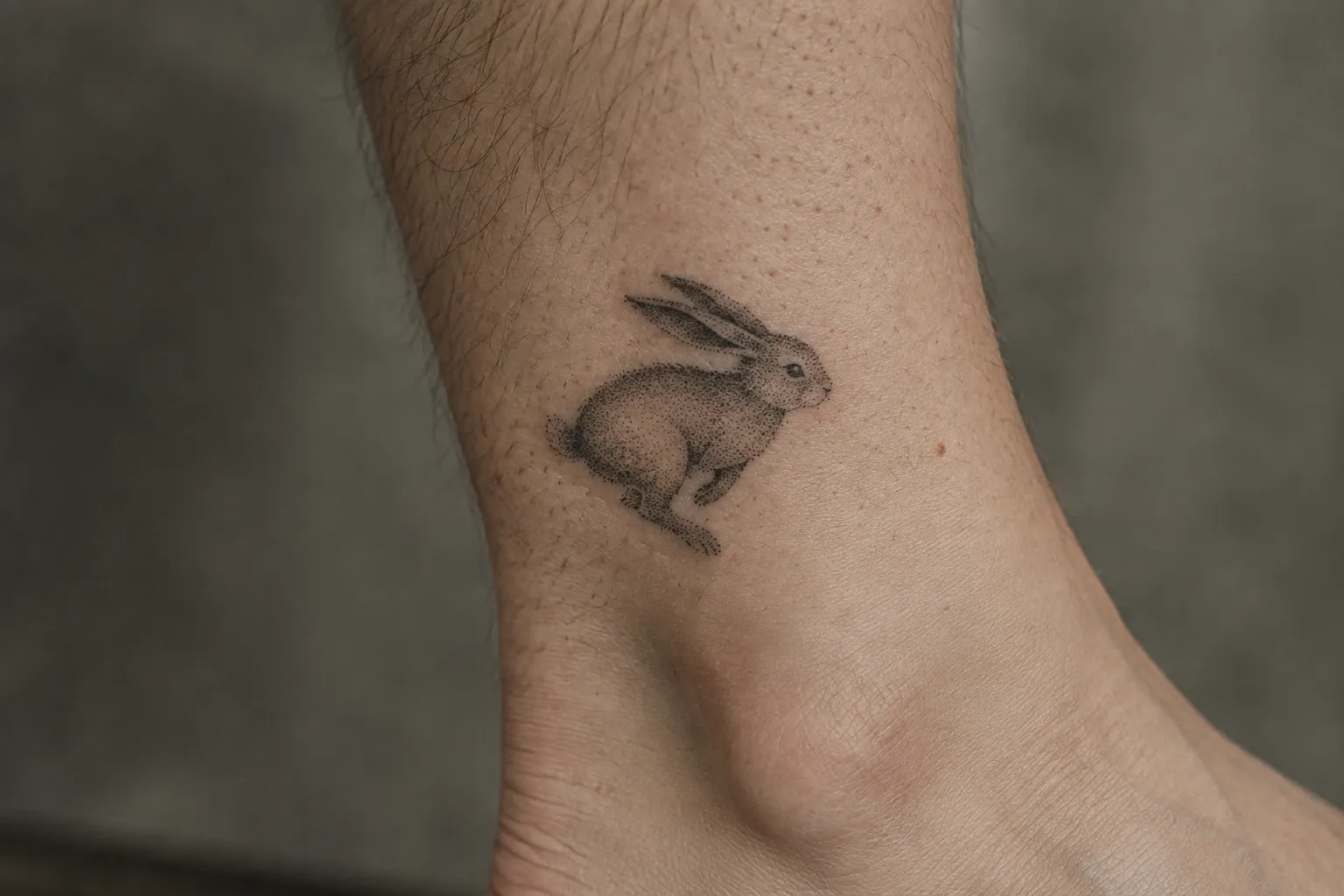
A small rabbit tattoo works best as a simple outline or silhouette, because a compact design only has room for a few clear shapes, and a busy composition swamps the subject (1)(2). A bunny tattoo with more personality comes from pose, ear shape and one small prop rather than from added detail.
Minimalist outlines and silhouettes
The ears are the rabbit’s identifying feature, and at small scale they carry the whole design. Whatever else you cut, keep the ears long, clearly separated and in proportion. A tiny rabbit with short ears reads as a mouse or a cat.
Three minimalist approaches hold up well:
- Solid black silhouette. A filled shape in blackwork is the most durable small option, because there is no fine interior detail to blur. A tiny negative-space eye (a dot of skin left unworked) adds life without adding lines.
- Single continuous line. One unbroken line tracing the ears, back and tail is elegant at small size, as long as the line has some weight to it.
- Simple outline with minimal features. An outline with an eye and a nose dot, no whiskers. Whiskers are usually the first thing to go fuzzy, and at small size they barely read anyway.
For discreet placements, the inner wrist, the ankle and behind the ear all suit a small design, while larger and more detailed compositions need more skin (2). Keep the outline clean and resist adding fur texture, grass or a background. A small rabbit tattoo reads from a few feet away because of its shape, not its interior.
Playful poses and props
A hopping pose, expressive ears or a small prop gives a bunny tattoo a lighter character (1). These are design directions, not symbolic meanings. The teacup rabbit is one of the most requested whimsical versions, and one prop is the limit before the design turns into a scene that needs far more skin (1).
Good playful directions include:
- Mid-hop, with the back legs extended and the ears swept back. Motion reads well even in a small outline.
- One flopped ear. A single lop ear instantly adds personality and nods to lop breeds if you’re tattooing your own rabbit.
- One prop. A carrot, a strawberry, a tiny bow or a flower in the mouth gives the design a focal point.
- Peeking or hiding, such as a rabbit behind a leaf or emerging from a teacup, which suits curved placements like the ankle.
For more punch, playful bunnies translate well into American traditional. The thick outline and limited palette that define the style give a cartoonish rabbit a strong silhouette, and a bold traditional bunny ages better than a delicate one (1). The pitfall with playful designs is prop creep. A rabbit with a carrot, a bow, flowers, a banner and stars turns into clutter at anything smaller than palm size. Pick one prop and let the pose do the rest.
One more distinction: if you want something wilder or more folkloric, ask for a hare rather than a bunny. Its longer limbs and leaner face make it read as a wild animal rather than a pet, and that changes the tone of the whole piece (1).
Fine-line and minimalist designs: how they age
Fine-line rabbit designs look crisp the day they’re done, but thin lines can soften or blur over time and may need a touch-up (1). The same guide puts fine-line and minimalist rabbits in the small range, around 5-8 cm (about 2-3 in) (1).
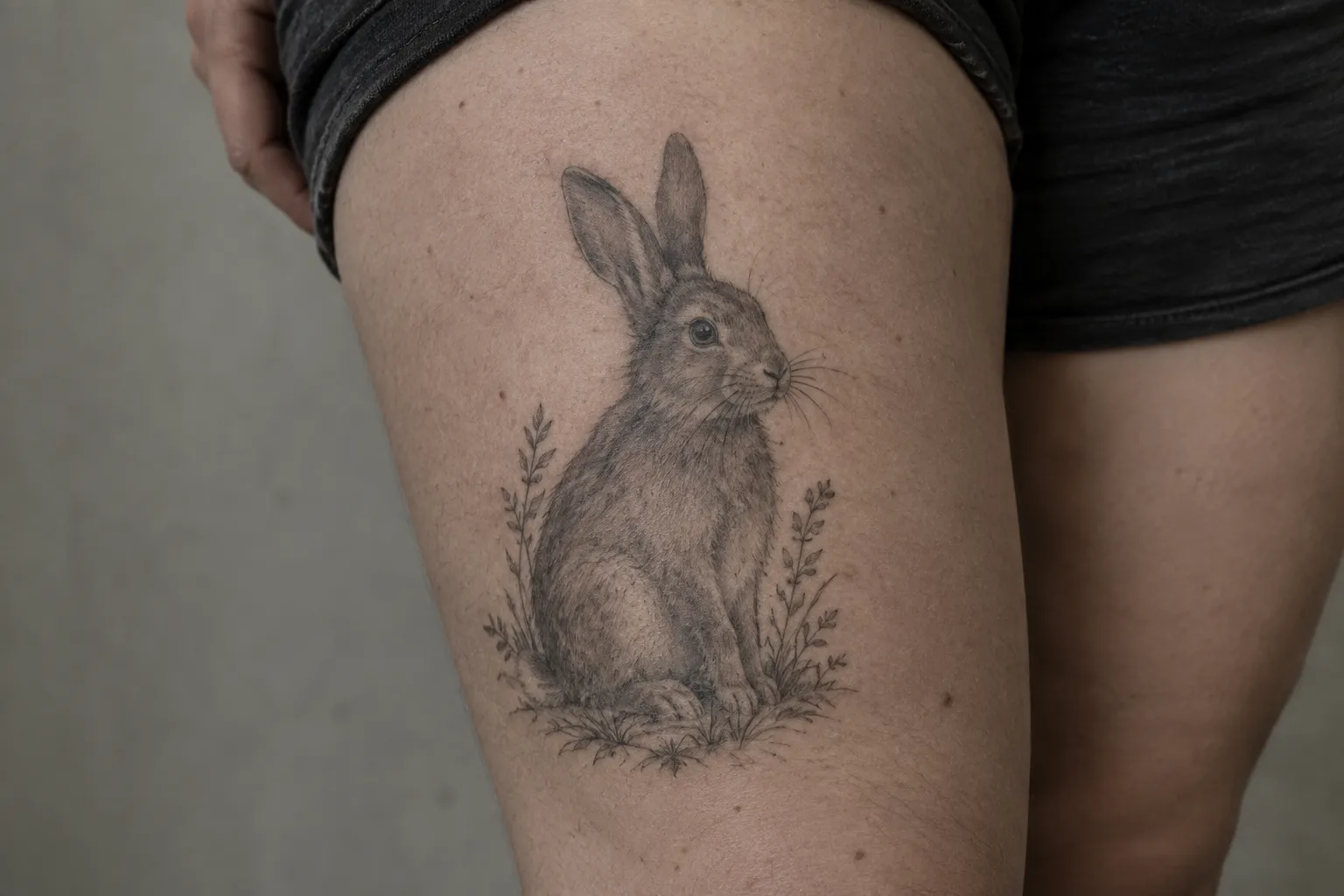
Fine line has two technical hallmarks, both covered in our fine line tattoo guide. The first is thin linework, usually done with a single needle or a very small liner grouping. The second is minimal or no shading, with any tone added as light stippling or a soft wash. The appeal is obvious: delicate, understated, easy to hide under a sleeve. The trade-off comes from how skin behaves. Ink particles spread slightly over the years as the body processes them. A bold line that spreads a little still reads as a line. A hairline that spreads a little loses its edge, and two hairlines that started close together can merge into one grey shape.
The common pitfall when artists do fine line badly is packing detail too tightly. On a rabbit that usually means whiskers, the eye, the nose and the inner-ear line crammed into a face smaller than a fingernail. Fresh, every line is distinct. Healed and a few years on, the face turns into a smudge. The other failure is depth: fine lines pushed too deep blow out, leaving a blurry halo that no touch-up fully fixes.
If long-term crispness matters more to you than the delicate look on day one, skip fine line and choose a bolder or shaded composition that holds detail better as it ages (1)(2). That can mean:
- A heavier outline, still clean and minimal, but with lines that have some weight.
- A solid black silhouette instead of an outline.
- Black and grey shading at a larger size, where depth comes from tone rather than a web of thin lines.
A simple black-line rabbit is the kind of design that ages best over a decade (1). Placement affects ageing too. Hands, fingers and the sides of the feet get constant friction and washing, so fine lines there fade and break up faster than on the upper arm or the back. Before you commit, ask your artist for healed photos of their fine-line work, ideally pieces a couple of years old. Fresh photos tell you about their linework; healed photos tell you how it lasts.
Placement guide: pain rankings and the 1/3 sizing rule
Of five placements commonly suggested for small rabbit designs, one tattoo artist’s guide rates behind the ear and the finger highest at 8/10, the inner wrist and ankle at 7/10, and behind the neck mildest at 6/10 (2). So a design destined for the ear or a finger will likely hurt more than one on the wrist or neck. Even the mildest of the five is not a low-pain spot: a pilot study built on interviews with tattoo artists put the head and neck in its high-pain group and the wrist in its middle group (5), and our tattoo pain chart places the neck and fingers in its 6-8/10 tier. Pain also varies from person to person (2). The general pattern holds across the body: spots directly over bone, such as the ankle, wrist and ribs, are reliably harder than fleshy areas like the outer thigh (1).
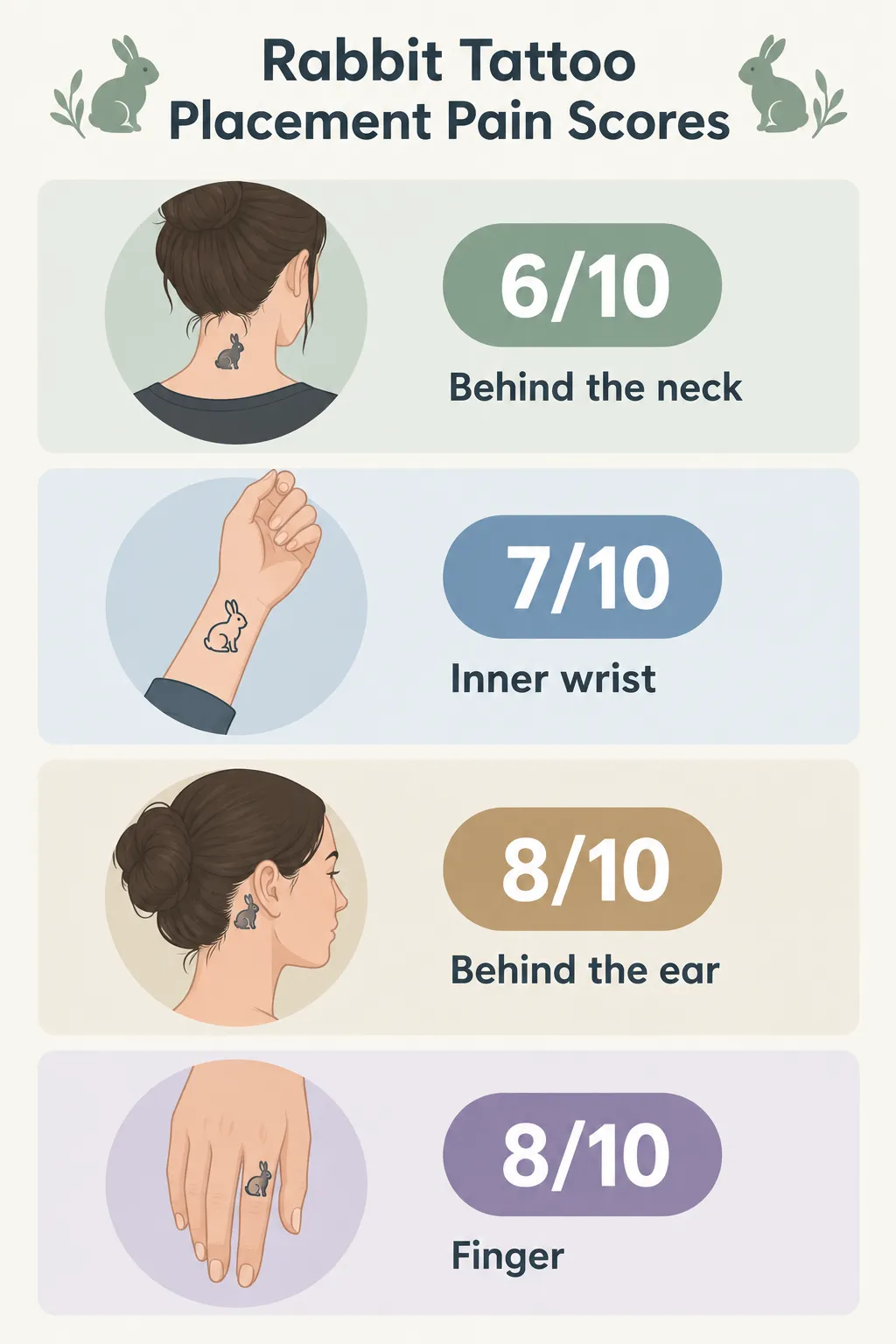 One source estimates rabbit tattoo placement pain at 6/10 behind the neck, 7/10 on the inner wrist, and 8/10 behind the ear and on the finger.
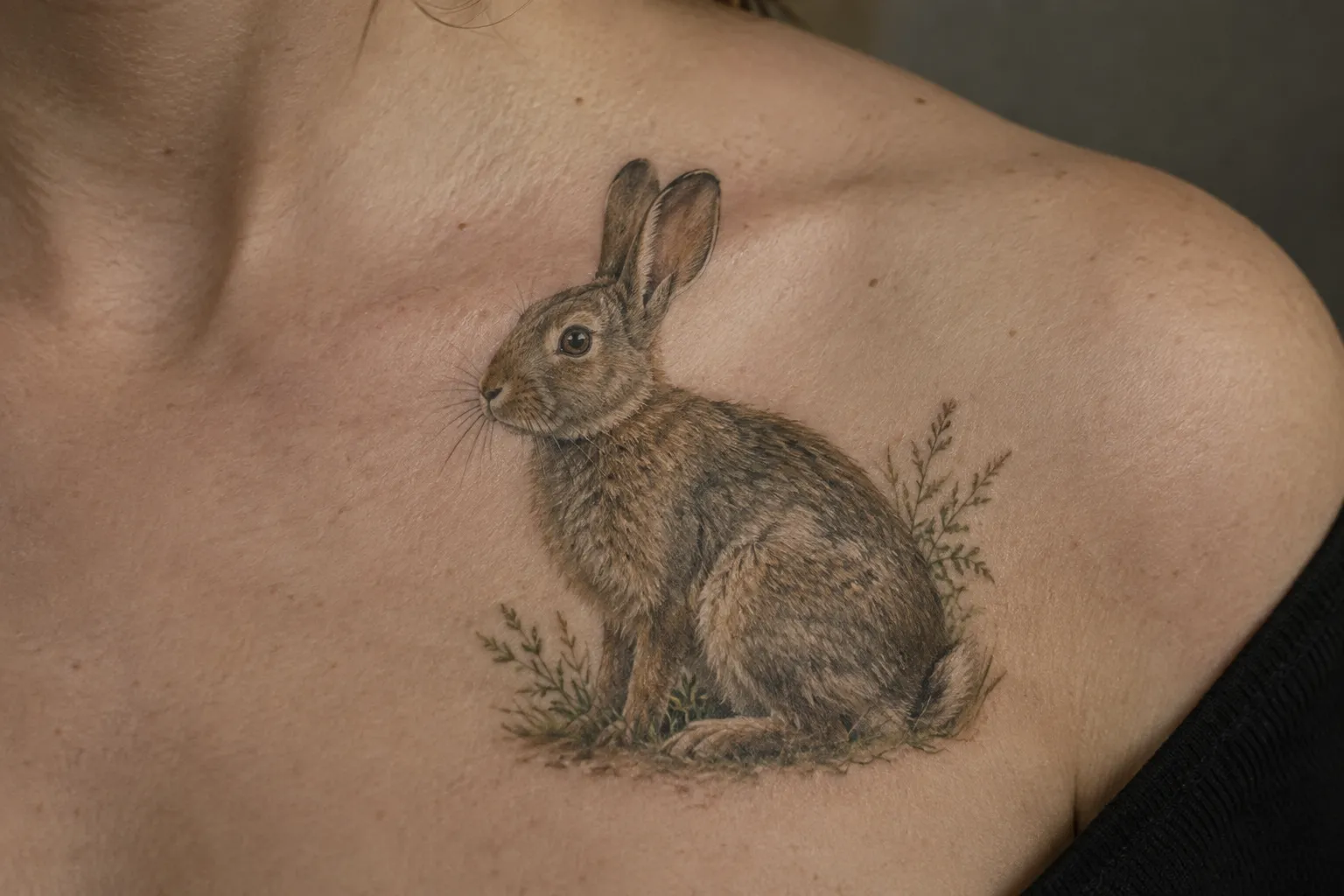
Size is the other half of the placement decision. Our tattoo placement guide explains the “1/3 rule”: roughly one-third of a limb segment, such as the upper arm between shoulder and elbow, is a natural visual unit for a standalone piece, and going much larger or much smaller makes the proportions read off. It also applies to composition: balance dark areas, midtones and open skin so the rabbit reads clearly instead of filling every inch.
Ear and finger placements: what to expect
If you’re asking specifically how painful ear tattoos are, one estimate puts behind the ear among the highest of the five locations rated, tied with the finger and well above the back of the neck (2). People describe it less as sharp pain and more as intense, rattling vibration. The needle works over thin skin right against bone, and the buzz carries straight into your skull. The upside is that a small rabbit is a short session: one artist puts a minimalist rabbit at one to two hours (2). Tattoos on the ear itself, such as the helix or the inner bowl, sit on cartilage, and many artists are reluctant to do detailed work there because ink fades unevenly.
Fingers combine high pain with poor durability. The skin on the sides and palms of the fingers regenerates quickly and gets constant use, so ink falls out and lines spread. Many artists won’t guarantee finger work, and some will only do bold, simple designs on the tops of the fingers. A small rabbit silhouette on top of a finger can work. A fine-line rabbit with whiskers on the side of a finger usually blurs and breaks up faster than anywhere else on this list.
If you’re set on the ear or a finger for meaning or visibility, choose the boldest version of your design and budget for a touch-up. If you’re flexible, behind the neck or the wrist will hurt less and hold the linework longer.
Rabbit Tattoo Placement: Pain and Detail
| Inner wrist | Behind the ear | Ankle | Finger | Behind the neck | |
|---|---|---|---|---|---|
| Small or fine-line detail | Simple outline; delicate detail may soften | Tiny silhouette; limited room for detail | Curved, simple design; consider bolder lines | Bold, simple shapes; fine lines may break up | Small designs; relatively little friction |
Before you book: safety, aftercare, and getting the design right
Before you book a rabbit design, settle the meaning, the size and placement, and how the exact design looks at that size together. Style is the choice that changes everything downstream, from size and healing to how the piece looks in ten years (1). Then check the studio’s inks and hygiene, and know which healing symptoms need a professional’s attention (3).
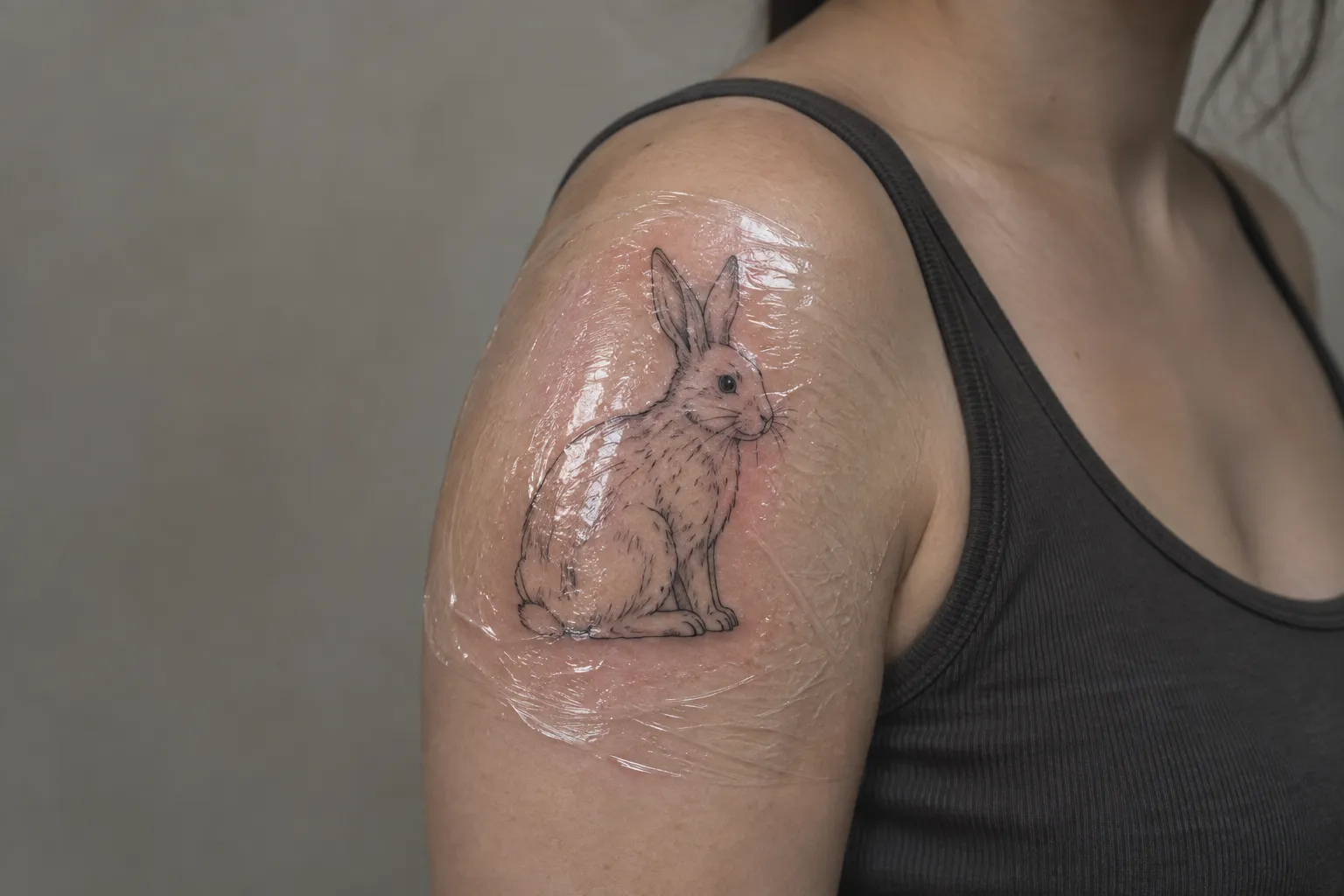
Picking your rabbit’s meaning first
Start from the meaning, because it dictates everything downstream. A pet tribute needs room for likeness. A lucky charm needs a recognizable foot or a clover. A moon rabbit needs a full moon and a story object. Gather references for your chosen direction and bring three to your consultation instead of one (1). That gives the artist a sense of your taste rather than a single image to copy.
Then settle size together with placement. The most common regret with rabbit tattoos is going too small: below its detail threshold, a rabbit heals into a grey blob that no artist can rescue without reworking the whole piece (1). A stencil on your skin at the real size is the best test. If the mallet in your moon-rabbit design is only a few millimeters long on the stencil, either the design gets simpler or the tattoo gets bigger.
Checking ink and studio hygiene
A clean-looking studio isn’t the whole safety picture. Firms have carried out 18 voluntary recalls of tattoo inks contaminated with microorganisms between 2003 and 2024 (6), and people have developed infections from contaminated tattoo inks and allergic reactions to the inks themselves; even unopened, sealed inks can harbor bacteria and other microorganisms that cause infections (3). Tattoo practice itself is overseen by state and local authorities, while the inks fall under FDA oversight as cosmetics (3).
At the studio, look for single-use needles opened in front of you, fresh gloves, ink poured into disposable caps rather than used straight from a shared bottle, and an artist who can tell you which ink brand they use: if you react to a tattoo, the FDA advises asking for the brand, color and lot number of the ink (3).
Since hygiene can’t remove every risk, watch the tattoo as it heals. A typical timeline for a small piece, in line with our tattoo aftercare guide, looks like this:
- Day 1-3: Keep the wrap on as long as your artist says, then wash gently with clean hands and lukewarm water and pat dry. Some redness, swelling and weeping plasma are normal.
- Day 4-7: The skin tightens and starts to flake. Apply a thin layer of fragrance-free moisturizer two or three times a day, and don’t pick, soak in baths or pools, or put the tattoo in direct sun.
- Week 2: Peeling and itching. Let the flakes come off on their own.
- Week 3-4: The surface looks healed, though the skin underneath keeps settling for a few months. Keep the tattoo out of direct sun for the first 4 to 6 weeks, covered with sun-protective clothing outdoors.
If the tattoo develops a rash or doesn’t seem to be healing, contact your artist and a health professional, especially if you develop a fever (3).
Caring for a healed tattoo in the sun
Once the tattoo is fully healed, sun is the biggest single cause of fading and line softening, and it hits fine-line work hardest. Use broad-spectrum SPF 30 or higher on healed tattoos exposed to the sun. Don’t put sunscreen on fresh, unhealed skin; during healing, cover the tattoo with clothing instead. Wrist, ankle and behind-the-neck placements get more sun than you’d think, so make reapplying a summer habit.
How to Prepare a Rabbit Tattoo Design
Choose the rabbit reference, check that its details fit the intended placement, and confirm the studio and care plan before booking.
- 1
Choose the meaning
Decide whether the design is a pet tribute, a luck charm or a moon-rabbit reference, then gather references that match that direction.
- 2
Set size and placement together
Choose a size and body location that leave the key identifying details legible rather than shrinking them to fit.
- 3
Preview the actual design
Ask the artist to place a stencil of the exact design on your skin at the proposed size, and simplify or enlarge it if details crowd together.
- 4
Confirm studio practices and aftercare
Ask about ink and hygiene practices, discuss the healing plan, and cover sun protection for when the tattoo is fully healed.
Frequently Asked Questions
- Is a bunny rabbit good luck?
- A rabbit tattoo can serve as a chosen luck symbol, but getting tattooed does not produce luck; the rabbit's foot has a long folk history as a lucky charm.
- How painful are ear tattoos?
- Behind-the-ear tattoos tend to feel more intense than forearm work because the skin is thin and close to bone; cartilage placements also limit detail.
- What is the 1/3 rule in tattoos?
- On a limb, roughly a third of a segment, such as the upper arm between shoulder and elbow, is a natural visual unit for a standalone piece; it also means balancing dark areas, midtones and open skin.
- Why does my rabbit have a tattoo in her ear?
- It is an identification mark, not body art: in the US, rabbits bred or shown carry a personal tattoo in the left ear and any registration tattoo in the right (13). Ask the breeder or rescue what it records.
- What does a moon rabbit tattoo mean?
- It can reference distinct East Asian lunar stories, so the rabbit's tool and surrounding motifs help identify which tradition the design draws from.
- Do fine-line rabbit tattoos hold up over time?
- Fine-line designs can lose separation between closely spaced features; healed examples from an artist show how their linework settles over time.
- How do I protect a healed rabbit tattoo from fading?
- Cover healed tattoos with broad-spectrum SPF 30 or higher when exposed to sunlight; use clothing rather than sunscreen on skin that is still healing.
Deciding meaning, size and line style as one choice
The meaning, the size and placement, and the line style of a rabbit design have to be settled together, because any one of them can undercut the others once the tattoo heals. A moon rabbit shrunk onto a finger loses its mallet. A pet portrait done in fine line on the inner wrist loses its likeness. A playful bunny head with no body can read as a logo you never wanted. Choose the reference first, then let it set the minimum size, then pick a placement with enough flat space and a pain level you can sit through. Bring your three references to the consultation, ask for a stencil at the real size on the real placement, and look at the artist’s healed work before you book.