A Celtic knot tattoo borrows its interlace from medieval Insular manuscripts (5), and the best-known of them, the Book of Kells, was written close to 800 AD (10). Many of the one-line meanings printed under knot designs today are modern, a lot of them supplied by the 19th-century Celtic Revival rather than by the manuscripts (1)(5). This guide separates what the manuscripts document from what tattoo culture added afterward. It then covers how a triquetra, an endless knot and a wraparound armband differ on the body.
✓ Pros
- A closed motif can stand alone or become part of a larger composition.
- Black interlace makes the weave readable without relying on color to separate strands.
✗ Cons
- A broken over-under sequence is obvious, so the artist needs to understand the construction, not just copy the reference.
- Dense crossings leave little margin for line spread; tiny versions can lose their open structure.
The trade-offs, up front. Knotwork scales well, from a single triquetra on the inner wrist to a band that circles the upper arm. It also carries a recognizable heritage reference and ages well as bold blackwork. The downsides are real, though. It needs an artist who understands interlace. Most of its meaning is chosen by the wearer rather than fixed by history. Small, dense knots can close up and blur as the ink settles.
What is a Celtic knot tattoo? Documented history and modern meaning
A Celtic knot tattoo is interlaced ornament from early medieval Insular art, with strands woven alternately over and under, adapted to skin, usually in solid black linework (5)(1). Insular art was a post-Roman style found across the British Isles, mostly in Ireland and Scotland, and interlace was its hallmark (14).
Good knotwork has two technical hallmarks:
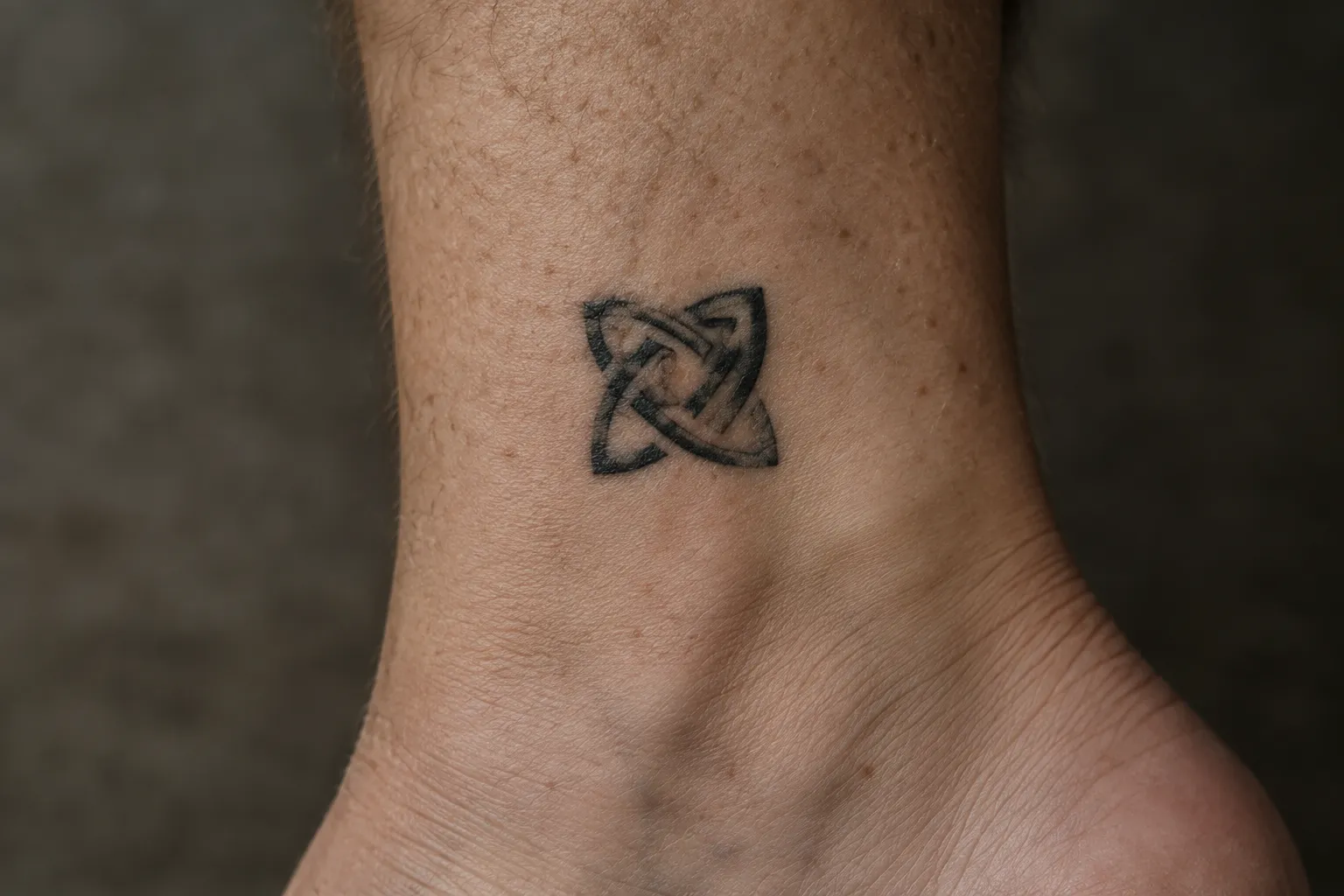
- Consistent strand width with a strict over-under rhythm. Every crossing alternates, and no strand dead-ends.
- Even negative space. The gaps between strands are part of the design, and they have to stay open for decades.
The classic pitfall shows up when an artist copies a flat image without understanding the weave. You get two “overs” in a row, a strand that disappears into nothing, or gaps so tight that the healed tattoo reads as a gray mass. Anyone who has looked closely at real interlace spots a broken over-under from across the room.
The Book of Kells and Insular interlace
The Book of Kells is the reference most knot designs trace back to. It is a Gospel manuscript held at Trinity College Dublin and written close to 800 AD (10). Nobody knows exactly where it was made. Trinity College Dublin states there is no way of knowing whether it was produced wholly at Iona, wholly at Kells, or partly at each (10). The manuscript draws more than 500,000 visitors per year to its exhibition (9). That figure shows how much public pull the book has today, though it says nothing about how many people get knot tattoos.
The Book of Kells was not the first appearance of knotwork. Interlace appears in monasteries around the Irish Sea from the mid-seventh century AD, and the key works are the Book of Durrow, the Lindisfarne Gospels and the Book of Kells (5). That geography answers a common question: is the Celtic knot an Irish symbol? It is strongly associated with Ireland. The documented origin, though, is a network of monasteries around the Irish Sea, not a single Irish site (5). Interlace also survives in Irish and Scottish stone carving and metalwork (1).
One more correction. Most of what gets sold as ancient Celtic tattoo symbolism is early medieval Christian manuscript art, not Iron Age pagan design (5). No tattooed Celtic remains have ever been found, so claims about ancient Celtic tattooing rest on Roman written accounts (5). Monks illuminating Gospels made knotwork. Tattooed warriors did not.
“No beginning or end”: built into the line, not labelled in the manuscripts
“No beginning or end” is the most common present-day reading of continuous knotwork, and it is the one idea built into the construction itself: true interlace is made of continuous strands (1). What the historical record does not give is a meaning for each individual knot; it shows where the patterns appear and how they were used decoratively (1). In the Book of Kells, that decoration punctuates the Gospel text with the aim of glorifying Jesus’ life and message (10).
Most of what you read online about Celtic knot tattoo meaning comes from contemporary idea guides, which assign eternity, protection, unity, love or specific family bonds to particular knots (1)(6). Several of those assignments are recent: the Celtic motherhood knot is a modern commercial design, and the interlaced warrior band is a twentieth-century tattoo-studio composition (5).
So what is the meaning behind Celtic tattoos? Historically, the documented context for knotwork is Christian devotional art, made by monks in Gospel books (5). Everything else is a later layer: protection, sibling bonds, a parent-and-child knot (5). That layer is not illegitimate. A tattoo means what you decide it means. Just know which part is history and which part is a choice, especially if you plan to explain the piece to people who know the manuscripts.
Trinity knot tattoo: the triquetra and the Holy Trinity reading
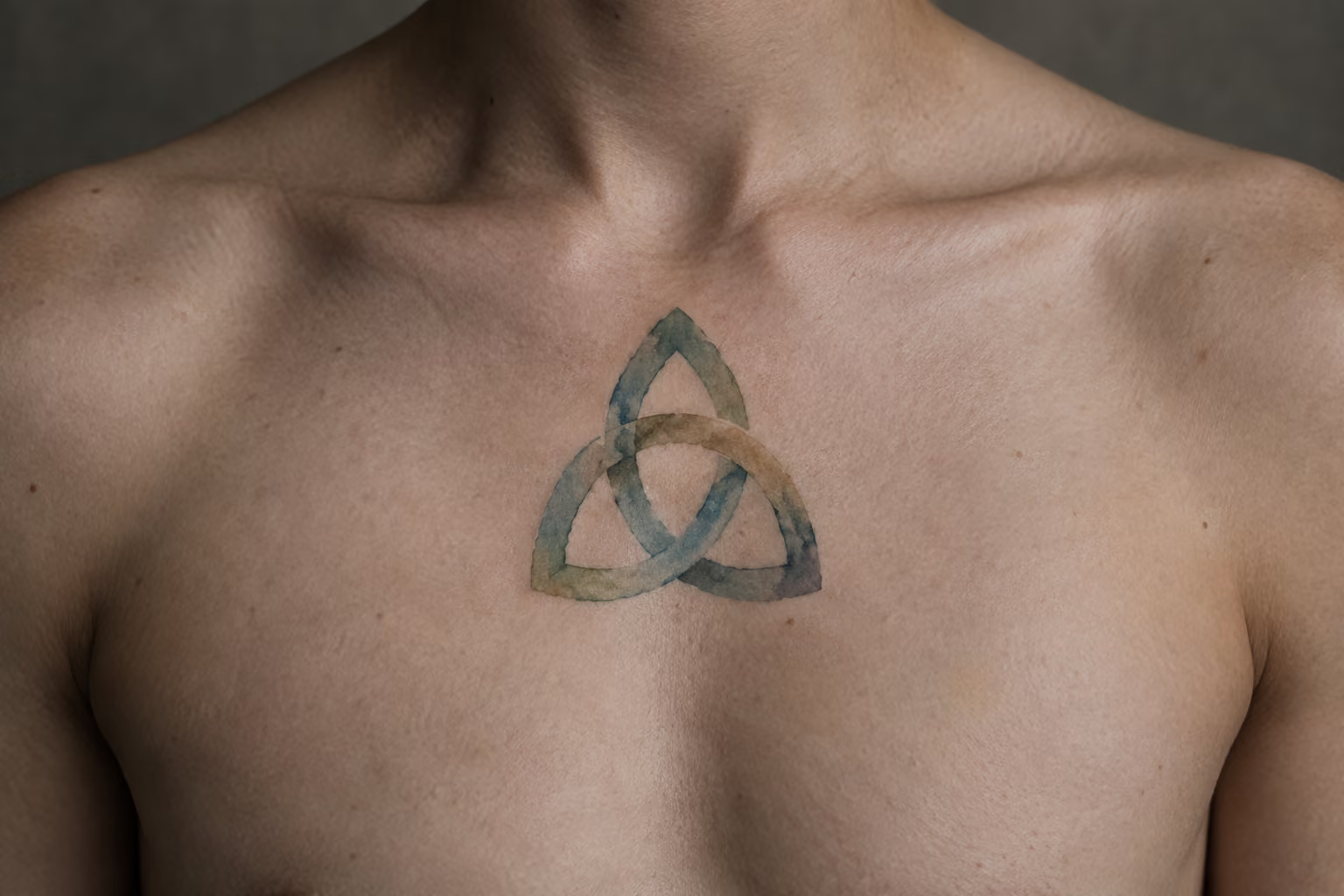
A trinity knot tattoo uses the triquetra, a three-cornered interlaced figure. The shape appears in Insular ornament from about the 7th century, and its reading as the Holy Trinity spread especially with the 19th-century Celtic revival (4).
What a triquetra looks like
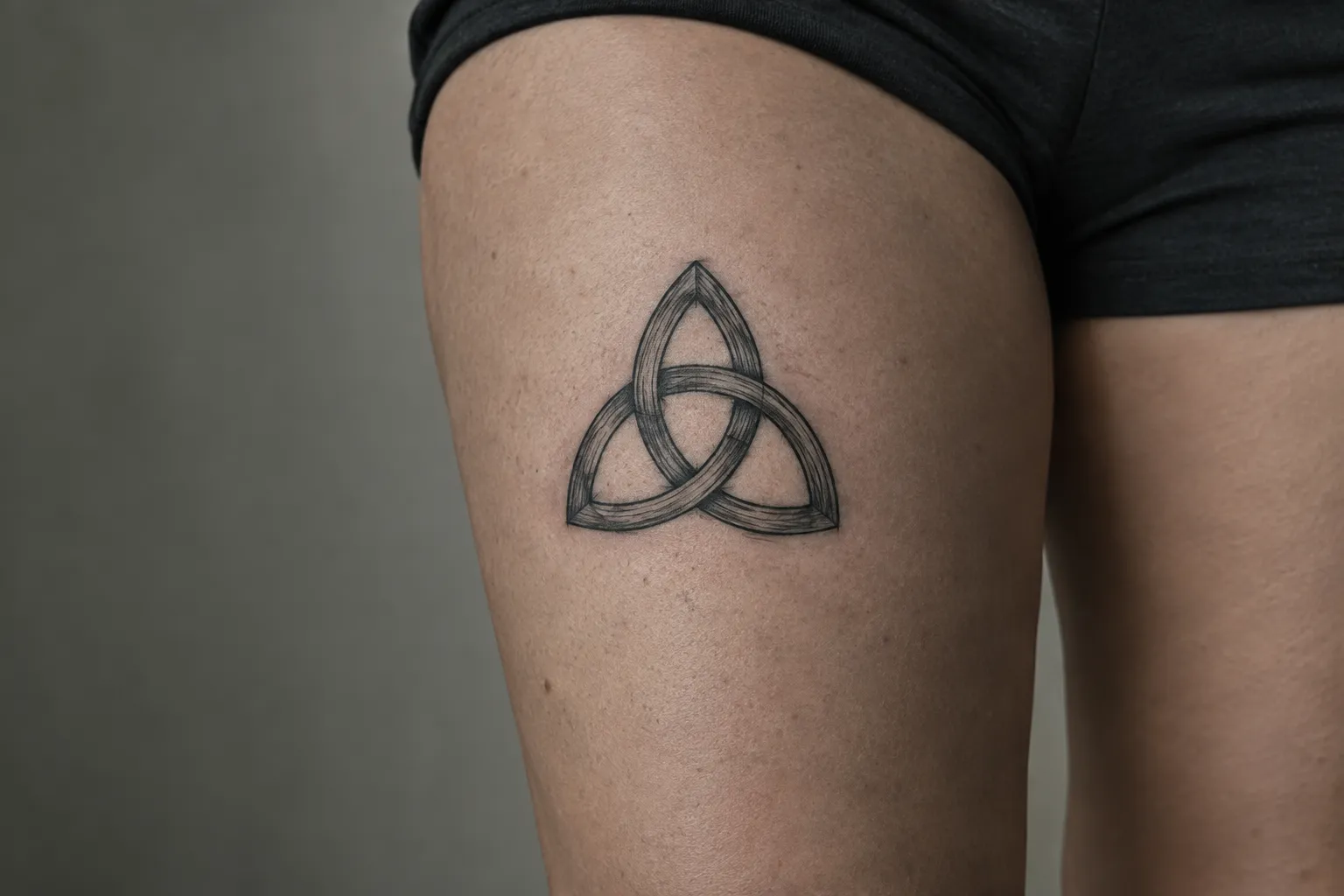
The name comes from the Latin triquetrus, “three-cornered.” The figure is built from three interlaced arcs, or three overlapping lens shapes (4). In knot theory it is the trefoil, the simplest nontrivial knot (13). It appears in Insular manuscript illumination, on early Christian high crosses and slabs, and outside the Celtic world too (4). One example is a triquetra on one of the Funbo Runestones, carved in the 11th century and now in the park of Uppsala University (4). If anyone tells you the triquetra is exclusively Irish, that is one reason to doubt them. Norse ornament used interlace as well, with strands that often end in animal heads rather than looping endlessly (1); our Viking tattoo guide covers that tradition.
On skin, the triquetra is the most recognized Celtic knot (1), and it is forgiving. Only three loops cross, so the gaps stay open even at small sizes. Many versions weave a circle through the three points. That adds crossings and needs a little more room. Good placements:
- Inner forearm: flat, easy to stretch, and low to moderate pain, getting sharper toward the wrist.
- Behind the ear or the back of the neck: discreet. Both hurt more than the outer forearm, and the skin behind the ear is thin, so keep the strands bold rather than fine-line.
- Between the shoulder blades: room for a larger version with the woven circle.
- Outer upper arm: one of the easiest spots to sit for, with plenty of flat space.
Holy Trinity reading vs. personal three-part symbolism
The triquetra has been read as the Holy Trinity especially since the Celtic revival of the 19th century (4). The original intention of the early medieval artists is unknown (4). The symbol is used regularly as a Trinitarian emblem in contemporary Catholic iconography (4).
The timeline is the part most guides skip. Insular knotwork appears in the mid-seventh century (5). One of the earliest references to the triquetra as a Trinity symbol is George Petrie’s 1845 book The Ecclesiastical Architecture of Ireland, and the reading spread with the Celtic revival (4).
The popular “land, sea and sky” reading comes from modern Celtic Reconstructionists, who use the triquetra for the tripartite division of the world (4).
That leaves the choice to you:
- Religious reading: Father, Son and Holy Spirit. The triquetra is often read as the Christian Trinity (1), so many people will read your tattoo this way.
- Personal three-part reading: three children, parent-partner-child, past-present-future, or any trio that means something specific to you (1)(2). Treat it as your own reference, not an ancient definition.
If you go personal, expect strangers to assume the religious reading. Decide whether that bothers you before the stencil goes on.
Celtic armband tattoo: how the band wraps the arm
A Celtic armband tattoo only reads as one continuous interlace when the artist measures your arm and calculates the repeat, so the pattern meets itself without a visible seam (1).
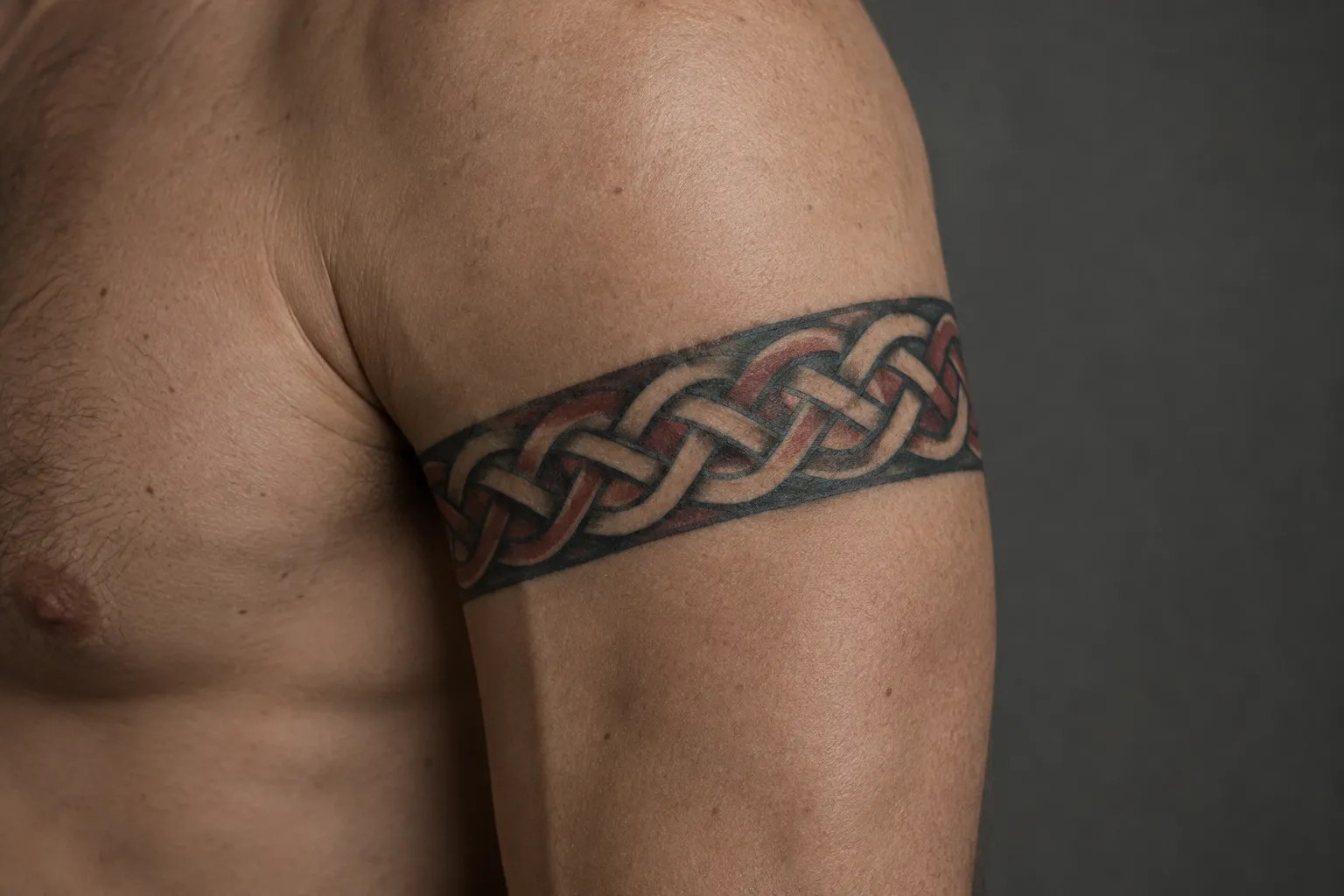
A standalone triquetra sits on a patch of skin and works wherever it lands. A band has to circle a limb that tapers and twists. The upper arm is wider at the biceps than near the elbow. The forearm narrows toward the wrist. Muscle shifts as you rotate. A repeat drawn as a flat strip has to divide cleanly into your circumference. If it doesn’t, the last unit gets squashed or stretched where the ends meet.
Ask your artist three things before tattooing:
- Where the seam goes. Ask whether the closure can sit on the inner arm, where the eye catches it least.
- How the repeat closes. The strands at each end should join so the over-under rhythm continues unbroken around the arm.
- Whether the band follows the taper. A band that sits level on a flat drawing can tilt on a conical arm. The stencil should be checked standing, arms relaxed, from the front and side.
A good artist will reposition the stencil several times. That is normal, not indecision.
Narrow band vs. wide, dense interlace
Bands come narrow and minimal or wide and dense, and the two age differently.
- Narrow band: a two-strand braid or a simple repeating knot, often with border lines top and bottom. It is fast to tattoo, ages cleanly, and the seam is easier to hide because each repeat unit is short.
- Wide, dense interlace: more strands and more crossings per inch of skin, sometimes with knots nested inside a border. It looks striking fresh. It needs disciplined spacing, though, because every tight gap is a place where the healed lines can merge.
If you love a dense band, go wider rather than squeezing the same pattern into a narrow strip. Keep the strand count and open up the gaps.
Wrist, forearm, or upper arm
Continuous knotwork bands show up around the wrist, arm and ankle (1). Each placement trades visibility against comfort:
- Upper arm: the classic armband spot, with the most room for a wide, dense design. The outer upper arm is one of the easiest areas to sit for. The band wraps toward the armpit on the inside, and that inner stretch hurts far more than the outside (armpit > biceps > outer upper arm).
- Forearm: highly visible in short sleeves. The outer forearm sits low to moderate on pain, while the inner forearm gets sharper toward the wrist. The taper is steep, so fit-testing matters most here.
- Wrist: suits only a narrow, simple band. Constant movement and friction from watches and cuffs wear on fine detail, so a dense pattern ages badly on the wrist.
- Ankle: a narrow band works. Bony ankles hurt more than the calf, and socks rub during healing.
For a standalone knot on the upper arm, artists often work from the 1/3 rule. Roughly one-third of a limb segment is a natural visual unit for a standalone piece, and the upper arm between shoulder and elbow holds one cohesive design at about that scale. Our tattoo placement guide explains how it applies to composition. For relative pain across the body, see our tattoo pain chart.
Choosing your design: size, session length, and combining motifs
Session length is the most practical filter for knotwork ambition: a compact triquetra can fit a short appointment, while a full wraparound armband needs a much longer booking.
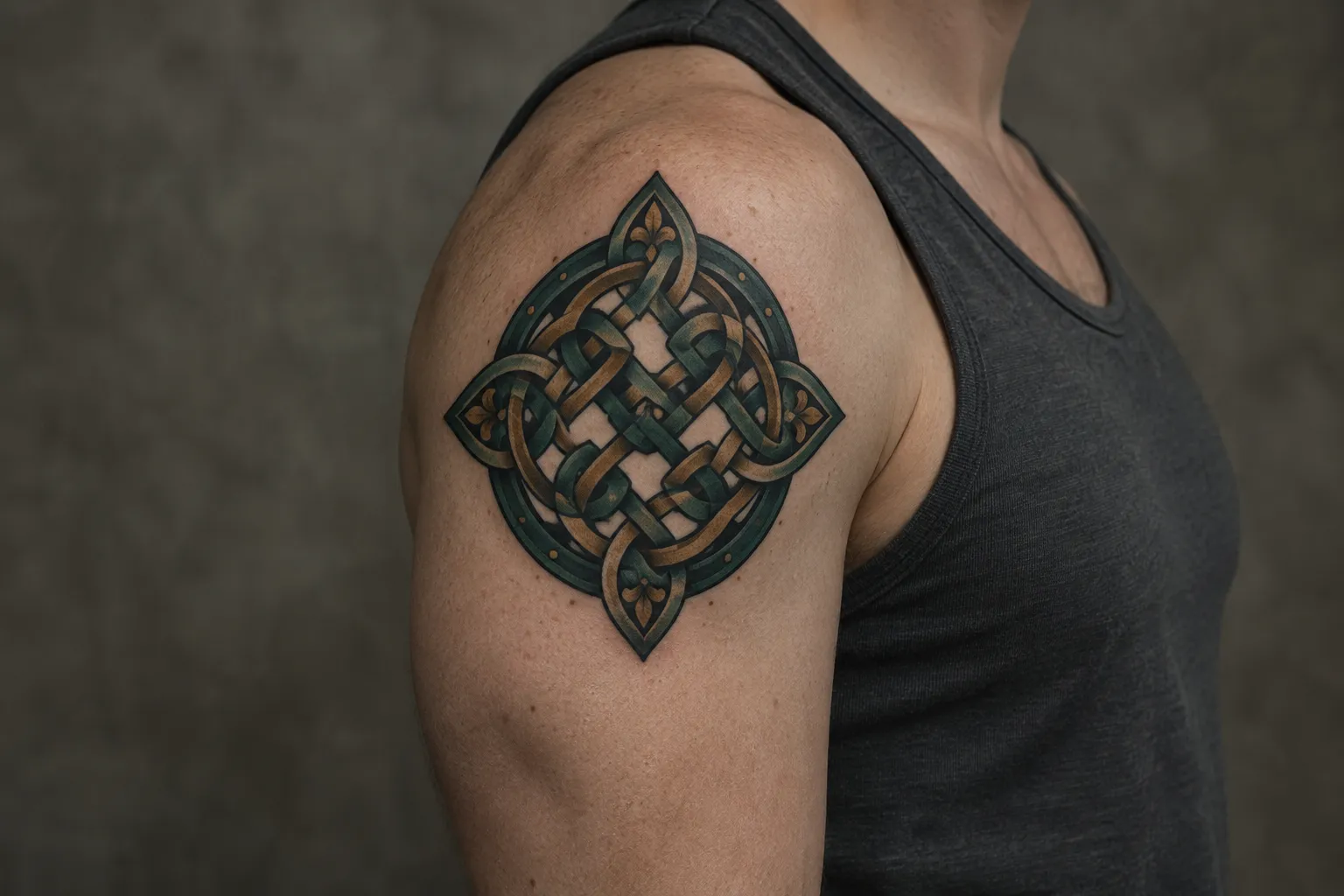
For a sense of how session pricing is structured, one tattooer’s FAQ lists $200 for one hour with a one-hour minimum, a rate it dates to April 1, 2022, plus $800 for a 4-hour half-day and $1,500 for a 7.5-hour full day (7). Note that this artist lists Celtic knotwork among the styles that aren’t a good fit for him (7). That points to the bigger lesson: book a knotwork specialist, and expect their rates to follow their own market.
Standalone triquetra: the one-hour option
A standalone triquetra or compact knot is the restrained choice. Its open center and few crossings keep it legible at small sizes (1). A small trinity or shield knot is usually under an hour (1), so it can fit a one-hour minimum like the one above. Adding a woven circle, a double outline or shading inside the loops adds time.
Size it so the gaps between strands stay clearly open. If your artist suggests going bigger than you planned, it’s usually because the knot would close up at your size, not because they want more table time.
Longer armband sessions
A dense or full wraparound band takes longer than a standalone knot. Ask for a session estimate rather than a total, since knotwork linework tends to run longer than artists first predict (1). The extra time goes into the stencil fitting, the long continuous lines and the solid black fill of the background, if your design has one.
Long sessions on the inner arm are hard to sit through. If your artist suggests splitting the band into two sittings, take the offer. The second sitting also lets them check how the first half healed before closing the seam.
Combining a knot with a name or date
You can weave a name, a date or another motif into knotwork. Contemporary galleries show plenty of knotwork combined with other imagery (3). Agree with your artist first on how the lettering affects the interlace and legibility. Letters break the over-under rhythm wherever they sit, so the knot usually needs a dedicated panel or a gap in the band.
Size lettering by letter height, the height of the whole letter:
- Standard script: at least 12 mm (1/2 in).
- Fine or ornate script: about 25 mm (1 in).
- Block, serif, typewriter lettering and numerals: at least 6 mm (1/4 in).
On the wrist, only bold script or block lettering holds. A date in block numerals beside a triquetra stays readable for years. A name in thin script tucked inside a knot does not.
Types of Celtic knotwork designs
Celtic knotwork designs fall into two families: a standalone knot that reads as one closed shape, and a repeating interlace that runs as a border or band.
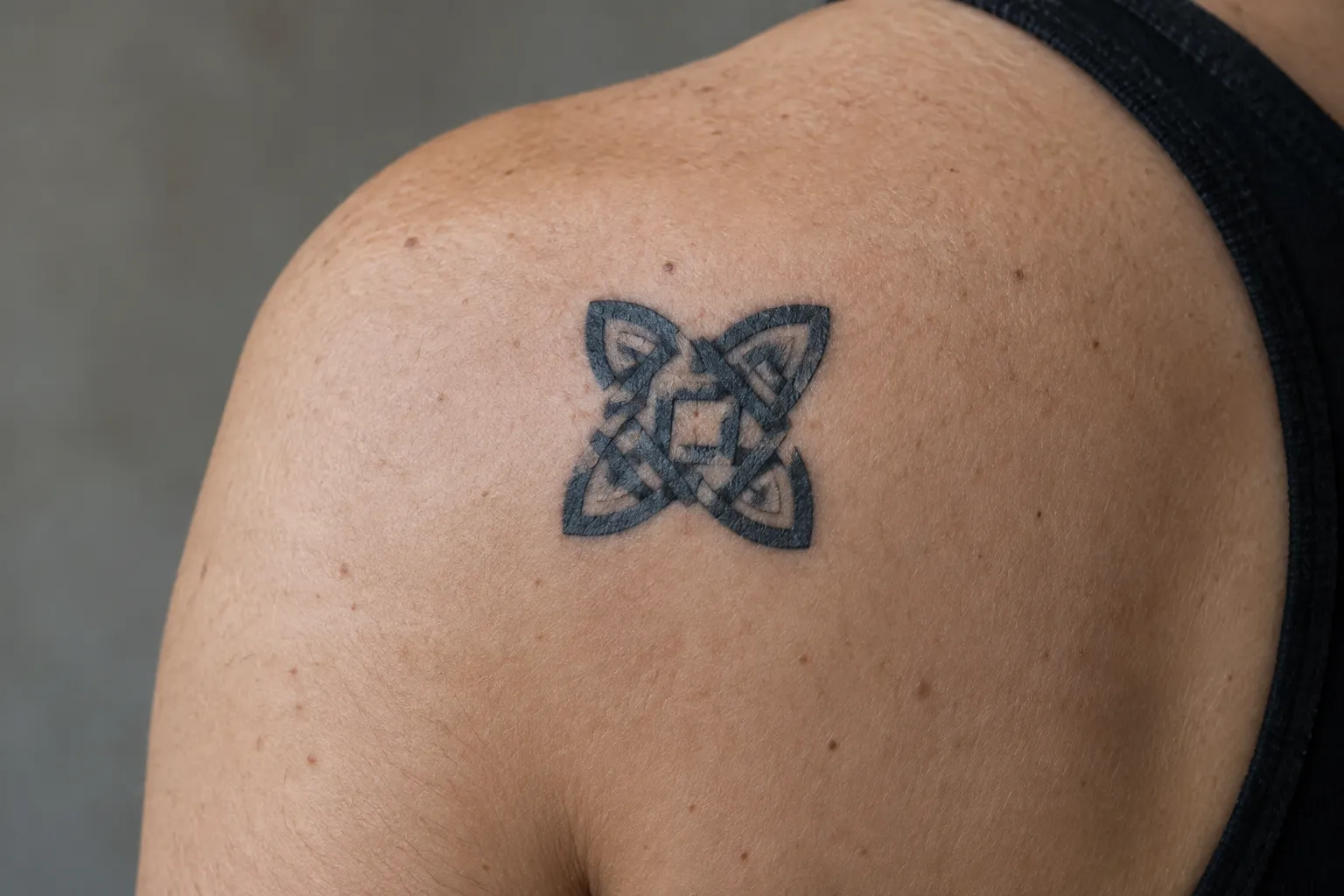
Standalone knots include the triquetra and its variants, the four-looped endless or “love” knot (2), the shield knot (3) and the Dara knot (5). They work as single motifs on the forearm, upper arm, shoulder blade or calf, from a small single-needle-group knot up to a palm-sized piece.
Repeating interlace includes braids, plaits and chained knots that run as a strip. These suit armbands, legbands and borders framing other work. A strip also wraps a shoulder cap or traces a spine, though the spine sits high on pain.
The family decides the planning. A standalone knot can go anywhere it fits. A repeating band has to be planned around the body’s circumference and curves. Newer work also strips the interlace back to clean strands and wide gaps, sometimes combined with hard geometric tattoo shapes or solid blocks of black (1).
Celtic spiral knot
Spiral designs are often grouped with knotwork, but spirals are far older. The spirals at Newgrange in County Meath were carved around 3200 BC, some 2,500 years before Celtic culture reached Ireland (5). The triskele, three spirals radiating from a center, appears alongside trinity knots in many contemporary galleries (3).
Technically, a spiral knot asks for even spacing between coils. The center is where it fails first: tight inner coils blur into a dot. If you want a spiral, keep the inner coils loose and let your artist dictate how far in they can go.
Claddagh, Celtic cross, and Ogham: different symbols, not knotwork
Three popular Celtic designs often get lumped in with knotwork, but they are separate symbols.
The Claddagh shows two hands holding a crowned heart. It comes from the fishing village of Claddagh outside Galway city, where the earliest surviving rings date to around 1700, and it stands for friendship, love and loyalty (5). The Celtic cross is a cross with a ring around the intersection, a monument form of Ireland and Britain from the eighth century onward (5). It often carries knotwork panels without being a knot itself (1). Ogham is the earliest form of writing in Ireland, an alphabet of strokes cut across or beside a stem line, surviving on inscribed stones from the fourth to the seventh century AD (5). Tattooing it means tattooing lettering, so spelling matters more than weave.
Getting it done: artist, consultation, and aftercare
Getting a Celtic knot done well comes down to three steps: choosing an artist with healed interlace in their portfolio, arriving at the consultation prepared, and following a clean healing routine.
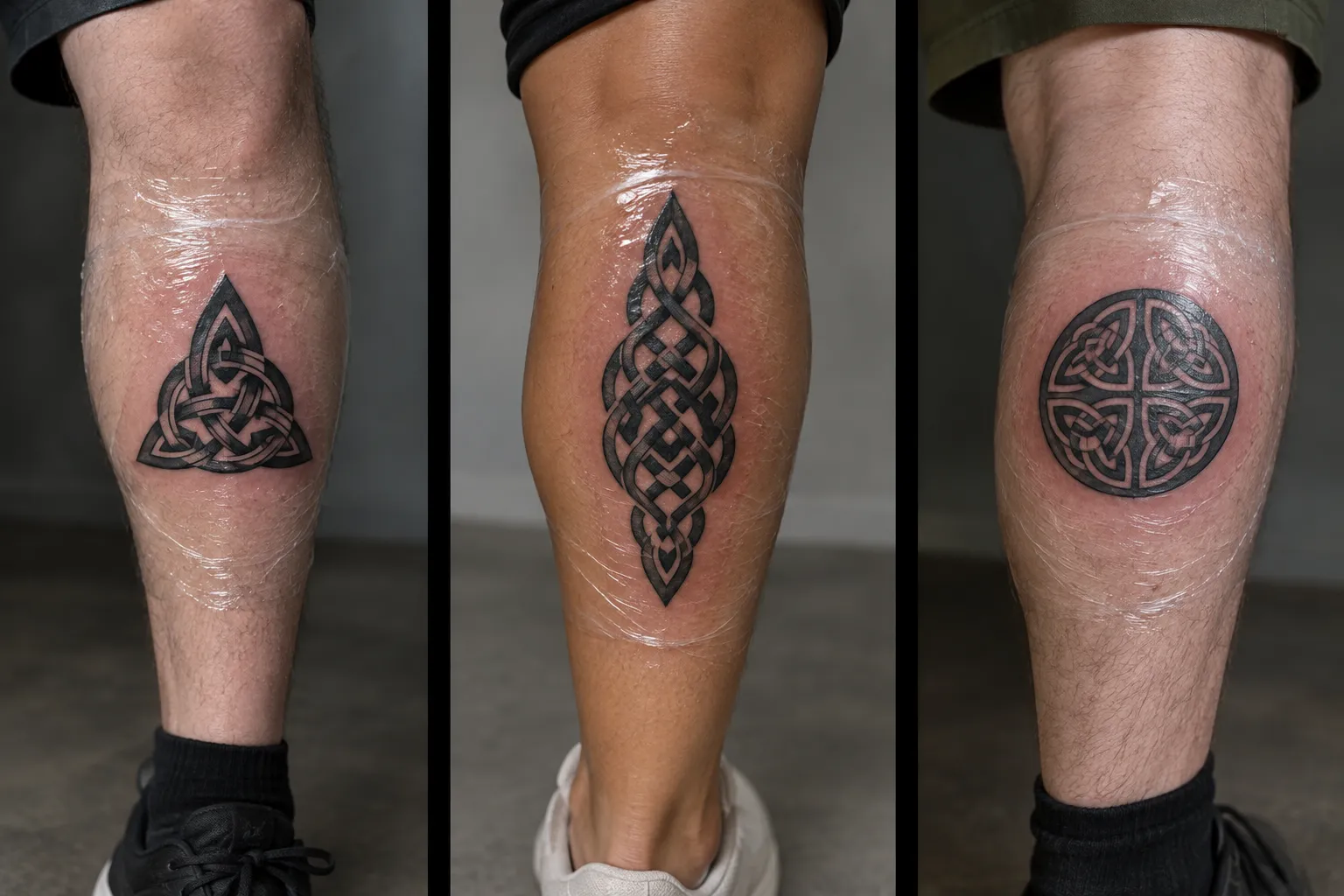
What to bring to your consultation
Bring clear reference images, a photo of the body area you want tattooed, and a short explanation of the symbolism you’re after. One tattooer’s booking form asks for clear pictures of the body part being tattooed, any references you find inspiring, and a specific description of what you want (7). Three to five references are enough. Mark what you like in each: the weave on one, the border on another, the size of a third.
Use the consultation to settle size, orientation, and whether the knot should close into a band. Some studios offer free consultations (7)(8).
Before booking, look for healed photos of crisp interlace and of wrapping armbands in the artist’s portfolio. Fresh photos flatter everyone. Healed photos show whether the gaps stayed open. A band that circles the arm has to be planned around the body, not copied from a flat image, and that skill shows up in healed armband photos or not at all.
Checking hygiene and ink safety
Clean needles are not the whole picture. The FDA has received reports of infections from contaminated tattoo inks as well as unhygienic equipment, and has found that even unopened, sealed inks can harbor bacteria (11). So ask two questions alongside the usual ones about single-use needles and surface cleaning:
- Which ink brand and batch will you use? A professional studio answers without hesitation.
- Is any of it subject to an FDA advisory? In an advisory posted in May 2025, the FDA advised against using certain Sacred tattoo inks found contaminated with bacteria, including Pseudomonas aeruginosa (12). Avoid the products named in that advisory.
One tattooer asks clients to avoid alcohol and blood-thinning pain medications such as ibuprofen for the 24 hours before the appointment (7).
Healed vs. fresh: how knotwork ages and heals
Knotwork shows the gap between fresh and healed more than most styles. A knot that looks stunning on day one can turn into a black smudge within five years if the spacing was wrong (1). Ink spreads slightly under the skin over time. Lines that nearly touch on day one will touch eventually. Discuss line spacing with your artist before approving a dense design, and ask to see healed examples at a similar size.
Bold black knotwork also tends to stay visible for a long time. That cuts both ways if you later want a cover-up, because dense black interlace is hard to hide under lighter work. Treat looking good long term and healing without trouble as separate outcomes. A tattoo can hold its color for decades and still have needed attention while it healed.
Healing follows the standard calendar from our tattoo aftercare guide:
- Day 1-3: open wound, weeping plasma and swelling. Wash 2-4 times a day with unscented soap, using fingertips only. Apply a thin film of petrolatum ointment: a slight shine, not wet.
- Day 4-7 (rest of week 1): tight, shiny and starting to flake. Switch to a fragrance-free moisturizer from about day 3. Keep washing 2-4 times a day, then taper as weeping stops.
- Week 2: peeling and itching. Don’t pick the flakes off the knot lines, or you risk patchy strands.
- Week 3-4: looks healed on the surface while the deeper skin is still remodeling.
- From week 6: touch-ups can be booked; the deeper skin keeps settling for a few months.
Keep the tattoo out of direct sun for the first 4-6 weeks. Sun-protective clothing is easiest on an armband, then use SPF 30 or higher whenever it’s exposed. No swimming, soaking, hot tubs or saunas for at least the first 2-3 weeks. Every product should be fragrance-free, with no essential oils or exfoliants. Antibiotic creams are not needed for normal healing; they are for an infection a doctor has diagnosed.
Some signs need a professional opinion. If redness, swelling or warmth isn’t improving, or a rash or fever appears, contact a healthcare professional. Tell your tattooist too, so the ink can be identified (11). With contaminated ink, the commonly reported signs are rashes or lesions of red papules where the ink went in (12).
Plan a Celtic knot tattoo
Work through the design, reference, fit and studio checks before settling on an appointment length.
- 1
Choose the symbol and meaning
Select a triquetra, endless knot, spiral or band, then decide whether its meaning is historical, religious or personal.
- 2
Prepare references
Gather three to five reference images and photograph the body area you want tattooed.
- 3
Consult an interlace specialist
Book with an artist whose portfolio includes healed knotwork, and discuss size, orientation and whether the design should form a band.
- 4
Fit-test an armband stencil
If the design wraps around an arm, check the stencil on your actual arm, including the seam and how the pattern meets.
- 5
Check ink and hygiene
Confirm the ink brand and batch, and ask how the studio handles needles, surfaces and hygiene.
- 6
Match the appointment to the design
Choose a session length that fits the design's scope; consider splitting a long band into two sittings.
Frequently Asked Questions
- Is the Celtic knot an Irish symbol?
- Knotwork is strongly associated with Ireland, but its documented Insular origins lie in monasteries around the Irish Sea, with the Book of Durrow, the Lindisfarne Gospels and the Book of Kells as key works (5).
- What is the meaning behind Celtic tattoos?
- For knotwork, the documented context is Christian art; meanings such as protection or family bonds are modern choices rather than established historical definitions (5)(1)(6).
- What is the most powerful Celtic symbol?
- There is no single most powerful Celtic symbol; for strength, the Dara knot, named from the Irish word for an oak grove, represents strength through hidden roots (5), and the triquetra is the most recognized Celtic knot (1).
- What does a Celtic Trinity Knot represent?
- The triquetra is commonly read as the Christian Holy Trinity, an association strengthened during the 19th-century Celtic revival; early artists left no recorded intent (4).
- Where did Celtic knotwork originate?
- Insular knotwork appears in Christian art from the mid-seventh century AD, across monasteries around the Irish Sea rather than one confirmed birthplace (5)(10).
- What does a Claddagh tattoo mean?
- A Claddagh tattoo stands for friendship, love and loyalty; it comes from the village of Claddagh outside Galway, and the hands, heart and crown make it figurative imagery, not knotwork (5).
- What is Ogham, and can it be used for a tattoo?
- Ogham is the earliest form of writing in Ireland, an alphabet of strokes along a stem line, and it can be tattooed as lettering; have the spelling checked first, since it has no letters for J, K, V, W, X, Y or Z (5).
Locking down symbol, size and session length
The core split is simple. Insular interlace is documented history, dating to the mid-seventh century and peaking in manuscripts like the Book of Kells (5). Per-knot meanings such as protection or family bonds came later, many of them with the 19th-century Celtic Revival, and the triquetra’s Trinity reading spread with that same revival (4)(5). Choose your meaning knowing which kind it is.
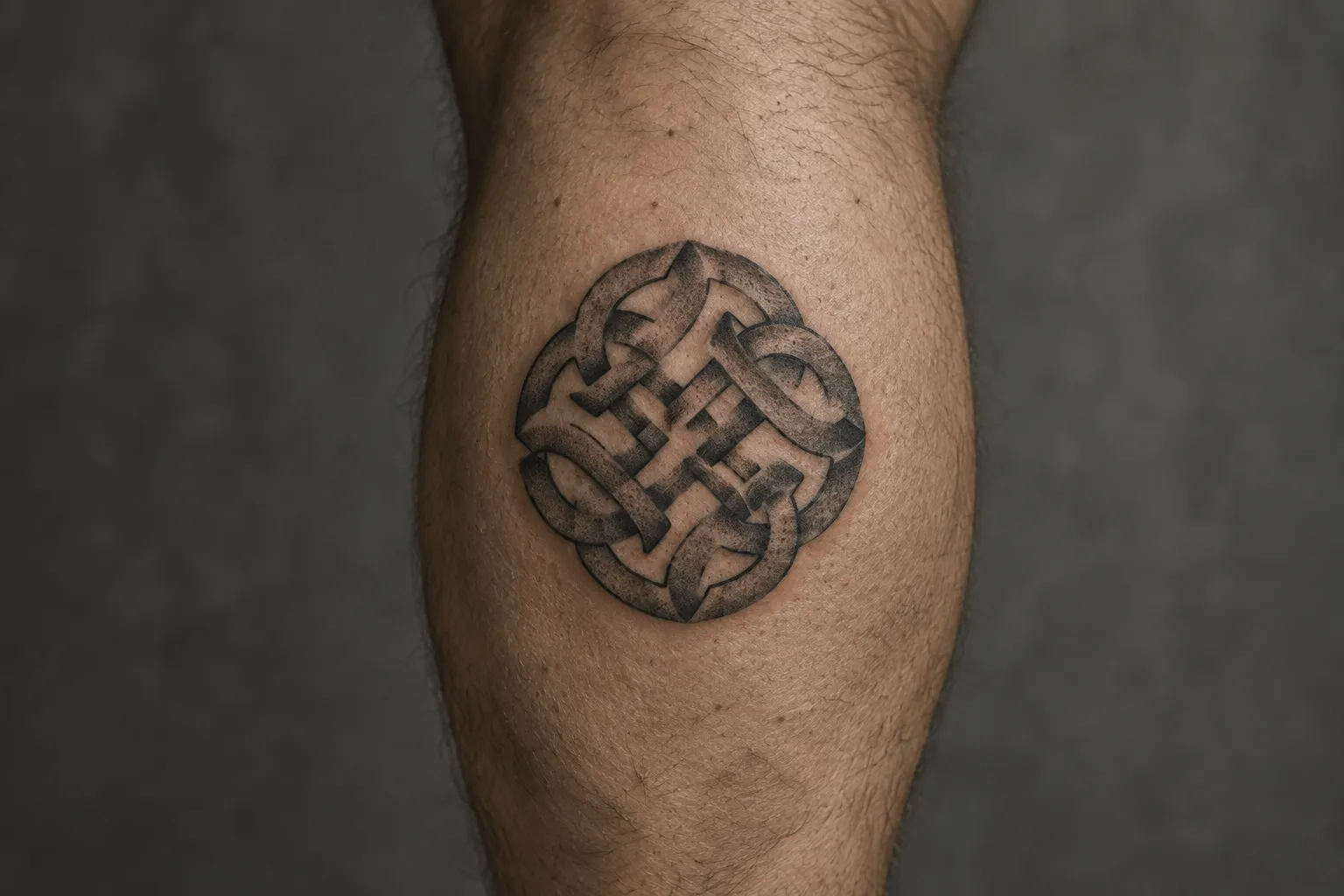
The practical decisions belong in a single consultation. A standalone triquetra on the inner forearm or outer upper arm is the short, forgiving option. A narrow band suits the forearm or wrist. A wide, dense Celtic armband tattoo on the upper arm needs stencil fitting, a hidden seam on the inner arm, and the most table time. Bring references and a photo of the area, ask to see healed interlace, confirm the ink, and protect the open gaps between strands through six weeks of healing. Those gaps decide whether the knot still reads as a knot in ten years.