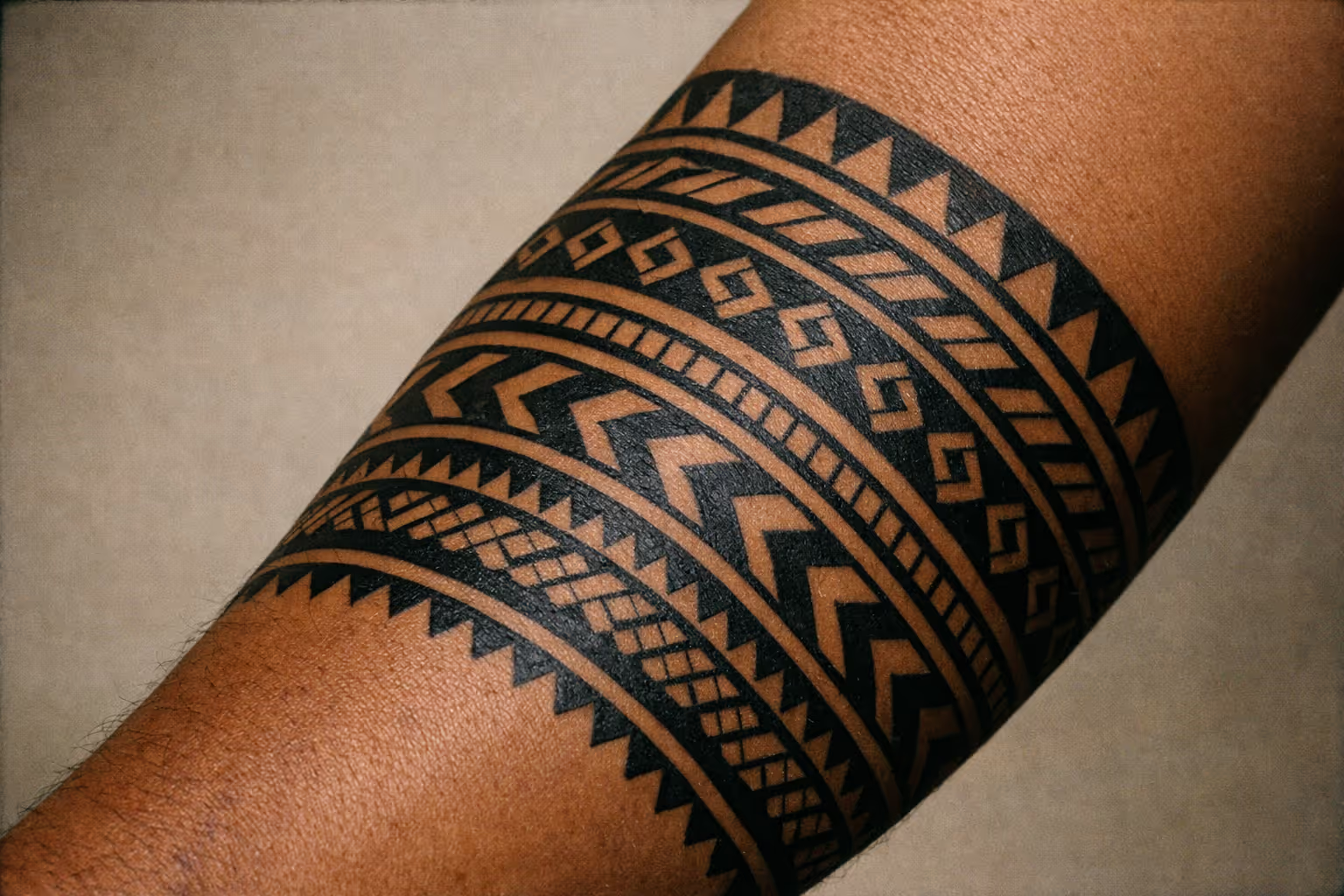
Before you book a Samoan tribal tattoo, understand this: the motifs aren’t decorative patterns - they’re a rank-coded language, and specific designs are reserved for people of specific status within Samoan society. Wear the wrong ones and you’re not paying homage, you’re overstepping a line that matters deeply to the culture. This is the one tattoo where the ethics come before the aesthetics. Here’s what the motifs encode, where the appropriation line sits, and how sleeve sizing and pricing work if you’re cleared to get one.
The Cultural Significance of a Samoan Tribal Tattoo
Tatau has been practiced in Samoa for at least 2,000 to 3,000 years, making it one of the oldest continuous tattoo traditions on earth (5). It survived missionary suppression in the 19th century, when European clergy tried to ban it as pagan, and it survived the colonial period that followed. Today it sits at the center of Samoan cultural identity.
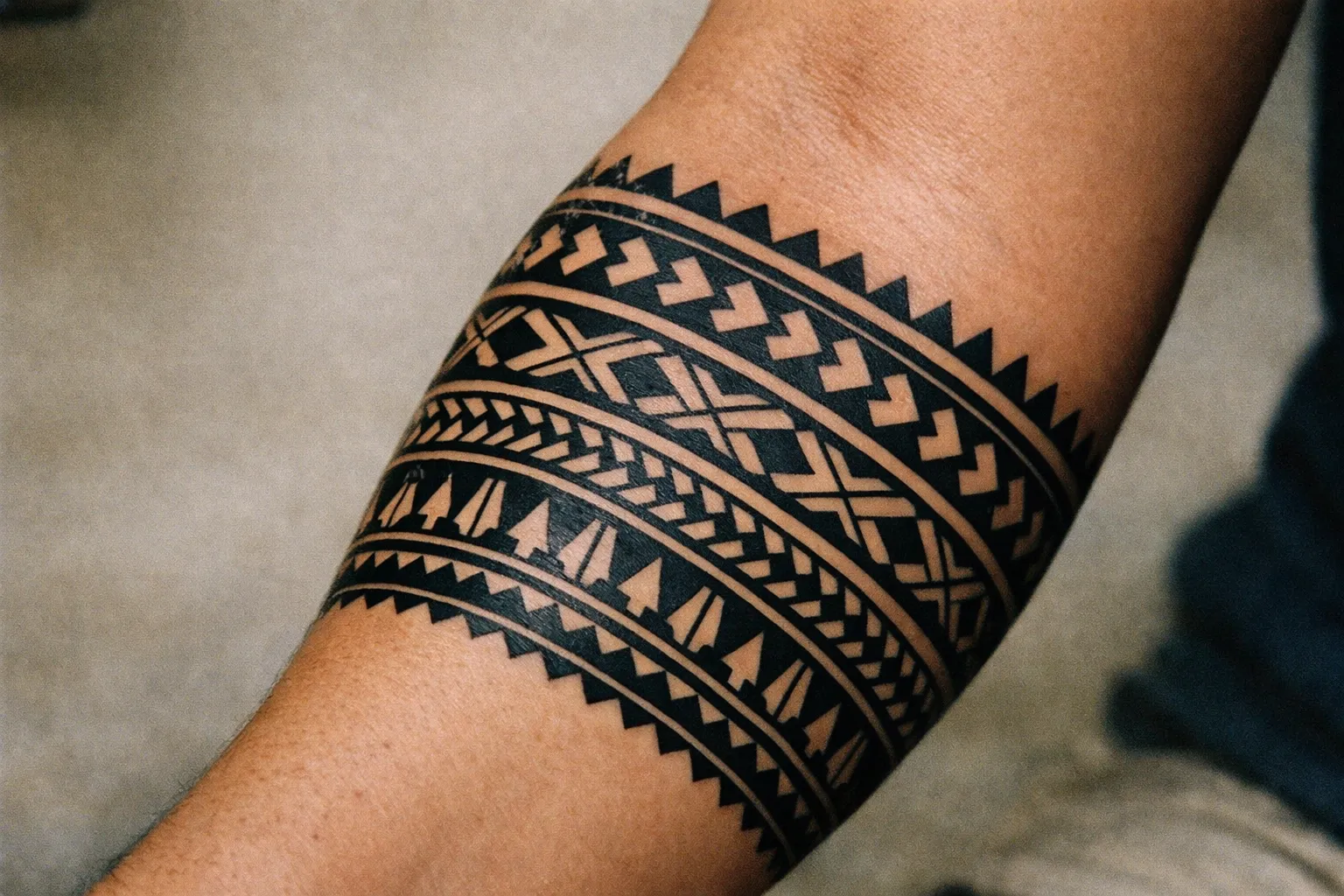
Tatau is not decoration. It marks service to family (aiga), readiness for chiefly duty, and standing within the community. A tattooed man - a soga’imiti - is expected to use his body in service of his village. A woman who wears the malu signals her role in ceremonial life and her connection to chiefly lineage.
That weight is the thing most modern flash sheets miss entirely. When you see a Polynesian piece labeled “Samoan tribal” online, you’re often looking at motifs that, in their original context, were tied to specific families, ranks, or events. Pulling them out and rearranging them without understanding is the equivalent of wearing a stranger’s military medals.
The Two Traditional Forms: Pe’a and Malu
The pe’a is the male tattoo. It runs 360° around the body from the waist to just below the knees - a solid, dense field of black bands, chevrons, and geometric motifs broken by careful negative space. It takes 10 to 14 consecutive days of work, often 3 to 6 hours a day, for a total of 30 to 70 hours of tapping (5).
The malu is the female tattoo. It covers the back of the thighs down to below the knees, with a signature diamond-shaped motif (the malu itself) visible just under the kneecap. The linework is lighter than the pe’a, with more breathing room, and the design centers on protection and graceful service.
Neither is something you book between brunch and a haircut. Both require sponsorship from family, blessings, and - in most cases - a real relationship with the tufuga doing the work.
✓ Pros
- Rich cultural significance tied to family, rank, and community service
- Distinct male (pe'a) and female (malu) traditional forms with deep meaning
- Survived centuries of suppression and remains central to Samoan identity
✗ Cons
- Traditional tattoos require long time commitments and family sponsorship
- Cultural weight means inappropriate use is considered disrespectful
- Traditional process is physically demanding and involves significant healing time
How a Traditional Tatau Is Actually Made
The tool is called the au. It’s a small comb made of boar tusk, bone, or modern surgical steel, lashed to a wooden handle with coconut fiber. The tufuga dips the comb into ink - historically made from burned candlenut soot mixed with water - and taps it into the skin with a second wooden mallet called the sausau.
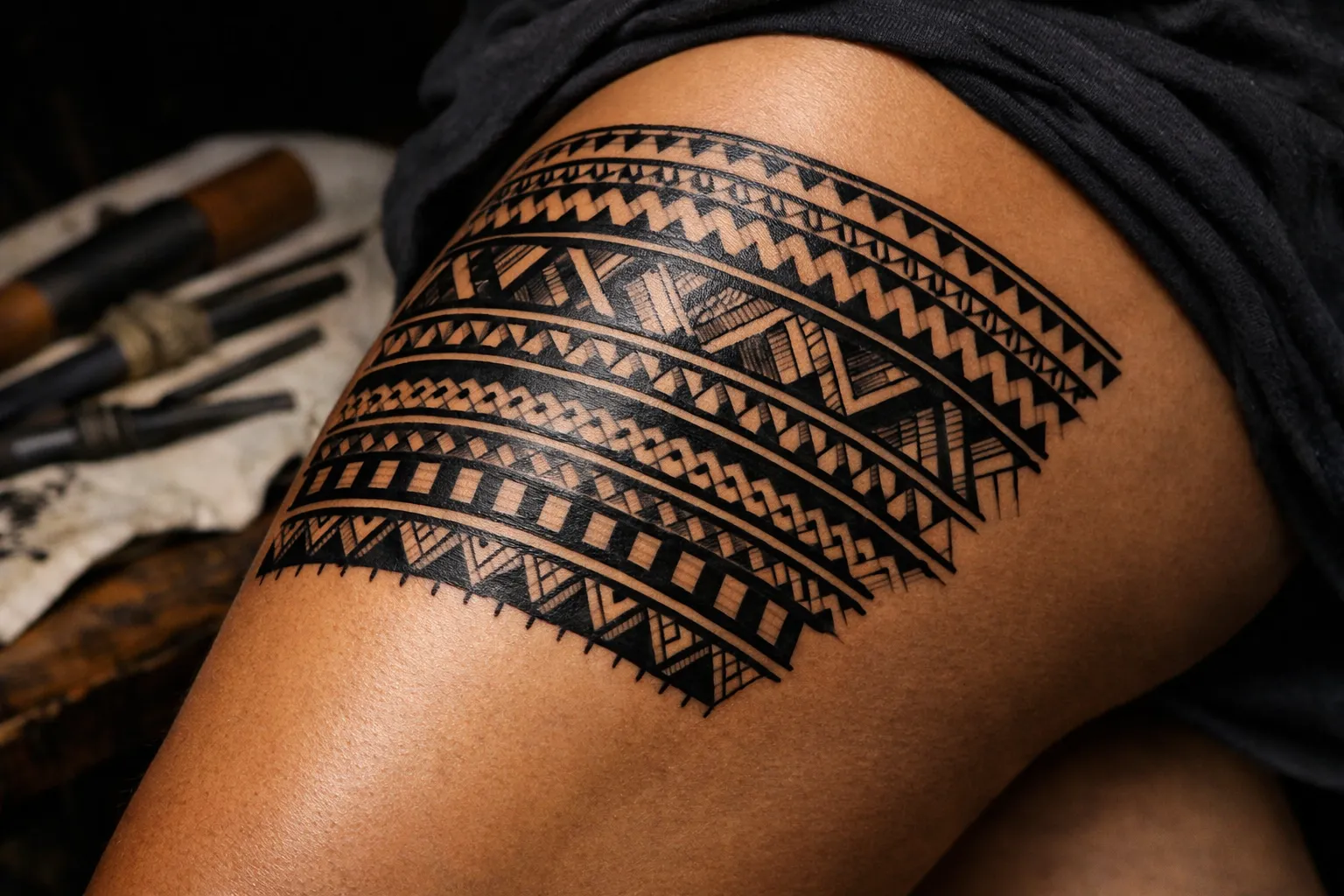
Different combs do different jobs. A wide au with many teeth lays down the broad black fields. A narrow au with a few sharp teeth cuts the fine lines and frames. The whole process depends on rhythm and on the stretchers - usually family members or apprentices - who pull the skin taut and wipe blood and ink as the tufuga works.
A few things to understand if you’ve only ever sat for machine work:
- It bleeds more. Hand-tapping is more traumatic than a rotary machine. Sessions end when the body says enough, not when the clock runs out.
- It heals as a wound, not a tattoo. Expect 7 to 14 days of scabbing, then 2 to 3 months for full recovery. Swimming in the ocean is off the table for weeks.
- It’s never solo. A pe’a or malu involves the tufuga, his apprentices, the stretchers, and family who feed everyone, sing during sessions, and absorb the cost in fine mats and gifts.
Quitting partway through a pe’a carries real shame in traditional Samoan society. An unfinished pe’a is called pe’a mutu, and the person who walks away wears that mark for life. This is part of why the decision is taken so seriously before the first tap.
What Does a Samoan Tribal Tattoo Mean?
Every motif in a Samoan piece is doing a job. Modern artists may stylize them, but the vocabulary is fairly consistent across Polynesia, with Samoan-specific variations.
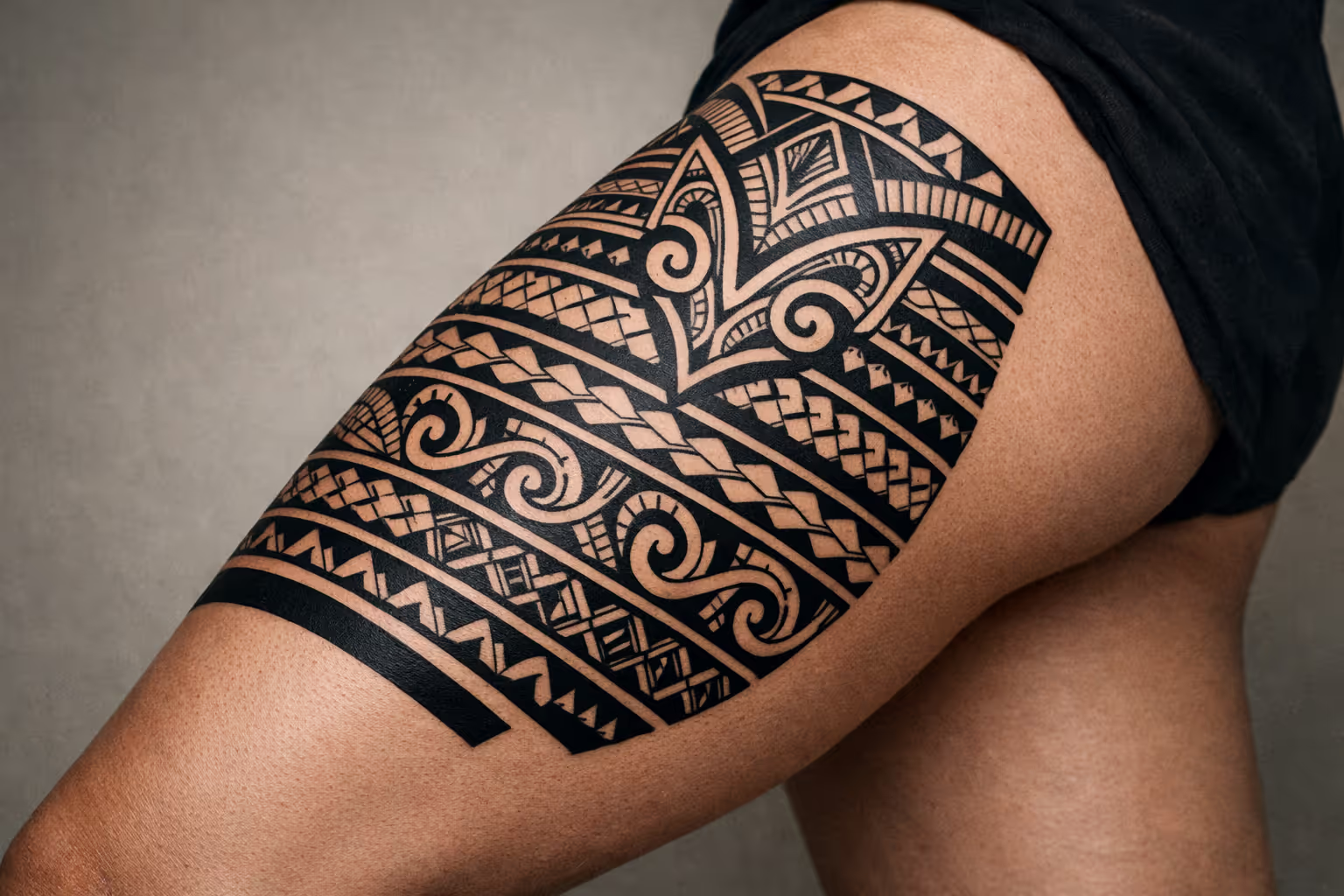
Spearheads (and arrow patterns). Courage, warrior spirit, defense of family. Often used as repeating bands on the upper arm or thigh.
Shark teeth (niho mano). Protection, strength, adaptability, guidance through difficulty. Triangular and tightly packed - one of the most recognizable Polynesian motifs.
Ocean waves and current lines. Continuity, change, the passage between life and death, ancestral migration across the Pacific.
Enata (small human figures). People, ancestors, relationships. More common in Marquesan work but used across Polynesia to represent specific family members or gods.
Turtle (laumei or honu). Long life, peace, family, navigation. Often placed where the design needs an anchor.
Lizard and tiki forms. Spiritual messengers, semi-gods, protection against bad spirits (3).
Sun and ray patterns. Leadership, prosperity, eternity.
Centipede and millipede motifs (atualoa). Warrior strength, danger overcome.
In a pe’a, these motifs are arranged by body zone. The upper torso carries motifs tied to honor and spirituality. The lower body - thighs and the area around the knees - carries motifs tied to daily life, work, and relationships. The artist isn’t decorating the skin; they’re writing a layout that reflects how Samoans understand the body.
A proper Samoan tattoo meaning consultation should involve the artist asking about your family, your work, and your story before they sketch anything. I’ve sat in on consultations where the artist spent forty minutes asking questions before picking up a pencil. If they hand you a flash sheet and ask which one you want, find someone else.
Samoan Tattoo Designs: Sleeves, Legs, and Smaller Pieces
Most people getting Samoan work today aren’t booking a full pe’a. They’re commissioning Samoan-inspired pieces in machine ink, and the formats break down predictably.
Samoan Tattoo Sleeve
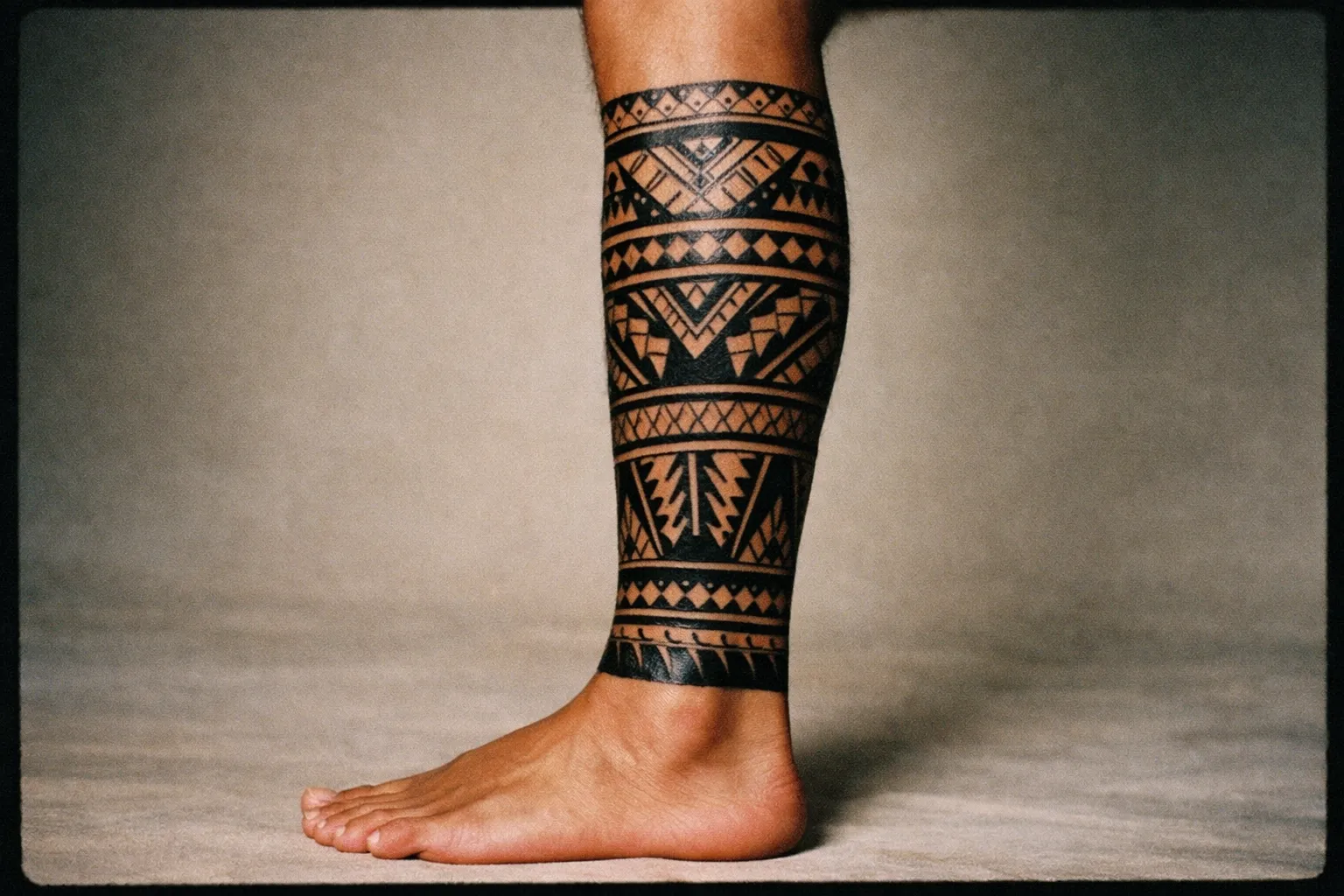
The arm is the most popular placement for Polynesian-influenced work, and a Samoan tattoo sleeve typically runs from shoulder to wrist. Common breakdown:
- Upper arm and shoulder cap: strength, bravery, leadership - anchored by a large geometric centerpiece, often a sun, turtle, or shield motif.
- Inner upper arm: softer motifs, sometimes tied to family or spirituality. This area also hurts more than the outer arm.
- Forearm: work, craft, creativity. Bands of spearheads or shark teeth around the wrist are common.
- Wrist cuff: a clean closing band, often a row of niho mano.
Size range: a half sleeve sits in the 8 to 12 inch (20-30 cm) vertical span from shoulder to mid-bicep. A full sleeve covers roughly 22 to 26 inches (55-65 cm) of arm. Plan on 15 to 25 hours of machine work across multiple sessions.
Samoan Leg Pieces
A thigh-to-calf design is the closest modern echo of the pe’a silhouette without claiming the traditional form. Expect 20 to 40 hours and a higher pain ceiling - the inner thigh and the back of the knee are some of the worst real estate on the body for needle work. Ribcage > inner thigh > back of knee, in terms of how much you’ll regret your scheduling.
Smaller Samoan Pattern Tattoos
If you’re new to large blackwork, a Samoan pattern tattoo in a contained band is the right starting point:
- Forearm band: 2-4 inches (5-10 cm) wide, 1-3 hours of work.
- Calf band: 3-5 inches (8-13 cm), 2-4 hours.
- Chest plate (one side): 4-6 inches wide along the pec, 3-5 hours.
- Shoulder cap: about the size of your palm, 2-3 hours.
These are good test runs. They let you see how your skin holds dense blackwork before you commit to a sleeve. I always recommend this to clients who haven’t worn large-scale Polynesian work before - a forearm band tells you a lot about how your skin takes saturation.
Samoan Tattoo Female Designs
A Samoan tattoo female piece, in modern practice, usually borrows from the malu vocabulary without claiming the malu itself. Popular placements:
- Back of thigh: the closest analog to the malu, often a softer pattern with the signature diamond visible above the knee.
- Hip and lower back panel: patterns that flow with the body, associated with life energy and family.
- Ankle cuff: a delicate band of malu-inspired motifs, 1-2 inches (3-5 cm) wide.
- Wrist or forearm band: professionally visible, lighter line weight than male sleeves.
If you want a true malu, that conversation belongs with a Samoan tufuga, not a street-shop artist.
Is It Disrespectful to Get a Samoan Tattoo Without Being Samoan?
This is the question people most want a clean yes-or-no answer to, and there isn’t one.
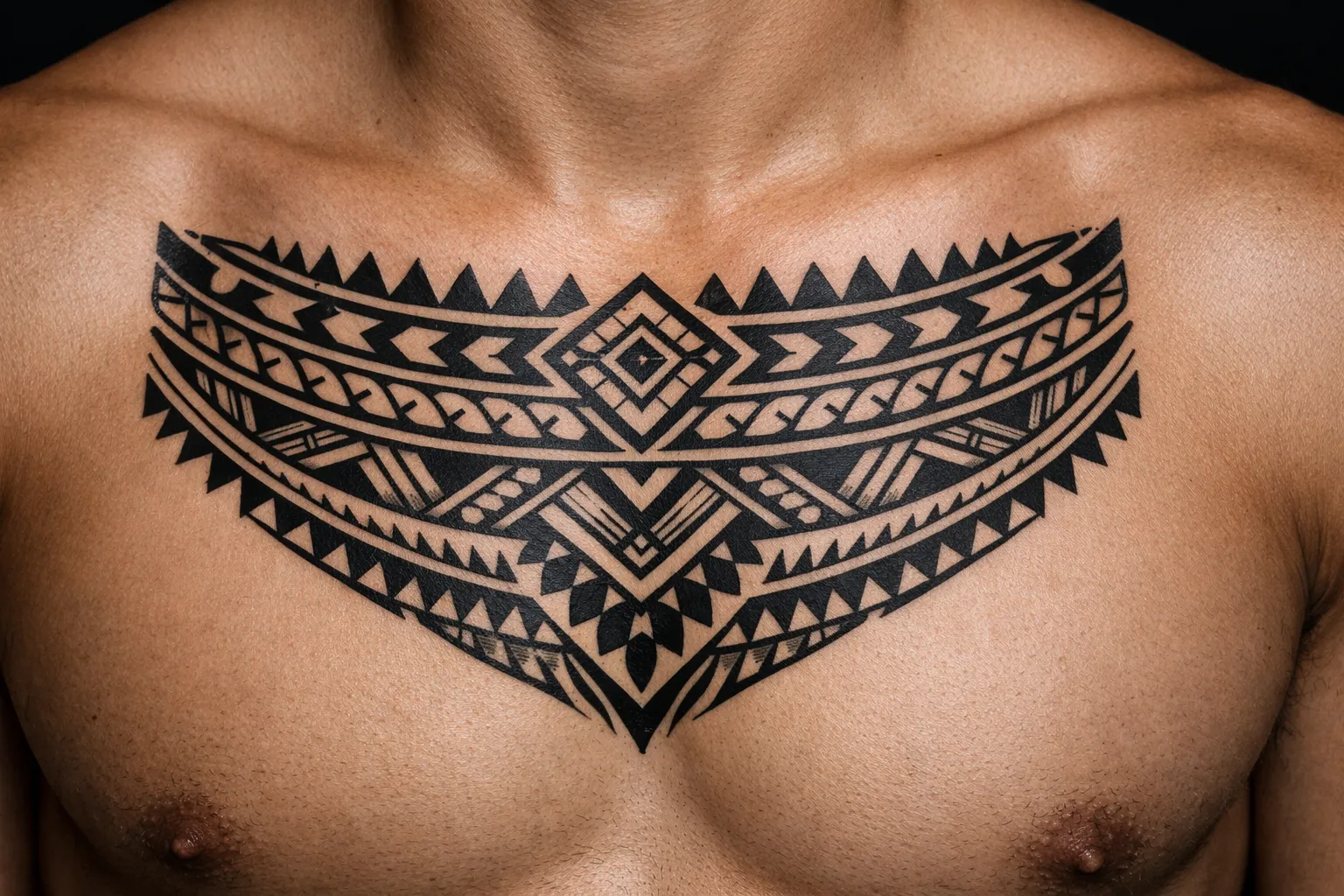
The full pe’a and malu: don’t. These are not abstract designs. They are rank-linked, ceremonial tattoos tied to Samoan family structures and chiefly systems. Receiving one without Samoan ancestry, sponsorship, and a relationship with a tufuga is widely considered appropriation by Samoan communities. Most legitimate tufuga will refuse to do a full pe’a or malu on a non-Samoan, and many modern studios now publish this policy on their websites.
Samoan-inspired custom work: usually fine, if you do it right. Many Samoan and Polynesian artists accept non-Samoan clients for custom pieces that draw on Samoan motifs without claiming sacred forms. The shared rules across studios:
- The design avoids rank-specific patterns reserved for matai (chiefs) or specific families.
- You can explain what your motifs mean and why you chose them.
- The artist keeps creative control to maintain cultural integrity.
- You’re not asking them to copy another person’s tattoo from a photo.
A useful test: if you can answer “why Samoan, and not Maori or Marquesan or Hawaiian?” with something more than “it looks cool,” you’re on the right side of the line. If you can’t, you’re shopping a culture for aesthetics, and that’s where the disrespect lives.
A few practical scripts that artists tell me they actually want to hear:
- “My family migrated through the Pacific and I want to honor that connection.”
- “I lived in Samoa for X years and want a piece that reflects that.”
- “I want a custom Polynesian-inspired sleeve and I’ll defer to you on which motifs are appropriate.”
Avoid asking for “a Samoan tattoo like The Rock’s.” That’s the conversation that gets you politely declined.
Pricing, Time, and Logistics
Concrete numbers, because almost no other article gives them.
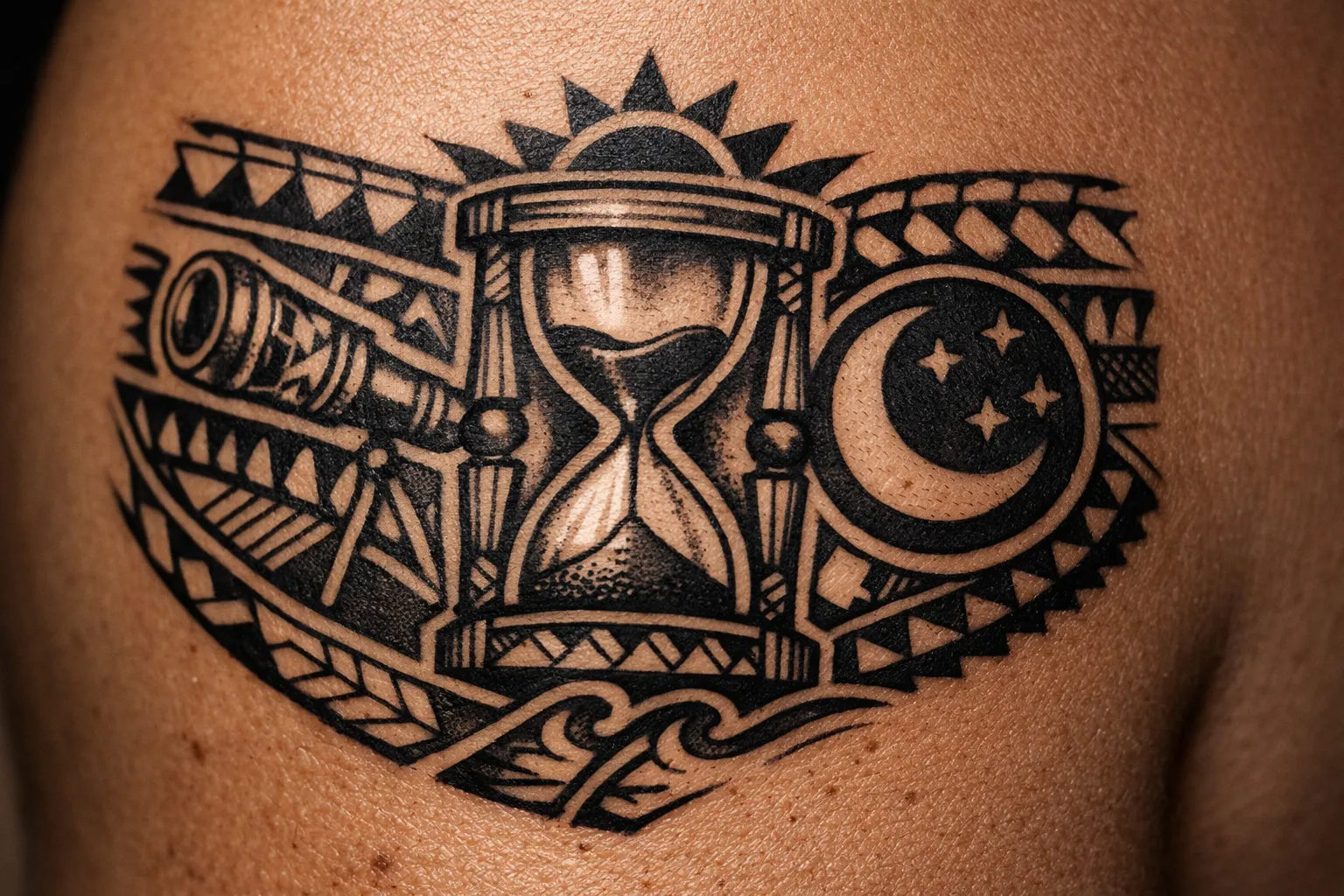
Machine-Based Samoan Work (2024-2025 Averages, USD)
- Small pattern band (forearm, calf, 2-4 inches): $150-$500, 1-3 hours.
- Shoulder cap or chest plate: $400-$900, 3-5 hours.
- Half sleeve: $800-$2,000, 8-12 hours across 2-3 sessions.
- Full sleeve: $1,000-$3,000, 15-25 hours across 3-5 sessions.
- Leg piece (thigh to calf): $1,500-$4,000, 20-40 hours.
- Back piece: $2,500-$6,000, 25-45 hours.
Hourly rates for established Polynesian specialists run $80-$200/hour in the US, Australia, and New Zealand. Big-name artists in Auckland, Honolulu, and LA can run higher.
Traditional Pe’a or Malu
A traditional piece by a recognized tufuga isn’t priced like a tattoo. It’s structured more like a cultural service:
- Fine mats, food, and gifts for the tufuga and his stretchers.
- Travel and lodging if you’re going to Samoa (most do).
- Contributions to the village or family hosting you.
Realistic all-in cost: $2,000 to $5,000+, often more once you factor in 2 to 3 weeks of travel.
Time Commitment Beyond the Chair
- Consultation: 1-3 sessions of 30-90 minutes, especially if you’re customizing genealogy.
- Recovery between sessions: 2-4 weeks for the skin to be ready for the next pass.
- Healing time for machine work: 2-3 weeks for surface heal, 6-8 weeks for full dermal heal.
- Healing time for traditional tatau: 7-14 days of scabbing, 2-3 months for full recovery, with no ocean swimming or contact sports until cleared.
Aftercare for Large Black-Heavy Pieces
Samoan designs are blackwork-dominant - a lot of saturated ink across a large area. The aftercare timeline matters more here than it does for a small fine-line piece.
Day 1 to 3. Leave the artist’s wrap on for the time they specify (usually 2-24 hours, or up to 5 days for a long-wear film like Saniderm). When you remove it, wash with fragrance-free antibacterial soap, pat dry with a clean paper towel, and apply a thin layer of a petrolatum-free tattoo balm or A+D-style ointment. Wash 2-3 times a day. Sleep on clean sheets.
Week 1. Switch to a fragrance-free moisturizer - a thick, unscented lotion - two or three times a day. The tattoo will start scabbing and itching. Don’t pick. Don’t scratch. Keep it out of direct sun.
Week 2 to 4. Scabs flake off on their own. The tattoo will look dull and patchy - that’s a layer of dead skin over the healing ink, not a botched piece. Keep moisturizing. Avoid pools, ocean, hot tubs, and saunas.
Month 2 onward. Surface healed. Keep using sun-protective clothing or SPF 30+ over the piece whenever it’s exposed. UV is the main reason Samoan blackwork fades and turns blue-grey within a decade. Touch-ups are reasonable at the 5-10 year mark.
For traditional pe’a or malu, the wound area is enormous and the infection risk is real. Historical accounts include deaths from sepsis. Modern traditional sessions in Samoa and the diaspora typically pair traditional tools with modern antiseptics, and families assist with cleaning 2 to 3 times a day. Budget $30-$60 for aftercare supplies on a large project.
Do Tattoos Lower Cortisol?
This question shows up in Samoan tattoo searches because a lot of people are weighing the prospect of a 30-hour piece and wondering what it does to the body.
Short answer: long single sessions spike cortisol in the short term - that’s just the body’s stress response to sustained acute pain. A 2016 study by Lynn and colleagues in the American Journal of Human Biology found that people who had received multiple tattoo sessions over time showed a reduced cortisol response compared to first-timers, suggesting some physiological conditioning. The evidence base is small, and there’s no Samoan-specific research.
What that means practically for a large Samoan piece:
- Marathon sessions backfire. A 6 to 8 hour session leaves cortisol elevated, which slows healing and increases inflammation. Three or four hours is a better ceiling for most people.
- Eat before you sit. A high-carb meal 1 to 2 hours before keeps blood sugar stable, which lowers pain perception.
- Hydrate. Dehydration makes pain worse and makes skin harder to work on.
- Sleep. Show up well-rested. Cortisol is already elevated when you’re sleep-deprived, and you’ll feel every tap.
None of this is unique to Samoan work, but Samoan pieces are large enough that the physiological math actually matters.
Common Mistakes That Wreck a Samoan Tattoo
Twelve years of watching these pieces heal - and watching some of them not heal well - here’s the pattern I keep seeing.
Asking for an exact copy of a Pinterest pin. Most reputable Polynesian artists will refuse. They consider it disrespectful to copy another tufuga’s layout, because that layout was built for a specific person’s story.
Cramming too much detail into a small space. Samoan style relies on line weight and negative space. A 3-inch forearm band with twelve motifs packed in will turn into a blur within five years. Better: three or four bold motifs with clean spacing.
Mixing Polynesian cultures into one piece. Maori koru spirals next to Hawaiian kapa next to Samoan spearheads reads, to anyone familiar with the traditions, as someone who didn’t do their homework. Pick one tradition and commit.
Ignoring how patterns cross joints. Samoan motifs traditionally follow muscle lines and bend at the elbow and knee. Forcing a straight band across a joint distorts the design as the skin stretches over the years.
Copying family-linked motifs from stock photo sites. Some patterns on stock sites (6) come from real pe’a or malu and carry specific family meanings. Lifting them is exactly the appropriation people warn about.
Underestimating time off work. A 6-hour session on the thigh can make walking and sitting genuinely painful for 2 to 3 days. Don’t book the session the day before you have to fly.
Skipping washes in humid climates. If you got the work done in Samoa, Hawaii, or anywhere tropical, two washes a day is the minimum. Dense blackwork in humid heat is an infection magnet.
Working With Pinterest Inspiration the Right Way
People bring images to consultations. That’s fine - most artists welcome it. The problem is how those images get used.
A pin is a conversation starter, not a brief. The right way to use one:
- Bring 3 to 5 images, not 30. Curate. Show your artist what you respond to in terms of line weight, motif density, and overall flow - not “I want exactly this.”
- Annotate what you like. “I like the thickness of these outlines.” “I like the way this design uses negative space at the elbow.” “I don’t like how dense this upper arm is.”
- Bring your story, not just references. What’s the family situation, the migration path, the work, the loss, the gain? Your artist can translate that into motifs better than any pin can.
- Let the artist replace anything that’s family-coded. If a reference includes a motif tied to someone else’s lineage, your artist should swap it for something that belongs to your story.
The pin shows you a result without the context. Good artists rebuild the context from your life, not the original wearer’s.
How to Choose a Samoan Tattoo Artist
A few hard filters worth applying:
- Their portfolio explicitly lists Samoan or Polynesian work. “Tribal” alone is a red flag - it usually means generic blackwork without cultural grounding.
- They show healed work, not just fresh. Ask to see pieces 6 months or more after completion. Healed Samoan work should still have clean, crisp black fields without significant blowout or fading patches.
- They ask about you before they sketch. A consultation that opens with “tell me about your family” is a good sign. One that opens with “which design did you want?” is not.
- They have clear cultural policies. Many studios now publish what they will and won’t do - “we don’t replicate pe’a or malu for non-Samoans” is a healthy sign of cultural awareness, not a brush-off.
- They’re honest about scheduling. A 25-hour sleeve over three sessions is a different beast than the same sleeve over six. Better artists will push you toward more, shorter sessions.
Frequently Asked Questions
- What is the difference between Samoan and Tongan tattoos?
- Samoan tatau features dense, solid black fields with intricate geometric motifs covering large continuous body areas, while Tongan tattoos use bolder, more separated motifs with more negative space. Tongan tattooing was nearly extinct for much of the 20th century before recent revival efforts. Visually, Samoan work feels denser and more architectural; Tongan work feels more open.
- Who can get a malu tattoo?
- Traditionally, the malu is reserved for Samoan women connected to chiefly families or community service, requiring family blessing and a relationship with a tufuga. Non-Samoan women should request malu-inspired designs rather than a true malu, as most legitimate tufuga will not apply the traditional malu without cultural ties.
- Can a Samoan tattoo be removed?
- Laser removal is possible but slow and expensive due to dense black saturation. Full sleeves may require 10 to 15 sessions over 1.5 to 2 years, costing $200 to $500 per session. Total removal costs can match or exceed the original tattoo. Removal of traditional pe'a or malu is rare due to cultural and practical reasons.
- How should I prepare for a large Samoan tattoo session to minimize pain and improve healing?
- Eat a high-carb meal 1 to 2 hours before your session to stabilize blood sugar, stay well-hydrated, and ensure you are well-rested. Avoid marathon sessions longer than 3 to 4 hours to prevent elevated cortisol levels that slow healing and increase inflammation.
- What aftercare products are recommended for large blackwork Samoan tattoos?
- Use fragrance-free antibacterial soap for washing initially, then switch to a fragrance-free moisturizer during the scabbing phase. After healing, protect the tattoo with sun-protective clothing or SPF 30+ sunscreen to prevent fading.
- Is it possible to get a traditional Samoan tattoo without family sponsorship?
- In most cases, no - family sponsorship, blessings, and a real relationship with a recognized tufuga are strong norms for traditional pe'a and malu. Practice varies by tufuga and community, but attempting to get these tattoos without cultural ties is widely considered disrespectful and is refused by most legitimate artists.
- How long should I wait between tattoo sessions for a large Samoan piece?
- Allow 2 to 4 weeks between sessions to let the skin recover sufficiently before the next pass, especially for machine-based work.
Before You Book
A Samoan piece, done right, is one of the most visually striking tattoos you can wear. Dense, architectural blackwork that follows the body’s actual geometry. Done wrong - copied from a pin, mashed up with other Polynesian styles, crammed onto the wrong placement - it ages into a muddy blob that doesn’t say anything to anyone.
The decision points that actually matter, in order:
- Why Samoan, specifically. If you can’t answer this, slow down.
- Find the right artist. Polynesian portfolio, healed work, asks about you before sketching. Understanding how to choose a tattoo artist by evaluating their style and healed portfolio is the same discipline here, applied to a specialized tradition.
- Choose a starting placement. A forearm or calf band is a smarter first move than a full sleeve.
- Plan for healing. Block time off, buy aftercare supplies in advance, stay out of the ocean.
- Let the artist drive the design. Bring story, not stencils.
Samoan tatau survived 3,000 years because the people who carry it take it seriously. If you’re going to wear any version of it, that’s the standard worth matching.