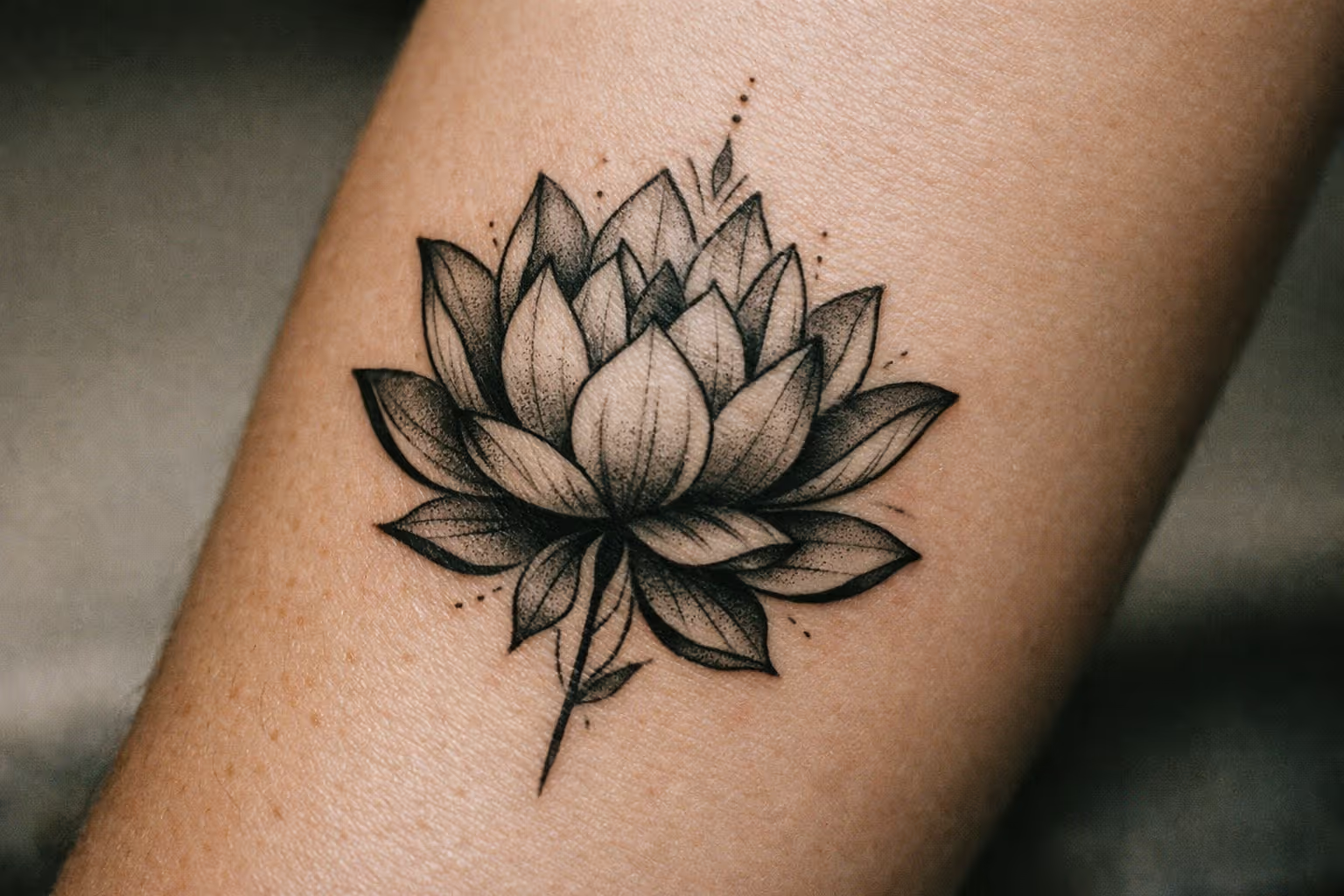
A lotus flower tattoo is the classic victim of the watercolor trend: those soft, borderless washes look stunning at the reveal and fade to a pale bruise within 3-5 years if there’s no black linework anchoring them. The fix isn’t avoiding color - it’s building in anchor lines so the piece holds its shape. The symbolism runs deep too. Here’s how color, petal counts, and style decide both the meaning and the lifespan.
Lotus Flower Tattoo Meaning Across Cultures
The lotus (Nelumbo) is sacred in three distinct traditions, and the meaning shifts depending on which one you’re drawing from.
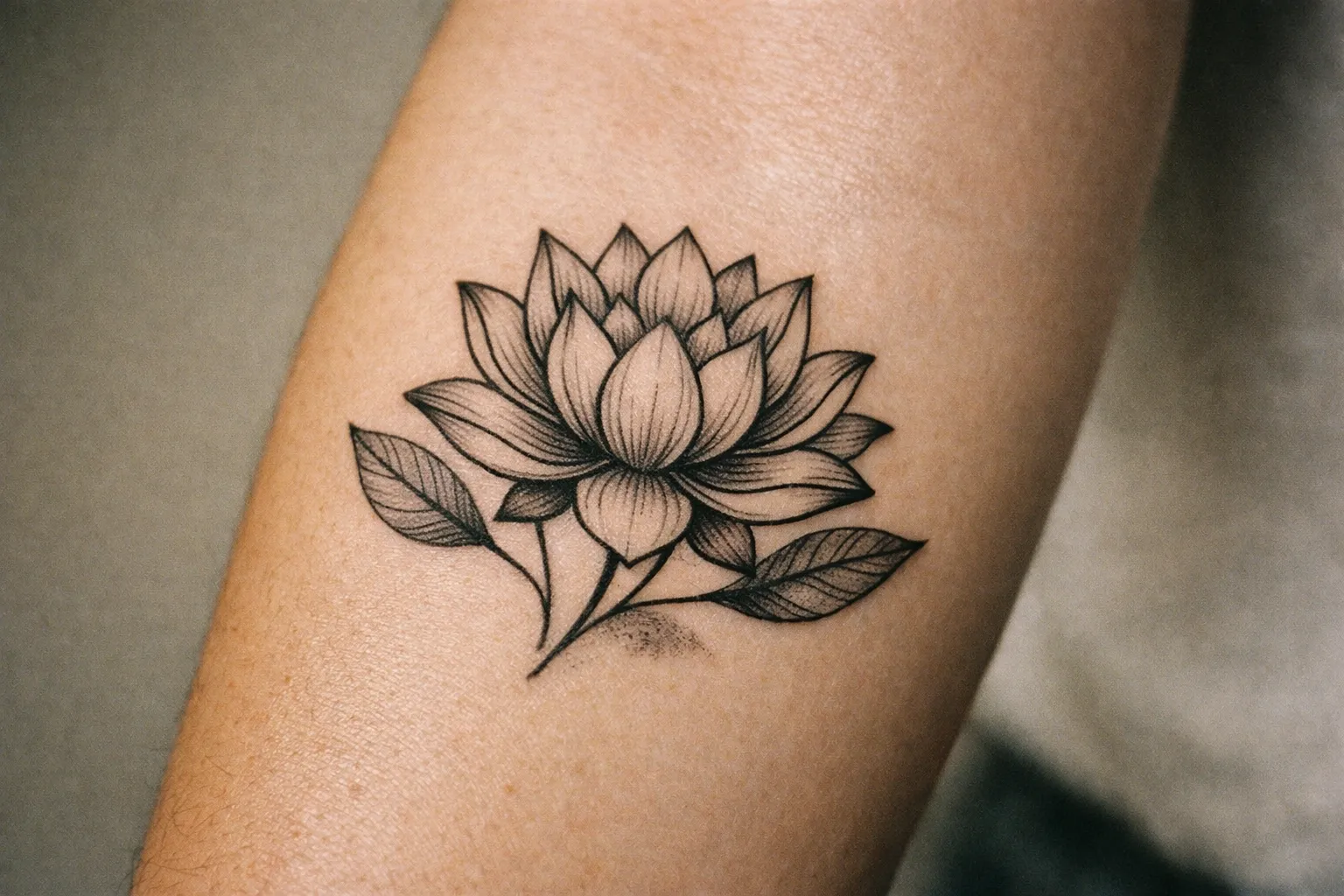
In Hinduism, the lotus - called Padma - is tied to deities including Vishnu, Brahma, Lakshmi, and Ganesha. It represents purity, beauty, spiritual advancement, and prosperity (1)(2)(3)(4). Lakshmi seated on a lotus is the classic prosperity image, which matters if you’re choosing this design for abundance symbolism rather than spiritual practice alone.
In Buddhism, the lotus is one of the Eight Auspicious Symbols and represents the path to enlightenment. An eight-petal lotus is often a direct reference to the Eightfold Path (5). The mud-to-bloom metaphor maps onto suffering, awakening, and freedom from attachment.
In ancient Egypt, the blue lotus opened at sunrise and closed at dusk, so Egyptians tied it to the sun, creation, and rebirth - beginning and end of the day in a single flower. Sri Lankan tradition leans toward discipline and virtue.
In modern Western tattoo culture, the meaning has flattened a bit. Most clients walk in wanting “rebirth,” “overcoming hardship,” or “new chapter” - a stripped-down version of the Buddhist purity-from-suffering idea, often with no religious practice attached. That’s not wrong, just worth naming. If you’re getting a Buddha, Lakshmi, or Ganesha alongside the lotus, do the reading first. Sacred-imagery tattoos placed below the waist - especially on feet - are read as disrespectful in many practicing Hindu and Buddhist communities.
Color Meanings and Petal Counts
Color changes the message more than any other design choice. The standard readings:
- White lotus - purity, enlightenment, spiritual awakening. The most “neutral” symbolic choice.
- Red lotus - love, passion, compassion. Tied to Lakshmi.
- Blue lotus - wisdom and knowledge. Tied to Vishnu and to the Egyptian sun cycle.
- Pink lotus - often read as the “true” lotus of Buddha; devotion and the heart of practice.
- Purple lotus - mysticism, esoteric spirituality, the more hidden side of the path.
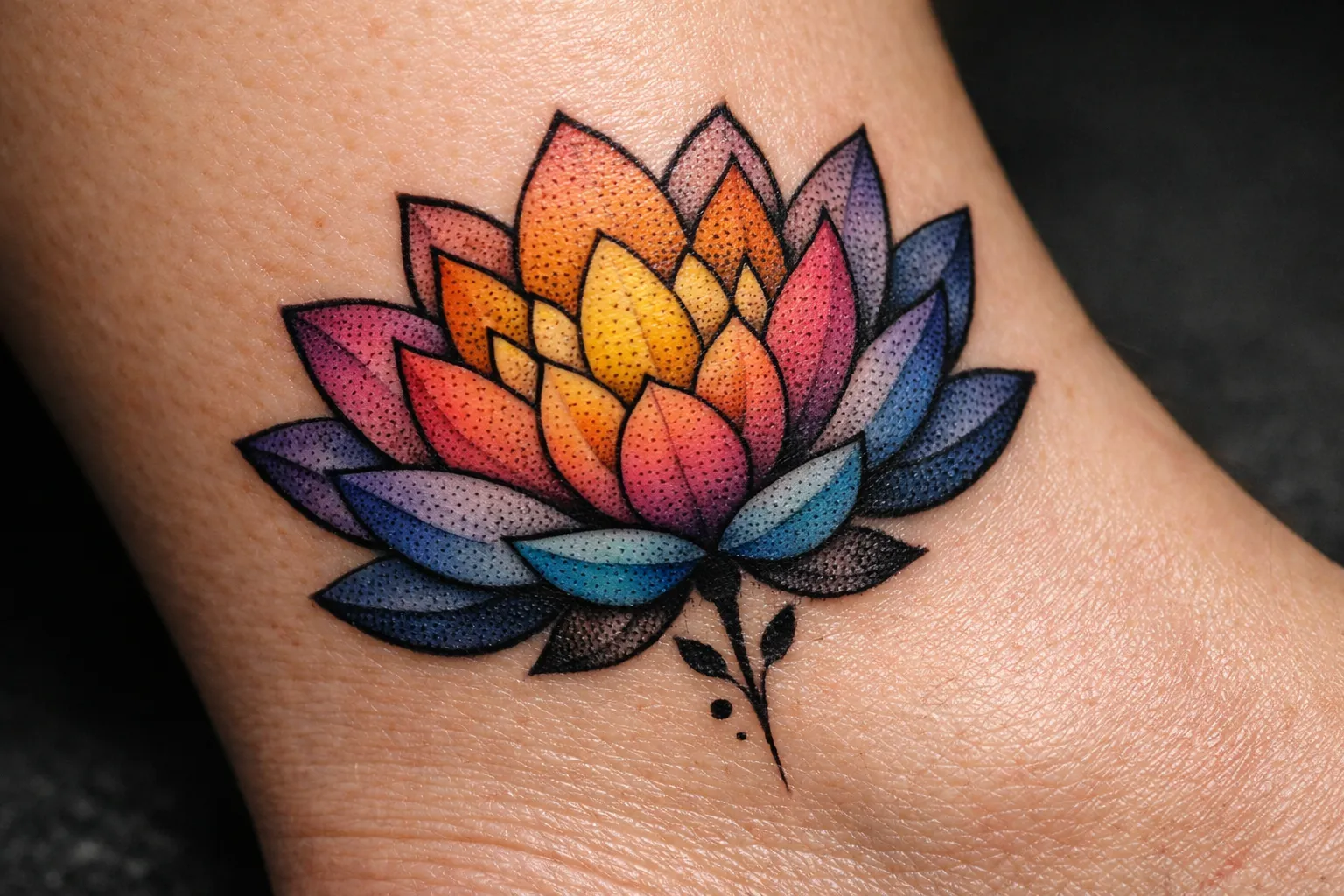
- Multi-colored lotus - blends. Half-red, half-white reads as love plus purity, for instance.
Petal count carries weight too. Eight petals ties to the Eightfold Path in Buddhism. Chakra diagrams in yogic and tantric traditions assign specific petal counts to specific energy centers - the heart chakra (Anahata) has twelve, the throat (Vishuddha) has sixteen. If you want a chakra-correct lotus, get the count right. Tattooers won’t catch this for you.
Designs and Styles
Technical execution determines how the piece reads in five years, not just on day one. I’ve seen plenty of beautifully photographed fresh tattoos that looked like grey smudges eighteen months later because the artist didn’t account for how the style ages. Here are the styles people actually request, with what works and what fails.
Mandala Lotus Flower Tattoo
A mandala lotus flower tattoo combines the radial symmetry of mandala sacred geometry with lotus petals at the center or perimeter. Two technical hallmarks: heavy reliance on dotwork shading and geometric line precision - usually pulled with fine liners like 3RL or 5RL. The common pitfall is artists cramming hundreds of micro-lines into a 2-inch space. Ink spreads microscopically over years, and what looks razor-sharp at the consultation will blur into a grey blob inside 1-3 years.
Size and placement: mandala lotus reads best at 4-6 inches (10-15 cm) minimum. Ideal placements are upper back, sternum, outer thigh, or upper arm. Black and grey holds up better than color on a mandala because the geometry stays legible as the ink ages.
Watercolor Lotus Flower Tattoo
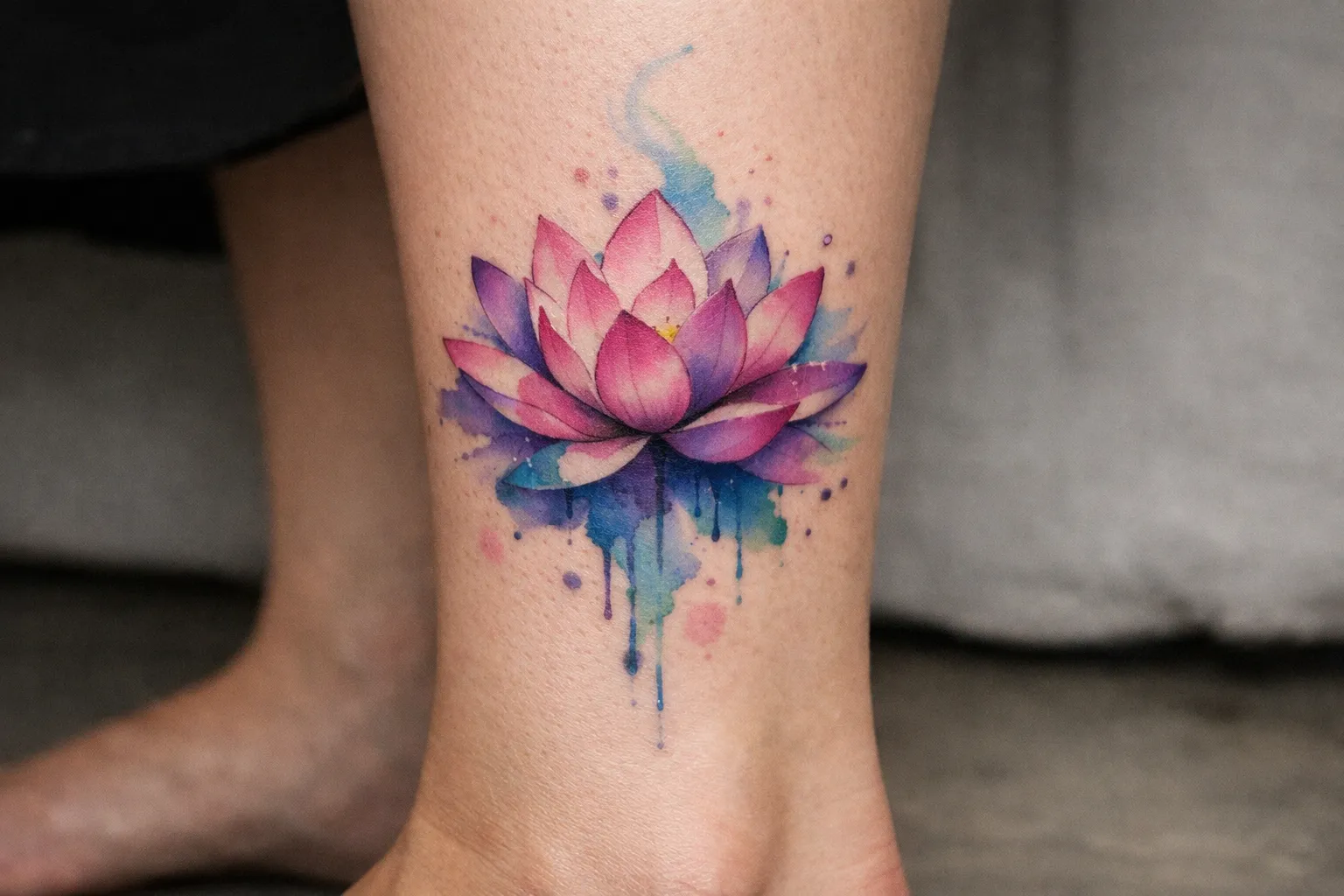
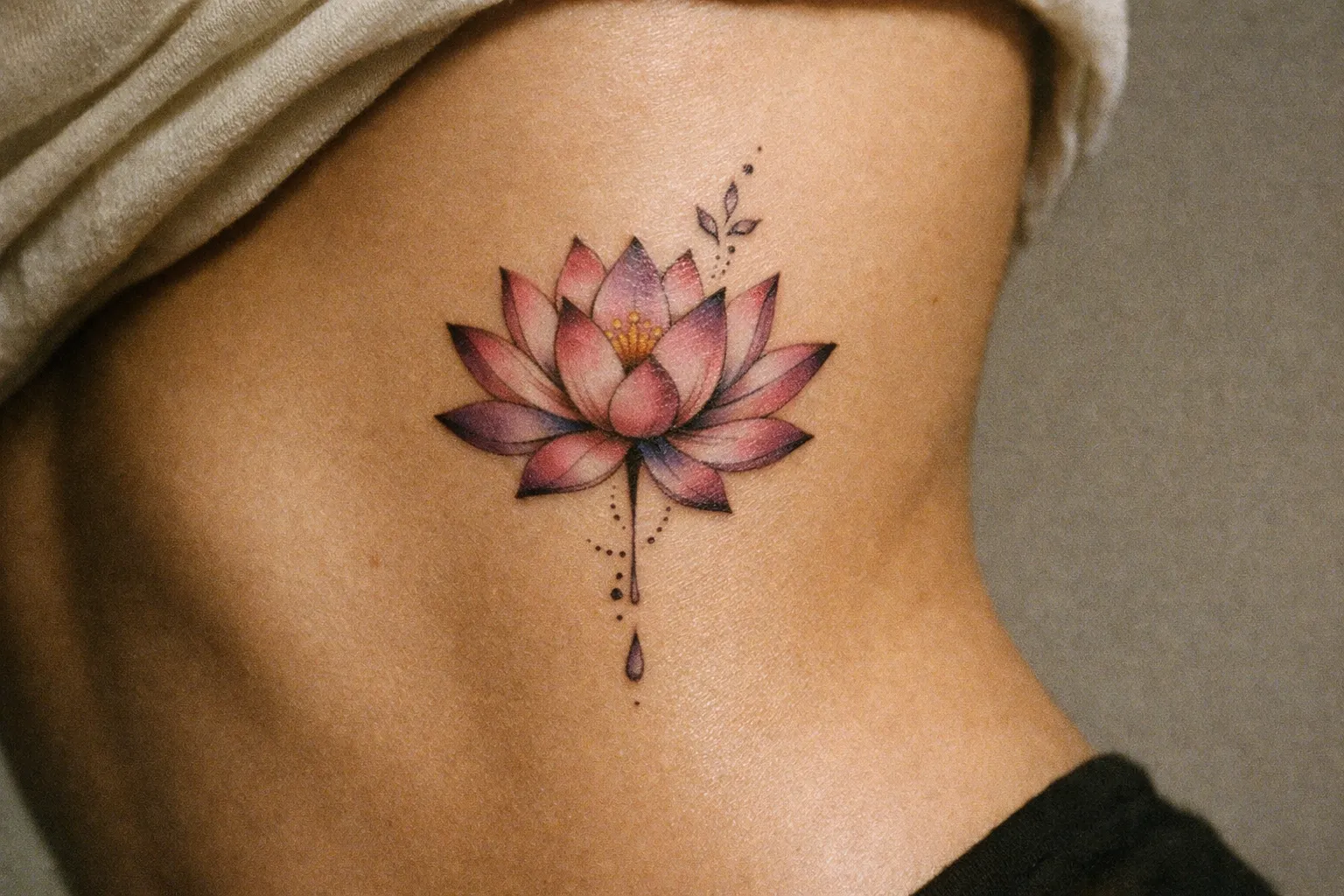
A watercolor lotus flower tattoo mimics paint washes - soft pinks, purples, blues bleeding into each other with no strong black outline. Technical hallmarks: magnum shaders (7M, 9M) for blended fills, often pulled with a rotary pen for soft gradients. The pitfall is built into the style. Without dark anchor lines, watercolor pieces fade noticeably in 3-5 years versus 5-10 years for bold-line designs, especially on sun-exposed skin.
If you want watercolor, add subtle grey linework or dotwork as a structural anchor, keep it off forearms and shins that catch daily sun, and commit to SPF 30+ as a permanent habit. Forearm and upper arm are the cleanest placements for this style. Ankles and feet will fade fastest.
Small Lotus Flower Tattoo
A small lotus flower tattoo is usually 1-2 inches, single-line or few-petal, designed for the wrist, ankle, behind the ear, or inner forearm. Cost runs $60-$150, sessions are under an hour, and pain is minimal on most of these spots - wrist and behind-the-ear sting more than fleshy inner forearm.
The catch: line clarity is everything. A tiny lotus done with too-fine a needle blows out within a year because the skin can’t hold sub-hair-width lines cleanly. Ask for a 3RL rather than a single-needle for longevity. Small does not mean detailed - it means simplified.
Realistic and 3D Lotus Designs
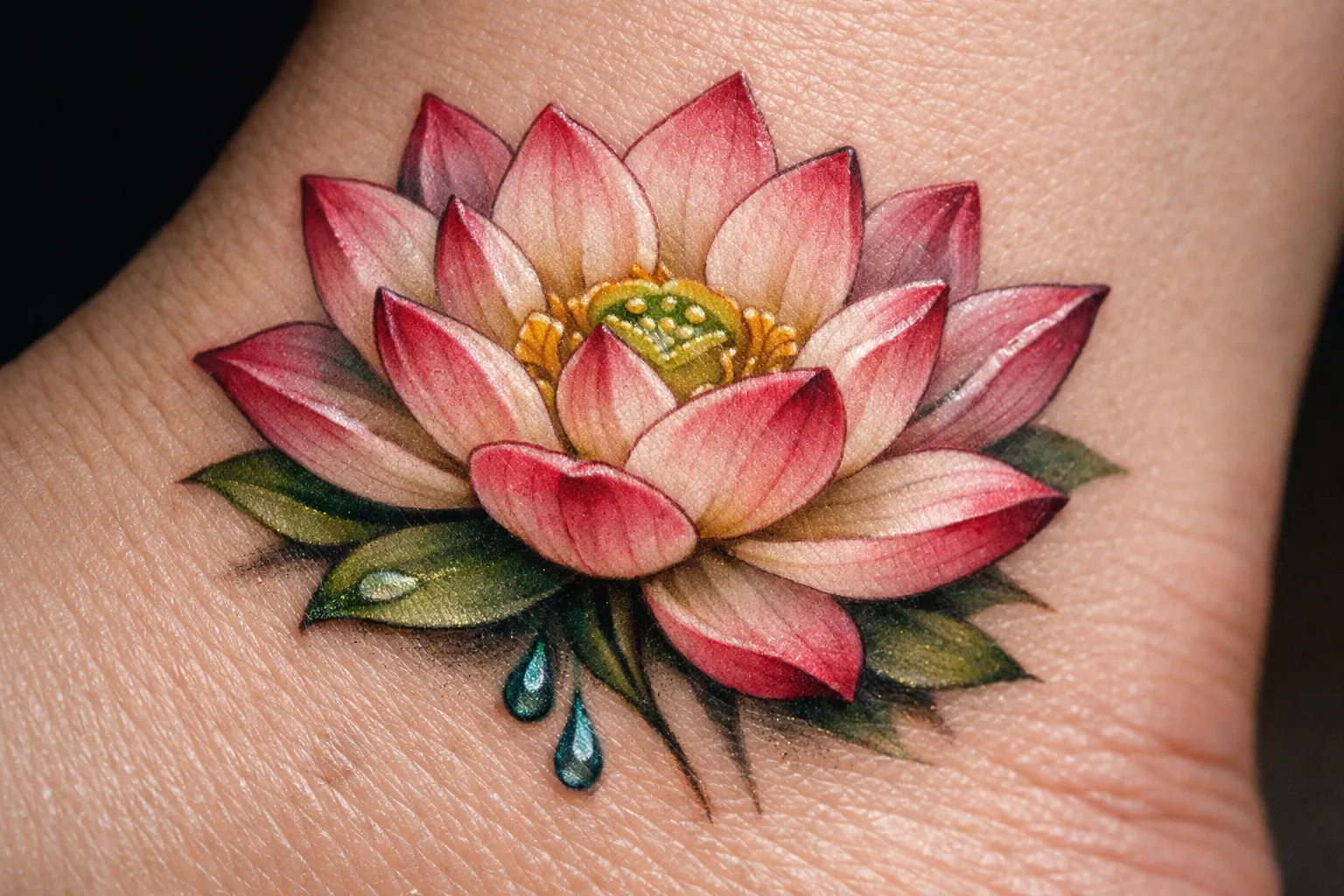
Realistic lotus tattoos use heavy shading, soft gradients, and sometimes water droplet details to push the bloom toward photographic. These need a 5-6 inch (12-15 cm) minimum to hold detail and an artist with a portfolio specifically in botanical realism. Common pitfall: realism done by a traditional or neo-traditional artist looks muddy because the shading approach is entirely different. Check the portfolio before you book.
Geometric and Linework Lotus
Stripped-down geometric lotus designs - triangles, dotwork, single continuous lines - read clean at small sizes and age well because there’s less detail to lose. A solid option as a first tattoo if you want spiritual symbolism without the visual weight of a full mandala.
Lotus + Unalome
The Unalome + lotus combo has surged in popularity. The Unalome - the spiral winding upward to a straight line - represents the path to enlightenment, and the lotus on top represents the awakening at the end. This composition reads vertically, which makes it ideal for spine, sternum, or back-of-neck placements. I’ve drawn this combo more times than I can count, and it works best when the Unalome has real length to breathe - cramming it into 3 inches loses the whole point of the rising line.
Lotus on the Back: Placement and Composition
A lotus flower tattoo on back is the most flexible canvas for this motif because you have the surface area to do detail right. Three common compositions:
- Spine lotus - a vertical Unalome + lotus running down the spine, usually 8-14 inches long. Strong pain on the vertebrae themselves (the bone gives no padding), more bearable on the muscle to either side.
- Upper back mandala - a 6-10 inch mandala lotus centered between the shoulder blades. Lower pain than the spine, easier to sit through in a single session.
- Full-back composition - lotus with koi, water, clouds, or Buddha imagery filling the upper back or extending toward the lower back. Multi-session work, often 6-10+ hours total split over 2-3 sittings spaced 2-4 weeks apart.
A few practical notes from the chair: have the artist mark vertebrae and posture lines, and take photos of you standing and sitting before the stencil goes on. Skin shifts when you move, and a spine lotus that looks symmetrical when you’re hunched will skew when you stand straight. I’ve had to re-stencil more than once because a client’s natural posture was different from how they stood for the initial placement check.
Also think about bra and sports bra straps. Running a detailed petal directly under a strap means years of friction and faster fading on that section. Either go higher or go lower. Don’t straddle the line.
Pricing: a back mandala lotus runs $400-$800, a large watercolor or composition back piece runs $800-$1,500+ depending on detail and city.
Placement and Pain Reality
Pain is relative to placement, not a 1-to-10 score. From most bearable to roughest for a lotus tattoo:
- Outer thigh, outer upper arm, forearm - most bearable. Plenty of muscle, no bone right under the skin. Best first-tattoo placements.
- Upper back, shoulder blade - manageable. Some bone awareness near the scapula but mostly muscle.
- Lower back, hip - moderate. Tolerable for most.
- Ankle, foot, behind the ear, wrist - sharp and bony. Short sessions help because the sting is concentrated.
- Sternum, ribcage, spine - the rough end. Ribcage > forearm by a wide margin. Direct contact with bone, breathing moves the skin, and there’s nowhere for the pain to dissipate.
Healing timeline for any lotus tattoo, regardless of placement:
- Day 1-3 - wrap on for the first few hours per your artist’s instruction, then gentle washes 2-3x daily with fragrance-free soap. Some plasma weeping is normal.
- Week 1 - light flaking and itching starts. Apply a fragrance-free moisturizer thinly. Don’t pick.
- Week 2-4 - outer layer is healed but the skin is still remodeling underneath. Color can look dull and waxy - this is normal, it’ll clear up.
- Week 6-8 - full skin remodeling done. Safe for strong sun, swimming pools, and the ocean.
For the entire healing window: no direct sun, no soaking (baths, hot tubs, lakes, ocean), and loose clothing over the tattoo. After healing, SPF 30+ on the tattoo any time it’s exposed. That’s the single biggest factor in how the piece looks in ten years.
Lotus on the Ankle
The ankle lotus is a category of its own because the placement creates specific problems most people don’t think about until they’re three weeks in. A 1-2 inch ankle lotus flower placed on the side ankle or just above the malleolus (the ankle bone) is the most common request.
Three practical adjustments:
- Place above the bone, not on it. Sitting directly on the malleolus hurts more, heals slower because of constant shoe contact, and fades faster.
- Avoid full ankle wraps. Designs that cross the back of the heel hit the highest friction zone on the body. Expect color loss and a touch-up needed in 1-3 years.
- Schedule for sandal season. Booking an ankle lotus in winter when you’ll be in tight boots for 2-3 weeks of healing is asking for scabbing and color loss. Late spring or summer is ideal.
Pricing: a small ankle lotus runs $120-$250 depending on detail and shop minimum.
Pricing, Sessions, and What to Expect
Current US studio benchmarks for a lotus flower tattoo:
- Shop minimum - $60-$100 for tiny pieces (finger, behind ear, small ankle).
- Small linework lotus - $120-$250, 1-2 hours.
- Medium mandala lotus (forearm, upper back, 4-6 inches) - $250-$600, 2-4 hours at $120-$180/hr.
- Large watercolor or back piece - $600-$1,500+ over 2-3 sessions.
- Tipping - 15-20% on the total is standard in most US shops.
Consultations are usually 15-30 minutes, often free or with a $25-$50 deposit credited to the final piece. For complex work, expect the artist to draw a custom design rather than copy a Pinterest image directly.
Using Pinterest References Without Copying
People walk into consultations holding screenshots from Pinterest and ask for an exact replica. Most reputable artists will refuse, for two reasons: those designs are someone else’s copyrighted work, and a tattoo drawn for someone else’s anatomy won’t fit yours.
The better approach: bring 3-5 lotus references that show what you like - petal shape from one, shading style from another, composition from a third - and let the artist combine them into a custom design that suits your placement, skin tone, and body shape. It also avoids the awkward moment when the original artist sees a copy of their work on Instagram, which happens more than people think.
Lotus and Money Symbolism
A common question - which tattoo attracts money? - gets a real answer with the lotus. The most direct prosperity association is Lakshmi seated on a lotus. Lakshmi is the Hindu goddess of wealth and good fortune, and her iconography almost always includes a lotus, often pink or red. Other prosperity-leaning compositions: lotus growing from a bowl of coins, lotus with gold-leaf shading, or lotus with a prosperity mantra in Sanskrit.
Caveat: if you’re not Hindu and want to use Lakshmi imagery, do the reading first and consider working with an artist who has cultural literacy. A poorly drawn Lakshmi or a misspelled Sanskrit mantra is worse than no symbolism at all.
Lotus in Religious Context - What Different Traditions Say
The lotus is primarily a Hindu, Buddhist, and ancient Egyptian symbol. It does not appear as a central symbol in Christianity, Judaism, or Islam. The Bible doesn’t reference the lotus directly in any doctrinally significant way - references to flowers tend to be lilies, roses, and almond blossoms. So “what does God say about lotus?” depends entirely on which tradition you mean. In Hindu scripture, the lotus is divine and tied to creation (Brahma is depicted emerging from a lotus from Vishnu’s navel). In Buddhist sutras, the lotus represents the awakened mind. In Abrahamic traditions, it carries no theological weight.
If you’re a practicing Christian, Jew, or Muslim getting a lotus tattoo, the symbolism you’re drawing on is aesthetic and cross-cultural rather than scriptural. Worth knowing so you can be clear with yourself and anyone who asks.
The 1/3 Rule in Tattoo Composition
The “1/3 rule” gets thrown around in tattoo communities and means two different things depending on the artist.
Composition rule of thirds: placing the focal point of a design at one-third or two-thirds of the available canvas (a back, an arm, a thigh) rather than dead center creates more visual dynamism. For a back lotus, that means placing the bloom at the upper or lower third of the back rather than centered on the spine - useful for asymmetric or off-center compositions.
Budget rule of thirds: spend roughly one-third of your total project budget on design and consultation for complex multi-session work. Proper planning prevents cover-up costs later, which typically run $500-$1,000+ because cover-ups need to be larger and darker than the original. For a $1,200 back piece, that’s $300-$400 in design and consultation time well spent.
Both versions are guidelines, not laws. A skilled artist will tell you when to break them.
Choosing Your Lotus: Quick Decision Checklist
Before you book, lock in these specifics:
- Meaning - rebirth, spiritual practice, prosperity, mental health recovery, cultural heritage. Be specific.
- Color - white, red, blue, pink, purple, or black-and-grey. Each carries different weight. Like a koi fish tattoo, color choice here is one of the most loaded decisions you’ll make.
- Petal count - eight for the Eightfold Path, chakra-specific counts for yogic symbolism, or aesthetic choice with no fixed number.
- Style - mandala, watercolor, minimalist linework, realistic, geometric, or Unalome combo.
- Size - 1-2 inches small, 4-6 inches medium, 8+ inches large.
- Placement - accounting for pain, fading, friction, and visibility. If you’re leaning toward the arm, the forearm tattoos guide covers aging, pain, and design strategies specific to that canvas.
- Budget - including 15-20% tip and a buffer for one touch-up at 6-12 months. A peeling tattoo in the first two weeks is normal - knowing the stages ahead of time prevents panic and picking, which is the fastest way to lose color.
Frequently Asked Questions
- What does God say about lotus?
- The lotus is not a symbol in Abrahamic scripture (Christianity, Judaism, Islam) - it carries no specific theological position in those traditions. The lotus is sacred in Hinduism (associated with Brahma, Vishnu, Lakshmi, and Ganesha), Buddhism (one of the Eight Auspicious Symbols), and ancient Egyptian religion (tied to the sun and rebirth). If you're getting a lotus from outside those traditions, you're drawing on cross-cultural symbolism rather than religious doctrine.
- What is the 1/3 rule tattoo?
- Two meanings. As a composition principle, it means placing the focal point at one-third or two-thirds of the canvas rather than centered, creating more visual interest. As a budgeting principle, it means allocating roughly one-third of your project budget to design and consultation for complex pieces, which reduces costly cover-ups later.
- Which tattoo attracts money?
- In Hindu symbolism, Lakshmi seated on a lotus is the most direct prosperity image - Lakshmi is the goddess of wealth and good fortune, and the lotus is her primary attribute. Other money-associated designs: lotus growing from coins, gold-shaded lotus, or lotus with prosperity mantras. If you're using deity imagery from a tradition you don't practice, work with an artist familiar with the iconography to avoid errors.
- Does a watercolor lotus tattoo fade faster than a black one?
- Yes. Watercolor designs without strong black outlines fade noticeably in 3-5 years, while bold-line designs with solid color or black-and-grey shading hold up 5-10 years under standard aftercare. Adding subtle grey linework or dotwork to a watercolor piece extends its legibility, and SPF 30+ on the tattoo whenever it's exposed is the single biggest factor in longevity.
- How long does a small lotus tattoo take to heal?
- The outer layer heals in about 2-3 weeks - that's when the flaking stops and the surface looks smooth. Full skin remodeling underneath takes 6-8 weeks, after which you can safely return to strong sun, pools, and the ocean. During healing, keep it out of direct sun, don't soak, and apply fragrance-free moisturizer thinly once flaking begins.