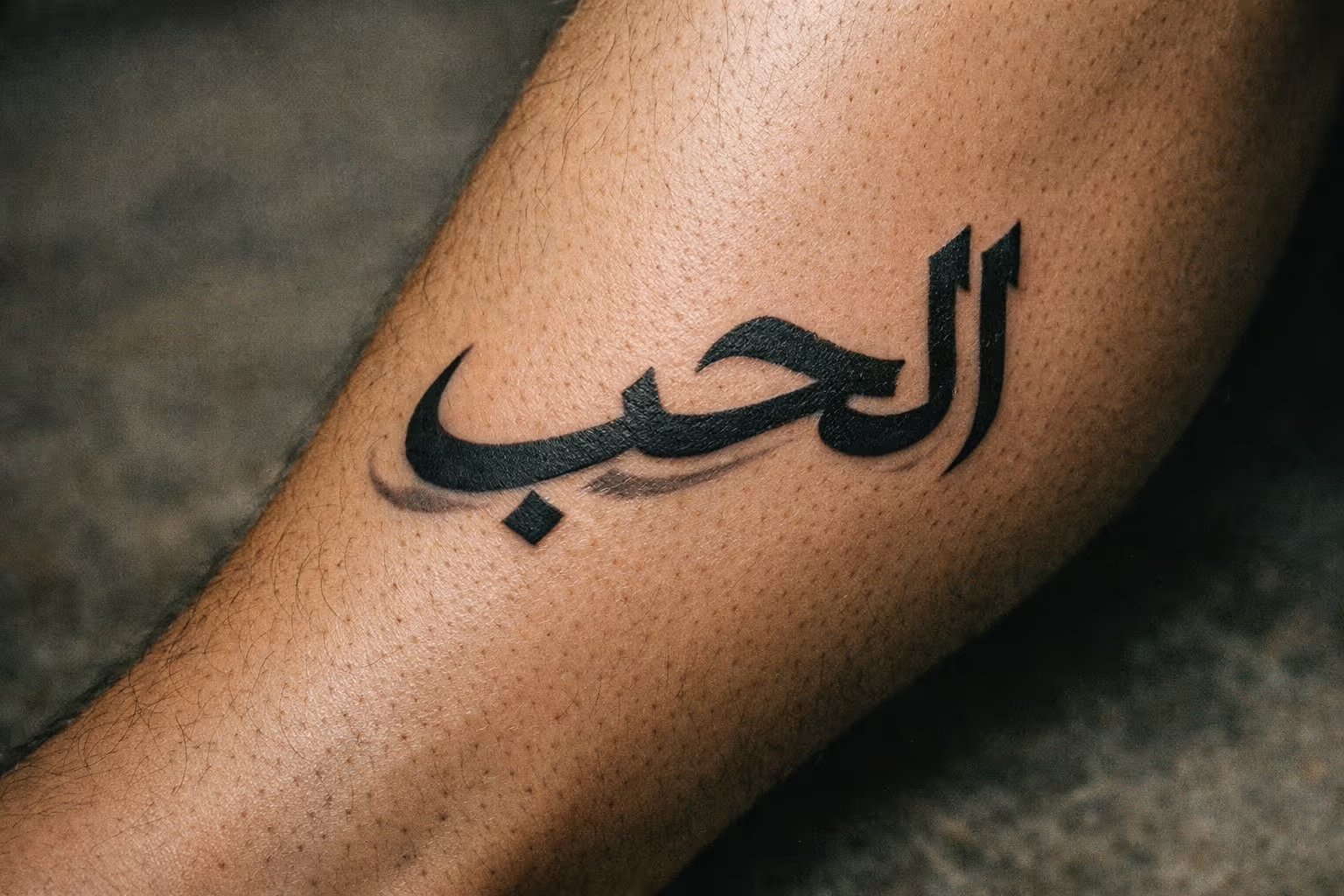
A single Arabic word packs more meaning than it looks like at first glance, which is why Arabic tattoos have become so popular. Arabic is a root-based language: three consonants form a stem that branches into dozens of related words. Take sabr (صبر) - it’s not just “patience” but a whole field of endurance and forbearance. That density is exactly why Arabic tattoos resonate deeply. The script flows naturally along the forearm or down the spine, and it carries specific meaning. But Arabic is a living language spoken by over 400 million people (according to the UN Arabic Language Day 2024 briefing), and it’s surprisingly easy to get the direction, diacritics, or dialect wrong. This guide breaks down the most-requested words and what they really mean, how calligraphy style changes the look and feel, where Arabic script suits the body best, and what you should double-check before the needle hits skin.
✓ Pros
- The right-to-left cursive flow naturally follows body lines - forearm, spine, collarbone - no need for extra framing.
- One word can carry a whole concept, not just a flat dictionary definition.
- For Arab and Muslim diaspora clients, the script connects deeply to family, language, and homeland.
- Flexible sizing: a discreet 3 cm word or a full-back ornamental band both work.
✗ Cons
- Mistranslation is common and permanent. Machine translation often botches gender, diacritics, and idioms.
- Religious and social context matters - permanent tattoos are considered haram by mainstream Islamic scholars, and visible Arabic script can raise eyebrows at borders or workplaces.
- Fine script and diacritics blur faster than bold imagery as skin ages.
- If you can't read or pronounce it, you're wearing something you can't verify - which fuels appropriation critiques.
Why Arabic Tattoos Have Become One of the Most Requested Script Styles
Arabic script has surged in popularity because it combines a naturally flowing cursive form with dense meaning packed into a single word. The connected letters flow right to left, creating a linear shape that fits the forearm, spine, or collarbone without extra framing.
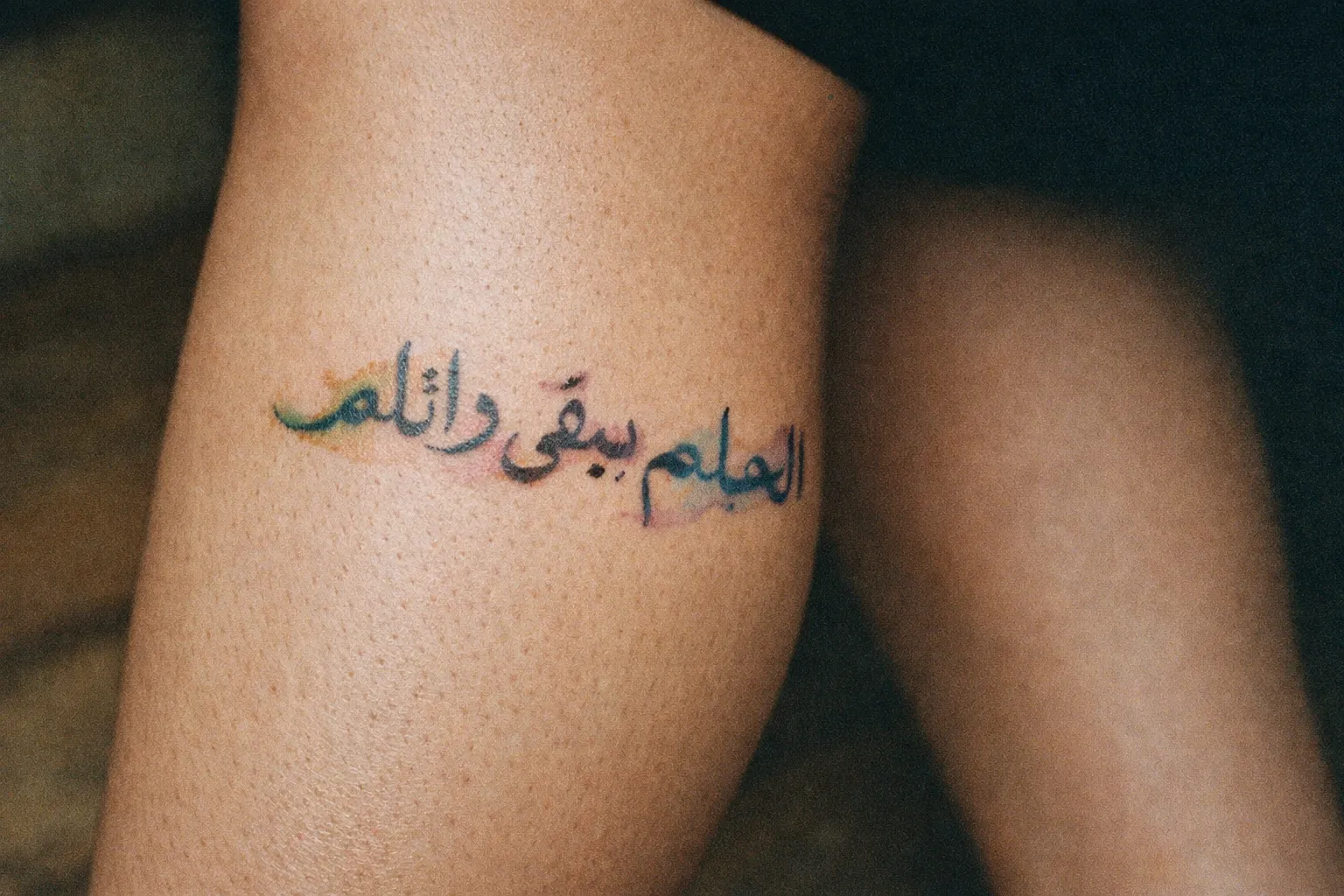
The linguistic structure is a big part of the appeal. The United Nations Group of Experts on Geographical Names points out that Arabic’s consonantal root system lets a three-letter root generate dozens of related words. So a word like sabr (صبر) doesn’t just mean patience but also endurance and forbearance - a semantic cluster, not a single flat meaning.
Most demand comes from the diaspora. Berlin-based Arabic calligrapher eL Seed told me in a 2023 interview that about two-thirds of his commissions come from clients in Europe and North America wanting family names or hometowns. About 60 to 70% of his custom work anchors identity and heritage rather than generic phrases. After the Arab Spring, words like ḥurriyya (freedom) became popular as both personal and political markers among Syrian and wider Arab diaspora clients.
Then there’s the celebrity effect and the aesthetic-first crowd. Plenty of non-Arabic speakers pick the script because it looks striking, with meaning second. That’s where mistakes start.
What Does Rihanna’s Arabic Tattoo Say?
Rihanna’s tattoo reads al-ḥurriyya fi al-Maseeh (الحرية في المسيح), which means “freedom in Christ.” It’s on her left ribcage just below the breast, according to a 2014 Latin Post feature. It’s one of the most searched and copied Arabic tattoos out there. Arabic speakers have debated the exact wording as slightly non-standard, which is a clear warning: copying any celebrity tattoo without independent language review carries risks the original may already have.
Words, Phrases and What They Actually Mean
The most-requested arabic tattoos tend to fall into a few thematic groups. Each word carries connotations a dictionary won’t capture. Below, I list the script, transliteration, literal meaning, and what it signals to a fluent Arabic reader.
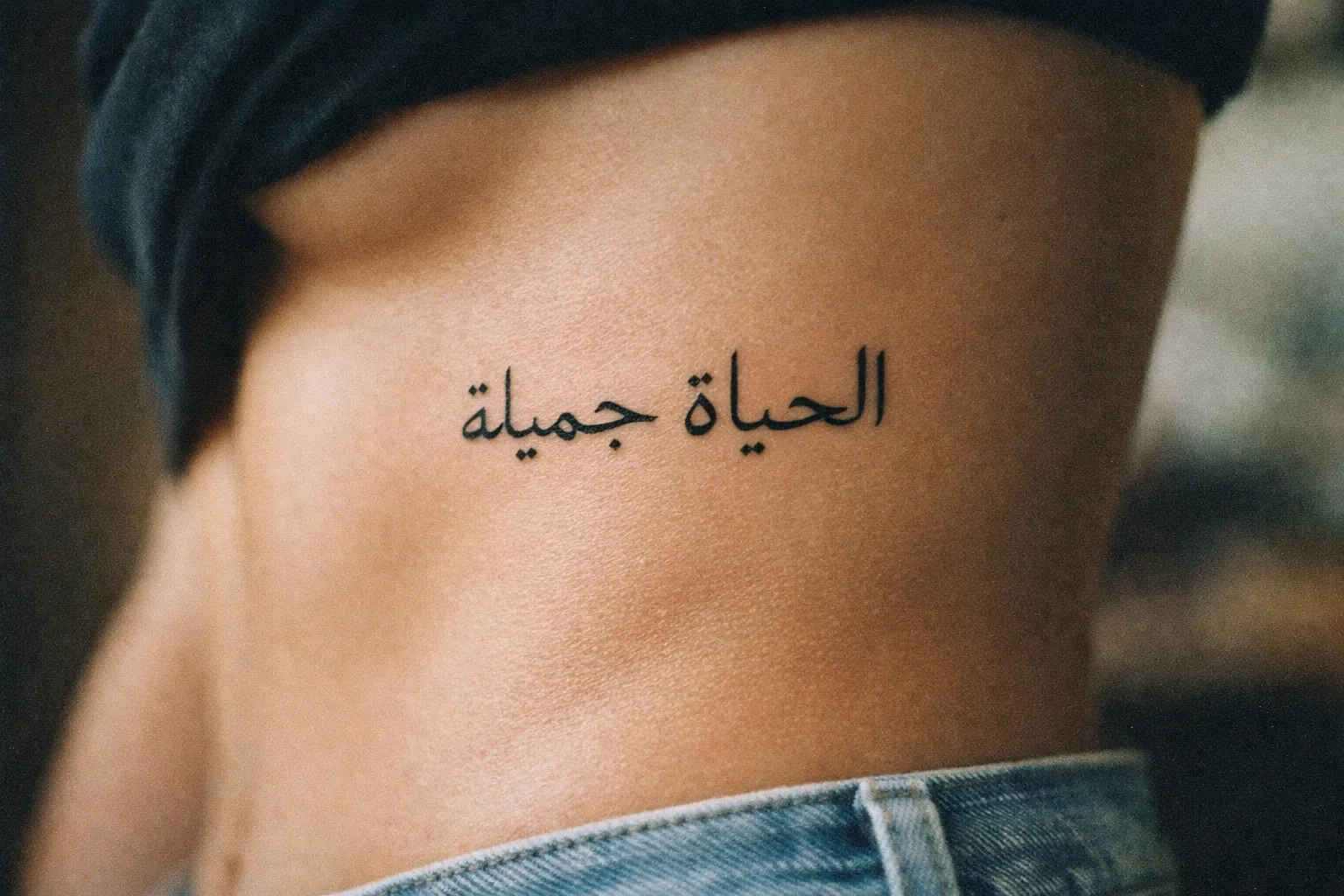
Virtue Words: Sabr, Shukr, Ḥurriyya, Quwwa
- Sabr (صبر) - patience, endurance, forbearance. The Qur’anic Arabic Corpus at the University of Leeds notes ṣabr appears in over 90 Qur’an verses, so what looks like a generic “patience” tattoo carries strong ethical and religious weight. It reads cleanly at 3-5 cm in bold Thuluth style on the forearm or shoulder.
- Shukr (شكر) - gratitude. The King Fahd Complex for the Printing of the Holy Qur’an records shukr and related forms over 40 times in Qur’anic text. So “gratitude” here is anchored in Islamic virtue. Same placement advice as sabr.
- Ḥurriyya (حرية) - freedom. The political and personal meanings differ sharply. Be clear which you mean before you commit.
- Quwwa (قوة) - strength. Frequently mistranslated from English “power.” Confirm if you want physical strength, inner strength, or power - they’re different words in Arabic.
Identity and Heritage Phrases
This is the diaspora’s go-to: family names, children’s names, hometowns. These carry personal, specific meaning and are safer emotionally.
- Kayan (كيان) - “being” or “existence,” recorded by the Arab Ink Project as a self-tribute to one’s own life.
- Waṭan (وطن) - homeland. Strong nationalist resonance; heavier and more political than a neutral “home.”
- ʿĀʾila (عائلة) - family.
Short Quotes and Motivational Lines
- “I suffered, I learned, I changed” - a modern, popular phrase, but one of the most frequently botched in translation (more on that below).
- “If you live, live free” - Levantine origin; the dialect differs from Modern Standard Arabic (MSA).
- “The lemon will bloom” - a metaphor for resilience, meaning good things come from bitter situations. Explain the idiom carefully to your artist.
- Maktūb (مكتوب) - “it is written.” Fatalistic and spiritual, with Qur’anic echoes about destiny.
Some words carry religious weight even when used secularly. Sabr and shukr are Qur’anic virtues, maktūb echoes divine decree. That’s not a reason to avoid them, just know the reader hears those associations. Dialect matters too: ḥubb (حب) means “love” in universal MSA, but habibi (حبيبي) is colloquial Levantine/Egyptian and reads as informal, regional slang to educated speakers.
What to Avoid - and Why
Some choices are wrong from the start.
- Machine-translated phrases. ArabicGenie, a specialist Arabic tattoo translation site, has documented many Pinterest designs of “I suffered, I learned, I changed” with gender mistakes and missing diacritics - broken Arabic that native speakers spot immediately.
- Qur’anic verses below the waist or near sexualized imagery. This is offensive in Muslim contexts no matter the intent.
- Isolated letters. Arabic letters connect in writing; separating them is a classic artist error.
- Copied Pinterest designs. Many widely shared images contain errors that get tattooed repeatedly.
Calligraphy Styles: How the Script Choice Changes the Whole Tattoo
Arabic calligraphy isn’t one font. Each style has strict proportions - the height of the alif, the letter curves - that determine if it reads as true calligraphy or just generic handwriting. Some styles carry religious weight even with secular text. Pick your style before booking, because not every artist can nail every style at tattoo scale.
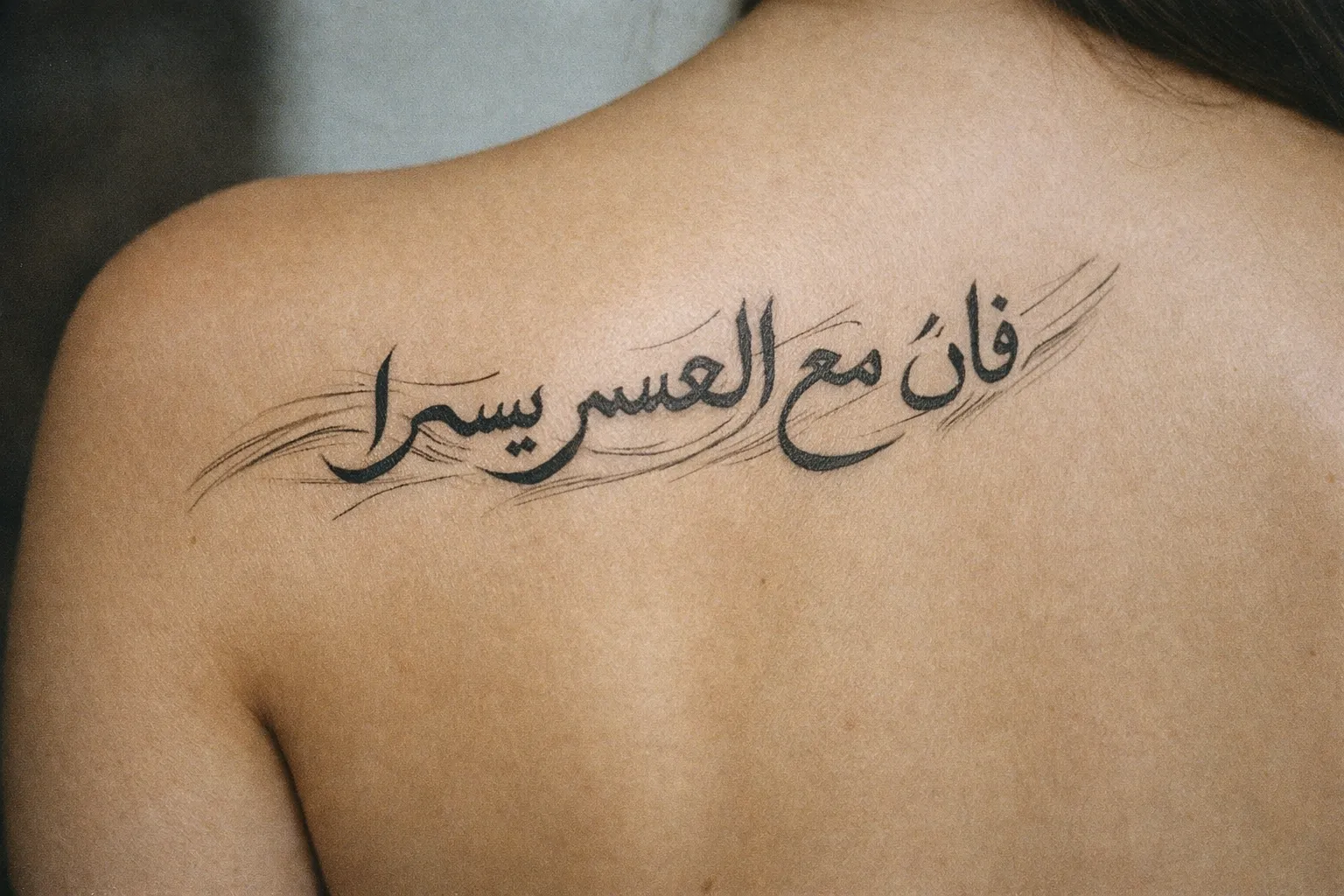
Here’s a quick rundown:
Arabic Calligraphy Styles for Tattoos
| Naskh | Thuluth | Diwani | Kufic | Ruq'ah | Calligraffiti | |
|---|---|---|---|---|---|---|
| Visual Hallmark | Clean, proportional, legible | Ornate, elongated verticals | Highly cursive, looping | Angular, geometric | Informal handwriting style | Bold, expressive, street art hybrid |
| Best Use Case | Longer phrases on forearm or spine | Single-word centerpiece | Decorative single words | Short words, geometric patterns | Personal, intimate pieces | Large areas like back or thigh |
| Minimum Size (cm) | 8-20 | 6-10 | Larger scale only | Varies | Varies | Large scale |
| Cultural Register | Neutral, readable | Classical, religious associations | Aesthetic, less legible | Archaic, Qur'anic | Casual, everyday | Contemporary, less traditional |
The biggest mistake across all styles is shrinking ornate scripts like Thuluth and Diwani too small. The detail that makes them beautiful blurs first.
Placement Guide: Where Arabic Script Actually Works on the Body
Script tattoos have a directionality problem image tattoos don’t. Arabic reads right to left, so horizontal on the forearm looks different than vertical down the spine. You have to plan orientation deliberately. Skin movement matters too. The American Academy of Dermatology notes areas with frequent movement and thin skin - inner wrist, ribcage - blur fine lines faster than flatter, more stable spots like the outer forearm and upper back. That’s critical for keeping diacritics legible.
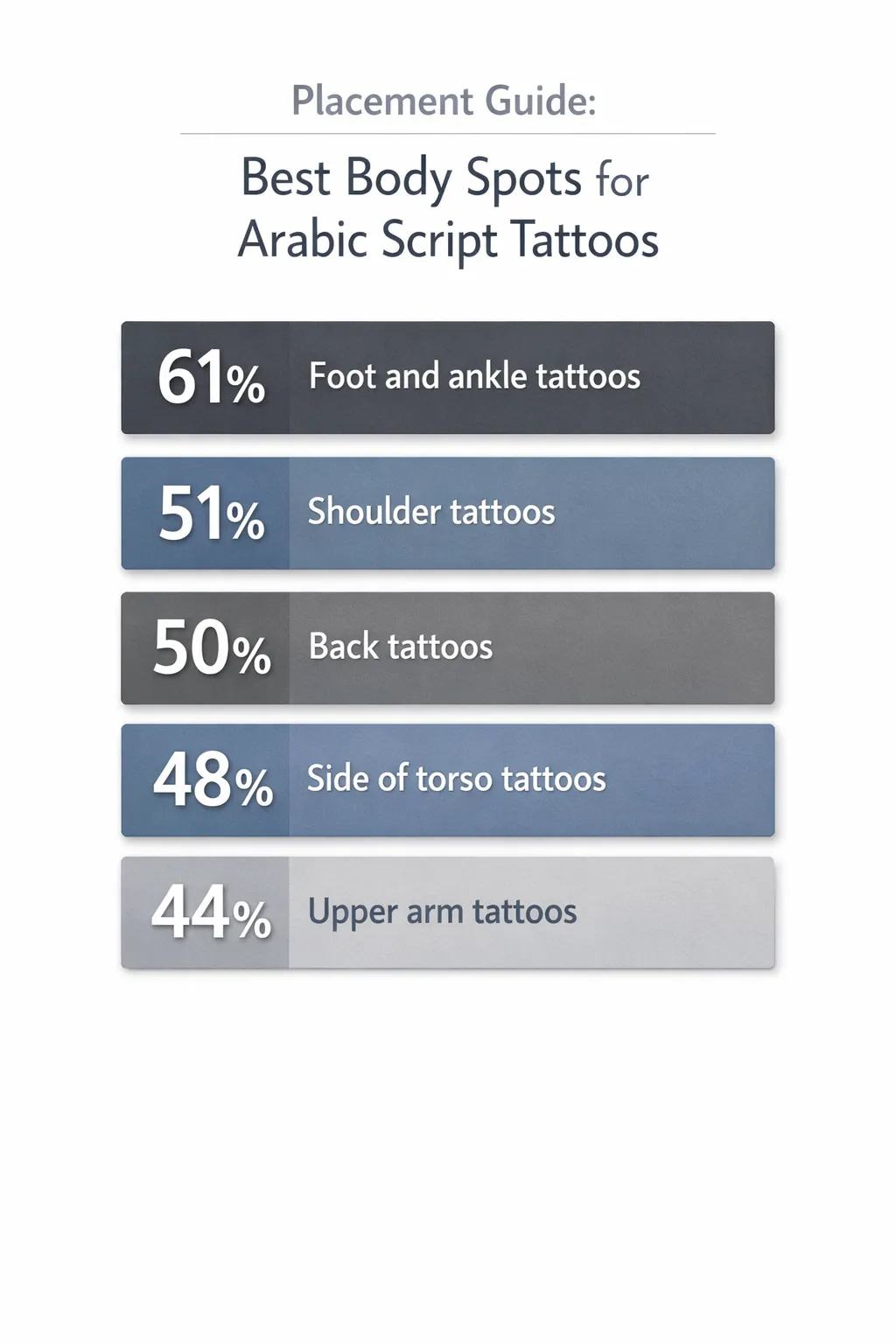 Statista survey of women’s tattoo placement shows: Foot and ankle 61%, Shoulder 51%, Back 50%, Side of torso 48%, Upper arm 44%.
Culturally, if you’re tattooing phrases with religious resonance, placement above the waist is strongly preferred in Muslim contexts. IslamQA highlights that Qur’anic or sacred text on feet or lower legs is considered disrespectful due to proximity to the ground.
A 2023 Statista survey of women’s tattoo placement shows the foot and ankle at 61%, followed by shoulder (51%), back (50%), side of torso (48%), and upper arms (44%). That matches well with where Arabic word tattoos tend to land.
Arabic Tattoos on the Spine
Vertical orientation fits Arabic’s connected letters naturally. A phrase or stacked words read well down the thoracic spine. Plan for 6-20 cm depending on length. Pain is moderate to high over vertebrae. It’s a private spot when covered, but diacritics demand a skilled fine-line artist - the small vowel marks blur first here.
Arabic Tattoos on the Arm
The outer forearm is the most practical arm spot: flat, visible, low distortion, and easier to heal. Horizontal script at 8-15 cm works well. The upper arm suits larger single-word pieces in Thuluth style. The inner forearm hurts more and fades faster, so reserve it for tattoos you’re willing to touch up.
Arabic Tattoos on the Back
The upper back between shoulder blades suits symmetrical single-word centerpieces. The full back works for longer verses or ornamental bands. Avoid lower back for religious text - it’s culturally sensitive.
Collarbone and Sternum
The collarbone follows the natural body curve and fits short phrases (four to eight words) in Naskh. The sternum delivers a strong visual but high pain - ribcage hurts more than forearm - and heals slowly. Budget time for both the session and aftercare.
Ankle and Foot
Statistically the most popular but the worst for longevity. Fine script blurs faster due to shoe friction and sun exposure. The TryTattoo 2026 aftercare guide notes unprotected tattoos lose 30-50% intensity over 10 years versus 5-10% with consistent SPF 50. The ankle is hard to protect regularly. Plan for touch-ups.
The Cultural and Religious Context You Need to Understand First
Arabic is the primary language for over 400 million people (UN Arabic Language Day 2024). Choosing it just for decoration, without knowing its weight, involves the linguistic identity of a population comparable in size to the EU. That’s the core of the appropriation critique - and it’s specific. A 2020 Al Jazeera opinion piece quoted Arab commentators criticizing non-Arab clients who can’t read or pronounce their tattoos, calling it “orientalizing” - treating the script as pure decoration with no regard for meaning.
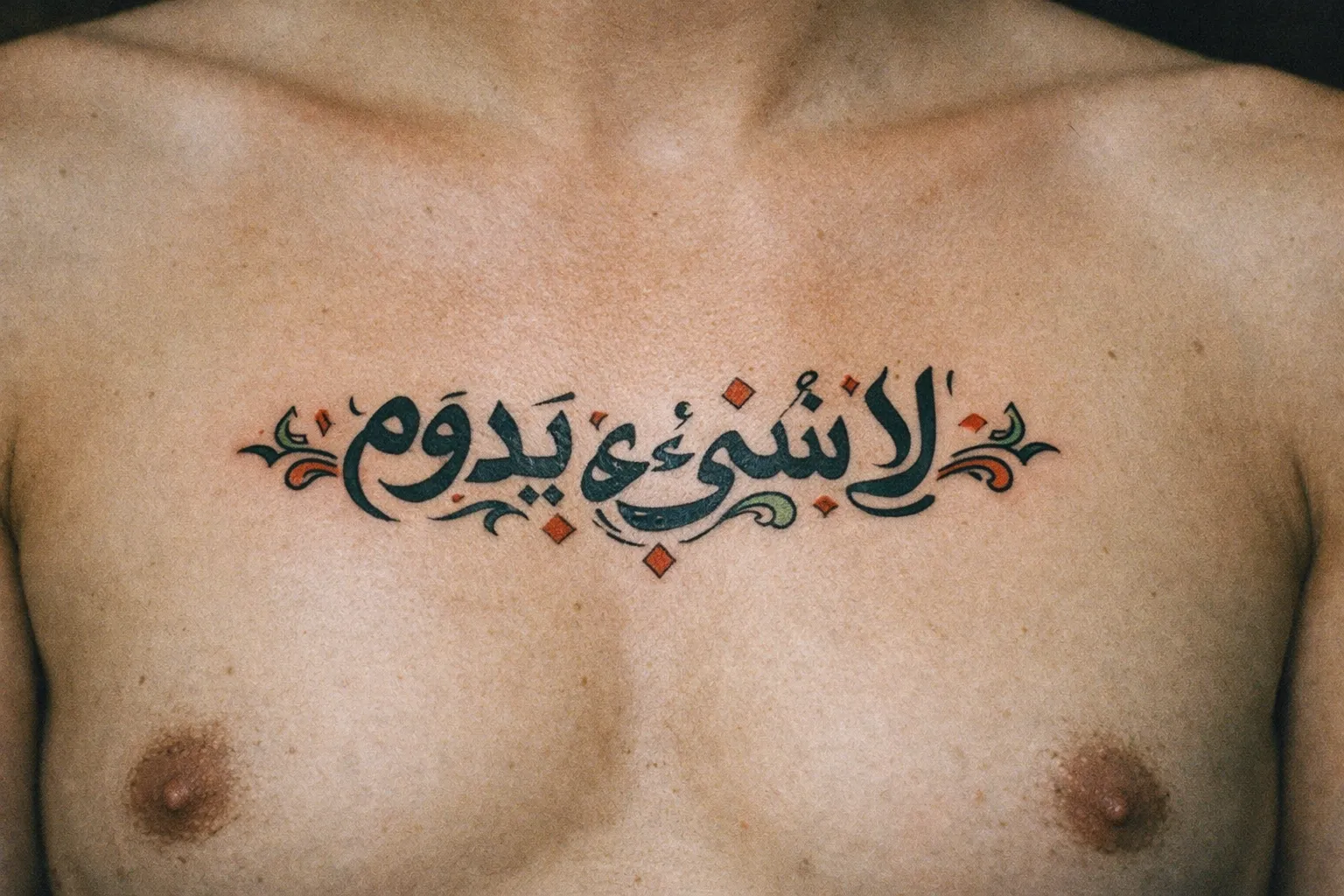
On the flip side, tattooing isn’t foreign to Arab culture. The Journal of Anthropological Research documents tattooing among pre-Islamic Arab and Levantine communities over 3,000 years ago, marking life stages, tribal ties, and protection.
The religious position is the bigger challenge for many. IslamQA states permanent tattoos are considered haram (forbidden) in mainstream Sunni law, while temporary adornments like henna are allowed. That’s how many Muslim clients navigate the choice.
There are practical social consequences too. Visible Arabic script can attract attention at borders, affect jobs, or cause family tension. Factor that in when picking placement.
Heritage Tattoos vs. Aesthetic-Only Tattoos
There’s a clear difference between an Arab diaspora client tattooing a grandmother’s name or hometown to reclaim identity, and a non-Arabic speaker picking the script just because it looks good. Both are valid starting points but require different levels of due diligence. If you don’t speak the language, your verification burden is higher - you’re relying entirely on others to confirm what you wear permanently.
If the Words Have Religious Resonance
Many clients pick virtue words - sabr, shukr - with Qur’anic roots but no direct scripture. Tattooing actual Qur’anic verses raises more theological concerns even among Muslims who accept tattoos. IslamQA specifically warns against inscribing Qur’anic verses on body parts that might be exposed to impurity or disrespect. If faith is your reason, virtue words are a safer bet.
How to Commission an Arabic Tattoo Without Getting It Wrong
The reliable way uses two specialists - a professional Arabic calligrapher for the design and a tattooist experienced with Arabic script for execution. ArabicGenie notes these roles rarely overlap and separating them cuts spelling and connection errors. Here’s the workflow:
How to Commission an Arabic Tattoo Without Getting It Wrong
About 1.5 hours of active work plus design timeStep-by-step process from concept to healed tattoo
- 1
Define your theme and wording in English
Write out your intended meaning clearly - resilience, family, faith, or a specific phrase - before approaching anyone.
- 2
Work with a fluent Arabic speaker or professional calligrapher
Avoid Google Translate. Request 1-3 versions reflecting nuance, like political vs. inner freedom for ḥurriyya.
- 3
Request a fully vowelled version (with diacritics/ḥarakāt)
Even if tattooing minimal script, the vowelled version confirms exact pronunciation and meaning.
- 4
Choose your calligraphy style
Decide on Naskh, Thuluth, Kufic, etc., before booking a tattooist to ensure they can execute it.
- 5
Verify direction and letter connections on the stencil
Arabic reads right to left; letters must join correctly. Have a fluent speaker check before tattooing.
- 6
Test readability at scale
Print the design at 100%, 75%, and 50%. If readable at arm's length at smallest size, it will age better.
- 7
Book a tattooist with proven Arabic script experience
Ask for healed photos of script work, not just fresh tattoos. Freehand Arabic from a non-reader is risky.
- 8
Keep the final design documented
Save digital and printed copies with translation and transliteration for future touch-ups or explanations.
Dialect vs. Modern Standard Arabic - Which Should You Use?
Modern Standard Arabic (MSA) is universal and literary; it reads as neutral and educated across the Arab world. Dialects - Levantine, Egyptian, Gulf - feel more intimate and personal but might be less understood outside their region. If your tattoo is for a specific family or hometown, dialect adds that intimacy. For clean reading anywhere, go MSA.
How Long the Process Takes
Translation and design tweaks usually take 2-14 days, depending on complexity and response times. The TryTattoo 2026 guide says a small single-word tattoo (3-6 cm) takes 15-45 minutes; longer verses or ornamental bands take 1-3 hours or multiple sessions.
How Arabic Script Ages - and What Keeps It Legible Long-Term
Line weight is the biggest factor in whether Arabic script stays legible over decades. The American Academy of Dermatology explains that fine-line tattoos are more prone to blowout and blurring - slight needle depth variations cause pigment to spread under the skin. That hits small details like diacritics hardest. If vowel marks matter, they need heavier linework or a very skilled fine-line artist.
Style matters too. IRCICA’s calligraphy manual notes Naskh executed with uniform stroke weight and stable proportions scales better than ornate scripts like Diwani, which rely on overlapping fine curves. That’s why calligraphers recommend Naskh for small pieces and reserve Diwani for larger ones.
Placement matters as well. Dermatologists writing in the Journal of Clinical and Aesthetic Dermatology say tattoos on low-movement areas like outer forearm and upper back hold line definition better than ankle or inner wrist, where friction and motion blur details faster. Sun is the biggest controllable factor: unprotected tattoos lose 30-50% intensity over 10 years versus 5-10% with consistent SPF 50, per TryTattoo 2026 aftercare.
Healing Timeline for Script Tattoos
- Days 1-3: Keep covered as directed. Wash with fragrance-free antibacterial soap and apply a thin layer of fragrance-free ointment. Avoid soaking - especially important for fine diacritics.
- Week 1 (Days 4-7): Itchy, flaky phase. Do not pick - picking pulls ink from fine lines and vowels first.
- Weeks 2-4: Surface healing finishes; switch to fragrance-free moisturizer. Deeper healing continues up to three months.
- Long-term: Use SPF 30-50 on exposed tattoos and avoid tanning beds. Plan a check at 6-12 months to see if fine lines need touching up.
Minimum Size for Legibility
- Single words in Naskh or Thuluth need 3-5 cm minimum for clean lines. Smaller risks blurring within 3-5 years.
- Short phrases of 4-8 words need 10-20 cm along forearm or spine. Crowding words sacrifices legibility.
- If diacritics are included, add at least 20-30% more space than the base script.
Frequently Asked Questions
- What Arabic tattoos should I avoid?
- Avoid machine-translated phrases, Qur'anic verses below the waist, isolated letters, and Pinterest copies without verification. If you can't explain your tattoo, research more.
- What does a 3 dots tattoo on the finger mean?
- Three dots often reference Latin American gang culture or 'mi vida loca.' They have no specific Arabic meaning; a single Arabic word is more linguistically grounded.
- Can non-Arabic speakers get Arabic tattoos?
- Yes, with proper verification by a fluent speaker, not just translation software. Understand and explain your tattoo accurately.
- Is it disrespectful to tattoo Qur'anic verses?
- Many scholars consider permanent tattoos haram. Tattooing Qur'anic text adds theological debate. Most clients choose virtue words instead.
- How do I find a tattooist who can actually do Arabic script?
- Ask for healed photos of Arabic or non-Latin scripts. Confirm they work from calligrapher designs, not freehand from non-readers.
- Will my Arabic tattoo still be legible in 10 years?
- Depends on line weight, placement, and sun exposure. Bold script on outer forearm or upper back holds best. Plan a 12-month check.
- What are the most popular Arabic tattoo phrases for women?
- *Sabr*, *shukr*, *ḥubb*, *ḥurriyya*, 'I suffered, I learned, I changed,' and family names are top requests with shoulder, collarbone, spine, and torso placements.
Before You Book: The Three Things That Actually Matter
Whether your Arabic tattoo lasts and reads well comes down to three choices:
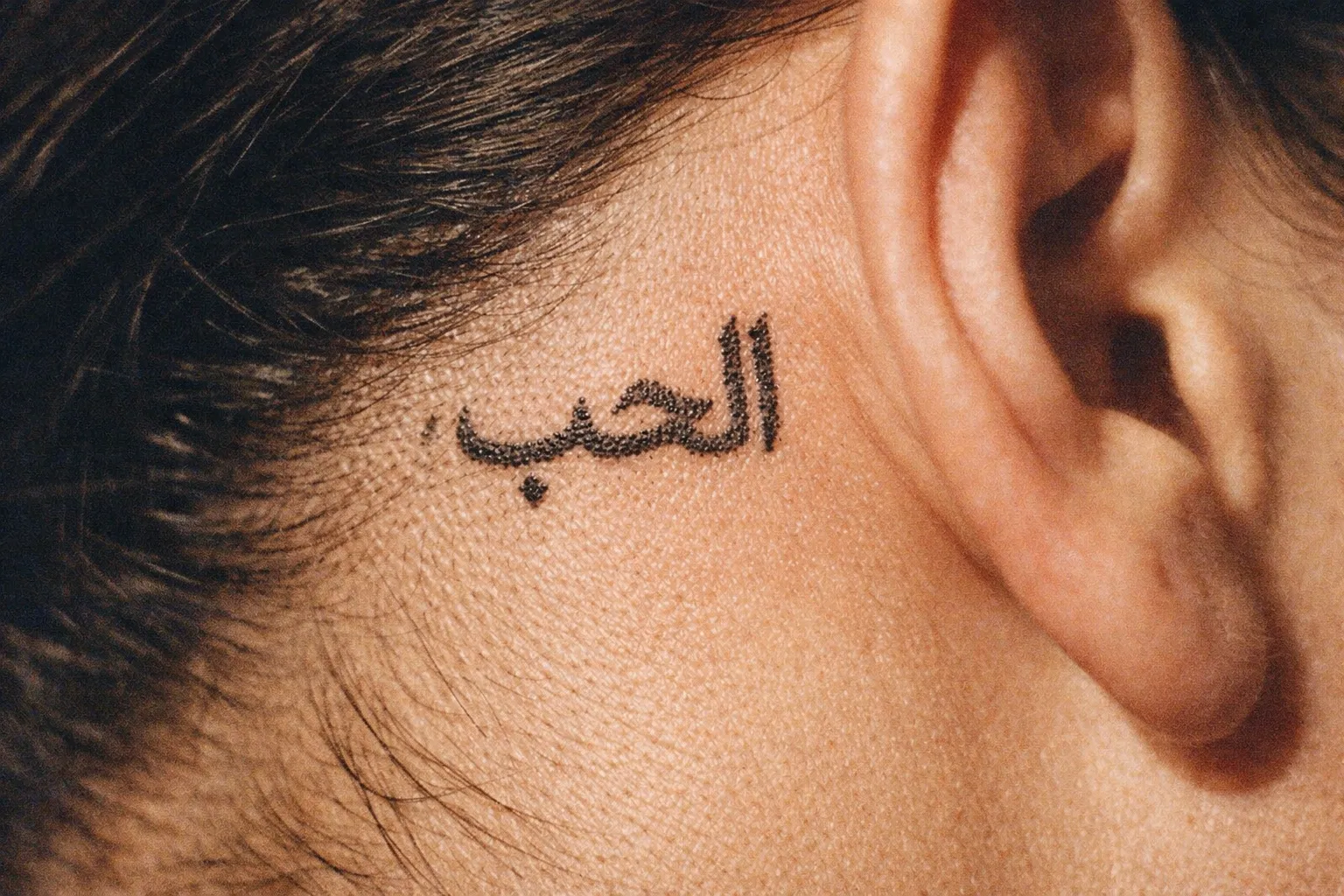
- Language verification. At least one fluent speaker, ideally a professional calligrapher. Never trust a translation app alone.
- Placement vs. life context. Where it sits relative to your work, family, and cultural environment - religious text should stay above the waist.
- Artist selection. Ask for healed script photos, not just fresh tattoos. Confirm they’re working from a verified design file, not freehanding something they can’t read.
Arabic script is visually compelling and rich in meaning. But it’s also a living language that people will read and understand exactly. Make sure you do too.