A henna tattoo is one of the safest ways to wear a design - plant paste, no needles, gone in a couple of weeks - which is exactly why the words “black henna” should stop you cold. That darker version often contains PPD, a dye that can chemically burn and scar skin for life. Genuine henna is different: it peaks in color 24 to 48 hours after the paste comes off and fades on its own. Here’s how long it lasts by placement, and how to spot the dangerous kind before it touches you.
What is a henna tattoo and how does it work?
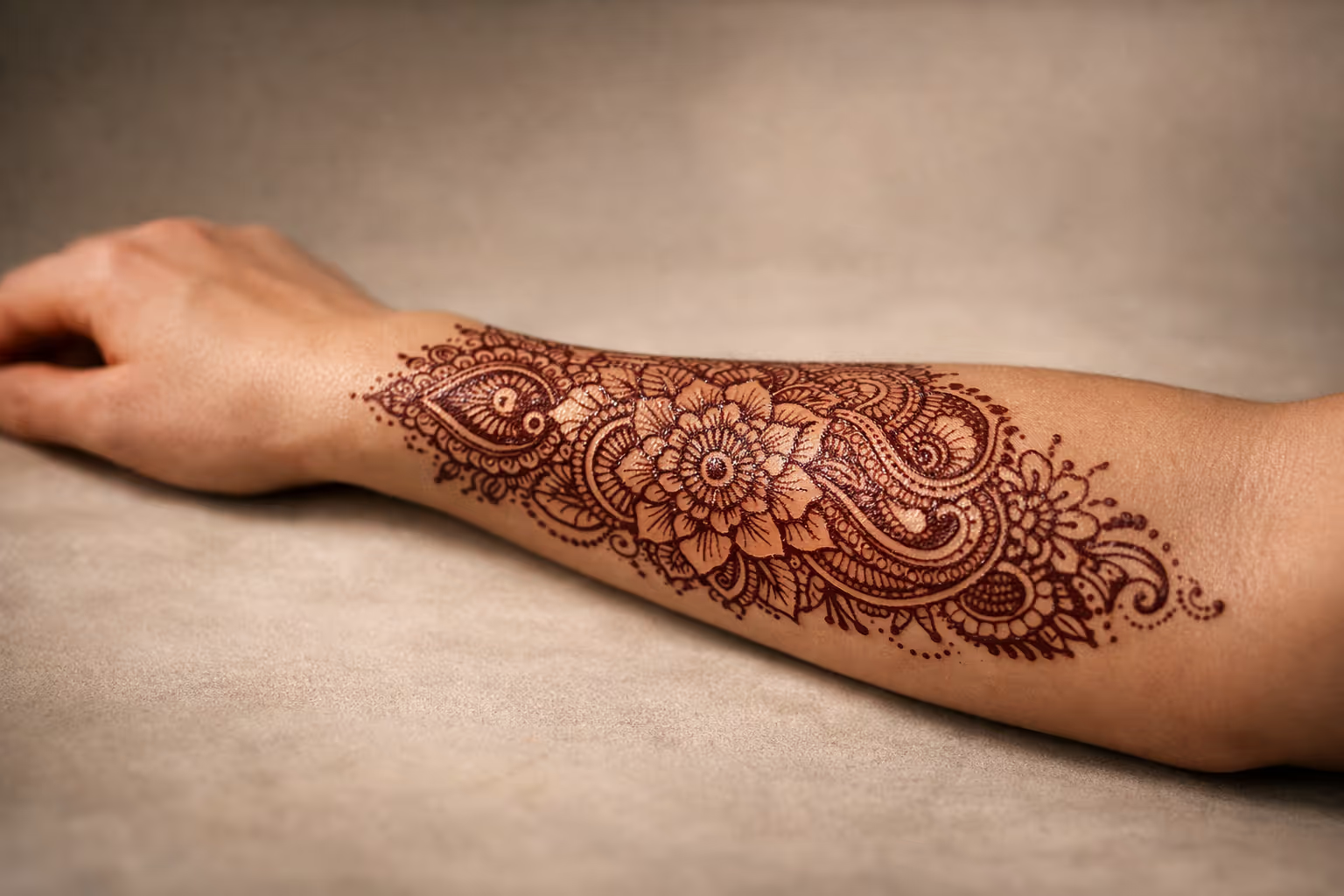
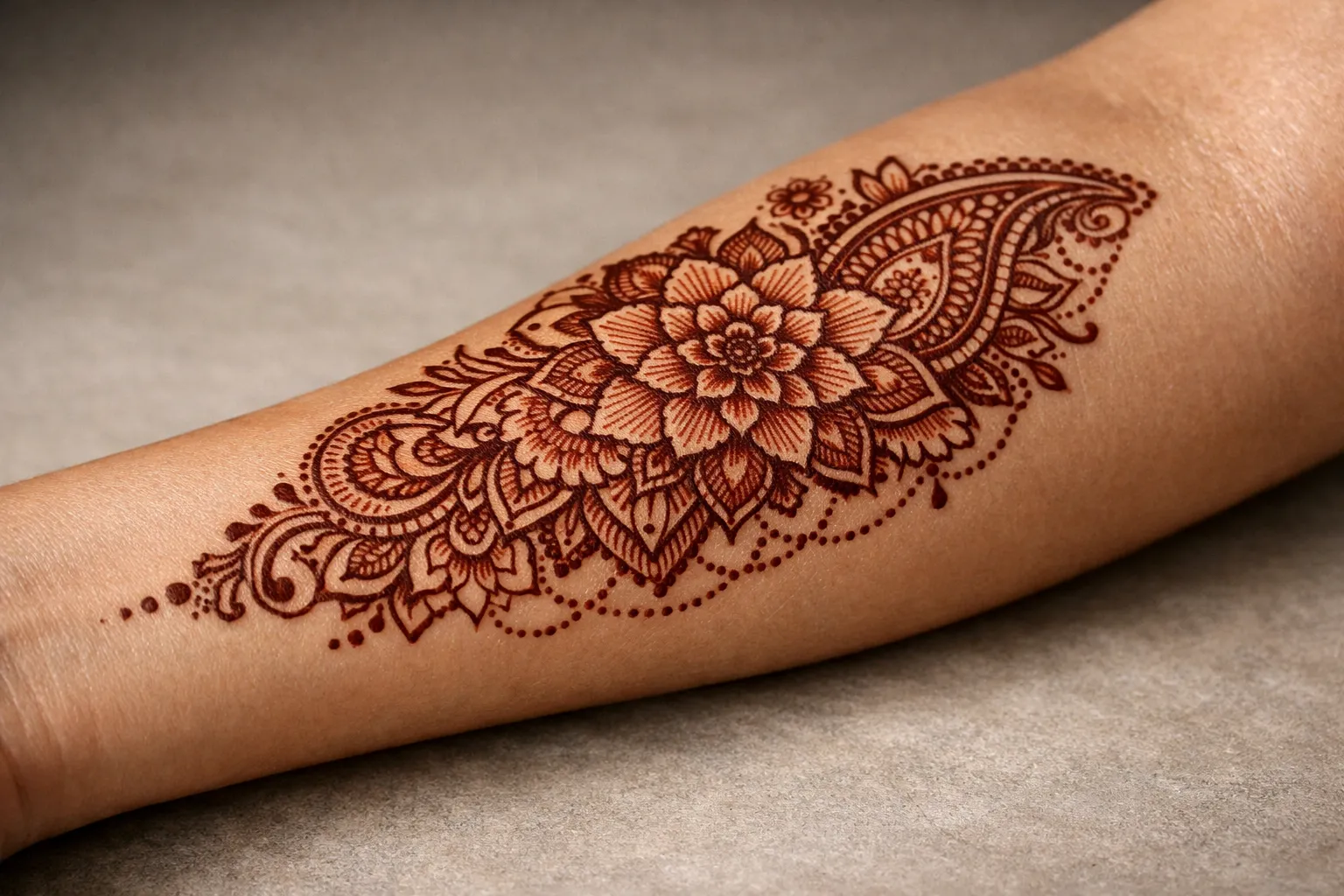
A henna tattoo is created using henna, or mehndi as it’s often called, which is a powder made from the leaves of the Lawsonia inermis plant. The active dye molecule - lawsone - binds to keratin in the outer layer of your skin. That’s why henna is temporary and doesn’t require needles. (1)(2)
Here are a couple of practical points that save people from bad expectations:
- Natural henna stains orange to reddish-brown. It does not stain jet black. (1)(3)
- Henna’s active molecule, lawsone, penetrates into and binds to keratin within the stratum corneum - it’s not just sitting on the surface, which is why it fades as those bound skin cells exfoliate. (2)(3)
- It’s been used for body art and dyeing for thousands of years across South Asia, North Africa, and the Middle East - not some new “festival trend” even if that’s how you discovered it. (1)(4)
Cultural meaning (and why “one meaning” is usually fake)
In Hindu and Islamic traditions, henna is tied to weddings, religious holidays, and major life milestones - usually symbolizing celebration, blessing, and protection. (4) In Western tattoo culture, people often use it as:
- a low-commitment way to test tattoo placement before going permanent,
- matching body art for special events,
- or simply because geometric patterns look good on hands.
All legit reasons. Just don’t treat any motif as having a single fixed meaning across every culture and time.
Duration and fading: how long does it last realistically?
Natural henna generally sticks around for 1-3 weeks (7-21 days). (1)(2)(4) Some health authorities note it can last up to a couple of months in rare cases - usually on thick-skinned areas with careful protection. (Western Australia Department of Health) (3)
Color timeline: what “lasting” actually looks like
- Right after paste removal: light orange
- 24-48 hours: darkens significantly
- Day 2-3: peak color
- After that: fades gradually until gone (1)
If you’re aiming for an event, get your henna done 24-48 hours before so it hits peak color right when you want it.
Duration based on body part (realistic ranges)
Placement is the biggest factor you can control.
- Palms & fingers: often 10-20 days (darkest stain; thick keratin)
- Soles/tops of feet & toes: often 10-20 days
- Back of hands: about 7-14 days
- Wrists & inner forearm: about 7-10 days (lots of washing and friction)
- Upper arm, chest, back, neck: about 3-7 days (thinner skin and faster turnover)
High-friction spots like knuckles, elbows, and waistband areas blur and fade faster - not because the henna is bad, but because your body treats these areas like sandpaper.
Factors that speed up fading
- frequent hot showers and long baths
- swimming (chlorine plus soaking)
- exfoliating scrubs or loofahs
- constant handwashing or sanitizer (hands fade first - always)
- oily lotion applied before henna (blocks staining)
How to care for your henna
Good aftercare starts before you even put the paste on. Henna rewards planning. If you want a deeper look at how skin heals around any body art, the tattoo aftercare principles around moisture, friction, and sun protection apply here too.
Before application (the prep that actually matters)
- Wash and degrease the skin with soap and water, then a swipe of alcohol or hand sanitizer. Skip lotion.
- If you’re sensitive, do a patch test: a small dot on your inner arm, wait 24-48 hours. (Medical reviews warn about reactions from adulterated products - don’t gamble.) (8)
During application (contact time = color depth)
- Let the paste dry 15-30 minutes before moving around. (6)
- Keep paste on for at least 3-4 hours; overnight (6-8+ hours) gives the deepest stain, especially on hands and feet. (4)(6)
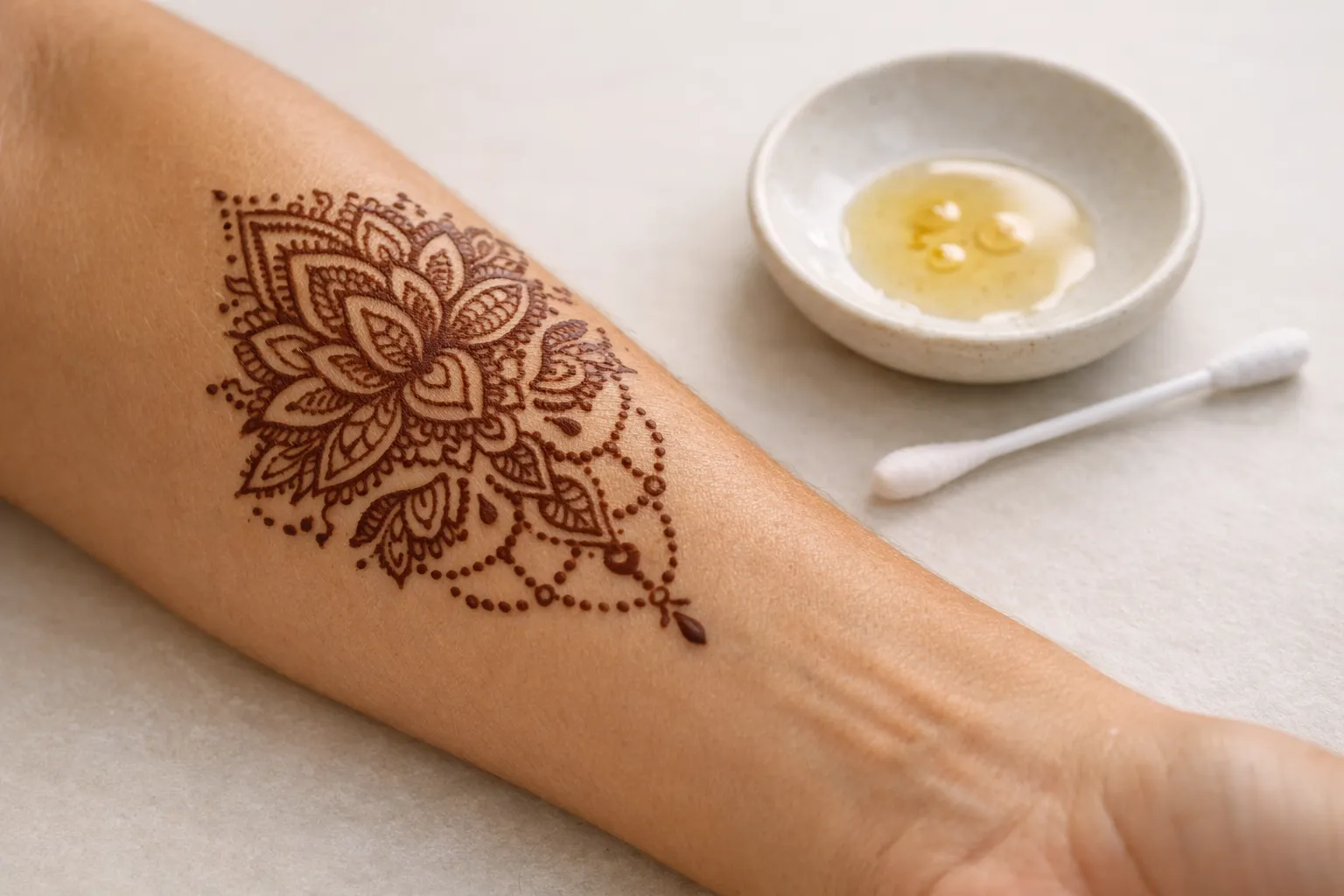
The sealant method (lemon + sugar, but do it right)
Mix a simple sealant:
- 1:1 fresh lemon juice + white sugar until syrupy
How to use it:
- Dab (don’t soak) with a cotton swab once the paste is touch-dry.
- Re-dab if the paste starts cracking or flaking.
Why bother? It keeps the paste stuck longer, which usually means a darker stain and longer wear.
Skip bottled lemon juice if it irritates you or contains preservatives that make your skin angry. Fresh lemon is easier to control.
After paste removal (don’t rinse it off)
- Scrape dried paste off gently (a credit card edge works).
- Avoid water for 8-12 hours if you want maximum darkness. (4)(6)
- Then treat it like a stain you want to protect: moisturize and reduce friction.
Ongoing care (the “make it last” routine)
- Use a fragrance-free moisturizer or a simple oil (coconut, olive, sesame) after showering. Oils also act as a barrier before washing dishes.
- Cover it with sun-protective clothing when you’re in the sun. UV rays won’t help your stain look better.
Common mistakes that cause weak stains
- removing paste too soon (under 30-60 minutes)
- washing the area right after paste removal
- using old, stale cones stored at room temperature for months
- applying on elbows or knees and expecting crisp details to stay sharp
Typical placements and sizing
People usually pick placement based on tradition, visibility, and how long they want the stain to last.
Best placements for bold color and longevity
- Palms and fingers
- Feet (soles and tops) and toes (4)
If you want the darkest, longest-lasting henna, start here.
Good “everyday” placements (still decent longevity)
- Back of hand
- Wrist cuff
- Inner forearm (great if you want to preview a future permanent forearm tattoo)
If you’re doing your first DIY, try a design in the 2-4 in / 5-10 cm range on the inner forearm. It’s a flat surface and you can get cone control without committing to a full hand.
Placements that fade fast (not wrong, just realistic)
- upper arm, shoulder cap
- chest/sternum
- neck/face
These spots tend to look lighter and disappear sooner because the skin is thinner or the area gets washed and rubbed more.
How much does it cost?
Prices vary widely, so think in tiers:
- Single pre-made cone: usually $2-$5 (online or beauty stores)
- henna tattoo kit: typically $15-$40 depending on cones and tools included
- Professional small design (wrist/hand accent): commonly $20-$60
- Bridal/full hands + feet: often $150-$500+ depending on region, detail, and time (3-6 hour sessions are normal for bridal sets)
If someone offers a “black stain that develops in 10 minutes” for cheap at a beach kiosk, you’re not getting a bargain - you’re risking a reaction. More on that below.
What you actually need in a henna kit (and what’s optional)
A henna tattoo kit is handy if you want predictable results without buying pro supplies. But it only works if the paste is fresh and ingredients are clear.
Minimum kit checklist (for clean lines)
- body-art-quality henna powder (Lawsonia inermis) or fresh cones
- applicator cones or fine-tip bottles
- alcohol wipes or sanitizer for prep
- tissue or cotton swabs for cleanup
- optional but helpful: stencils and practice sheets
DIY paste mixing ratios
A typical artist baseline:
- 1 part henna powder : 0.5-0.75 part liquid (lemon juice or water)
- about 1-2 tsp sugar per 25 g powder
- essential oils (eucalyptus, tea tree) in small amounts to support stain quality (follow safe dilution; don’t dump oils in). (6)
Mixing takes 30-60 minutes, then paste usually needs 4-12 hours resting for dye release, depending on recipe and temperature. (6)
Storage: how not to ruin your paste
- Fresh paste works best quickly.
- Many artists freeze filled cones to keep dye strength for months. Room-temp storage for long periods weakens stains.
Natural henna, black henna, white henna, and jagua: what’s the difference?
This part matters because people get hurt - literally - so let’s keep it simple.
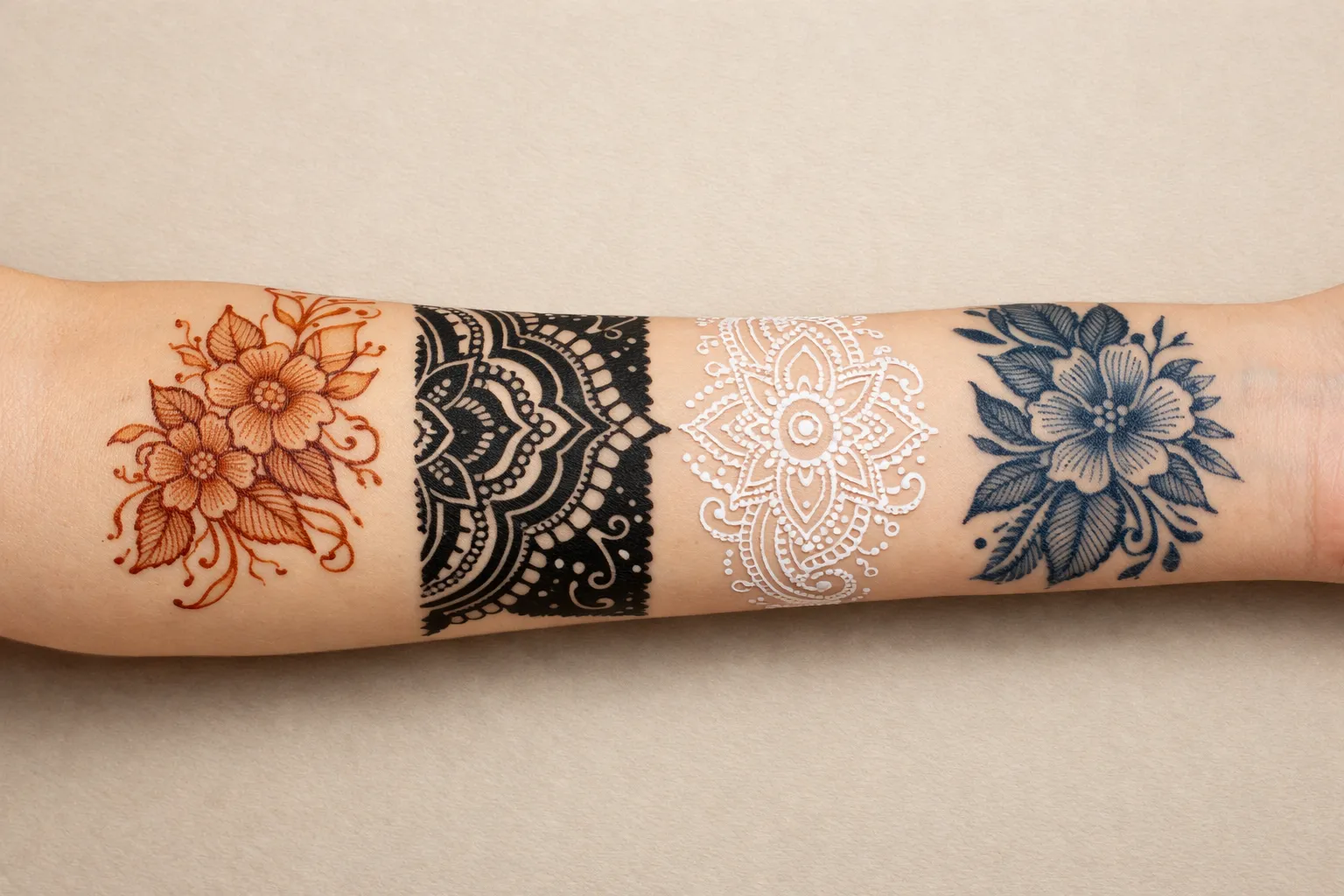
Natural henna (the safe default)
- made from Lawsonia inermis
- stains orange to reddish-brown
- develops over 24-48 hours
- lasts 1-3 weeks (1)(2)
Why I don’t recommend black henna tattoo
A black henna tattoo often isn’t henna at all. It’s usually mixed with para-phenylenediamine (PPD) - a hair dye chemical that can cause severe allergic reactions on skin. Dermatology studies link PPD tattoos to blistering, dermatitis, scarring, and long-term sensitization (meaning future hair dye can cause problems). (8)
The Western Australia Department of Health specifically warns against black henna temporary tattoos because of these risks. (3)
Red flags:
- stains jet black quickly
- “develops in 10-30 minutes”
- unlabeled cones from markets, fairs, or tourist stalls
- vague or missing ingredient lists
If you want a darker look without PPD, jagua (below) is an option - but patch test it first.
White henna tattoo (not actual henna)
A white henna tattoo is usually body paint or cosmetic adhesive with white pigment or glitter. It sits on top of the skin instead of staining it, so it wears off faster than real henna - typically 2-5 days with decent aftercare, though high-friction areas like wrists can push it toward the shorter end.
It can look nice for photoshoots, especially on the collarbone, shoulder, or sternum, but don’t expect it to behave like real henna.
Jagua (often sold alongside henna)
Jagua gel (from Genipa americana) stains blue-black and lasts about 1-2 weeks. It’s not henna but a common alternative if you want a darker temporary stain. Patch test it like anything else.
How to learn henna design
Henna is basically linework practice. If you can control pressure, spacing, and repetition, you can do henna.
Start with line control (before chasing “intricate”)
Practice these on paper first:
- consistent dots (same size and spacing)
- straight lines without wobble
- teardrops or paisley shapes
- simple vines with repeatable curves
When you use a cone, your “needle depth” is pressure. Too much pressure = fat lines and blobs. Too little = skipping and broken lines.
Beginner-friendly placements for practice
- Inner forearm (flat surface, low movement)
- Outer calf
- Upper arm
Start with 2-4 in / 5-10 cm designs so you can finish cleanly.
Learning resources (video is fastest)
Most top tutorials are video for a reason: you need to see paste consistency and hand position. This YouTube step-by-step is a solid baseline for beginners. (6)
Troubleshooting: if your stain is too light
- You removed the paste too early → next time leave it for 3-4+ hours, ideally overnight. (4)(6)
- You washed too soon after removal → try 8-12 hours without water.
- Your cone/paste is old → buy from sellers who list ingredients and production or freeze dates.
- You applied over lotion or oil → prep with alcohol and apply on dry skin.
Popular henna tattoo designs and their best placements
Most henna tattoo designs fit into a few families. Pick based on placement and how detailed you want it to stay.
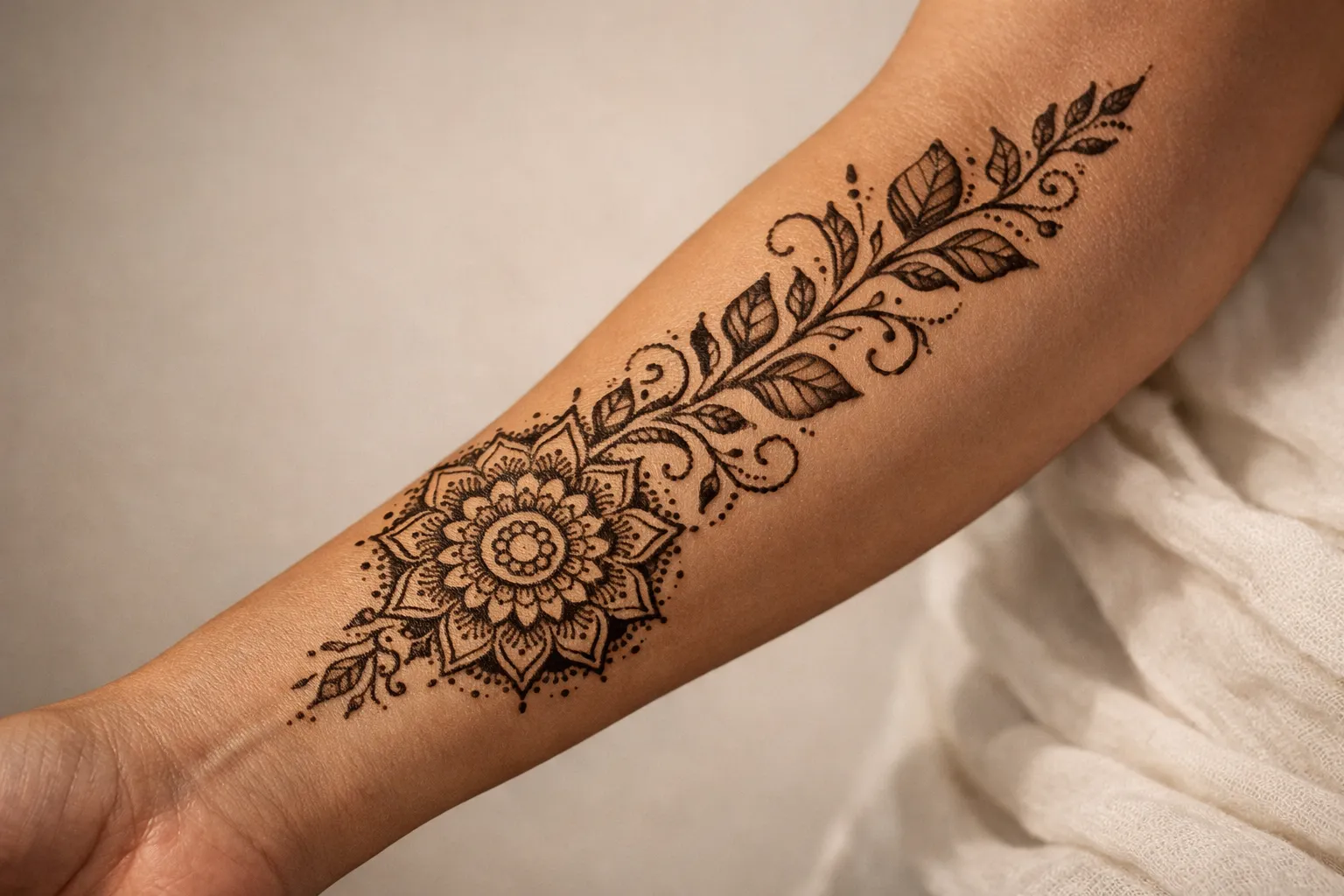
1) Floral vines and finger trails
Best for: hands, wrists, forearms
Why: flows with anatomy and looks decent even as it fades.
A clean choice: a vine wrapping the wrist like a cuff with 1-2 finger trails.
2) Mandalas (palms, backs of hands, elbows if you accept fading)
Best for: palm center, back of hand, inner forearm
Heads up: mandalas show symmetry mistakes fast. Lightly sketch a center point and guide dots before committing.
3) Paisley (South Asian influence)
Best for: hands and feet, side of forearm
Paisleys forgive wobbly lines because they’re layered shapes. The lotus flower tattoo tradition shares similar South Asian roots and pairs well with paisley motifs if you’re considering a permanent complement.
4) Moroccan / geometric panels (North African influence)
Best for: forearm bands, ankle cuffs, back of hand
They rely on crisp edges. Keep spacing a bit wider than you think - you’ll lose fine details faster with wear.
5) Minimal designs for first-timers
If you’re new, go minimalist:
- a small 3-flower cluster on the inner forearm
- a simple sun or mandala on the wrist
- dot-and-line finger accents
Henna isn’t where you learn micro-detail control first.
How to remove it safely
You can’t peel henna off because it’s in the skin’s top layer. Removing it means speeding up exfoliation.
Method 1: gentle exfoliation
- Warm shower
- Mild scrub with washcloth or exfoliating glove
- Don’t scrub raw - irritation looks worse than leftover stain
Method 2: oils to loosen the stain
Oils soften and loosen stained skin:
- olive oil
- coconut oil
Massage in, let sit a few minutes, wipe, then wash.
Reality check: henna fades with skin renewal, which takes about a month, but the visible stain usually disappears sooner depending on placement and care.
Frequently Asked Questions
- Can I get a henna tattoo if I have sensitive skin or allergies?
- Do a patch test 24-48 hours before full application to check for reactions. Avoid black henna due to PPD risks. If you have eczema or known allergies, consult a doctor first.
- Why does my henna tattoo fade faster on some parts of my body?
- Areas with thinner skin or high friction (wrists, elbows, waistband) shed skin faster or get rubbed more, causing quicker fading.
- Is it safe to use black henna or instant black stains?
- No. Black henna often contains PPD, which can cause severe allergic reactions, scarring, and long-term sensitivity. Avoid unlabeled or fast-developing black stains.
- How can I make my henna tattoo last longer?
- Keep paste on for 6-8+ hours, avoid washing for 8-12 hours after removal, use fragrance-free moisturizers or oils, and protect the stain from sun and friction.
- Can I use henna tattoos to preview a permanent tattoo?
- Yes, henna on the inner forearm or wrist is a good low-commitment way to test placement and design before committing to permanent ink.
- What's the difference between white henna and natural henna?
- White henna is body paint or adhesive with pigment sitting on top of skin and lasts 1-3 days. Natural henna stains the skin and lasts 1-3 weeks.
- How do I store henna paste or cones for best results?
- Fresh paste is best used quickly. Freeze filled cones to keep dye potency for months; room temperature storage weakens stains.
Conclusion
If you want a henna tattoo that’s dark, crisp, and actually lasts, pick the right placement (palms or feet for longevity, inner forearm for a simple first design), keep paste on for 3-8+ hours, and avoid water for 8-12 hours after removal. Expect 7-21 days from natural henna and treat “instant black” stains as a warning sign, not a feature. Your results come down to craft: fresh paste, clean prep, long contact time, and low friction afterward.