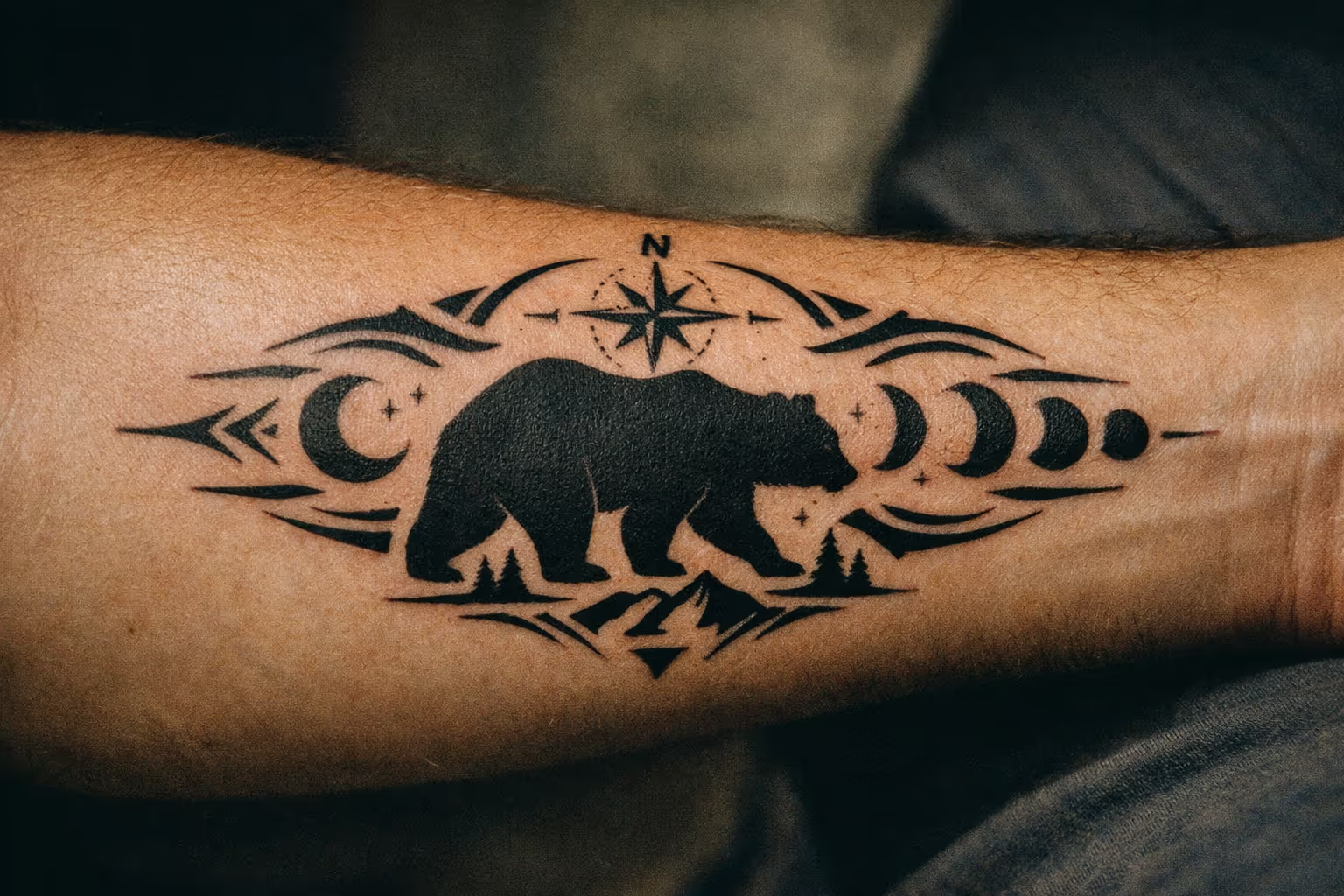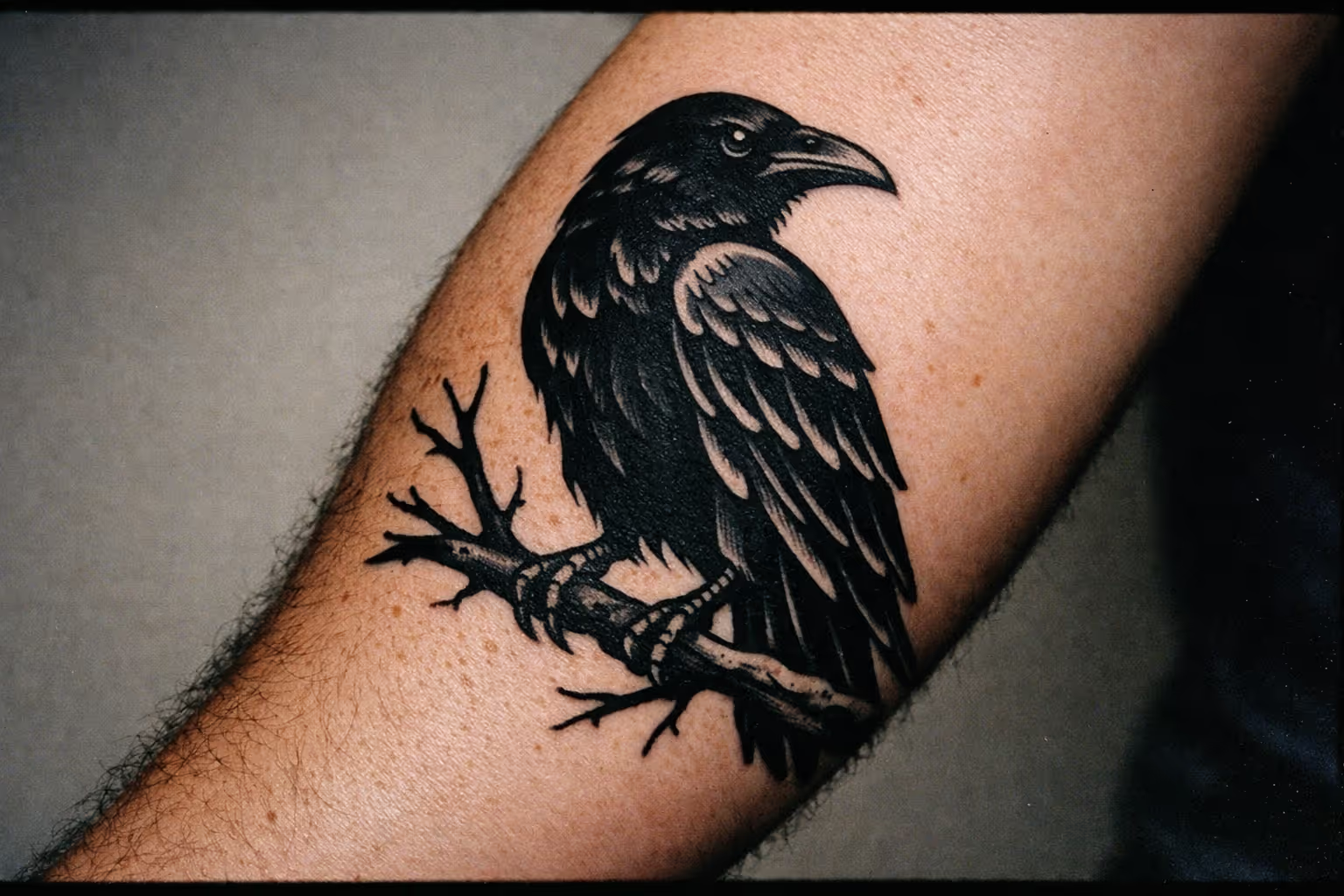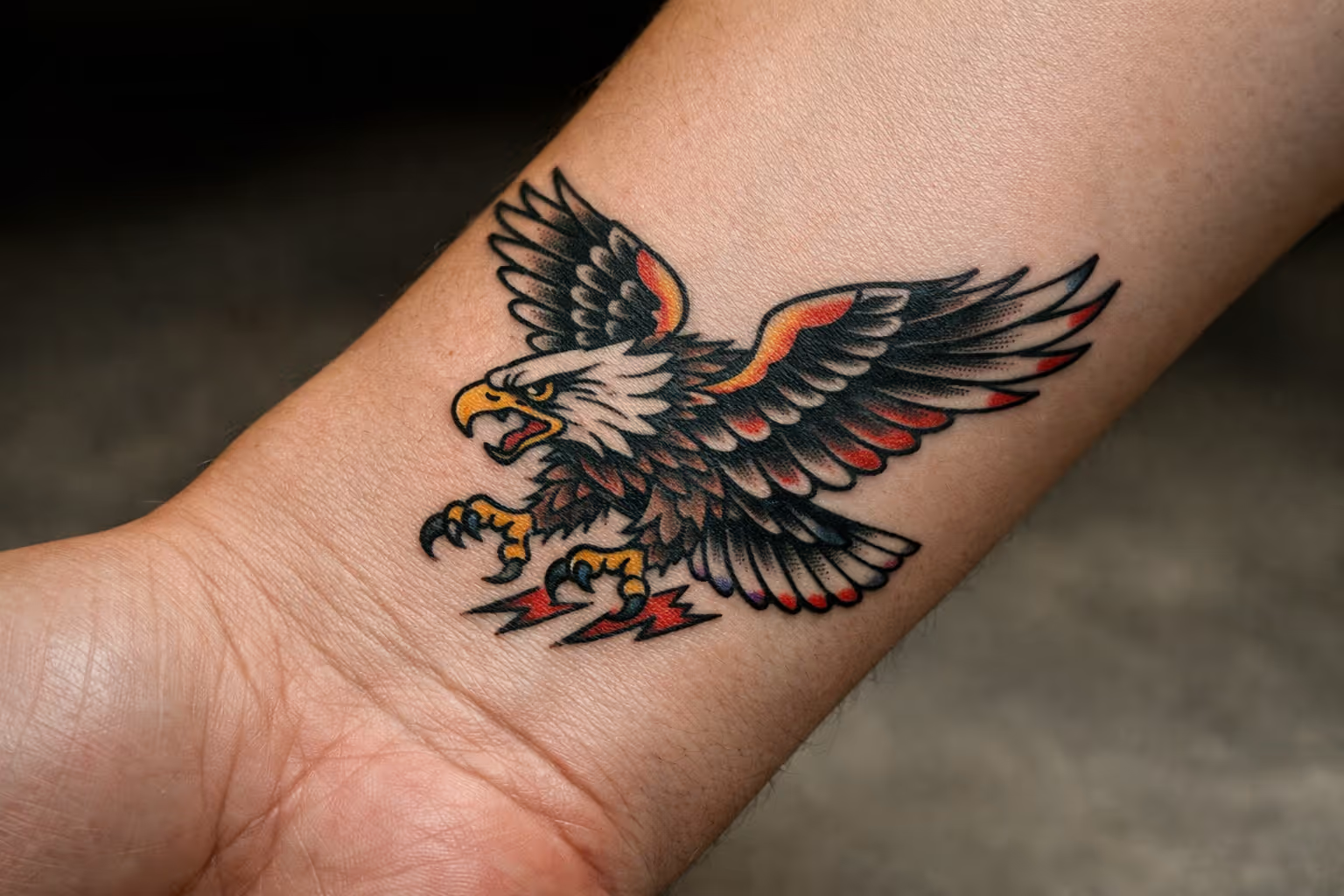
An eagle tattoo is one of the most-requested pieces and one of the most-often mis-sized. Below 5 cm it collapses into a dark blob within a few years; done properly on the chest it needs 25-35 cm and a stencil adjusted to the curve of the pec. The meaning is the easy part - it’s the scale where eagles fail, and where the money goes. Here’s the sizing and pricing first, then what the bird actually stands for.
What an Eagle Tattoo Actually Symbolizes
The three meanings cited most consistently across tattoo guides are freedom, strength, and courage (1)(2)(4). That’s the baseline. The bird also reads as vision and clarity - the eagle’s eyesight is sharp enough to spot prey from a thousand feet, and that translates into symbolism around perception, foresight, and rising above a situation (2)(3).
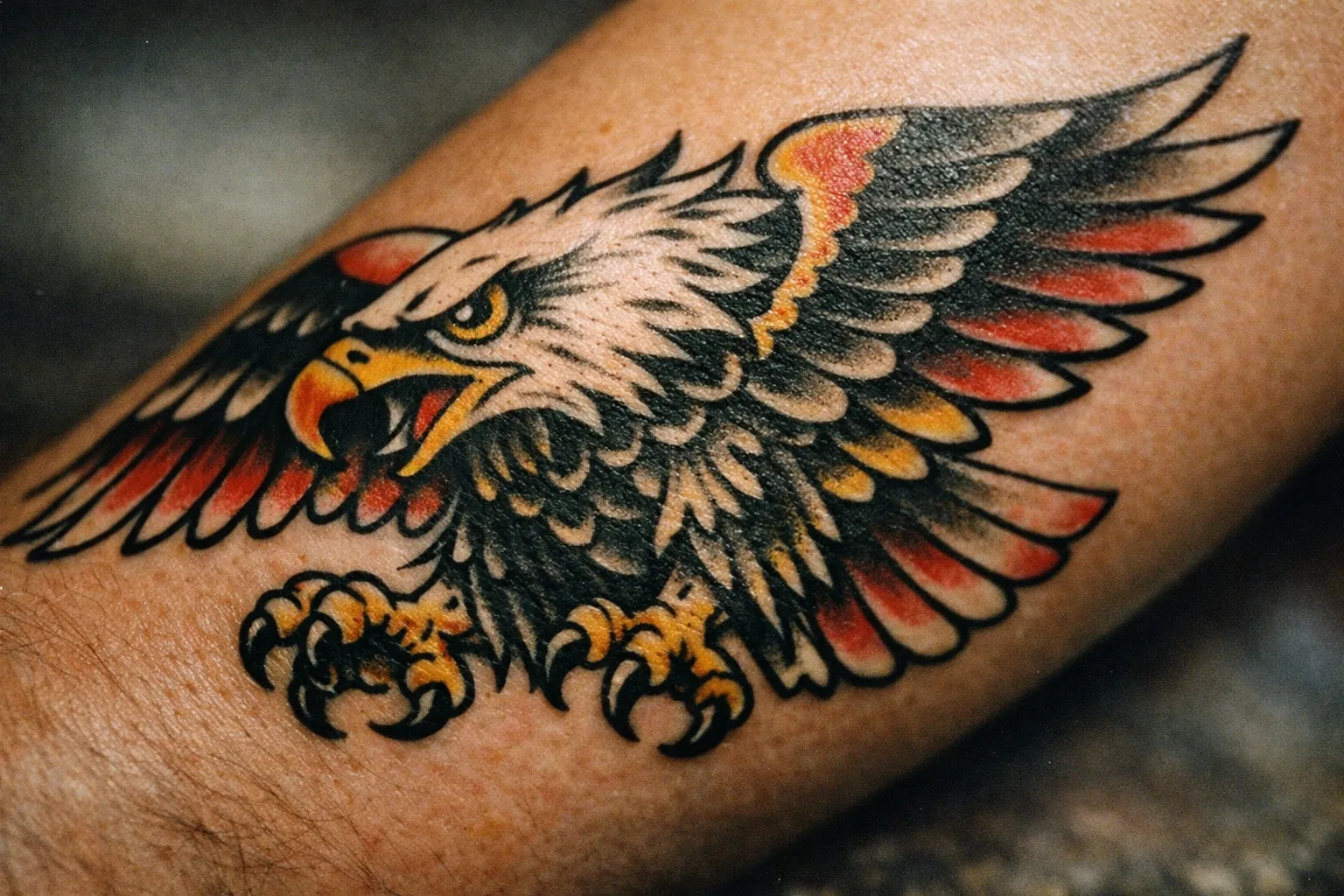
Cultural meanings layer on top of that baseline:
- American / bald eagle: National emblem of the U.S. since 1789, tied to freedom, patriotism, and honor (1)(4).
- Native American traditions: Eagles act as messengers between Earth and the Creator; eagle feathers are awarded for acts of bravery and honor, and remain protected items under U.S. federal law.
- Greco-Roman: The eagle was Zeus and Jupiter’s bird - divine authority, sovereignty, lightning (4).
- Ancient Egypt: Linked to Horus, representing royalty and protection (3).
- Aztec / Mexica: The eagle warrior (cuāuhtli) was an elite military order; the eagle devouring a serpent on a cactus is the central image of the Mexican flag.
The meaning isn’t fixed. A bald eagle clutching a flag reads as patriotism; the same bird in black and grey, head turned skyward, reads as something more personal - vision, ambition, or a memorial. Decide what you want the piece to communicate before you decide what it looks like.
Traditional Style Hallmarks of the American Eagle
The traditional eagle tattoo - specifically the American traditional version - is the most enduring eagle design in Western tattooing. I’ve drawn and tattooed more of these than I can count, and the reason they keep coming back isn’t nostalgia. It’s that they actually hold up.
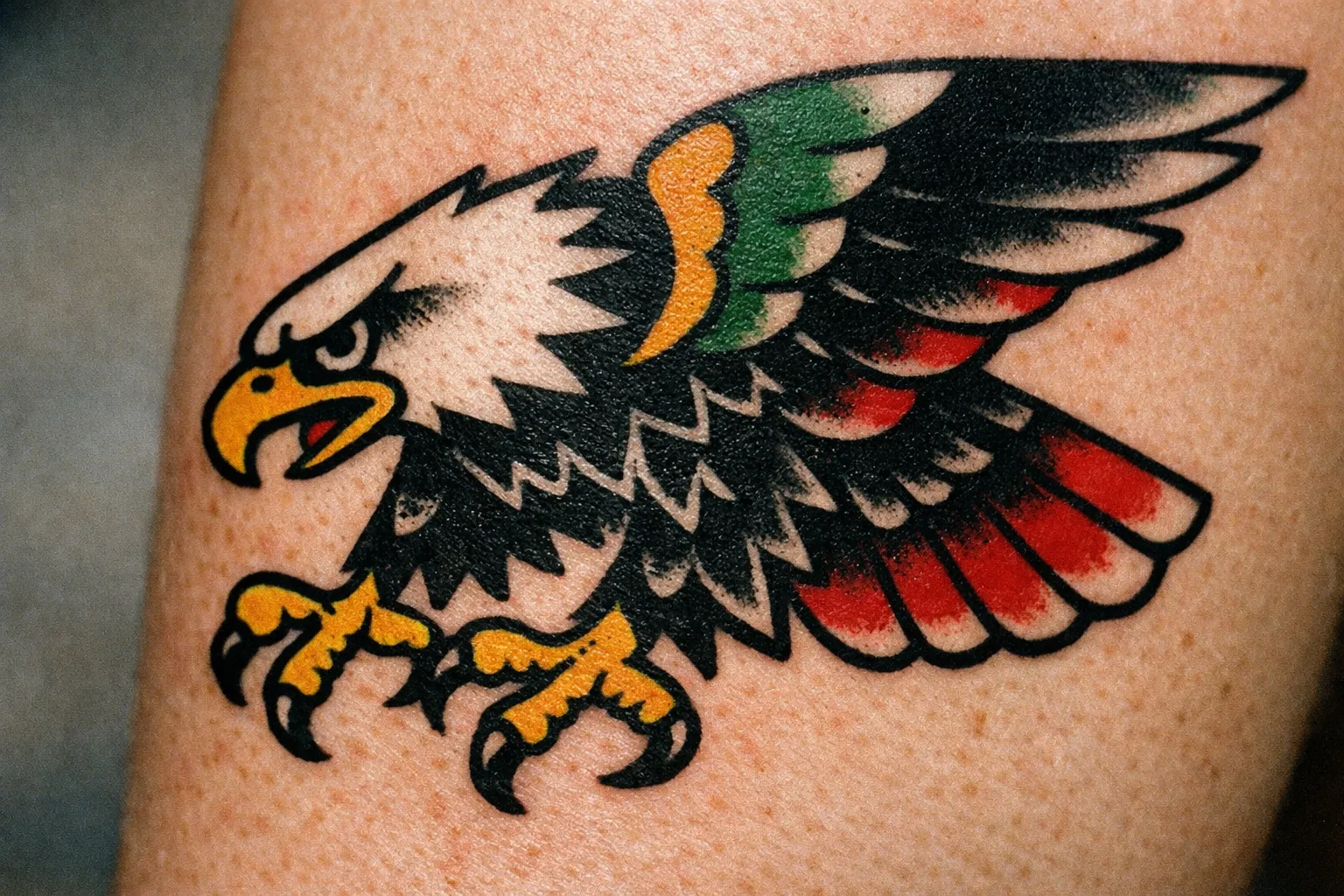
Two technical hallmarks define the style:
- Thick black outlines and a limited color palette. Black, red, yellow, green. That’s the working set. Outlines are usually pulled with a 3-9 liner, fills packed with 11-15 magnums.
- Bold, readable silhouette. You should be able to identify the bird from across a room. No fussy feather detail, no soft gradients - just clean shapes that read at distance.
Common compositions: an eagle clutching arrows, a banner, a flag, a dagger, or a snake in its talons. Sometimes paired with roses or nautical stars. The American traditional eagle tattoo ages exceptionally well because the bold outlines and solid color blocks hold up as the skin shifts over decades - fine line styles can’t make that claim.
Common pitfall when artists do it badly: thin, hesitant outlines and over-detailed feathers. Traditional work is supposed to look graphic, almost like a printed flash sheet. If your artist is trying to render every barb of every feather, they’re working against the style.
The American Traditional Chest Piece
The eagle tattoo on chest placement is the showpiece. Wings span across the pectorals, body sits over the sternum, head turned to one side. It’s also where most of the planning failures happen.
Sizing. A full chest piece typically spans 25-35 cm wide. Smaller than that and the bird loses presence; larger and you start running into the shoulder caps and ribs where the design distorts.
Symmetry vs. body curvature. Your chest isn’t flat. A perfectly symmetrical eagle drawn on paper will look crooked when transferred to a curved, asymmetrical torso. I’ve had clients come in with reference images that were gorgeous on screen and needed significant adjustment once we stenciled them up. Good artists adjust the stencil to follow your pec curve - the wings should ride the natural slope, not fight it.
Pain. Relative scale: sternum and the area near the collarbones are noticeably worse than the outer pec. Ribcage > sternum > inner pec > outer pec. Most people can sit 2-3 hours on the chest before the sternum area becomes the limiting factor. Plan multiple sessions.
Heart chakra symbolism. Some symbolism guides connect chest-placed eagles with the heart chakra - freedom and emotional balance (3). Take it or leave it, but it’s a reason people choose this placement beyond aesthetics.
Time and cost. A full color American traditional chest eagle typically runs $600-$1,500 across 1-3 sessions of 2-4 hours each in a reputable U.S. shop.
Eagle Warrior and Aztec Eagle Warrior Tattoo Designs
The eagle warrior tattoo is one of the most misunderstood designs in this category. There are two versions, and they aren’t interchangeable.
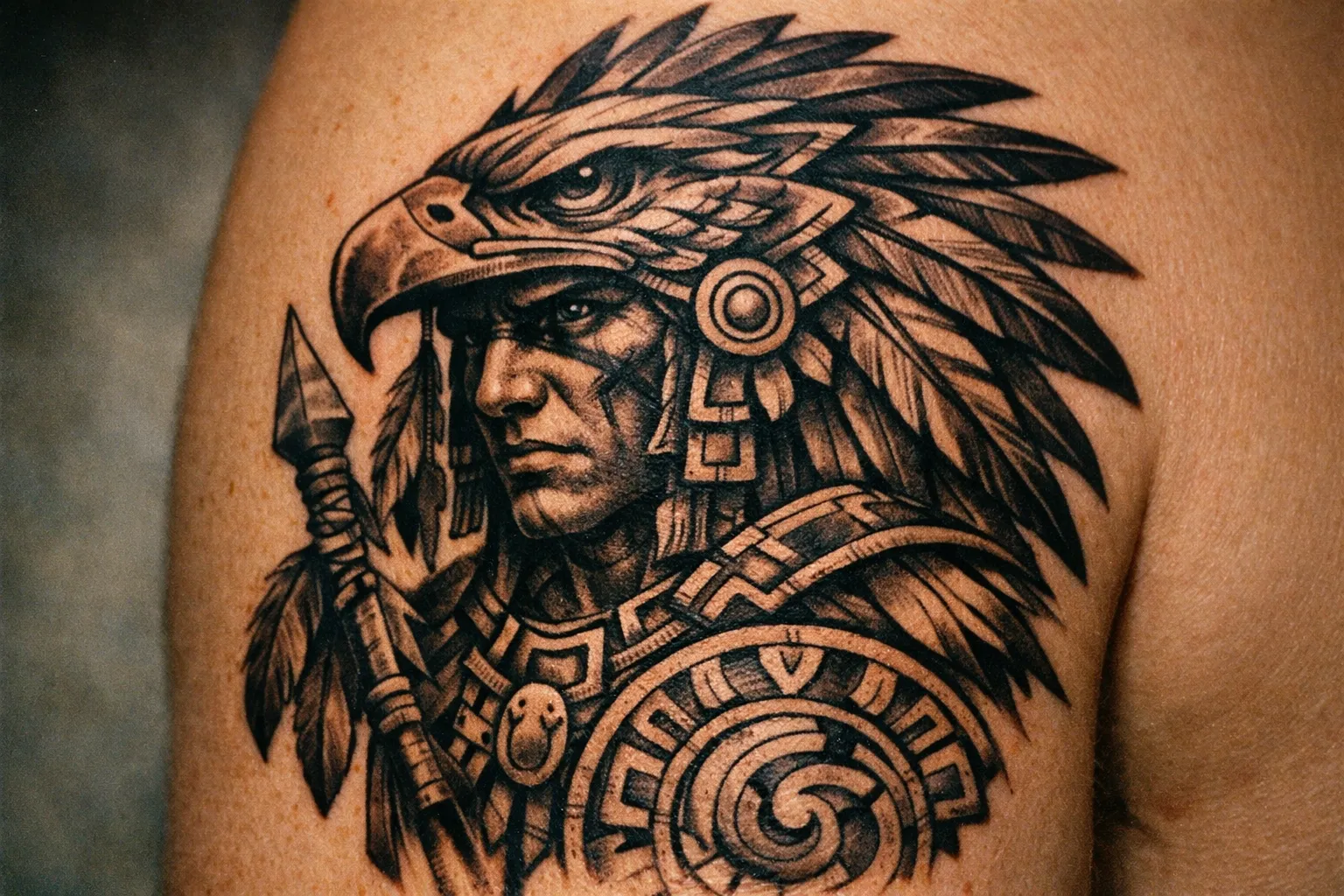
The Aztec eagle warrior tattoo depicts a cuāuhtli - a member of the elite Mexica military order whose warriors wore eagle-head helmets and feathered regalia. These pieces incorporate specific iconography: the eagle headdress with the warrior’s face emerging from the open beak, obsidian weapons (macuahuitl), feathered shields, and geometric border patterns drawn from codices. Done well, this is a piece with serious historical weight.
The generic “fantasy warrior with eagle wings” version is something else entirely. It borrows the silhouette without the cultural specifics. Both are valid as designs - but if you tell your artist you want an Aztec eagle warrior and you actually want generic fantasy, the reference photos will not match.
Mexican eagle tattoo designs often pull from the Mexican coat of arms directly: the golden eagle perched on a prickly pear cactus, devouring a serpent. It’s a marker of national identity and pre-Hispanic heritage. Common styles include black and grey realism and Chicano fine line - both of which require an artist with a strong portfolio in that lineage. I’ve seen these pieces done brilliantly and I’ve seen them butchered by artists who had no business touching the style. Check healed photos specifically.
Cultural sensitivity matters here. If you have no connection to Mexican or Indigenous heritage, that doesn’t necessarily disqualify you from the design, but it does mean you should think hard about what you’re communicating and consider whether a generic eagle motif accomplishes the same thing without the cultural weight. Most studios now ask about this in the consultation.
Sizing and placement. These are large-canvas designs. Full back: 35-50 cm tall, $1,500-$4,000+, 3-8 sessions of 3-5 hours. Chest or upper back panel: 20-30 cm, $800-$2,000, 2-4 sessions.
Other Styles Worth Knowing
Neo-traditional. Thicker lines than American traditional, expanded color palette, more illustrative shading. Good middle ground if you want the boldness of trad with a bit more dimension.
Realism (black and grey). Highly detailed feathers, dimensional eyes, smooth gradients. Requires an experienced realism artist - the eyes especially make or break the piece. A small white ink highlight in the iris and on the beak dramatically increases perceived focus and depth. When I see realism eagles where the artist skipped that step, the bird looks flat and dead. It’s a small thing that matters a lot.
Tribal and Polynesian-inspired. Bold black shapes, no shading. Worth noting: traditional Polynesian tatau uses culturally specific motifs that aren’t generic clip art - if you go this direction, work with an artist who actually knows the tradition.
Minimalist linework. Single-line eagles, simple silhouettes. Cheaper, less painful, faster to heal. Pitfall: very fine line eagles on high-friction areas (wrist, hand, fingers) tend to blur or fade within 3-5 years. Place these somewhere with less wear.
Geometric. Eagle forms built from triangles, polygons, and dotwork. Works best at medium size - too small and the geometric segments lose definition once healed.
Placement Notes: Chest, Back, Arm, and Beyond
Placement should be driven by three things: how visible you want the piece, how much canvas the design needs, and how much pain you’re willing to sit through. Not two of those three. All three.
- Chest: Best for symmetrical American traditional or large illustrative pieces. Sternum is painful. Sizes 20-35 cm work; smaller looks lost.
- Full back: The only realistic canvas for full Aztec eagle warrior compositions or large diving eagle scenes. Multi-session commitment.
- Upper arm / shoulder cap: Great for perched eagles or three-quarter view designs. Moderate pain, easy to conceal, photographs well.
- Forearm: Outer forearm is one of the most photogenic eagle spots - wings can wrap naturally, visibility is high. Pain is moderate. 12-18 cm is a good range.
- Ribcage / side piece: Allows soaring designs with wings extending toward the hip. Among the more painful zones - plan accordingly.
- Neck / hand: High visibility, faster fading, more workplace stigma. Eagles around the neck have been linked symbolically to the Ajna (third eye) chakra - vision and intuition (3). Whether you care about that or not, expect higher pain on the neck than almost anywhere else on the body.
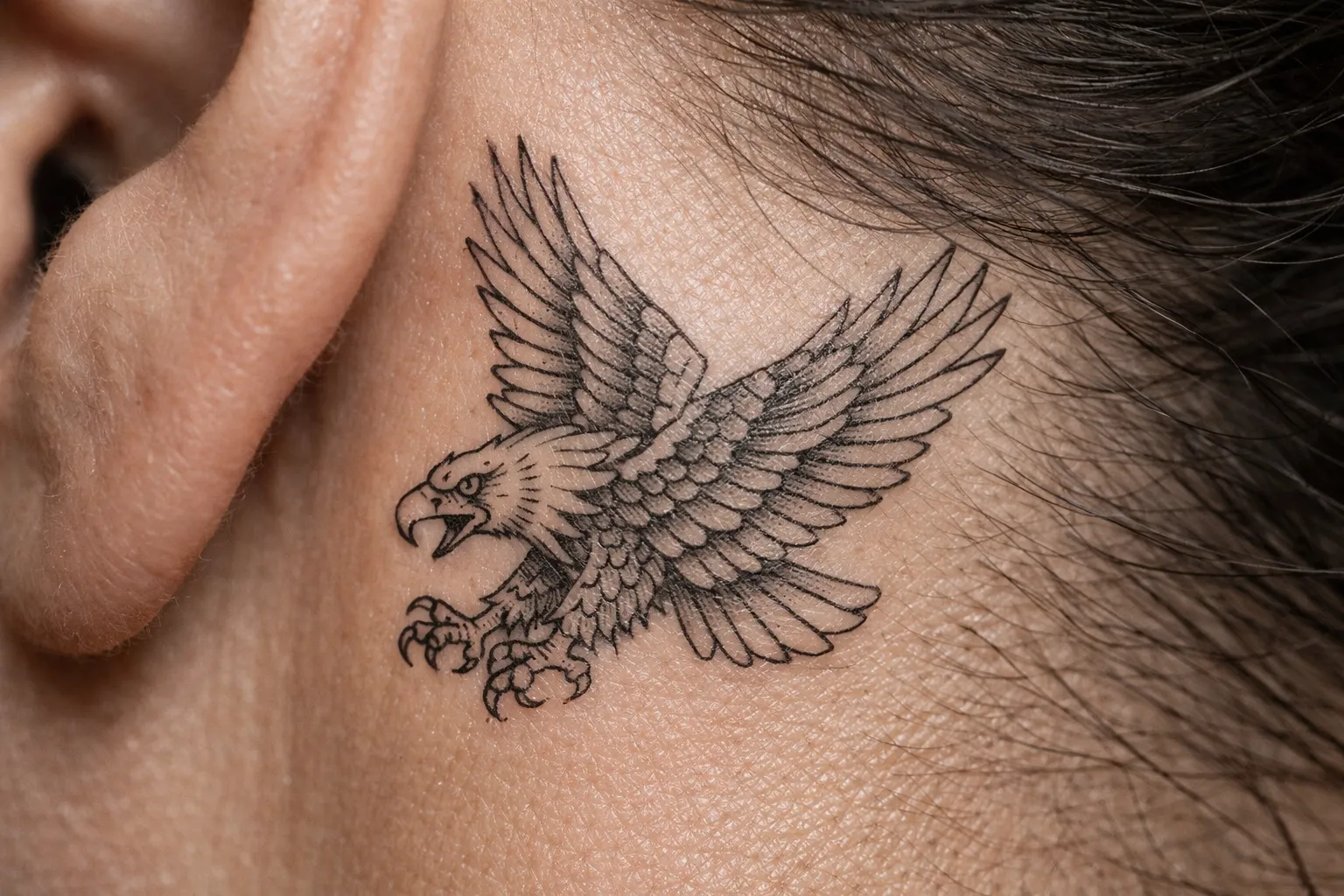
- Behind the ear / wrist: Only viable for small, simplified eagle silhouettes. Don’t try to cram detail in here.
Eagle Feather Tattoos
An eagle feather tattoo carries its own weight - it’s not a “lite” version of a full eagle. In Native American traditions, eagle feathers are awarded for acts of honor and bravery, and they remain protected under U.S. federal law (only enrolled tribal members can legally possess actual eagle feathers). The symbolism is specific: honor, courage, spiritual connection, a mark of accomplishment.
If you have no Native American heritage and you’re drawn to the feather purely as an aesthetic, consider that the design carries cultural weight that doesn’t disappear because the wearer doesn’t know about it. A generic feather - not specifically eagle - carries less of that load.
Design and sizing. Feathers work at almost any size - 5 cm minimalist on the forearm, 15-25 cm detailed feather along the ribcage. Realistic detailed feathers benefit from larger sizes (10 cm+) so individual barbs read clearly. Watercolor and tribal styles work smaller.
Placement. Forearm running along the muscle, ribcage following the curve, behind the ear (small), or as part of a larger composition with a dreamcatcher or arrow.
Small and Minimalist Designs
Small eagle tattoos work - but they have hard limits. Below about 5 cm, the bird needs to be a silhouette or a single-line drawing. Trying to fit American traditional detail into a 3 cm circle produces a blob within two years. I’ve had clients come back wanting touch-ups on exactly this kind of piece, and the honest answer is usually that the design was the wrong scale from the start.
What works at small scale:
- Single-line eagle silhouettes (outer forearm, behind the ear, ankle)
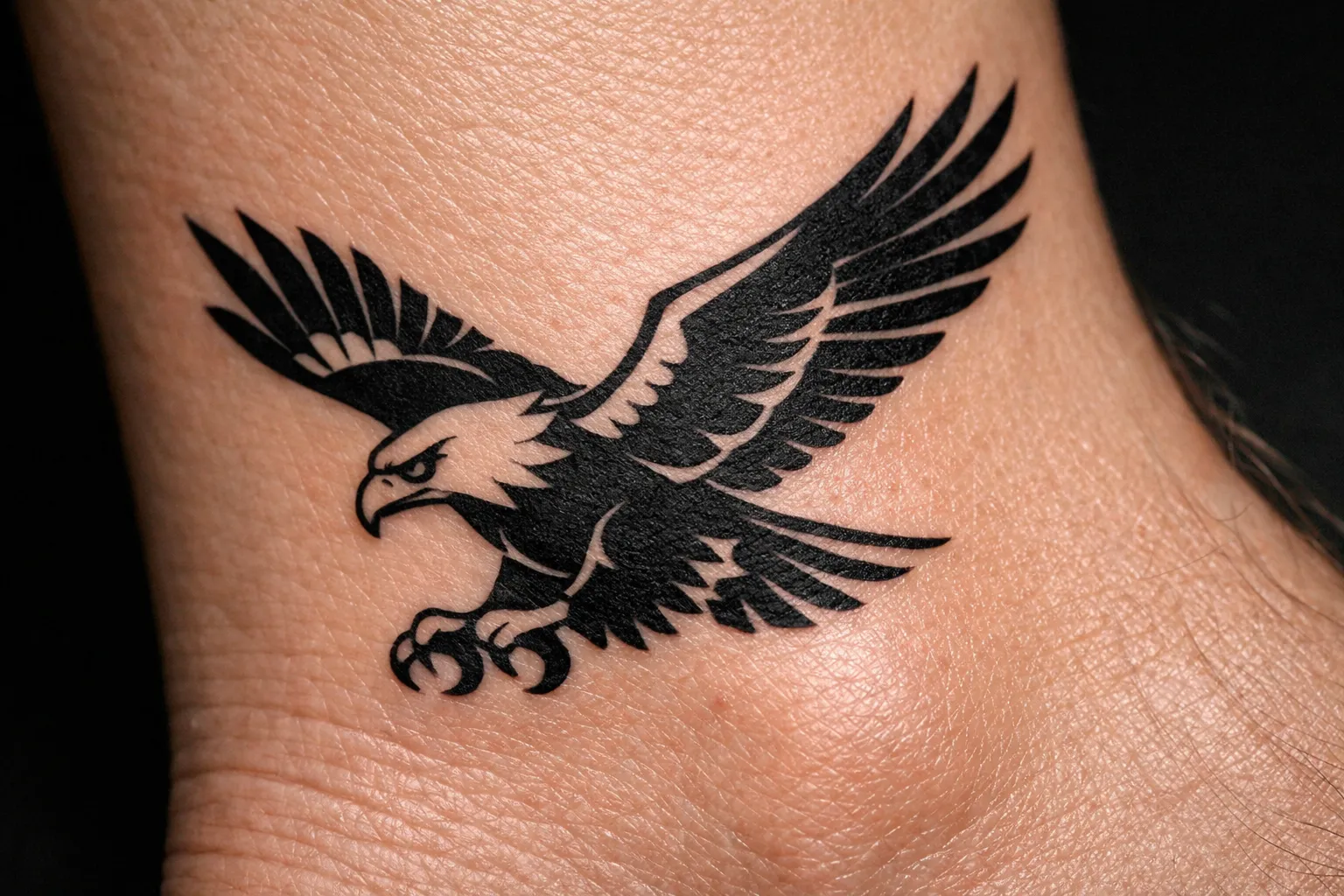
- Solid black flying silhouettes (wrist, inner bicep, chest above the heart)
- Simplified perched eagle heads with bold outlines only (forearm, calf)
What doesn’t work small:
- Detailed feathers
- Multi-color American traditional with banners and text
- Eagle-and-snake combos (too much information for the canvas)
Cost. A small simple eagle (5-8 cm) typically runs $120-$250, with shop minimums often starting at $80-$100.
Eagle Tattoo Combinations That Hold Up
The eagle pairs well with several supporting elements, but each addition demands more space:
- Eagle vs. snake. Triumph over evil, resilience (2). Central to the Mexican eagle motif and to Greco-Roman imagery.
- Eagle and skull. Strength against mortality, overcoming adversity (2). Heavy symbol - works best in black and grey or traditional, less so in fine line.
- Eagle with shield or flag. Patriotism, protection, honor. Standard American traditional pairing.
- Eagle and compass. Guidance, direction (2). Common with traveler-themed pieces.
- Eagle and roses. Trad combo - beauty and ferocity. Works on chest, sleeve, or thigh.
- Eagle with dates or text. Memorial pieces. Keep block lettering at least ¼ inch (6 mm) and script at least ½ inch (12-13 mm) tall in the healed result, or the letters will blur into each other.
Related raptors - phoenix, hawk, owl - sometimes get combined with eagles in larger sleeve or back compositions. They’re not interchangeable: a hawk has a smaller head and shorter wings, making it read as a scrappier, more aggressive bird tattoo at the same scale - where an eagle at 20 cm on the forearm commands the space, a hawk at the same size can look like a pigeon with attitude. An owl reads as wisdom rather than vigilance; a phoenix carries rebirth symbolism the eagle doesn’t. According to the Smithsonian’s National Zoo, bald eagles have a wingspan of up to 2.4 meters - that physical scale is part of why the silhouette reads as dominant even in a simplified tattoo format.
Pricing in 2024-2025
These ranges assume a reputable U.S. shop with a licensed artist who has a strong portfolio in the style you want:
- Small simple eagle (5-8 cm): $120-$250
- Medium chest or forearm eagle, detailed black and grey (12-18 cm): $250-$600
- Large American traditional chest piece (25-35 cm, full color): $600-$1,500 across 1-3 sessions
- Full back Aztec eagle warrior or large scene: $1,500-$4,000+ across 3-8 sessions of 3-5 hours
Add 15-25% tip on top of the artist’s quoted price. Aftercare products run $15-$40 for soap, balm, and SPF.
Shop minimums in major U.S. cities (NYC, LA, Chicago) have crept up to $150-$200 in 2024 - if you want anything tiny in those markets, the minimum applies regardless of size.
Aftercare and Healing
Eagle tattoos rely on bold black saturation (traditional) or smooth feather gradients (realism). Both fall apart with bad aftercare. This is where I see people undo good work.
Day 1-3: Keep the initial wrap on for the duration your artist specifies - 2-24 hours for plastic film, 3-5 days for second-skin bandages. Wash 2-3 times daily with fragrance-free soap. Apply a thin layer of fragrance-free moisturizer or a tattoo-specific balm. Don’t slather it - too much product suffocates the skin and causes ink to lift.
Week 1: Peeling and itching starts around day 4-7. Do not pick. Picked scabs pull color out, which on a traditional eagle means patchy reds and washed-out blacks. Continue washing and light moisturizing.
Week 2-4: Most surface healing is complete by week two, but the deeper skin is still settling. No swimming, no sauna, no direct sunbathing for 2-3 weeks minimum. Switch to a regular fragrance-free lotion once the flaky stage is over.
Long term: SPF 30-50 on the tattoo any time it’s exposed to sun. UV is the single biggest factor in tattoo fading - a bald eagle that took six hours to pack with saturated color will look washed out in five years if you don’t protect it. A 2023 review published in the Journal of the American Academy of Dermatology confirmed that UV exposure accelerates pigment breakdown in tattoo ink significantly faster than normal skin aging alone (4). Sun-protective clothing helps for arm and chest pieces. For a full breakdown of tattoo aftercare by healing stage, that guide covers week-by-week specifics in detail.
Second-skin bandages have become standard in many shops in 2024 - they reduce scabbing and improve healed saturation when used correctly, though they add $5-$20 to your bill.
Designs That Age Badly - And What to Avoid
The “tattoos to avoid” category isn’t really about style - it’s about designs that age badly, designs with unintended symbolic associations, and designs that don’t survive translation to skin.
Designs that age badly:
- Ultra-fine line micro tattoos on high-friction areas (fingers, hands, feet)
- White ink tattoos (rarely heal as intended; often look like scars within a year)
- Heavily detailed designs crammed into small spaces - including eagles under 5 cm with full feather detail
- Trendy script fonts in tiny sizes - they blur into illegible smudges
Designs with unintended associations:
- Certain eagle styles can resemble emblems used by extremist groups. The German imperial eagle and certain stylized eagle-over-symbol compositions have been co-opted historically. If you want a heritage eagle (Polish, German, Mexican), work with an artist who can steer the design clearly toward the cultural reference and away from the appropriated version.
- Generic “tribal” designs lifted from clip art without understanding the source culture.
Designs that don’t translate:
- Anything that depends on perfect symmetry on a non-flat body part
- Photorealistic portraits at small sizes
- Designs with no clear focal point - the eye needs somewhere to land
What Is the 1/3 Rule in Tattoos?
The 1/3 rule is a composition guideline used when planning how much of a body area a tattoo should occupy. The principle: a single tattoo should cover roughly one-third of the available canvas, leaving two-thirds as negative space - or, for larger pieces, the design should respect a 1/3 to 2/3 ratio between heavily detailed areas and breathing room.
Applied to an eagle tattoo on chest: if your pectoral area from collarbone to nipple line measures roughly 18-20 cm vertically, the eagle’s vertical span should sit around 6-7 cm tall in a smaller composition, or take up the full pec with deliberate negative space inside the design (gaps between feathers, open sky around the wings).
For full back pieces, the 1/3 rule helps prevent the “wall of tattoo” effect - leaving open skin around the eagle warrior’s outline gives the design somewhere to breathe and ages better than a fully packed back.
It’s a guideline, not a law. Plenty of great pieces ignore it. But if your composition feels visually overwhelming on paper, the 1/3 rule is the first thing to check.
- How much does an eagle tattoo cost?
- It depends heavily on size and style. A small simple eagle (5-8 cm) typically runs $120-$250. A medium detailed black and grey piece on the chest or forearm (12-18 cm) runs $250-$600. A full color American traditional chest eagle (25-35 cm) costs $600-$1,500 across 1-3 sessions. Full back Aztec eagle warrior compositions run $1,500-$4,000+ across 3-8 sessions. Add 15-25% tip on top of the quoted price.
- Where is the best placement for an eagle tattoo?
- It depends on the design. The chest is the classic spot for symmetrical American traditional eagles - wings span the pectorals, body sits over the sternum. The outer forearm works well for perched or three-quarter view eagles (12-18 cm range). The full back is the only realistic canvas for large Aztec eagle warrior compositions. Behind the ear and wrist only work for small, simplified silhouettes - don't try to cram detail in there.
- Do eagle tattoos age well?
- American traditional eagles with thick black outlines and solid color blocks age exceptionally well - the bold structure holds up as skin shifts over decades. Fine line and micro eagles on high-friction areas like wrists, hands, and fingers tend to blur or fade within 3-5 years. Realism pieces depend heavily on how well the artist packed the black and grey, and on how consistently you protect the tattoo from UV exposure.
- What is the difference between an Aztec eagle warrior tattoo and a Mexican eagle tattoo?
- An Aztec eagle warrior tattoo depicts a cuāuhtli - a member of the elite Mexica military order - with specific iconography: the eagle-head helmet with the warrior's face emerging from the open beak, obsidian weapons, feathered shields, and geometric codex-derived borders. A Mexican eagle tattoo typically pulls from the Mexican coat of arms: the golden eagle perched on a prickly pear cactus, devouring a serpent. Both are culturally specific designs that benefit from an artist with a strong portfolio in that lineage.
- How do I take care of a new eagle tattoo?
- Days 1-3: keep the wrap on for the duration your artist specifies, wash 2-3 times daily with fragrance-free soap, and apply a thin layer of fragrance-free moisturizer. Week 1: peeling and itching starts around day 4-7 - do not pick, or you pull color out. Week 2-4: no swimming, sauna, or direct sunbathing. Long term: SPF 30-50 any time the tattoo is exposed to sun - UV is the single biggest driver of fading.
Rune Tattoos Combined with Eagle Imagery - What to Know
Worth covering because eagle tattoos sometimes get combined with Norse imagery - wings with runes, eagles paired with Yggdrasil, and so on. Some runes carry baggage you should know about before you commit.
The runes most often flagged for caution:
- Othala (ᛟ): A legitimate Elder Futhark rune meaning ancestral heritage, but used by white nationalist groups since the 20th century. Hard to wear without the association.
- Sig / Sowilo (ᛋ) in doubled form: The single rune is fine and means “sun.” Two together, drawn in the angular Armanen style, evokes the SS insignia. Avoid the doubled stylized form.
- Tiwaz / Tyr (ᛏ) in certain contexts: The rune itself is benign, but it was used as a symbol by certain Nazi-era youth organizations and has been adopted by some neo-Nazi groups. Single use in a clearly Norse pagan context reads fine; isolated and stylized, less so.
If you want runic elements in an eagle piece, work with an artist who knows the Elder Futhark and can advise. The cleanest approach: full runic phrases in their original linguistic context, not isolated symbols that can be misread.
Frequently Asked Questions
- What does an eagle tattoo symbolize?
- Beyond freedom, strength, and courage, eagle tattoos symbolize vision and clarity. Cultural meanings vary widely, including American patriotism, divine authority in Greco-Roman myths, spiritual messenger roles in Native American traditions, and warrior status in Aztec iconography.
- Where does an eagle tattoo look best?
- Ideal placements include the chest for symmetrical American traditional designs, upper back for large warrior or Aztec pieces, and outer forearm for photogenic side-view eagles. High-friction areas like fingers and hands cause rapid fading and are best avoided for detailed eagles.
- How painful is a chest eagle tattoo compared to other placements?
- Chest pain varies: sternum and collarbone areas are more painful than outer pectorals. Ribcage pain exceeds sternum. Expect to manage 2-3 hour sessions before pain limits endurance, with multiple sessions needed for large pieces.
- Can I get an Aztec eagle warrior tattoo if I'm not Mexican?
- While not prohibited, the Aztec eagle warrior design carries significant cultural and religious weight. If you lack connection to the heritage, consider whether a generic eagle design better suits your intent to avoid cultural appropriation concerns.
- What aftercare steps are crucial for preserving an eagle tattoo's color and detail?
- Keep the initial wrap as directed, wash with fragrance-free soap 2-3 times daily, and apply thin layers of fragrance-free moisturizer or tattoo balm. Avoid picking scabs, swimming, sauna, and sun exposure for 2-3 weeks. Long-term sun protection with SPF 30-50 and sun-protective clothing preserves color saturation.
- What are common design mistakes that cause eagle tattoos to age poorly?
- Ultra-fine line tattoos on high-friction areas, white ink, overly detailed small tattoos, and tiny script fonts blur or fade quickly. Designs lacking a clear focal point or relying on perfect symmetry on curved body parts also age badly.
- How does the 1/3 rule apply to eagle tattoo composition?
- The 1/3 rule suggests covering roughly one-third of the available canvas with the tattoo, leaving two-thirds as negative space. This prevents visual overcrowding and helps the design age better by allowing breathing room, especially on chest and back pieces.
- What should I know about combining runes with eagle tattoos?
- Some runes like Othala, doubled Sig/Sowilo, and certain uses of Tiwaz carry associations with extremist groups. Use runes in their original linguistic context and work with an artist knowledgeable in Elder Futhark to avoid misinterpretation.