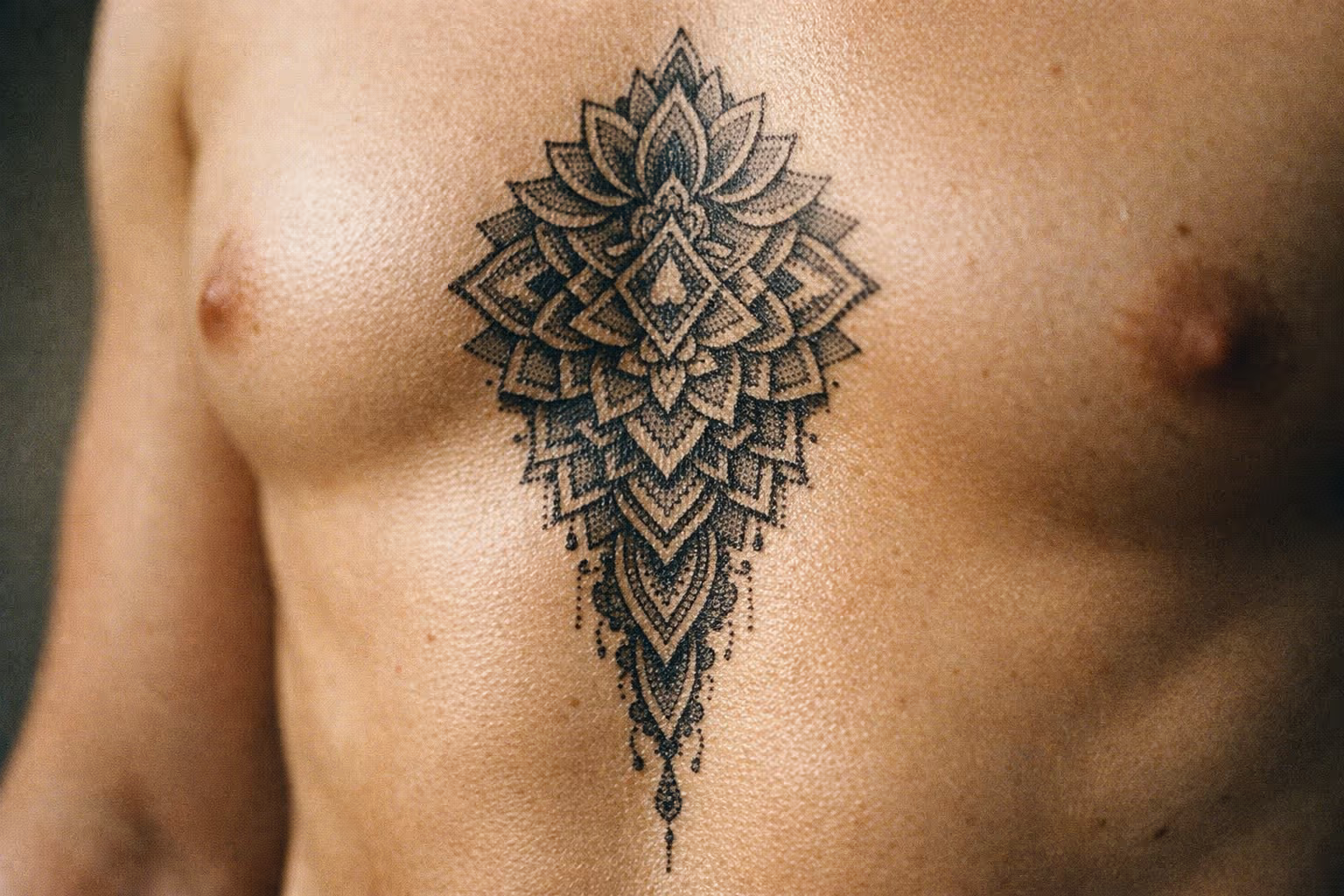
The sternum is one of the few placements where the needle vibrates directly against bone with almost no tissue buffer, and that single fact tells you most of what you need to know about chest tattoos for men: this is a high-commitment placement that rewards planning. When considering chest tattoos for men, the chest works exceptionally well for symmetry, script, and large motifs, but the experience shifts dramatically between the outer pecs and the breastbone. Every chest piece comes down to four decisions - which zone you put it in, what design you choose, how you manage the pain, and how you structure the sessions. This guide covers all four, with men as the primary focus and a dedicated section for women.
✓ Pros
- Large, naturally symmetrical canvas with a built-in central axis (sternum)
- Easily concealed under a shirt for work or formal settings
- Flat pectoral surface handles detailed linework and shading well
- Pairs naturally with shoulder/sleeve extensions for future expansion
- Bold visual impact when revealed
✗ Cons
- Sternum rated 7-8/10 pain, collarbone 6-7/10 - both high-commitment zones
- Constant chest movement with breathing complicates sternum linework
- Clothing friction (bras, tight shirts) extends healing and risks ink loss
- Large pieces require 2-4 multi-hour sessions; significant time commitment
- Designs near breast tissue or nipples can distort with body changes
Chest Tattoos for Men - Placement Variants, Size Ranges, and Design Considerations
The chest is not one surface. It’s three zones with different skin thickness, different tissue padding, and a pain profile that shifts noticeably as you move from the outer edge toward the breastbone. Understanding that geometry before you pick a design saves you from booking something that fights the anatomy.
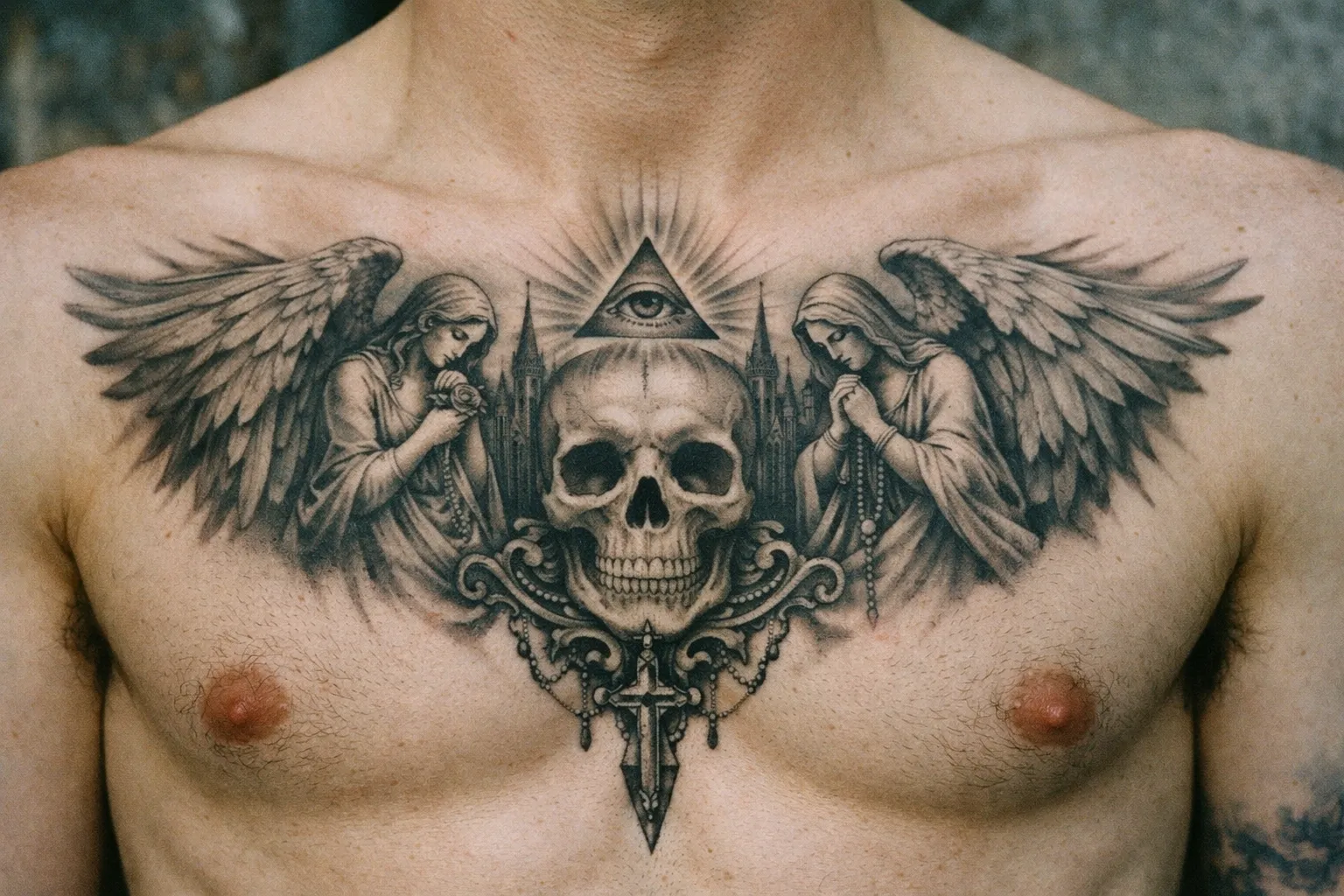
A chest piece tattoo is a design covering the pectorals, sternum, and sometimes the upper ribcage. For men, a full one typically spans 20 to 30 cm wide across both pectorals and 10 to 15 cm tall; sternum-focused designs run 10 to 20 cm vertically down the breastbone. The reason the chest is a natural canvas for symmetry is structural - the sternum functions as a literal midline axis, with the clavicles and nipples as secondary alignment landmarks. Mirror a motif across that line and it reads as balanced.
The concealment advantage is real. A standard crew-neck shirt hides a full chest piece completely, unlike a forearm or neck placement that’s always in view. And the chest connects cleanly into shoulder and sleeve work - extended compositions can reach 40 to 50 cm across the front torso if you plan the layout from the start.
Upper pecs, sternum, and underboob - three zones, three pain levels
- Upper pecs: roughly 5 to 6/10 pain, more tissue padding, a reasonable zone for a first chest session.
- Sternum: 8-9/10 (2). Thin skin directly over bone; the needle vibration is the dominant sensation, not the surface sting.
- Underboob: 6 to 8/10 on a curved surface, complicated by bra friction during healing.
- Outer chest: 4 to 6/10, the most forgiving zone on the whole area.
The gradient runs inside-to-out: outer chest sits around 4-6/10, while the sternum spikes to 7-8/10 (3). Plan your design around which zones you’re actually willing to sit through.
Chest Tattoo Zones Comparison
| Outer chest | Upper pectorals | Underboob | Sternum | Collarbone edge | |
|---|---|---|---|---|---|
| Pain Level | 4-6/10 | 5-6/10 | 6-8/10 | 8-9/10 | 6-7/10 |
| Skin/Tissue | More padding | Moderate padding | Curved, thin | Thin, over bone | Minimal tissue |
| Best Design Types | Any style; good for first sessions | Portraits, bold motifs, script | Ornamental, floral arcs | Symmetrical, vertical script, mandalas | Short script, fine detail accents |
| Healing Notes | Easiest to heal | Standard 2-3 week surface healing | Bra friction risk; skip underwire 4 weeks | Most movement; breathing management needed | Lower than sternum but still bony; keep designs 2-3 cm below bone |
Variants and Size Ranges for Chest Tattoos in Men
Chest tattoos for men range from a single-pec motif you can finish in one sitting to a full chest piece extending into both shoulders. Here’s how the main configurations break down by size and chair time.
Single-pec designs cover one pectoral, usually 10 to 15 cm wide, and take 2 to 4 hours. I usually recommend this as the entry point - you learn how your body handles the placement before committing to full symmetry.
Full chest pieces span both pectorals plus the sternum, 20 to 30 cm wide, and commonly run 2 to 3 sessions of 3 to 5 hours each. This is the definitive configuration and the one most people picture when they think “chest piece.”
Upper chest designs for men sit 2 to 3 cm below the collarbone, which keeps them out of the worst bone-edge pain while staying visible in an open-collar shirt. Sub-zone pain maps consistently rank the collarbone itself and the ribs at the top of the scale (4), so dropping a design a couple of centimeters below that edge is a meaningful comfort saving.
Half chest designs for men cover one side only, often built to flow into a sleeve. This lets you expand in stages without committing to full symmetry upfront - useful if you’re not sure you want both sides done.
Extended pieces flowing into the shoulders or a sleeve reach a total span of 40 to 50 cm. These require the full composition mapped before session one. Retrofitting a layout after the fact usually means shading corrections you’d rather avoid.
A smart middle path is the modular approach: artists often propose a central sternum piece plus two add-on pec elements you can expand later. It reduces the regret risk of jumping straight to full coverage.
Simple chest tattoos for men - when less coverage works better
Small doesn’t mean weak. A high-impact sternum piece at 10 to 12 cm fits into a single session of 1.5 to 3 hours and reads cleanly. Simple chest tattoos for men - a cross, a geometric shape, a small eagle on one pec - are low-commitment, age well, and stay expandable. If you’re adding script at this scale, keep script letter height at ½ inch (12-13 mm) minimum or it won’t stay readable after healing.
Design Styles and Ideas for Chest Tattoos
The best chest tattoo ideas use the area’s natural geometry rather than fighting it: symmetry off the sternum, bold motifs across the flat pectoral plane, and line weights that survive a high-movement surface.
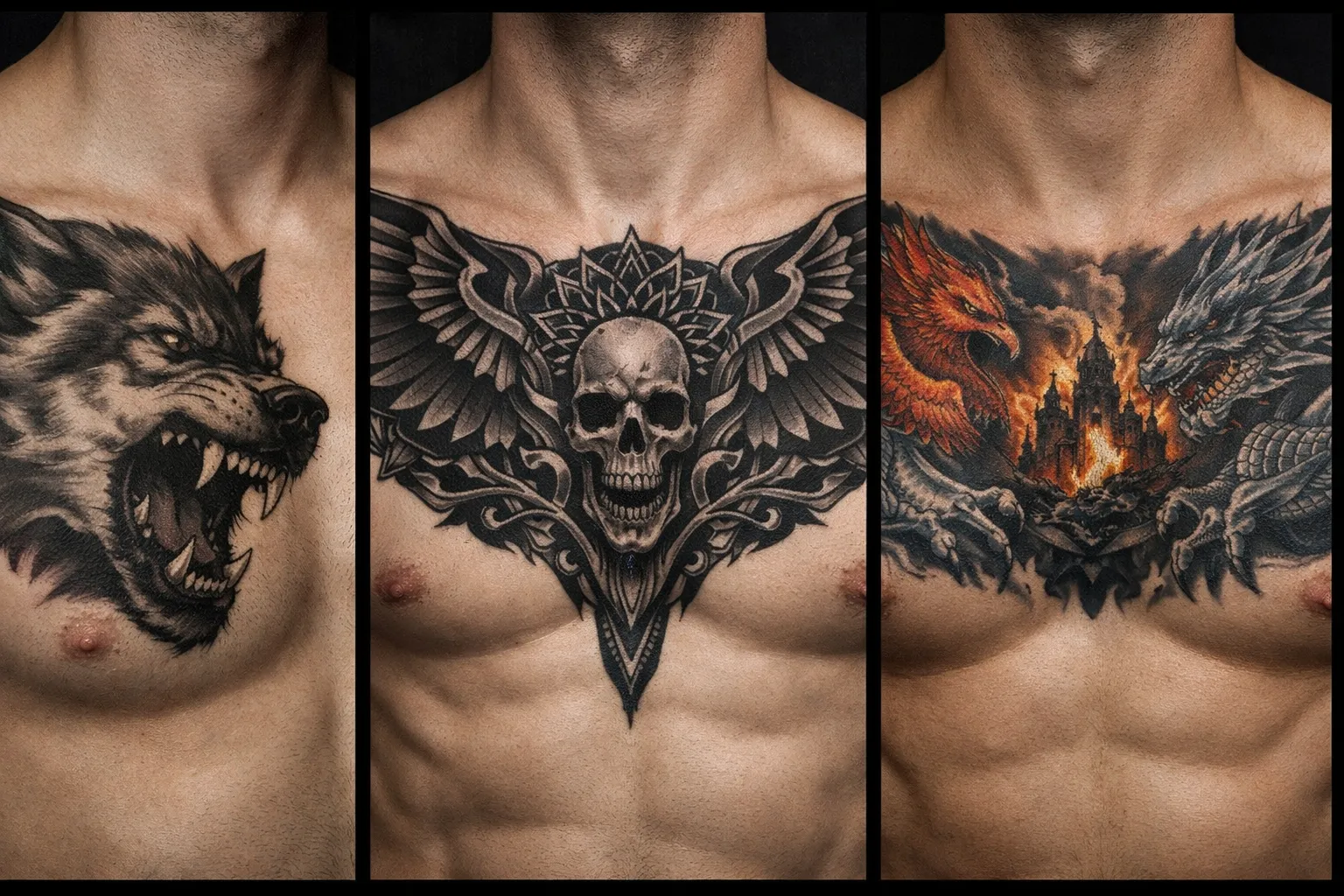
Eagles, wings, and armor designs span naturally across both pectorals at 25 to 35 cm wide. American traditional style - two technical hallmarks being thick black outlines and a limited palette - ages reliably here because the heavy linework holds its shape as skin softens over the years. The common pitfall with American traditional is thin, undersaturated black that greys out within a decade; done right, the outline is what carries the piece long-term.
Lion chest tattoos for men work as portrait realism on one pec or split across both. Facial detail needs room to survive healing - go 6 to 10 cm minimum for the face, or the fine gradients blur into mud within a few years.
Skulls, geometric patterns, and mandalas use the sternum as a natural center axis. Dotwork and blackwork hold well on the flat pectoral surface. Worth knowing: intricate dotwork sitting directly on the breastbone means a sharp, high-vibration sitting - the sternum’s thin-skin-over-bone construction (5) makes dense midline work genuinely rough.
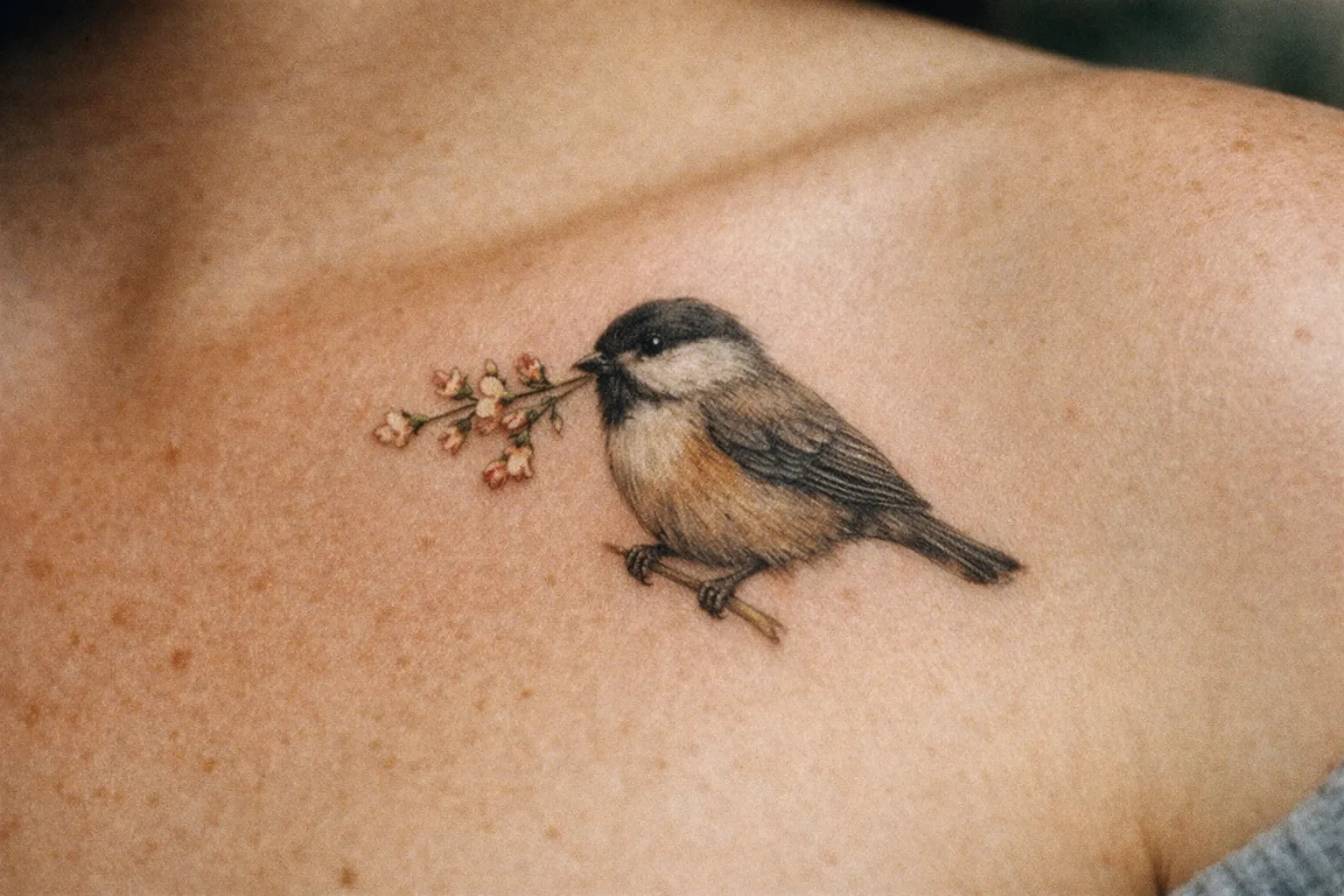
Floral and ornamental designs are increasingly requested by men as fine-line or neo-traditional pieces. Scale and line weight decide whether the result reads bold or delicate - a fine-line rose on the sternum is a different long-term bet than a neo-traditional one with a bold outline.
Religious and script motifs - crosses, sacred imagery, verse text - land on the chest more than anywhere else for faith work that goes beyond a simple forearm cross. Match the cross variant to your tradition: Latin cross, crucifix, three-bar, or Celtic knotwork each carry a specific origin, and knotwork in particular needs at least 3 inches or the negative space closes up into a blob.
On color versus blackwork: color chest pieces need 30 to 50% more time than black and grey equivalents because of the layering and saturation passes, which often adds a full session to the project. And a style that ages poorly here is worth naming plainly - overly fine single-needle work on the sternum blurs within 5 to 10 years due to dermal spread and constant movement. It’s not a surprise, it’s a known trade-off.
Unique chest tattoos for men - going beyond the standard eagle
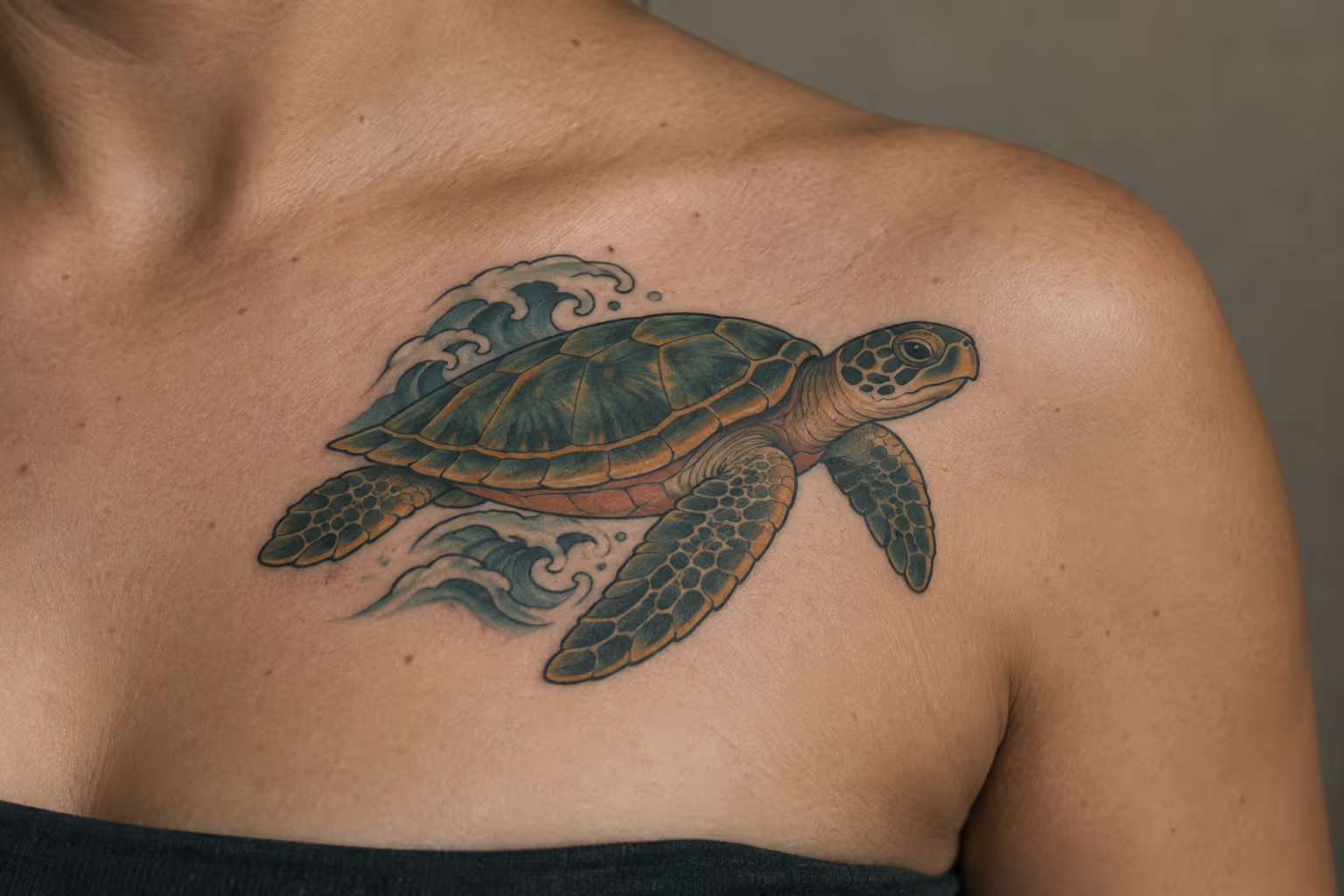
Japanese irezumi motifs - dragons, waves, koi - adapt well to the chest because the tradition is built around designs that flow with body contours rather than sitting flat on the skin. If you go this route, respect the cultural origin and let the artist route the composition around the pectoral shape rather than stamping a static image on it.
Biomechanical and geometric armor designs treat the pectorals as plates and the sternum as the central seam - a natural fit for the anatomy. Neo-traditional animals with bold outlines are another solid choice; they age better than fine-line realism on a high-movement area precisely because the linework is heavier.
Script Placement, Sizing, and Legibility Rules on the Chest
A script chest tattoo stays readable only if the letter height clears ½ inch (12-13 mm) and the font holds its form on a curved, moving surface. Get either wrong and the text blurs or cramps within years.
There are three viable script placements: along the collarbone line in 12 to 20 cm stretches, across the upper chest parallel to the clavicle, or centered vertically down the sternum. Each behaves differently.
Minimum letter height is the single most important number. At ½ inch (12-13 mm) or more, script letters read at normal viewing distance and hold up as the ink spreads; ornate script needs about 1 inch (25 mm). Anything smaller becomes illegible at arm’s length, especially across the curve of the pectoral where the surface tilts away from the viewer.
Font choice matters more than people expect. Serif and bold blackletter fonts hold their form as skin ages. Thin cursive scripts blur at the hairline strokes within 5 to 10 years - the delicate connecting lines are the first thing to go.
Line direction on the sternum is a technical detail good artists insist on: vertical strokes and short horizontal segments over the breastbone survive better than long horizontal lines, because the chest expands with every breath and horizontal lines shift most with that movement.
Collarbone script has its own catch. The curve of the clavicle means letters on the outer ends tilt, so the stencil has to be applied while you’re standing, not lying down - otherwise the text reads crooked once you’re upright. I’ve had to redo stencils mid-consultation because a client sat down after I applied it and the whole thing shifted. It’s a quick fix, but only if you catch it before the needle goes in.
Short phrases beat long quotes every time. A 3 to 5 word phrase at 1.3 to 1.5 cm letter height reads cleanly; a 15-word quote crammed below ½ inch looks tight and blurs faster. If the phrase matters to you, give it the room to stay legible.
Placement Differences and Design Considerations for Women’s Chest Tattoos
A women chest tattoo works from three main placements - the sternum and cleavage, the underboob curve, and the high-center chest below the collarbones - each with its own bra-friction and healing considerations that men’s chest work doesn’t share.
The three primary options are sternum/cleavage designs centered between the breasts, underboob tattoos following the inframammary curve, and high-center chest motifs sitting 3 to 5 cm below the collarbones.
Bra-line positioning is the practical detail that often gets skipped. Artists position sternum and underboob designs 5 to 10 mm above the typical bra underwire line to reduce chronic friction during healing - so mark your bra line with the artist before the stencil goes on.
A butterfly chest tattoo is one of the most requested motifs for women’s sternum and upper-chest placements. It works centered on the breastbone at an 8 to 12 cm wingspan, or split across the upper chest with wings extending toward each shoulder. Moth and butterfly motifs carry transformation symbolism with roots in multiple traditions, so it’s a meaning that translates rather than being tied to one culture.
Ornamental and floral sternum designs - fine-line dotwork, lace patterns, mandalas - follow the natural V of the cleavage and photograph well. These typically run 15 to 25 cm wide.
Underboob designs follow the inframammary fold at 6 to 8/10 pain, and here’s the honest caveat: designs extending below the sternum distort most with pregnancy or significant weight change. Discuss that during planning, not after.
Clothing logistics for women are stricter than for men. Skip underwire bras for at least 4 weeks on underboob designs, use soft bralettes or front-clasp bras, and avoid seams or lace pressing across fresh linework.
Butterfly chest tattoo - sizing, placement, and style options
- Centered sternum butterfly: 8 to 12 cm wingspan, single session of 2 to 3 hours.
- Upper chest spread: wings extending toward the shoulders, 18 to 25 cm total width, may need 2 sessions.
- Style options: fine-line blackwork, watercolor effect, or American traditional bold outline. They age differently - fine-line may blur at 5 to 10 years, a bold outline holds 10 to 15 years.
- Moth as an alternative: same placement logic, darker aesthetic, and more blackwork-friendly if you want heavier saturation.
Session Structure, Healing Timeline, and Aftercare
Session time scales with scope: a single-pec piece runs 2 to 4 hours, a full symmetric chest piece takes 2 to 3 sessions of 3 to 5 hours each, and a detailed color full chest can reach up to 15 hours across 3 to 4 sessions. Many studios cap sternum-heavy sessions at 4 to 5 hours because of cumulative pain and breathing fatigue - past that point line quality drops. Sessions are usually spaced 3 to 6 weeks apart to let the skin recover between major passes.
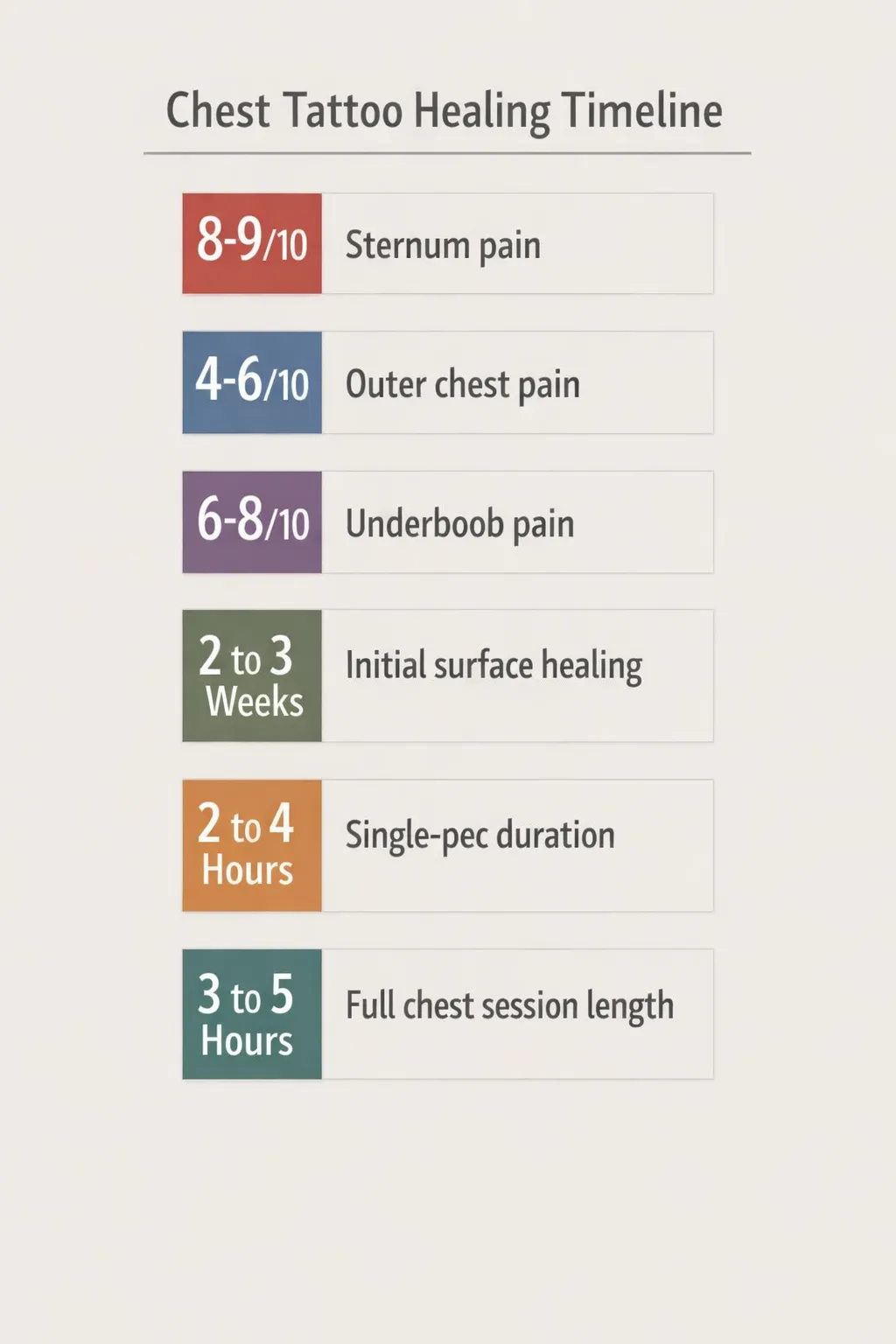 Single-pec piece: 2 to 4 hours; full chest: 2 to 3 sessions at 3 to 5 hours each; initial surface healing 2 to 3 weeks; total healing 6 to 8 weeks.
Healing timeline - what to expect week by week
- Day 1 to 3: Keep the original dressing on as instructed. After removal, wash with lukewarm water and fragrance-free soap, then apply a thin layer of fragrance-free moisturizer 2 to 3 times daily. Mild swelling and redness are normal.
- Week 1: Peeling begins - do not pick it. Avoid anything that presses or rubs on the piece: tight shirts, gym compression tops, backpack straps. Sleep on your back.
- Week 2 to 4: Peeling runs through day 10 to 14 (7). Once peeling stops, apply a fragrance-free mineral SPF 30+ whenever the area is exposed. Pastel ink may look patchy - it usually resolves by week 6.
- Week 6 to 8: Full dermal healing completes for medium pieces at the 6 to 8 week mark. Normal clothing and gym work are fine again; book a touch-up evaluation if needed.
One thing I see constantly: clients stop moisturizing at 10 to 14 days when the surface looks closed, but full healing takes 6 to 8 weeks. Dryness and sun exposure in that window cause noticeable fading within 12 to 24 months. The tattoo looks fine on the outside and is still vulnerable underneath.
Clothing and friction management
- Avoid tight shirts or anything with a seam sitting directly over the tattoo for 5 to 7 days.
- Sleep on your back or side, not your front, for at least 7 to 10 nights.
- Stick to loose cotton tops or button-ups for the first 2 weeks - anything you can put on without dragging it across the chest.
- Go back to your usual shirts and straps around week 3 to 4, once peeling is complete and no scabbing remains.
- Skip underwire for at least 4 weeks on underboob designs.
- Long term, UV is the biggest enemy of chest ink - apply SPF whenever the area is exposed.
Healing Timeline for Chest Tattoos
8 weeksWeek-by-week care and what to expect during healing
- 1
Days 1-3
Keep original dressing as instructed. After removal, wash with lukewarm water and fragrance-free soap. Apply fragrance-free moisturizer 2-3 times daily. Mild swelling and redness are normal.
- 2
Week 1
Peeling starts; do not pick. Avoid tight clothing and anything that rubs the piece. Sleep on your back to reduce friction.
- 3
Weeks 2-4
Surface skin closes around day 10-14. Apply fragrance-free mineral SPF 30+ when exposed to sun. Pastel ink may look patchy but usually evens out by week 6.
- 4
Weeks 6-8
Full dermal healing completes. Normal clothing and training resume. Schedule touch-up evaluation if needed.
How Chest Tattoos Age - and What Speeds Up Fading
Black and dark grey hold 10 to 15 years before noticeable softening, which makes them the most reliable choice for a high-movement area like the sternum. This is the honest longevity picture most galleries skip.
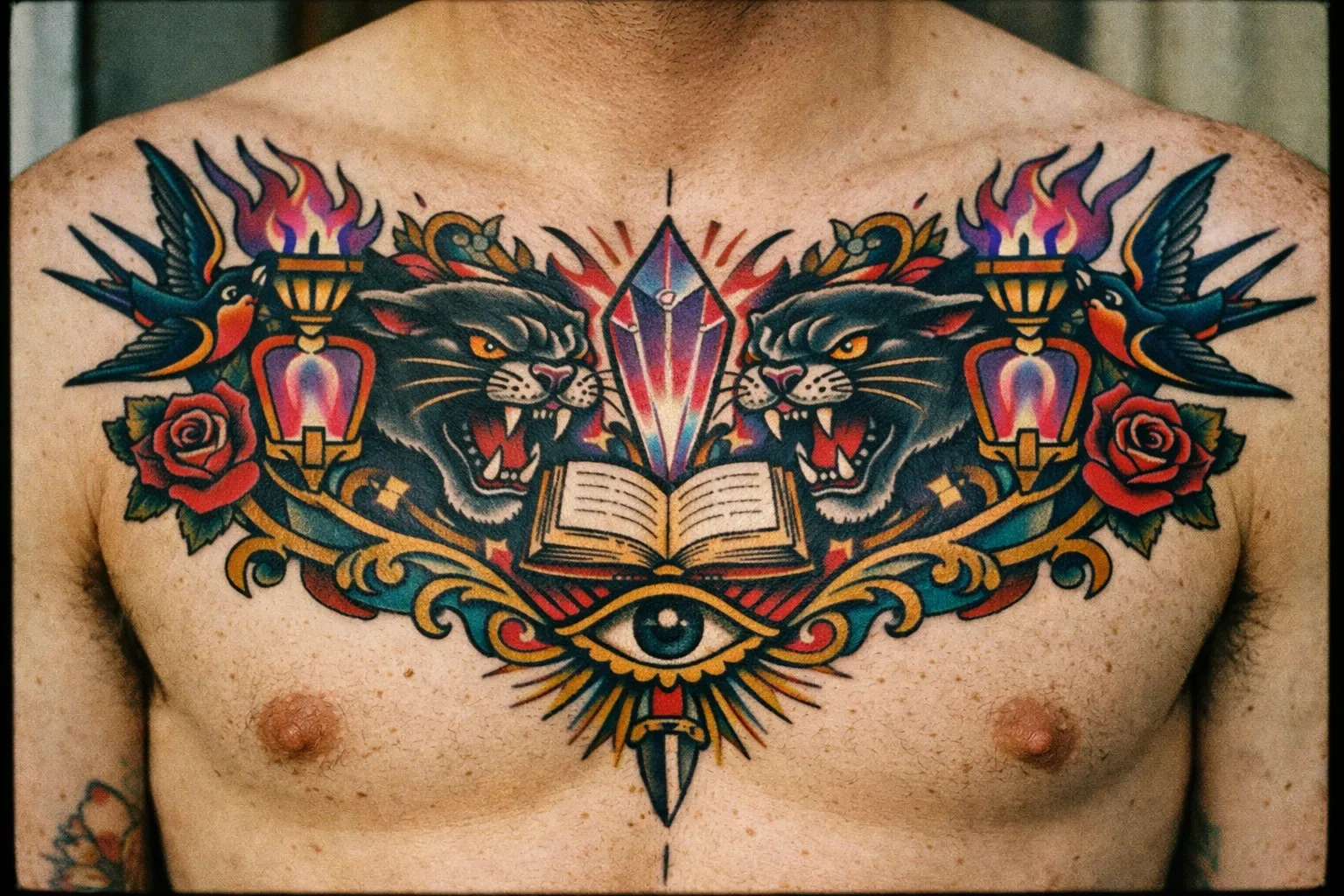
Fine-line work may blur 5 to 10 years in as dermal spread and the sternum’s constant movement work against it. If you want fine-line here, plan for wider line spacing and stronger saturation than you’d use on a still, padded area - it buys you time before a touch-up.
Pastel and light colors fade 30 to 50% faster on the chest than on lower-movement areas. Budget for a 5 to 7 year touch-up if you’re using delicate color.
Body changes matter more here than almost anywhere. Significant muscle gain shifts pec centering, weight fluctuation stretches surrounding tissue, pregnancy distorts anything extending below the sternum, and breast surgery relocates the whole plane. Raise all of these during planning. Designs placed within 1 to 2 cm of the nipples or breast tissue are the most vulnerable to distortion - a point that rarely comes up in consultation but should.
Sun exposure is the biggest long-term factor you actually control. The upper chest is frequently exposed in summer, and consistent SPF 30+ is the single most effective maintenance step you can take.
Common Mistakes That Derail a Chest Piece
- Underestimating sternum pain after easy forearm or outer-thigh sessions. The jump from 3 to 4/10 to 9/10 is genuinely shocking mid-session and ends more sittings than anything else.
- Sizing script too small. Script letters under ½ inch (12-13 mm) go illegible after healing, especially across the curved pectoral surface.
- Symmetry misalignment. Ignoring the midline, nipple, and clavicle landmarks produces a piece that reads 1 to 2 cm off-center in photos - correction means extra shading or cover-up work.
- Stopping aftercare too early. Full healing is 6 to 8 weeks, not the 10 to 14 days when the surface closes.
- Ignoring future body changes. Muscle gain, weight change, or breast surgery can distort a piece that was placed perfectly at the time.
- Choosing overly fine linework on the sternum without accepting the 5 to 10 year blur timeline. It’s a known trade-off on a thin-skin, high-movement area, not a surprise you get to be upset about later.
Frequently Asked Questions
- How painful is a chest tattoo for a male?
- The sternum rates 8-9/10 pain - needle vibrating directly against bone with almost no tissue buffer. The collarbone edge sits lower, around 6-7/10, while outer pectorals are a more manageable 5-6/10. The sensation over the breastbone is a deep vibration, not just surface sting.
- How small of a chest tattoo can I get on a tight budget?
- Budget dictates size and complexity more than anything else. A very small, simple design - think a single symbol or short word under 3 cm - is typically the entry point. Sternum pieces with any real detail require more time and cost more accordingly. Check with your artist directly, since hourly rates vary widely by region and experience level.
- Which tattoo is best for chest men?
- Designs that use the chest's natural symmetry like eagles, mandalas, bold scripts, and portraits age best. American traditional and blackwork styles hold up longer.
- How long does a full chest piece take to heal?
- Surface skin closes in 10-14 days, but full healing takes 6-8 weeks. Sternum and underboob areas may take longer due to friction.
- Can women get the same chest tattoo designs as men?
- Most designs cross genders, but women often prefer sternum, cleavage, or underboob placements. Bra logistics require avoiding underwire for 4+ weeks.
- Does a chest tattoo affect gym training?
- Avoid chest-heavy exercises for 10-14 days post-session. Light cardio is fine after day 7-10 if clothing doesn't rub the tattoo.
- How do I find an artist experienced with chest pieces?
- Look for healed chest tattoos in portfolios and ask about symmetry methods. Avoid artists who won't show healed work or pressure deposits early.
What Actually Determines Whether a Chest Piece Works Long-Term
Three decisions carry a chest piece long-term, and none of them is the design itself.
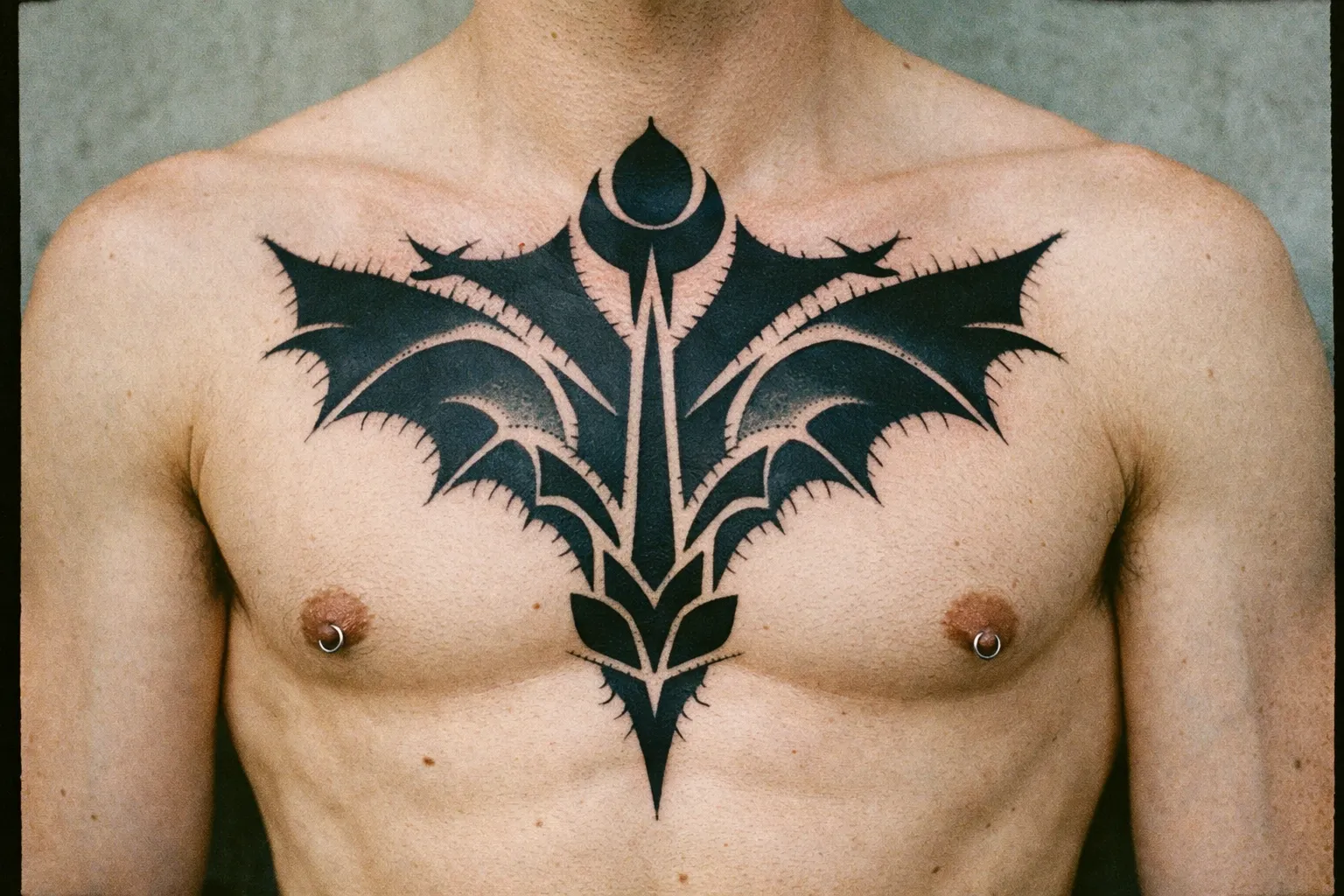
Placement zone. Choose based on your pain tolerance and design type, not just how it looks in a reference photo. The sternum is the hardest zone to sit through and the most technically demanding for the artist - go in knowing that.
How it ages. Blackwork and bold linework hold 10 to 15 years. Fine-line on the sternum is a 5 to 10 year commitment before a touch-up. Pick your style knowing which timeline you’re signing up for.
Aftercare duration. Surface healing at 10 to 14 days is not full healing. The 6 to 8 week mark is when the piece is actually stable and safe for normal clothing, sun exposure, and gym work.
Before you book, bring healed-work references to the consultation, get the stencil applied standing up, and confirm the artist measures from the midline before locking in a layout. That’s the difference between a chest piece that looks right in the mirror and one that needs correction.