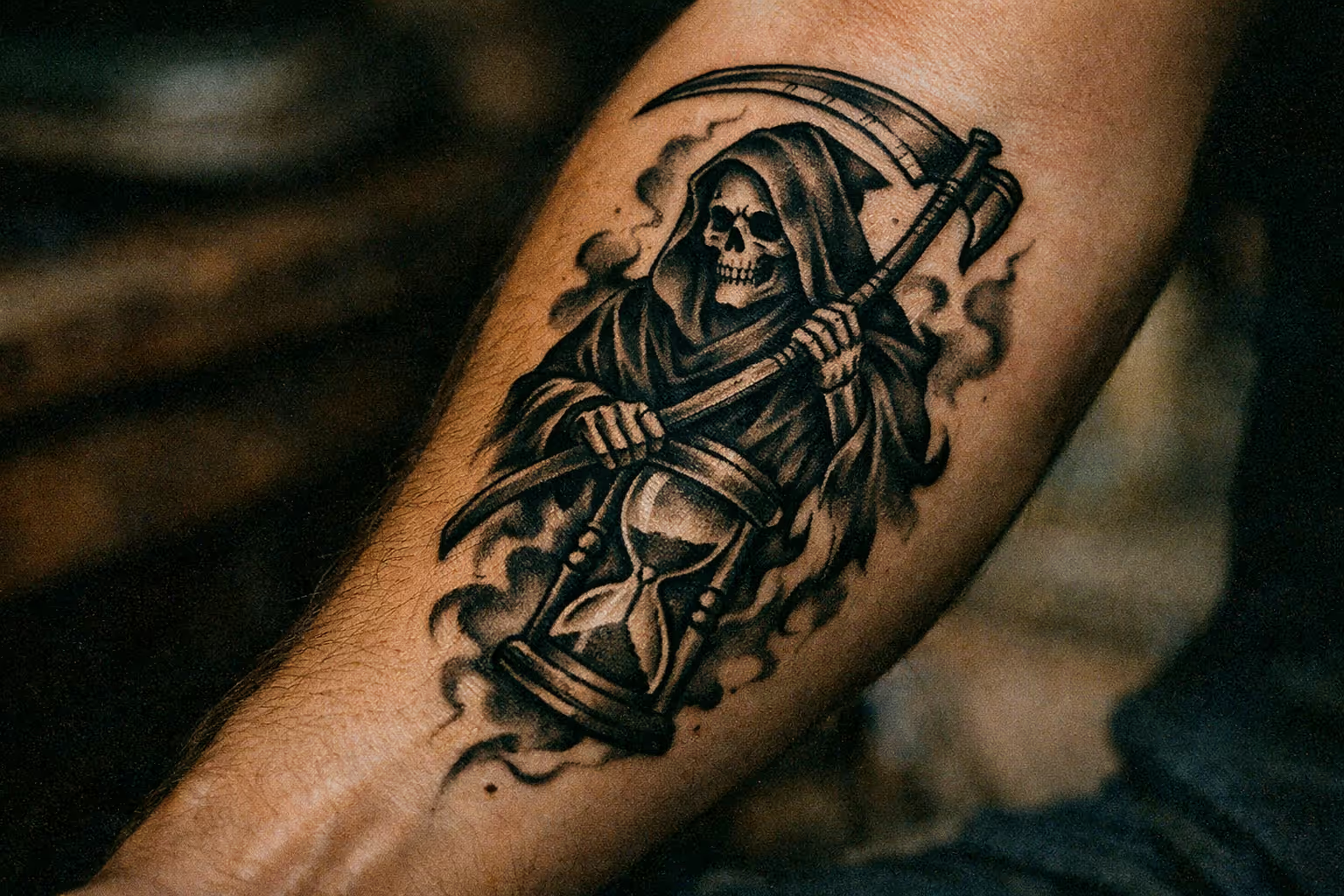
A grim reaper tattoo lives or dies on how it’s built. A fine-line micro version blurs into a grey blob within 5-10 years; the same reaper in traditional bold work still reads at twenty-plus. That gap, plus clock variants and placement, matters more than most people booking one realize. Here’s what the grim reaper means, and how to make it last.
The Symbolism: What a Grim Reaper Tattoo Actually Means
A grim reaper tattoo puts a hooded skeleton - usually with a scythe, sometimes an hourglass or a clock - on your skin as a daily marker that time runs out. It’s one of the oldest death motifs in Western tattoo flash, and it still pulls in collectors because the symbolism does real work: mortality, transformation, courage in the face of an ending. This guide covers grim reaper tattoo meaning, the main grim reaper tattoo designs you’ll encounter in a shop, how a traditional grim reaper tattoo differs from realism, and what a grim reaper clock tattoo actually communicates. I’ll also flag the sizes that age well, the placements that don’t, and a few practical things that most listicles skip entirely.
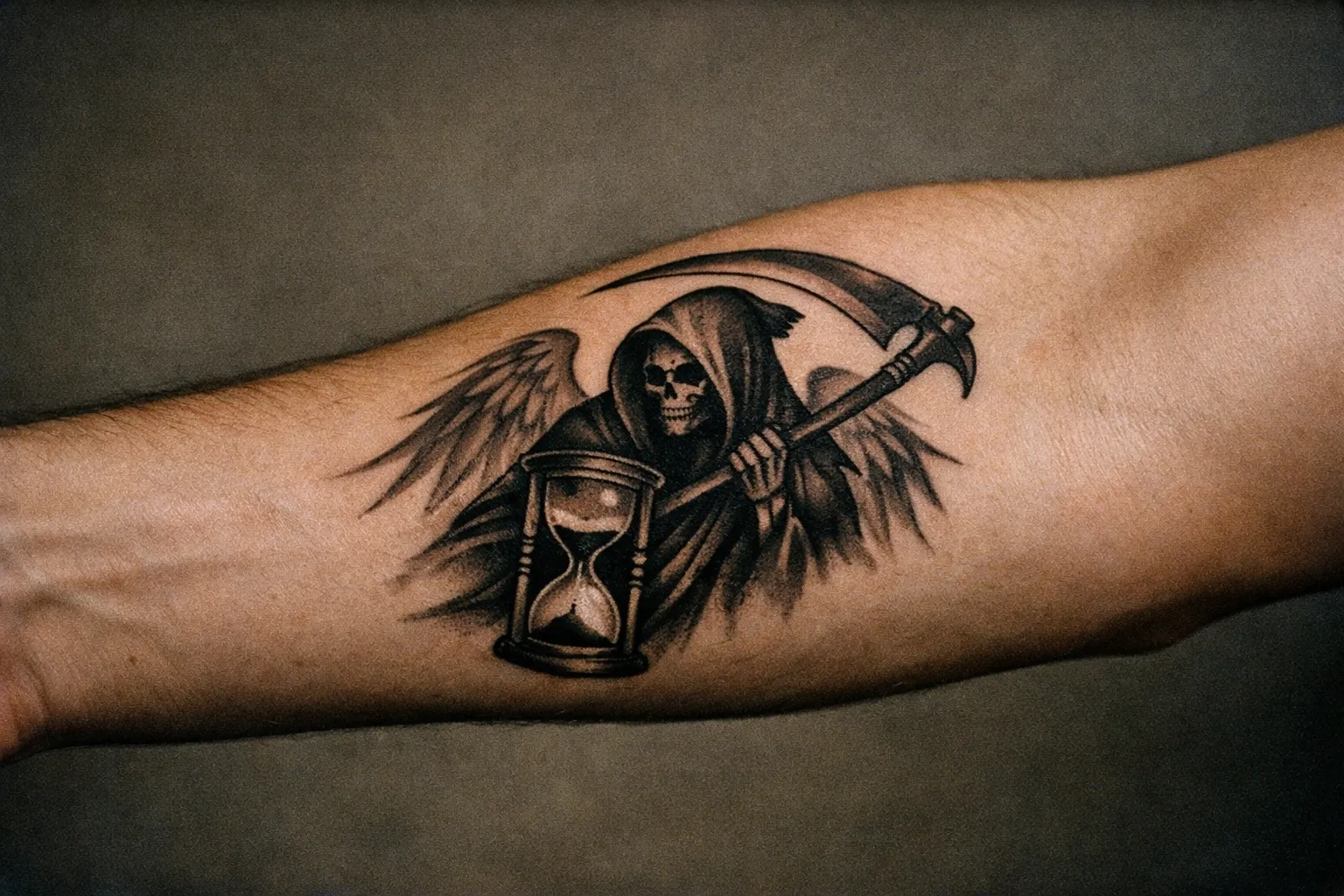
The Reaper as we know him - hooded skeleton with a scythe - settled into Western imagery around 15th-century Europe, born out of plague-era memento mori art. The scythe came from harvest iconography (souls as ripe grain); the hood obscured identity because death isn’t personal, it comes for everyone.
In modern tattoo culture, the meaning has loosened considerably. Across the major tattoo galleries, the core readings cluster around four ideas (1):
- Mortality and the inevitability of death - the dominant reading, present in the vast majority of design descriptions.
- Protection - the Reaper as gatekeeper rather than predator, especially common in memorial pieces.
- Respect for the dead - paired with names, dates, or roses.
- Surviving something - near-death experience, addiction, illness, combat. The Reaper as the thing you outran.
This is worth saying clearly because clients ask: the grim reaper is not inherently evil in tattoo symbolism. Most artists and most clients treat him as a neutral psychopomp - a guide between life and death, closer to the Death card in tarot (which means change, not literal death) than to a demon. A minority of religious traditions read him as Satanic imagery; if that’s your family or workplace context, factor it in before you put him on your neck.
✓ Pros
- Strong symbolism with multiple nuanced meanings beyond death
- Variety of styles from traditional to realism and neo-traditional
- Ages well in traditional and neo-traditional styles with proper sizing
- Customizable elements like clocks and roses add personal meaning
✗ Cons
- Fine-line and micro designs blur quickly and age poorly
- Complex designs require larger placements and more sessions
- Some placements distort detail or age badly (wrist, fingers, ribs)
Style Breakdown: Designs From Traditional to Realism
There’s a real difference between styles, and it changes how the tattoo ages, what it costs, and how long you sit. Here are the styles you’ll actually be choosing between.
Traditional Grim Reaper Tattoo
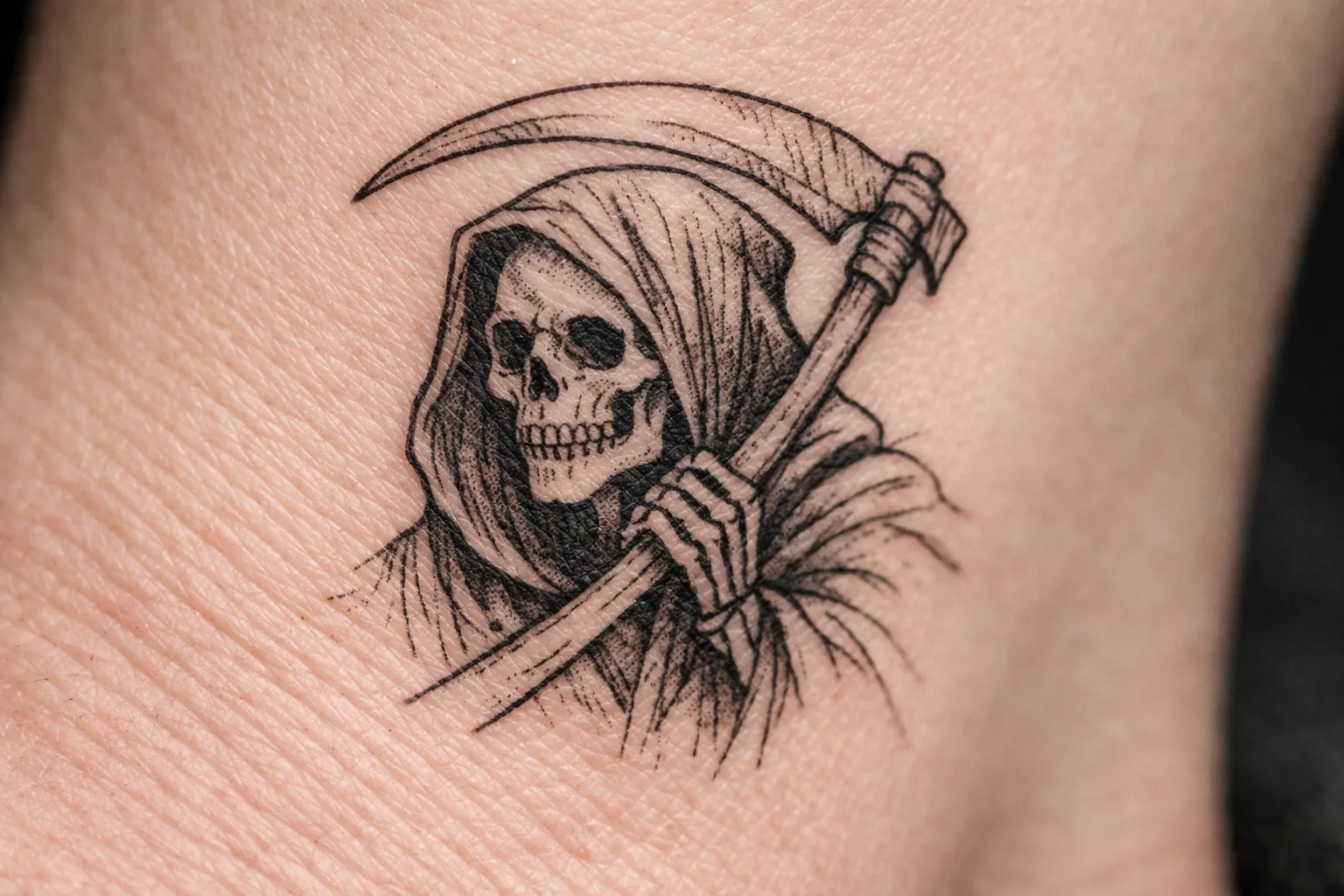
American traditional follows two technical hallmarks: thick black outlines (artists usually pull these with 7-14RL liners) and a limited palette - black, red, green, yellow, occasionally a muted blue. The skull is simplified, the cloak reads as bold shapes rather than fabric texture, and there’s heavy black behind the figure to frame it.
This style ages better than any other. Twenty years in, a traditional grim reaper tattoo on a forearm still reads clearly from across a room because the contrast was built in from day one. The common pitfall: artists who try to “soften” traditional with mid-tone grey washes everywhere. You lose the punch and the piece looks muddy within five years.
Black-and-Grey Realism
This is what dominates the curated “best of” galleries right now - roughly 60-70% of featured reaper pieces lean realism. Smooth gradients on the skull, real fabric texture in the cloak, detailed scythe blade. It looks incredible fresh. It also needs a specialist who actually does black-and-grey realism - not every traditional artist can pull it off - and you’ll sit longer (4-7 hours for a forearm-size portrait).
Pitfall: realism without enough black anchoring tends to soften over a decade. Ask for solid darks in the cloak interior, not just smoke and shading.
Neo-Traditional
Bold outlines like traditional, but with a wider color range and more illustrative detail - roses around the scythe, a raven on the shoulder, decorative borders. Younger collectors increasingly pick turquoise, magenta, or orange palettes over strict black-and-red. It’s a strong middle ground if you want color but care about longevity.
Illustrative, Anime, and Comic Styles
Stylized reapers pulled from horror illustration, video games, or anime. Less symbolically loaded, more aesthetic. Works well if the Reaper is a character to you - Death from Sandman, the reaper from Soul Eater - rather than a death symbol.
Minimalist and Fine-Line
Small hooded figure, no face detail, single-needle linework. Cheaper, faster, lower commitment. The honest caveat: micro reaper designs under 2 inches blur noticeably within 5-10 years. Fine-line ink sits shallow and the body breaks it down faster than thick traditional linework. If you want a small reaper that holds up, go traditional-small with bold outlines, not fine-line.
The Clock Variant: Designing Around Time
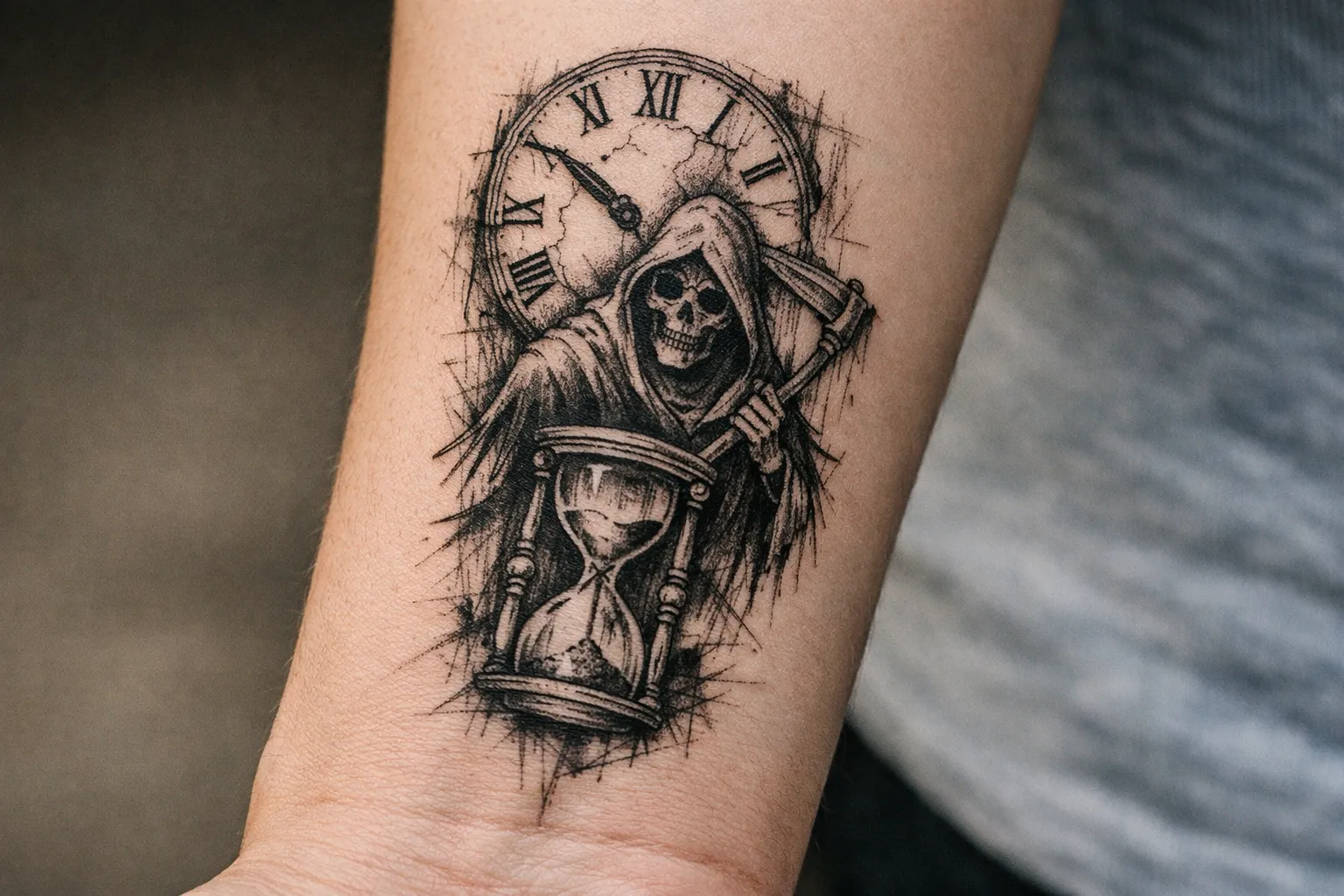
A grim reaper clock tattoo isn’t just an aesthetic combo - it’s the most specific statement in the reaper vocabulary. The clock (or pocket watch, or hourglass) narrows the meaning from general mortality to time running out. Roughly a quarter to a third of curated reaper designs include a clock or hourglass element.
A few design decisions actually matter here:
- Set the time to something meaningful. Generic 12:00 or 3:00 reads as filler. The time of a birth, a loss, a sobriety date, or the moment you survived something turns the piece into a personal marker. Artists routinely recommend this.
- Roman numerals vs. modern digits. Romans read better at distance and age better in small sizes; digits get muddy under 3 inches.
- Clock without hands is a common variation - it means time has stopped, often used in memorial work.
- Hourglass instead of clock shifts the reading toward finite life in motion rather than a fixed moment. Good if you don’t want to commit to a specific date.
Placement for clock variants: forearm (vertical layout - scythe on one side, clock face on the other), upper arm, or calf. Avoid putting clock detail on the ribs or any tight curve - the numerals distort.
I’ve seen clients bring in a grim reaper clock tattoo reference with a beautifully detailed pocket watch face, then insist on fitting it into a 3-inch wrist spot. The numerals turn to blobs within a few years. Size to the placement, not the other way around.
Placement and Size: What Actually Works
Around 40-50% of featured reaper tattoos sit on sleeves or large forearm/upper-arm pieces, with calf, back, and chest making up most of the rest. That’s not arbitrary - the reaper is a vertical, narrative figure with a long scythe, and he needs vertical real estate.
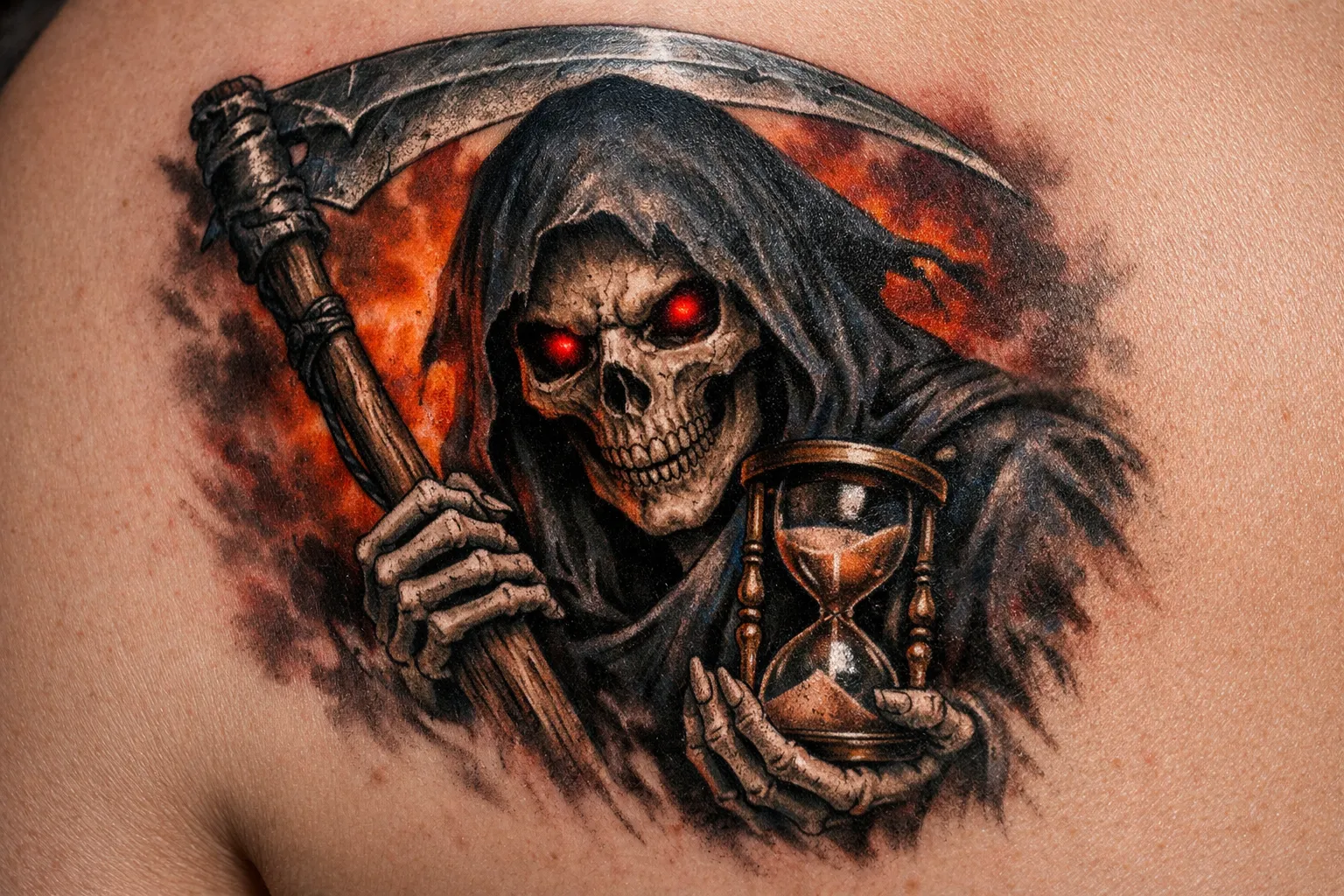
Forearm (3-6 inches): the most-recommended first reaper placement. Visible to you daily, reasonable pain (forearm is one of the more manageable spots), takes detail well. A traditional forearm reaper runs 1-2 hours; a realism portrait runs 4-7.
Upper arm or half-sleeve (7-10 inches): room for a full figure with background - clouds, smoke, a clock, tombstones. This is where most reaper pieces actually live.
Calf (6-10 inches): great vertical canvas, ages well because the calf doesn’t take as much sun as the arm. Pain is moderate - more than the forearm, less than the ribcage.
Full back or full sleeve (18-24 inches): scenic compositions - graveyard, multiple figures, full cloak flow. Plan on 3-5 sessions of 3-5 hours for a sleeve, 10-20 hours total for a back piece.
Ribs, sternum, spine, elbow ditch: ribcage hurts more than forearm, sternum more than ribs. Save these for your second or third tattoo, not your first reaper.
Avoid for a detailed reaper: wrist (under 3 inches loses face detail fast), inner forearm tight curves (distorts the focal point), hand and finger (heavy black blurs and needs touch-ups every couple of years).
Size Honesty
If you want full skull detail, cloak folds, and roman numerals on a clock, you need at least 4 inches of vertical space. Below 3 inches, plan on losing detail within 3-5 years. Below 2 inches, skip the clock and the scythe blade detail entirely - go silhouette only.
What to Add: Scythe, Hourglass, Roses, Cards
The scythe shows up in roughly 80-90% of featured reaper tattoos - it’s basically standard equipment. But you can layer in more:
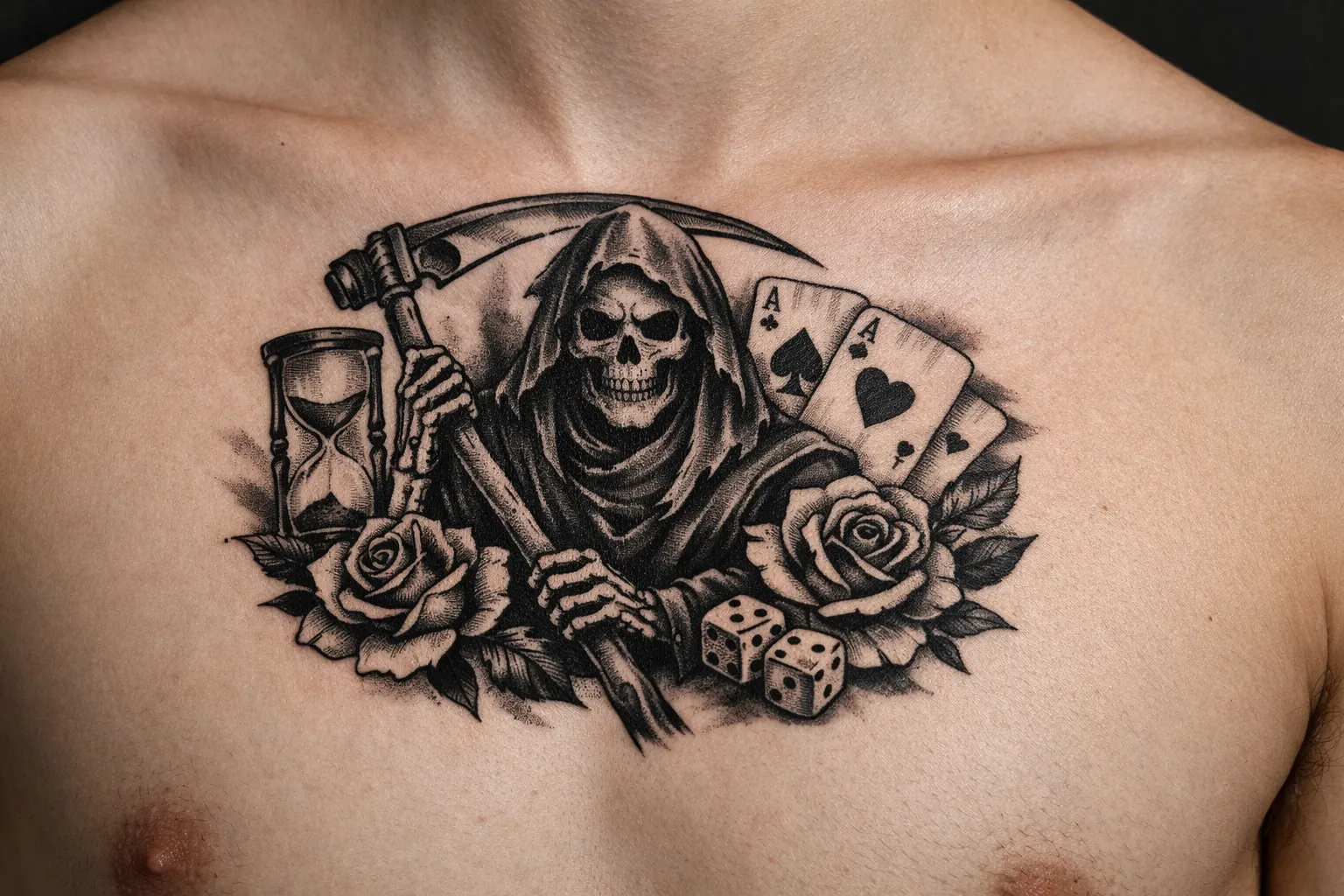
- Hourglass: finite time, life slipping away. Pairs naturally with the scythe but doesn’t compete with it visually.
- Roses: memorial readings, or duality (beauty + death). Red traditional roses sit best with traditional reapers; realistic black-and-grey roses pair with realism portraits.
- Cards or dice: fate and risk. Common with gamblers, people in high-risk jobs, or anyone framing the piece around chance rather than certainty.
- Skulls or bones beyond the head: about 40% of designs include extra bones - a pile of skulls at the feet, a ribcage under the cloak. Adds weight but eats space.
- Crows or ravens: psychopomp companions, classic Western death iconography.
- Candles, hooded lanterns: the reaper as guide rather than executioner.
One pitfall I see constantly: cramming reaper + clock + roses + raven + script + background into a 4-inch forearm spot. Pick one core symbol - death, time, fate, protection - and remove anything that doesn’t directly support it. A clean composition reads forever; a busy one looks like a sticker pack.
Female Reaper Designs and Modern Variations
Female grim reaper tattoos have grown noticeably in the past few years - not as a softening of the symbol, but as a re-claiming. The figure stays cloaked and skeletal; what changes is posture, sometimes a more elongated silhouette, occasionally a face that’s intact rather than skull-only.
A few design notes worth knowing:
- A female reaper can carry the same scythe and hourglass - the symbolism doesn’t change with gender.
- Ornamental detail in the cloak hem (lace patterns, decorative borders) is more common in female reaper designs and works well in neo-traditional palettes.
- Size and placement rules are identical - the same 4-inch minimum for detail applies.
The framing of “grim reaper for women” as inherently smaller or more delicate is something I’d push back on. If you want a large traditional reaper across your back, get it. The figure works at any scale.
Color or Black-and-Grey: How to Choose
Roughly 60-70% of featured reaper tattoos are black-and-grey, with traditional and neo-traditional color making up the rest.
Go black-and-grey if: you want realism, you want maximum longevity with minimum touch-ups, you want the piece to read as somber, or you work in a context where bright color reads as too casual.
Go traditional color if: you want a piece that holds up for 20+ years without losing punch, you like the classic flash aesthetic, or you want red, green, and yellow doing the heavy lifting alongside black.
Go neo-traditional color if: you want personality - turquoise smoke, magenta roses, an orange sky behind a black cloak. This is where the most experimentation is happening in 2024-2026 reaper work.
A red accent splash on an otherwise black-and-grey reaper - blood on the scythe, a red rose, glowing eyes - has become a popular hybrid in current galleries. It works because the rest of the piece anchors it.
Customizing a Saved Design: More About That Pin
Most people walking into a consult for a reaper bring a Pinterest board. That’s fine as a starting point - but a saved pin is inspiration, not a stencil. Two reasons:
- Copying another artist’s piece is a working-shop ethics problem. Most reputable artists will refuse, or rework it heavily.
- The pin you saved may not work at your size, your placement, or for your skin tone. A piece designed for an 8-inch upper arm doesn’t translate to a 3-inch wrist.
The practical move: bring 5-10 reference images, not one. Separate them by element - one pin for the skull style you like, one for the cloak flow, one for the scythe angle, one for the background. Tell the artist what’s pulling you to each one. They’ll combine elements into something that’s actually yours.
Ask the artist to change at least 3-5 major elements from any single reference: pose, weapon angle, perspective, color scheme, background. That’s the threshold most artists use to consider a design adapted rather than copied.
Create Your Own Grim Reaper Tattoo: A Concept Workflow
If you want to come into a consult with a real concept instead of a vague idea, here’s the workflow that actually holds up:
Creating a Grim Reaper Tattoo Concept
About 1 hourStep-by-step process to develop a meaningful and well-designed grim reaper tattoo concept.
- 1
Pick one core meaning
Decide if your tattoo is about mortality, time, survival, protection, or memorial. Write it down to guide all other decisions.
- 2
Collect 10-20 references
Gather images separately for skull, cloak, scythe, background, and color palette from reliable sources like Tattoodo or Adobe Stock.
- 3
Decide style first
Choose between traditional, realism, neo-traditional, or illustrative to match your priorities and find the right artist.
- 4
Sketch thumbnails small
Create or request 1-inch silhouette sketches to ensure your design reads clearly at small sizes.
- 5
Pick placement and size accordingly
Measure your chosen spot and set minimum size to preserve detail; design to fit the placement, not vice versa.
- 6
Subtract unnecessary elements
Remove anything that doesn't support your core meaning to avoid clutter and maintain clarity.
- 7
Bring your concept to consult
Schedule a 30-minute consult before booking the tattoo session to catch design or placement issues.
Related Themes Worth Exploring
The reaper sits in a broader visual and philosophical tradition. If the symbolism pulls you, these adjacent themes often pair well or open up the concept:
- Memento mori art - Latin for “remember you must die,” the European tradition that gave us the hooded skeleton in the first place. Skulls, hourglasses, wilting flowers, candles.
- The Death card in tarot - number 13, almost universally misunderstood. It means transformation and the end of a phase, not literal death. A reaper paired with tarot iconography reads as change.
- Día de los Muertos imagery - culturally distinct from the Western reaper (sugar skulls, marigolds, ancestor veneration), but in the same death-positive family. Don’t mix them carelessly; Día de los Muertos has specific cultural ownership.
- Santa Muerte - a folk saint in Mexican tradition, often depicted as a robed skeleton with a scythe. Visually adjacent to the reaper but religiously specific; research before tattooing.
- Death-positive philosophy - the modern movement around accepting mortality (Caitlin Doughty’s work, Order of the Good Death). Reaper tattoos increasingly come from this framing rather than goth or horror aesthetics.
Cost, Time, and Booking
Current U.S. shop rates for a grim reaper tattoo, 2024-2026 ranges:
- Shop minimum (1-2 inch reaper head): $80-$150.
- Small/medium forearm piece (3-6 inches): $200-$500, at $120-$200/hour.
- Large upper arm, thigh, or half-sleeve: $500-$1,200, typically 4-8 hours of work.
- Full sleeve or back piece with background: $1,200-$3,000+, spread over 10-20 hours and multiple sessions.
Booking lead times at solid shops in major cities run 2-8 weeks; established artists with a strong reaper portfolio often have 3-6 month waitlists. Don’t book the first available artist if their portfolio doesn’t include reaper work. The reaper exposes weak fundamentals fast - skull anatomy, fabric folds, scythe perspective. You want someone who’s done this before.
Aftercare: The Healing Timeline
A reaper with heavy black needs disciplined aftercare to keep saturation. The timeline:
- Day 1-3: initial weeping, redness, mild swelling. Keep the second-skin dressing on if your artist applied one (usually 24 hours); after removal, wash gently with fragrance-free soap, pat dry, apply a thin layer of fragrance-free moisturizer.
- Week 1: peeling and itching starts around day 3 and runs through day 10. Don’t pick, don’t scratch. Continue fragrance-free moisturizer 2-3 times daily.
- Week 2-4: surface healing completes around days 10-21. Skin looks normal but is still healing underneath. Start using sun-protective clothing or high-SPF mineral sunscreen on the area - UV is the single biggest factor in black ink fading.
- Week 4-8: full internal healing, especially for large pieces with heavy black saturation. Touch-ups, if needed, are usually done after this point.
Studios increasingly recommend fragrance-free, petroleum-free balms over the older petroleum-based methods - they hold black saturation better through the peeling stage. Medical-grade film dressings (second-skin products) for the first 24 hours have become standard at most reputable shops.
Common Mistakes to Avoid
A short list of what goes wrong with reaper tattoos:
- Sizing detail too small. Full skull + cloak folds + clock numerals under 3 inches blur within 3-5 years.
- Overloading the design. Reaper + clock + roses + raven + script + background on a small canvas reads as visual noise.
- Wrong placement for the composition. Wrapping the reaper’s face around a tight curve distorts the focal point when viewed straight on.
- Ignoring how it ages. Fine-line micro reapers look great fresh and disappointing at year five.
- Copying a Pinterest pin directly. Ethics issue with the original artist, and the design wasn’t built for your body.
- Skipping the consult. Walking in cold and designing in the chair is how you end up with regrets.
Designs Worth Avoiding (Especially as a First Reaper)
A few categories worth steering clear of, particularly if this is one of your first pieces:
- Ultra-fine micro tattoos under 1 inch - fade fast, especially the linework.
- Finger and hand reapers with heavy black - blur quickly, need touch-ups every 1-2 years.
- Inner lip tattoos - sweat away within months; not a serious format for a reaper.
- Trendy flash with no adaptation - anything trending on TikTok is going to look dated quickly. The traditional reaper has lasted 100 years for a reason.
- Designs you haven’t sat with for at least a month - the reaper is symbolically heavy. If the concept doesn’t still feel right after 30 days, wait.
Frequently Asked Questions
- Is the grim reaper tattoo symbol always about death?
- While mortality is the core theme, the grim reaper tattoo often symbolizes transformation, protection, or surviving hardship depending on added elements like clocks or roses.
- Can a small grim reaper tattoo hold detail over time?
- Micro reaper tattoos under 2 inches, especially fine-line styles, tend to blur within 5-10 years. For lasting detail, aim for at least 3-4 inches and bold outlines.
- How do I avoid ethical issues when using Pinterest references?
- Bring multiple reference images separated by design element and ask your artist to adapt at least 3-5 major elements to create a unique tattoo.
- Why do some reaper tattoos include clocks or hourglasses?
- These elements narrow the meaning to time running out or finite life in motion, adding personal significance beyond general mortality.
- Are female grim reaper tattoos a softer symbol?
- No, female reaper designs maintain the core symbolism but may feature different posture or ornamental cloak details. The meaning and size rules remain the same.
- What placements are best for a detailed grim reaper tattoo?
- Forearm (3-6 inches), upper arm or half-sleeve (7-10 inches), and calf (6-10 inches) offer vertical space and moderate pain for detailed work.