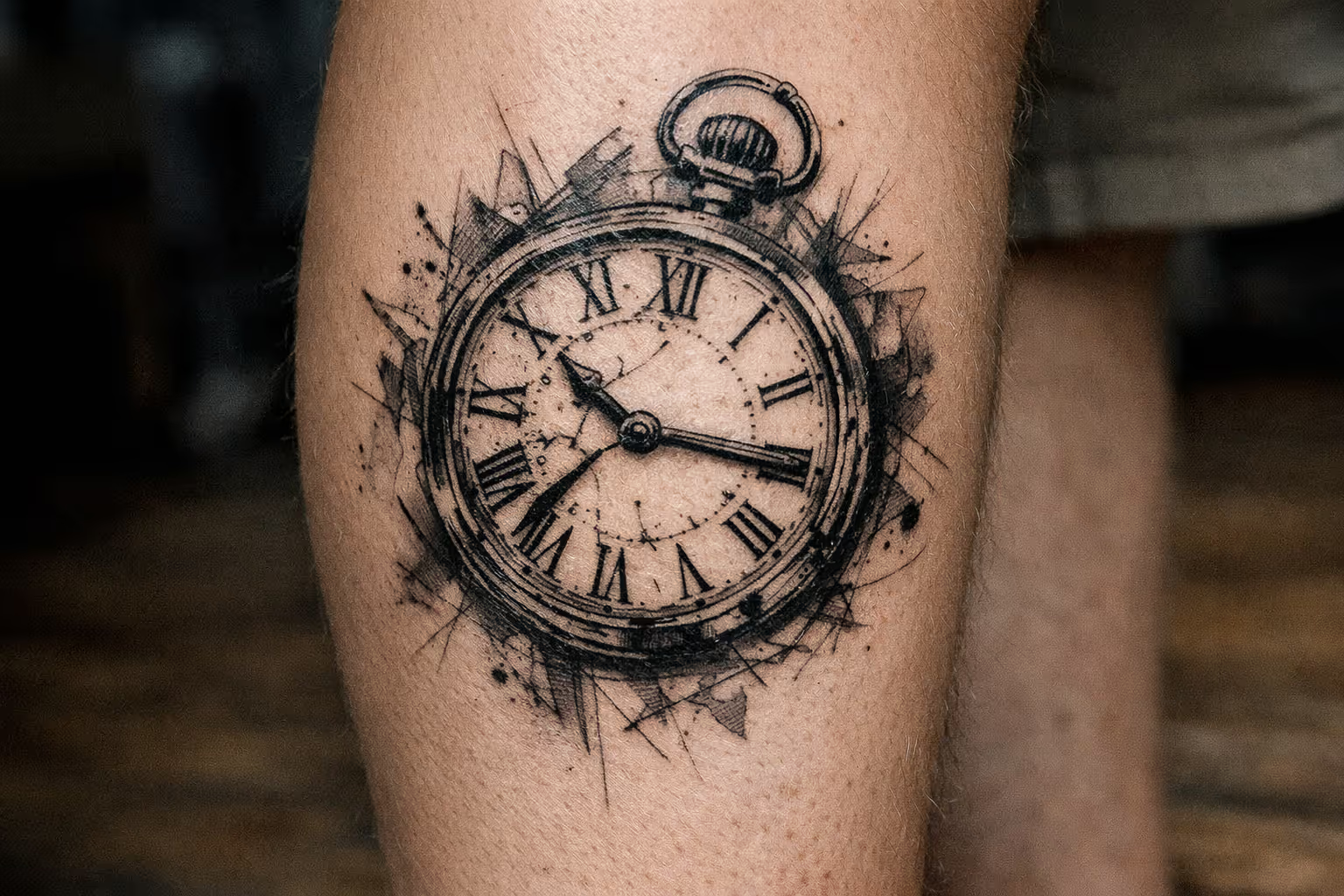
A clock tattoo is where symbolism and mechanics collide, and both can go wrong. The meaning swings hard by variant - a broken clock, a melting one, and a handless one each say something different - while the fine detail punishes bad calls: hands blur within 12-18 months, Roman numerals under ¼ inch (6 mm) merge into a smudge. Pick the variant and the scale with both in mind. Here’s what a clock tattoo means, and how to build one that survives.
What a Clock Tattoo Actually Means
Strip away the Pinterest mood boards and clock tattoos fall into a handful of meaning categories:
- Time and transience - the basic, most common read: life is finite, the hands keep moving (1)(2).
- Mortality - especially with skulls, hourglasses, or ravens added.
- A specific moment - hands set to a birth time, time of death, sobriety hour, wedding minute. This is the most personal use and the hardest to regret if the moment is real (5).
- Perseverance - a clock that’s cracked, dented, or still running despite damage.
- Fate or destiny - often paired with compasses, constellations, or tarot imagery.
- A rejection of time - handless clocks, melted faces, shattered glass. The wearer is saying schedules don’t run them (3).
The hands matter more than most people realize. A clock with hands pointing nowhere meaningful is just decoration. Pick the time before you pick the artist - the exact hour and minute, and ideally a date if you’re adding Roman numerals around the dial.
Clock and Rose Tattoo
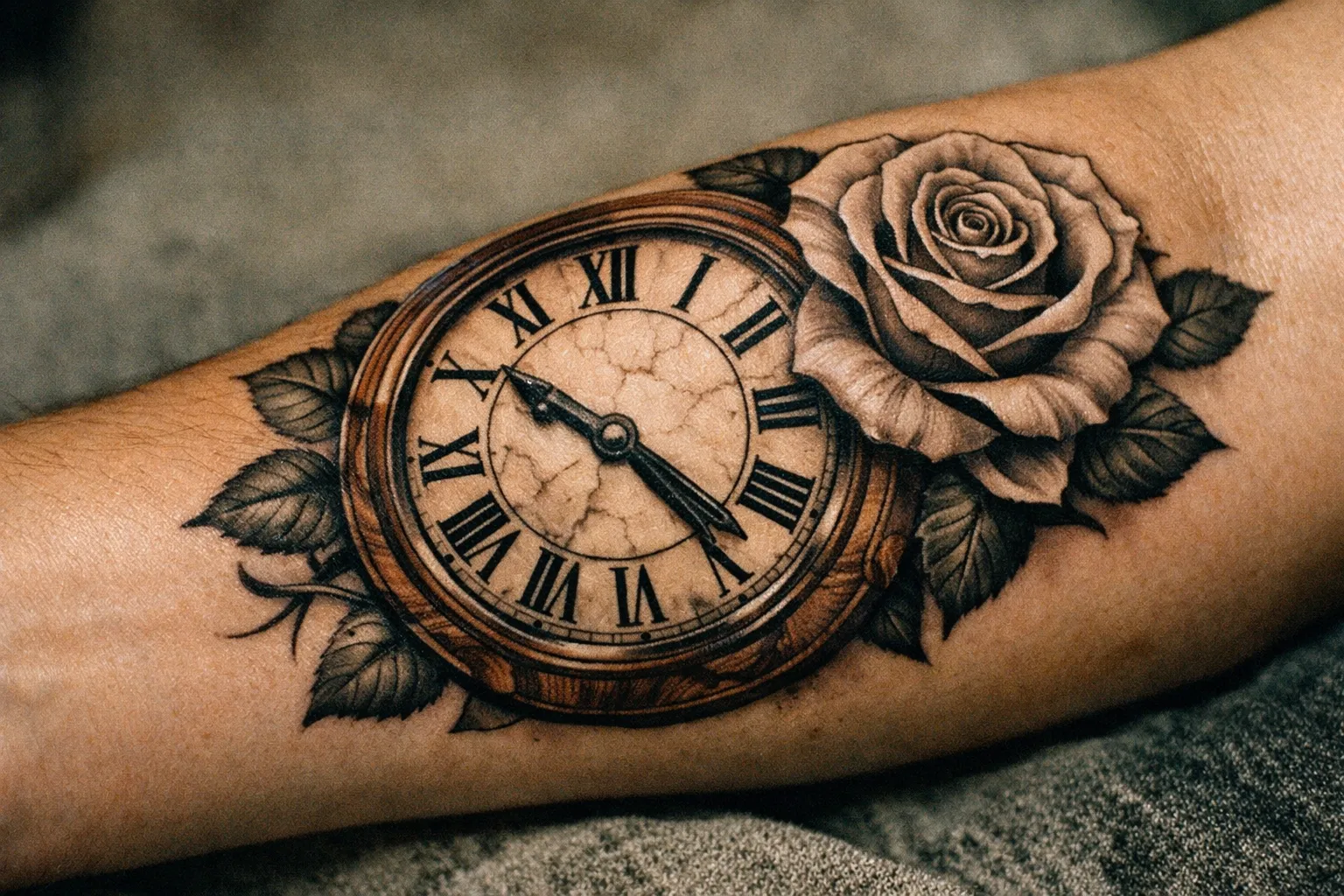
The clock and rose tattoo is the most common pairing in the Western tattoo market, and for good reason - the rose softens the harshness of the clock face and adds a clear focal point. The standard reading is time + love: a moment in life worth holding onto, or a person tied to a specific hour (3)(5).
I’ve drawn this combination more times than I can count, and the ones that age well share the same technical foundation.
Technical hallmarks of a good one:
- Strong black outline on the clock face, with the rose petals carrying the softer greywash gradients
- Roses framing the clock rather than crowding it - they should anchor the composition, not compete with it
- Negative space (open skin) between the rose and the clock to keep the silhouette readable as it ages
Common pitfall: all mid-gray, no strong blacks. Without solid black anchors in the deepest shadows, the whole piece turns into a muddy gray smear within 3-5 years. A clean clock and rose tattoo needs contrast - pure black, mid-gray, and bare skin highlights. I’ve had clients come in for touch-ups on pieces done elsewhere where the artist went too light on the blacks, and there’s only so much you can do at that point.
Placement and size: outer forearm at 5-7 inches is the sweet spot. The skin is flat, the surface doesn’t distort when you flex, and there’s room for the rose to breathe. Upper arm works too. Avoid the inner wrist for this combo - too curved, and the clock dial warps as the wrist moves.
Broken Clock Tattoo
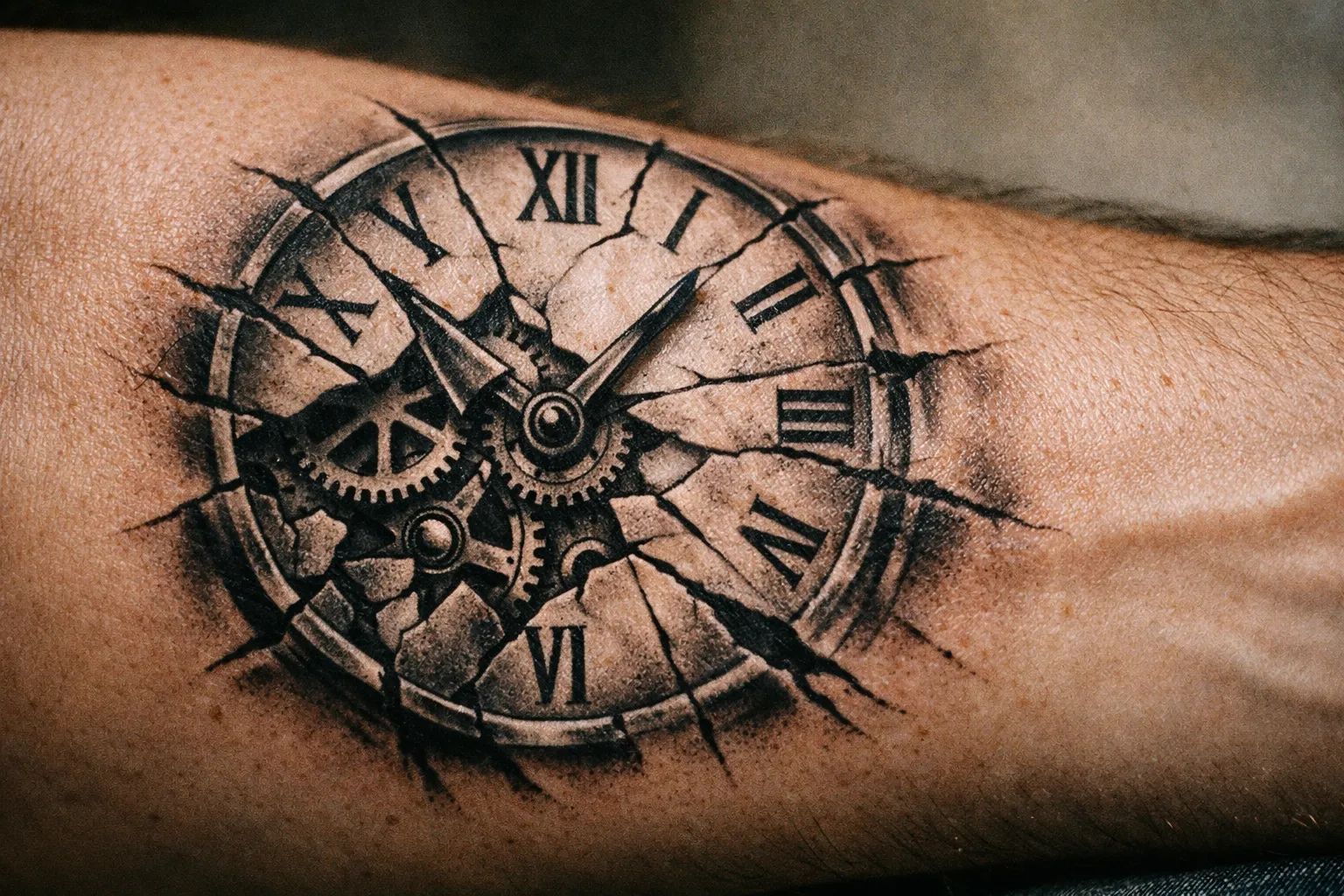
A broken clock tattoo reads as “time stopped” - usually at a traumatic event, a transformation, or a moment the wearer wants to mark as the dividing line of their life. It can also signal a deliberate rejection of linear time and schedules.
There’s a more recent reading worth knowing: in neurodivergent communities, broken clocks are increasingly used to represent ADHD time-blindness - the experience of time not working the way it does for everyone else. It’s not a universal symbol (there is no official ADHD tattoo), but it’s common enough that if you’re getting one, expect people in the know to ask. If you want the ADHD meaning to be unambiguous, pair the broken clock with a dopamine molecule or brain motif.
Design choices that make broken clocks work:
- Strong black in the deepest fracture lines - this is what sells the shattered-glass illusion
- Highlights left as bare skin, not white ink (white ink yellows and fades within a couple of years)
- Cracks that follow the curve of the clock face, not random scratches across it
- Visible gears or mechanism peeking through the largest break - gives depth
Placement: upper arm, chest, or outer forearm at 4-7 inches. The detail in the fracture work needs space. A 2-inch broken clock on a wrist will blur into a gray blob within a couple of years - I’ve seen it happen, and it’s not a fun conversation with a client.
Melting Clocks (Surrealist Style)
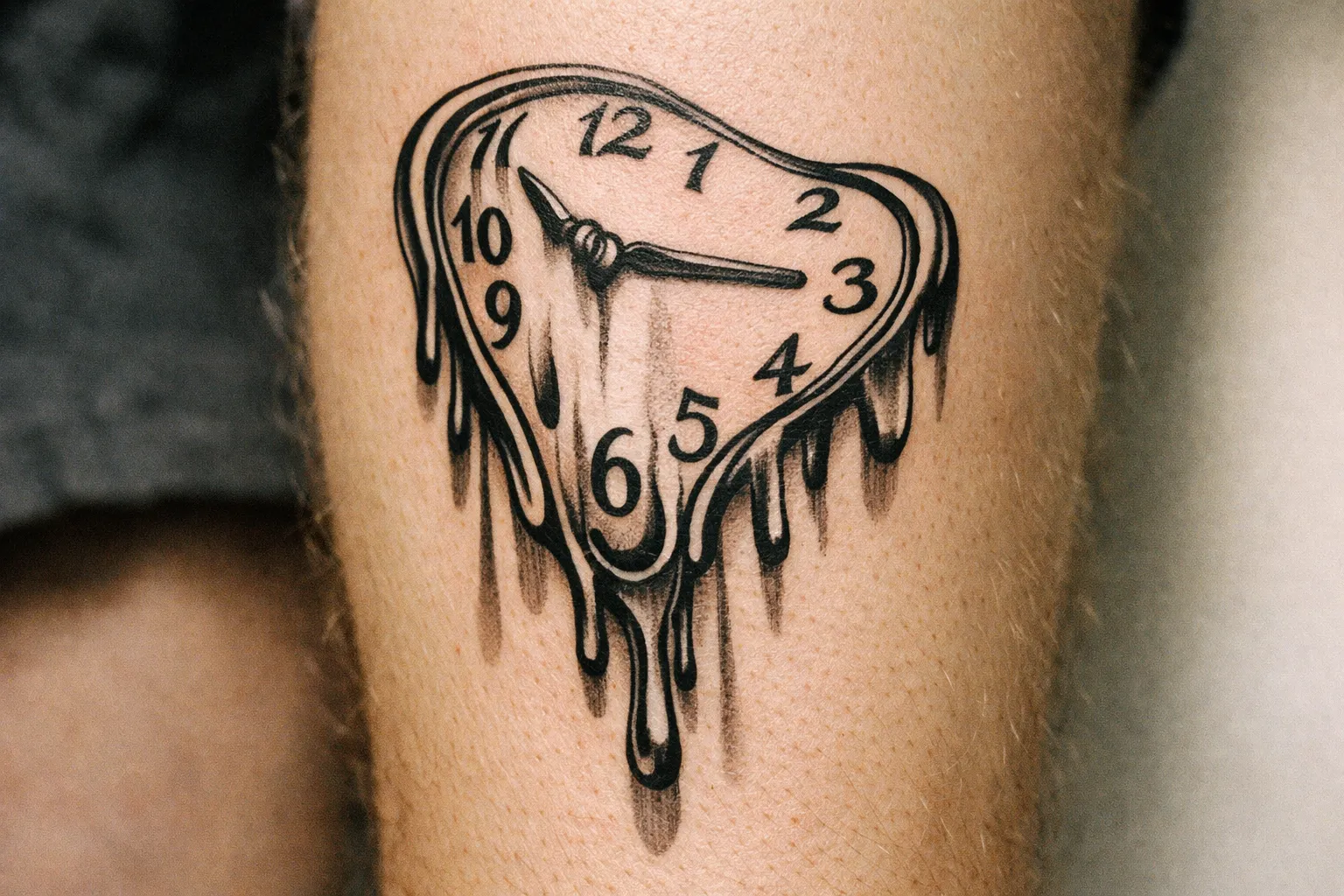
The melting clock pulls directly from Salvador Dalí’s The Persistence of Memory. The meaning is close to the broken clock - time as fluid, subjective, distorted - but the visual language is surrealist rather than violent (3).
The technical challenge is making the “melt” look like soft sag rather than a printer error. That means smooth gradient shading along the drooping edge, no hard outline where the face flows down, and a believable sense of gravity. Cheap melting clock tattoos look like a clock face stretched in Photoshop. Good ones look like the dial is genuinely sliding off a branch or edge.
Pairs well with skulls (mortality), roses (love that warps with time), or barren tree branches (Dalí reference). Size: 5-8 inches, forearm or upper arm. Smaller than that and the gradient work falls apart.
Pocket Watch Clock Designs
A pocket watch tattoo - usually rendered on a chain - is the design of choice for memorial pieces and heritage tributes. The chain element gives the artist somewhere to take the composition (wrapping around the arm, trailing into other elements) and the round case suits engraving-style lettering for names and dates. Pocket watch designs have been a staple of American traditional and neo-traditional tattooing for decades precisely because the format is self-contained: the case border acts as a natural frame, the chain provides a compositional anchor, and the face gives you a canvas for meaningful detail.
Why it ages well: the case provides a thick black border that holds up over decades, and the chain links can be re-blacked easily during touch-ups without disturbing the face.
What to put on the face:
- Roman numerals around the dial (keep them at least ¼ inch / 6 mm tall - smaller numerals merge over time as ink spreads 10-20% with age)
- A specific time tied to the person or event being memorialized
- An engraved name or date inside the case, in a serif font that mimics actual watch engraving
Placement and size: inner forearm, upper arm, or chest at 4-8 inches for the case alone, longer if you’re including the chain. The pocket watch is one of the few clock designs that works at sleeve scale without feeling repetitive.
Just the Hands: Minimalist Clock Designs
A clock hands tattoo - just the hands, no face, or hands floating against a minimal background - is the minimalist version of the motif. It’s a strong choice when you want the specific time to be the entire point, without the visual weight of a full clock.
It works because there’s nothing to overdesign. Two thin hands at a specific angle, maybe a tiny center pin, and the time itself does the symbolic work. Often paired with a date in fine-line Roman numerals or written numbers beside or below.
Placement: inner forearm, inner bicep, ribcage, or behind the ear at 1.5-3 inches. This is one of the few clock designs that genuinely works small. Fine-line work on flatter, less-exposed skin holds up best - the inner bicep is one of the slowest-aging spots on the body.
Pitfall: going too thin. A 0.2mm hairline on the inner wrist looks crisp at three months and ghostly at three years. Ask the artist to bump the line weight slightly above stencil thickness - they should already know to do this, but it’s worth asking.
Hand Placement for Clock Designs
A clock tattoo on hand is one of the most visible, most regretted, and most touched-up placements in the entire tattoo world. That doesn’t mean don’t do it - it means go in with your eyes open.
What to know before booking:
- Fade rate: hand tattoos blur faster than almost any other placement. Expect noticeable softening within 12-18 months and touch-ups every 2-4 years - faster than forearm or upper arm placements by a significant margin, according to working tattooers who track their own client return rates (2).
- Many shops now refuse free lifetime touch-ups on hands - the wear is too predictable and the artist is correcting your lifestyle, not their work.
- The back of the hand holds ink better than the fingers. Finger clock tattoos (especially the sides and between knuckles) often blur into illegibility within 2 years.
- Avoid micro-detail. A realistic clock with tiny gears and fine Roman numerals will not survive a back-of-hand placement. Go bolder, simpler, higher contrast.
What works on hand: a stylized clock face with thick outlines, large numerals (Roman or Arabic), and strong black anchors. Size: 2.5-4 inches across the back of the hand. Skip the elaborate broken-glass or melting-face designs here - they need detail you won’t keep.
Job consideration: hand tattoos are still a hiring filter in plenty of industries. The “tattoos are normalized” line is true in some sectors and total fiction in others. Know your field before you commit to a placement you can’t cover with a long sleeve.
Handless Clocks, Digital Clocks, and 00:00
A clock with no hands at all is a deliberate statement: time doesn’t apply, the wearer isn’t bound by schedules, or the moment being marked is timeless rather than specific (3). It’s a popular variant for people who don’t want to commit to a fixed hour.
A digital clock tattoo - usually a seven-segment LED-style display reading a specific time - gives precision that an analog face can’t. It’s also the cleanest way to render 00:00, which has become one of the more requested clock tattoo readings recently. The 00:00 reading typically signals a reset, a fresh start, or “time zero” - the beginning of a new chapter. Some wearers tie it to the midnight-as-rebirth idea or to angel-number-style numerology, though the cleaner read is just “starting over.”
11:11 has similar appeal - synchronicity, alignment, making a wish - and works well in a minimalist digital format on the inner forearm or wrist at 1-2 inches.
Grandfather Clock and Roman Numeral Variants
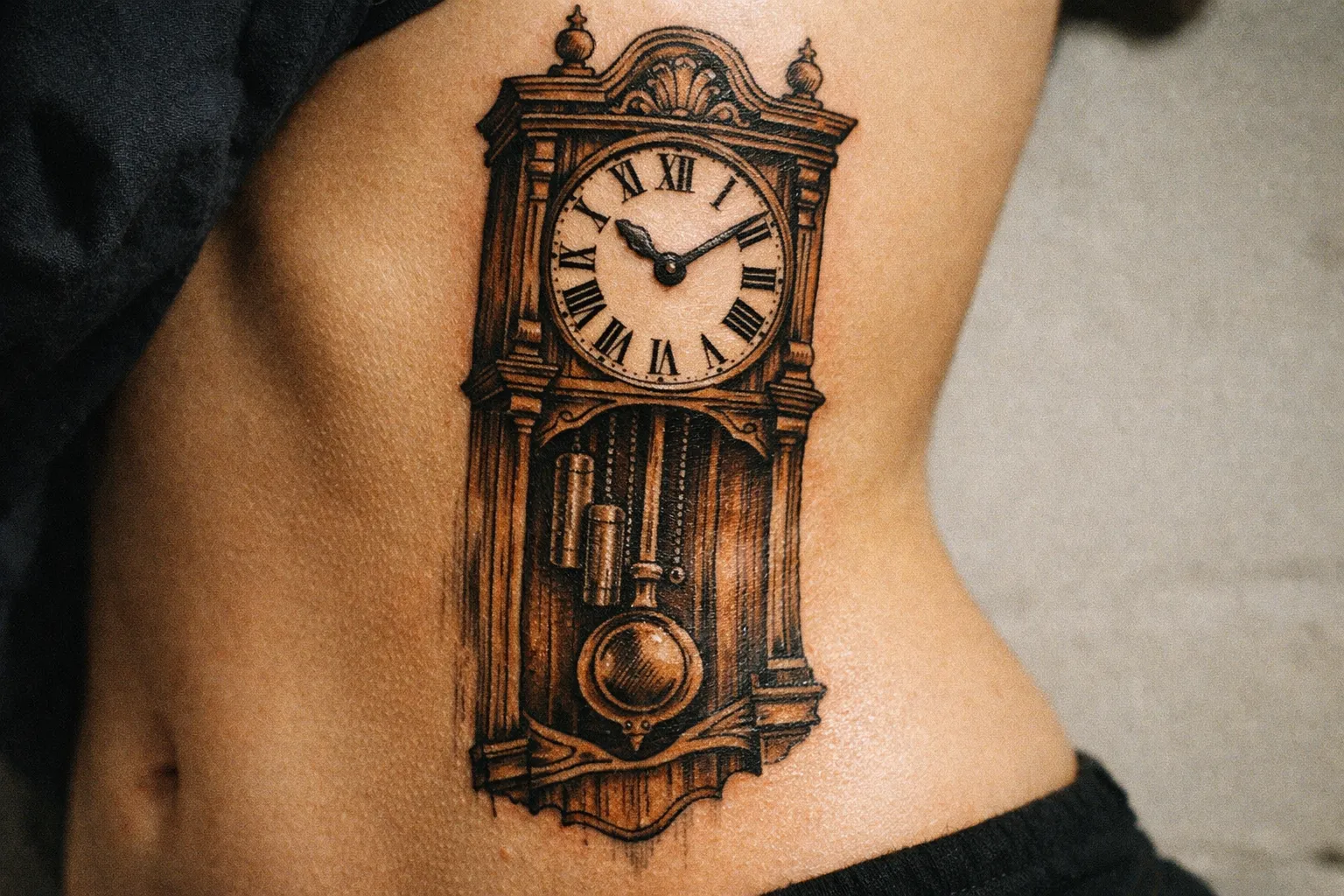
The grandfather clock pulls toward heritage and family memory - the kind of clock that stood in someone’s hallway and ticked through generations (3). It’s a good choice when the meaning is about lineage rather than a single moment.
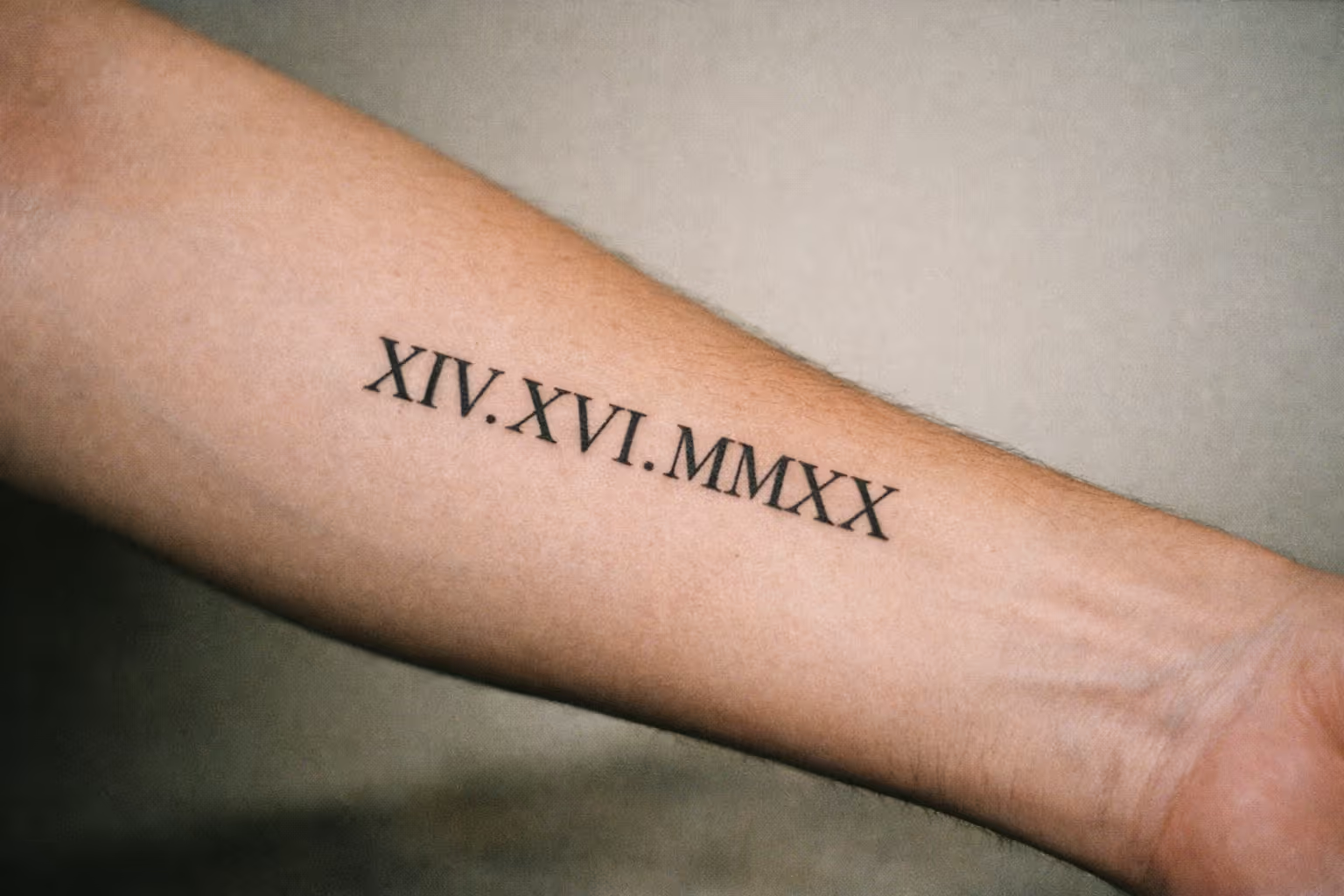
Roman numeral clock faces - whether on a pocket watch, a standing clock, or a wall clock - give the design a classical weight and let you encode a date around the dial. Keep numerals at least ¼ inch (6 mm) tall. Smaller than that and the IIs, IIIs, and IVs merge as ink spreads.
A small note on accuracy: traditional clock faces use IIII for 4, not IV. It’s a clockmaking convention. If your artist defaults to IV, that’s not wrong, but IIII is the more historically faithful choice.
Cost, Time, and Aftercare
Realistic US pricing for clock tattoos in a mid-tier city:
- Small clock hands or minimalist clock (2-3 inches): $150-$300, 45-90 minutes
- Forearm clock and rose in black & gray (4-6 inches): $300-$600, 2-3 hours
- Detailed pocket watch with Roman numerals and shading: $400-$800, 3-5 hours
- Upper arm or half-sleeve composition with clock, roses, and additional elements: $800-$1,800, 6-10 hours
- Full realistic sleeve dominated by clocks and roses: $1,800-$4,000+, often over 3-5 sessions
Hand and neck placements typically add 30-60 minutes for extra stencil care and command a higher per-hour rate at most shops.
Aftercare timeline:
- Day 1-3: wash twice daily with fragrance-free soap, thin layer of fragrance-free ointment after each wash. Expect some plasma weep and tightness.
- Week 1: switch from ointment to a fragrance-free moisturizer once the surface stops weeping. Do not pick scabs.
- Week 2-4: flaking and itching peak around day 7-14. Keep moisturized. No pool, hot tub, ocean, or sauna submersion.
- Week 4-6: lines and shading fully settle. This is when you can judge the actual look of the piece - not before.
- Long term: sun is the biggest enemy. Once healed, use sun-protective clothing or high-SPF on the tattoo whenever it’s exposed. Black & gray clocks age better than full color, but UV breaks both down.
For a full breakdown of the healing process, the week-by-week healing rules cover everything from day-one care through long-term maintenance.
Common Mistakes to Avoid
- Picking the design before picking the meaning. A clock with hands set to a random time you chose in the shop is decoration, not symbolism.
- Overcrowding. Lion + clock + rose + dove + skull + quote in one forearm-sized panel reads as visual noise within a year. Pick a focal point.
- Going too small on Roman numerals. Under ¼ inch (6 mm) and they will merge.
- All-gray, no-black shading. A clock without strong black anchors turns muddy after a few years.
- Hand placement with realistic detail. The detail won’t survive the placement. Match the design complexity to the body part.
- Copying a viral design wholesale. The lion-clock-rose sleeve is so saturated that it’s become a cultural joke in some circles (4), but it stays commercially popular because it’s a strong composition. If you want it, personalize it - change the time, change the flower, change the proportions. Don’t just bring in the same Pinterest screenshot 200 other people brought in this year.
Pain by Placement
Relative pain for clock placements, easiest to hardest:
- Outer upper arm and outer forearm - the easiest spots. Most people sit through these without issue.
- Inner bicep - surprisingly tender for a soft spot; the skin is thin.
- Calf - manageable for most.
- Chest - sharp over the sternum, easier over the pec muscle.
- Hand and fingers - short sessions but intense; lots of nerve endings, less padding.
- Ribcage - the hardest placement for most people. Long sessions here are brutal.
If it’s your first tattoo and you’re set on a clock and rose piece, start with the outer forearm. Don’t make your first sit a 4-hour ribcage session.
Frequently Asked Questions
- What does the clock tattoo mean?
- Clock tattoos most commonly represent the passage of time, mortality, or a specific frozen moment. The meaning shifts with design: broken or melting clocks symbolize transformation or rejection of time, handless clocks denote timelessness, and pocket watches often memorialize a person or event.
- What does 00:00 mean as a tattoo?
- 00:00 usually signals a reset or fresh start, marking 'time zero' or the beginning of a new chapter. It's often rendered digitally on the inner forearm or wrist and can be linked to rebirth or numerology.
- What is the 1/3 rule tattoo?
- The 1/3 rule is a tattoo composition principle about balancing detail, mid-tone, and negative space, not a clock symbol. It guides how much area to fill in a design or sleeve to allow for future work.
- What is the tattoo symbol for ADHD?
- There is no universal ADHD tattoo, but common symbols include the dopamine molecule, semicolon, lightning bolts, and increasingly broken or melting clocks to represent time-blindness. To clarify the ADHD meaning, pair broken clocks with brain or dopamine imagery.
- Why do so many guys get clock tattoos?
- Clock tattoos resonate with themes like mortality and memory, which align with masculine-coded imagery such as skulls and lions. The lion-clock-rose sleeve became one of the most replicated tattoo compositions over the last decade.
- Do clock tattoos on the hand fade fast?
- Yes, hand clock tattoos blur noticeably within 12-18 months and typically require touch-ups every 2-4 years. Many shops no longer offer free lifetime touch-ups on hands due to predictable fading.
- What goes well with a clock tattoo?
- Complementary elements include roses (love and time), skulls (mortality), hourglasses (time themes), compasses (fate), birds and feathers (freedom), and engraved nameplates or Roman numeral dates (memorial). Limit to one or two to avoid clutter.
The Decision That Actually Matters
The right clock tattoo isn’t about which style is trending. Pick the time before you pick the design. Pick the placement before you pick the size. Pick the artist before you pick the reference photo.
A 4-inch black and gray clock and rose on the outer forearm, done by someone who handles contrast well, will outlast and outshine a crowded full sleeve from someone who’s never built a composition before. I’ve seen both in the same shop on the same day.
If the meaning isn’t clear to you before you sit down, the tattoo won’t fix that. If it is clear, almost any of the variations above will carry it.