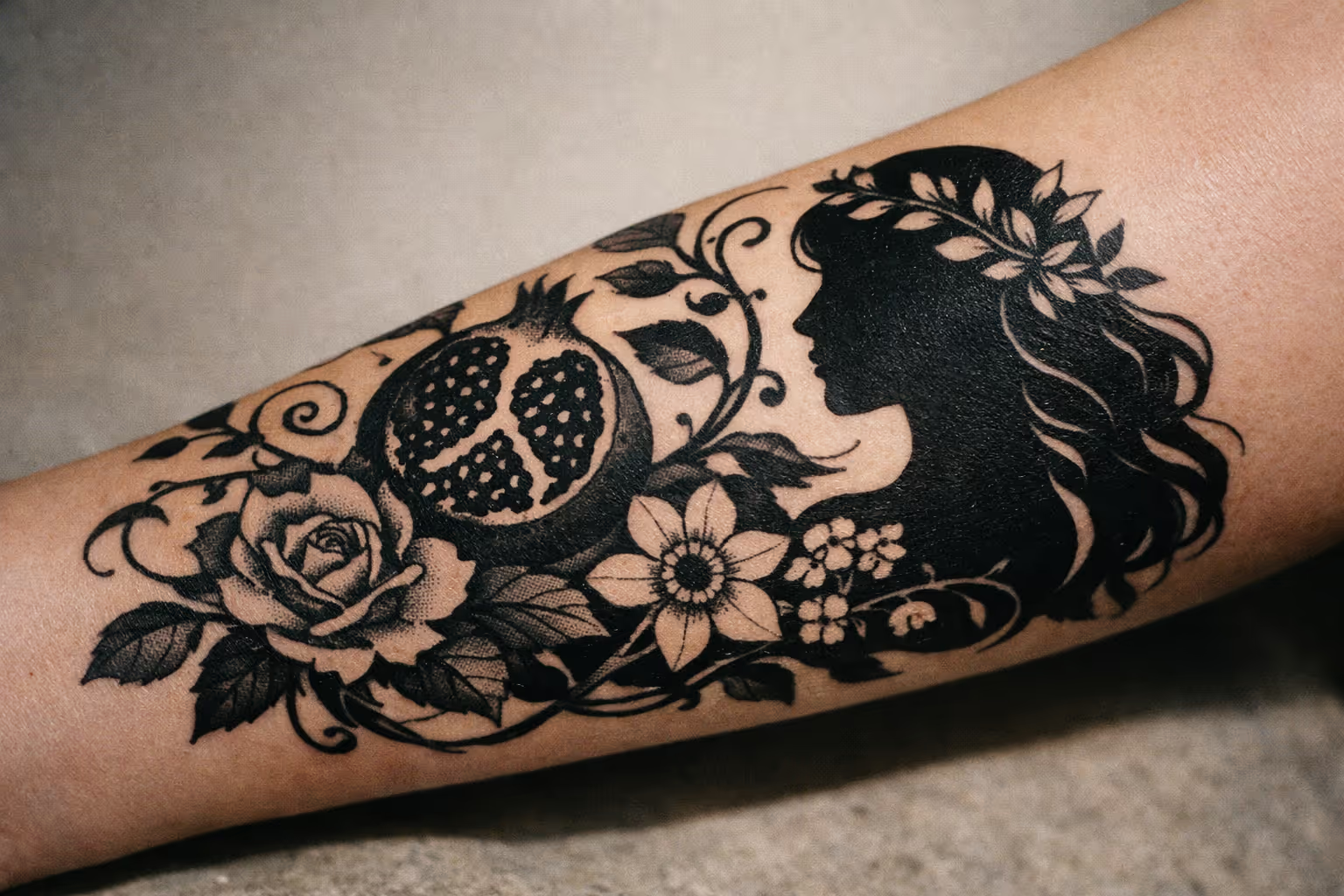
A Persephone tattoo tends to fail for one reason: people cram a whole mythological scene - pomegranate, flowers, the underworld, the goddess herself - into a piece too small to hold it, and it blurs within a few years. There’s also a quieter trap if you add runes: a couple of them have been co-opted by hate groups, so a symbol you mean as ancient can read as something ugly. Here’s how to size a Persephone piece so it heals clean, and which details are safe to include.
Persephone Tattoo: Myth, Meaning, Styles, and Design Ideas
Persephone was the daughter of Zeus and Demeter, goddess of agriculture. Hades - god of the underworld and, mythologically, Persephone’s paternal uncle - abducted her and took her below to be his wife and queen (2). Demeter, devastated, abandoned her duties over the harvest, and famine spread across the world.
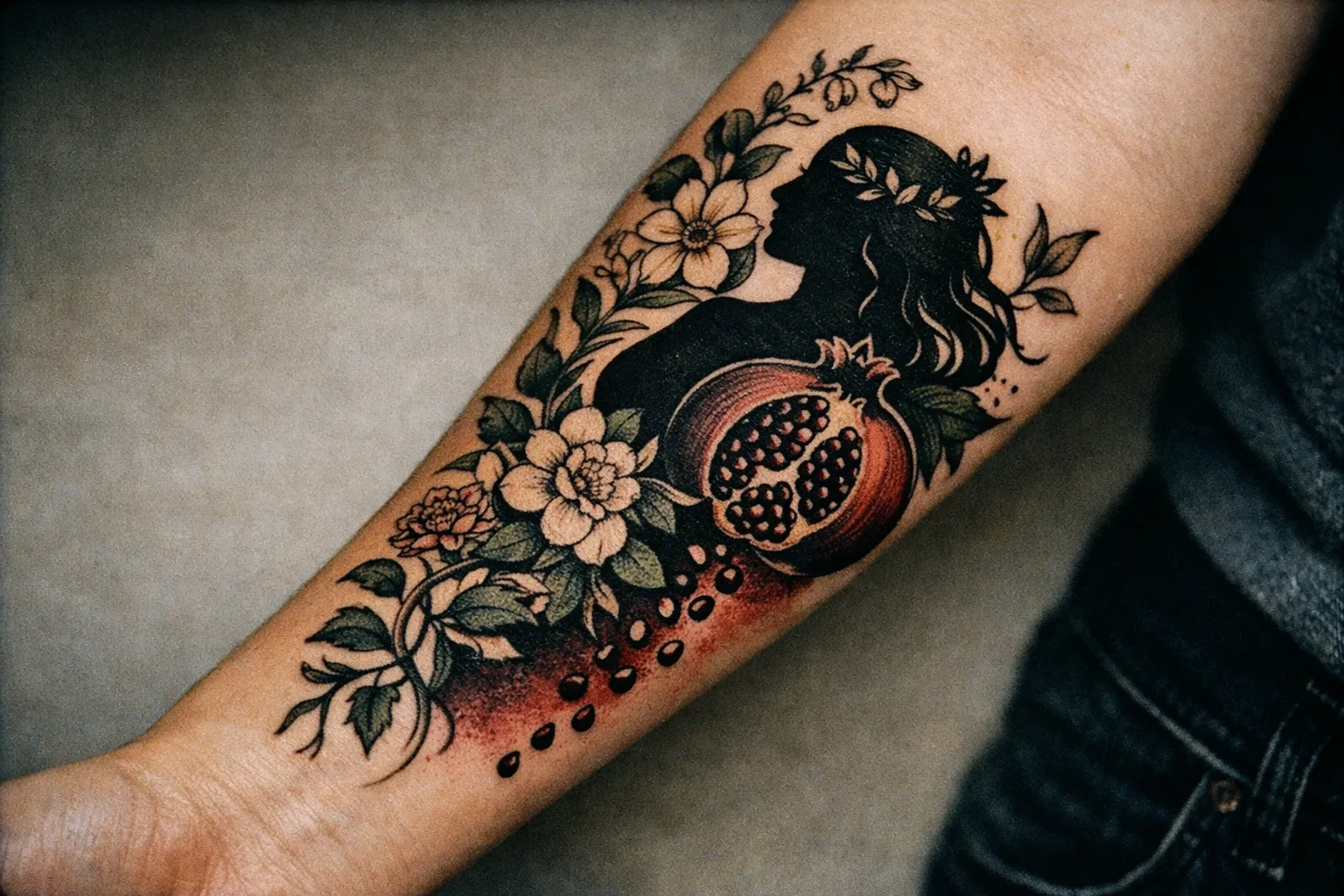
When Demeter demanded her daughter back, Hades offered Persephone a pomegranate. She ate six seeds. Because she had consumed food of the underworld, she was bound to return: Zeus decreed she would spend part of each year below with Hades and the rest above with her mother. Mythologically she spends roughly three to four months in the underworld - winter - and the rest of the year above ground (2). When she descends, the earth goes cold. When she returns, spring comes.
That seasonal cycle is the whole point of the myth, and it’s why Persephone reads so differently from most goddess tattoos. She isn’t one thing. She’s the spring maiden and the sovereign of the dead, and the better designs hold both at once.
The Myth That Makes Persephone Worth Tattooing
Most of the meaning people attach to a Persephone tattoo comes down to a handful of ideas, and they overlap:
- Transformation and rebirth - the literal life/death/spring cycle she controls (2)(3).
- Survival after a dark period - emerging from the “underworld” renewed. A lot of social media posts explicitly frame the design this way, tagging it as recovery from trauma or a hard stretch of life (4).
- Duality - innocence and power, light and shadow, the maiden and the queen living in the same person (1).
- Femininity and autonomy - newer readings (2023-2025) lean hard into Persephone as a figure who claims her own authority rather than staying a passive abductee (5)(6).
If someone asks what a Persephone tattoo really means, the honest answer is: it depends which chapter of her story you’re marking. The abduction reads as loss or upheaval. The bargain over the pomegranate reads as compromise. Her queenship reads as power claimed in a hostile place. Pick the chapter before you pick the imagery - it changes everything about the composition.
One thing worth knowing before you commit: Hades is Persephone’s uncle, so yes, he married his niece. Family relationships among the Olympians were tangled, and this one surprises clients sometimes. I’ve had people come in with a romanticized couple concept, hear that detail, and want to rethink the framing entirely - which is fine. If that bothers you, reframe the myth allegorically. Focus on the seasonal cycle and her transformation rather than the relationship.
Symbols That Represent Persephone
If you want a Persephone reference without a full portrait, these are the symbols that carry her story:
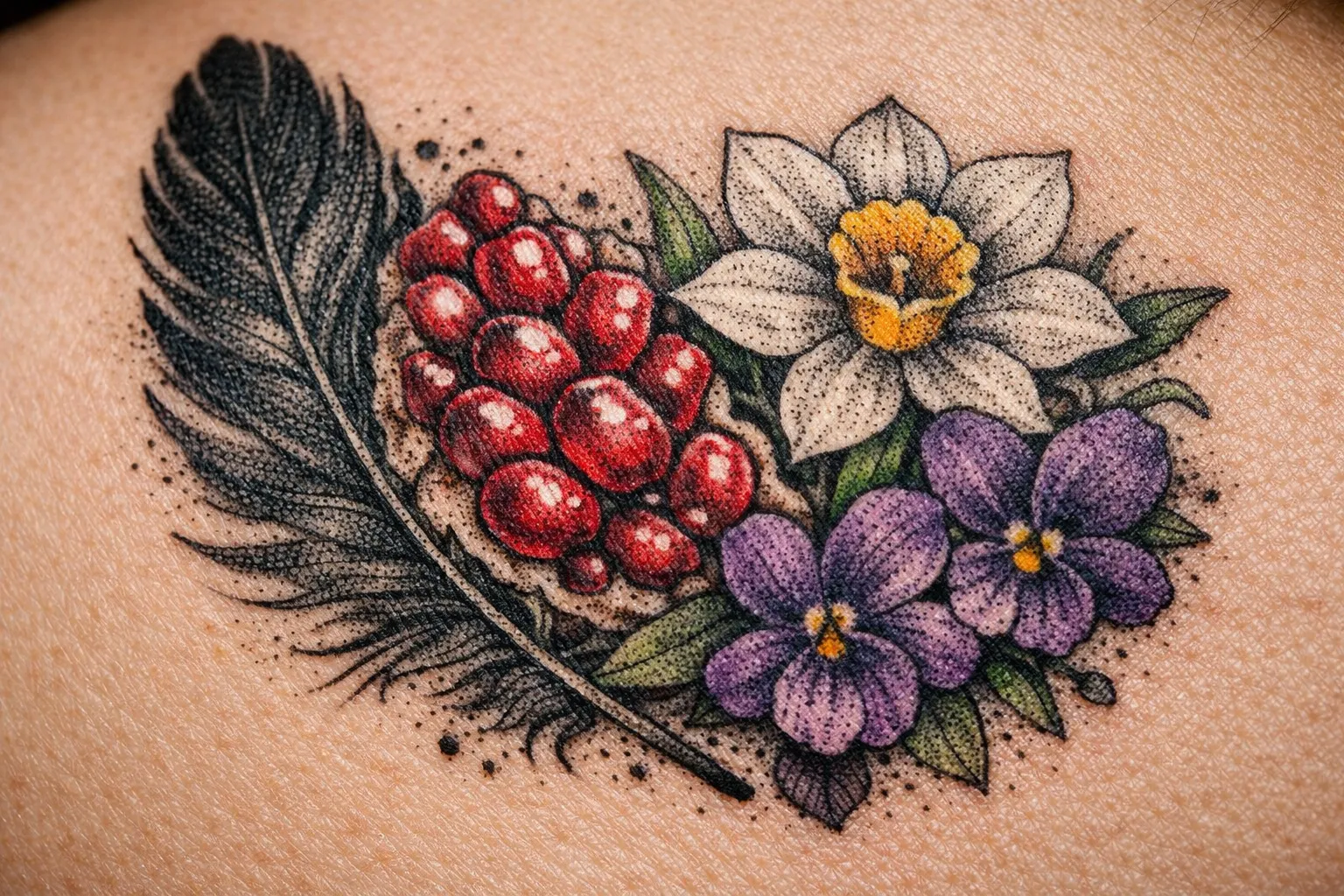
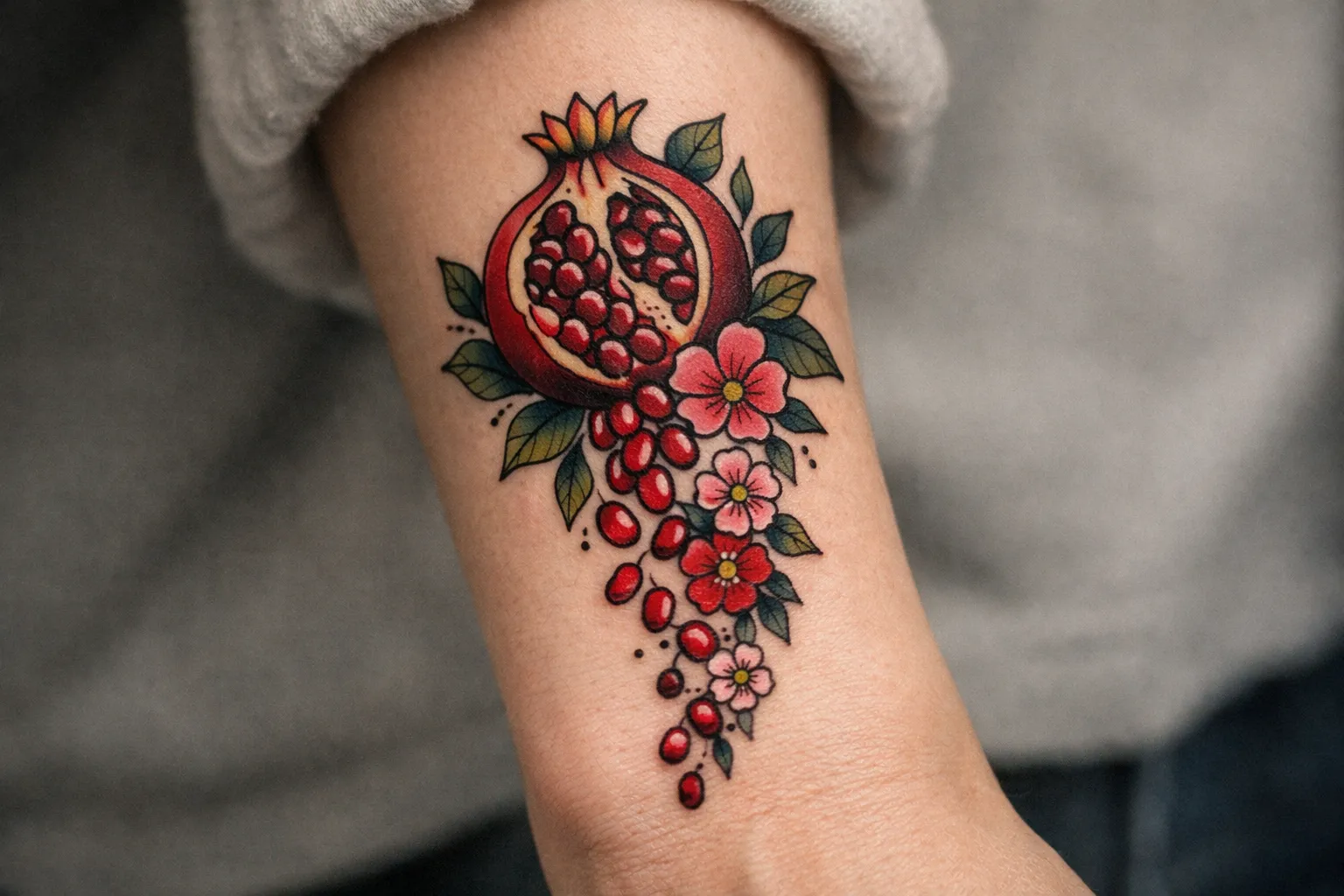
- Pomegranate and pomegranate seeds - the strongest single symbol of her bond to the underworld. Many designs use three or six seeds to echo the months she spends below (1). Choosing the seed count to match something in your own life - three years of recovery, six months of “winter” - gives a small tattoo real weight.
- Narcissus flower - the bloom Hades used to lure her before the abduction. A subtle, myth-literate choice; the narcissus flower tattoo carries its own meaning beyond this myth (1).
- Poppies and spring blooms - renewal, innocence, her connection to the season (1).
- Crown or diadem - her authority as queen of the underworld (1)(6).
- Wheat or grain - her tie to Demeter and agriculture (2).
- Split or dual imagery - half living face, half skull; half floral background, half shadow.
A pomegranate or single narcissus at 1-3 inches works well on the inner forearm, behind the ear, or the ankle. Don’t try to cram five symbols into a tiny piece - detail under three inches blurs within a few years, and you’ll end up with a smudge that used to be meaningful.
Design Ideas for Persephone Tattoos Worth Considering
Here are the directions people take this, with placement and size guidance for each.
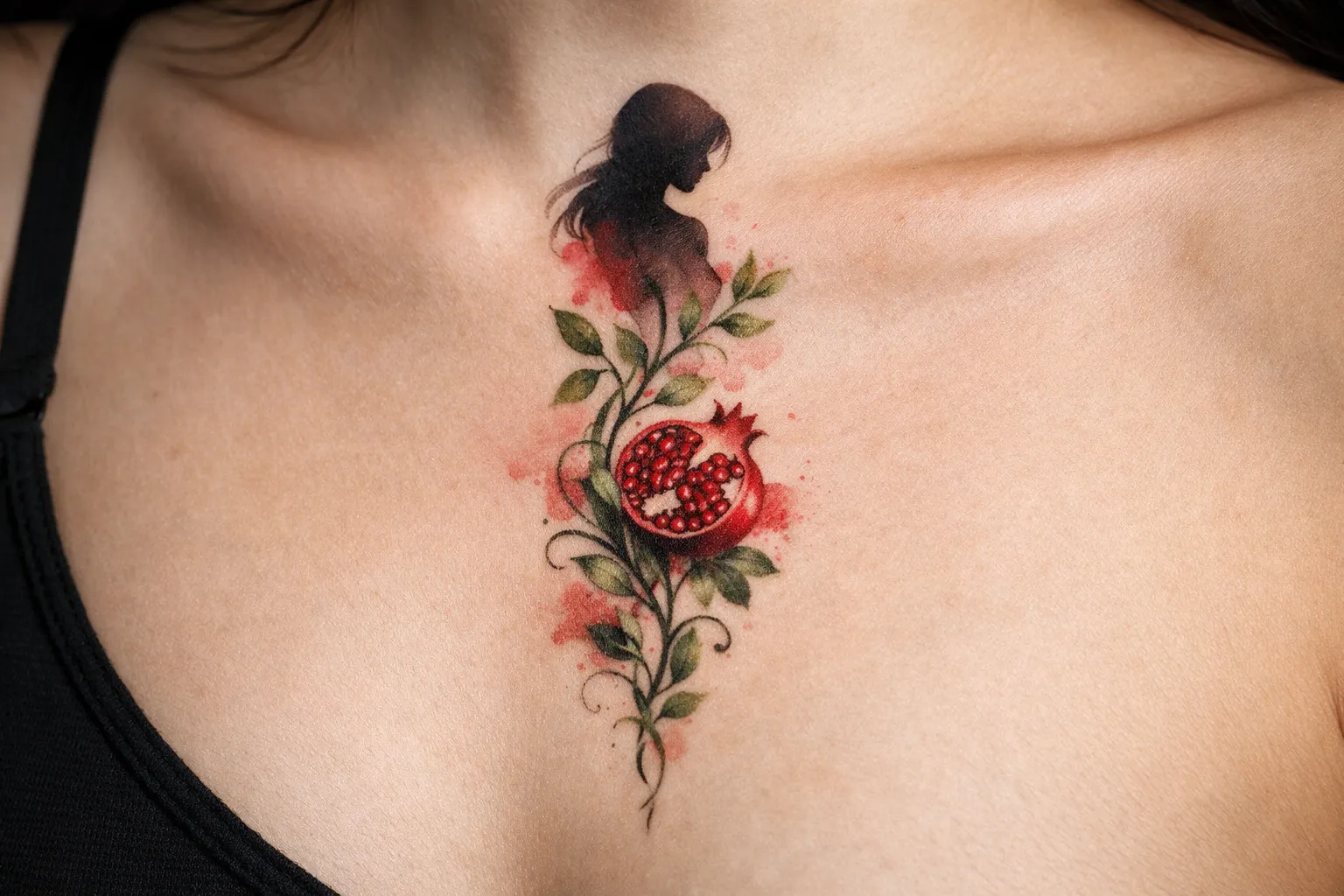
1. Goddess of spring portrait. Persephone crowned with flowers, in soft warm tones. A detailed back or shoulder piece (8-12 inches) gives the linework room to breathe. This is not a wrist tattoo - facial detail on a small, high-movement area distorts fast.
2. Split-faced duality. One side crowned with flowers and pretty features, the other crowned with skulls, snakes wrapped at the neck, sunk in darkness. This is the most popular composition for a reason - it states the whole myth in one image. Best at 5-8 inches on the thigh, upper arm, or back where both halves get equal space.
3. Hades and Persephone. A Hades and Persephone tattoo depicts the relationship and the contrast between them - his tough, underworld nature against her spring softness. These work as couple tattoos on matching forearms, or as a single large thigh or back scene at 8-12+ inches. New school versions render the pair almost cartoonishly, with bright pink and green palettes pulled from webtoon and game aesthetics.
4. Pomegranate-focused. The fruit alone, or a hand offering it. The pomegranate stands for commitment and the compromise at the heart of her bargain. Clean at 2-4 inches on the forearm or calf.
5. Floral Persephone. Flowers trailing where she stepped, framing her face or filling a background. Suits fine-line or neo-traditional treatment well.
6. Minimal Persephone. Thin single-needle linework - a profile, a pomegranate, a flower crown reduced to its outline. Good for the inner forearm, rib, or ankle at under 8 cm. The tradeoff: very fine micro tattoos with lots of tiny elements can blur within 3-5 years, so keep the element count low.
7. Outstretched hands. Two hands from different realms reaching for a pomegranate - one breaking through petals, the other a skeleton erupting from thorns. The contrast does the storytelling without needing a face.
8. Mythological moments. A specific scene - the abduction, the bargain, the reunion with Demeter. More narrative, more personal, usually larger.
9. Demeter and Persephone. The mother-daughter bond. When Persephone was taken, Demeter abandoned the harvest and fought to get her back. A strong choice for a matching tattoo with your mother.
10. Underworld queen portrait. Persephone at her darkest - throned, commanding, deathly. This leans into her power rather than her softness, which tracks with how the myth gets reread now (6).
Styles for Persephone Goddess Tattoos
The same goddess looks completely different depending on the style. Match the style to the mood you want - this is where I see people make the most avoidable mistakes.
- Black-and-grey realism. Portrait-driven, somber, dimensional. Best for busts and large goddess pieces. Two hallmarks done right: smooth gradient shading and accurate facial structure. Done badly, the face looks muddy or just off - which is why you don’t want to be an artist’s first deity portrait. Look at their portfolio hard before you book.
- Neo-traditional. Bold outlines, rich muted color, ornate frames. Suits the vintage Greek goddess vibe and ages well because the heavy linework holds. This is probably the most forgiving style for a Persephone goddess tattoo at medium scale.
- New school. Exaggerated eyes, bright pink and green palettes, comic-style shading. Popular with anime and webtoon fans reimagining Persephone as a modern heroine. The pitfall here is color maintenance - vivid greens and pinks fade noticeably within 1-3 summers without consistent SPF 30-50 on the healed tattoo.
- Blackwork / illustrative. Heavy line and dotwork shading, stark contrast - leans into the underworld tone. The most durable option long-term because there’s no color to fade and bold lines age slowly.
- Fine-line. Very thin outlines, minimal shading, delicate. Good for subtle placements but the least forgiving over decades.
Persephone’s Place in Modern Culture
A significant chunk of current interest comes from pop reinterpretations - webtoons like Lore Olympus and the Hades video game - which recast Persephone as a confident, self-possessed figure rather than a victim. Online discourse has shifted with it: posts increasingly frame her as a symbol of consent, autonomy, and reclaiming her own narrative (5)(6). People are actively pushing back on the “just a girl hurt by a man” reading in favor of her strength and queenship (5).
This matters for your design. If you like a specific pop interpretation, bring it to your artist as a mood reference - they can echo the palette and attitude without copying the art directly. To avoid ending up with something that looks like flash off a screen, pair a classic Persephone symbol with something personal, so the piece reads as yours rather than a copy of a webtoon panel.
Choosing the Right Tattoo Placement and Style
A few things to settle before you book:
- Decide which chapter of the myth you’re marking. Abduction, bargain, queenship, or return to spring - each pulls the design in a different direction. List three adjectives you want the tattoo to embody (say, “rebirth, softness, power”) and test every element against them.
- Vet the artist’s portfolio. Look for at least 5-10 mythological or portrait pieces before you commit, and match the style. If you want new school, pick someone who regularly posts bright, exaggerated character work - not a black-and-grey realist who’s willing to try something new on your skin.
- Plan for your skin tone. Pale pastel flowers heal differently on different complexions. Talk contrast with your artist upfront.
- Think about placement and your life. For conservative workplaces, keep large goddess imagery on the upper arm, thigh, or back and leave forearms neutral. If you want it visible daily, the forearm or calf keeps Persephone in view.
- Watch the pain map. Detailed goddess pieces wrapping under the arm or into the armpit hurt more and heal harder. As a rough scale, ribcage and inner arm hurt more than the outer forearm or calf - place delicate, detail-heavy work where movement and friction won’t distort it during healing.
One more thing worth flagging: be careful blending Norse runes into underworld imagery for “edgy” effect. Some runes carry modern extremist baggage - the Othala (Odal) rune rendered with wings or bars, and the Wolfsangel, are both flagged by artists across Europe and North America because hate groups co-opted them. If you want Norse elements, run them past your artist first. The wrong symbol next to dark imagery creates readings you didn’t intend, and they’re not easy to fix.
✓ Pros
- Rich mythological symbolism with multiple layers of meaning
- Versatile design options from small symbols to large portraits
- Styles available to suit different moods and skin tones
- Strong cultural relevance with modern reinterpretations
✗ Cons
- Complex myth requires understanding to choose meaningful imagery
- Fine-line and micro tattoos risk blurring within a few years
- Colorful new school styles need diligent sun protection to maintain vibrancy
- Large detailed pieces can be painful and require longer healing
Cost, Time, and Healing
Concrete numbers so you can plan (US averages, 2024-2025):
- Small symbol (pomegranate, single flower, 1-3 inches): $100-$250, usually the shop minimum plus 1-2 hours.
- Medium black-and-grey bust (4-6 inches): $300-$600 over 3-5 hours.
- Large Hades and Persephone piece (8-12+ inches, color): $800-$2,000+ across 2-4 sessions.
High-demand artists in NYC, LA, and London often charge $200-$300 per hour, which puts a detailed full-day session around $1,200-$2,000.
On healing, here’s the realistic timeline:
- Day 1-3: Keep the bandage or second-skin film on for 24-72 hours per your artist’s protocol. Wash gently twice a day with fragrance-free soap.
- Week 1: Light moisturizing 2-3 times a day with a fragrance-free moisturizer. Expect tightness and some pulling sensation.
- Week 2-4: Peeling and itching peak around days 4-10 - don’t pick. Avoid pools, baths, and submersion for 2-3 weeks, and keep strong sun off it for 4-6 weeks. Surface healing finishes in 2-4 weeks; color and contrast fully settle around 6-8 weeks.
For color pieces especially, SPF 30-50 on the healed tattoo is the single biggest factor in how those spring greens and pinks look in five years. I tell every color client this, and the ones who skip it always come back asking why their piece looks dull. One note for EU readers: tighter REACH ink rules since 2022 pushed manufacturers toward new pigment formulations, particularly for some blues and greens, so your artist may advise slight color compromises versus pre-2022 work.
Building a Custom Tattoo Inspired by Persephone
Custom beats flash for a piece this personal. A workable framework:
- Read the myth properly first. A summary of the Homeric Hymn to Demeter takes ten minutes and will tell you which chapter actually resonates.
- Map your own story to hers. If you went through a “winter” - depression, loss, a hard year - let that drive the imagery: bare branches and a cold palette for the underworld, lush blooms for your return.
- Pick 2-3 core symbols, not seven. Choose a pomegranate seed count tied to your timeline, one specific flower, maybe a crown. Let the artist build the composition around those rather than cramming everything in.
- Scale to your level. New to tattoos? Start with a small symbolic piece. Heavily tattooed already? A full myth narrative sleeve with multiple panels gives the story room.
Persephone also pairs naturally with related figures for larger work - Hecate, Artemis, or Demeter in a multi-figure sleeve for mythology fans, or floral, herb-and-fruit compositions that lean on her agricultural side for a softer, nature-heavy build.
Frequently Asked Questions
- What does a tattoo of Persephone mean?
- It usually marks transformation, survival after a dark period, or the duality of light and shadow within one person - drawn from her cycle between spring and the underworld (2)(3). The exact meaning depends on which chapter of her myth you depict: abduction reads as upheaval, the pomegranate bargain as compromise, and her queenship as power claimed.
- What is a symbol for Persephone?
- Key symbols include the pomegranate (often with three or six seeds), narcissus flower, poppies and spring blooms, a crown or diadem, and wheat tied to Demeter. Split imagery like half living, half skeletal faces is shorthand for her dual nature.
- What rune tattoo to avoid?
- Artists widely warn against the Othala (Odal) rune with wings or bars and the Wolfsangel, as hate groups have co-opted them. Avoid placing these near underworld imagery to prevent unintended associations.
- Did Hades marry his niece?
- Yes. In Greek mythology, Hades is Zeus's brother and thus Persephone's paternal uncle. The marriage begins through her abduction and is later formalized.
- How should I choose placement for a Persephone tattoo?
- Consider your lifestyle and pain tolerance. Large detailed goddess portraits suit the upper arm, thigh, or back, while smaller symbols work well on the forearm or ankle. Ribcage and inner arm placements hurt more and heal slower than outer forearm or calf.
- How long does a Persephone tattoo take to heal?
- Initial surface healing takes 2-4 weeks, with color and contrast settling around 6-8 weeks. Proper aftercare includes fragrance-free moisturizing and avoiding sun and water submersion during healing.
- Can I incorporate modern pop culture styles into my Persephone tattoo?
- Yes, but bring your artist mood references rather than copying art directly. Combining classic symbols with personal elements helps keep the tattoo unique and meaningful.