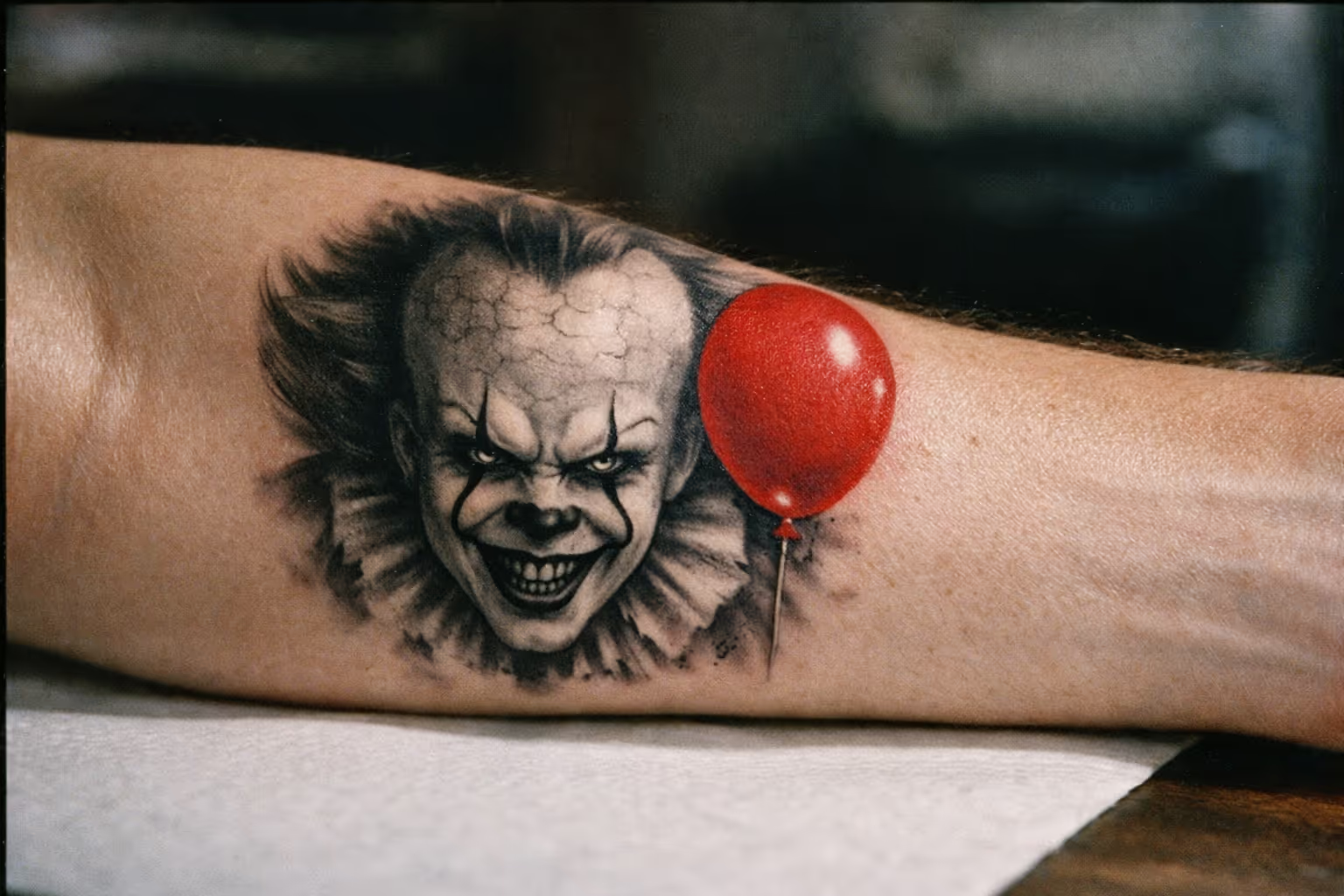
A Pennywise tattoo is a serious commission - $2,000 buys eight to thirteen hours in the chair, not a quick session - and the single biggest threat to it is the color that makes the character: red. The balloon, the grin, the red on the costume all fade faster than the black, so a Pennywise that looks vivid today can go muddy without the right placement and upkeep. Here’s how style, size, and red-ink management decide whether yours ages well.
Why Pennywise Tattoo Keeps Showing Up in Tattoo Portfolios
A pennywise tattoo isn’t subtle. You’re putting a shape-shifting horror clown on your skin - yellow eyes, red balloon, sharp teeth, the whole Derry sewer atmosphere. Done well, it’s one of the most striking horror portraits in modern tattooing. Done badly, it ages into a muddy blob of red and black inside three years.
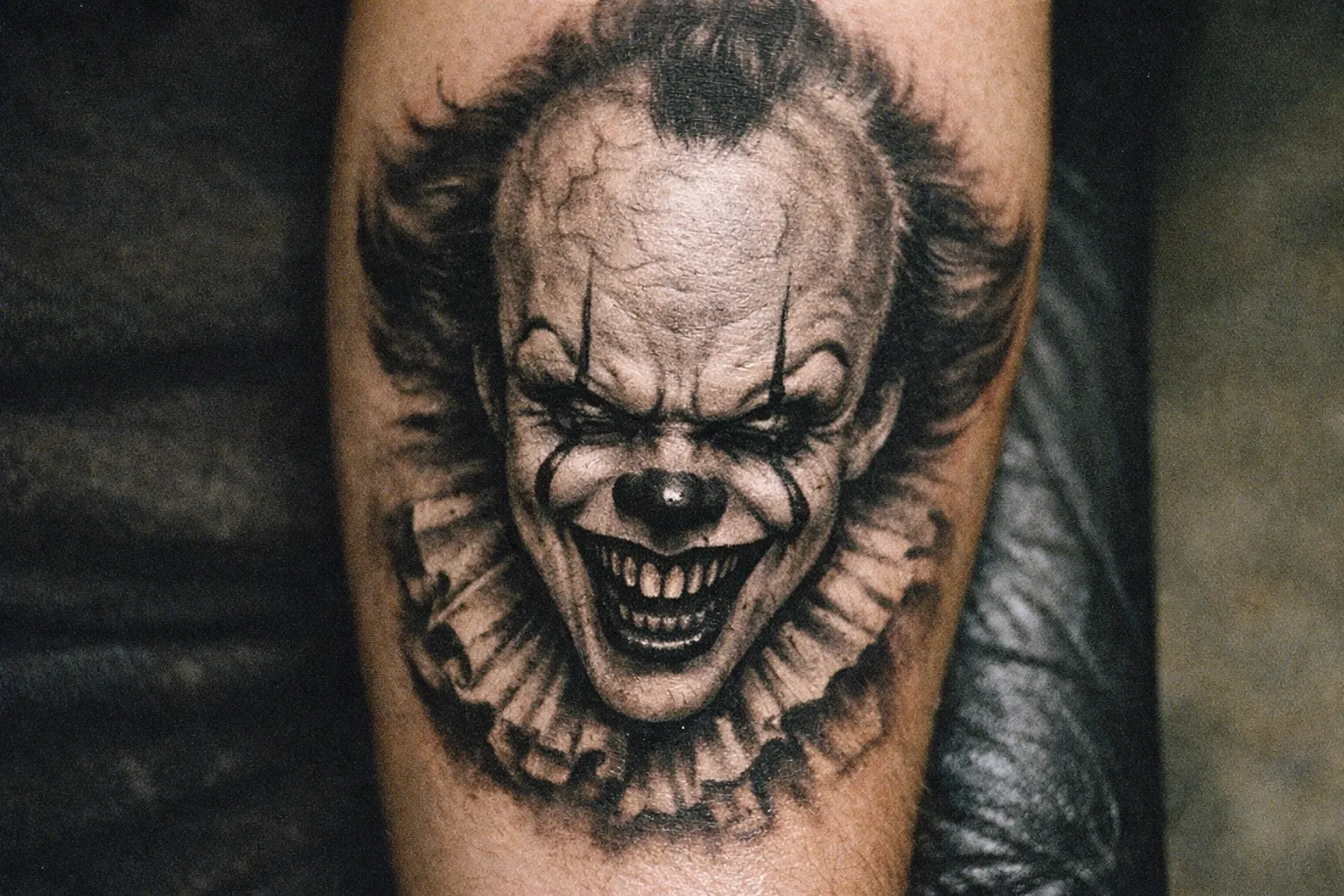
Stephen King’s clown has been crawling out of storm drains since the 1986 novel, but the 2017 and 2019 films are what flooded tattoo portfolios with Pennywise work. The Bill Skarsgård design - elongated forehead, cracked greasepaint, that buck-toothed snarl - is now the dominant reference in 2026 galleries, accounting for the clear majority of Pennywise requests I see. Tim Curry’s version shows up mostly in retro neo-traditional pieces, and I still see a handful of those come through the shop every month from clients who grew up with the miniseries. According to horror tattoo forums and portfolio aggregators tracked through 2025, Skarsgård-based designs outnumber Curry-based requests by a significant margin in US and UK shops.
What people are actually buying when they sit down for this one:
- Horror fandom, plain and simple - a way to carry a favorite film without any ambiguity about it.
- Facing fear - Pennywise personifies it, so the tattoo becomes a “I beat the thing in the drain” symbol for anxiety, addiction, or trauma.
- Dark nostalgia - childhood memories of the novel or the 1990 miniseries, shot through with that specific 80s/90s horror tone.
- Duality - the smiling face hiding the monster, useful shorthand for “appearances deceive” (2).
None of those readings is wrong. Just be honest with yourself about which one you’re carrying around on your forearm for the next few decades.
✓ Pros
- Highly recognizable horror iconography with strong cultural resonance
- Multiple layers of personal and fandom meaning to choose from
- Works well in several tattoo styles and sizes when planned properly
✗ Cons
- Red ink fades among the faster colors, requiring touch-ups every few years
- Complex realism can age poorly if placed or sized incorrectly
- Hand and face placements have high maintenance and social impact
What a Pennywise Tattoo Actually Means
This is the question I get most often during consultations, so it deserves a direct answer. A pennywise tattoo most commonly means one of four things:
- Confronting personal fear - Pennywise feeds on fear in the story, so the tattoo flips that and says you faced yours (2).
- Love of the horror genre - straightforward fandom, no deeper reading required.
- The dark side of nostalgia - connecting to a specific era of horror or to the memory of first reading or watching It (2).
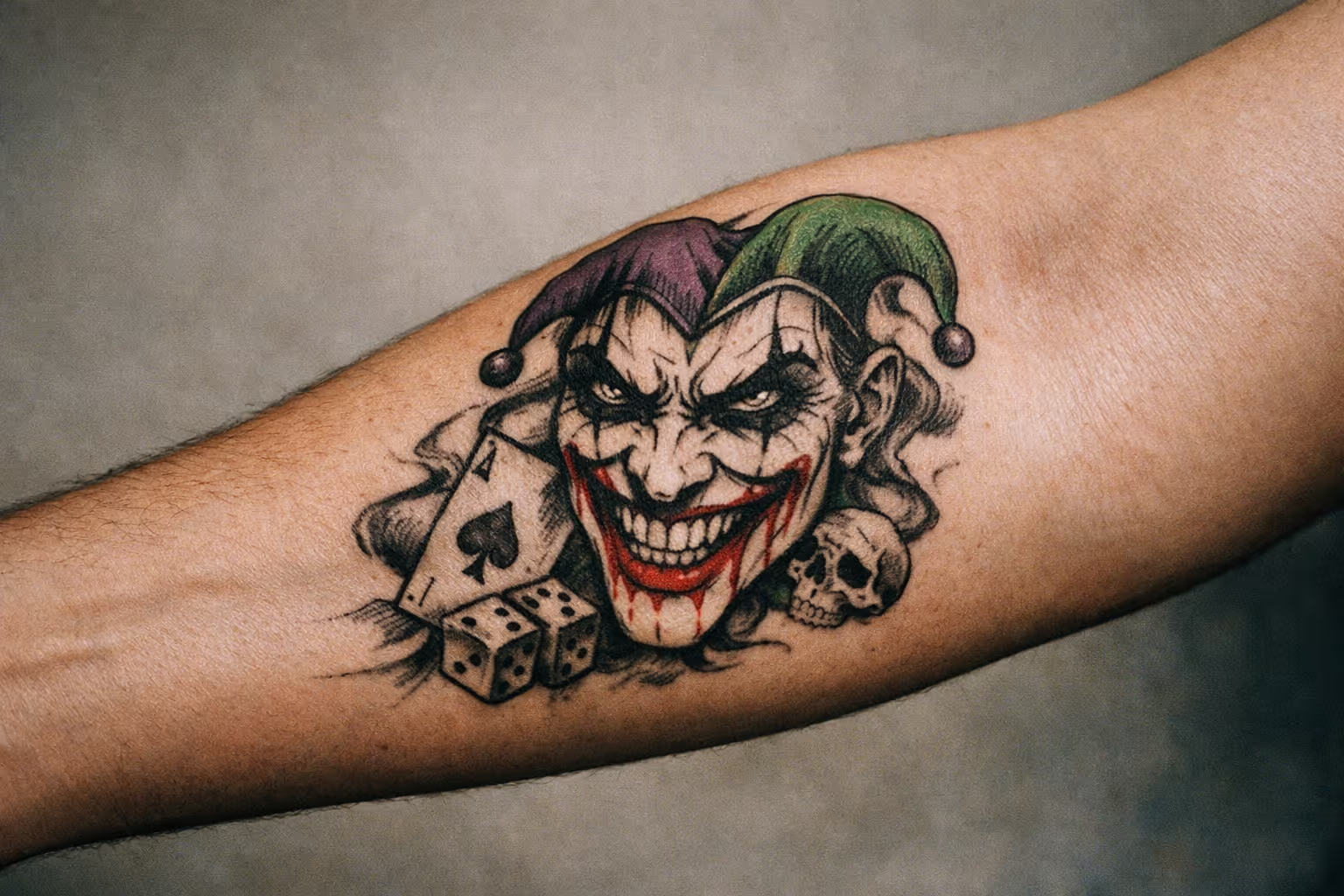
- Acceptance of inner darkness - the clown mask hiding the monster, used as a metaphor for the parts of yourself you don’t show in public. It’s the same pull behind a Joker tattoo - the villain whose grin is the threat.
The meaning isn’t fixed. If someone asks why you got it, you get to decide which of those threads to pull. Just know the default cultural read is “horror fan” - anything more personal needs you to explain it.
Top Styles for a Pennywise Design
The style you pick determines whether the face ages well or turns to mush. I’ve seen genuinely beautiful Pennywise pieces and I’ve seen disasters. The difference is almost always style choice relative to placement and size.
Black and Gray Realism
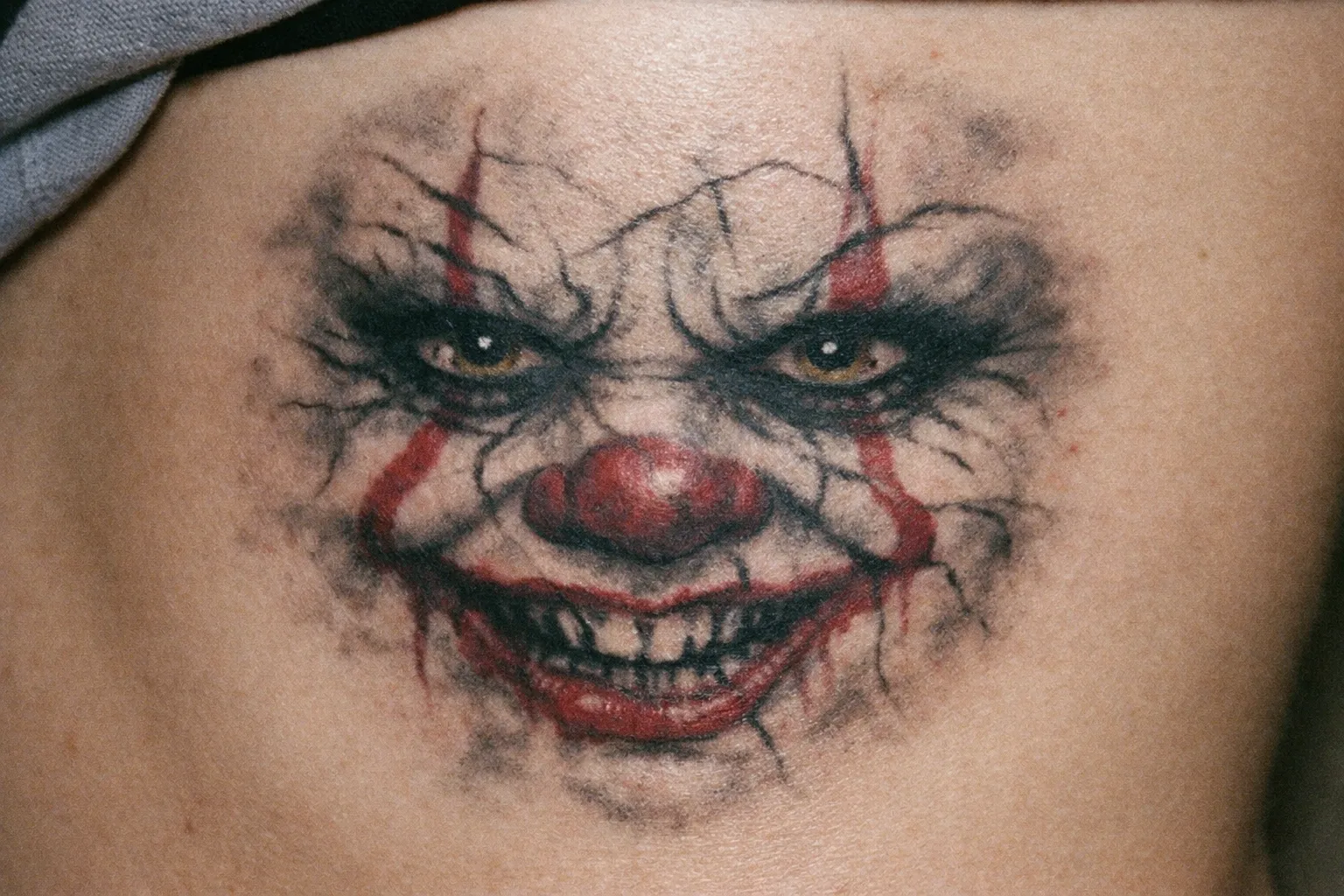
The most reliable choice for a face portrait. Heavy contrast, smooth shading, no color to fade unevenly. Two technical hallmarks of good black-and-gray Pennywise work: soft transitions in the white greasepaint (no harsh stencil lines on the cheeks) and crisp negative space in the teeth (the gaps need to stay open, not flood with black ink over time). The common pitfall when artists do this badly: packing the shadows too dark, which kills the cracked-makeup texture once healed. I’ve touched up more than a few of these where the whole mid-tone range just collapsed.
Great for forearms, calves, thighs, and upper arms - flat surfaces where the face won’t distort. Minimum size for a readable face: 4-5 inches tall.
Full-Color Cinematic Realism
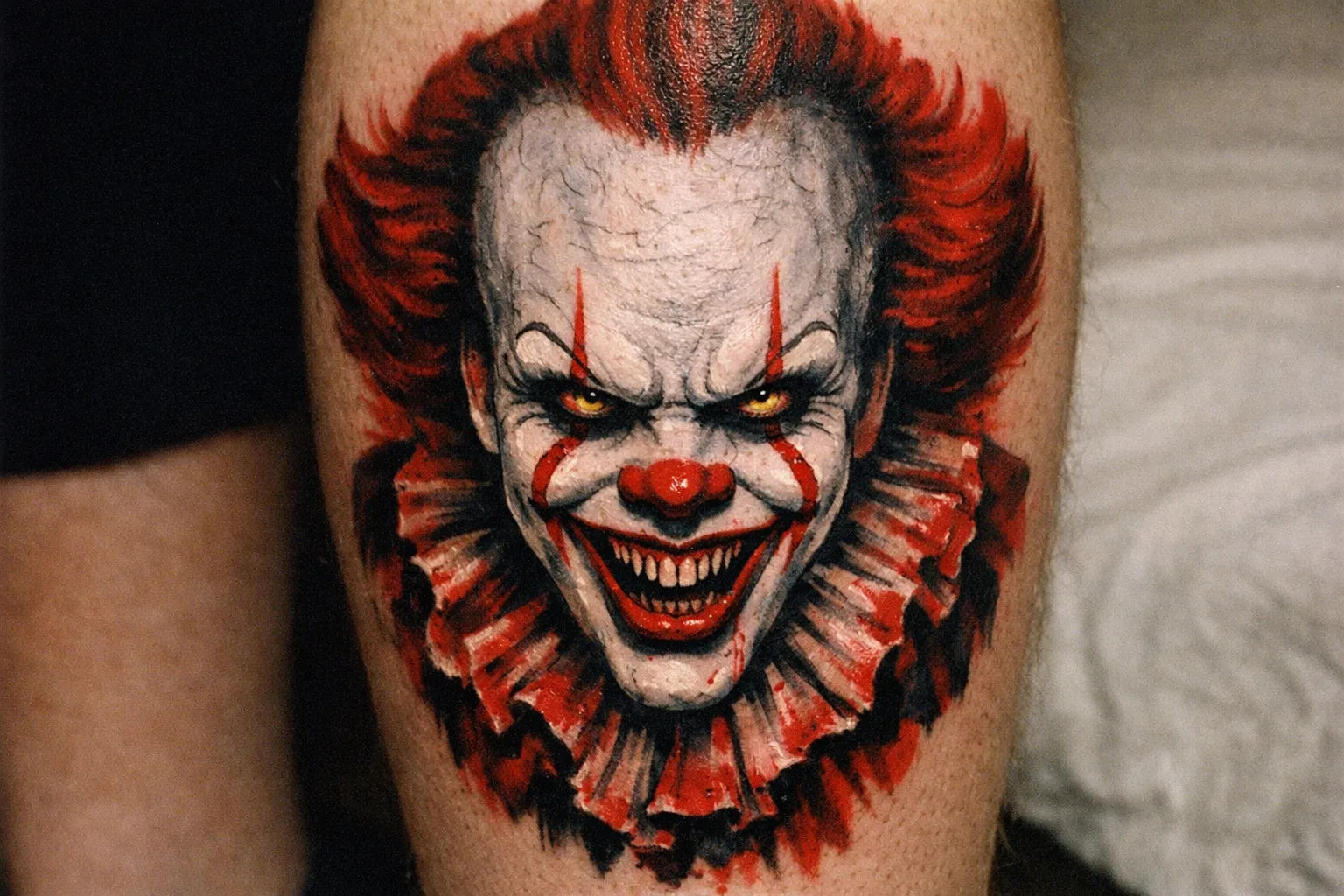
The Skarsgård look in full color: yellow irises, white face, dripping red around the mouth. Cinematic and aggressive, but you’re committing to touch-ups every 3-5 years on the reds, which are among the faster-fading ink colors alongside yellow and some light blues. Before you book, ask the artist what brand of red they use and ask to see healed photos at the one-year mark. Any serious color realism artist will have those.
Neo-Traditional
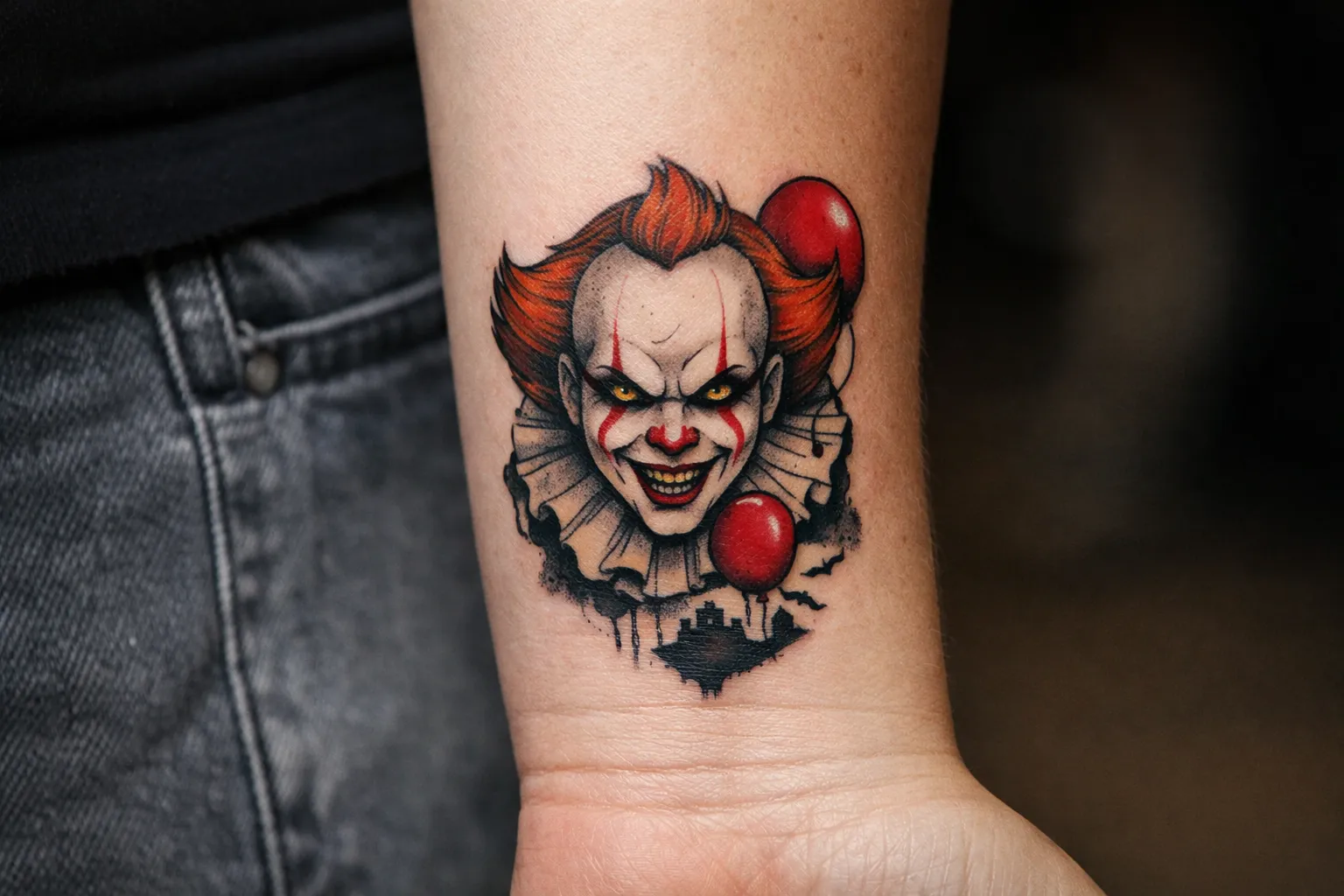
Thick black outlines, saturated reds and oranges, stylized ruff and balloon - this has been a consistent gallery trend through 2025-2026. Two technical hallmarks: bold uniform line weight and a limited, punchy palette (red, black, flesh, maybe one accent color). Common pitfall: artists who primarily do neo-traditional florals trying their hand at a horror portrait. The line weight ends up too thin around the eyes and the whole face reads cartoonish in the wrong way. Ask to see horror portraits specifically, not just their best neo-trad work.
Watercolor and Abstract
Splattered red and black backgrounds around a minimalist balloon or face silhouette. Lower commitment, less gore, easier to explain in a job interview. The trade-off is real though: watercolor effects soften with time and need a strong black anchor - often the balloon string - to stay legible past year five.
Simple Linework
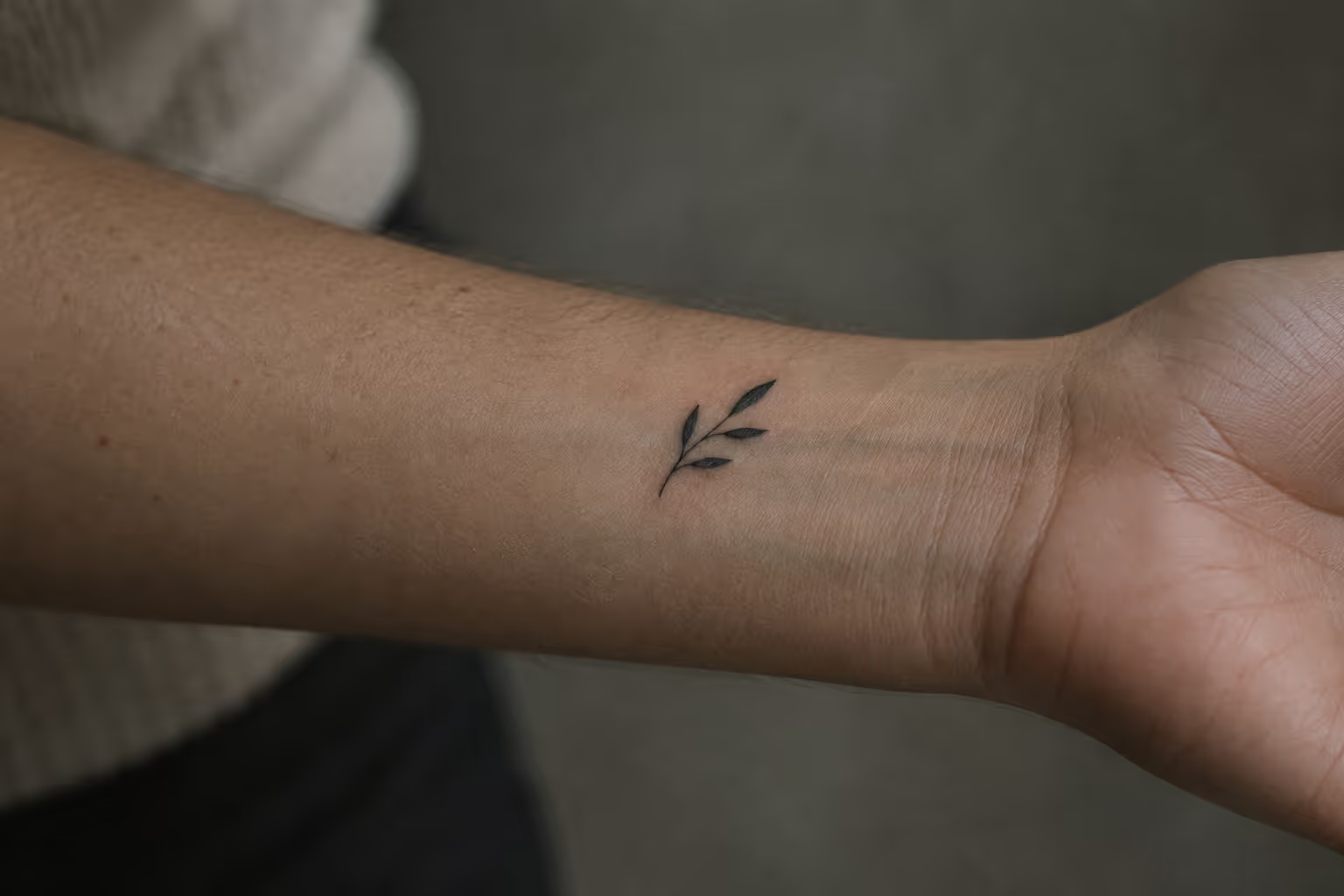
A simple Pennywise Tattoo strips everything down to a few elements: outline of a balloon, the word “IT” in dripping font, a stylized clown silhouette. This is the budget-friendly entry point and the safest for first-timers. Two-color max, 1-2 hours of work, and it ages well because there’s almost nothing to fade. I’d take a clean simple piece over a botched realism attempt every time.
Ideas by Element
Some elements pull more weight than others in pennywise tattoo ideas - they’re recognizable instantly, even small.
The Pennywise Balloon Tattoo
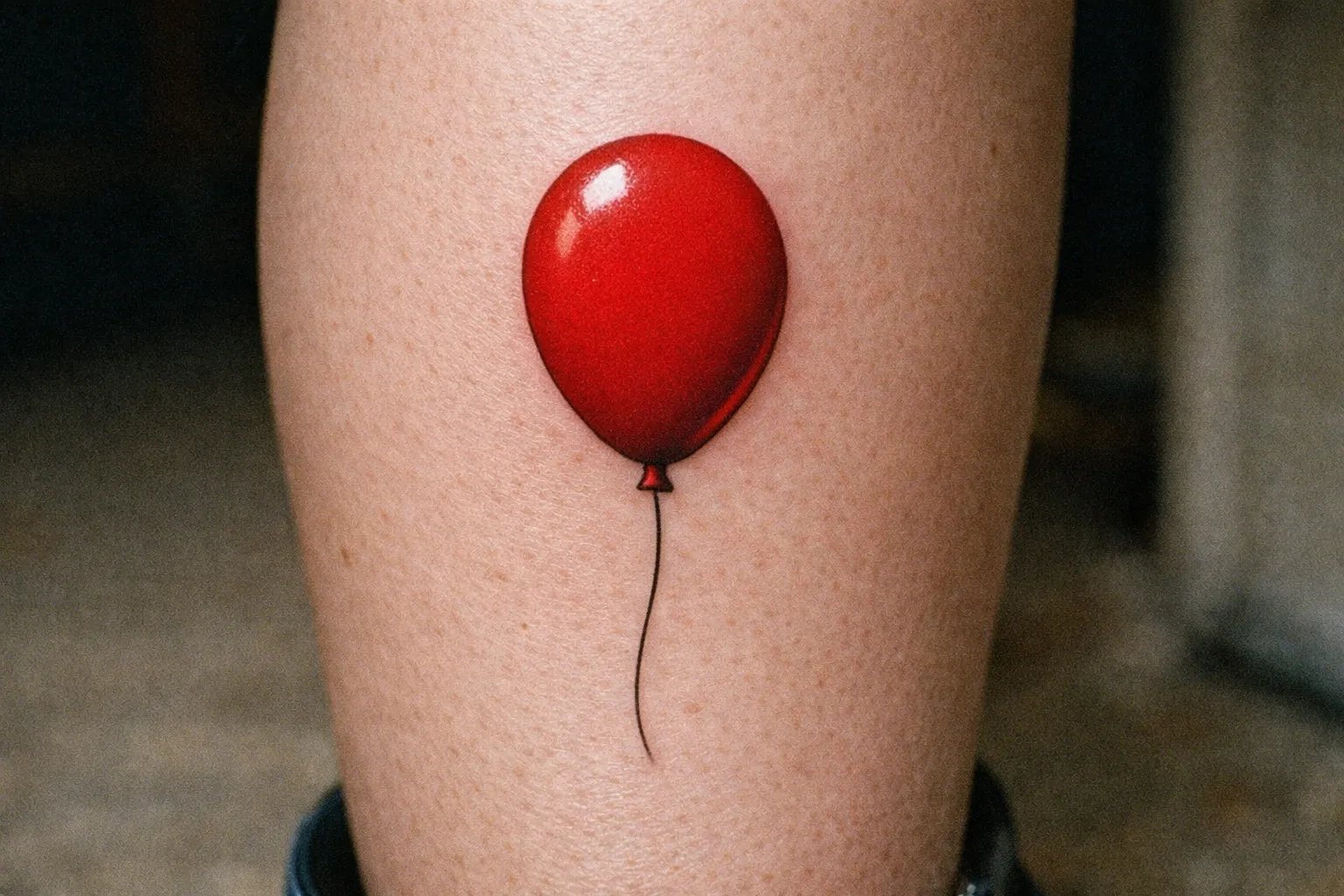
The red balloon is the single most efficient piece of Pennywise iconography. People read it as Pennywise even without the clown anywhere in the design. A Pennywise balloon Tattoo works at almost any size - wrist, ankle, behind the ear at around 1.5 inches, or as a focal element in a larger composition. Popular variations:
- Balloon with the string forming the words “We all float” or “Derry.”
- A child’s hand reaching up to a single red balloon (the Georgie reference).
- A cluster of balloons drifting up out of a sewer grate.
One technical note: keep the balloon slightly larger on the stencil than you want it healed. Red ink spreads a touch as it settles, and a too-tight balloon outline can blow out into a pink halo around the edges.
The Pennywise Face Tattoo
A dedicated Pennywise face Tattoo is the centerpiece option - the full portrait, eyes locked on the viewer. Size matters more here than anywhere else. Below 4 inches, the teeth blur together and the eyes lose their focus. At 5-7 inches on a forearm or calf, you get the detail Skarsgård’s makeup actually deserves. Above 8 inches on a thigh or back, you have room for cinematic background - sewer water, dripping pipes, paper boats.
Quotes and Text
The most-tattooed Pennywise line is “We all float down here”. “You’ll float too” runs a close second. If you’re integrating text:
- Keep script line weight at 0.7 mm or thicker - anything finer will blur within five years.
- Place it where there’s real negative space (under the balloon, beside the face) - not across knuckles or fingers.
- Avoid dripping-blood fonts if the tattoo is already on a high-friction area; the detail won’t survive the wear.
Derry References
Sewer grates, paper boats (the SS Georgie), the word “Derry,” a yellow raincoat. These pull deeper from the book and reward people who actually read King. Useful as background filler in a larger piece or as standalone micro-tattoos for fans who don’t want the clown’s face staring back at them every morning.
Placement Ideas That Actually Work for Pennywise Designs
Placement decides two things: how long the tattoo stays sharp, and how it fits into your daily life.
Pennywise Hand Tattoo
A Pennywise hand Tattoo maximizes visibility and minimizes longevity. The hand fades faster than almost anywhere else on the body - friction, sun, frequent washing all eat at the ink. Realistic expectations:
- Stick to 2-3 inch designs (small face, balloon, or “IT” lettering). A full portrait will not hold on a hand.
- Plan for touch-ups every 2-3 years, not five.
- Many artists charge a premium or refuse outright, because the re-touch risk hurts their healed portfolio photos.
- Workplace impact is real. Hand tattoos are still a problem in conservative industries.
If you want the visibility but not the maintenance, consider the side of the wrist or the outer forearm just above the wrist instead.
Forearm
The default for a reason. Flat, relatively low pain (forearm is significantly easier than ribcage or sternum), easy to size up to a proper 5-7 inch portrait, and you control visibility with sleeve length. Holds detail well over time.
Upper Arm and Shoulder
Best for portraits in the 7-9 inch range. Hides under a t-shirt, low pain. The curve of the deltoid lets the face wrap slightly, which can actually add to the menace if the artist plans for it from the start.
Calf and Thigh
Large flat real estate, low pain (the calf is one of the most manageable spots on the body), and room for full scenes - Pennywise plus balloons, Derry sewer, a paper boat. If you want a big cinematic piece without committing to a sleeve, the thigh is where I’d point you first.
Sleeve
A full sleeve dedicated to It lets you tell the story instead of just showing the face. Common compositions: Pennywise centered on the upper arm, Georgie scene on the inner forearm, balloons drifting up the outer forearm, “We all float down here” wrapping the wrist. Pain scale: ribcage > inner bicep > elbow ditch > most other placements. Plan for 3-5 sessions across several months, and don’t try to rush it into fewer sittings to save money.
Spots to Think Twice About
The ribcage and sternum sound dramatic but Pennywise is primarily a face, and face tattoos lose definition fastest on areas with a lot of skin stretch and movement. Neck and face placements carry the strongest social impact and limit job options. Not a rule - just a flag worth raising before you book.
Building a Stencil That Holds Up
The Pennywise Tattoo stencil is where most bad Pennywise pieces go wrong before a needle even touches skin. A bad reference image - a low-res screenshot, a distorted fan render - produces a warped likeness that gets worse once healed. Horror portraits are unforgiving: the eyes have to land in exactly the right spot or it just looks like a generic clown with a ruff.
What to bring your artist:
- High-resolution film stills of whichever Pennywise you want (Curry or Skarsgård).
- A second angle of the same expression - the artist needs to understand the face in three dimensions, not just trace the front view.
- A clear note on which details are non-negotiable (the cracked makeup? the buck teeth? the yellow eye?) so the stencil simplification doesn’t lose what makes Pennywise Pennywise.
Ask the artist to refine the stencil before transfer - simplify the eye shapes, the nose, the ruff - while preserving likeness. A clean stencil with fewer lines almost always heals better than a busy one trying to capture every greasepaint crack.
Cost: What a Pennywise Piece Runs in 2026
Pricing varies by city and artist tier, but these are realistic 2026 ranges for reputable horror specialists in major US/UK markets:
- simple Pennywise Tattoo (2-3 inch balloon, minimal linework face, “IT” lettering): $150-$350
- Medium black-and-grey forearm portrait (5-7 inch): $400-$800
- Full-color realism half-sleeve with Pennywise and balloon, across 2-3 sessions: $800-$1,800
- Large back, thigh, or full sleeve with multiple elements (Derry, Losers’ Club, sewer): $1,500-$3,000+
Add 15-25% tip on top in US shops. Consultations are often free or $50-$100 credited to the first session.
How Big Is a $2,000 Tattoo?
At $150-$250 per hour - the going rate for experienced horror and portrait specialists in major cities, per industry pricing surveys cited by tattoo trade publications - $2,000 buys you 8 to 13 hours of work. In practice that means:
- A detailed half-sleeve (upper arm or full forearm) with Pennywise portrait plus background elements.
- A large thigh or upper-back piece roughly 8-12 inches tall, dense with detail and full color.
- A back-of-calf scene with the clown, balloons, and a sewer grate.
Most $2,000 pieces split into 2-3 sessions of 3-5 hours each. Trying to do it in one sitting compromises detail consistency - the artist’s hand fatigues, your skin swells, and the last two hours of work never look as clean as the first two. I’ve seen clients push for marathon sessions to save on travel costs and regret it when the healed piece comes out uneven.
Famous Pennywise Lines Worth Tattooing
The most-quoted line in pennywise tattoo work, by a wide margin:
“We all float down here.”
Short, recognizable, fits under a balloon or beside a face portrait, and carries the whole tone of the character in six words. The runner-up is “You’ll float too,” which works well as standalone text without any imagery. A third option that shows up in fan designs is “Tasty, tasty, beautiful fear” - longer and more specific, better suited to a larger piece with room for legible script.
Don’t stack multiple quotes in one tattoo. Pick one. Place it where there’s real negative space, not crammed against the design.
Tattoos to Avoid (Including Some Pennywise Variants)
The question “what tattoos should I avoid?” comes up alongside Pennywise searches because the character sits on a line. General tattoo-ethics guidance flags hate symbols, culturally appropriated sacred imagery, gang signs, and graphic violence as categories to skip regardless of style.
Specific to Pennywise:
- Extremely gory scenes involving children - the Georgie sewer scene rendered with explicit child harm reads very differently in a tattoo than in the film. Most reputable artists will refuse, and it limits where you can wear the piece without consequence.
- Hyper-realistic blood and gore on visible areas - hand, neck, or face Pennywise pieces with heavy gore close off jobs and create real problems in environments with children (teachers, pediatric medical staff, parents at school events).
- Cultural context - in some cultures clowns carry spiritual or ritual significance, and a horror clown reads as offensive. Worth knowing if you travel or work internationally.
None of this is moralizing. It’s a reminder that a tattoo follows you into every room you walk into. Plan accordingly.
Aftercare for Heavy Red and Black Tattoos
Horror tattoos live or die on saturation and contrast. The same heavy black-and-red upkeep applies to any high-contrast horror piece, from a skull tattoo to a full Derry portrait. Poor aftercare dulls the reds and softens the blacks within 1-3 years, which turns a sharp Pennywise into a faded smudge. I’ve seen clients come back at the two-year mark with pieces that look five years older than they should because the aftercare fell apart in week one.
Day 1-3
- Leave the artist’s wrap on for the time they specify (usually 2-24 hours depending on the product used).
- Gently wash with fragrance-free antibacterial soap and lukewarm water, 2-3 times a day. No soaking.
- Pat dry with a clean paper towel. Apply a thin layer of fragrance-free moisturizer or a tattoo-specific balm.
- Sleep on clean sheets. No gym, no swimming, no alcohol.
Week 1
- Continue washing and moisturizing 2-3 times daily.
- The tattoo will start to flake and peel. Do not pick. Picking pulls ink out and creates patchy spots that are obvious on a portrait - especially in the white greasepaint areas.
- Keep the area out of direct sun. No tight clothing rubbing across the tattoo.
Week 2-4
- Flaking finishes; the tattoo may look slightly cloudy (the “milky scab” stage). Normal - the final color comes back as the deeper skin layers heal.
- Keep moisturizing daily. Switch to a lighter lotion if the balm feels heavy on healed skin.
- Still no direct sun, no soaking baths, no chlorinated pools.
Long-Term
- Daily SPF 30+ on the tattoo once healed, whenever it’s exposed. UV is one of the most consistent factors in red and black saturation loss - alongside friction and skin type, it’s a major reason pieces dull faster than expected.
- Moisturize regularly. Dry skin makes any tattoo look dull.
- Plan a touch-up around year 3-5, especially if your design has prominent red (balloon, nose, dripping blood). Same artist if possible - they know their own line weight and how to match it.
Choosing a Horror Specialist
Don’t take a Pennywise piece to a generalist. Two filters that matter:
- Portfolio depth in horror or realism portraits - not flash sheets, not script, not florals with one horror piece tucked in. You want 15-20 portraits where you can actually recognize the subjects.
- Healed photos at 3-12 months old. Fresh tattoos look great on everyone’s Instagram. Healed photos tell you whether the whites stayed white, the reds held, and the line weight survived. Any serious horror artist will have these or share them on request.
Read reviews specifically for how the artist handled long sessions and touch-ups. A $2,000 portrait is a working relationship, not a one-time transaction.
Frequently Asked Questions
- Can I get a Pennywise tattoo if I want just a subtle nod to the character?
- Yes. Elements like the red balloon or 'We all float' text work well as small, minimalist tattoos that hint at Pennywise without showing the full clown face.
- How do I know if my artist is qualified for a Pennywise portrait?
- Look for a portfolio with multiple horror or realism portraits and healed photos at least 3 months old. Avoid artists who only do general flash or unrelated styles.
- Is it better to choose black and gray or color for a Pennywise tattoo?
- Black and gray realism tends to age better with less maintenance, while full-color pieces require regular touch-ups, especially for reds.
- What should I avoid when placing a Pennywise tattoo?
- Avoid high-friction or high-movement areas like the hand for detailed portraits, and be cautious with neck or face placements due to social impact.
- How do I care for a Pennywise tattoo with heavy red ink?
- Daily SPF 30+ after healing and moisturizing regularly are key. Expect to schedule touch-ups every 3-5 years to maintain vibrant reds.
- Are there any Pennywise tattoo designs that are considered inappropriate?
- Yes. Extremely gory depictions involving children or culturally sensitive clown imagery should be avoided to prevent offense or social issues.