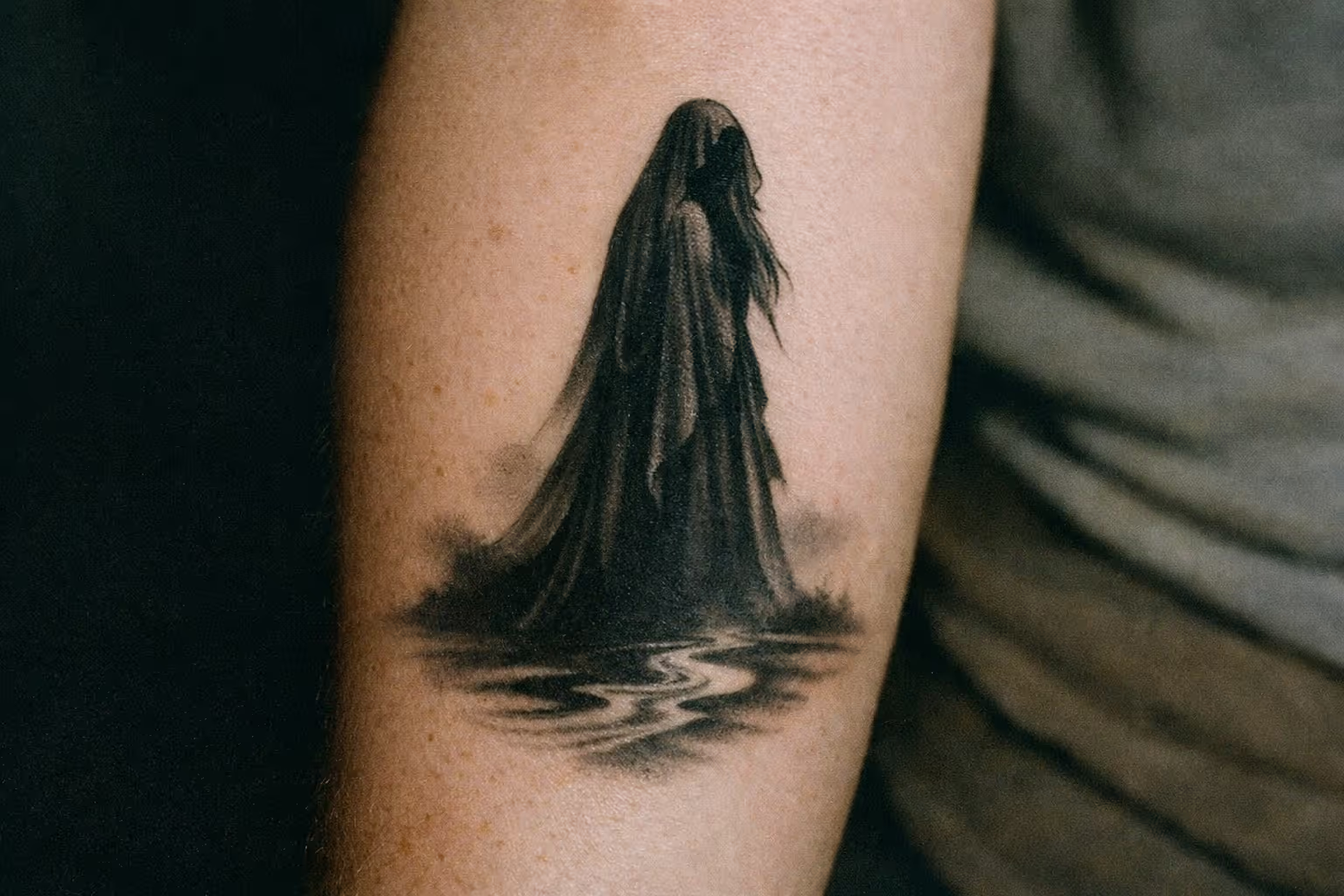
A La Llorona tattoo tempts you to illustrate the whole legend at once - the figure, the river, the roses, the candlelight - and that’s exactly how it fails. Pack five symbols into one small panel and they blur into mud within five to ten years. This is a design that rewards one strong image with room to breathe. Here’s which La Llorona scenes and placements actually hold up, and how to carry the story with less.
What a La Llorona Tattoo Means
La Llorona translates to “the weeping woman.” In the most common telling, she was a woman in love who was betrayed and abandoned by her husband. In a fit of grief and rage, she drowned her children in a river. When she understood what she’d done, she drowned herself too. Her spirit has wandered ever since, crying near water, searching for the children she lost (5)(6).
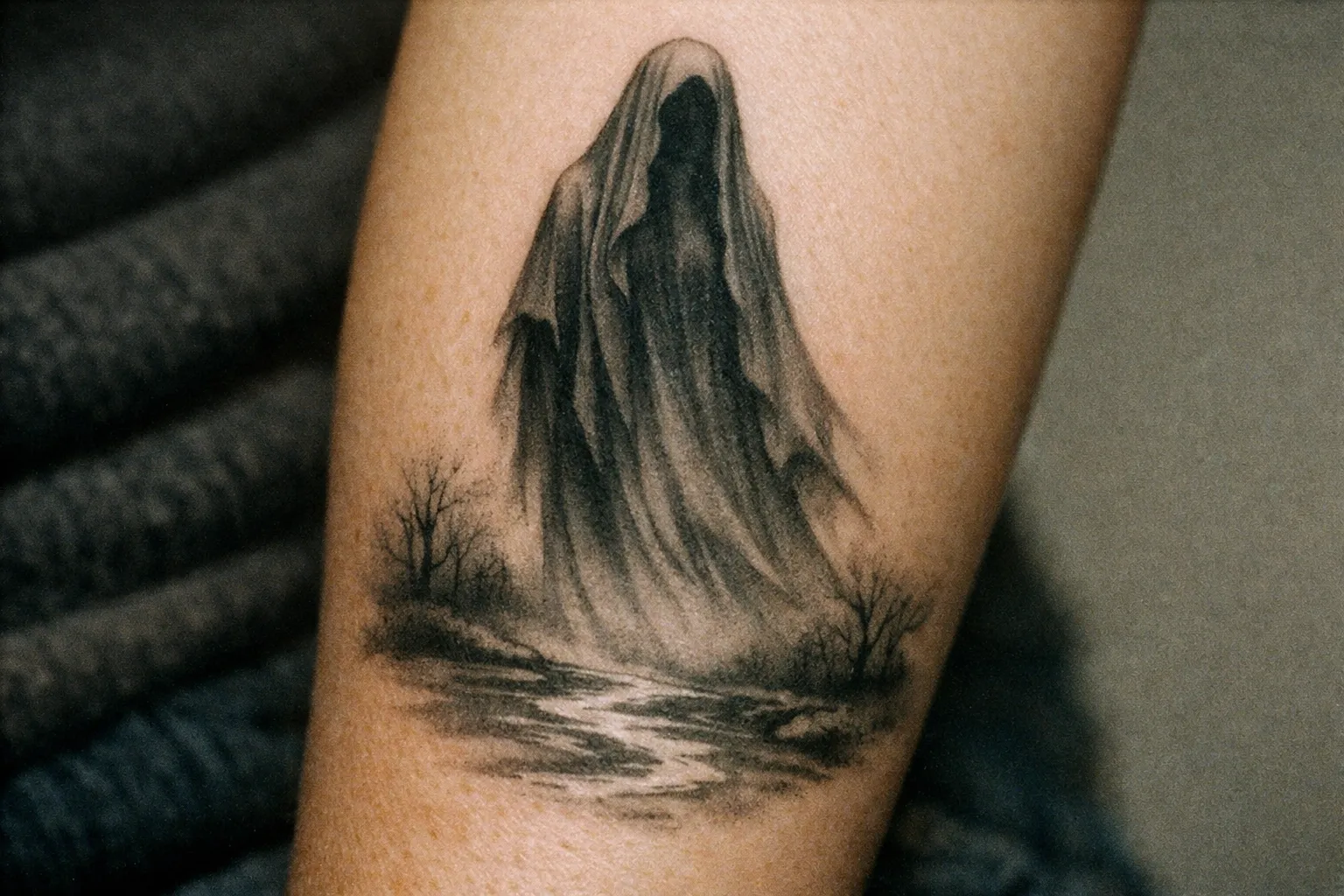
That story carries the symbolism. A La Llorona tattoo most often signals:
- Grief and irreversible loss - over a person, a relationship, or a choice you can’t take back
- Betrayal and infidelity - the most-cited modern reading, spread heavily through TikTok folklore clips that frame her as the patron of the cheated-on (3)(7). This modern Western interpretation shifts her meaning from traditional folklore, emphasizing personal betrayal over communal caution.
- Motherhood and maternal love - including its dark, destructive edge
- Mexican and Chicano cultural identity - pride in heritage and a connection to ancestral storytelling (1)
She functions as a cautionary figure too: a warning about unchecked passion, jealousy, and neglect. In Chicano communities she’s also read as a symbol of collective and intergenerational trauma - and of surviving it (5). So the meaning isn’t only sorrow. Plenty of people wear her as a marker of resilience after coming through something that should have drowned them.
If you’re choosing her, get clear on which reading is yours. Grief, identity, horror aesthetic, or all three - that decision shapes every line, and an honest answer keeps the piece from feeling borrowed.
✓ Pros
- Rich cultural symbolism with multiple layers of meaning
- Strong emotional impact tied to grief and resilience
- Versatile design options across styles and placements
✗ Cons
- Complex symbolism can be misunderstood or misrepresented
- Fine details and shading require experienced artists to age well
- Emotional weight may not suit all clients or casual wearers
The Symbols That Change Her Meaning
La Llorona almost never appears alone. The elements packed around her do the heavy lifting, and swapping one for another shifts the whole story.
- Tears - unending grief, emotional release. Dark or bloody tears push the piece toward horror; thin clean lines keep it mournful (4).
- Water, rivers, lakes - the boundary between life and death, and the site of the tragedy. Water can read as cleansing or as the thing that drowned everything she loved (1).
- Empty cradle or drowned children silhouettes - personal or ancestral loss. Be careful here: literal child imagery can lead people to assume you lost children biologically. Decide whether it’s literal or metaphorical and be ready to say so.
- Long hair over the face, flowing gown - anonymity and the universality of grief. Classic horror framing.
- Sacred Heart - suffering paired with divine, unconditional love; a strong devotional companion that reframes her grief as something holy.
- Spider web - entrapment, fate, or time served. Beside La Llorona it can read as being trapped in past choices.
- Roses - beauty that survives pain; a nod to who she was before grief consumed her.
Mix three to five of these at most. Cram in children, water, Sacred Heart, web, script, and skulls at a small size and you get visual mud that blurs within five to ten years. Hierarchy matters more than quantity. One practical note on scale: a symbol like the Sacred Heart reads clearly at 2 inches on its own, but loses definition fast when it’s competing with four other elements in a 4-inch panel. If you’re working small, cut the symbol count before you cut the size.
La Llorona Tattoo Ideas by Style
These are the design categories you’ll see most across 2024-2026 idea galleries, with the placement and size ranges that actually hold up.
Black-and-Grey Realism Portrait
The dominant style for this subject. A detailed face with tears, veiled hair, and soft shading. I’ve seen this go sideways more times than I can count when clients bring a reference to an artist who doesn’t specialize in portraits - you end up with stiff faces, uneven eyes, and hair that reads as a helmet instead of something flowing. Best on the forearm, calf, or upper arm at 4-7 inches, where there’s enough real estate for facial detail to breathe. Budget 4-8 hours of chair time. Two technical hallmarks here are smooth gradient shading and realistic facial proportions; a common pitfall is muddy shading that obscures expression.
Weeping La Llorona
The classic. Her spirit is cursed to relive the moment she lost her children, so a weeping depiction sits at the core of the legend. Works at almost any size, but the tears need enough room to read - go 3 inches or larger so the linework around the eyes doesn’t collapse into each other. Hallmarks include expressive tear lines and soft facial features; poorly done tears can look like smudges or random marks.
Split-Face La Llorona
One half crowned with flowers, weeping but still human - before the tragedy. The other half a hollow-eyed ghost with dark tears and blank white eyes. It shows that the figure people fear was once a broken woman. Strong vertical placement: sternum, center back, or outer forearm, ideally 5-8 inches so both halves get equal detail. I’ve drawn this one several times and the proportions are unforgiving - too small and the contrast between the halves disappears. The style demands precise symmetry and contrast in shading; a common mistake is uneven detail that blurs the narrative.
Drowning / Lake Scene
She stands waist-deep in still water, surrounded by her drowned children, at the moment she decides to end it. Heavy on fine lines and atmosphere. This is a scene, not a portrait - it needs space. Think back piece, full sternum panel, or large thigh, 8 inches and up. Hallmarks include layered depth and delicate linework; rushed work here can flatten the scene and lose emotional impact.
Watercolor / Surreal
Soft splashes, blue tones, abstract water, distorted faces to represent psychological trauma. Tones down the horror and leans into mood. One honest caveat: watercolor without a solid black or grey anchor underneath fades and muddies faster than people expect. Ask your artist to ground it with structural linework, or you’re looking at a blurry pastel mess in five years. Best on the upper arm or shoulder, 4-6 inches. Key hallmarks are loose color washes and minimal outlines; without a strong anchor, the design ages poorly.
Devotional / Catholic-Leaning
La Llorona posed like a saint, with a Sacred Heart, rosary, or candles. Reframes grief as something sacred rather than monstrous. Pairs naturally with a chest or forearm placement where religious iconography traditionally sits. Hallmarks include clear religious symbols and balanced composition; a pitfall is overcrowding the design with too many devotional elements.
Neo-Traditional / Chicano
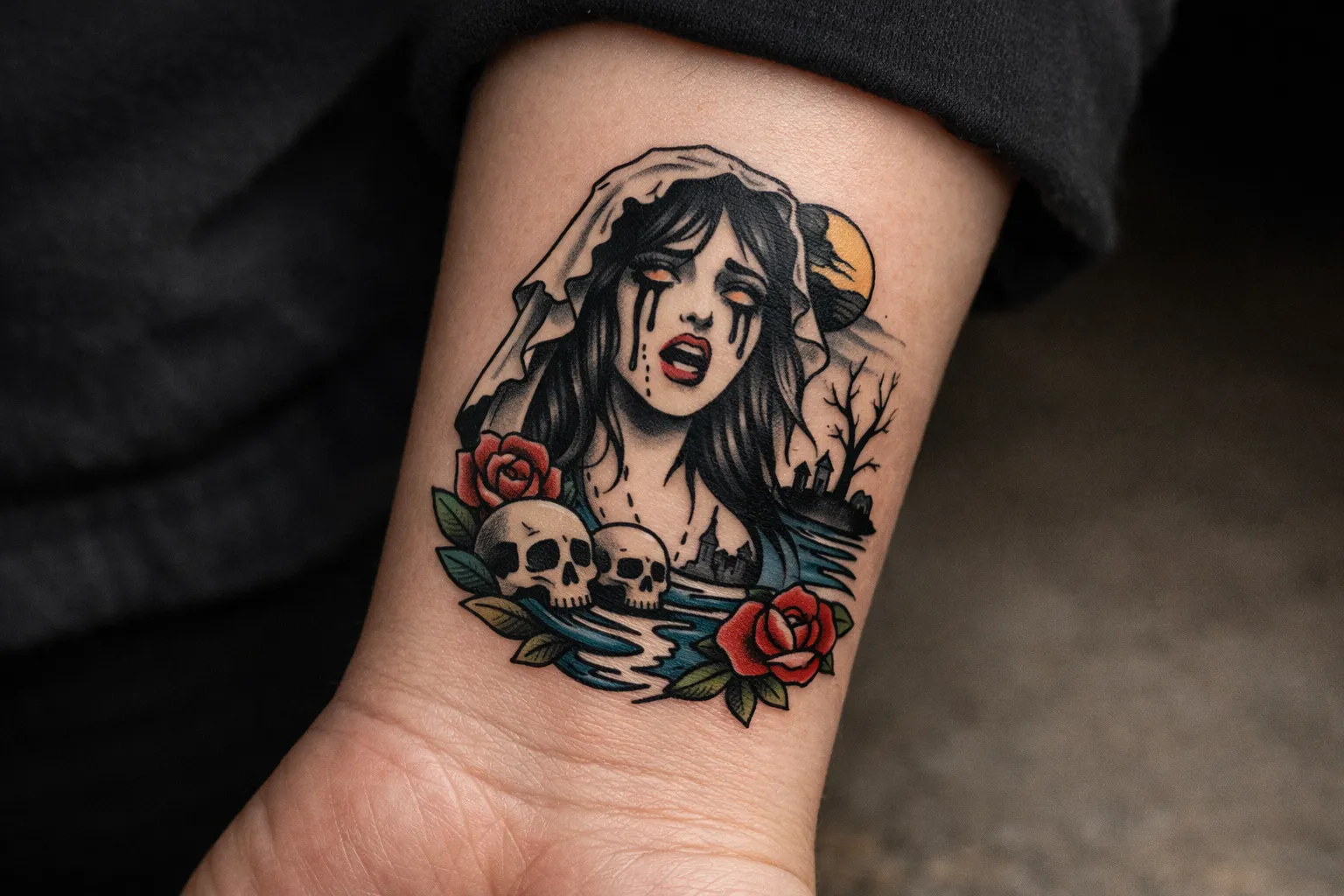
Bold lines, limited palette, script (“La Llorona,” “Perdóname”), roses, and Sacred Hearts integrated. The two technical hallmarks here are strong black outlines and confident shading - when done badly, the lines go thin and the design loses the punch the style depends on. Holds up well on the outer forearm or calf, 5-8 inches.
Minimalist / Fine Line
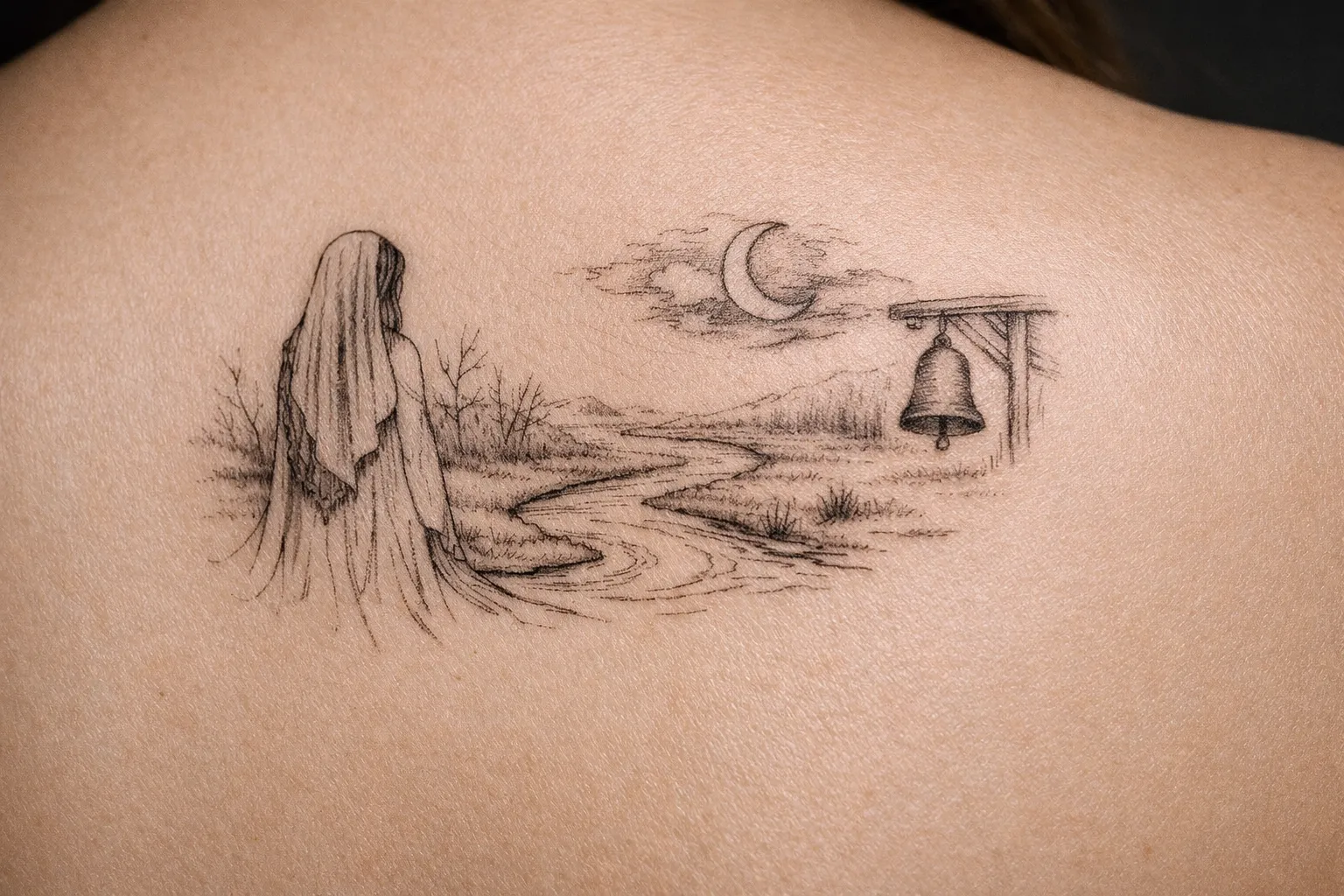
A simplified silhouette of a woman by a river, two or three water lines, one tear. Proof that simple can still carry weight. Keep it 2-4 inches on the inner forearm or upper arm - and avoid fingers, hand sides, and feet, where fine lines blur fastest from friction and cell turnover.
Horror-Leaning
Skull face, empty sockets, ragged dress, storm clouds, dark river. Often paired with an upside-down cross. Built to provoke a reaction - it’ll either unsettle people or start a long conversation. Hallmarks include high contrast black shading and aggressive linework; a common pitfall is over-detailing that muddies the horror effect.
Tim Burton Style
A gothic, Corpse Bride-flavored take with elongated features and a melancholic stillness. Distinctive and surprisingly tender for how spooky it reads. This style relies on exaggerated proportions and muted palettes; poorly done, it can look cartoonish instead of eerie.
Crafting Your Own Design
You’re not tattooing yourself - but you should concept the piece before you walk in. The best symbolic work comes from clients who arrive with intent, not a single Pinterest screenshot.
Start with two short lists: three personal events tied to grief, regret, or resilience, and three cultural or family stories. Only use symbols that connect to at least one item on those lists. That single rule keeps the design anchored to you instead of generic horror art. It also makes the artist consultation faster - when you can explain why you want water instead of roses, the artist can make a real design decision instead of guessing at your intent.
Then map a narrative if you’re going large. Many strong La Llorona pieces run as a visual three-act story:
- Before the tragedy - happy mother, children, light
- The moment of loss - children in the water, storm, climax
- The eternal search - the ghost walking the riverside
Decide the emotional tone on a slider - say 70% sorrow, 30% resilience - and let that govern your light versus shadow, flowers versus bones. Pick the one feeling you want a viewer to register first: fear, empathy, or reverence. Give that element 60-70% of the visual space. Use negative space (untattooed skin) as mist, fog, or water reflection so a large piece stays breathable instead of solid black.
Bring a reference folder of 5-15 images - La Llorona art, film stills, Catholic iconography, water textures. If you can, journal a page on your own grief or ancestry. It gives your artist the raw material for the script and symbol choices, and it usually leads to a better consultation than walking in and saying “I want something dark but meaningful.”
What a La Llorona Piece Costs and How Long It Takes
Idea galleries rarely quantify this, so here’s the practical breakdown for the US and Canada in 2024-2026.
Most professional shops charge $120-$250 per hour, with high-profile artists running $250-$400+ per hour. For a La Llorona specifically:
- Small fine-line piece (2-4 in, minimal shading): $150-$350
- Medium forearm or upper-arm portrait (4-7 in, black-and-grey): $400-$900 over one to two sessions
- Large back piece or full narrative sleeve (15-25+ hours): $2,000-$6,000+, depending on artist and city
Time-wise: consultation and design runs 30-90 minutes. An outline session is 1-4 hours. Shading and color add 2-5 hours per session, and large narrative pieces often need 3-6 sessions spaced 2-4 weeks apart.
Because La Llorona leans on facial expression and fabric flow, hire someone with proven portrait or Chicano experience. Ask to see healed photos of similar work - not just fresh shots - so you can judge how the line and shading actually settle over time. Fresh tattoos always look sharper than they’ll heal. That’s not the artist lying to you; it’s just physics. But it does mean healed photos are the only honest metric. A grey-wash portrait that looks crisp at day three can look flat and patchy at month six if the artist over-packed the mid-tones - healed photos catch that, fresh photos don’t.
This is especially important because the meaning of La Llorona tattoos has shifted in modern Western tattoo culture, where TikTok and social media have popularized a reading focused on infidelity and personal betrayal rather than the original folklore. A skilled artist will help you navigate these layers in the design.
Healing
Detailed black-and-grey portraits hold their emotional impact only if they heal clean. Follow the timeline:
- Day 1-3: Keep the bandage on as long as your artist instructs (often a few hours, or 1-3 days for adhesive film). Wash gently with lukewarm water and fragrance-free soap, pat dry, apply a thin layer of fragrance-free moisturizer. Expect some weeping and redness.
- Week 1: Flaking and light scabbing start. Do not pick - pulling a scab off a shaded face will lift ink and leave patchy spots that ruin the expression. Keep moisturizing lightly, two to three times a day.
- Week 2-4: The surface looks healed but isn’t done underneath. Avoid soaking (no pools, baths, or ocean) and heavy friction. Full internal healing takes 4-8 weeks.
Once healed, the single biggest threat to a La Llorona portrait is the sun. UV breaks down grey wash and fine line faster than anything else. Use sun-protective clothing or a high-SPF, fragrance-free sunscreen on the area for the life of the tattoo.
A word on placement and pain, since people ask: a sternum piece hurts more than a forearm one - bone and thin skin amplify everything. Ribs and the center back sit high on the discomfort scale too. The outer forearm and calf are the friendliest spots for a first large piece, which is part of why they’re so common for this design.
Adding to that, the wrist and fingers are poor placements for La Llorona tattoos, especially fine-line or detailed portraits, because the design ages badly there due to skin texture and frequent movement.
Frequently Asked Questions
- What does the La Llorona tattoo mean?
- It represents grief, loss, and the consequences of irreversible choices, drawn from the Mexican legend of the weeping woman who drowned her children and herself (5)(6). In modern usage - heavily through TikTok - it's frequently chosen after infidelity or the loss of a loved one (3)(7). For many Latinx and Chicano wearers it also signals cultural identity, maternal lineage, and resilience after trauma.
- What does La Llorona symbolize?
- The legend frames her as a cautionary figure about unchecked passion, jealousy, and parental neglect, and as a broader symbol of collective and intergenerational trauma in Mexican and Chicano communities (5). Depending on the design, she can lean toward sorrow, horror, or survival - the surrounding symbols (tears, water, Sacred Heart, roses) decide which reading lands.
- What does a 2% tattoo mean?
- This is unrelated to La Llorona and worth flagging so you don't accidentally conflate the two. In US tattoo culture, "2%" tattoos are commonly associated with extremist and white-supremacist slogans referencing "2% of the population" or "2% of bikers." Many reputable artists refuse to do them, and the symbol is generally avoided by mainstream shops.
- Who spent $200,000 to remove tattoos?
- Several news stories over the years describe people spending $100,000-$200,000 on full-body tattoo removal or cover-ups, including a widely reported case of an Australian man who reportedly spent around $200,000 removing extensive full-body work. This context highlights why thinking through a heavy, emotionally loaded design before committing matters.
Making the Call
A La Llorona tattoo works when the meaning is anchored to your own life and the design respects its roots in Mexican folklore - not when it’s grabbed as a generic ghost woman because the aesthetic looked good on someone else’s arm. Decide whether you’re marking grief, identity, horror, or resilience, then let that drive your symbols, your style, and your placement. Put detail-heavy portraits where they’ll last - outer forearm, calf, upper arm - and keep fine-line versions away from fingers and feet. Hire an artist with healed portrait work to show you. And if you’re considering this during an acute crisis, sit with the concept a few weeks first. The goal is a piece you’ll still want when the wound isn’t fresh.