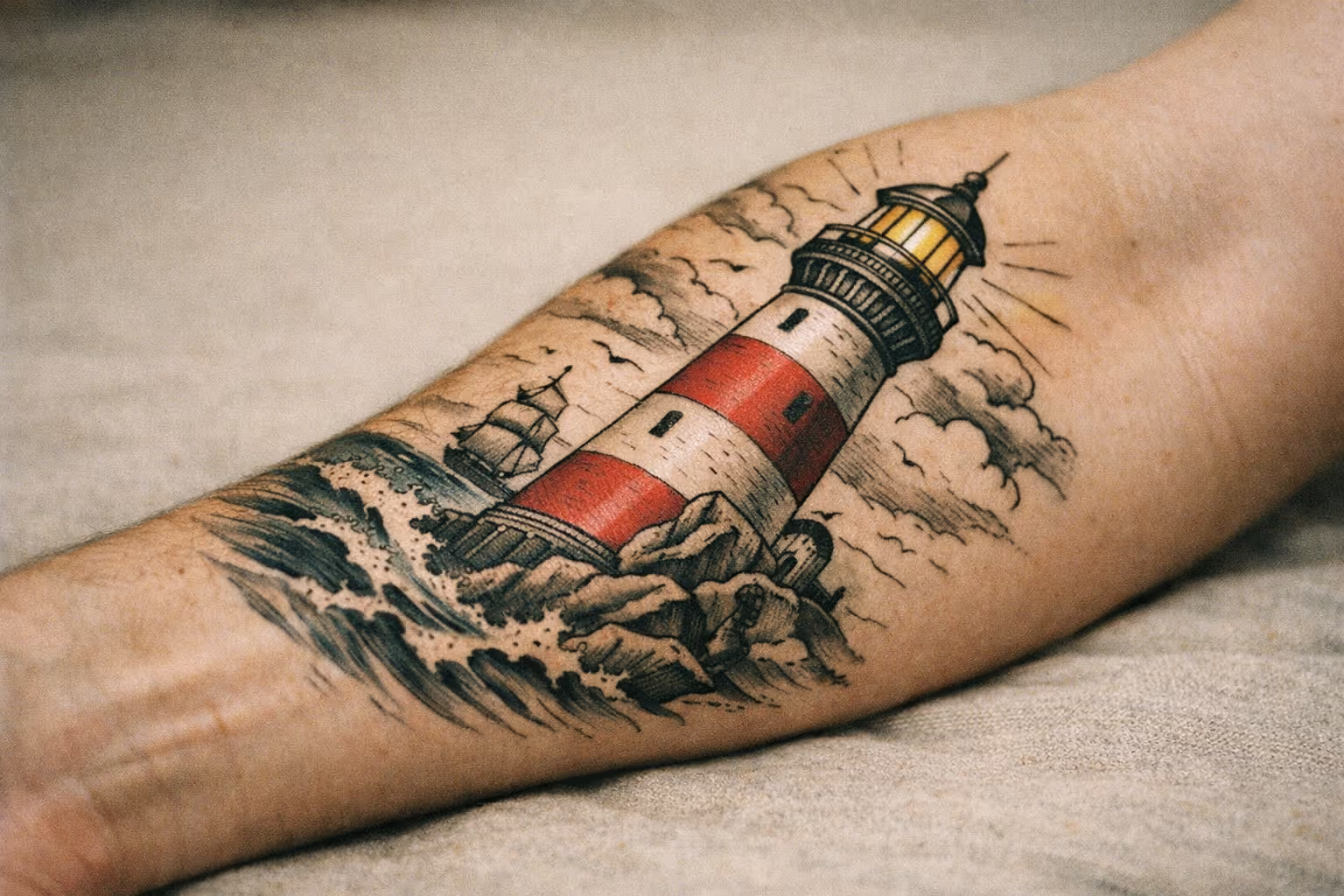
A lighthouse tattoo tempts everyone toward detail - the tower’s stonework, the beam, the crashing waves - and that’s exactly what kills it small. Under two inches, all that detail collapses into a dark smudge within a few years; the pieces that last keep it simple and give the design room. The meaning is steady and clear, which is half the appeal. Here’s how to fit one to the forearm, and the style rules that keep it readable.
What a Lighthouse Tattoo Actually Means
The core symbolism is consistent across maritime tattoo tradition and modern interpretation: guidance, protection, resilience, hope, and safe harbor (1)(2)(4). The lighthouse stands while the storm doesn’t. That’s the whole metaphor, and it’s why the motif keeps showing up on people coming out of hard chapters - recovery, grief, career pivots, mental health work.
A few sub-meanings worth knowing before you commit:
- Calm sea, clear sky. Peace, stability, arrival. Often chosen by people marking a settled period after turmoil (1)(4).
- Stormy sea, dark clouds, lightning. Overcoming adversity. This is the most common framing for recovery and mental health pieces (2)(3)(4).
- Isolated lighthouse, no other elements. Solitude, self-reflection, watchfulness (3)(4).
- Beam aimed outward. Guiding others - parents, caregivers, teachers often choose this orientation.
- Beam aimed inward or toward the wearer. Inner guidance, self-direction.
- Religious framing. Christian wearers sometimes link the lighthouse to Christ as “light of the world,” refuge and salvation imagery (4).
One honest caveat: the lighthouse has picked up so many meanings that strangers will read into it however they want. If you don’t want people assuming sobriety or religious symbolism, the design choices around the lighthouse - storm vs. calm, cross vs. compass, banner text - do more work than the lighthouse itself. I’ve had clients surprised that people kept asking if their lighthouse was a sobriety tattoo, when the meaning they had in mind was completely different. The surrounding elements are the message.
Traditional Lighthouse Tattoo: The Style That Ages Best
If you want one style recommendation that will still look sharp in twenty years, it’s the traditional lighthouse tattoo. American traditional has two technical hallmarks that make it work: thick black outlines and a limited palette - usually red, yellow, blue-green, black, and a touch of flesh tone. Those bold outlines act as a frame that holds saturation in place as ink migrates a fraction of a millimeter over decades. The limited palette means no subtle gradients slowly fading into mush.
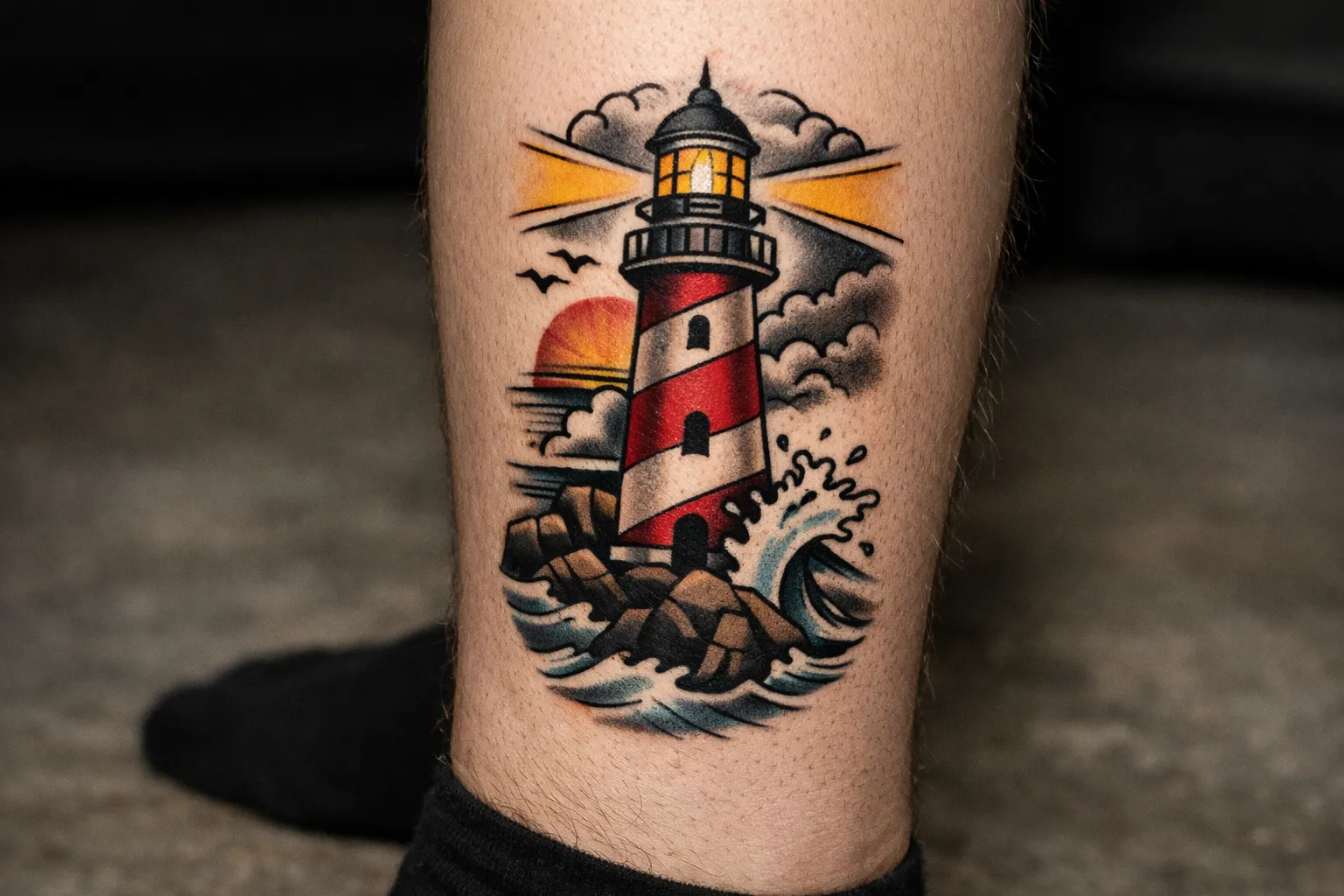
A traditional lighthouse usually includes:
- A red-and-white or black-and-white striped tower with a yellow beam
- Stylized waves (think Sailor Jerry curls, not photorealistic water)
- A banner with a date, name, or short phrase
- Optional anchor, ship, swallow, or rose
The common pitfall when artists do traditional badly: thin, wobbly outlines and pastel fills that look like a neo-traditional piece without the technical chops. If your artist’s portfolio shows traditional work where the black lines look feathered or the colors are muted, that’s not traditional - that’s an imitation that will fade fast. I look for consistency in line weight across the whole piece. Uneven outlines on a healed traditional tattoo are a red flag.
Neo-traditional is the close cousin: thicker, more varied linework, extended palette, more depth in shading. It also ages well, just not quite as bulletproof as classic American traditional.
Small: What Works and What Doesn’t
A small lighthouse tattoo is anything under roughly 2-3 inches (5-7.5 cm). It’s the most-requested size right now and also the most often botched.
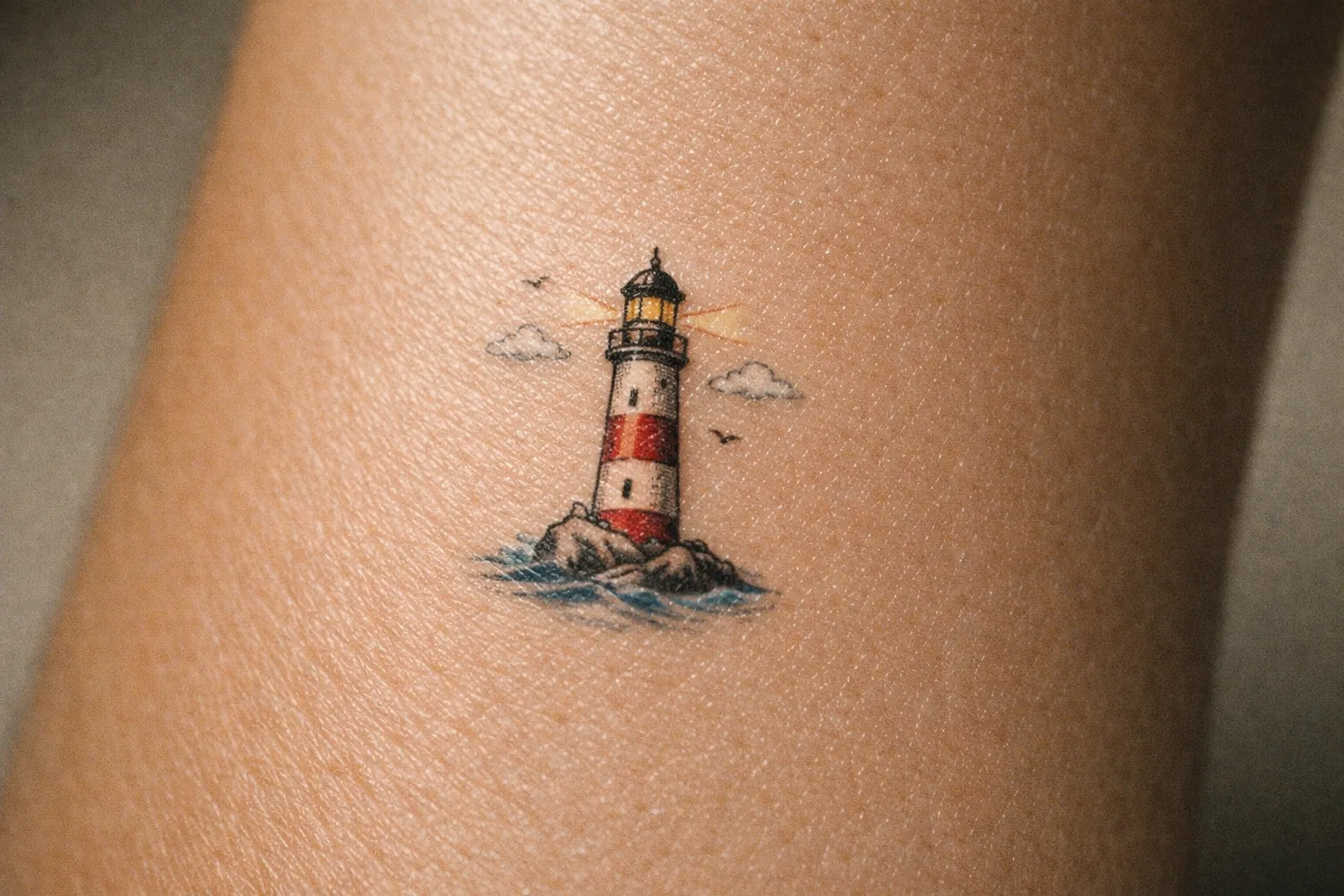
What works at small scale:
- Simple silhouette of the tower with a single beam line - black ink only, no fills
- Fine-line outline of the tower with minimal interior detail
- Tiny traditional with just the tower, no background scene
- Placements: behind the ear (1-1.5 in), inner wrist (1.5-2 in), back of the upper arm (2-3 in), ankle (2 in)
What doesn’t work at small scale:
- A full scene with waves, ship, clouds, and beam crammed into 2 inches
- Tiny windows in the tower (they blur into a smudge within 3-5 years)
- Script under the design at small size - script letters under about ½ inch (12-13 mm) tall almost always blow out
The honest rule: at small sizes, subtract elements. Pick the tower OR the beam OR a wave, not all three. A clean black silhouette of a lighthouse on the inner forearm at 2 inches will look better at year ten than a busy 2-inch scene will at year two. I tell clients this in consultation and some push back. Then they come back four years later and ask about a cover-up.
Budget for a small lighthouse tattoo: $80-$200 at most US studios, with a shop minimum usually around $80-$120. Time in the chair: 30-90 minutes.
Lighthouse Forearm Tattoo: Why the Placement Works
The lighthouse forearm tattoo is the most flattering placement for this motif, and the geometry is the reason. A lighthouse is vertical. The forearm - inner or outer - gives you a vertical canvas roughly 7-10 inches (18-25 cm) long. The proportions fit without distortion.
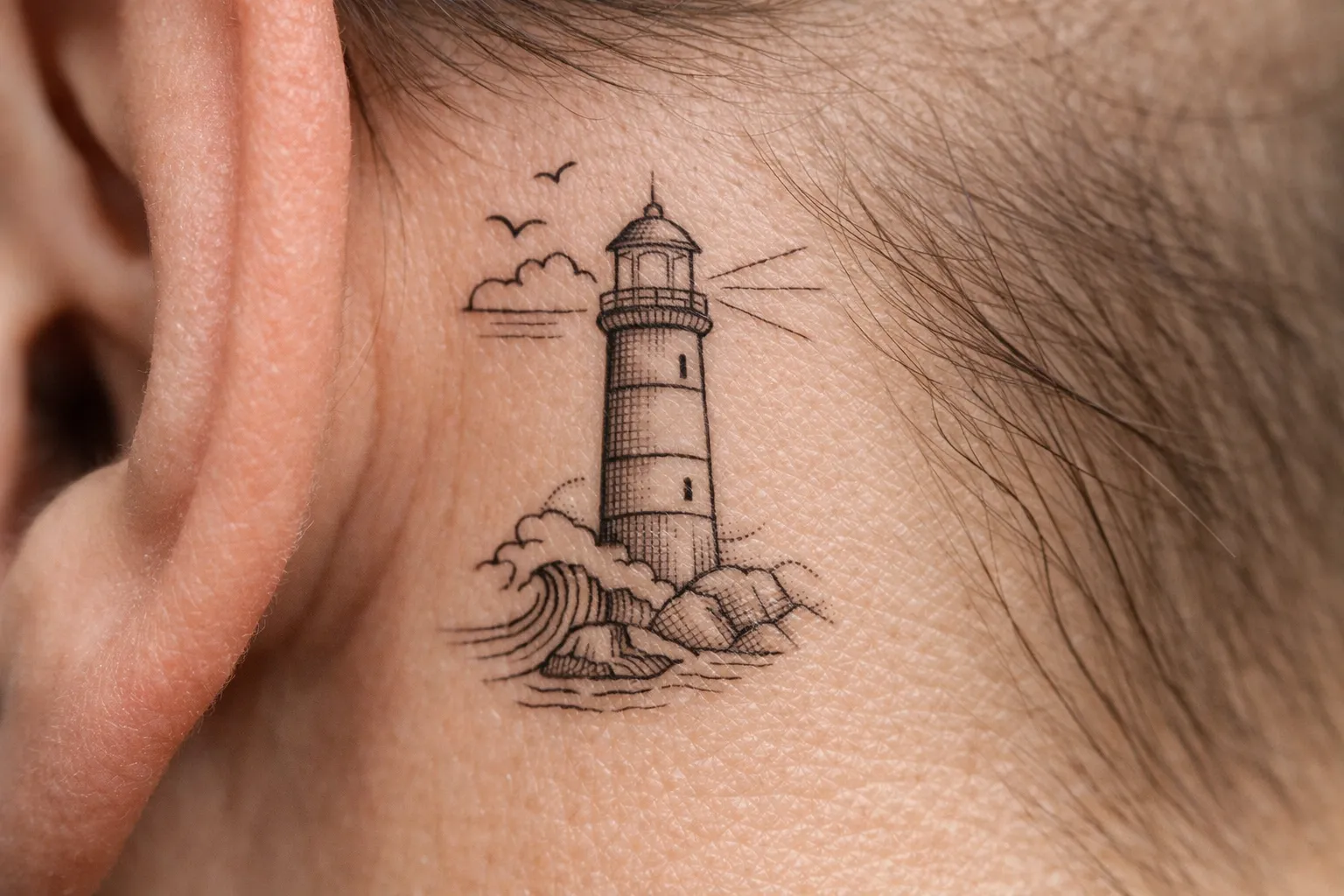
A few placement specifics:
- Inner forearm: lower pain, less sun exposure, easier to hide under a sleeve. Good for color work because the skin is smoother and ink saturates evenly.
- Outer forearm: more visible, more sun, slightly higher pain near the elbow. Holds detail well.
- Wrap-around forearm: for larger scenes with cliff, sea, and sky. Needs 4-6 hours and an artist comfortable composing across a curved surface.
Pain ranking for context: forearm is on the lower end. Ribcage > sternum > spine > inner bicep > forearm. If this is your first piece, the forearm is forgiving.
Size and cost for a medium forearm lighthouse with waves, sky, and color: 5-7 inches, $250-$600, 2-4 hours, usually one session. Add a ship or background cliff and you’re looking at $400-$700 and possibly a second session.
Designs Worth Considering
A few combinations that pull their weight visually:
- Lighthouse + compass. Doubles down on the guidance meaning. Works at medium size, 4-6 inches.
- Lighthouse + ship. Classic nautical pairing. The ship gives the beam a target, which makes the composition feel complete rather than just a tower floating in space.
- Lighthouse + roses. Pure American traditional flash. Roses fill negative space and add color contrast.
- Lighthouse + coordinates. Latitude/longitude of a specific lighthouse - a hometown landmark, a place that mattered. Subtler than a full quote.
- Heritage/Victorian lighthouse. Ornate architectural detailing instead of a generic striped tower, pulling from real 19th-century lighthouse design (3). Best at 6+ inches because the detail needs room to breathe.
- Stormy vs. calm split. Storm at the base, clear sky at the top - a vertical narrative of struggle and clarity. Strong on the forearm, calf, or spine.
What to skip on a first lighthouse tattoo: ultra-thin micro pieces under 1 inch with windows and text (blowout risk is high), watercolor-only without black linework (fades fast on sun-exposed skin), and exact copies of another artist’s flash. Ask for a custom reinterpretation instead - most artists will, and the result will actually fit your body better.
Placement Options Beyond the Forearm
The forearm is the default, but a few other placements work well depending on size and style:
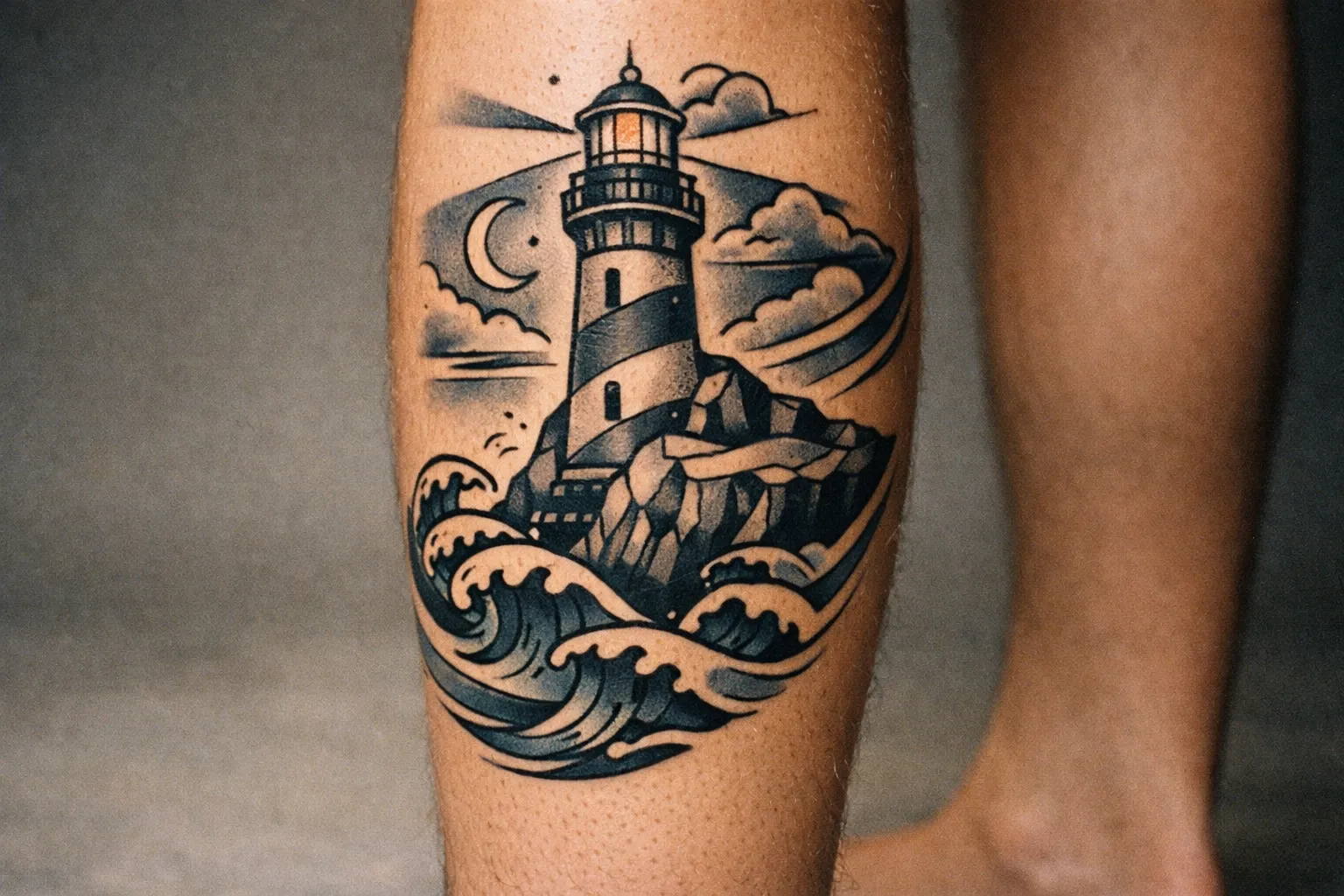
- Calf / outer leg. Excellent vertical canvas, low distortion as you age, less sun exposure than the forearm. Good for 6-10 inch pieces.
- Spine / center back. Allows the tallest, most detailed scenes - 10-14 inches comfortably. Usually clothed, so color stays saturated for years.
- Ribs / side. Aesthetically strong for tall designs, but the pain is real. Ribs are one of the worst spots for most people - bony, thin skin, and breathing moves the canvas under the needle.
- Upper arm / outer bicep. Good for 4-6 inch traditional pieces. Easy to integrate into a future half-sleeve.
- Behind the ear or back of the neck. Only for tiny silhouettes, 1-1.5 inches max.
Avoid: inner wrist for anything detailed (the skin moves and ink spreads faster here), fingers (lighthouses on fingers blur within a year), and the stomach (skin changes distort vertical designs more than most people expect).
How Much to Tip
This comes up constantly and most design guides skip it. Tipping in US tattoo shops follows the same logic as other skilled service industries: 15-25% of the total cost, paid in cash if possible.
Concrete examples:
- $150 tattoo: $25-$40 tip
- $300 tattoo: $50-$75 tip
- $500 tattoo: $75-$125 tip, with $100 (20%) being the standard
- $1,000 tattoo: $150-$250 tip
Tip the artist directly, not the shop. If you brought in a custom design and your artist drew multiple revisions before the session, lean toward the higher end. If you no-call-no-showed a previous appointment and they squeezed you back in, definitely the higher end.
Tattoos to Avoid (Lighthouse-Specific Edition)
A general list of “bad tattoo ideas” isn’t useful - what matters is what goes wrong on a lighthouse specifically:
- Micro lighthouses under 1 inch with detailed windows. Windows become smudges. Tower stripes bleed together. You end up with a vertical black smear in three years.
- Watercolor lighthouses without any black linework. Pretty fresh, noticeably faded in five years, mostly gone in ten. If you want watercolor, ask for it built around a solid black outline of the tower.
- Photorealistic lighthouse next to existing traditional work. Style clash. Keep one body region in one style family.
- Exact copies of a known artist’s flash. Bad ethics, and the artist who tattoos it for you usually isn’t as good at executing it as the original. Custom reinterpretation costs the same and fits your body better.
- Lighthouse on the inner wrist with a full scene. Skin moves too much, ink spreads, scene blurs into mud within a few years.
- Trend-driven geometric overlays. Geometric line patterns over a lighthouse are very 2022. They date faster than the lighthouse itself.
Designing a Custom Lighthouse: How It Actually Goes
If you walk into a consultation with “I want a lighthouse” and nothing else, a good artist will ask a series of questions before sketching anything. Here’s what the process actually looks like:
- Reference gathering. You bring 3-8 images - not to copy, but to show what you’re drawn to: tower style, level of detail, color vs. black-and-grey, mood.
- Meaning conversation. Why this design? The answer changes whether the artist draws a storm or a calm sea, beam outward or inward, banner with a date or no text at all.
- Placement and size discussion. Forearm vs. calf vs. spine. The artist will often hold a printed sketch against the body to check proportions before committing.
- Sketch round one. Usually delivered 1-2 weeks before the appointment. Expect to request changes - that’s normal, not rude.
- Sketch round two. Fine-tune. After this, the design is locked.
- Session day. Stencil applied, position confirmed in a mirror, tattooing begins. For a medium forearm piece, 2-4 hours.
- Healed photo. A good artist will ask for a photo 4-6 weeks after the session for their portfolio and to see how the piece settled.
This is the difference between a generic flash pull and a piece that actually belongs on your body.
Aftercare
Healing timeline for a standard forearm or calf piece:
Day 1-3. The artist’s bandage - often a clear adhesive film like Saniderm or a wrap - stays on for the time they specify, usually 24 hours to 5 days depending on the product. Once off, wash gently 2-3 times daily with a fragrance-free gentle cleanser, pat dry with a clean paper towel (not a cloth towel - too much bacteria). Apply a thin layer of fragrance-free moisturizer or a non-petroleum tattoo aftercare lotion. The tattoo will look shiny and feel tight.
Week 1. Peeling and itching start around day 3-5 and peak around day 7. Do not pick, do not scratch, do not soak. Quick showers only - no baths, pools, hot tubs, ocean. Keep moisturizing 2-3 times daily. The peeling skin will look like the color is coming off; it isn’t, that’s just dead surface skin.
Week 2-4. Surface healing finishes around day 14. The tattoo may look slightly dull or cloudy for another 1-2 weeks as the deeper layers settle - this is normal and clears up. Continue moisturizing once daily. Start using sun-protective clothing or SPF 30+ on the tattoo any time it’s exposed.
Week 4-6. Full skin recovery. The tattoo settles into its final appearance. If a small spot didn’t take ink well - common on bony areas or near joints - schedule a free touch-up with your artist around the 6-8 week mark.
One thing I tell every client: sunscreen is the single biggest factor in how a lighthouse tattoo looks at year ten. UV breaks down ink. A forearm piece that gets daily sun without protection will lose 20-30% of its saturation in five years. The same piece kept covered or sunscreened will look nearly fresh. It’s not exciting aftercare advice, but it’s the most important one. For more on protecting your tattoo, see sun-protective clothing.
Lighthouse Tattoo FAQ
Frequently Asked Questions
- Can I get a lighthouse tattoo if I want a non-nautical meaning?
- Yes. A lighthouse alone without sea elements leans more toward general guidance and inner direction rather than literal maritime symbolism.
- Why do small lighthouse tattoos often blur or fade quickly?
- Small sizes under 2 inches with detailed windows or text tend to blur because the ink spreads and details merge over time. Simplifying the design helps longevity.
- Is it better to get a traditional or neo-traditional lighthouse tattoo?
- Traditional tattoos with thick black outlines and limited colors age best. Neo-traditional also ages well but may not be as bulletproof over decades.
- How should I care for my lighthouse tattoo to keep it looking sharp?
- Follow a strict aftercare routine with fragrance-free cleanser and moisturizer, avoid soaking during peeling, and use sun-protective clothing or sunscreen long-term.
- What placements should I avoid for a lighthouse tattoo?
- Avoid inner wrist for detailed scenes, fingers, and stomach due to skin movement and distortion causing faster ink spread and blurring.
- How do artists handle custom lighthouse tattoo designs?
- They start with reference images and meaning discussions, then sketch rounds before the session to ensure the design fits your body and story.