A good Icarus tattoo shows a human figure suspended mid-air: wings half-dissolved, feathers pulling loose, the sun burning above and the sea waiting below. Before you book one, understand what you’re actually getting into: an Icarus tattoo is not a simple “chase your dreams” design. Rooted in Greek mythology, it carries the full weight of the myth: ambition and consequence, flight and fall. The single biggest decision you’ll make isn’t style or placement. It’s whether you’re depicting the ascent or the fall, because that choice changes the composition, the placement logic, and what strangers read on your skin.
Get that decision right and you have a design that ages well and means something specific to you. Get it wrong and you’re wearing a symbol of failure when you meant to mark ambition. What follows covers the myth, the meaning, the styles that hold up over decades, and how to brief an artist so the piece actually says what you intend.
✓ Pros
- Rich, layered symbolism that works on multiple levels (aspiration, caution, mortality)
- Highly adaptable: works in realism, neo-traditional, minimalist, and geometric styles
- Scales from a small wrist silhouette to a full back narrative piece
- Strong visual narrative even without text; the pose tells the story
- Meaning can be personalised by choosing flight, fall, or Daedalus as the focal point
✗ Cons
- Dual meaning means strangers may read it as a symbol of failure rather than ambition
- Complex figure with wings requires an experienced artist; not a beginner-friendly design
- Detailed versions need significant space (15-20 cm+) to age well
- Increasingly common in Greek-myth tattoo cycles; some wearers find it overused
- Mixing too many myth elements (labyrinth, sun, sea, quote) in one piece creates visual noise
The Myth Behind the Wings: What Daedalus and Icarus Actually Did
The Icarus myth is a Greek story about an inventor and his son escaping the island of Crete on wings that carry a warning built into them. Daedalus, a master craftsman imprisoned by King Minos, fashions wings of feathers and wax so that he and his son can fly out (1).
Before takeoff, Daedalus gives Icarus a specific instruction: don’t fly too low, or sea spray will wet the feathers, and don’t fly too high, or the sun’s heat will melt the wax holding the wings together (7). Icarus, caught up in the thrill of flight, ignores both warnings. He climbs toward the sun, the beeswax softens and gives way, the feathers pull loose, and he falls into the sea and drowns. Greek tradition names that stretch of water the Icarian Sea, near the island of Ikaria, said to be named after him.
Here’s the part most people forget: Daedalus survives. He completes the flight and goes on living as an inventor and craftsman. The father is a distinct figure with his own symbolic weight: the maker, the one who gave the warning, the one who had to keep going afterward. I bring this up because few clients who come in describing what they want have actually thought about Daedalus as a separate design direction. If you find yourself drawn to the creation of the wings rather than the fall, you’re identifying with Daedalus, not Icarus. That’s a legitimate angle, and I’ll come back to it.
Why Icarus Is Not Actually a Fallen Angel
People search for Icarus as a “fallen angel,” and it’s easy to see why: feathered wings, a fatal fall from the sky, a story about overreaching. But Icarus is a mortal youth from Greek mythology, not a theological figure. Fallen angels belong to Judeo-Christian tradition, most famously Lucifer, and their fall is a spiritual rebellion against the divine. Icarus fell because wax melted and he disobeyed his father, not because of any cosmic sin. Calling him a fallen angel is a modern metaphor built on visual similarity, nothing more.
Worth knowing if you’re choosing the design for religious resonance versus mythological weight. They’re not the same thing, and they pull the design in different directions. Tattoo guides read the falling figure as an expression of failure and the fallout of pride (7), and the myth itself as a warning against overconfidence and arrogance (1), so others may read the piece that way rather than as aspiration. Know both readings before it’s on your skin for good.
Meaning Behind the Icarus Tattoo, and Why the Pose Changes Everything
An Icarus tattoo carries a cluster of related meanings from the Greek myth, and the specific one you land on depends heavily on how the figure is posed. In the myth and in most modern readings, Icarus is tied to hubris, disobedience of wise counsel, and the danger of overreaching, while Daedalus stands for technical ingenuity and prudence, giving the story a built-in tension between innovation and reckless ambition.
Six symbolic clusters come up again and again:
- Ambition: the drive to climb higher, achieve more, reach past what’s expected.
- Freedom: escape from confinement, the literal act of flight away from a prison.
- Rebellion: defiance of authority and of the limits others set for you.
- Risk-taking and hubris: the willingness to gamble, and the overconfidence that tips it into disaster.
- Mortality: a reminder that reaching too far has a cost, and that cost can be final.
- Creativity and innovation: via Daedalus, the maker who engineered a way out.
The reason this design keeps getting requested is the dual tension. It reads as liberation from constraints and as a warning against overconfidence at the same time. That’s why it lands so hard with people who’ve been through burnout, a rough career collapse, or a major risk that didn’t pan out: the myth holds both the beauty of reaching and the price of overreaching in a single frame.
Most wearers I’ve talked through this with fall into one of three categories. First, the ones who want a daily marker to chase their dreams but stay grounded: the “middle way” reading, neither too low nor too high. Second, the ones who’ve survived a crash (career, relationship, addiction) and are rising again despite the setback. Third, the ones making a declaration of personal liberty, deliberately reclaiming Icarus from his cautionary role and celebrating the flight regardless of the fall.
Some guides frame an Icarus tattoo as a permanent memento mori, a reminder of mortality and limits rather than pure aspiration (3). The same reading suits recovery journeys and resilience after a fall, not just the initial ascent. If that’s your angle, the fall-focused pose does the heavy lifting.
Flight-Focused vs. Fall-Focused: Choosing Your Narrative
Tilting the figure’s orientation is the single most important design decision, because direction encodes meaning. An upward-angled body with wings spread emphasizes aspiration and rebellion; a downward, falling pose emphasizes humility, consequence, and mortality.
Flight-focused designs show Icarus soaring, wings wide, sun above. They stress ambition, freedom, and rebellion, and they often omit the fall entirely. This is the “I’m still climbing” reading.
Fall-focused designs show the figure descending, feathers scattering, the sea below. They stress consequence, tragedy, learning from mistakes, and mortality. This is the reading that resonates with recovery and resilience.
Dual-panel or two-phase designs show both ascent and fall, sometimes split across two limbs to capture the rise and the crash together. It’s the most narratively complete option and also the most complex to execute well.
One practical rule: tell your artist which phase you’re depicting before the consultation, not during it. The most common bad outcome is an artist defaulting to a generic falling figure when you wanted the ascent, or vice versa. I’ve seen it happen, and fixing it costs another session.
The Daedalus Variation: Innovation Over Hubris
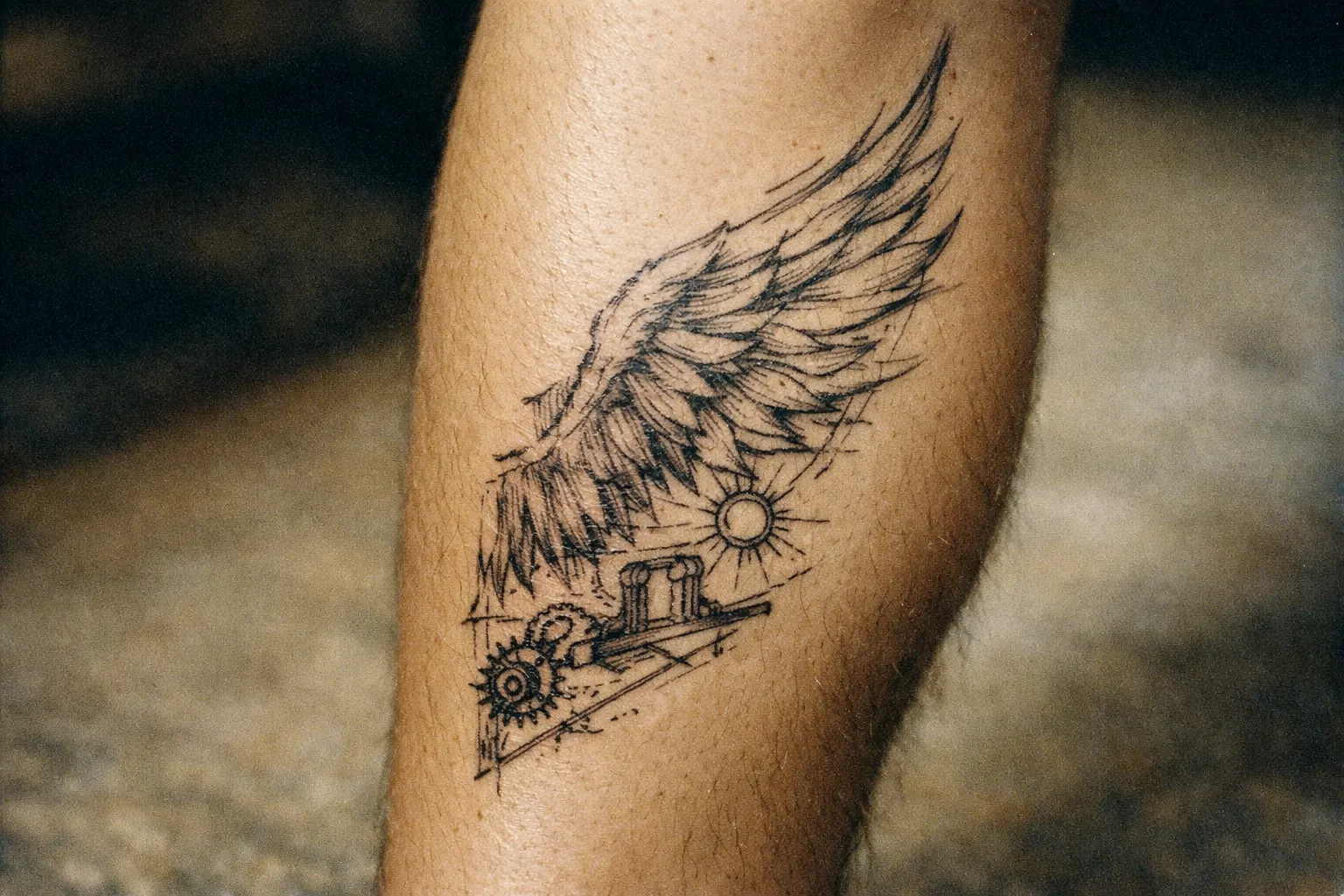
Shift the focal figure from Icarus to Daedalus and the entire meaning reframes. Daedalus is the maker, the problem-solver, the one who built the wings and survived to keep inventing. If you identify with creativity and engineering rather than reckless ambition, this is your version. Design-wise, Daedalus-focused pieces often make the wings themselves the hero of the composition (the craftsmanship, the feather layering, the engineering) rather than a body plummeting toward the sea. It’s a strong choice for artists, engineers, and anyone who’d rather celebrate the build than mourn the fall.
Styles for This Design: Which Approach Holds Up Over Time
The four main styles for an Icarus tattoo are realism, neo-traditional, minimalist line art, and geometric. They differ sharply in how much space they need and how well they hold up over years. Here’s the honest breakdown before you fall in love with a reference photo.
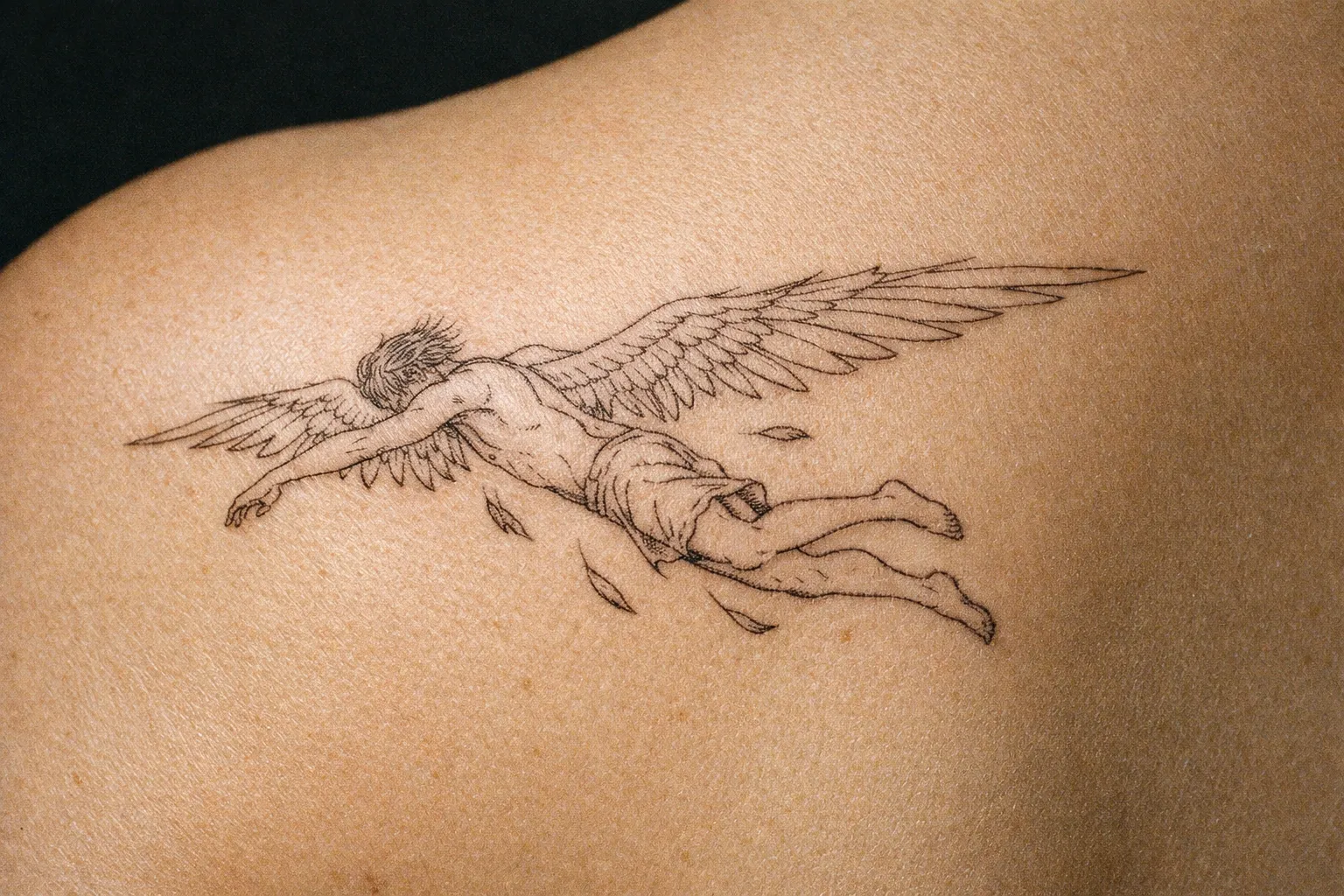
Realism renders a detailed human figure with anatomically correct wings and dramatic chiaroscuro lighting: bright sun against shadowed sea. Two technical hallmarks define it: photographic value gradients (no hard outlines, just tonal shifts) and extreme detail density in the feathers and skin. The common pitfall is undersizing: artists who attempt realism below roughly 15-20 cm in height find that the fine, closely packed lines blur faster than bold outlines as the skin ages, turning the detail to mush within a few years. Best on the back, chest, and large upper arm. Only book this with an artist whose portfolio shows real figure and mythology work.
Neo-traditional uses bold black outlines, a saturated color palette, and a stylized sun and sea. Those hallmarks also define its common pitfall: artists who soften the outlines or reach for too many mid-tones end up with something that reads as muddy realism rather than neo-traditional, and the style loses its legibility fast. It’s the most forgiving over the long haul: those thick anchor lines hold their shape far better than fine-line or watercolor work over time, especially on high-movement areas like the forearm. Popular for forearm and thigh pieces, and it reads clearly from across a room.
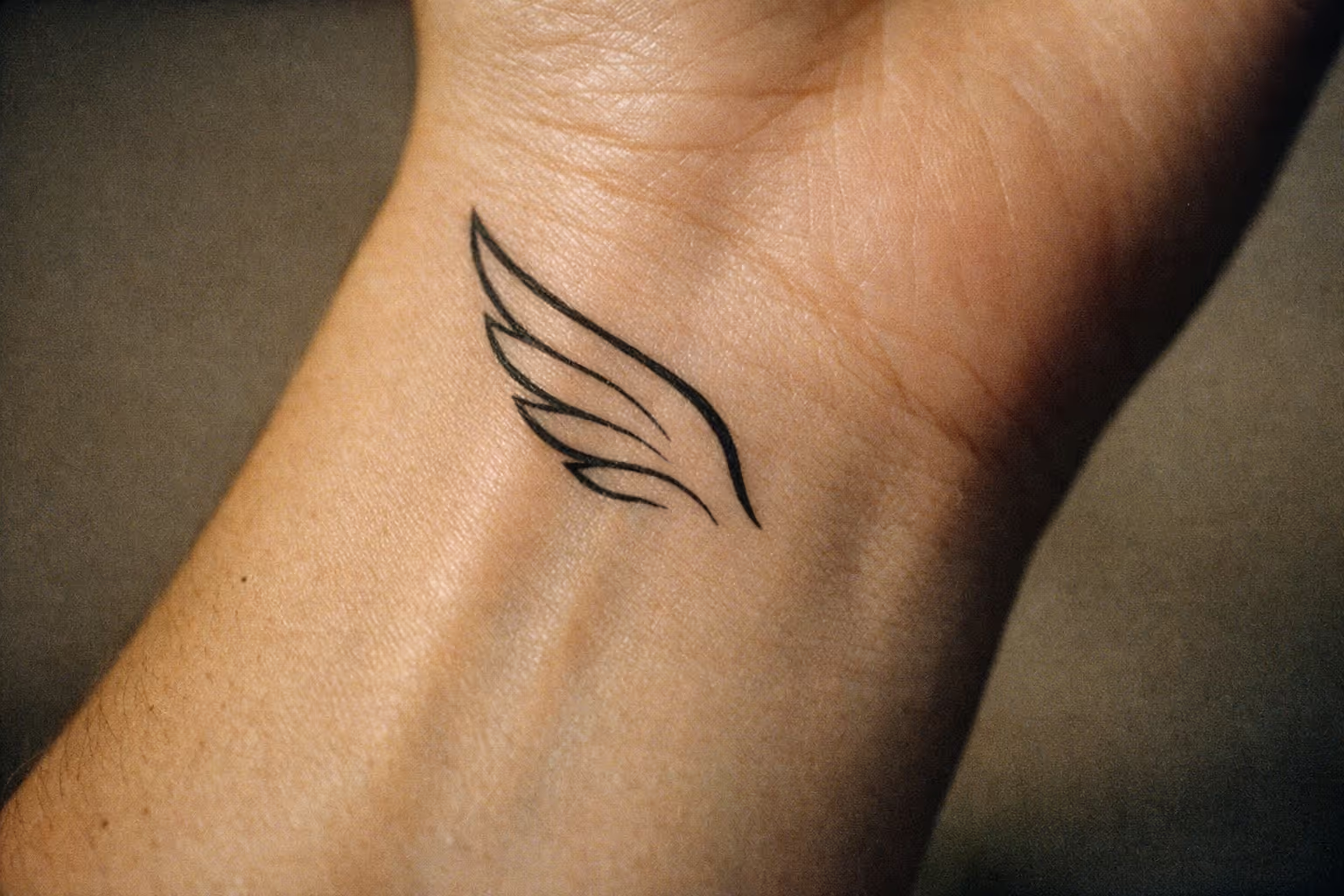
Minimalist / line art strips the design to a simple silhouette of a falling Icarus or a small set of wings in black ink only. It’s the fastest to execute (a single session of 1-2 hours) and ideal for the wrist, ankle, or behind the ear. The trade-off: it’s the most likely to be misread without context, and it fades faster in sun-exposed spots.
Geometric / abstract combines the figure with geometric shapes: a circle for the sun, triangles that encode ascent versus descent. It gives the piece a contemporary, graphic quality and works well on the forearm or shoulder. Anchored with solid blackwork, it holds up well.
A word on aging you won’t always hear from a gallery site: fine-line and watercolor approaches fade faster in high-friction or sun-exposed areas, and fine-line pieces often benefit from a refresh pass at five to seven years if lines have blown out, to restore crispness and contrast. Blackwork and neo-traditional outlines outlast them by a wide margin.
Aftercare matters here too. Days 1-3: follow your artist’s bandage instructions (a traditional wrap usually comes off after a few hours, a second-skin film can stay on longer), wash gently with unscented soap, and pat dry, no soaking. From about day 3, switch to a thin layer of fragrance-free lotion; the skin will peel and itch, which is normal. Weeks 2-4: the surface heals but the deeper layers are still settling, so keep moisturizing lightly and cover the piece with sun-protective clothing any time you’re outside. UV exposure is the fastest way to fade a fine-line or color piece before it’s even fully healed.
Icarus Tattoo Style vs. Placement Fit
| Realism | Neo-traditional | Minimalist / line art | Geometric / abstract | |
|---|---|---|---|---|
| Best Placements | Back, chest, large upper arm | Forearm, thigh, upper arm | Wrist, ankle, behind ear | Forearm, shoulder, upper arm |
| Minimum Size | 15 cm+ | 8-10 cm | 5-8 cm (silhouette only) | 8-12 cm |
| Longevity | High if sized correctly; blurs if too small | High; bold outlines hold well | Moderate; fades faster in sun/friction zones | High if blackwork-anchored |
| Session Count | Multiple | 1-2 | 1 (1-2 hrs) | 1-2 |
Color vs. Black-and-Grey for Icarus Designs
Black-and-grey suits realism and minimalist approaches especially well, because the contrast between a bright sun and a shadowed sea can be rendered entirely in value, no color needed. Color gives neo-traditional its punch, and a warm palette works best here: gold and amber for the sun, deep blue for the sea.
Color aging order matters. Black anchors the design and lasts longest; yellow and pastel inks fade fastest, particularly in sunlight. If your Icarus relies on a golden sun or a pale sky, anchor it with strong black linework so it stays legible as the color softens. Build on black, use color as accent rather than foundation, especially for any piece that will see regular sun exposure.
Placement and Sizing: Matching Your Design to the Body
Any Icarus tattoo with feather detail, a readable face, or background elements like the sun, sea, or labyrinth needs at least 15-20 cm of vertical space to stay legible as your skin ages. That single rule prevents the most common regret in complex figure tattoos: going too small and watching the detail turn to mush within a few years. Below, placements from largest to smallest, with honest size minimums and pain context.
Back and Chest: Full Narrative Scenes
The back and chest are where full narrative Icarus scenes belong: the complete flight-and-fall sequence, or the figure set against sun and sea. The back gives you a flat surface, maximum space, and minimal distortion from body movement; full-back pieces run across multiple sessions, so plan for at least two bookings. The chest works well for a single soaring Icarus with wings spreading toward the shoulders, though sternum placement is among the most painful spots on the body; ribcage, sternum, and spine consistently sit at the top of the pain scale, well above forearm or thigh. Minimum for a detailed back or chest piece: 15-20 cm tall.
Thigh, Calf, and Upper Arm: The Mid-Size Sweet Spot
These placements handle mid-size Icarus designs well and sit in the lower-to-mid pain range. The thigh offers the most flat surface of any leg placement and takes a wrap-around wing design well; the calf suits a vertical falling figure. The upper arm and shoulder blade are strong for a medium Icarus in flight at 10-15 cm; the shoulder blade in particular lets the wings follow the natural curve of the back, which I find works better than forcing them onto a flat surface.
The forearm is the go-to for neo-traditional and minimalist versions. The inner forearm is less sun-exposed and tends to keep its saturation longer, and you want the design to read correctly when your arm is at rest; check this with your artist before they finalize the stencil orientation.
Wrist, Ankle, and Small Placements: When Less Is More
Small placements under about 6 cm should drop the human figure entirely and use wings or a clean silhouette instead. Feather detail and facial expression will blur at that scale, usually within three to five years. Simplified silhouette pieces hold up at 5-8 cm. The wrist and ankle sit at mid-tier pain, but they see high sun and friction exposure, which means faster fading, so fine-line work here needs long-term SPF 30+ protection.
Avoid placing Icarus directly over a joint. When the limb flexes, the skin stretches and compresses, which literally bends the perceived direction of an ascending or falling figure. That distorts the one thing the pose is supposed to communicate.
Design Pitfalls That Lead to Regret
The tattoos most likely to disappoint you later are the ones that ignore the myth, cram detail into too little space, or sit where the body distorts them.
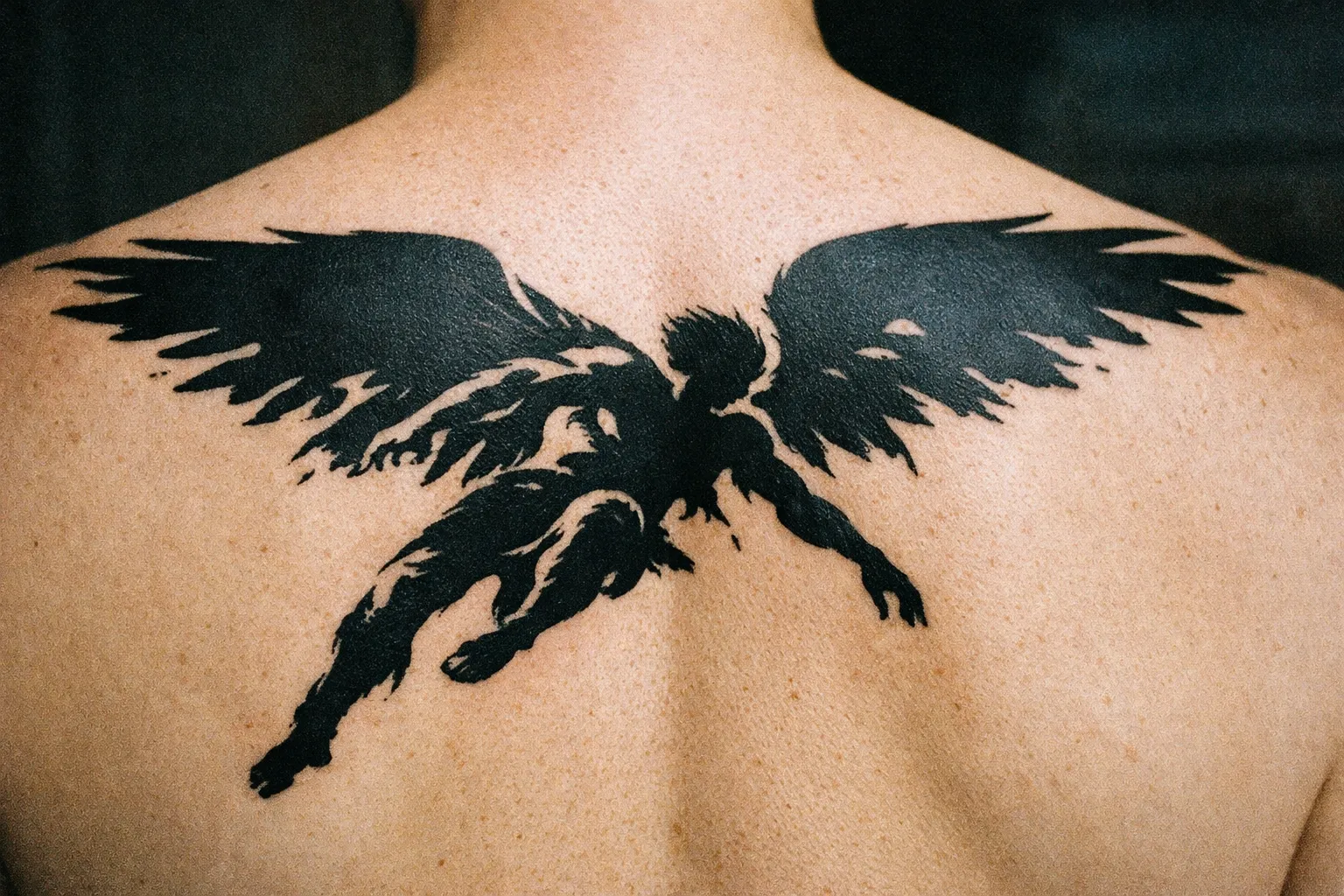
Ignoring the cautionary side of the myth. If you intend “success” or “freedom,” know that others may read the piece as a symbol of failure or arrogance. Understand both readings before you commit. This is the number-one regret I hear about with charged myths like this one.
Over-detailed figures in too-small spaces. A 2-3 cm Icarus on the wrist loses feather definition and facial expression within a few years as the lines spread and blur. At that scale, use wings or a silhouette, not a full figure.
Placing over joints. Wrists, elbows, and knees stretch and compress with movement, distorting the directional reading (ascending versus falling) every time you flex. Keep the figure on a stable, flat surface.
Mixing too many symbols in a small area. Labyrinth plus sun plus wings plus sea plus a quote in one compact design becomes visual noise and the core story weakens. For anything under 10 cm, pick two or three elements maximum.
Choosing Icarus without reading the myth. The story carries associations with disobedience (ignoring parents or mentors) that may clash with what you intend. Read it first.
Long quotes at small sizes. Text ages worse than imagery. Letter-legibility guidance puts the floor at about ½ inch (12-13 mm) per letter for script and ¼ inch (6 mm) for bold block lettering; long quotes crammed under that will merge into an unreadable smudge. If you want words, a single one (“balance,” “limit,” “rise”) stays legible over 10 to 20 years.
How to Brief Your Artist for an Icarus Piece
A clear brief prevents the most common bad outcome: the artist defaulting to a generic falling figure when you wanted the ascent. Icarus is a figure in motion with wings, which is technically demanding (anatomical accuracy and believable movement are far harder than a static symbol), so the more you decide before you walk in, the better the result.
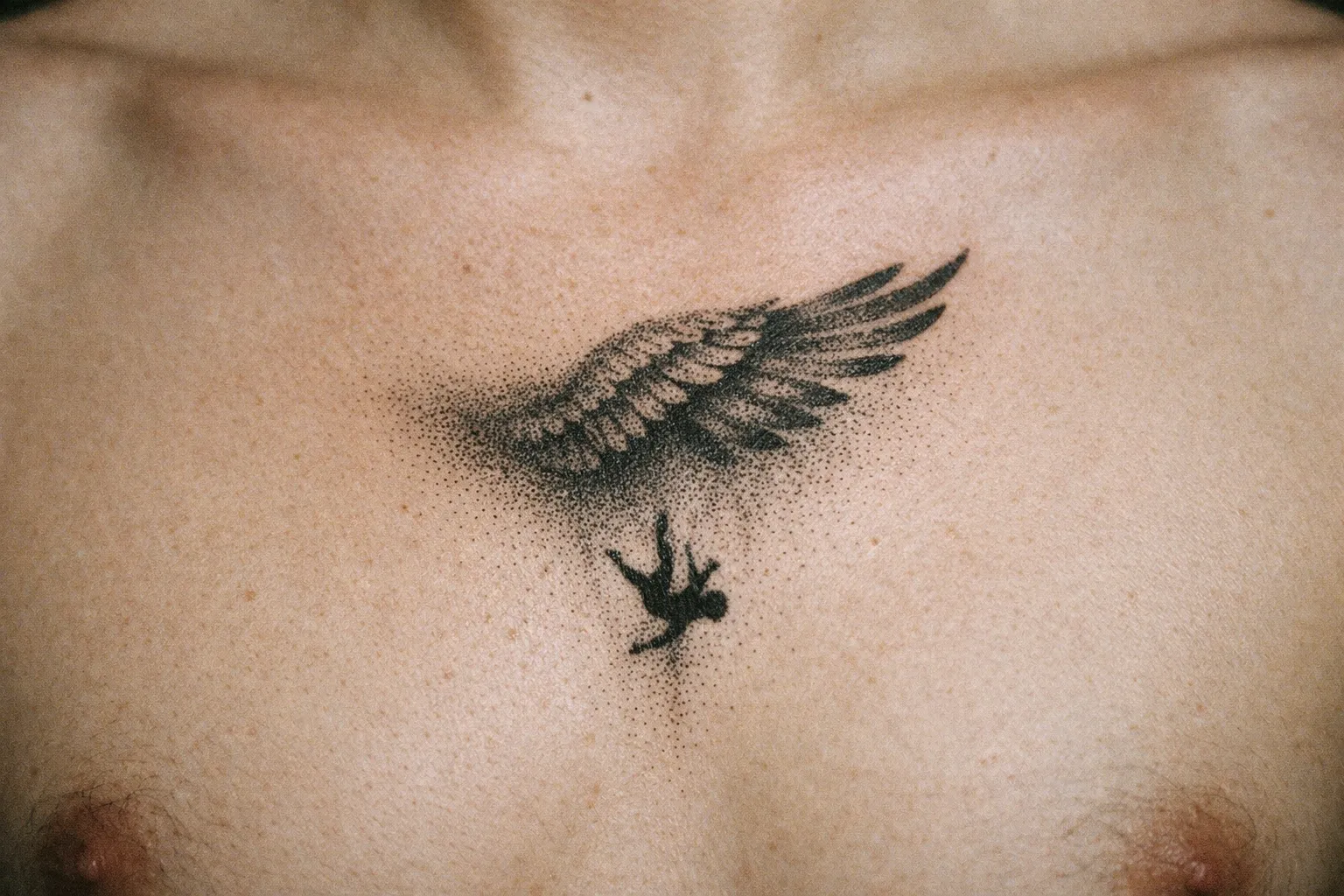
Three decisions to lock in before the consultation: your narrative (flight, fall, or dual-phase), your style (realism, neo-traditional, minimalist, or geometric), and your placement and size. Those three shape everything else the artist does.
Bring two or three reference images rather than copying one existing tattoo: one for pose and anatomy, one for wing shape and feather style, and one for line quality and style. Don’t pull all three from the same artist: that’s both a plagiarism issue and a limit on your own design. Vet the portfolio specifically for Greek mythology, figure work, and dynamic motion, and look at healed photos, not just fresh shots from the day of the appointment. Wings in particular demand experience with feather layering and foreshortening. I can usually tell within thirty seconds of looking at a portfolio whether an artist has actually done this kind of work or is winging it.
On timing: small line-art silhouettes finish in a single session of 1-2 hours, complex full-color myth scenes run across several sessions, and back or chest narrative pieces almost always require multiple bookings.
How to Prepare for Your Icarus Tattoo Consultation
1-2 hours for small pieces; more for complex designsSteps to ensure your artist understands your vision and executes it well.
- 1
Decide on your narrative
Choose flight (aspiration), fall (consequence and resilience), or dual-phase (both). This shapes all other decisions.
- 2
Choose your style
Pick realism, neo-traditional, minimalist, or geometric based on placement size and artist strengths.
- 3
Pick your placement and confirm the size minimum
Back/chest for narrative scenes (15-20 cm+), upper arm/thigh for mid-size (10-15 cm), wrist/ankle for silhouette-only (5-8 cm).
- 4
Gather reference images
Bring 2-3 images: one for pose/anatomy, one for wing shape, one for line quality. Avoid sourcing all from one artist.
- 5
Vet the artist's portfolio
Look for Greek mythology, figure work, dynamic motion, and healed photos, not just fresh ink.
- 6
Confirm session count upfront
Small silhouettes: 1-2 hours single session; complex color pieces: multiple sessions; back/chest scenes: at least two bookings.
Frequently Asked Questions
Frequently Asked Questions
- What does an Icarus tattoo mean?
- Icarus tattoos carry meanings like ambition, freedom, rebellion, risk-taking, hubris, and mortality, shifting with pose from aspiration to consequence or resilience.
- Why is Icarus sometimes called a fallen angel?
- Icarus is a mortal from Greek myth, not a fallen angel. The confusion arises from visual similarities but they belong to different traditions.
- What does Icarus symbolize beyond 'fly too close to the sun'?
- It symbolizes ambition, freedom, rebellion, ignoring wise counsel, mortality, and creativity via Daedalus, plus resilience after a fall.
- What size does an Icarus tattoo need to be to age well?
- Designs with feather detail or background need 15-20 cm vertical space; smaller placements should use wings or silhouettes at 5-8 cm.
- Which style works best for an Icarus tattoo?
- Neo-traditional holds best long-term; realism is dramatic but needs large canvas; minimalist fades faster; geometric suits graphic tastes.
- Is an Icarus tattoo overused?
- It's common in Greek-myth tattoos but personal meaning outweighs popularity; distinctive compositions feel more unique than generic silhouettes.
- Can I work Icarus into a sleeve?
- Yes, it fits mythology-themed sleeves well. Plan the focal point and background with your artist before starting for a cohesive design.
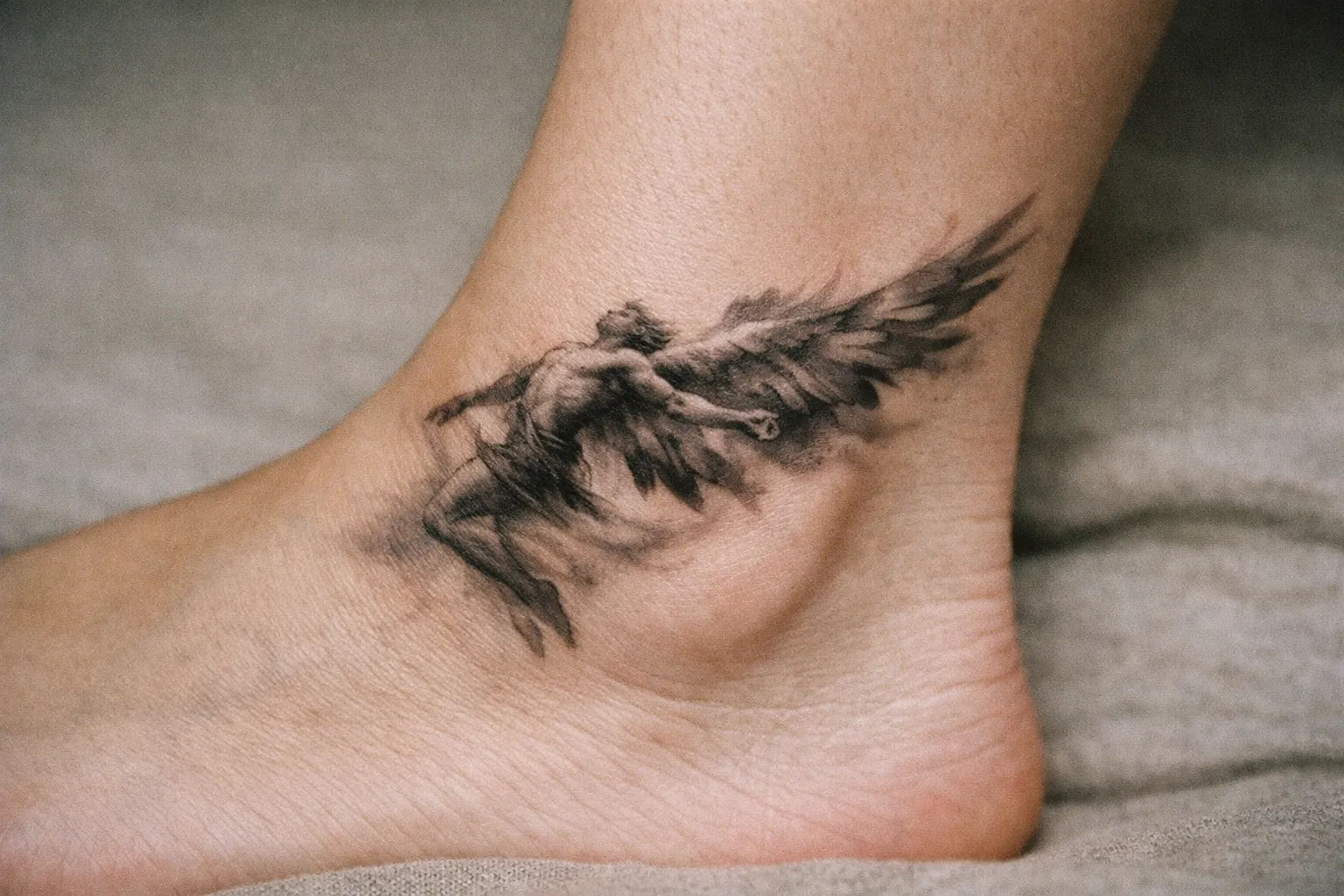
Before You Book
Three decisions determine whether this tattoo holds up ten years from now.
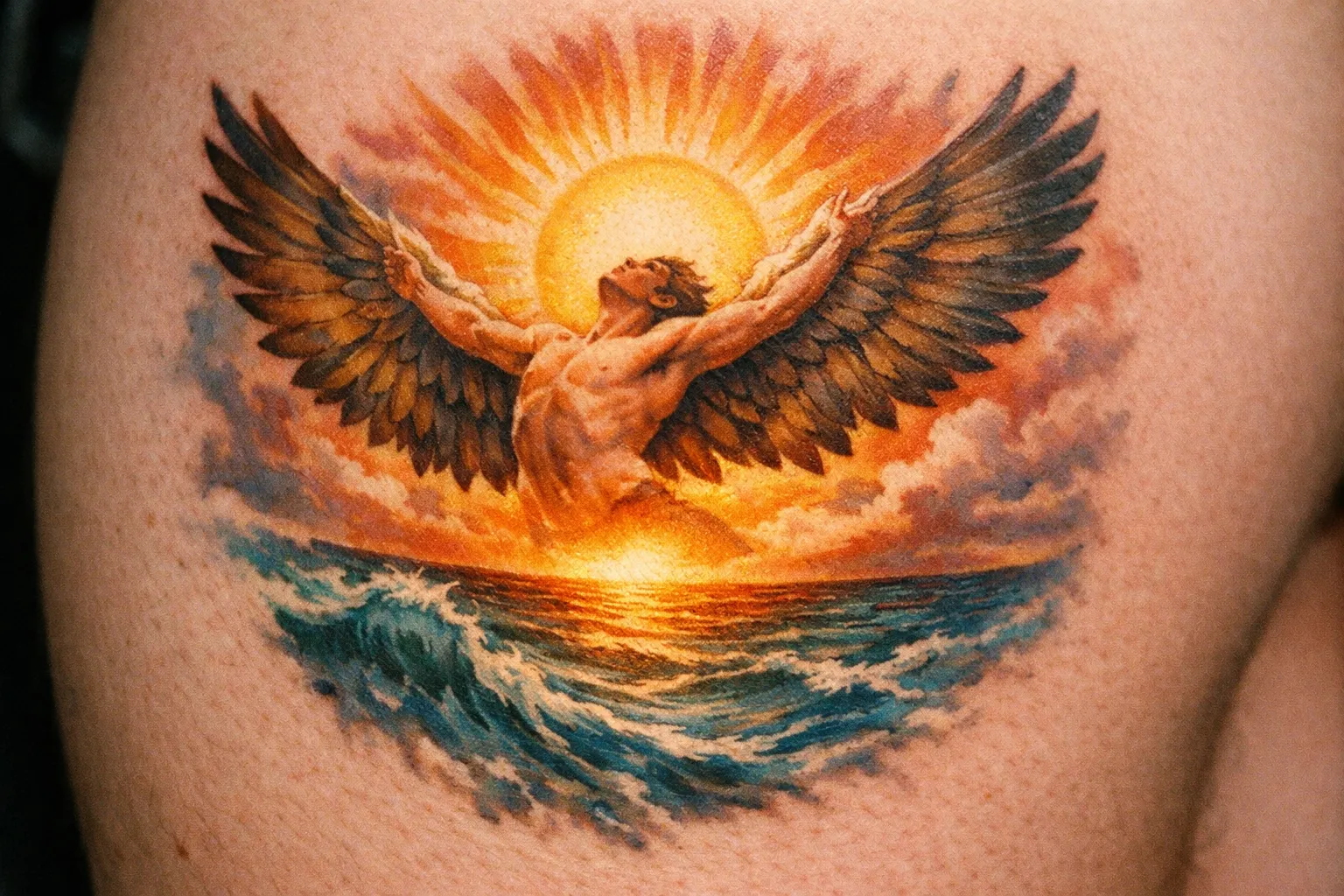
First, which phase of the myth: flight, fall, or both. Get this wrong and the piece says something you didn’t intend, and there’s no easy fix once the ink is in.
Second, placement and size. The most common regret in complex figure tattoos is going too small. If the design needs feather detail, give it the 15-20 cm it requires. Cramming it onto a wrist because you like the placement is how you end up with a blurred smudge by year five.
Third, artist selection. Icarus is a figure in motion with wings, which demands specific portfolio experience. Check healed work, not just fresh shots from the chair; fresh ink flatters everything.
The myth has lasted more than 2,000 years because it holds two true things at once: the beauty of reaching and the cost of overreaching. A well-executed Icarus tattoo does the same on skin. Make yours deliberate enough to carry that weight.