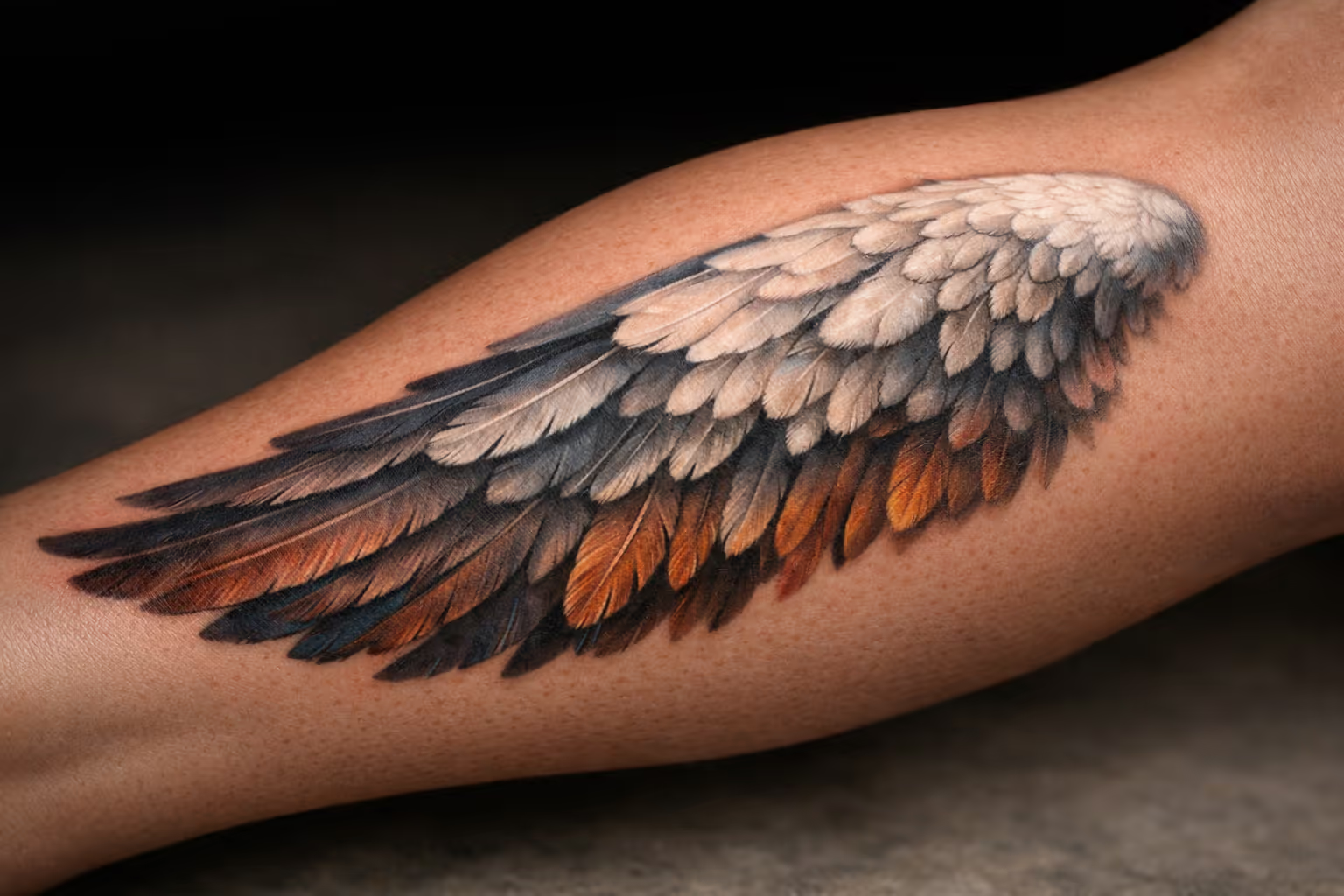
Not all angel tattoos carry the same weight. A guardian angel with wings spread over the chest reads as protection; a fallen angel with broken wings slumped on the upper arm reads as loss, rebellion, or inner conflict. The motif you pick matters as much as the artist you pick, because each angel type communicates something different to anyone who recognizes the iconography. This guide covers the four main families - guardian, archangel, fallen angel, and wings-only - plus placement, sizing, and the mistakes that lead to regret.
Angel designs pull from Christian, Jewish, and Islamic traditions, though most tattoo iconography draws on Christian and Western visual language. Wings, halos, swords, armor, broken feathers, and prayer text each shift the reading. Get clear on your intent first - protection, strength, rebellion, or remembrance - then match the design to it.
✓ Pros
- Versatile across religious, spiritual, and secular contexts
- Scale well from small minimalist wings (about 2 inches on forearm) to full back realism pieces
- Strong symbolic range: protection, strength, rebellion, remembrance - one motif family covers a lot of ground
- Black-and-grey realism style ages reliably when executed with proper line weight
✗ Cons
- Complex designs (archangel battle scenes, detailed feathers, faces) require a specialist realism artist - not every shop can execute them well
- Large pieces (full back, chest) need multiple sessions and higher budget
- Fallen angel imagery can be misread socially or religiously if the wearer hasn't thought through both interpretations
- Overcrowding elements (prayer text + figures + wings + demons) is a common pitfall that kills visual legibility
What an Angel Tattoo Actually Symbolizes
An angel tattoo most commonly symbolizes protection and guidance, spirituality and faith, loss and remembrance, or transformation and redemption - and the specific angel type determines which of those readings dominates.
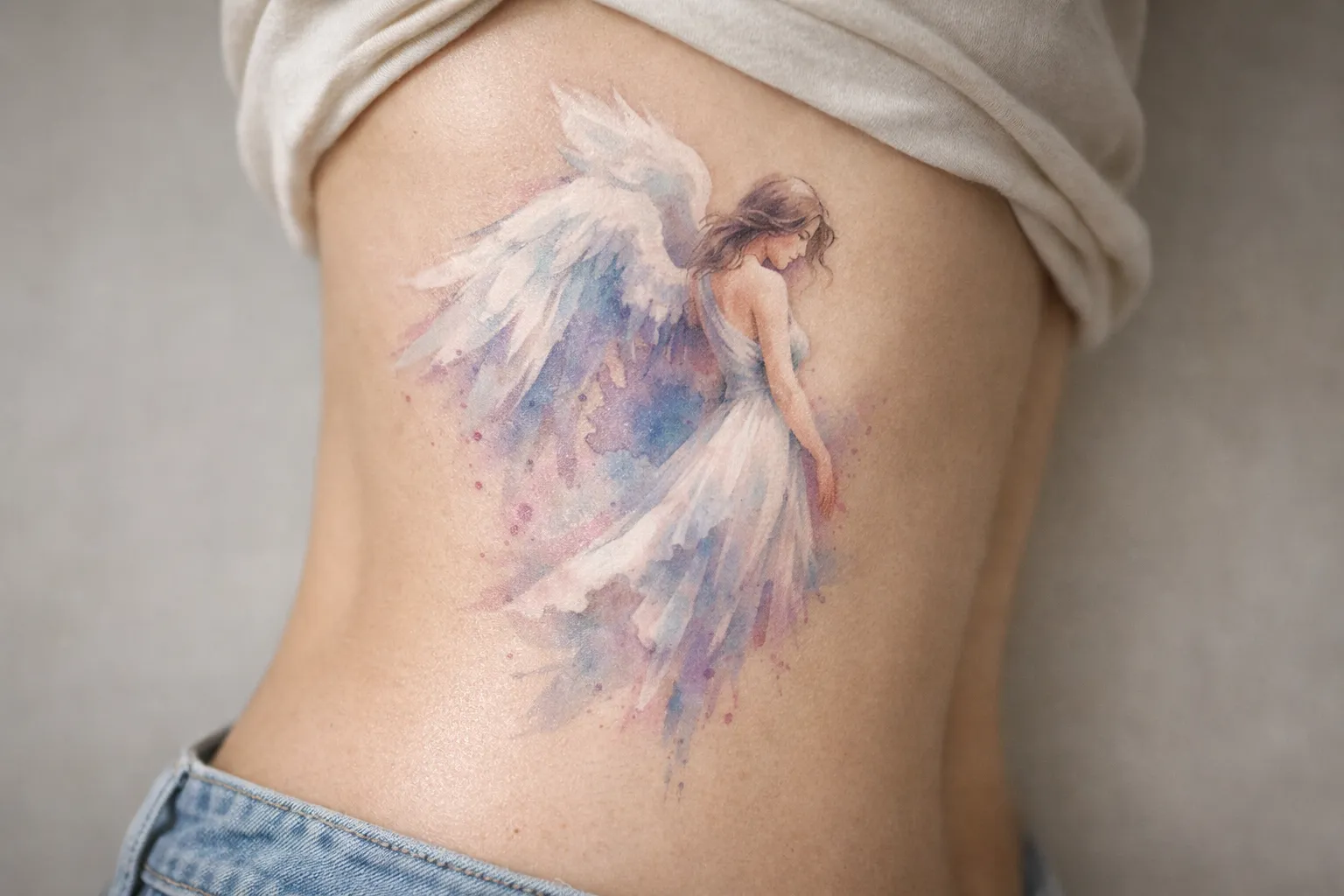
Break the core meanings down by design cue:
- Protection and guidance. Spread wings over a figure or a child signal safety and watchfulness. This is the guardian-angel reading, rooted in Christian doctrine that assigns each believer a protective angel. The Catechism of the Catholic Church (paragraph 336) states that “from infancy to death human life is surrounded by their watchful care and intercession” (15).
- Spirituality and faith. A halo signals spiritual enlightenment; praying hands and light rays reinforce devotion. Angels here work as a visible marker of belief.
- Loss and remembrance. Wings paired with dates or initials read as tribute to someone who has passed. This is a classic memorial configuration.
- Transformation and redemption. Fallen-and-recovered narratives - broken wings healing, light emerging from shadow - express a personal arc rather than a fixed belief.
There’s a real split between religious and secular readings. In Christian doctrine a guardian angel is a specific protector assigned to each person. In modern spiritual framing, the same image works as a marker of conscience, a tribute to someone who has passed, or a symbol of resilience through hardship (6). Neither reading is wrong, but the viewer supplies their own interpretation based on the iconography you chose.
Angels are rooted in Christian, Jewish, and Islamic traditions alike (4), but most tattoo iconography draws on Christian and Western art. If your intent sits outside that tradition, bring specific references so the artist doesn’t default to the standard Renaissance-angel visual language.
One caveat worth saying plainly: the design you choose signals intent to anyone who recognizes the imagery. A guardian angel reads as protection; an archangel with a sword reads as spiritual warfare; a fallen angel reads as rebellion or struggle. Knowing what yours communicates matters before the needle touches skin.
Guardian Angel Tattoo - Protection You Can See
A guardian angel tattoo depicts a protective figure watching over the wearer, rooted in Christian doctrine but widely adopted in secular contexts as a personal amulet in visual form.
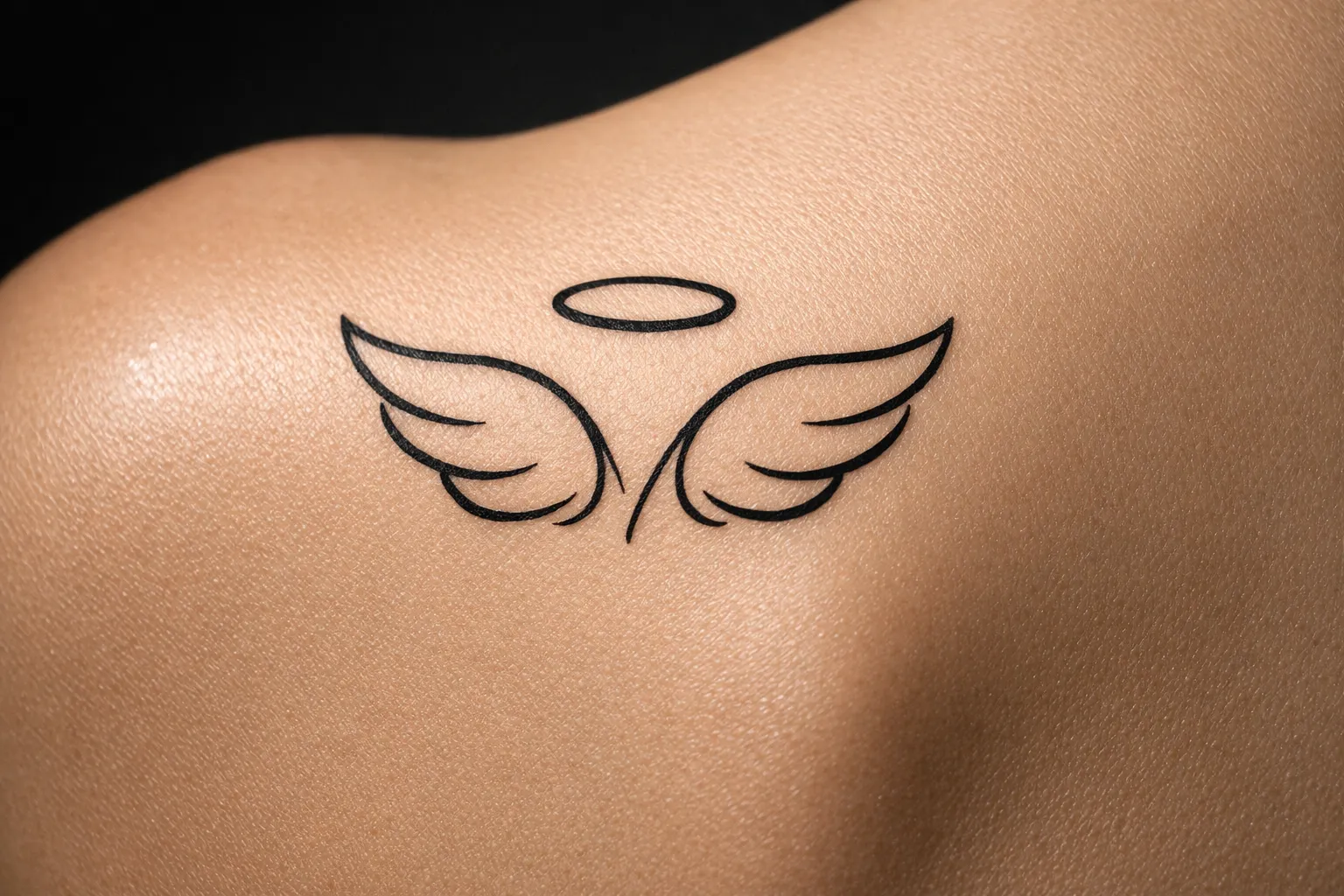
The doctrine behind it is old and specific. The Catechism of the Catholic Church (paragraph 336) quotes, “Beside each believer stands an angel as protector and shepherd leading him to life,” and its footnote credits that line to St. Basil (Adversus Eunomium III, 1) (15). Tattoo guides frequently describe the guardian angel design as a “visible embodiment” of that protector, meant to guard the wearer against adversities, temptations, and dangers (3).
Design hallmarks that make it read correctly:
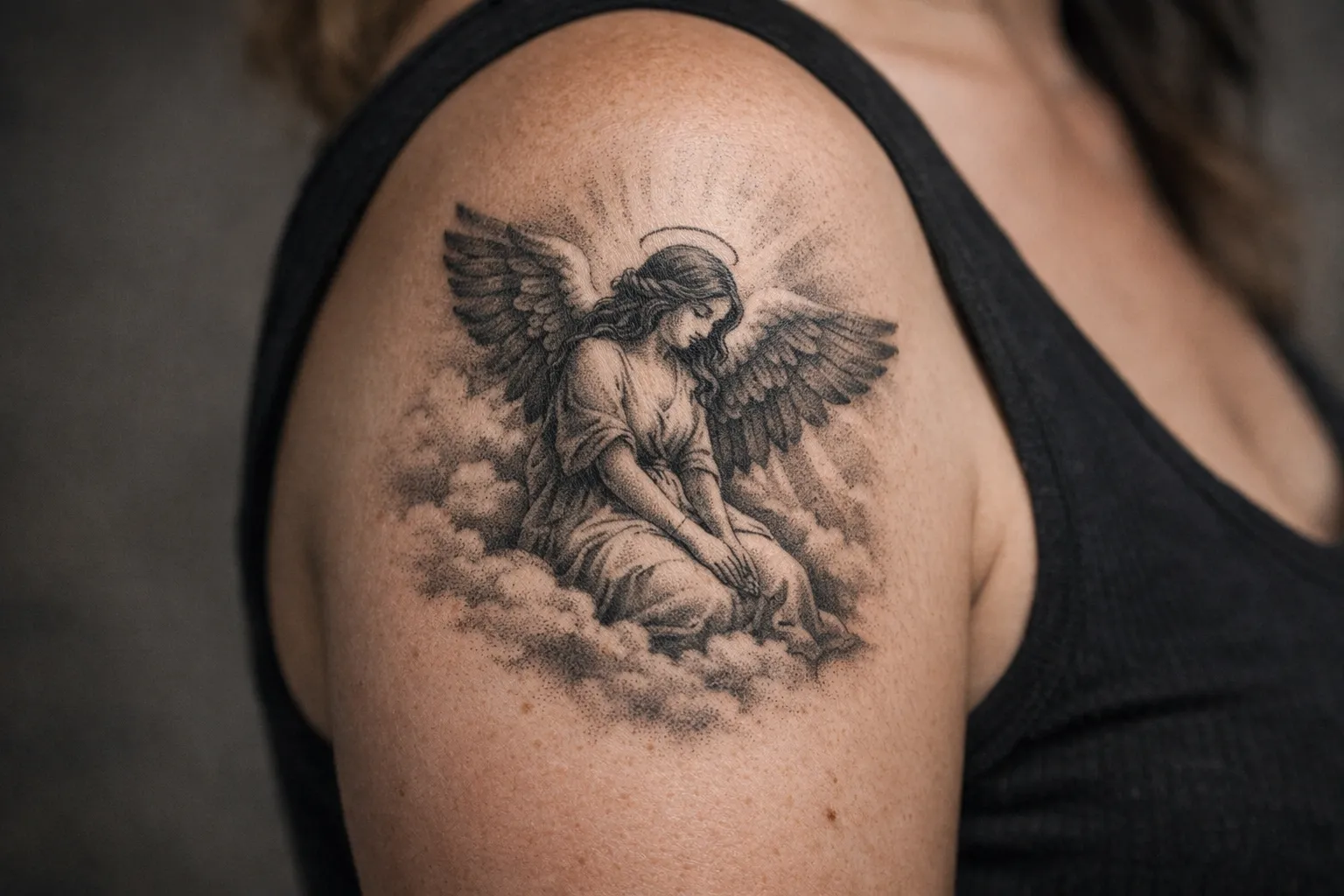
- Wings spread wide. This is non-negotiable for the protective reading. Closed or clipped wings unintentionally shift the message toward restriction or loss - flag this to your artist explicitly.
- A watching-over posture. The figure is often depicted above the wearer, or watching over a child, to emphasize the nurturing role (9).
- Soft facial features and flowing robes. These reinforce comfort and calm rather than the warrior energy of an archangel.
The symbolism is specific: safety from adversity and temptation, comfort during grief, and guidance through hard decisions. Many clients dedicate a guardian angel to a parent or child, which fits the doctrine’s framing of a lifelong protector.
I’ve drawn this design more times than I can count, and the single most common error I see in finished pieces - not just in my own early work, but in healed photos clients bring in for cover-up consultations - is clipped or half-closed wings on what was supposed to be a protective figure. The artist didn’t flag it, the client didn’t know to ask, and the result reads as restriction rather than safety.
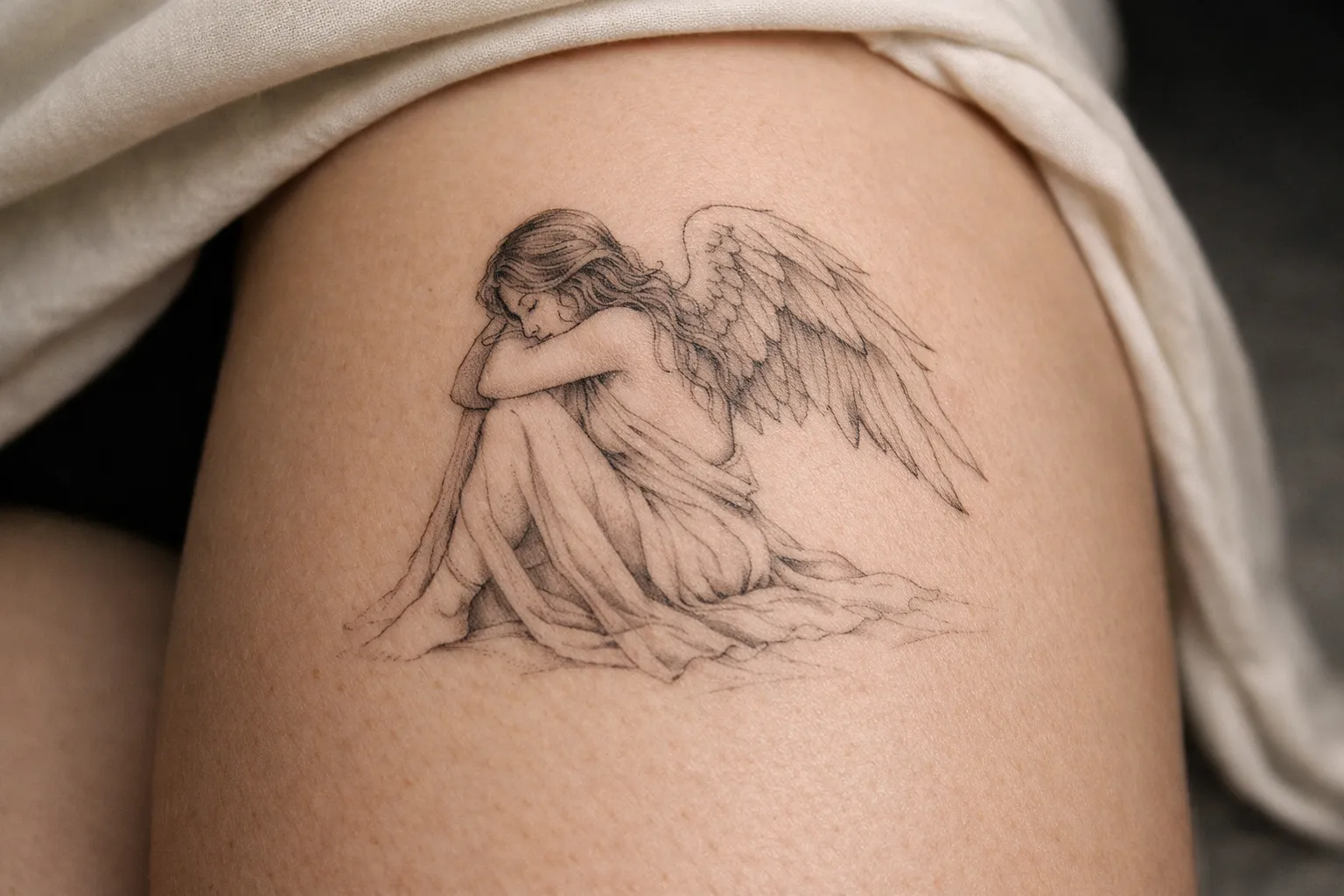
Style options depend on scale. Black-and-grey realism gives you maximum detail in feathers and drapery on a larger placement. Fine-line or minimalist work suits smaller placements. Neo-traditional with bold outlines gives a less literal, more graphic interpretation that ages reliably because of the thick linework.
This design suits readers drawn to protection, comfort, or memorial meaning. It’s the wrong choice if your intent is rebellion or inner conflict - that’s fallen angel territory, and forcing it onto a guardian figure produces a tattoo that doesn’t match what you mean.
Archangel Michael Tattoo - Warrior Iconography and What It Means
An archangel Michael tattoo depicts the chief warrior of the heavenly host - leader of the heavenly armies and protector against evil - typically shown trampling a serpent or demon and wielding a sword (3)(7).
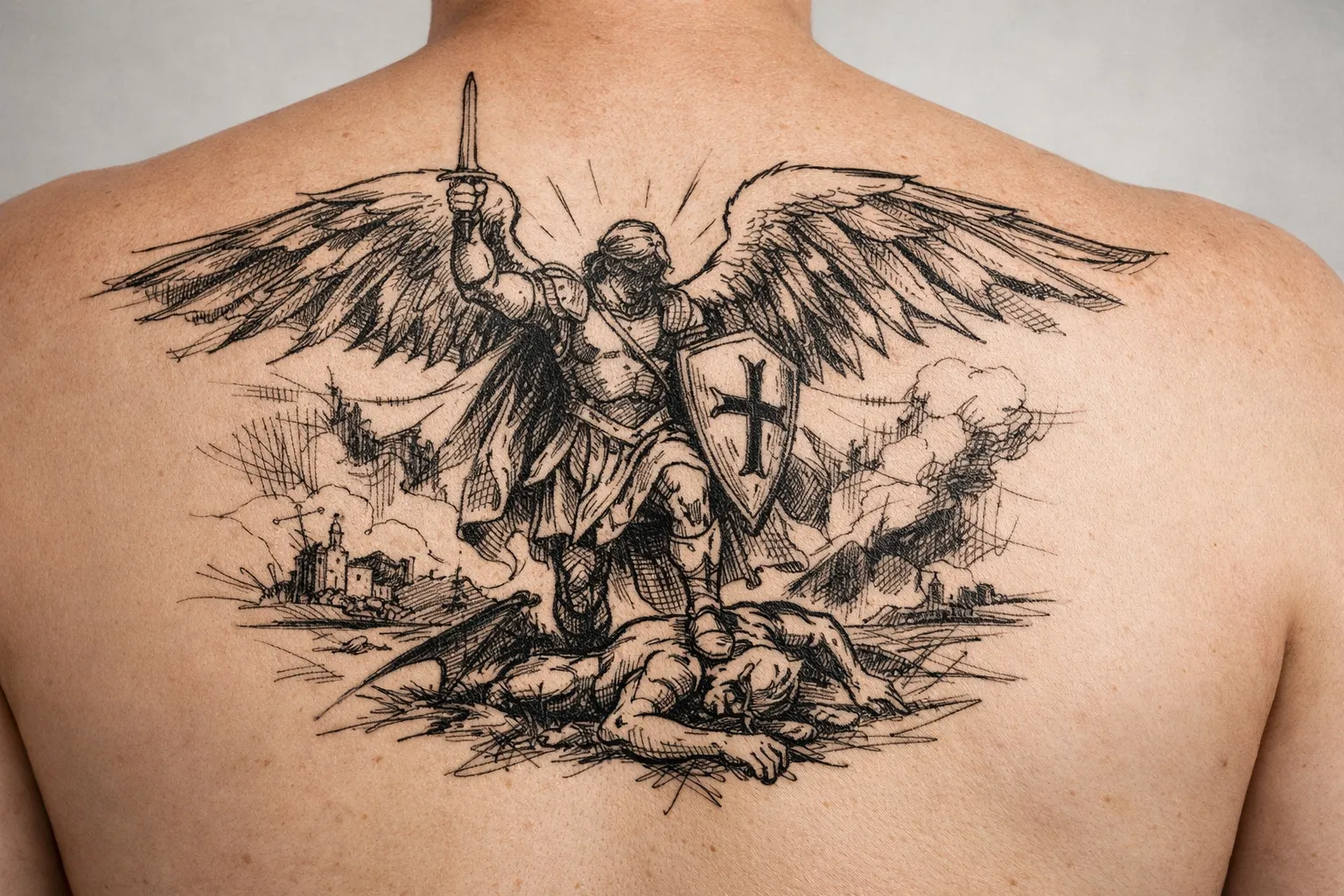
Michael’s role anchors the meaning. Christian tradition identifies him as the commander of the heavenly hosts, most famously depicted subduing Lucifer, the dragon or fallen angel (12). The name Michael comes from the Hebrew Mikha’el, understood as the rhetorical question “Who is like God?” - rendered in Latin as Quis ut Deus? (16) - which reinforces a humility-through-strength reading rather than pure aggression.
Core symbolic meanings: strength of spirit, victory over evil, divine justice, and courage in personal battles. Current guides frame the archangel Michael tattoo as an inner-battle narrative - overcoming addiction, depression, or personal vices - rather than a strictly religious statement (12). That framing tracks with what I hear in consultations. Clients bring in Michael references and describe recovery, not religion.
Each iconographic element signals something specific:
- Michael trampling a serpent or demon - victory over evil, overcoming personal vices.
- Sword - divine justice, cutting through falsehood.
- Shield - protection, the “celestial bodyguard” symbolism (12).
- Full armor - readiness, spiritual warfare.
- Wings - ascension and divine connection.
- Halo - spiritual enlightenment.
The design tip that matters most: the combat narrative has to be legible. Michael actively defeating the serpent or dragon communicates victory; a generic “angel holding a sword” loses that specificity and reads as decorative. If overcoming something is your point, the design needs to show the fight being won, with the angel clearly triumphing over the demon (10).
The St. Michael prayer works well as an add-on, but text demands planning. Font size and line spacing have to be set for long-term legibility, and if you’re using Latin (Quis ut Deus?), English, or Spanish, check the spelling in every variant before inking - print it at actual size and read it from two feet away. Black-and-grey realism is the standard style for this motif; geometric and linework interpretations exist but are far less common.
Placement for Archangel Michael Designs
- Full back or full chest - the recommended choice for battle scenes with multiple figures, clouds, or flames. The composition needs room to breathe, and a detailed piece here typically runs across multiple long sessions - expect a significant time commitment that varies considerably depending on the artist’s pace and the complexity of the scene.
- Upper arm or forearm - suits vertical designs of Michael standing with sword and shield. Good for a medium-sized piece without the full narrative scene.
- Calf, thigh, or side torso - works for diagonal, dynamic compositions that show motion.
The pitfall to avoid: cramming a full battle scene onto a narrow forearm. All the detail that makes this design meaningful - the armor, the serpent, the movement - collapses into muddy noise within a few years. Match the scene to the canvas.
Fallen Angel - Rebellion, Loss, and the Dual Nature Motif
A fallen angel tattoo depicts banishment from paradise, loss of innocence, or exile - rooted in the Lucifer narrative but framed by modern tattoo art more broadly as rebellion against authority, a difficult fate, or inner moral struggle.
Visual hallmarks separate it clearly from a guardian angel:
- Broken or torn wings - the single most important cue for the fallen reading.
- Downward body posture - slumped, falling, or bowed rather than upright and watchful.
- Torn clothing and a shadowed or anguished expression - reinforcing the emotional weight.
The dual-nature symbolism is the point for many people who choose this design. Light versus shadow, broken versus intact - that contrast carries inner conflict, grief, rebellion, or temptation, and broken wings, black feathers, strong contrast, and dramatic shading make the design more intense (2). Many fallen angel pieces also carry a redemption arc, with the fall read as the start of personal growth (4). Black-and-grey with strong contrast between light and shadow areas serves the motif best, because the tonal drama reinforces the duality.
Be clear on the misread risk before you commit. Fallen angel imagery can be read as pride or sin by some viewers, even though in modern art it more often stands for rebellion and a difficult fate (3). Neither reading is wrong; both exist. If you’re comfortable being read either way, proceed - but decide that in advance rather than discovering it from a relative’s reaction at a family dinner.
This design suits readers processing inner conflict, rebellion against authority, grief, or a personal fall-and-recovery narrative. It’s the wrong pick if your intent is straightforward protection. If you want to feel watched over, the guardian angel communicates that; a fallen angel communicates the opposite.
Angel Wings Meaning - When You Want the Symbol Without the Figure
Angel wings on their own most often carry divine protection and guidance, alongside faith and remembrance - honoring a loved one who has passed - which also makes wings a natural memorial configuration (8).
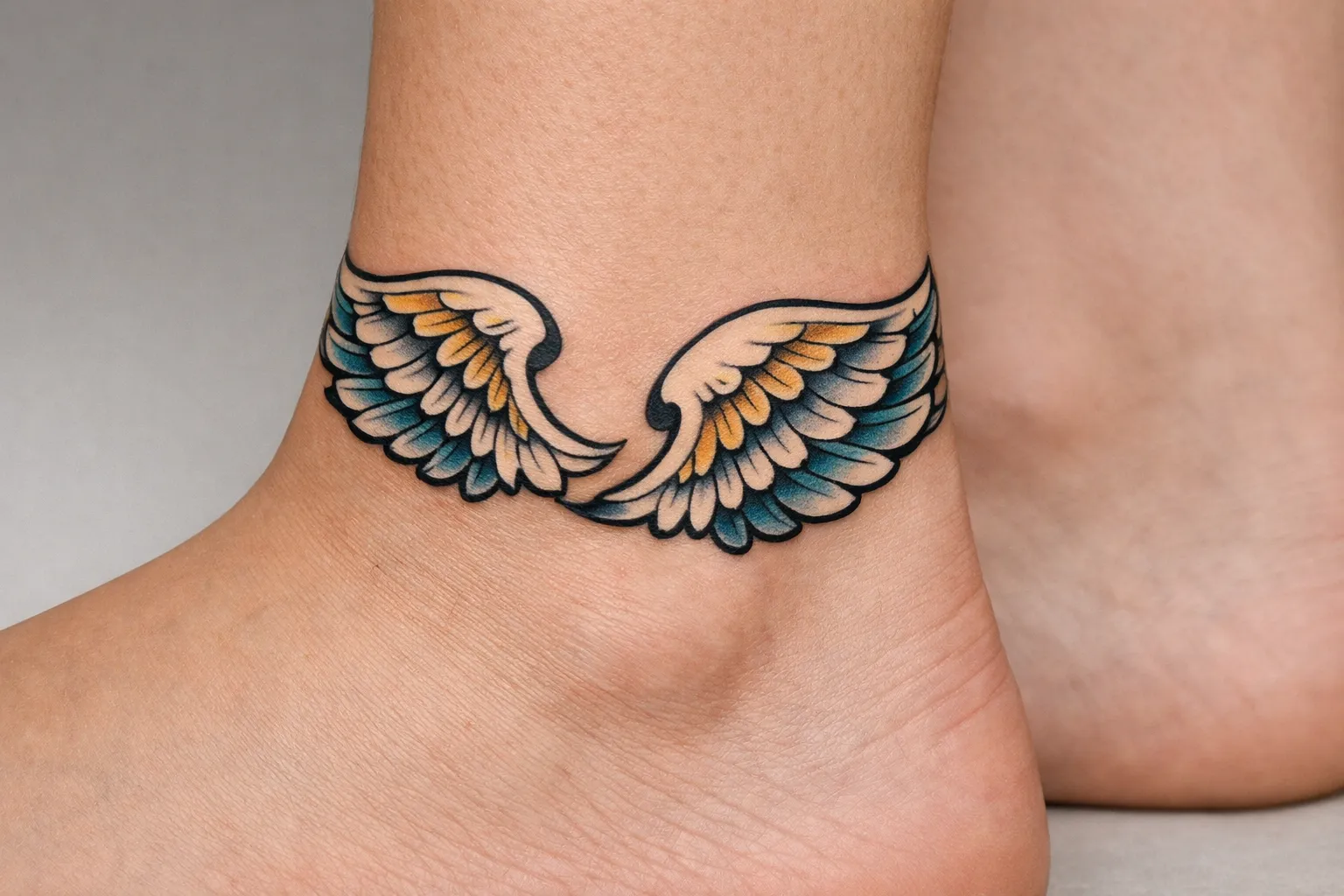
Wings-only designs read differently from full-figure work. Without a face or posture to interpret, they’re less iconographically loaded than an archangel or fallen angel, which makes them more versatile across religious and secular contexts. That’s a large part of why the angel wings meaning skews toward tribute and spirituality rather than warfare or rebellion.
Design variations by scale:
- Full back wings - the largest canvas and maximum visual impact, requiring multiple sessions. Spread wings read as safety and security; closed wings shift the message toward restriction, so specify spread if protection is your intent.
- Shoulder blade wings - medium scale on the upper back, and a strong pairing with dates or initials for memorial pieces, usually finished in 1-2 sessions. The blade itself sits over bone, so it runs sharper than the fleshier outer upper back (8); plan session length with that in mind.
- Small minimalist wings - forearm or collarbone, fine-line or linework, faster session and lower commitment. A pair around 2-3 inches on the forearm is a common lower-commitment memorial or protective symbol.
For memorial designs, wings over the heart (chest) or across the upper back, paired with dates or initials, reinforce remembrance without overcrowding the piece.
A style note on longevity: full back wings in realism need an artist with genuine feather-detail skill, and the work is a long-term project - a large realistic full back runs 20-60+ hours of tattooing, in sessions of about 4-8 hours each (8). Minimalist wings on the forearm can hold up well in fine-line, but only if the line weight is sufficient. Hairline single-needle work looks sharp on day one and softens sooner on sun-exposed, high-movement areas; our fine-line guide puts the outer forearm at roughly 5-10 years before a touch-up. Line weight is the variable that makes or breaks longevity here.
Placement - Matching the Design to the Body
Placement determines how much detail survives long-term, and complex angel designs need more canvas than most first-timers expect. Pick the placement to fit the design, not the other way around.
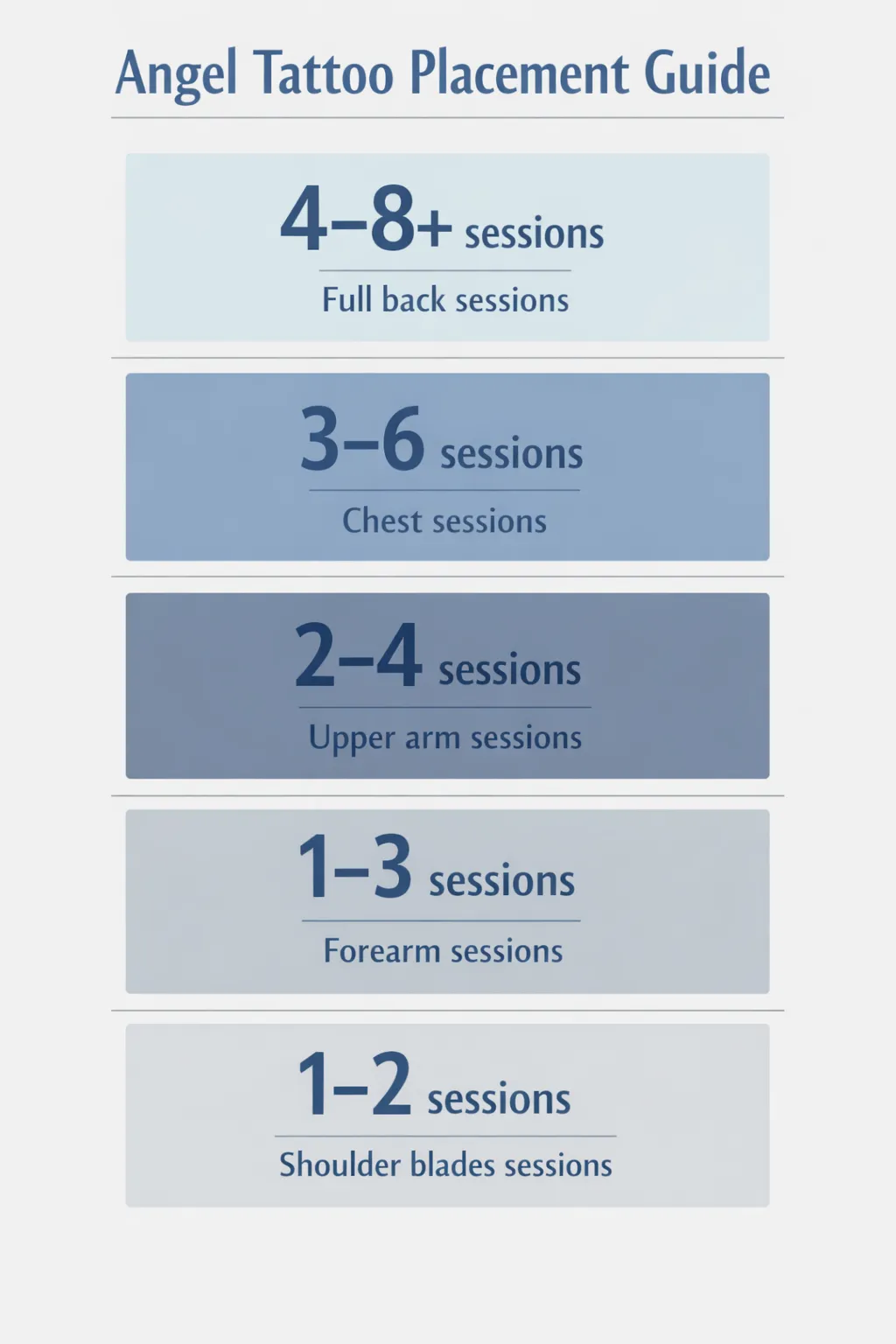 Common angel tattoo placements and their typical session ranges: Full back 4-8+ sessions; Upper arm 2-4; Forearm 1-3; Shoulder blades 1-2. A full chest piece usually runs 2-3 sessions, or 3-4 for detailed color work (see our chest tattoo guide).
Comparison of Angel Tattoo Placements at a Glance
Angel Tattoo Placement at a Glance
| Full Back | Chest / Over the Heart | Upper Arm / Bicep | Forearm | Collarbone / Sternum | Shoulder Blades | |
|---|---|---|---|---|---|---|
| Recommended Canvas Size (inches/cm) | 12-20 / 30-50 | 6-12 / 15-30 | 4-8 / 10-20 | 2-6 / 5-15 | Small only | Medium scale |
| Relative Pain Level | Moderate to high | High | Lower than chest or ribcage | Low | High | Moderate to high (over bone) |
| Best Angel Design Type | Full-spread wings, archangel battle scenes, large guardian compositions | Memorial, faith-driven guardian pieces, wings with dates or initials | Medium guardian or archangel designs, vertical sword-and-figure | Small to medium minimalist wings, simplified figures, fine-line | Small wing pairs, minimalist motifs, text-only prayer work | Medium wings with memorial dates or initials |
| Typical Session Count (Full Piece) | 4-8+ | 2-4 | 2-4 | 1-3 | 1-2 | 1-2 |
How to Brief Your Artist on an Angel Design
- Lead with intent, not the image. Tell the artist whether you want protection, strength, rebellion, or remembrance. The right motif follows from that.
- Bring 3-5 reference images. Classical religious art, statues, or specific iconographic poses beat a folder of Pinterest screenshots. Show the pose and mood you want.
- Confirm the placement and size together. A complex scene on too small an area is the most common regret. Let the artist tell you the minimum size the design needs.
- Plan text separately. If you want prayer text, decide font, letter height, and placement away from heavy shading before the stencil stage.
- Check healed work. Ask to see healed photos of the artist’s religious realism, not just fresh shots - healed work is the honest test.
Choosing the Right Style for Your Angel Design
The style you choose should match both your aesthetic and how the design will age - and for most angel work, that decision comes down to four styles.
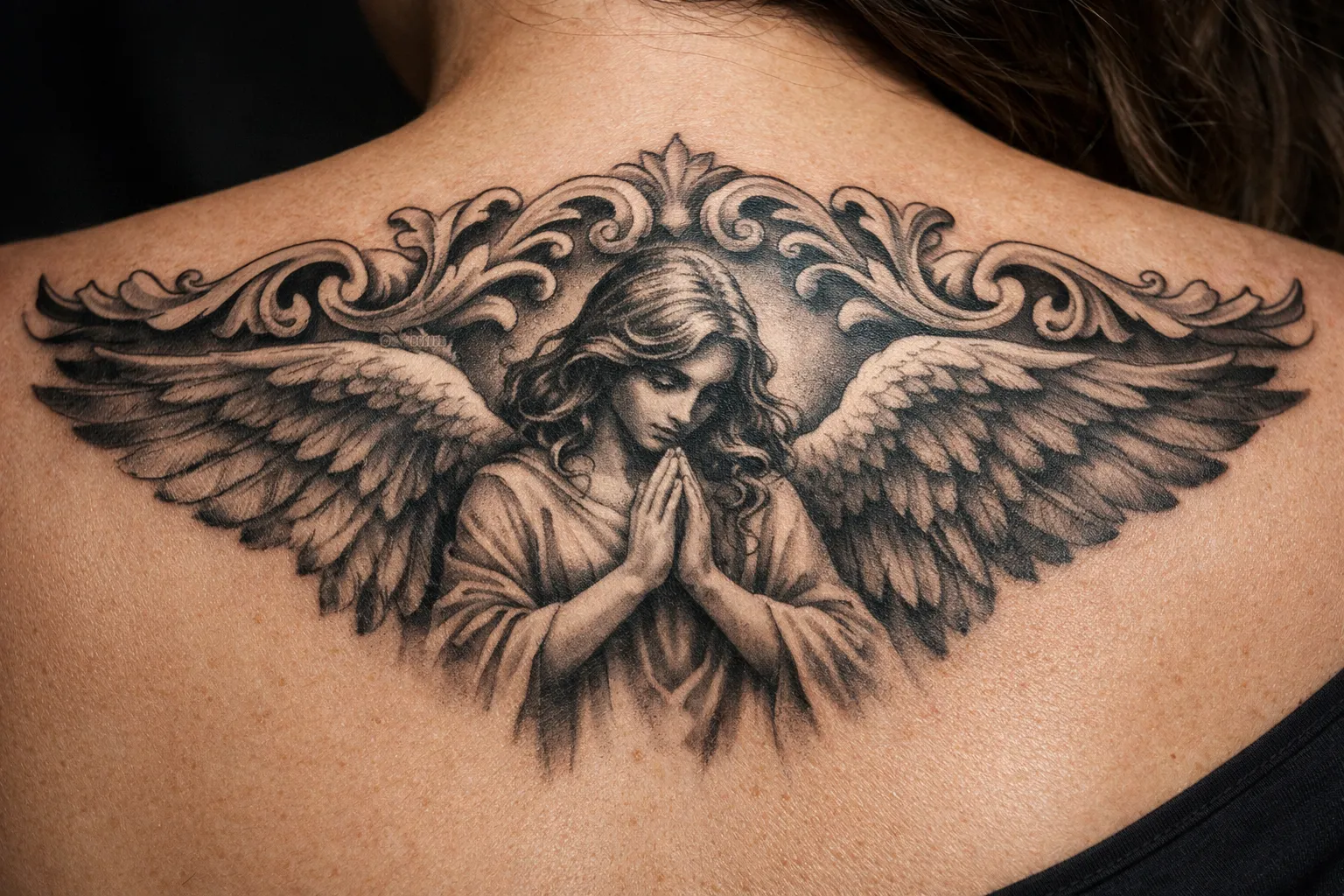
Black-and-grey realism is the dominant style for guardian, archangel, and fallen angel designs. It excels at feather texture, facial expression, armor detail, and drapery. It requires a specialist realism artist and ages well when the line weight is sufficient. It’s also the most time-intensive - a large realistic back piece can run 20-60+ hours across multiple long sessions (8).
Fine-line and minimalist linework suits small wings on the forearm or collarbone and simplified angel silhouettes. Lower commitment, faster session. The catch: single-needle hairline work looks sharp early but can blur within a few years on high-movement areas. Use adequate line weight and it holds.
Neo-traditional uses bold black outlines and a limited but saturated palette. More graphic and less literal, which works well for guardian angel designs that don’t need photorealistic feathers. The thick outlines are exactly why it ages reliably.
Illustrative and fantasy styles are looser and more expressive than strict realism. They suit fallen angel designs where the emotional tone matters more than anatomical accuracy.
The most common style mistake is booking an artist whose portfolio doesn’t include religious realism or archangel work. Off-proportion wings, flat faces, and muddy armor are the predictable result. Always check healed work, not just fresh photos - a fresh piece looks crisp on everyone; healed work separates the specialists from the rest.
Design Pitfalls That Lead to Regret
Most angel tattoo regret traces back to a handful of avoidable decisions.
Overcrowded symbolism. Stacking a guardian angel, archangel iconography, St. Michael prayer text, demons, and large wings into one piece reduces legibility and makes future touch-ups difficult. Pick one clear narrative and stick to it.
Wrong motif for the intent. Choosing guardian angel imagery when you actually mean rebellion or inner conflict produces a tattoo that doesn’t reflect what you feel. Work out your intent before the consultation, not in the chair.
Undersized placement for complex designs. A detailed archangel battle scene on a narrow forearm loses definition as ink spreads over the years. Full back or chest for narrative scenes; forearm for simplified designs.
Closed or clipped wings on a guardian angel. This quietly flips the symbolism toward restriction or loss rather than protection. Spread wings for safety, open posture for guidance.
Underestimating pain and session reality. Collarbone and chest placements for large wings are significantly more intense than the bicep or forearm. First-timers who underestimate this mid-session sometimes rush the artist, and rushing shows in the healed result.
Illegible prayer text. St. Michael prayer text in a font that’s too small or too ornate will blur within years. Set a minimum letter height, use a clean font, and keep it away from heavy shading areas. Non-negotiable.
Frequently Asked Questions
- What does an angel tattoo symbolize?
- The core meanings are protection and guidance, spirituality and faith, loss and remembrance, and transformation. The specific type matters for the message.
- What's the difference between a guardian angel and a fallen angel tattoo?
- Guardian angels use spread wings and upright posture for protection; fallen angels use broken wings and downward posture to show exile or inner struggle.
- Where is the best placement for an angel tattoo?
- Full back and chest suit large scenes; upper arm and bicep fit medium vertical designs; forearm works for small minimalist wings; avoid detailed scenes on narrow spots.
- How many sessions does a large angel tattoo take?
- A detailed full back usually takes 4-8+ sessions totaling 20-60+ hours, and a full chest piece 2-3 sessions (3-4 for detailed color); add time for prayer text and plan sessions to build coherently.
- What are some tattoos to avoid?
- Avoid overcrowded designs, complex scenes on small placements, closed wings on guardian angels, and prayer text too small to remain legible.
- Is an archangel Michael tattoo only for religious people?
- No. Though rooted in Christian tradition, many use it as a secular symbol of strength and overcoming personal struggles.
- What is the luckiest tattoo for females?
- Angel wings, especially small ones on collarbone, sternum, or forearm, are popular protective symbols; guardian angels over the heart suit memorial intent.
- Do angel tattoos have to be large to look good?
- No, but size must match complexity. Small wings work well at 2-3 inches; detailed archangels need 6-8 inches minimum to hold detail.
Nail down your intent first - protection, strength, rebellion, or remembrance - then match the angel type to it: guardian for protection and comfort, archangel Michael for strength and victory, fallen angel for inner conflict, wings for tribute. Only after that should you find an artist whose healed portfolio shows the specific style you need.
Placement and scale are the two decisions most people underestimate. Getting those right matters more than any single other choice you’ll make about this design.
Aftercare matters as much as the design itself. Days 1-3 are the most critical: keep the tattoo clean with unscented soap, apply a thin layer of fragrance-free moisturizer 2-3 times a day, and do not rewrap unless your artist specifically instructs it. Week 1, expect peeling and light scabbing - do not pick, and keep the area out of direct sun. Weeks 2-3, the surface heals, while the deeper layers keep settling until around week six; switch to sun-protective clothing over sunscreen on fresh work, and keep up the fragrance-free moisturizer until the skin feels fully normal. Our tattoo aftercare guide covers each stage in detail. Large pieces across the back or chest follow the same timeline per session - each session resets the clock on that area.
When you’re ready, book a consultation with real reference images - classical religious art, statues, or specific iconographic poses, not just a wall of Pinterest screenshots. That’s what gives an artist something concrete to work from, and it’s the difference between a design that reads clearly in ten years and one that turns to noise.