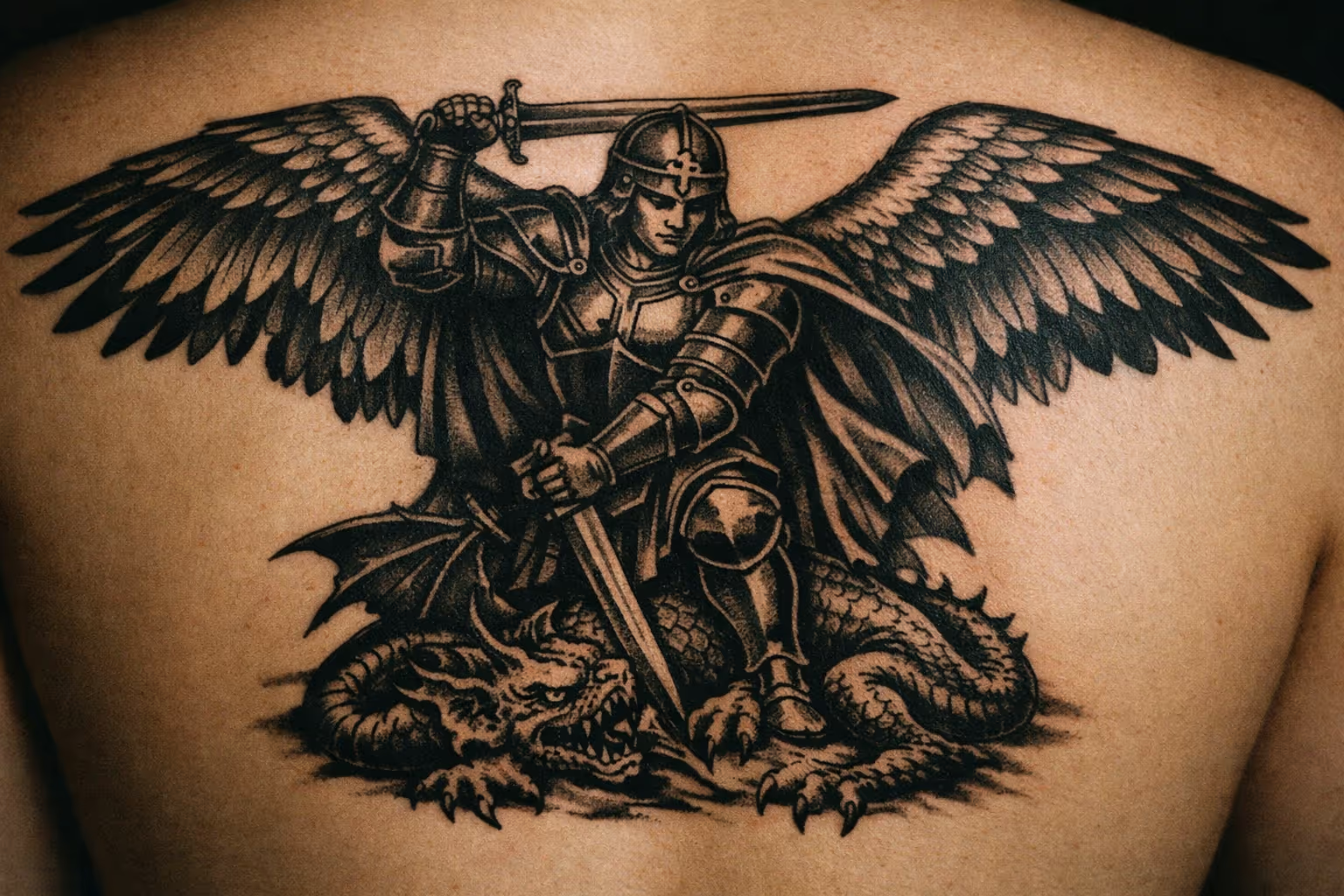
A Saint Michael tattoo shows the archangel with his sword raised over a defeated dragon, the visual shorthand for protection, courage, and victory over evil that keeps Michael at the top of archangel tattoo galleries. It’s a high-commitment design. Full battle scenes demand large format, a specialist artist, and multiple sessions, so before you start pinning references, it helps to understand what the design means, how its elements fit together, and which placements actually hold the composition you want. This guide covers all of that: meaning, symbols, styles, placement and sizing, the prayer variant, and how a piece this detailed ages over a decade.
What a Saint Michael Tattoo Actually Means
A Saint Michael tattoo means divine protection, courage, justice, and the victory of good over evil, rooted in Michael’s role as leader of the heavenly armies in Christian tradition. He is the angelic warrior who fights the dragon in scripture, and his imagery is built around conflict rather than a neutral portrait.
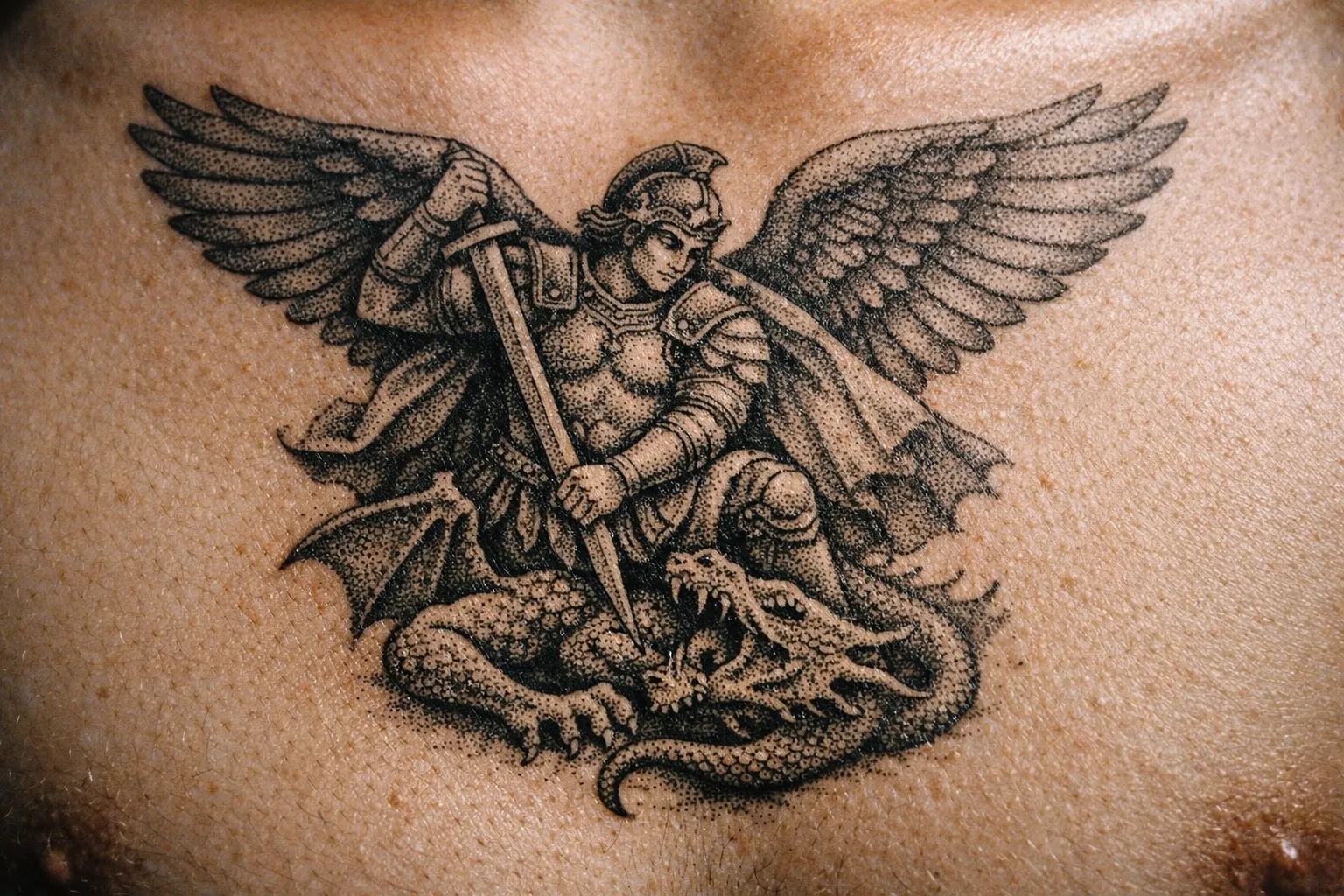
Michael’s scriptural anchors are Revelation 12:7-9 and Daniel 10:13, 21; 12:1. In Daniel, he is the great prince who stands guard over the people of Israel and arises on their behalf in a time of distress; no dragon appears in those passages. The dragon fight is Revelation-specific: Revelation 12:7-9 describes Michael and his angels waging war against the dragon and casting it down from heaven (16). The name comes from the Hebrew Mikha’el, glossed as “Who is like God?”, which is the conceptual basis for the Latin phrase Quis ut Deus? that shows up as script in many designs. Catholic prayer tradition frames him explicitly as defense “against the wickedness and snares of the devil,” and the St. Michael prayer opens with “St. Michael the Archangel, defend us in battle” (4). That single line is where the tattoo’s core protective reading comes from.
The meaning splits into two layers. The overtly religious layer: guardianship, unwavering faith, the commander of heavenly armies. The personal layer: many wearers use Michael’s battle imagery as a metaphor for their own struggle (addiction, trauma, moral temptation) rather than a straight theological statement. I’ve had clients come in with both framings in the same sitting, and the design works for either, as long as you’ve decided which one you’re going for before the artist starts drawing.
One thing worth flagging: Michael is recognized across Catholic, Eastern Orthodox, Anglican, and broader Christian traditions, but the visual language varies considerably. A Byzantine icon, a Renaissance painting, and a modern black-and-grey realism piece all depict the same figure with very different iconographic conventions. Decide which tradition’s visual style fits your intent before you brief an artist, because that choice will shape everything from the armor detail to how the halo is rendered.
The battle scene as personal metaphor
Revelation 12:7-9, where Michael and his angels fight the dragon and throw it out of heaven (4), gives you a symbolic frame for mapping the enemy onto something specific. If the dragon represents your addiction, your grief, or a period you fought through, that changes how the artist draws it: more coiled and menacing, or already broken underfoot. Talk this through before the design is finalized. The core artistic formula of sword, shield, and dragon comes straight from long-standing Michael iconography, so any personal metaphor should be planned around that established visual grammar, not bolted on after.
Saint Michael’s Symbols and What Each Element Adds
Saint Michael’s primary symbols are the sword, the shield, and the dragon underfoot, the core iconographic trio that identifies him in nearly every depiction (6). Each element carries a specific meaning, and understanding them helps you decide what to include and what to leave out.
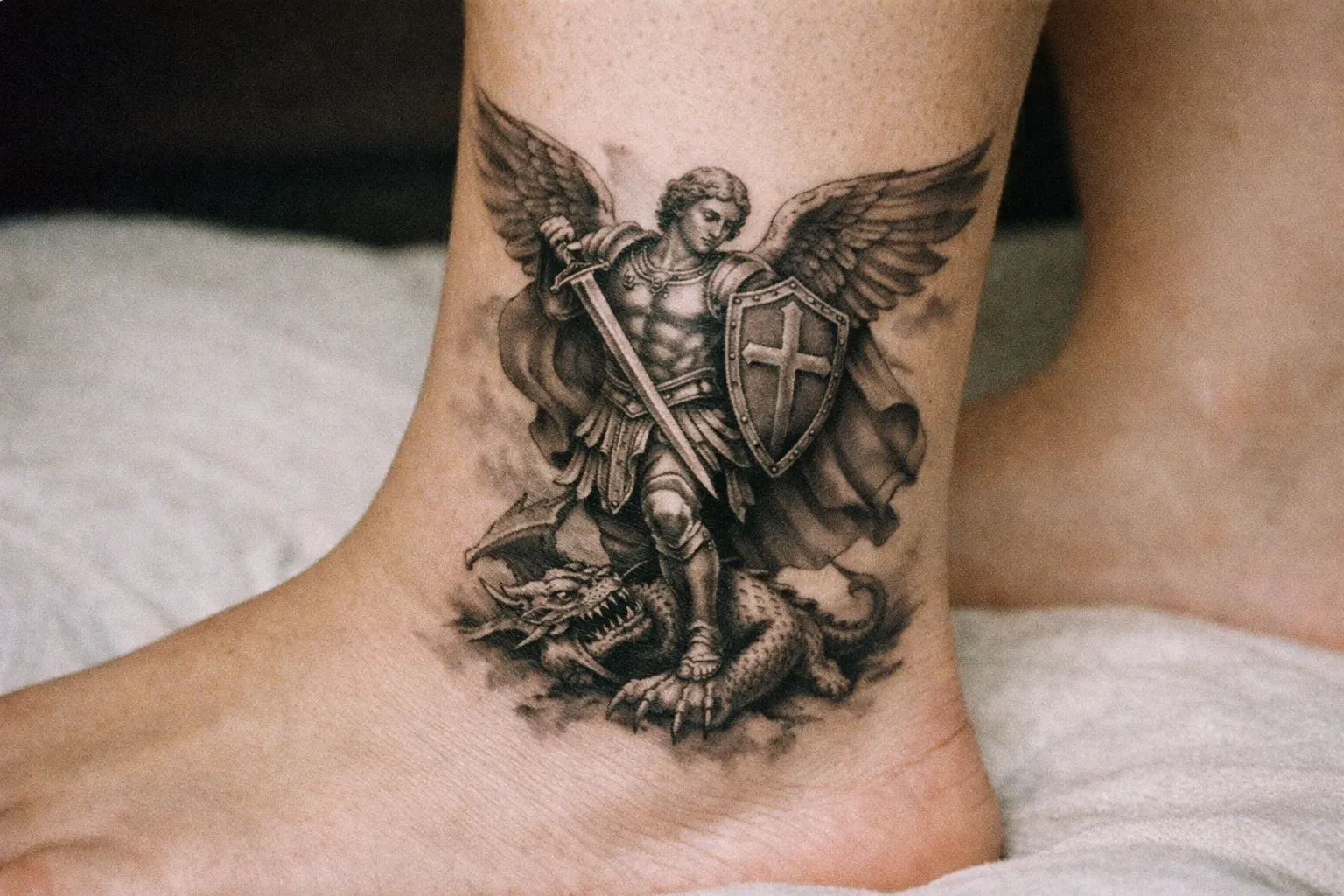
- Sword: divine justice, courage, cutting through falsehood. The most common single-element Michael tattoo for smaller placements. A sword-only design reads clearly at medium scale where a full figure would collapse.
- Shield: a barrier against negative forces, reinforcing the “celestial bodyguard” reading. Often paired with the sword in standing-guardian compositions. In Catholic art, the shield sometimes carries the inscription Quis ut Deus?
- Wings: ascension, spiritual growth, divine connection. Wing span is the main driver of scale requirements; fully spread wings are what push a design onto the back or chest.
- Halo: spiritual enlightenment, inner light. Subtle in realism, more prominent in icon-influenced designs.
- Dragon or serpent underfoot: the defeated enemy, the most explicit symbol of evil or personal opposition. It’s the most dramatic compositional element and the one that demands the most space.
- Armor: Michael is consistently depicted as an angelic warrior in Roman or medieval armor, so the armor isn’t decorative filler, it’s part of the identity. The detail in the breastplate, pauldrons, and greaves is what separates a skilled religious realism artist from a generalist.
- Flames and clouds: environmental framing. Clouds suggest the heavenly realm, flames the intensity of spiritual battle. Both add background depth and both add session time.
The prayer line “defend us in battle” is why the sword and shield read as divine protection rather than generic fantasy armor. That framing matters when you’re briefing an artist who works across genres.
Combining elements without overcrowding
Start from the trio of sword, shield, and dragon, and treat everything beyond it as a deliberate choice, not a default. The 1/3 rule applies here: roughly one-third central figure, one-third background (clouds, rays, flames), one-third text or secondary symbols. Stacking full prayer text plus multiple figures plus flames plus a cross into one piece produces something illegible and miserable to touch up. If your design already carries wings and armor, the compact Quis ut Deus? is enough text to anchor the meaning without competing with the figure.
✓ Pros
- Deeply layered symbolism that works on religious, personal, and aesthetic levels
- Scales beautifully to large formats
- Strong visual drama in black-and-grey realism
- Recognized across Catholic, Orthodox, and broader Christian traditions
- Highly customizable across composition, elements, and style
✗ Cons
- Demands a large canvas for full compositions; small placements sacrifice detail
- Requires an artist with specialist religious realism experience
- Multi-session commitment for back or chest pieces
- Script elements need careful sizing to stay legible over the years
- Visible placements carry social and professional considerations
- Imagery carries denominational weight worth understanding before you sit
Style Options for a Saint Michael Tattoo
Black-and-grey realism is the dominant style for Michael tattoos because classical depictions emphasize exactly what realism renders well: armor texture, musculature, cloud depth, and the dragon’s scales. It ages reliably on large formats with proper sun protection, but it lives or dies on the artist. I’ve seen technically competent portrait artists produce Michael pieces where the wings look like a Halloween costume, because wings and armor are specific problems that require specific reference and practice. You want someone with a strong healed-portrait and religious realism portfolio, not just fresh photos.
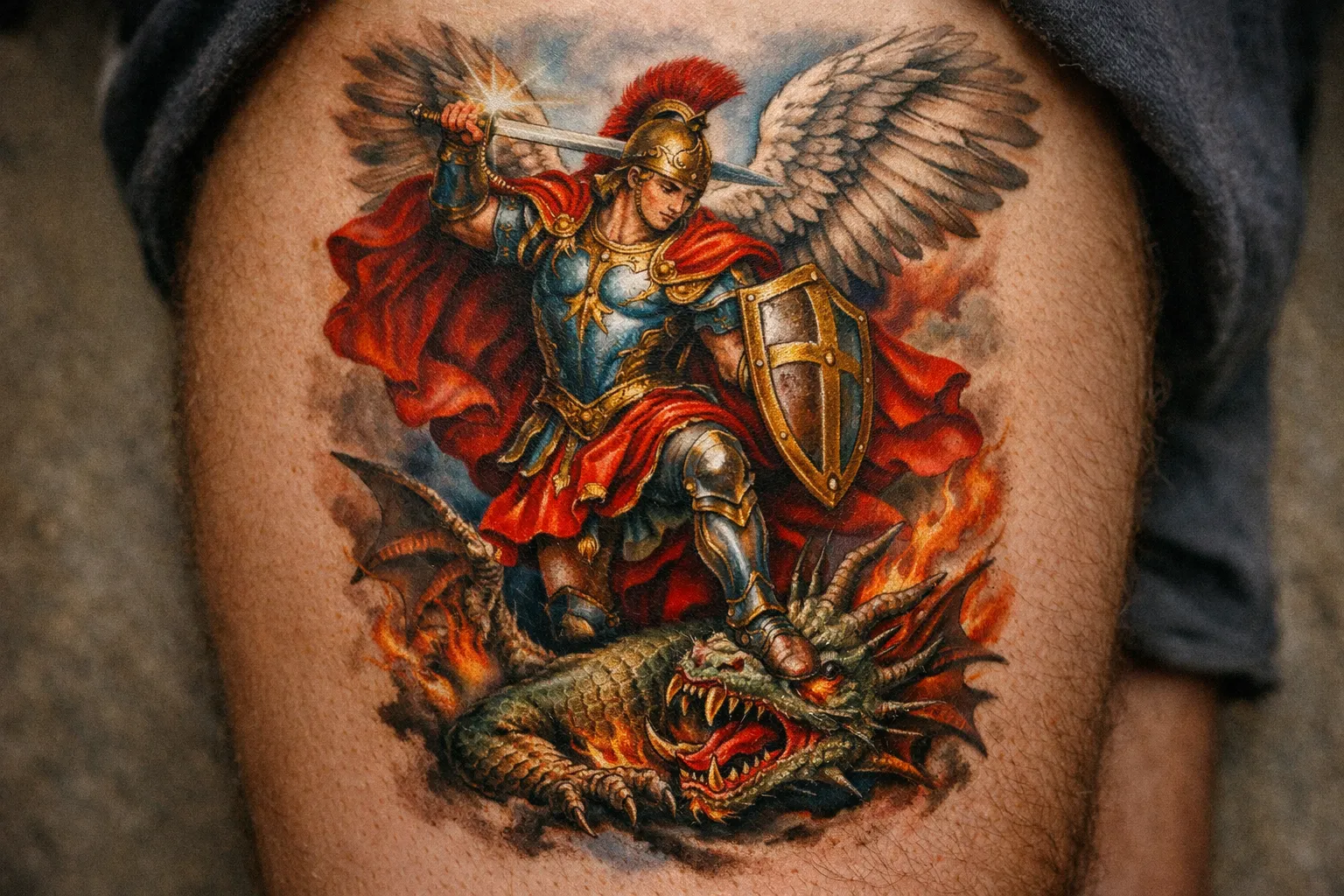
The main style routes:
- Black-and-grey realism: the default. Highlights armor, wings, and dragon detail. Holds up on the back and chest over decades if the shading was laid in with enough contrast to survive softening.
- American Traditional: thick black outlines and a limited palette of red, yellow, and blue. It flattens the figure but holds up exceptionally well over decades: the bold outlines and saturated fill are why traditional work reads clearly at twenty years. Better suited to a medium forearm or upper-arm piece than a full-back battle scene. The common pitfall when artists do it badly: they soften the outlines trying to add realism, and you end up with something that’s neither.
- Fine-line / linework: the modern minimalist take, simplifying Michael into outlines and geometric shapes. Works for smaller forearm or calf placements, but loses armor and wing detail at scale and needs more frequent touch-ups, especially on high-movement areas.
- Script-focused designs: the St. Michael prayer or Quis ut Deus? as the primary element with a smaller angel motif alongside. The shield phrase gives icon-style or script-first designs a built-in textual anchor. Requires careful font sizing and layout planning around the figure.
- Icon / Byzantine style: flat, stylized, gold-toned, referencing Eastern Orthodox iconography where the figure is more symbolic than in Renaissance realism. Less common in studios but distinctive. Best executed by an artist with icon-painting reference experience.
Choosing an artist for religious realism
A strong portrait artist is not automatically a strong religious realism artist. Armor, faces, and wings each fail in specific ways: flat pauldrons, off-proportion faces, wings that read like a costume. Look for healed examples of all three in the portfolio, not just fresh photos taken the day of the session. Fresh work always looks crisp; healed work tells you what you’ll actually be wearing in year two. On a piece this detailed, a generalist is a genuine risk.
Placement and Size: Matching to the Body
Placement is driven by composition type: a standing guardian is vertical, an active battle scene is diagonal or horizontal, and prayer script is linear. Match the placement to the composition, not the other way around, or you end up cramming a battle scene onto a forearm and losing every detail that made it worth getting.
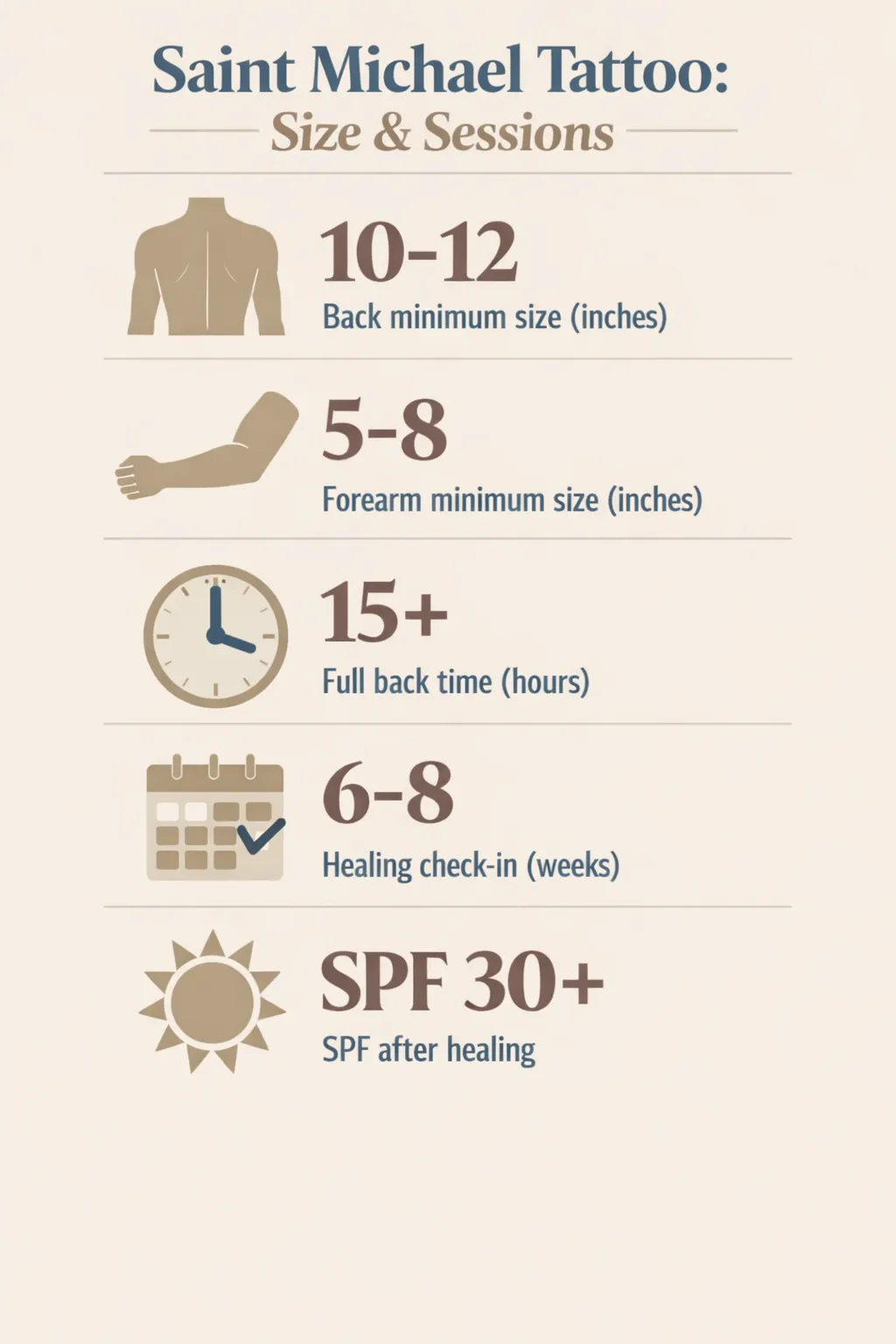 Typical Saint Michael tattoos require back sizes of 10-12 inches or forearm 5-8 inches, about 15+ hours on a full back across multiple sessions, with a 6-8 week healing check-in and SPF 30+ after healing.
Full back and full chest are the natural home for narrative battle scenes with wings fully spread. Plan for a minimum of 10-12 inches (25-30 cm) to preserve wing and armor detail, and expect a multi-session project: full back pieces run 15+ hours even for simpler designs, and a detailed battle scene sits well above that, so plan for 4 to 10 or more sessions depending on complexity. Pain here is low to moderate; the back is one of the more forgiving large canvases compared to the ribcage or sternum.
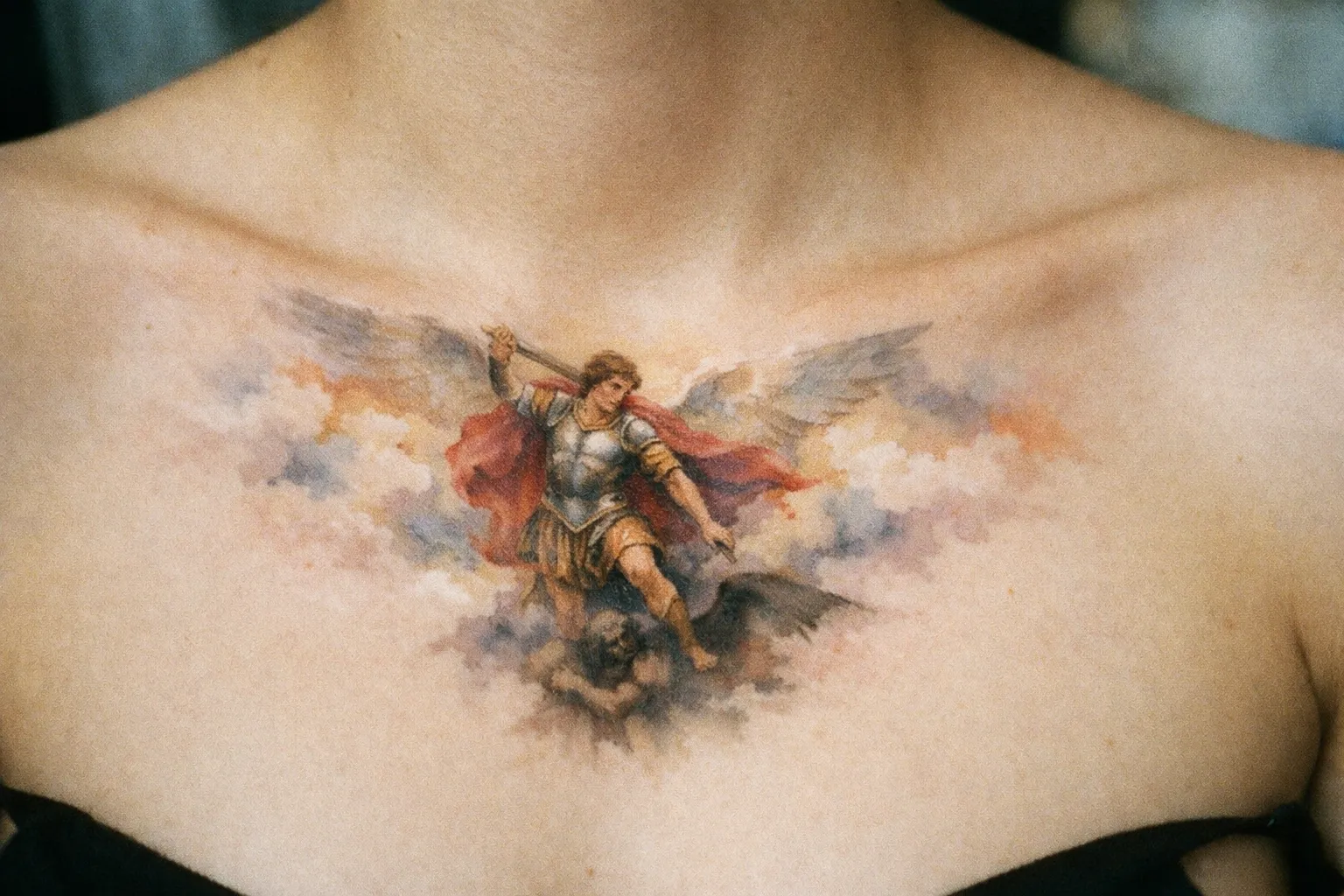
Upper arm and sleeve suit vertical sword-and-shield compositions. A half-sleeve at 15-20 cm holds Michael with minimal background; a full sleeve lets the battle scene wrap the arm. Upper arm aging is very reliable.
Forearm works best for standing-guardian or sword-only designs at 5-8 inches (13-20 cm). The outer forearm ages reliably with SPF 30+; the inner forearm suits the short Quis ut Deus? script with a smaller figure. High visibility, easy to conceal under a long sleeve.
Shoulder and shoulder blade is the “watching your back” placement: a single-figure guardian with wings partially spread, from about 4 inches (10 cm) up. It connects naturally into a chest or back extension later if you decide to expand.
Calf and thigh are underused but effective for diagonal battle compositions that show motion. The calf handles vertical designs well from around 5 inches (13 cm); the thigh offers more width for multi-figure scenes from 6 inches (15 cm). Both age very reliably under trousers.
Chest, near the heart gives you a faith and inner-protection reading, pairing guardianship symbolism with the physical location of the heart. Pain runs moderate to high over the sternum, noticeably more than the upper arm or outer forearm. Budget at least 3 inches (7.5 cm) for any meaningful detail, more for a full figure.
Small designs on the wrist or behind the ear are sword-only or halo-only motifs, fine-line only. Accept that detail will be minimal and touch-ups more frequent, since the wrist is a high-movement, faster-fading spot.
Placement comparison at a glance
Saint Michael Tattoo Placement Comparison
| Full back | Chest | Upper arm / sleeve | Outer forearm | Shoulder blade | Calf | Thigh | Forearm (script) | |
|---|---|---|---|---|---|---|---|---|
| Pain Level | Low-moderate | Moderate-high | Low-moderate | Low-moderate | Low-moderate | Moderate | Low-moderate | Low-moderate |
| Min. Size | 10+ in / 25+ cm | 6+ in / 15+ cm | 5 in / 13 cm | 5-8 in / 13-20 cm | 4 in / 10 cm | 5 in / 13 cm | 6 in / 15 cm | 5 in / 13 cm |
| Best Composition | Battle scene, full wings | Standing guardian | Vertical sword-and-shield | Standing guardian, script | Single-figure guardian | Battle scene, vertical | Battle scene, diagonal | Quis ut Deus? + small figure |
| Visibility | Low | Low-moderate | Moderate | High | Low | Moderate | Low | High |
| Concealment | Any top | Shirt | Short sleeve | Long sleeve | Any top | Trousers | Trousers | Long sleeve |
| Aging | Very reliable | Reliable | Very reliable | Reliable (SPF) | Very reliable | Reliable | Very reliable | Reliable (script ≥12-13 mm) |
Linking placement to personal meaning
The placement can carry meaning too. Chest and heart for faith and inner protection. Upper back and shoulder blades to “watch your back”: guardianship, quite literally behind you. Forearm for a visible daily marker of courage and justice, something in view every time you push up your sleeves. None of this is fixed doctrine, but matching placement to intent gives the piece a second layer beyond the image.
The Saint Michael Prayer Tattoo
The St. Michael prayer tattoo integrates the well-known Catholic prayer, which opens with “St. Michael the Archangel, defend us in battle”, as text alongside a central Michael figure, usually on a full-back or chest composition. It’s a rising trend, and it carries its own planning demands because the text is long.
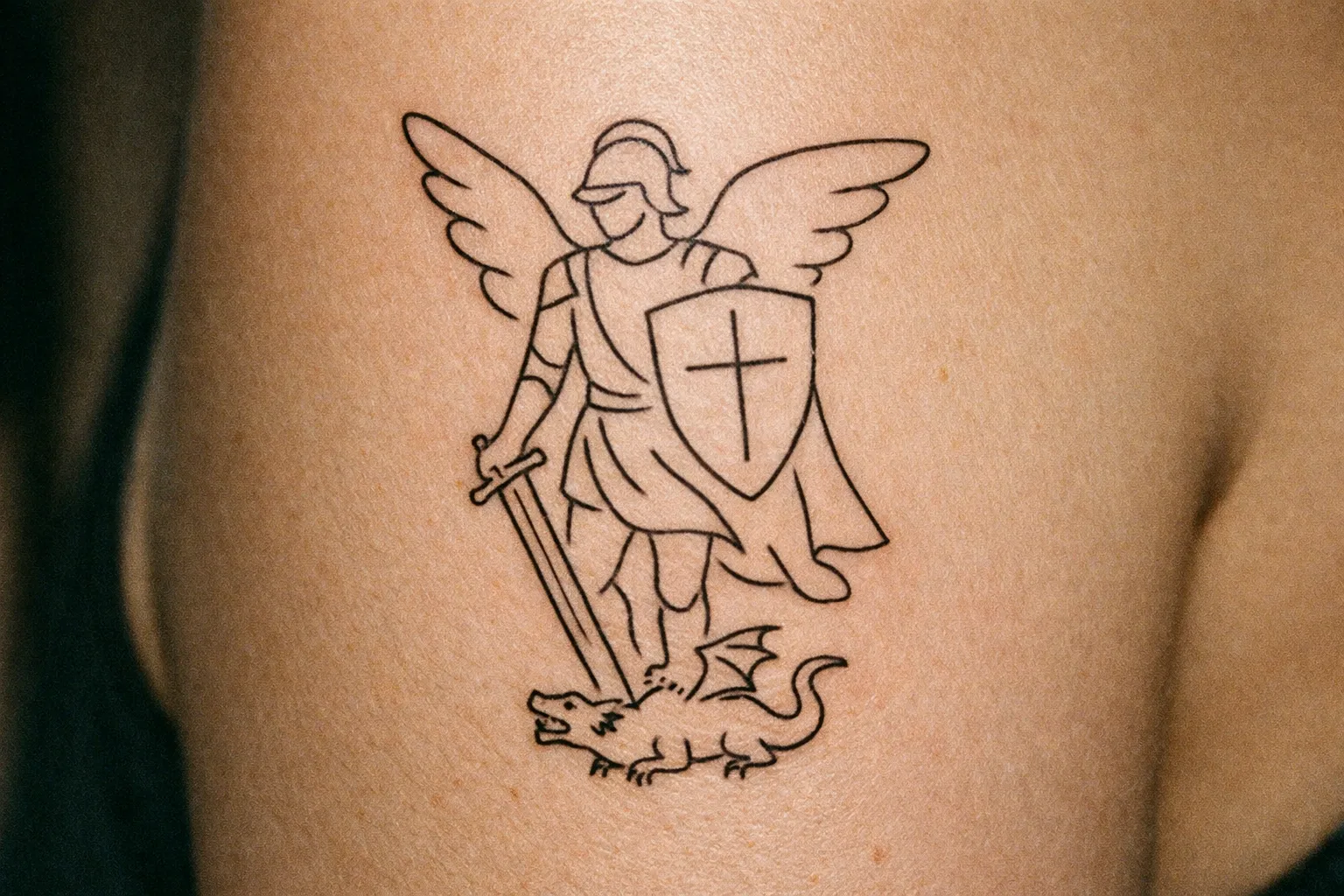
The full prayer continues past the opening with lines like “May God rebuke him, we humbly pray,” which makes it far longer than a single-line motif. That length is the whole planning problem: full prayer text needs a full arm or the back to breathe. Never compress it onto a small area.
The compact alternative is Quis ut Deus?, just three Latin words meaning “Who is like God?”. At three words it’s easy to size legibly, works on a forearm, or slots in as a banner element within a larger piece. It’s also the phrase historically rendered on Michael’s shield in some depictions, so it integrates naturally into armor detail.
A few rules for script:
- Letter height: aim for at least ½ inch (12-13 mm) per letter for standard script and about 1 inch (25 mm) for ornate script. Smaller than that and the letters blur together as the lines spread, especially on high-movement areas.
- Font choice: avoid overly ornate scripts that blur as lines widen with age. Print the text at actual size and check it before you commit.
- Verify the Latin: confirm spelling more than once. A fluent Latin speaker or a priest is a useful second check, because a misspelled Latin tattoo is a permanent, public error.
- Layout first: size and position the text around the central figure before session one, not as an afterthought. The 1/3 rule holds: text should not compete with the figure for dominance.
I’ve had clients arrive with the full prayer printed out on a piece of paper, wanting it wrapped around a full-back battle scene. That’s a legitimate design goal, but it requires the back specifically, careful font selection, and a layout session before anyone picks up a machine. Get the layout approved first.
Design Ideas by Composition
The most useful way to think about Michael designs is by composition type, because the composition dictates size, placement, and how many sessions you’re signing up for.
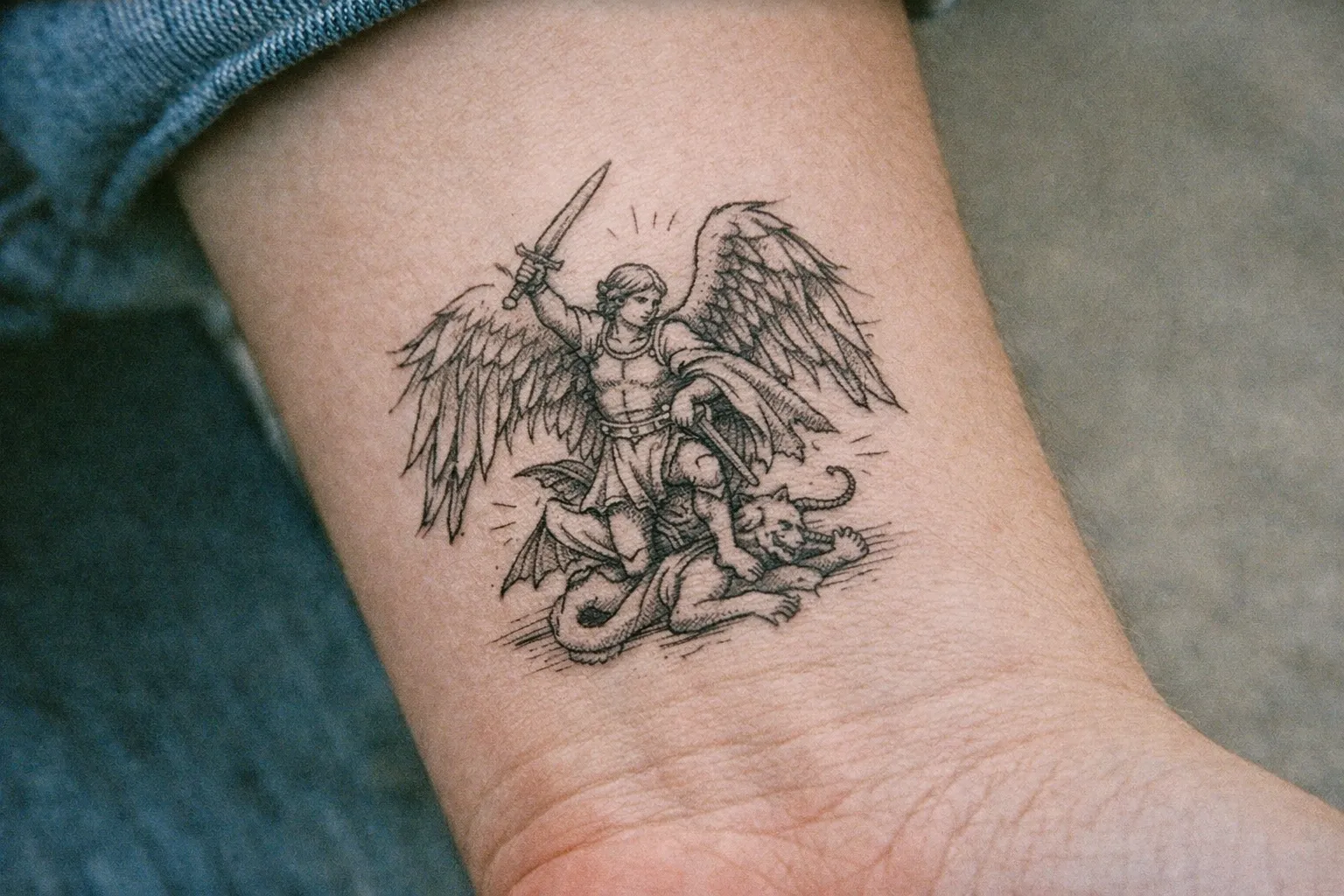
- Standing guardian: Michael upright, sword raised or at rest, wings spread. The most recognizable pose, and the most canonical version of the angelic warrior. Best on the back, chest, or shoulder. Guido Reni’s Saint Michael is a common reference point for this pose.
- Battle scene (Michael vs. dragon/serpent): the most dramatic composition, reflecting the Revelation imagery directly. Michael in motion, dragon underfoot or mid-struggle. Needs the most space, so full back or chest, though the diagonal energy also suits the calf and thigh.
- Sword-and-shield close-up: isolated weapons with minimal or no figure. Works at medium scale on the forearm or upper arm, and it’s a strong choice for wearers who want the symbolism without a full figurative piece.
- Wings-only or wings-with-halo: Michael reduced to his most recognizable attributes. Works as a back piece with wings spanning the shoulder blades, or as a smaller forearm or calf design.
- Michael with scales of justice: less common, but it sharpens the justice and leadership reading and pairs well with the commander-of-heavenly-armies framing. Suits those in law enforcement, military, or leadership roles.
- Michael with a cross or rays of light: a cross adds explicit Christian framing. Rays of light work as background fill that ages better than large areas of solid black shading, which tends to spread over the years.
- Prayer text as the primary element: Michael as a secondary motif framing the prayer. Text-dominant, and it needs the careful layout planning covered above. The opening line “St. Michael the Archangel, defend us in battle” can serve as the centerpiece if the rest of the composition stays restrained.
Using classical religious art as reference
Working from Book of Revelation depictions, traditional icons, and Renaissance paintings (Reni, Raphael) produces more recognizable, structurally sound designs than pulling from generic warrior imagery. Classical art has already solved the pose, the proportion, and the balance of figure against background. Bring your artist two or three of these as reference alongside their own portfolio examples. It gives you a shared vocabulary and a design with a spine, rather than a fantasy knight who happens to have wings.
When I consult on pieces like this, I’ll often pull up Reni’s Saint Michael alongside a client’s chosen tattoo reference and just compare the two side by side. The classical painting almost always has better compositional balance. That’s not an accident: those artists were solving the same problem of figure versus background that your tattooer will face.
Planning: What to Sort Out Before You Book
Decide on composition type and scale first, because a full battle scene and a forearm sword design are entirely different commitments in time, cost, and artist selection. Everything else follows from that first choice.
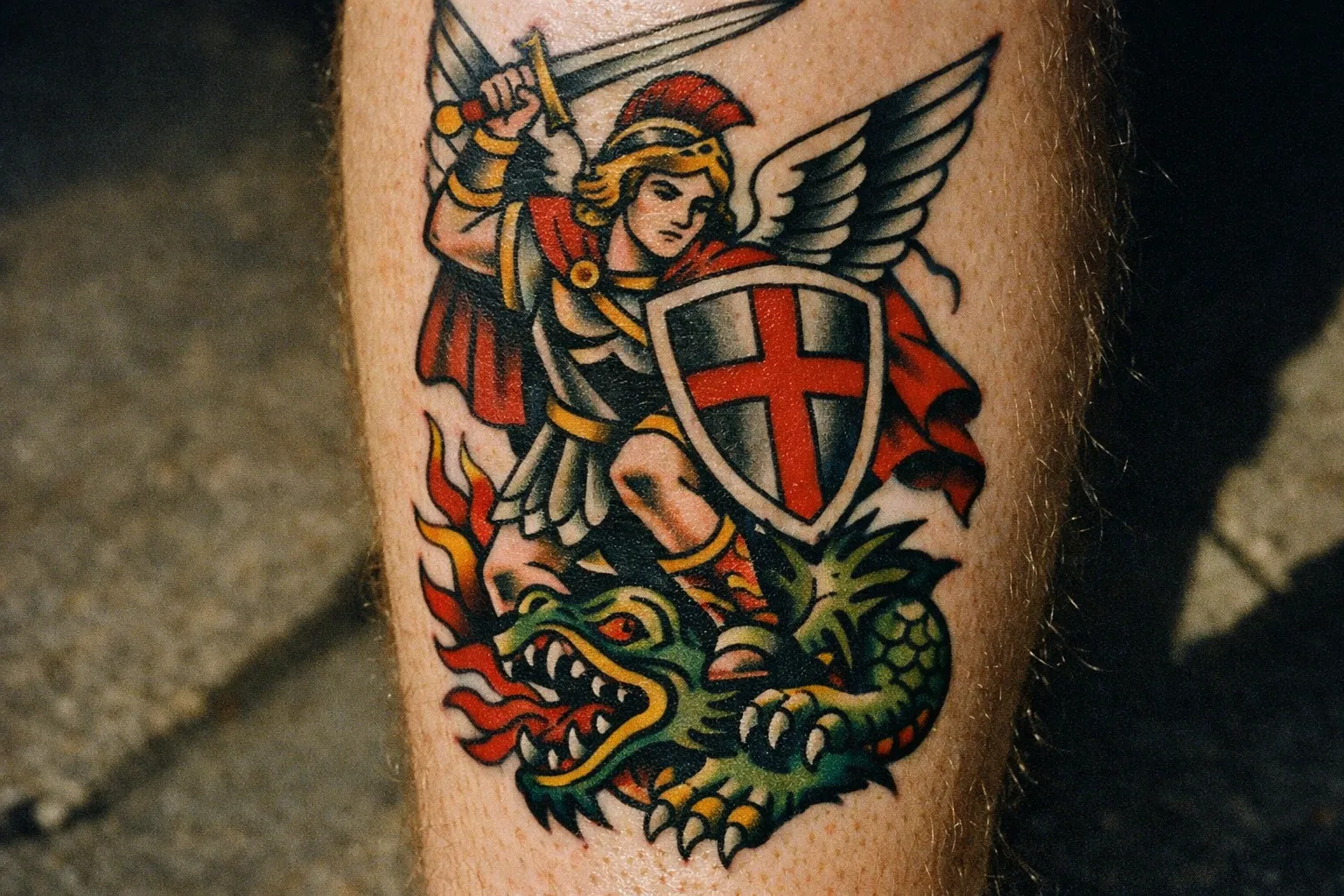
Collect reference material before the consultation: religious artwork (paintings, icons, statues), tattoo portfolio examples, and any personal symbols you want incorporated. Know what the dragon represents for you before you walk in. Then vet the artist specifically for religious realism, looking for healed examples of armor, faces, and wings, not fresh photos alone.
The common ways this design goes wrong:
- Insufficient canvas for the composition. A complex battle scene on a small forearm collapses into muddled detail. This is the single most frequent failure.
- Overloading with elements. Full prayer text plus multiple figures plus flames plus a cross reads as noise and is a nightmare to touch up later.
- Script too small or too ornate. Standard script under about ½ inch (12-13 mm) per letter blurs as the lines spread with age.
- Style mismatch between artist and subject. Off-proportion wings and faces are the most visible failure point, the thing people notice from across a room.
- Choosing imagery without understanding the symbolism. Regret is more common when the design was picked for looks alone, with no personal or theological grounding.
For large pieces, session planning matters. A detailed full-back battle scene is a serious time commitment. A full back runs 15+ hours of work even for simpler designs, and a detailed battle scene sits well above that. Sessions are usually capped at around 4-6 hours each and spaced several weeks apart, so budget for 4 to 10 or more sessions depending on complexity and your artist’s pace. Map the full composition before session one, and never start a large piece without layout approval. And settle the denominational question early: Catholic, Orthodox, and non-denominational representations differ in iconographic style, so decide which tradition’s visual language fits before briefing the artist.
Step-by-step planning checklist
Planning Your Saint Michael Tattoo
About 5 hours over multiple daysA checklist to prepare for a complex Saint Michael tattoo design.
- 1
Define your composition type and scale
Choose between standing guardian, battle scene, sword-only, or prayer script and understand the size each requires.
- 2
Select symbolic elements
Decide which elements like sword, shield, dragon, wings, or text to include and what they personally mean to you.
- 3
Choose your tattoo style and artist
Find an artist with healed portfolio examples in your chosen style, especially religious or figurative realism.
- 4
Gather reference material
Collect classical paintings, icons, statues, and tattoo examples to bring to your consultation.
- 5
Decide on placement
Match placement to composition size and your visibility or concealment needs.
- 6
Verify script text
Check Latin spelling and prayer wording with a fluent speaker or priest; print at actual size to test legibility.
- 7
Book a consultation
Discuss layout, session count, and touch-up plans before committing to the tattoo.
- 8
Approve full composition layout
For large pieces, get the full design mapped and approved before the first session to avoid surprises.
How the Design Ages and How to Keep It Sharp
Black-and-grey realism ages better than color on large religious pieces, and designs built around clear separation of sword, shield, and dragon stay readable longer than dense multi-line text or crowded elements. Fine-line work on high-movement areas like the wrist and inner elbow blurs faster than the same design on a flatter surface like the outer forearm or back.
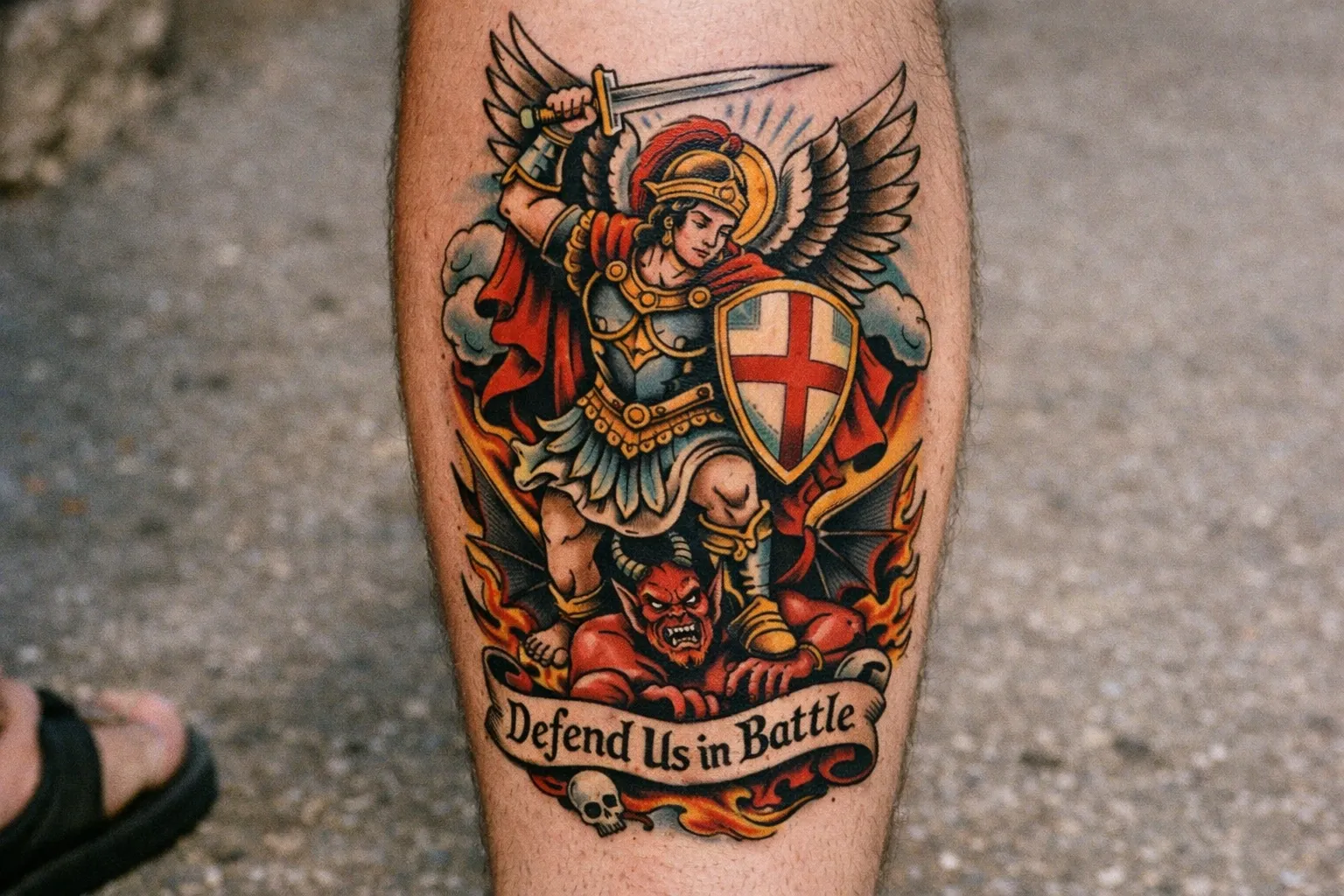
Sun exposure is the single biggest fading factor for exposed placements. SPF 30+ after healing is non-negotiable for forearm, shoulder, and calf pieces. Large shaded areas such as clouds and background fill tend to soften and spread over the years. That’s normal, but worth raising with your artist at the design stage, because slightly higher contrast in the initial shading compensates for it.
Script elements age based on letter height. Standard script needs letters at least ½ inch (12-13 mm) tall and ornate script about 1 inch (25 mm), the thresholds our tattoo font guide sets out in detail. The full St. Michael prayer is particularly vulnerable if it was compressed below those thresholds. The compact Quis ut Deus? is inherently more durable than long prayer text in limited space.
Expect a check-in at 6-8 weeks post-healing for any patchiness. Larger pieces may need a touch-up session at 1-2 years as the skin settles, so plan for that financially and logistically.
For the healing phase itself:
- Days 1-3: keep the initial bandage as directed, wash 2-3 times daily with fragrance-free soap, and apply a fragrance-free moisturizer. Expect some plasma weeping and minor swelling.
- Week 1: itching and flaking are normal. Do not pick. Avoid pools, hot tubs, and direct sun.
- Weeks 2-4: surface healing completes. Color may look dull or patchy, but this is temporary. Keep moisturizing.
- Month 2-3: deep healing finishes and the final crispness emerges. Schedule any touch-up after week 6 if needed.
Sun-protective clothing matters during weeks 2-4 for any placement that can’t be covered otherwise. A loose long sleeve over a healing forearm piece is the easiest solution.
Which Archangel Is Most Tattooed, and Where Michael Stands
Across archangel idea guides and gallery roundups, Michael appears far more frequently than any other archangel, driven by his warrior imagery, strong visual drama, and broad recognition across Christian traditions. His visual language of sword, shield, and dragon is simply the most composition-friendly of any archangel for a tattoo.
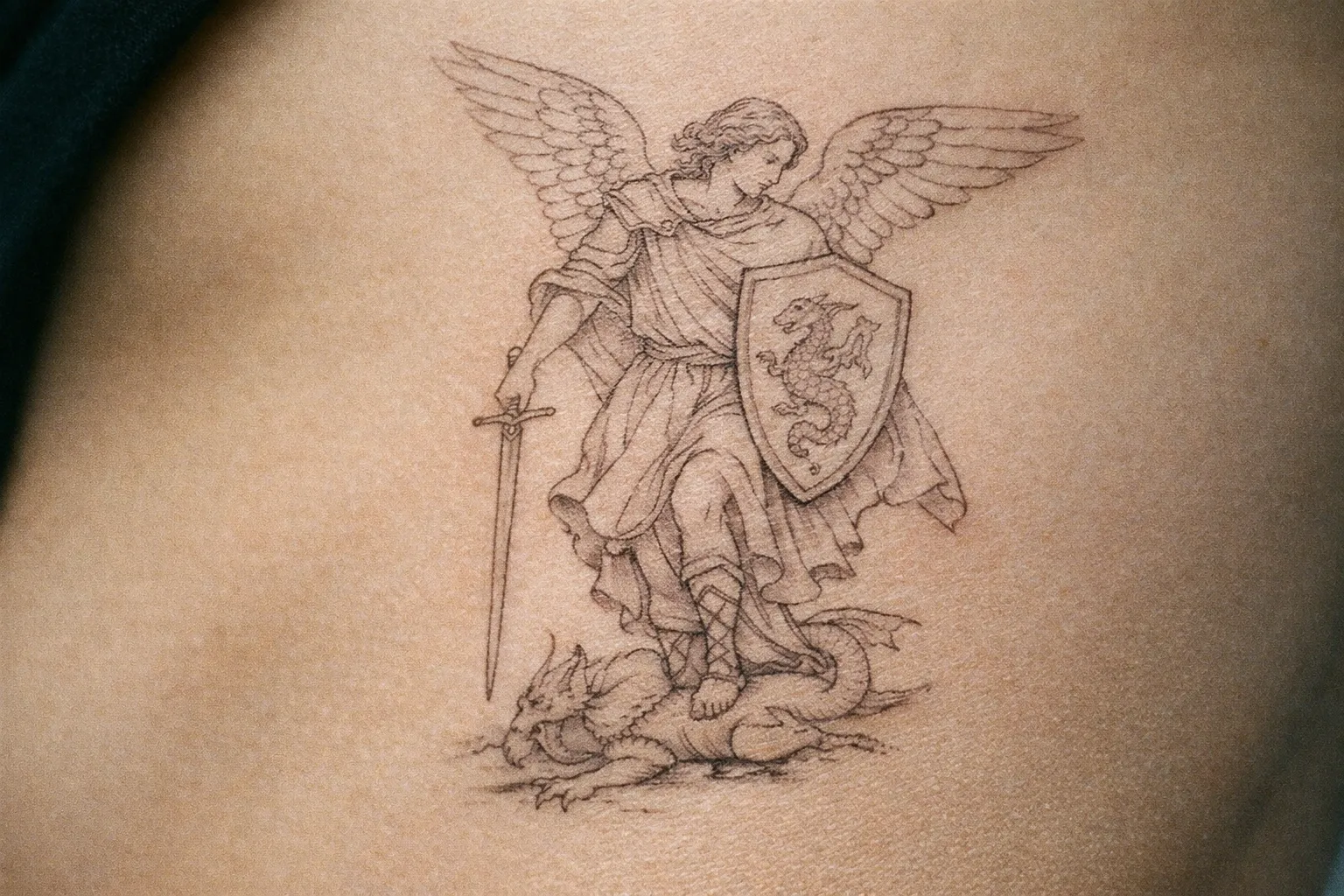
Gabriel, the messenger often depicted with a horn or lily, and Raphael, the healer usually shown with a staff and fish, appear in archangel galleries but far less frequently. The warrior archetype is the differentiator: Michael’s battle imagery translates directly into large-format compositions in a way that Gabriel’s or Raphael’s iconography doesn’t. His name meaning, “Who is like God?”, also reinforces the overt theological symbolism many wearers want.
Among archangel designs for men specifically, Michael dominates current idea guides and gallery roundups, with the “divine guardian” and “spiritual victory” framing driving sustained interest.
One clarification worth making: fallen-angel or Lucifer imagery is sometimes grouped with archangel tattoos, but it carries distinct and often opposite symbolism. If you’re considering any fallen-angel elements, be clear with your artist about intent, because the two readings don’t mix cleanly.
Frequently Asked Questions
- What does a St. Michael tattoo mean?
- Michael symbolizes divine protection, courage, justice, and victory over evil, often used as a personal metaphor for struggles like addiction or trauma.
- What is Saint Michael's symbol?
- His main symbols are the sword (justice), shield (protection), wings (divine connection), and dragon underfoot (defeated evil).
- Which archangel is most tattooed?
- Michael appears far more often than any other archangel in tattoo idea guides and galleries, thanks to his warrior imagery and broad recognition across Christian traditions.
- What size does a Saint Michael tattoo need to be?
- Sword-only or standing-guardian designs work at 5-8 inches on forearm or upper arm; full battle scenes need at least 10 inches on back or chest.
- How many sessions does a full Saint Michael back piece take?
- A full back runs 15+ hours of work even for simpler designs, and a detailed battle scene sits well above that. With sessions of around 4-6 hours spaced several weeks apart, budget for 4 to 10 or more sessions depending on complexity and your artist's pace.
- Can I get a Saint Michael tattoo if I'm not Catholic?
- Yes, Michael appears in multiple Christian traditions and his symbolism resonates beyond religious practice.
- What's the Latin phrase on Saint Michael tattoos?
- *Quis ut Deus?* means 'Who is like God?' and often appears as script or on Michael's shield.
- What are the most common mistakes with Saint Michael tattoos?
- Common mistakes include choosing too small a canvas, overloading elements, too small script, and selecting artists without religious realism experience.
Before You Book
Three variables decide whether this tattoo works. Scale: is your chosen placement actually big enough for your chosen composition, or are you forcing a battle scene into a space that will muddy it? Artist: does their portfolio show healed religious realism (armor, faces, and wings that held up) and not just crisp day-of photos? Intent: do you understand what each element means, including the dragon, so the piece has grounding beyond aesthetics?
A design this size is a multi-year relationship with your artist: touch-ups, possible additions, ongoing sun protection. The planning you do before session one is what determines how the piece looks in year ten, not just on healing day.
Map the full composition. Verify any script at actual size. Look at healed work before you book. Get those three right and the rest is just chair time.