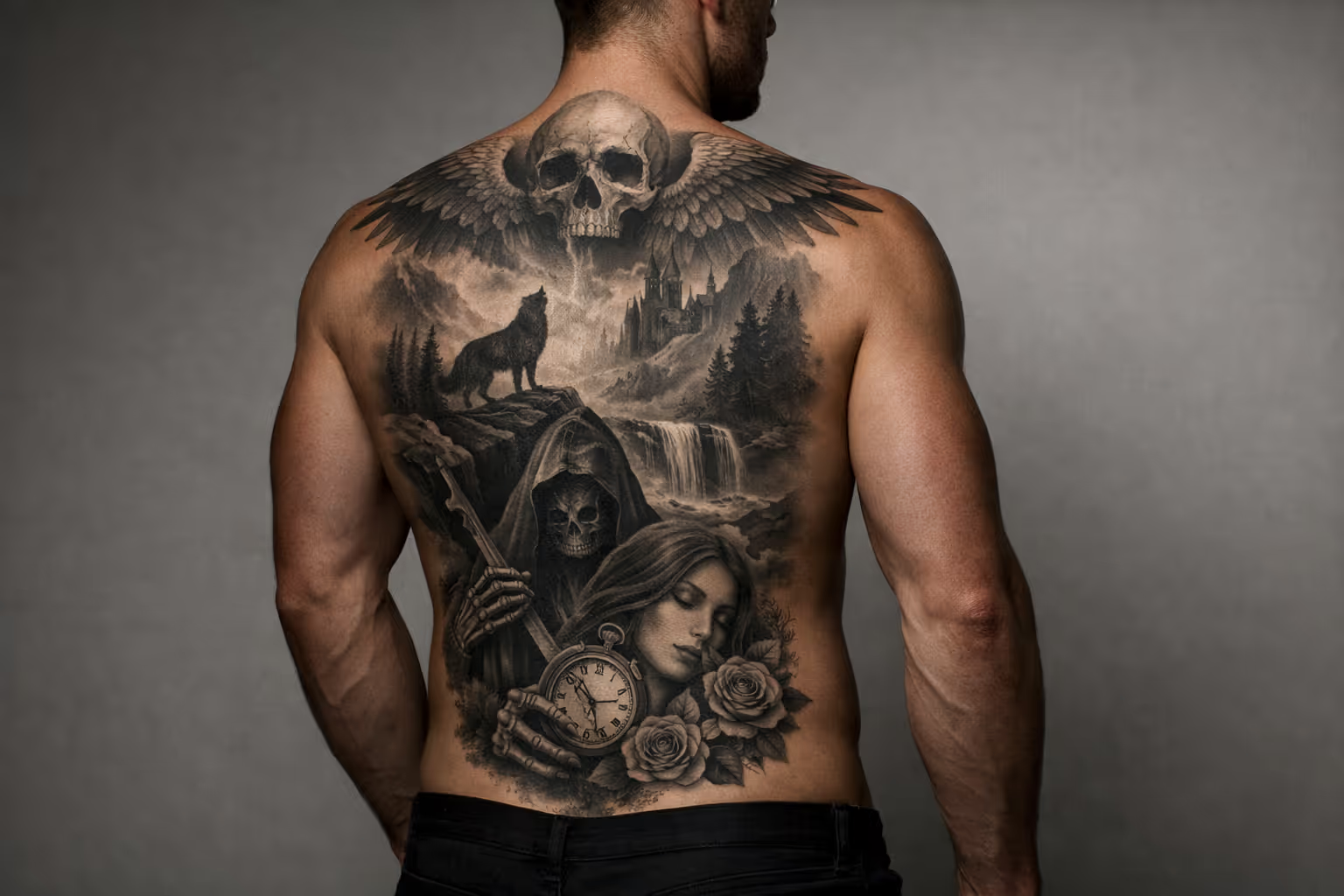
The back runs roughly 60 cm from nape to sacrum - the single largest flat canvas on the human body. That scale is exactly why back tattoos read so dramatically, and it’s also why they demand real planning before anyone picks up a machine. You’re looking at 20 to 30+ hours of work spread across months, so this isn’t a walk-in decision. Pain varies sharply by sub-area - the spine is a completely different animal from the shoulder blade - and design choices for men and women have both diverged and converged in ways worth understanding before you book anything. This guide maps the geography, the pain, the sequencing, and the motifs so you know where to start and what to put there.
Before you book anything, weigh the trade-offs honestly.
The upside: The back is the largest single canvas on the body, with room for compositions 20 to 50 cm tall. The upper back and lats are among the lower-pain zones for a large placement, sitting around 4 to 5 out of 10. Everything is easily concealed under a shirt and visible on demand. The flat, broad surface holds detail well and ages predictably on muscle areas. And you can build it in stages: start with a central anchor piece and expand later.
The downside: The spine is one of the sharpest spots on the entire body - sharper than the ribcage for most people - and the lower back is a moderate-to-sharp zone that catches many clients off guard. Full back pieces need 15+ hours across multiple sessions spanning months. Healing logistics are genuinely awkward - backpacks, office chairs, sports bras, and waistbands all create friction. You can’t see your own tattoo without mirrors, which makes monitoring the heal difficult. And scattered small pieces block a future cohesive composition.
✓ Pros
- Largest single canvas on the body - room for compositions 20-50 cm tall
- Upper back and lats are among the lower-pain zones (4-5/10) for a large placement
- Easily concealed under a shirt; visible on demand
- Flat, broad surface holds detail well and ages predictably on muscle areas
- Can be built in stages - start with a central piece, expand later
✗ Cons
- Spine rates about 9/10 on pain charts - among the sharpest spots on the body; lower back is a moderate-to-sharp zone at around 7/10, which still catches most clients off guard
- Full back pieces require 15+ hours across multiple sessions spanning months
- Awkward healing logistics: backpacks, office chairs, sports bras, and waistbands all create friction
- Hard to see your own tattoo without mirrors; difficult to monitor healing
- Scattered small pieces across the back can block a future cohesive composition
How Back Tattoos Break Down as a Canvas
The back divides into four working zones - upper back, spine column, lats, and lower back - each with different skin thickness, curvature, and surface area. “Back tattoo” is really four placement decisions, not one. Understanding this geography before you talk design saves you from committing to a spot you’ll regret.
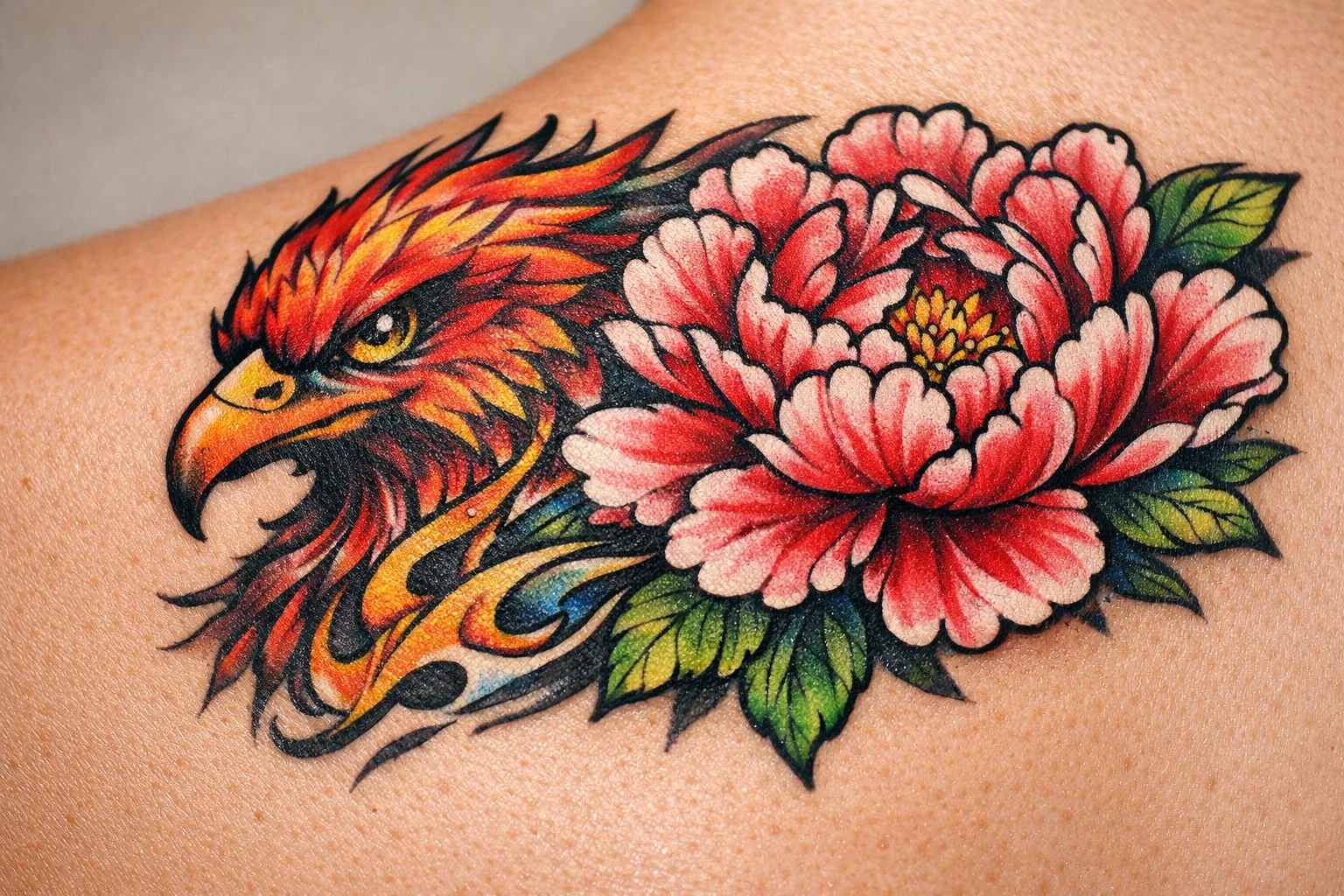
Back curvature matters more than most people expect. The shoulder blades protrude, the lumbar area dips, and your artist has to stretch the skin during tattooing to get a clean line. That stretching affects both comfort and how the finished design sits when you stand versus bend. A composition that looks balanced while you’re lying flat can pull or compress when you stand up straight - which is why mapping happens before the needle touches skin.
Upper back and shoulder-blade zone
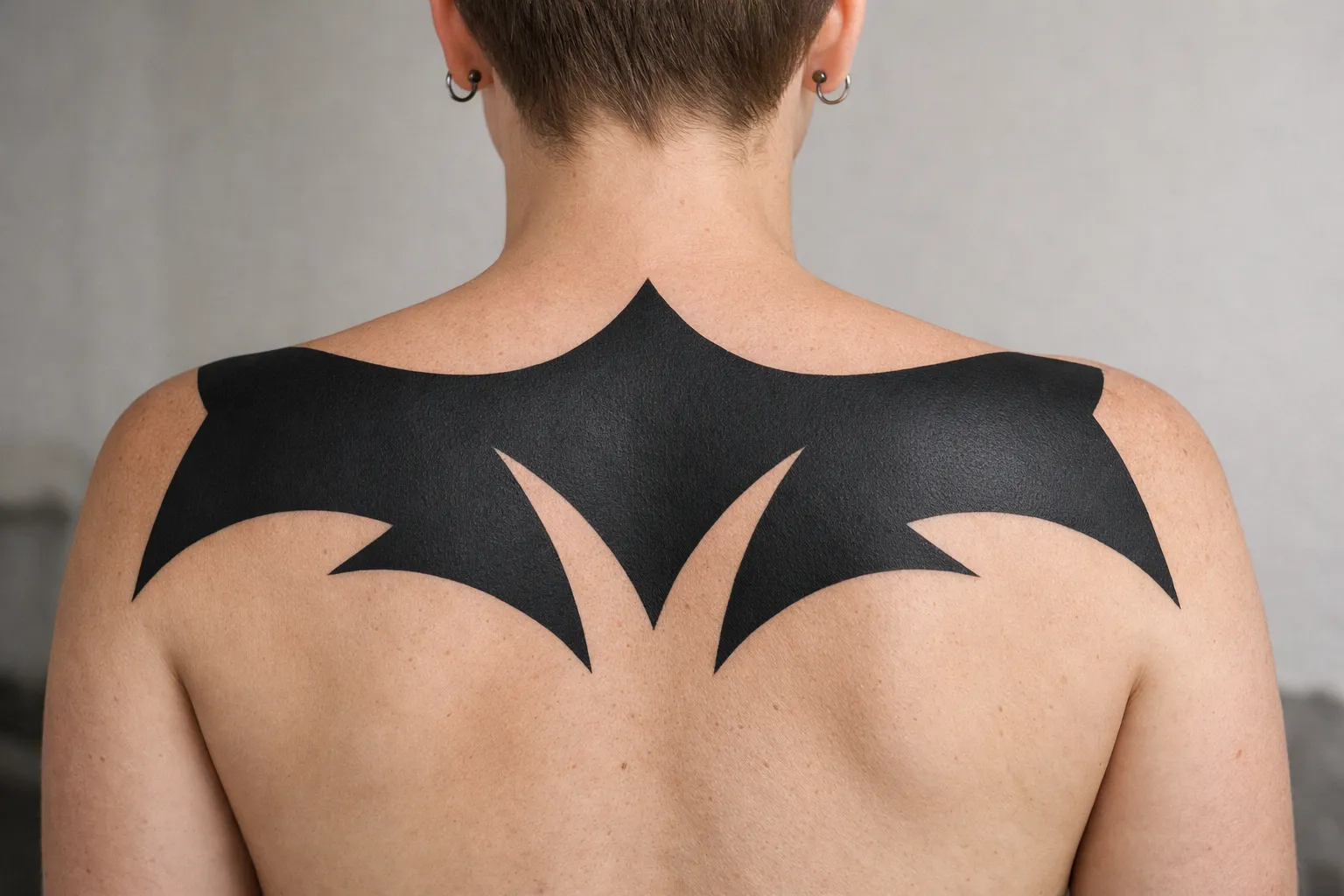
The upper back between the shoulder blades spans about 35 cm shoulder to shoulder, the broadest flat zone on the body. That width suits symmetrical compositions - wings, mandalas, matched floral arrangements - without wrapping onto the arms. The shoulder blades themselves are bony, which bumps the pain up and forces skin stretching, but the trapezius muscle mass on either side of the spine is forgiving and holds detail well over time.
The spine as a design axis
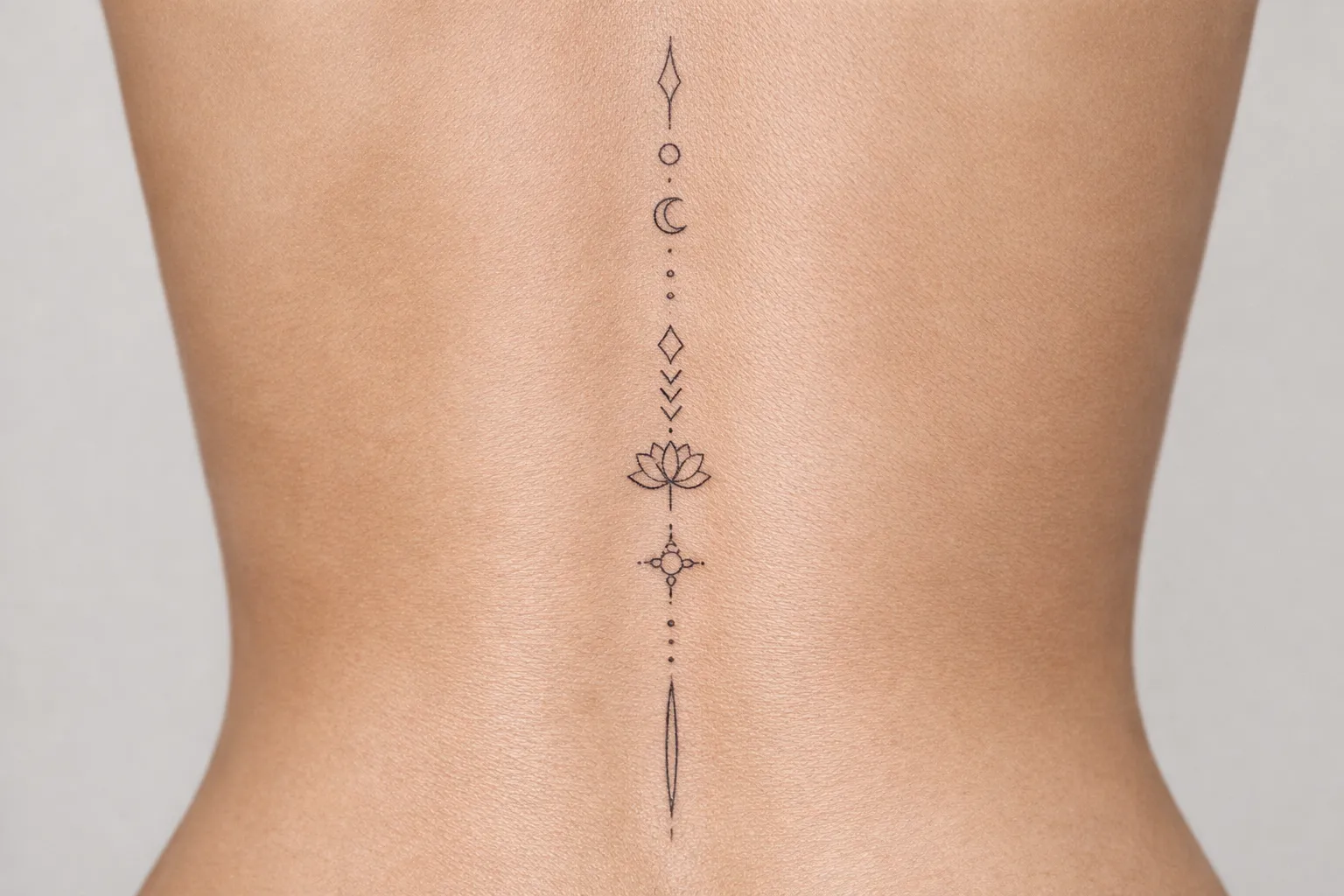
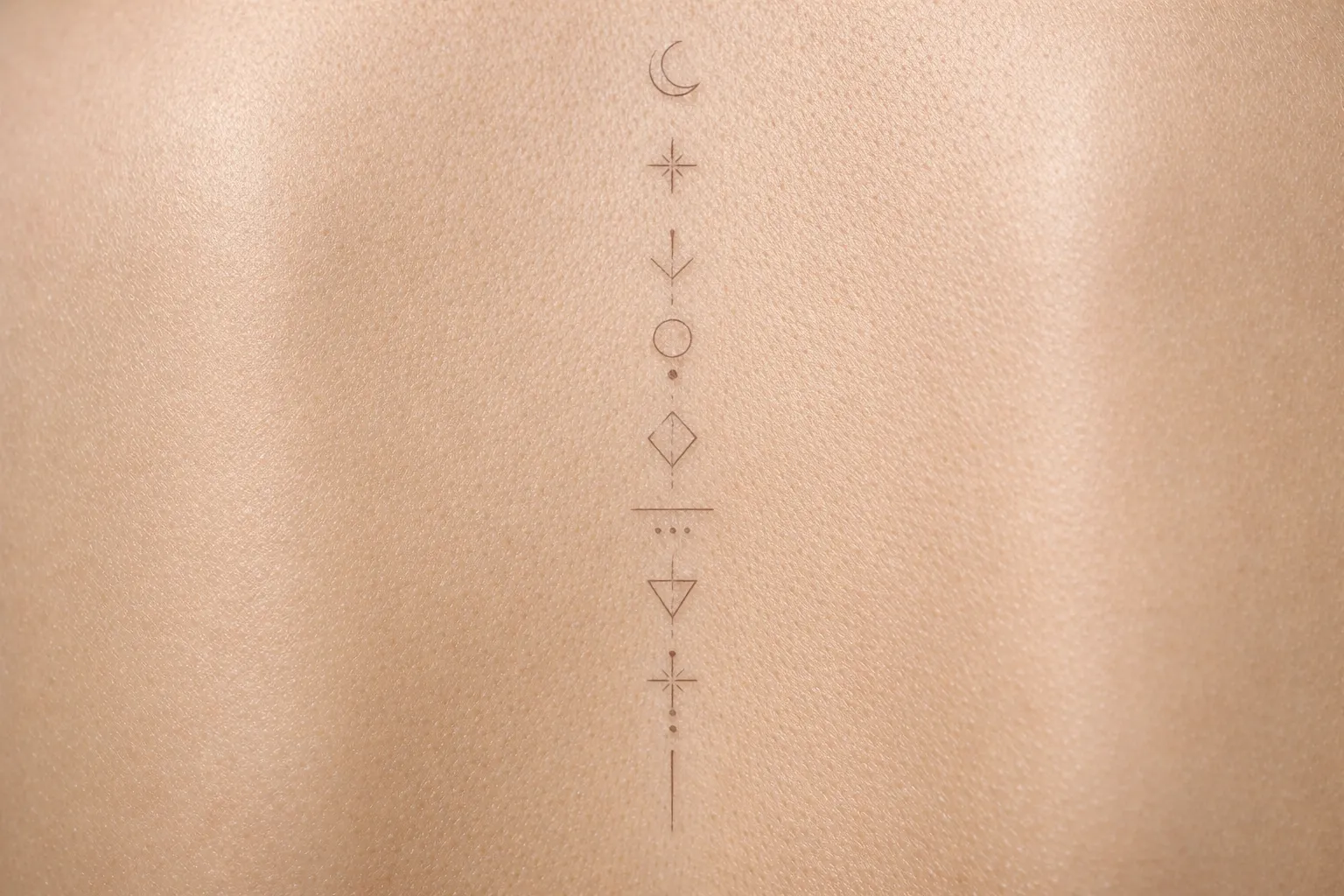
The spine forms a narrow vertical column, roughly 3 to 5 cm wide, running the full length of the back. That narrow strip is the natural axis for linear designs: vertical script, moon phases, stacked symbols, botanical stems. The catch is that it sits directly over the vertebrae, so it’s the sharpest zone on the back for pain.
Lower back and sacrum
The lower back and sacrum area curves, sits over nerve-rich tissue, and historically hosted ornamental horizontal bands. The lats wrap around the torso from here up, connecting back pieces to rib or hip work if you want the composition to flow beyond the back plane.
Pain Across the Back - What Each Zone Actually Feels Like
The back overall is low-to-moderate pain compared with the body’s worst spots, but the internal variation is significant: the spine is in a completely different category from the lats, which sit at the easier end of the back’s range - the spine ranks among the most painful spots on the entire body while the lats are among the most forgiving. Treating “back pain” as a single number is the mistake most guides make.
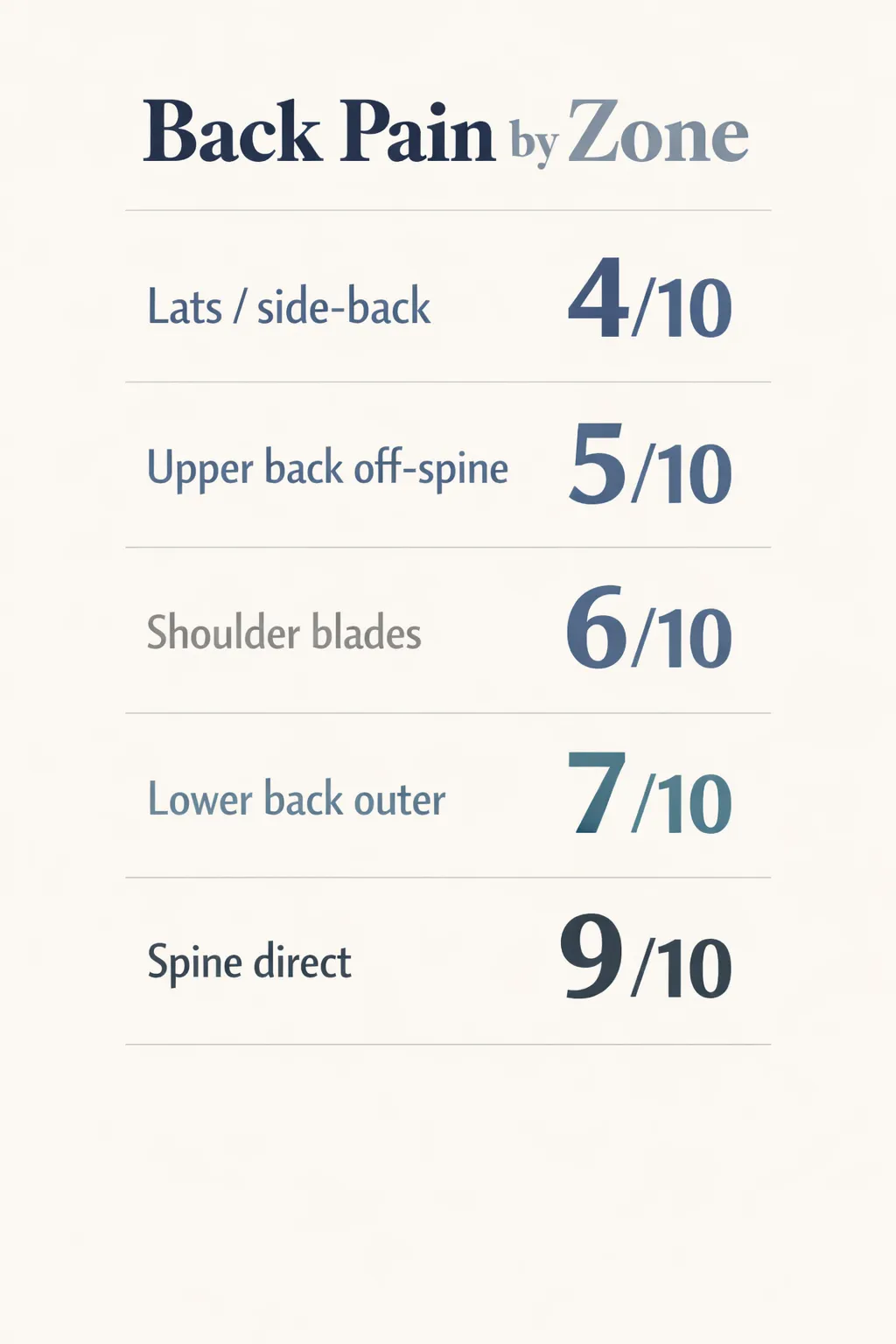 Pain ratings by back zone range from 4/10 (lats) to 9/10 (spine).
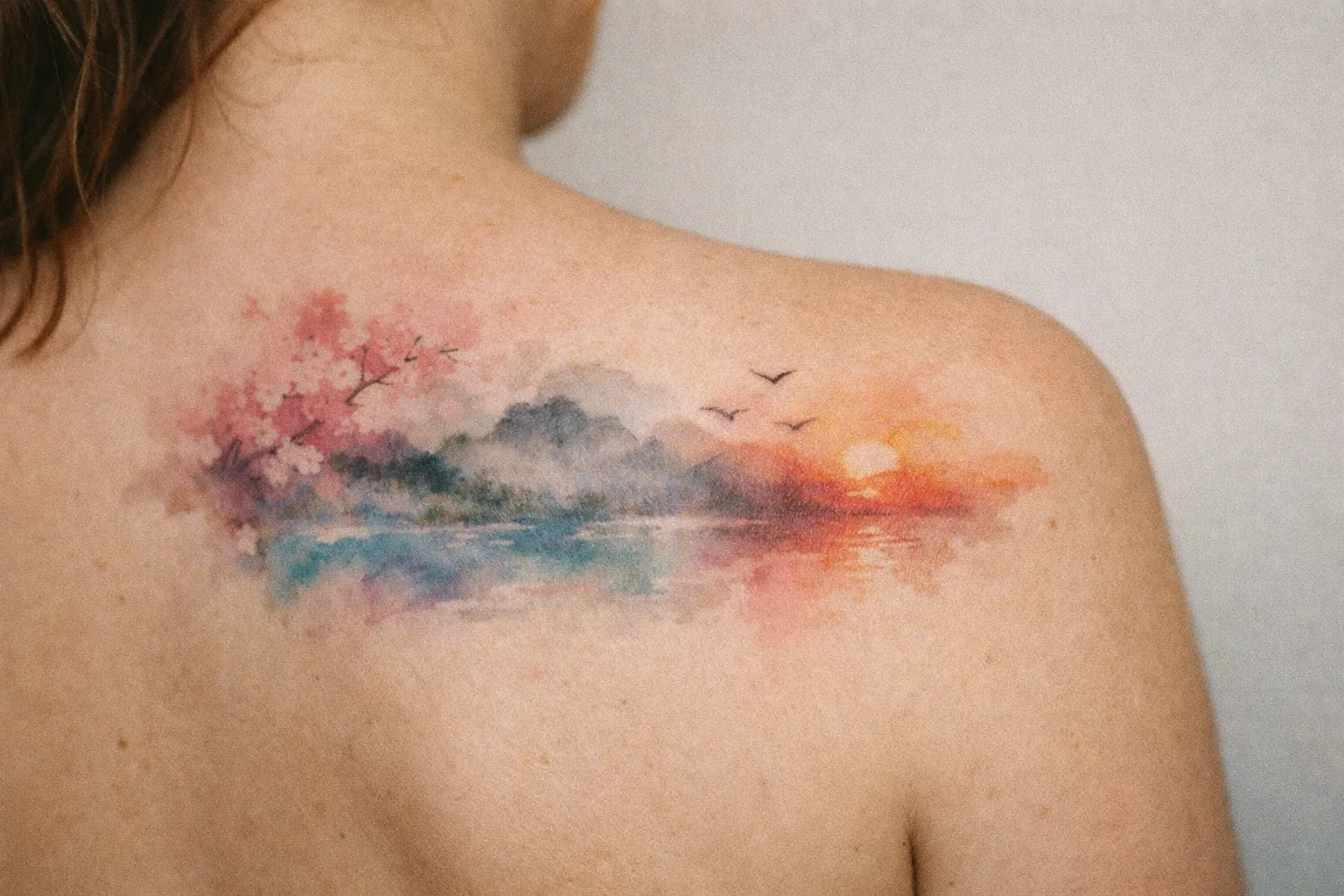
Here’s how the zones stack up. The lats and side-back are the gentlest zone on the back - thick muscle, few bony protrusions, good for large filler and wraparound pieces, and noticeably easier than the ribcage or ditch. Upper back away from the spine is a step up from the lats but still manageable: broad muscle with moderate nerve density, and that makes it the sensible choice for a statement piece or a first large tattoo. Shoulder blades are harder than the surrounding trapezius because of the bony surface and the skin stretching involved, which is why wings and symmetrical designs there hurt more than the muscle on either side. The outer lower back is a moderate-to-sharp zone - lower back and hips typically fall in the 5 to 7 out of 10 range - sharper than the upper back thanks to nerve clusters and sacrum proximity, best reserved for ornamental bands and horizontal motifs. The spine itself, tattooed directly over the vertebrae, is the sharpest zone on the back by a clear margin - commonly rated around 9 out of 10, comparable to the sternum and shin - reserve it for script and linear symbols and plan short sessions.
Back Pain Zone Comparison
| Lats / side-back | Upper back (off-spine) | Shoulder blades | Lower back | Spine (direct) | |
|---|---|---|---|---|---|
| Pain Score | about 4/10 | about 5/10 | about 6/10 | about 7/10 | about 9/10 |
| Why It Hurts | Thick muscle, few bony protrusions | Broad muscle, moderate nerve density | Bony surface, skin stretched during work | Nerve clusters, proximity to sacrum | Needle vibration on vertebrae, no muscle buffer |
| Best For | Large filler, wraparound pieces | Statement pieces, first large tattoo | Wings, symmetrical designs | Ornamental bands, horizontal motifs | Script, linear symbols - plan short sessions |
Why the spine is in a different pain category
Simple mechanical reason: the needle’s vibration transmits directly into bone with no muscle buffer to absorb it. That’s why pain guides consistently flag the spine as a separate category from general upper or lower back. I’ve watched clients who sailed through four hours on the lats tap out after 45 minutes on the vertebrae - it’s a different sensation entirely, more of a deep rattling than a surface sting.
A standard recommendation follows from this: placing work just to either side of the spine rather than directly on the vertebrae makes sessions noticeably more manageable, because the off-spine muscle has lower nerve density and more padding.
Recent studio content from 2025 and 2026 also flags gendered sensitivity patterns: women may feel heightened sensitivity near the spine and lower back, while men often report it more acutely in low-fat, dense-nerve zones. Neither pattern is a rule, but it’s worth factoring into your expectations.
Starting smart: which zone to book first
If your pain tolerance is unknown, book your first back work on the upper back or lats. Both combine large surface area with the most manageable pain on the back, so you learn how your body responds before committing to the spine or lower back. First sessions on high-pain zones are how pieces get abandoned half-finished.
Planning a Statement Back Piece - Sessions, Scale, and Sequencing
A full back piece is a 15+ hour project split across multiple sessions over months, not a one-weekend commitment - and the sequencing you choose at the start determines whether the finished composition reads as unified or as scattered fragments. Plan the endgame before session one.
The time reality by scale: small back pieces run 1 to 3 hours, medium shoulder-blade or upper-back pieces 3 to 8 hours, large back pieces 4 to 12+ hours, and full back projects 15+ hours (1) across several sittings. Full-day sessions average roughly 8 hours of working time, with longer sessions typically split across multiple appointments. Because realism runs more than 2× slower than linework (2), a color or heavily saturated design pushes those numbers well past the baseline.
For full-back projects, the standard approach is to split the work into outline session(s) and separate shading or color session(s). This reduces acute swelling and keeps line quality high. Spine and lower back segments warrant shorter sessions of 3 to 5 hours because of pain intensity, while you can push longer on the upper back and lats.
Sequencing mirrors sleeve-building logic: start with an anchor on the upper back or lats where pain is lower and surface area is large, then expand toward the spine and lower back once you know how your body handles it. At the consultation, your artist maps the midline and shoulder width, then checks how the piece aligns when you stand, sit, and twist. Body symmetry decisions have to happen before the needle touches skin. Allow 3 to 6 weeks between major sessions for skin recovery, which puts a realistic full-back timeline anywhere from several months to over a year.
How to phase a full-back project without boxing yourself in
The danger is scattering unconnected small pieces across the back, which makes a future cohesive composition nearly impossible without cover-ups. I’ve seen it happen more than once - someone gets a 10 cm piece between the shoulder blades, then a script lower down, then decides they want a full back and realizes none of it connects. Decide the final scope before you book.
What to bring to the consultation
Bring your references, an honest sense of your budget and timeline, and questions about how the artist handles multi-session projects. Meaningful and custom work often carries a separate design fee for concept development, so ask about that upfront rather than being surprised by it.
Planning a Multi-Session Back Piece
6 monthsSteps to organize your back tattoo project for a smooth, cohesive result
- 1
Decide the final scope
Choose between a single statement piece or a full back before booking to match the right artist.
- 2
Book a design consultation
Bring 5-10 reference images showing motifs, line weight, and style - not exact copies.
- 3
Map midline and shoulder width
Have the artist mark your back and review the composition standing and seated.
- 4
Schedule the outline session
Start on the upper back or lats if your pain tolerance is unknown.
- 5
Allow skin recovery time
Wait 3-6 weeks between sessions before adding shading or expanding.
- 6
Plan clothing logistics
Use front-opening tops for upper back work and loose waistbands for lower back sessions.
Back Tattoos for Men - Motifs That Work at Scale
Men’s back tattoos favor designs that need room to breathe: dragons, samurai scenes, biomechanical armor, large animal realism, and mythological compositions all benefit from the 40 to 50 cm of vertical space the back offers. Cramming these into a small placement wastes the design. The back is where they finally fit.
Full-back formats: dragons, armor, and irezumi
Japanese irezumi is the natural home for full-back work. The tradition was historically composed around large body areas, and classic motifs - full-back dragons, koi, samurai scenes with wind bars and waves - are designed as single narrative images that cover the entire back panel. A traditional full-back dragon commonly occupies most of the vertical canvas from nape to lower back. Because irezumi compositions are built around the body’s curves, the back is their native canvas rather than an afterthought.
Two technical hallmarks of irezumi worth knowing: bold, deliberate outlines paired with graduated color shading that follows the body’s contours, and heavy use of negative space to let the background breathe. The common pitfall when artists do it badly is cramming too many competing elements - clouds, waves, wind bars, and a dragon all fighting for the same space, with nothing reading clearly at distance.
Style note worth internalizing: heavy saturation or full-color realism runs more than 2× slower than black linework (2). The same dragon in Japanese traditional color will take dramatically longer than the same dragon in blackwork - budget your time and money accordingly.
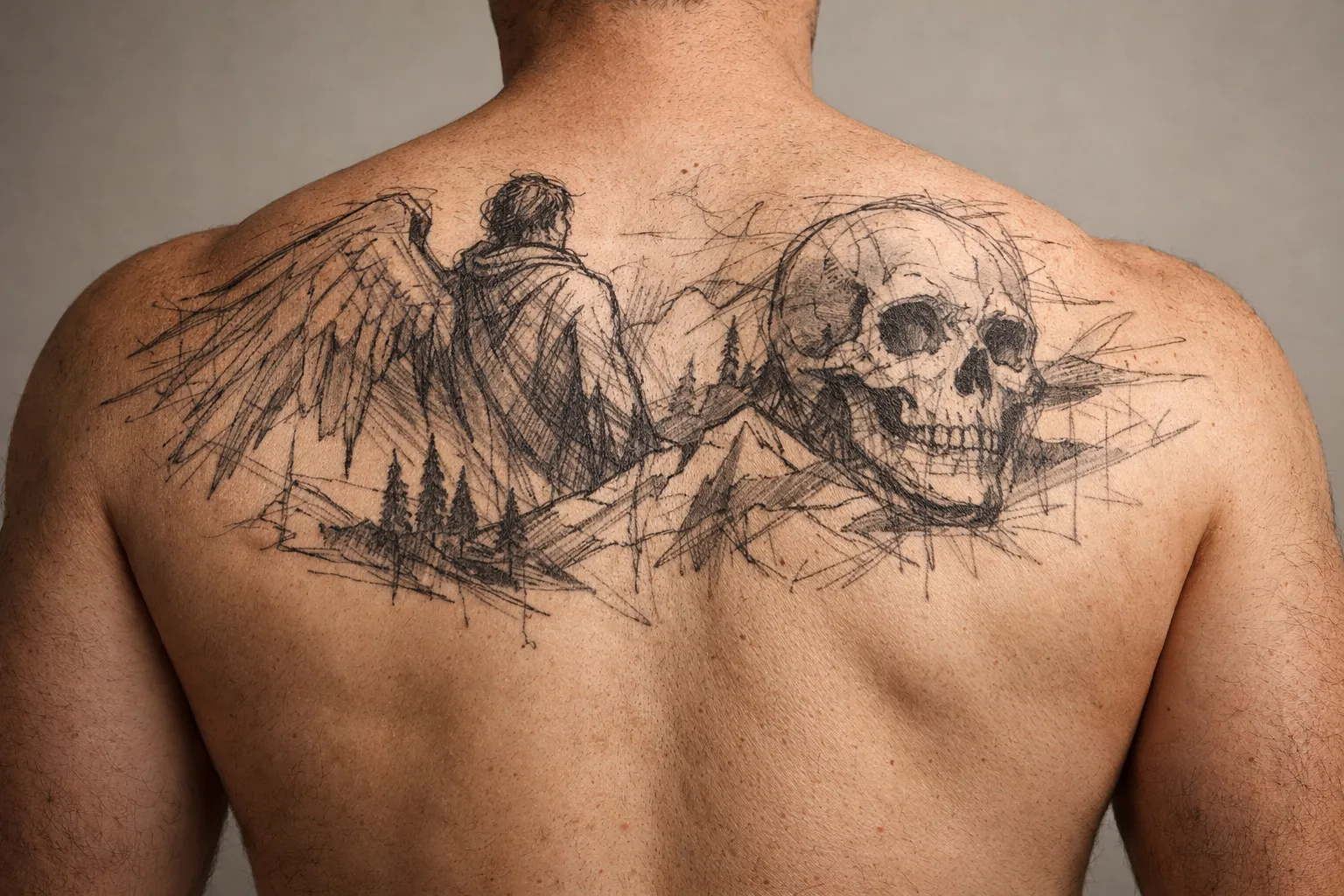
Wings across the shoulder blades
Wings across the shoulder blades are among the most requested back tattoos for men - angel wings, eagle wings, demon wings - typically spanning 30 to 40 cm shoulder to shoulder. American traditional versions use thick black outlines and a limited palette, which age well and read cleanly from a distance. The pitfall with traditional wings is muddy feather detail: when an artist crams too much fine linework into a traditional format, the black fills bleed together as the piece heals. Realistic feather versions require well over 10 to 15 hours and demand a specialist.
Names, crosses, and bold upper-back scripts
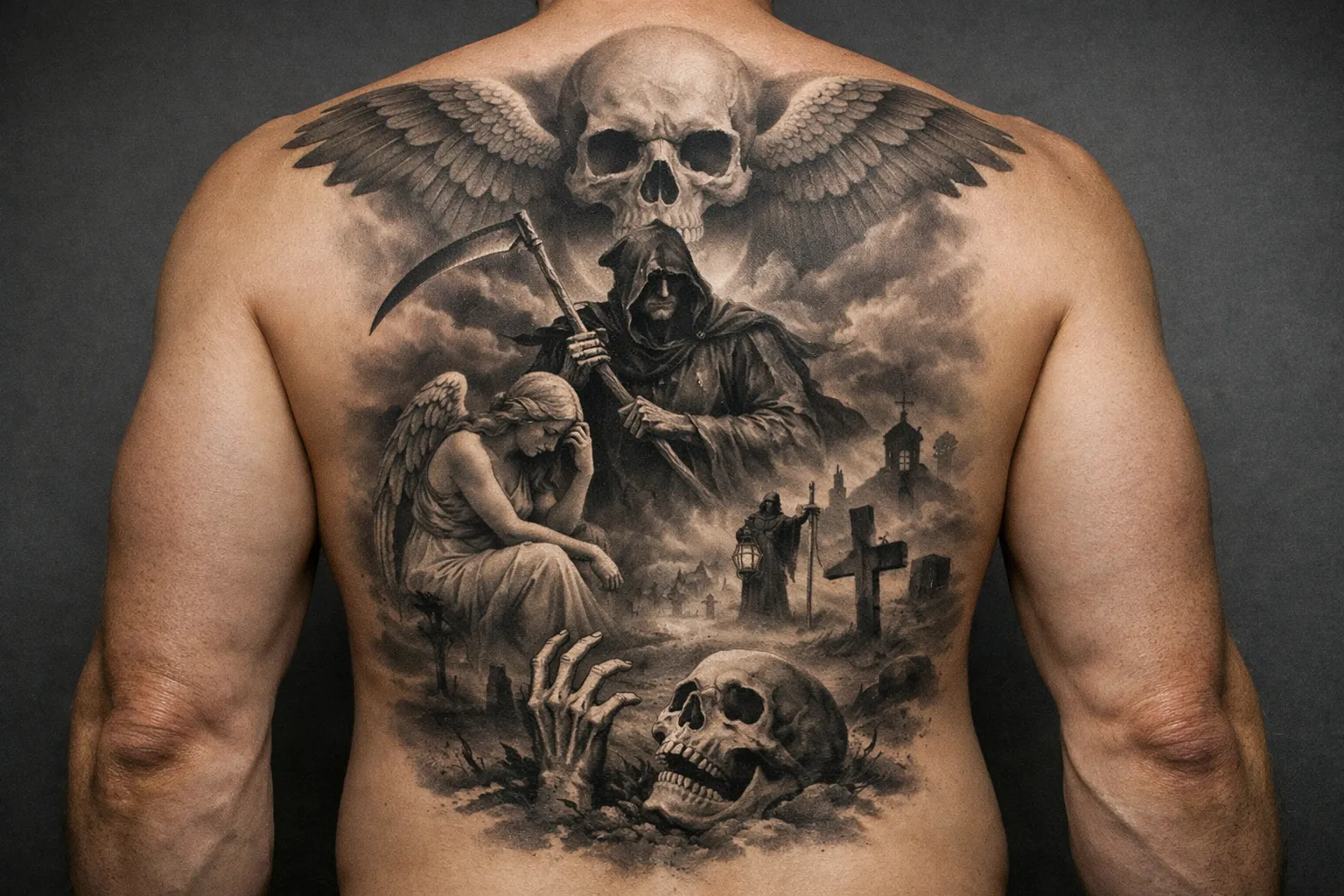
Family and last name scripts sit commonly across the upper back in bold lettering. Keep the letter height at 3 to 5 cm for long-term legibility - anything smaller distorts as the trapezius flexes. A bold Latin cross centered on the upper back or a geometric mandala between the shoulder blades both anchor well and leave room to expand later. Religious and memorial scenes - crucifixion, archangels, Last Supper - are inherently vertical narratives that use the full canvas from upper to lower back, and they’re a natural fit for black and grey realism.
Butterfly Back Tattoo, Spine Designs, and Women’s Back Motifs
Women’s back work spans decorative and symbolic territory - butterflies, spine ornamentation, florals, and celestial sets - often executed in fine-line and dotwork for a lighter aesthetic than the heavy irezumi and realism common in men’s pieces. These read as intentional and delicate rather than aggressive.
Butterfly placement and sizing options
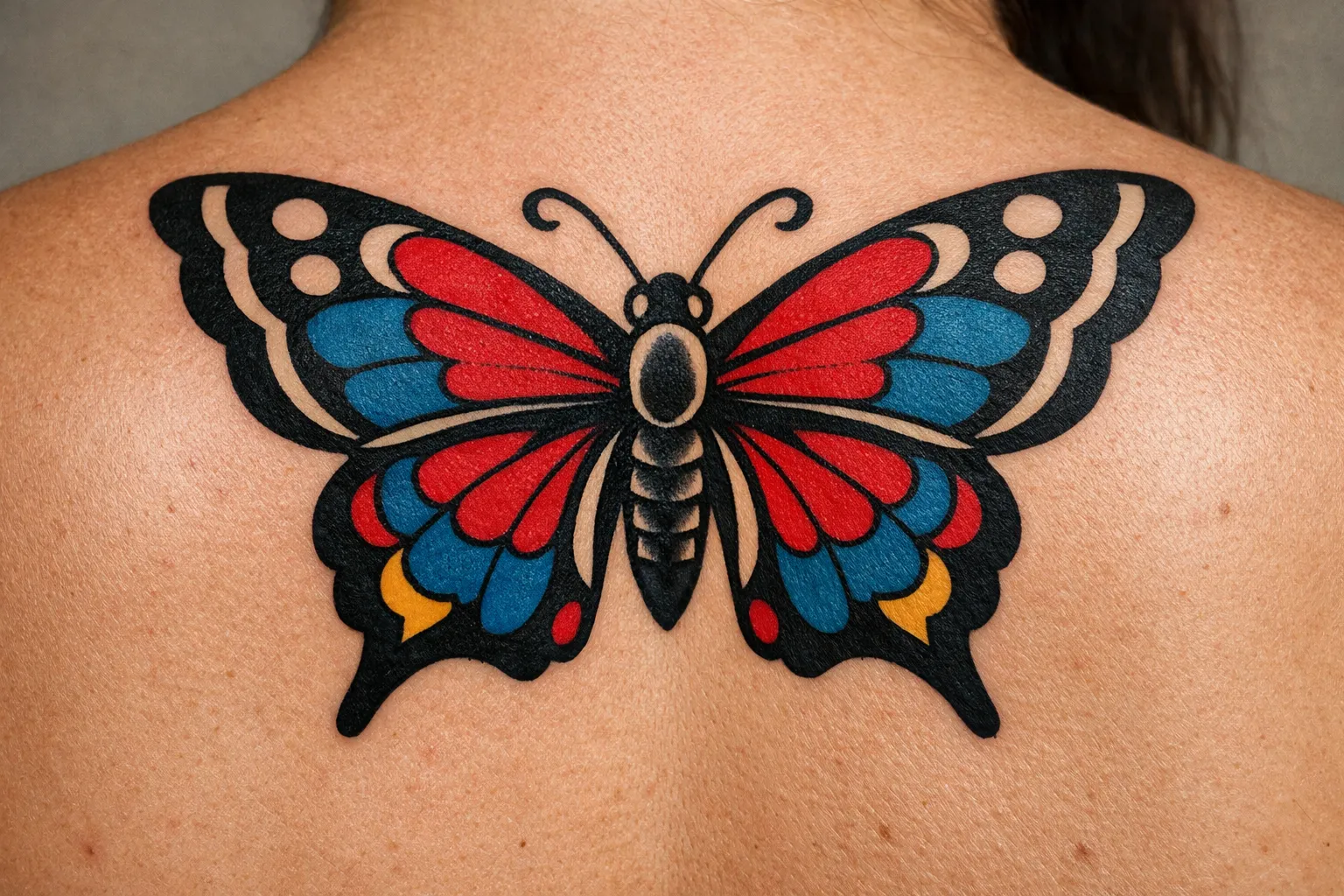
A butterfly back tattoo works two main ways: a single large butterfly centered between the shoulder blades with a 15 to 20 cm wingspan, or a multi-butterfly composition climbing along one side of the spine. Both combine well with floral elements or watercolor effects, and fine-line or dotwork styles suit the placement.
On symbolism: the butterfly reads as transformation and rebirth across both Western and East Asian tattoo traditions - there’s no single fixed cultural origin, so don’t let anyone sell you one “true” meaning. It means what it means to you. What I can tell you is that the centered upper-back placement is one of the more forgiving spots for this design. The flat trapezius surface holds fine-line detail well, and a 15 to 20 cm wingspan gives the artist enough room to work the wing structure without compressing it into mush.
Spine tattoo design rules: spacing, legibility, and pain management
A spine tattoo uses that narrow 3 to 5 cm column for vertical compositions: moon phases, chakra symbols, runes, botanical stems, minimalist animals climbing upward, or vertical script. Two technical rules keep it legible over time. First, plan consistent 1 to 2 cm spacing between symbols to accommodate vertebral movement and prevent overlap when you bend. Second, keep script at a minimum letter height of about ½ inch (12-13 mm), because anything smaller distorts as the skin flexes over the vertebrae.
Ornamental spine “jewellery” - mandala chains, geometric diamonds, lace-like patterns running cervical to lumbar - is trending in fine-line and dotwork. Just respect the pain reality: the spine is consistently ranked among the most painful spots on the body, sharper than the ribcage and comparable to the shin or sternum, commonly rated around 9 out of 10. The aesthetic payoff is high, but book shorter sessions of 3 to 4 hours and expect more breaks.
Floral, ornamental, and celestial back pieces
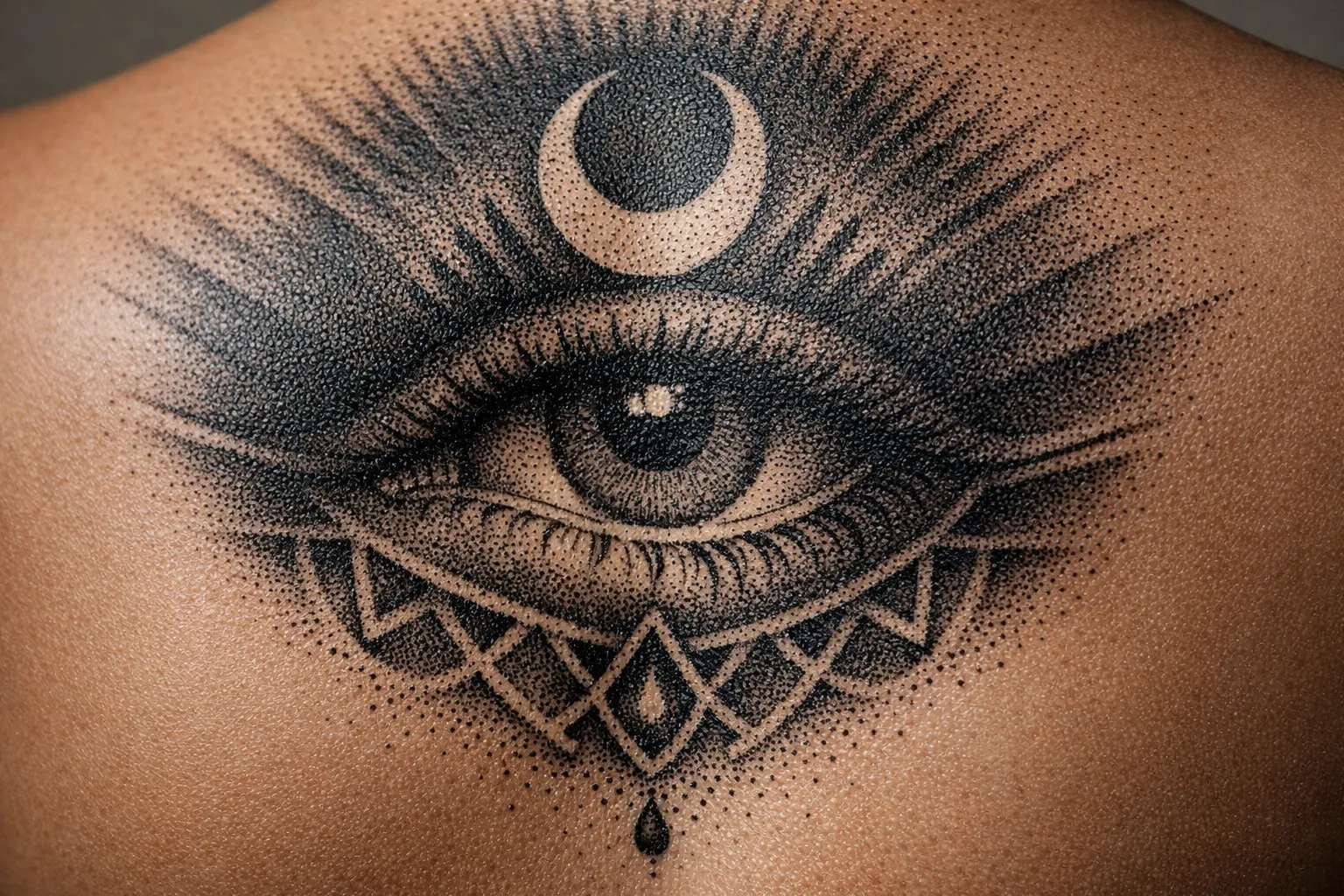
Large peony or rose compositions spanning the upper back, often asymmetrical and leaning toward one shoulder, age well on the flat upper-back surface - fine-line botanical work in particular. Moon and constellation sets scatter across the upper back or follow the spine and suit minimalist and fine-line styles. The flat trapezius area is forgiving of detail, which is why botanical back pieces hold up better than the same work on a high-movement placement like the ribs.
Lower Back Tattoos - Beyond the Early-2000s Associations
The lower back tattoo peaked in the late 1990s and early 2000s, declined under stigma, and is now being reclaimed - particularly by Gen Z as part of Y2K nostalgia and a feminist reinterpretation of the “tramp stamp” label. The placement itself was never the problem. The dated clip-art tribal was.
Design choices that don’t date
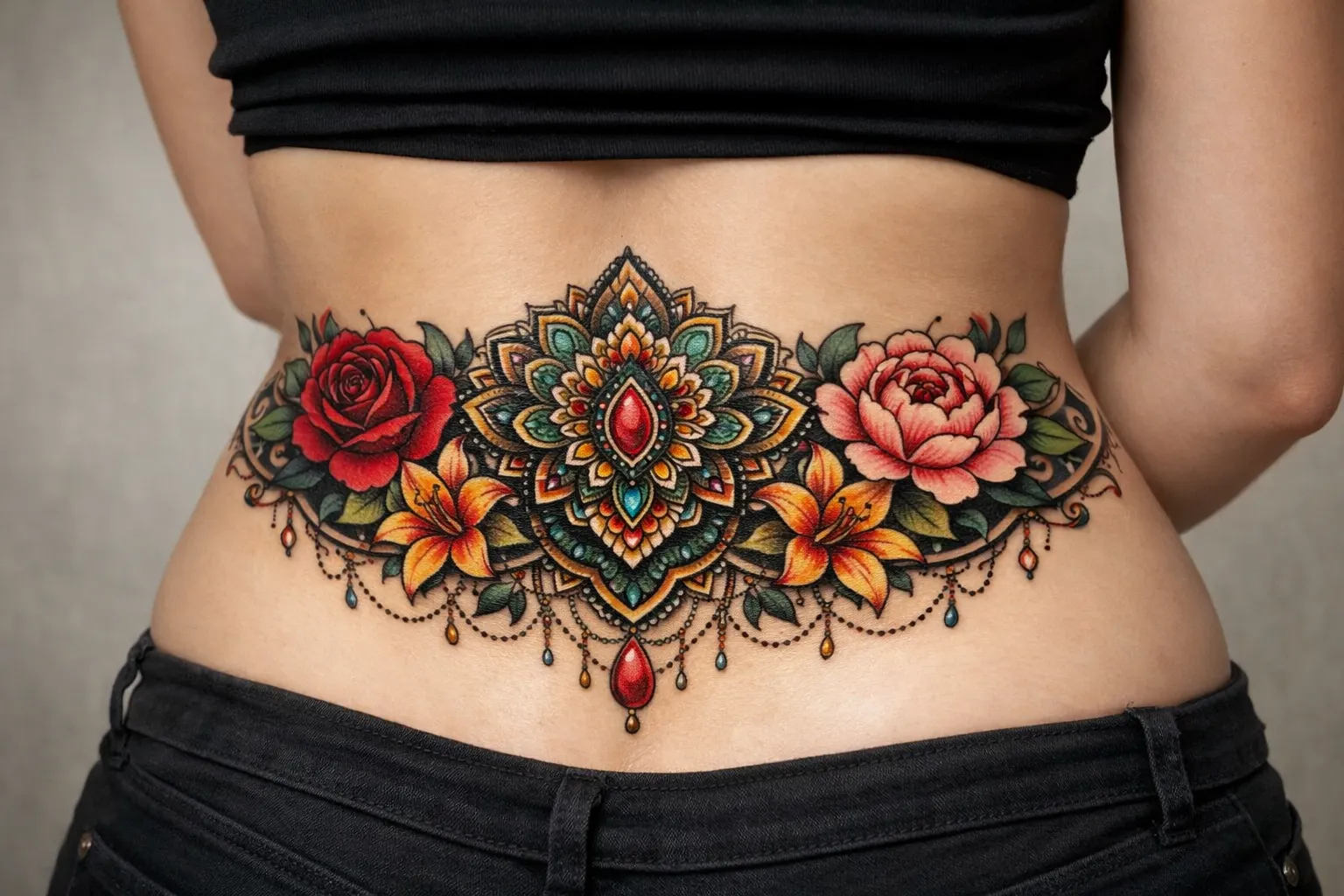
Current directions have moved well past tribal clip-art: ornamental mandalas, geometric bands, lace-work, lotus, phoenix, and protective symbols. Modern fine-line lower back pieces read as intentional rather than dated. Worth knowing for context - archaeological research published in 2022 described female Egyptian mummies with protective motifs on the lower back and buttocks linked to the deity Bes, so the placement has a history far longer than any 2000s comedy sketch.
Sizing and placement geometry
Keep the width at 50 to 70% of your hip width to avoid visual spill onto the flanks and to hold symmetry through weight fluctuation. A 15 to 20 cm centered design is a practical starting point. Center the piece on the spinal midline and lean on subtle symmetry - mirrored wings, floral arcs - so it reads correctly when your body rotates or your weight shifts by a few kilos.
On pain and healing: the outer lower back rates around 7/10 thanks to nerve clusters and sacrum proximity, sharper than the upper back, so plan sessions of 3 to 4 hours maximum. Tight waistbands and shapewear complicate healing in the first 2 to 3 weeks. On visibility, the placement is genuinely flexible - fully hidden under mid-rise jeans, visible with low-rise or a bikini.
Meaningful Back Tattoos - Using the Full Canvas for Personal Work
The back’s scale makes it the natural home for a meaningful back tattoo that needs room to develop: memorial portraits, family trees spanning shoulder to shoulder, spiritual scenes, and personal life-narrative compositions running nape to lower back. Small placements force you to compress. The back lets the concept breathe.
Memorial portraits and family tributes
Memorial portraits demand a strong healed portrait portfolio from the artist - ask to see healed work, not just fresh photos. Keep facial detail at a minimum of about 15 cm so it survives long-term without blurring, and plan for upper back or full back format in black and grey realism, the standard for this work. Family names across the upper back work in bold lettering at 3 to 5 cm letter height, in blackwork or American traditional weight, legible at distance and stable over the trapezius mass.
Spiritual and mythological full-back scenes
Spiritual and religious scenes - crucifixion, archangels, mandalas as spiritual maps, deity portraits from Hindu or Buddhist traditions - all benefit from the vertical scale of the full back. Japanese irezumi mythological scenes are a culturally grounded option: in Japanese tradition, dragons read as protection symbols and koi as perseverance. These full-back scenes fall into the 15+ hour category, especially in black and grey realism or detailed irezumi.
Life-narrative compositions arrange sequential scenes or symbols vertically - a starting point at the top, key markers at intervals, a grounding image at the lower back. This kind of work needs careful pre-planning so it reads as unified rather than a timeline of disconnected tattoos. Budget for the design work separately from the tattooing time. Custom meaningful pieces usually involve significant concept development and revision, and the artists who do this well charge accordingly.
Healing a Back Tattoo - The Logistics Nobody Warns You About
A back tattoo is uniquely awkward to heal: you can’t easily see it, and daily life throws constant friction at it from office chairs, backpacks, sports bras, tool belts, and car seat headrests. Plan your schedule and wardrobe around the heal, not the other way around.
Large pieces need second-skin (saniderm) films sized 20 to 40 cm or more, and you’ll want someone to help apply and check coverage. Keep second-skin on for no more than 7 days - past that, adhesive irritation and fluid buildup become a real risk.
Day-by-day healing timeline
- Day 1 to 3: Open wound phase. Wash 2 to 3× daily with fragrance-free soap; apply a thin ointment layer; avoid lying directly on the fresh tattoo.
- Week 1: Peeling begins around day 4 to 7. Do not pick. Moisturize 2 to 3× daily with a fragrance-free moisturizer and avoid soaking - no baths, pools, or hot tubs.
- Week 2 to 4: The surface closes while deeper layers keep healing. Itching is normal; resume normal activity cautiously and keep the piece out of direct sun. Sun-protective clothing is the practical solution here - easier than applying SPF to your own back.
- Week 4 onward: Back tattoos on large pieces reach surface healing around 4 to 6 weeks, with deeper recovery running longer because of friction and sleeping pressure. Once healed, apply SPF 30 to 50+ in the sun - UV is the primary long-term fading driver.
Clothing and friction management
For the first 7 to 14 days, choose front-opening tops for upper back work and loose waistbands or dresses for lower back work. Avoid backpacks entirely. Strapless or loose-fitting options work best for shoulder-blade pieces.
These aren’t suggestions. A bra band or backpack strap dragging across a peeling tattoo lifts pigment and leaves patchy healing. I’ve had clients come back after their first week looking like the piece was half-erased because they didn’t swap out their daily bag. It’s a fixable problem, but it means a touch-up session and more healing time.
Pre-session prep matters for long sittings too. Eat a full meal 1 to 2 hours before, hydrate the day before and the morning of, and avoid alcohol for 24 to 48 hours prior. Skipping these steps raises your dizziness risk and forces extra breaks, which degrades line quality in the final hours of a long session.
How back pieces age over time
Upper back and lat pieces on muscle age predictably well. Spine and lower back pieces crossing the lumbar curve can warp more under posture changes and weight fluctuation - factor that into your placement decision at the design stage, not after the piece is done.
Common Planning Mistakes That Derail Back Projects
Most failed back projects fail in the planning, not the tattooing. Here are the errors that come up again and again.
- Underestimating total time. Expecting a full back in one or two sessions collides with the 15+ hour reality (1), which requires months of commitment. Budget for the timeline before you start.
- Ignoring sub-area pain differences. Choosing the spine or lower back as a starting point without knowing your pain response is how sessions get aborted. The upper back and lats are the sensible entry points.
- Scattering unconnected small pieces. This makes a future cohesive composition nearly impossible without cover-ups. Plan the endgame before the first session.
- Choosing realism without accepting the timeline. Realism runs more than 2× slower than linework (2). A large realistic dragon is not a two-session project, no matter how badly you want it finished.
- Spine script too small. Script letter height below about ½ inch (12-13 mm) on moving tissue distorts over time, and vertebral movement compounds the problem.
- Ignoring clothing and work logistics. Office chairs, backpacks, and sports bras are daily realities that directly affect healing. Schedule around them.
- Skipping session prep. Arriving hungry, dehydrated, or sleep-deprived to an 8-hour session raises the chance of dizziness, extra breaks, and degraded line quality late in the sitting.
Frequently Asked Questions
- How long does a full back tattoo take?
- A full back tattoo typically runs 15+ hours of work spread across multiple sessions, broken into 4 to 10+ sittings depending on style and detail level - published estimates vary widely, with some sources putting a full-color or full-realism back well above 30 hours total. Realism and full-color irezumi push toward the higher end.
- Which part of the back hurts the most?
- The spine directly over the vertebrae hurts the most (about 9/10), followed by the lower back (about 7/10), shoulder blades (about 6/10), with upper back and lats being least painful.
- Can I start small and expand a back tattoo later?
- Yes, start with a central upper-back anchor piece and expand later with the same artist to maintain compositional coherence.
- How do I sleep after a back tattoo?
- Sleep on your stomach or side for the first few nights; use clean sheets and keep any second-skin bandage on for up to 7 days.
- Do back tattoos age well?
- Upper back and lat tattoos age predictably well; spine and lower back pieces may warp with posture and weight changes over time.
- What style works best for a full back piece?
- Japanese irezumi, black and grey realism, and neo-traditional styles hold up well; avoid mixing styles in one composition.
- How soon can I go back to work after a back tattoo session?
- Desk work is usually fine within 1-2 days if you avoid pressure on the tattoo; physical jobs require 5-7 days off.
What Actually Matters for Your Decision
Three things decide whether a back piece works. First, choose your starting zone by pain tolerance - upper back and lats first, spine and lower back later, once you know how your body responds. Second, settle the final scope before session one so scattered pieces don’t block a future composition. Third, the back rewards patience: a full piece built over 6 to 18 months in planned sessions will outlast and outperform anything rushed into two sittings.
Placement determines your pain and how the piece ages. Style determines the time commitment - realism at 2 to 3× the hours of linework is the single biggest multiplier. The consultation is where composition lives or dies, because that’s where the midline gets mapped and the design gets fitted to how your body actually moves.
Book the consultation before you book the session.