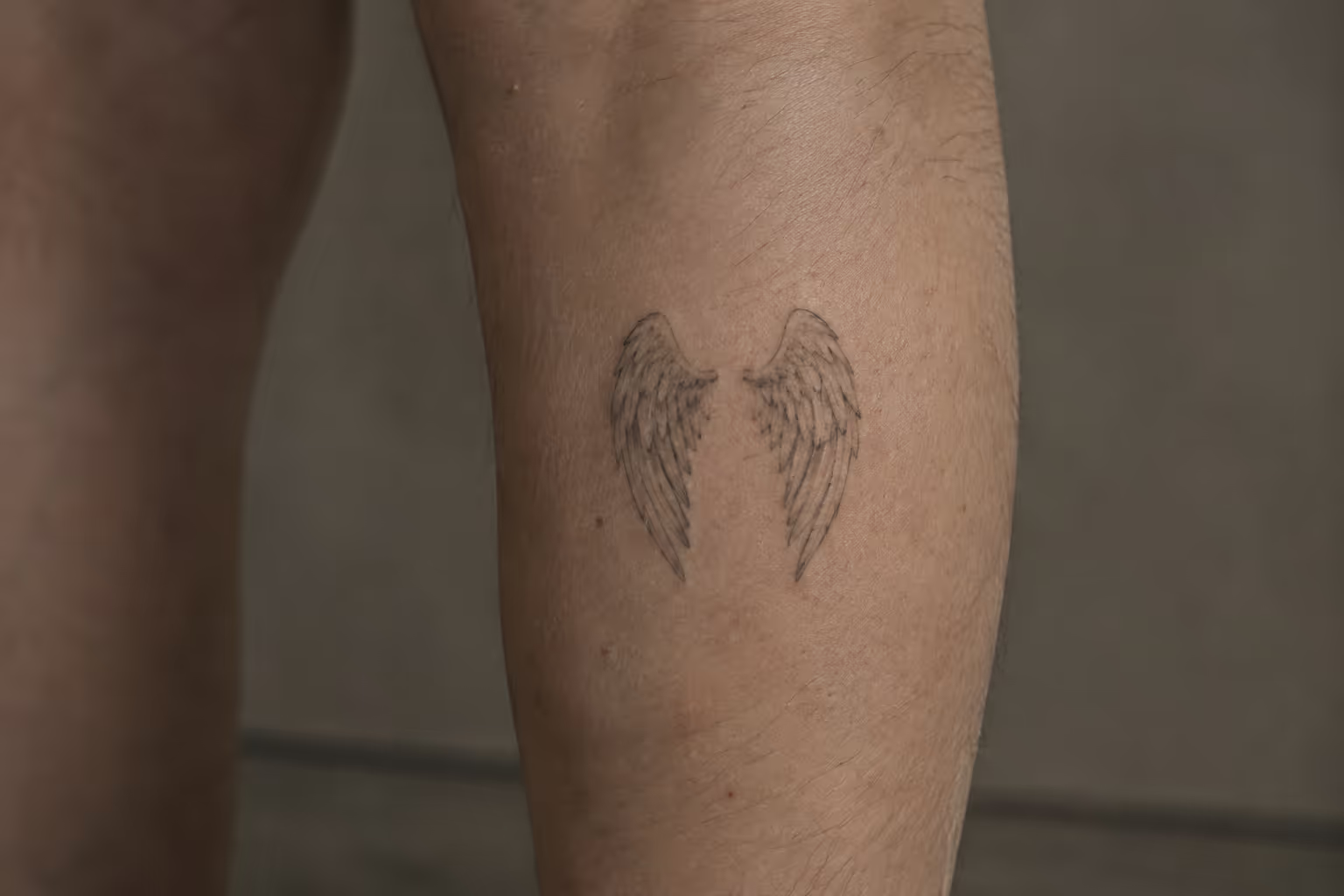
An angel wings tattoo can mean protection, faith, freedom or remembrance, and which one depends on who’s wearing it. No rulebook fixes the meaning. What decides how the piece reads on skin is the style, the scale, and whether the placement gives the feathers enough room. A 20-inch realistic spread across the back and a 1.5-inch fine-line pair on the collarbone share a motif and little else.
Here is the trade-off before you book. The motif is flexible: it works as a spiritual symbol, a memorial or a purely visual choice, and it fits almost any placement from a full back to the inside of an ankle. It is also easy to personalize with a name, a date or a paired symbol. The downsides are just as concrete. Because the meaning isn’t fixed, strangers will read it their own way. Small versions tend to blur as feather lines spread under the skin. And like any permanent tattoo, you’re weighing ink safety and a few weeks of healing, not only a design.
✓ Pros
- The motif can carry personal meaning without requiring religious imagery.
- A wing pair can be designed to follow the body's natural lines rather than forcing a fixed template.
✗ Cons
- A paired design can look unbalanced if the stencil is not checked on the body in a standing position.
- Memorial lettering and feather detail both need enough space to remain legible as the ink settles.
Angel wings tattoo meaning: protection, faith and remembrance
The angel wings tattoo meaning most wearers intend is protection, guidance, faith, freedom or remembrance, but these are common readings, not a single fixed definition (1). The same drawing can be a devotional piece on one person and a memorial on another.
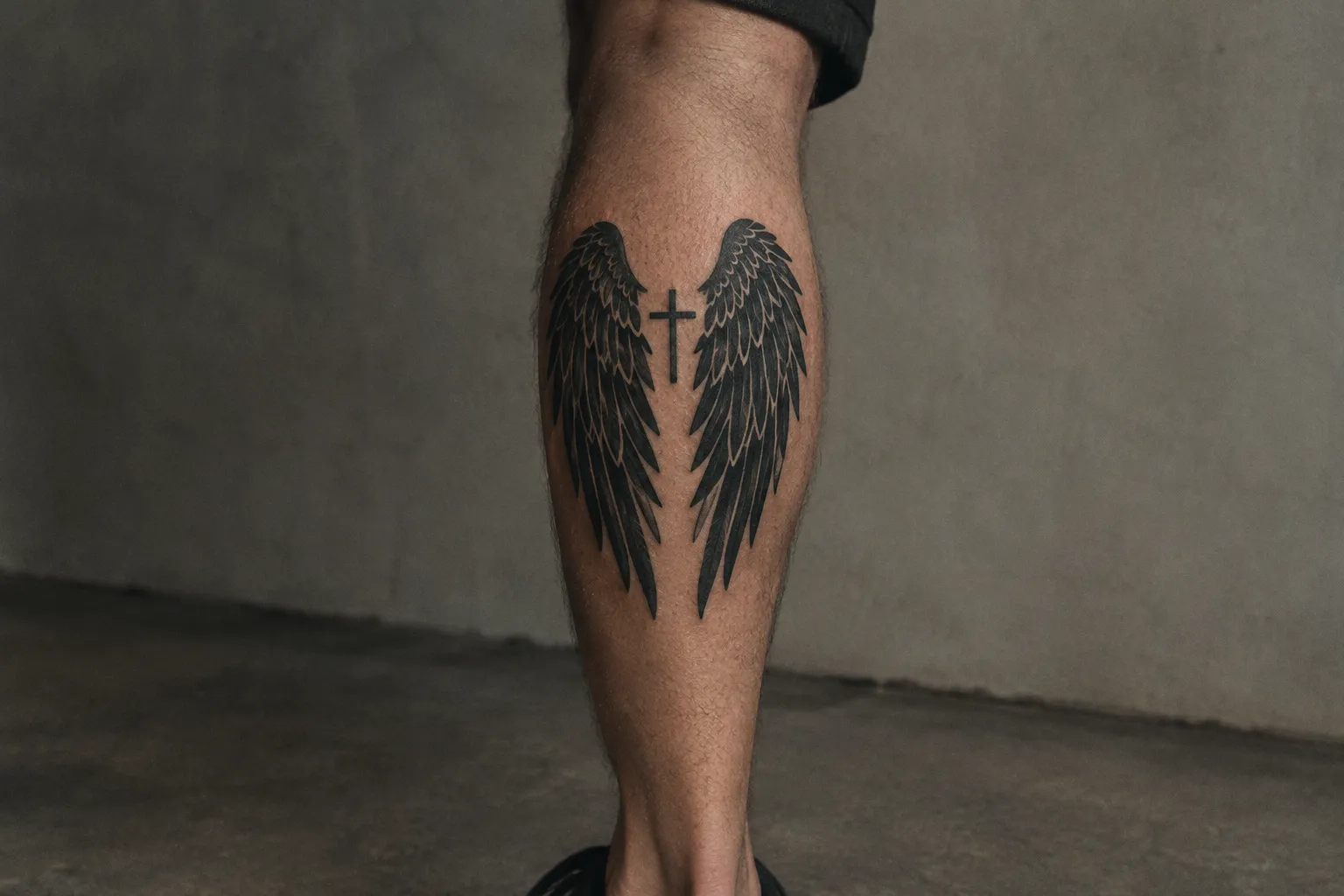
Common associations: protection, faith, freedom, remembrance
Winged guardian figures are much older than the angel you picture from church art. Assyrian palace reliefs show winged protective spirits. Egyptian art gives Isis outstretched wings, and Greek art has Nike, the winged figure of victory. The earliest Christian images of angels show them without wings; winged angels appear from the late 4th century, long after Greek art had given human figures such as Nike wings (6). In Jewish, Christian and Islamic traditions, angels are messengers and protectors, which is where the “guardian” reading comes from.
In tattooing today, wings still carry faith for many wearers, and they are also a frequent memorial choice: a loved one who died, “watching over” the wearer (1). A third group treats them as a secular symbol of freedom or of getting through a hard stretch, with no religious content at all (4). None of these readings is more correct than the others. If a specific meaning matters to you, add something to the design that points to it: a name, a cross, a date. Otherwise people will fill in the blank themselves.
Do angel wings point up or down?
No reliable source establishes that upward or downward angel wings carry a fixed meaning, so treat direction-based symbolism as unverified rather than as a rule. You’ll find blogs claiming raised wings mean ascension and lowered wings mean mourning or a “fallen” angel. Other pages say the reverse. The published design coverage describes varied symbolism without settling on a direction rule (1)(4).
In practice, wing direction is a composition decision. Raised wings with the tips pointing up add height and suit a tall placement like the spine or the back of the arm. Lowered, folded wings sit tighter and suit the shoulder blades or a chest piece where you want the shape to follow the collarbones. Pick the angle that fits your anatomy and the mood you want, then explain it however you like. If you’re drawn to fallen angel imagery specifically, the clearer signals are broken or torn feathers and dark shading, not the angle alone.
A quick note on 444 angel wing tattoos
A 444 tattoo with wings is a different motif: the number comes from modern “angel number” numerology, which spread mostly through social media, not from any religious or tattoo tradition. People who wear it usually describe it as a sign of protection or of being on the right path. That meaning is recent and informal, and no research backs a single agreed reading. Adding wings to 444 simply layers the guardian idea on top. We cover this separately in our guide to 444 angel number tattoos.
Angel wings memorial tattoo: honoring someone you’ve lost
An angel wings memorial tattoo works best when the design points to one specific person through a name, a date or a symbol tied to your relationship, instead of relying on wings alone to carry the meaning (1)(4). Wings by themselves read as “memorial” to some viewers and “spiritual” or “decorative” to others. The additions are what make the piece yours.
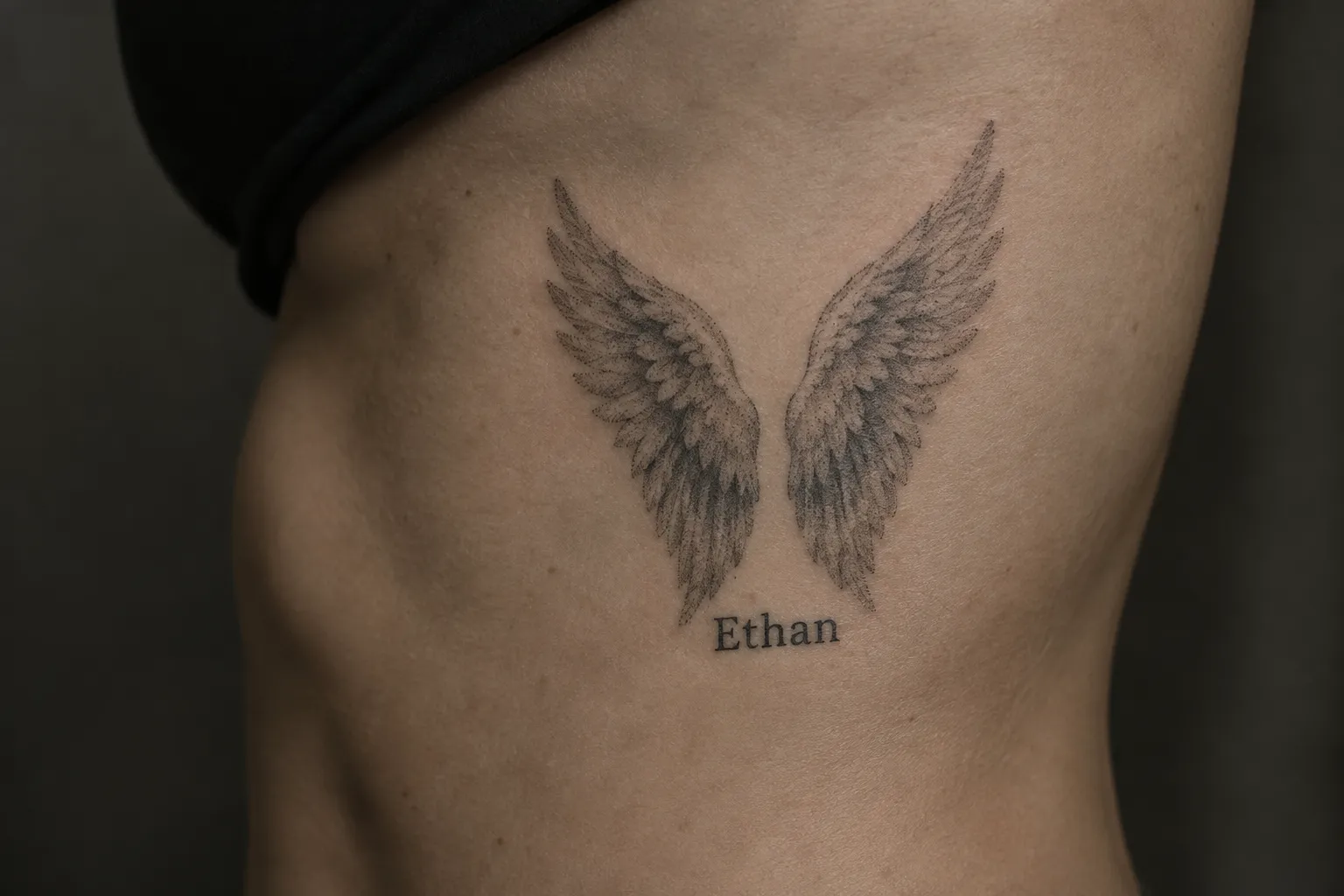
Symbols and wording that add personal meaning
The standard pairings are a name or initials between the wings, birth and death dates underneath, a cross, a heart, or a halo. Those work, but the strongest memorial pieces use something only you would choose: the person’s handwriting copied from a card, a flower they grew, a nickname nobody else used. Pick imagery that reflects your relationship with them rather than a generic symbolism claim (1)(4).
Lettering is where memorial designs most often fail as they age. Size it by letter height, measured across the whole letter, using the same floors as our tattoo font guide:
- Standard script: at least 12 mm (1/2 in) letter height.
- Fine or ornate script: at least 25 mm (1 in), because thin hairline strokes close up as the ink settles.
- Block, serif, typewriter lettering and numerals (dates): at least 6 mm (1/4 in).
If you want a copied handwriting signature, have your artist thicken the strokes slightly. Real handwriting is often too thin to heal cleanly. On the wrist, only bold script or block lettering holds over the years. Fine script there tends to blur into a grey line.
Placement ideas for memorial designs
Design guides point to the chest and the arm for memorial wings with a name or date, and to the wrist or collarbone for smaller memorial details (4). Three placements that work well:
- Chest (over the heart), 3-6 in (7.5-15 cm) wide: private under a shirt and meaningful for many wearers. It hurts more than the forearm, especially near the sternum.
- Inner or outer forearm, 3-5 in (7.5-12.5 cm) wide: you see it every day, it heals easily, and the flat surface suits a name underneath. Forearm is one of the easier placements for pain.
- Shoulder cap or back of the shoulder, 4-7 in (10-18 cm) wide: the rounded surface suits wings that curve around the joint. Easy to cover, easy to show.
Think about who you want to see it. A forearm memorial invites questions from strangers. A chest piece is for you and the people you choose to show.
Design styles: realistic, fine-line, blackwork and wings with a cross
Angel wings tattoo designs start from a style (realistic, fine-line, blackwork or watercolor) and often add a combination such as a cross, a heart or an angel-and-demon contrast, each suited to different sizes and placements (4). Choose the style first, because it largely decides how big the tattoo has to be.
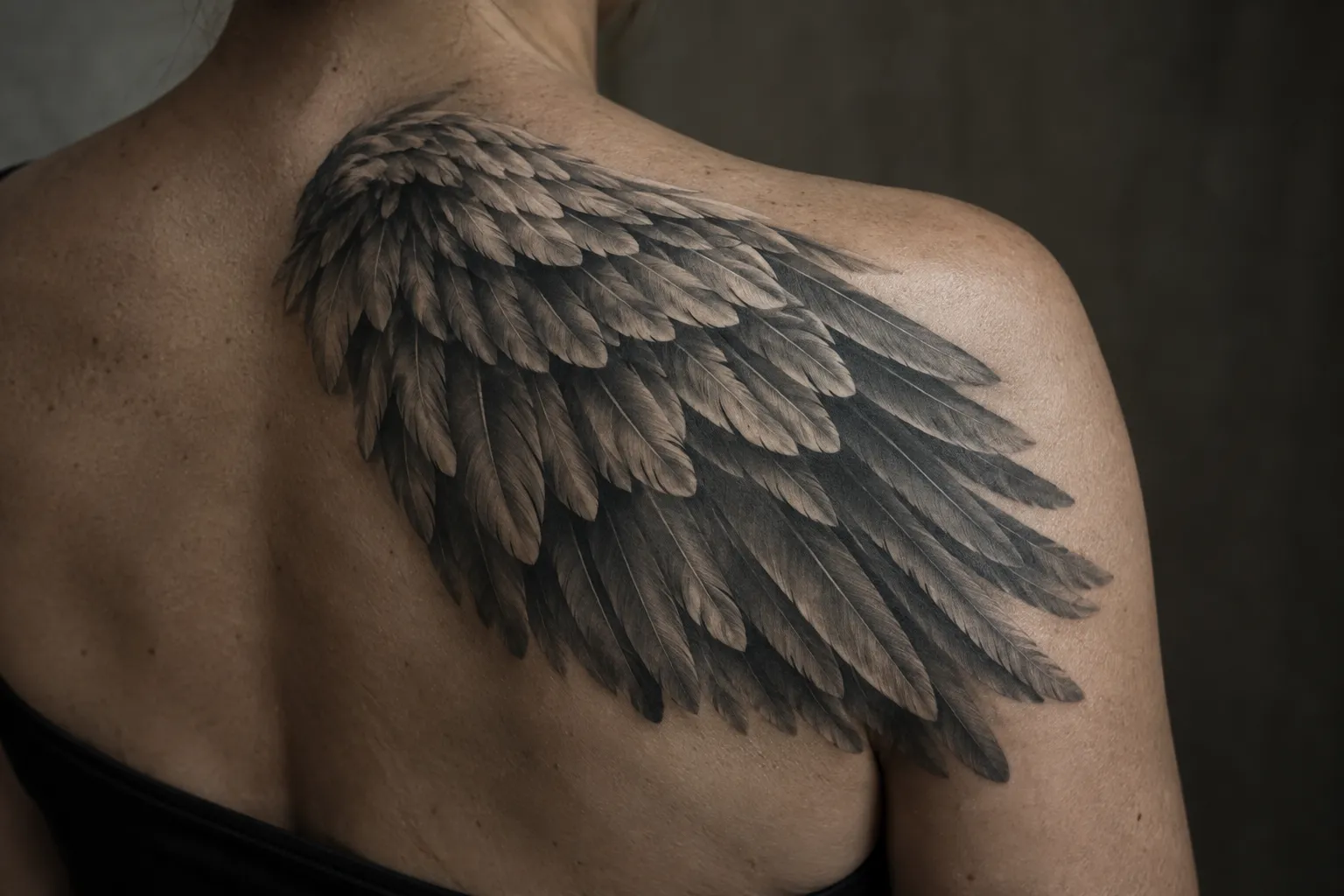
Realistic wings
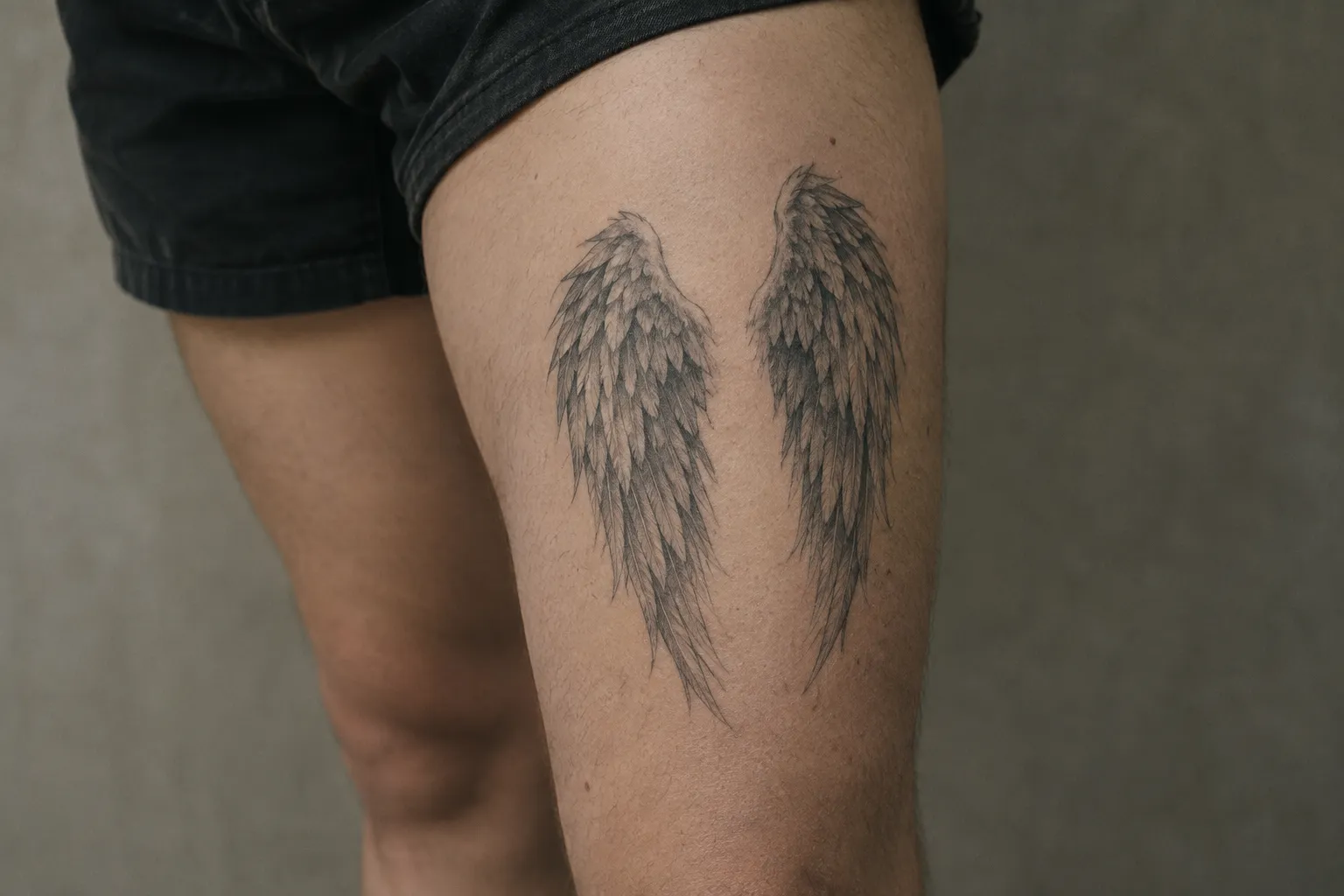
Realistic wings imitate real feathers: individual barbs, overlapping layers, soft shadows where one feather tucks under the next. The two technical hallmarks are smooth black-and-grey gradients built up in several shades of wash, and a full value range, from bare skin highlights to solid black in the deepest folds. That contrast lets the wings read from across a room. The source coverage pairs realistic wings with the back, shoulders and chest (4), and that pairing isn’t arbitrary: the style needs space.
The common pitfall is soft realism with no black anchor. Everything sits in the middle greys, it looks lovely fresh, and five years later it’s a flat grey smudge. Ask to see healed realism in the artist’s portfolio, not only fresh photos.
Fine-line wings
Fine-line wings use single-needle or small round-liner work: thin, even outlines with little or no shading. Hallmarks: consistent hairline linework and negative space doing the job that shading does in realism. Fine-line suits smaller sites like the wrist, collarbone and forearm (4).
The pitfall is overpacking. An artist draws every feather as a separate line two millimetres from the next. Ink spreads slightly under the skin over the years, and those lines merge. Fine-line also fades faster than bold work, so expect a touch-up sooner, especially on hands and wrists.
Blackwork wings
Blackwork uses solid black fills and heavy outlines, sometimes with feathers cut out as bare-skin shapes. Hallmarks: dense, even black saturation and bold graphic silhouettes with little or no grey. Blackwork wings are linked to power, contrast and darker symbolism, and suit the upper arm, back and thigh (4). They also age better than any other style here, because solid black holds its shape.
The pitfall is patchy packing: areas of solid black that heal blotchy because the artist went over them unevenly or overworked the skin. Large solid-black areas also take longer to heal and can scab heavily in the first week.
Wings paired with a cross or heart
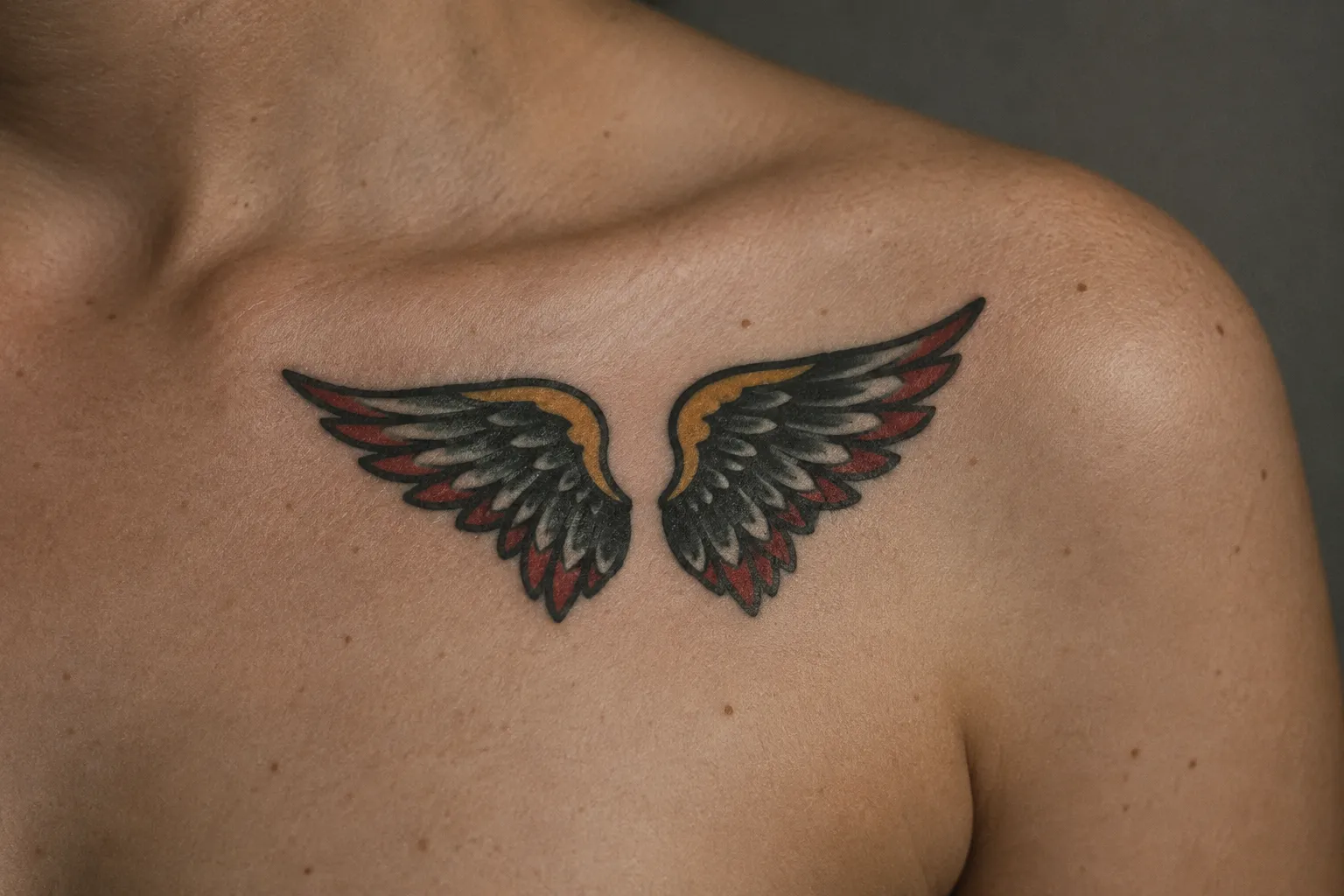
Wings with a cross usually signal faith and devotion and suit the chest, forearm or back (4). A heart with wings leans toward love and emotional freedom (4), and it works on the chest, arm or shoulder. The winged heart is also a classic of American traditional flash, where the hallmarks are a thick black outline and a limited palette (red, yellow, green, black) with solid color packing. Traditional-style wings are stylized, with a few large feathers, and they hold up for decades.
The pitfall with the cross versions is proportion. The cross gets squeezed between two large wings, the arms of the cross end up too thin to read, and it disappears at a glance. Make the central symbol at least a third of the total height.
Angel and demon wing contrasts
Angel-and-demon pairs, one feathered wing and one leathery bat-like wing, represent duality and inner conflict (4), and they need room: the back, chest or upper arms. The contrast only works if the two wings are rendered with different textures: layered feathers on one side, smooth stretched membrane with visible bone structure on the other. The pitfall is drawing both wings with the same shading approach, so the demon wing reads as a darker angel wing. At a distance the concept vanishes.
How the styles compare: Realistic wings need the most room, ideally 10 in (25 cm) or wider across the back, shoulder blades or chest. They have the highest detail level and blur badly if shrunk. Fine-line wings work from about 1.5-4 in (4-10 cm) on the wrist, collarbone or forearm, with low to moderate detail, and a moderate risk of blurring and fading if the lines sit too close. Blackwork wings suit 4-12 in (10-30 cm) on the upper arm, back or thigh, with bold, simplified detail and the lowest aging risk. Wings with a cross or heart range from about 3-8 in (7.5-20 cm) on the chest, forearm or back, with moderate detail and a moderate risk centered on the middle symbol getting too thin.
Angel wings back tattoo: large-scale designs for the back and shoulders
An angel wings back tattoo gives feathered detail the most room of any placement, which is why the back, shoulder blades and chest are the standard sites for large realistic wings (1)(5). Size is what lets an artist render individual feathers that stay separate for decades.
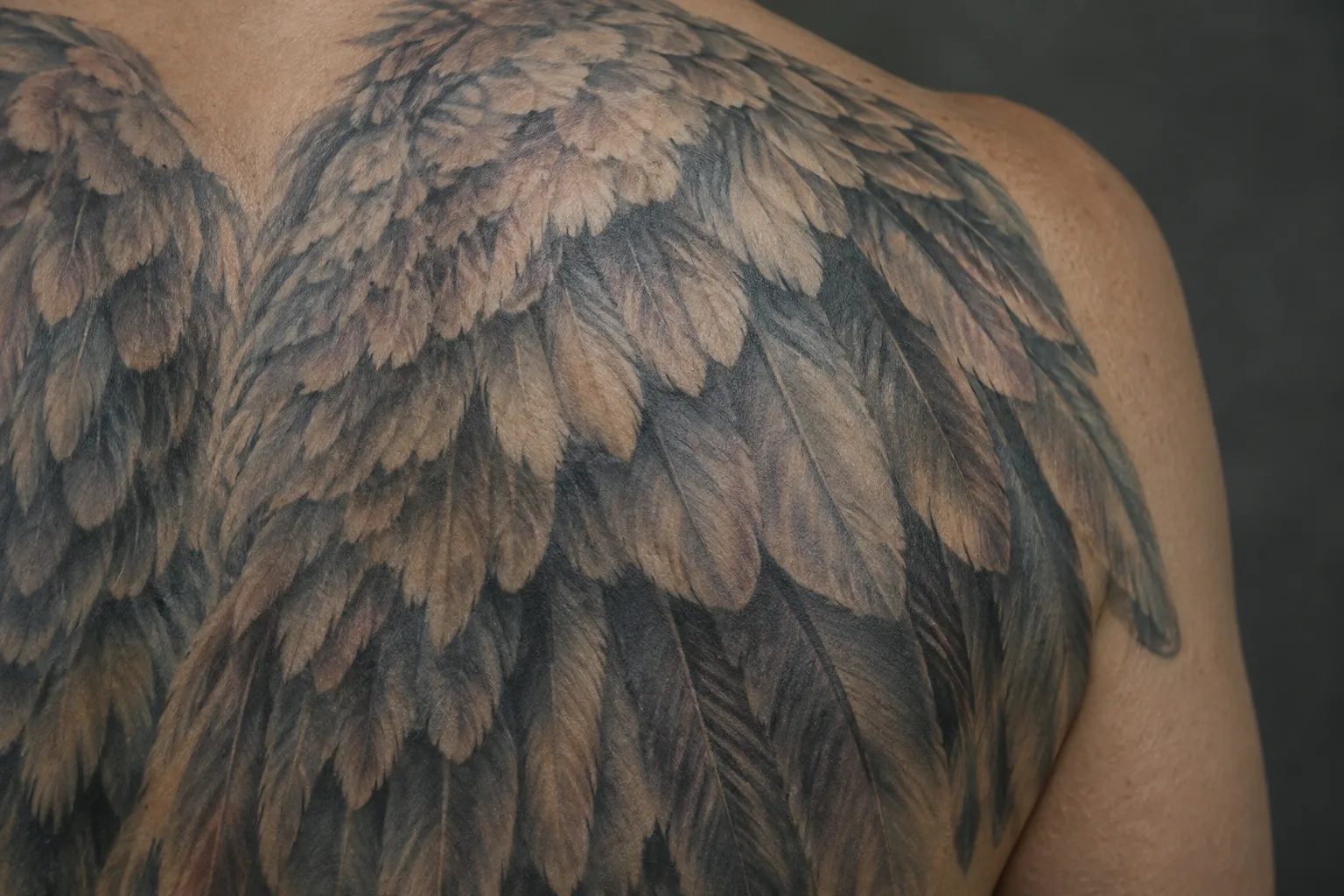
Full-back spread
A full-back spread typically runs 18-24 in (45-60 cm) wingtip to wingtip, with the wings rooted near the spine at the shoulder blades and the long flight feathers sweeping down toward the lower back or out to the ribs. This is the classic “wings growing out of you” look. It’s multi-session work: expect several appointments spaced weeks apart so each section heals before the next.
On pain, the outer upper back is among the milder large areas. The spine and the bony ridges of the shoulder blades are the most sensitive points of a back piece, and the ribs sit in the same most-painful group (1). If the design wraps onto your sides, plan for those sessions to be harder. Ask the artist to design around your posture. Wings drawn on a flat sheet and stuck on a curved back can look lopsided when you stand.
Shoulder blade wings
Shoulder blade wings are the compact version: one wing on each blade, often 6-10 in (15-25 cm) tall per wing, folded or half-open. The shoulder blade gives a broad, fairly flat surface, so shading heals evenly and the wings move naturally when you roll your shoulders. It’s also an easy placement to cover for work and to show off in a low-back top.
The main design decision is the gap between the wings. A 1-2 in (2.5-5 cm) gap at the spine keeps the pair looking deliberate. Too wide and they read as two unrelated tattoos.
Chest placement
Chest wings sit symmetrically across the pecs, rooted at the sternum and spreading toward the shoulders, usually 10-14 in (25-35 cm) wide. The symmetry is the appeal: the wings frame the collarbones and follow the chest’s natural line (1). A cross, heart or name often sits on the sternum between them.
Pain ranks higher here than on the back: sternum > collarbone > upper chest. Symmetry is also harder to pull off on the chest, because most people’s pectoral muscles and collarbones differ slightly side to side. A good artist will stencil it while you stand, check it in a mirror, and adjust.
Small and fine-line wing placements: wrist, collarbone and forearm
A small angel wings tattoo works on the wrist, collarbone, forearm or ankle only if the detail level matches the size: fewer, larger feather groups instead of dozens of tiny strokes (4)(2). The decision rule is plain. Realistic wings belong on large back or shoulder pieces, fine-line wings belong on small sites, and at any small size you keep feathers in readable groups so they don’t blur.
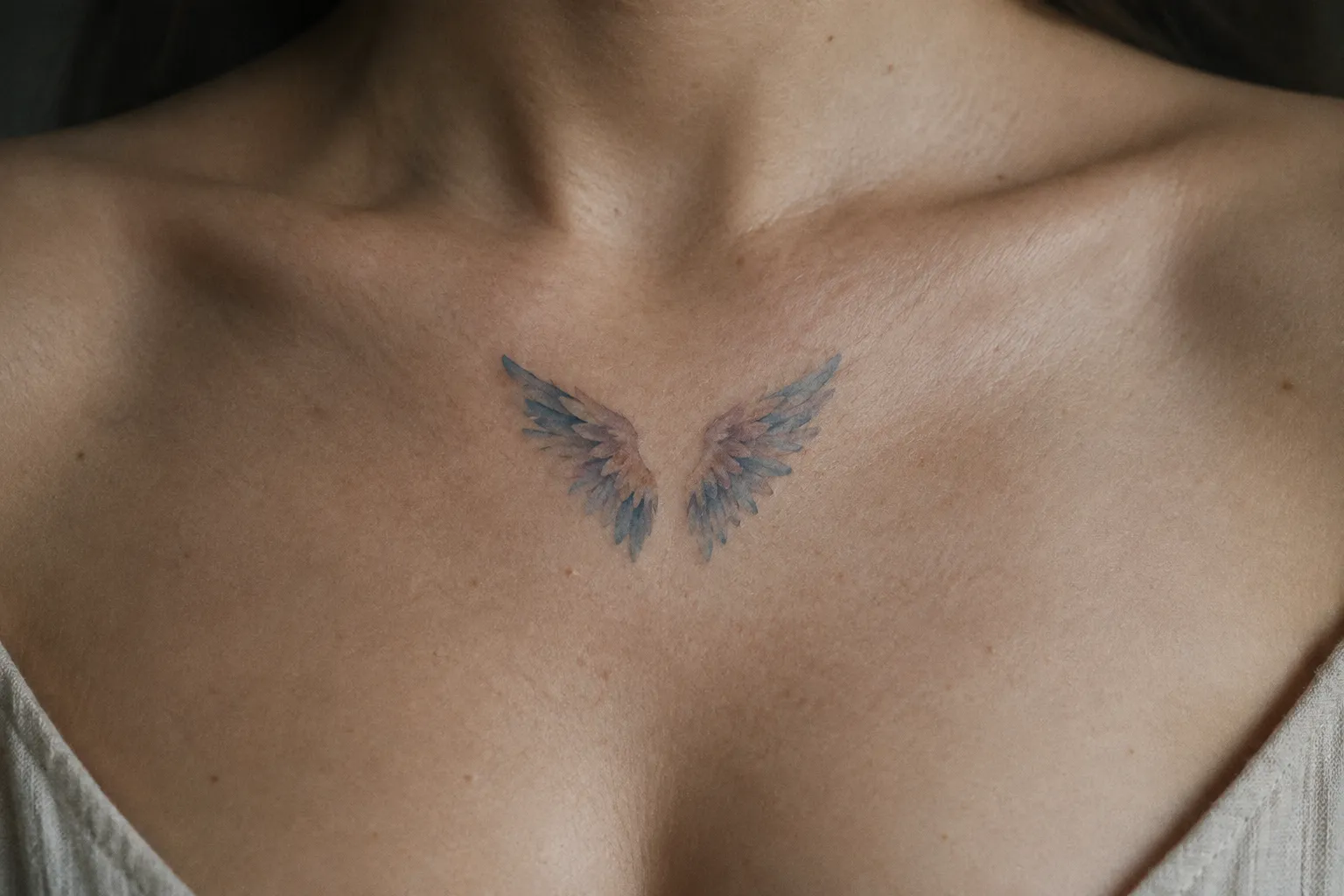
Wrist and collarbone
- Inner wrist: 1.5-2.5 in (4-6 cm) wide. Visible and easy to glance at. It’s also one of the worst spots for aging, because the skin moves constantly and gets heavy sun and friction. Fine-line wings here fade and soften faster than almost anywhere else. Go slightly bolder than you think you need.
- Collarbone: 2-4 in (5-10 cm) wide, following the line of the bone. A small pair of wings sits well tucked along it. Collarbone > forearm for pain, because the needle runs over bone with little padding.
Tiny wings behind the ear appear in design coverage too (4). They can work, but at under about 1 in (2.5 cm) the feathers will read as a smudge within a few years.
Forearm and ankle
- Inner or outer forearm: 2-5 in (5-12.5 cm) wide. The forearm is the most forgiving small placement: flat, easy to heal, lower on the pain scale than the wrist or collarbone, and roomy enough for a little shading. It’s where I’d steer most people who want small but detailed.
- Ankle, outer or inner: 1.5-3 in (4-7.5 cm) wide. A pair of wings at the ankle is a classic subtle placement. Ankle > forearm for pain, since the bone sits close to the surface. Socks and shoes rub the area during healing, so plan around that first week.
Keeping feather detail readable at small scale
Too many tiny feather marks blur, and the fix is to keep feather groups readable (2). In practice:
- Cut the feather count. A 2-inch wing might carry 6-8 feather shapes, not 25.
- Leave skin between lines. Aim for gaps of at least 1 mm (about 1/32 in) between parallel lines. Ink migrates slightly as it settles.
- Use one or two weights of line. A slightly heavier outer contour with lighter inner feathers holds its shape better than uniform hairlines.
- Skip grey wash below about 2 in (5 cm). Soft shading at that size tends to heal patchy.
Use the consultation to settle size, line weight, shading density and which details to drop (2). Ask to see the stencil at the actual intended size, not a blown-up drawing on a tablet. If you have to squint to see the feathers on the stencil, the healed tattoo will be worse.
Ink safety, healing and what to tell your artist
Tattoo ink safety comes down to three habits: ask your artist about sterile practice and ink sourcing, follow a clear healing timeline, and know which symptoms mean you should call a health professional. The FDA says it has received reports of infections from contaminated inks and of allergic reactions to the inks themselves (3).
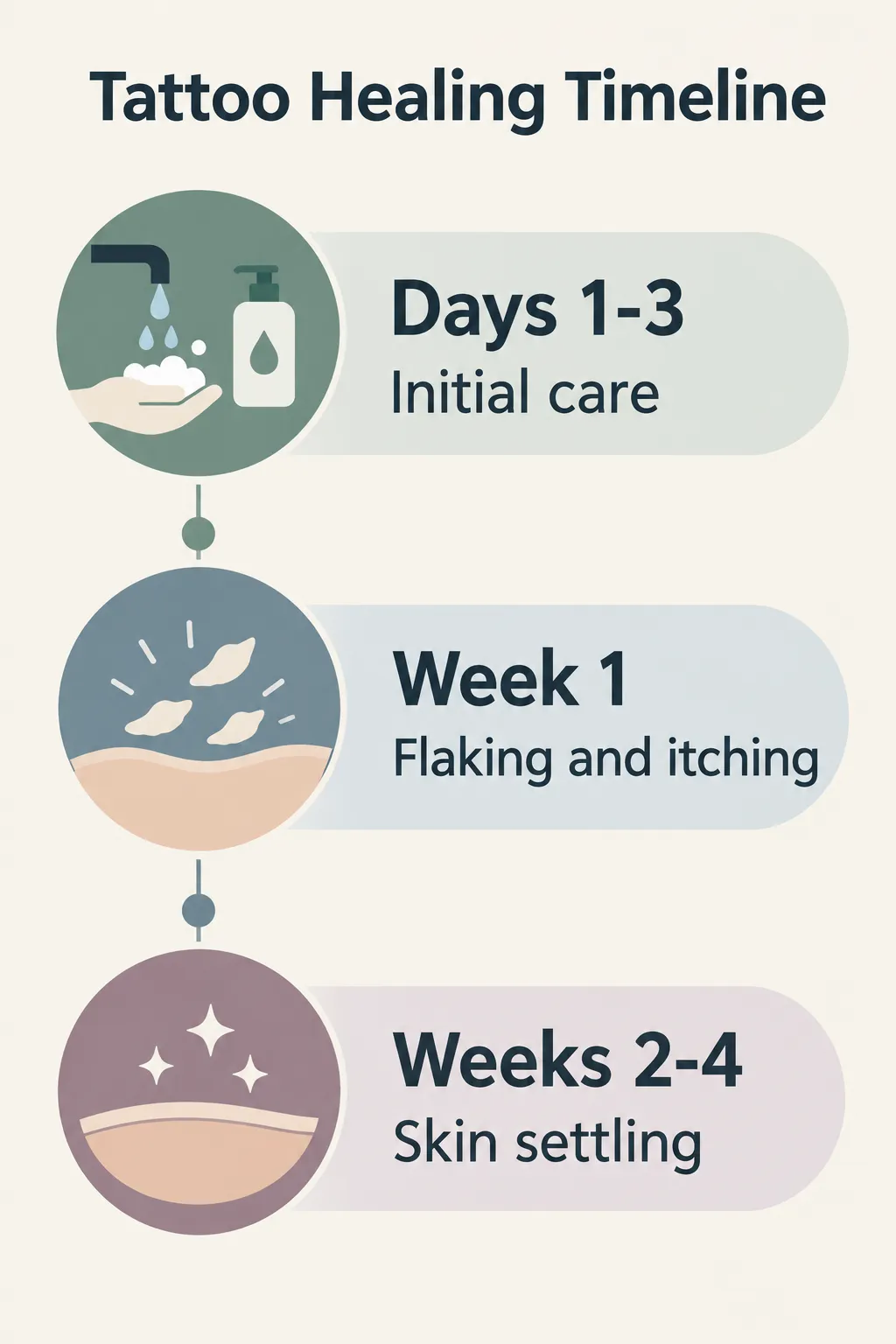 Flaking starts late in week 1, peeling and itching peak in week 2, and the surface looks healed by weeks 3-4.
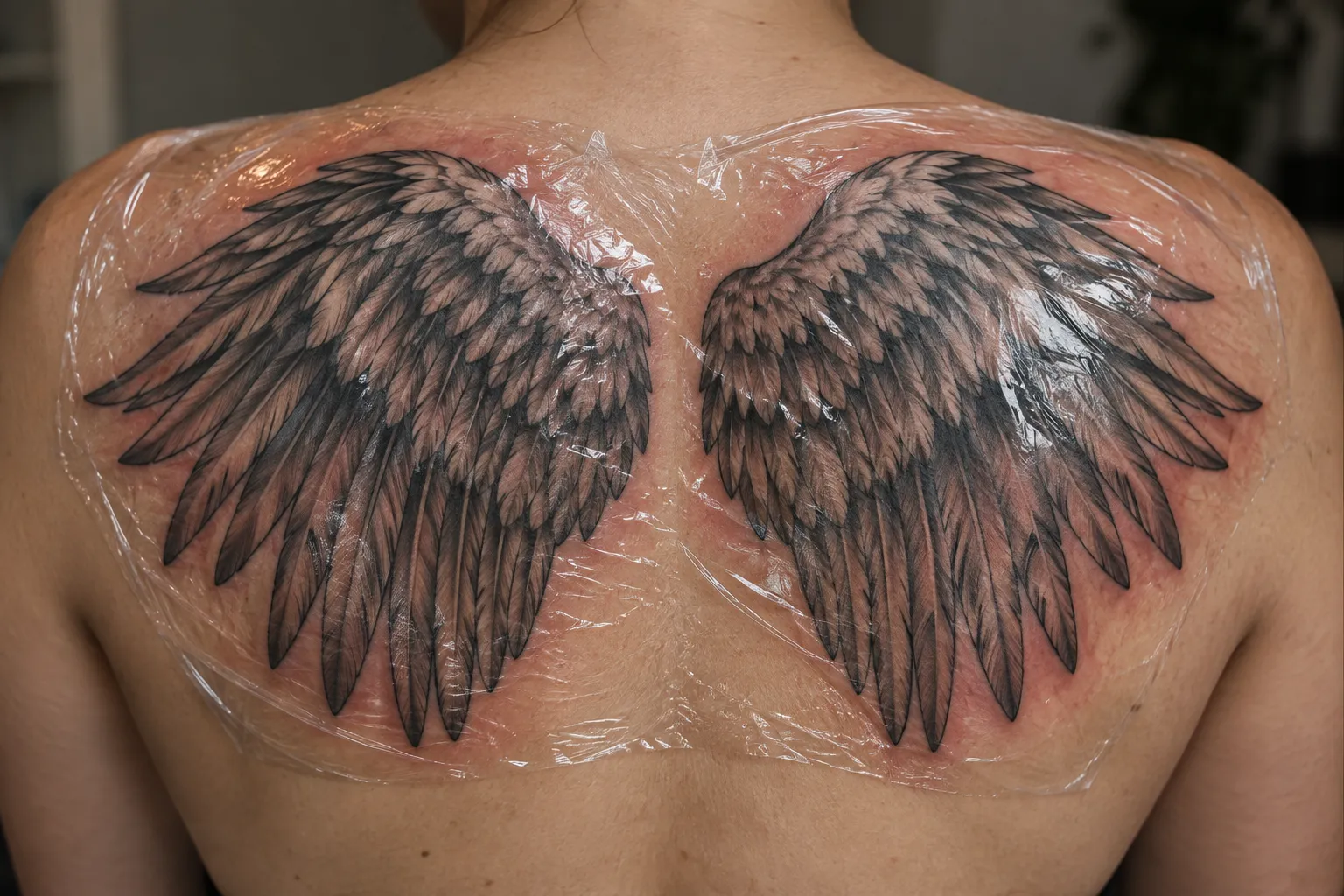
Why a ‘sterile’ label doesn’t guarantee safety
A sealed or “sterile”-labeled ink bottle is not proof that the ink is safe. The FDA reports that scientists have found bacteria and other microorganisms in unopened, sealed tattoo inks, and that infections can come from unsterile equipment or contaminated ink (3). One common contamination route is non-sterile water used to dilute pigments (3). That matters for wing designs in particular, because grey wash for realistic feathers is made by diluting black ink.
So don’t stop at the packaging. Ask your artist directly:
- What water or solution do you use to dilute grey wash?
- Are needles single-use and opened in front of me?
- Do you pour ink into single-use caps and throw the leftovers away?
A good artist answers these without getting defensive. Also tell them about any medications you take. One angel wings guide advises skipping alcohol and blood-thinning medication before a session (1), but if a blood thinner is prescribed, ask your doctor first rather than stopping it on your own.
Healing timeline: days 1-3, week 1, weeks 2-4
Follow your artist’s specific instructions first. This is the general pattern for a permanent tattoo, and our tattoo aftercare guide covers each stage in detail:
- Days 1-3: Keep the initial wrap or film on as long as your artist says. After that, wash gently with lukewarm water and a fragrance-free soap, pat dry with a clean paper towel, and apply a thin layer of fragrance-free moisturizer. Some redness, swelling, warmth and local discomfort are expected after a tattoo (3). Clear plasma or slight ink weeping is normal too.
- Week 1 (days 4-7): The surface dries, feels tight and starts to flake, and it may begin to itch. Don’t pick or scratch. No baths, pools, hot tubs or the sea. For an angel wings back tattoo, sleep on your front or side, and avoid backpack straps and tight bra bands over fresh work.
- Weeks 2-4: Week 2 is peak peeling and itching, and the tattoo can look cloudy or “milky” for a while. That’s a new layer of skin settling, not faded ink. By weeks 3-4 the surface looks healed. Keep it out of direct sun with sun-protective clothing for the first 4-6 weeks, then switch to sunscreen for the long term. Fine-line wings on the wrist and collarbone fade fastest without sun protection.
Deeper layers keep healing after the surface looks done, with full integration around week 6, so judge whether you need a touch-up only after about six weeks.
Signs to call a health professional
Redness and tenderness in the first few days are expected. Contact a health professional, and let your tattooist know, if the tattoo isn’t healing, if a rash develops, or if you get a fever (3). Redness that spreads or gets worse after about day 5, pus, or red streaks from the site also deserve a call rather than a wait.
If you do react, keep a record of the ink brand, color and lot or batch number. The FDA says that information helps identify the source of a problem (3). Ask your artist to write it down for you on the day. Most studios can.
Mentioning tattoos before an MRI
Tell the technician or health professional about your tattoos before an MRI scan. The FDA notes that swelling or burning at a tattoo site can occur during an MRI; it’s rare and usually temporary (3). Large areas of dark ink, like a blackwork angel wings back tattoo, are worth mentioning specifically so staff can monitor you.
Cost and other practical questions
Published prices are rough brackets, not quotes. One 2026 angel wings guide lists about $150-400 for a small piece, $400-1,200 for a medium one and $1,500-5,000+ for a large or full-back piece (1); a broader 2026 angel tattoo guide gives $100-250 for small designs and $1,000-3,000+ for large realistic back pieces (2). Neither says where those rates were collected, so treat them as a starting range. The FDA adds how common tattooing has become: polling and data suggest that about 30% of Americans, and 40% of people aged 18-34, have at least one tattoo (3). That means plenty of artists, and a wide spread of rates.
What drives the cost of wings is predictable, even without a figure:
- Size and hours. A small pair can be finished in a single 1-3 hour session, while a large realistic full back runs 20-60+ hours across several sessions (1). Most studios charge by the hour for large work and a flat rate or shop minimum for small pieces.
- Style. Realistic black-and-grey wings take far longer per square inch than fine-line or American traditional wings, because of the layered shading.
- Artist and location. A sought-after specialist in a big city costs more than a generalist in a smaller town, and often has a longer waitlist.
- Custom design and lettering. A memorial piece built around handwriting or a specific photo may carry a drawing fee or a deposit.
Get a quote after the consultation, when the artist knows the size and placement. Ask whether the quote includes a free touch-up. Pick the artist for their healed wing work, not for the lowest rate; a cheap back piece that needs a cover-up costs more in the end.
Frequently Asked Questions
- What does an angel wing tattoo mean?
- An angel wing tattoo has no universal meaning; its wearer may connect it to faith, remembrance, protection, or a personal experience that the design alone cannot specify.
- Do angel wings point up or down?
- No established source assigns a fixed meaning to wing direction; choose an angle that follows the body's shape and the composition you want.
- How much do angel wing tattoos cost?
- Ask for a quote after the artist has assessed your design, placement, and detail level; online prices without those specifics are not a reliable estimate.
- What does a 444 tattoo with wings symbolize?
- A 444 tattoo with wings combines modern angel-number numerology with guardian imagery; the number's meaning is informal, not a fixed religious or tattoo tradition.
- What's the best placement for a small angel wings tattoo?
- For a small pair with some detail, the forearm gives the artist more room to separate feather shapes than the wrist or behind-the-ear area.
- How do you keep an angel wings memorial tattoo from looking generic?
- Choose a detail specific to your relationship, such as copied handwriting or a personal nickname, and ask the artist to test its legibility in the stencil.
- Should you tell your MRI technician about a tattoo?
- Yes, mention tattoos before the scan and point out large or dark areas so the MRI staff can monitor any reaction during the procedure.
Choosing your wings: style, scale and the artist
An angel wings tattoo means what you intend it to mean, and a name, date or paired symbol is the only reliable way to make that clear to others. The decisions that change how the tattoo looks in ten years are more practical. Match the style to the size: realistic wings at 10 in (25 cm) and up on the back, shoulder blades or chest, fine-line or bold simplified wings for the forearm, collarbone or wrist. Keep feather groups readable at any size, and check the stencil at real scale. Size any lettering to the floors above.
Then pick an artist whose healed wing work you’ve seen, who answers plainly when you ask how they dilute grey wash and handle needles, and who gives you a written aftercare plan covering days 1-3, week 1 and weeks 2-4, with sun protection through week 6. Keep the ink details on file, protect the tattoo from sun once it’s healed, and mention it before any MRI.