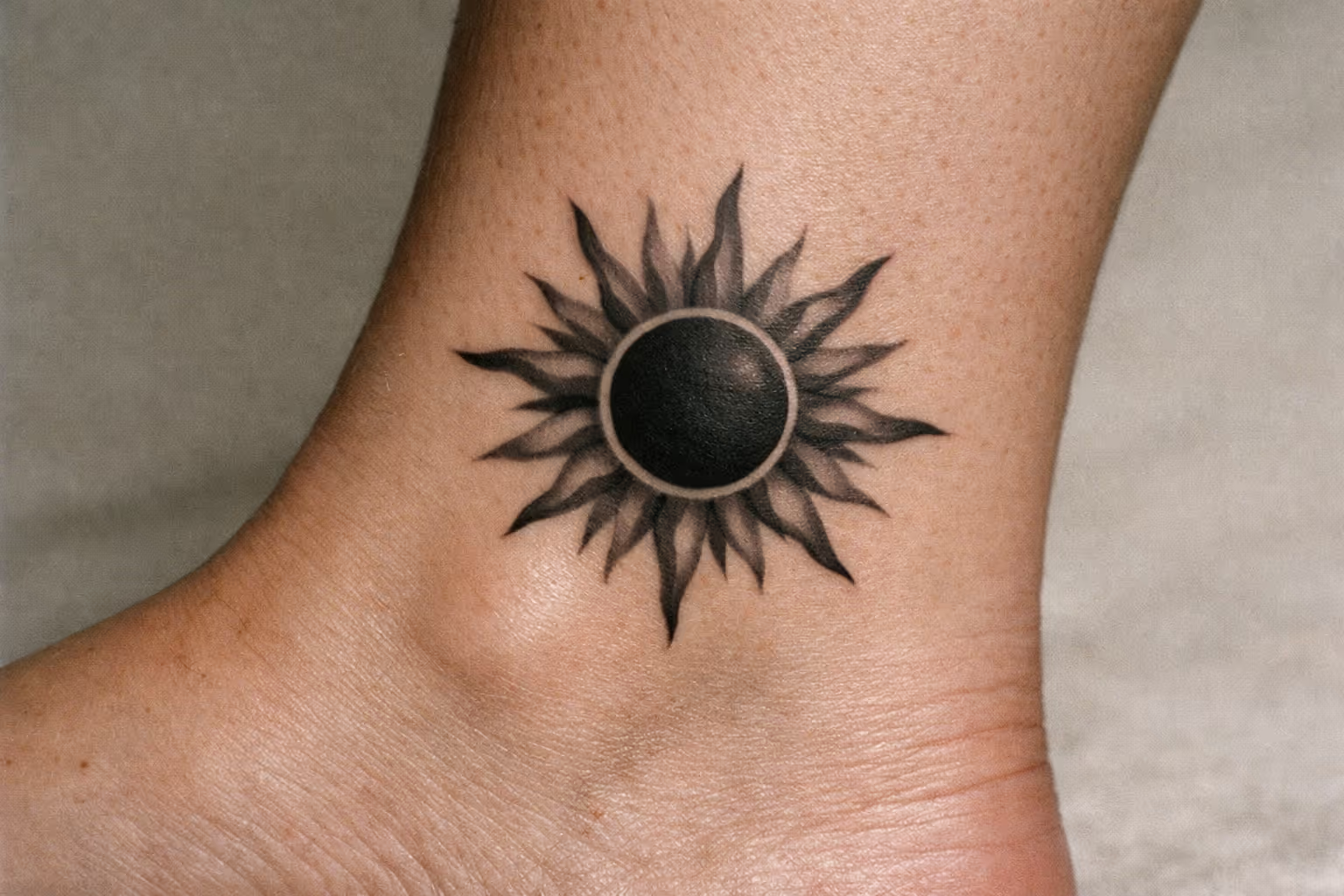
A sun tattoo isn’t a single design. It’s a whole family of designs, and which one you pick changes not only what it means but also how it wears on your skin over time. A Filipino sun with its eight triangular rays signals national heritage. A solid black disc suggests transformation after hardship. A 2 cm fine-line circle on the wrist reads as something subtle and personal. Same basic motif, four very different messages. This guide breaks down the four key angles you need to know before booking: solar symbolism, the Filipino sun, minimalist designs, and blackwork - plus where each style fits best on your body and how it ages.
Before you book, it pays to understand what you’re signing up for with this motif.
✓ Pros
- Universally legible motif across cultures and contexts
- Radial symmetry scales well from 2 cm wrist dot to 25 cm back piece
- Strong symbolic range: vitality, rebirth, cultural pride, resilience
- Works in nearly every style: fine line, blackwork, geometric, tribal
✗ Cons
- Radial symmetry is unforgiving; asymmetry or off-center placement is obvious
- Solid black fills require longer sessions and patch on high-movement zones
- Cultural designs often copied without understanding historical weight
- Overcrowded compositions dilute the solar motif's clarity
What a Sun Tattoo Actually Means
Sun tattoos most consistently symbolize life and vitality, power and strength, and rebirth or renewal. These three core ideas pop up in nearly every tradition and guide. The sun is the source of light and warmth, and it rises again after every dark night. That cycle naturally fits personal resilience.
Beyond those, you’ll see a second cluster of meanings: enlightenment, clarity, protection, optimism, truth and light, and inner warmth toward others - friendship, guidance, the idea that you radiate light for the people around you (9).
Most people who get a sun tattoo for overcoming hardship lean on the “triumph of light over darkness” reading. The daily sunrise quietly carries that narrative.
One honest note before we jump into styles: the sun is an intercultural symbol, not owned by any one tradition. That’s why it resonates so broadly. But it also means the meaning shifts hard depending on the design. A rising sun means something very different from a zenith sun or a solid black disc. The style you choose will say more than you expect.
Rising Sun vs. Zenith Sun: How Orientation Changes Meaning
A rising sun - partially visible over a horizon line, rays pointing up - means new beginnings and hope after dark times. A zenith sun - full disc, centered, rays radiating evenly - means peak strength and authority. Orientation isn’t just decoration; it’s part of the message.
This affects placement. A rising sun fits better lower on the body or anywhere a horizon line reads naturally - forearm, calf, ribcage. A zenith sun demands a centered, symmetrical spot: upper shoulder, chest, or upper back. Match orientation to placement and the design looks intentional. Mismatch it, and it feels off.
Sun Symbolism Across Cultures
Solar worship is nearly universal - almost every ancient civilization built a sun deity into its worldview. That’s why the sun carries weight without belonging to anyone.
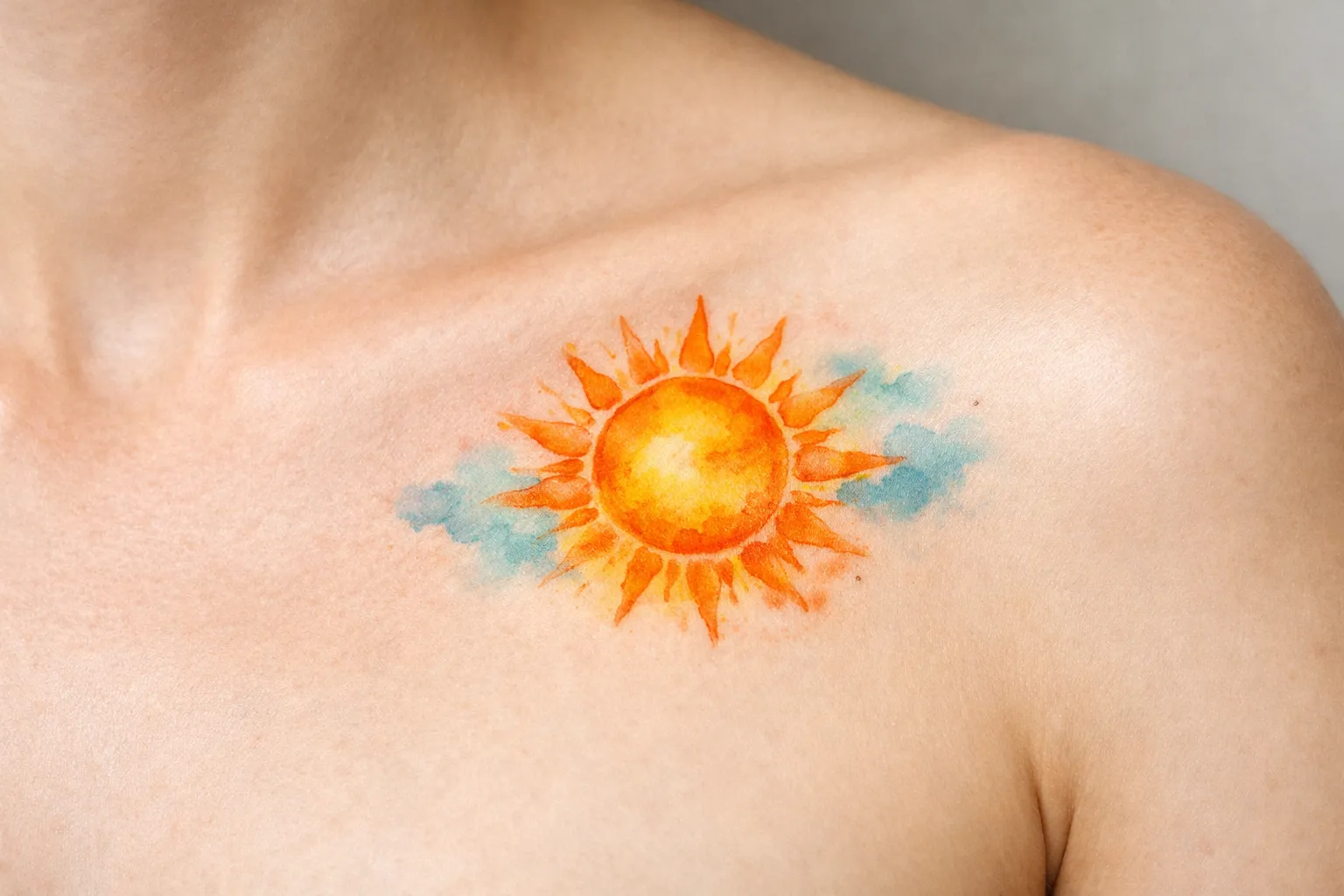
In Egyptian mythology, Ra was the creator of heaven, earth, and the underworld, the source of all life and light. Egyptian kings called themselves “Son of Ra,” linking royal power and afterlife passage to the solar disk. In Greek tradition, Helios personified the sun, riding across the sky in a golden chariot pulled by four horses, and his radiate crown still shapes how the sun is drawn today, rays extending outward from the disc (2). Helios symbolizes light, life, and all-seeing truth. The Aztec sun stone stands for cyclical time and sacrifice - it’s a distinct design tradition we’ll touch on later.
Polynesian and Celtic sun motifs feed into much of what studios today call “tribal sun” work. Here’s the straightforward truth: a “tribal sun” is often a generic mash-up rather than a specific cultural artifact. Authentic Polynesian tatau carries real cultural weight and should be done by an artist trained in that tradition. A blackwork sun with heavy curved rays “in a tribal style” usually isn’t from one lineage - it’s an aesthetic. Know what you’re getting.
The Japanese rising sun (asahi) carries national-identity meaning but also contested modern associations. The Rising Sun Flag - a red disc with 16 rays - is controversial in countries like Korea and China, where it’s linked to Japanese militarism and WWII history. This isn’t a judgment call, just something you should know before committing it to skin.
Christian and spiritual suns lean on divine presence, halo-like symbolism, and spiritual rebirth. And then there’s the most historically specific solar tattoo people ask about: the Filipino sun.
The Filipino Sun Tattoo: Eight Rays, Three Stars, One History
The Filipino sun tattoo comes straight from the Philippine flag, and its meaning is political and historical, not just decorative. The National Commission for Culture and the Arts of the Philippines (NCCA) quotes the 1898 proclamation of independence: the sun’s eight rays represent the eight provinces - Manila, Cavite, Bulacan, Pampanga, Nueva Ecija, Bataan, Laguna, and Batangas - that declared themselves in a state of war as soon as the first revolt against Spain was initiated, and the three five-pointed stars signify the three principal islands of Luzon, Mindanao, and Panay, where the revolutionary movement started (14). The stars are often read today as Luzon, Visayas, and Mindanao, but the founding text names Panay, not the Visayas as a whole.
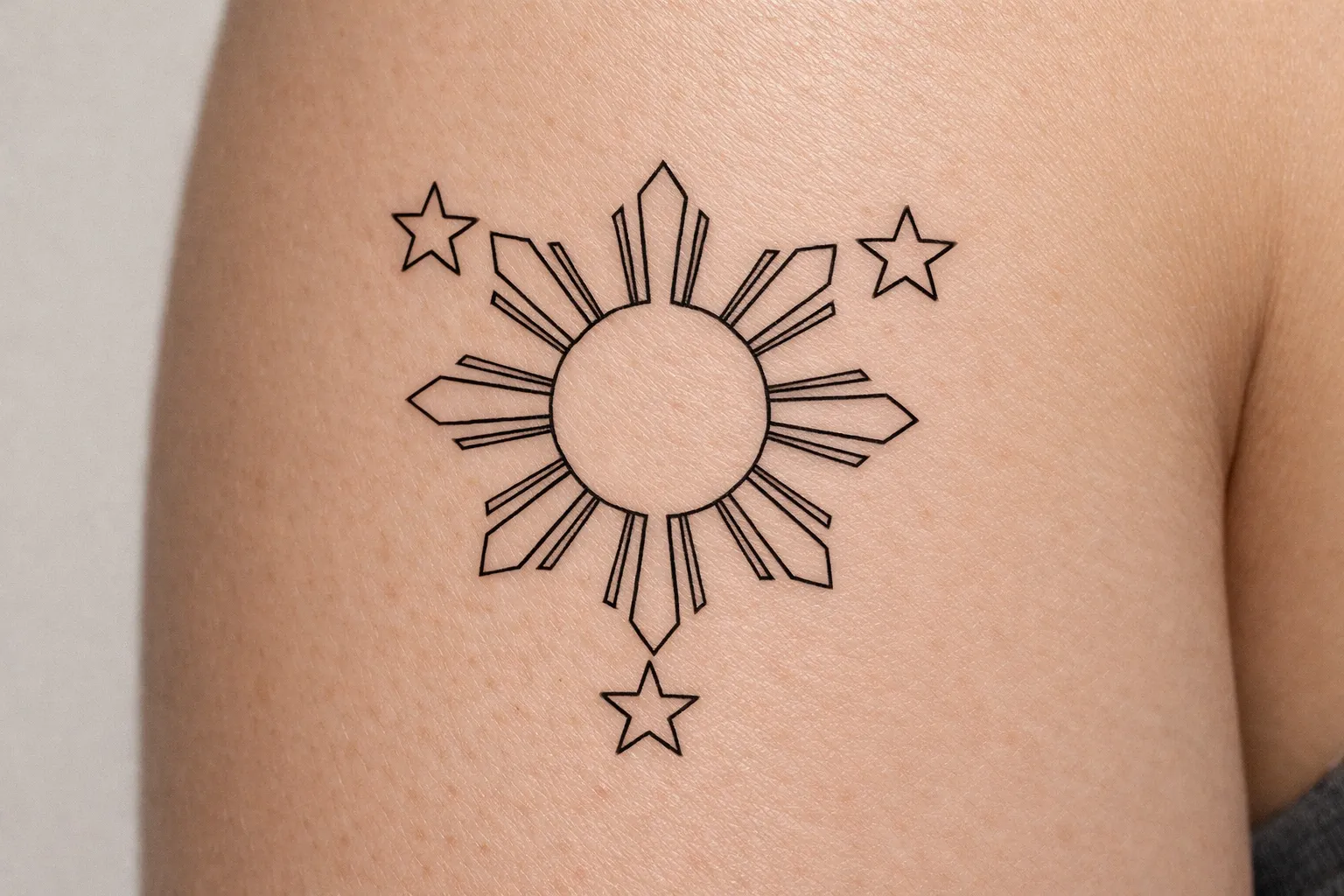
In tattoos, the three stars usually flank the sun or form a triangle above or around it, echoing the flag’s layout. This design communicates national pride, resistance, and heritage. For many in the diaspora, it’s identity and a connection to home - not “I visited the Philippines once.” It carries the revolution with it.
Geometry matters here more than with most sun variants. The eight rays are traditionally triangular and evenly spaced. Keeping them sharp and proportionate is everything - a Filipino sun with rounded, uneven, or miscounted rays loses its meaning. Work from flag reference images, not freehand.
One cultural-sensitivity point: copying the Filipino sun without understanding what the eight rays mean is the most common misuse. If the heritage is yours or genuinely meaningful, get the geometry right out of respect.
For placement, the chest - sternum-centered and about 8-12 cm wide - is the most common choice, since the symmetry suits a centered spot and the cultural weight fits over the heart. The upper arm at 10-15 cm works for visibility. The back gives space for larger, more detailed versions with the stars fully worked in.
Getting the Geometry Right: Rays, Stars, and Proportions
The ray count is non-negotiable: always eight. Not six, not ten. The shape is triangular, not rounded, and the rays should be evenly spaced so the sun looks balanced from every angle. The three stars sit exactly where the flag places them, sized smaller than the sun so they don’t compete.
Ask your artist to build the stencil from actual flag references and confirm the spacing before the needle hits skin. “Close enough” is visible to anyone who knows the flag.
Minimalist Suns: Small Designs That Actually Age Well
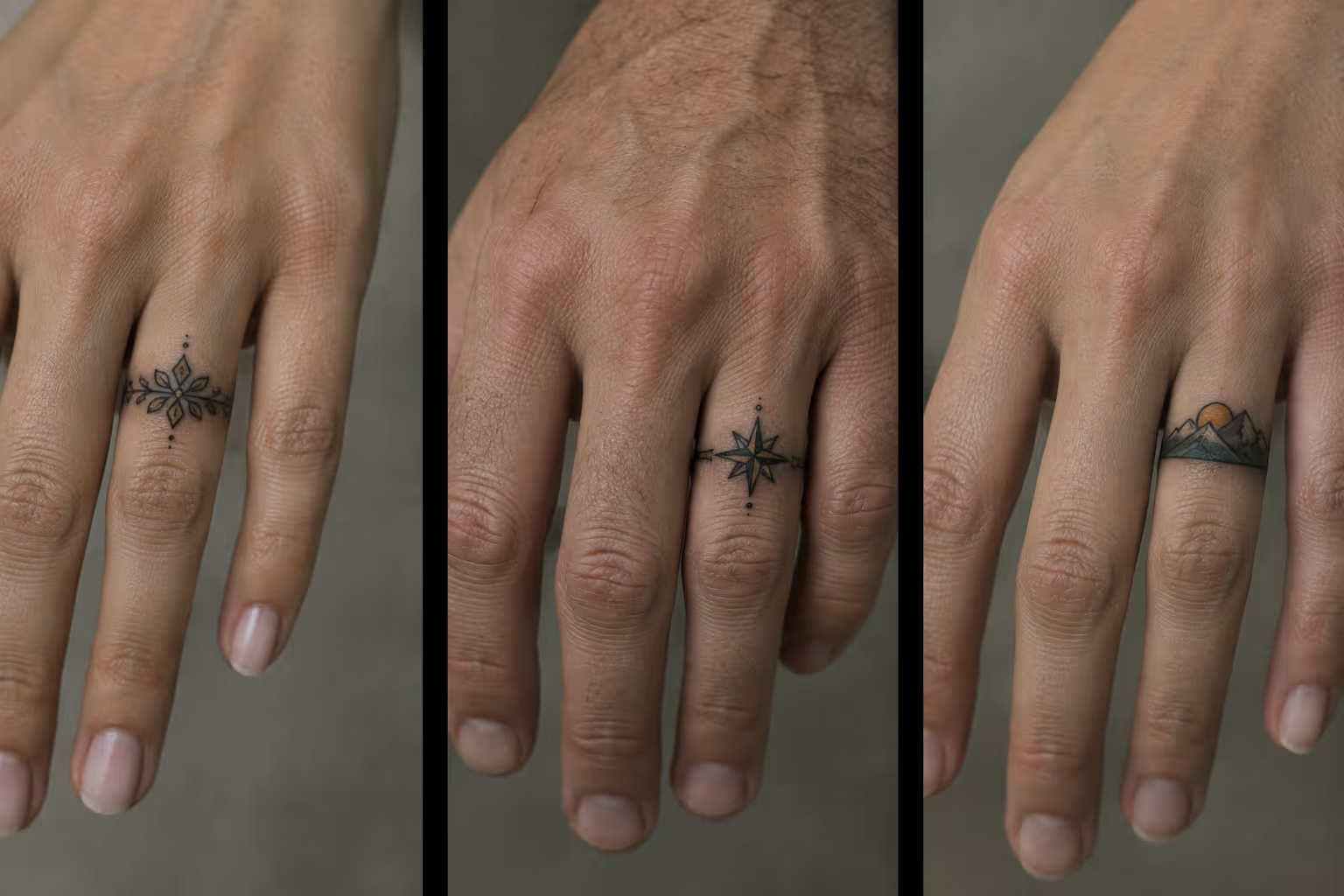
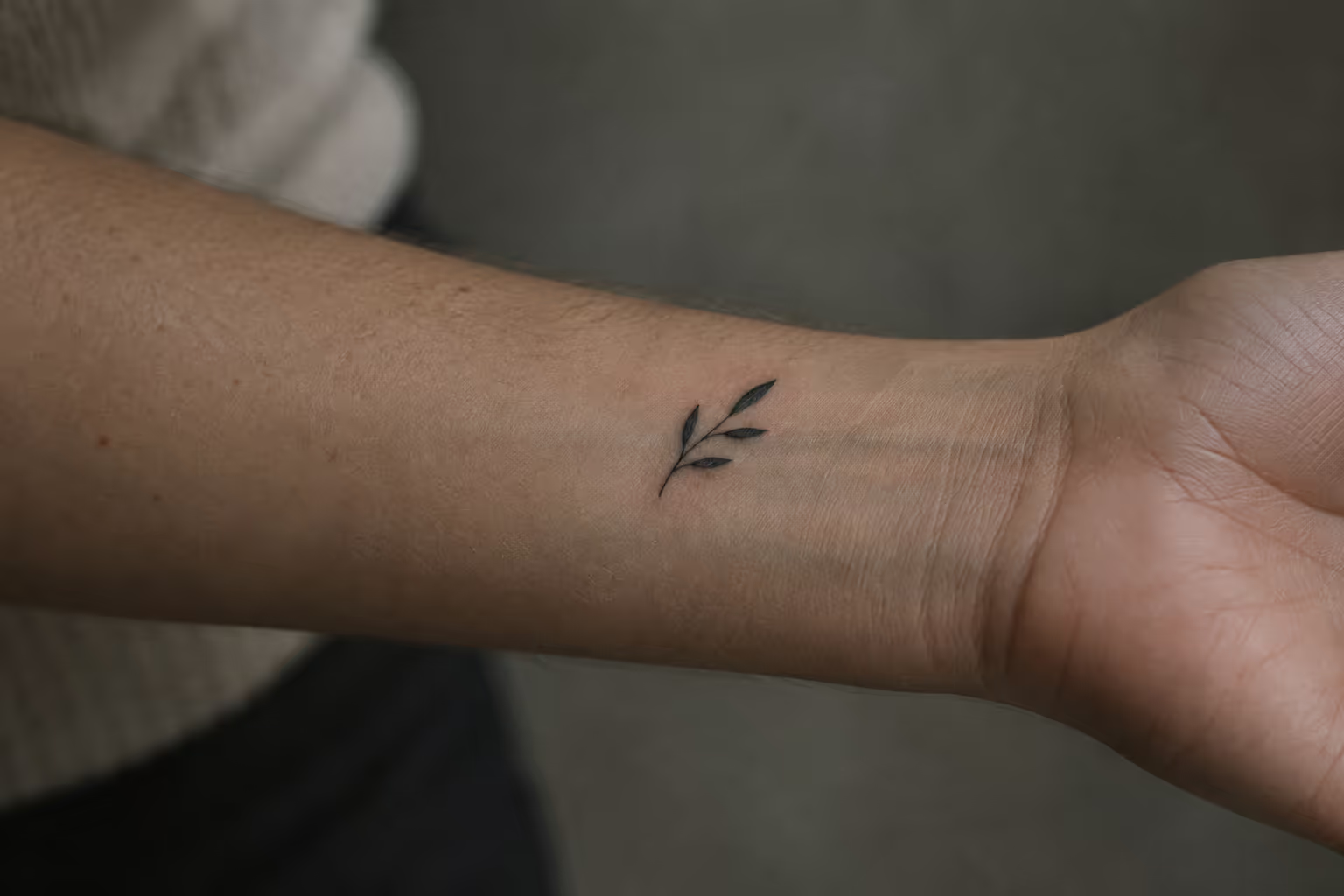
A minimalist sun tattoo is a fine-line or single-needle circle with short rays or dots - no shading, no fill - made for discreet spots like the wrist, inner forearm, behind the ear, collarbone, or sternum. The appeal is restraint. The risk is that “small and simple” done wrong blurs into a smudge in a few years.
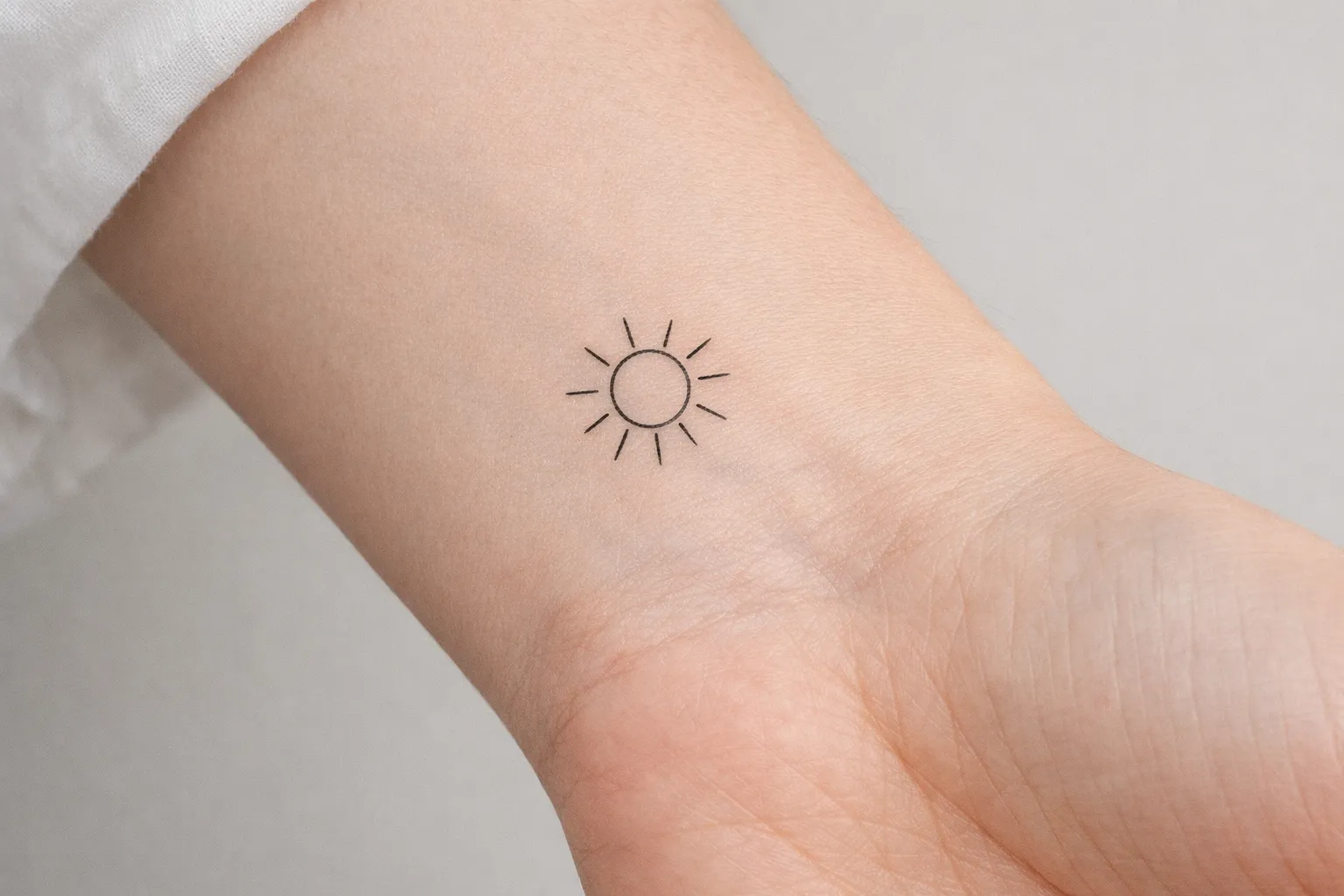
True minimalist suns sit in the 1-4 cm range. Below about 1.5 cm, you’ll generally want to reduce ray count to eight or fewer - the rays tend to close up as ink spreads over time, and fine detail at that scale rarely survives healing cleanly. As a rule of thumb, design elements under 1 cm are at real risk of merging or losing clarity once healed.
The line-weight trick to keep these clean: make the outer ring slightly thicker than the rays. That subtle contrast gives the design a clear focal point without adding clutter.
The most common mistake is cramming more than 12 rays into a 2-3 cm circle. It looks fine fresh but blurs after healing. Same with adding tiny faces or symbols inside the sun at small scale - fine detail has nowhere to go when skin ages.
Placement affects how long a minimalist sun lasts:
- Inner forearm (3-4 cm): flat surface, easiest aftercare, best longevity. This is the safe bet.
- Wrist, inner or outer (2-3 cm): stays visible but friction causes edge fading over time. Fine-line work on high-friction spots typically needs touch-ups sooner than work on flat, low-movement zones - plan for periodic maintenance.
- Behind the ear (1.5-2 cm max): low visibility, low friction, ages well.
- Collarbone or sternum (2-4 cm): jewelry-like spot, moderate pain.
- Finger (around 1 cm): fades significantly in 2-3 years due to friction. I flag this honestly - people often regret fingers.
Sessions run short: one studio’s size chart puts a piece under 5 cm at 15 to 45 minutes of chair time (15), so most minimalist suns are done well inside an hour.
Geometric Minimalist Sun: Circles, Triangles, and Concentric Rings
The geometric version leans mandala-adjacent - clean triangular rays, concentric rings, sometimes dotwork inside bands. It scales better than pure fine-line minimalism, working well at 4-8 cm on the forearm or shoulder blade. The catch: geometric precision demands an artist comfortable with perfect line symmetry on circles. A ring that’s even slightly off-round looks like a mistake once healed.
Black Suns: Blackwork, Tribal, and the Black Disc
Black sun tattoos break down into three distinct types, and mixing them up can get you the wrong artist and expectations. Figure out which one you want first.
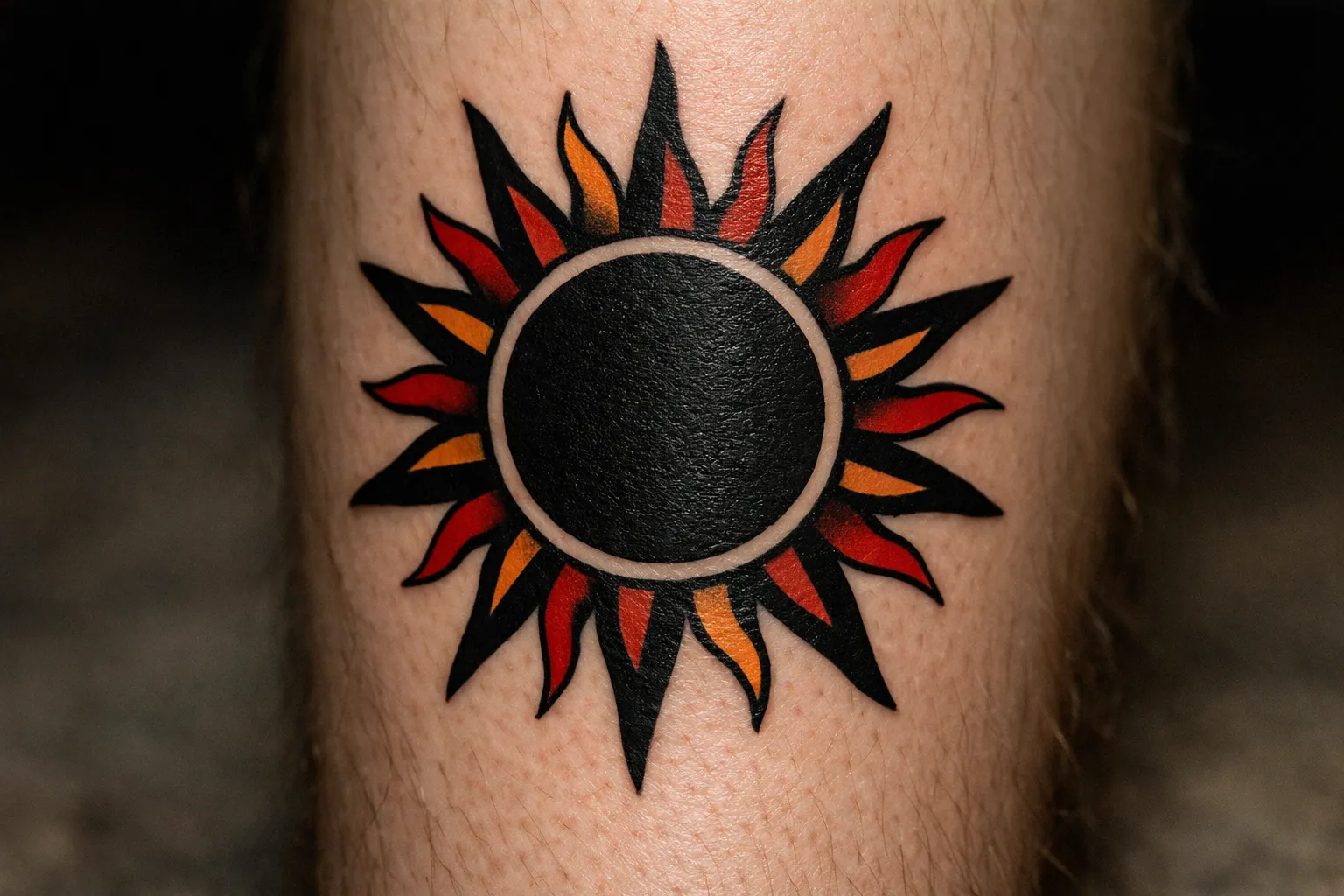
- Tribal sun - bold black lines, curved or angular rays, drawing from Polynesian or Celtic lineages (or a generic fusion). Associated with strength, guidance, protection. Lines are thick and bold, and this style demands an artist who knows line symmetry - any wobble shows.
- Blackwork geometric sun - clean solid fills, triangular rays, strong negative space. Graphic and modern; reads as transformation and a defined personal identity.
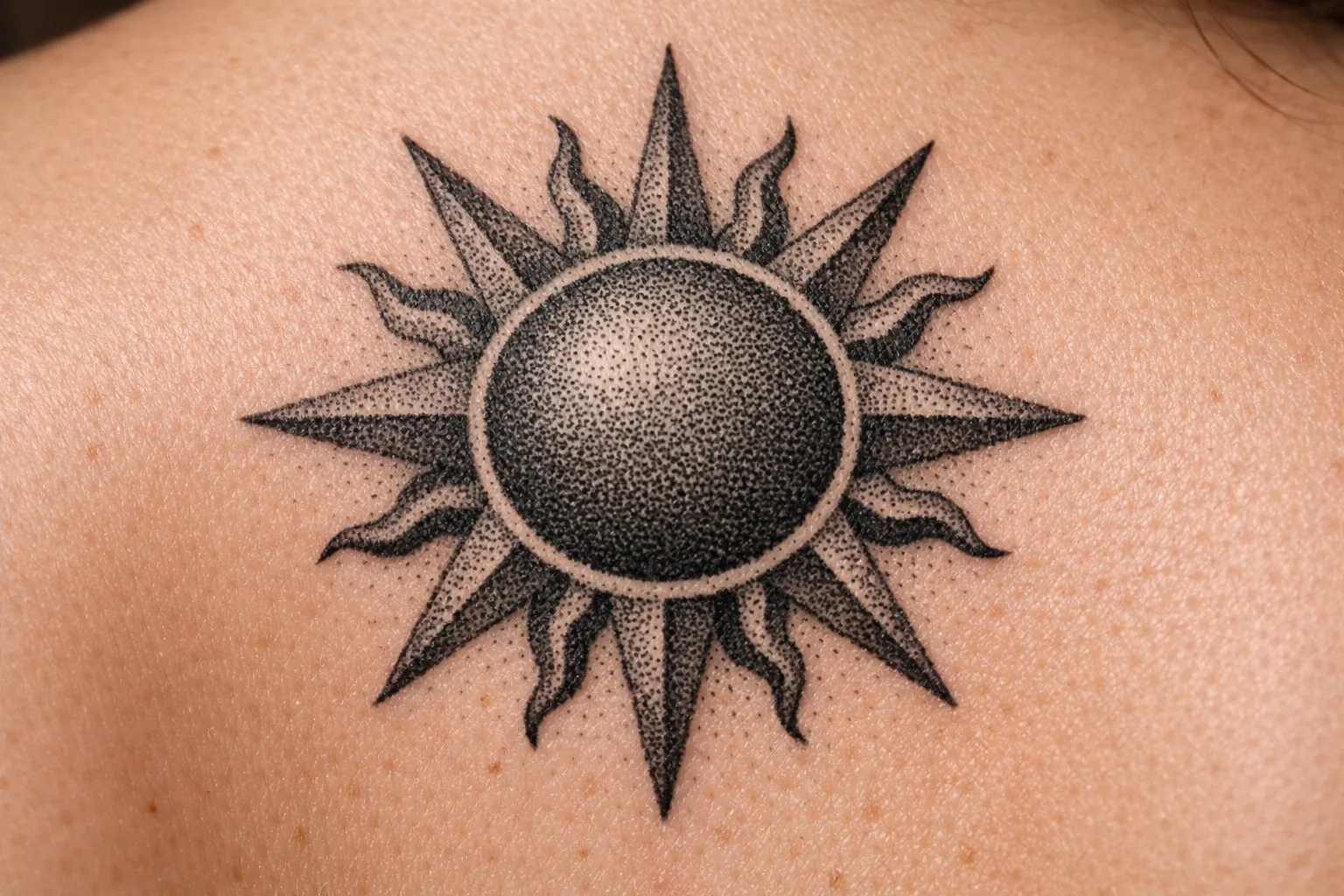
- Black disc / solid black sun - a fully or nearly solid black center with radiating black rays. This is the hardest technically and carries the most distinct symbolism.
About that symbolism: a black sun isn’t nihilistic, no matter what the look suggests. It reads as transformation after hardship - the sun stripped down to its most basic form. It’s about introspective rebirth, not despair.
Solid black fills take longer than fine-line work. You’re looking at multiple passes and longer sessions. As a rough guide, one studio’s chart puts a 5-15 cm piece at 1 to 3 hours of chair time and anything larger than 15 cm at 4 to 8 hours, often split across several sessions (15). An 8-12 cm blackwork sun leans toward the top of its range because packing solid black takes time. Dense black also outlasts fine-line work, worth knowing before you commit to a big disc.
Here’s the insider tip: build in negative space. A thin gap between rays or a highlight ring inside the fill cuts down on patchiness over time. Blackwork pros plan this carefully - a 100% packed disc is the one most likely to go blotchy as it heals and ages.
Placement caution: avoid the inner elbow and other high-crease spots for solid fills. The disc warps and patches as skin folds. Bold black lines elsewhere hold up significantly longer than fine-line work, which is why thick rays are key for longevity.
Tribal Sun Tattoo: Polynesian and Celtic Influences
Draw a clear line between authentic Polynesian tatau and generic tribal fusion. Polynesian tatau carries real cultural weight and specific meanings - if that’s what you want, work with an artist trained in the tradition, not someone approximating the look. Celtic sun designs lean on knotwork and interlace, a different lineage with its own history. What most Western studios call “tribal sun” is usually a blackwork aesthetic borrowing from both without claiming either. That’s fine as long as you know it’s a bold graphic sun, not a cultural artifact.
Design Ideas by Style: An Overview
Here’s the practical part: style determines meaning, aging behavior, and which artist you need. Pick the style before the placement. These are the sun tattoo ideas worth building your consultation around.
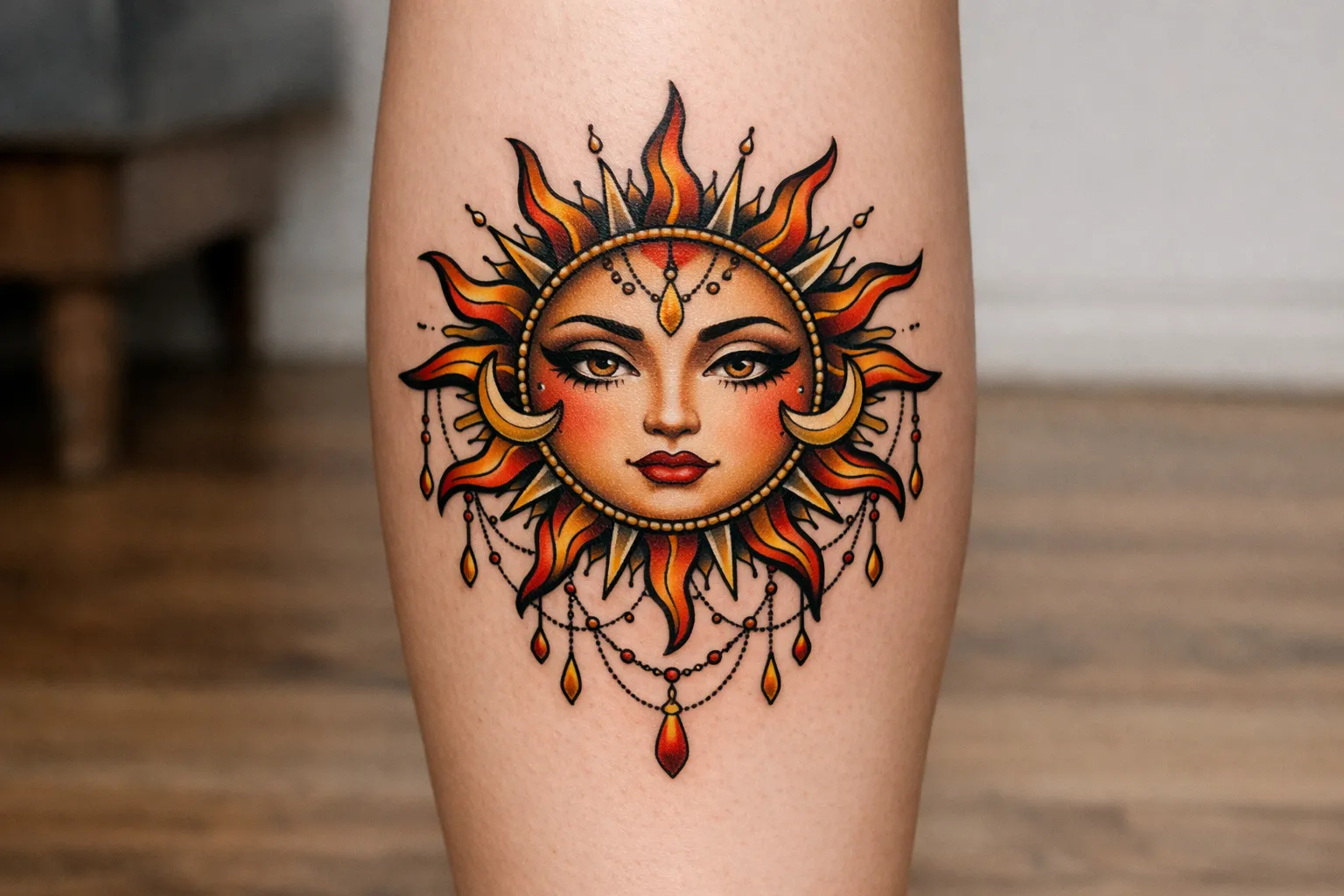
Classic Radiant Sun Tattoo
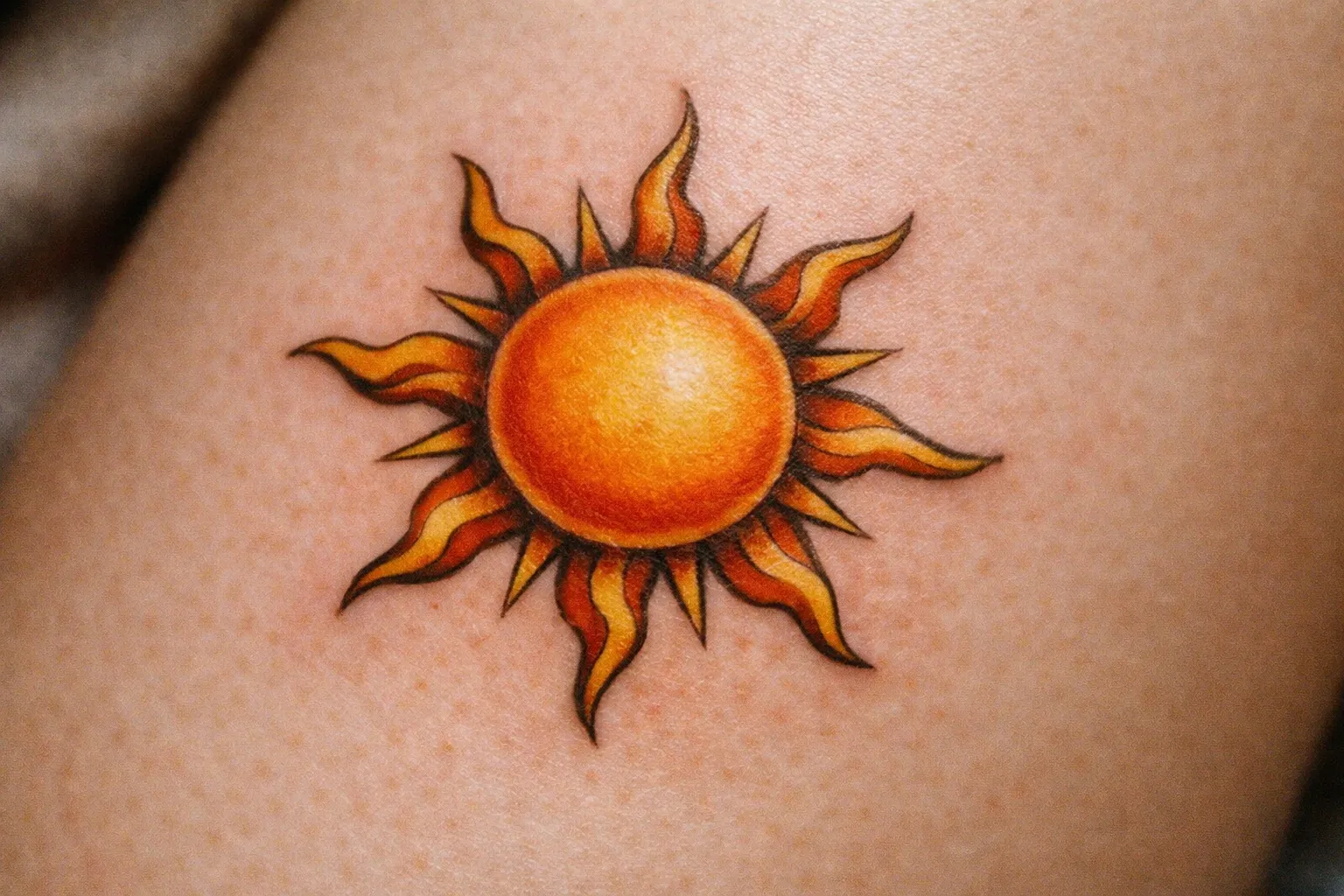
A central circle plus 8-16 rays, done in linework or minimal shading. This is the most versatile and legible version - the default “sun.” Best on the outer forearm or shoulder at 6-12 cm. Ages well on flat, low-friction spots. Pitfall: more than 12 rays on anything under 5 cm blurs together after healing.
American Traditional Sun Tattoo
American traditional handles the sun with two defining hallmarks: a thick black outline and a limited palette of bold, flat colors - yellow, orange, red, black, with minimal blending. The rays are solid and clearly separated, never wispy. Done badly, artists skip the heavy outline and try to compensate with shading, which muddies the design and ages poorly. Best on the outer forearm or upper arm at 8-15 cm, where the bold linework holds for decades.
Japanese / Irezumi Sun Tattoo
In irezumi, the sun (hi-no-maru or asahi) appears as a red disc or rising sun integrated into a larger composition - waves, koi, clouds, or wind bars framing it. The two technical hallmarks are dynamic background integration (the sun is never floating in empty space) and graduated color packing, where the disc transitions from deep red at center to orange at the edge using tight, directional needle passes. Done badly, artists isolate the disc without context, and it reads as a generic radiant rather than irezumi. Best as part of a sleeve or back piece, or as a standalone 8-12 cm disc on the upper arm or shoulder.
Rising Sun Tattoo
Sun half-visible over a horizon line, sometimes with waves or mountains. Represents new beginnings and hope. Works well on the forearm, calf, or upper arm at 8-15 cm. Pitfall: the horizon line must be straight or the whole piece looks tilted and off.
Geometric / Mandala Sun Tattoo
Concentric rings, triangular rays, dotwork shading - modern and balanced. Best on the shoulder blade, sternum, or outer thigh at 8-15 cm. Requires an artist with geometric precision - freehand drift on a circle is obvious. Ages well if lines stay clean.
Fine-Line Minimalist Sun
Covered above - wrist, behind the ear, inner forearm; 1-4 cm. Book a single-needle specialist because fine-line work leaves little margin for error.
Blackwork / Tribal Sun
Also covered above - upper arm, calf, chest; 8-20 cm. Bold line weight is essential for longevity; thin lines age poorly.
Here’s a quick comparison:
Sun Tattoo Styles Comparison
| Classic Radiant | Rising Sun | Geometric / Mandala | Fine-Line Minimalist | Blackwork / Tribal | |
|---|---|---|---|---|---|
| Hallmarks | Circle + 8-16 rays, linework | Disc over horizon line | Rings, triangular rays, dotwork | Single-needle circle, short rays | Bold lines, solid fills |
| Typical Size | 6-12 cm | 8-15 cm | 8-15 cm | 1-4 cm | 8-20 cm |
| Best Placement | Outer forearm, shoulder | Forearm, calf, upper arm | Shoulder blade, sternum, thigh | Wrist, behind ear, forearm | Upper arm, calf, chest |
| Session Time | Under 1-2 hours | 1-3 hours | 2-4 hours | 15-45 min | 1-3 hours up to 15 cm, 4-8 beyond |
| Longevity Note | Solid on flat, low-friction zones | Horizon must stay straight | Clean lines age well | Periodic touch-ups on wrist and fingers | Bold lines hold longest |
Where to Place Your Sun: Size and Symmetry
The big challenge with sun tattoos is radial symmetry. Our eyes immediately spot when a circle is off-center or warped by body curves. Before you commit, test the stencil on your skin and check how it sits against muscle curves at the shoulder, knee, or ribcage. What looks round on paper can skew on your body.
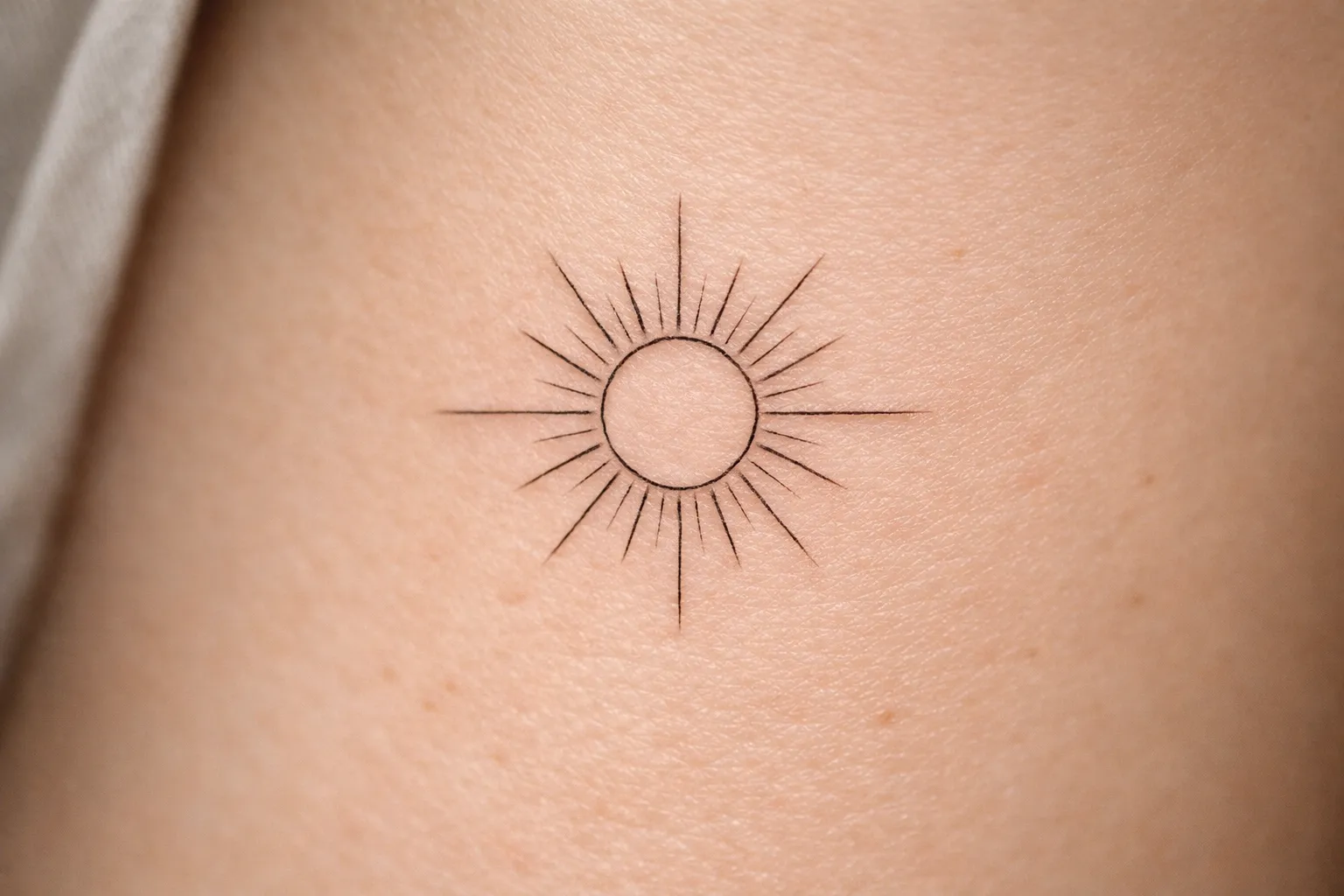
Here’s the breakdown by body zone:
- Outer forearm: flat, low friction, easy aftercare - best all-around for 4-12 cm suns. Moderate pain, ages well.
- Shoulder / upper arm: large flat surface, ideal for 8-15 cm radiant or blackwork suns. Low friction, good longevity.
- Chest / sternum: centered placement fits the sun’s symmetry perfectly; 8-15 cm. Higher pain than forearm. Filipino sun designs fit here culturally.
- Upper back / shoulder blade: great for larger geometric or mandala suns (10-20 cm). Low friction, ages very well, but you can’t see it yourself.
- Ribcage: vertical orientation suits rising suns. Higher pain and skin turnover; expect longer healing.
- Wrist / inner forearm: minimalist suns only (1-4 cm). Wrist has moderate friction; inner forearm ages better.
- Behind the ear: max 1.5-2 cm, low friction, low visibility.
- Elbow: popular but tricky. Inner elbow crease distorts solid fills. Outer elbow cap handles bold linework better.
Approach these with caution: inner elbow for solid fills, fingers (fade in 2-3 years), and foot soles (fade fastest). Fingers, hands, feet, and inside wrists fade noticeably faster than outer forearms or upper arms - constant bending and rubbing accelerate ink loss on all of these spots.
Pain, relatively: ribcage > sternum > inner bicep > ankle > outer forearm > shoulder.
Centering and Symmetry: The One Thing You Can’t Fix Later
Even a slight off-center placement on the chest or back looks like a mistake, not a style choice. The geometry demands intentional alignment. This is the most common regret with sun tattoos and it’s not fixable without covering or a major rework. Always check the stencil placement in the mirror from several angles before the needle starts. Five minutes adjusting beats a lifetime of a crooked circle.
Design Mistakes That Are Hard to Fix
Most regrets with this motif aren’t about what it means - they’re technical and totally avoidable. The ones I see most:
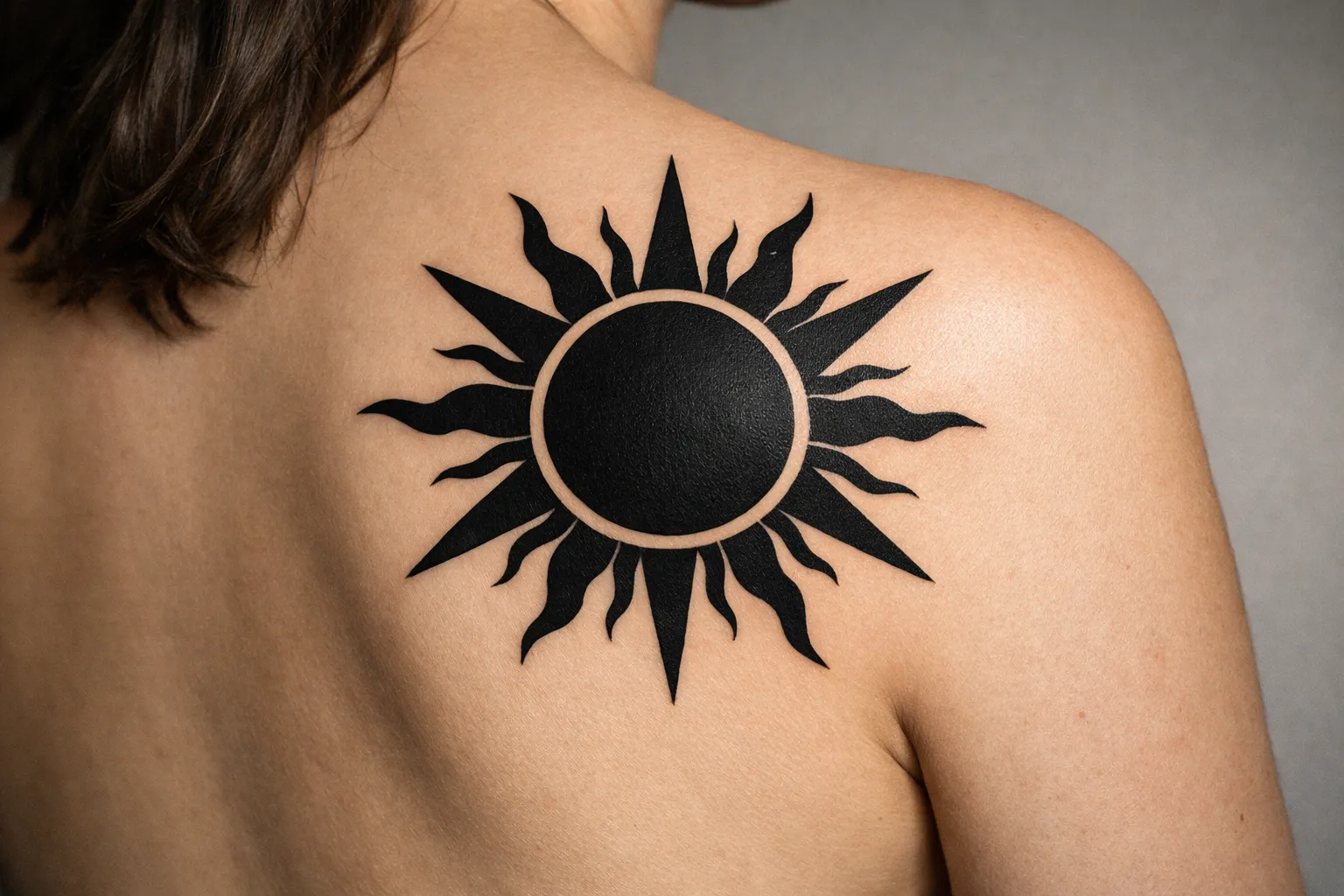
- Too many thin rays on a small sun. More than 12 rays on a 2-3 cm circle will blur together after healing. Legibility tanks within a few years. Keep ray count proportionate to size.
- Complex detail inside rays at small scale. Faces, tiny glyphs, or symbols close up after healing. Save that for designs 8 cm and up.
- A Filipino sun with the wrong ray count. Six or ten rays exist but lose the historical meaning entirely. If the cultural significance matters, the geometry has to be right.
- Solid black disc on high-crease or high-stretch zones. Inner elbow or knee ditches warp and patch over time.
- Off-center placement of a radially symmetric design. The most common regret, and the hardest to live with.
- Too many elements around the sun. Text plus birds plus waves plus geometric frame equals visual noise that buries the sun. One or two supporting elements max.
- Mismatched line weights across rays. Skews the sun visually, especially in minimalist or geometric styles. Consistent thickness is non-negotiable.
Frequently Asked Questions
Frequently Asked Questions
- What does the sun tattoo mean?
- Life, vitality, rebirth, strength, and truth/light are consistent meanings. Design variant and orientation shift the reading significantly.
- Is a sun tattoo good or bad?
- The sun is a universally positive symbol. Practical risks include poor placement, too many rays small, solid fills on creases, or copying cultural designs without understanding.
- How much do sun tattoos typically cost?
- Small minimalist suns cost similar to other fine-line work; medium geometric or blackwork suns require longer sessions and cost more. Shop minimums apply.
- How many rays should a sun tattoo have?
- Generic suns work best with 8-12 rays for legibility; Filipino suns require exactly eight rays for historical accuracy.
- What's the difference between a minimalist sun and a blackwork sun?
- Minimalist suns use fine-line, thin outlines, small size; blackwork suns use bold lines, solid fills, longer sessions, and read as graphic and assertive.
- Does a sun tattoo work as a first tattoo?
- Yes, minimalist suns on outer forearm or behind ear are low-pain and age well. Avoid solid black fills and ribcage for first tattoos.
Aftercare: What the Healing Timeline Actually Looks Like
The sun’s radial symmetry means any uneven healing - patchy peeling, scabbing that pulls ink - shows immediately. Stay on top of aftercare and you protect the geometry.
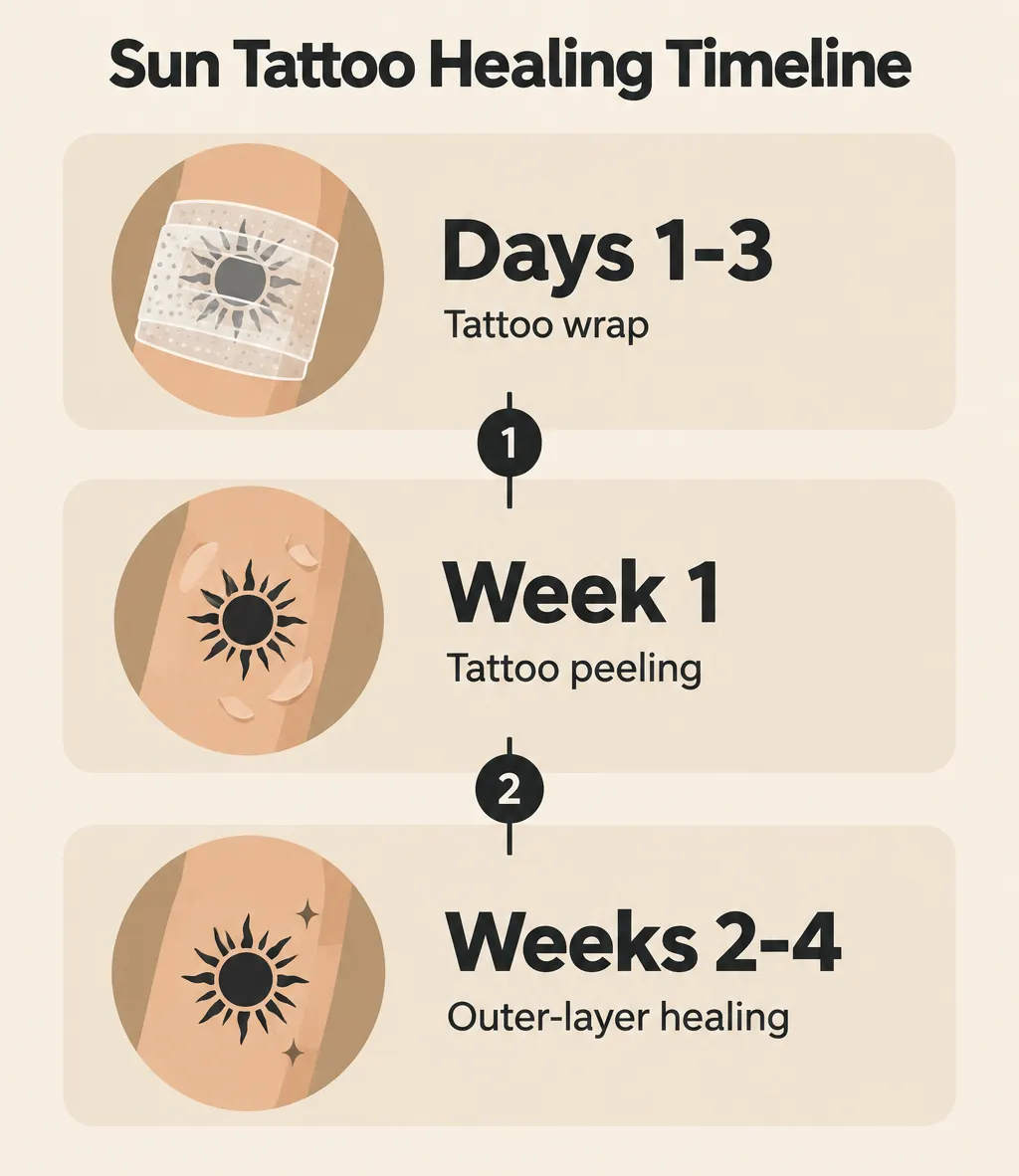 Healing a sun tattoo: covered for the first 24 hours, peeling in week 1, and the outer layer settling over weeks 2-4, before full integration around week 6.
Days 1-3: The tattoo is an open wound. Keep it covered with a breathable wrap or second-skin bandage for the first 24 hours, then wash gently with unscented soap twice a day and pat dry. Apply a thin layer of fragrance-free moisturizer - enough to keep the surface from drying out, not enough to suffocate the skin. Avoid soaking in water entirely.
Week 1: Peeling starts. Do not pick or scratch. The surface will look dull and flaky - that’s normal. Keep applying fragrance-free moisturizer two to three times a day. Blackwork and solid-fill suns may feel tighter and peel more heavily than fine-line work; that’s the larger ink volume working out.
Weeks 2-4: The outer layer finishes peeling and the design settles into its healed color. Fine-line minimalist suns may look slightly faded at this stage - that’s the skin closing over the ink, not ink loss. By weeks 3-4 the surface looks healed while the deeper skin is still remodeling, and full integration comes around week 6. Keep the area out of direct sun for the first 4-6 weeks; UV exposure on a healing tattoo accelerates fading. Once healed, sun-protective clothing helps preserve the ink (16), and consistent sun protection matters most for fine-line work on the forearm or wrist.
Choosing Your Sun Design: The Decisions That Actually Matter
Three choices carry the whole thing. First, the style - it determines meaning and how the tattoo ages, so settle that before anything else. Second, placement - it decides longevity and whether the symmetry reads straight or crooked. Third, the cultural variant, if one applies - like the Filipino sun, which means doing your homework on the eight rays before you sit down.
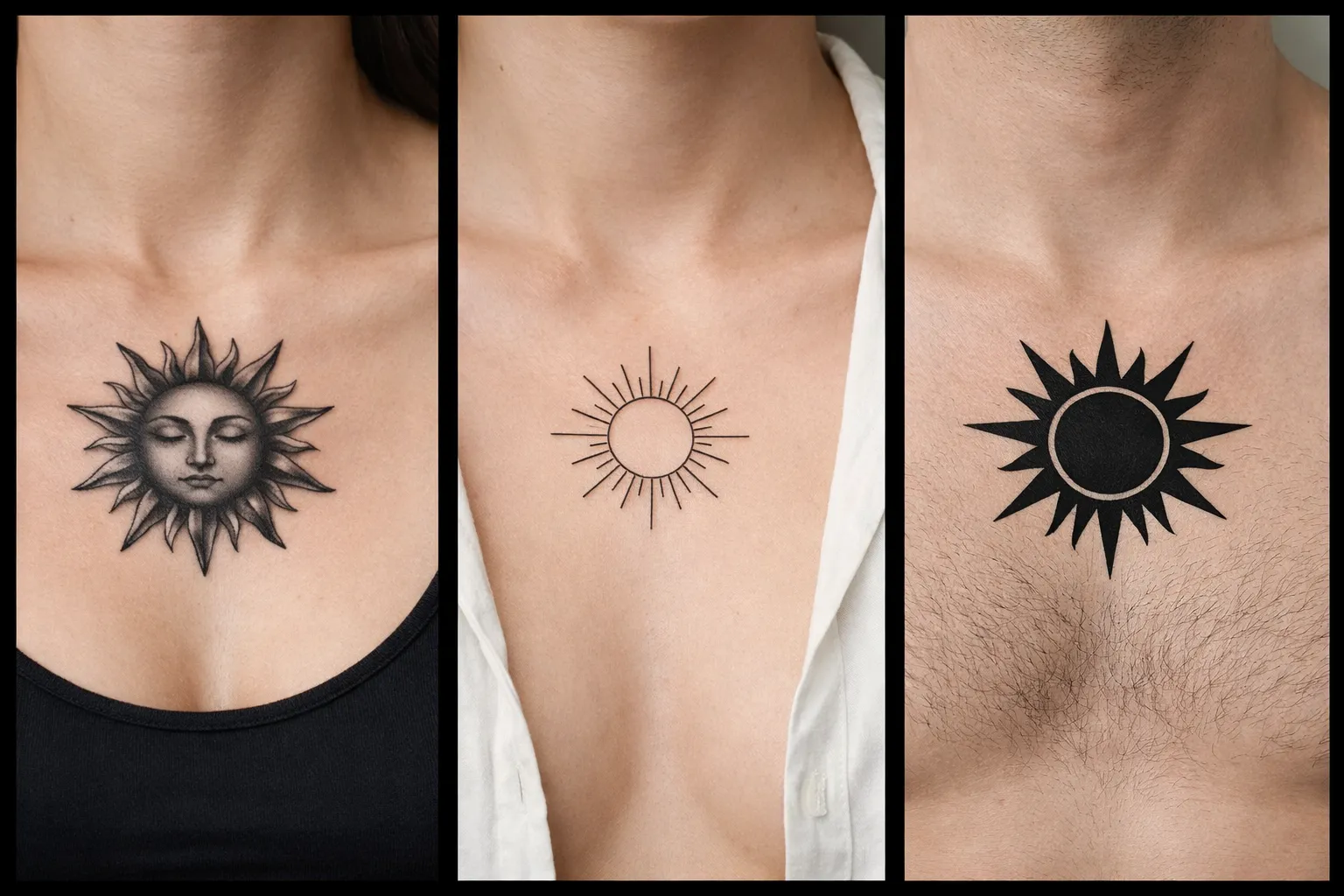
Here’s the bottom line: the sun is one of the most forgiving motifs when it comes to meaning. It’s hard to pick the wrong message. But it’s unforgiving on execution. The mistakes people live with are technical: too many rays too small, a solid disc on a crease that patches out, a circle half an inch off-center. Get size, ray count, line weight, and placement right. Confirm the stencil in the mirror before the needle starts. The rest falls into place.