The difference between a great white lunging with its jaws open and a hammerhead cruising sideways in profile is the difference between two completely different tattoos. A shark tattoo is not one thing: depending on species, pose, and style, the same animal reads as raw aggression, quiet dominance, or a protective guardian spirit. That range is exactly why sharks sit among the most flexible animal motifs in tattooing, and it’s also why they carry real planning decisions. This guide covers what a shark actually means, its Polynesian and Japanese cultural roots, which styles fit which designs, how placement and sizing interact, and how to heal the piece by body area, so you can skip to whatever you need.
Sharks scale from a two-inch silhouette to a full back piece without losing the thread of what they represent, and they land cleanly across nearly every style you’d consider. But that flexibility is also where people go wrong. Get the pose right and a shark reads as calm authority. Get it wrong and a piece you meant as protective reads as pure violence.
✓ Pros
- Scales from a 2-inch minimalist silhouette to a full back piece without losing conceptual coherence.
- Works across traditional, realism, Japanese, Polynesian, blackwork, and minimalist styles.
- Strong, legible symbolism that reads clearly without explanation.
- Species variation (great white, hammerhead, bull shark, whale shark) lets you personalize inside the same motif.
- Placement flexibility: the elongated body suits forearm and calf, while a head-only design suits shoulder and chest panel.
✗ Cons
- Open-jawed designs can read as purely aggressive even when you meant power or protection. Posture matters and is easy to get wrong.
- Detailed realism and Japanese compositions need large body areas (back, chest, thigh). This is not a small-space motif when detail is the point.
- Polynesian and Japanese cultural motifs carry real obligations around research and artist selection.
- High-movement placements (calf, foot) present healing challenges and faster wear on fine detail.
- Generic "shark head" designs are everywhere. Standing out takes deliberate style and composition choices.
What a Shark Tattoo Actually Means
A shark tattoo most commonly reads as power, fearlessness, survival, and adaptability, but the emphasis shifts hard depending on the pose you choose and the culture you draw from. Modern guides published across 2024 to 2026 repeat the same core cluster: strength, resilience, protection, freedom, focus, and instinct. What matters is that these split into two distinct emotional registers, and a design lands in one or the other based on choices you make before the artist picks up a machine.
The first register is aggression and dominance: apex predator energy, authority, fearlessness. The second is protection and guardianship: the shark as talisman, survival symbol, and marker of resilience. The same animal carries both. An open-jawed, forward-lunging shark reads as aggression and dominance, while a calm cruising pose reads as control, focus, and protection. That’s not a small detail. It’s the whole ballgame.
There’s also been a real shift in the last couple of years toward psychological framing. Newer guides position the shark less as a fear symbol and more as an endurance symbol: inner strength, personal growth, overcoming adversity, marking life transitions. Recovery from trauma, letting go of old habits, embracing a new chapter. Alongside that runs an emerging reading of quiet confidence and controlled strength, distinct from overt aggression, and a conservation angle where ocean lovers pick sharks as emblems of harmony with marine ecosystems rather than dominance over them.
Power, Fearlessness, and the Apex Predator Reading
The apex predator reading leans on dominance, authority, and an ancient lineage that reinforces endurance. Sharks predate dinosaurs, and tattoo artists lean on that fact to signal immortality and power that outlasts everything around it. This is the reading that draws athletes, martial artists, entrepreneurs, and people marking a competitive identity where relentless pursuit is the whole point.
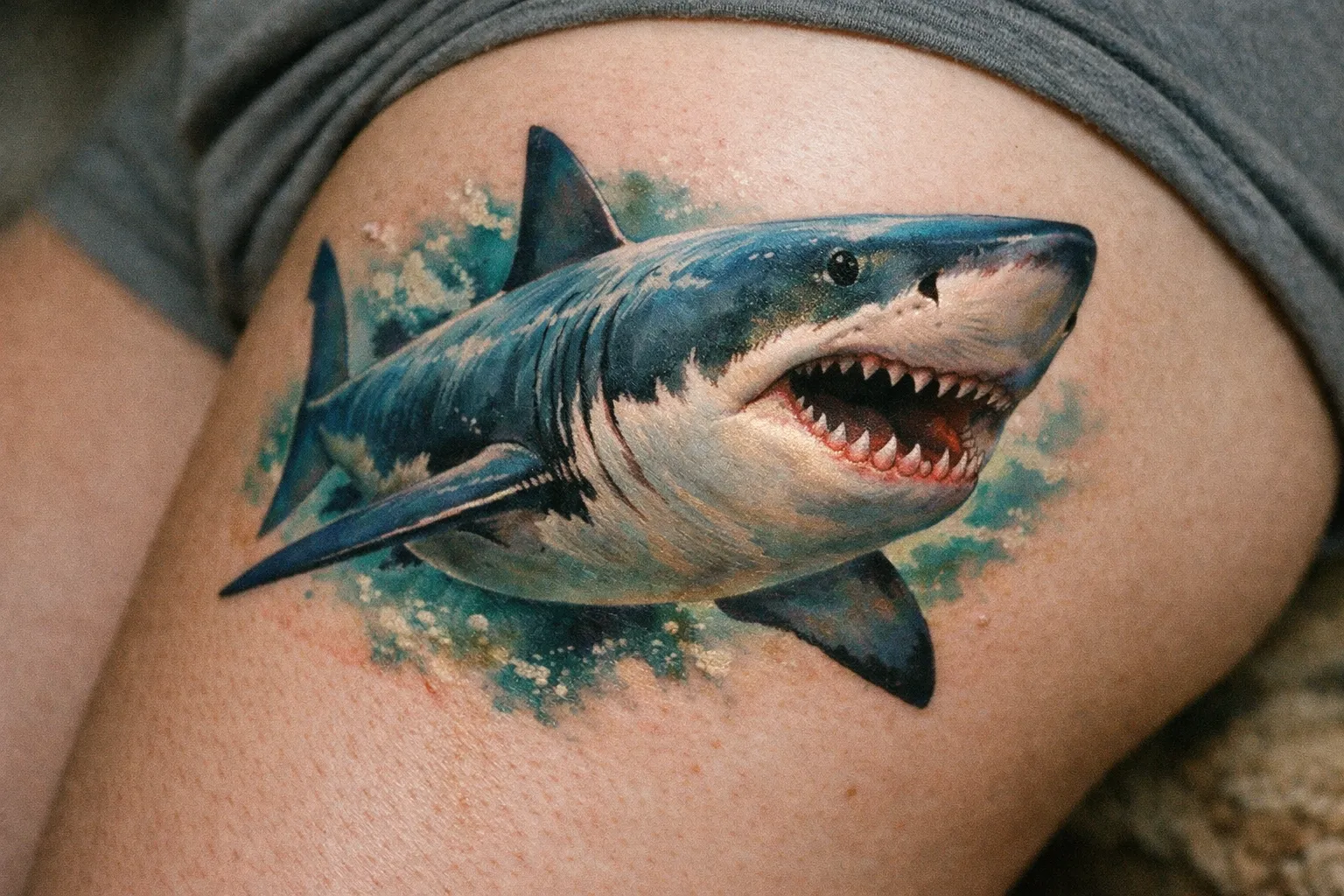
The design signals that reinforce this reading are specific: a head-on angle, open jaws, teeth forward, crown elements, and aggressive forward motion. If you want the tattoo to read as raw power the moment someone sees it, you build toward those cues. A great white with its mouth open and eyes forward is the clearest version of this statement in the whole shark vocabulary.
Protection, Survival, and the Guardian Reading
The guardian reading treats the shark as a protective talisman, which is especially resonant for sailors, ocean workers, and anyone who sees the animal as a spirit rather than a threat. In Polynesian symbolism, shark-teeth motifs tie directly to protection, guidance, and strength, and can represent an aumakua, a deified ancestor or spirit that appears in animal form to offer advice or protection. This is not a modern reframe. It’s rooted in the tradition itself.
Survival and resilience framing shows up in designs where the shark moves through storms or rough water, mapping onto the idea of overcoming adversity. The personal growth angle of letting go, new beginnings, and recovery fits here too. The design signals that push toward this reading run opposite to the aggression cues: a calm cruising pose, a closed mouth, pairing with waves or an anchor. A closed-mouth shark in profile communicates something entirely different from an open-jawed attack, and if protection is your intent, that’s the direction you steer.
Cultural Roots: Polynesian and Japanese Shark Symbolism
Two traditions carry genuine spiritual weight around shark imagery, and both are worth understanding before you borrow from either. Polynesian tattooing treats the shark as a powerful protective spirit representing strength, adaptability, and protection, expressed through geometric pattern systems rather than standalone illustration. Japanese tattooing reads the shark through persistence and determination, folded into larger narrative compositions rather than isolated as a single figure. The two could not be more different in how they build a piece, and neither is decorative wallpaper.
Layered on top of both is the pop culture register, driven by Jaws and The Meg. That layer carries no spiritual weight, but it drives sustained interest and shapes how the general public reads a great white in particular. It’s fine to work in that register, as long as you’re honest that it’s aesthetic, not heritage.
Polynesian Shark Motifs: What the Patterns Actually Signify
In Polynesian tattooing, shark symbolism runs through pattern language, not through a portrait of an animal. Shark teeth (niho mano) function inside a broader system of geometric elements, and they signify protection, guidance, and strength. The connection is to the ocean and to ancestral identity, and the aumakua concept means the shark can stand in for a specific protective ancestor. This is spiritually loaded work, not a style you pick off a wall.
Practically, that means two things. First, research the specific tradition: Samoan, Hawaiian, and Māori approaches differ in pattern vocabulary and meaning. “Tribal-style” is not a tradition. Second, consult an artist with genuine experience in Polynesian work, someone who understands the pattern logic and can show you healed examples, not a generalist who does the occasional black geometric piece. If you don’t have a connection to the culture, be honest with yourself and the artist about that.
Japanese Irezumi-Influenced Shark Compositions
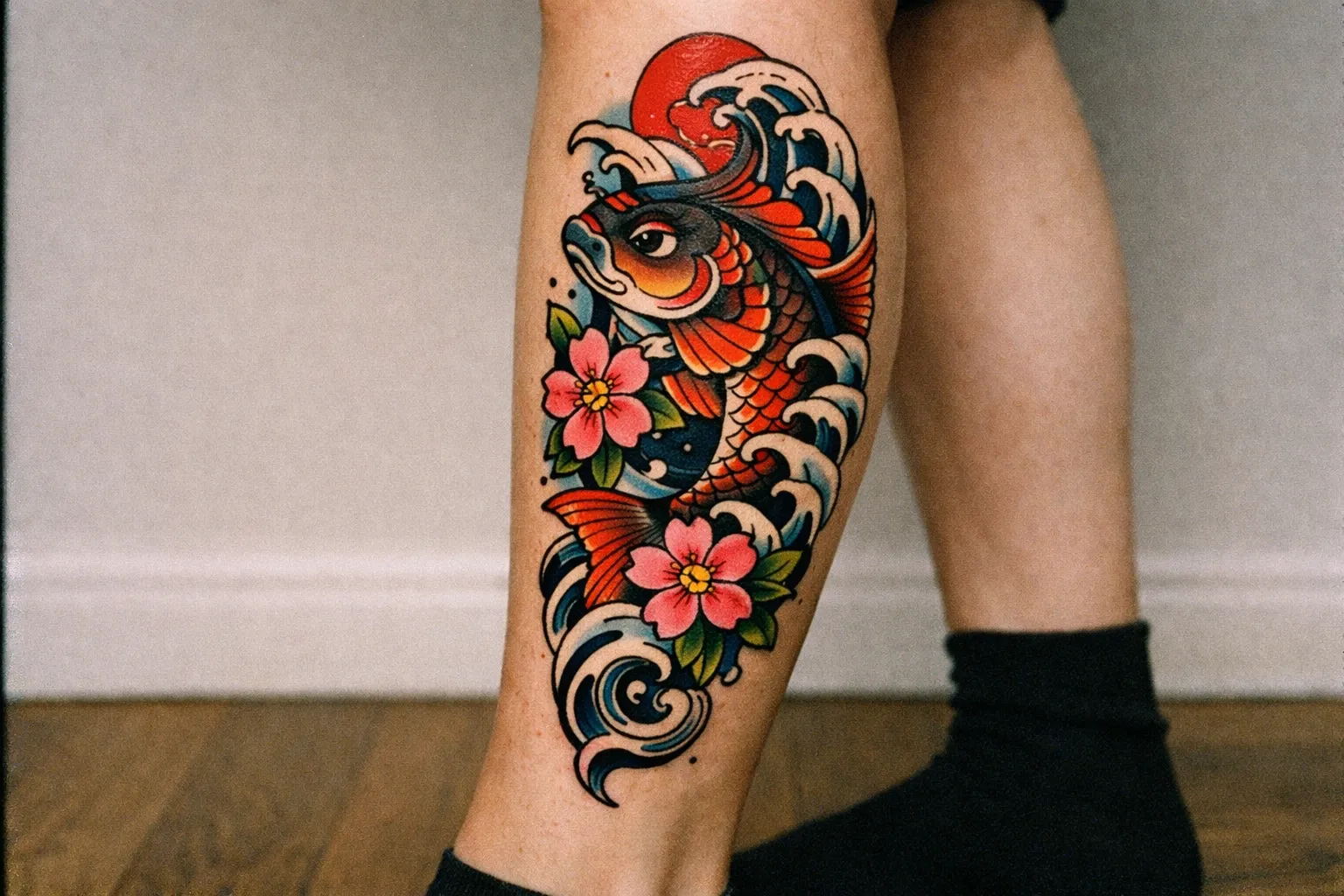
Japanese-influenced work is composition-driven, so the shark almost never stands alone. It appears paired with waves (nami), koi, or dragons, read in this tradition as a noble creature with a place in the spiritual order of the sea rather than a monster to fear (3). The background is not optional decoration. It’s the sentence the shark is a word in.
That has a hard consequence for scale: these are not small-piece designs. To let the background flow function, you’re looking at a half-sleeve minimum, and back pieces or full sleeves are where the style really works. Downscaling an irezumi-adjacent shark to three inches strips out the very context that makes it read correctly. As with Polynesian work, commission this from an artist with real portfolio depth in Japanese tattooing, not someone offering generic “Asian-inspired” pieces.
Shark Tattoo Styles: Which One Fits Your Design
Sharks work across the full style range: realism and photorealism, American traditional, neo-traditional, Japanese, Polynesian, minimalist linework, and blackwork. The move is to match style to meaning. Traditional suits a bold power statement. Realism suits the ocean-lover who wants texture and detail. Polynesian suits cultural connection. Minimalist suits subtle, personal symbolism. And aging tracks with style: bold outlines (traditional, blackwork) hold up far more predictably over decades than fine-line detail or soft color gradients, which soften and blur faster.
Think of the styles on a rough complexity ladder, beginner through advanced, and let the space you have plus the artist you can access tell you which rung is realistic.
American Traditional: Bold Lines, Limited Palette
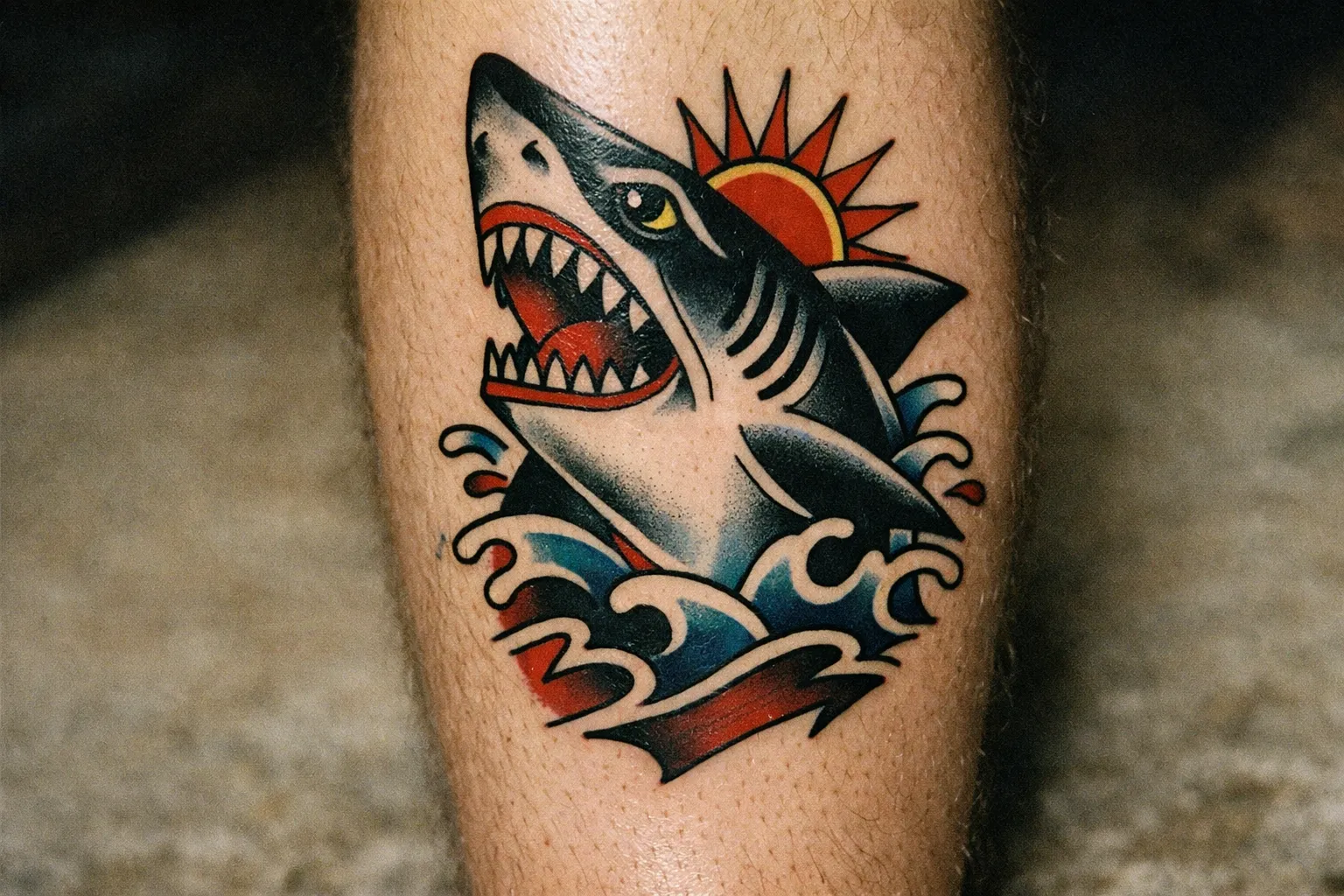
American traditional runs on two hallmarks: thick black outlines and a limited palette (black, red, yellow, blue), with stylized rather than realistic anatomy. A shark head with open jaws is a classic flash composition in this style, and it’s the reason so many first shark tattoos land here. The common pitfall is artists trying to sneak realism into the traditional frame, which muddies the design over time and defeats the point of the bold, legible line.
This style ages about as well as tattooing gets. The outlines hold, the limited palette stays readable, and touch-ups are simple. A workable size sits around 4-7 inches (10-18 cm), and it fits the upper arm, forearm, calf, or a chest panel. I’d steer most first-time shark clients toward this entry point before anything else.
Realism and Black-and-Grey: When Detail Is the Point
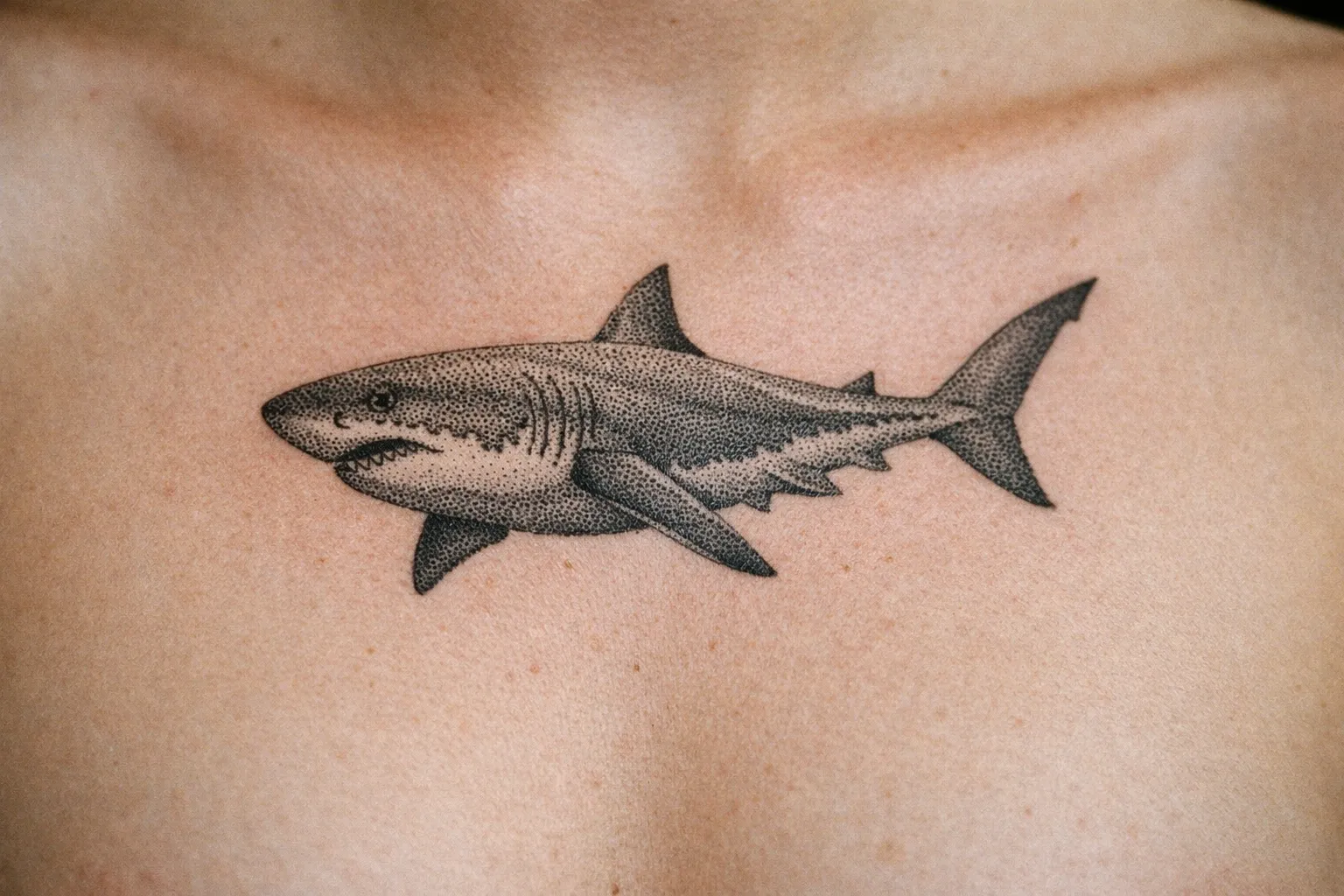
Realism is where detail is the whole reason you’re getting the piece, and it demands space. A realistic shark head is generally most workable at 6-8 inches (15-20 cm) or larger, especially once the artist is rendering skin texture and water. Full-body scenes with reef, water, or a wreck need the back, chest, or thigh. Black-and-grey realism reads cinematic and moody, and it ages better than color realism because it doesn’t rely on pigments that flatten and shift over the years.
Vet the artist hard on healed large-scale work. Fresh photos mislead badly on how gradients settle once the skin heals, so ask specifically to see pieces that are one to three years old. This is not a beginner-friendly choice, and it is not a job for a generalist. Realism is a specialty.
Neo-Traditional: Stylized Color with More Range
Neo-traditional keeps the bold outlines of traditional but adds richer color gradients, illustrative shading, and decorative elements like flowers, daggers, and waves. That decorative range is the point: a shark surrounded by florals softens the aggression, while a shark paired with a dagger amplifies it. You’re dialing the tone up or down through the supporting elements, which makes this a flexible middle ground.
Complexity is medium, and it works well at 5-8 inches (12-20 cm) on the upper arm, calf, or thigh. It ages better than photo-realism color work because the bold outlines hold the shape even as color softens, but plan on eventual color touch-ups regardless.
Polynesian and Japanese Styles: Scale and Commitment
These two styles share one requirement: scale and commitment. Polynesian work integrates the shark into geometric pattern systems designed for larger body areas, so you’re looking at a half-sleeve or a back panel to let the pattern logic function. Japanese-influenced work is narrative, with the shark as part of a scene rather than a standalone figure, and it needs comparable real estate: half-sleeve and up.
Both demand artists with genuine portfolio depth in those specific traditions. Not “tribal,” not “Asian-inspired,” but the real thing, with healed examples you can inspect. If you can’t find that artist locally, it’s worth traveling for or waiting on. Rushing a culturally specific piece to a generalist is how you end up with something that reads as neither respectful nor well-executed.
Minimalist and Blackwork: Small, Clean, Readable
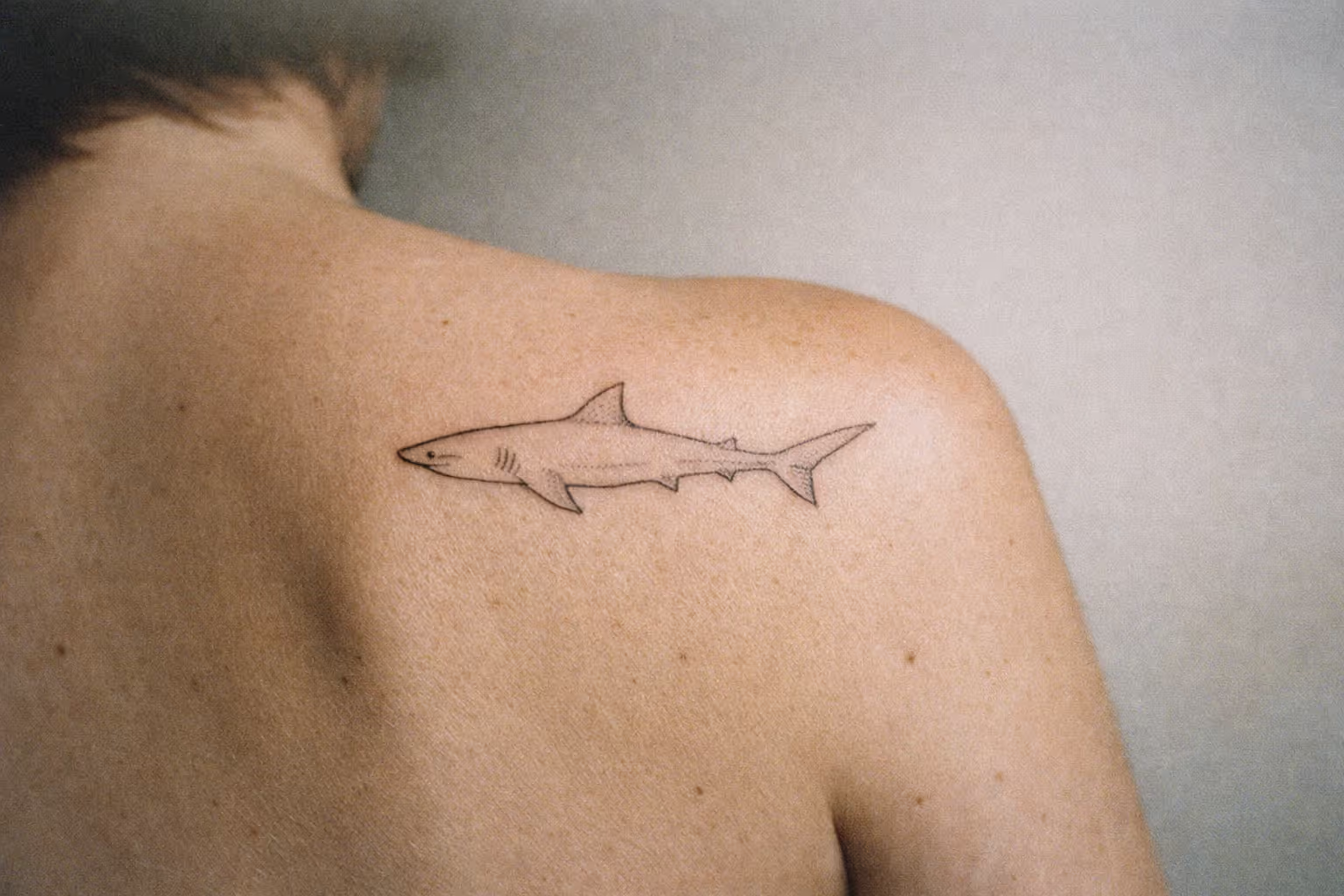
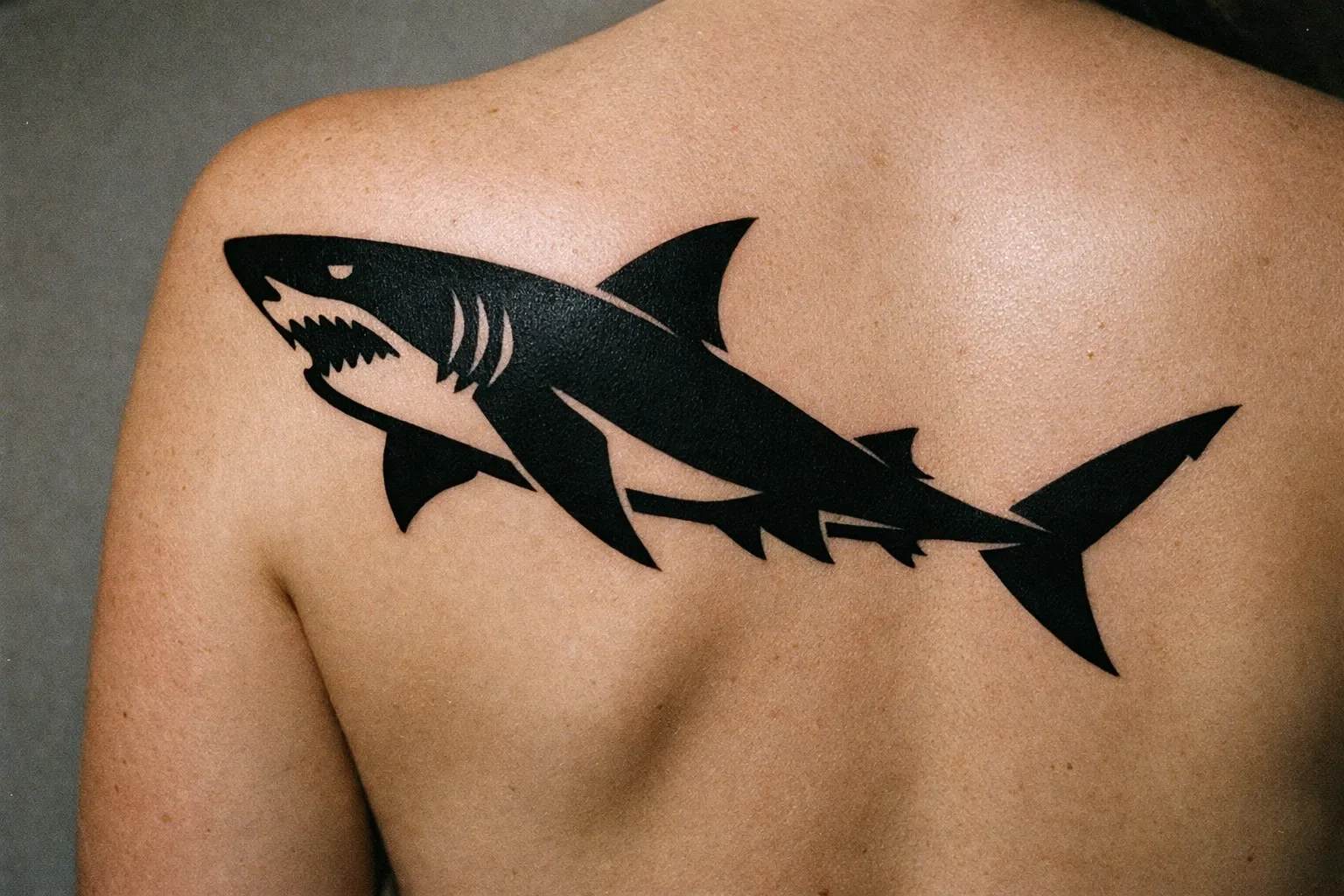
Minimalist linework silhouettes work small and clean, at 2-4 inches (5-10 cm) on the shoulder, forearm, ankle, or inner wrist. Blackwork uses solid fills and shading without color complexity, and it ages well on limbs where movement is limited. Both are strong choices for first tattoos, low-visibility placements, and subtle personal symbolism.
The one caution: don’t pack fine detail into a small minimalist piece. A clean silhouette outlasts a tiny detailed scene every time. A 2-inch great white with individual teeth and skin texture will blur into a smudge within a decade, while a 2-inch solid-black silhouette of the same animal stays crisp. Minimalist is a discipline, not a shrinking of a big design.
Shark Head vs. Full Body: How Composition Changes Everything
Most guides skip the single decision that changes a shark tattoo most: whether you’re getting a head or a whole animal. A head-only design emphasizes the face, teeth, and aggression. It’s the more compact option, and it works best when the goal is a clear power statement. A full-body composition emphasizes motion, environment, and freedom, because the shark’s body line is itself part of the message, and it needs more room to say what it’s saying.
That maps onto placement cleanly. Head-only designs suit the shoulder, chest panel, and upper arm, and they hold up at smaller sizes because the face carries all the weight. Full-body designs want the forearm (an elongated silhouette follows the limb), the back, or the thigh. From there, supporting symbols refine the reading: waves push toward freedom and ocean connection, ships toward conquest and adventure, anchors toward stability amid chaos, Polynesian patterns toward cultural depth, flowers toward softened aggression, and other sea creatures toward ecosystem and harmony rather than dominance.
Pose is the last variable and often the most overlooked. A head-on attack reads as aggression. A lateral profile reads as calm and controlled. An upward breach reads as dynamism and breaking through. Specify it. “A shark” is not a brief.
Species Choice: Great White, Hammerhead, and Beyond
The species you pick changes both the read and the space you need. The great white is the most recognizable, tied hardest to fear and power in popular culture thanks to the Jaws effect, and it carries the strongest aggression read. Its pointed snout works in a relatively compact frame. The hammerhead has a distinctive silhouette that reads as unconventional and unique, with a less aggressive visual tone, but that wide head demands more horizontal space than a great white’s profile.
The bull shark is compact and aggressive in body shape, which suits smaller compositions where you still want tenacity in the read. The whale shark is the outlier: the largest fish, paradoxically gentle, and a strong fit for ocean-lover and conservation-minded clients who want an entirely different symbolic register. Species drives sizing as much as symbolism, so decide it early. A hammerhead’s head geometry and a whale shark’s bulk are not going to fit the same footprint a bull shark will.
Placement: Matching the Design to the Body
Placement comes down to three variables: the size of the design, its shape (elongated versus compact), and your lifestyle, whether you need it visible or concealable. Forearm and upper arm are the day-to-day display placements. Chest and back are where you go for large designs you can cover for professional settings. Everything else is a trade between those poles, and each spot has an honest catch worth knowing before you book.
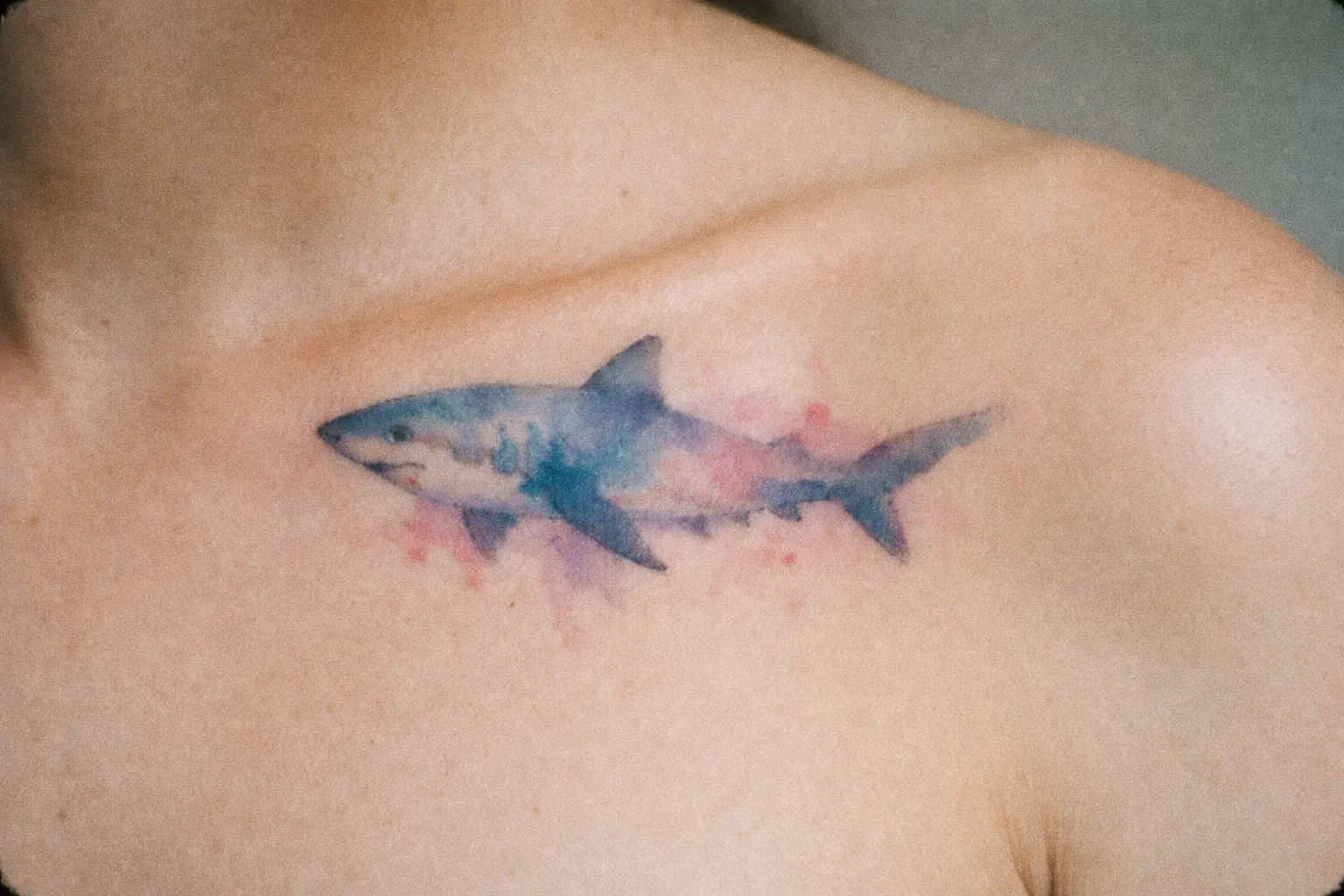
Forearm and Upper Arm: Visible, Versatile, High-Traffic
The forearm is ideal for elongated full-body shark silhouettes that follow the muscle line, typically at 4-7 inches (10-18 cm), with a practical starting range around 6-15 cm for inner or outer forearm work. Sleek species, a great white or a hammerhead in profile, sit best here. The upper arm is the most typical placement for shark tattoos overall, allowing larger, more visible designs at 5-8 inches (12-20 cm) and commonly starting around 8-20 cm; it handles head-only and medium full-body compositions comfortably.
Pain on the forearm is among the more manageable placements, though the inner forearm closer to the wrist gets sharper. Healing is standard with no unusual friction issues. The main long-term concern on both placements is sun exposure, precisely because they’re so visible.
Back and Chest: The Large-Canvas Placements
The back is excellent for large, detailed shark designs, realistic scenes with water, reef, or a shipwreck, at 8-14 inches (20-35 cm) and up, with full-body compositions that have environmental context to breathe. The chest supports extensive detailed designs too, and symmetrical or breaching shark compositions work particularly well across it, with starting sizes around 15-30 cm+. Both are easily covered for professional settings, which is the strategic reason to choose them if visibility control matters.
Pain runs hotter over the sternum on the chest, and it varies across the back, where the spine is more intense than the shoulder-blade area. These are the right placements for realism and Japanese-influenced compositions, the styles that genuinely need space rather than getting crammed onto a limb.
Calf and Thigh: Leg Placements That Work
The calf is good for vertical or circling shark patterns and follows the muscle line well for elongated designs, at 5-9 inches (12-23 cm). The thigh is a large canvas with lower visibility and easier healing than the calf, and it suits large detailed designs, commonly starting around 15-30 cm+. Between the two, the thigh is the more forgiving long-term home for detail.
Healing is the catch on the calf: it’s a higher-friction zone thanks to socks and boots, so plan aftercare around your footwear during the heal, and skip compression socks while it settles. On pain, the outer thigh is forgiving, the inner thigh is sharper, and the calf sits moderate.
Shoulder and Foot: Smaller Canvases and Tradeoffs
The shoulder is recommended for smaller shark tattoos, head-only designs and simple outlines, at 3-5 inches (7-12 cm). Its natural rounded shape makes a fine home for a shark-head composition, and it’s a good starting point if you might expand into a sleeve later. The foot is less common and genuinely distinctive, but it’s harder to show off, it’s a high-friction healing challenge, and the ink fades faster from walking and washing.
The honest caveat: if constant visibility is your goal, the foot is the wrong choice no matter how unique it looks. Choose it only if the uniqueness is a deliberate trade you’re happy to make, and budget for touch-ups sooner than you’d need anywhere else.
Sizing: How Big Does Need to Be
Size is a readability and aging decision, not just an aesthetic preference. The general principle: broad, simple shapes on joints and high-movement areas age more gracefully than tiny fine-line detail, which spreads and softens over the years. Here’s a practical reference for matching design type to size, placement, style, and complexity.
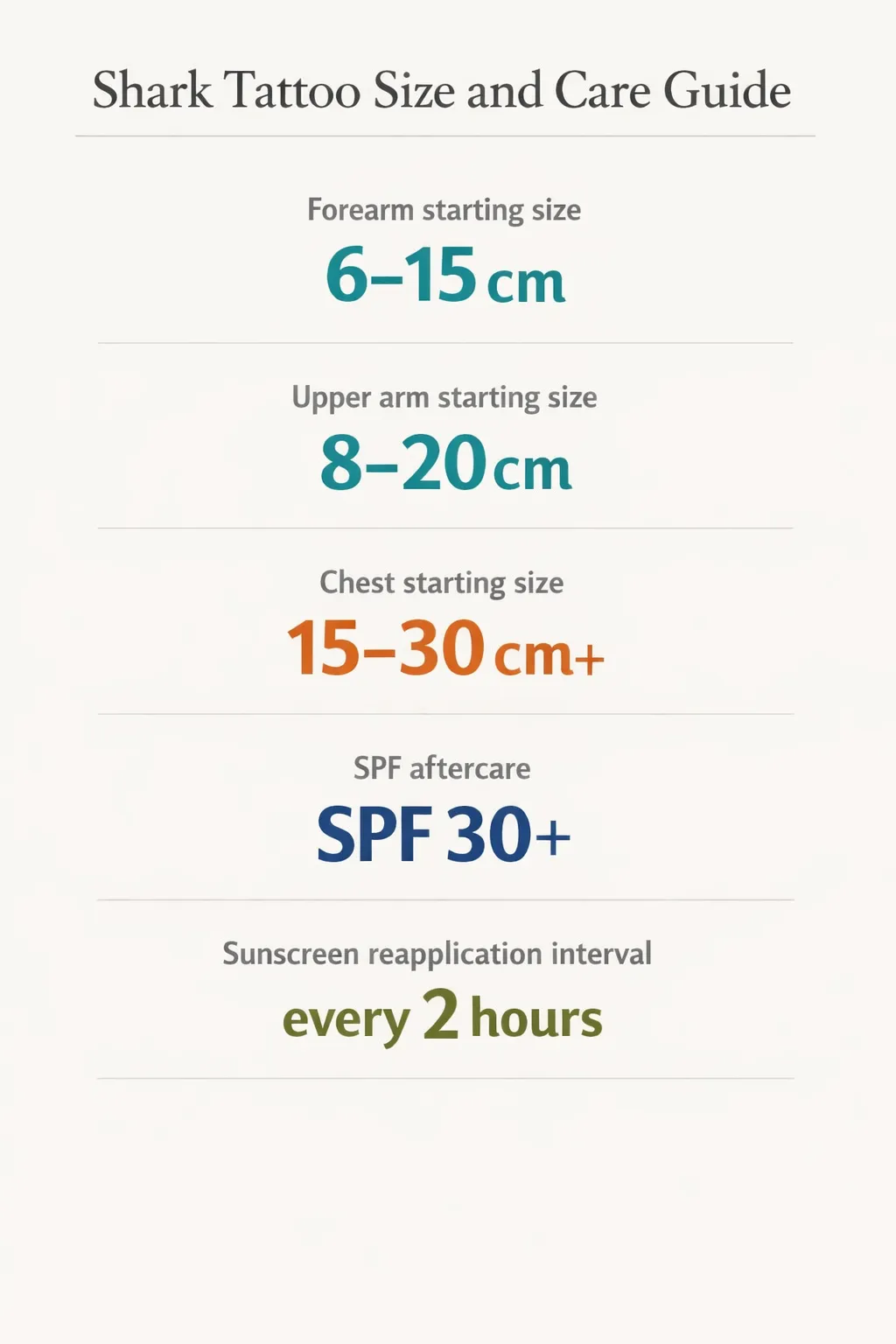 Shark tattoo sizing and aftercare by placement: forearm 6-15 cm, upper arm 8-20 cm, chest 15-30 cm+, SPF 30+, reapply every 2 hours.
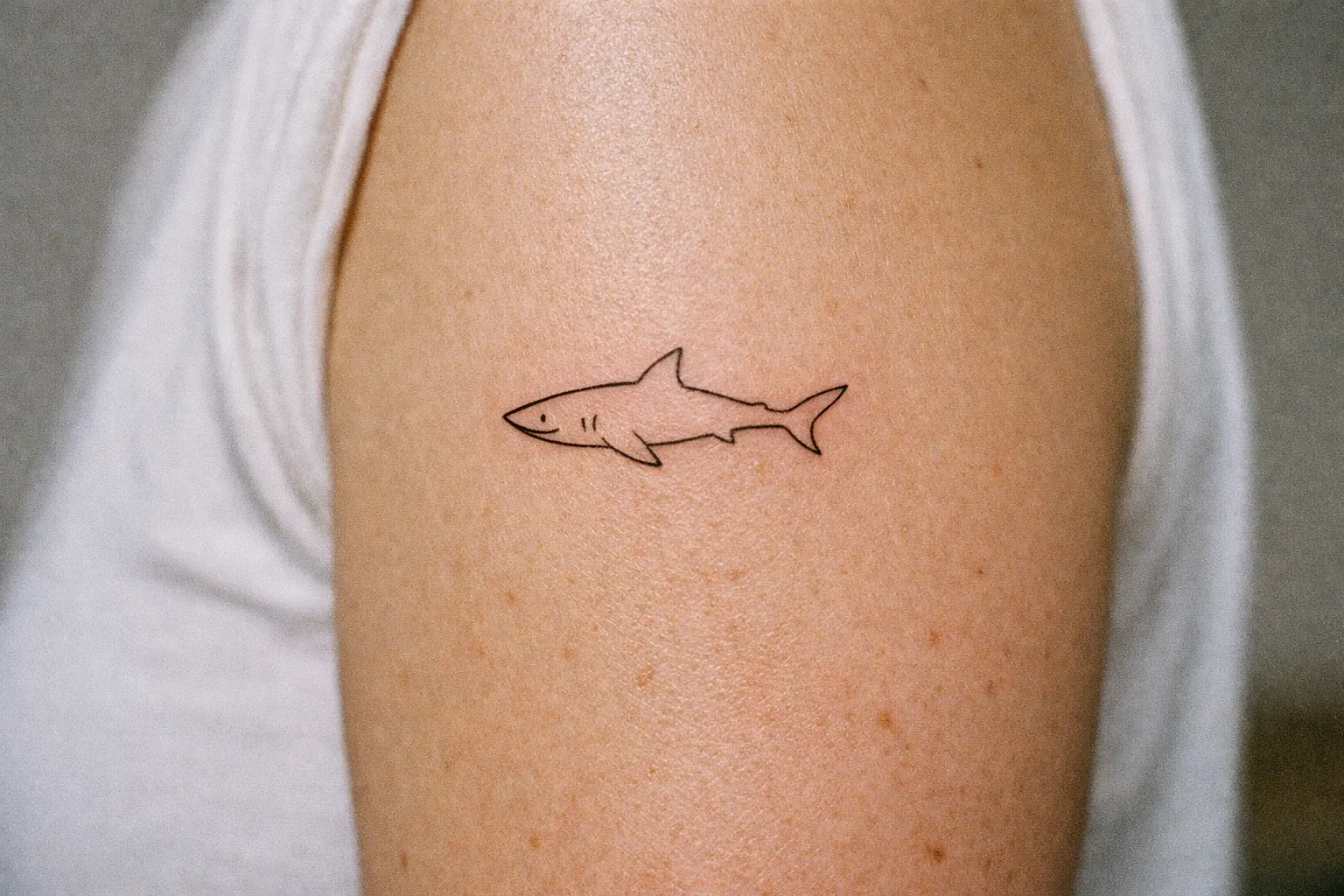
Shark Tattoo Size Recommendations by Design Type
| Minimalist silhouette | Head-only (traditional/neo-trad) | Full-body elongated | Medium scene (shark + elements) | Large realistic scene | Full Polynesian/Japanese composition | |
|---|---|---|---|---|---|---|
| Recommended Size | 2-4 in (5-10 cm) | 4-6 in (10-15 cm) | 5-8 in (12-20 cm) | 6-9 in (15-23 cm) | 8-14 in (20-35 cm) | 10 in+ (25 cm+) |
| Best Placements | Shoulder, inner forearm, ankle | Upper arm, chest panel, shoulder | Forearm, calf | Upper arm, thigh, calf | Back, chest, thigh | Back, half-sleeve, chest |
| Style Fit | Minimalist, blackwork | Traditional, neo-traditional | All styles | Neo-traditional, blackwork | Realism, Japanese-influenced | Polynesian, irezumi-influenced |
| Complexity | Beginner | Beginner-Intermediate | Intermediate | Intermediate | Advanced | Advanced/Collector |
When to Go Small, and What Actually Works at That Scale
Small shark tattoos run 2-4 inches (5-10 cm) and belong on the shoulder, inner forearm, ankle, or inner wrist. What works at that scale is a clean silhouette (solid black or a single color), a head-only design with a bold outline, or a single fin or tail used as a minimalist element. What doesn’t work: tiny realistic scenes, fine-line detail on high-movement areas, and species-specific anatomy under two inches.
The honest note bears repeating. A 2-inch great white with open jaws and visible teeth will tend to blur and lose definition significantly faster than a clean silhouette, because fine detail on small, high-movement areas spreads as the skin ages. A 2-inch solid silhouette of the same animal holds its shape far longer. If you want small, commit to simplicity rather than trying to shrink a detailed design down.
Medium Designs: The Sweet Spot for Most Placements
The 4-7 inches (10-18 cm) range is where most styles function well, and it’s where the majority of shark tattoos land. It handles American traditional, neo-traditional, blackwork, and medium realism, and it fits the forearm, upper arm, calf, or a chest panel. You get enough space for real detail without committing to a multi-session marathon, which is why it’s the default I’d point most people toward.
Large and Full-Scale Compositions
At 8 inches (20 cm) and up, you’re into the territory required for realism with environmental context, Japanese-influenced compositions, and Polynesian half-sleeves. These live on the back, chest, thigh, or a full sleeve. Plan for multiple sessions; realism and detailed Japanese work are consistently more time-intensive and are not one-sitting pieces. Book a consultation before you lock in a size, because the artist needs to assess the actual body area, not just the flat drawing.
Design Planning: Decisions to Make Before the Consultation
Walking into a consultation with a clear brief is the single biggest thing you can do to get a shark tattoo you’ll still like in a decade. Here’s a practical sequence to work through before you book:
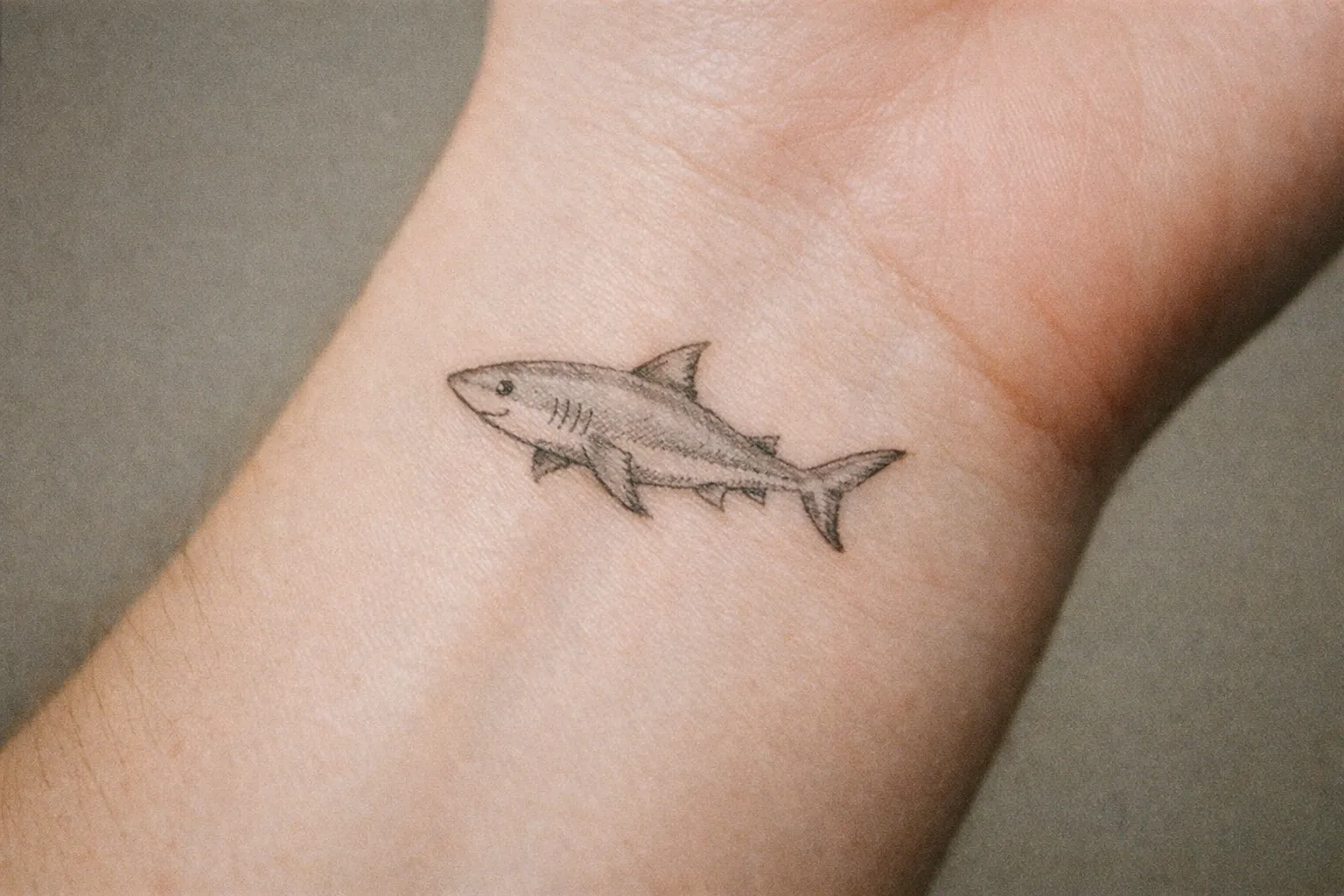
- Define the primary meaning: power and aggression, protection and survival, or freedom.
- Choose the species based on visual impact and symbolism.
- Decide the composition: head-only, full-body, or an environmental scene.
- Select the pose: attack, cruise, or breach.
- Identify supporting symbols, if any.
- Choose the style based on the space you have and your artist’s specialty.
- Confirm placement based on size, body flow, and lifestyle.
- Vet the artist on healed work in your chosen style, then book the consultation.
Matching Pose to Meaning: The Most Overlooked Decision
Pose is the most important planning decision, because the same species sends a different message depending on how it’s posed. A calm cruising shark reads as focus, control, and quiet confidence, not aggression. An open-jawed attack pose reads as aggression, dominance, and fearlessness, an explicit power statement. An upward breach reads as dynamism, freedom, and breaking through.
Fail to specify the pose and you hand the artist a coin flip on the register your tattoo communicates. Open-jawed is the clearest aggression signal, while a closed-mouth profile reads as control or protection. Bring reference images that show the exact posture you want, not just the species. The artist needs direction, not a one-word brief.
Supporting Symbols That Refine the Message
Supporting elements shift the reading from raw dominance toward context. Waves push toward freedom and ocean connection. Ships or anchors push toward conquest, adventure, or stability amid chaos. Polynesian geometric patterns add cultural depth and protective energy, but only if researched and executed respectfully. Flowers soften aggression and add contrast. Other sea creatures reframe the piece around ecosystem and harmony rather than dominance over nature. Daggers or crowns amplify the power-and-authority reading.
A protection-focused design usually pairs calmer body language with anchors or waves, while a power-focused design leans on forward motion and a teeth-forward composition. Pick the elements that serve the register you settled on in step one, and cut anything that pulls against it.
Cultural Designs: How to Commission Respectfully
Polynesian motifs are spiritually loaded, not decorative, so the planning rule is concrete: research the specific tradition rather than defaulting to “tribal style,” and find an artist with genuine portfolio depth in Polynesian or Japanese work. Ask to see healed examples in the exact tradition you want, not just fresh photos. For Japanese-influenced compositions, remember the shark is part of a scene; the background of waves, wind bars, and other elements is structural, not optional.
One more practical warning: don’t copy AI-generated references for culturally specific designs. AI output frequently misrepresents anatomy and cultural detail, and most professional artists redraw such references from scratch to fix errors anyway. For a tradition where accuracy carries meaning, an AI render is the wrong starting point. Bring real references and be honest about your connection to the culture.
Common Mistakes That Ruin Shark Pieces
Four mistakes wreck more shark tattoos than anything else. Over-detailing on small areas: packing realism into a foot or a small shoulder gives you muddled lines as the ink ages. Ignoring body flow: a short, compact shark on a forearm or calf looks awkward when the muscle flexes, because elongated designs are the ones that follow the limb. Misaligned meaning: not clarifying the aggressive-versus-protective register before the artist draws, which is how people end up with a violent-looking piece they meant as a guardian.
The fourth is choosing an artist by price over portfolio. Realism and Polynesian work are specialties, and a generalist working outside their lane produces work that shows its weakness within a few years. Vet healed work, not fresh photos, because fresh photos flatter every artist and tell you nothing about how gradients and fine lines settle.
Healing and Aftercare by Placement
Standard aftercare applies to every shark tattoo, and it runs on a clear timeline. Days 1-3: wash gently with unscented soap twice a day, pat dry, and apply a thin layer of fragrance-free moisturizer: the skin is open and needs to stay clean above everything else. Week 1: peeling starts; keep moisturizing, don’t pick, and wear loose clothing over the area. Weeks 2-4: the surface closes but the deeper layers are still settling, so continue fragrance-free moisturizer, avoid soaking (pools, baths, open water), and keep the piece out of direct sun. Once fully healed, sun protection takes over as the main maintenance job. The common shark placements each come with their own wrinkle worth planning around on top of that baseline.
On the forearm and upper arm, healing is straightforward. Avoid tight sleeves during the first two weeks, and treat sun exposure as the main long-term concern given how visible these placements are. On the back and chest, the larger surface area means longer surface healing, and sleeping position matters: sleep on your front for a back piece, and skip tight bras or compression garments for a chest piece while it settles.
The calf is a high-friction zone thanks to socks and boots. Wear loose, breathable clothing over the area, and avoid compression socks during healing. The foot is the most challenging placement of all: constant friction from footwear, faster fading, and touch-ups you should expect sooner than anywhere else. If you choose it, plan for that maintenance from the start.
Long-term, sun protection is the single cheapest thing you can do to keep a shark tattoo readable. The American Academy of Dermatology advises protecting healed tattooed skin with a broad-spectrum, water-resistant sunscreen of SPF 30 or higher, applied 15 minutes before going outside and reapplied at least every 2 hours (15). For fresh tattoos, public health guidance is to avoid direct sun entirely at first and wait until the skin has closed before using any sunscreen. Exposed placements like the forearm and calf need the most consistent UV protection, because sun exposure is a major long-term cause of fading, and it hits color pieces and fine-line work hardest. Sun-protective clothing does the same job when reapplication isn’t practical.
Frequently Asked Questions
- What does a shark tattoo symbolize?
- A shark tattoo most commonly represents power, fearlessness, survival, protection, or freedom. The exact read shifts based on pose and composition: an open-jawed lunge signals aggression and dominance, while a calm cruising profile reads as control, focus, or guardianship.
- What does a shark tattoo mean on a woman?
- The meaning is the same regardless of gender: power, fearlessness, survival, protection, or freedom, depending on pose and composition.
- What's the difference between a shark head tattoo and a full-body design?
- Head-only designs emphasize identity and aggression and work at smaller sizes; full-body designs emphasize motion and freedom and need more space.
- Which shark species makes the best tattoo?
- Species choice depends on desired symbolism: great whites for power, hammerheads for uniqueness, bull sharks for aggression, whale sharks for gentleness.
- Do shark tattoos age well?
- Bold outlines in traditional and blackwork age predictably; fine-line realism on high-movement areas fades faster; sun protection is key for longevity.
- Is it disrespectful to get a Polynesian shark tattoo?
- Respect depends on research and artist choice; Polynesian motifs are spiritually significant and require cultural understanding and genuine portfolio depth.
- What's a good size for a first shark tattoo?
- A 4-6 inch traditional or blackwork shark on upper arm or forearm suits most first-timers; minimalist silhouettes at 2-4 inches work for smaller pieces.
- Can a shark tattoo be a symbol of protection rather than aggression?
- Yes; protection is conveyed by calm poses, supporting symbols like anchors and waves, and must be communicated to the artist explicitly.
Before You Book: The Three Decisions That Actually Matter
Three decisions determine whether a shark tattoo holds up long-term, and they’re worth settling before you sit in the chair.
First, pose: aggressive or guardian? This is the meaning decision, and it has to be made before the artist draws anything. An open-jawed lunge and a calm cruise are two different tattoos wearing the same species.
Second, size and placement, which are linked. The placement sets the maximum size, and the size determines which styles are viable. Don’t pick a placement and then try to force a style into it. Work from the style’s requirements outward: if you want realism with a water scene, you need a back or thigh, full stop.
Third, artist vetting. For realism, Polynesian, and Japanese-influenced work, healed photos are non-negotiable, because fresh photos flatter everyone. A shark tattoo at the right scale by the right artist holds for decades. One crammed into the wrong space, or done by a generalist working in a specialist style, will show it within a few years.
One last honest note on maintenance: sun protection on exposed placements like the forearm and calf is the cheapest long-term investment you’ll ever make in keeping the piece readable. The AAD is specific: SPF 30 or higher, broad-spectrum, water-resistant, reapplied every two hours when you’re outside (15). Sun-protective clothing covers the same job when reapplication isn’t practical.