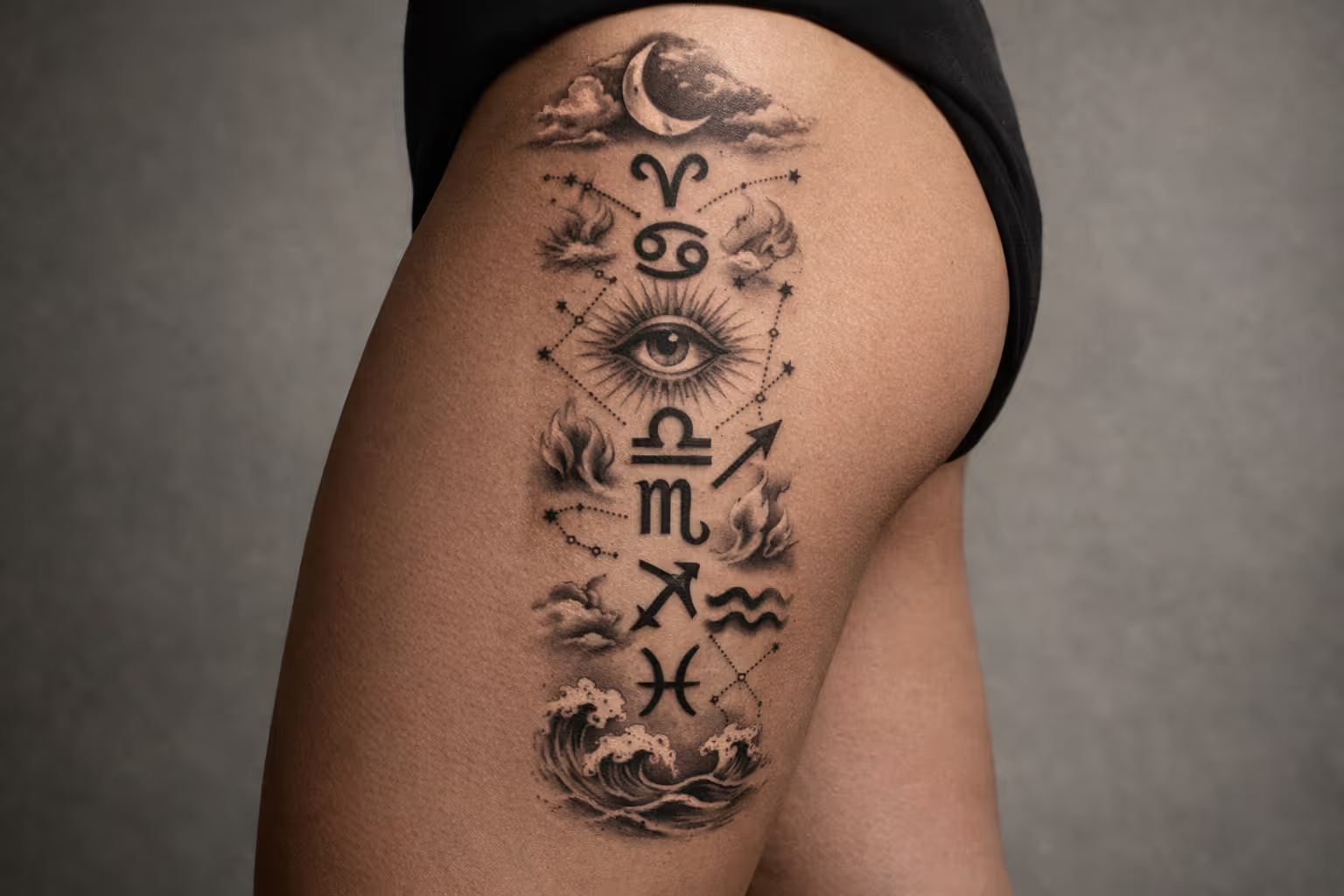
A triangle with three dots means Aries to you and nothing to anyone else. That is the core problem with zodiac sign tattoos: they live or die on legibility. A glyph is unambiguous - anyone who knows astrology reads ♑ as Capricorn from across a room. A random abstract wave reads as “some line art.” This guide is a decision tool for the three real forks in the road: glyph versus constellation versus element motif, how the four elements (fire, earth, air, water) should shape your composition, and how to scale from a 2 cm wrist piece to a full zodiac sleeve. It also covers the three chart points people tattoo - Sun, Moon, and Rising - because that is why some people want one symbol and others want three.
Here is the honest breakdown before you book anything.
✓ Pros
- Glyphs are compact - under 3 cm, single session
- Element-based designs scale from minimal to full sleeve
- Sun/Moon/Rising trio gives a highly personalized multi-symbol piece
- Constellations work across fine-line, dotwork, and watercolor styles
- Placement flexibility - wrist to ribcage to full arm
✗ Cons
- Abstract motifs without explicit markers read as generic line art
- Incorrect element assignment (e.g., waves for Gemini) contradicts established groupings
- Very fine constellation linework under 2 cm can blur within years
- Overcrowding all 12 signs at equal size dilutes visual focus
- Choosing a sign for aesthetics rather than identity can lead to later disconnect
Three Ways to Tattoo Your Zodiac Sign - and What Each One Actually Communicates
There are three core ways to render a zodiac sign: a glyph, a constellation, or a representational motif. Each communicates something different to a viewer. Pick the wrong one for your size and placement and the astrology intent evaporates. Astrology works from a system of 12 signs (1), grouped into 4 elements with 3 signs each. Your job is to make sure the finished piece says “zodiac” and not “abstract dots.”
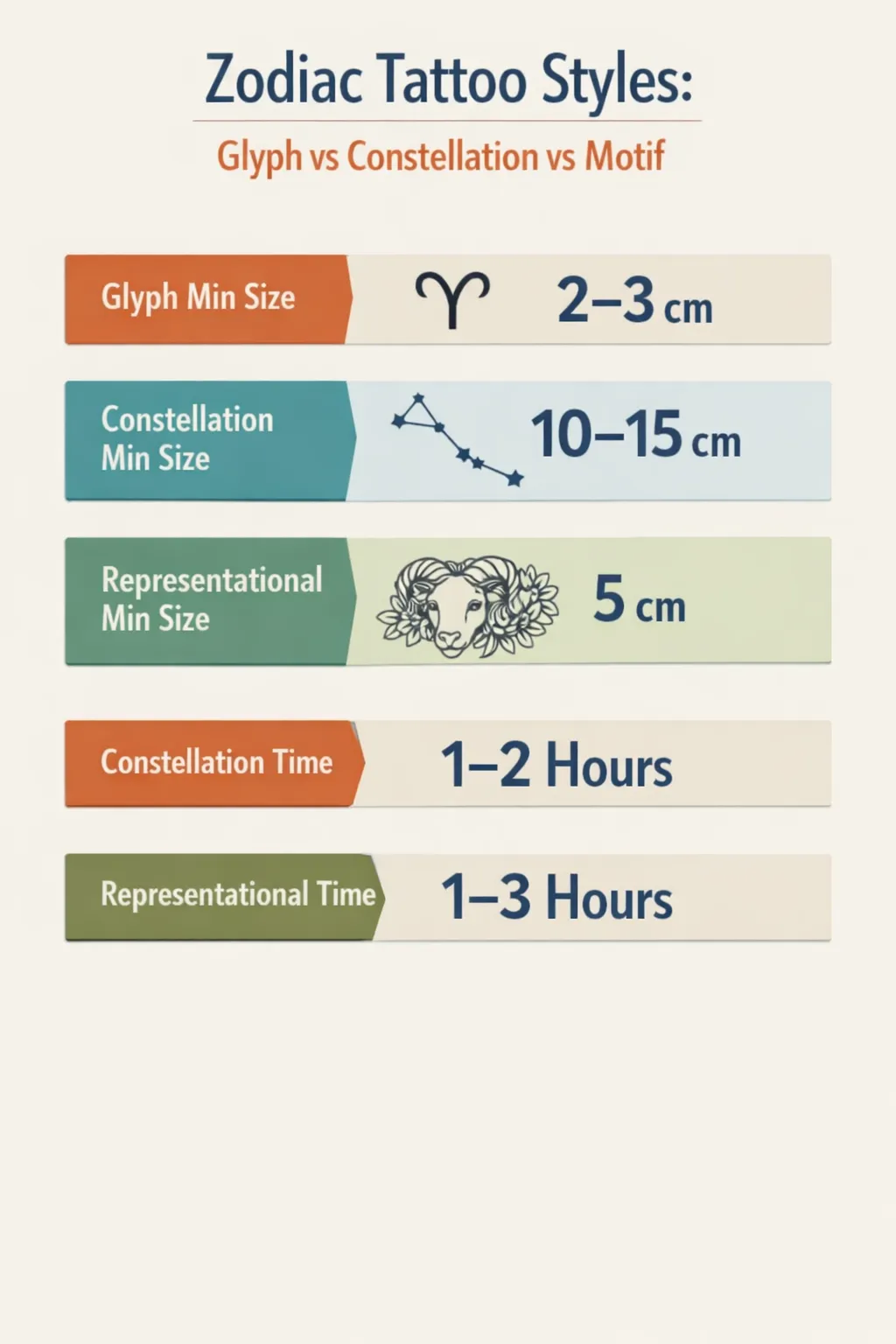 Glyph min size 2-3 cm; Constellation min size 10-15 cm; Representational min size 5 cm; Constellation time 1-2 hours; Representational time 1-3 hours.
Here is how the three approaches compare. A glyph needs roughly 2 to 3 cm to hold its character shape, takes under an hour, and reads immediately to anyone astrology-aware - best on wrist, behind the ear, sternum, or ankle, with low long-term risk. A constellation needs 10 to 15 cm to keep star spacing legible, takes 1 to 2 hours, and reads well if the star pattern is accurate - best on shoulder blade, ribcage, inner forearm, or thigh, with medium blur risk on tiny dots. A representational motif needs at least 5 cm for a recognizable silhouette, takes 1 to 3 hours, reads at moderate legibility unless anchored by a glyph or animal, and sits best on the upper arm, outer forearm, or calf.
Tattoo aftercare for zodiac sign tattoos follows a typical timeline: day 1-3 involves gentle cleansing and applying a fragrance-free moisturizer; week 1 focuses on keeping the tattoo clean and avoiding soaking; weeks 2-4 require sun-protective clothing to prevent fading and support healing.
Glyph vs Constellation vs Representational Motif - At a Glance
| Compact Glyph | Constellation | Representational Motif | |
|---|---|---|---|
| Minimum readable size | 2-3 cm | 10-15 cm | 5 cm |
| Typical session time | Under 1 hour | 1-2 hours | 1-3 hours |
| Best styles | Fine-line, minimalist | Dotwork, fine-line, watercolor | Illustrative, realism, neo-traditional |
| Zodiac legibility | Immediate (to astrology-aware viewers) | High (if star pattern is accurate) | Moderate (needs glyph or animal anchor) |
| Best placements | Wrist, behind ear, sternum, ankle | Shoulder blade, ribcage, inner forearm, thigh | Upper arm, outer forearm, calf |
| Long-term clarity risk | Low (if ≥2 cm, clean lines) | Medium (tiny dots can blur under 10 cm) | Low (bold silhouettes hold well) |
| Works for multi-sign pieces | Yes - easy to stack | Yes - needs spacing plan | Harder to combine without crowding |
Glyphs - the case for going small and direct
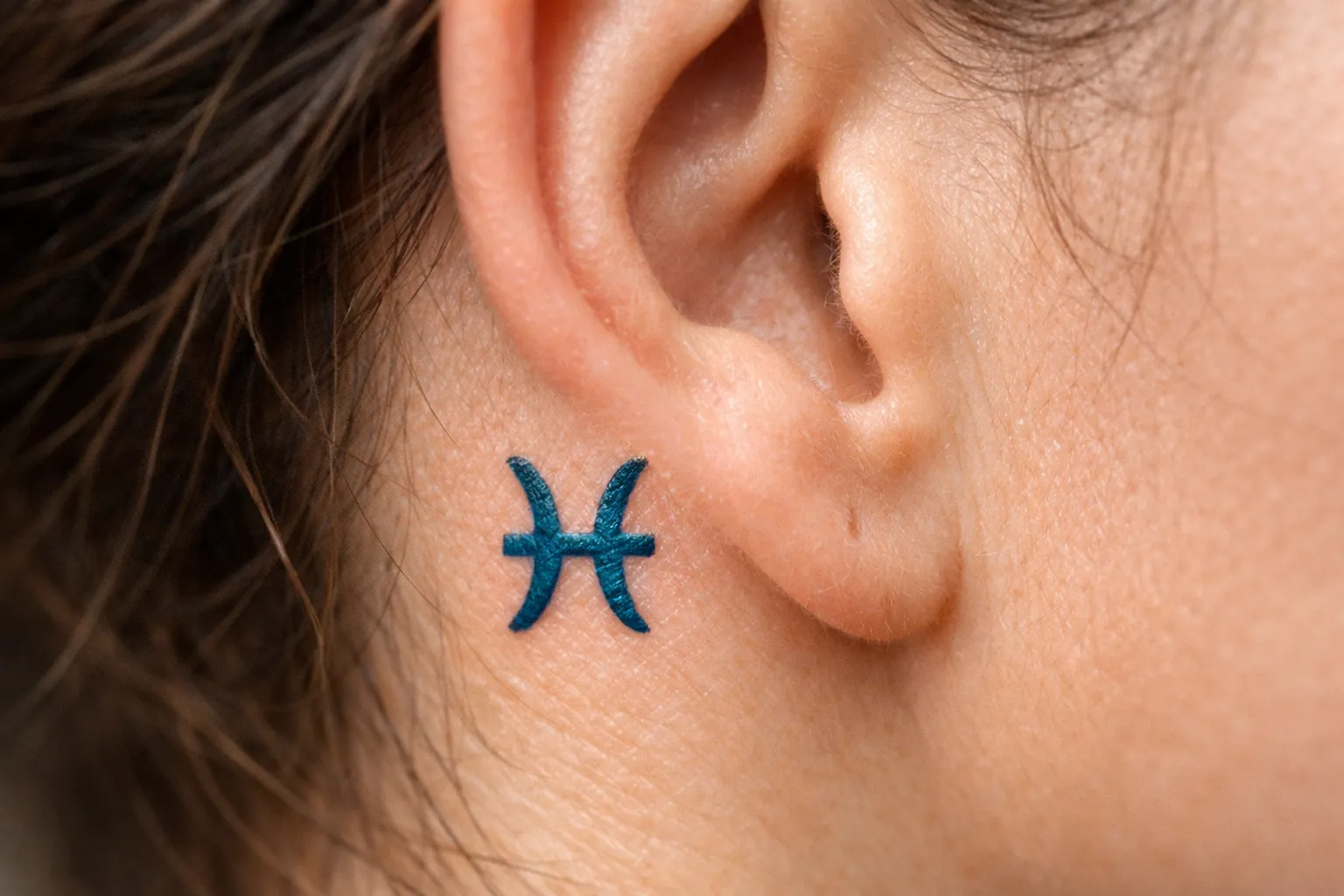
The 12 zodiac symbols are the character marks - ♈ through ♓ - and they are the most compact, unambiguous option. Capricorn’s glyph, for example, is ♑ (2). They hold up well at 2 to 5 cm in a single session, and they suit minimalist and fine-line work. The trade-off: they read as astrology only to people who already know the symbols.
That is usually fine. Most zodiac tattoos are for the wearer, not the audience.
Constellations - dot-and-line maps and where they need room to breathe
A constellation tattoo maps the actual star pattern in dots connected by lines. These need room - at least 10 to 15 cm - to keep star spacing accurate and legible. They work in dotwork, fine-line, or galaxy-shaded styles. One thing worth knowing: the astronomical zodiac band actually contains 13 constellations, including Ophiuchus, which astrology’s 12-sign system leaves out (3). If you invent a pattern that does not match the real stars, an astronomy-literate viewer will clock it.
Representational motifs - when the animal or element does the work
Ram, bull, twins, crab, lion, maiden, scales, scorpion, archer, sea-goat, water bearer, fish - these are the illustrative, realism-friendly route, and they layer well with element imagery (flames, waves, mountains, wind). The rule: include at least one explicit zodiac marker - a glyph, the animal, or the constellation - or the piece reads as generic nature art.
My legibility floor for any of these: at least one or two explicit markers readable from 1 to 2 metres. A constellation with its glyph tucked underneath is the most immediately readable format for anything under 8 cm.
Zodiac by Element - How Fire, Earth, Air, and Water Should Shape Your Design
The four elements are not decoration. They should drive your composition, palette, line quality, and motif choice. Western astrology sorts the 12 signs into 4 element groups of 3 signs each (1). Most guides list the elements and move on. Here is how each one should actually change the design on your skin.
Fire signs (Aries, Leo, Sagittarius) - sharp, kinetic, warm
Fire signs are Aries, Leo, and Sagittarius (1). Design for motion: sharp angles, dynamic lines, flame and sun motifs, a warm palette of reds, oranges, and golds. Think arrows mid-flight, a lion’s mane in motion, a flame-tipped glyph. Both bold blackwork and saturated color work here - the composition should feel kinetic, not static.
Earth signs (Taurus, Virgo, Capricorn) - grounded, botanical, solid
Earth signs are Taurus, Virgo, and Capricorn (1). Build grounded, stable compositions - mountains, florals, geometric solids - in greens, browns, and blackwork. Capricorn’s sea-goat silhouette or the Virgo maiden with botanical detail both suit heavier bases. Keep elements anchored. No floating shapes drifting in negative space.
Air signs (Gemini, Libra, Aquarius) - open space and light linework
Air signs are Gemini, Libra, and Aquarius (1). Negative space is your design tool here - open, airy spacing around the glyph or figure, light single-weight linework, and motifs like wings, feathers, clouds, and abstract geometric lines.
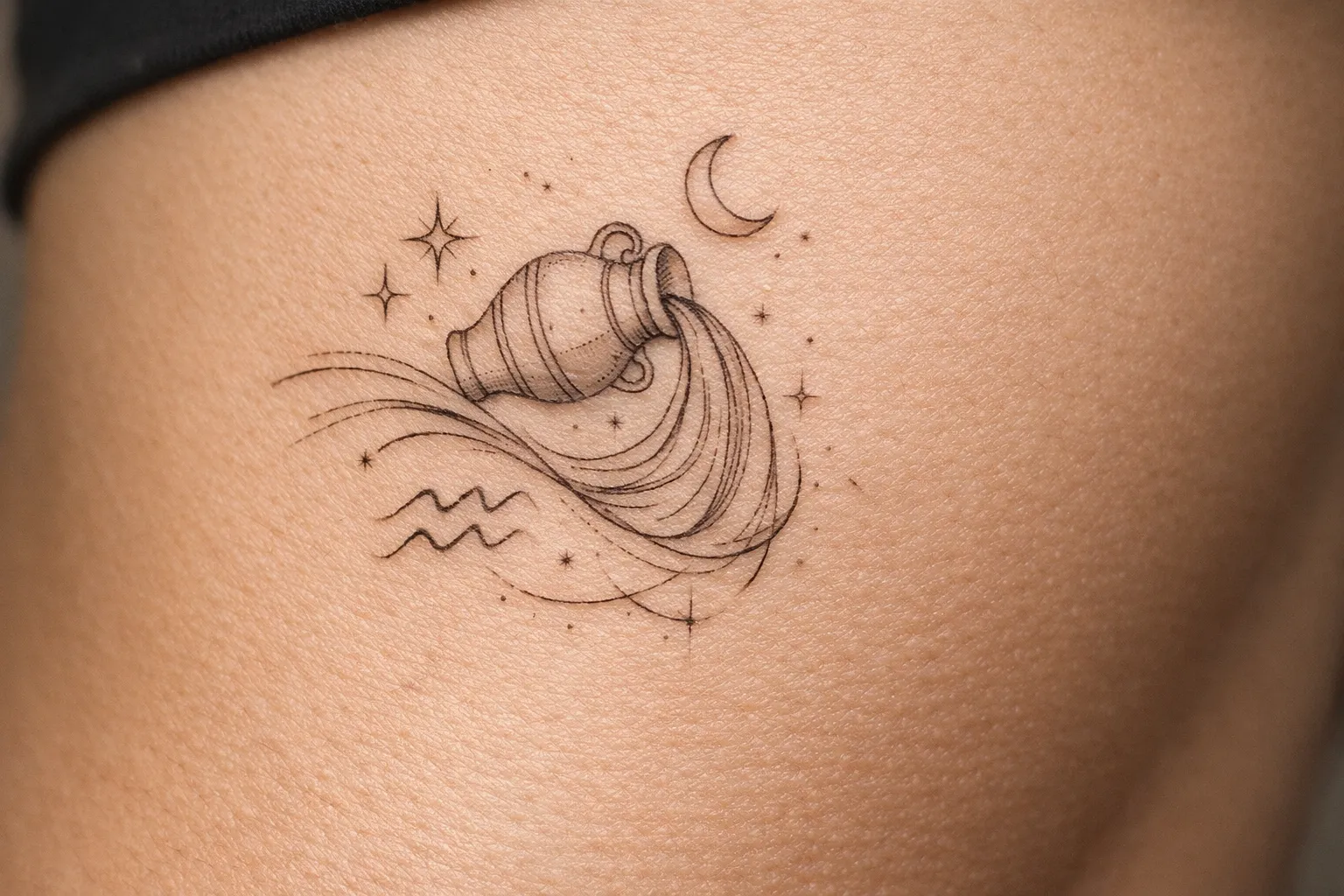
One critical misread to avoid: Aquarius is an air sign despite its water-bearer imagery (Babylonian/Hellenistic astrology) (1). The glyph ♒ represents two stacked waves flowing from the water bearer’s pitcher; modern interpretations also read them as airwaves or electrical currents, per the Farmers’ Almanac. Rendering Aquarius as waves fits its glyph, but keep the design airy with open spacing and light linework at 4 to 7 cm.
Water signs (Cancer, Scorpio, Pisces) - curves, moons, and fluid shading
Water signs are Cancer, Scorpio, and Pisces (1). Lean into fluid curves, wave forms, moon phases, and sea life - cool tones (blues, teals, deep purples) or full blackwork with fluid shading. Pisces fish in opposing motion, Cancer’s crab with shell detail, Scorpio’s tail curve.
Practical tip for any small tattoo: adding a subtle element cue - a tiny flame near a fire-sign glyph, a wave line under a water-sign constellation - makes the piece read as zodiac without sacrificing minimalism.
All Twelve Signs - Symbols, Motifs, and What Each One Actually Means
Here is the per-sign reference: dates, element, glyph, symbolic traits, and concrete design directions with sizing. A note on constellation legibility before you commit - Scorpius and Sagittarius have enough distinctive stars to read at 10 to 12 cm, while Aries and Cancer are sparse and need a glyph anchor to avoid confusion.
Aries (Mar 21-Apr 19) - ram, courage, fire
Aries runs March 21 to April 19, a fire sign of courage and new beginnings. The glyph ♈ resembles ram’s horns. The constellation is sparse, so pair it with the glyph. A ram’s-head motif at 5 to 8 cm on the outer forearm holds a clean silhouette; the glyph alone works at 2 to 3 cm on the wrist.
Taurus (Apr 20-May 20) - bull, stability, earth
Taurus runs April 20 to May 20, an earth sign of stability and sensuality. The glyph ♉ is a bull’s head with horns. Good directions: the glyph with a small floral base at 4 to 6 cm, or a bull silhouette at 6 to 8 cm on the upper arm with botanical grounding.
Gemini (May 21-Jun 20) - twins, duality, air
Gemini runs May 21 to June 20, an air sign of duality and communication. The glyph ♊ reads like the Roman numeral II. Lean air: open spacing, light linework, twin figures or a mirrored composition. Works at 4 to 7 cm on the inner forearm.
Cancer (Jun 21-Jul 22) - crab, intuition, water
Cancer runs June 21 to July 22, a water sign of intuition and emotional depth. The glyph ♋ looks like a stylized 69 or crab claws. The constellation is faint - anchor it with the glyph. A crab with shell detail at 5 to 7 cm suits the outer forearm; add moon phases for a water cue.
Leo (Jul 23-Aug 22) - lion, confidence, fire
Leo runs July 23 to August 22, a fire sign of confidence and leadership. The glyph ♌ suggests a lion’s mane and tail. A lion’s head in motion at 6 to 10 cm on the upper arm carries warm shading well; the glyph with a small sun accent works small.
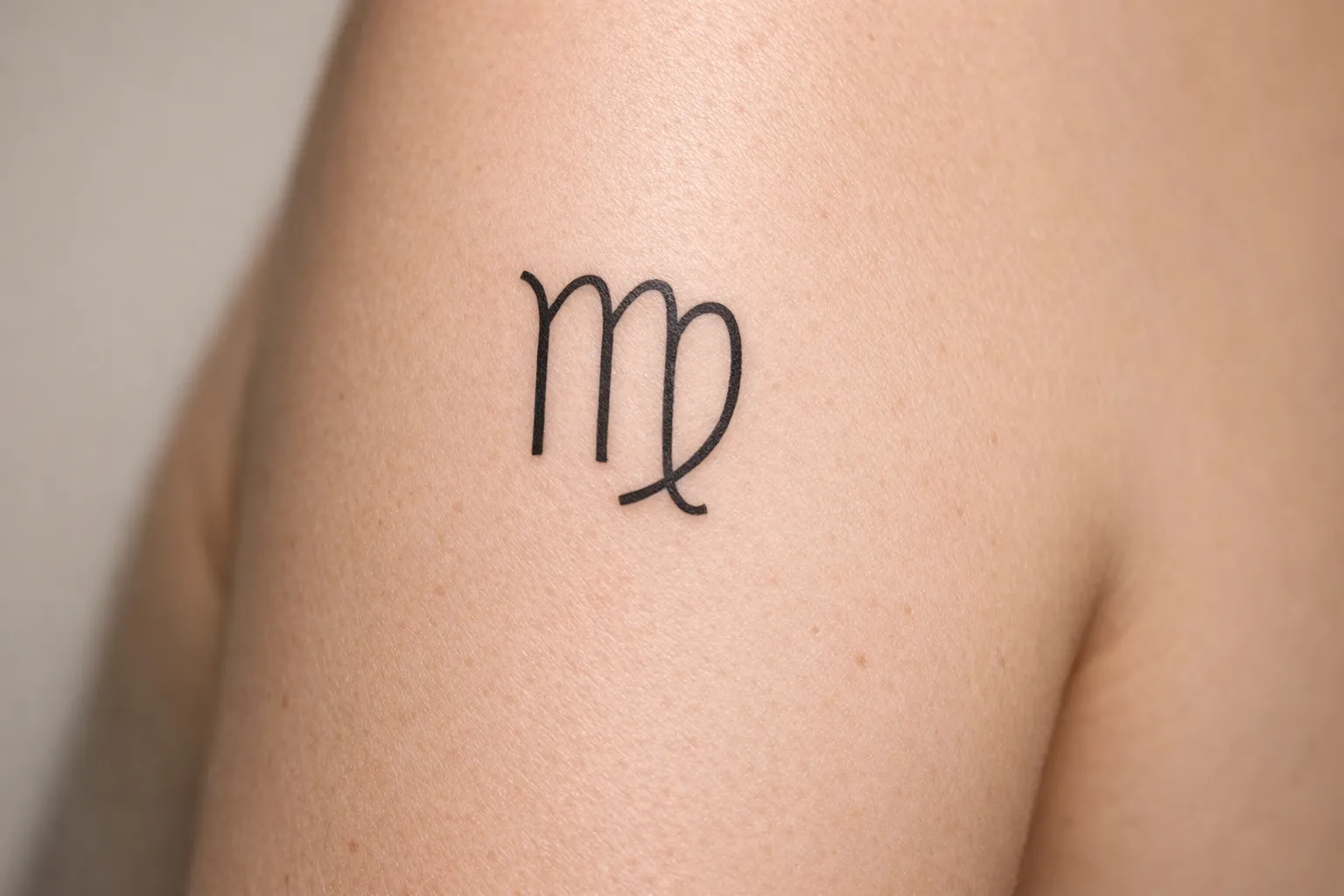
Virgo (Aug 23-Sep 22) - maiden, precision, earth
Virgo runs August 23 to September 22, an earth sign of precision and wisdom. The glyph ♍ is an M with an inward loop. The maiden figure with botanical detail at 6 to 9 cm suits the forearm or calf, grounded with florals rather than floating.
Libra (Sep 23-Oct 22) - scales, balance, air
Libra runs September 23 to October 22, an air sign of balance and justice. The glyph ♎ is scales, and it is one of the most self-explanatory glyphs in the set. Scales at 4 to 7 cm on the inner forearm read instantly; keep the linework light and airy.
Scorpio (Oct 23-Nov 21) - scorpion, transformation, water
Scorpio runs October 23 to November 21, a water sign of transformation and passion. The glyph ♏ is an M with a barbed tail. Scorpius is one of the most recognizable constellations - it reads at 10 to 12 cm on the ribcage or inner forearm. A scorpion with a curved tail at 6 to 9 cm works as a representational piece.
Sagittarius (Nov 22-Dec 21) - archer, freedom, fire
Sagittarius runs November 22 to December 21, a fire sign of freedom and adventure. The glyph ♐ is an arrow. The constellation has enough stars to read at 10 to 12 cm. An arrow mid-flight or a bow at 6 to 10 cm on the forearm captures the kinetic fire quality.
Capricorn (Dec 22-Jan 19) - sea-goat, discipline, earth
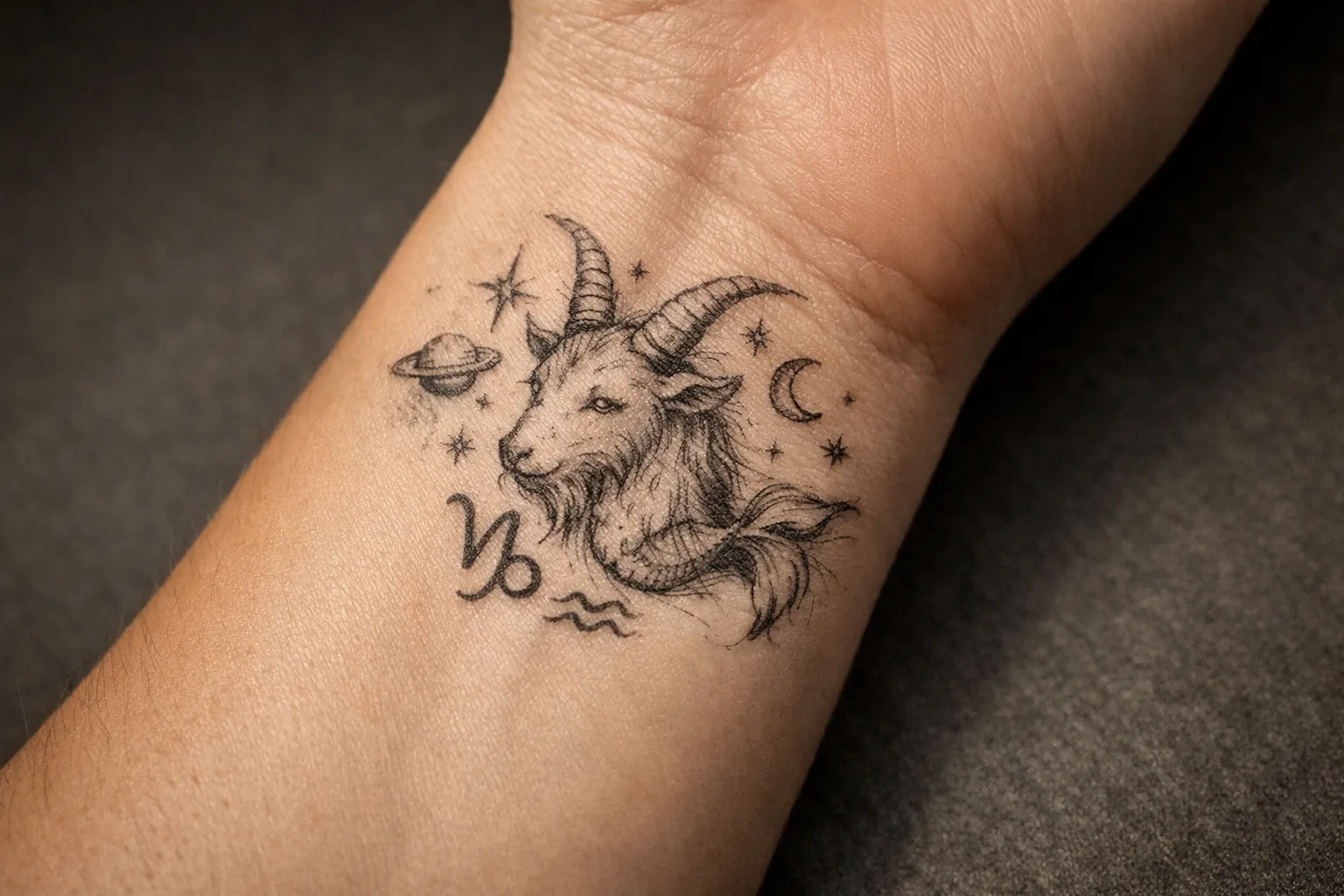
Capricorn runs December 22 to January 19 (Babylonian/Hellenistic astrology), an earth sign of discipline and ambition. The glyph is ♑ (2) - a V-shape with a curved tail representing the sea-goat’s body and fish tail. The representational motif is the sea-goat itself: a goat with a fish tail.
The motifs most often cited as reinforcing Capricorn’s qualities are the mountain goat mid-climb or the sea-goat ascending from water to land - upward-trajectory compositions that echo Capricorn’s Saturn-ruled ambition. As for the “devil” association some people ask about: it comes from the horned goat resemblance to demonic imagery in Western iconography, not from anything in the astrology, which frames Capricorn as disciplined and realistic. If that ambiguity bothers you, the constellation or a plain mountain-goat motif reads more neutrally. The sea-goat silhouette works at 5 cm or larger on the forearm or upper arm.
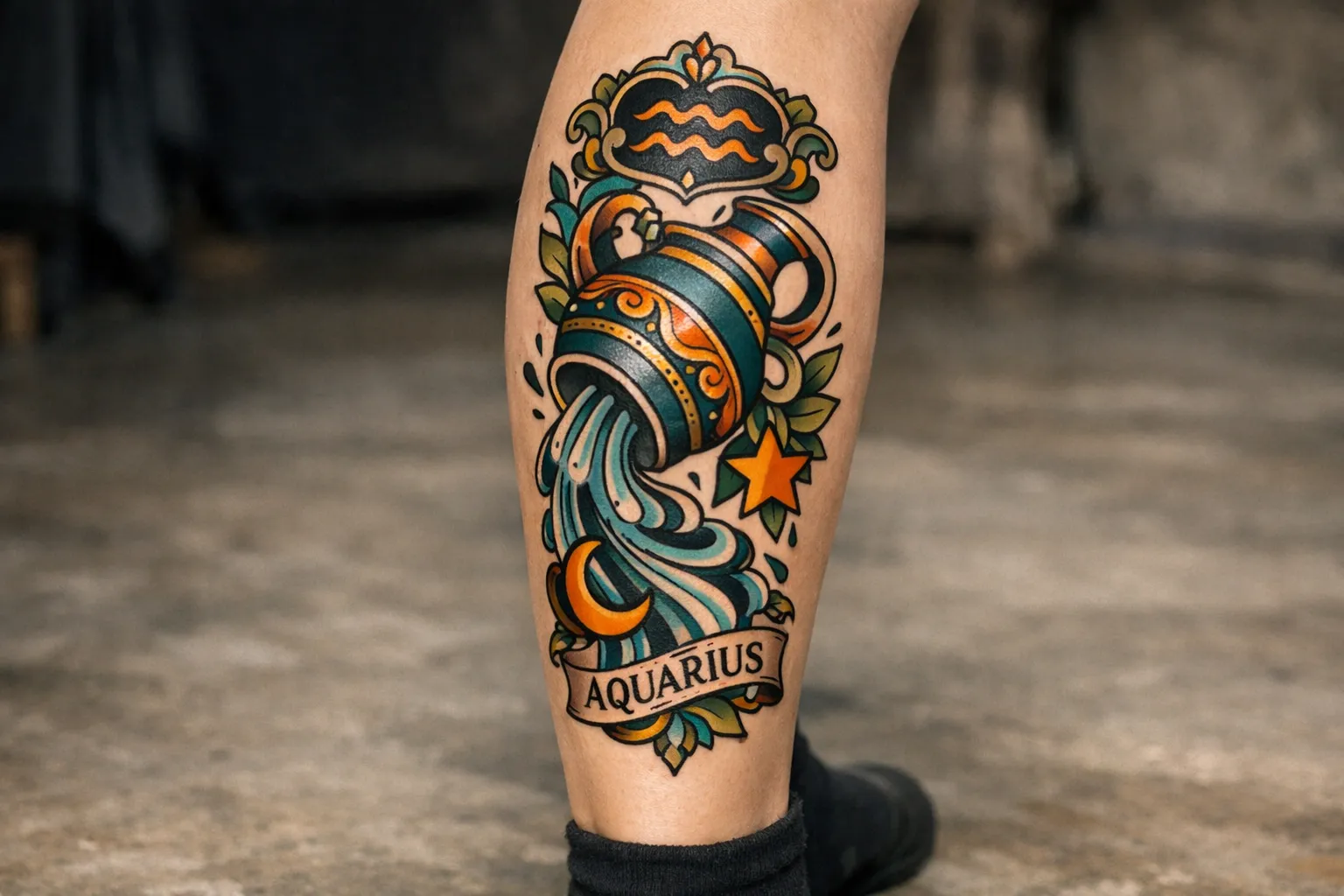
Aquarius (Jan 20-Feb 18) - water bearer, innovation, air
Aquarius runs January 20 to February 18 (Babylonian/Hellenistic astrology) - one of the two February signs - and it is an air sign despite the water-bearer imagery (1). The glyph ♒ is two stacked waves, traditionally read as the water bearer’s flowing water, though modern interpretations also read them as airwaves or electrical currents. Design it airy: open spacing, geometric lines, light linework at 4 to 7 cm. Ocean waves can work if balanced with air sign motifs.
Pisces (Feb 19-Mar 20) - fish pair, compassion, water
Pisces runs February 19 to March 20, a water sign of compassion and spiritual depth. The glyph ♓ is two fish joined by a line, swimming in opposite directions. Two fish in opposing motion at 5 to 8 cm on the forearm or ribcage, in cool tones or fluid blackwork, reads clearly as Pisces.
Placement That Works - Where Each Design Type Sits Best on the Body
Placement should follow the design type and its size, not the sign itself. Finer linework holds better on flatter, lower-friction skin than on hands or fingers, where small zodiac line art blurs faster over the years.
I steer clients away from finger and hand placements for detailed glyph work. The fade is real, the touch-ups are frequent, and the detail you paid for is gone within a few years.
Small and discreet - wrist, ankle, behind the ear, sternum
Small glyphs under 3 cm sit well on the wrist, behind the ear, inner ankle, and sternum - low-friction, flatter areas that hold fine linework longer. This is the placement territory that skews toward smaller, more discreet zodiac sign tattoos for anyone wanting something subtle. Fingers and hands fade faster and need touch-ups.
Mid-size constellation and motif placements - forearm, shoulder blade, ribcage, thigh
Constellation pieces at 10 to 15 cm want the inner forearm, shoulder blade, ribcage, or thigh - enough flat surface for accurate star spacing. Representational and element motifs at 5 to 10 cm suit the upper arm, outer forearm, and calf, where there is surface for detail without distortion on curved muscle.
On pain: ribcage hurts more than forearm - ribcage > forearm - but it gives a clean, flat canvas for fine-line constellation work. Sternum and spine placements suit water and air signs especially, where fluid, vertical compositions follow the body’s natural lines. Sternum pain is significant, but it remains a popular spot. For longevity, the upper arm and inner forearm age better than hands or fingers.
Multi-Sign Compositions - Sun, Moon, and Rising Trios
Your Sun sign is your outer identity, your Moon sign is your emotional world, and your Rising sign is your outward style - which is why one glyph is not always enough. Knowing all three requires a birth chart calculator (date, time, and place of birth). Because astrology runs on a 12-sign system (1), a trio is just a way to combine three signs from that set into one coherent piece.
Building a Sun-Moon-Rising glyph trio
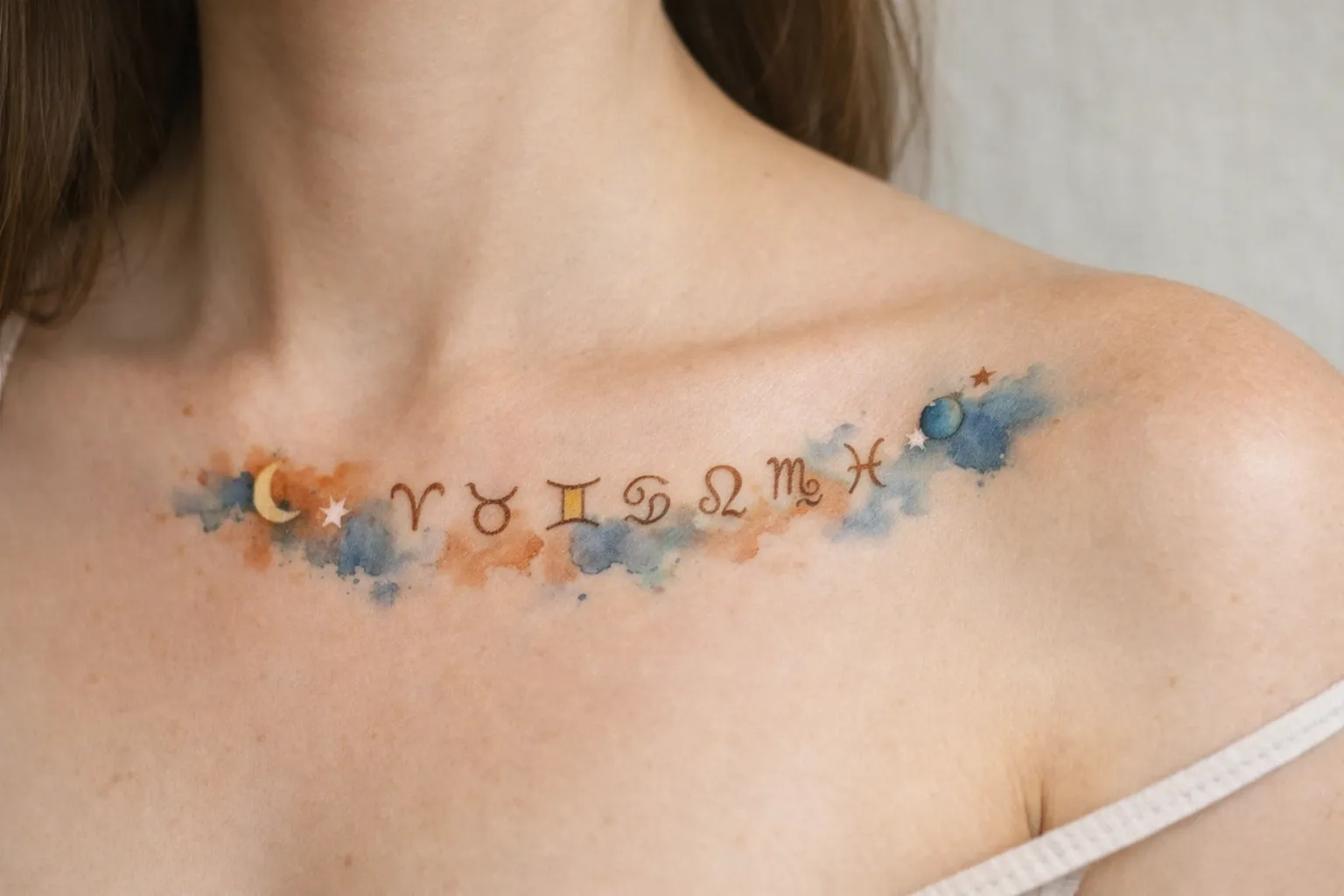
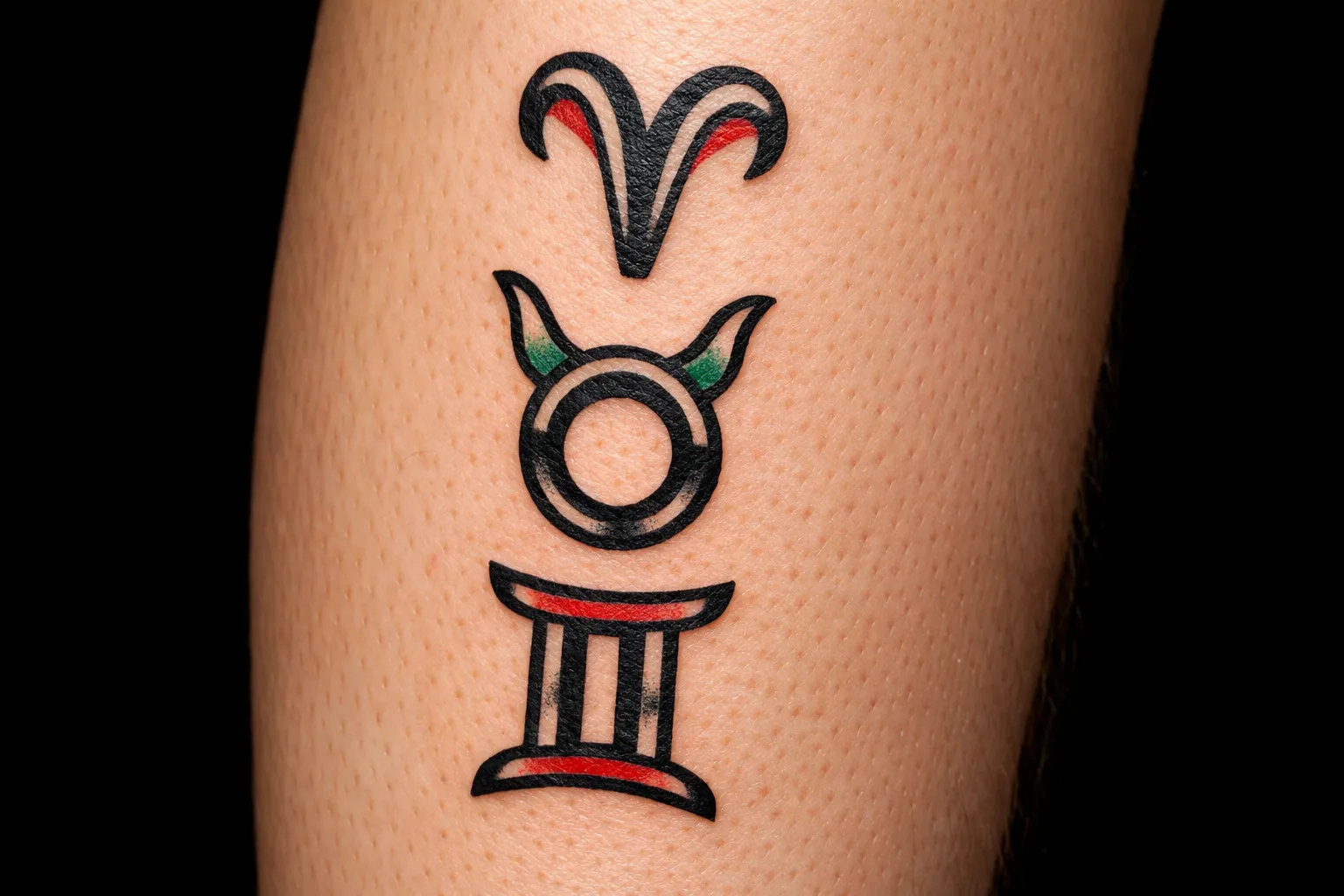
A three-glyph arrangement - linear or triangular - works at 5 to 8 cm total width on the inner forearm or sternum, with each glyph under 2 cm individually. Give the composition a hierarchy: Sun sign largest or most central, Moon sign secondary, Rising as the smallest accent.
Equal-size glyphs read as a cluttered row. Hierarchy keeps it legible.
Three-constellation clusters - spacing and hierarchy
Three constellations need real space - upper arm or ribcage at 15 to 20 cm - to keep each star pattern distinct. Connect them with a subtle orbit line or a moon-phase arc so the piece does not read as random scattered dots. If all three of your signs share an element (a triple-fire chart, say), lean into that element’s visual language for unity. If they span multiple elements, use a neutral connector - stars, orbit lines, negative space - to bridge them.
Pairing Signs for Couples - Without Matching Outfits
Zodiac tattoos for couples work best when each design reads on its own, not only when the two of you stand side by side. The couple-friendly element pairings most people use are water-earth (Cancer-Capricorn, Scorpio-Taurus, Pisces-Virgo) and air-fire (Gemini-Sagittarius, Libra-Aries, Aquarius-Leo). These are design interpretations built on the standard four-element system (1), not official astrology “compatibility,” so treat them as a visual bridge rather than a rule.
For structure, you have a few clean options. Mirrored glyphs on each partner’s inner wrist - one left, one right. Two matching constellations in the same dot-and-line style on the same body location, for example both on the inner forearm at 2 to 3 inches. Or interlocking shapes - circles, infinity forms - with each sign’s glyph set inside.
Complementary beats identical for long-term risk. If each tattoo reads alone, a change in circumstances stings less than a design that only makes sense as a pair. A multi-sign approach also works - one partner’s sign as the dominant motif with the other’s as a secondary element, like Libra scales with a small Scorpio scorpion balanced on one side.
On placement, both people do not need matching pain tolerance. Inner forearm works for most; ribcage is a higher-commitment option; wrist and ankle are the most common low-commitment couple spots.
Planning a Zodiac Sleeve - From One Sign to All Twelve
A zodiac sleeve is a multi-year project, not a single appointment - plan it in stages. Anchor it conceptually to the 12 signs of the zodiac (1) and the four elemental bands (fire, earth, air, water), and if you include constellation work, remember the astronomical zodiac actually holds 13 constellations (3), so decide up front whether you are following the 12-sign astrology model or the star map.
Full sleeve - all 12 signs in one composition
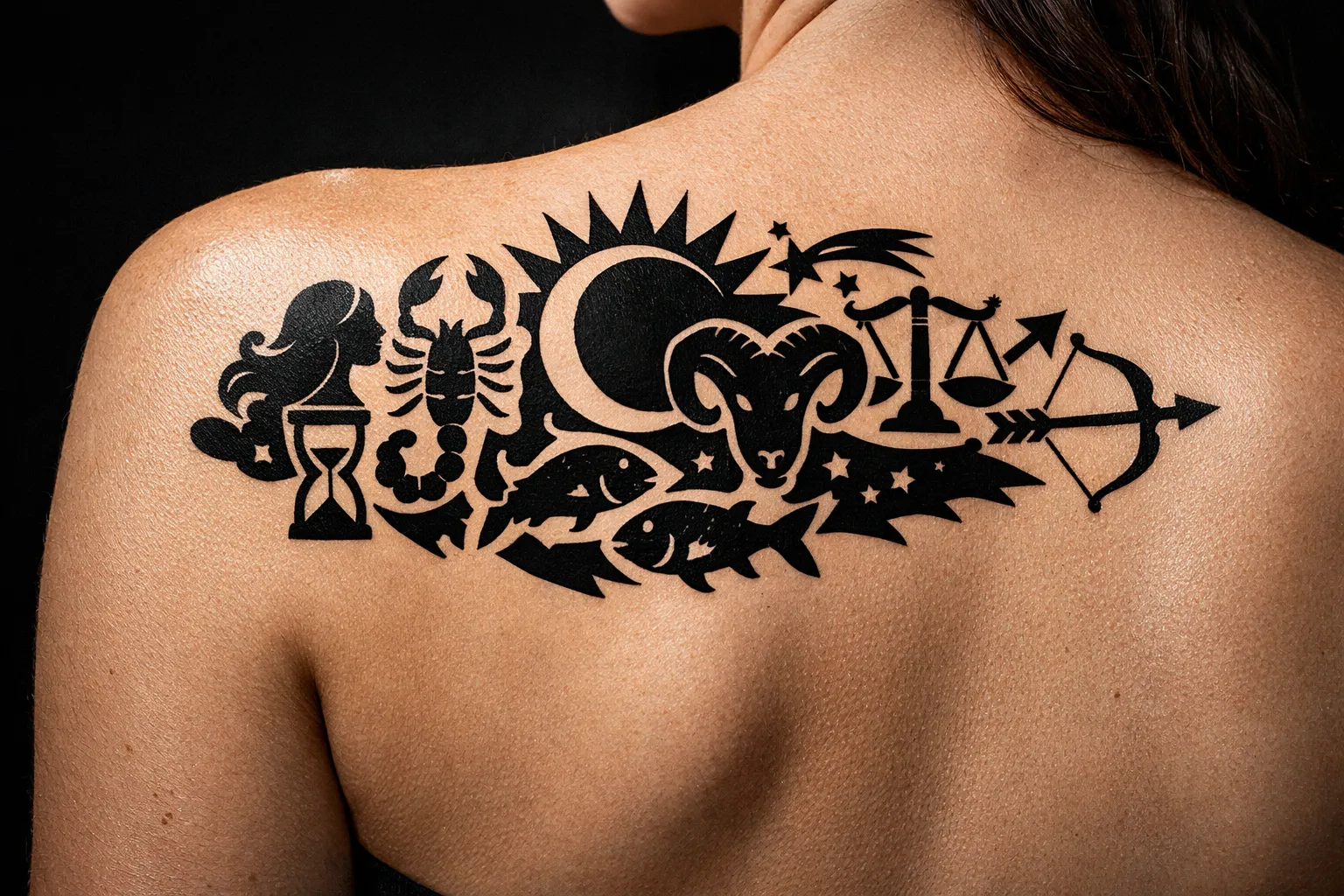
A full sleeve arranges all 12 glyphs in chronological order from Aries through Pisces around the arm, with element-themed sections differentiated by motif and line quality. A full arm runs roughly 60 to 70 cm in length. Session counts vary widely by artist speed and design density, so treat any quoted number as an estimate and confirm with your specific artist before booking.
The technique that keeps 12 separate symbols coherent is a central axis - a vertical constellation path, a planetary orbit line, or an element flow (fire rising, water falling) running the length of the arm, with signs arranged around it in order.
Half-sleeve - element group or Big Three as a focused piece
A half-sleeve focuses on three signs from one element group, or your Sun/Moon/Rising, connected by an element-specific background - flames, waves, botanical growth, wind bars. Run it shoulder to elbow or elbow to wrist. Upper-arm anchors age better than starting on the forearm, where skin fades faster.
One non-negotiable rule: keep every element in the same style. All fine-line, all blackwork, or all neo-traditional - mixed styles read as a sticker collection, not a sleeve.
For session planning, start with one or two anchor pieces on the upper arm and forearm (4 to 6 inches each), live with them for 3 to 6 months, then add background and connectors over 6 to 24 months.
Aftercare for sleeves is critical: day 1-3 requires gentle washing and fragrance-free moisturizer; week 1 means no soaking and loose clothing; weeks 2-4 call for sun-protective clothing and avoiding abrasion to preserve linework and saturation.
What Makes a Zodiac Tattoo Read as Astrology (Not Just Line Art)
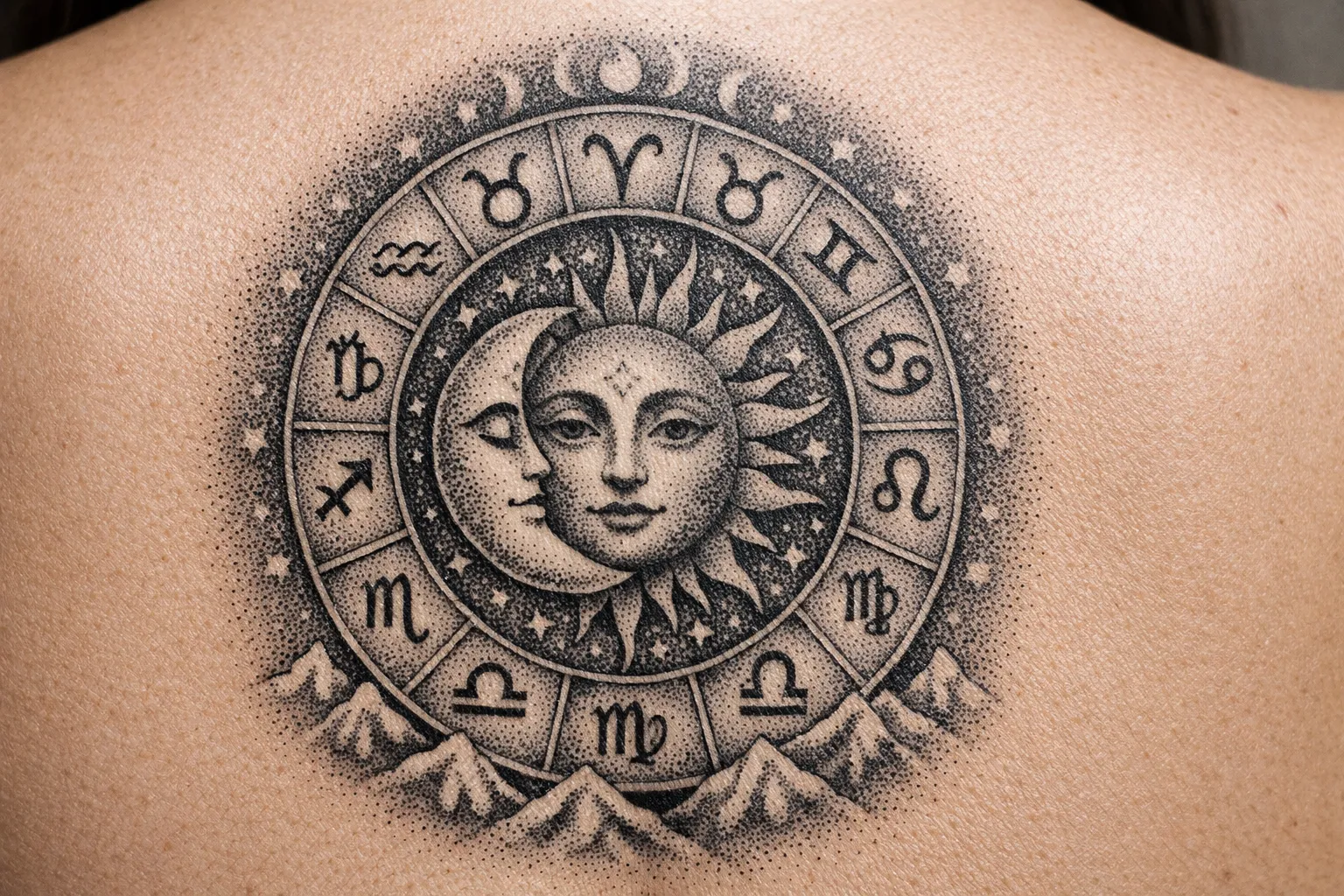
A zodiac tattoo reads as astrology only when it carries at least one explicit marker - a glyph, a recognizable animal or human motif, an accurate constellation, or a planetary symbol - that is legible from 1 to 2 metres. A triangle with dots is not obviously Aries. A wave is not obviously Pisces. Without a marker, the astrology intent disappears the moment someone else looks at it. A glyph solves the ambiguity outright because it is a sign-specific symbol (2), not a scene.
Mind your size floors. Glyphs need at least 2 cm to hold their character shape over years. Constellations need 10 cm or more for accurate star spacing. Representational animals need at least 5 cm for a recognizable silhouette.
On line weight: fine-line tattoos generally hold crisp detail for around 5 to 10 years on well-chosen placements, with higher-friction areas like hands, fingers, and feet needing touch-ups every 3 to 5 years, according to fine-line longevity guides from working tattoo studios. Structural lines at 1 to 1.5 mm hold longer across all placements. Dotwork ages well but excessively tight dot spacing merges over time.
Watch the element-only trap. A gorgeous flame composition with no Aries glyph or ram reads as “fire tattoo,” not “Aries tattoo.” Element motifs earn their keep as background, not as the sole zodiac identifier. And verify constellation accuracy against a star chart or astronomy app before finalizing - astrology-literate viewers notice when a “Scorpio” constellation has the wrong star angles or looks like Taurus.
How to Brief Your Artist on a Zodiac Tattoo
20 minutesA step-by-step guide to preparing for your zodiac tattoo consultation.
- 1
Identify your chart points
At minimum your Sun sign; for a richer piece, pull your Moon and Rising from a birth chart calculator (date, time, and place of birth).
- 2
Choose your approach
Glyph, constellation, representational motif, or a combination; decide before the consultation, not during.
- 3
Set your size and placement
Name a specific body location and a size in centimetres; vague briefs like 'somewhere on my arm' won't work.
- 4
Verify your constellation
Cross-reference the star pattern against an astronomy app; bring a printed or screenshotted reference.
- 5
Collect 5 to 10 visual references
Note line weight, style (fine-line, dotwork, blackwork), and what makes each read clearly as zodiac.
- 6
Confirm element accuracy
Double-check your sign's element before the artist starts; fixing a fire/water mix-up after stencil wastes time.
- 7
Ask for a design that works at 1 to 2 metres
Request at least one explicit zodiac marker (glyph, animal, constellation) legible from conversational distance.
Frequently Asked Questions
- What is the symbol for Capricorn?
- Capricorn's glyph is ♑, a V-shape with a curved tail representing the sea-goat's body and fish tail. The sea-goat motif works well at 5 cm or larger on forearm or upper arm.
- Which tattoo is lucky for Capricorn?
- Lucky Capricorn tattoos feature mountain goats mid-climb, sea-goats ascending, or Saturn's ring near the glyph, placed on upper arm or forearm for upward progress symbolism.
- Is Capricorn a devil or angel?
- Capricorn is neither; the 'devil' association comes from Western iconography of horned goats, not astrology. The sign represents discipline and realism.
- What's the difference between a zodiac constellation tattoo and a zodiac glyph tattoo?
- Glyphs are compact symbols (2-5 cm) instantly recognizable to astrology-aware viewers; constellations map star patterns needing 10-15 cm for legibility.
- Can I get tattoos for all three of my chart signs - Sun, Moon, and Rising?
- Yes; a three-glyph arrangement at 5-8 cm on inner forearm or sternum works well. Constellation clusters need larger areas like upper arm or ribcage.
- What zodiac signs are in February?
- February includes Aquarius (Jan 20-Feb 18, air sign) and Pisces (Feb 19-Mar 20, water sign). Both have distinctive glyphs suited for small tattoos.
- How do zodiac tattoos for couples usually work?
- Couples often choose matching glyphs or constellations on mirrored placements, or complementary designs that read independently, using compatible element pairings.
- How long does a zodiac sleeve take to complete?
- A full zodiac sleeve takes 3-6 sessions of 2-4 hours each over 6-24 months; half-sleeves on element groups or Big Three signs take fewer sessions.
Three Decisions That Actually Determine Whether It Works
Strip away the aesthetics and a zodiac tattoo comes down to three calls. Which approach: glyph for compactness and clarity, constellation for celestial detail, representational motif for illustrative depth - the most durable pieces usually combine at least two of the three. What size and placement: name the body location and a minimum size before the consultation, because fine-line constellations under 10 cm on high-friction areas are the most common regret I see. How many signs: your Sun sign alone is fine, a Sun/Moon/Rising trio is more personally specific, and a full sleeve is a multi-year commitment.
Before you book, do three concrete things: pull your birth chart, verify your constellation against a star chart, and bring references that show the line weight and style you want - not just the zodiac symbol on its own.