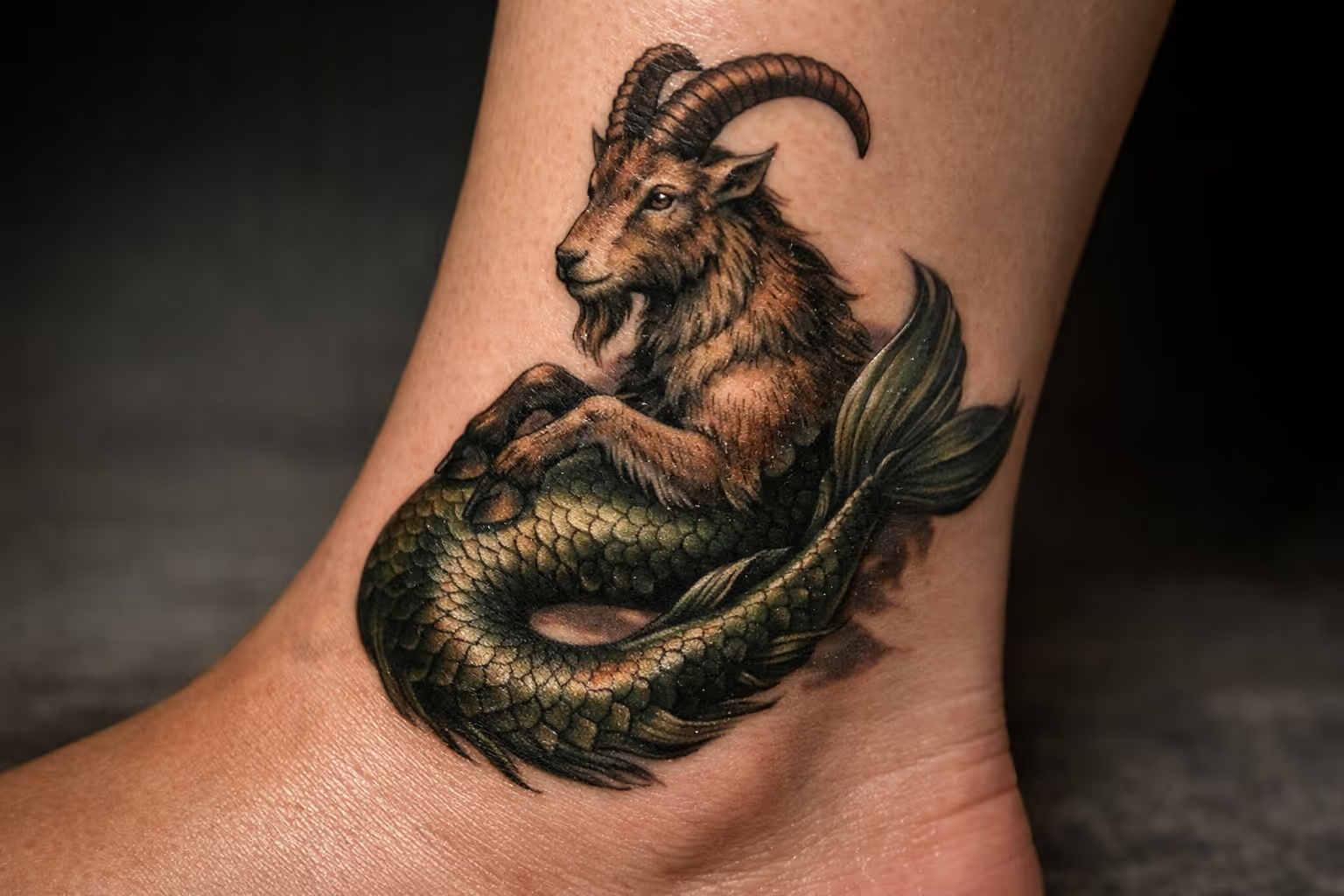
The sea-goat splits down the middle: mountain goat above, fish tail below. That hybrid is the whole point of a Capricorn tattoo - grounded ambition on top, emotional depth underneath, all captured in one figure. Capricorn runs December 22-January 19, ruled by Saturn, the planet astrologers tie to discipline and time (1). You have three symbol families to work with: the sea-goat for full narrative weight, the glyph for discretion, and the constellation for a subtle astrology reference. The choice mostly comes down to how visible you want the reference to be and how much skin you’re willing to give it.
Here’s the honest breakdown of what you’re getting into with a Capricorn zodiac tattoo as a category.
✓ Pros
- Three distinct symbol options cover every commitment level, from a 2 cm glyph to a full mythological scene.
- The glyph and constellation scale down to micro sizes without losing meaning.
- The earth-sign aesthetic - mountains, geometry, dark palettes - ages well in blackwork.
- Saturn and mountain motifs read as visually distinct from other zodiac signs.
- The sign works across styles from minimalist fine-line to neo-traditional.
✗ Cons
- Cusp dates around December 21-22 and January 19-20 mean you should verify your birth time before committing.
- Ultra-fine linework on fingers or hands blurs within a few years.
- Cramming goat, fish, Saturn, and text into under 5 cm produces a cluttered, illegible mess.
- Bold sea-goat compositions run 1-3+ hours and may need multiple sessions.
- The glyph gets misread as Virgo when copied from distorted font sources.
What the Capricorn Tattoo Symbols Actually Mean
Capricorn has three core symbols - the sea-goat, the glyph ♑, and the constellation - each rooted in Babylonian and astrological tradition, each suited to a different tattoo scale. Knowing what they actually represent helps you pick the one that matches your intent instead of defaulting to whatever looked good on a reference board.
The Sea-Goat’s Babylonian Roots
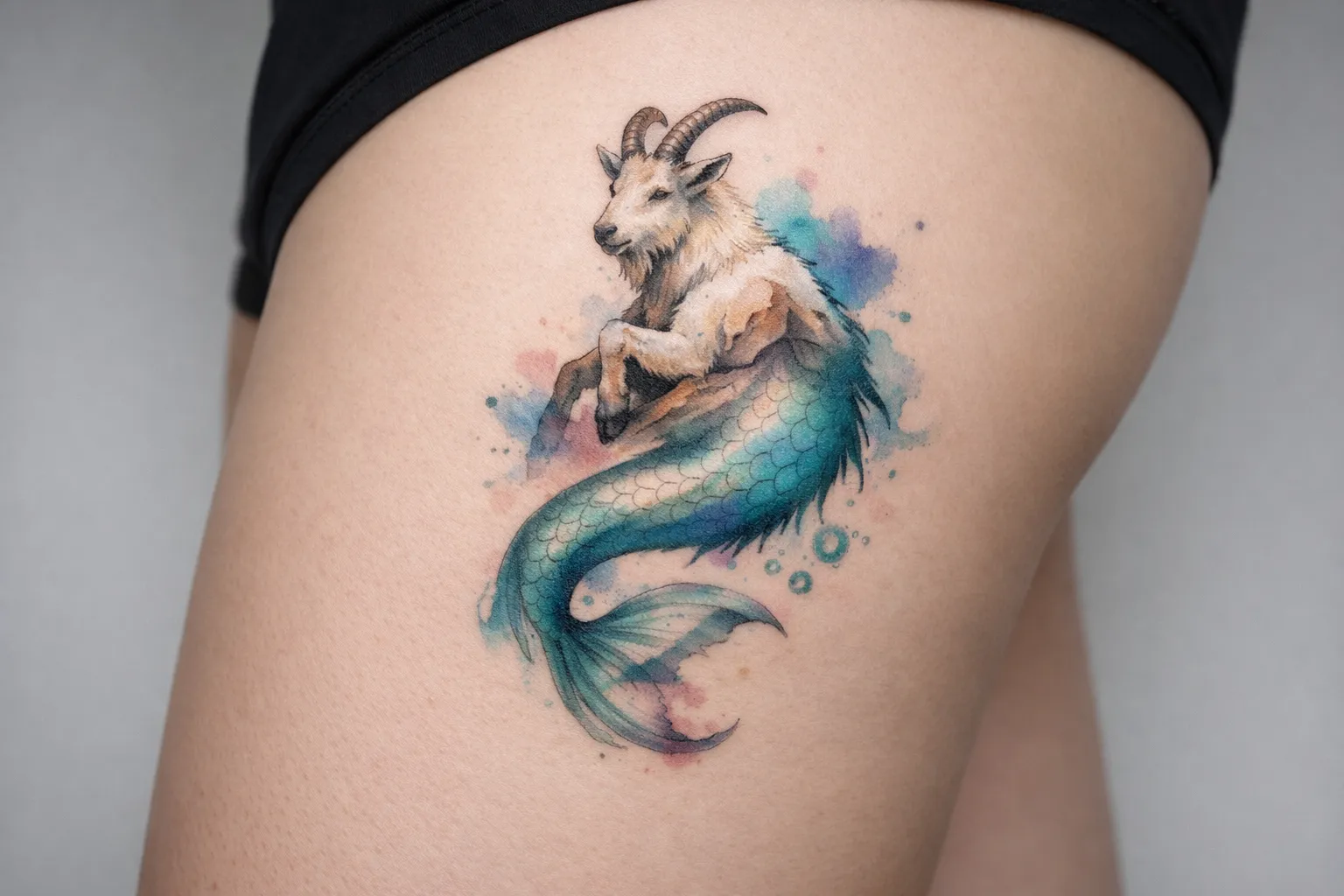
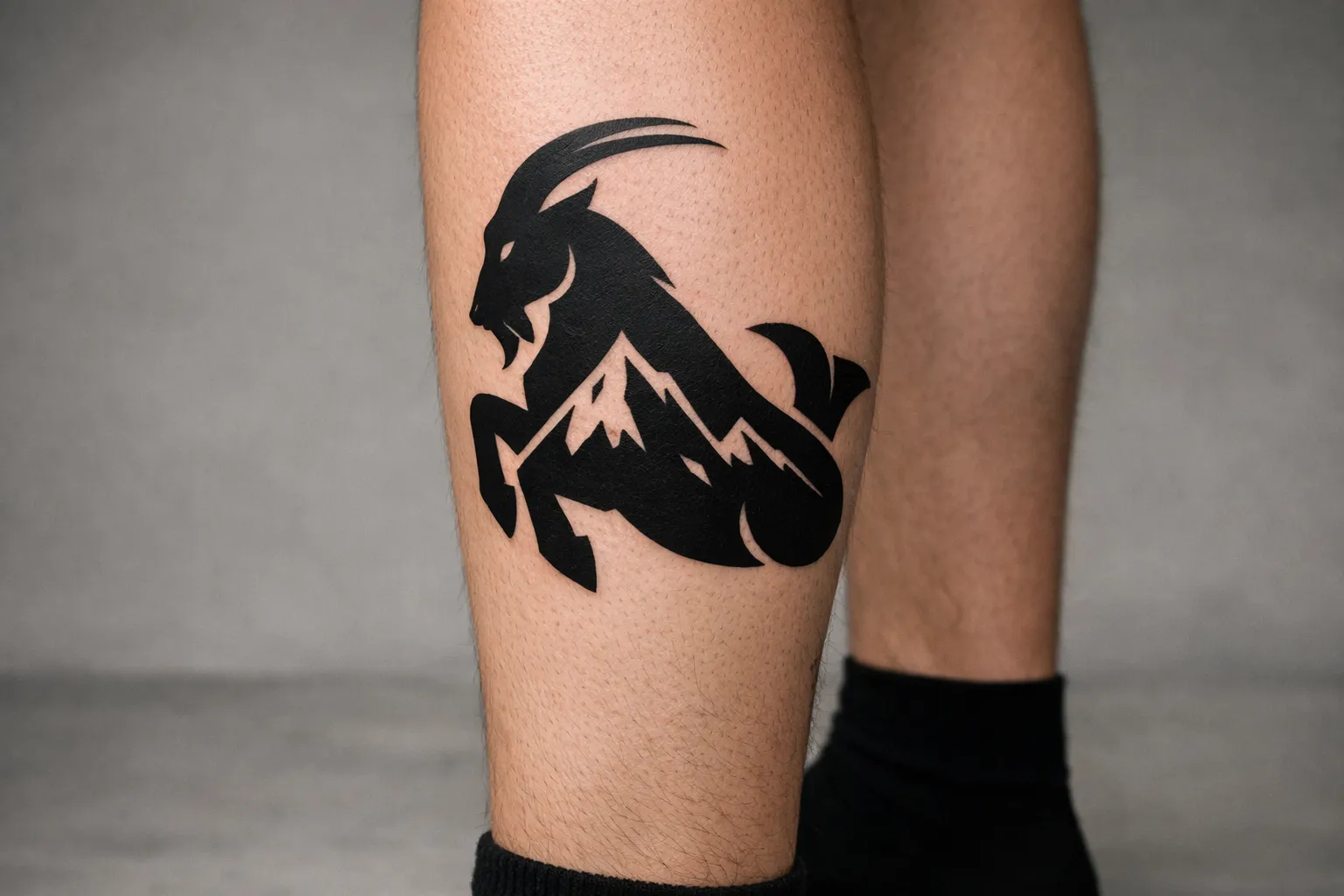
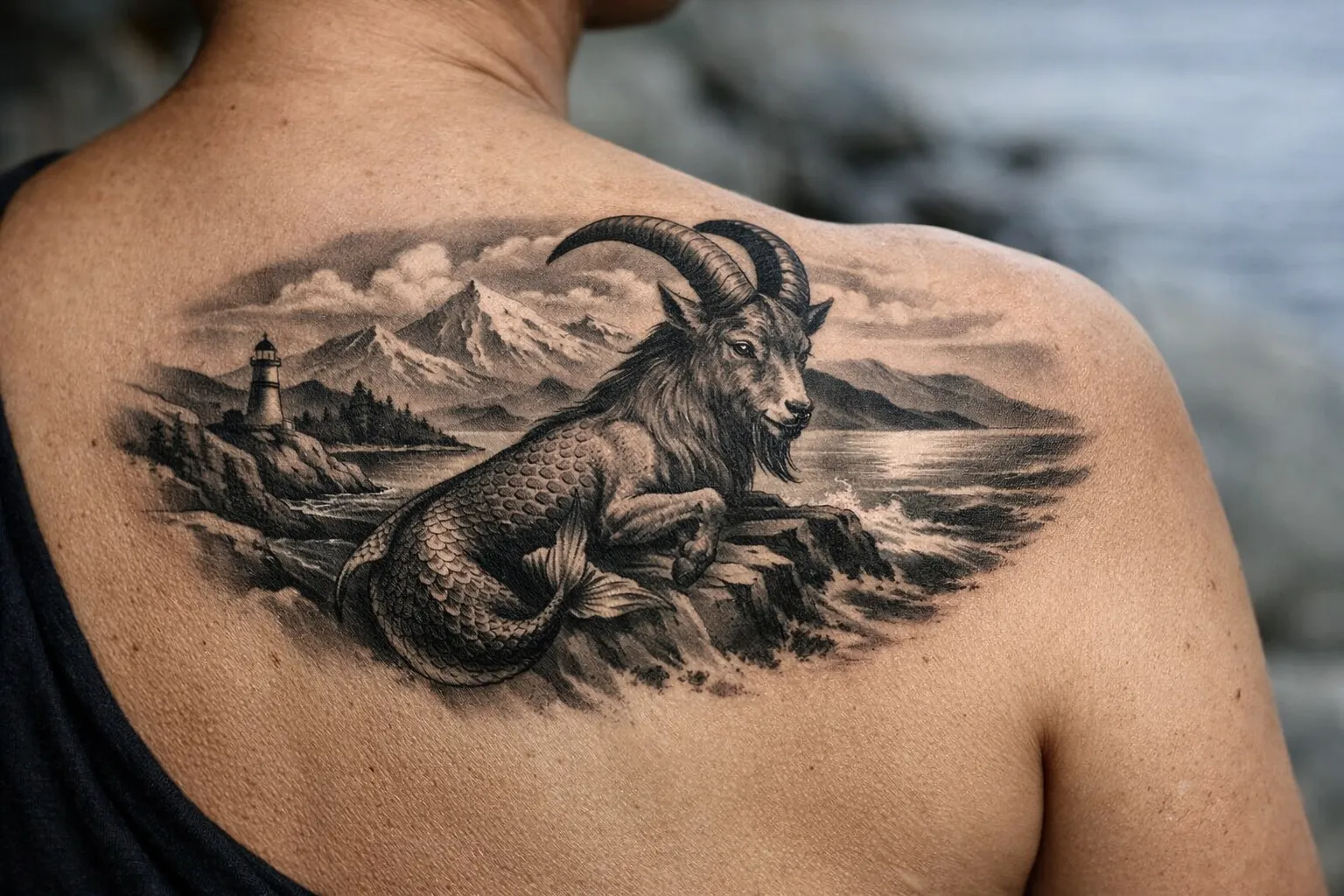
The sea-goat comes from Babylonian astrology: a mythological creature combining a mountain goat - which represents ambition and climbing toward goals - with a fish tail representing emotional depth and intuition. That hybrid reads differently than a plain goat tattoo. A goat alone signals stubbornness or rural imagery to most viewers. The fish tail is what flags it as astrological and adds the second layer of meaning: the drive to climb paired with a hidden emotional undercurrent. Worth flagging: in modern Western tattoo culture, the sea-goat’s meaning has narrowed considerably. The Babylonian original carried a broader cosmic significance tied to the god Enki; today most wearers and viewers read it almost exclusively as a personality marker - ambition, discipline, the grind. That’s not wrong, but it is a reduction. If the mythological depth matters to you, it’s worth knowing the original context so you can brief your artist on whether you want the design to lean ancient or contemporary.
I’ve had clients come in with a reference photo of just a goat head and wonder why it doesn’t read as Capricorn to anyone who doesn’t already know their sign. The fish tail is the tell. Without it, you have a goat tattoo. With it, you have the full symbolic story.
Reading the Glyph Correctly
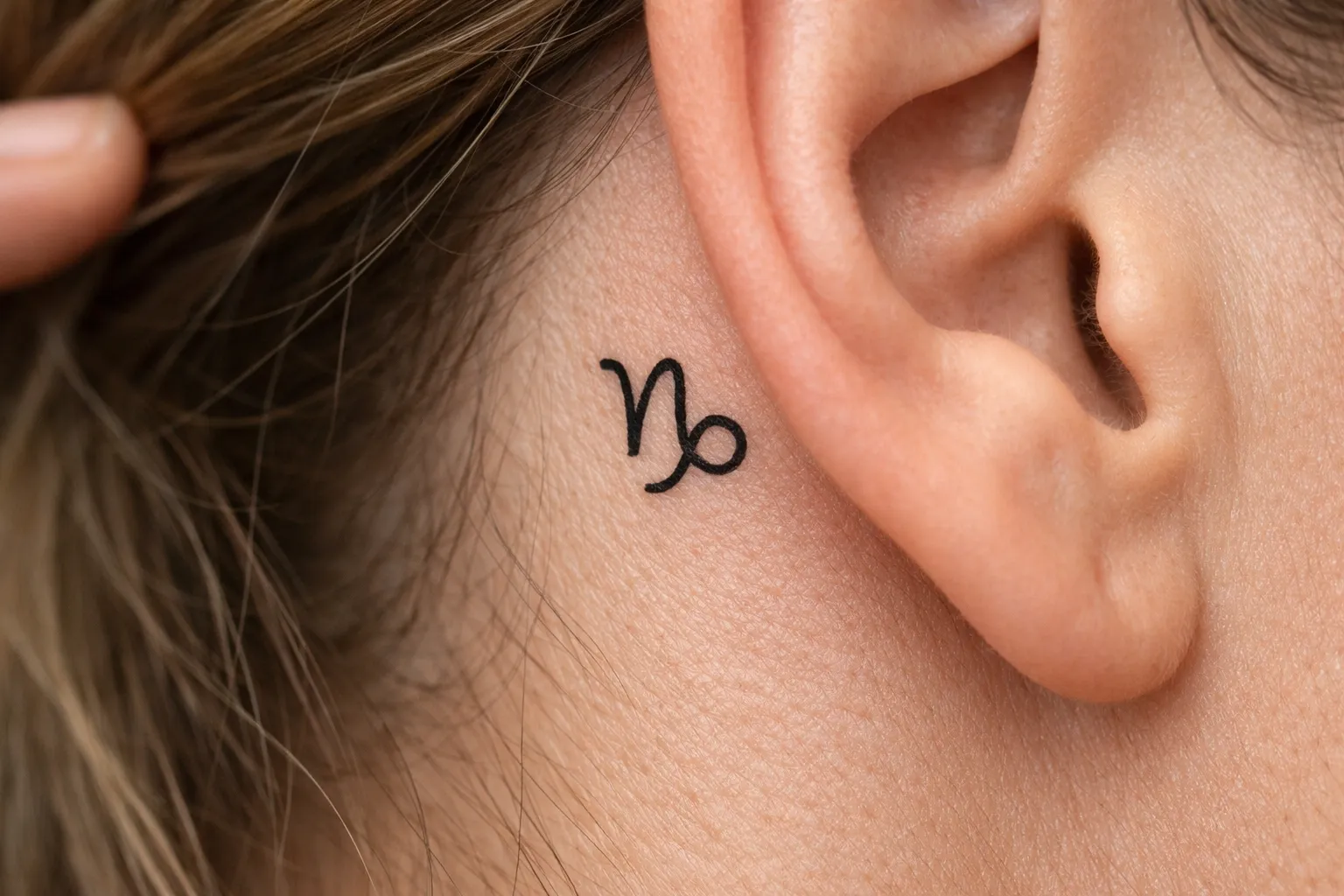
The Capricorn glyph (♑) is a curved symbol resembling a stylized “V” or “N” with a loop or tail, representing the goat’s horn and a spiral fish tail (7). The common error: people copy the glyph from decorative or calligraphic fonts, and the distorted version ends up looking closer to Virgo’s glyph (♍). I’ve seen this happen more than once - a client brings in a Pinterest screenshot, the artist works from that, and the finished piece is technically the wrong sign.
Show your artist the Unicode symbol ♑ directly, not a stylized font version. The structure matters. Astrology-literate viewers notice a wrong glyph immediately.
Saturn and the Earth Element as Design Anchors
Saturn rules Capricorn, and in astrology Saturn is the planet of discipline, time, and mastery through persistence (1). That informs design choices - clocks, rings, geometric structure - but Saturn works best as a supporting element rather than the focal point. As for the constellation: Capricornus is one of the fainter zodiacal constellations, with only one star brighter than 3rd magnitude (the brightest, Deneb Algedi, sits about 39 light-years away at magnitude 2.9). Modern references commonly render it as 6 named stars in a roughly triangular or arrowhead pattern. That faintness actually suits the sign’s understated nature.
Capricorn also sits in the earth triplicity alongside Taurus and Virgo, which is why the design language leans toward rock textures, mountain silhouettes, and muted palettes - deep greens, browns, muted grays - rather than flames or waves. When I’m designing for an earth sign client, the palette almost picks itself.
Capricorn’s Core Meanings and What They Look Like in Ink
Capricorn’s personality maps cleanly onto concrete visual motifs, which is why the best capricorn tattoo ideas start from a trait and translate it into an image rather than piling on symbols. The sign’s traits - ambitious, disciplined, hardworking, patient, realistic, responsible, cautious, determined, self-controlled, persistent - each have a natural visual anchor.
Ambition and Discipline as Visual Motifs
Ambition reads as a mountain summit. The climb toward a goal is the most direct Capricorn image there is, and it works because it’s literal rather than decorative. Patience and the long game translate into Saturn’s rings - the planet of time rendered as a simple ellipse. Discipline shows up as geometric structure: clean angular linework, sacred geometry, architectural lines that feel built rather than drawn.
The underlying design philosophy is “building something substantial,” which is why architectural elements, mountain paths, clocks, and the cornucopia all reference Capricorn’s long-game orientation toward achievement. In 2025-2026, this career-ambition framing is driving a lot of the current demand for Capricorn ink - the “grade-A hustler” energy that’s showing up across social media tattoo content.
Earth Sign Aesthetics: Mountains, Geometry, and Dark Palettes
Capricorn designs lean toward solid, grounded compositions - the opposite of a water sign’s fluid waves or a fire sign’s bold flame-and-color energy. That contrast is exactly why earth-sign tattoos work in heavy blackwork: stable shapes, hard edges, muted color. The design holds.
Capricorn’s associated stones, onyx and amber, offer a practical color reference - deep black ink with warm amber-toned accents, or a gem silhouette integrated into the design without overcrowding it. If you want color at all, stay in the earth palette: deep greens, muted browns, dark grays. Bright or pastel tones read as fire or air sign energy and don’t hold up as well in fine-line work over time.
The Three Main Capricorn Tattoo Designs - Which One Fits You
Your capricorn tattoo design comes down to three symbol families, and the right one depends on whether you want full narrative imagery, a discreet marker, or a subtle cosmic reference.
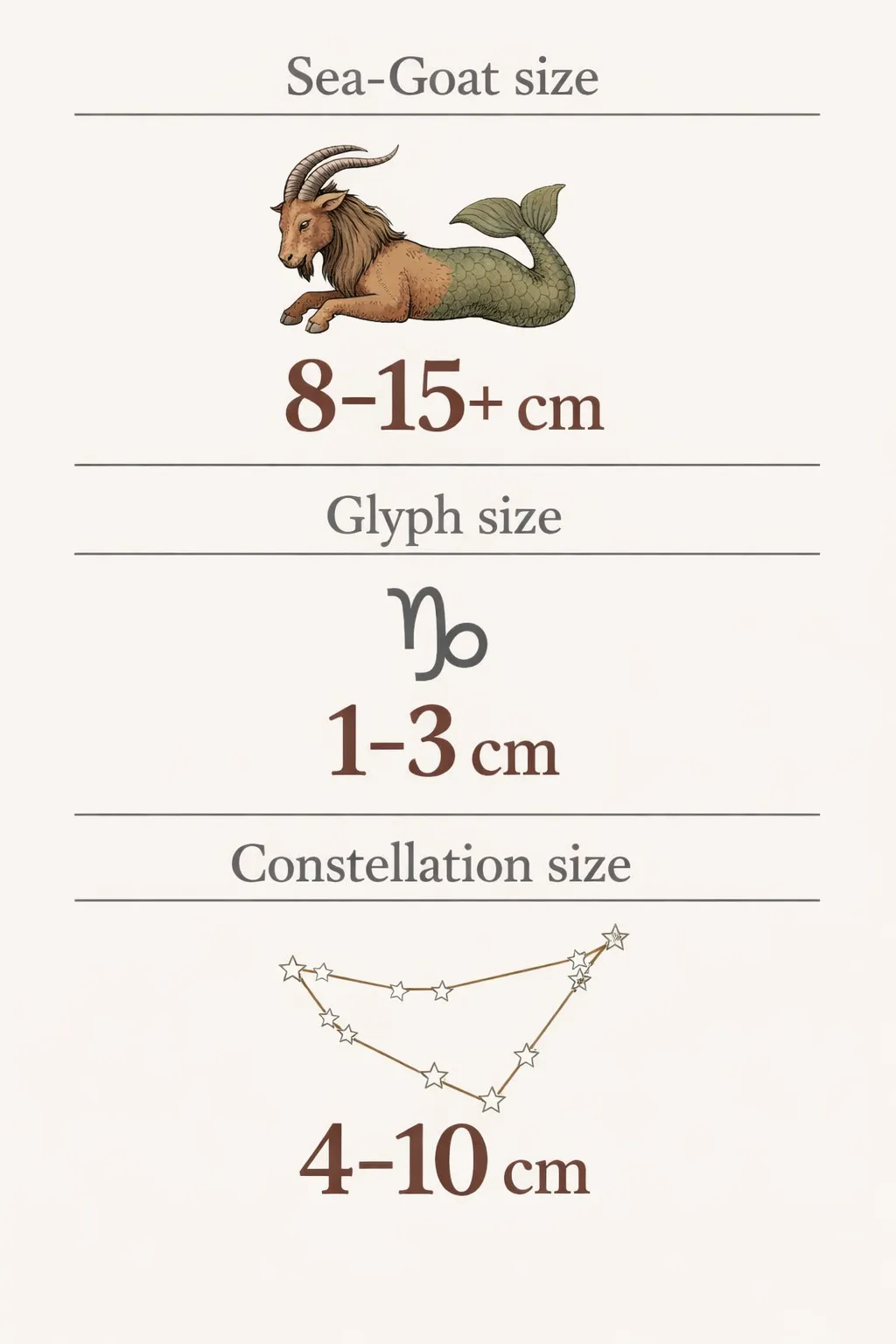 Capricorn symbol sizes: sea-goat 8-15+ cm; glyph 1-3 cm; constellation 4-10 cm.
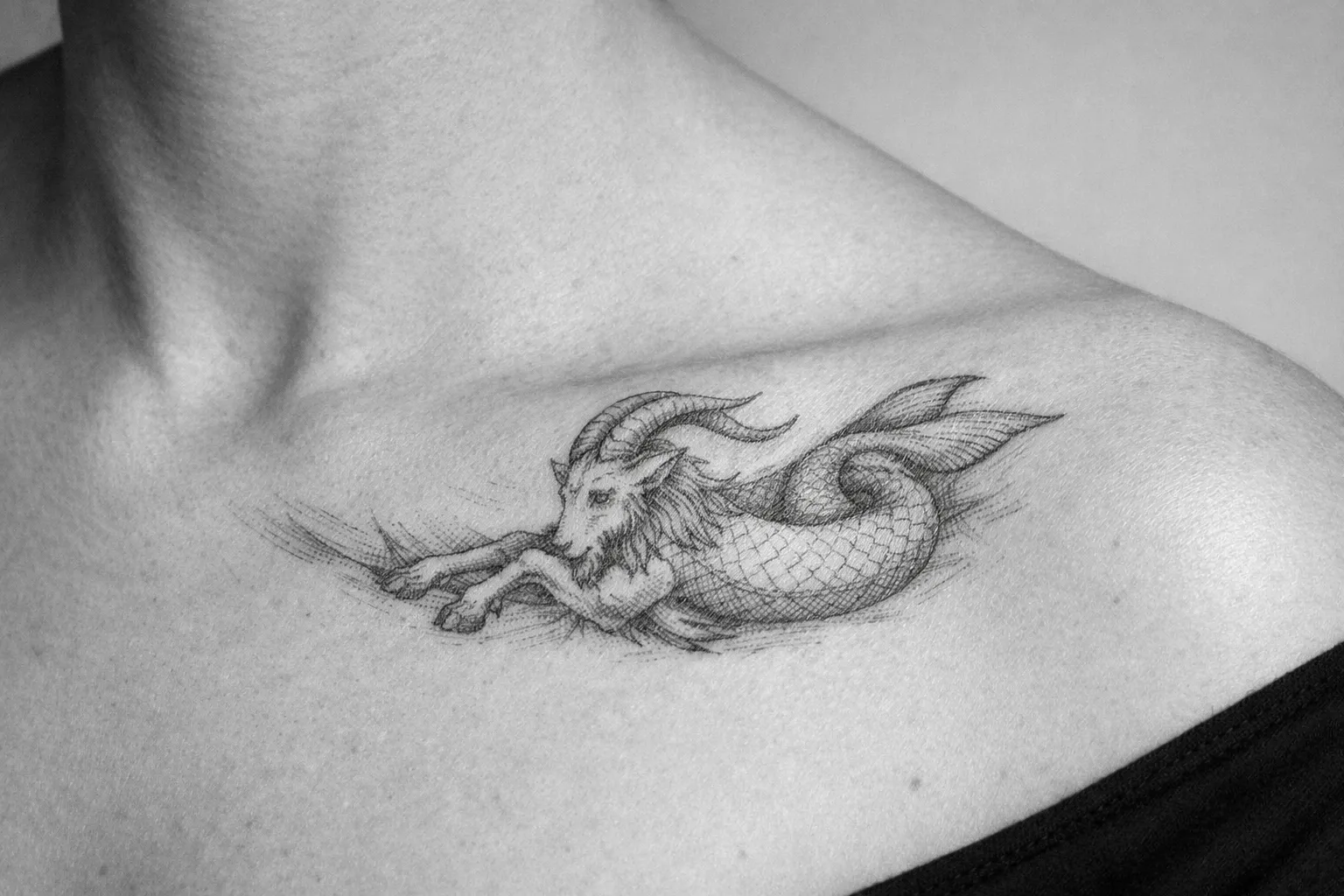
Sea-Goat Designs - Full Narrative, Bigger Canvas
The sea-goat is for wearers who want mythic, storytelling imagery. It pairs naturally with mountains, waves, or cosmic backgrounds, and it needs room - typically 8-15+ cm for the detail to read clearly. Below that, the split between goat and fish tail muddies and you lose the whole point of the design. Good placements are the forearm, upper arm, calf, and shoulder blade. Session time runs 1-3+ hours, and larger scenes may need multiple sittings.
This is the intermediate-to-advanced tier. The goat capricorn tattoo carries the most meaning but demands the most skin and the most chair time.
Glyph Designs - Small, Discreet, and Surprisingly Versatile
The glyph is best for minimalists, first-time tattoo wearers, and anyone needing workplace discretion. It scales down to 1-3 cm and still reads clearly on stable skin. Placement options include the inner wrist, finger side, behind the ear, and nape of the neck. Usually done in under an hour.
The one warning: watch the distortion risk from decorative fonts, and skip the fingers if you don’t want to be back for touch-ups in a couple of years. Fingers are a high-friction area - the skin regenerates faster there, and even a clean glyph will blur.
Constellation Designs - Subtle Astrology for the Understated Wearer
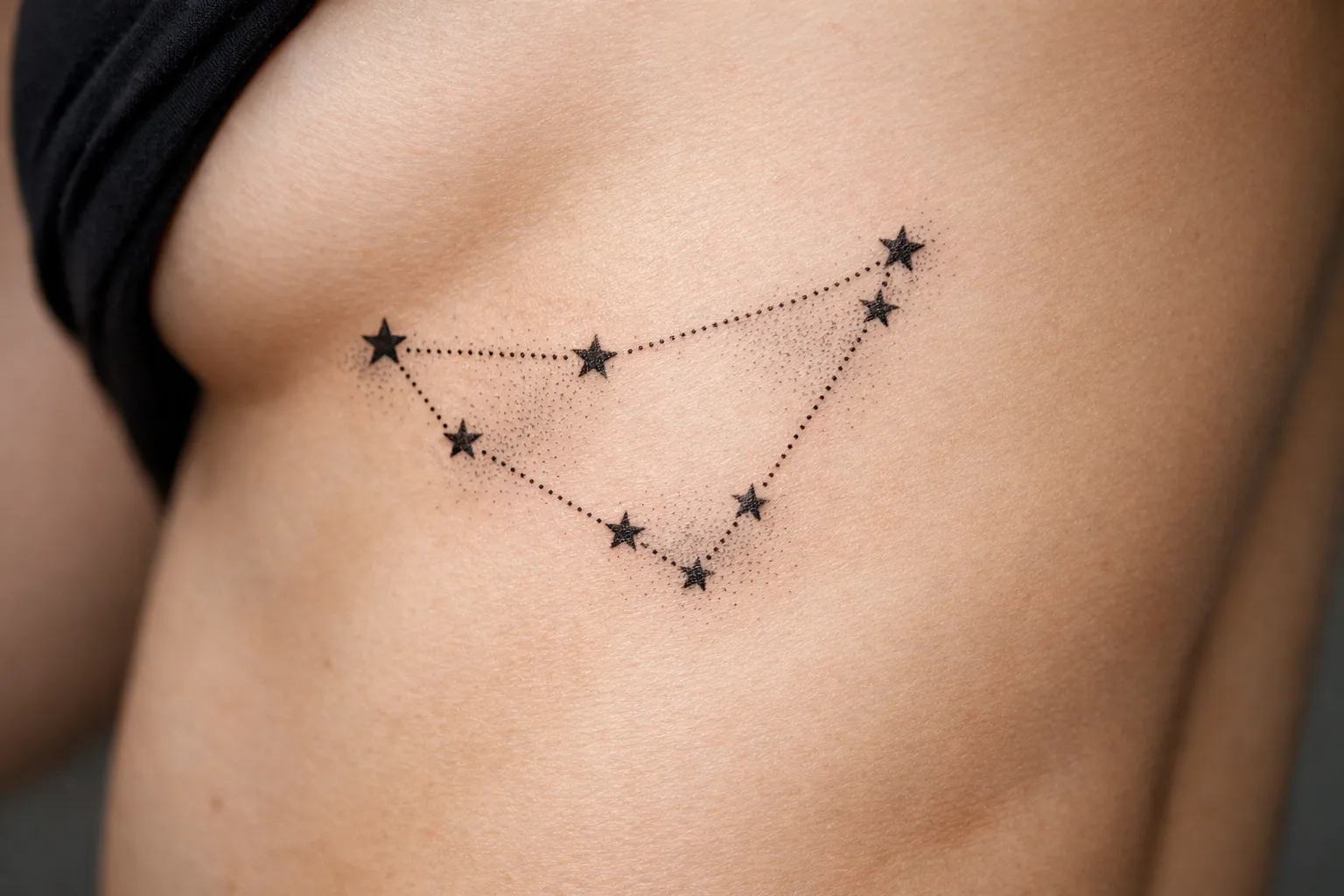
The constellation is the most subtle astrology reference of the three. Rendered as 6 named stars in dot-and-line format, in fine-line or dotwork. Popular placements are the collarbone, inner forearm, and shoulder blade. Keep it at a minimum of about 5 cm to preserve star spacing and avoid blowout - anything smaller on a high-movement area risks the dots blurring into one another.
It’s a small capricorn tattoo option that still reads as astrology to anyone who knows the sky.
Combination designs layer these: a goat with a constellation background, the glyph with a mountain silhouette, Saturn’s rings as a framing device. Just know that combining more than two or three elements under 5 cm creates clutter. Larger compositions of 10-15+ cm handle layering far better.
Capricorn Tattoo Design Comparison
| Sea-Goat | Glyph (♑) | Constellation | |
|---|---|---|---|
| Best for | Full narrative, mythic imagery | Minimalists, first-timers, professionals | Subtle astrology lovers, fine-line fans |
| Typical size | 8-15+ cm | 1-3 cm | 4-10 cm |
| Session time | 1-3+ hours (may need multiple) | Under 1 hour | 1-2 hours |
| Recommended placements | Forearm, upper arm, calf, back | Inner wrist, behind ear, finger, nape | Collarbone, inner forearm, shoulder blade, ribcage |
| Best styles | Neo-traditional, blackwork, realism | Fine-line, blackwork | Fine-line, dotwork, watercolor wash |
| Longevity risk | Low if sized correctly | High on fingers/hands | Moderate - avoid under 4 cm on high-friction areas |
| Complexity tier | Intermediate to advanced | Beginner | Beginner to intermediate |
How to Choose Your Capricorn Tattoo Design
About 1.5 hoursStep-by-step process to pick the right Capricorn tattoo for you
- 1
Verify your sign
Confirm you're December 22-January 19 using a birth chart calculator with your exact birth time, especially if born near cusp dates.
- 2
Choose your symbol
Pick sea-goat for full narrative, glyph for minimalism, or constellation for subtle astrology. Use the comparison table to match your lifestyle.
- 3
Pick your placement
Decide on visibility level - statement, semi-hidden, or micro - and check it against the symbol's minimum size requirements.
- 4
Select your style
Choose blackwork for boldness, fine-line for delicacy, or neo-traditional for illustrative weight. Brief your artist on style hallmarks.
- 5
Test before committing
Use a temporary Capricorn tattoo in the intended placement for 3-7 days to check visibility and symbol clarity.
- 6
Bring the correct glyph reference
If getting the ♑ glyph, show your artist the Unicode symbol directly, not a stylized font version, to avoid errors.
Capricorn Constellation Tattoo - Placement, Size, and Style Execution
A capricorn constellation tattoo works best at 5 cm or larger on stable skin, rendered in fine-line or dotwork, with the star pattern kept as the clear focal point. Because Capricornus is a faint constellation, the tattoo version reads as quiet and understated - which is exactly the appeal for a lot of wearers (2).
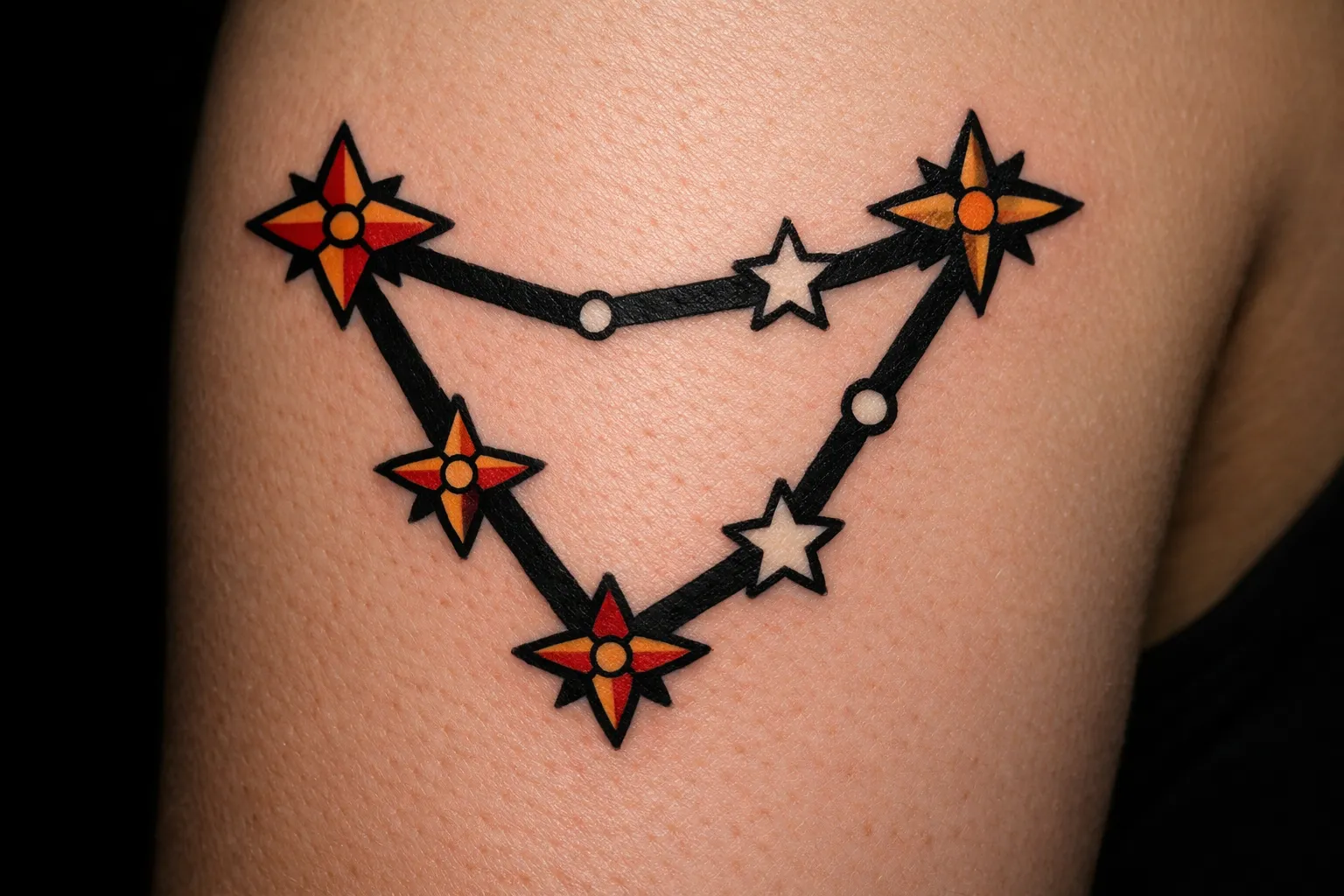
Getting the Star Pattern Right
Star accuracy matters more than people expect. Capricornus is commonly rendered as 6 named stars in a roughly arrowhead or triangular shape. Astrology-aware viewers notice an incorrect arrangement the same way they notice a wrong glyph.
Reference the actual pattern so you can check your artist’s stencil against it before the needle touches skin. The real sky pattern is subtle - the brightest star, Deneb Algedi, is only magnitude 2.9 - so you’re not working from a dramatic, obvious shape, which is all the more reason to verify it. I always tell clients to pull up the actual star map on their phone when they’re reviewing the stencil. It takes thirty seconds and saves a lot of regret.
Best Placements for Constellation Longevity
For longevity, the collarbone (4-8 cm, where the horizontal spread suits the constellation’s shape), inner forearm (stable skin, low distortion), shoulder blade (room for larger 8-12 cm versions with more star detail), and ribcage (semi-hidden, suits the understated symbol) are your strongest options.
Keep it above about 4 cm. Under that, the star dots and connecting lines risk blurring together within a few years, especially on high-movement areas. The inner forearm and upper back hold fine-line work noticeably better than fingers or hands.
For style, you’ve got three routes: pure fine-line for a clean modern look, dotwork for texture without heavy shading, or fine-line over a watercolor or galaxy wash for more visual weight (better on the shoulder blade or ribcage, where there’s room). If you pair the constellation with other elements - Saturn’s rings as a subtle halo, a single mountain silhouette below the stars, the glyph placed adjacent - keep the additions minimal so the star pattern stays the focal point.
Capricorn Tattoo Placement - Visibility, Pain, and Long-Term Wear
Placement is the variable most people underestimate, and it decides visibility, pain, and how well the design holds over the next decade. Match the location to how public you want the reference and to how much friction that skin takes.
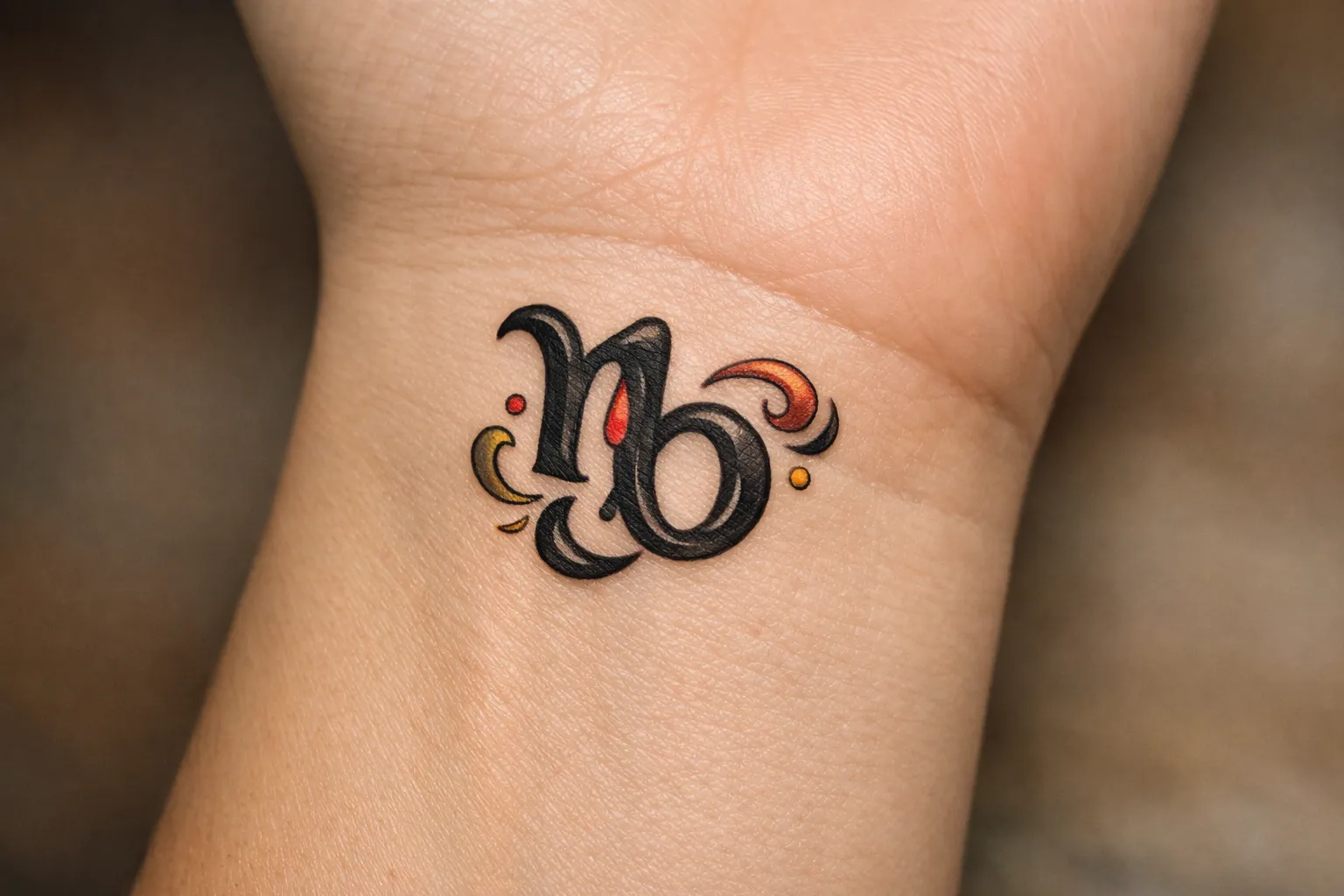
Visible Placements for Bold Compositions
For statement pieces, the forearm (inner or outer, 6-15 cm) is the workhorse - readable, low distortion, moderate pain. The upper arm and bicep suit larger sea-goat or geometric goat compositions. The calf is a good canvas for medium-to-large pieces and hurts less than the ribcage. The shoulder is versatile enough for both a constellation and a full sea-goat.
These placements broadcast the tattoo, which is the point if you chose the sea-goat for its narrative weight.
Discreet Options That Still Hold Detail
For semi-hidden work, the ribcage takes fine-line constellations or the glyph well - the skin moves less than the hands, so linework holds - but expect notably more pain than the forearm. Ribcage is more intense than forearm, full stop. Worth knowing before that’s your first tattoo. The shoulder blade gives you a large flat area with low visibility in professional settings. The sternum and underboob are popular for delicate feminine Capricorn designs.
For micro placements: behind the ear takes a 1-3 cm glyph or single star, the inner wrist takes a glyph or 3-5 cm constellation, and the ankle takes a glyph or small constellation - though the higher friction there means faster fading.
On longevity: fingers and hands fade fastest because of friction and skin cell turnover, and fine-line glyphs there need touch-ups within 2-3 years. The inner forearm, upper arm, and shoulder blade hold fine-line work significantly longer.
Style Guide - From Minimalist Glyph to Full Mythological Sea-Goat
Capricorn designs run a full style spectrum, from a sub-1-hour black glyph to a multi-session mythological sea-goat. The style you pick should follow your experience level and how much detail the placement can hold.
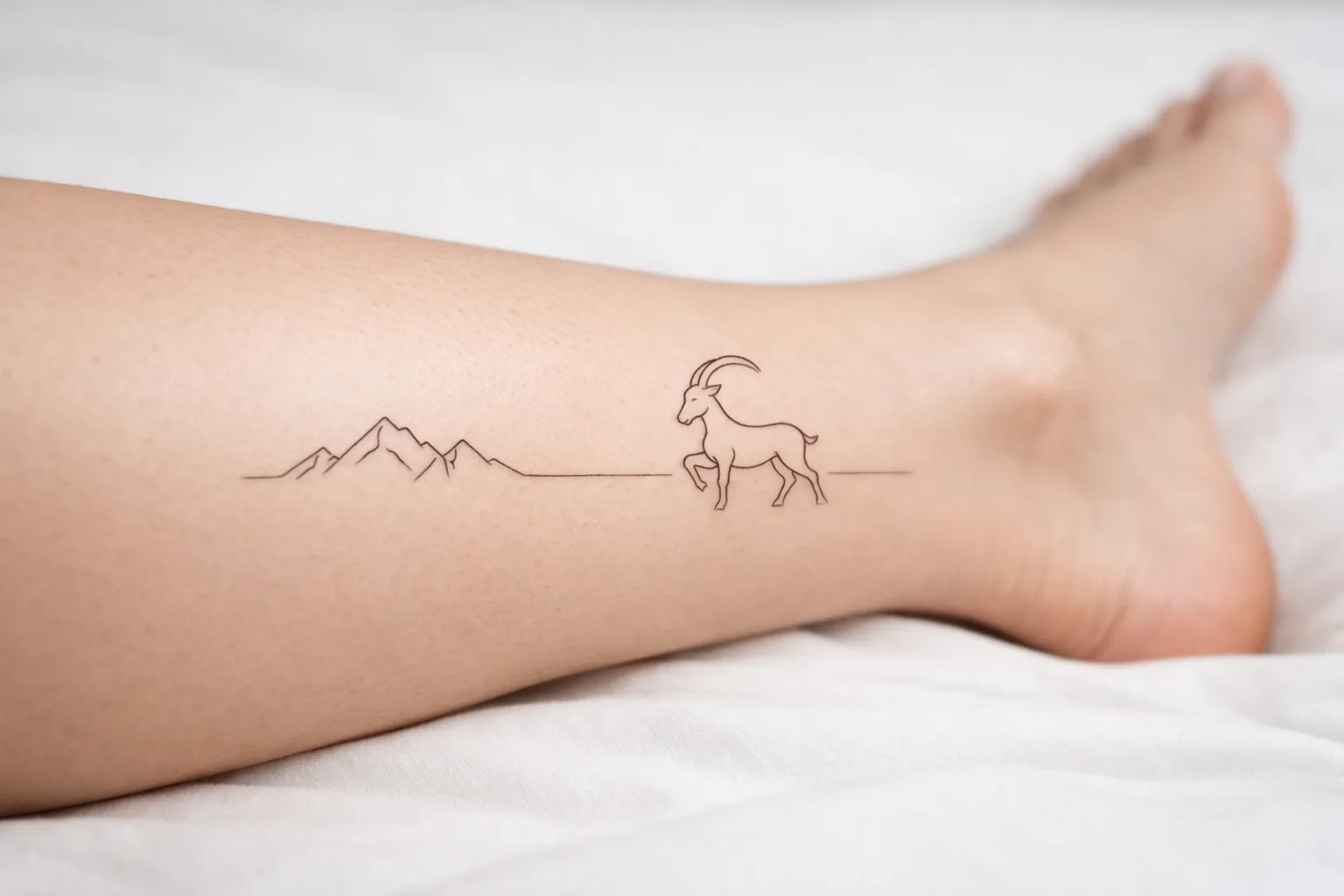
Blackwork and Neo-Traditional - Bold Capricorn Designs
Blackwork means solid black, no color, high contrast. Neo-traditional is American traditional’s evolved cousin - thick black outlines with a limited palette. Both are the dominant choices for a capricorn tattoo for men, and they’re a large part of why Capricorn tattoos age well: solid black holds crispness far better than heavy color layering.
A bold goat head, a geometric goat with angular facets, or a full sea-goat scene all sit here. The common pitfall when this style is done badly: outlines that aren’t thick or clean enough to survive a few years of healing and blur, at which point the whole piece goes muddy. I’ve seen plenty of neo-traditional goats that looked great fresh and fell apart within five years because the artist went too light on the line weight.
Fine-Line and Geometric - The Minimalist Approach
Fine-line means single-needle precision with subtle shading. Geometric leans on angular facets and mandala-adjacent structure. This is the tier for the delicate constellation, the micro glyph, and the clean geometric goat head.
Beginner-friendly work - a 1-3 cm glyph, a single-line goat head, or a simple black constellation - usually fits in a single session under an hour. The pitfall: pushing fine-line too small or onto high-friction skin, where the thin lines blur and lose definition within a few years.
The intermediate tier - a geometric goat head, a mountain-plus-constellation combo at 8-12 cm, or Saturn with rings as a secondary element - runs 1-3 hours and suits the forearm, upper arm, or calf. The advanced tier - a full mythological sea-goat scene combining water, mountains, planetary imagery, and sacred geometry - typically runs 10-15+ cm across multiple sessions and suits the back, chest, thigh, or a sleeve.
Design Considerations for Men vs. Feminine-Leaning Styles
Capricorn tattoos for men in practice lean toward bold goat heads on muscular placements - bicep, chest, calf - in heavy blackwork or neo-traditional with thick outlines and a limited palette, sized toward 8-15+ cm. Feminine-leaning Capricorn designs tend toward a delicate fine-line constellation on the collarbone or sternum, a micro glyph behind the ear, floral accents around a goat silhouette, or ornamental underboob linework, sized toward 3-8 cm.
The symbols themselves are unisex. The difference is line weight, palette, scale, and placement - not the goat or the glyph. That’s the useful thing to know if you’re browsing capricorn tattoos for men and women and wondering why they look so different: it’s execution, not iconography.
Cusp Dates, Sign Verification, and One Mistake Worth Avoiding
Capricorn runs December 22-January 19, but the exact start shifts by about a day depending on the year, so anyone born December 21-22 or January 19-20 sits on a cusp and should verify before committing. Getting a permanent tattoo of the wrong sign because you trusted a generic date table is a genuinely avoidable mistake.
The fix is simple: use a birth chart calculator with your exact birth time and location. The Sun’s degree position confirms your sign beyond doubt. Don’t rely on date-range tables alone if you were born near either boundary.
Two more mistakes worth naming. First, glyph accuracy - the correct ♑ has a specific curved structure, and copying from decorative or calligraphic fonts can produce a shape closer to Virgo’s ♍. Show your artist the Unicode symbol ♑, not a stylized script version. Second, overloading a small area - cramming goat, fish tail, mountains, Saturn, and text into under 5 cm produces cluttered, illegible results. If you want multiple elements, size up to at least 10 cm or split them into separate pieces.
One practical move before any of this: temporary Capricorn tattoos come as pre-printed sheets with sea-goat, glyph, or constellation options. Wear one in the intended placement for a week. It’s the cheapest way to test size, placement, and whether the symbol reads clearly on that part of your body before it’s permanent.
Lucky Motifs and What Works Best for Capricorn Ink
The motifs most often called “lucky” for Capricorn tie back to the sign’s stones and ruling planet - onyx, amber, Saturn’s rings, and the mountain summit - all of which reference discipline, achievement, and the payoff of long-term effort.
In tattoo terms, onyx (self-control, discipline) and amber (wisdom, warmth) translate into deep black ink with warm amber-toned accents, or gem shapes integrated into the design without overcrowding it. Saturn’s rings work best in minimalist form - a simple ellipse around a dot - as a background or framing element rather than the main subject, which keeps the design from feeling dated.
The strongest single pairing is the mountain plus constellation. The mountain silhouette grounds the composition - earth sign, ambition, the climb - while the constellation adds cosmic identity. Because Capricornus is faint, that quiet star pattern sits well against a solid mountain shape, and the combo holds up in both blackwork and fine-line (2).
On compatibility, if you’re thinking of a couples or friendship piece: Capricorn’s most commonly cited matches are the fellow earth signs Taurus and Virgo, and the water signs Scorpio and Pisces, which complement earth’s steadiness with emotional depth. The cleanest execution pairs Capricorn’s glyph or constellation with a partner’s sign, kept small and adjacent.
The honest answer to “which is best”: for longevity and versatility, an inner-forearm placement with a 5-8 cm fine-line constellation or geometric goat in blackwork hits the best balance of visibility, durability, and design clarity. Not a universal answer - but it’s the one I’d stand behind for most people.
Frequently Asked Questions
- What is the symbol for Capricorn?
- Capricorn has three main symbols: the sea-goat, the glyph ♑, and the constellation with 6 named stars in an arrowhead pattern.
- What tattoo is lucky for Capricorn?
- Lucky Capricorn tattoos use onyx and amber symbolism, Saturn's rings, mountain summits, and the cornucopia to represent discipline and achievement.
- Which Capricorn tattoo design is best?
- Sea-goat suits maximum symbolism, glyph works for discretion, and fine-line constellation balances subtlety and clarity at 5+ cm size.
- Who is a Capricorn soulmate?
- Capricorn pairs best with Taurus and Virgo (earth signs) and Scorpio and Pisces (water signs), often shown as paired glyph or constellation tattoos.
- Where should I place a Capricorn constellation tattoo?
- Collarbone and inner forearm offer stable skin and low distortion; shoulder blade suits larger pieces; avoid fingers and hands.
- How small can a Capricorn glyph tattoo go?
- Glyphs can be 1-2 cm on stable skin like inner wrist or behind the ear; below 1 cm details merge and fingers require frequent touch-ups.
- Do Capricorn tattoos work in color?
- Black ink suits Capricorn's earth aesthetic best; if colored, deep greens, muted browns, and dark grays fit; avoid bright or pastel tones.
Aftercare: What to Do in the First Month
Fresh ink needs consistent attention for about four weeks. The timeline breaks down cleanly.
Days 1-3: the tattoo is an open wound. Keep it covered with the wrap your artist applies, wash gently with unscented soap twice a day, and pat dry. No soaking, no sun. Apply a thin layer of fragrance-free moisturizer after each wash - enough to keep the skin from tightening, not enough to suffocate the ink.
Week 1: peeling starts. Do not pick. The skin is still fragile and pulling flakes early pulls ink with them. Keep moisturizing with a fragrance-free moisturizer two to three times a day. Fine-line work and dotwork - which most constellation and glyph pieces are - are especially vulnerable to ink loss at this stage.
Weeks 2-4: the surface heals but the deeper layers are still settling. Sun exposure is the main threat here. Cover the tattoo with sun-protective clothing any time you’re outside. UV breaks down black ink faster than anything else, and a faded constellation loses its star spacing quickly. By week four, most pieces look close to their healed state - though full skin recovery runs closer to three months.
One placement note: ribcage and sternum pieces take slightly longer to settle because the skin flexes with every breath. Budget an extra week of careful moisturizing for those locations.
Making the Decision
Three choices determine whether a capricorn tattoo holds up over the long term: symbol, placement, and size. Pick the symbol by how visible you want the astrology to be - glyph for discretion, constellation for subtlety, sea-goat for full visual weight.
Placement is where most people get it wrong. The inner forearm and shoulder blade hold fine-line work significantly longer than fingers or hands, so choose durability over novelty if you want the piece to last. If you’re combining elements, size up rather than down - a cluttered 4 cm composition ages worse than a clean 8 cm one.
And verify your sign with a birth chart before the appointment, not after, especially if you were born near December 22 or January 19. Get those four things right and the tattoo holds up.