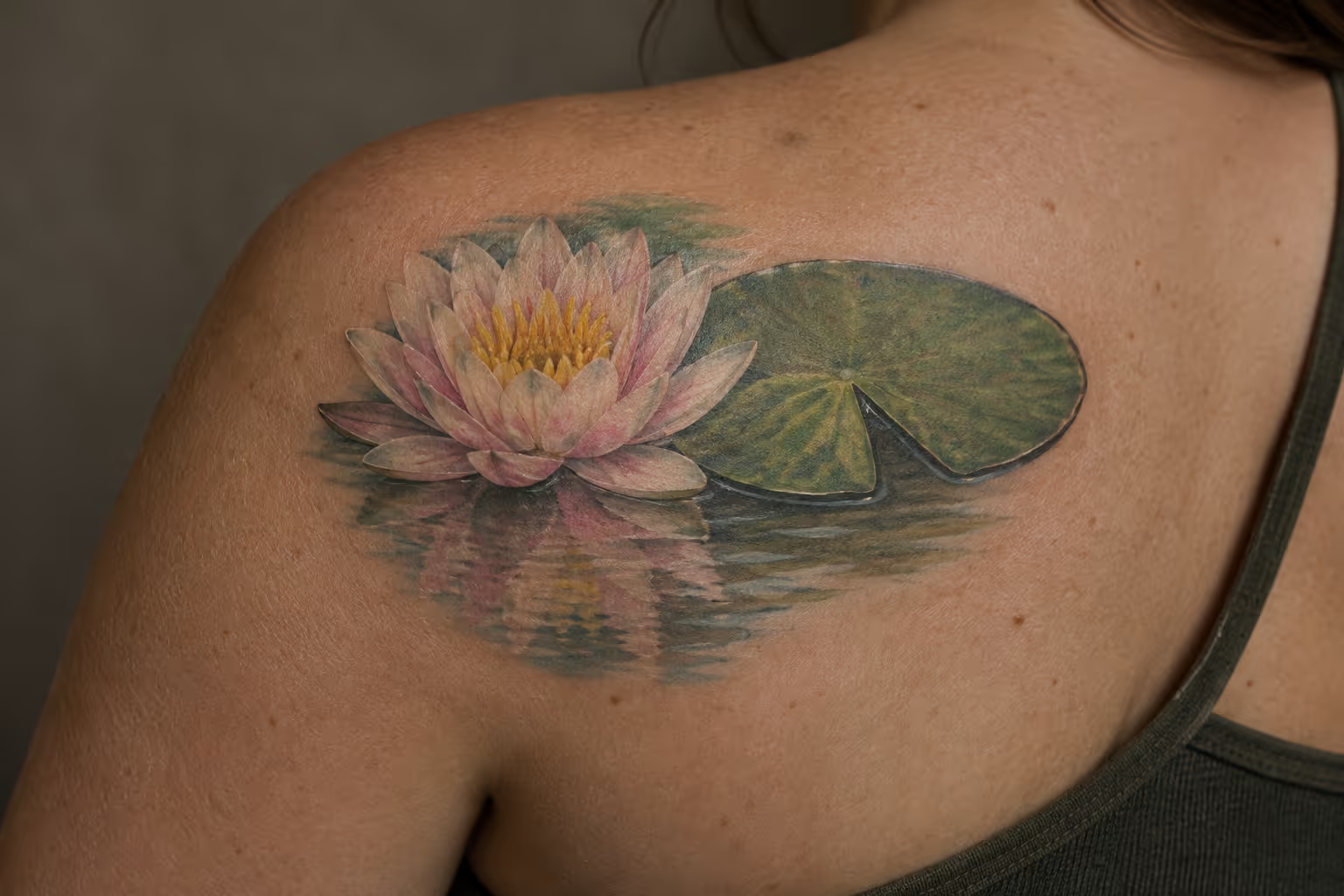
A water lily tattoo depends on one detail: the leaf. A water lily pad floats flat on the water with a single V-shaped notch and typically measures 8-16 inches (20-41 cm) across (9). An American lotus leaf has no notch (9), tops out at about 2 feet (61 cm) wide and usually sits above the surface (1). If those cues are unclear in your reference photo, the tattoo can easily end up reading as a lotus.
Compared with other flower tattoo designs, the water lily comes with clear trade-offs. On the plus side, it reads soft and calm. It scales down to a single bloom and one pad without losing its identity. It also takes almost any palette, from black and grey to pastel watercolor. On the minus side, a careless drawing gets mistaken for a lotus. Fine water reflections disappear at very small sizes. And the symbolism is interpretive rather than fixed, so the meaning you attach to it is the one that counts.
✓ Pros
- The notched pad gives the design a botanical cue an artist can preserve through stylization.
- A floating composition can follow the body's horizontal contours, especially on the forearm or outer thigh.
✗ Cons
- A reference that hides the leaf can leave the artist guessing which plant you mean.
- Highly symmetrical framing can push the bloom toward a lotus-like silhouette unless the pad remains visible.
Water Lily Tattoo Meaning and Symbolism
The water lily tattoo meaning is interpretive. Tattoo guides most often assign renewal, calm, purity and resilience, and one studio guide stresses that the reading shifts with culture, personal story and color rather than following one fixed definition (7). One placement-focused guide gives the basic Western reading as purity, enlightenment and rebirth (4). StyleCraze leans on the plant’s habitat: water lilies grow from muddy water, so they stand for beauty found in adversity, adaptability and survival (8). Another ideas roundup lists growth, calm, resilience and renewal (6).
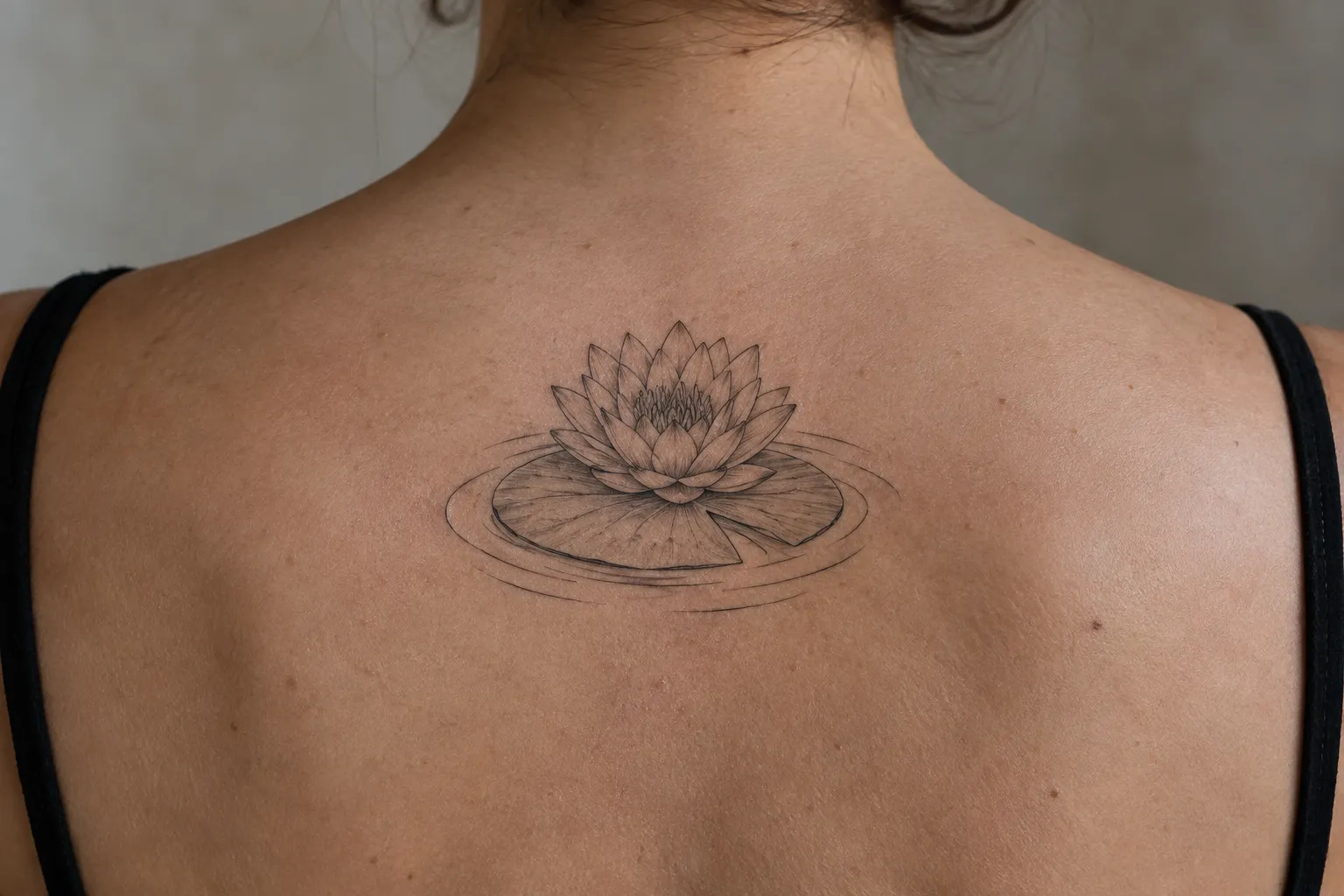
All of these come from the same visual: the flower rises from muddy water and opens into something clean and still, which is why the interpretations overlap so much (7). If you’re choosing a water lily for what it represents, decide which of those readings matters to you before the consult. “Rebirth after a hard year” and “calm” can produce different compositions: a bud opening over dark water versus a fully open bloom on a flat, glassy surface.
There are two older traditions behind the modern reading, and both need care:
- Ancient Egypt. The blue water lily, Nymphaea caerulea, is tied to ancient Egyptian sun symbolism (4). It is often called the “blue lotus” or “Egyptian lotus”, but it is a water lily in the genus Nymphaea, not a true lotus (13).
- Buddhism and Hinduism. The sacred lotus, Nelumbo nucifera, takes its common name from its status in Buddhism and Hinduism (12). Buddhist enlightenment imagery traditionally uses the true lotus, not the water lily (4).
The meaning has shifted in modern Western tattooing. The water lily tattoo is often called a “lotus tattoo” in casual usage, and most “lotus tattoo” images and Pinterest results depict the water lily form rather than the true lotus (4). One Los Angeles studio’s lily guide puts it bluntly: a water lily is not a lotus, whatever the internet says (5). The same studio says clients mix the two up constantly, and the tattoo ends up saying something they didn’t choose (5).
Color meanings by publisher: white, pink, blue, yellow
Water lily color meanings differ from one publisher to the next, so treat them as design conventions rather than a fixed code. One guide assigns white to purity, pink to affection, blue to Egyptian sacred symbolism and yellow to vitality (4). A studio guide links pink to emotional healing and tenderness and blue to introspection (7). The roundup above pitches pink as romantic, red as moody and blue as dreamy (6), which is a mood board rather than a symbol system.
The botanical palette is a better starting point. Water lily flowers are typically white to pink to violet, often with a yellow center (9). A design that stays in that range reads as a real plant. A teal or black-petalled lily reads as stylized, which is fine as long as you know that’s the choice you’re making.
Color also has technical consequences on skin:
- White petals are best built from negative space (bare skin) with grey or soft pink shading. One guide notes that white ink can yellow on sun-exposed skin and that many artists use off-white or pale grey instead (4).
- Pale yellow centers hold better when outlined or set against a darker pad. Pink, blue and yellow work fades faster than black and grey (4).
- Blue lilies need saturated blue packed against a solid green or black pad. Otherwise similar cool shades blend together from a distance (6).
Water lily as a July birth flower
Birth-flower guides pair July with larkspur and the water lily, and one tattoo guide calls the water lily July’s “primary” birth flower (4). Roundups also suggest combining the two July flowers in a single piece (6), and our birth flower tattoo list gives the same pair for July.
The pairing does have a seasonal logic. The Missouri Department of Conservation lists water lily blooms from July through October (9), so a July birthday falls at the start of the flowering season. If the birth month is your reason for choosing the flower, it works as a personal reference. Just know that some people will think of larkspur first.
A common July birth-flower layout is a single water lily with a name or date running along the stem line or under the pad (4). Size the lettering by letter height, meaning the height of the whole letter. Standard script needs at least 12 mm (1/2 in), fine or ornate script about 25 mm (1 in), and block letters or numerals at least 6 mm (1/4 in). On a small wrist piece, that means bold script or block lettering rather than a delicate signature-style name.
Water Lily vs Lotus Tattoo: Telling the Flowers Apart
The water lily vs lotus tattoo question comes down to two botanical cues: a notched leaf floating at the surface means water lily, and an unnotched, raised leaf means lotus (1)(9). The plants come from different genera. Water lilies are Nymphaea, in the family Nymphaeaceae (11), and lotuses are Nelumbo (9)(12). Despite the name, a water lily is not a true lily either: it is a Nymphaea, not a Lilium (5). Around ponds, the two are often lumped together as “lily pads” even though they are separate plants (1).
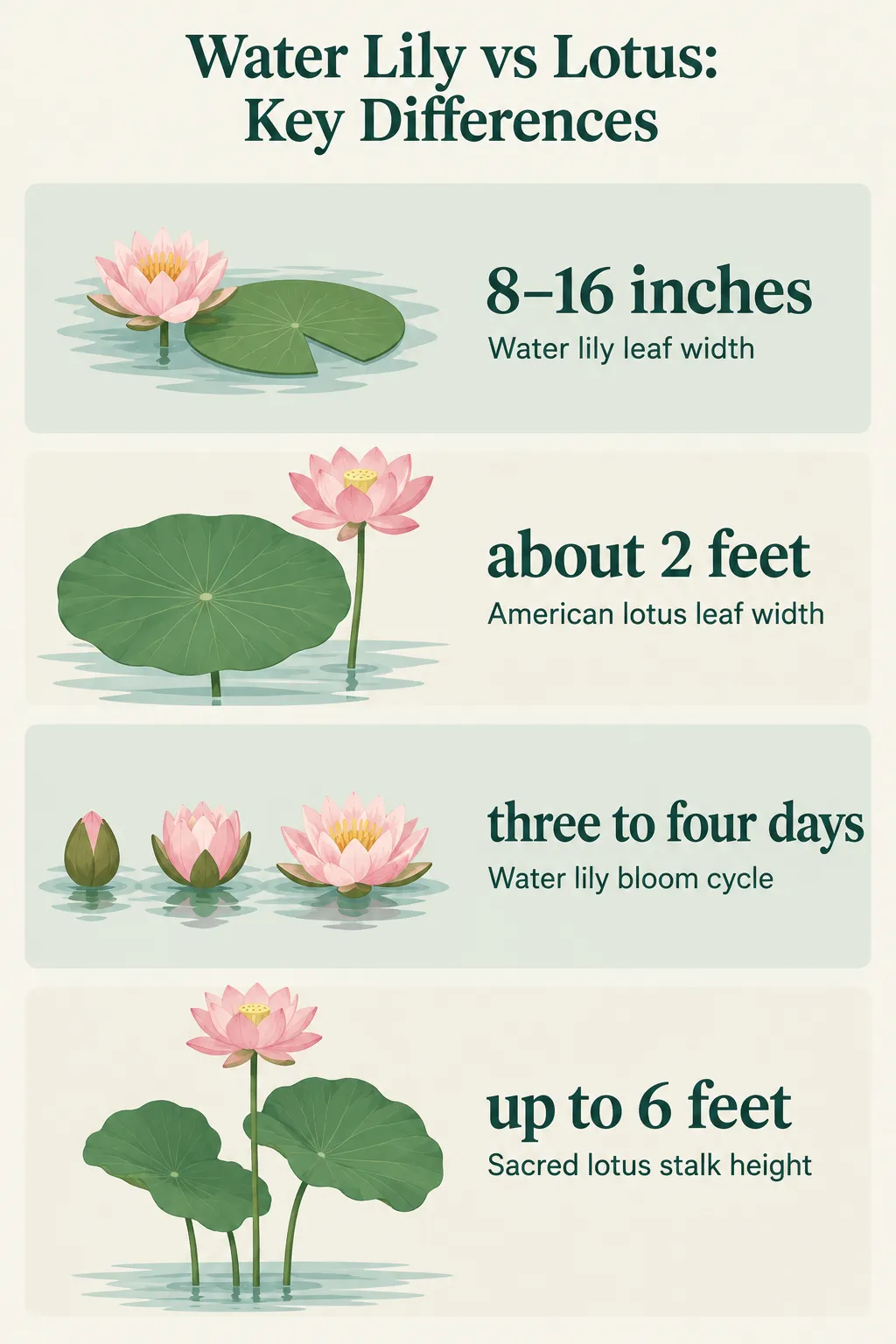 Water lily leaves typically measure 8-16 inches across and their flowers open over three to four days, while American lotus leaves reach about 2 feet and sacred lotus stalks grow up to 6 feet.
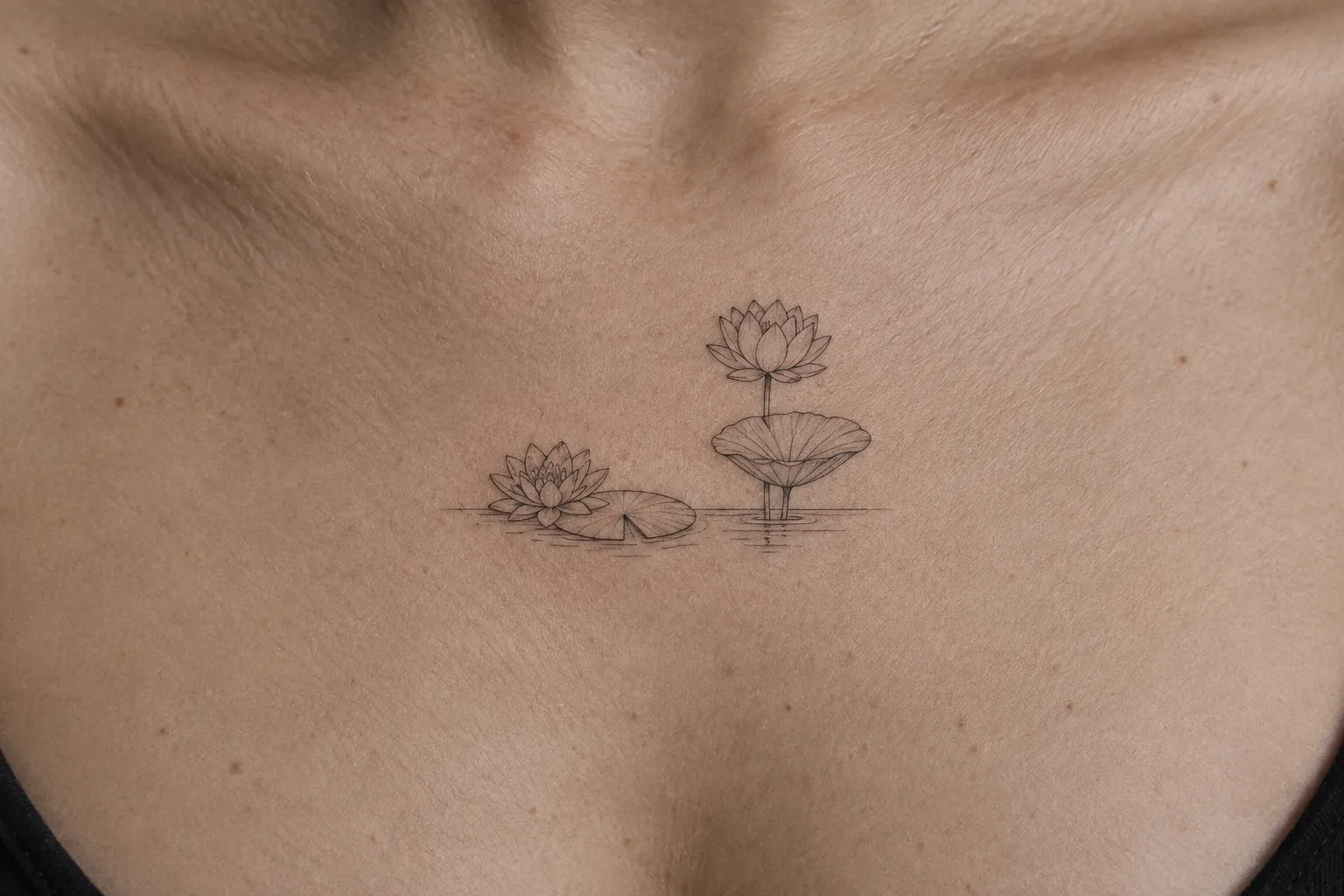
That confusion carries straight into tattoo flash. A lotus drawn from memory and a water lily drawn from memory often end up as the same pointed, upright, many-petalled flower. The leaf and the flower’s height above the water are what separate them in a simplified design.
Leaf shape and size: the notch that gives it away
The water lily leaf notch is the most reliable identifier. Each pad has a single V-shaped notch (9), cut from the edge toward the center (11), so the leaf looks like a circle with one wedge removed. A lotus leaf has no notch and forms a complete circle (9)(11). Its stalk joins a depression in the middle of the leaf blade (12), which makes it look like a shallow bowl or an upturned umbrella with veins radiating from a central point.
Size also differs. American lotus leaves reach about 2 feet (61 cm) wide, while water lily leaves usually run 8-16 inches (20-41 cm) (1)(9). That makes a mature lotus leaf roughly 1.5 to 3 times wider than a typical lily pad. If your reference photo shows a huge, platter-sized leaf dwarfing the flower, it is probably a lotus. A water lily reference should show the smaller, notched pad.
Height above the water is a weaker clue than the notch. Water lily leaves can float, rise above the surface or sit submerged depending on the water level (9). Sacred lotus leaves can float as well as stand up to 5 feet above the water (12). The notch never changes, which is why it should be the one detail you protect in the drawing.
In linework, keep that notch as an open wedge with clear skin between the two edges, not a hairline slit. Lines spread slightly as a tattoo ages. A notch drawn too narrow closes up over the years, and the pad turns back into an anonymous circle.
Flower position: floating at the waterline vs held above it
A water lily flower sits at or near the water surface. It is cup-shaped and opens and closes daily over three to four days (11), on a flexible stalk rising from a rhizome on the pond bottom (9). A sacred lotus flower is held above the water on stalks up to 6 feet tall (12). The center differs too. A water lily’s center is often a yellow cluster (9). A lotus has a large central disk that resembles a showerhead (9), which a tattoo can show as a disc with dots.
To translate this into a tattoo:
- For a water lily, set the bloom directly on a pad or on a ring of ripple lines, with no visible stem above the surface.
- For a lotus, show a stem lifting the flower clear of the water, and draw the leaf unnotched.
- Avoid the hybrid of a lotus-style pointed flower on a tall stem sitting next to a notched pad. It reads as neither plant, and anyone who knows ponds will notice.
Choosing water lily or lotus based on the symbolism you want
Pick the flower whose tradition matches the meaning you want. If you want Buddhist enlightenment imagery, choose a lotus design, because that tradition uses the true lotus (4)(12). If you want the water lily’s own associations, whether the Egyptian blue water lily, the Western renewal-and-calm reading, or a July birth-flower reference, keep the bloom at the waterline with a visibly notched pad. One studio sums it up: a water lily carries European and Egyptian readings rather than Buddhist ones (5).
If botanical accuracy matters, bring the artist a plant photo, not just a tattoo you found online. Make sure it shows the two cues botanical guides use: a pad that floats with a single notch (11) and a flower that sits on the water rather than above it (1). Ask your artist to keep those two cues even if the rest of the design is stylized.
Water Lily vs Lotus: Botanical Cues and Tattoo Associations
| Water lily (*Nymphaea*) | Lotus (*Nelumbo*) | |
|---|---|---|
| Botanical family | Nymphaeaceae | Nelumbonaceae |
| Leaf shape | Single V-shaped notch | Unnotched; stalk joins a central depression |
| Typical leaf width | 8-16 inches (20-41 cm) | Up to about 2 feet (61 cm) for American lotus |
| Flower position | At or near the water surface | Held above the water; leaves may also float |
| Common tattoo-guide associations | Renewal, calm, purity, resilience; blue water lily linked to Egyptian sun symbolism | Buddhist and Hindu sacred meaning; enlightenment |
Design Directions: Floating Blooms, Fine Line, and Mandala Styling
Water lily designs in the guides fall into three broad directions: a bloom floating with its pads (5), a fine-line or watercolor treatment (4)(5), and mandala or geometric framing (4)(8). Each one asks for a different minimum size and suits a different style of artist. Pick the direction before you pick the placement.
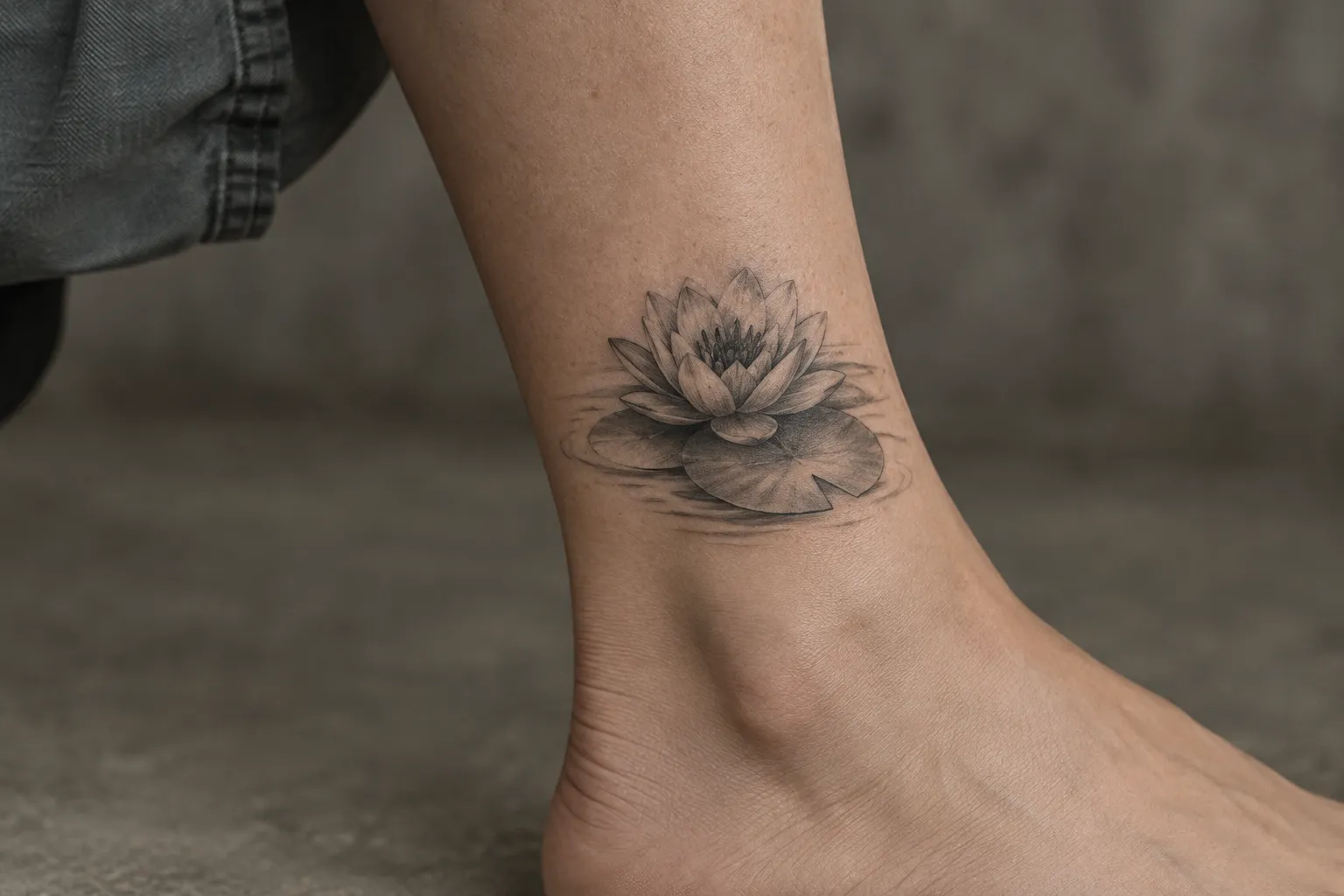
Single bloom with a notched lily pad
The single bloom on a notched pad is the most readable water lily layout at any size. The flower has a many-petalled radial form (4), so you can draw it two ways:
- Top-down, where the petals form a star or rosette around the yellow center. This is strong on round placements like the shoulder cap or the back of the calf, and it shows the radial symmetry best.
- Three-quarter view, where the cup shape rises off the pad. This is easier to read as a water lily specifically, because you see the bloom sitting on the water rather than a flat rosette that could be any flower.
Add-ons that fit the habitat include ripple rings, a second smaller pad, a closed bud, or a dragonfly. Roundups also show Japanese-inspired compositions with waves around the bloom (6). In any layout that adds water, waves or koi, keep the notched pad visible so the water lily stays distinct from a lotus.
As an American traditional piece, the water lily works well: one guide describes the style as a bold black outline with saturated color fill (4). A limited palette suits it: black, one green, one pink or red, and yellow for the center. The common pitfall is drawing too many petals. A real water lily carries 15 to 25 petals (4), but traditional work needs fewer, bolder, countable shapes, or the bloom turns into a muddy disc.
Watercolor and fine-line treatments
Fine-line water lilies rely on single-needle linework (4) and soft grey shading with little or no solid black. The petals may sit on the water in a single sketched pass, as one roundup shows (6). This style suits the delicacy of the flower. The pitfall is going too small or too detailed. Lines placed too close together can visually merge over the years, so the petal edges fuse (6). The healed result looks noticeably softer than the fresh photo on the artist’s feed.
Watercolor treatments use translucent washes of color, often bleeding past the edges of the drawing, with soft gradients instead of solid fills. Pink, violet and blue petals over a pale green wash fit the plant’s natural range. The pitfall is skipping the structure. One studio warns that watercolor ages faster than line work because the splashes lack an outline scaffold (5), so a piece without a black or dark grey skeleton (an outline, or at least dark accents at the petal bases) loses its edges as the washes soften. After several years you can’t tell where the flower ends and the pad begins. Ask any watercolor artist how they plan to anchor the shape.
Mandala and geometric water lily designs
Mandala water lily designs set the bloom inside a symmetrical frame of repeating petals, dotwork rings or line patterns. StyleCraze presents the mandala treatment as a bold design tied to harmony, balance and spiritual growth (8). Another guide calls mandala framing a popular style for spiritual-symbolic tattoos (4). Both are interpretive associations, layered on top of the flower’s own readings.
The two hallmarks of this style are strict radial symmetry and texture built from dots or fine repeating marks rather than flat shading. The common pitfall is cramming it. One guide suggests mandala water lilies at medium-to-large scale (4), because dotwork rings need space between the dots, and on a small piece they merge into a grey smudge.
A second pitfall is specific to this flower. Mandala petals are usually drawn pointed and upright, which pushes the design toward the lotus. If you want the result to read as a water lily, work the notched pad into the frame. For example, make the pad the outer ring with its notch at the bottom center, so the botanical cue survives the geometry.
Placement and Size: From a Small Wrist Lily to a Full Floating Scene
A small water lily tattoo works on the inner wrist at 1-2 inches (2.5-5 cm) or behind the ear at 0.5-1 inch (1.3-2.5 cm), according to one tattoo placement guide (4). Larger scenes move to the inner forearm, chest, back and outer thigh. Treat these figures as that guide’s suggestions, not technical limits. Your artist’s style and line weight change what fits.
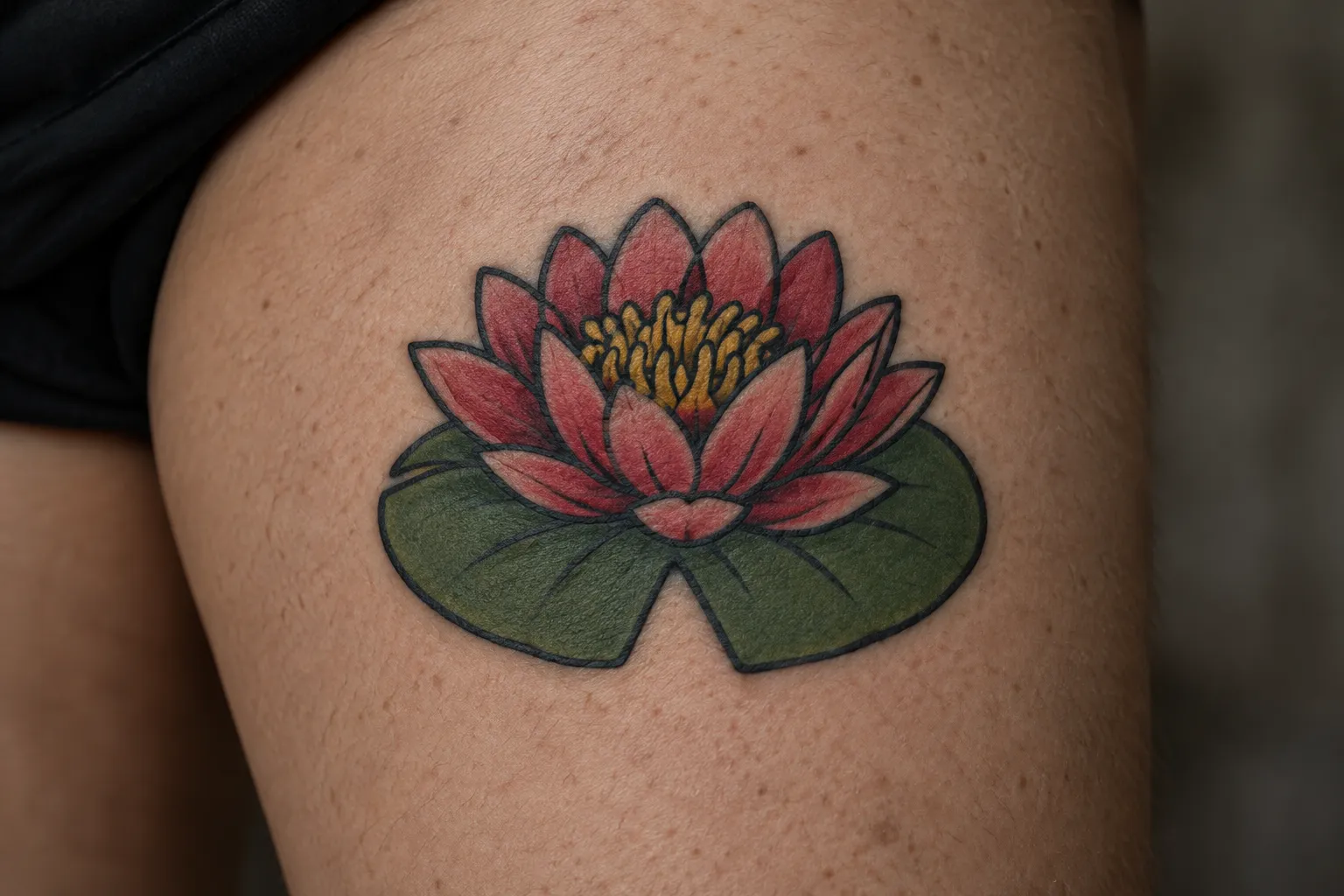
Small placements: inner wrist and behind the ear
At the inner-wrist size of 1-2 inches (2.5-5 cm) and the behind-the-ear size of 0.5-1 inch (1.3-2.5 cm) (4), simplify hard. Keep the flower silhouette and one notched pad. Drop the water reflections, ripple rings and mandala detail. At that scale there is room for the flower’s outline, a few interior petal lines and a clearly open notch. Anything finer tends to soften over time (6).
For a small water lily tattoo, use these placement notes:
- Inner wrist: easy to see, and the guide rates pain there as low to moderate (4).
- Behind the ear: discreet, and the guide rates pain as moderate (4). The area is small and curved, which suits a single bloom seen from the side with a sliver of pad, not a top-down rosette.
- Ankle (outer): the same guide puts small-to-medium ankle pieces at 1.5 to 3 inches (3.8 to 7.6 cm), with low to moderate pain (4). A lily with one pad trailing toward the heel suits the curve of the bone.
Mid-size: inner forearm
The inner forearm takes a water lily at 2-4 inches (5-10 cm) (4). That leaves enough flat space for a horizontal floating composition: one open bloom, a second pad with its notch visible, maybe a bud and a short run of ripple lines. The same guide rates the pain as low (4), and our tattoo pain chart puts the forearm in the low tier, well below the ribs and sternum.
This is where fine line and watercolor start to make sense, because petals get enough width to carry shading. Run the waterline along the length of the forearm rather than across it. A horizontal surface fits the long axis of the arm, and it also emphasizes that the flower is floating rather than standing up like a lotus.
Larger scenes: outer thigh, back, and chest
The outer thigh suits a larger water lily piece at 4-8 inches (10-20 cm), with low to moderate pain and easy coverage under clothing (4). At this scale you can build a full pond scene: several blooms at different stages, overlapping notched pads, dragonflies, reflections, even a koi beneath the surface if you want a Japanese-influenced feel.
The back and upper chest also suit a horizontal floating scene. A full back panel can hold a whole stretch of pond, and a chest piece can spread pads across both pecs with a bloom near the center. Pain is unevenly distributed. One guide rates the sternum high because of thin skin over bone and the spine line moderate to high, against low pain on the upper back and shoulder blade (4).
Larger work is also where mandala and geometric water lilies belong. Upper back, sternum and thigh give the symmetry enough room for the dotwork to stay separated.
Booking Tips: Reference Photos and Aftercare Basics
Before you book a water lily piece, bring a plant reference photo, ask how the studio handles hygiene, and know which healing signs mean you should see a professional. The plant photo matters most for this flower. Bring one that shows the notched pad flat on the water and the bloom at the waterline, plus one or two tattoo examples for the style you like.
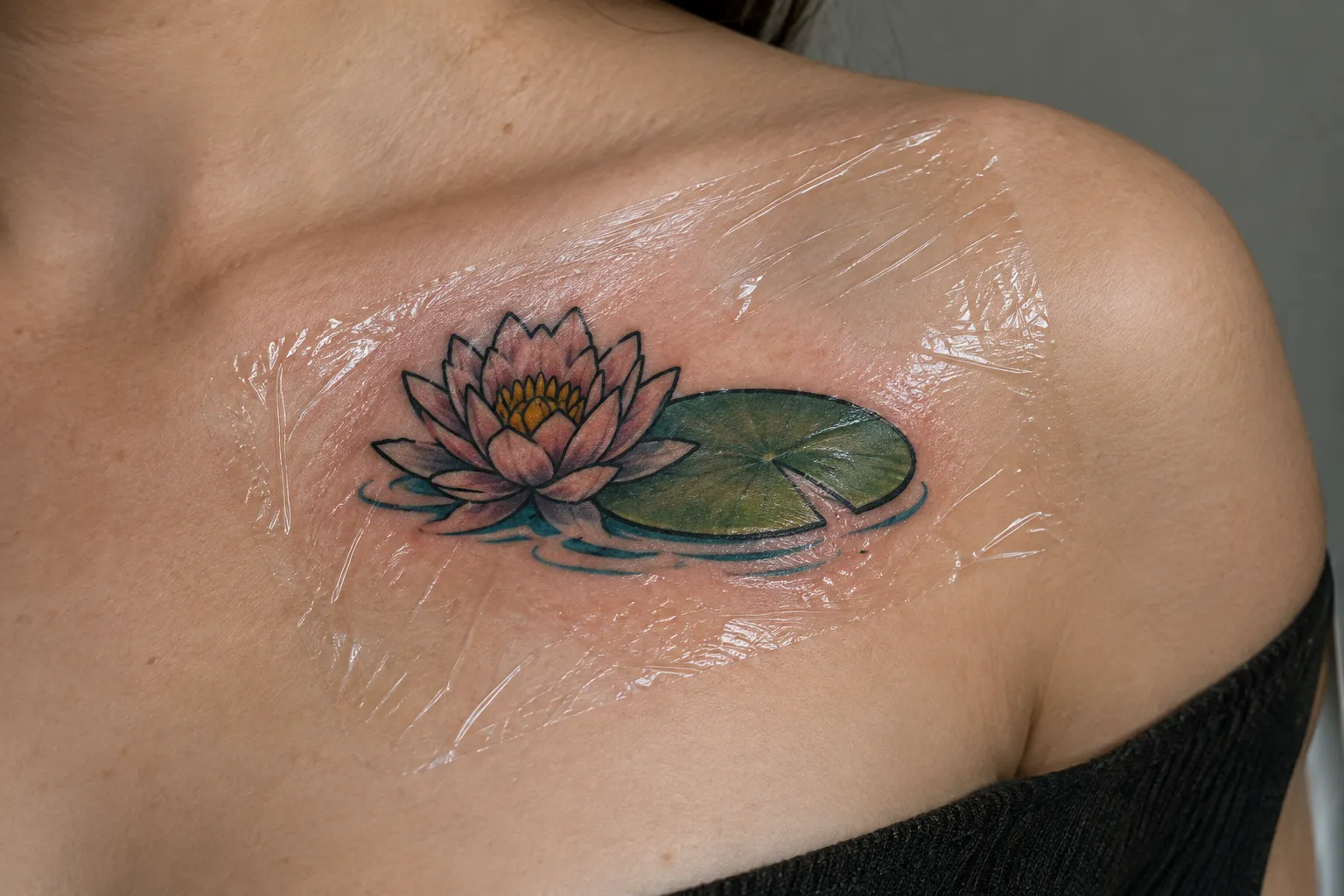
On hygiene, the FDA has received reports of infections from contaminated tattoo inks and allergic reactions to the inks themselves. It also notes that even unopened, sealed inks can harbor bacteria and other microorganisms (10). Ask your artist where their inks come from, whether needles are single-use and opened in front of you, and how the station is set up. A good studio answers without hesitation.
Basic aftercare runs on a predictable timeline, which our tattoo aftercare guide covers day by day:
- Days 1-3: keep the wrap on for as long as your artist says, then wash gently with clean hands and a mild cleanser and pat dry. Expect redness, some weeping and tenderness.
- Days 4-7: the skin feels tight and starts to flake. Apply a thin layer of fragrance-free moisturizer, don’t pick at flaking, and stay out of baths, pools and the sea for the first weeks.
- Week 2 onward: peeling and itching come in week 2. Around weeks 3-4 the surface looks healed while the deeper skin is still settling, with full integration around week 6. Keep a fresh forearm, wrist or chest piece out of direct sun for the first 4 to 6 weeks. This matters most for pale pinks, yellows and white petals.
If the tattoo develops a rash or doesn’t seem to be healing, the FDA advises contacting a healthcare professional and telling your tattooist. Fever alongside signs of infection needs particular attention (10).
Frequently Asked Questions
- What does a water lily tattoo mean?
- Water lily tattoos commonly suggest renewal or calm, but the symbolism is interpretive; Egyptian blue-water-lily imagery and modern Western meanings are distinct traditions.
- Is the water lily July's birth flower?
- Yes. Birth-flower guides pair July with larkspur and the water lily, and one tattoo guide calls the water lily July's primary birth flower.
- How can I keep a water lily tattoo from looking like a lotus?
- Keep the pad's V-shaped notch open and show the bloom at the waterline; those two cues distinguish a water lily from a lotus.
- Can a small water lily tattoo keep its detail?
- A small design can stay legible if it keeps the flower silhouette and one open notch, while dropping closely spaced petals and water details.
- What should I bring to a water lily tattoo consultation?
- Bring a clear plant photo showing the notched pad and waterline bloom, plus style references; tattoo images alone may repeat the lotus mix-up.
- When should I contact a professional about a healing tattoo?
- Contact a healthcare professional if a tattoo develops a rash or appears not to be healing; seek particular attention for fever with infection signs.
The Notch, the Waterline, and the Size You Pick
A water lily tattoo reads correctly when two cues survive: a notched pad lying flat on the water and a bloom sitting at the waterline. Lose the notch or lift the flower on a stem and you get a lotus, with a different botanical identity and a different set of meanings.
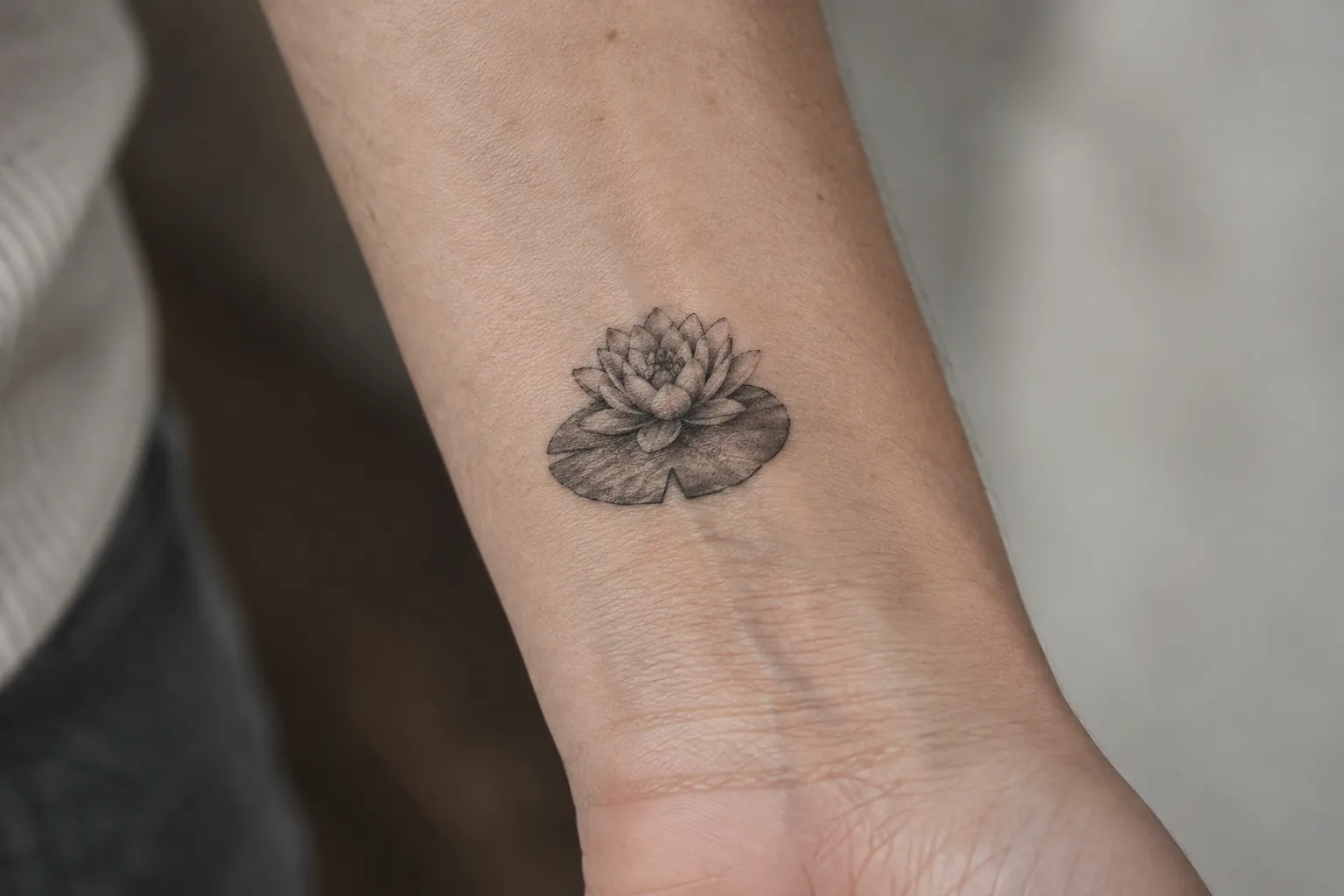
Bring a plant reference photo to the consult and ask your artist to keep both cues. Then match the detail to the placement. A single bloom and one open-notched pad is enough for the inner wrist or behind the ear. A floating composition with ripples fits the inner forearm. Mandala framing and full pond scenes need the room of the outer thigh, chest or back. Plan the aftercare around sun exposure if you choose pale petals, and the design will stay readable as it ages.