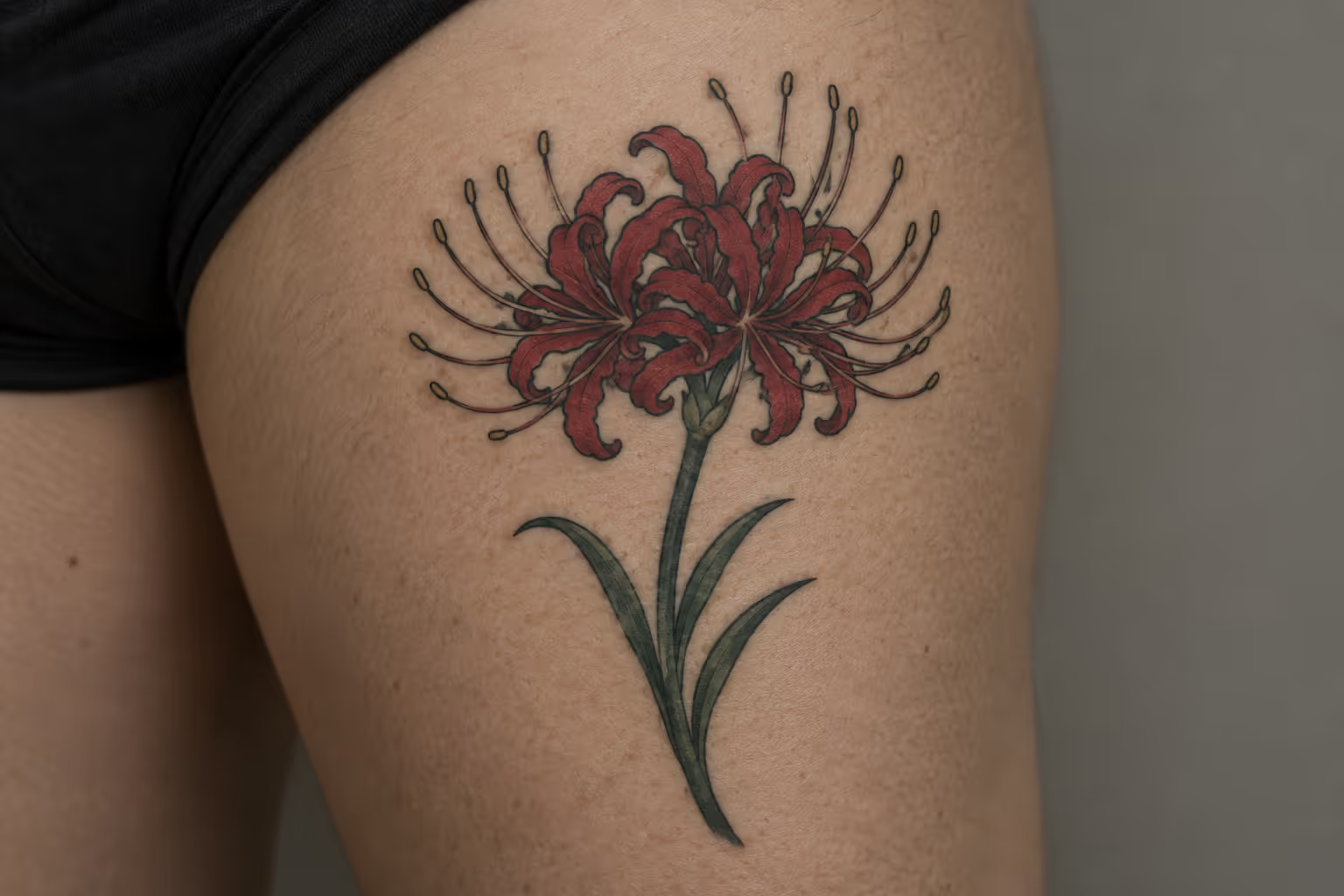
Higanbana, the Japanese name for the red spider lily, ties the flower to Higan, the Buddhist observance held around the autumn equinox (4)(7). The bloom most spider lily tattoo references draw from lasts about 2 weeks on the plant (9). That short window, plus the flower’s habit of growing near graves, is where most of its meaning comes from: in Japan it stands for remembrance of the dead and final parting (3)(4). This guide is about that flower, Lycoris radiata. The name “spider lily” is also used for Hymenocallis, a different genus native to the Americas, with green, white, or yellow flowers whose stamens are joined by a membrane cup (11). Once you know which flower you mean, the bigger design decisions are colour, layout, and line weight for the placement you pick.
Higanbana Tattoo Meaning: What a Spider Lily Tattoo Represents in Japanese Culture
A higanbana tattoo draws on Japanese associations with Higan, remembrance of the dead, and final parting (3)(4). Tattoo guides add their own layers, such as transition and rebirth (2)(6). Tattoo History Atlas notes that people who wear the flower in the Japanese tradition usually intend the death-and-parting meaning, so know that reading even if your own reason is different (4).
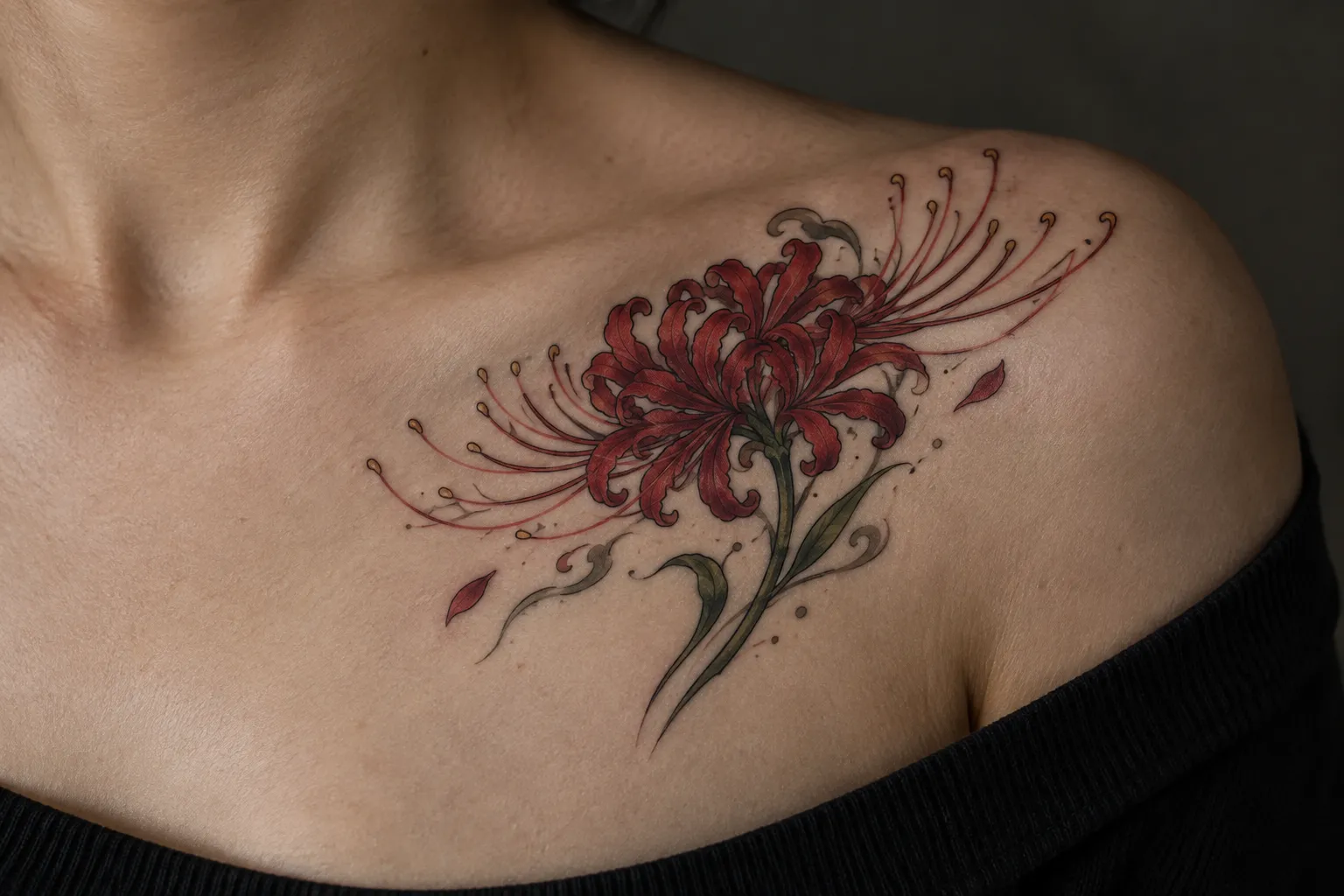
The flower grows along rice paddies, waterways, and in cemeteries in Japan (3). It also appears in Japanese legends with a darker reading, linked to death and the idea of eternal separation (3). One tattoo history reference summarises the red spider lily’s most common reading as death, final parting, and the crossing into the afterlife (4).
The modern tattoo reading is broader. One studio guide presents the spider lily as a symbol of death and rebirth, because the plant flowers before its leaves appear: an ending that makes room for something new (2). Farewell and remembrance also feature in its list (2). Rebirth has an older Buddhist echo too: one legend says the flowers grow along the path to the underworld and guide the dead toward reincarnation (3), and under its Buddhist name, manjushage, taken from a flower described in the Lotus Sutra, the plant can stand for purity and reincarnation (7). The studio version simply ties rebirth to the growth cycle instead.
The lily also arrives in tattooing as a borrowed motif rather than one the tattoo trade invented. No single artist “fixed” a canonical lily design the way Sailor Jerry did with the American traditional rose, so the wearer chooses which inherited meaning to carry (4). That is true of most flower tattoo ideas, where several traditions sit on top of each other. For a spider lily, that means you decide whether the piece is about someone you lost, about a season of change, or about the shape of the flower.
Why Higan and the Autumn Equinox Matter
Higan is a Buddhist observance held around the equinox, and the flower’s Japanese name points straight at it (4)(7). The word higan means “the other shore”; in popular Japanese culture it came to mean the far side of the Sanzu River, the realm of the dead, which is why the name carries such a strong link to death and the afterlife (7). In Japan the higanbana blooms in September, around the autumn equinox (3). That equinox is a national holiday, Shubun no Hi, which falls on September 22 or 23 depending on the year (3).
The autumn equinox began as a Buddhist observance when families clean and tend their ancestors’ graves (3)(7). Red spider lilies, blooming at that moment, are planted around graves and used as offerings at memorial ceremonies, which earned them nicknames such as “flower of the dead” and “flower of the afterlife” (3)(7). If you want your piece to mark a death or an anniversary, the seasonal link gives it a specific reference. A design built around a September loss, or a remembrance you keep every autumn, gives the tattoo a reason beyond the visual.
If the seasonal link doesn’t fit your intention, skip it. Connect the design to the equinox only when it matches what you’re marking.
Why the Bloom Is Called Fleeting, Not a Garden Fixture
Each red spider lily stalk carries an umbel of 4-6 flowers, and those flowers last about 2 weeks before fading to a lighter pink (9). The plant then puts up strap-shaped leaves that stay green through winter, dies back in late spring, and sits dormant until the next cycle (9).
That short window is why the bloom reads as fleeting rather than as a garden staple you can admire for months. The bloom also appears on a bare stalk before the leaves are fully out (3), so for a short spell you see only the red flower on a long stem with no greenery. Leaves and flowers never appear at the same time, and that trait sits behind the separation legends: in one Japanese telling, the sun goddess Amaterasu parted them forever (3), and in Korea the plant is called sangsahwa, “the flower of unrealized love” (7). Many tattoo designs copy the bare look directly: a single stem, a radial head, no leaves.
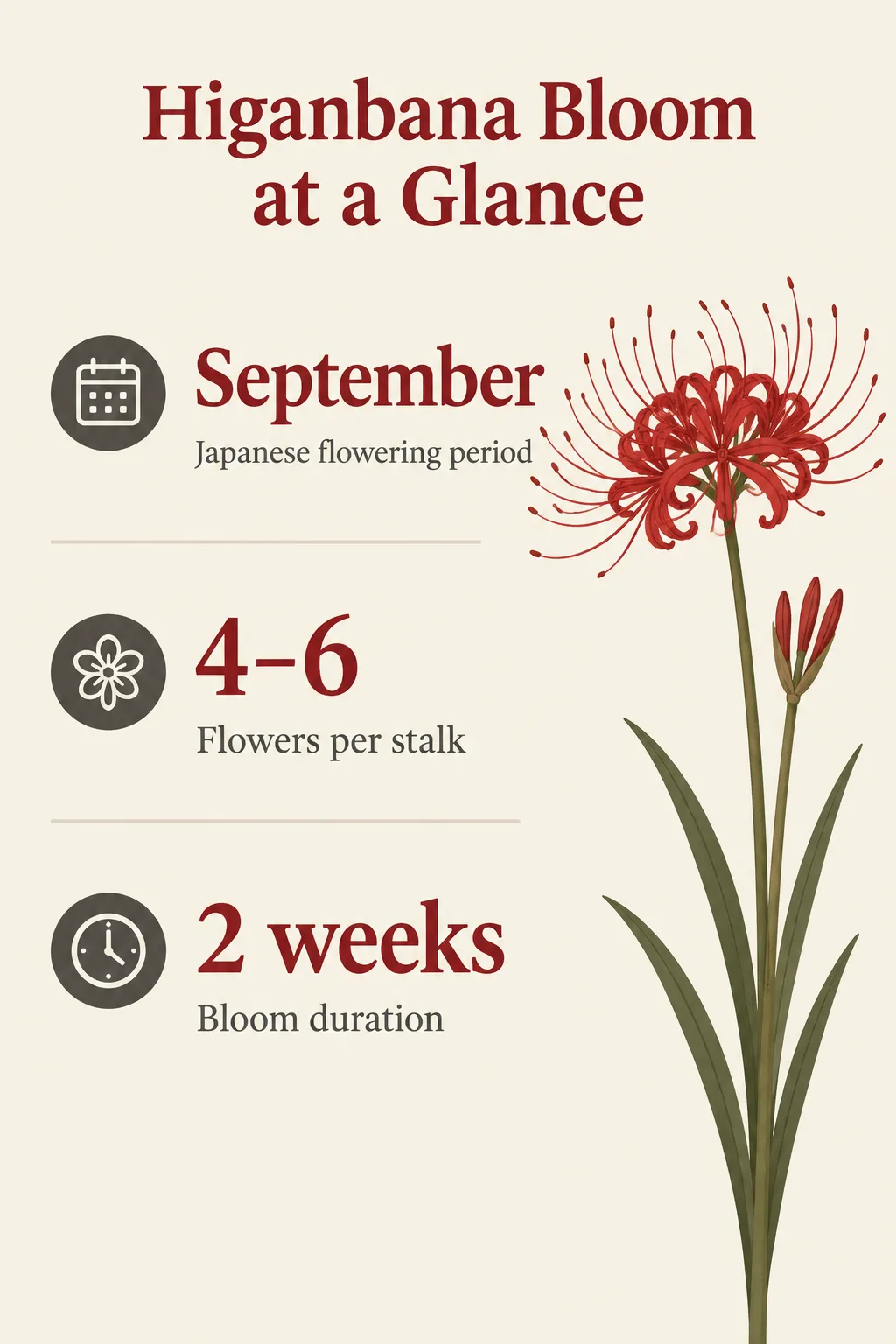 The Japanese higanbana flowers in September, bears 4-6 flowers per stalk, and blooms for about 2 weeks (3)(9).
As a design idea, “fleeting” works if you want a piece about something brief, a season, a relationship, a stage of life. Leaves drawn on a blooming stem are artistic licence rather than botany, since the strap-shaped leaves only follow the flowers (9); keep them if you like the balance they give the design.
Is a Spider Lily Tattoo Bad Luck?
In Japan the flower itself is associated with death, final parting, and bad luck, strongly enough that it is customarily never given as a gift (4)(7). Nothing forbids wearing one: Tattoo History Atlas says there is no prohibition on a non-Japanese person getting it, only that the honest practice is to know what it means in its home culture (4). One design guide adds that personal stories change the meaning a lot (6).
Two facts sit behind that reputation. The first is the cemetery and death symbolism. The second is that the bulbs are poisonous, which is one reason the plants were grown along paddies and over graves: the toxic bulbs help keep rats, mice, moles, and other pests away (3)(4). A toxic bulb is a botanical fact about a plant. It says nothing about ink on your skin.
What you can fairly expect is that some people who know the flower’s Japanese associations will read your tattoo as a memorial piece. If you’d rather avoid that conversation at family dinners, a black-and-grey or abstracted version (covered below) shifts attention to the shape. If you’re getting it for someone you lost, the association works in your favour.
✓ Pros
- The radial shape stays identifiable even when you simplify the surrounding details.
- A personal interpretation can sit alongside the Japanese associations without claiming one fixed meaning.
- The motif can be adapted to read as botanical illustration or as a more explicit cultural reference.
✗ Cons
- The flower's cultural associations can prompt memorial-related assumptions from viewers.
- A compact design leaves little room for the curled petals and long filaments to remain distinct.
- A stylised version may be read as a different Lycoris species if its colour and reference are unclear.
Red Spider Lily vs Yellow Shōki-zuisen: Getting the Species Right
The true higanbana is Lycoris radiata, a characteristically red flower, while the vivid yellow lookalike is shōki-zuisen, a separate Lycoris species and not a yellow colour form of higanbana (7)(12). If your design is yellow, it depicts a relative.
Why Lycoris radiata Is the True Higanbana
Lycoris radiata is a bulbous perennial in the amaryllis family (3)(7), not a true lily of the genus Lilium (4). Red is its defining colour (7). It’s known by a long list of common names, including red spider lily, equinox flower, hurricane lily, and corpse flower, enough that it is nicknamed “the flower with 600 names” (3)(7). The plant is originally from China, Japan, Korea, and Nepal (7). It was introduced to the United States in 1854 and has since naturalized in North Carolina, Texas, Oklahoma, and other southern states (7).
White spider lilies exist too, and Josen-ji, a temple in Kanagawa, is known for them (3). Nerima City’s notes on the Makino Memorial Garden, which grows both colours, describe the white form, shirobana manjushage, as a presumed hybrid of higanbana and shōki-zuisen, so it is not a simple colour variant (5). A white bloom is a real plant, then, though it loses the immediate red-flower recognition that carries the red spider lily tattoo meaning for most viewers.
That recognition matters for how strangers read your piece. In Japan the flower turns up in literature, anime, and manga as a sign of death, hell, and the afterlife (7), so for viewers who know that culture the red reads instantly. The red does most of that work. Change the colour and you weaken the cultural signal, which is fine if that’s your goal.
What a Yellow Spider-Lily Design Actually Depicts
That leaves the “yellow higanbana” question. The yellow flower with the same higanbana shape is shōki-zuisen (Lycoris traubii), a different species within Lycoris (12). It looks the same at a glance, but it’s a different plant.
For your tattoo, that means three practical things:
- If you want the higanbana meaning, keep it red. A yellow bloom described as higanbana will confuse anyone who knows the plant.
- If you love yellow, call it what it is. A shōki-zuisen piece is a legitimate floral design. It just doesn’t carry the Higan link in the same way.
- Brief your artist with the right reference. Bring a photo of the species you mean.
It’s an easy mix-up to avoid at the reference stage.
Choosing a Color Approach: Red, Black-and-Grey, or Restrained Outline
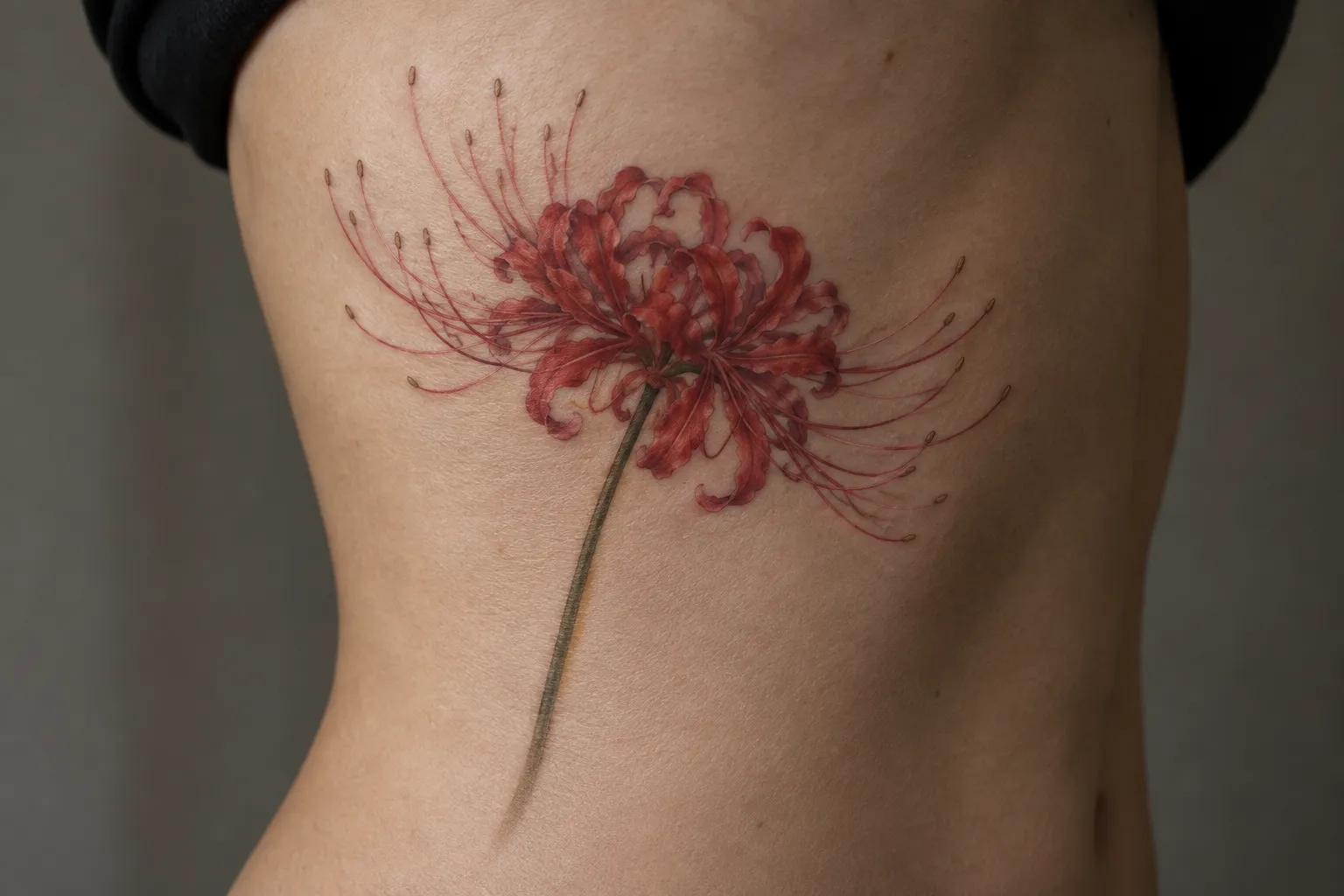
Because the traditional higanbana is a deep, saturated red, colour work makes the bloom a bold focal piece, while black-and-grey realism puts the emphasis on the curl of each petal (2). A restrained single-colour outline shifts it further toward the flower’s shape.
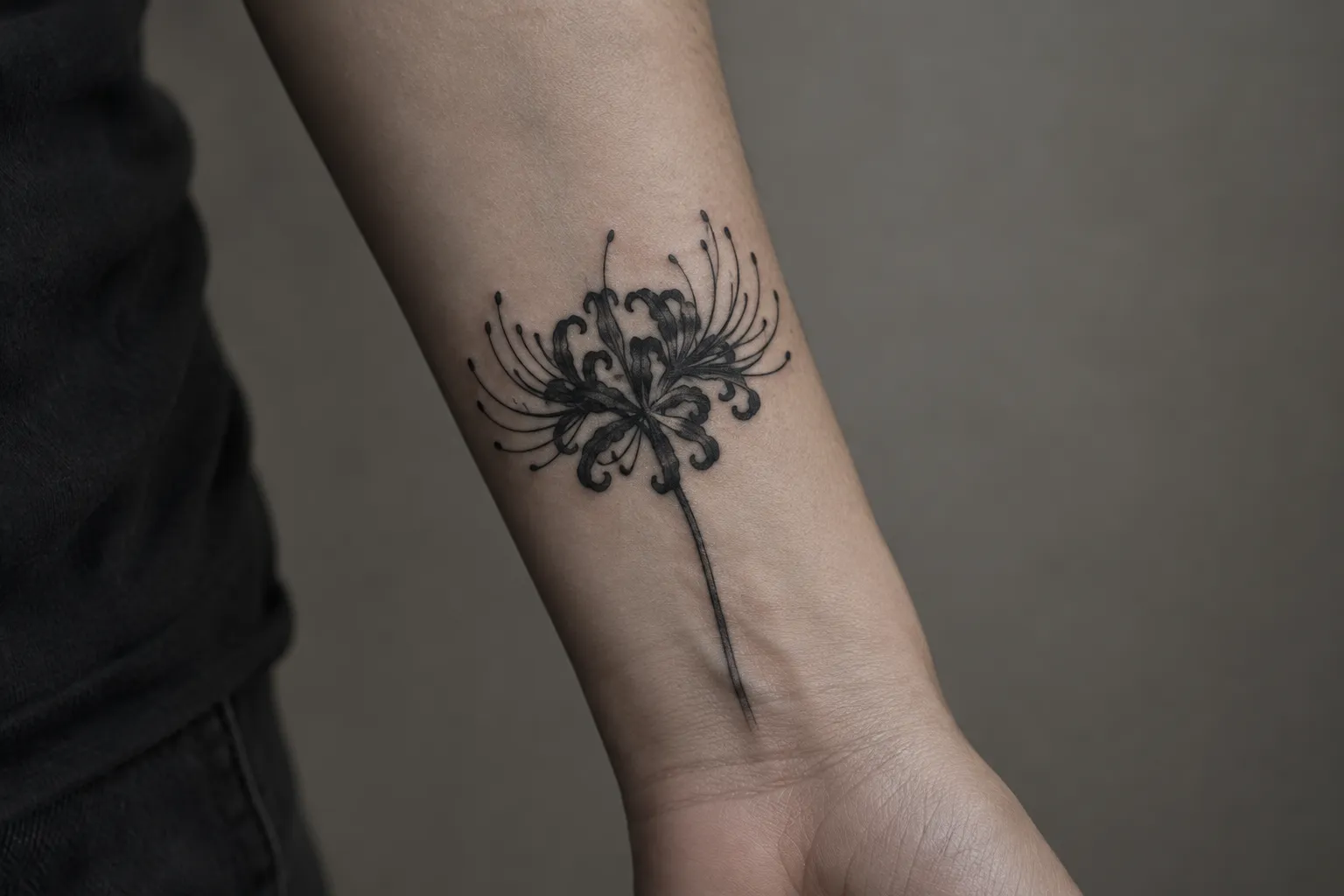
Think of the three options as a dial for how loudly the symbolism reads:
- Full red: the most recognisable. Viewers who know the flower will read remembrance or farewell straight away.
- Black-and-grey: emphasises silhouette and texture. The cultural signal is still there for people who recognise the shape, but quieter.
- Restrained outline: a single-colour line drawing, red or black, with little or no fill. It’s the most minimal version and reads as botanical illustration more than symbol.
Visibility plays into this too. A red piece on your forearm stands out in short sleeves and draws comments. The same design in black-and-grey on the same spot draws fewer questions. If you work somewhere conservative or simply don’t want to explain the death symbolism to strangers, a placement you can hide and a muted palette are your easiest levers (6).
A quick note on red pigment: red is often the culprit when someone develops an allergy to tattoo ink, though any colour can cause one, and a reaction can appear long after the tattoo has healed (10). If you’ve reacted to a red tattoo before, raise it with your artist before committing to a large red piece.
When Fine Red Linework Works
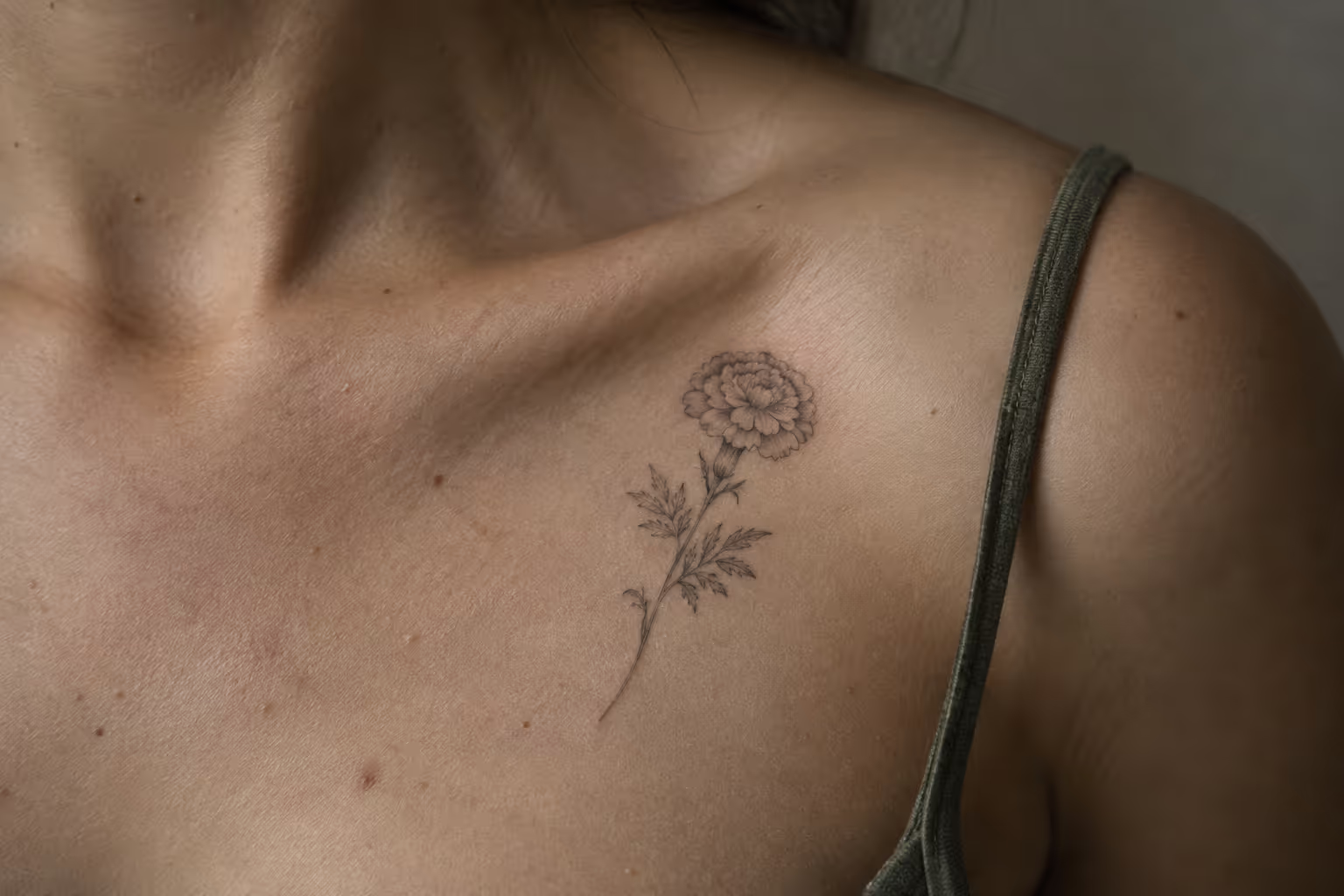
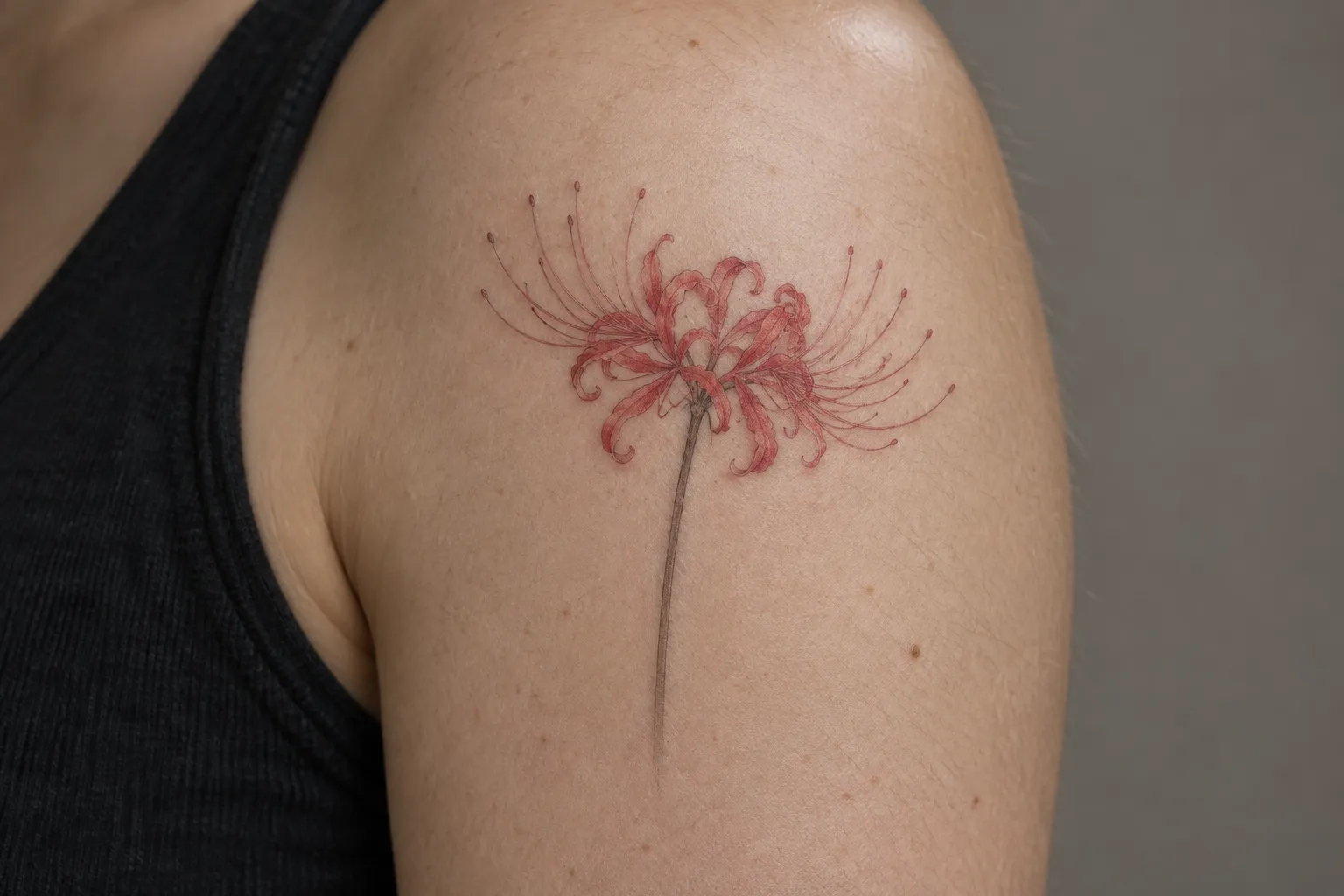
Fine red linework works best when the piece is small and you want the cultural image front and centre. A thin red outline of curling petals and long filaments on the inner forearm or behind the ear reads as a higanbana immediately, and the delicacy suits the flower’s fragile look.
The trade-off is longevity. Red can fade faster than black, and thin red filaments age differently from heavier black outlines, so talk this through with your artist (6). A good compromise is a slightly heavier red line than the reference photo suggests, or a fine black outline with red packed inside the petals so the shape holds even as the colour mellows.
When Black-and-Grey Reads Better
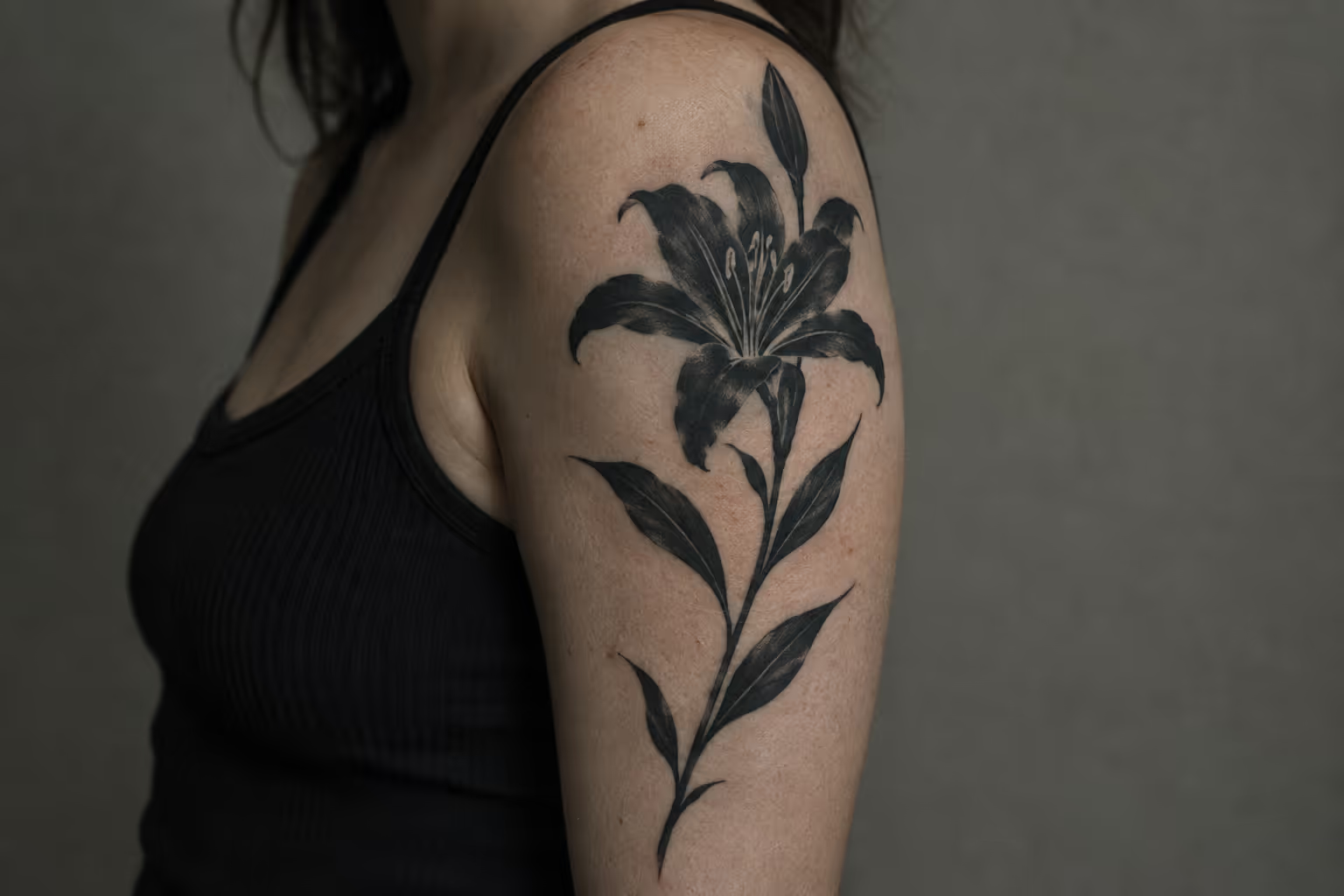
Black-and-grey reads better when the piece is large, when you want the shape to carry the design, or when you want the symbolism to be more private. Strong outlines help a design stay readable over time (6), and grey wash lets the artist render the depth of the curled petals and the arc of the filaments without relying on colour saturation.
It also suits Japanese-influenced work, where the red spider lily appears most often in tattooing, alongside illustrative styles (4). The classical irezumi flowers are the peony and the chrysanthemum (4), and a black-and-grey higanbana slots into a Japanese-influenced sleeve or back piece more naturally than a delicate red line drawing would. A common pitfall in that style is shading the petals so heavily that they merge into one dark mass and the radial spider shape disappears. Ask to see how much open skin the artist plans to leave between petals.
Compositions: Single Bloom or Trailing Petal Layout
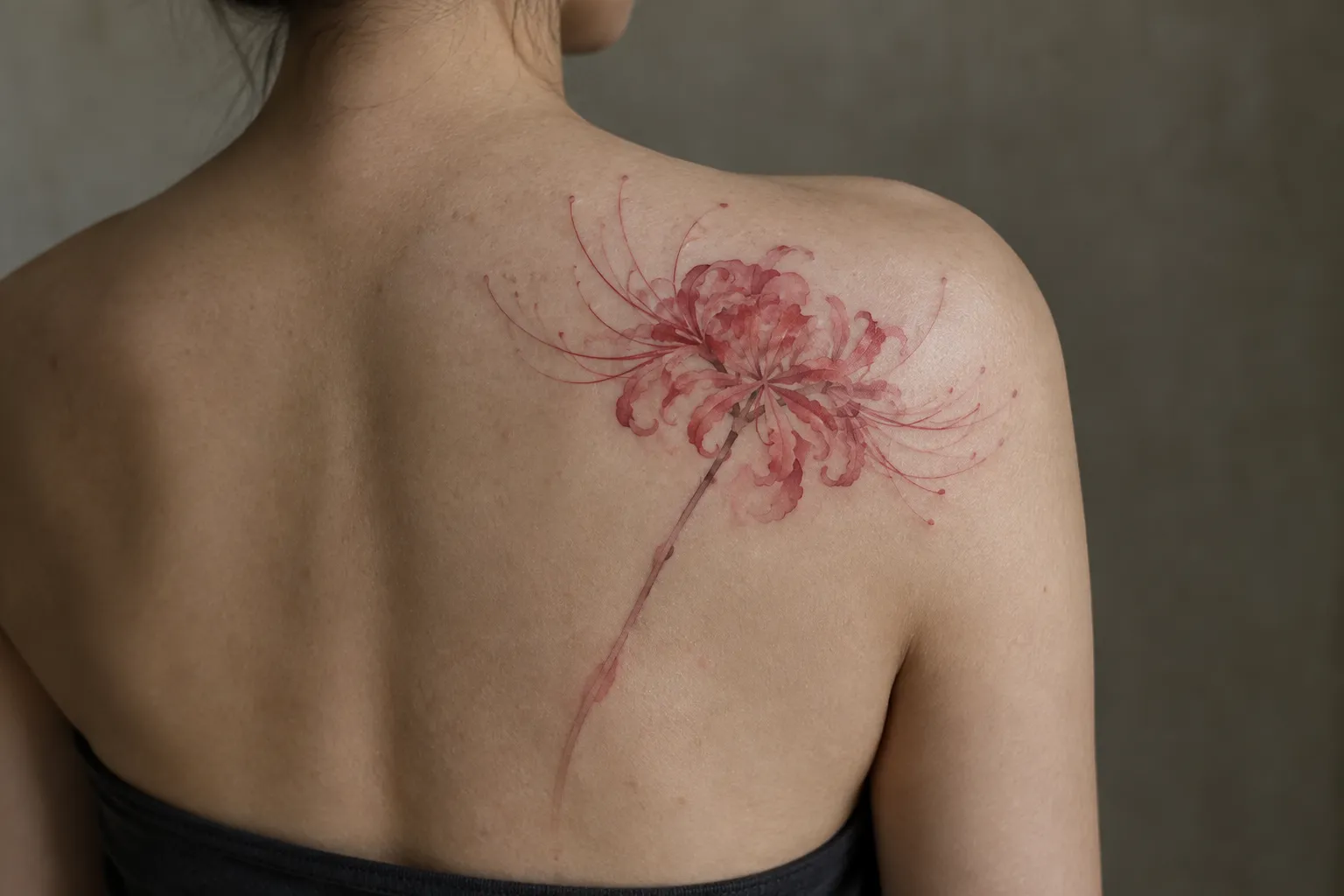
A spider lily tattoo design generally takes one of two forms: a single restrained bloom that reads as a compact symbol, or an elongated composition that uses the trailing petals and long filaments to follow the body (2). Choose the compact bloom if you want a discreet symbol. Choose the elongated layout if you want a flowing piece.
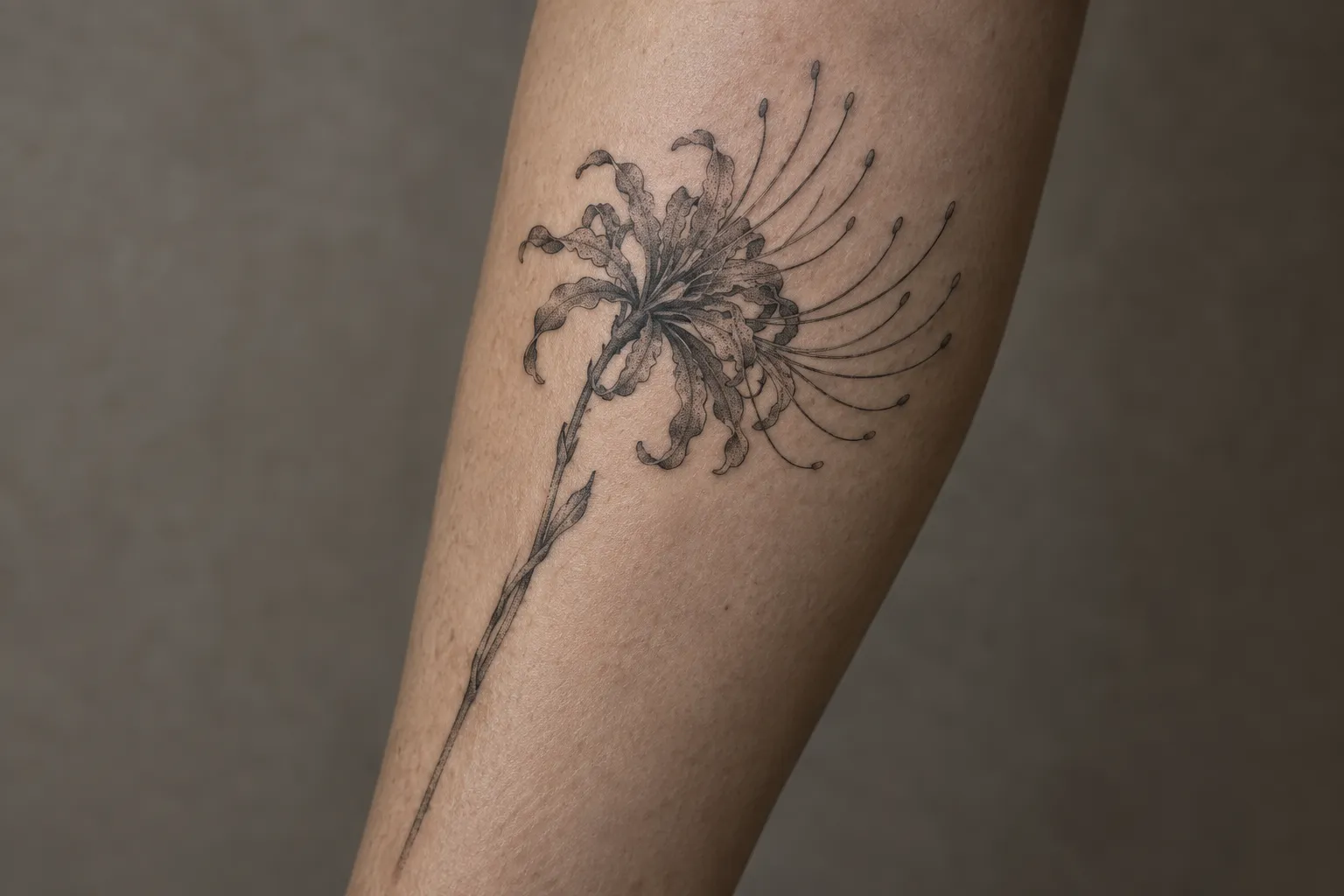
The flower’s anatomy drives this. The head is radial, with narrow curled petals fanning out from a centre and long filaments sweeping past them. Seen face-on, it’s a round, starburst shape that sits neatly in a small area. Seen from the side or drawn on a long stem, it becomes a vertical line with a burst at the end, which suits long, narrow placements.
Single Restrained Bloom
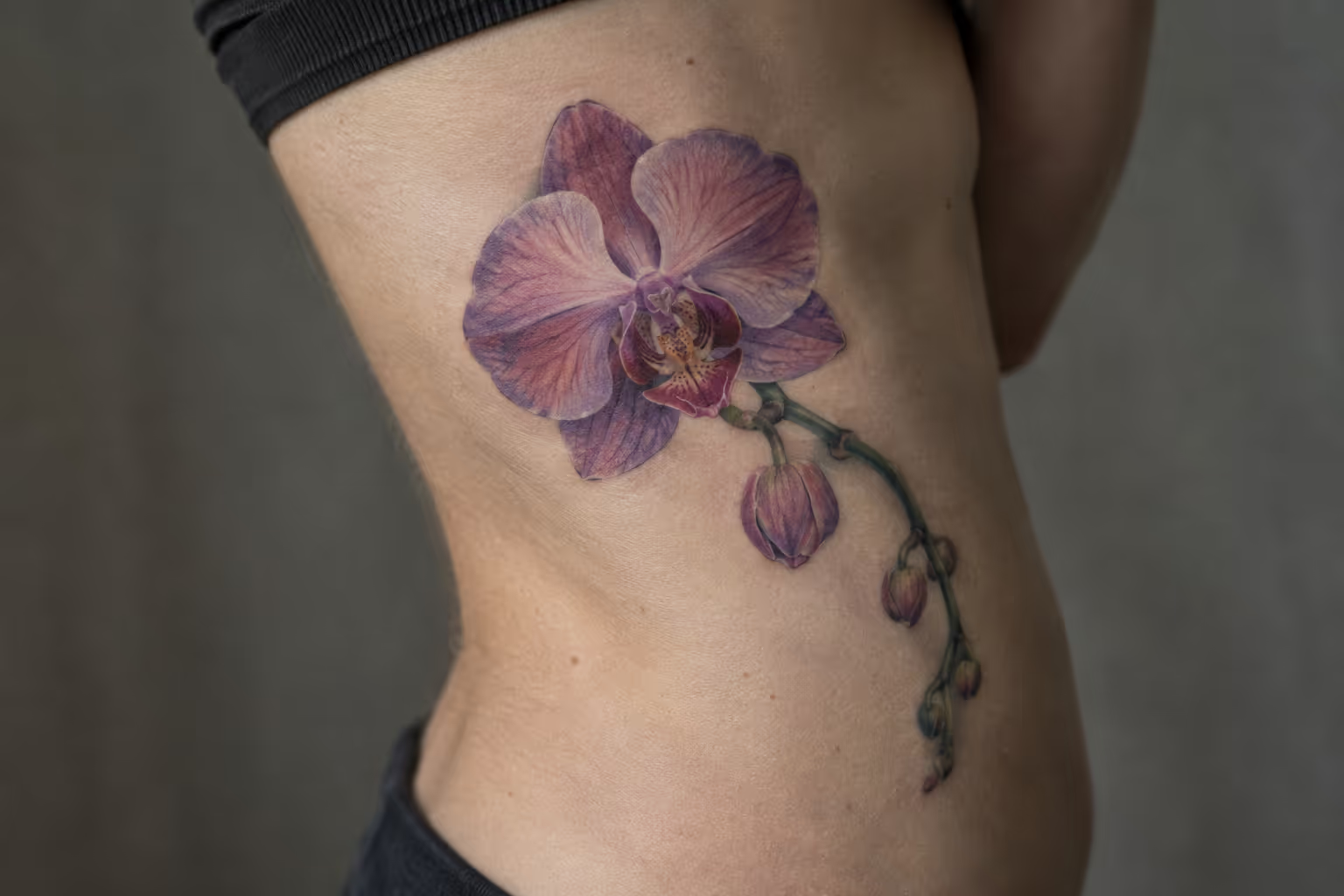
A single bloom in fine linework reads clearly on a small area like the forearm or ribs (2). The appeal is focus: one head, maybe a short stem, no leaves (accurate to the plant, which blooms bare (3)), and nothing competing for attention.
A few design choices make a single bloom work:
- Simplify the filaments. A real umbel holds 4-6 flowers (9), each with its own filaments. At small sizes, rendering all of them turns into a tangle. One head with a handful of clean filaments reads better than a botanically complete cluster.
- Leave negative space. The spidery look depends on gaps between petals. If they’re packed too close, the bloom reads as a red blob from arm’s length.
- Decide on face-on or profile. Face-on gives the starburst. Profile gives a more elegant, drooping curve.
A single bloom is also the easiest to add to later. You can extend it with a stem, a second flower, or background elements if you decide to build a larger piece.
Elongated Trailing Design
The trailing petals and long filaments are what make an elongated composition work. One tattoo studio specifically recommends using them in layouts along the spine, side ribs, wrapped forearm, or thigh (2).
These designs usually run a long stem or a chain of blooms along the length of the body part, letting the filaments flow in one direction as though caught in wind. On a spine, that might be a vertical line of stems with flowers at intervals. On a forearm, it might wrap from the inner wrist toward the elbow so the bloom sits on the outer arm and the stem trails underneath.
The key difference on the body: a single bloom reads as a symbol you look at, while an elongated design reads as movement, something that follows the curve of your ribs or the twist of your forearm. Elongated pieces also handle the cluster more convincingly. With more length to work with, the artist can show several flowers at different angles, which is closer to how the plant looks in a September paddy than a single isolated head.
The cost is commitment. Elongated designs take more sessions, more skin, and more planning around future work. If there’s any chance you’ll want a sleeve or back piece later, tell your artist now so the trailing design doesn’t box in that space.
Placement and Line Weight by Body Area
One studio guide matches style to size: fine linework for small spots like the forearm, ribs, or behind the ear, and black-and-grey realism for larger back, thigh, or sleeve pieces (2). Line weight matters too, since thin red filaments age differently from heavier black outlines (6).
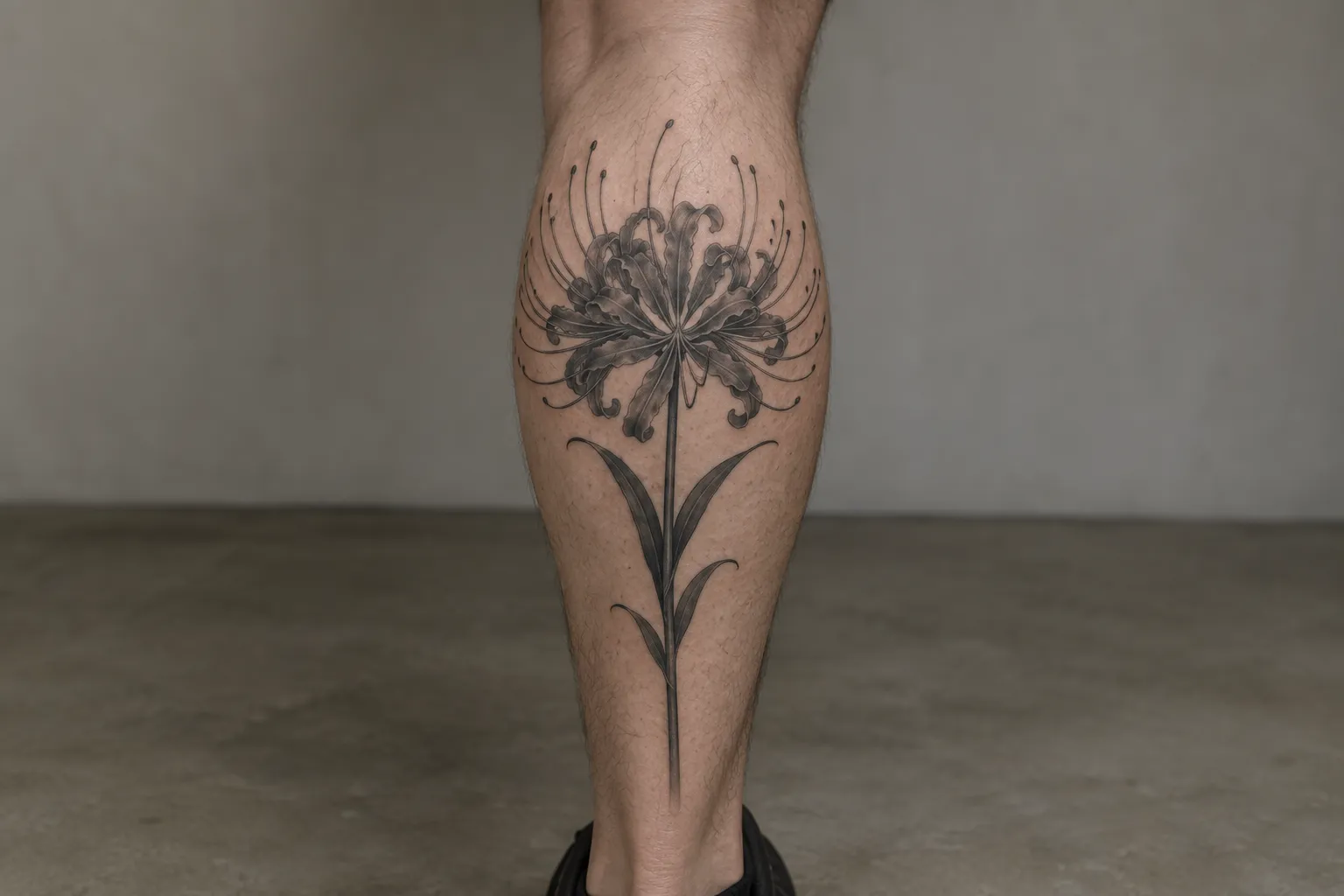
Fine lines spread slightly as skin ages and ink settles, and that spread shows more on a thin line than on a thick one. A hairline filament can soften into a blurry thread over the years. A bold outline loses a fraction of its sharpness and still reads clearly. So the smaller and finer your design, the more carefully you need to pick a placement that doesn’t get heavy sun, friction, or a lot of stretching.
Small, Discreet Spots: Forearm, Ribs, Behind the Ear
A tattoo-studio guide suggests fine linework for small placements such as the forearm, ribs, or behind the ear (2). Here’s how they compare in practice:
- Inner forearm: easy to show or hide with sleeves, flat enough for clean linework, and relatively manageable for pain. The forearm and upper arm suit a single stem or a tall vertical composition (4). Sun is the main threat to fine red here, so cover it.
- Ribs: private, curved, and good for a single bloom or a short vertical stem. Pain is noticeably higher than on the forearm, because the skin is thin over bone and moves with every breath; our tattoo pain guide puts the ribs in its high tier. Healing can be uncomfortable under tight clothing.
- Behind the ear: very discreet and suits a tiny bloom. The space is small, so the design must be simplified hard, and the bony area is sharper than the forearm. Hair and glasses arms rub on it, which affects healing.
A placement to think twice about is the wrist. One studio guide does list it for small single blooms (2), but the skin there flexes constantly, gets sun, and rubs against watch straps and cuffs, which puts delicate red filaments at risk of blurring. If you want the wrist, ask for a bolder version.
Larger Canvases: Spine, Thigh, Back
For bigger floral compositions, the back and thigh are the usual choices (4), and the spine, side ribs, wrapped forearm, and thigh suit elongated trailing layouts (2). These areas give the artist room to render several blooms, layer filaments, and use heavier black outlines that hold up better over time.
- Spine: a vertical stem-and-bloom layout follows the line naturally. Pain is high directly over the vertebrae, higher than the outer thigh, and you can’t see it yourself.
- Thigh: large, fairly flat, and easy to cover. The outer thigh is one of the more comfortable spots for a long session. The inner thigh is more sensitive.
- Back: enough flat space for the full Japanese-influenced treatment, with clusters, background, and wind or water elements. A full back panel is a multi-session project, and the shoulder blades and spine are the sore spots.
- Wrapped forearm: a trailing design that spirals around the arm. It’s visible, so the colour decisions above apply.
On these larger areas, match the line weight to the scale. A thin red line that looks perfect on a palm-sized forearm piece will look faint and scratchy across a back panel. Bigger pieces need bolder outlines to read from a distance, and red is best used for fill inside a black structure rather than as the only line.
Healing fine red linework follows the standard timeline in our tattoo aftercare guide, but be gentle with it, because thin lines show any scabbing damage:
- Day 1-3: keep the wrap on as long as your artist says, then wash gently with lukewarm water and fragrance-free soap. Pat dry and apply a thin layer of the ointment your artist recommends.
- Day 4-7 and week 2: the surface dries and flakes, then peels and itches in the second week. Don’t pick or scratch, and avoid soaking (baths, pools, the sea).
- Week 3-4: the surface looks healed while the skin underneath is still settling, and red can look cloudy until it does. Full integration comes around week 6.
Keep the piece out of direct sun for the first 4-6 weeks. Once healed, sunscreen on exposed placements is what keeps fine red from fading early.
Working With Your Artist: From Concept to Stencil
A strong spider lily tattoo design starts with a written note of what the flower means to you, a clear decision about visibility, and a stencil test on the body before any ink goes in (6). Those three steps settle most placement and scale questions before the session.
Writing Down What the Flower Means to You
Tattoo design guidance recommends deciding on the meaning before you ask an artist to develop the design (6). Because the higanbana arrives with a strong cultural reading of death and parting (4), the most useful first step is writing down your own reason, so you know whether you are carrying that reading or adding to it.
Keep it short. A sentence or two is enough: “This is for my grandmother, who died in September,” or “I like the shape and the idea of something that blooms briefly,” or “Marking the end of a bad few years.” Show that statement to the artists you consult; one design guide suggests talking to at least two (6).
The note changes the design. A memorial piece might include a subtle date or tiny initials (6), or a cluster of flowers representing family members. A purely aesthetic piece might push the curling filaments into a more graphic, stylised shape. A “transition” piece might show one bloom fading into the pale pink the flowers turn as they age (9). Your artist can’t make those choices without knowing your reason.
Before you book, also think through who will see it. Consider your clothing, your career, and how visible you want the piece to be (6). A spider lily on the forearm stands out in short sleeves. One on the ribs is seen by people you choose. If the cultural associations might draw questions you’d rather avoid, that should shape placement and colour as much as the visuals do.
Testing the Design Before the Needle Touches Skin
Ask your artist to test the placement with a stencil or temporary transfer, and to show how the design sits on your body in motion (6). A design that looks right on paper can twist badly when you lift your arm or turn your torso.
What to check during the stencil test:
- Move. Raise your arm, twist your forearm, bend at the waist, breathe deeply for rib placements. Watch the filaments. Do they stay graceful or kink into odd angles?
- Step back. Look in a mirror from across the room. If the bloom reads as a blob at that distance, it needs more negative space or a bolder outline.
- Check the orientation. Decide whether the flower should read right-way-up to you looking down, or to someone facing you. Artists differ on this, and it’s your call.
- Talk about line weight. Ask directly how the fine red lines will age compared with black outlines (6). A good artist will tell you honestly whether the reference is too delicate for the size and placement.
Packing too much fine detail into a tiny design makes the petal structure hard to read. If your artist suggests simplifying, it’s usually because they know how fine lines heal. Listen.
Frequently Asked Questions
- What does a spider lily tattoo mean?
- A spider lily tattoo can refer to remembrance, separation, or transition; the wearer's own reason can determine which association matters most.
- What does spider lily symbolize?
- In Japanese culture, higanbana is connected with Higan and remembrance; meanings assigned to spider lilies elsewhere can differ by tradition and context.
- Is a spider lily tattoo bad luck?
- In Japan the flower is linked with death, parting, and bad luck and is not given as a gift. Nothing forbids the tattoo, but viewers who know the flower may read it as a memorial piece.
- What tattoo stands for anxiety?
- Higanbana is read as a flower of remembrance and parting rather than anxiety; choose a motif tied to your own experience.
- Can I get a white spider lily instead of red?
- Yes. White spider lilies are real plants, though the Japanese white form is considered a hybrid rather than a white Lycoris radiata, and it loses the instant red recognition.
- Is it disrespectful to get a higanbana tattoo if I'm not Japanese?
- A higanbana tattoo is not automatically disrespectful; learn the flower's context and avoid presenting a personal interpretation as a universal Japanese belief.
- Why do some spider lily tattoos look faded after a few years?
- A spider lily can lose definition when fine details heal too close together; ask your artist to preserve clear gaps between petals and filaments.
Before You Book: Meaning, Colour, and Line Weight
Treat the higanbana’s Japanese meaning (Higan, remembrance, final parting, a bloom that lasts about 2 weeks) as a starting point, then pair it with your own written reason before the consultation. If you want the cultural image to read clearly, keep it red and make sure it’s Lycoris radiata, not yellow shōki-zuisen. If you’d rather the shape do the talking, go black-and-grey or a restrained outline.
Then match line weight to placement. Fine linework belongs on small spots like the inner forearm, ribs, or behind the ear. Heavier black outlines belong on spine, thigh, and back pieces. Test the stencil while moving, keep the healing skin out of direct sun for the first 4-6 weeks, and use sunscreen once it’s healed. That combination decides whether your spider lily still reads as a spider lily in ten years.